Trắc nghiệm Tiếng Anh 12 Global Success Unit 7 Listening (có đáp án)
20 câu hỏi
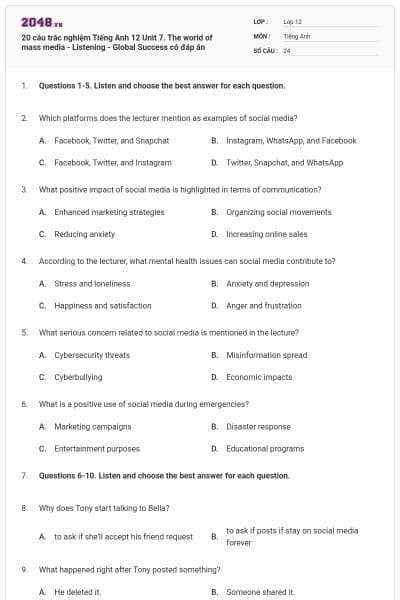
Questions 1-5. Listen and choose the best answer for each question.
Facebook, Twitter, and Snapchat
Instagram, WhatsApp, and Facebook
Facebook, Twitter, and Instagram
Twitter, Snapchat, and WhatsApp
Hướng dẫn giải
Đáp án đúng: C
Thông tin: Social media platforms like Facebook, Twitter, and Instagram have revolutionized communication. (Các nền tảng truyền thông xã hội như Facebook, Twitter và Instagram đã cách mạng hóa việc giao tiếp.)
Enhanced marketing strategies
Organizing social movements
Reducing anxiety
Increasing online sales
Hướng dẫn giải
Đáp án đúng: B
Thông tin: They enable people to stay connected, share ideas, and even organize social movements. (Chúng cho phép mọi người giữ liên lạc, chia sẻ ý tưởng và thậm chí tổ chức các phong trào xã hội.)
Stress and loneliness
Anxiety and depression
Happiness and satisfaction
Anger and frustration
Hướng dẫn giải
Đáp án đúng: B
Thông tin: Social media can contribute to anxiety and depression, especially among young people. (Mạng xã hội có thể góp phần gây ra lo âu và trầm cảm, đặc biệt là ở giới trẻ.)
Cybersecurity threats
Misinformation spread
Cyberbullying
Economic impacts
Hướng dẫn giải
Đáp án đúng: C
Thông tin: Cyberbullying is another serious concern. (Bạo lực mạng cũng là một mối lo ngại nghiêm trọng khác.)
Marketing campaigns
Disaster response
Entertainment purposes
Educational programs
Hướng dẫn giải
Đáp án đúng: B
Thông tin: On the positive side, social media has been instrumental in disaster response and spreading important health information. (Về mặt tích cực, mạng xã hội đóng vai trò quan trọng trong việc ứng phó với thiên tai và lan truyền thông tin sức khỏe quan trọng.)
Nội dung bài nghe:
Good afternoon, everyone. Today we’re discussing the societal impacts of social media. Social media platforms like Facebook, Twitter, and Instagram have revolutionized communication. They enable people to stay connected, share ideas, and even organize social movements. However, there are also significant downsides. Social media can contribute to anxiety and depression, especially among young people. Cyberbullying is another serious concern. Moreover, these platforms collect vast amounts of personal data, raising privacy issues. On the positive side, social media has been instrumental in disaster response and spreading important health information. Overall, while social media offers many benefits, it's crucial to be aware of its potential negative effects.
Dịch bài nghe:
Chào buổi chiều mọi người. Hôm nay chúng ta sẽ thảo luận về tác động của mạng xã hội đối với xã hội. Các nền tảng mạng xã hội như Facebook, Twitter và Instagram đã cách mạng hóa việc giao tiếp. Chúng cho phép mọi người giữ liên lạc, chia sẻ ý tưởng và thậm chí tổ chức các phong trào xã hội. Tuy nhiên, cũng có những mặt trái đáng kể. Mạng xã hội có thể góp phần gây ra lo âu và trầm cảm, đặc biệt là ở giới trẻ. Bắt nạt trực tuyến là một mối lo ngại nghiêm trọng khác. Hơn nữa, các nền tảng này thu thập một lượng lớn dữ liệu cá nhân, làm dấy lên các vấn đề về quyền riêng tư. Về mặt tích cực, mạng xã hội đã đóng vai trò quan trọng trong việc ứng phó với thảm họa và lan truyền thông tin sức khỏe quan trọng. Nhìn chung, mặc dù mạng xã hội mang lại nhiều lợi ích, điều quan trọng là phải nhận thức được những tác động tiêu cực tiềm tàng của nó.
Questions 6-10. Listen and choose the best answer for each question.
to ask if she'll accept his friend request
to ask if posts if stay on social media forever
Hướng dẫn giải
Đáp án đúng: B
Thông tin: If we post something on social media, we can delete it, right? (Nếu chúng ta đăng tải thứ gì đó lên mạng xã hội, chúng ta có thể xóa nó đi, đúng không?)
He deleted it.
Someone shared it.
Hướng dẫn giải
Đáp án đúng: A
Thông tin: I posted something, but I deleted it right away. (Tôi đã đăng một bài viết, nhưng đã xóa ngay lập tức.)
accept friend requests from strangers
use antivirus software
Hướng dẫn giải
Đáp án đúng: A
Thông tin: Well, watch out for scams. I love social media, but I never accept friend requests from strangers. (Hãy cẩn thận với các chiêu trò lừa đảo. Tôi thích mạng xã hội, nhưng tôi không bao giờ chấp nhận lời mời kết bạn từ người lạ.)
extra schoolwork
after-school activities
Hướng dẫn giải
Đáp án đúng: B
Thông tin: Exactly, teens should spend less time online and more time joining after school clubs or doing other extracurricular activities. (Chính xác, thanh thiếu niên nên dành ít thời gian trực tuyến hơn và dành nhiều thời gian hơn tham gia các câu lạc bộ sau giờ học hoặc các hoạt động ngoại khóa khác.)
teens' school grades
teens' social lives
Hướng dẫn giải
Đáp án đúng: A
Thông tin: If teens spend too much time on social media, it can affect grades in their home lots. (Nếu thanh thiếu niên dành quá nhiều thời gian cho mạng xã hội, điều đó có thể ảnh hưởng đến điểm số của họ ở nhà.)
Nội dung bài nghe:
Tony: Hi, Bella. Can I ask you a question?
Bella: Sure, Tony.
Tony: If we post something on social media, we can delete it, right?
Bella: It depends. You can delete posts from your own social media, but if other people have shared your post, then they will be permanent.
Tony: I understand.
Bella: Why do you ask?
Tony: I posted something, but I deleted it right away. No one shared it. It's good to be careful though.
Bella: You're right, and there are other things you should be careful of too.
Tony: Like what?
Bella: Well, watch out for scams. I love social media, but I never accept friend requests from strangers.
Tony: I got a friend request from someone I didn't know yesterday. I didn't accept it.
Bella: Good. Also, you should get antivirus software installed on your computer. It stops people from stealing your personal details.
Tony: There's a lot of think about when it comes to using social media safely.
Bella: Yeah, and it's not just about security. You should make sure social media doesn't affect the other parts of your life.
Tony: You mean like spending too much time online or not having enough time for other things?
Bella: Exactly, teens should spend less time online and more time joining after school clubs or doing other extracurricular activities. It's an important part of growing up and learning different things.
Tony: I totally agree. If teens spend too much time on social media, it can affect grades in their home lots.
Bella: Yeah, well, I'm off the test club now. See you, Tony
Tony: Bye, Bella.
Dịch bài nghe:
Tony: Chào Bella. Tôi có thể hỏi bạn một câu được không?
Bella: Chắc chắn rồi, Tony.
Tony: Nếu chúng ta đăng nội dung nào đó lên mạng xã hội, chúng ta có thể xóa nó, đúng không.
Bella: Còn tùy. Bạn có thể xóa bài đăng khỏi mạng xã hội của mình nhưng nếu người khác đã chia sẻ bài đăng của bạn thì bài đăng đó sẽ vĩnh viễn.
Tony: Tôi hiểu.
Bella: Tại sao bạn hỏi?
Tony: Tôi đã đăng một cái gì đó nhưng tôi đã xóa nó ngay lập tức. Không ai chia sẻ nó. Tuy nhiên, cẩn thận là tốt.
Bella: Bạn nói đúng, và có những điều khác bạn cũng nên cẩn thận.
Tony: Như cái gì cơ?
Bella: Chà, coi chừng lừa đảo đấy. Tôi yêu thích mạng xã hội nhưng tôi không bao giờ chấp nhận lời mời kết bạn từ người lạ.
Tony: Hôm qua tôi nhận được lời mời kết bạn từ một người mà tôi không quen. Tôi đã không chấp nhận nó.
Bella: Tốt. Ngoài ra, bạn nên cài đặt phần mềm chống vi-rút trên máy tính của mình. Nó ngăn chặn mọi người ăn cắp thông tin cá nhân của bạn.
Tony: Có rất nhiều điều cần suy nghĩ về việc sử dụng mạng xã hội một cách an toàn.
Bella: Vâng, và đó không chỉ là vấn đề bảo mật. Bạn nên đảm bảo rằng mạng xã hội không ảnh hưởng đến những phần khác trong cuộc sống của bạn.
Tony: Ý bạn là dành quá nhiều thời gian trực tuyến hoặc không có đủ thời gian cho những việc khác?
Bella: Chính xác, thanh thiếu niên nên dành ít thời gian trực tuyến hơn và dành nhiều thời gian hơn để tham gia các câu lạc bộ sau giờ học hoặc tham gia các hoạt động ngoại khóa khác. Đó là một phần quan trọng của quá trình trưởng thành và học hỏi những điều khác nhau.
Tony: Tôi hoàn toàn đồng ý. Nếu thanh thiếu niên dành quá nhiều thời gian trên mạng xã hội, điều đó có thể ảnh hưởng đến điểm số ở nhà của các em.
Bella: Vâng, bây giờ tôi đã rời khỏi câu lạc bộ kiểm tra. Hẹn gặp lại, Tony
Tony: Tạm biệt, Bella.
Questions 11-15. Listen to a talk about fake news and decide if the following statements are True or False.
True
False
Hướng dẫn giải
Đáp án đúng: A
Thông tin: Fake news is nothing new but silly stories can reach more people more quickly via social media. (Tin giả không phải là điều mới mẻ, nhưng những câu chuyện ngớ ngẩn có thể lan truyền nhanh chóng và rộng rãi hơn thông qua mạng xã hội.)
True
False
Hướng dẫn giải
Đáp án đúng: A
Thông tin: Even in legitimate news stories, the headline doesn’t always tell the whole story. (Ngay cả trong những tin tức chính thống, tiêu đề cũng không phải lúc nào cũng phản ánh toàn bộ câu chuyện.)
True
False
Hướng dẫn giải
Đáp án đúng: B
Thông tin: Another telltale sign of a fake story is often the author. In some cases, the authors are not even real. (Một dấu hiệu khác cho thấy câu chuyện là giả thường là tác giả. Trong một số trường hợp, tác giả thậm chí không phải là người thật.)
True
False
Hướng dẫn giải
Đáp án đúng: B
Thông tin: Some false stories aren’t completely faked but rather distortions of real events. (Một số câu chuyện sai sự thật không hoàn toàn bịa đặt mà chỉ là sự xuyên tạc các sự kiện có thật.)
True
False
Hướng dẫn giải
Đáp án đúng: A
Thông tin: Bias leads people to be more interested in information that confirms their beliefs and question information that doesn’t. (Thiên kiến khiến mọi người quan tâm nhiều hơn đến thông tin xác nhận niềm tin của họ và nghi ngờ những thông tin không phù hợp.)
Nội dung bài nghe:
Fake news is nothing new but silly stories can reach more people more quickly via social media. A lot of these viral claims aren’t news at all but efforts to fool readers into thinking they’re real. Here are some strategies to protect yourself from fake news:
Are you familiar with the source? Is it legitimate? Has it been reliable in the past? If a provocative headline draws your attention, read a little further before you decide to pass along the shocking information. Even in legitimate news stories, the headline doesn’t always tell the whole story. But fake news, particularly efforts to be comic can include several revealing signs in the text.
Another telltale sign of a fake story is often the author. In some cases, the authors are not even real. One story was credited to a doctor who won 14 Awards and a handful prizes which would be very impressive, if it wasn’t also totally made up. Many times these stories will cite official or official sounding sources but once you look into it, this source doesn’t back up the claim. Some false stories aren’t completely faked but rather distortions of real events.
Bias leads people to be more interested in information that confirms their beliefs and question information that doesn’t. But the next time you’re automatically annoyed at some social media posts concerning a belief you oppose, take a moment to check it out. Try this simple test: What other stories have been posted to the news website? You may be sure to believe a story about a thing you don’t like, but if the news site also features a ridiculous story, maybe you should think twice before sharing.
Dịch bài nghe:
Tin giả không phải là điều mới mẻ, nhưng những câu chuyện ngớ ngẩn có thể lan truyền nhanh chóng và dễ dàng hơn qua mạng xã hội. Rất nhiều thông tin lan truyền này thực chất không phải là tin tức mà chỉ là những nỗ lực nhằm đánh lừa người đọc tin rằng chúng là thật. Dưới đây là một số chiến lược để bảo vệ bản thân khỏi tin giả:
Bạn có quen thuộc với nguồn tin không? Nó có đáng tin cậy không? Trước đây nó có đáng tin cậy không? Nếu một tiêu đề gây sốc thu hút sự chú ý của bạn, hãy đọc kỹ hơn trước khi quyết định chia sẻ thông tin gây sốc đó. Ngay cả trong những tin tức chính thống, tiêu đề cũng không phải lúc nào cũng nói lên toàn bộ câu chuyện. Nhưng tin giả, đặc biệt là những nỗ lực nhằm mục đích gây cười, có thể bao gồm một số dấu hiệu tiết lộ trong văn bản.
Một dấu hiệu nhận biết khác của một câu chuyện giả thường là tác giả. Trong một số trường hợp, tác giả thậm chí không có thật. Có một câu chuyện được cho là của một bác sĩ đã giành được 14 giải thưởng và một số phần thưởng khác, điều này sẽ rất ấn tượng nếu nó không hoàn toàn bịa đặt. Nhiều lần những câu chuyện này sẽ trích dẫn các nguồn chính thức hoặc nghe có vẻ chính thức, nhưng khi bạn tìm hiểu, nguồn này không xác thực tuyên bố. Một số câu chuyện sai sự thật không hoàn toàn là bịa đặt mà là sự xuyên tạc các sự kiện có thật. Thiên kiến khiến mọi người quan tâm hơn đến thông tin xác nhận niềm tin của họ và nghi ngờ thông tin không phù hợp. Nhưng lần tới khi bạn tự động khó chịu với một số bài đăng trên mạng xã hội liên quan đến một niềm tin mà bạn phản đối, hãy dành chút thời gian để kiểm tra. Hãy thử bài kiểm tra đơn giản này: Những câu chuyện nào khác đã được đăng tải trên trang web tin tức đó? Bạn có thể chắc chắn tin một câu chuyện về điều bạn không thích, nhưng nếu trang web tin tức đó cũng đăng tải một câu chuyện vô lý, có lẽ bạn nên suy nghĩ kỹ trước khi chia sẻ.
Questions 16-20. Listen to a talk about newspapers and choose the correct answer to each of the following questions.
telegraph
high-speed presses
digital formats
radio
Hướng dẫn giải
Đáp án đúng: B
Thông tin: Let's start with the Industrial Revolution, a pivotal era that introduced giant presses capable of printing ten thousand papers per hour. (Chúng ta hãy bắt đầu với cuộc Cách mạng Công nghiệp, một kỷ nguyên then chốt đã giới thiệu những máy in khổng lồ có khả năng in mười nghìn tờ báo mỗi giờ.)
Peanuts
the Yellow Kid
Garfield
Calvin and Hobbes
Hướng dẫn giải
Đáp án đúng: B
Thông tin: Speaking of comics, let's mention The Yellow Kid, a comic strip from the late 19th century, which became one of America's first and most popular newspaper comics. (Nhân tiện nói về truyện tranh, hãy nhắc đến The Yellow Kid, một bộ truyện tranh từ cuối thế kỷ 19, đã trở thành một trong những bộ truyện tranh báo chí đầu tiên và nổi tiếng nhất ở Mỹ.)
They gave less detailed news.
They gave instant updates.
They were at higher costs.
They were for entertainment only.
Hướng dẫn giải
Đáp án đúng: B
Thông tin: When radio and television emerged, they brought with them immediate news updates. (Khi đài phát thanh và truyền hình xuất hiện, chúng đã mang đến những thông tin cập nhật tức thời.)
to show a newspaper that couldn't adapt to new technology
to point out a newspaper that has stopped printing
to highlight a newspaper that has thrived in both print and digital forms
to suggest a newspaper that no longer covers global news
Hướng dẫn giải
Đáp án đúng: C
Thông tin: Giants like The New York Times and The Wall Street Journal continue to thrive, maintaining strong sales in both their printed and digital formats. (Những ông lớn như The New York Times và The Wall Street Journal tiếp tục phát triển mạnh mẽ, duy trì doanh số bán hàng cao ở cả phiên bản in và kỹ thuật số.)
They will disappear.
They will still evolve.
Only digital will survive.
They will return to traditional forms.
Hướng dẫn giải
Đáp án đúng: B
Thông tin: The ongoing evolution of newspapers shows that as long as people seek information, the nature of how we consume news will continue to transform. (Sự phát triển không ngừng của báo chí cho thấy rằng chừng nào con người còn tìm kiếm thông tin, thì bản chất của cách chúng ta tiếp nhận tin tức sẽ tiếp tục thay đổi.)
Nội dung bài nghe:
Good morning, class! Today, we're diving into an exciting chapter of history: the evolution of newspapers and how technological advances have shaped news media. Let's start with the Industrial Revolution, a pivotal era that introduced giant presses capable of printing ten thousand papers per hour. This innovation was crucial in the massive expansion of the newspaper industry.
As we move into the early 20th century, newspapers underwent a significant transformation. The introduction of colour photographs, banner headlines, illustrations, and comics revolutionised their appearance. Speaking of comics, let's mention The Yellow Kid, a comic strip from the late 19th century, which became one of America's first and most popular newspaper comics.
However, the rise of newspapers was soon challenged by newer forms of media. When radio and television emerged, they brought with them immediate news updates. Imagine not having to wait until the next morning to catch up on events; radio provided this instant access. Television further changed the game by offering engaging visual news formats. People often spent their evenings glued to their TV sets to catch the latest updates on politics, sports, and weather.
Despite these advancements, newspapers remained a trusted source for detailed, re-readable information. Fast forward to today, and we see yet another shift with the advent of computers and the internet. Giants like The New York Times and The Wall Street Journal continue to thrive, maintaining strong sales in both their printed and digital formats.
In our high-tech world, some still cherish the ritual of reading the morning paper with a cup of coffee, while others prefer the quick, digital access to news. The ongoing evolution of newspapers shows that as long as people seek information, the nature of how we consume news will continue to transform. With technology at our fingertips, everyone has the power to create and share news, marking an era where the history of newspapers is still very much being written.
Dịch bài nghe:
Chào buổi sáng, cả lớp! Hôm nay, chúng ta sẽ cùng tìm hiểu một chương thú vị trong lịch sử: sự phát triển của báo chí và cách những tiến bộ công nghệ đã định hình nên truyền thông tin tức. Chúng ta hãy bắt đầu với Cách mạng Công nghiệp, một kỷ nguyên then chốt đã giới thiệu những máy in khổng lồ có khả năng in mười nghìn tờ báo mỗi giờ. Sự đổi mới này đóng vai trò quan trọng trong sự mở rộng mạnh mẽ của ngành công nghiệp báo chí.
Khi bước sang đầu thế kỷ 20, báo chí đã trải qua một sự chuyển đổi đáng kể. Sự ra đời của ảnh màu, tiêu đề lớn, hình minh họa và truyện tranh đã cách mạng hóa diện mạo của chúng. Nói về truyện tranh, chúng ta hãy nhắc đến The Yellow Kid, một truyện tranh từ cuối thế kỷ 19, đã trở thành một trong những truyện tranh báo chí đầu tiên và nổi tiếng nhất của Mỹ.
Tuy nhiên, sự trỗi dậy của báo chí sớm bị thách thức bởi các hình thức truyền thông mới hơn. Khi đài phát thanh và truyền hình xuất hiện, chúng đã mang đến những cập nhật tin tức tức thì. Hãy tưởng tượng bạn không cần phải đợi đến sáng hôm sau để cập nhật các sự kiện; đài phát thanh đã cung cấp khả năng truy cập tức thì này. Truyền hình tiếp tục thay đổi cuộc chơi bằng cách cung cấp các định dạng tin tức trực quan hấp dẫn. Mọi người thường dành buổi tối dán mắt vào màn hình TV để cập nhật những thông tin mới nhất về chính trị, thể thao và thời tiết. Bất chấp những tiến bộ này, báo chí vẫn là nguồn thông tin đáng tin cậy, chi tiết và dễ đọc lại. Quay trở lại hiện tại, chúng ta chứng kiến một sự thay đổi nữa với sự ra đời của máy tính và internet. Những gã khổng lồ như The New York Times và The Wall Street Journal tiếp tục phát triển mạnh mẽ, duy trì doanh số bán hàng cao ở cả dạng in và kỹ thuật số.
Trong thế giới công nghệ cao của chúng ta, một số người vẫn trân trọng nghi thức đọc báo buổi sáng với một tách cà phê, trong khi những người khác lại thích truy cập tin tức nhanh chóng, thông qua kỹ thuật số. Sự phát triển không ngừng của báo chí cho thấy rằng chừng nào con người còn tìm kiếm thông tin, bản chất của cách chúng ta tiếp nhận tin tức sẽ tiếp tục thay đổi. Với công nghệ trong tầm tay, mọi người đều có khả năng tạo ra và chia sẻ tin tức, đánh dấu một kỷ nguyên mà lịch sử của báo chí vẫn đang được viết tiếp.