Trắc nghiệm Tiếng Anh 12 Global Success Unit 4 Listening (có đáp án)
20 câu hỏi
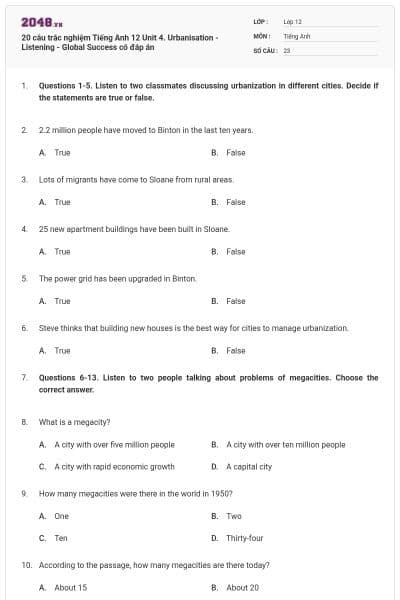
Questions 1-5. Listen to two classmates discussing urbanization in different cities. Decide if the statements are true or false.
True
False
Hướng dẫn giải:
Đáp án đúng: A
Thông tin: Chrine: Yeah, I'm ready. I research Binton, and over the last 10 years, the population of Binton has increased by 2.2 million. (Ừ, tôi đã sẵn sàng. Tôi nghiên cứu về Binton và trong 10 năm qua, dân số Binton đã tăng 2,2 triệu người.)
True
False
Hướng dẫn giải:
Đáp án đúng: B
Thông tin: Steve: I learn about Sloane. The population has increased to… let me see. The number of people in Sloane has gone up by 1.2 million. They're mostly migrants from other countries. (Tôi tìm hiểu về Sloane. Dân số đã tăng lên đến mức… để tôi xem. Số người ở Sloane đã tăng thêm 1,2 triệu. Họ chủ yếu là người di cư từ các nước khác.)
True
False
Hướng dẫn giải:
Đáp án đúng: B
Thông tin:
Chrine: … So how has housing changed in Sloane? (… Vậy nhà ở ở Sloane đã thay đổi như thế nào?)
Steve: Well, 35 new apartment buildings have been built in the last 10 years. (Chà, 35 tòa chung cư mới đã được xây dựng trong 10 năm qua.)
True
False
Hướng dẫn giải:
Đáp án đúng: A
Thông tin:
Chrine: … In Binton 28 new apartment buildings have been built. (… Ở Binton, 28 tòa chung cư mới đã được xây dựng.)
Steve: Okay, so has the infrastructure improved? (Được rồi, cơ sở hạ tầng đã được cải thiện chưa?)
Chrine: Yes, they've upgraded their power grid. (Có, họ đã nâng cấp lưới điện.)
True
False
Hướng dẫn giải:
Đáp án đúng: B
Thông tin: Chrine: I think it's building new homes because having a home is the most important thing for a lot of people. (Chrine: Tôi thì nghĩ đó là xây những ngôi nhà mới vì có một chỗ ở là điều quan trọng nhất đối với nhiều người.)
Nội dung bài nghe:
Chrine: Hi, Steve.
Steve: Hi, Chrine. Are you ready to prepare a presentation? We have to compare urbanization in two cities.
Chrine: Yeah, I'm ready. I research Binton, and over the last 10 years, the population of Binton has increased by 2.2 million.
Steve: Wow, that's quite a lot. Where do they come from?
Chrine: They're mostly migrants from rural areas. So how about you? Which city did you learn about?
Steve: I learn about Sloane. The population has increased to… let me see. The number of people in Sloane has gone up by 1.2 million. They're mostly migrants from other countries.
Chrine: Has the population density increased?
Steve: Yes, it's gone up by 15% from 1501 to 1726 people per square kilometer. How about Binton?
Chrine: It's increased to from 3337 to 4171 people per square kilometer. That's about 25%. So how has housing changed in Sloane?
Steve: Well, 35 new apartment buildings have been built in the last 10 years.
Chrine: Oh, that's a lot. In Binton 28 new apartment buildings have been built.
Steve: Okay, so has the infrastructure improved?
Chrine: Yes, they've upgraded their power grid.
Steve: They need to reduce congestion in Sloane and so they've added… just a second… 22 new bus routes and three subway lines.
Chrine: Okay, so what do you think is the best way to manage urbanization?
Steve: I think it's improving public transportation because it reduces the congestion and helps the environment too.
Chrine: I think it's building new homes because having a home is the most important thing for a lot of people.
Dịch bài nghe:
Chrine: Chào Steve.
Steve: Chào Chrine. Bạn đã sẵn sàng chuẩn bị bài thuyết trình chưa? Chúng ta phải so sánh quá trình đô thị hóa ở hai thành phố.
Chrine: Ừ, tôi đã sẵn sàng. Tôi nghiên cứu về Binton và trong 10 năm qua, dân số Binton đã tăng 2,2 triệu người.
Steve: Wow, khá là nhiều đấy. Họ đến từ đâu?
Chrine: Họ chủ yếu là người di cư từ các vùng nông thôn. Vậy còn bạn thì sao? Bạn đã tìm hiểu về thành phố nào?
Steve: Tôi tìm hiểu về Sloane. Dân số đã tăng lên đến mức… để tôi xem. Số người ở Sloane đã tăng thêm 1,2 triệu. Họ chủ yếu là người di cư từ các nước khác.
Chrine: Mật độ dân số có tăng lên không?
Steve: Có, nó đã tăng 15%, từ 1501 lên 1726 người/km2. Còn Binton thì sao?
Chrine: Tăng từ 3337 lên 4171 người/km2, khoảng 25%. Vậy nhà ở ở Sloane đã thay đổi như thế nào?
Steve: Chà, 35 tòa chung cư mới đã được xây dựng trong 10 năm qua.
Chrine: Ồ, nhiều quá. Ở Binton, 28 tòa chung cư mới đã được xây dựng.
Steve: Được rồi, cơ sở hạ tầng đã được cải thiện chưa?
Chrine: Có, họ đã nâng cấp lưới điện.
Steve: Họ cần giảm tắc nghẽn ở Sloane và vì vậy họ đã bổ sung thêm … đợi một lát… 22 tuyến xe buýt mới và ba tuyến tàu điện ngầm.
Chrine: Được rồi, vậy bạn nghĩ cách tốt nhất để quản lý quá trình đô thị hóa là gì?
Steve: Tôi nghĩ đó là cải thiện giao thông công cộng vì nó làm giảm ùn tắc và cũng có ích cho môi trường.
Chrine: Tôi thì nghĩ đó là xây những ngôi nhà mới vì có một chỗ ở là điều quan trọng nhất đối với nhiều người.
Questions 6-13. Listen to two people talking about problems of megacities. Choose the correct answer.
A city with over five million people
A city with over ten million people
A city with rapid economic growth
A capital city
Hướng dẫn giải:
Đáp án đúng: B
Thông tin: A megacity is an urban area with a population of over ten million people. (Siêu đô thị là khu vực đô thị có dân số trên mười triệu người.)
One
Two
Ten
Thirty-four
Hướng dẫn giải:
Đáp án đúng: B
Thông tin: In 1950, there were two mega cities in the world. (Năm 1950, trên thế giới có hai siêu đô thị.)
About 15
About 20
About 34
Nearly 50
Hướng dẫn giải:
Đáp án đúng: C
Thông tin: Today there are 34, in 15 year’s time, there’ll be nearly 50. (Hiện nay có 34, trong 15 năm nữa, con số này sẽ lên đến gần 50.)
Overcrowding
Waste management
Traffic congestion and air pollution
Housing shortages
Hướng dẫn giải:
Đáp án đúng: C
Thông tin: Greater Los Angeles with more than 12 million residents is famous for its traffic jams and the air pollution they cause. (Vùng Đại Los Angeles, với hơn 12 triệu cư dân, nổi tiếng với tình trạng tắc đường và ô nhiễm không khí do chúng gây ra.)
Nearly 10 billion dollars
About 12 million dollars
Nearly 20 billion dollars
Over 50 billion dollars
Hướng dẫn giải:
Đáp án đúng: C
Thông tin: In 2017, a study found that congestion cost the city nearly 20 billion dollars in lost productivity. (Một nghiên cứu năm 2017 cho thấy tắc nghẽn giao thông đã gây thiệt hại cho thành phố gần 20 tỷ đô la do mất năng suất lao động.)
Because it has too many residents
Because its transport problems remain unsolved
Because it lacks public transport
Because it produces too much waste
Hướng dẫn giải:
Đáp án đúng: B
Thông tin: LA’s troubles are a caution for other growing megacities especially in emerging economies where car use is continuing to rise. (Những vấn đề của Los Angeles là lời cảnh tỉnh cho các siêu đô thị đang phát triển khác, đặc biệt là ở các nền kinh tế mới nổi nơi việc sử dụng ô tô tiếp tục gia tăng.)
It will decrease worldwide
It will double in all regions
It will double in South Asia and triple in Sub-Saharan Africa
It will remain unchanged
Hướng dẫn giải:
Đáp án đúng: C
Thông tin: By 2050, total waste generation in South Asia will double and in Sub-Saharan Africa it will triple. (Đến năm 2050, tổng lượng chất thải phát sinh ở Nam Á sẽ tăng gấp đôi và ở châu Phi cận Sahara sẽ tăng gấp ba.)
Burning rubbish
Burying waste underground
Recycling on a large and advanced scale
Leaving rubbish to decompose naturally
Hướng dẫn giải:
Đáp án đúng: C
Thông tin: Recycling is not a new thing at all but in a mega city you need to do it at an absolutely huge scale and with a high degree of sophistication. (Tái chế không phải là điều mới mẻ, nhưng ở một siêu đô thị, bạn cần thực hiện nó trên quy mô cực lớn và với mức độ chuyên nghiệp cao.)
Nội dung bài nghe:
Speaker A: A megacity is an urban area with a population of over ten million people. In 1950, there were two mega cities in the world. Today there are 34, in 15 year’s time, there’ll be nearly 50. Smart planning can improve the way cities grow but a functioning transport system is essential. Greater Los Angeles with more than 12 million residents is famous for its traffic jams and the air pollution they cause. In 2017, a study found that congestion cost the city nearly 20 billion dollars in lost productivity. They’ve built wider freeways and a light rail system introduced more lanes and even a smart traffic supercomputer but so far nothing has unstuck the jam. LA’s troubles are a caution for other growing megacities especially in emerging economies where car use is continuing to rise.
Speaker B: By 2050, total waste generation in South Asia will double and in Sub-Saharan Africa it will triple. In mega-cities like Manila in the Philippines, rubbish is either burned, buried or left in the open to rot. As it decomposes, it releases greenhouse gases and chemicals that can pollute water supplies, yet there’s one solution that’s been around for decades. Recycling is not a new thing at all but in a mega city you need to do it at an absolutely huge scale and with a high degree of sophistication.
Dịch bài nghe:
Người nói A: Siêu đô thị là khu vực đô thị có dân số trên mười triệu người. Năm 1950, trên thế giới có hai siêu đô thị. Ngày nay có 34 siêu đô thị, và trong 15 năm nữa, sẽ có gần 50. Quy hoạch thông minh có thể cải thiện cách các thành phố phát triển, nhưng một hệ thống giao thông hoạt động hiệu quả là điều thiết yếu. Vùng Đại Los Angeles với hơn 12 triệu cư dân nổi tiếng với tình trạng tắc nghẽn giao thông và ô nhiễm không khí do chúng gây ra. Năm 2017, một nghiên cứu cho thấy tắc nghẽn giao thông đã khiến thành phố thiệt hại gần 20 tỷ đô la do mất năng suất. Họ đã xây dựng các đường cao tốc rộng hơn và hệ thống đường sắt nhẹ, bổ sung thêm làn đường và thậm chí cả một siêu máy tính giao thông thông minh, nhưng cho đến nay vẫn chưa có gì giải quyết được tình trạng tắc nghẽn. Những rắc rối của Los Angeles là lời cảnh báo cho các siêu đô thị đang phát triển khác, đặc biệt là ở các nền kinh tế mới nổi, nơi việc sử dụng ô tô tiếp tục gia tăng.
Người nói B: Đến năm 2050, tổng lượng chất thải được tạo ra ở Nam Á sẽ tăng gấp đôi và ở châu Phi cận Sahara sẽ tăng gấp ba. Tại các siêu đô thị như Manila ở Philippines, rác thải hoặc bị đốt, chôn hoặc để ngoài trời cho đến khi phân hủy. Khi phân hủy, nó giải phóng khí nhà kính và các hóa chất có thể gây ô nhiễm nguồn nước, nhưng có một giải pháp đã tồn tại hàng thập kỷ. Tái chế không phải là điều mới mẻ, nhưng ở một siêu đô thị, bạn cần thực hiện nó trên quy mô cực lớn và với mức độ tinh vi cao.
Questions 14-20. Listen to a talk about evolution and future of urbanisation and choose the correct answer to each of the following questions.
About 50%
About 20%
About 70%
About 90%
Hướng dẫn giải:
Đáp án đúng: A
Thông tin: Today, more than half of all people in the world live in an urban area. (Hiện nay, hơn một nửa dân số thế giới sống ở khu vực đô thị.)
As farmers
In permanent cities
As hunter-gatherers
In industrial societies
Hướng dẫn giải:
Đáp án đúng: C
Thông tin: In the earliest days of human history, humans were hunter-gatherers, often moving from place to place in search of food. (Trong những ngày đầu của lịch sử loài người, con người là những người săn bắn hái lượm, thường xuyên di chuyển từ nơi này sang nơi khác để tìm kiếm thức ăn.)
Industrial technology
Selective breeding and early agriculture
Electricity
Trade specialisation
Hướng dẫn giải:
Đáp án đúng: B
Thông tin: But about 10,000 years ago, our ancestors began to learn the secrets of selective breeding and early agricultural techniques. (Nhưng khoảng 10.000 năm trước, tổ tiên chúng ta bắt đầu tìm hiểu những bí quyết về chọn lọc giống và các kỹ thuật nông nghiệp sơ khai.)
People preferred moving
Villages were unsafe
The soil became depleted after some years
There was not enough water
Hướng dẫn giải:
Đáp án đúng: C
Thông tin: Well, at first, the villages still had to relocate every few years as the soil became depleted. (Ban đầu, các làng vẫn phải di dời vài năm một lần vì đất đai bị bạc màu.)
Better hunting tools
Long-term food supply from improved agriculture
The invention of cities
Population decline
Hướng dẫn giải:
Đáp án đúng: B
Thông tin: It was only with the development of agricultural techniques about 5,000 years ago that people could rely on a long-term supply of food, making permanent settlements possible. (Chỉ đến khi kỹ thuật nông nghiệp phát triển khoảng 5.000 năm trước, con người mới có thể dựa vào nguồn cung cấp lương thực lâu dài, tạo điều kiện cho việc định cư lâu dài.)
During ancient times
About 10,000 years ago
After the 21st century
During the Industrial Revolution
Hướng dẫn giải:
Đáp án đúng: D
Thông tin: Modern cities didn’t really get their start until the Industrial Revolution, when new technology developed on a mass scale allowed cities to expand, establishing police, fire, and sanitation departments, as well as road networks, and later electricity distribution. (Các thành phố hiện đại thực sự chỉ bắt đầu hình thành từ cuộc Cách mạng Công nghiệp, khi công nghệ mới phát triển trên quy mô lớn cho phép các thành phố mở rộng, thiết lập các sở cảnh sát, cứu hỏa và vệ sinh, cũng như mạng lưới đường sá, và sau này là hệ thống phân phối điện.)
They will depend on one industry only
Food will only come from farms
Energy will increasingly come from renewable sources
Cities will stop growing
Hướng dẫn giải:
Đáp án đúng: C
Thông tin: Food production might move to skyscrapers, rooftop gardens, while power will increasingly come from multiple sources of renewable energy. (Việc sản xuất lương thực có thể chuyển sang các tòa nhà chọc trời, vườn trên mái nhà, trong khi nguồn điện sẽ ngày càng đến từ nhiều nguồn năng lượng tái tạo khác nhau.)
Nội dung bài nghe:
Today, more than half of all people in the world live in an urban area. By mid-century, this will increase to 70%. But as recently as 100 years ago, only two out of ten people lived in a city, and before that, it was even less.
In the earliest days of human history, humans were hunter-gatherers, often moving from place to place in search of food. But about 10,000 years ago, our ancestors began to learn the secrets of selective breeding and early agricultural techniques.
For the first time, people could raise food rather than search for it, and this led to the development of semi-permanent villages for the first time in history.
"Why only semi-permanent?" you might ask. Well, at first, the villages still had to relocate every few years as the soil became depleted. It was only with the development of agricultural techniques about 5,000 years ago that people could rely on a long-term supply of food, making permanent settlements possible. And with the extra food that these techniques produced, it was no longer necessary for everyone to farm. This allowed the development of other specialised trades, and, by extension, cities.
Modern cities didn’t really get their start until the Industrial Revolution, when new technology developed on a mass scale allowed cities to expand, establishing police, fire, and sanitation departments, as well as road networks, and later electricity distribution.
So, what is the future of cities? Global population is currently more than 7 billion and is predicted to top out around 10 billion.
Most of this growth will occur in the urban areas of the world’s poorest countries.
So, how will cities need to change to accommodate this growth?
First, the world will need to seek ways to provide adequate food, sanitation, and education for all people. Second, growth will need to happen in a way that does not damage the land that provides us with the goods and services that support the human population. Food production might move to skyscrapers, rooftop gardens, while power will increasingly come from multiple sources of renewable energy.
The future of cities is diverse and creative, no longer built around a single industry, but reflecting an increasingly connected and global world.
Dịch bài nghe:
Ngày nay, hơn một nửa dân số thế giới sống ở khu vực đô thị. Đến giữa thế kỷ này, con số đó sẽ tăng lên 70%. Nhưng chỉ cách đây 100 năm, chỉ có hai trong số mười người sống ở thành phố, và trước đó nữa thì con số này còn thấp hơn.
Trong những ngày đầu của lịch sử loài người, con người là những người săn bắt hái lượm, thường di chuyển từ nơi này sang nơi khác để tìm kiếm thức ăn. Nhưng khoảng 10.000 năm trước, tổ tiên chúng ta bắt đầu học được những bí quyết của việc chọn lọc giống và các kỹ thuật nông nghiệp sơ khai.
Lần đầu tiên, con người có thể tự trồng trọt thay vì phải tìm kiếm, và điều này đã dẫn đến sự phát triển của các làng mạc bán cố định lần đầu tiên trong lịch sử.
"Tại sao chỉ là bán cố định?" bạn có thể hỏi. Chà, ban đầu, các làng mạc vẫn phải di dời vài năm một lần vì đất đai bị cạn kiệt. Chỉ với sự phát triển của các kỹ thuật nông nghiệp khoảng 5.000 năm trước, con người mới có thể dựa vào nguồn cung cấp thực phẩm lâu dài, giúp cho việc định cư lâu dài trở nên khả thi. Và với lượng thực phẩm dư thừa mà các kỹ thuật này tạo ra, không còn cần thiết cho tất cả mọi người phải làm nông nữa. Điều này đã cho phép sự phát triển của các ngành nghề chuyên môn khác, và, rộng hơn, là các thành phố.
Các thành phố hiện đại thực sự chỉ bắt đầu hình thành từ cuộc Cách mạng Công nghiệp, khi công nghệ mới phát triển trên quy mô lớn cho phép các thành phố mở rộng, thiết lập các sở cảnh sát, cứu hỏa và vệ sinh, cũng như mạng lưới đường sá, và sau đó là phân phối điện.
Vậy, tương lai của các thành phố sẽ như thế nào? Dân số toàn cầu hiện nay là hơn 7 tỷ người và được dự đoán sẽ đạt đỉnh điểm vào khoảng 10 tỷ người.
Phần lớn sự tăng trưởng này sẽ diễn ra ở các khu vực đô thị của các quốc gia nghèo nhất thế giới.
Vậy, các thành phố cần phải thay đổi như thế nào để đáp ứng sự tăng trưởng này?
Thứ nhất, thế giới cần tìm cách cung cấp đủ lương thực, vệ sinh và giáo dục cho tất cả mọi người. Thứ hai, sự tăng trưởng cần phải diễn ra theo cách không làm tổn hại đến đất đai, nơi cung cấp cho chúng ta hàng hóa và dịch vụ hỗ trợ dân số. Sản xuất lương thực có thể chuyển sang các tòa nhà chọc trời, vườn trên mái nhà, trong khi điện năng ngày càng đến từ nhiều nguồn năng lượng tái tạo.
Tương lai của các thành phố rất đa dạng và sáng tạo, không còn được xây dựng xung quanh một ngành công nghiệp duy nhất, mà phản ánh một thế giới ngày càng kết nối và toàn cầu.