Đề kiểm tra Tiếng Anh 12 Global Success Unit 4 (có đáp án)
40 câu hỏi
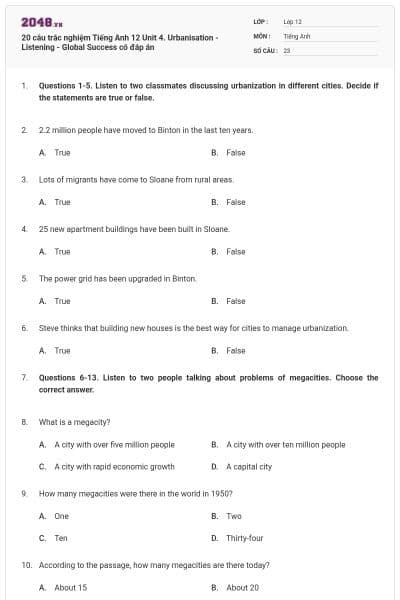
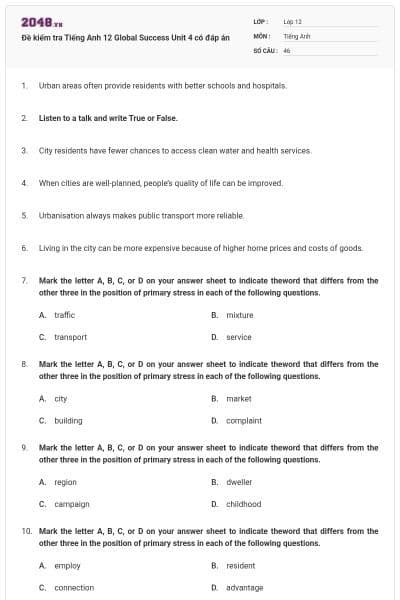
Listen to a talk and write True or False.
Urban areas often provide residents with better schools and hospitals.
Đáp án đúng: True
Thông tin: Well, urbanised areas usually have better facilities, such as good schools and modern hospitals. (Ừm, các khu vực đô thị hóa thường có cơ sở vật chất tốt hơn, chẳng hạn như trường học tốt và bệnh viện hiện đại.)
City residents have fewer chances to access clean water and health services.
Đáp án đúng: False
Thông tin: City residents also have access to better health and communication services, clean water and waste management facilities. (Người dân thành phố cũng được tiếp cận với các dịch vụ chăm sóc sức khỏe và truyền thông tốt hơn, nước sạch và cơ sở quản lý chất thải.)
When cities are well-planned, people’s quality of life can be improved.
Đáp án đúng: True
Thông tin: When urban infrastructure is well-planned, people's quality of life is also improved. (Khi hạ tầng đô thị được quy hoạch tốt, chất lượng cuộc sống của người dân sẽ được cải thiện.)
Urbanisation always makes public transport more reliable.
Đáp án đúng: False
Thông tin: As a result, public transport may not be as reliable as residents would wish. (Do đó, giao thông công cộng có thể không đáng tin cậy như người dân mong muốn.)
Living in the city can be more expensive because of higher home prices and costs of goods.
Đáp án đúng: True
Thông tin: Home prices become higher, and goods and services cost more. So cities tend to be more expensive to live in. (Sống ở thành phố có thể đắt đỏ hơn vì giá nhà và hàng hóa cao hơn.)
Nội dung bài nghe:
Well, urbanised areas usually have better facilities, such as good schools and modern hospitals. City residents also have access to better health and communication services, clean water and waste management facilities. When urban infrastructure is well-planned, people's quality of life is also improved. Local authorities expand roads trying to make driving easier. At the same time, they try to get more people into public transport by making bus and train services more convenient and frequent. As many city residents earn higher salaries, they can also afford to buy a nice house or a flat in the many high-rise buildings. Now, let's talk about the disadvantages of urbanisation. When too many people live in urban areas, traffic conditions become worse and worse. As a result, public transport may not be as reliable as residents would wish. Smog, high carbon emissions, increased number of private cars and waste from the large population can all lead to higher levels of pollution. Long-term exposure to air pollution can cause a range of diseases. In addition, home prices become higher, and goods and services cost more. So cities tend to be more expensive to live in.
Hướng dẫn dịch:
Vâng, các khu vực đô thị hóa thường có cơ sở vật chất tốt hơn, chẳng hạn như trường học tốt và bệnh viện hiện đại. Cư dân thành phố cũng được tiếp cận với các dịch vụ y tế và truyền thông tốt hơn, nước sạch và hệ thống xử lý chất thải. Khi cơ sở hạ tầng đô thị được quy hoạch tốt, chất lượng cuộc sống của người dân cũng được cải thiện. Chính quyền địa phương mở rộng đường sá để việc lái xe trở nên dễ dàng hơn. Đồng thời, họ cố gắng thu hút nhiều người sử dụng phương tiện giao thông công cộng hơn bằng cách làm cho dịch vụ xe buýt và tàu hỏa trở nên thuận tiện và thường xuyên hơn. Khi nhiều cư dân thành phố có mức lương cao hơn, họ cũng có đủ khả năng mua một ngôi nhà đẹp hoặc một căn hộ trong nhiều tòa nhà cao tầng. Bây giờ, hãy nói về những bất lợi của quá trình đô thị hóa. Khi quá đông dân cư sống ở các khu vực đô thị, tình trạng giao thông ngày càng trở nên tồi tệ hơn. Kết quả là, giao thông công cộng có thể không đáng tin cậy như người dân mong muốn. Khói bụi, lượng khí thải carbon cao, số lượng xe hơi cá nhân tăng và rác thải từ dân số đông đúc đều có thể dẫn đến mức độ ô nhiễm cao hơn. Tiếp xúc lâu dài với ô nhiễm không khí có thể gây ra một loạt các bệnh. Ngoài ra, giá nhà tăng cao, hàng hóa và dịch vụ cũng đắt đỏ hơn. Vì vậy, các thành phố có xu hướng đắt đỏ hơn để sinh sống.
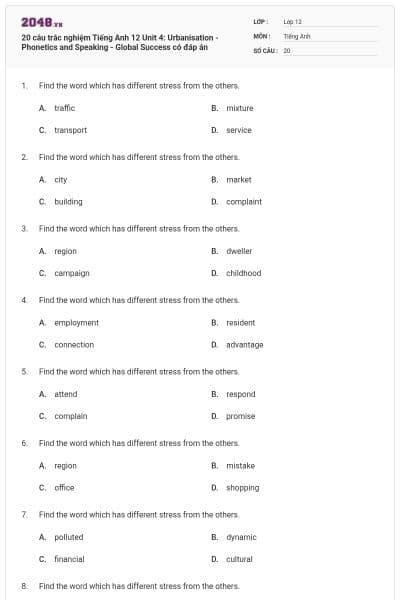
Mark the letter А, B, C, or D on your answer sheet to indicate theword that differs from the other three in the position of primary stress in each of the following questions.
traffic
mixture
transport
service
Đáp án đúng: D
Đáp án D trọng âm số 2. Các đáp án còn lại trọng âm số 1
Mark the letter А, B, C, or D on your answer sheet to indicate theword that differs from the other three in the position of primary stress in each of the following questions.
city
market
building
complaint
Đáp án đúng: D
Đáp án D trọng âm số 2. Các đáp án còn lại trọng âm số 1
Mark the letter А, B, C, or D on your answer sheet to indicate theword that differs from the other three in the position of primary stress in each of the following questions.
region
dweller
campaign
childhood
Đáp án đúng: C
Đáp án C trọng âm số 2. Các đáp án còn lại trọng âm số 1
Mark the letter А, B, C, or D on your answer sheet to indicate theword that differs from the other three in the position of primary stress in each of the following questions.
employ
resident
connection
advantage
Đáp án đúng: B
Đáp án B trọng âm số 1. Các đáp án còn lại trọng âm số 2
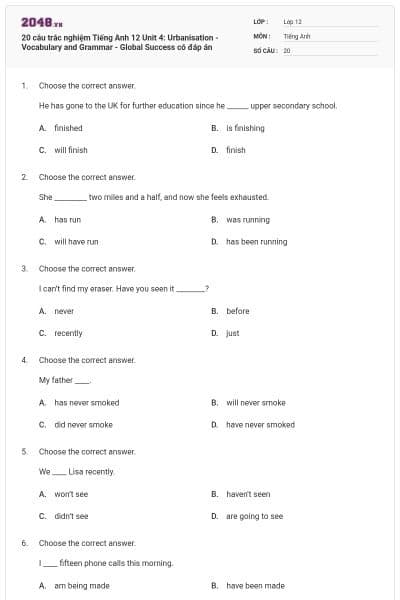
Mark the letter А, B, C, or D on your answer sheet to indicate the correct answer to each of the following questions.
The project on expanding the road _________ since it _________ last year.
has started / was proposed
started / was proposed
has started / has been proposed
started / has been proposed
Đáp án đúng: A
Giải thích: “since” → chia hiện tại hoàn thành ở mệnh đề chính (“has started”) và quá khứ đơn ở mệnh đề sau (“was proposed”).
Dịch nghĩa: Dự án mở rộng con đường đã được bắt đầu kể từ khi nó được đề xuất vào năm ngoái.
small and small
more small and small
smaller and smaller
small and small more
Đáp án đúng: C
Giải thích: Cấu trúc: comparative + and + comparative → “smaller and smaller” = ngày càng nhỏ hơn.
Dịch nghĩa: Diện tích cây xanh trong thành phố này ngày càng nhỏ lại.
see
saw
will see
have seen
Đáp án đúng: D
Giải thích: mệnh đề quan hệ dùng thì hiện tại hoàn thành để diễn tả kinh nghiệm: “that I have seen”.
Dịch nghĩa: Đây là trung tâm thương mại lớn nhất mà tôi từng thấy.
More urbanised / more polluted
The more urbanised / the more polluted
More urbanising / more polluting
The more urbanising / the more polluting
Đáp án đúng: B
Giải thích: Cấu trúc so sánh kép: The more + adj, the more + adj → càng... càng...
Dịch nghĩa: Thành phố càng đô thị hóa, nó càng trở nên ô nhiễm.
get lost
settle in
date back
go up
Đáp án đúng: D
Giải thích: “go up to the city” = lên thành phố (trái nghĩa với “go down to the countryside”).
Dịch nghĩa: Nhiều người ở nông thôn quyết định lên thành phố vì dễ tìm việc hơn.
Read the following advertisement/ announcement and mark the letter A, B, C or D on your answer sheet to indicate the correct option that best fits each of the numbered blanks from 15 to 20.
EXPLORE URBAN FUTURES CONFERENCE
Join us for an interesting conference on Urbanisation and the Future of Cities! Don’t miss this opportunity to inquire key discussions and insights shaping urban development. Here’s what you can expect:
Expert Speakers: (15) _________ with renowned urban planners, architects, and policymakers.
Interactive Workshops: Hands-on sessions to explore innovative urban solutions.
Networking Opportunities: Connect with professionals and (16) _________ in the field.
Cutting-edge Topics: Explore sustainability, smart cities, and community development.
Q&A Sessions: Get answers (17) _________ your burning urbanisation questions.
Save the date: March 24th
Location: Tran Phu Venue, Nam Cao street, Thai Binh province.
Limited spots available. Reserve yours now!
URBANISATION WORKSHOP SUMMARY
Recap of the Urbanisation Workshop, (18) ________ dynamic event about insightful discussions and practical insights:
Diverse Perspectives: Participants brought diverse experiences and enriched the conversation.
Keynote Addresses: Experts highlighted urbanisation trends, challenges, and opportunities.
Interactive Sessions: Engaging workshops explored (19) _________ urban planning and design.
Community Engagement: Emphasis on involving communities in decision-making for inclusive development
Networking Success: Attendees connected, promoted collaborations (20) ________ future urban projects.
Stay tuned for more events about the future of our cities!
Engaging
To engage
Engage
Engaged
Đáp án đúng: C
Giải thích: “Engage with...” = tham gia, kết nối với.
Dịch nghĩa: Kết nối với các chuyên gia quy hoạch đô thị, kiến trúc sư và nhà hoạch định chính sách nổi tiếng.
enthusiasm
enthusiastic
enthusia
enthusiasts
Đáp án đúng: D
Giải thích: “professionals and enthusiasts” = các chuyên gia và người đam mê trong lĩnh vực đó → danh từ số nhiều.
Dịch nghĩa: Kết nối với các chuyên gia và những người đam mê trong lĩnh vực này.
on
to
from
in
Đáp án đúng: B
Giải thích: get / find / give answers to (sth) = nhận / tìm / đưa ra câu trả lời cho (điều gì).
Dịch nghĩa: Nhận câu trả lời cho những thắc mắc nóng hổi của bạn về đô thị hóa.
an
the
a
Ø (no article)
Đáp án đúng: A
Giải thích: “event” bắt đầu bằng nguyên âm /ɪ/ → dùng “an” trước tính từ “dynamic”.
Dịch nghĩa: Tổng kết hội thảo về đô thị hóa, một sự kiện sôi nổi với những thảo luận sâu sắc và góc nhìn thực tế.
sustain
sustainability
sustainably
sustainable
Đáp án đúng: D
Giải thích: “urban planning and design” cần một tính từ bổ nghĩa
Dịch nghĩa: Các buổi hội thảo hấp dẫn đã khám phá quy hoạch và thiết kế đô thị bền vững.
for
from
at
in
Đáp án đúng: A
Giải thích: “collaborations for + mục đích” = hợp tác cho / vì mục tiêu nào đó.
Dịch nghĩa: Người tham dự đã kết nối, thúc đẩy các hợp tác cho những dự án đô thị trong tương lai.
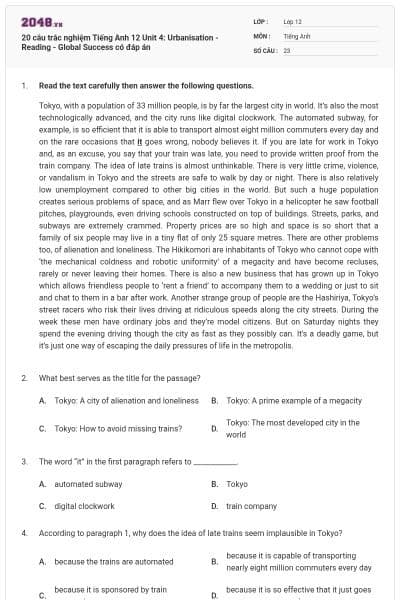
Read the text carefully then answer the following questions from 21 to 27.
Tokyo, with a population of 33 million people, is by far the largest city in world. It’s also the most technologically advanced, and the city runs like digital clockwork. The automated subway, for example, is so efficient that it is able to transport almost eight million commuters every day and on the rare occasions that it goes wrong, nobody believes it. If you are late for work in Tokyo and, as an excuse, you say that your train was late, you need to provide written proof from the train company. The idea of late trains is almost unthinkable. There is very little crime, violence, or vandalism in Tokyo and the streets are safe to walk by day or night. There is also relatively low unemployment compared to other big cities in the world. But such a huge population creates serious problems of space, and as Marr flew over Tokyo in a helicopter he saw football pitches, playgrounds, even driving schools constructed on top of buildings. Streets, parks, and subways are extremely crammed. Property prices are so high and space is so short that a family of six people may live in a tiny flat of only 25 square metres. There are other problems too, of alienation and loneliness. The Hikikomori are inhabitants of Tokyo who cannot cope with ‘the mechanical coldness and robotic uniformity’ of a megacity and have become recluses, rarely or never leaving their homes. There is also a new business that has grown up in Tokyo which allows friendless people to ‘rent a friend’ to accompany them to a wedding or just to sit and chat to them in a bar after work. Another strange group of people are the Hashiriya, Tokyo’s street racers who risk their lives driving at ridiculous speeds along the city streets. During the week these men have ordinary jobs and they’re model citizens. But on Saturday nights they spend the evening driving though the city as fast as they possibly can. It’s a deadly game, but it’s just one way of escaping the daily pressures of life in the metropolis.
What best serves as the title for the passage?
Tokyo: A city of alienation and loneliness
Tokyo: A prime example of a megacity
Tokyo: How to avoid missing trains?
Tokyo: The most developed city in the world
Đáp án đúng: B
Giải thích: Bài đọc mô tả Tokyo là một siêu đô thị (megacity) – vừa hiện đại, vừa đông đúc, vừa có các vấn đề xã hội.
automated subway
Tokyo
digital clockwork
train company
Đáp án đúng: A
Giải thích:
Dựa vào câu: The automated subway, for example, is so efficient that it is able to transport almost eight million commuters every day and on the rare occasions that it goes wrong, nobody believes it. (Ví dụ, tàu điện ngầm tự động hiệu quả đến mức có thể vận chuyển gần tám triệu lượt người đi làm mỗi ngày và trong những trường hợp hiếm hoi xảy ra sự cố, chẳng ai tin cả.)
because the trains are automated
because it is capable of transporting nearly eight million commuters every day
because it is sponsored by train companies
because it is so effective that it just goes wrong on rare occasions
Đáp án đúng: D
Giải thích:
Dựa vào câu: If you are late for work in Tokyo and, as an excuse, you say that your train was late, you need to provide written proof from the train company. The idea of late trains is almost unthinkable. (Nếu bạn đi làm muộn ở Tokyo và lấy lý do là tàu hỏa bị trễ, bạn cần cung cấp bằng chứng bằng văn bản từ công ty tàu hỏa. Chuyện tàu hỏa bị trễ gần như là điều không tưởng.)
spacious
occupied
packed
busy
Đáp án đúng: C
Giải thích: “crammed” = chật kín, chen chúc → đồng nghĩa với “packed”.
hermits
introverts
monks
ascetics
Đáp án đúng: A
Giải thích: “recluses” = người ẩn dật, sống tách biệt → đồng nghĩa với “hermits”.
Which of the following is NOT mentioned about Tokyo in the passage?
Due to the severe space shortage, property prices are so high.
In Tokyo, a new business has been growing, allowing single people to rent a boyfriend or a girlfriend.
Some individuals tend to avoid going outside due to isolation and loneliness.
During the week, the Hashiriya are model citizens and Tokyo’s street racers on Saturday nights.
Đáp án đúng: B
Giải thích: Đoạn văn chỉ nhắc đến dịch vụ thuê bạn bè để đi cùng, không nhắc đến “thuê bạn trai hay bạn gái”.
Japanese government is planning to invest more in constructing schools on top of buildings.
People in Tokyo are too busy to even make friends.
Tokyo is a wealthy city, but it may be difficult to live there because of overcrowding and busy lifestyles.
Living in Tokyo would make you solitary and stressed because of the busy environment.
Đáp án đúng: C
Giải thích: Bài cho thấy Tokyo vừa hiện đại, giàu có nhưng lại có vấn đề quá tải dân số, thiếu không gian sống → khó sống thoải mái.
Dịch bài đọc:
Với dân số 33 triệu người, Tokyo là thành phố lớn nhất thế giới. Đây cũng là thành phố tiên tiến nhất về mặt công nghệ, và thành phố vận hành như một cỗ máy kỹ thuật số. Ví dụ, hệ thống tàu điện ngầm tự động hiệu quả đến mức có thể vận chuyển gần tám triệu lượt người đi làm mỗi ngày, và trong những trường hợp hiếm hoi xảy ra sự cố, chẳng ai tin cả. Nếu bạn đi làm muộn ở Tokyo và lấy lý do là tàu bị trễ, bạn cần cung cấp bằng chứng bằng văn bản từ công ty tàu hỏa. Ý tưởng về những chuyến tàu trễ gần như là không thể tưởng tượng được. Tội phạm, bạo lực hay phá hoại ở Tokyo rất ít, và đường phố an toàn cho việc đi bộ cả ngày lẫn đêm. Tỷ lệ thất nghiệp cũng tương đối thấp so với các thành phố lớn khác trên thế giới. Tuy nhiên, dân số đông đúc như vậy lại gây ra những vấn đề nghiêm trọng về không gian, và khi Marr bay qua Tokyo bằng trực thăng, ông đã nhìn thấy các sân bóng đá, sân chơi, thậm chí cả trường dạy lái xe được xây dựng trên nóc các tòa nhà. Đường phố, công viên và tàu điện ngầm đều cực kỳ đông đúc. Giá bất động sản quá cao và không gian quá hẹp đến nỗi một gia đình sáu người có thể sống trong một căn hộ nhỏ chỉ 25 mét vuông. Ngoài ra còn có những vấn đề khác, về sự xa lánh và cô đơn. Hikikomori là cư dân của Tokyo không thể đối phó với "sự lạnh lẽo máy móc và sự đồng nhất như robot" của một siêu đô thị và đã trở thành những người ẩn dật, hiếm khi hoặc không bao giờ rời khỏi nhà. Ngoài ra còn có một loại hình kinh doanh mới phát triển ở Tokyo cho phép những người không có bạn bè "thuê một người bạn" để đi cùng họ đến một đám cưới hoặc chỉ để ngồi trò chuyện với họ trong quán bar sau giờ làm việc. Một nhóm người kỳ lạ khác là Hashiriya, những tay đua đường phố của Tokyo, những người liều mạng lái xe với tốc độ vô lý trên đường phố thành phố. Vào các ngày trong tuần, những người đàn ông này làm những công việc bình thường và họ là những công dân gương mẫu. Nhưng vào tối thứ Bảy, họ dành buổi tối để lái xe qua thành phố nhanh nhất có thể. Đó là một trò chơi chết người, nhưng đó chỉ là một cách để thoát khỏi những áp lực hàng ngày của cuộc sống ở đô thị.
Read the text carefully then answer the following questions from 28 to 33.
Where the significance of migration to cities is recognised, it is widely seen as a problem. In 2013, a UN study of all 193 UN member states found that 80 per cent had policies to reduce rural to urban migration. This figure has risen substantially in recent decades, up from only 38 per cent in 1996. It is also more pronounced in poorer countries: 88 per cent of the least developed countries reported policies to reduce migration to urban areas. But this negative attitude towards migration to cities may well be mistaken. The WMR argues that problems of access to services – such as housing, sanitation, education or employment – that result from rural to urban migration, are not inevitable. Rather, they are caused by poor planning. Although all socio- economic classes are reflected in migration to cities, migrants from rural areas are disproportionately poor, and inadequate planning is often a result of a weak political will to support them. In this way, migrants who come to cities can help diversify the networks that the city can draw upon – for instance, by linking cities to broader global networks. Perhaps the most famous example of this is Eastleigh in Nairobi. Known as “Little Mogadishu”, this neighbourhood has become a vibrant, global commercial hub, powered by enterprising members of the Somali, Ethiopian and Kenyan diasporas.
Migrants coming to urban areas from rural areas
Migrants coming to urban areas to find jobs
The effects of rising migrant numbers in urban areas
The analysis on why rural migrants migrate to urban areas
Đáp án đúng: A
Giải thích: Bài đọc tập trung vào việc di cư từ nông thôn ra thành phố, chính sách và ảnh hưởng của nó.
ambiguous
stable
evident
vague
Đáp án đúng: C
Giải thích: “pronounced” = rõ rệt, hiển nhiên → đồng nghĩa với “evident”.
Poor access to services such as housing
Problems with sanitation
Difficulties to find employment
Overcrowding in the cities
Đáp án đúng: D
Giải thích:
Dựa vào câu: The WMR argues that problems of access to services – such as housing, sanitation, education or employment – that result from rural to urban migration, are not inevitable. (WMR lập luận rằng các vấn đề về tiếp cận dịch vụ - chẳng hạn như nhà ở, vệ sinh, giáo dục hoặc việc làm - phát sinh do di cư từ nông thôn ra thành thị là không thể tránh khỏi.)
politicians
migrants
citizens
poor people
Đáp án đúng: B
Giải thích:
Dựa vào câu: Although all socio- economic classes are reflected in migration to cities, migrants from rural areas are disproportionately poor, and inadequate planning is often a result of a weak political will to support them. (Mặc dù tất cả các tầng lớp kinh tế xã hội đều được phản ánh trong quá trình di cư đến các thành phố, nhưng những người di cư từ vùng nông thôn lại nghèo một cách không cân xứng và việc quy hoạch không đầy đủ thường là kết quả của ý chí chính trị yếu kém trong việc hỗ trợ họ.)
Which of the following is TRUE, according to the passage?
80 UN members states had policies aimed at reducing rural to urban migration.
Problems resulting from rural to urban migration linked to access to services are unavoidable.
Migrants who come to cities will help diversify the networks from which the city can depend on.
Eastleigh in Nairobi is considered the poorest city in the world.
Đáp án đúng: C
Giải thích: Bài đọc cho rằng người di cư đến thành phố có thể giúp đa dạng hóa các mạng lưới kết nối của thành phố.
Lack of financial resources
Weak political will to support migrants
Limited migrant networks
Overcrowding in cities
Đáp án đúng: B
Giải thích:
Dựa vào câu: Although all socio- economic classes are reflected in migration to cities, migrants from rural areas are disproportionately poor, and inadequate planning is often a result of a weak political will to support them. (Mặc dù tất cả các tầng lớp kinh tế xã hội đều được phản ánh trong quá trình di cư đến các thành phố, nhưng những người di cư từ vùng nông thôn lại nghèo một cách không cân xứng và việc quy hoạch không đầy đủ thường là kết quả của ý chí chính trị yếu kém trong việc hỗ trợ họ.)
Dịch bài đọc:
Khi tầm quan trọng của việc di cư đến các thành phố được công nhận, nó thường được coi là một vấn đề. Năm 2013, một nghiên cứu của Liên Hợp Quốc về tất cả 193 quốc gia thành viên cho thấy 80% đã có chính sách giảm thiểu di cư từ nông thôn ra thành thị. Con số này đã tăng đáng kể trong những thập kỷ gần đây, từ mức chỉ 38% vào năm 1996. Điều này cũng rõ rệt hơn ở các nước nghèo: 88% các quốc gia kém phát triển nhất đã báo cáo các chính sách giảm thiểu di cư đến các khu vực thành thị. Tuy nhiên, thái độ tiêu cực này đối với việc di cư đến các thành phố có thể là một sai lầm. Báo cáo Đô thị Thế giới (WMR) lập luận rằng các vấn đề về tiếp cận dịch vụ - chẳng hạn như nhà ở, vệ sinh, giáo dục hoặc việc làm - phát sinh từ việc di cư từ nông thôn ra thành thị không phải là tất yếu. Thay vào đó, chúng là do quy hoạch kém. Mặc dù tất cả các tầng lớp kinh tế xã hội đều được phản ánh trong quá trình di cư đến các thành phố, nhưng người di cư từ nông thôn lại nghèo một cách không cân xứng, và việc quy hoạch không đầy đủ thường là kết quả của việc thiếu ý chí chính trị trong việc hỗ trợ họ. Bằng cách này, những người di cư đến các thành phố có thể giúp đa dạng hóa các mạng lưới mà thành phố có thể tận dụng - ví dụ, bằng cách kết nối các thành phố với các mạng lưới toàn cầu rộng lớn hơn. Có lẽ ví dụ nổi tiếng nhất về điều này là Eastleigh ở Nairobi. Được mệnh danh là "Tiểu Mogadishu", khu phố này đã trở thành một trung tâm thương mại toàn cầu sôi động, được thúc đẩy bởi những người dân Somalia, Ethiopia và Kenya di cư đầy sáng kiến.
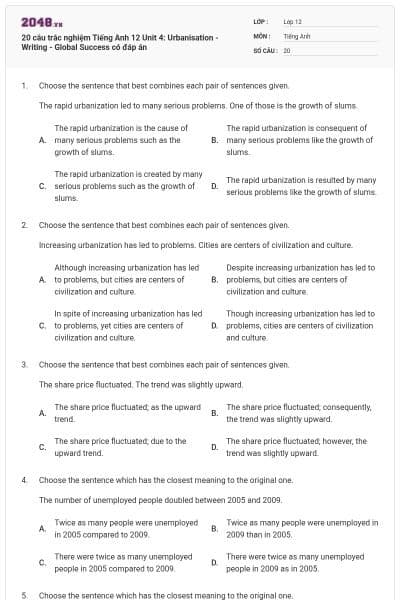
Mark the letter A, B, C or D on your answer sheet to indicate the correct arrangement of the sentences to make a meaningful paragraph/ letter in each of the following questions.
a. Firstly, improving public transportation can relieve traffic congestion and reduce air pollution.
b. By combining these strategies, cities aim to minimise the bad effects of rapid urbanisation.
c. Lastly, community involvement in urban planning allows residents to voice their concerns and contribute to decisions that affect their neighbourhoods.
d. In response to the negative impacts of urbanisation, various plans are being developed to create more sustainable and livable cities.
e. Secondly, the construction of green spaces within urban areas can enhance the overall well-being of residents by providing recreational areas and improving air quality.
c-a-b-e-d
d-a-e-c-b
e-a-c-d-b
d-c-e-a-b
Đáp án đúng: B
Giải thích:
(d) mở đầu: giới thiệu nguyên nhân và mục tiêu của các kế hoạch đô thị bền vững.
(a) giải pháp đầu tiên: cải thiện giao thông công cộng.
(e) giải pháp thứ hai: xây dựng không gian xanh.
(c) giải pháp cuối: khuyến khích cộng đồng tham gia vào quy hoạch đô thị.
(b) kết đoạn: nêu kết quả của việc kết hợp các chiến lược.
Dịch nghĩa:
a. Thứ nhất, việc cải thiện giao thông công cộng có thể giảm ùn tắc giao thông và ô nhiễm không khí.
b. Bằng cách kết hợp các chiến lược này, các thành phố hướng đến mục tiêu giảm thiểu tác động tiêu cực của quá trình đô thị hóa nhanh chóng.
c. Cuối cùng, sự tham gia của cộng đồng vào quy hoạch đô thị cho phép cư dân bày tỏ mối quan tâm và đóng góp vào các quyết định ảnh hưởng đến khu vực lân cận của họ.
d. Để ứng phó với những tác động tiêu cực của quá trình đô thị hóa, nhiều kế hoạch khác nhau đang được xây dựng nhằm tạo ra những thành phố bền vững và đáng sống hơn.
e. Thứ hai, việc xây dựng không gian xanh trong khu vực đô thị có thể nâng cao phúc lợi chung của cư dân bằng cách cung cấp các khu vực giải trí và cải thiện chất lượng không khí.
a. Additionally, there’s a focus on creating more green spaces within cities, contributing to a healthier environment.
b. Firstly, the government is actively promoting sustainable practices, encouraging eco-friendly construction, and enhancing public transportation to reduce congestion.
c. I hope this information is useful for you.
d. Take care,
e. Dear Phuong,
Hope this letter finds you well. I am writing to share some interesting news about urban development policies in Viet Nam.
f. It’s impressive to see how these policies aim to balance urban growth with environmental considerations.
e-b-a-c-f-d
e-a-b-c-f-d
e-b-a-d-f-c
e-b-a-f-c-d
Đáp án đúng: D
Giải thích:
(e) mở đầu bức thư – lời chào và giới thiệu mục đích viết thư.
(b) nội dung đầu tiên – các chính sách của chính phủ về đô thị hóa bền vững.
(a) mở rộng ý – chú trọng tạo thêm không gian xanh.
(f) bình luận cảm xúc – thể hiện sự ấn tượng với chính sách đó.
(c) câu kết – hi vọng thông tin hữu ích.
(d) lời chào tạm biệt cuối thư.
Dịch nghĩa:
a. Ngoài ra, chính phủ cũng tập trung vào việc tạo ra nhiều không gian xanh hơn trong các thành phố, góp phần tạo nên một môi trường trong lành hơn.
b. Thứ nhất, chính phủ đang tích cực thúc đẩy các hoạt động bền vững, khuyến khích xây dựng thân thiện với môi trường và cải thiện giao thông công cộng để giảm ùn tắc.
c. Tôi hy vọng thông tin này hữu ích cho bạn.
d. Bảo trọng,
e. Thân gửi Phương,
Hy vọng lá thư này đến tay bạn vẫn khỏe mạnh. Tôi viết thư này để chia sẻ một số tin tức thú vị về các chính sách phát triển đô thị tại Việt Nam.
f. Thật ấn tượng khi thấy các chính sách này hướng đến việc cân bằng giữa tăng trưởng đô thị với các cân nhắc về môi trường.
Read the following passage and mark the letter A, B, C or D on your answer sheet to indicate the correct option that best fits each of the numbered blanks from 36 to 40.
More than 1 billion people live in housing (36) is below minimum standards of comfort and sanitation, and new houses will have to be built for 3 billion people by 2030.
Investing in essential infrastructure propels growth and human development. There (37) some progress in narrowing the infrastructure deficit in recent decades, but much more needs to be done. Good planning and sound management is needed to manage this. National and local governments need to become more strategic in responding (38) the full range of challenges and opportunities posed by rapid urbanisation. This can be done by formulating a national urbanisation (39) as a first step to help to identify urban development priorities, shape plans and better coordinate actions by all the actors involved, including the private sector.
There is, (40) no one-size-fits-all urban strategy. Urban policy priorities and choices depend on a variety of factors - including the scale, speed and source of urbanisation, the size of cities and the stage of urban development.
More than 1 billion people live in housing (36) is below minimum standards of comfort and sanitation, and new houses will have to be built for 3 billion people by 2030.
who
that
when
why
Đáp án đúng: B
Giải thích: “that” được dùng để nối mệnh đề quan hệ chỉ vật (“housing”).
Dịch nghĩa: Hơn 1 tỷ người đang sống trong những ngôi nhà mà chất lượng dưới mức tiêu chuẩn tối thiểu về sự thoải mái và vệ sinh.
is
will be
was
has been
Giải thích: Dấu hiệu “in recent decades” → dùng thì hiện tại hoàn thành để chỉ sự việc đã diễn ra và còn ảnh hưởng hiện tại.
Dịch nghĩa: Trong những thập kỷ gần đây đã có một số tiến bộ trong việc thu hẹp khoảng cách về cơ sở hạ tầng.
on
of
to
in
Đáp án đúng: C
Giải thích: “respond to something” = phản ứng / ứng phó với điều gì đó.
Dịch nghĩa: Chính phủ cần có chiến lược hơn trong việc ứng phó với toàn bộ những thách thức và cơ hội do đô thị hóa nhanh mang lại.
This can be done by formulating a national urbanisation (39) as a first step to help to identify urban development priorities, shape plans and better coordinate actions by all the actors involved, including the private sector.
strategy
reality
conclusion
reduction
Đáp án đúng: A
Giải thích: “formulate a strategy” (xây dựng chiến lược).
Dịch nghĩa: Việc này có thể được thực hiện bằng cách xây dựng một chiến lược đô thị hóa quốc gia như bước đầu tiên.
therefore
despite
although
however
Đáp án đúng: D
Giải thích: “however” (tuy nhiên) được dùng để chuyển ý trái ngược với câu trước.
Dịch nghĩa: Tuy nhiên, không có một chiến lược đô thị nào phù hợp cho tất cả.
Dịch bài đọc:
Hơn 1 tỷ người đang sống trong những ngôi nhà mà chất lượng dưới mức tiêu chuẩn tối thiểu về sự thoải mái và vệ sinh, và cần phải xây thêm nhà ở cho 3 tỷ người vào năm 2030.
Việc đầu tư vào cơ sở hạ tầng thiết yếu thúc đẩy tăng trưởng và phát triển con người. Trong những thập kỷ gần đây đã có một số tiến bộ trong việc thu hẹp khoảng cách về cơ sở hạ tầng, nhưng vẫn còn rất nhiều việc cần làm. Cần có quy hoạch tốt và quản lý hiệu quả để giải quyết vấn đề này. Chính quyền trung ương và địa phương cần có chiến lược hơn trong việc ứng phó với toàn bộ các thách thức và cơ hội do đô thị hóa nhanh mang lại. Việc này có thể được thực hiện bằng cách xây dựng một chiến lược đô thị hóa quốc gia như bước đầu tiên, giúp xác định các ưu tiên phát triển, định hình kế hoạch và phối hợp tốt hơn giữa các bên liên quan, bao gồm cả khu vực tư nhân.
Tuy nhiên, không có một chiến lược đô thị nào phù hợp với tất cả. Các ưu tiên và lựa chọn trong chính sách đô thị phụ thuộc vào nhiều yếu tố — bao gồm quy mô, tốc độ và nguồn gốc của đô thị hóa, kích thước của thành phố và giai đoạn phát triển đô thị.