Topic 6: Gender equality (Phần 2)
8 câu hỏi
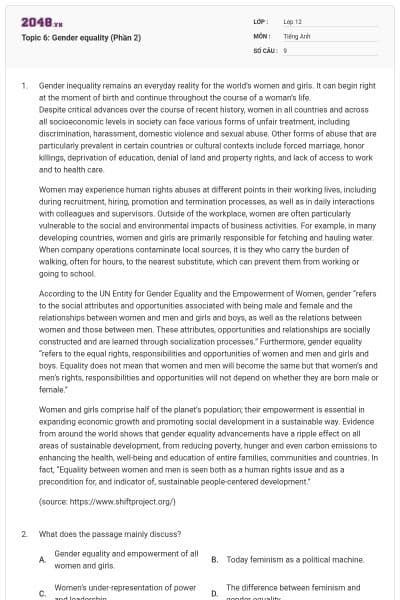
Gender inequality remains an everyday reality for the world’s women and girls. It can begin right at the moment of birth and continue throughout the course of a woman’s life.
Despite critical advances over the course of recent history, women in all countries and across all socioeconomic levels in society can face various forms of unfair treatment, including discrimination, harassment, domestic violence and sexual abuse. Other forms of abuse that are particularly prevalent in certain countries or cultural contexts include forced marriage, honor killings, deprivation of education, denial of land and property rights, and lack of access to work and to health care.
Women may experience human rights abuses at different points in their working lives, including during recruitment, hiring, promotion and termination processes, as well as in daily interactions with colleagues and supervisors. Outside of the workplace, women are often particularly vulnerable to the social and environmental impacts of business activities. For example, in many developing countries, women and girls are primarily responsible for fetching and hauling water. When company operations contaminate local sources, it is they who carry the burden of walking, often for hours, to the nearest substitute, which can prevent them from working or going to school.
According to the UN Entity for Gender Equality and the Empowerment of Women, gender “refers to the social attributes and opportunities associated with being male and female and the relationships between women and men and girls and boys, as well as the relations between women and those between men. These attributes, opportunities and relationships are socially constructed and are learned through socialization processes.” Furthermore, gender equality “refers to the equal rights, responsibilities and opportunities of women and men and girls and boys. Equality does not mean that women and men will become the same but that women’s and men’s rights, responsibilities and opportunities will not depend on whether they are born male or female.”
Women and girls comprise half of the planet’s population; their empowerment is essential in expanding economic growth and promoting social development in a sustainable way. Evidence from around the world shows that gender equality advancements have a ripple effect on all areas of sustainable development, from reducing poverty, hunger and even carbon emissions to enhancing the health, well-being and education of entire families, communities and countries. In fact, “Equality between women and men is seen both as a human rights issue and as a precondition for, and indicator of, sustainable people-centered development.”
(source: https://www.shiftproject.org/)
What does the passage mainly discuss?
Gender equality and empowerment of all women and girls.
Today feminism as a political machine.
Women’s under-representation of power and leadership
The difference between feminism and gender equality.
Đáp án A
Đoạn văn chủ yếu thảo luận là gì?
A. Bình đẳng giới và trao quyền cho tất cả phụ nữ và trẻ em gái.
B. Ngày nay nữ quyền như một bộ máy chính trị.
C. Sự đại diện của phụ nữ về quyền lực và khả năng lãnh đạo
D. Sự khác biệt giữa nữ quyền và bình đẳng giới.
Căn cứ vào thông tin đoạn 1 tác giả nêu ra thực trạng về bình đẳng giới:
“Gender inequality remains an everyday reality for the world’s women and girls. It can begin right at the moment of birth and continue throughout the course of a woman’s life.
Despite critical advances over the course of recent history, women in all countries and across all socioeconomic levels in society can face various forms of unfair treatment, including discrimination, harassment, domestic violence and sexual abuse. Other forms of abuse that are particularly prevalent in certain countries or cultural contexts include forced marriage, honor killings, deprivation of education, denial of land and property rights, and lack of access to work and to health care.”
(Bất bình đẳng giới vẫn là một thực tế hàng ngày đối với phụ nữ và trẻ em gái trên thế giới. Nó có thể bắt đầu ngay tại thời điểm được sinh ra và tiếp tục trong suốt cuộc đời của một người phụ nữ.
Bất chấp những tiến bộ quan trọng trong quá trình lịch sử gần đây, phụ nữ ở tất cả các quốc gia và trên mọi cấp độ kinh tế xã hội trong xã hội có thể phải đối mặt với nhiều hình thức đối xử không công bằng, bao gồm phân biệt đối xử, quấy rối, bạo lực gia đình và lạm dụng tình dục. Các hình thức lạm dụng khác đặc biệt phổ biến ở một số quốc gia hoặc bối cảnh văn hóa bao gồm cưỡng hôn, giết người, tước quyền học tập, từ chối quyền sử dụng đất và tài sản, và không được tiếp cận với công việc và chăm sóc sức khỏe.
Căn cứ vào thông tin đoạn cuối:
In fact, “Equality between women and men is seen both as a human rights issue and as a precondition for, and indicator of, sustainable people-centered development.”
(Trên thực tế, "Bình đẳng giữa phụ nữ và nam giới được coi là vấn đề nhân quyền và là một điều kiện tiên quyết và chỉ số phát triển lấy người dân làm trọng tâm phát triển bền vững.)
=> Như vậy, đoạn văn đang thảo luận về bình đẳng giới và việc trao quyền cho phụ nữ và trẻ em gái.
The word “deprivation” in paragraph 2 can be replaced by _______.
ruin
unavailability
removal
wealth
Đáp án B
Từ “deprivation” trong đoạn 2 có thể được thay thế bằng ____.
A. sự hủy hoại
B. sự không có sẵn
C. sự gỡ bỏ, loại bỏ
D. sự giàu có
=> Từ đồng nghĩa: Deprivation (mất đi, không có được, không có quyền) = unavailability
Other forms of abuse that are particularly prevalent in certain countries or cultural contexts include forced marriage, honor killings, deprivation of education, denial of land and property rights, and lack of access to work and to health care.
Which of the following about the hardships of women in working activities is NOT stated, according to paragraph 3?
Being the last choice in positive chance and the first option for negative change.
Denied equitable educational opportunities due to outside inconveniences.
Being in charge of laborious and time-intensive tasks.
Continual sexual harassment in the work place.
Đáp án D
Điều nào sau đây về những khó khăn của phụ nữ trong quá trình làm việc KHÔNG được nêu lên, theo đoạn 3?
A. Là lựa chọn cuối cùng cho những cơ hội tốt đẹp và là lựa chọn đầu tiên cho những biến đổi tồi tệ.
B. Các cơ hội giáo dục công bằng bị phủ nhận do những bất tiện bên ngoài.
C. Đảm nhận các công việc tốn nhiều công sức và thời gian.
D. Quấy rối tình dục liên tục ở nơi làm việc
Căn cứ vào thông tin đoạn ba:
Women may experience human rights abuses at different points in their working lives, including during recruitment, hiring, promotion and termination processes, as well as in daily interactions with colleagues and supervisors. Outside of the workplace, women are often particularly vulnerable to the social and environmental impacts of business activities. For example, in many developing countries, women and girls are primarily responsible for fetching and hauling water. When company operations contaminate local sources, it is they who carry the burden of walking, often for hours, to the nearest substitute, which can prevent them from working or going to school.
(Phụ nữ có thể bị lạm dụng nhân quyền ở những thời điểm khác nhau trong cuộc sống làm việc của họ, bao gồm trong quá trình tuyển dụng, thuê mướn, thăng chức và sa thải, cũng như tương tác hàng ngày với đồng nghiệp và quản lí. Bên ngoài nơi làm việc, phụ nữ thường đặc biệt dễ bị tổn thương trước các tác động xã hội và môi trường của các hoạt động kinh doanh. Ví dụ, ở nhiều nước đang phát triển, phụ nữ và trẻ em gái chịu trách nhiệm chính trong việc lấy và mang nước. Khi các hoạt động của công ty làm ô nhiễm các nguồn nước địa phương, chính họ là người phải đảm đương gánh nặng của việc đi bộ, thường là hàng giờ, đến chỗ lấy nước thay thế gần nhất, điều này có thể ngăn họ làm việc hoặc đi học.)
*Note: Ý câu A là phụ nữ luôn phải chịu đựng những điều tiêu cực và luôn bị bỏ lỡ nhiều cơ hội tốt. Dù không có thông tin cụ thể nhưng đọc hết đoạn 3 cũng đủ để toát lên ý này trong bài. Chẳng hạn họ là người phải đảm đương gánh nặng của việc mang và xách nước khi phải đi bộ hàng giờ liền => phải đi đầu cho những thay đổi tiêu cực. Và ảnh hưởng, khiến họ không thể đi làm, đi học; cũng như những gánh chịu khác như: tuyển dụng, thuê mướn, thăng chức và sa thải, cũng như tương tác hàng ngày với đồng nghiệp và quản lí cũng bị lạm dụng quyền,… => mất đi những cơ hội tốt đẹp lẽ ra thuộc về họ
=> Đáp án A không sai.
The word “termination” in paragraph 3 can be replaced by _______.
divorce
closing
firing
outcome
Đáp án C
Từ “termination /ˌtɜː.mɪˈneɪ.ʃən/” trong đoạn 3 có thể được thay thế bởi từ ______.
A. li hôn
B. kết thúc
C. sa thải
D. kết quả
Từ đồng nghĩa: termination (thôi việc) = firing
Căn cứ thông tin đoạn 3:
Women may experience human rights abuses at different points in their working lives, including during recruitment, hiring, promotion and termination processes, as well as in daily interactions with colleagues and supervisors.
(Phụ nữ có thể bị lạm dụng nhân quyền ở những thời điểm khác nhau trong cuộc sống làm việc của họ, bao gồm trong quá trình tuyển dụng, thuê mướn, thăng chức và sa thải, cũng như tương tác hàng ngày với đồng nghiệp và quản lí.)
According to the UN Entity for Gender Equality and the Empowerment of Women, the term “gender equality” means ______.
All genders being identical and indistinguishable in all aspects.
Providing each gender with utmost freedom and security.
Liberation from domination, and oppression for everyone.
Receiving and taking in the consideration of factors impervious to genders.
Đáp án D
Theo Tổ chức Liên hợp quốc về Bình đẳng giới và Trao quyền cho phụ nữ, thuật ngữ “bình đẳng giới” có nghĩa là ________.
A. Tất cả các giới đều giống hệt nhau và không thể phân biệt về mọi mặt.
B. Cung cấp cho mỗi giới tính tự do và an ninh tối đa.
C. Giải phóng khỏi sự thống trị, và áp bức cho mọi người.
D. Tiếp nhận và xem xét các yếu tố không chịu ảnh hưởng bởi giới tính.
Căn cứ vào thông tin đoạn 4:
Furthermore, gender equality “refers to the equal rights, responsibilities and opportunities of women and men and girls and boys. Equality does not mean that women and men will become the same but that women’s and men’s rights, responsibilities and opportunities will not depend on whether they are born male or female.”
(Hơn nữa, bình đẳng giới "đề cập đến quyền, trách nhiệm và cơ hội bình đẳng của phụ nữ và đàn ông; con gái và con trai. Bình đẳng không có nghĩa là phụ nữ và nam giới sẽ trở nên giống nhau nhưng quyền, trách nhiệm và cơ hội của phụ nữ và nam giới sẽ không phụ thuộc vào việc họ sinh ra là nam hay nữ.)
The word “those” in paragraph 4 refers to ______.
relations
attributes
opportunities
interactions
Đáp án A
Từ “those” trong đoạn 4 nói đến______.
A. quan hệ
B. thuộc tính
C. cơ hội
D. tương tác
Ta thấy từ “those” ở đây dùng để thay thế cho danh từ mối quan hệ được nhắc trước đó.
According to the UN Entity for Gender Equality and the Empowerment of Women, gender "refers to the social attributes and opportunities associated with being male and female and the relationships between women and men and girls and boys, as well as the relations between women and those between men. (Theo Tổ chức Liên hợp quốc về Bình đẳng giới và Trao quyền cho phụ nữ, giới tính "đề cập đến các thuộc tính xã hội và cơ hội liên quan đến việc là nam và nữ và mối quan hệ giữa phụ nữ và đàn ông; con gái và con trai, cũng như mối quan hệ giữa phụ nữ với nhau và mối quan hệ giữa đàn ông với nhau.)
Which of the following best describes the tone of paragraph 5?
indignant
appreciation
mocking
sympathetic
Đáp án B
Điều nào sau đây mô tả đúng nhất tông giọng của tác giả trong của đoạn 5?
A. phẫn nộ
B. đánh giá cao
C. chế giễu
D. thông cảm
Căn cứ vào thông tin đoạn 5:
Women and girls comprise half of the planet’s population; their empowerment is essential in expanding economic growth and promoting social development in a sustainable way. Evidence from around the world shows that gender equality advancements have a ripple effect on all areas of sustainable development.
(Phụ nữ và trẻ em gái chiếm một nửa dân số hành tinh; việc trao quyền cho họ là điều cần thiết trong việc mở rộng tăng trưởng kinh tế và thúc đẩy phát triển xã hội một cách bền vững. Chứng cớ từ khắp nơi trên thế giới cho thấy những tiến bộ về bình đẳng giới có tác động gợn sóng trên tất cả lĩnh vực phát triển bền vững.)
The passage implies that ______.
If your gender equality isn’t intersectional, it’s not real gender equality.
The fight for gender equity is everyone’s responsibility.
Inequality exists in our minds, in our biases and prejudices.
The current law system cannot guarantee enough equality rights.
Đáp án B
Đoạn văn ngụ ý rằng__________.
A. Nếu bình đẳng giới của bạn không giao nhau, thì đó không phải là bình đẳng giới thực sự.
B. Cuộc đấu tranh vì bình đẳng giới là trách nhiệm của mọi người.
C. Bất bình đẳng tồn tại trong tâm trí của chúng ta, trong những thành kiến và định kiến của chúng ta.
D. Hệ thống luật hiện hành không thể đảm bảo đủ quyền bình đẳng.
Căn cứ vào thông tin đoạn cuối:
In fact, “Equality between women and men is seen both as a human rights issue and as a precondition for, and indicator of, sustainable people-centered development.”
(Trên thực tế, "Bình đẳng giữa phụ nữ và nam giới được coi là vấn đề nhân quyền và là một điều kiện tiên quyết và chỉ số phát triển lấy người dân làm trọng tâm phát triển bền vững.)
=> Như vậy, có thể suy ra rằng cuộc đấu tranh vì bình đẳng giới là trách nhiệm của mỗi con người, để có thể giúp phát triển bền vững quốc gia cũng như xã hội.
Bạn có thích hoạt động này không?