3000 câu Trắc nghiệm tổng hợp Tiếng Anh 2026 (có đáp án) - Phần 6
26 câu hỏi
More and more people no longer read newspaper or watch TV programs to get news. They get news about the world through the internet. Why? Is this a positive or negative development?
Hướng dẫn giải:
Gợi ý 1:
Nowadays, more and more people prefer to get news online rather than through newspapers or television. This shift is mainly due to convenience and accessibility, and I believe it is largely a positive development.
One reason people turn to the internet is speed. Online platforms provide instant updates, whereas newspapers and TV programs often report events hours later. In addition, the internet offers a wider range of sources, allowing readers to access international news and diverse perspectives. Another factor is flexibility. People can read or watch news on their smartphones anytime and anywhere, unlike traditional media which requires fixed schedules or physical copies.
This trend has several positive effects. It encourages people to stay informed more regularly and promotes global awareness. Furthermore, digital platforms often allow interaction, such as commenting or sharing, which makes news more engaging. However, there are drawbacks, such as the spread of misinformation and reduced trust in online sources.
In conclusion, the growing reliance on the internet for news is driven by convenience and speed. Although it poses challenges, I believe it is a positive development overall, provided that people learn to evaluate sources critically.
(Ngày nay, ngày càng nhiều người thích đọc tin tức trực tuyến hơn là qua báo in hoặc truyền hình. Sự thay đổi này chủ yếu do tính tiện lợi và khả năng tiếp cận, và tôi tin rằng đây phần lớn là một sự phát triển tích cực.
Một lý do khiến mọi người chuyển sang internet là tốc độ. Các nền tảng trực tuyến cung cấp cập nhật tức thì, trong khi báo và chương trình TV thường đưa tin muộn hơn nhiều giờ. Ngoài ra, internet mang lại nhiều nguồn tin hơn, cho phép người đọc tiếp cận tin tức quốc tế và nhiều góc nhìn khác nhau. Một yếu tố khác là sự linh hoạt. Mọi người có thể đọc hoặc xem tin tức trên điện thoại thông minh bất cứ lúc nào, khác với truyền thông truyền thống vốn yêu cầu lịch trình cố định hoặc bản in.
Xu hướng này có nhiều tác động tích cực. Nó khuyến khích mọi người cập nhật thông tin thường xuyên hơn và nâng cao nhận thức toàn cầu. Hơn nữa, các nền tảng kỹ thuật số thường cho phép tương tác, như bình luận hoặc chia sẻ, khiến tin tức hấp dẫn hơn. Tuy nhiên, cũng có hạn chế như sự lan truyền thông tin sai lệch và giảm niềm tin vào nguồn trực tuyến.
Tóm lại, việc ngày càng phụ thuộc vào internet để đọc tin tức xuất phát từ sự tiện lợi và tốc độ. Mặc dù có thách thức, tôi tin rằng đây là một sự phát triển tích cực, miễn là mọi người biết cách đánh giá nguồn tin một cách cẩn trọng.)
Gợi ý 2:
The internet has become the primary source of news for many people, replacing newspapers and television. This change is driven by technological advancement and changing lifestyles, and it has both benefits and drawbacks.
People prefer online news because it is immediate and accessible. Unlike newspapers, which are printed once a day, or TV programs that follow fixed schedules, online platforms update continuously. Moreover, the internet provides multimedia content—videos, images, and live streams—that make news more engaging. Another reason is cost. Most online news is free, whereas newspapers require payment and television often demands subscriptions.
This development is positive in many ways. It democratizes information, giving people access to diverse viewpoints and breaking news at their fingertips. It also reduces paper consumption, which benefits the environment. However, the negative side is the rise of fake news and sensationalism, which can mislead readers. Traditional journalism often has stricter editorial standards, while online platforms sometimes prioritize speed over accuracy.
To sum up, the internet has become the dominant source of news because it is fast, convenient, and cost-effective. While this is mostly positive, society must address the issue of misinformation to maximize its benefits.
(Internet đã trở thành nguồn tin tức chính của nhiều người, thay thế báo in và truyền hình. Sự thay đổi này được thúc đẩy bởi tiến bộ công nghệ và lối sống thay đổi, và nó có cả mặt lợi và hại.
Mọi người thích tin tức trực tuyến vì nó nhanh chóng và dễ tiếp cận. Khác với báo in chỉ phát hành một lần mỗi ngày hoặc chương trình TV theo lịch cố định, các nền tảng trực tuyến cập nhật liên tục. Hơn nữa, internet cung cấp nội dung đa phương tiện—video, hình ảnh và phát trực tiếp—khiến tin tức hấp dẫn hơn. Một lý do khác là chi phí. Hầu hết tin tức trực tuyến miễn phí, trong khi báo in phải trả tiền và truyền hình thường yêu cầu đăng ký.
Sự phát triển này có nhiều mặt tích cực. Nó dân chủ hóa thông tin, giúp mọi người tiếp cận nhiều quan điểm và tin nóng ngay trong tầm tay. Nó cũng giảm tiêu thụ giấy, có lợi cho môi trường. Tuy nhiên, mặt tiêu cực là sự gia tăng tin giả và giật gân, có thể gây hiểu lầm cho người đọc. Báo chí truyền thống thường có tiêu chuẩn biên tập nghiêm ngặt hơn, trong khi nền tảng trực tuyến đôi khi ưu tiên tốc độ hơn độ chính xác.
Tóm lại, internet đã trở thành nguồn tin tức chủ đạo vì nó nhanh, tiện lợi và tiết kiệm chi phí. Mặc dù phần lớn là tích cực, xã hội cần giải quyết vấn đề thông tin sai lệch để tận dụng tối đa lợi ích của nó.)
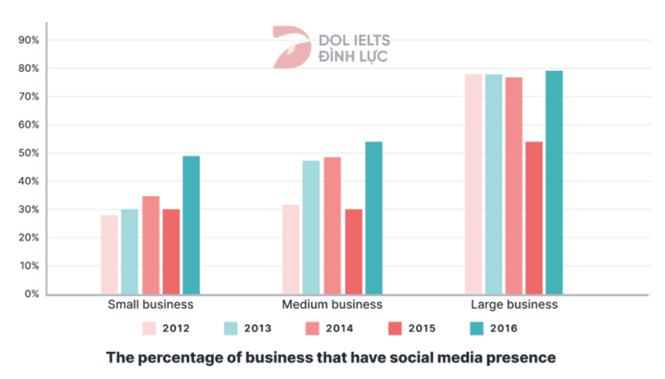
The bar chart shows the percentage of small , medium, large companies which used social media for business purposes between 2012 to 2016. Summarise the information by selecting and reporting the main features, and make comparisons where relevant.
Hướng dẫn giải:
Gợi ý 1:
The bar chart compares the proportion of small, medium, and large businesses that used social media for business purposes between 2012 and 2016. Overall, the percentage of companies with a social media presence increased in all categories, with large businesses consistently having the highest figures.
In 2012, only around 30% of small and medium businesses used social media, while the figure for large businesses was much higher, at approximately 75%. Over the following years, the proportion of small and medium companies rose steadily, reaching nearly 50% by 2016. The growth was particularly noticeable among small businesses, whose social media usage almost doubled during the period.
Large businesses, on the other hand, maintained a strong presence throughout the five years. Their figures remained stable at around 75–80%, showing only a slight increase by 2016. This suggests that most large companies had already adopted social media early on, while smaller firms were catching up gradually.
In summary, social media adoption grew across all business sizes from 2012 to 2016, with small and medium enterprises showing the most significant improvement, although large businesses continued to lead overall.
(Biểu đồ cột so sánh tỷ lệ doanh nghiệp nhỏ, vừa và lớn sử dụng mạng xã hội cho mục đích kinh doanh từ năm 2012 đến 2016. Nhìn chung, tỷ lệ doanh nghiệp có mặt trên mạng xã hội tăng ở tất cả các nhóm, trong đó doanh nghiệp lớn luôn chiếm tỷ lệ cao nhất.
Năm 2012, chỉ khoảng 30% doanh nghiệp nhỏ và vừa sử dụng mạng xã hội, trong khi con số này ở doanh nghiệp lớn cao hơn nhiều, khoảng 75%. Trong những năm tiếp theo, tỷ lệ doanh nghiệp nhỏ và vừa tăng đều, đạt gần 50% vào năm 2016. Mức tăng đặc biệt rõ rệt ở doanh nghiệp nhỏ, khi tỷ lệ sử dụng mạng xã hội gần như tăng gấp đôi.
Trong khi đó, doanh nghiệp lớn duy trì mức độ hiện diện mạnh mẽ trong suốt 5 năm. Tỷ lệ của họ ổn định quanh mức 75–80%, chỉ tăng nhẹ vào năm 2016. Điều này cho thấy phần lớn các công ty lớn đã áp dụng mạng xã hội từ sớm, trong khi các doanh nghiệp nhỏ hơn dần bắt kịp.
Tóm lại, việc sử dụng mạng xã hội tăng ở mọi quy mô doanh nghiệp từ năm 2012 đến 2016, với doanh nghiệp nhỏ và vừa có mức tăng đáng kể nhất, dù doanh nghiệp lớn vẫn dẫn đầu.)
Gợi ý 2:
The bar chart illustrates the percentage of small, medium, and large businesses that used social media for business purposes between 2012 and 2016. It is clear that social media usage increased in all categories, especially among smaller companies.
In 2012, small and medium businesses had relatively low levels of social media presence, at around 25–30% and 30–35% respectively. By contrast, nearly 80% of large businesses were already active on social media. Over the next four years, the figures for small and medium businesses rose steadily, reaching about 50% by 2016.
Large businesses maintained the highest proportion throughout the period, with only a slight increase from roughly 75% in 2012 to 80% in 2016. This indicates that while large companies were early adopters, smaller firms gradually embraced social media as its importance in marketing and communication became more evident.
Overall, the data shows a clear upward trend in social media usage among all business sizes, with small and medium enterprises experiencing the most notable growth between 2012 and 2016.
(Biểu đồ cột minh họa tỷ lệ doanh nghiệp nhỏ, vừa và lớn sử dụng mạng xã hội cho mục đích kinh doanh từ năm 2012 đến 2016. Rõ ràng rằng việc sử dụng mạng xã hội tăng ở tất cả các nhóm, đặc biệt là ở các doanh nghiệp nhỏ.
Năm 2012, doanh nghiệp nhỏ và vừa có mức độ hiện diện trên mạng xã hội tương đối thấp, khoảng 25–30% và 30–35% tương ứng. Ngược lại, gần 80% doanh nghiệp lớn đã hoạt động trên mạng xã hội. Trong bốn năm tiếp theo, tỷ lệ của doanh nghiệp nhỏ và vừa tăng đều, đạt khoảng 50% vào năm 2016.
Doanh nghiệp lớn duy trì tỷ lệ cao nhất trong suốt giai đoạn, chỉ tăng nhẹ từ khoảng 75% năm 2012 lên 80% năm 2016. Điều này cho thấy trong khi các công ty lớn là những người tiên phong, các doanh nghiệp nhỏ hơn dần nhận ra tầm quan trọng của mạng xã hội trong tiếp thị và giao tiếp.
Nhìn chung, dữ liệu cho thấy xu hướng tăng rõ rệt trong việc sử dụng mạng xã hội ở mọi quy mô doanh nghiệp, với doanh nghiệp nhỏ và vừa có mức tăng nổi bật nhất từ năm 2012 đến 2016.)
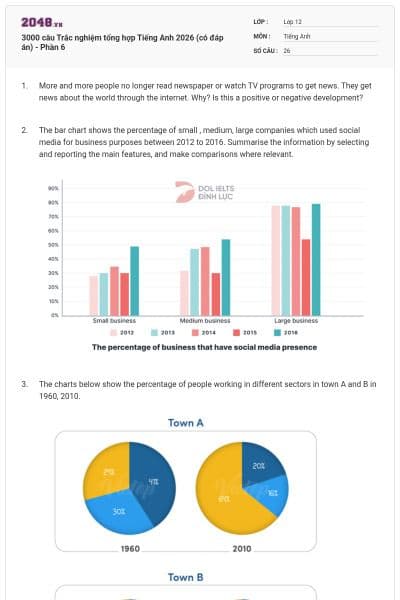
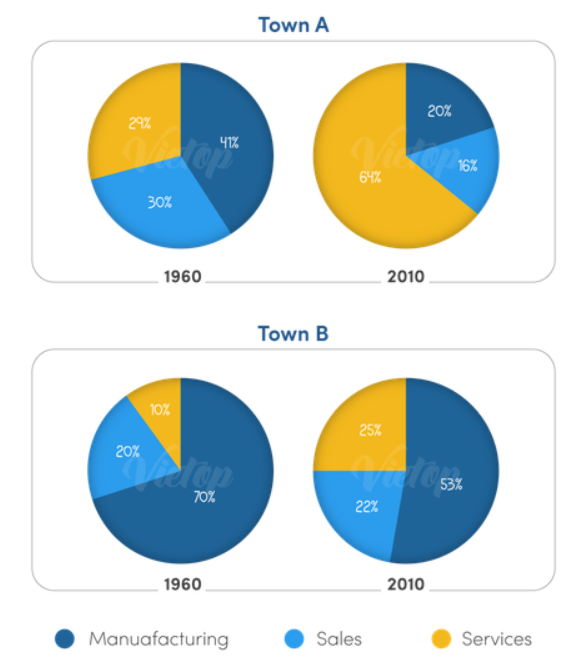
The charts below show the percentage of people working in different sectors in town A and B in 1960, 2010.
Hướng dẫn giải:
Gợi ý 1:
The pie charts compare the proportions of people working in three sectors—manufacturing, sales, and services—in Town A and Town B in 1960 and 2010. Overall, both towns experienced a decline in manufacturing employment and a rise in services over the 50-year period, though the changes were more dramatic in Town A.
In 1960, manufacturing was the largest employment sector in both towns, accounting for 41% in Town A and a much higher 70% in Town B. Sales represented 30% in Town A and 20% in Town B, while services were the smallest sector in both, at 29% and 10% respectively.
By 2010, the employment structure had shifted significantly. In Town A, services became dominant, rising sharply to 64%, while manufacturing fell to 20% and sales dropped slightly to 16%. Town B also saw a decline in manufacturing, though it remained the largest sector at 53%. Services increased to 25%, and sales rose marginally to 22%.
In summary, both towns moved away from manufacturing toward service-based employment between 1960 and 2010, with Town A showing a more pronounced transformation than Town B.
(Các biểu đồ tròn so sánh tỷ lệ người làm việc trong ba lĩnh vực — sản xuất, bán hàng và dịch vụ — ở thị trấn A và thị trấn B vào năm 1960 và 2010. Nhìn chung, cả hai thị trấn đều chứng kiến sự sụt giảm trong việc làm ngành sản xuất và sự gia tăng trong lĩnh vực dịch vụ, mặc dù sự thay đổi rõ rệt hơn ở thị trấn A.
Năm 1960, sản xuất là lĩnh vực việc làm lớn nhất ở cả hai thị trấn, chiếm 41% ở thị trấn A và cao hơn nhiều ở thị trấn B với 70%. Bán hàng chiếm 30% ở thị trấn A và 20% ở thị trấn B, trong khi dịch vụ là lĩnh vực nhỏ nhất ở cả hai, lần lượt là 29% và 10%.
Đến năm 2010, cơ cấu việc làm đã thay đổi đáng kể. Ở thị trấn A, dịch vụ trở thành lĩnh vực chủ đạo, tăng mạnh lên 64%, trong khi sản xuất giảm xuống còn 20% và bán hàng giảm nhẹ xuống 16%. Thị trấn B cũng chứng kiến sự sụt giảm trong sản xuất, mặc dù nó vẫn là lĩnh vực lớn nhất với 53%. Dịch vụ tăng lên 25% và bán hàng tăng nhẹ lên 22%.
Tóm lại, cả hai thị trấn đều chuyển từ sản xuất sang dịch vụ trong giai đoạn 1960–2010, với thị trấn A có sự chuyển đổi rõ rệt hơn thị trấn B.)
Gợi ý 2:
The charts illustrate the distribution of employment across manufacturing, sales, and services in Town A and Town B in 1960 and 2010. It is clear that the importance of manufacturing declined in both towns, while the service sector expanded considerably.
In 1960, manufacturing was the main source of employment, particularly in Town B, where it accounted for 70% of jobs. Town A had a smaller share at 41%. Sales made up 30% in Town A and 20% in Town B, whereas services were relatively minor, at 29% and 10% respectively.
By 2010, the situation had changed dramatically, especially in Town A. The proportion of people working in services rose to 64%, overtaking manufacturing, which fell to 20%. Sales also decreased slightly to 16%. In Town B, manufacturing remained the largest sector but dropped to 53%. Meanwhile, services increased to 25%, and sales grew modestly to 22%.
Overall, both towns shifted from manufacturing toward services over the 50-year period, with Town A undergoing a more significant transformation than Town B.
(Các biểu đồ minh họa sự phân bố việc làm trong ba lĩnh vực — sản xuất, bán hàng và dịch vụ — ở thị trấn A và thị trấn B vào năm 1960 và 2010. Rõ ràng rằng tầm quan trọng của ngành sản xuất đã giảm ở cả hai thị trấn, trong khi lĩnh vực dịch vụ tăng mạnh.
Năm 1960, sản xuất là nguồn việc làm chính, đặc biệt ở thị trấn B, nơi chiếm 70% tổng số việc làm. Thị trấn A có tỷ lệ thấp hơn, 41%. Bán hàng chiếm 30% ở thị trấn A và 20% ở thị trấn B, trong khi dịch vụ chỉ chiếm 29% và 10% tương ứng.
Đến năm 2010, tình hình thay đổi đáng kể, đặc biệt ở thị trấn A. Tỷ lệ người làm việc trong lĩnh vực dịch vụ tăng lên 64%, vượt qua sản xuất, vốn giảm xuống còn 20%. Bán hàng cũng giảm nhẹ xuống 16%. Ở thị trấn B, sản xuất vẫn là lĩnh vực lớn nhất nhưng giảm xuống 53%. Trong khi đó, dịch vụ tăng lên 25% và bán hàng tăng nhẹ lên 22%.
Nhìn chung, cả hai thị trấn đều chuyển dịch từ sản xuất sang dịch vụ trong 50 năm, với thị trấn A có sự thay đổi mạnh mẽ hơn thị trấn B.)
In many countries, plastic containers have become more popular than ever. They are used in many businesses, for example, the food and drink industries. Do you think the advantages outweigh the disadvantages?
Hướng dẫn giải:
Gợi ý 1:
In many countries, plastic containers are increasingly used in various industries, especially food and drink. Although they offer convenience and cost efficiency, I believe their disadvantages outweigh the benefits due to their environmental impact.
On the one hand, plastic containers have several advantages. They are lightweight, durable, and inexpensive to produce, making them ideal for packaging and transportation. Businesses benefit from reduced costs and improved efficiency, while consumers enjoy convenience, as plastic packaging keeps food fresh and prevents contamination. Moreover, plastics are versatile and can be molded into different shapes, which helps companies design attractive products.
On the other hand, the widespread use of plastic containers has serious drawbacks. The most significant issue is environmental pollution. Plastics are non-biodegradable and often end up in oceans and landfills, harming wildlife and ecosystems. Microplastics also contaminate water sources and enter the food chain, posing health risks to humans. Furthermore, the production of plastic relies on fossil fuels, contributing to greenhouse gas emissions and climate change.
In conclusion, while plastic containers provide practical and economic benefits, their long-term environmental consequences are far more damaging. Therefore, the disadvantages clearly outweigh the advantages, and governments should encourage the use of sustainable alternatives.
(Ở nhiều quốc gia, hộp nhựa ngày càng được sử dụng phổ biến trong nhiều ngành, đặc biệt là thực phẩm và đồ uống. Mặc dù chúng mang lại sự tiện lợi và hiệu quả chi phí, tôi cho rằng nhược điểm của chúng lớn hơn lợi ích do tác động tiêu cực đến môi trường.
Một mặt, hộp nhựa có nhiều ưu điểm. Chúng nhẹ, bền và rẻ, rất phù hợp cho việc đóng gói và vận chuyển. Doanh nghiệp được hưởng lợi từ chi phí thấp và hiệu quả cao, trong khi người tiêu dùng thấy tiện lợi vì bao bì nhựa giúp giữ thực phẩm tươi và tránh nhiễm bẩn. Ngoài ra, nhựa có thể được tạo hình linh hoạt, giúp các công ty thiết kế sản phẩm hấp dẫn hơn.
Mặt khác, việc sử dụng rộng rãi hộp nhựa gây ra nhiều hậu quả nghiêm trọng. Vấn đề lớn nhất là ô nhiễm môi trường. Nhựa không phân hủy sinh học và thường bị thải ra đại dương hoặc bãi rác, gây hại cho động vật và hệ sinh thái. Vi nhựa cũng làm ô nhiễm nguồn nước và đi vào chuỗi thực phẩm, gây nguy hiểm cho sức khỏe con người. Hơn nữa, sản xuất nhựa phụ thuộc vào nhiên liệu hóa thạch, góp phần vào phát thải khí nhà kính và biến đổi khí hậu.
Tóm lại, mặc dù hộp nhựa mang lại lợi ích thực tế và kinh tế, nhưng hậu quả môi trường lâu dài của chúng gây hại nhiều hơn. Do đó, nhược điểm rõ ràng lớn hơn ưu điểm, và chính phủ nên khuyến khích sử dụng vật liệu bền vững thay thế.)
Gợi ý 2:
Plastic containers have become increasingly common in modern industries, particularly in food and beverage packaging. Although they bring certain benefits, I believe their negative effects on the environment make them more harmful than useful.
The popularity of plastic containers can be attributed to their convenience and affordability. They are lightweight, waterproof, and easy to transport, which helps businesses reduce costs and improve efficiency. For consumers, plastic packaging ensures hygiene and extends the shelf life of products. In addition, plastics are versatile and can be recycled for various purposes, which seems beneficial in theory.
However, the disadvantages are more significant. Plastic waste has become one of the world’s most pressing environmental problems. Most plastic containers are single-use and end up polluting oceans and soil. Marine animals often mistake plastic for food, leading to fatal consequences. Moreover, recycling is not always effective, as only a small percentage of plastics are actually reused. The rest contributes to long-term pollution and carbon emissions.
To sum up, although plastic containers offer convenience and cost savings, their environmental damage far outweighs these benefits. Promoting biodegradable materials and stricter waste management is essential to reduce their negative impact.
(Hộp nhựa ngày càng trở nên phổ biến trong các ngành công nghiệp hiện đại, đặc biệt là trong đóng gói thực phẩm và đồ uống. Mặc dù chúng có một số lợi ích, tôi tin rằng tác động tiêu cực đến môi trường khiến chúng gây hại nhiều hơn là có ích.
Sự phổ biến của hộp nhựa xuất phát từ tính tiện lợi và giá thành rẻ. Chúng nhẹ, chống thấm nước và dễ vận chuyển, giúp doanh nghiệp giảm chi phí và tăng hiệu quả. Đối với người tiêu dùng, bao bì nhựa đảm bảo vệ sinh và kéo dài thời hạn sử dụng sản phẩm. Ngoài ra, nhựa có thể tái chế cho nhiều mục đích khác nhau, điều này có vẻ hữu ích về lý thuyết.
Tuy nhiên, nhược điểm lại nghiêm trọng hơn. Rác thải nhựa đã trở thành một trong những vấn đề môi trường cấp bách nhất thế giới. Phần lớn hộp nhựa chỉ dùng một lần và gây ô nhiễm đại dương, đất đai. Động vật biển thường nhầm nhựa là thức ăn, dẫn đến hậu quả chết chóc. Hơn nữa, việc tái chế không phải lúc nào cũng hiệu quả, vì chỉ một phần nhỏ nhựa được tái sử dụng. Phần còn lại góp phần vào ô nhiễm lâu dài và phát thải carbon.
Tóm lại, mặc dù hộp nhựa mang lại sự tiện lợi và tiết kiệm chi phí, nhưng thiệt hại môi trường mà chúng gây ra lớn hơn nhiều. Việc thúc đẩy sử dụng vật liệu phân hủy sinh học và quản lý rác thải nghiêm ngặt là cần thiết để giảm tác động tiêu cực này.)
In the future, nobody will buy printed newspapers or books because they will be able to read everything they want online without paying. To what extent do you agree or disagree with the statement?
Hướng dẫn giải:
Gợi ý 1:
It is often argued that printed newspapers and books will eventually disappear because people can access everything online for free. While I agree that digital platforms are becoming dominant, I do not believe that printed materials will vanish completely.
On the one hand, the internet offers undeniable advantages. Online news and e-books are instant, convenient, and often free of charge. Readers can access a wide range of information from anywhere in the world using smartphones or laptops. Moreover, digital platforms allow interactive features such as hyperlinks, videos, and comments, which make reading more engaging than traditional print. For businesses, online publishing reduces printing costs and environmental impact.
On the other hand, printed newspapers and books still hold value. Many readers prefer the tactile experience of holding a book or newspaper, which cannot be replicated digitally. Printed materials are also more reliable, as online sources may contain misinformation. Furthermore, not everyone has access to the internet, especially in rural or underdeveloped areas, so printed materials remain essential for inclusivity.
In conclusion, although online platforms are increasingly popular, printed newspapers and books will continue to exist, serving readers who value tradition, reliability, and accessibility. Therefore, I disagree that they will completely disappear.
(Nhiều người cho rằng báo in và sách sẽ biến mất vì mọi người có thể đọc mọi thứ trực tuyến miễn phí. Mặc dù tôi đồng ý rằng nền tảng kỹ thuật số đang chiếm ưu thế, tôi không tin rằng tài liệu in sẽ hoàn toàn biến mất.
Một mặt, internet mang lại lợi ích rõ ràng. Tin tức trực tuyến và sách điện tử nhanh chóng, tiện lợi và thường miễn phí. Người đọc có thể tiếp cận thông tin từ khắp nơi trên thế giới bằng điện thoại hoặc máy tính. Hơn nữa, nền tảng kỹ thuật số cho phép các tính năng tương tác như liên kết, video và bình luận, khiến việc đọc hấp dẫn hơn. Đối với doanh nghiệp, xuất bản trực tuyến giảm chi phí in ấn và tác động môi trường.
Mặt khác, báo và sách in vẫn có giá trị. Nhiều người thích cảm giác cầm sách hoặc báo trên tay, điều mà kỹ thuật số không thể thay thế. Tài liệu in cũng đáng tin cậy hơn, vì nguồn trực tuyến có thể chứa thông tin sai lệch. Ngoài ra, không phải ai cũng có internet, đặc biệt ở vùng nông thôn hoặc kém phát triển, nên tài liệu in vẫn cần thiết để đảm bảo tính bao quát.
Tóm lại, mặc dù nền tảng trực tuyến ngày càng phổ biến, báo và sách in sẽ tiếp tục tồn tại, phục vụ những người coi trọng truyền thống, độ tin cậy và khả năng tiếp cận. Do đó, tôi không đồng ý rằng chúng sẽ hoàn toàn biến mất.)
Gợi ý 2:
Some people believe that printed newspapers and books will no longer be purchased in the future because all information will be available online for free. I partly agree with this statement, but I think printed materials will still survive in certain contexts.
The main reason for the decline of print media is convenience. Online platforms provide instant access to news and literature without cost. Readers can download e-books or read articles anytime, eliminating the need to visit bookstores or wait for newspapers. In addition, digital content is environmentally friendly, as it reduces paper consumption and printing waste.
However, printed materials offer unique benefits. Books are often collected as cultural or personal treasures, and many people enjoy the sensory experience of reading a physical copy. Printed newspapers also provide credibility, as they are usually produced under strict editorial standards, unlike some online sources that spread fake news. Moreover, certain professional and academic fields still rely on printed publications for reference and preservation.
Overall, while digital platforms will dominate in the future, printed newspapers and books will not disappear entirely. They will remain valuable for cultural, educational, and personal reasons, even if their role becomes smaller.
(Một số người tin rằng báo và sách in sẽ không còn được mua trong tương lai vì mọi thông tin sẽ có sẵn trực tuyến miễn phí. Tôi phần nào đồng ý với nhận định này, nhưng tôi nghĩ tài liệu in vẫn tồn tại trong một số bối cảnh.
Nguyên nhân chính khiến báo in suy giảm là sự tiện lợi. Nền tảng trực tuyến cung cấp tin tức và văn học tức thì, không mất phí. Người đọc có thể tải sách điện tử hoặc đọc bài viết bất cứ lúc nào, không cần đến hiệu sách hay chờ báo phát hành. Ngoài ra, nội dung kỹ thuật số thân thiện với môi trường vì giảm tiêu thụ giấy và chất thải in ấn.
Tuy nhiên, tài liệu in mang lại lợi ích riêng. Sách thường được sưu tầm như kho báu văn hóa hoặc cá nhân, và nhiều người thích trải nghiệm cảm giác đọc bản in. Báo in cũng có độ tin cậy cao hơn, vì thường được sản xuất theo tiêu chuẩn biên tập nghiêm ngặt, khác với một số nguồn trực tuyến lan truyền tin giả. Hơn nữa, một số lĩnh vực chuyên môn và học thuật vẫn dựa vào ấn phẩm in để tham khảo và lưu trữ.
Nhìn chung, mặc dù nền tảng kỹ thuật số sẽ chiếm ưu thế trong tương lai, báo và sách in sẽ không hoàn toàn biến mất. Chúng vẫn có giá trị về văn hóa, giáo dục và cá nhân, dù vai trò sẽ nhỏ hơn.)
Some people believe that the care of elderly people should be a priority of government spending. Others believe that government spending should focus more on young people, especially on their education. Discuss both views and give your opinion.
Hướng dẫn giải:
Gợi ý 1:
Some argue that governments should prioritize spending on elderly care, while others believe that investment in young people, particularly education, is more important. In my view, both areas deserve attention, but education should take precedence as it ensures long-term national development.
On the one hand, elderly care is essential because older citizens often face health problems and financial insecurity. Many retirees depend on pensions or government support, and without adequate funding, they may struggle to afford medical treatment or daily living expenses. Providing care for the elderly also reflects social responsibility, as they have contributed to society throughout their lives.
On the other hand, focusing on young people, especially education, is crucial for the future. Education equips the younger generation with skills and knowledge to drive economic growth and innovation. If governments neglect education, societies risk stagnation and unemployment. Moreover, investing in youth creates a more productive workforce, which in turn generates tax revenue that can later support elderly care.
In conclusion, while elderly care is important for social welfare, education should be the primary focus of government spending because it ensures sustainable development and benefits all generations in the long run.
(Một số người cho rằng chính phủ nên ưu tiên chi tiêu cho việc chăm sóc người cao tuổi, trong khi những người khác tin rằng đầu tư vào giới trẻ, đặc biệt là giáo dục, quan trọng hơn. Theo tôi, cả hai lĩnh vực đều cần được chú ý, nhưng giáo dục nên được đặt lên hàng đầu vì nó đảm bảo sự phát triển lâu dài của quốc gia.
Một mặt, chăm sóc người cao tuổi là cần thiết vì họ thường gặp vấn đề sức khỏe và khó khăn tài chính. Nhiều người nghỉ hưu phụ thuộc vào lương hưu hoặc hỗ trợ của chính phủ, và nếu không có nguồn tài chính đầy đủ, họ có thể khó chi trả cho việc điều trị y tế hoặc chi phí sinh hoạt hàng ngày. Việc chăm sóc người cao tuổi cũng thể hiện trách nhiệm xã hội, vì họ đã đóng góp cho cộng đồng trong suốt cuộc đời.
Mặt khác, tập trung vào giới trẻ, đặc biệt là giáo dục, rất quan trọng cho tương lai. Giáo dục trang bị cho thế hệ trẻ kỹ năng và kiến thức để thúc đẩy tăng trưởng kinh tế và đổi mới. Nếu chính phủ bỏ qua giáo dục, xã hội có nguy cơ trì trệ và thất nghiệp. Hơn nữa, đầu tư vào giới trẻ tạo ra lực lượng lao động năng suất hơn, từ đó tạo ra nguồn thuế để hỗ trợ người cao tuổi sau này.
Tóm lại, mặc dù chăm sóc người cao tuổi quan trọng đối với phúc lợi xã hội, giáo dục nên là trọng tâm chi tiêu của chính phủ vì nó đảm bảo sự phát triển bền vững và mang lại lợi ích cho mọi thế hệ về lâu dài.)
Gợi ý 2:
It is often debated whether government spending should prioritize elderly care or youth education. I believe that both are necessary, but education should receive greater emphasis as it builds the foundation for a prosperous society.
Supporters of elderly care argue that older citizens deserve dignity and support after a lifetime of contribution. Healthcare costs rise with age, and without sufficient government funding, many elderly people may face poverty or illness. Furthermore, caring for the elderly strengthens family and social bonds, promoting compassion and stability.
However, education for young people is equally, if not more, important. A well-educated population is the driving force behind technological progress, economic competitiveness, and social advancement. For example, countries that invest heavily in education often achieve higher living standards and stronger economies. Additionally, educated youth are better equipped to care for the elderly in the future, creating a cycle of support.
Overall, while elderly care is vital for social justice, prioritizing education ensures long-term benefits for society. Governments should strike a balance, but education must remain the cornerstone of public investment.
(Người ta thường tranh luận rằng chi tiêu của chính phủ nên ưu tiên chăm sóc người cao tuổi hay giáo dục giới trẻ. Tôi tin rằng cả hai đều cần thiết, nhưng giáo dục nên được nhấn mạnh hơn vì nó xây dựng nền tảng cho một xã hội thịnh vượng.
Những người ủng hộ chăm sóc người cao tuổi cho rằng họ xứng đáng được sống trong nhân phẩm và nhận hỗ trợ sau cả đời đóng góp. Chi phí y tế tăng theo tuổi, và nếu không có nguồn tài chính đủ, nhiều người cao tuổi có thể rơi vào cảnh nghèo đói hoặc bệnh tật. Hơn nữa, chăm sóc người cao tuổi củng cố mối quan hệ gia đình và xã hội, thúc đẩy lòng nhân ái và sự ổn định.
Tuy nhiên, giáo dục cho giới trẻ cũng quan trọng không kém, thậm chí còn hơn. Một dân số được giáo dục tốt là động lực thúc đẩy tiến bộ công nghệ, khả năng cạnh tranh kinh tế và sự phát triển xã hội. Ví dụ, những quốc gia đầu tư mạnh vào giáo dục thường đạt mức sống cao hơn và nền kinh tế vững mạnh hơn. Ngoài ra, giới trẻ được giáo dục tốt sẽ có khả năng chăm sóc người cao tuổi trong tương lai, tạo ra vòng tuần hoàn hỗ trợ.
Nhìn chung, mặc dù chăm sóc người cao tuổi rất quan trọng đối với công bằng xã hội, nhưng ưu tiên giáo dục đảm bảo lợi ích lâu dài cho xã hội. Chính phủ nên cân bằng, nhưng giáo dục phải là nền tảng của đầu tư công.)
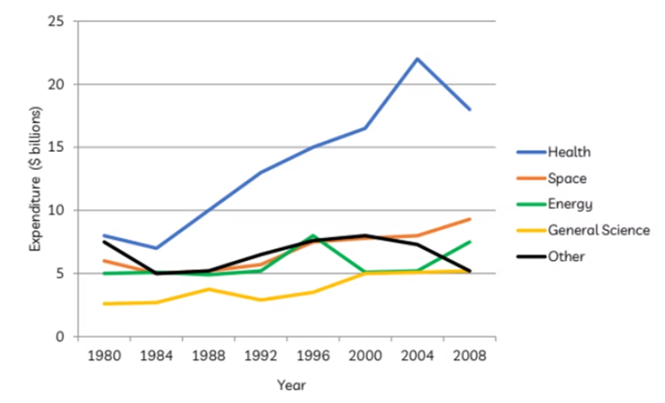
The graph below gives information about U.S. government spending on research between 1980 and 2008.
Summarise the information by selecting and reporting the main features, and make comparisons where relevant.
Write at least 150 words.
Hướng dẫn giải:
Gợi ý 1:
The line graph illustrates how much money the U.S. government spent on research in five different sectors—health, space, energy, general science, and other areas—from 1980 to 2008. Overall, expenditure on health research increased dramatically, while spending on other sectors remained relatively stable or declined slightly.
In 1980, health research received the highest funding at around $8 billion, followed by other areas and space at approximately $7 billion and $6 billion respectively. Energy and general science were the least funded sectors, both below $5 billion. Over the next two decades, spending on health rose steadily, reaching a peak of nearly $20 billion in 2004 before falling slightly by 2008.
By contrast, expenditure on space research grew gradually from $6 billion to about $9 billion by 2008. Energy research fluctuated, peaking at around $9 billion in 1996 before dropping to $6 billion in 2008. General science showed a modest upward trend, increasing from $3 billion to $5 billion. Spending on other areas remained stable until 2000, then declined to $5 billion by the end of the period.
In summary, health research consistently attracted the most funding, while other sectors experienced minor changes or declines over the 28-year period.
(Biểu đồ đường minh họa số tiền mà chính phủ Hoa Kỳ chi cho nghiên cứu trong năm lĩnh vực khác nhau — y tế, không gian, năng lượng, khoa học tổng quát và các lĩnh vực khác — từ năm 1980 đến 2008. Nhìn chung, chi tiêu cho nghiên cứu y tế tăng mạnh, trong khi các lĩnh vực khác tương đối ổn định hoặc giảm nhẹ.
Năm 1980, nghiên cứu y tế nhận được nguồn tài trợ cao nhất, khoảng 8 tỷ USD, tiếp theo là các lĩnh vực khác và không gian với khoảng 7 tỷ và 6 tỷ USD. Năng lượng và khoa học tổng quát là hai lĩnh vực được tài trợ ít nhất, đều dưới 5 tỷ USD. Trong hai thập kỷ tiếp theo, chi tiêu cho y tế tăng đều, đạt đỉnh gần 20 tỷ USD vào năm 2004 trước khi giảm nhẹ vào năm 2008.
Ngược lại, chi tiêu cho nghiên cứu không gian tăng dần từ 6 tỷ lên khoảng 9 tỷ USD vào năm 2008. Nghiên cứu năng lượng biến động, đạt đỉnh khoảng 9 tỷ USD vào năm 1996 rồi giảm xuống 6 tỷ USD vào năm 2008. Khoa học tổng quát tăng nhẹ từ 3 tỷ lên 5 tỷ USD. Chi tiêu cho các lĩnh vực khác ổn định đến năm 2000, sau đó giảm xuống 5 tỷ USD vào cuối giai đoạn.
Tóm lại, nghiên cứu y tế luôn nhận được nguồn tài trợ lớn nhất, trong khi các lĩnh vực khác chỉ có thay đổi nhỏ hoặc giảm nhẹ trong suốt 28 năm.)
Gợi ý 2:
The graph shows U.S. government expenditure on research in five fields—health, space, energy, general science, and other—from 1980 to 2008. It is clear that spending on health rose sharply, whereas other categories saw little growth or even a decline.
In 1980, health was the largest area of investment, at about $8 billion, while space and other sectors followed closely behind. Energy and general science received the least funding, at around $5 billion and $3 billion respectively. Between 1980 and 2004, health spending increased significantly, reaching a peak of $20 billion before falling slightly to $17 billion in 2008.
Space research funding grew steadily throughout the period, rising from $6 billion to $9 billion. Energy spending fluctuated, peaking at $9 billion in the mid-1990s but ending lower at $6 billion. General science showed a slow but consistent increase, while expenditure on other areas remained stable until 2000 and then declined.
Overall, the U.S. government prioritized health research, with its funding far exceeding that of other sectors by the end of the period.
(Biểu đồ cho thấy chi tiêu của chính phủ Hoa Kỳ cho nghiên cứu trong năm lĩnh vực — y tế, không gian, năng lượng, khoa học tổng quát và các lĩnh vực khác — từ năm 1980 đến 2008. Rõ ràng rằng chi tiêu cho y tế tăng mạnh, trong khi các lĩnh vực khác tăng ít hoặc giảm.
Năm 1980, y tế là lĩnh vực được đầu tư nhiều nhất, khoảng 8 tỷ USD, trong khi không gian và các lĩnh vực khác theo sau. Năng lượng và khoa học tổng quát nhận được ít tài trợ nhất, lần lượt khoảng 5 tỷ và 3 tỷ USD. Từ năm 1980 đến 2004, chi tiêu cho y tế tăng đáng kể, đạt đỉnh 20 tỷ USD trước khi giảm nhẹ xuống 17 tỷ USD vào năm 2008.
Chi tiêu cho nghiên cứu không gian tăng đều trong suốt giai đoạn, từ 6 tỷ lên 9 tỷ USD. Năng lượng biến động, đạt đỉnh 9 tỷ USD vào giữa thập niên 1990 nhưng kết thúc thấp hơn ở mức 6 tỷ USD. Khoa học tổng quát tăng chậm nhưng ổn định, trong khi chi tiêu cho các lĩnh vực khác giữ nguyên đến năm 2000 rồi giảm.
Nhìn chung, chính phủ Hoa Kỳ ưu tiên nghiên cứu y tế, với nguồn tài trợ vượt xa các lĩnh vực khác vào cuối giai đoạn.)
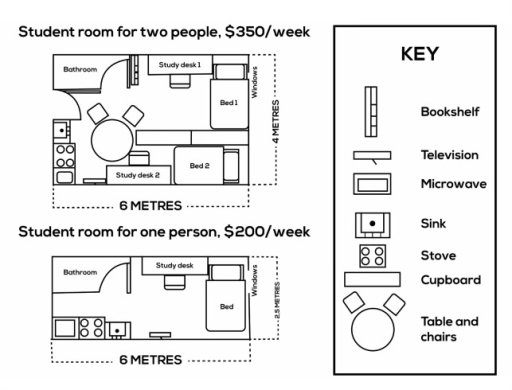
The plans below show a student room for two people and a student room for one person at an Australian University. Summarize the information by selecting and reporting the main features and make comparisons where relevant.
Hướng dẫn giải:
Gợi ý 1:
The diagrams compare two types of student accommodation at an Australian university: one for two people and another for a single occupant. Overall, the room for two people is larger, more expensive, and equipped with more furniture and facilities than the single room.
The two-person room, measuring 6 metres by 4 metres, costs $350 per week. It contains two beds and two study desks, each with its own chair and bookshelf. The room also includes a shared bathroom, a kitchen area with a sink, stove, microwave, and cupboard, as well as a small dining area with a table and two chairs. A television is provided for entertainment.
By contrast, the single room is smaller, measuring 6 metres by 3.5 metres, and costs $200 per week. It has one bed, one study desk, and similar kitchen and bathroom facilities. However, it lacks a television and has fewer pieces of furniture, reflecting its simpler design and lower price.
In summary, the two-person room offers more space and amenities suitable for shared living, while the single room provides a more compact and private environment at a lower cost.
(Các sơ đồ so sánh hai loại phòng ký túc xá dành cho sinh viên tại một trường đại học ở Úc: một phòng cho hai người và một phòng cho một người. Nhìn chung, phòng cho hai người rộng hơn, đắt hơn và được trang bị nhiều tiện nghi hơn so với phòng đơn.
Phòng hai người, có kích thước 6 mét x 4 mét, giá 350 đô la mỗi tuần. Phòng có hai giường và hai bàn học, mỗi bàn có ghế và kệ sách riêng. Ngoài ra còn có phòng tắm chung, khu bếp với bồn rửa, bếp, lò vi sóng và tủ đựng đồ, cùng khu ăn uống nhỏ với bàn và hai ghế. Phòng còn được trang bị tivi để giải trí.
Ngược lại, phòng một người nhỏ hơn, kích thước 6 mét x 3,5 mét, giá 200 đô la mỗi tuần. Phòng có một giường, một bàn học và các tiện nghi tương tự ở khu bếp và phòng tắm. Tuy nhiên, phòng không có tivi và ít đồ nội thất hơn, phù hợp với thiết kế đơn giản và giá thấp hơn.
Tóm lại, phòng hai người mang lại không gian rộng rãi và nhiều tiện nghi hơn cho việc sống chung, trong khi phòng một người mang đến môi trường riêng tư và tiết kiệm chi phí hơn.)
Gợi ý 2:
The plans illustrate two types of student rooms at an Australian university: one designed for two students and another for one. It is clear that the shared room is larger and more expensive, while the single room is smaller and more basic.
The shared room measures 6 metres in length and 4 metres in width, costing $350 per week. It includes two beds and two study desks, allowing each student to have a personal workspace. The room also features a shared bathroom and a kitchen equipped with a sink, stove, microwave, and cupboard. A table with two chairs and a television are provided for communal use.
In comparison, the single room is 6 metres long and 3.5 metres wide, with a weekly rent of $200. It contains one bed and one study desk, along with similar kitchen and bathroom facilities. However, it lacks a television and has fewer furnishings, making it more suitable for students who prefer privacy and simplicity.
Overall, the two-person room provides more comfort and shared facilities, while the single room offers a quieter and more affordable option.
(Các sơ đồ minh họa hai loại phòng ký túc xá dành cho sinh viên tại một trường đại học ở Úc: một phòng cho hai sinh viên và một phòng cho một người. Rõ ràng rằng phòng chung lớn hơn và đắt hơn, trong khi phòng đơn nhỏ hơn và đơn giản hơn.
Phòng chung có kích thước 6 mét dài và 4 mét rộng, giá 350 đô la mỗi tuần. Phòng có hai giường và hai bàn học, cho phép mỗi sinh viên có không gian làm việc riêng. Ngoài ra, phòng có phòng tắm chung và khu bếp với bồn rửa, bếp, lò vi sóng và tủ đựng đồ. Một bàn ăn với hai ghế và tivi được bố trí để sử dụng chung.
So với đó, phòng một người có kích thước 6 mét dài và 3,5 mét rộng, giá 200 đô la mỗi tuần. Phòng có một giường và một bàn học, cùng các tiện nghi tương tự ở khu bếp và phòng tắm. Tuy nhiên, phòng không có tivi và ít đồ nội thất hơn, phù hợp với sinh viên thích sự riêng tư và đơn giản.
Nhìn chung, phòng hai người mang lại sự thoải mái và nhiều tiện ích hơn, trong khi phòng một người là lựa chọn yên tĩnh và tiết kiệm hơn.)
Describe a new store/shop that just opened in your area.
Hướng dẫn giải:
Gợi ý 1:
A new store that has recently opened in my area is a small organic grocery shop called Green Basket. It opened just a few weeks ago near the local market, and it has already attracted a lot of attention.
The shop mainly sells fresh fruits, vegetables, and other organic products such as rice, beans, and herbal teas. What makes it special is that all the items are sourced from local farms, so they are fresh and chemical-free. The store is not very large, but it is neatly arranged, with wooden shelves and eco-friendly packaging.
I visited the shop last weekend, and I was impressed by the friendly staff. They explained where the products came from and even gave me tips on how to cook certain vegetables. The prices are slightly higher than in supermarkets, but I think it is worth it because of the quality and the fact that it supports local farmers.
Overall, I feel this shop is a great addition to the neighborhood. It promotes healthy eating and sustainability, and I plan to shop there regularly.
(Một cửa hàng mới vừa mở ở khu vực tôi là cửa hàng thực phẩm hữu cơ nhỏ tên là Green Basket. Nó khai trương cách đây vài tuần gần chợ địa phương và đã thu hút khá nhiều sự chú ý.
Cửa hàng chủ yếu bán trái cây, rau củ tươi và các sản phẩm hữu cơ khác như gạo, đậu và trà thảo mộc. Điểm đặc biệt là tất cả đều được lấy từ các nông trại địa phương, nên rất tươi và không có hóa chất. Cửa hàng không lớn nhưng được sắp xếp gọn gàng, với kệ gỗ và bao bì thân thiện môi trường.
Tôi ghé cửa hàng vào cuối tuần trước và rất ấn tượng với nhân viên thân thiện. Họ giải thích nguồn gốc sản phẩm và còn cho tôi mẹo nấu một số loại rau. Giá có hơi cao hơn siêu thị, nhưng tôi nghĩ xứng đáng vì chất lượng và vì nó hỗ trợ nông dân địa phương.
Nhìn chung, tôi thấy cửa hàng này là một bổ sung tuyệt vời cho khu phố. Nó khuyến khích ăn uống lành mạnh và bền vững, và tôi dự định sẽ mua hàng thường xuyên.)
Gợi ý 2:
Recently, a new coffee shop called Urban Brew opened in my area, right next to the university. It has quickly become a popular spot for students and young professionals.
The shop has a modern design with cozy seating areas, free Wi-Fi, and soft background music. Apart from serving coffee, they also offer smoothies, pastries, and light meals. One unique feature is that they use reusable cups and encourage customers to bring their own, which shows their commitment to reducing plastic waste.
I went there with a friend last week, and we really enjoyed the atmosphere. The staff were welcoming, and the coffee tasted much better than what we usually get from chain stores. The prices are reasonable, and they even give discounts to students.
I think this shop will do very well because it combines good quality products with a comfortable environment. It is not just a place to drink coffee, but also somewhere to study, relax, or meet friends.
(Gần đây, một quán cà phê mới tên là Urban Brew đã mở ngay cạnh trường đại học. Nó nhanh chóng trở thành địa điểm yêu thích của sinh viên và giới trẻ đi làm.
Quán có thiết kế hiện đại với chỗ ngồi thoải mái, Wi-Fi miễn phí và nhạc nền nhẹ nhàng. Ngoài cà phê, họ còn phục vụ sinh tố, bánh ngọt và bữa nhẹ. Một điểm độc đáo là họ dùng cốc tái sử dụng và khuyến khích khách mang cốc riêng, thể hiện cam kết giảm rác thải nhựa.
Tuần trước tôi đi cùng một người bạn và rất thích không khí ở đó. Nhân viên thân thiện, cà phê ngon hơn nhiều so với các chuỗi cửa hàng. Giá cả hợp lý, và họ còn giảm giá cho sinh viên.
Tôi nghĩ quán này sẽ rất thành công vì kết hợp sản phẩm chất lượng với không gian thoải mái. Nó không chỉ là nơi uống cà phê mà còn là chỗ học tập, thư giãn hoặc gặp gỡ bạn bè.)
An increasing number of people are choosing cosmetic surgery for changing their appearance. What can be the reasons for this? Do you think it’s a positive or negative development?
Hướng dẫn giải:
Gợi ý 1:
An increasing number of people are undergoing cosmetic surgery to change their appearance. This trend is driven by social, psychological, and economic factors, and I believe it has more negative than positive consequences.
One major reason is the influence of social media and celebrity culture. People are constantly exposed to images of “perfect” bodies and faces, which creates pressure to conform to unrealistic beauty standards. Another factor is the growing affordability and accessibility of cosmetic procedures. Clinics advertise heavily, making surgery appear safe and routine. In addition, some individuals seek cosmetic surgery to boost self-confidence or improve career prospects, especially in industries where appearance plays a significant role.
Despite these motivations, the trend has serious drawbacks. Cosmetic surgery carries health risks, including infections, complications, and long recovery times. It can also lead to psychological issues, as people may become overly dependent on surgery to feel attractive. Furthermore, the pursuit of artificial beauty often reinforces superficial values in society, overshadowing qualities such as intelligence and kindness.
In conclusion, while cosmetic surgery may provide short-term satisfaction, its risks and social consequences outweigh the benefits. I consider this a negative development, as it promotes unrealistic ideals and undermines genuine self-acceptance.
(Ngày càng nhiều người lựa chọn phẫu thuật thẩm mỹ để thay đổi ngoại hình. Xu hướng này xuất phát từ yếu tố xã hội, tâm lý và kinh tế, và tôi cho rằng nó mang lại nhiều tác hại hơn lợi ích.
Nguyên nhân chính là ảnh hưởng của mạng xã hội và văn hóa người nổi tiếng. Con người thường xuyên tiếp xúc với hình ảnh “hoàn hảo”, tạo áp lực phải tuân theo tiêu chuẩn sắc đẹp phi thực tế. Một yếu tố khác là chi phí phẫu thuật ngày càng hợp lý và dễ tiếp cận. Các phòng khám quảng cáo rầm rộ, khiến phẫu thuật trở nên phổ biến và an toàn trong mắt công chúng. Ngoài ra, một số người tìm đến phẫu thuật thẩm mỹ để tăng sự tự tin hoặc cải thiện cơ hội nghề nghiệp, đặc biệt trong các ngành coi trọng ngoại hình.
Tuy nhiên, xu hướng này có nhiều hệ quả nghiêm trọng. Phẫu thuật thẩm mỹ tiềm ẩn rủi ro sức khỏe như nhiễm trùng, biến chứng và thời gian hồi phục dài. Nó cũng có thể dẫn đến vấn đề tâm lý, khi con người quá phụ thuộc vào phẫu thuật để cảm thấy hấp dẫn. Hơn nữa, việc chạy theo vẻ đẹp nhân tạo thường củng cố giá trị bề ngoài, làm lu mờ những phẩm chất như trí tuệ và lòng nhân hậu.
Tóm lại, mặc dù phẫu thuật thẩm mỹ có thể mang lại sự hài lòng ngắn hạn, nhưng rủi ro và hệ quả xã hội của nó lớn hơn nhiều. Tôi coi đây là một sự phát triển tiêu cực vì nó thúc đẩy lý tưởng phi thực tế và làm suy yếu sự chấp nhận bản thân.)
Gợi ý 2:
Cosmetic surgery has become increasingly popular worldwide, with more people choosing to alter their appearance. This phenomenon can be explained by cultural and personal reasons, but overall, I view it as a negative development.
The main reasons behind this trend are societal expectations and personal insecurities. In many cultures, physical attractiveness is highly valued, and individuals feel pressure to look young and flawless. Social media amplifies this by constantly showcasing edited images of celebrities and influencers. Moreover, advances in medical technology have made cosmetic procedures safer and more affordable, encouraging more people to try them. Some also believe that improving their looks can enhance confidence and open up opportunities in both personal and professional life.
However, the disadvantages are significant. Cosmetic surgery is not without risks, and failed procedures can cause permanent damage. It also fosters a culture of vanity, where people judge themselves and others based on appearance rather than character. Additionally, the financial burden of repeated surgeries can be considerable, especially for those who become addicted to altering their looks.
To sum up, although cosmetic surgery is becoming more common due to social and personal factors, I believe it is a negative development. It promotes superficial values and can harm both physical and mental well-being.
(Phẫu thuật thẩm mỹ ngày càng phổ biến trên toàn thế giới, với nhiều người chọn thay đổi ngoại hình. Hiện tượng này có thể được giải thích bởi lý do văn hóa và cá nhân, nhưng nhìn chung, tôi cho rằng đây là một sự phát triển tiêu cực.
Nguyên nhân chính là kỳ vọng xã hội và sự bất an cá nhân. Ở nhiều nền văn hóa, ngoại hình được coi trọng, và mọi người cảm thấy áp lực phải trẻ trung và hoàn hảo. Mạng xã hội càng làm trầm trọng thêm khi liên tục đăng tải hình ảnh chỉnh sửa của người nổi tiếng và influencer. Hơn nữa, tiến bộ y học khiến phẫu thuật thẩm mỹ an toàn và rẻ hơn, khuyến khích nhiều người thử. Một số người còn tin rằng cải thiện ngoại hình sẽ tăng sự tự tin và mở ra cơ hội trong cuộc sống cá nhân lẫn nghề nghiệp.
Tuy nhiên, nhược điểm rất đáng kể. Phẫu thuật thẩm mỹ không hề an toàn tuyệt đối, và những ca thất bại có thể gây tổn thương vĩnh viễn. Nó cũng nuôi dưỡng văn hóa phù phiếm, nơi con người đánh giá bản thân và người khác dựa trên ngoại hình thay vì tính cách. Ngoài ra, gánh nặng tài chính từ việc phẫu thuật nhiều lần có thể rất lớn, đặc biệt với những người nghiện thay đổi ngoại hình.
Tóm lại, mặc dù phẫu thuật thẩm mỹ ngày càng phổ biến do yếu tố xã hội và cá nhân, tôi tin rằng đây là một sự phát triển tiêu cực. Nó thúc đẩy giá trị bề ngoài và có thể gây hại cho cả sức khỏe thể chất lẫn tinh thần.)
Some people say that art (e.g. painting, music, poetry) can be made by everyone whereas others believe that it can be only made by those with special abilities. Discuss both views and give your opinion.
Hướng dẫn giải:
Gợi ý 1:
Some people argue that art, such as painting, music, or poetry, can be created by anyone, while others believe that only individuals with special talents are capable of producing true art. In my opinion, although talent plays a role, art is ultimately accessible to everyone.
On the one hand, those who believe art requires special abilities emphasize the importance of natural talent and training. For example, professional musicians often spend years mastering instruments, and painters may possess unique skills in color and composition. Such abilities allow them to produce works of high quality that can inspire and move audiences. Without these skills, some argue, art may lack depth or originality.
On the other hand, art is also a form of self-expression, and everyone has the capacity to express emotions and ideas creatively. A child drawing with crayons or a person writing simple poetry is still engaging in art, even if the work is not technically advanced. Moreover, modern technology has made artistic tools more accessible, allowing ordinary people to create music, digital art, or videos without formal training. This democratization of art shows that creativity is not limited to professionals.
In conclusion, while special abilities can enhance artistic quality, art is not exclusive to talented individuals. It is a universal form of human expression, and everyone can participate in it.
(Một số người cho rằng nghệ thuật như hội họa, âm nhạc hay thơ ca có thể được tạo ra bởi bất kỳ ai, trong khi những người khác tin rằng chỉ những người có tài năng đặc biệt mới có thể sáng tạo nghệ thuật thực sự. Theo tôi, mặc dù tài năng đóng vai trò quan trọng, nghệ thuật cuối cùng vẫn thuộc về mọi người.
Một mặt, những người tin rằng nghệ thuật cần khả năng đặc biệt nhấn mạnh tầm quan trọng của tài năng bẩm sinh và sự rèn luyện. Ví dụ, các nhạc sĩ chuyên nghiệp thường mất nhiều năm để thành thạo nhạc cụ, và họa sĩ có thể sở hữu kỹ năng độc đáo về màu sắc và bố cục. Những khả năng này giúp họ tạo ra tác phẩm chất lượng cao, có thể truyền cảm hứng và lay động khán giả.
Mặt khác, nghệ thuật cũng là một hình thức thể hiện bản thân, và ai cũng có khả năng bộc lộ cảm xúc và ý tưởng một cách sáng tạo. Một đứa trẻ vẽ bằng bút màu hay một người viết bài thơ đơn giản vẫn đang tham gia vào nghệ thuật, dù tác phẩm không quá tinh vi. Hơn nữa, công nghệ hiện đại đã khiến công cụ nghệ thuật dễ tiếp cận hơn, cho phép mọi người sáng tạo nhạc, nghệ thuật số hoặc video mà không cần đào tạo chính quy. Điều này cho thấy sự sáng tạo không chỉ giới hạn ở giới chuyên nghiệp.
Tóm lại, mặc dù khả năng đặc biệt có thể nâng cao chất lượng nghệ thuật, nhưng nghệ thuật không chỉ dành riêng cho người tài năng. Nó là hình thức biểu đạt phổ quát của con người, và ai cũng có thể tham gia.)
Gợi ý 2:
It is often debated whether art can be produced by everyone or only by those with exceptional abilities. I believe that both perspectives have merit, but art should be seen as something open to all.
Supporters of the view that art requires talent argue that great works are the result of extraordinary skills. Famous painters like Picasso or musicians like Mozart possessed abilities far beyond the average person, and their art continues to be admired centuries later. This suggests that true artistic achievement depends on rare gifts and rigorous practice.
However, art is not only about technical mastery but also about personal expression. Everyday people create art in various forms—writing poems, singing songs, or painting pictures—that reflect their emotions and experiences. Even if these works are not masterpieces, they still hold meaning for the creator and sometimes for others. Furthermore, contemporary art movements often value originality and personal perspective over technical perfection, which broadens the definition of who can be considered an artist.
Overall, while talent and skill can elevate art to a professional level, creativity is a universal human trait. Therefore, art should be regarded as something that everyone can make, regardless of ability.
(Người ta thường tranh luận rằng nghệ thuật có thể được tạo ra bởi tất cả mọi người hay chỉ bởi những người có khả năng xuất chúng. Tôi tin rằng cả hai quan điểm đều có lý, nhưng nghệ thuật nên được coi là thứ dành cho tất cả mọi người.
Những người ủng hộ quan điểm nghệ thuật cần tài năng cho rằng các tác phẩm vĩ đại là kết quả của kỹ năng phi thường. Những họa sĩ nổi tiếng như Picasso hay nhạc sĩ như Mozart sở hữu khả năng vượt xa người bình thường, và nghệ thuật của họ vẫn được ngưỡng mộ hàng thế kỷ sau. Điều này cho thấy thành tựu nghệ thuật thực sự phụ thuộc vào tài năng hiếm có và sự rèn luyện nghiêm túc.
Tuy nhiên, nghệ thuật không chỉ là kỹ thuật mà còn là sự thể hiện cá nhân. Người bình thường vẫn sáng tạo nghệ thuật dưới nhiều hình thức—viết thơ, hát, vẽ tranh—phản ánh cảm xúc và trải nghiệm của họ. Dù những tác phẩm này không phải kiệt tác, chúng vẫn có ý nghĩa đối với người sáng tạo và đôi khi cả người khác. Hơn nữa, các phong trào nghệ thuật đương đại thường coi trọng sự độc đáo và góc nhìn cá nhân hơn là sự hoàn hảo kỹ thuật, mở rộng định nghĩa về nghệ sĩ.
Nhìn chung, mặc dù tài năng và kỹ năng có thể nâng nghệ thuật lên tầm chuyên nghiệp, nhưng sáng tạo là đặc điểm phổ quát của con người. Do đó, nghệ thuật nên được coi là thứ mà ai cũng có thể tạo ra, bất kể khả năng.)
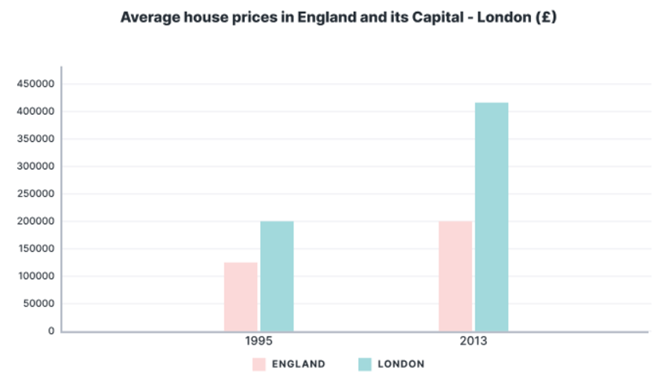
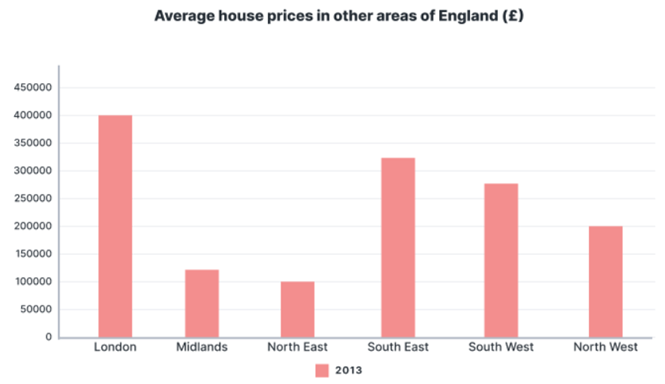
The bar charts illustrate the average house expenses in England and its capital city – London, and to present the comparison regarding the average house prices between distinct areas of England within the year 2013.
Hướng dẫn giải:
Gợi ý 1:
The bar charts illustrate the average house prices in England and its capital city, London, in 1995 and 2013, as well as the average prices in different regions of England in 2013. Overall, house prices increased significantly over the period, with London remaining the most expensive area.
In 1995, the average house price in England was around £125,000, while in London it was higher, at approximately £200,000. By 2013, both figures had risen considerably. The average price in England doubled to £200,000, whereas in London it more than doubled, reaching about £425,000. This indicates that the growth rate in London was much faster than the national average.
The second chart shows the variation in house prices across different regions of England in 2013. London had the highest average price, at roughly £400,000, followed by the South East (£320,000) and the South West (£280,000). In contrast, the North East had the lowest average price, at only £100,000, while the Midlands and North West were moderately priced at £120,000 and £200,000 respectively.
In summary, house prices rose sharply between 1995 and 2013, especially in London, which remained far more expensive than other regions of England.
(Các biểu đồ cột minh họa giá nhà trung bình ở Anh và thủ đô London vào năm 1995 và 2013, cũng như giá trung bình ở các vùng khác của Anh trong năm 2013. Nhìn chung, giá nhà tăng mạnh trong giai đoạn này, với London vẫn là khu vực đắt đỏ nhất.
Năm 1995, giá nhà trung bình ở Anh khoảng £125,000, trong khi ở London cao hơn, khoảng £200,000. Đến năm 2013, cả hai con số đều tăng đáng kể. Giá trung bình ở Anh tăng gấp đôi lên £200,000, còn ở London tăng hơn gấp đôi, đạt khoảng £425,000. Điều này cho thấy tốc độ tăng giá ở London nhanh hơn nhiều so với mức trung bình toàn quốc.
Biểu đồ thứ hai thể hiện sự khác biệt về giá nhà giữa các vùng của Anh năm 2013. London có giá trung bình cao nhất, khoảng £400,000, tiếp theo là vùng Đông Nam (£320,000) và Tây Nam (£280,000). Ngược lại, vùng Đông Bắc có giá thấp nhất, chỉ £100,000, trong khi vùng Midlands và Tây Bắc có giá trung bình lần lượt là £120,000 và £200,000.
Tóm lại, giá nhà tăng mạnh từ năm 1995 đến 2013, đặc biệt ở London, nơi vẫn đắt hơn nhiều so với các vùng khác của Anh.)
Gợi ý 2:
The two bar charts compare average house prices in England and London in 1995 and 2013, and show the average prices in various regions of England in 2013. It is clear that house prices increased dramatically over time, with London being the most expensive area by a large margin.
In 1995, houses in England cost around £125,000 on average, while those in London were priced at about £200,000. By 2013, the figures had risen to £200,000 and £425,000 respectively. This means that London’s house prices more than doubled, whereas the national average increased by roughly 60%.
The second chart reveals regional differences in 2013. London had the highest average house price, at £400,000, followed by the South East (£320,000) and the South West (£280,000). The North East was the cheapest region, with houses costing only £100,000 on average. The Midlands and North West were also relatively affordable, with prices of £120,000 and £200,000 respectively.
Overall, house prices in England rose substantially between 1995 and 2013, and London continued to dominate as the most expensive housing market in the country.
(Hai biểu đồ cột so sánh giá nhà trung bình ở Anh và London vào năm 1995 và 2013, đồng thời thể hiện giá trung bình ở các vùng khác của Anh năm 2013. Rõ ràng rằng giá nhà tăng mạnh theo thời gian, với London là khu vực đắt đỏ nhất.
Năm 1995, giá nhà trung bình ở Anh khoảng £125,000, trong khi ở London là £200,000. Đến năm 2013, các con số tăng lên £200,000 và £425,000 tương ứng. Điều này có nghĩa là giá nhà ở London tăng hơn gấp đôi, trong khi mức trung bình toàn quốc tăng khoảng 60%.
Biểu đồ thứ hai cho thấy sự khác biệt giữa các vùng năm 2013. London có giá nhà trung bình cao nhất, £400,000, tiếp theo là vùng Đông Nam (£320,000) và Tây Nam (£280,000). Vùng Đông Bắc là nơi rẻ nhất, với giá trung bình chỉ £100,000. Midlands và Tây Bắc cũng tương đối rẻ, với giá lần lượt là £120,000 và £200,000.
Nhìn chung, giá nhà ở Anh tăng đáng kể từ năm 1995 đến 2013, và London vẫn là thị trường nhà ở đắt đỏ nhất cả nước.)
Some people focus on news in their country, while others think it is more important to be aware of international news. Discuss both views and give your opinion.
Hướng dẫn giải:
Gợi ý 1:
Some people believe that focusing on national news is more important, while others argue that keeping up with international events is essential. In my opinion, both types of news are valuable, but awareness of global issues has become increasingly important in today’s interconnected world.
Those who prioritize domestic news often do so because it directly affects their daily lives. Local politics, economic policies, and social issues have an immediate impact on citizens. For example, information about healthcare reforms or education funding helps people make informed decisions. Moreover, focusing on national news fosters patriotism and a sense of unity, as people stay updated on matters that concern their country’s progress.
However, international news is equally significant. Global events such as climate change, pandemics, and economic crises influence every nation. Understanding these issues enables individuals to see how their country fits into the global context. In addition, international awareness promotes cultural understanding and cooperation between nations. For instance, knowing about conflicts or humanitarian crises abroad can inspire empathy and global solidarity.
In conclusion, while national news helps people stay informed about domestic affairs, international news broadens perspectives and encourages global awareness. Therefore, I believe that people should pay attention to both, with a slight emphasis on international developments in the modern era.
(Nhiều người cho rằng báo in và sách sẽ biến mất vì mọi người có thể đọc mọi thứ trực tuyến miễn phí. Mặc dù tôi đồng ý rằng nền tảng kỹ thuật số đang chiếm ưu thế, tôi không tin rằng tài liệu in sẽ hoàn toàn biến mất.
Một mặt, internet mang lại lợi ích rõ ràng. Tin tức trực tuyến và sách điện tử nhanh chóng, tiện lợi và thường miễn phí. Người đọc có thể tiếp cận thông tin từ khắp nơi trên thế giới bằng điện thoại hoặc máy tính. Hơn nữa, nền tảng kỹ thuật số cho phép các tính năng tương tác như liên kết, video và bình luận, khiến việc đọc hấp dẫn hơn. Đối với doanh nghiệp, xuất bản trực tuyến giảm chi phí in ấn và tác động môi trường.
Mặt khác, báo và sách in vẫn có giá trị. Nhiều người thích cảm giác cầm sách hoặc báo trên tay, điều mà kỹ thuật số không thể thay thế. Tài liệu in cũng đáng tin cậy hơn, vì nguồn trực tuyến có thể chứa thông tin sai lệch. Ngoài ra, không phải ai cũng có internet, đặc biệt ở vùng nông thôn hoặc kém phát triển, nên tài liệu in vẫn cần thiết để đảm bảo tính bao quát.
Tóm lại, mặc dù nền tảng trực tuyến ngày càng phổ biến, báo và sách in sẽ tiếp tục tồn tại, phục vụ những người coi trọng truyền thống, độ tin cậy và khả năng tiếp cận. Do đó, tôi không đồng ý rằng chúng sẽ hoàn toàn biến mất.)
Gợi ý 2:
Some people believe that printed newspapers and books will no longer be purchased in the future because all information will be available online for free. I partly agree with this statement, but I think printed materials will still survive in certain contexts.
The main reason for the decline of print media is convenience. Online platforms provide instant access to news and literature without cost. Readers can download e-books or read articles anytime, eliminating the need to visit bookstores or wait for newspapers. In addition, digital content is environmentally friendly, as it reduces paper consumption and printing waste.
However, printed materials offer unique benefits. Books are often collected as cultural or personal treasures, and many people enjoy the sensory experience of reading a physical copy. Printed newspapers also provide credibility, as they are usually produced under strict editorial standards, unlike some online sources that spread fake news. Moreover, certain professional and academic fields still rely on printed publications for reference and preservation.
Overall, while digital platforms will dominate in the future, printed newspapers and books will not disappear entirely. They will remain valuable for cultural, educational, and personal reasons, even if their role becomes smaller.
(Một số người tin rằng báo và sách in sẽ không còn được mua trong tương lai vì mọi thông tin sẽ có sẵn trực tuyến miễn phí. Tôi phần nào đồng ý với nhận định này, nhưng tôi nghĩ tài liệu in vẫn tồn tại trong một số bối cảnh.
Nguyên nhân chính khiến báo in suy giảm là sự tiện lợi. Nền tảng trực tuyến cung cấp tin tức và văn học tức thì, không mất phí. Người đọc có thể tải sách điện tử hoặc đọc bài viết bất cứ lúc nào, không cần đến hiệu sách hay chờ báo phát hành. Ngoài ra, nội dung kỹ thuật số thân thiện với môi trường vì giảm tiêu thụ giấy và chất thải in ấn.
Tuy nhiên, tài liệu in mang lại lợi ích riêng. Sách thường được sưu tầm như kho báu văn hóa hoặc cá nhân, và nhiều người thích trải nghiệm cảm giác đọc bản in. Báo in cũng có độ tin cậy cao hơn, vì thường được sản xuất theo tiêu chuẩn biên tập nghiêm ngặt, khác với một số nguồn trực tuyến lan truyền tin giả. Hơn nữa, một số lĩnh vực chuyên môn và học thuật vẫn dựa vào ấn phẩm in để tham khảo và lưu trữ.
Nhìn chung, mặc dù nền tảng kỹ thuật số sẽ chiếm ưu thế trong tương lai, báo và sách in sẽ không hoàn toàn biến mất. Chúng vẫn có giá trị về văn hóa, giáo dục và cá nhân, dù vai trò sẽ nhỏ hơn.)
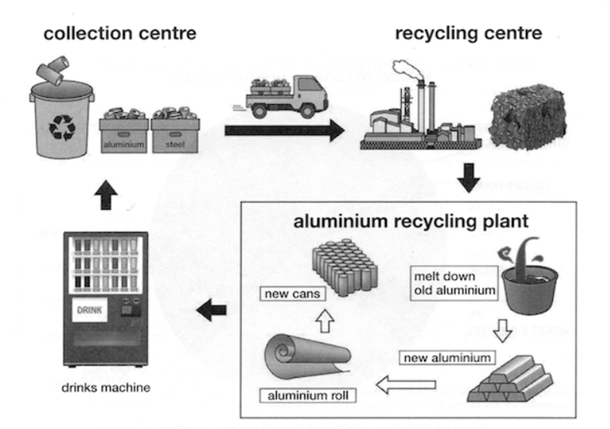
The diagram below show the stages in the recycling of aluminum drinks can. Summarize the information by selecting and reporting the main features, and make comparisons where relevant.
Hướng dẫn giải:
Gợi ý 1:
The diagram illustrates the process of recycling aluminium drink cans, showing how used cans are collected, processed, and reused to produce new ones. Overall, the recycling of aluminium cans involves three main stages: collection, processing, and reproduction, forming a continuous cycle.
In the first stage, used aluminium cans are gathered at a collection centre, where they are separated from other materials such as steel. The collected cans are then transported by truck to a recycling centre, where they are compressed into large blocks for easier handling and storage.
Next, these blocks are sent to an aluminium recycling plant, where the old aluminium is melted down. The molten metal is then converted into new aluminium, which is rolled into sheets. These aluminium rolls are used to manufacture new cans, completing the production process.
Finally, the new cans are distributed to drink machines for consumer use. Once the cans are used, they are collected again, restarting the recycling cycle.
In summary, the diagram demonstrates a closed-loop system in which aluminium cans are continuously reused through collection, melting, and remanufacturing, helping to conserve resources and reduce waste.
(Sơ đồ minh họa quy trình tái chế lon nước giải khát bằng nhôm, cho thấy cách các lon đã qua sử dụng được thu gom, xử lý và tái sử dụng để sản xuất lon mới. Nhìn chung, quá trình tái chế lon nhôm gồm ba giai đoạn chính: thu gom, xử lý và tái sản xuất, tạo thành một chu trình khép kín.
Ở giai đoạn đầu, các lon nhôm đã qua sử dụng được thu gom tại trung tâm thu gom, nơi chúng được tách khỏi các vật liệu khác như thép. Sau đó, các lon được vận chuyển bằng xe tải đến trung tâm tái chế, nơi chúng được nén thành khối lớn để dễ xử lý và lưu trữ.
Tiếp theo, các khối này được chuyển đến nhà máy tái chế nhôm, nơi nhôm cũ được nung chảy. Kim loại nóng chảy sau đó được chuyển hóa thành nhôm mới, rồi cán thành tấm. Những tấm nhôm này được dùng để sản xuất lon mới, hoàn tất quy trình sản xuất.
Cuối cùng, các lon mới được phân phối đến máy bán nước giải khát cho người tiêu dùng. Khi lon được sử dụng xong, chúng lại được thu gom, bắt đầu lại chu trình tái chế.
Tóm lại, sơ đồ cho thấy một hệ thống khép kín, trong đó lon nhôm được tái sử dụng liên tục thông qua các bước thu gom, nung chảy và tái sản xuất, giúp tiết kiệm tài nguyên và giảm chất thải.)
Gợi ý 2:
The diagram shows the stages involved in recycling aluminium drink cans. It is clear that the process is cyclical, beginning with the collection of used cans and ending with the production of new ones.
At the start of the process, aluminium cans are collected at a collection centre and sorted from other recyclable materials such as steel. The sorted cans are then loaded onto trucks and transported to a recycling centre, where they are compressed into blocks.
In the next stage, these blocks are delivered to an aluminium recycling plant. Here, the old aluminium is melted down and transformed into new aluminium. The new material is rolled into sheets, which are then used to produce new cans.
The final stage involves distributing the newly manufactured cans to drink machines for sale. After consumers use the cans, they are returned to the collection centre, and the cycle begins again.
Overall, the recycling process for aluminium cans is a sustainable system that allows materials to be reused indefinitely, reducing environmental impact and conserving energy.
(Sơ đồ cho thấy các giai đoạn trong quy trình tái chế lon nước giải khát bằng nhôm. Rõ ràng rằng quá trình này mang tính chu kỳ, bắt đầu từ việc thu gom lon đã qua sử dụng và kết thúc bằng việc sản xuất lon mới.
Ở giai đoạn đầu, các lon nhôm được thu gom tại trung tâm thu gom và tách khỏi các vật liệu tái chế khác như thép. Sau đó, các lon được chất lên xe tải và vận chuyển đến trung tâm tái chế, nơi chúng được nén thành khối.
Tiếp theo, các khối này được đưa đến nhà máy tái chế nhôm. Tại đây, nhôm cũ được nung chảy và chuyển hóa thành nhôm mới. Vật liệu mới được cán thành tấm, sau đó dùng để sản xuất lon mới.
Giai đoạn cuối cùng là phân phối các lon mới đến máy bán nước giải khát. Sau khi người tiêu dùng sử dụng, các lon lại được thu gom và chu trình bắt đầu lại.
Nhìn chung, quy trình tái chế lon nhôm là một hệ thống bền vững, cho phép vật liệu được tái sử dụng vô hạn, giảm tác động môi trường và tiết kiệm năng lượng.)
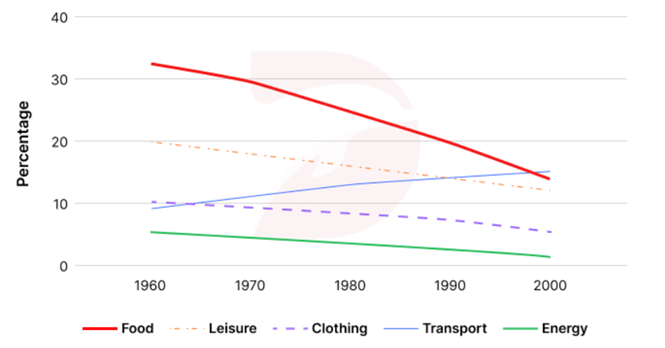
The line graph shows the percentage of spending in a European country from 1960 to 2000. Summarize the information by selecting and reporting the main features and make comparisons where relevant.
Hướng dẫn giải:
Gợi ý 1:
The line graph illustrates changes in the percentage of spending on five categories—food, leisure, clothing, transport, and energy—in a European country between 1960 and 2000. Overall, spending on food, leisure, clothing, and energy declined, while transport was the only category that saw an increase.
In 1960, food accounted for the largest share of expenditure, at just over 30%. However, this figure fell steadily over the next four decades, reaching around 15% by 2000. Leisure also experienced a gradual decline, dropping from 20% to just above 15%. Similarly, spending on clothing decreased slightly from 10% to below that level, and energy fell from about 6% to roughly 3%.
In contrast, transport showed an upward trend. Starting at around 10% in 1960, it rose consistently throughout the period, overtaking leisure and food by 2000 at approximately 15%.
In summary, while most categories saw a reduction in spending, transport became increasingly significant, suggesting a shift in priorities toward mobility and travel over time.
(Biểu đồ đường minh họa sự thay đổi tỷ lệ chi tiêu cho năm hạng mục—thực phẩm, giải trí, quần áo, giao thông và năng lượng—ở một quốc gia châu Âu từ năm 1960 đến 2000. Nhìn chung, chi tiêu cho thực phẩm, giải trí, quần áo và năng lượng đều giảm, trong khi giao thông là hạng mục duy nhất tăng lên.
Năm 1960, thực phẩm chiếm tỷ lệ cao nhất trong tổng chi tiêu, hơn 30%. Tuy nhiên, con số này giảm đều trong bốn thập kỷ tiếp theo, chỉ còn khoảng 15% vào năm 2000. Giải trí cũng giảm dần, từ 20% xuống hơn 15%. Tương tự, chi tiêu cho quần áo giảm nhẹ từ 10% xuống dưới mức đó, và năng lượng giảm từ khoảng 6% xuống còn 3%.
Ngược lại, giao thông có xu hướng tăng. Bắt đầu ở mức 10% năm 1960, nó tăng đều trong suốt giai đoạn và vượt qua giải trí cùng thực phẩm vào năm 2000, đạt khoảng 15%.
Tóm lại, trong khi hầu hết các hạng mục đều giảm chi tiêu, giao thông ngày càng trở nên quan trọng, cho thấy sự thay đổi trong ưu tiên của người dân hướng đến di chuyển và du lịch.)
Gợi ý 2:
The line graph compares the proportion of spending on five different items—food, leisure, clothing, transport, and energy—in a European country from 1960 to 2000. It is clear that expenditure on food and energy declined sharply, whereas transport spending increased steadily.
In 1960, food represented the highest percentage of total spending, at slightly above 30%. This figure fell continuously to around 15% by 2000. Leisure also declined from 20% to about 17%, while clothing dropped marginally from 10% to around 8%. Energy spending was the lowest throughout the period, decreasing from 6% to roughly 3%.
By contrast, transport was the only category that showed growth. It started at 10% in 1960 and rose gradually to 15% by 2000, becoming one of the top spending areas by the end of the period.
Overall, the data indicates that people in this European country spent less on basic necessities such as food and energy over time, while transport became a more prominent part of household expenditure.
(Biểu đồ đường so sánh tỷ lệ chi tiêu cho năm hạng mục khác nhau—thực phẩm, giải trí, quần áo, giao thông và năng lượng—ở một quốc gia châu Âu từ năm 1960 đến 2000. Rõ ràng rằng chi tiêu cho thực phẩm và năng lượng giảm mạnh, trong khi chi tiêu cho giao thông tăng đều.
Năm 1960, thực phẩm chiếm tỷ lệ cao nhất trong tổng chi tiêu, hơn 30%. Con số này giảm liên tục xuống khoảng 15% vào năm 2000. Giải trí cũng giảm từ 20% xuống khoảng 17%, trong khi quần áo giảm nhẹ từ 10% xuống khoảng 8%. Năng lượng là hạng mục có tỷ lệ thấp nhất trong suốt giai đoạn, giảm từ 6% xuống khoảng 3%.
Ngược lại, giao thông là hạng mục duy nhất tăng. Bắt đầu ở mức 10% năm 1960, nó tăng dần lên 15% vào năm 2000, trở thành một trong những lĩnh vực chi tiêu hàng đầu vào cuối giai đoạn.
Nhìn chung, dữ liệu cho thấy người dân ở quốc gia này chi tiêu ít hơn cho các nhu cầu cơ bản như thực phẩm và năng lượng theo thời gian, trong khi giao thông trở thành phần quan trọng hơn trong ngân sách hộ gia đình.)
Some people say that outdoor activities bring more benefits to children’s development rather than computer games. To what extent do you agree or disagree?
Hướng dẫn giải:
Gợi ý 1:
Some people argue that outdoor activities are more beneficial for children’s development than computer games. I completely agree with this view because outdoor play promotes physical health, social skills, and emotional well-being, whereas computer games often encourage isolation and sedentary habits.
Firstly, outdoor activities help children stay physically active and healthy. Playing sports, cycling, or simply running around improves fitness, strengthens muscles, and reduces the risk of obesity. In contrast, spending long hours on computer games can lead to health problems such as poor posture and eye strain. Moreover, outdoor play allows children to experience nature, which can reduce stress and improve concentration.
Secondly, outdoor activities enhance social and emotional development. When children play together, they learn teamwork, communication, and problem-solving skills. They also develop empathy and resilience through real-life interactions. Computer games, on the other hand, often limit face-to-face communication and may lead to addiction or aggressive behavior, especially when games involve violence.
In conclusion, outdoor activities provide far greater benefits for children’s physical, social, and emotional growth than computer games. Therefore, parents and schools should encourage children to spend more time outdoors rather than in front of screens.
(Một số người cho rằng các hoạt động ngoài trời mang lại nhiều lợi ích hơn cho sự phát triển của trẻ em so với trò chơi điện tử. Tôi hoàn toàn đồng ý với quan điểm này vì hoạt động ngoài trời giúp trẻ khỏe mạnh, phát triển kỹ năng xã hội và tinh thần, trong khi trò chơi điện tử thường khiến trẻ cô lập và ít vận động.
Trước hết, hoạt động ngoài trời giúp trẻ năng động và khỏe mạnh hơn. Việc chơi thể thao, đạp xe hoặc chạy nhảy giúp cải thiện thể lực, tăng cường cơ bắp và giảm nguy cơ béo phì. Ngược lại, việc dành quá nhiều thời gian cho trò chơi điện tử có thể gây ra các vấn đề sức khỏe như đau lưng và mỏi mắt. Hơn nữa, việc tiếp xúc với thiên nhiên giúp trẻ giảm căng thẳng và tăng khả năng tập trung.
Thứ hai, hoạt động ngoài trời thúc đẩy sự phát triển xã hội và cảm xúc. Khi chơi cùng nhau, trẻ học cách làm việc nhóm, giao tiếp và giải quyết vấn đề. Chúng cũng phát triển lòng đồng cảm và khả năng kiên cường thông qua tương tác thực tế. Trong khi đó, trò chơi điện tử thường hạn chế giao tiếp trực tiếp và có thể dẫn đến nghiện hoặc hành vi hung hăng, đặc biệt khi trò chơi có yếu tố bạo lực.
Tóm lại, hoạt động ngoài trời mang lại nhiều lợi ích hơn cho sự phát triển thể chất, xã hội và tinh thần của trẻ em so với trò chơi điện tử. Do đó, cha mẹ và nhà trường nên khuyến khích trẻ dành nhiều thời gian ngoài trời hơn là trước màn hình.)
Gợi ý 2:
It is often said that outdoor activities contribute more to children’s development than computer games. I agree with this statement to a large extent because outdoor play supports both physical and social growth, while excessive gaming can have negative effects.
Outdoor activities are essential for physical development. They allow children to move freely, exercise, and build stamina. Activities such as football, swimming, or hiking not only improve health but also teach discipline and teamwork. In contrast, computer games are mostly sedentary and can cause health issues like obesity and poor eyesight.
Furthermore, outdoor play helps children develop social and emotional skills. By interacting with peers, they learn cooperation, leadership, and conflict resolution. These experiences are crucial for building confidence and independence. Although computer games can improve cognitive skills such as problem-solving and hand-eye coordination, they often isolate children from real social environments.
To sum up, while computer games may offer some educational or entertainment value, outdoor activities are far more beneficial for children’s overall development. Encouraging outdoor play is vital for raising healthy, well-rounded individuals.
(Người ta thường nói rằng các hoạt động ngoài trời đóng góp nhiều hơn cho sự phát triển của trẻ em so với trò chơi điện tử. Tôi đồng ý với nhận định này ở mức độ lớn vì hoạt động ngoài trời hỗ trợ cả sự phát triển thể chất lẫn xã hội, trong khi việc chơi game quá mức có thể gây tác động tiêu cực.
Hoạt động ngoài trời rất quan trọng cho sự phát triển thể chất. Chúng giúp trẻ vận động, rèn luyện sức khỏe và tăng sức bền. Các hoạt động như đá bóng, bơi lội hay đi bộ đường dài không chỉ cải thiện sức khỏe mà còn dạy trẻ tính kỷ luật và tinh thần đồng đội. Ngược lại, trò chơi điện tử khiến trẻ ít vận động và có thể gây ra các vấn đề như béo phì hoặc cận thị.
Ngoài ra, hoạt động ngoài trời giúp trẻ phát triển kỹ năng xã hội và cảm xúc. Khi tương tác với bạn bè, trẻ học cách hợp tác, lãnh đạo và giải quyết xung đột. Những trải nghiệm này rất quan trọng để xây dựng sự tự tin và tính độc lập. Mặc dù trò chơi điện tử có thể cải thiện khả năng tư duy và phối hợp tay-mắt, chúng thường khiến trẻ xa rời môi trường xã hội thực tế.
Tóm lại, dù trò chơi điện tử có thể mang lại giá trị giải trí hoặc giáo dục nhất định, hoạt động ngoài trời vẫn có lợi hơn nhiều cho sự phát triển toàn diện của trẻ. Việc khuyến khích trẻ tham gia hoạt động ngoài trời là điều cần thiết để nuôi dưỡng những cá nhân khỏe mạnh và toàn diện.)
Some people think that sports play an important role in the development of society. Others think they are nothing more than a leisure activity. Discuss both views and give your opinion.
Hướng dẫn giải:
Gợi ý 1:
Some people believe that sports play a vital role in the development of society, while others argue that they are simply a form of entertainment. In my opinion, sports contribute significantly to social progress, although they also serve as leisure activities.
On the one hand, sports are more than just games; they foster unity and national pride. International competitions such as the Olympics or the World Cup bring people together, transcending cultural and political differences. Sports also promote healthy lifestyles, reducing the burden on healthcare systems. Furthermore, they provide career opportunities, not only for athletes but also for coaches, medical staff, and event organizers, thereby contributing to the economy.
On the other hand, some argue that sports are primarily recreational. Many people watch or play sports for enjoyment and relaxation, rather than for social development. For instance, playing football with friends or watching a tennis match is often seen as a way to relieve stress. Critics also point out that excessive focus on sports can divert attention from more pressing issues such as education or poverty.
In conclusion, while sports undoubtedly serve as leisure activities, their role in promoting unity, health, and economic growth makes them an important factor in the development of society.
(Một số người tin rằng thể thao đóng vai trò quan trọng trong sự phát triển xã hội, trong khi những người khác cho rằng chúng chỉ là hình thức giải trí. Theo tôi, thể thao góp phần đáng kể vào tiến bộ xã hội, mặc dù chúng cũng phục vụ nhu cầu giải trí.
Một mặt, thể thao không chỉ là trò chơi; chúng thúc đẩy sự đoàn kết và niềm tự hào dân tộc. Các cuộc thi quốc tế như Olympic hay World Cup gắn kết mọi người, vượt qua khác biệt văn hóa và chính trị. Thể thao cũng khuyến khích lối sống lành mạnh, giảm gánh nặng cho hệ thống y tế. Hơn nữa, chúng tạo ra cơ hội nghề nghiệp cho vận động viên, huấn luyện viên, nhân viên y tế và ban tổ chức, qua đó đóng góp cho nền kinh tế.
Mặt khác, một số người cho rằng thể thao chủ yếu mang tính giải trí. Nhiều người xem hoặc chơi thể thao để thư giãn, thay vì vì sự phát triển xã hội. Ví dụ, chơi bóng đá với bạn bè hoặc xem một trận tennis thường được coi là cách giảm căng thẳng. Những người chỉ trích cũng cho rằng việc quá tập trung vào thể thao có thể làm phân tán sự chú ý khỏi các vấn đề cấp bách hơn như giáo dục hay nghèo đói.
Tóm lại, mặc dù thể thao chắc chắn là hoạt động giải trí, vai trò của chúng trong việc thúc đẩy đoàn kết, sức khỏe và tăng trưởng kinh tế khiến chúng trở thành yếu tố quan trọng trong sự phát triển xã hội.)
Gợi ý 2:
It is often debated whether sports are crucial for social development or merely a pastime. I believe that sports play a significant role in shaping society, although they also function as a source of entertainment.
Supporters of the idea that sports contribute to society highlight their ability to build discipline, teamwork, and resilience. These qualities are not only valuable for athletes but also for ordinary citizens, as they can be applied in education and the workplace. Moreover, sports events generate revenue and tourism, boosting local economies. They also encourage inclusivity, as people from diverse backgrounds can participate and compete on equal terms.
However, others view sports as nothing more than leisure. For many individuals, sports are simply a way to escape daily routines and enjoy themselves. Watching a basketball game or jogging in the park does not necessarily contribute to social development. Additionally, critics argue that professional sports can sometimes promote unhealthy competition, commercialization, and even corruption, which undermines their positive impact.
Overall, although sports can be seen as recreational activities, their broader influence on health, economy, and social cohesion demonstrates that they play a vital role in the development of society.
(Người ta thường tranh luận rằng thể thao có quan trọng đối với sự phát triển xã hội hay chỉ là thú vui. Tôi tin rằng thể thao đóng vai trò đáng kể trong việc định hình xã hội, mặc dù chúng cũng là nguồn giải trí.
Những người ủng hộ quan điểm thể thao góp phần cho xã hội nhấn mạnh khả năng xây dựng tính kỷ luật, tinh thần đồng đội và sự kiên cường. Những phẩm chất này không chỉ có giá trị cho vận động viên mà còn cho người dân bình thường, vì chúng có thể áp dụng trong giáo dục và công việc. Hơn nữa, các sự kiện thể thao tạo ra doanh thu và du lịch, thúc đẩy kinh tế địa phương. Thể thao cũng khuyến khích sự hòa nhập, khi mọi người từ nhiều nền tảng khác nhau có thể tham gia và cạnh tranh bình đẳng.
Tuy nhiên, những người khác coi thể thao chỉ là giải trí. Với nhiều người, thể thao đơn giản là cách thoát khỏi thói quen hàng ngày và tận hưởng niềm vui. Việc xem một trận bóng rổ hoặc chạy bộ trong công viên không nhất thiết đóng góp cho sự phát triển xã hội. Ngoài ra, những người chỉ trích cho rằng thể thao chuyên nghiệp đôi khi thúc đẩy cạnh tranh không lành mạnh, thương mại hóa và thậm chí tham nhũng, làm suy giảm tác động tích cực của chúng.
Nhìn chung, mặc dù thể thao có thể được coi là hoạt động giải trí, ảnh hưởng rộng lớn của chúng đến sức khỏe, kinh tế và sự gắn kết xã hội cho thấy chúng đóng vai trò quan trọng trong sự phát triển xã hội.)
Some universities offer online courses as an alternative to classes delivered on campus. Do the advantages of this outweigh the disadvantages?
Hướng dẫn giải:
Gợi ý 1:
Some universities now provide online courses as an alternative to traditional on-campus classes. While this approach has certain drawbacks, I believe the advantages outweigh them.
On the one hand, online courses offer flexibility and accessibility. Students can study from anywhere, saving time and money on commuting or accommodation. This is particularly beneficial for working professionals or those living in remote areas. Moreover, online platforms often provide recorded lectures and digital resources, allowing learners to review materials at their own pace. Such flexibility can enhance independent learning and self-discipline.
On the other hand, online learning has limitations. It reduces face-to-face interaction between students and teachers, which may affect communication and collaboration. Some learners also struggle with motivation and concentration when studying alone. Additionally, practical subjects that require laboratory work or hands-on experience cannot be fully taught online.
In conclusion, although online courses have disadvantages, their accessibility and flexibility make them a valuable alternative to traditional classes. Therefore, I believe the benefits outweigh the drawbacks, especially in today’s digital age.
(Một số trường đại học hiện nay cung cấp khóa học trực tuyến như một lựa chọn thay thế cho lớp học truyền thống. Mặc dù cách tiếp cận này có một số hạn chế, tôi tin rằng lợi ích của nó vượt trội hơn.
Một mặt, khóa học trực tuyến mang lại sự linh hoạt và khả năng tiếp cận. Sinh viên có thể học từ bất cứ đâu, tiết kiệm thời gian và chi phí đi lại hoặc chỗ ở. Điều này đặc biệt hữu ích cho người đi làm hoặc sống ở vùng xa. Hơn nữa, nền tảng trực tuyến thường cung cấp bài giảng ghi hình và tài liệu số, cho phép người học xem lại theo tốc độ riêng. Sự linh hoạt này giúp nâng cao khả năng tự học và tính kỷ luật.
Mặt khác, học trực tuyến có hạn chế. Nó giảm sự tương tác trực tiếp giữa sinh viên và giảng viên, ảnh hưởng đến giao tiếp và hợp tác. Một số người học cũng gặp khó khăn trong việc duy trì động lực và tập trung khi học một mình. Ngoài ra, các môn học thực hành cần phòng thí nghiệm hoặc trải nghiệm thực tế không thể dạy hoàn toàn trực tuyến.
Tóm lại, mặc dù khóa học trực tuyến có nhược điểm, nhưng khả năng tiếp cận và linh hoạt khiến chúng trở thành lựa chọn giá trị. Do đó, tôi tin rằng lợi ích vượt trội hơn hạn chế, đặc biệt trong thời đại số hiện nay.)
Gợi ý 2:
The rise of online courses in universities has sparked debate about whether they are more advantageous than conventional classroom learning. In my view, despite some challenges, the benefits of online education are greater.
One clear advantage is convenience. Online courses allow students to learn from home, which saves travel costs and time. They also provide opportunities for international learners who may not be able to attend classes abroad. Furthermore, online platforms often use interactive tools such as discussion forums, quizzes, and multimedia, which can make learning more engaging.
However, online education is not without problems. It lacks the social environment of campus life, where students build friendships and networks. Technical issues such as poor internet connections can also disrupt learning. Moreover, some students may feel isolated or find it difficult to stay motivated without direct supervision.
Overall, while online courses cannot completely replace traditional classes, their flexibility, accessibility, and cost-effectiveness make them a positive development. I believe universities should continue to expand online learning alongside campus-based education.
(Sự gia tăng của các khóa học trực tuyến tại các trường đại học đã làm dấy lên tranh luận về việc liệu chúng có lợi hơn học tập truyền thống hay không. Theo tôi, mặc dù có một số thách thức, lợi ích của giáo dục trực tuyến vẫn lớn hơn.
Một lợi thế rõ ràng là sự tiện lợi. Khóa học trực tuyến cho phép sinh viên học tại nhà, tiết kiệm chi phí và thời gian đi lại. Chúng cũng tạo cơ hội cho sinh viên quốc tế không thể tham gia lớp học ở nước ngoài. Hơn nữa, nền tảng trực tuyến thường sử dụng công cụ tương tác như diễn đàn thảo luận, bài kiểm tra và đa phương tiện, giúp việc học trở nên hấp dẫn hơn.
Tuy nhiên, giáo dục trực tuyến không tránh khỏi vấn đề. Nó thiếu môi trường xã hội của đời sống đại học, nơi sinh viên xây dựng tình bạn và mạng lưới. Các vấn đề kỹ thuật như kết nối internet kém cũng có thể làm gián đoạn việc học. Ngoài ra, một số sinh viên có thể cảm thấy cô lập hoặc khó duy trì động lực khi không có sự giám sát trực tiếp.
Nhìn chung, mặc dù khóa học trực tuyến không thể hoàn toàn thay thế lớp học truyền thống, nhưng sự linh hoạt, khả năng tiếp cận và tiết kiệm chi phí khiến chúng trở thành một bước phát triển tích cực. Tôi tin rằng các trường đại học nên tiếp tục mở rộng hình thức học trực tuyến song song với giáo dục tại trường.)
Some people say that modern technology has made shopping today easier while others disagree. Discuss both views and give your opinion.
Hướng dẫn giải:
Gợi ý 1:
Some people argue that modern technology has made shopping easier, while others believe it has complicated the process. In my opinion, technology has largely simplified shopping, though some drawbacks remain.
On the one hand, technology has revolutionized shopping by increasing convenience. Online platforms allow customers to browse thousands of products from home, compare prices instantly, and read reviews before making decisions. Mobile payment systems and delivery services further reduce the need to visit physical stores. For example, busy professionals can order groceries online and have them delivered within hours, saving time and effort.
On the other hand, critics argue that technology has introduced new challenges. Online shopping can lead to overconsumption, as advertisements and discounts encourage impulse buying. Moreover, customers may face issues such as delayed deliveries, poor product quality, or even fraud. Traditional shopping, by contrast, allows people to physically inspect items before purchase, reducing the risk of disappointment.
In conclusion, although modern technology has created some problems, its benefits in terms of convenience, accessibility, and efficiency outweigh the disadvantages. Shopping today is undeniably easier thanks to technological innovations.
(Một số người cho rằng công nghệ hiện đại đã khiến việc mua sắm trở nên dễ dàng hơn, trong khi những người khác tin rằng nó làm phức tạp quá trình này. Theo tôi, công nghệ nhìn chung đã đơn giản hóa việc mua sắm, mặc dù vẫn tồn tại một số hạn chế.
Một mặt, công nghệ đã cách mạng hóa việc mua sắm bằng cách tăng sự tiện lợi. Các nền tảng trực tuyến cho phép khách hàng duyệt hàng nghìn sản phẩm tại nhà, so sánh giá ngay lập tức và đọc đánh giá trước khi quyết định. Hệ thống thanh toán qua điện thoại và dịch vụ giao hàng giúp giảm nhu cầu đến cửa hàng. Ví dụ, những người bận rộn có thể đặt hàng tạp hóa trực tuyến và nhận trong vài giờ, tiết kiệm thời gian và công sức.
Mặt khác, những người chỉ trích cho rằng công nghệ đã tạo ra thách thức mới. Mua sắm trực tuyến có thể dẫn đến tiêu dùng quá mức, khi quảng cáo và khuyến mãi khuyến khích mua hàng bốc đồng. Ngoài ra, khách hàng có thể gặp vấn đề như giao hàng chậm, chất lượng sản phẩm kém hoặc thậm chí lừa đảo. Trong khi đó, mua sắm truyền thống cho phép người mua kiểm tra sản phẩm trực tiếp, giảm nguy cơ thất vọng.
Tóm lại, mặc dù công nghệ hiện đại tạo ra một số vấn đề, nhưng lợi ích về sự tiện lợi, khả năng tiếp cận và hiệu quả vượt trội hơn. Việc mua sắm ngày nay chắc chắn dễ dàng hơn nhờ đổi mới công nghệ.)
Gợi ý 2:
It is often debated whether modern technology has simplified shopping or made it more complicated. I believe that while technology has introduced certain challenges, the advantages are far greater.
The main benefit of technology is convenience. Online shopping platforms enable people to purchase goods anytime and anywhere, without being restricted by store hours. Price comparison websites and customer reviews also empower buyers to make informed choices. Additionally, innovations such as digital wallets and fast delivery services have streamlined the shopping experience.
However, some disadvantages exist. Online shopping lacks the personal interaction of traditional stores, and customers cannot physically examine products before buying. This sometimes results in dissatisfaction or the need for returns. Furthermore, the abundance of options online can overwhelm shoppers, making decision-making more difficult.
Overall, despite these drawbacks, modern technology has made shopping more efficient and accessible. I believe the advantages clearly outweigh the disadvantages, as technology continues to improve the way people purchase goods.
(Người ta thường tranh luận rằng công nghệ hiện đại đã đơn giản hóa việc mua sắm hay khiến nó phức tạp hơn. Tôi tin rằng mặc dù công nghệ mang lại một số thách thức, nhưng lợi ích vẫn lớn hơn nhiều.
Lợi ích chính của công nghệ là sự tiện lợi. Các nền tảng mua sắm trực tuyến cho phép mọi người mua hàng bất cứ lúc nào, bất cứ nơi đâu, không bị giới hạn bởi giờ mở cửa. Các trang web so sánh giá và đánh giá của khách hàng cũng giúp người mua đưa ra quyết định sáng suốt. Ngoài ra, các đổi mới như ví điện tử và dịch vụ giao hàng nhanh đã tối ưu hóa trải nghiệm mua sắm.
Tuy nhiên, vẫn tồn tại một số nhược điểm. Mua sắm trực tuyến thiếu sự tương tác cá nhân như ở cửa hàng truyền thống, và khách hàng không thể kiểm tra sản phẩm trực tiếp trước khi mua. Điều này đôi khi dẫn đến sự không hài lòng hoặc phải trả lại hàng. Hơn nữa, sự phong phú của lựa chọn trực tuyến có thể khiến người mua bị choáng ngợp, khó đưa ra quyết định.
Nhìn chung, mặc dù có những hạn chế, công nghệ hiện đại đã khiến việc mua sắm hiệu quả và dễ tiếp cận hơn. Tôi tin rằng lợi ích rõ ràng vượt trội so với bất lợi, khi công nghệ tiếp tục cải thiện cách con người mua hàng.)
The table below shows information about age, average income per person and population below poverty line in three states in the USA. Summarise the information by selecting and reporting and make comparisons where relevant.

Hướng dẫn giải:
Gợi ý 1:
The table compares three states in the USA—California, Utah, and Florida—in terms of age distribution, average income per person, and the proportion of people living below the poverty line. Overall, Utah has the youngest population and the lowest poverty rate, while Florida has the oldest population, and California records the highest average income.
In detail, Utah has the largest proportion of people aged under 18, at 28%, compared with 17% in California and 16% in Florida. Conversely, Florida has the highest percentage of residents aged over 60, at 23%, which is almost three times higher than Utah’s 8%. California stands in between, with 13% of its population in this age group.
When it comes to income, California leads with an average of $23,000 per person, followed closely by Florida at $22,000. Utah has the lowest average income, at $17,000. Interestingly, despite its lower income, Utah has the smallest proportion of people living below the poverty line (9%), while California has the highest (16%). Florida’s poverty rate is moderate, at 12%.
In summary, Utah appears to have a younger and relatively less impoverished population, while Florida has an older demographic. California, though wealthier on average, faces a higher poverty rate than the other two states.
(Bảng so sánh ba bang của Hoa Kỳ—California, Utah và Florida—về cơ cấu độ tuổi, thu nhập trung bình mỗi người và tỷ lệ dân số sống dưới mức nghèo. Nhìn chung, Utah có dân số trẻ nhất và tỷ lệ nghèo thấp nhất, trong khi Florida có dân số già nhất, còn California có thu nhập trung bình cao nhất.
Cụ thể, Utah có tỷ lệ người dưới 18 tuổi cao nhất, đạt 28%, so với 17% ở California và 16% ở Florida. Ngược lại, Florida có tỷ lệ người trên 60 tuổi cao nhất, 23%, gần gấp ba lần Utah (8%). California nằm ở giữa với 13%.
Về thu nhập, California dẫn đầu với mức trung bình $23,000 mỗi người, tiếp theo là Florida với $22,000. Utah có thu nhập thấp nhất, $17,000. Tuy nhiên, dù thu nhập thấp hơn, Utah lại có tỷ lệ nghèo thấp nhất (9%), trong khi California cao nhất (16%). Florida có tỷ lệ nghèo trung bình, 12%.
Tóm lại, Utah có dân số trẻ và ít người nghèo hơn, trong khi Florida có dân số già. California tuy giàu hơn nhưng lại có tỷ lệ nghèo cao hơn hai bang còn lại.)
Gợi ý 2:
The table provides information about the age structure, average income per person, and poverty levels in three U.S. states: California, Utah, and Florida. It is clear that Utah has the youngest population and the lowest poverty rate, whereas Florida has the oldest population, and California enjoys the highest income.
Utah stands out for having the highest proportion of people aged under 18, at 28%, compared with 17% in California and 16% in Florida. In contrast, Florida has the largest elderly population, with 23% aged over 60, while Utah has only 8%. California’s figure for this age group is 13%, placing it between the other two states.
Regarding income, California has the highest average income per person, at $23,000, followed by Florida at $22,000. Utah’s average income is the lowest, at $17,000. However, Utah also has the smallest proportion of people living below the poverty line (9%), while California has the highest (16%). Florida’s poverty rate is slightly lower, at 12%.
Overall, the data suggests that Utah is the most prosperous state in terms of social well-being, despite its lower income, while California and Florida face higher poverty levels, with Florida having a notably older population.
(Bảng cung cấp thông tin về cơ cấu độ tuổi, thu nhập trung bình mỗi người và mức độ nghèo ở ba bang của Hoa Kỳ: California, Utah và Florida. Rõ ràng rằng Utah có dân số trẻ nhất và tỷ lệ nghèo thấp nhất, trong khi Florida có dân số già nhất, còn California có thu nhập cao nhất.
Utah nổi bật với tỷ lệ người dưới 18 tuổi cao nhất, 28%, so với 17% ở California và 16% ở Florida. Ngược lại, Florida có tỷ lệ người cao tuổi lớn nhất, 23%, trong khi Utah chỉ có 8%. California có 13%, nằm giữa hai bang còn lại.
Về thu nhập, California có mức trung bình cao nhất, $23,000 mỗi người, tiếp theo là Florida với $22,000. Utah có thu nhập thấp nhất, $17,000. Tuy nhiên, Utah cũng có tỷ lệ nghèo thấp nhất (9%), trong khi California cao nhất (16%). Florida có tỷ lệ nghèo thấp hơn một chút, 12%.
Nhìn chung, dữ liệu cho thấy Utah là bang có mức sống tốt nhất về mặt xã hội dù thu nhập thấp hơn, trong khi California và Florida có tỷ lệ nghèo cao hơn, với Florida có dân số già đáng kể.)
The diagrams show how the layout of a school library changed. Summarise the information by selecting and reporting the main features, and make comparisons where relevant.
Write at least 150 words.
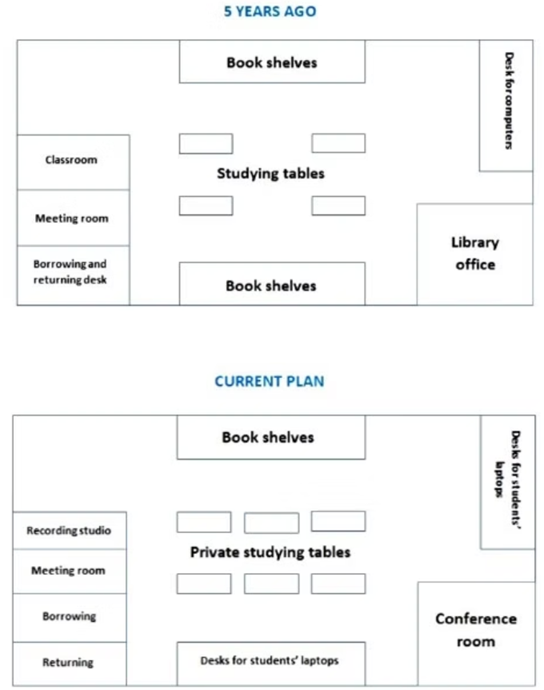
Hướng dẫn giải:
Gợi ý 1:
The diagrams illustrate how the layout of a school library has changed over the past five years. Overall, the library has been modernized and reorganized to include more technology-based and private study areas.
Five years ago, the library featured two sets of bookshelves at the top and bottom of the room, with four studying tables in the center. On the left side, there was a classroom, a meeting room, and a borrowing and returning desk. The right side contained a desk for computers and a library office.
In the current plan, several changes have been made. The classroom has been replaced by a recording studio, while the borrowing and returning desk has been divided into two separate sections labeled “borrowing” and “returning.” The central area now has six private studying tables instead of four shared ones. On the right, the computer desk has been replaced by desks for students’ laptops, and the library office has been converted into a conference room. Additionally, a new row of desks for students’ laptops has been added along the bottom of the layout.
In summary, the library has been redesigned to provide more individual study spaces and accommodate modern technology, reflecting a shift toward digital learning and collaboration.
(Các sơ đồ minh họa cách bố trí của thư viện trường học đã thay đổi trong 5 năm qua. Nhìn chung, thư viện đã được hiện đại hóa và sắp xếp lại để có thêm khu vực học tập riêng và ứng dụng công nghệ nhiều hơn.
Năm năm trước, thư viện có hai dãy kệ sách ở phía trên và dưới, với bốn bàn học ở trung tâm. Bên trái là phòng học, phòng họp và bàn mượn – trả sách. Bên phải có bàn máy tính và văn phòng thư viện.
Trong bản thiết kế hiện tại, nhiều thay đổi đã được thực hiện. Phòng học được thay bằng phòng thu âm, còn bàn mượn – trả sách được chia thành hai khu riêng biệt. Khu vực trung tâm hiện có sáu bàn học riêng thay vì bốn bàn chung. Ở bên phải, bàn máy tính được thay bằng bàn cho sinh viên dùng laptop, và văn phòng thư viện được chuyển thành phòng hội nghị. Ngoài ra, một hàng bàn laptop mới được thêm ở phía dưới sơ đồ.
Tóm lại, thư viện đã được thiết kế lại để cung cấp nhiều không gian học tập cá nhân hơn và hỗ trợ công nghệ hiện đại, phản ánh xu hướng học tập kỹ thuật số và hợp tác.)
Gợi ý 2:
The two diagrams compare the layout of a school library five years ago with its current design. It is clear that the library has undergone significant modernization, with new facilities added to support digital learning and private study.
Previously, the library contained two sets of bookshelves and four studying tables in the center. The left side included a classroom, a meeting room, and a borrowing and returning desk, while the right side featured a computer desk and a library office.
In the present layout, the classroom has been replaced by a recording studio, and the borrowing and returning desk has been separated into two distinct areas. The number of studying tables has increased to six, and they are now labeled as private studying tables. The computer desk has been replaced by desks for students’ laptops, and the library office has been converted into a conference room. A new section for students’ laptops has also been added along the bottom of the plan.
Overall, the library has been transformed from a traditional study space into a modern learning environment, emphasizing technology use and individual study.
(Hai sơ đồ so sánh bố cục của thư viện trường học cách đây 5 năm với thiết kế hiện tại. Rõ ràng rằng thư viện đã được hiện đại hóa đáng kể, với các tiện ích mới nhằm hỗ trợ học tập kỹ thuật số và học cá nhân.
Trước đây, thư viện có hai dãy kệ sách và bốn bàn học ở trung tâm. Bên trái gồm phòng học, phòng họp và bàn mượn – trả sách, trong khi bên phải có bàn máy tính và văn phòng thư viện.
Trong bố cục hiện nay, phòng học được thay bằng phòng thu âm, và bàn mượn – trả sách được tách thành hai khu riêng biệt. Số lượng bàn học tăng lên sáu và được gọi là bàn học riêng. Bàn máy tính được thay bằng bàn cho sinh viên dùng laptop, và văn phòng thư viện được chuyển thành phòng hội nghị. Một khu bàn laptop mới cũng được thêm ở phía dưới sơ đồ.
Nhìn chung, thư viện đã được chuyển đổi từ không gian học truyền thống sang môi trường học hiện đại, nhấn mạnh việc sử dụng công nghệ và học tập cá nhân.)
It is a natural process for animal species to become extinct (e.g dinosaurs, dodos, etc.). There is no reason why people should try to prevent this from happening. To what extent do you agree or disagree?
Gợi ý 1:
Some people argue that animal extinction is a natural process and that humans should not interfere. While it is true that species have disappeared throughout history, I strongly believe that people should take action to prevent further loss of biodiversity.
On the one hand, extinction has always been part of nature’s cycle. Species such as dinosaurs and dodos vanished long before humans had the ability to influence their survival. Natural selection ensures that only the fittest species adapt and thrive, while others die out. From this perspective, human intervention may seem unnecessary or even unnatural.
However, the current rate of extinction is largely caused by human activities rather than natural processes. Deforestation, pollution, and climate change have destroyed habitats and endangered countless species. If humans do not act, the balance of ecosystems will collapse, affecting food chains and even human survival. Moreover, many species play crucial roles in medicine, agriculture, and environmental stability. Protecting them is not only ethical but also essential for our own well-being.
In conclusion, although extinction is a natural phenomenon, the accelerated loss of species today is mainly due to human actions. Therefore, we have a moral and practical responsibility to protect wildlife and preserve biodiversity.
(Một số người cho rằng sự tuyệt chủng của động vật là quá trình tự nhiên và con người không nên can thiệp. Mặc dù đúng là các loài đã biến mất trong suốt lịch sử, tôi tin rằng con người cần hành động để ngăn chặn sự mất mát đa dạng sinh học.
Một mặt, tuyệt chủng luôn là một phần của chu trình tự nhiên. Các loài như khủng long và chim dodo đã biến mất từ lâu trước khi con người có thể ảnh hưởng đến sự tồn tại của chúng. Chọn lọc tự nhiên đảm bảo rằng chỉ những loài thích nghi tốt nhất mới tồn tại, trong khi những loài khác sẽ biến mất. Từ góc nhìn này, sự can thiệp của con người có thể bị coi là không cần thiết hoặc trái tự nhiên.
Tuy nhiên, tốc độ tuyệt chủng hiện nay chủ yếu do hoạt động của con người gây ra. Phá rừng, ô nhiễm và biến đổi khí hậu đã phá hủy môi trường sống và đe dọa vô số loài. Nếu con người không hành động, hệ sinh thái sẽ sụp đổ, ảnh hưởng đến chuỗi thức ăn và cả sự sống của chính chúng ta. Hơn nữa, nhiều loài đóng vai trò quan trọng trong y học, nông nghiệp và sự ổn định môi trường. Bảo vệ chúng không chỉ là đạo đức mà còn cần thiết cho lợi ích của con người.
Tóm lại, mặc dù tuyệt chủng là hiện tượng tự nhiên, nhưng sự mất mát nhanh chóng của các loài ngày nay chủ yếu do con người gây ra. Vì vậy, chúng ta có trách nhiệm đạo đức và thực tế trong việc bảo vệ động vật hoang dã và duy trì đa dạng sinh học.)
Gợi ý 2:
It is often said that animal extinction is a natural process and that humans should not attempt to stop it. I disagree with this view because modern extinction is largely driven by human behavior, and protecting species is vital for ecological and moral reasons.
Admittedly, extinction has occurred naturally for millions of years. Environmental changes and evolution have led to the disappearance of certain species, allowing new ones to emerge. Interfering with this process might seem unnecessary, as nature has its own way of maintaining balance.
Nevertheless, the situation today is different. Human activities such as industrialization, deforestation, and overhunting have accelerated extinction rates far beyond natural levels. Losing species disrupts ecosystems and threatens biodiversity, which is essential for clean air, water, and food production. Furthermore, animals have intrinsic value, and humans have an ethical duty to protect them from harm caused by our own actions.
In summary, while extinction is part of nature, the current crisis is man-made. I believe that humans must take responsibility and actively work to conserve endangered species to ensure ecological stability and a sustainable future.
(Người ta thường nói rằng sự tuyệt chủng của động vật là quá trình tự nhiên và con người không nên cố gắng ngăn chặn. Tôi không đồng ý với quan điểm này vì sự tuyệt chủng hiện nay chủ yếu do hành vi của con người gây ra, và việc bảo vệ các loài là điều cần thiết về mặt sinh thái và đạo đức.
Thừa nhận rằng tuyệt chủng đã xảy ra tự nhiên trong hàng triệu năm. Sự thay đổi môi trường và tiến hóa đã khiến một số loài biến mất, cho phép các loài mới xuất hiện. Việc can thiệp vào quá trình này có thể bị coi là không cần thiết, vì tự nhiên có cách riêng để duy trì cân bằng.
Tuy nhiên, tình hình hiện nay đã khác. Các hoạt động của con người như công nghiệp hóa, phá rừng và săn bắt quá mức đã khiến tốc độ tuyệt chủng tăng nhanh hơn nhiều so với tự nhiên. Việc mất đi các loài làm gián đoạn hệ sinh thái và đe dọa đa dạng sinh học, vốn rất quan trọng cho không khí, nước và thực phẩm. Hơn nữa, động vật có giá trị riêng, và con người có nghĩa vụ đạo đức phải bảo vệ chúng khỏi những tác hại do chính mình gây ra.
Tóm lại, mặc dù tuyệt chủng là một phần của tự nhiên, nhưng khủng hoảng hiện nay là do con người tạo ra. Tôi tin rằng con người phải chịu trách nhiệm và tích cực bảo tồn các loài đang bị đe dọa để đảm bảo sự ổn định sinh thái và tương lai bền vững.)
Many companies today sponsor sports as a way of advertising themselves. Some people think that this is a good thing for the world of sports. Others think this has disadvantages. Discuss both these views and give your own opinion.
Hướng dẫn giải:
Gợi ý 1:
Many companies today sponsor sports as a way of advertising themselves. Some people believe this is beneficial for the world of sports, while others argue it has drawbacks. In my opinion, the advantages outweigh the disadvantages.
On the one hand, sponsorship provides essential funding for sports. Organizing tournaments, maintaining facilities, and supporting athletes require significant financial resources. Corporate sponsorship helps cover these costs, allowing sports to grow and reach wider audiences. For example, international events such as the Olympics or the FIFA World Cup rely heavily on sponsorship deals to operate successfully. Moreover, sponsorship can raise the profile of less popular sports, giving them more visibility and encouraging participation.
On the other hand, critics argue that sponsorship can commercialize sports excessively. Companies often prioritize profit over athletes’ welfare, leading to overexposure of advertisements during matches. In some cases, sponsors may influence decisions, such as team selections or event locations, which undermines the integrity of sports. Additionally, when companies associated with unhealthy products, such as fast food or alcohol, sponsor sports, it sends conflicting messages about health and fitness.
In conclusion, while sponsorship may bring certain disadvantages, it plays a crucial role in sustaining and promoting sports. I believe that with proper regulation, the benefits of sponsorship far outweigh its drawbacks.
(Ngày nay, nhiều công ty tài trợ cho thể thao như một cách quảng bá thương hiệu. Một số người cho rằng điều này có lợi cho thế giới thể thao, trong khi những người khác cho rằng nó có mặt hạn chế. Theo tôi, lợi ích lớn hơn bất lợi.
Một mặt, tài trợ cung cấp nguồn tài chính cần thiết cho thể thao. Việc tổ chức giải đấu, duy trì cơ sở vật chất và hỗ trợ vận động viên đòi hỏi nguồn lực lớn. Tài trợ từ doanh nghiệp giúp trang trải chi phí, cho phép thể thao phát triển và tiếp cận khán giả rộng hơn. Ví dụ, các sự kiện quốc tế như Olympic hay World Cup phụ thuộc nhiều vào hợp đồng tài trợ. Hơn nữa, tài trợ có thể nâng cao vị thế của những môn thể thao ít phổ biến, khuyến khích nhiều người tham gia.
Mặt khác, những người chỉ trích cho rằng tài trợ có thể thương mại hóa thể thao quá mức. Doanh nghiệp thường đặt lợi nhuận lên trên phúc lợi của vận động viên, dẫn đến quảng cáo tràn lan trong các trận đấu. Trong một số trường hợp, nhà tài trợ có thể ảnh hưởng đến quyết định như chọn đội hoặc địa điểm thi đấu, làm suy giảm tính công bằng. Ngoài ra, khi các công ty liên quan đến sản phẩm không lành mạnh như đồ ăn nhanh hoặc rượu bia tài trợ cho thể thao, điều này tạo ra thông điệp mâu thuẫn về sức khỏe.
Tóm lại, mặc dù tài trợ có một số bất lợi, nhưng nó đóng vai trò quan trọng trong việc duy trì và quảng bá thể thao. Tôi tin rằng với sự quản lý hợp lý, lợi ích của tài trợ vượt trội hơn hạn chế.)
Gợi ý 2:
The practice of companies sponsoring sports has become increasingly common. Some people see this as a positive development, while others believe it has negative consequences. I think that although there are some disadvantages, sponsorship is generally beneficial for sports.
Supporters of sponsorship highlight its financial benefits. Sports organizations often struggle with funding, and corporate sponsorship provides a reliable source of income. This allows athletes to train professionally, facilities to be improved, and events to be organized on a larger scale. Sponsorship also helps promote sports to a global audience, making them more accessible and inspiring young people to participate.
However, opponents argue that sponsorship can distort the true spirit of sports. Excessive branding and advertising may overshadow the game itself, turning sports into a marketing tool. Furthermore, reliance on corporate funding can create inequality, as popular sports attract more sponsors while less popular ones remain underfunded. There is also concern when companies with controversial reputations use sports sponsorship to improve their public image.
Overall, despite these drawbacks, sponsorship provides vital financial support and helps sports flourish. Therefore, I believe it is a positive development, provided that ethical guidelines are followed to prevent misuse.
(Việc các công ty tài trợ cho thể thao ngày càng phổ biến. Một số người coi đây là sự phát triển tích cực, trong khi những người khác cho rằng nó có hậu quả tiêu cực. Tôi nghĩ rằng mặc dù có một số hạn chế, nhưng nhìn chung tài trợ có lợi cho thể thao.
Những người ủng hộ nhấn mạnh lợi ích tài chính. Các tổ chức thể thao thường gặp khó khăn về kinh phí, và tài trợ từ doanh nghiệp cung cấp nguồn thu ổn định. Điều này cho phép vận động viên tập luyện chuyên nghiệp, cơ sở vật chất được cải thiện và sự kiện được tổ chức quy mô lớn hơn. Tài trợ cũng giúp quảng bá thể thao ra toàn cầu, khiến chúng dễ tiếp cận hơn và truyền cảm hứng cho giới trẻ tham gia.
Tuy nhiên, những người phản đối cho rằng tài trợ có thể làm sai lệch tinh thần thể thao. Quảng cáo quá mức có thể lấn át bản chất của trận đấu, biến thể thao thành công cụ tiếp thị. Hơn nữa, sự phụ thuộc vào tài trợ có thể tạo ra bất bình đẳng, khi các môn thể thao phổ biến thu hút nhiều tài trợ hơn, trong khi môn ít phổ biến vẫn thiếu kinh phí. Cũng có lo ngại khi các công ty có danh tiếng gây tranh cãi dùng tài trợ thể thao để cải thiện hình ảnh công chúng.
Nhìn chung, mặc dù có những hạn chế, tài trợ mang lại nguồn hỗ trợ tài chính quan trọng và giúp thể thao phát triển. Do đó, tôi tin rằng đây là một sự phát triển tích cực, miễn là có các quy định đạo đức để ngăn chặn việc lạm dụng.)
Some people think that it is good for a country's culture to import foreign movies and TV programs. Others think that it is better to produce these locally. Discuss both views and give your own opinion.
Gợi ý 1:
Some people believe that importing foreign movies and TV programs enriches a country’s culture, while others argue that producing them locally is more beneficial. In my opinion, both approaches have value, but local production should be prioritized.
On the one hand, foreign films and shows expose audiences to different cultures, ideas, and lifestyles. This can broaden people’s perspectives and promote cultural exchange. For example, Hollywood movies are popular worldwide and often introduce new trends in fashion, language, and technology. Moreover, foreign programs can raise standards in the domestic industry by providing inspiration and competition.
On the other hand, producing movies and TV programs locally helps preserve and promote national identity. Local productions reflect the traditions, values, and social issues of a country, making them more relatable to domestic audiences. They also provide employment opportunities for local actors, directors, and technicians, contributing to the growth of the national film industry. Relying too heavily on foreign imports may risk cultural homogenization, where local traditions are overshadowed by global influences.
In conclusion, while foreign movies and TV programs can enrich cultural diversity, local production is essential for maintaining national identity and supporting the domestic industry. Therefore, I believe countries should focus on producing their own content while still welcoming foreign influences.
(Một số người cho rằng việc nhập khẩu phim và chương trình truyền hình nước ngoài làm phong phú văn hóa của một quốc gia, trong khi những người khác cho rằng sản xuất nội địa có lợi hơn. Theo tôi, cả hai cách đều có giá trị, nhưng sản xuất trong nước nên được ưu tiên.
Một mặt, phim và chương trình nước ngoài giúp khán giả tiếp xúc với các nền văn hóa, ý tưởng và lối sống khác nhau. Điều này mở rộng tầm nhìn và thúc đẩy giao lưu văn hóa. Ví dụ, phim Hollywood phổ biến trên toàn thế giới và thường tạo ra xu hướng mới về thời trang, ngôn ngữ và công nghệ. Ngoài ra, các chương trình nước ngoài có thể nâng cao tiêu chuẩn của ngành công nghiệp trong nước bằng cách tạo cảm hứng và cạnh tranh.
Mặt khác, sản xuất phim và chương trình trong nước giúp bảo tồn và quảng bá bản sắc dân tộc. Các tác phẩm nội địa phản ánh truyền thống, giá trị và vấn đề xã hội của quốc gia, khiến chúng gần gũi hơn với khán giả trong nước. Chúng cũng tạo cơ hội việc làm cho diễn viên, đạo diễn và kỹ thuật viên trong nước, góp phần phát triển ngành điện ảnh quốc gia. Nếu quá phụ thuộc vào nhập khẩu, văn hóa địa phương có thể bị lu mờ bởi ảnh hưởng toàn cầu.
Tóm lại, mặc dù phim và chương trình nước ngoài có thể làm phong phú văn hóa, nhưng sản xuất nội địa là cần thiết để duy trì bản sắc dân tộc và hỗ trợ ngành công nghiệp trong nước. Do đó, tôi tin rằng các quốc gia nên tập trung vào sản xuất nội dung của riêng mình, đồng thời vẫn chào đón ảnh hưởng từ bên ngoài.)
Gợi ý 2:
It is often debated whether importing foreign movies and TV programs benefits a country’s culture or whether it is better to produce them locally. I think that although foreign content has advantages, local production plays a more crucial role.
Supporters of foreign imports argue that they provide access to high-quality entertainment and innovative storytelling. International productions often have larger budgets and advanced technology, which can inspire domestic filmmakers. Additionally, foreign programs allow audiences to learn about other cultures, fostering global understanding and tolerance.
However, local productions are vital for cultural preservation. They showcase national traditions, languages, and values, ensuring that younger generations remain connected to their heritage. Furthermore, producing content locally strengthens the domestic economy by creating jobs and supporting creative industries. If a country relies too much on foreign imports, its cultural identity may weaken, and its film industry may struggle to compete.
Overall, while foreign movies and TV programs can enrich cultural diversity, local production is more important for sustaining national identity and economic growth. In my view, countries should strike a balance, but give greater emphasis to developing their own creative industries.
(Người ta thường tranh luận rằng nhập khẩu phim và chương trình truyền hình nước ngoài có lợi cho văn hóa quốc gia hay sản xuất trong nước tốt hơn. Tôi cho rằng mặc dù nội dung nước ngoài có ưu điểm, nhưng sản xuất nội địa đóng vai trò quan trọng hơn.
Những người ủng hộ nhập khẩu cho rằng nó mang lại giải trí chất lượng cao và cách kể chuyện sáng tạo. Các tác phẩm quốc tế thường có ngân sách lớn và công nghệ tiên tiến, có thể truyền cảm hứng cho nhà làm phim trong nước. Ngoài ra, chương trình nước ngoài giúp khán giả tìm hiểu về các nền văn hóa khác, thúc đẩy sự hiểu biết và khoan dung toàn cầu.
Tuy nhiên, sản xuất nội địa rất quan trọng để bảo tồn văn hóa. Nó thể hiện truyền thống, ngôn ngữ và giá trị dân tộc, đảm bảo thế hệ trẻ gắn bó với di sản của mình. Hơn nữa, sản xuất nội dung trong nước củng cố nền kinh tế bằng cách tạo việc làm và hỗ trợ ngành sáng tạo. Nếu một quốc gia quá phụ thuộc vào nhập khẩu, bản sắc văn hóa có thể suy yếu và ngành điện ảnh khó cạnh tranh.
Nhìn chung, mặc dù phim và chương trình nước ngoài có thể làm phong phú văn hóa, nhưng sản xuất nội địa quan trọng hơn để duy trì bản sắc dân tộc và tăng trưởng kinh tế. Theo tôi, các quốc gia nên cân bằng, nhưng cần chú trọng hơn vào phát triển ngành sáng tạo của riêng mình.)
Many students find it harder to study when they are at university or college than when they were at school. Why is this? What can be done to solve the problem?
Hướng dẫn giải:
Gợi ý 1:
Many students find studying at university more challenging than at school. This is mainly due to the increased independence and academic demands, but there are ways to address these difficulties.
One reason is that university requires greater self-discipline. Unlike school, where teachers closely monitor progress, university students are expected to manage their own schedules and meet deadlines independently. This sudden freedom can be overwhelming, especially for those who lack time-management skills. Another factor is the higher academic standards. University courses often involve complex theories, extensive research, and critical thinking, which are more demanding than school-level tasks. Additionally, students may face financial pressures or the need to balance part-time jobs with studies, further complicating their academic life.
To solve these problems, universities can provide better support systems. Orientation programs and workshops on study skills, time management, and stress management can help students adapt. Academic advisors and mentoring schemes can guide students through their courses. Moreover, universities should offer accessible counseling services to support mental health. On a personal level, students can develop effective study habits, set realistic goals, and seek help from peers or tutors when needed.
In conclusion, the challenges of university life stem from increased independence and academic demands. However, with institutional support and personal effort, students can overcome these difficulties and succeed in higher education.
(Nhiều sinh viên thấy việc học ở đại học khó khăn hơn ở trường phổ thông. Nguyên nhân chủ yếu là do sự tự chủ cao hơn và yêu cầu học thuật cao hơn, nhưng có những cách để giải quyết.
Một lý do là đại học đòi hỏi tính kỷ luật tự giác. Khác với trường phổ thông, nơi giáo viên theo sát tiến độ, sinh viên đại học phải tự quản lý lịch học và hoàn thành bài tập đúng hạn. Sự tự do này có thể gây choáng ngợp, đặc biệt với những người thiếu kỹ năng quản lý thời gian. Ngoài ra, tiêu chuẩn học thuật cao hơn cũng là một yếu tố. Các khóa học đại học thường liên quan đến lý thuyết phức tạp, nghiên cứu sâu và tư duy phản biện, khó hơn nhiều so với các bài tập ở trường phổ thông. Thêm vào đó, sinh viên có thể gặp áp lực tài chính hoặc phải cân bằng giữa việc học và làm thêm.
Để giải quyết, các trường đại học có thể cung cấp hệ thống hỗ trợ tốt hơn. Các chương trình định hướng và hội thảo về kỹ năng học tập, quản lý thời gian và giảm căng thẳng sẽ giúp sinh viên thích nghi. Cố vấn học tập và chương trình cố vấn cá nhân cũng có thể hướng dẫn sinh viên. Ngoài ra, trường nên cung cấp dịch vụ tư vấn tâm lý dễ tiếp cận. Về phía cá nhân, sinh viên cần xây dựng thói quen học tập hiệu quả, đặt mục tiêu thực tế và tìm sự hỗ trợ từ bạn bè hoặc gia sư khi cần.
Tóm lại, những khó khăn ở đại học xuất phát từ sự tự chủ và yêu cầu học thuật cao hơn. Tuy nhiên, với sự hỗ trợ từ trường và nỗ lực cá nhân, sinh viên có thể vượt qua và thành công.)
Gợi ý 2:
It is often said that studying at university or college is harder than at school. This is true because of the greater workload, independence, and social pressures, but there are practical solutions to ease the transition.
Firstly, university students face heavier workloads. They are required to read extensively, write research papers, and prepare for exams that demand critical analysis rather than memorization. Secondly, the independence of university life can be daunting. Students must organize their own schedules, manage finances, and sometimes live away from home for the first time. Finally, social pressures such as making new friends or adapting to a different environment can add to the stress.
To address these issues, universities should provide academic support such as writing centers, tutoring services, and workshops on research skills. Peer mentoring programs can also help new students adjust socially and academically. Furthermore, universities can promote extracurricular activities to build community and reduce stress. On the individual level, students should learn to prioritize tasks, maintain a balanced lifestyle, and seek help when necessary.
Overall, while university life is undoubtedly more demanding than school, effective support systems and personal strategies can make the experience manageable and rewarding.
(Người ta thường nói rằng học ở đại học khó hơn ở trường phổ thông. Điều này đúng vì khối lượng công việc nhiều hơn, sự tự chủ cao hơn và áp lực xã hội, nhưng có những giải pháp thực tế để giảm bớt khó khăn.
Thứ nhất, sinh viên đại học phải đối mặt với khối lượng học tập lớn hơn. Họ phải đọc nhiều tài liệu, viết bài nghiên cứu và chuẩn bị cho các kỳ thi đòi hỏi phân tích thay vì chỉ ghi nhớ. Thứ hai, sự tự chủ ở đại học có thể gây khó khăn. Sinh viên phải tự tổ chức lịch học, quản lý tài chính và đôi khi sống xa nhà lần đầu tiên. Cuối cùng, áp lực xã hội như kết bạn mới hoặc thích nghi với môi trường khác cũng làm tăng căng thẳng.
Để giải quyết, các trường đại học nên cung cấp hỗ trợ học thuật như trung tâm viết, dịch vụ gia sư và hội thảo về kỹ năng nghiên cứu. Các chương trình cố vấn đồng đẳng cũng giúp sinh viên mới thích nghi. Ngoài ra, trường có thể khuyến khích tham gia hoạt động ngoại khóa để xây dựng cộng đồng và giảm căng thẳng. Về phía cá nhân, sinh viên cần học cách ưu tiên công việc, duy trì lối sống cân bằng và tìm sự giúp đỡ khi cần.
Nhìn chung, mặc dù cuộc sống đại học đòi hỏi nhiều hơn so với phổ thông, nhưng với hệ thống hỗ trợ hiệu quả và chiến lược cá nhân, trải nghiệm này có thể trở nên dễ dàng và bổ ích.)
With the growing population in cities, more and more people live in a home with small or no outdoor areas. Is it a positive or negative development?
Hướng dẫn giải:
Gợi ý 1:
With the rapid growth of urban populations, many people now live in homes with limited or no outdoor space. While this trend has some advantages, I believe it is largely a negative development.
On the positive side, smaller homes without outdoor areas allow cities to accommodate more residents in limited space. This can make housing more affordable and reduce urban sprawl, which helps protect rural land and natural habitats. Furthermore, compact living encourages efficient use of resources such as electricity and water, contributing to sustainability.
However, the disadvantages are more significant. Lack of outdoor space can negatively affect physical and mental health. Without gardens or yards, children have fewer opportunities to play outside, and adults may struggle to relax in natural surroundings. This can lead to sedentary lifestyles and increased stress. Moreover, the absence of private outdoor areas reduces opportunities for social interaction among neighbors, weakening community bonds.
In conclusion, although small homes may help solve housing shortages in cities, the loss of outdoor areas is harmful to health and social well-being. Therefore, I consider this a negative development overall.
(Với sự gia tăng nhanh chóng của dân số đô thị, nhiều người hiện sống trong những ngôi nhà có ít hoặc không có không gian ngoài trời. Mặc dù xu hướng này có một số lợi ích, tôi cho rằng nó chủ yếu là sự phát triển tiêu cực.
Ở mặt tích cực, những ngôi nhà nhỏ không có sân vườn giúp thành phố chứa được nhiều cư dân hơn trong diện tích hạn chế. Điều này có thể làm cho nhà ở trở nên phải chăng hơn và giảm tình trạng đô thị lan rộng, từ đó bảo vệ đất nông thôn và môi trường tự nhiên. Hơn nữa, việc sống trong không gian nhỏ khuyến khích sử dụng hiệu quả các nguồn tài nguyên như điện và nước, góp phần vào sự bền vững.
Tuy nhiên, bất lợi lại đáng kể hơn. Việc thiếu không gian ngoài trời có thể ảnh hưởng tiêu cực đến sức khỏe thể chất và tinh thần. Không có sân vườn, trẻ em ít có cơ hội chơi ngoài trời, còn người lớn khó thư giãn trong môi trường tự nhiên. Điều này có thể dẫn đến lối sống ít vận động và căng thẳng gia tăng. Ngoài ra, việc thiếu không gian riêng ngoài trời cũng làm giảm cơ hội giao tiếp xã hội giữa hàng xóm, khiến cộng đồng kém gắn kết.
Tóm lại, mặc dù nhà nhỏ có thể giúp giải quyết tình trạng thiếu nhà ở tại thành phố, nhưng việc mất đi không gian ngoài trời gây hại cho sức khỏe và đời sống xã hội. Vì vậy, tôi coi đây là một sự phát triển tiêu cực.)
Gợi ý 2:
As cities become more crowded, many people live in apartments or houses with little or no outdoor space. This trend has both benefits and drawbacks, but I believe the disadvantages outweigh the advantages.
On the one hand, living in compact homes can be practical. It allows more people to live close to workplaces, schools, and services, reducing commuting time and costs. Smaller homes also require less maintenance, which can be convenient for busy urban residents. In addition, shared public spaces such as parks can compensate for the lack of private outdoor areas.
On the other hand, the absence of outdoor space can reduce quality of life. Private gardens or yards provide opportunities for exercise, relaxation, and family activities. Without them, people may feel confined indoors, which can harm mental health. Furthermore, children growing up in such environments may miss out on valuable experiences with nature, which are important for their development. Overcrowding in public parks may also limit the benefits of shared outdoor spaces.
Overall, while small homes may be efficient and practical in dense cities, the lack of outdoor areas has negative consequences for health, lifestyle, and community life. I therefore view this trend as more harmful than beneficial.
(Khi các thành phố ngày càng đông đúc, nhiều người sống trong căn hộ hoặc nhà ở có ít hoặc không có không gian ngoài trời. Xu hướng này có cả lợi ích và hạn chế, nhưng tôi tin rằng bất lợi nhiều hơn lợi ích.
Một mặt, sống trong nhà nhỏ có thể thực tế. Nó cho phép nhiều người sống gần nơi làm việc, trường học và dịch vụ, giảm thời gian và chi phí đi lại. Nhà nhỏ cũng cần ít bảo trì hơn, thuận tiện cho cư dân đô thị bận rộn. Ngoài ra, các không gian công cộng như công viên có thể bù đắp phần nào cho việc thiếu không gian riêng ngoài trời.
Mặt khác, việc thiếu không gian ngoài trời có thể làm giảm chất lượng cuộc sống. Sân vườn riêng mang lại cơ hội tập thể dục, thư giãn và sinh hoạt gia đình. Không có chúng, con người dễ cảm thấy bị giam hãm trong nhà, ảnh hưởng đến sức khỏe tinh thần. Hơn nữa, trẻ em lớn lên trong môi trường như vậy có thể bỏ lỡ những trải nghiệm quý giá với thiên nhiên, vốn quan trọng cho sự phát triển. Sự quá tải ở công viên công cộng cũng có thể hạn chế lợi ích của không gian chung.
Nhìn chung, mặc dù nhà nhỏ có thể hiệu quả và thực tế trong các thành phố đông đúc, nhưng việc thiếu không gian ngoài trời gây ra hậu quả tiêu cực cho sức khỏe, lối sống và đời sống cộng đồng. Do đó, tôi cho rằng xu hướng này có hại nhiều hơn lợi.)