3000 câu Trắc nghiệm tổng hợp Tiếng Anh 2026 (có đáp án) - Phần 4
31 câu hỏi
Children should be required to help with household tasks as soon as they are able to do so. Do you agree or disagree with the following statement?
Hướng dẫn giải:
Gợi ý 1:
I strongly agree that children should be encouraged to participate in household chores once they are capable. This practice not only teaches them responsibility but also prepares them for independent living in the future.
Firstly, involving children in household tasks fosters a sense of discipline and accountability. When a child is asked to tidy their room, wash dishes, or help with laundry, they learn that maintaining a clean and organized environment requires effort. These small responsibilities gradually build their awareness of contributing to the family unit, rather than relying solely on parents.
Secondly, household chores equip children with practical life skills. For instance, cooking simple meals or managing basic cleaning tasks ensures that they will not struggle when living alone or studying abroad. Many young adults face difficulties because they were never taught these skills during childhood, which highlights the importance of early involvement.
Finally, sharing household duties strengthens family bonds. When children and parents work together, it creates opportunities for communication and teamwork. This shared effort can reduce stress on parents and instill a sense of pride in children for contributing meaningfully.
In conclusion, requiring children to help with household tasks from an early age is beneficial. It nurtures responsibility, teaches essential life skills, and enhances family relationships. Therefore, I firmly support this practice.
(Tôi hoàn toàn đồng ý rằng trẻ em nên được khuyến khích tham gia vào các công việc nhà ngay khi chúng có khả năng. Việc này không chỉ giúp trẻ học cách chịu trách nhiệm mà còn chuẩn bị cho chúng cuộc sống tự lập sau này.
Thứ nhất, việc tham gia công việc nhà giúp trẻ hình thành tính kỷ luật và tinh thần trách nhiệm. Khi trẻ được yêu cầu dọn phòng, rửa bát hoặc giúp giặt quần áo, chúng sẽ hiểu rằng việc giữ gìn môi trường sạch sẽ và ngăn nắp cần có sự nỗ lực. Những trách nhiệm nhỏ này dần dần xây dựng ý thức đóng góp cho gia đình, thay vì chỉ dựa vào cha mẹ.
Thứ hai, công việc nhà trang bị cho trẻ những kỹ năng sống thiết thực. Ví dụ, việc nấu những món ăn đơn giản hoặc làm quen với các công việc dọn dẹp cơ bản sẽ giúp chúng không gặp khó khăn khi sống một mình hoặc đi du học. Nhiều thanh niên gặp khó khăn vì chưa từng được dạy những kỹ năng này từ nhỏ, điều đó cho thấy tầm quan trọng của việc tham gia sớm.
Cuối cùng, việc chia sẻ công việc nhà giúp gắn kết tình cảm gia đình. Khi trẻ và cha mẹ cùng làm việc, nó tạo cơ hội để giao tiếp và hợp tác. Sự nỗ lực chung này có thể giảm bớt căng thẳng cho cha mẹ và khiến trẻ tự hào vì đã đóng góp một cách có ý nghĩa.
Tóm lại, yêu cầu trẻ giúp việc nhà từ sớm mang lại nhiều lợi ích. Nó nuôi dưỡng tinh thần trách nhiệm, dạy kỹ năng sống cần thiết và tăng cường mối quan hệ gia đình. Vì vậy, tôi hoàn toàn ủng hộ việc này.)
Gợi ý 2:
Although household chores can be beneficial, I disagree with the idea that children should be required to do them as soon as they are able. Instead, their involvement should be voluntary and balanced with their academic and personal development.
Firstly, imposing household tasks too early may place unnecessary pressure on children. At a young age, their primary focus should be on education, play, and social interaction, which are crucial for cognitive and emotional growth. If children are burdened with chores, they may feel stressed or resentful, which could negatively affect their development.
Secondly, mandatory chores can reduce the time children have for studying or pursuing hobbies. For example, a child who spends excessive time cleaning or cooking may have less time to practice music, sports, or academic subjects. This imbalance could hinder their overall progress and limit their opportunities in the future.
Moreover, household tasks should be seen as a way to teach cooperation, not as an obligation. If parents encourage children gently and make chores enjoyable, children are more likely to participate willingly. For instance, turning cleaning into a game or cooking together as a family can create positive experiences rather than feelings of compulsion.
In conclusion, while household chores can teach valuable lessons, they should not be strictly required at an early age. A balanced approach that prioritizes education and voluntary participation is more effective in nurturing well-rounded individuals.
(Mặc dù công việc nhà có thể mang lại lợi ích, tôi không đồng ý với quan điểm rằng trẻ em nên bị bắt buộc làm việc nhà ngay khi chúng có khả năng. Thay vào đó, sự tham gia của trẻ nên mang tính tự nguyện và cân bằng với việc học tập cũng như phát triển cá nhân.
Thứ nhất, việc áp đặt công việc nhà quá sớm có thể gây áp lực không cần thiết cho trẻ. Ở độ tuổi nhỏ, trọng tâm chính của trẻ nên là học tập, vui chơi và giao tiếp xã hội, những yếu tố quan trọng cho sự phát triển nhận thức và cảm xúc. Nếu trẻ bị gánh nặng bởi việc nhà, chúng có thể cảm thấy căng thẳng hoặc khó chịu, ảnh hưởng tiêu cực đến sự phát triển.
Thứ hai, việc bắt buộc làm việc nhà có thể làm giảm thời gian trẻ dành cho học tập hoặc theo đuổi sở thích. Ví dụ, một đứa trẻ phải dành quá nhiều thời gian để dọn dẹp hoặc nấu ăn sẽ ít có thời gian luyện tập âm nhạc, thể thao hoặc học tập. Sự mất cân bằng này có thể cản trở sự tiến bộ tổng thể và hạn chế cơ hội trong tương lai.
Hơn nữa, công việc nhà nên được coi là cách để dạy trẻ tinh thần hợp tác, chứ không phải nghĩa vụ. Nếu cha mẹ khuyến khích nhẹ nhàng và biến việc nhà thành hoạt động thú vị, trẻ sẽ sẵn sàng tham gia hơn. Chẳng hạn, biến việc dọn dẹp thành trò chơi hoặc cùng nhau nấu ăn có thể tạo ra trải nghiệm tích cực thay vì cảm giác bị ép buộc.
Tóm lại, mặc dù công việc nhà có thể dạy những bài học quý giá, chúng không nên bị bắt buộc từ quá sớm. Một cách tiếp cận cân bằng, ưu tiên giáo dục và sự tham gia tự nguyện sẽ hiệu quả hơn trong việc nuôi dưỡng những cá nhân toàn diện.)
It is not necessary to travel to other places to learn the culture of other people. We can learn just as much from books, films and the internet. Do you agree or disagree?
Hướng dẫn giải:
Gợi ý 1:
I agree that traveling is not the only way to learn about other cultures. With the advancement of technology and the availability of diverse resources, people can gain deep insights into foreign traditions without leaving their homes.
Firstly, books provide detailed accounts of history, customs, and values of different societies. For example, reading literature from Japan or India allows readers to understand the philosophies and lifestyles of those nations. Similarly, films vividly portray cultural practices, festivals, and everyday life, offering a visual experience that is often more engaging than mere observation during travel.
Secondly, the internet has revolutionized cultural learning. Online platforms such as documentaries, virtual museum tours, and cultural exchange forums enable individuals to access authentic information instantly. This accessibility makes cultural knowledge more democratic, allowing even those who cannot afford to travel to broaden their horizons.
Moreover, traveling can sometimes be superficial. Tourists may only see the surface of a culture, limited to famous landmarks or commercialized traditions. In contrast, books and online resources often provide deeper explanations and critical perspectives, helping learners to understand the underlying values and historical context.
In conclusion, while traveling can be enriching, it is not essential for cultural learning. Books, films, and the internet offer equally valuable, and sometimes more comprehensive, ways to explore and appreciate the diversity of human societies.
(Tôi đồng ý rằng việc đi du lịch không phải là cách duy nhất để tìm hiểu về các nền văn hóa khác. Với sự phát triển của công nghệ và sự phong phú của các nguồn tài liệu, con người có thể tiếp thu kiến thức sâu sắc về truyền thống nước ngoài mà không cần rời khỏi nhà.
Thứ nhất, sách cung cấp những ghi chép chi tiết về lịch sử, phong tục và giá trị của các xã hội khác nhau. Ví dụ, đọc văn học Nhật Bản hoặc Ấn Độ giúp người đọc hiểu triết lý và lối sống của các quốc gia đó. Tương tự, phim ảnh tái hiện sinh động các tập quán, lễ hội và đời sống thường nhật, mang lại trải nghiệm trực quan hấp dẫn hơn so với việc quan sát khi đi du lịch.
Thứ hai, internet đã cách mạng hóa việc học văn hóa. Các nền tảng trực tuyến như phim tài liệu, tham quan bảo tàng ảo và diễn đàn trao đổi văn hóa cho phép mọi người tiếp cận thông tin xác thực ngay lập tức. Điều này giúp tri thức văn hóa trở nên phổ biến hơn, ngay cả với những người không có điều kiện đi du lịch.
Hơn nữa, du lịch đôi khi chỉ mang tính bề nổi. Khách du lịch có thể chỉ nhìn thấy phần bề mặt của văn hóa, giới hạn ở các địa danh nổi tiếng hoặc truyền thống thương mại hóa. Trong khi đó, sách và tài nguyên trực tuyến thường cung cấp những giải thích sâu sắc và góc nhìn phê phán, giúp người học hiểu rõ giá trị nền tảng và bối cảnh lịch sử.
Tóm lại, mặc dù du lịch có thể mang lại trải nghiệm phong phú, nhưng nó không phải là điều thiết yếu để học văn hóa. Sách, phim và internet mang đến những cách tiếp cận giá trị, thậm chí toàn diện hơn, để khám phá và trân trọng sự đa dạng của xã hội loài người.)
Gợi ý 2:
I disagree with the statement because traveling provides unique experiences that cannot be fully replaced by books, films, or the internet. Direct interaction with people and immersion in their environment are essential to truly understand a culture.
Firstly, culture is not only about traditions and history but also about daily life and interpersonal communication. By visiting another country, individuals can observe how locals interact, taste authentic food, and participate in festivals. These experiences create emotional connections that no book or film can replicate.
Secondly, traveling allows people to challenge stereotypes. Media representations are often selective or biased, whereas firsthand experiences reveal the complexity and diversity of a culture. For instance, living with a host family or engaging in community activities provides insights that are far more genuine than reading about them.
Furthermore, traveling fosters empathy and global awareness. When people witness cultural practices in their natural context, they develop respect and appreciation for differences. This personal engagement encourages tolerance and reduces prejudice, which is crucial in today’s interconnected world.
In conclusion, while books, films, and the internet are valuable sources of cultural knowledge, they cannot substitute the depth of understanding gained through travel. Experiencing culture firsthand is irreplaceable and remains the most effective way to truly learn about others.
(Tôi không đồng ý với quan điểm trên vì du lịch mang lại những trải nghiệm độc đáo mà sách, phim hay internet không thể thay thế hoàn toàn. Việc trực tiếp giao tiếp với con người và hòa mình vào môi trường sống của họ là điều thiết yếu để thực sự hiểu một nền văn hóa.
Thứ nhất, văn hóa không chỉ là truyền thống và lịch sử mà còn là đời sống thường nhật và cách con người giao tiếp. Khi đến một quốc gia khác, chúng ta có thể quan sát cách người dân tương tác, thưởng thức món ăn đặc trưng và tham gia lễ hội. Những trải nghiệm này tạo ra sự gắn kết cảm xúc mà sách hay phim không thể tái hiện.
Thứ hai, du lịch giúp con người phá bỏ định kiến. Các phương tiện truyền thông thường chọn lọc hoặc thiên lệch, trong khi trải nghiệm thực tế cho thấy sự phức tạp và đa dạng của văn hóa. Ví dụ, sống cùng gia đình bản địa hoặc tham gia hoạt động cộng đồng mang lại cái nhìn chân thực hơn nhiều so với việc chỉ đọc về chúng.
Hơn nữa, du lịch nuôi dưỡng sự đồng cảm và nhận thức toàn cầu. Khi chứng kiến các tập quán văn hóa trong bối cảnh tự nhiên, con người sẽ phát triển sự tôn trọng và trân trọng sự khác biệt. Sự gắn kết cá nhân này khuyến khích lòng khoan dung và giảm định kiến, điều rất quan trọng trong thế giới ngày nay.
Tóm lại, mặc dù sách, phim và internet là nguồn kiến thức văn hóa hữu ích, chúng không thể thay thế sự hiểu biết sâu sắc mà du lịch mang lại. Trải nghiệm văn hóa trực tiếp là không thể thay thế và vẫn là cách hiệu quả nhất để thực sự học hỏi về người khác.)
The table describes the changes of people who went for international travel in 1990, 1995, 2000 and 2005. Summarise the information by selecting and reporting the main features and make comparisons where relevant.
Gợi ý 1:
The table illustrates the number of people who travelled internationally in 1990, 1995, 2000, and 2005, measured in millions, across six regions of the world.
Overall, the total number of international travellers increased significantly over the period, rising from 448.9 million in 1990 to 693.7 million in 2005. Europe consistently attracted the largest number of visitors, while the Middle East had the smallest figures throughout.
In 1990, Europe accounted for the majority of international travel, with 280.2 million people, followed by America at 80.5 million and Asia and the Pacific at 60.2 million. Africa and the Middle East recorded much lower numbers, at 18.2 and 9.8 million respectively.
By 1995, all regions experienced growth, with Europe and America seeing the most notable increases to 390.3 and 112.5 million respectively. The upward trend continued into 2000 and 2005, although the pace of growth slowed slightly in the later years. Asia and the Pacific showed the most dramatic rise, more than doubling from 60.2 million in 1990 to 135.8 million in 2005.
In contrast, America’s figures peaked at 118.2 million in 2000 before declining slightly to 113.2 million in 2005. Meanwhile, Africa and the Middle East saw steady but modest increases, reaching 28.7 and 15.8 million respectively by the end of the period.
In summary, international travel grew steadily between 1990 and 2005, with Europe remaining the dominant destination and Asia and the Pacific showing the fastest growth.
In summary, international travel grew steadily between 1990 and 2005, with Europe remaining the dominant destination and Asia and the Pacific showing the fastest growth.
(Bảng số liệu thể hiện lượng người đi du lịch quốc tế trong các năm 1990, 1995, 2000 và 2005, được tính bằng triệu người, ở sáu khu vực trên thế giới.
Nhìn chung, tổng số lượng khách du lịch quốc tế tăng đáng kể trong giai đoạn này, từ 448,9 triệu năm 1990 lên 693,7 triệu năm 2005. Châu Âu luôn là khu vực thu hút nhiều khách nhất, trong khi Trung Đông có số lượng thấp nhất.
Năm 1990, châu Âu chiếm phần lớn lượng khách du lịch quốc tế với 280,2 triệu người, tiếp theo là châu Mỹ (80,5 triệu) và châu Á – Thái Bình Dương (60,2 triệu). Châu Phi và Trung Đông có số lượng thấp hơn nhiều, lần lượt là 18,2 và 9,8 triệu.
Đến năm 1995, tất cả các khu vực đều tăng trưởng, trong đó châu Âu và châu Mỹ tăng mạnh nhất lên 390,3 và 112,5 triệu. Xu hướng tăng tiếp tục đến năm 2000 và 2005, dù tốc độ có phần chậm lại. Đáng chú ý, châu Á – Thái Bình Dương tăng hơn gấp đôi, từ 60,2 triệu năm 1990 lên 135,8 triệu năm 2005.
Ngược lại, lượng khách đến châu Mỹ đạt đỉnh 118,2 triệu năm 2000 rồi giảm nhẹ xuống 113,2 triệu năm 2005. Trong khi đó, châu Phi và Trung Đông tăng đều nhưng chậm, đạt lần lượt 28,7 và 15,8 triệu vào cuối giai đoạn.
Tóm lại, du lịch quốc tế tăng ổn định từ năm 1990 đến 2005, với châu Âu vẫn là điểm đến hàng đầu và châu Á – Thái Bình Dương là khu vực có tốc độ tăng nhanh nhất.)
Gợi ý 2:
The table compares the number of people who travelled internationally in 1990, 1995, 2000, and 2005 across six regions, measured in millions.
Overall, international travel increased steadily over the 15-year period, with Europe remaining the most popular destination and the Middle East the least visited. The most significant growth occurred in Asia and the Pacific.
In 1990, the total number of international travellers was 448.9 million, and this figure rose sharply to 693.7 million by 2005. Europe dominated throughout, attracting 280.2 million visitors in 1990 and reaching 400.2 million in 2005. America and Asia and the Pacific followed, though their patterns differed. America’s numbers grew from 80.5 million to a peak of 118.2 million in 2000 before falling slightly to 113.2 million in 2005. In contrast, Asia and the Pacific saw continuous growth, more than doubling from 60.2 million to 135.8 million.
Africa and the Middle East recorded the smallest figures but still showed gradual increases. Africa’s travellers rose from 18.2 million to 28.7 million, while the Middle East climbed from 9.8 million to 15.8 million over the same period.
In summary, international travel expanded considerably between 1990 and 2005, led by Europe and Asia and the Pacific, whereas other regions experienced slower but consistent growth.
(Bảng số liệu so sánh lượng người đi du lịch quốc tế trong các năm 1990, 1995, 2000 và 2005 ở sáu khu vực, được tính bằng triệu người.
Nhìn chung, du lịch quốc tế tăng đều trong suốt 15 năm, với châu Âu vẫn là điểm đến phổ biến nhất và Trung Đông ít được ghé thăm nhất. Khu vực có mức tăng mạnh nhất là châu Á – Thái Bình Dương.
Năm 1990, tổng số khách du lịch quốc tế là 448,9 triệu và tăng mạnh lên 693,7 triệu vào năm 2005. Châu Âu chiếm ưu thế trong suốt giai đoạn, thu hút 280,2 triệu khách năm 1990 và đạt 400,2 triệu năm 2005. Châu Mỹ và châu Á – Thái Bình Dương đứng sau, nhưng có xu hướng khác nhau. Lượng khách đến châu Mỹ tăng từ 80,5 triệu lên đỉnh 118,2 triệu năm 2000 rồi giảm nhẹ xuống 113,2 triệu năm 2005. Ngược lại, châu Á – Thái Bình Dương tăng liên tục, hơn gấp đôi từ 60,2 triệu lên 135,8 triệu.
Châu Phi và Trung Đông có số lượng thấp nhất nhưng vẫn tăng đều. Lượng khách đến châu Phi tăng từ 18,2 triệu lên 28,7 triệu, còn Trung Đông tăng từ 9,8 triệu lên 15,8 triệu trong cùng giai đoạn.
Tóm lại, du lịch quốc tế tăng đáng kể từ năm 1990 đến 2005, trong đó châu Âu và châu Á – Thái Bình Dương dẫn đầu, còn các khu vực khác tăng chậm nhưng ổn định.)
Some people say that to solve today global problem every nation should have a good relationship with other nation to what extent do you agree with statement?
Gợi ý 1:
I strongly agree that fostering positive international relationships is essential for addressing global challenges. In today’s interconnected world, no country can solve issues such as climate change, pandemics, or terrorism alone.
Firstly, environmental problems require collective action. For instance, reducing carbon emissions and protecting biodiversity demand cooperation among nations. If countries act independently, their efforts may be insufficient, but through agreements like the Paris Climate Accord, nations can set common goals and share resources.
Secondly, global health crises highlight the importance of collaboration. The COVID-19 pandemic demonstrated that sharing medical research, vaccines, and expertise across borders is vital to protect humanity. Without international solidarity, poorer nations would struggle to access life-saving treatments.
Moreover, economic and political stability also depend on strong diplomatic ties. Trade agreements, cultural exchanges, and peace negotiations help prevent conflicts and promote prosperity. Nations that isolate themselves risk falling behind in development and innovation.
In conclusion, good relationships among nations are not just desirable but necessary to tackle global problems effectively. Cooperation ensures shared responsibility and creates a safer, more sustainable future for all.
(Tôi hoàn toàn đồng ý rằng việc xây dựng mối quan hệ quốc tế tích cực là điều cần thiết để giải quyết các thách thức toàn cầu. Trong thế giới gắn kết ngày nay, không quốc gia nào có thể tự mình giải quyết các vấn đề như biến đổi khí hậu, dịch bệnh hay khủng bố.
Thứ nhất, các vấn đề môi trường đòi hỏi hành động tập thể. Ví dụ, việc giảm khí thải carbon và bảo vệ đa dạng sinh học cần có sự hợp tác giữa các quốc gia. Nếu mỗi nước hành động riêng lẻ, nỗ lực có thể không đủ, nhưng thông qua các hiệp định như Thỏa thuận Paris, các quốc gia có thể đặt mục tiêu chung và chia sẻ nguồn lực.
Thứ hai, khủng hoảng y tế toàn cầu cho thấy tầm quan trọng của hợp tác. Đại dịch COVID-19 chứng minh rằng việc chia sẻ nghiên cứu y học, vắc-xin và chuyên môn qua biên giới là rất cần thiết để bảo vệ nhân loại. Nếu không có tinh thần đoàn kết quốc tế, các quốc gia nghèo sẽ gặp khó khăn trong việc tiếp cận phương pháp điều trị cứu sống.
Hơn nữa, sự ổn định kinh tế và chính trị cũng phụ thuộc vào quan hệ ngoại giao vững mạnh. Các hiệp định thương mại, trao đổi văn hóa và đàm phán hòa bình giúp ngăn ngừa xung đột và thúc đẩy thịnh vượng. Những quốc gia tự cô lập sẽ có nguy cơ tụt hậu trong phát triển và đổi mới.
Tóm lại, mối quan hệ tốt đẹp giữa các quốc gia không chỉ là mong muốn mà còn là điều cần thiết để giải quyết hiệu quả các vấn đề toàn cầu. Sự hợp tác đảm bảo trách nhiệm chung và tạo ra một tương lai an toàn, bền vững cho tất cả mọi người.)
Gợi ý 2:
While I agree that international cooperation is crucial, I believe that good relationships alone are not sufficient to solve global problems. Effective solutions require both collaboration and strong domestic policies.
On the one hand, global challenges such as climate change, poverty, and terrorism cannot be tackled without cooperation. Nations must share knowledge, technology, and financial support to achieve meaningful progress. For example, international organizations like the United Nations provide platforms for dialogue and collective action.
On the other hand, good relationships are only effective if countries also implement strong internal measures. For instance, a nation may sign international agreements on reducing pollution, but without strict enforcement at home, the commitments remain symbolic. Similarly, economic inequality can only be reduced if governments prioritize fair policies domestically, even while engaging in global trade.
Furthermore, some global problems stem from conflicting national interests. While cooperation is ideal, disagreements over resources, political ideologies, or security concerns may hinder progress. Therefore, nations must balance diplomacy with self-reliance and accountability.
In conclusion, good relationships among nations are important but not the sole solution. To effectively address global problems, countries must combine international cooperation with strong domestic action.
(Mặc dù tôi đồng ý rằng hợp tác quốc tế là rất quan trọng, tôi cho rằng chỉ có mối quan hệ tốt đẹp thôi thì chưa đủ để giải quyết các vấn đề toàn cầu. Giải pháp hiệu quả cần cả sự hợp tác và chính sách nội bộ mạnh mẽ.
Một mặt, các thách thức toàn cầu như biến đổi khí hậu, nghèo đói và khủng bố không thể được giải quyết nếu thiếu hợp tác. Các quốc gia phải chia sẻ kiến thức, công nghệ và hỗ trợ tài chính để đạt được tiến bộ đáng kể. Ví dụ, các tổ chức quốc tế như Liên Hợp Quốc cung cấp nền tảng cho đối thoại và hành động tập thể.
Mặt khác, mối quan hệ tốt chỉ hiệu quả nếu các quốc gia cũng thực hiện biện pháp nội bộ mạnh mẽ. Chẳng hạn, một quốc gia có thể ký hiệp định quốc tế về giảm ô nhiễm, nhưng nếu không có sự thực thi nghiêm ngặt trong nước, cam kết đó chỉ mang tính hình thức. Tương tự, bất bình đẳng kinh tế chỉ có thể giảm nếu chính phủ ưu tiên chính sách công bằng trong nước, ngay cả khi tham gia thương mại toàn cầu.
Hơn nữa, một số vấn đề toàn cầu bắt nguồn từ lợi ích quốc gia xung đột. Dù hợp tác là lý tưởng, nhưng bất đồng về tài nguyên, ý thức hệ chính trị hoặc an ninh có thể cản trở tiến bộ. Do đó, các quốc gia phải cân bằng giữa ngoại giao và tự chủ cũng như trách nhiệm.
Tóm lại, mối quan hệ tốt đẹp giữa các quốc gia là quan trọng nhưng không phải là giải pháp duy nhất. Để giải quyết hiệu quả các vấn đề toàn cầu, các quốc gia cần kết hợp hợp tác quốc tế với hành động nội bộ mạnh mẽ.)
Some people think that old buildings should be knocked down and give way to new buildings. To what extent do you agree or disagree?
Hướng dẫn giải:
Gợi ý 1:
I agree that many old buildings should be replaced with modern ones, especially when they no longer serve practical purposes or pose safety risks. Modern architecture can better meet the demands of growing populations and technological advancements.
Firstly, old buildings often lack structural safety. Many were built decades ago without modern engineering standards, making them vulnerable to earthquakes, fires, or other hazards. Replacing them with new constructions ensures safer living and working environments.
Secondly, new buildings are more energy-efficient and environmentally friendly. Modern designs incorporate sustainable materials, solar panels, and better insulation, which reduce energy consumption. This is crucial in addressing climate change and promoting sustainable urban development.
Moreover, cities need to adapt to rapid urbanization. Old buildings may occupy valuable land that could be used for high-rise apartments, offices, or public facilities. Replacing them allows cities to maximize space and provide better infrastructure for residents.
In conclusion, while some historic buildings should be preserved for cultural value, many outdated structures should be demolished to make way for safer, more efficient, and practical modern buildings.
(Tôi đồng ý rằng nhiều công trình cũ nên được thay thế bằng những công trình hiện đại, đặc biệt khi chúng không còn phục vụ mục đích thực tế hoặc tiềm ẩn nguy cơ an toàn. Kiến trúc hiện đại có thể đáp ứng tốt hơn nhu cầu của dân số ngày càng tăng và sự phát triển công nghệ.
Thứ nhất, các tòa nhà cũ thường thiếu an toàn về kết cấu. Nhiều công trình được xây dựng từ hàng chục năm trước mà không có tiêu chuẩn kỹ thuật hiện đại, khiến chúng dễ bị ảnh hưởng bởi động đất, hỏa hoạn hoặc các rủi ro khác. Việc thay thế bằng công trình mới giúp đảm bảo môi trường sống và làm việc an toàn hơn.
Thứ hai, các tòa nhà mới tiết kiệm năng lượng và thân thiện với môi trường hơn. Thiết kế hiện đại thường sử dụng vật liệu bền vững, tấm pin mặt trời và hệ thống cách nhiệt tốt, giúp giảm tiêu thụ năng lượng. Đây là yếu tố quan trọng trong việc ứng phó biến đổi khí hậu và phát triển đô thị bền vững.
Hơn nữa, các thành phố cần thích ứng với quá trình đô thị hóa nhanh chóng. Các công trình cũ có thể chiếm diện tích đất quý giá, vốn có thể được sử dụng cho chung cư cao tầng, văn phòng hoặc cơ sở công cộng. Việc thay thế cho phép thành phố tận dụng không gian và cung cấp hạ tầng tốt hơn cho cư dân.
Tóm lại, mặc dù một số công trình lịch sử cần được bảo tồn vì giá trị văn hóa, nhiều công trình lỗi thời nên bị phá bỏ để nhường chỗ cho các tòa nhà hiện đại, an toàn và hiệu quả hơn.)
Gợi ý 2:
I disagree with the idea of demolishing old buildings indiscriminately, as they often hold cultural, historical, and aesthetic value that cannot be replaced by modern constructions.
Firstly, old buildings are part of a nation’s heritage. They reflect the history, traditions, and architectural styles of past generations. Preserving them allows future generations to understand their cultural identity. For example, ancient temples or colonial-era houses are not only functional but also serve as symbols of national pride.
Secondly, old buildings can attract tourism. Many cities, such as Rome or Paris, are famous for their historic architecture, which draws millions of visitors annually. Destroying such structures would harm the tourism industry and reduce economic benefits.
Moreover, modern buildings often lack character. While they may be practical, they are sometimes uniform and uninspiring. Old buildings, on the other hand, add uniqueness and charm to urban landscapes, creating a sense of place that new constructions cannot replicate.
In conclusion, although new buildings are necessary for urban development, old ones should not be demolished without consideration. Preserving them maintains cultural heritage, supports tourism, and enriches the identity of cities.
(Tôi không đồng ý với quan điểm phá bỏ các công trình cũ một cách bừa bãi, vì chúng thường mang giá trị văn hóa, lịch sử và thẩm mỹ mà các công trình hiện đại không thể thay thế.
Thứ nhất, các công trình cũ là một phần di sản của quốc gia. Chúng phản ánh lịch sử, truyền thống và phong cách kiến trúc của các thế hệ trước. Việc bảo tồn giúp thế hệ tương lai hiểu rõ bản sắc văn hóa của mình. Ví dụ, các ngôi chùa cổ hoặc nhà thời thuộc địa không chỉ có chức năng sử dụng mà còn là biểu tượng của niềm tự hào dân tộc.
Thứ hai, các công trình cũ có thể thu hút du lịch. Nhiều thành phố như Rome hay Paris nổi tiếng nhờ kiến trúc lịch sử, thu hút hàng triệu du khách mỗi năm. Việc phá bỏ những công trình này sẽ gây hại cho ngành du lịch và làm giảm lợi ích kinh tế.
Hơn nữa, các công trình hiện đại thường thiếu tính đặc trưng. Dù có thể tiện dụng, chúng đôi khi đồng nhất và thiếu cảm hứng. Ngược lại, các công trình cũ mang lại sự độc đáo và vẻ đẹp cho cảnh quan đô thị, tạo nên bản sắc mà công trình mới không thể tái hiện.
Tóm lại, mặc dù các công trình mới là cần thiết cho sự phát triển đô thị, các công trình cũ không nên bị phá bỏ mà không cân nhắc. Việc bảo tồn giúp duy trì di sản văn hóa, hỗ trợ du lịch và làm giàu bản sắc của thành phố.)
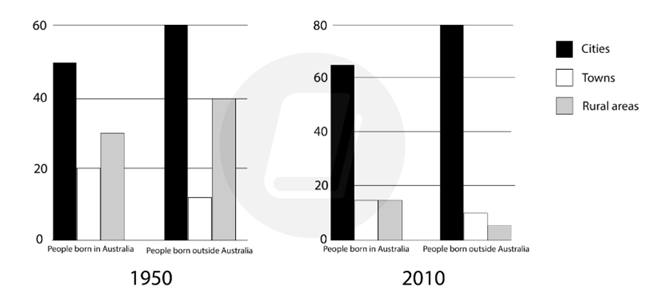
The chart below shows the percentage of people born in and outside of Australia living in cities, towns, and rural areas in 1950 and 2010. Summarise the information by selecting and reporting the main features of the graph and make comparisons where relevant.
Gợi ý 1:
The bar charts compare the percentages of people born in and outside Australia living in cities, towns, and rural areas in 1950 and 2010.
Overall, the proportion of people living in cities increased significantly for both groups, while the figures for towns and rural areas declined sharply. People born outside Australia were consistently more likely to live in cities than those born in the country.
In 1950, around 50% of Australian-born people lived in cities, compared to 60% of those born overseas. Meanwhile, roughly 30% of native-born Australians lived in towns and 20% in rural areas. For foreign-born residents, the figures were 40% for towns and only 10% for rural areas.
By 2010, the urban population had grown dramatically. About 65% of Australian-born people and 80% of foreign-born residents lived in cities. In contrast, the proportions in towns and rural areas fell to around 10–15% for both groups, showing a clear trend toward urbanization.
In summary, the data reveal a strong shift toward city living between 1950 and 2010, especially among people born outside Australia.
(Biểu đồ cột so sánh tỷ lệ người sinh trong và ngoài nước Úc sống ở thành phố, thị trấn và vùng nông thôn vào các năm 1950 và 2010.
Nhìn chung, tỷ lệ người sống ở thành phố tăng mạnh đối với cả hai nhóm, trong khi số liệu ở thị trấn và vùng nông thôn giảm đáng kể. Người sinh ngoài nước Úc luôn có xu hướng sống ở thành phố nhiều hơn người sinh trong nước.
Năm 1950, khoảng 50% người sinh tại Úc sống ở thành phố, so với 60% người sinh ở nước ngoài. Trong khi đó, khoảng 30% người Úc sống ở thị trấn và 20% ở vùng nông thôn. Đối với người nước ngoài, tỷ lệ này lần lượt là 40% ở thị trấn và chỉ 10% ở vùng nông thôn.
Đến năm 2010, dân số đô thị tăng mạnh. Khoảng 65% người sinh tại Úc và 80% người sinh ở nước ngoài sống ở thành phố. Ngược lại, tỷ lệ ở thị trấn và vùng nông thôn giảm xuống còn khoảng 10–15% đối với cả hai nhóm, cho thấy xu hướng đô thị hóa rõ rệt.
Tóm lại, dữ liệu cho thấy sự chuyển dịch mạnh mẽ sang cuộc sống đô thị từ năm 1950 đến 2010, đặc biệt ở nhóm người sinh ngoài nước Úc.)
Gợi ý 2:
The charts illustrate the proportion of people born in and outside Australia living in cities, towns, and rural areas in 1950 and 2010.
Overall, the majority of both groups lived in cities, and this trend became even stronger over time. Meanwhile, the percentages of people living in towns and rural areas declined substantially.
In 1950, half of Australian-born citizens lived in cities, while the figure for those born overseas was slightly higher at 60%. Towns and rural areas accounted for smaller shares, with 30% and 20% respectively for native-born Australians. For foreign-born residents, 40% lived in towns and only 10% in rural areas.
By 2010, the urban population had grown significantly. Around 65% of people born in Australia and 80% of those born abroad resided in cities. The proportions in towns and rural areas dropped to below 20% for both groups, with rural areas showing the lowest figures.
In conclusion, the data clearly indicate that urbanization increased dramatically between 1950 and 2010, with cities becoming the dominant living environment for both Australian-born and foreign-born populations.
(Biểu đồ thể hiện tỷ lệ người sinh trong và ngoài nước Úc sống ở thành phố, thị trấn và vùng nông thôn vào các năm 1950 và 2010.
Nhìn chung, phần lớn cả hai nhóm đều sống ở thành phố, và xu hướng này ngày càng mạnh mẽ hơn theo thời gian. Trong khi đó, tỷ lệ người sống ở thị trấn và vùng nông thôn giảm đáng kể.
Năm 1950, một nửa số người sinh tại Úc sống ở thành phố, trong khi tỷ lệ này ở người sinh ngoài nước là khoảng 60%. Thị trấn và vùng nông thôn chiếm tỷ lệ nhỏ hơn, lần lượt là 30% và 20% đối với người Úc. Đối với người nước ngoài, 40% sống ở thị trấn và chỉ 10% ở vùng nông thôn.
Đến năm 2010, dân số đô thị tăng mạnh. Khoảng 65% người sinh tại Úc và 80% người sinh ở nước ngoài sống ở thành phố. Tỷ lệ ở thị trấn và vùng nông thôn giảm xuống dưới 20% đối với cả hai nhóm, trong đó vùng nông thôn có tỷ lệ thấp nhất.
Tóm lại, dữ liệu cho thấy quá trình đô thị hóa tăng mạnh từ năm 1950 đến 2010, với thành phố trở thành nơi sinh sống chủ yếu của cả người sinh trong và ngoài nước Úc.)
It has been said that the world is becoming a global village in which there are no boundaries to trade and communication. Do the benefits of globalisation outweigh the drawbacks?
Hướng dẫn giải:
I believe that the advantages of globalization far outweigh its disadvantages. The increasing interconnectedness of nations has brought economic growth, cultural exchange, and technological progress that have improved lives worldwide.
Firstly, globalization promotes economic development. Free trade allows countries to specialize in industries where they have a competitive advantage, leading to higher productivity and lower prices for consumers. For example, developing nations can attract foreign investment, creating jobs and improving living standards.
Secondly, communication and technology have advanced rapidly due to globalization. People can now connect instantly across borders through the internet and social media, fostering international cooperation and understanding. This global network also enables the sharing of knowledge and innovation, accelerating scientific and medical breakthroughs.
However, globalization does have drawbacks. It can widen the gap between rich and poor nations and lead to cultural homogenization, where local traditions are overshadowed by global trends. Yet, these issues can be mitigated through fair trade policies and cultural preservation efforts.
In conclusion, although globalization presents certain challenges, its benefits in economic growth, technological advancement, and global unity are far greater. It has transformed the world into a more connected and prosperous place.
(Tôi cho rằng lợi ích của toàn cầu hóa vượt trội hơn nhiều so với những hạn chế của nó. Sự gắn kết ngày càng tăng giữa các quốc gia đã mang lại tăng trưởng kinh tế, giao lưu văn hóa và tiến bộ công nghệ, giúp cải thiện cuộc sống trên toàn thế giới.
Thứ nhất, toàn cầu hóa thúc đẩy phát triển kinh tế. Thương mại tự do cho phép các quốc gia chuyên môn hóa trong những ngành có lợi thế cạnh tranh, dẫn đến năng suất cao hơn và giá cả thấp hơn cho người tiêu dùng. Ví dụ, các nước đang phát triển có thể thu hút đầu tư nước ngoài, tạo việc làm và nâng cao mức sống.
Thứ hai, giao tiếp và công nghệ phát triển nhanh chóng nhờ toàn cầu hóa. Con người có thể kết nối tức thì qua biên giới thông qua internet và mạng xã hội, thúc đẩy hợp tác và hiểu biết quốc tế. Mạng lưới toàn cầu này cũng giúp chia sẻ tri thức và đổi mới, đẩy nhanh các tiến bộ khoa học và y học.
Tuy nhiên, toàn cầu hóa cũng có mặt tiêu cực. Nó có thể làm gia tăng khoảng cách giàu nghèo và dẫn đến sự đồng nhất văn hóa, khi các truyền thống địa phương bị lu mờ bởi xu hướng toàn cầu. Dù vậy, những vấn đề này có thể được giảm thiểu thông qua chính sách thương mại công bằng và bảo tồn văn hóa.
Tóm lại, mặc dù toàn cầu hóa mang lại một số thách thức, lợi ích của nó về tăng trưởng kinh tế, tiến bộ công nghệ và sự gắn kết toàn cầu vẫn lớn hơn nhiều. Nó đã biến thế giới thành một nơi kết nối và thịnh vượng hơn.)
Gợi ý 2:
Globalization has undoubtedly transformed the world, bringing both opportunities and challenges. While it has created economic and cultural benefits, its negative consequences cannot be ignored.
On the positive side, globalization encourages international cooperation and economic growth. Countries can trade freely, access new markets, and share technology. This has led to job creation and improved living standards in many developing nations. Moreover, global communication allows people to exchange ideas and learn from different cultures, promoting tolerance and understanding.
On the other hand, globalization can lead to inequality and exploitation. Wealthy nations and multinational corporations often dominate global markets, leaving poorer countries dependent and vulnerable. Additionally, the spread of global culture may erode local identities, as traditional customs and languages are replaced by Western influences.
Furthermore, globalization can harm the environment. Increased production and transportation contribute to pollution and climate change, which affect all nations regardless of borders.
In conclusion, globalization brings both benefits and drawbacks. While it promotes economic progress and cultural exchange, it also creates inequality and environmental challenges. Therefore, its advantages outweigh the disadvantages only when managed responsibly and fairly.
(Toàn cầu hóa chắc chắn đã thay đổi thế giới, mang lại cả cơ hội và thách thức. Mặc dù nó tạo ra lợi ích về kinh tế và văn hóa, nhưng những hậu quả tiêu cực cũng không thể bỏ qua.
Về mặt tích cực, toàn cầu hóa khuyến khích hợp tác quốc tế và tăng trưởng kinh tế. Các quốc gia có thể tự do giao thương, tiếp cận thị trường mới và chia sẻ công nghệ. Điều này đã tạo ra việc làm và cải thiện mức sống ở nhiều nước đang phát triển. Hơn nữa, giao tiếp toàn cầu giúp con người trao đổi ý tưởng và học hỏi từ các nền văn hóa khác nhau, thúc đẩy sự khoan dung và hiểu biết.
Tuy nhiên, toàn cầu hóa có thể dẫn đến bất bình đẳng và bóc lột. Các quốc gia giàu và tập đoàn đa quốc gia thường chiếm ưu thế trên thị trường toàn cầu, khiến các nước nghèo phụ thuộc và dễ bị tổn thương. Ngoài ra, sự lan rộng của văn hóa toàn cầu có thể làm phai nhạt bản sắc địa phương, khi phong tục và ngôn ngữ truyền thống bị thay thế bởi ảnh hưởng phương Tây.
Hơn nữa, toàn cầu hóa có thể gây hại cho môi trường. Việc sản xuất và vận chuyển tăng lên góp phần gây ô nhiễm và biến đổi khí hậu, ảnh hưởng đến mọi quốc gia không phân biệt biên giới.
Tóm lại, toàn cầu hóa mang lại cả lợi ích và hạn chế. Dù nó thúc đẩy tiến bộ kinh tế và giao lưu văn hóa, nó cũng tạo ra bất bình đẳng và thách thức môi trường. Do đó, lợi ích của nó chỉ vượt trội khi được quản lý một cách có trách nhiệm và công bằng.)
Internet technology means people do not need to travel to foreign countries to understand how others live. To what extent do you agree or disagree?
Hướng dẫn giải:
Gợi ý 1:
I agree that internet technology has made it possible to learn about other cultures without physically traveling abroad. The vast amount of information available online allows people to gain insights into lifestyles, traditions, and values across the globe.
Firstly, the internet provides instant access to cultural knowledge. Through documentaries, blogs, and social media, individuals can observe how people live in different countries. For example, platforms like YouTube or Instagram showcase daily routines, food, and festivals, offering a realistic picture of foreign lifestyles.
Secondly, online communication enables direct interaction. People can join international forums, attend virtual events, or even make friends through video calls. This form of cultural exchange is often more convenient and affordable than traveling, especially for those with limited resources.
However, while the internet offers valuable information, it may lack authenticity. Online content can be selective or exaggerated, and it does not always capture the emotional experience of being immersed in another culture. Despite this limitation, the internet still provides a practical alternative for most people.
In conclusion, internet technology has reduced the necessity of traveling abroad to understand other cultures. Although physical travel offers unique experiences, online resources are sufficient for gaining meaningful cultural knowledge.
(Tôi đồng ý rằng công nghệ internet đã giúp con người có thể tìm hiểu về các nền văn hóa khác mà không cần phải đi du lịch nước ngoài. Lượng thông tin khổng lồ có sẵn trực tuyến cho phép chúng ta hiểu về lối sống, truyền thống và giá trị trên toàn thế giới.
Thứ nhất, internet cung cấp khả năng tiếp cận tức thì với tri thức văn hóa. Thông qua phim tài liệu, blog và mạng xã hội, mọi người có thể quan sát cách sống ở các quốc gia khác nhau. Ví dụ, các nền tảng như YouTube hoặc Instagram giới thiệu thói quen hàng ngày, ẩm thực và lễ hội, mang lại hình ảnh chân thực về cuộc sống nước ngoài.
Thứ hai, giao tiếp trực tuyến cho phép tương tác trực tiếp. Con người có thể tham gia diễn đàn quốc tế, dự sự kiện ảo hoặc kết bạn qua cuộc gọi video. Hình thức trao đổi văn hóa này thường tiện lợi và tiết kiệm hơn so với việc đi du lịch, đặc biệt đối với những người có nguồn lực hạn chế.
Tuy nhiên, internet có thể thiếu tính xác thực. Nội dung trực tuyến đôi khi chọn lọc hoặc phóng đại, và không phải lúc nào cũng tái hiện được trải nghiệm cảm xúc khi hòa mình vào một nền văn hóa. Dù vậy, internet vẫn là một lựa chọn thực tế cho phần lớn mọi người.
Tóm lại, công nghệ internet đã làm giảm sự cần thiết phải đi du lịch nước ngoài để hiểu văn hóa khác. Mặc dù du lịch mang lại trải nghiệm độc đáo, tài nguyên trực tuyến vẫn đủ để có được kiến thức văn hóa ý nghĩa.)
Gợi ý 2:
I disagree with the statement because internet technology cannot fully replace the experience of traveling abroad. While online resources provide useful information, they lack the depth and authenticity of real-life exposure.
Firstly, culture is not only about facts and images but also about emotions and interactions. Visiting a foreign country allows individuals to taste authentic food, participate in local festivals, and communicate directly with residents. These experiences create lasting impressions that cannot be replicated through a computer screen.
Secondly, online content may be biased or incomplete. Social media often presents idealized versions of life, while blogs and documentaries reflect only certain perspectives. Without firsthand experience, people may develop stereotypes or misunderstandings about other cultures.
Moreover, traveling fosters empathy and global awareness. Immersing oneself in a different environment helps individuals appreciate diversity and overcome prejudices. This personal growth is difficult to achieve solely through internet-based learning.
In conclusion, although internet technology provides convenient access to cultural knowledge, it cannot substitute the richness of real-world experiences. Traveling abroad remains essential for truly understanding how others live.
(Tôi không đồng ý với quan điểm trên vì công nghệ internet không thể hoàn toàn thay thế trải nghiệm đi du lịch nước ngoài. Mặc dù tài nguyên trực tuyến cung cấp thông tin hữu ích, chúng thiếu chiều sâu và tính xác thực của trải nghiệm thực tế.
Thứ nhất, văn hóa không chỉ là dữ liệu và hình ảnh mà còn là cảm xúc và sự tương tác. Khi đến một quốc gia khác, con người có thể thưởng thức món ăn đặc trưng, tham gia lễ hội địa phương và giao tiếp trực tiếp với người dân. Những trải nghiệm này tạo ra ấn tượng lâu dài mà màn hình máy tính không thể tái hiện.
Thứ hai, nội dung trực tuyến có thể thiên lệch hoặc không đầy đủ. Mạng xã hội thường trình bày phiên bản lý tưởng hóa của cuộc sống, trong khi blog và phim tài liệu chỉ phản ánh một số góc nhìn. Nếu không có trải nghiệm thực tế, con người dễ hình thành định kiến hoặc hiểu sai về văn hóa khác.
Hơn nữa, du lịch nuôi dưỡng sự đồng cảm và nhận thức toàn cầu. Việc hòa mình vào môi trường khác giúp con người trân trọng sự đa dạng và vượt qua định kiến. Sự phát triển cá nhân này khó đạt được chỉ qua học tập trực tuyến.
Tóm lại, mặc dù công nghệ internet mang lại sự tiện lợi trong việc tiếp cận tri thức văn hóa, nó không thể thay thế sự phong phú của trải nghiệm thực tế. Du lịch nước ngoài vẫn cần thiết để thực sự hiểu cách người khác sống.)
In the future, it seems more difficult to live on Earth. Some people think more money should spent on researching another planet to live, such as Mars. To what extent do you agree or disagree with this statement.
Hướng dẫn giải:
Gợi ý 1:
I agree that investing in space research is necessary, as Earth faces increasing environmental and population pressures. Exploring other planets could provide long-term solutions for humanity’s survival.
Firstly, climate change and resource depletion are making life on Earth more challenging. Rising sea levels, extreme weather, and pollution threaten human existence. Researching planets like Mars offers hope for alternative habitats, ensuring that future generations have a backup option if Earth becomes uninhabitable.
Secondly, space exploration drives technological innovation. Investments in planetary research often lead to advancements in engineering, medicine, and communication. For example, satellite technology, initially developed for space missions, now plays a crucial role in everyday life. Thus, funding space research benefits society beyond the goal of colonization.
However, critics argue that money should be spent on solving Earth’s problems directly, such as poverty and healthcare. While this is valid, I believe both approaches can coexist. Addressing immediate issues is essential, but preparing for the future through space research is equally important.
In conclusion, spending more money on researching other planets is a wise investment. It not only secures humanity’s long-term survival but also fosters technological progress that benefits life on Earth.
(Tôi đồng ý rằng việc đầu tư vào nghiên cứu không gian là cần thiết, vì Trái Đất đang đối mặt với áp lực ngày càng lớn về môi trường và dân số. Việc khám phá các hành tinh khác có thể mang lại giải pháp lâu dài cho sự tồn tại của nhân loại.
Thứ nhất, biến đổi khí hậu và cạn kiệt tài nguyên đang khiến cuộc sống trên Trái Đất khó khăn hơn. Mực nước biển dâng, thời tiết cực đoan và ô nhiễm đe dọa sự sống con người. Nghiên cứu các hành tinh như sao Hỏa mang lại hy vọng về nơi ở thay thế, đảm bảo thế hệ tương lai có lựa chọn dự phòng nếu Trái Đất không thể ở được.
Thứ hai, khám phá không gian thúc đẩy đổi mới công nghệ. Đầu tư vào nghiên cứu hành tinh thường dẫn đến tiến bộ trong kỹ thuật, y học và truyền thông. Ví dụ, công nghệ vệ tinh ban đầu được phát triển cho các sứ mệnh không gian, nay đóng vai trò quan trọng trong đời sống hàng ngày. Do đó, tài trợ nghiên cứu không gian mang lại lợi ích vượt xa mục tiêu định cư.
Tuy nhiên, nhiều người cho rằng tiền nên được dùng để giải quyết trực tiếp các vấn đề trên Trái Đất như nghèo đói và y tế. Điều này đúng, nhưng tôi tin rằng cả hai hướng tiếp cận có thể song song tồn tại. Giải quyết vấn đề trước mắt là cần thiết, nhưng chuẩn bị cho tương lai thông qua nghiên cứu không gian cũng quan trọng không kém.
Tóm lại, chi nhiều tiền hơn cho nghiên cứu các hành tinh khác là khoản đầu tư khôn ngoan. Nó không chỉ đảm bảo sự sống lâu dài của nhân loại mà còn thúc đẩy tiến bộ công nghệ phục vụ cuộc sống trên Trái Đất.)
Gợi ý 2:
I disagree with the idea of prioritizing space research over solving Earth’s problems. While exploring other planets is fascinating, the immediate challenges we face require urgent attention and resources.
Firstly, Earth is still the most suitable planet for human life. Despite environmental issues, it has air, water, and ecosystems that no other planet can currently provide. Mars, for instance, has extreme temperatures and lacks breathable air, making colonization highly impractical in the near future. Instead of spending billions on space projects, governments should invest in renewable energy, sustainable agriculture, and pollution control to make Earth more habitable.
Secondly, poverty, inequality, and healthcare remain pressing issues. Allocating more money to space research while millions struggle with basic needs is ethically questionable. Improving education, healthcare, and infrastructure would directly enhance the quality of life for billions of people.
Moreover, technological solutions for Earth often arise from research focused on sustainability rather than colonization. For example, advancements in clean energy and waste management can address climate change more effectively than attempting to move humanity to another planet.
In conclusion, while space exploration has scientific value, I believe resources should primarily be directed toward solving Earth’s problems. Ensuring our planet remains livable is more realistic and beneficial than investing heavily in colonizing Mars.
(Tôi không đồng ý với quan điểm ưu tiên nghiên cứu không gian hơn là giải quyết các vấn đề của Trái Đất. Dù việc khám phá hành tinh khác hấp dẫn, những thách thức trước mắt cần được chú trọng và đầu tư khẩn cấp.
Thứ nhất, Trái Đất vẫn là hành tinh phù hợp nhất cho sự sống con người. Dù có vấn đề môi trường, nó vẫn có không khí, nước và hệ sinh thái mà không hành tinh nào hiện tại có thể cung cấp. Sao Hỏa, chẳng hạn, có nhiệt độ khắc nghiệt và không có không khí để thở, khiến việc định cư gần như không khả thi. Thay vì chi hàng tỷ đô la cho dự án không gian, chính phủ nên đầu tư vào năng lượng tái tạo, nông nghiệp bền vững và kiểm soát ô nhiễm để làm cho Trái Đất đáng sống hơn.
Thứ hai, nghèo đói, bất bình đẳng và y tế vẫn là vấn đề cấp bách. Việc chi nhiều tiền cho nghiên cứu không gian trong khi hàng triệu người thiếu nhu cầu cơ bản là điều đáng lo ngại về mặt đạo đức. Cải thiện giáo dục, y tế và cơ sở hạ tầng sẽ trực tiếp nâng cao chất lượng cuộc sống cho hàng tỷ người.
Hơn nữa, các giải pháp công nghệ cho Trái Đất thường xuất phát từ nghiên cứu tập trung vào tính bền vững hơn là định cư hành tinh khác. Ví dụ, tiến bộ trong năng lượng sạch và quản lý chất thải có thể giải quyết biến đổi khí hậu hiệu quả hơn so với việc cố gắng đưa nhân loại đến một hành tinh khác.
Tóm lại, mặc dù khám phá không gian có giá trị khoa học, tôi tin rằng nguồn lực nên được dành chủ yếu cho việc giải quyết các vấn đề của Trái Đất. Đảm bảo hành tinh của chúng ta có thể ở được là thực tế và có lợi hơn nhiều so với việc đầu tư mạnh vào việc định cư sao Hỏa.)
Some people argue job satisfaction is more important than job security. Others believe a permanent job is more important. Discuss both views and give your own opinion.
Hướng dẫn giải:
Job satisfaction and job security are both crucial aspects of employment, but many people argue that satisfaction is more valuable. I agree with this view because enjoying one’s work leads to greater productivity and personal fulfillment.
On the one hand, job satisfaction motivates employees to perform better. When people enjoy their tasks, they are more creative, committed, and willing to contribute to the success of the organization. For example, individuals working in fields they are passionate about often achieve higher results and feel less stressed. Moreover, satisfaction at work enhances mental health and overall happiness, which cannot be guaranteed by job security alone.
On the other hand, job security provides stability and financial safety. A permanent job ensures a steady income, which is essential for supporting families and planning for the future. In uncertain economic times, many people prioritize security over satisfaction because losing a job can lead to serious financial difficulties.
In my opinion, job satisfaction outweighs job security. While stability is important, working in a job that one dislikes can lead to frustration and burnout. A fulfilling career not only benefits individuals but also contributes positively to society through innovation and productivity.
(Sự hài lòng trong công việc và sự ổn định nghề nghiệp đều quan trọng, nhưng nhiều người cho rằng sự hài lòng có giá trị hơn. Tôi đồng ý với quan điểm này vì việc yêu thích công việc giúp tăng năng suất và mang lại sự thỏa mãn cá nhân.
Một mặt, sự hài lòng trong công việc thúc đẩy nhân viên làm việc tốt hơn. Khi con người yêu thích công việc, họ sáng tạo hơn, tận tâm hơn và sẵn sàng đóng góp cho sự thành công của tổ chức. Ví dụ, những người làm việc trong lĩnh vực mà họ đam mê thường đạt kết quả cao và ít căng thẳng hơn. Hơn nữa, sự hài lòng trong công việc cải thiện sức khỏe tinh thần và hạnh phúc tổng thể, điều mà sự ổn định nghề nghiệp không thể đảm bảo.
Mặt khác, sự ổn định nghề nghiệp mang lại sự an toàn tài chính. Một công việc lâu dài đảm bảo thu nhập ổn định, điều cần thiết để nuôi dưỡng gia đình và lập kế hoạch cho tương lai. Trong thời kỳ kinh tế bất ổn, nhiều người ưu tiên sự ổn định hơn sự hài lòng vì mất việc có thể dẫn đến khó khăn nghiêm trọng.
Theo quan điểm của tôi, sự hài lòng trong công việc quan trọng hơn sự ổn định. Dù sự ổn định cần thiết, nhưng làm việc trong một công việc không yêu thích có thể dẫn đến căng thẳng và kiệt sức. Một sự nghiệp thỏa mãn không chỉ mang lại lợi ích cho cá nhân mà còn đóng góp tích cực cho xã hội thông qua đổi mới và năng suất.)
Gợi ý 2:
While job satisfaction is desirable, I believe job security is more important because it provides financial stability and peace of mind, especially in today’s competitive job market.
On the one hand, job satisfaction makes work enjoyable and meaningful. Employees who feel fulfilled are more motivated and less likely to suffer from stress. They often develop stronger relationships with colleagues and contribute positively to workplace culture. Satisfaction also encourages long-term commitment, which benefits both employees and employers.
On the other hand, job security ensures stability and reduces anxiety about the future. A permanent job guarantees a steady income, which is essential for paying bills, raising children, and planning retirement. Without security, even a satisfying job can become stressful if there is constant fear of unemployment. For many people, especially those with families, financial stability outweighs personal enjoyment.
In my opinion, job security is more important than satisfaction. While enjoying work is valuable, the assurance of a permanent position provides the foundation for a stable life. Once financial needs are met, individuals can seek satisfaction through hobbies, family, or personal growth outside of work.
(Mặc dù sự hài lòng trong công việc là điều đáng mong muốn, tôi cho rằng sự ổn định nghề nghiệp quan trọng hơn vì nó mang lại sự an toàn tài chính và sự yên tâm, đặc biệt trong thị trường lao động cạnh tranh hiện nay.
Một mặt, sự hài lòng khiến công việc trở nên thú vị và ý nghĩa. Nhân viên cảm thấy thỏa mãn sẽ có động lực hơn và ít bị căng thẳng. Họ thường xây dựng mối quan hệ tốt hơn với đồng nghiệp và đóng góp tích cực cho văn hóa nơi làm việc. Sự hài lòng cũng khuyến khích sự gắn bó lâu dài, mang lại lợi ích cho cả nhân viên và nhà tuyển dụng.
Mặt khác, sự ổn định nghề nghiệp đảm bảo sự an toàn và giảm lo lắng về tương lai. Một công việc lâu dài đảm bảo thu nhập ổn định, điều cần thiết để chi trả hóa đơn, nuôi con và lên kế hoạch nghỉ hưu. Nếu thiếu sự ổn định, ngay cả một công việc thú vị cũng có thể trở thành căng thẳng khi luôn lo sợ thất nghiệp. Với nhiều người, đặc biệt là những người có gia đình, sự ổn định tài chính quan trọng hơn niềm vui cá nhân.
Theo quan điểm của tôi, sự ổn định nghề nghiệp quan trọng hơn sự hài lòng. Dù việc yêu thích công việc có giá trị, nhưng sự đảm bảo về vị trí lâu dài tạo nền tảng cho một cuộc sống ổn định. Khi nhu cầu tài chính được đáp ứng, con người có thể tìm kiếm sự thỏa mãn thông qua sở thích, gia đình hoặc sự phát triển cá nhân ngoài công việc.)
Nowadays, some parents put a lot of pressure on their children to succeed. What are parents’ reasons for doing this? Is this positive or negative development for the children?
Give reasons for your answer and include any relevant examples from your own experience or knowledge.
Gợi ý 1:
Many parents today place heavy pressure on their children to achieve success. This is often driven by concerns about competitiveness in education and the job market, but I believe this trend has more negative than positive consequences.
Parents push their children because they want them to secure a stable future. With increasing competition for university places and employment, parents feel that only outstanding academic performance and achievements can guarantee success. In addition, cultural expectations in many societies emphasize family pride, so parents may pressure children to excel in order to enhance the family’s reputation.
However, this pressure can harm children in several ways. Excessive demands often lead to stress, anxiety, and even depression. Children may lose interest in learning because they see education as a burden rather than a source of growth. Furthermore, constant pressure can damage parent-child relationships, as children may feel misunderstood or resentful. While some children may become disciplined and hardworking, the long-term psychological costs outweigh these benefits.
In conclusion, although parents’ intentions are understandable, putting too much pressure on children is a negative development. A balanced approach that encourages effort without overwhelming expectations is healthier for children’s growth.
(Ngày nay, nhiều bậc cha mẹ đặt áp lực lớn lên con cái để đạt được thành công. Điều này thường xuất phát từ lo ngại về sự cạnh tranh trong giáo dục và thị trường việc làm, nhưng tôi cho rằng xu hướng này mang lại nhiều tác động tiêu cực hơn là tích cực.
Cha mẹ thúc ép con cái vì họ muốn chúng có một tương lai ổn định. Với sự cạnh tranh ngày càng tăng trong việc giành chỗ học đại học và việc làm, cha mẹ cảm thấy rằng chỉ có thành tích học tập xuất sắc mới đảm bảo thành công. Ngoài ra, trong nhiều nền văn hóa, kỳ vọng xã hội nhấn mạnh niềm tự hào gia đình, nên cha mẹ có thể gây áp lực để con cái vượt trội nhằm nâng cao danh tiếng của gia đình.
Tuy nhiên, áp lực này có thể gây hại cho trẻ em theo nhiều cách. Yêu cầu quá mức thường dẫn đến căng thẳng, lo âu và thậm chí trầm cảm. Trẻ có thể mất hứng thú học tập vì coi giáo dục là gánh nặng thay vì là sự phát triển. Hơn nữa, áp lực liên tục có thể làm tổn hại mối quan hệ cha mẹ - con cái, khi trẻ cảm thấy bị hiểu sai hoặc bất mãn. Dù một số trẻ có thể trở nên kỷ luật và chăm chỉ, nhưng chi phí tâm lý lâu dài lớn hơn lợi ích.
Tóm lại, mặc dù ý định của cha mẹ là dễ hiểu, việc đặt quá nhiều áp lực lên con cái là một sự phát triển tiêu cực. Một cách tiếp cận cân bằng, khuyến khích nỗ lực mà không đặt kỳ vọng quá mức sẽ lành mạnh hơn cho sự trưởng thành của trẻ.)
Gợi ý 2:
Parents often pressure their children to succeed because they want them to have better opportunities in life. While this can motivate children to work harder, it also carries risks if the pressure becomes excessive.
One reason parents do this is the competitive nature of modern society. Academic qualifications and professional achievements are seen as essential for securing good jobs and financial stability. Parents therefore push their children to excel in school and extracurricular activities to prepare them for future challenges. Another reason is cultural values: in many societies, children’s success is viewed as a reflection of parental responsibility and family honor.
This pressure can have both positive and negative effects. On the positive side, it can instill discipline, resilience, and ambition in children. Many successful individuals attribute their achievements to the high expectations set by their parents. On the negative side, however, too much pressure can lead to stress, burnout, and strained family relationships. Children may feel that their worth is measured only by achievements, which can harm their self-esteem.
In my opinion, parental pressure is beneficial only when balanced with emotional support. Encouraging children to do their best while respecting their individuality creates a healthier environment than imposing unrealistic expectations.
(Cha mẹ thường gây áp lực lên con cái để thành công vì họ muốn chúng có nhiều cơ hội hơn trong cuộc sống. Mặc dù điều này có thể thúc đẩy trẻ làm việc chăm chỉ hơn, nó cũng tiềm ẩn rủi ro nếu áp lực trở nên quá mức.
Một lý do cha mẹ làm vậy là do tính cạnh tranh của xã hội hiện đại. Bằng cấp và thành tích nghề nghiệp được coi là yếu tố thiết yếu để có việc làm tốt và sự ổn định tài chính. Vì vậy, cha mẹ thúc ép con cái học giỏi và tham gia nhiều hoạt động ngoại khóa để chuẩn bị cho những thách thức trong tương lai. Một lý do khác là giá trị văn hóa: trong nhiều xã hội, thành công của con cái được coi là sự phản ánh trách nhiệm và danh dự của cha mẹ.
Áp lực này có thể mang lại cả tác động tích cực lẫn tiêu cực. Về mặt tích cực, nó có thể rèn luyện tính kỷ luật, sự kiên cường và tham vọng cho trẻ. Nhiều người thành công cho rằng thành tựu của họ bắt nguồn từ kỳ vọng cao của cha mẹ. Tuy nhiên, về mặt tiêu cực, áp lực quá lớn có thể dẫn đến căng thẳng, kiệt sức và mối quan hệ gia đình căng thẳng. Trẻ có thể cảm thấy giá trị bản thân chỉ được đo bằng thành tích, điều này gây hại cho lòng tự trọng.
Theo quan điểm của tôi, áp lực từ cha mẹ chỉ có lợi khi được cân bằng với sự hỗ trợ tinh thần. Khuyến khích trẻ nỗ lực hết mình đồng thời tôn trọng cá tính của chúng sẽ tạo ra môi trường lành mạnh hơn so với việc áp đặt kỳ vọng phi thực tế.)
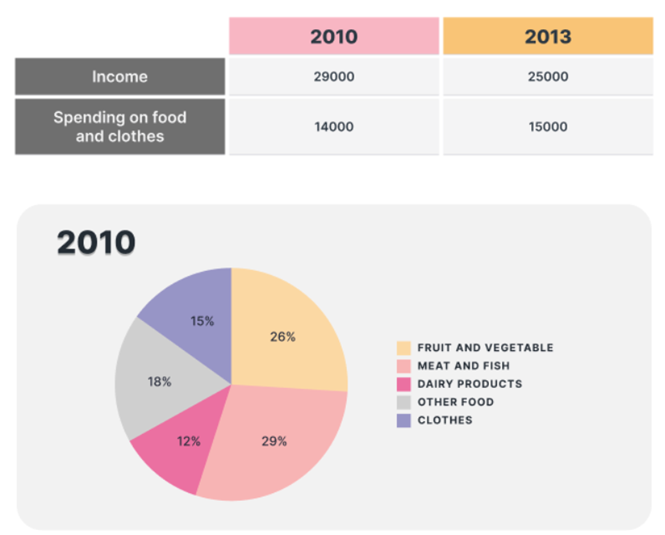
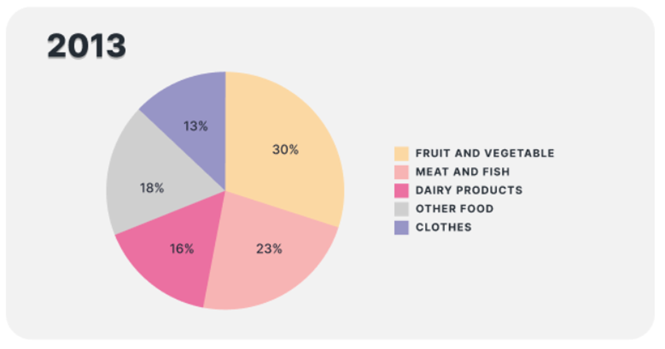
The pictures show information about average income and spending on food and clothes by an average family in a city in the UK.
Hướng dẫn giải:
Gợi ý 1:
The charts illustrate the average income and spending on food and clothes by a typical family in a UK city in 2010 and 2013, along with the breakdown of spending categories.
Overall, the family’s income decreased over the period, while their spending on food and clothes slightly increased. In both years, fruit and vegetables accounted for the largest share of spending, whereas clothes represented the smallest proportion.
In 2010, the average family earned £29,000 and spent £14,000 on food and clothes. Among the spending categories, meat and fish made up the highest percentage at 29%, followed by fruit and vegetables at 26%. Other food and clothes accounted for 18% and 15% respectively, while dairy products represented the smallest share at 12%.
By 2013, income had fallen to £25,000, but spending rose to £15,000. The proportion spent on fruit and vegetables increased to 30%, becoming the largest category. Meat and fish dropped to 23%, while dairy products rose slightly to 16%. Other food remained unchanged at 18%, and clothes declined to 13%.
In summary, although the family’s income decreased between 2010 and 2013, their spending on food and clothes grew, with fruit and vegetables taking up an increasingly significant portion of the budget.
(Các biểu đồ thể hiện thu nhập trung bình và chi tiêu cho thực phẩm và quần áo của một gia đình điển hình ở một thành phố tại Vương quốc Anh vào năm 2010 và 2013, cùng với cơ cấu chi tiêu chi tiết.
Nhìn chung, thu nhập của gia đình giảm trong giai đoạn này, trong khi chi tiêu cho thực phẩm và quần áo tăng nhẹ. Trong cả hai năm, trái cây và rau củ chiếm tỷ lệ lớn nhất trong chi tiêu, còn quần áo chiếm tỷ lệ nhỏ nhất.
Năm 2010, thu nhập trung bình của gia đình là £29,000 và chi tiêu cho thực phẩm và quần áo là £14,000. Trong các hạng mục chi tiêu, thịt và cá chiếm tỷ lệ cao nhất (29%), tiếp theo là trái cây và rau củ (26%). Thực phẩm khác và quần áo lần lượt chiếm 18% và 15%, trong khi sản phẩm từ sữa chiếm tỷ lệ nhỏ nhất (12%).
Đến năm 2013, thu nhập giảm xuống còn £25,000 nhưng chi tiêu tăng lên £15,000. Tỷ lệ chi cho trái cây và rau củ tăng lên 30%, trở thành hạng mục lớn nhất. Thịt và cá giảm xuống 23%, trong khi sản phẩm từ sữa tăng nhẹ lên 16%. Thực phẩm khác giữ nguyên ở mức 18%, còn quần áo giảm xuống 13%.
Tóm lại, mặc dù thu nhập của gia đình giảm từ năm 2010 đến 2013, chi tiêu cho thực phẩm và quần áo lại tăng, với trái cây và rau củ chiếm tỷ trọng ngày càng lớn trong ngân sách.)
Gợi ý 2:
The charts compare the average income and expenditure on food and clothes by a family in a UK city in 2010 and 2013, and show how spending was distributed among different categories.
Overall, the family earned less money in 2013 but spent more on food and clothing. Fruit and vegetables became the largest spending category, while clothes remained the smallest.
In 2010, the average income was £29,000, and £14,000 was spent on food and clothes. Meat and fish represented the biggest portion of spending at 29%, followed by fruit and vegetables at 26%. Other food accounted for 18%, clothes for 15%, and dairy products for 12%.
Three years later, income fell to £25,000, but spending rose to £15,000. The share of fruit and vegetables increased to 30%, overtaking meat and fish, which dropped to 23%. Dairy products rose to 16%, while other food stayed constant at 18%. Clothes saw a slight decline to 13%.
In conclusion, the data show that although the family’s income decreased, their spending increased, with a noticeable shift toward healthier food choices such as fruit and vegetables.
(Các biểu đồ so sánh thu nhập trung bình và chi tiêu cho thực phẩm và quần áo của một gia đình ở một thành phố tại Vương quốc Anh vào năm 2010 và 2013, đồng thời thể hiện cách phân bổ chi tiêu theo từng hạng mục.
Nhìn chung, gia đình kiếm được ít tiền hơn vào năm 2013 nhưng lại chi tiêu nhiều hơn cho thực phẩm và quần áo. Trái cây và rau củ trở thành hạng mục chi tiêu lớn nhất, trong khi quần áo vẫn là nhỏ nhất.
Năm 2010, thu nhập trung bình là £29,000 và £14,000 được chi cho thực phẩm và quần áo. Thịt và cá chiếm phần lớn nhất (29%), tiếp theo là trái cây và rau củ (26%). Thực phẩm khác chiếm 18%, quần áo 15%, và sản phẩm từ sữa 12%.
Ba năm sau, thu nhập giảm xuống còn £25,000 nhưng chi tiêu tăng lên £15,000. Tỷ lệ chi cho trái cây và rau củ tăng lên 30%, vượt qua thịt và cá, vốn giảm xuống 23%. Sản phẩm từ sữa tăng lên 16%, trong khi thực phẩm khác giữ nguyên ở mức 18%. Quần áo giảm nhẹ xuống 13%.
Tóm lại, dữ liệu cho thấy mặc dù thu nhập của gia đình giảm, chi tiêu lại tăng, với sự chuyển dịch rõ rệt sang các lựa chọn thực phẩm lành mạnh hơn như trái cây và rau củ.)
In many countries around the world, rural people are moving to cities, so the population in the countryside is decreasing. Do you think this is a positive or a negative development? Give reasons for your answer and include any relevant examples from your own knowledge or experience
Hướng dẫn giải:
Gợi ý 1:
The migration of rural residents to urban areas has become a global trend. While this movement can bring economic benefits, I believe it is largely a negative development because it leads to social imbalance and environmental problems.
Firstly, the decline in rural populations can harm agricultural production. As young people move to cities for better job opportunities, farming communities are left with fewer workers. This can reduce food supply and increase dependence on imported goods. For example, in many developing countries, rural areas struggle to maintain crop yields due to labor shortages.
Secondly, urban migration causes overcrowding and pressure on city infrastructure. Cities often face housing shortages, traffic congestion, and pollution as a result of rapid population growth. Meanwhile, rural areas become neglected, with limited investment and declining public services such as schools and hospitals.
Furthermore, the cultural gap between urban and rural communities widens. Traditional lifestyles and local customs may disappear as younger generations abandon their hometowns. This loss of cultural identity can weaken social cohesion and heritage preservation.
In conclusion, although moving to cities may improve individuals’ living standards, the overall impact on society is negative. Governments should encourage balanced development by creating more opportunities and better living conditions in rural areas.
(Việc người dân nông thôn di cư đến thành phố đã trở thành xu hướng toàn cầu. Mặc dù sự dịch chuyển này có thể mang lại lợi ích kinh tế, tôi cho rằng đây chủ yếu là một sự phát triển tiêu cực vì nó dẫn đến mất cân bằng xã hội và các vấn đề môi trường.
Trước hết, sự suy giảm dân số nông thôn có thể gây hại cho sản xuất nông nghiệp. Khi người trẻ chuyển đến thành phố để tìm việc làm tốt hơn, các cộng đồng nông nghiệp thiếu lao động. Điều này có thể làm giảm nguồn cung thực phẩm và tăng sự phụ thuộc vào hàng nhập khẩu. Ví dụ, ở nhiều quốc gia đang phát triển, khu vực nông thôn gặp khó khăn trong việc duy trì năng suất cây trồng do thiếu nhân công.
Thứ hai, việc di cư đến đô thị gây ra tình trạng quá tải và áp lực lên cơ sở hạ tầng thành phố. Các thành phố thường đối mặt với tình trạng thiếu nhà ở, tắc nghẽn giao thông và ô nhiễm do dân số tăng nhanh. Trong khi đó, khu vực nông thôn bị bỏ quên, ít được đầu tư và các dịch vụ công như trường học, bệnh viện suy giảm.
Hơn nữa, khoảng cách văn hóa giữa đô thị và nông thôn ngày càng lớn. Lối sống truyền thống và phong tục địa phương có thể biến mất khi thế hệ trẻ rời quê hương. Sự mất mát bản sắc văn hóa này có thể làm suy yếu sự gắn kết xã hội và việc bảo tồn di sản.
Tóm lại, mặc dù việc chuyển đến thành phố có thể cải thiện mức sống cá nhân, tác động tổng thể đối với xã hội là tiêu cực. Chính phủ nên khuyến khích phát triển cân bằng bằng cách tạo thêm cơ hội và điều kiện sống tốt hơn ở nông thôn.)
Gợi ý 2:
The movement of people from rural areas to cities is a common phenomenon in modern society. While this trend brings economic growth and better living standards, it also creates serious challenges that must be addressed.
On the positive side, urban migration contributes to national development. Cities offer more job opportunities, advanced education, and healthcare facilities. As a result, rural migrants can improve their quality of life and contribute to the economy. For instance, many developing countries have experienced rapid industrial growth due to the influx of labor from rural regions.
However, this trend also has negative consequences. The countryside suffers from depopulation, leaving behind elderly residents and reducing agricultural productivity. Moreover, cities face overcrowding, pollution, and rising living costs. These problems can lead to social inequality and lower quality of life for urban dwellers.
In my opinion, rural-to-urban migration is beneficial only when managed properly. Governments should invest in rural development—such as infrastructure, education, and job creation—to reduce the need for migration and ensure balanced growth between regions.
In conclusion, while moving to cities can bring personal and economic benefits, it becomes a negative development if rural areas are neglected. Sustainable policies are essential to maintain harmony between urban and rural communities.
(Việc người dân từ nông thôn chuyển đến thành phố là hiện tượng phổ biến trong xã hội hiện đại. Mặc dù xu hướng này mang lại tăng trưởng kinh tế và cải thiện mức sống, nó cũng tạo ra những thách thức nghiêm trọng cần được giải quyết.
Về mặt tích cực, di cư đến đô thị góp phần vào sự phát triển quốc gia. Thành phố cung cấp nhiều cơ hội việc làm, giáo dục tiên tiến và dịch vụ y tế tốt hơn. Do đó, người dân nông thôn có thể nâng cao chất lượng cuộc sống và đóng góp cho nền kinh tế. Ví dụ, nhiều quốc gia đang phát triển đã chứng kiến sự tăng trưởng công nghiệp nhanh chóng nhờ dòng lao động từ khu vực nông thôn.
Tuy nhiên, xu hướng này cũng có hậu quả tiêu cực. Nông thôn bị suy giảm dân số, chỉ còn người già ở lại và năng suất nông nghiệp giảm. Ngoài ra, các thành phố phải đối mặt với tình trạng quá tải, ô nhiễm và chi phí sinh hoạt tăng cao. Những vấn đề này có thể dẫn đến bất bình đẳng xã hội và giảm chất lượng cuộc sống của người dân đô thị.
Theo quan điểm của tôi, việc di cư từ nông thôn ra thành phố chỉ có lợi khi được quản lý hợp lý. Chính phủ nên đầu tư vào phát triển nông thôn — như cơ sở hạ tầng, giáo dục và tạo việc làm — để giảm nhu cầu di cư và đảm bảo sự phát triển cân bằng giữa các khu vực.
Tóm lại, mặc dù việc chuyển đến thành phố có thể mang lại lợi ích cá nhân và kinh tế, nó sẽ trở thành tiêu cực nếu khu vực nông thôn bị bỏ quên. Các chính sách phát triển bền vững là cần thiết để duy trì sự hài hòa giữa cộng đồng đô thị và nông thôn.)
Hướng dẫn giải:
Gợi ý 1:
I agree that maintaining good health should be considered a responsibility to society, not just a personal matter. Healthy individuals contribute to stronger communities and reduce the burden on public resources.
Firstly, when people take care of their health, they lessen the strain on healthcare systems. Preventing diseases through exercise, balanced diets, and regular check-ups reduces medical costs for governments and taxpayers. For example, societies with lower rates of obesity and smoking spend less on treating chronic illnesses.
Secondly, healthy citizens are more productive. They can work efficiently, support their families, and contribute to economic growth. In contrast, poor health often leads to absenteeism, reduced performance, and dependency on welfare systems, which negatively affects society as a whole.
Moreover, looking after one’s health sets a positive example for others. Communities where individuals prioritize well-being tend to foster healthier lifestyles collectively, creating a culture of responsibility and mutual care.
In conclusion, while personal benefits are undeniable, health should also be viewed as a duty to society. By staying healthy, individuals not only improve their own lives but also strengthen the social and economic fabric of their communities.
(Tôi đồng ý rằng việc duy trì sức khỏe tốt nên được coi là trách nhiệm đối với xã hội, chứ không chỉ là vấn đề cá nhân. Người khỏe mạnh góp phần xây dựng cộng đồng vững mạnh và giảm gánh nặng cho nguồn lực công cộng.
Thứ nhất, khi mọi người chăm sóc sức khỏe, họ giảm áp lực lên hệ thống y tế. Việc phòng ngừa bệnh tật thông qua tập thể dục, chế độ ăn cân bằng và khám sức khỏe định kỳ giúp giảm chi phí y tế cho chính phủ và người nộp thuế. Ví dụ, các xã hội có tỷ lệ béo phì và hút thuốc thấp thường chi ít hơn cho việc điều trị bệnh mãn tính.
Thứ hai, công dân khỏe mạnh năng suất hơn. Họ có thể làm việc hiệu quả, nuôi dưỡng gia đình và đóng góp cho tăng trưởng kinh tế. Ngược lại, sức khỏe kém thường dẫn đến nghỉ việc, giảm hiệu suất và phụ thuộc vào hệ thống phúc lợi, gây ảnh hưởng tiêu cực đến toàn xã hội.
Hơn nữa, việc chăm sóc sức khỏe bản thân tạo tấm gương tích cực cho người khác. Những cộng đồng nơi mọi người ưu tiên sức khỏe thường hình thành lối sống lành mạnh tập thể, tạo ra văn hóa trách nhiệm và sự quan tâm lẫn nhau.
Tóm lại, mặc dù lợi ích cá nhân là rõ ràng, sức khỏe cũng nên được coi là nghĩa vụ đối với xã hội. Bằng cách giữ gìn sức khỏe, mỗi người không chỉ cải thiện cuộc sống của mình mà còn củng cố nền tảng xã hội và kinh tế của cộng đồng.)
Gợi ý 2:
I disagree with the idea that health should primarily be seen as a duty to society. While good health benefits communities, it is fundamentally a personal responsibility aimed at improving one’s own quality of life.
Firstly, health is closely tied to individual happiness and well-being. People exercise, eat well, and avoid harmful habits mainly to feel better, live longer, and enjoy life. These personal motivations are stronger and more sustainable than abstract obligations to society.
Secondly, framing health as a duty to society may create unnecessary pressure. Individuals who suffer from illness or disability might feel guilty or stigmatized for not meeting social expectations. This could worsen their mental health and lead to discrimination, which is unfair and counterproductive.
Moreover, society itself benefits indirectly when individuals prioritize their own well-being. For example, a person who maintains good health for personal reasons will still reduce medical costs and contribute productively to the economy. Thus, the societal benefits are a natural outcome of personal care, not the primary motivation.
In conclusion, while healthy citizens do strengthen society, the main reason to look after one’s health should be personal benefit. Viewing health as an individual responsibility ensures motivation and fairness, while societal advantages follow naturally.
(Tôi không đồng ý với quan điểm rằng sức khỏe nên được coi chủ yếu là nghĩa vụ đối với xã hội. Mặc dù sức khỏe tốt mang lại lợi ích cho cộng đồng, nó về bản chất là trách nhiệm cá nhân nhằm cải thiện chất lượng cuộc sống của mỗi người.
Thứ nhất, sức khỏe gắn liền với hạnh phúc và sự thoải mái của cá nhân. Con người tập thể dục, ăn uống lành mạnh và tránh thói quen có hại chủ yếu để cảm thấy tốt hơn, sống lâu hơn và tận hưởng cuộc sống. Những động lực cá nhân này mạnh mẽ và bền vững hơn so với nghĩa vụ trừu tượng đối với xã hội.
Thứ hai, coi sức khỏe là nghĩa vụ xã hội có thể tạo áp lực không cần thiết. Những người mắc bệnh hoặc khuyết tật có thể cảm thấy tội lỗi hoặc bị kỳ thị vì không đáp ứng kỳ vọng xã hội. Điều này có thể làm trầm trọng thêm sức khỏe tinh thần và dẫn đến sự phân biệt đối xử, vốn không công bằng và phản tác dụng.
Hơn nữa, xã hội vẫn hưởng lợi gián tiếp khi cá nhân ưu tiên sức khỏe của mình. Ví dụ, một người chăm sóc sức khỏe vì lý do cá nhân vẫn giảm chi phí y tế và đóng góp năng suất cho nền kinh tế. Do đó, lợi ích xã hội là kết quả tự nhiên của việc chăm sóc cá nhân, chứ không phải động lực chính.
Tóm lại, mặc dù công dân khỏe mạnh củng cố xã hội, lý do chính để chăm sóc sức khỏe nên là lợi ích cá nhân. Xem sức khỏe như trách nhiệm cá nhân đảm bảo động lực và sự công bằng, trong khi lợi ích xã hội sẽ tự nhiên theo sau.)
Some people think that sending criminals to prison is not effective. Education and job training should be used instead. Do you agree or disagree?
Hướng dẫn giải:
Gợi ý 1:
I agree that education and job training are more effective than imprisonment in reducing crime. While prisons may provide temporary punishment, they often fail to address the root causes of criminal behavior.
Firstly, prisons can be counterproductive. Many inmates leave prison without rehabilitation and may reoffend due to lack of skills or opportunities. In some cases, prisons even expose individuals to hardened criminals, which can worsen their behavior rather than improve it.
Secondly, education and vocational training equip offenders with practical skills to reintegrate into society. For example, teaching literacy, computer skills, or trades such as carpentry and mechanics can help former criminals find stable employment. With a job and a sense of purpose, they are less likely to return to crime.
Moreover, focusing on rehabilitation benefits society as a whole. Instead of spending large sums on maintaining prisons, governments can invest in programs that reduce recidivism and create productive citizens. Countries like Norway, which emphasize rehabilitation, have some of the lowest reoffending rates in the world.
In conclusion, while prisons may be necessary for dangerous criminals, education and job training are more effective in preventing crime long-term. Rehabilitation creates opportunities for offenders to change and contribute positively to society.
(Tôi đồng ý rằng giáo dục và đào tạo nghề hiệu quả hơn việc bỏ tù trong việc giảm tội phạm. Nhà tù có thể mang lại sự trừng phạt tạm thời, nhưng thường không giải quyết nguyên nhân gốc rễ của hành vi phạm tội.
Thứ nhất, nhà tù có thể phản tác dụng. Nhiều tù nhân ra tù mà không được cải tạo và có thể tái phạm do thiếu kỹ năng hoặc cơ hội. Trong một số trường hợp, nhà tù còn khiến họ tiếp xúc với tội phạm nguy hiểm hơn, làm hành vi xấu đi thay vì cải thiện.
Thứ hai, giáo dục và đào tạo nghề cung cấp cho người phạm tội kỹ năng thực tế để tái hòa nhập xã hội. Ví dụ, dạy đọc viết, kỹ năng máy tính hoặc nghề như mộc và cơ khí có thể giúp họ tìm việc làm ổn định. Khi có công việc và mục đích sống, họ ít có khả năng quay lại con đường phạm pháp.
Hơn nữa, tập trung vào cải tạo mang lại lợi ích cho toàn xã hội. Thay vì chi nhiều tiền cho việc duy trì nhà tù, chính phủ có thể đầu tư vào các chương trình giảm tái phạm và tạo ra công dân hữu ích. Các quốc gia như Na Uy, nơi chú trọng cải tạo, có tỷ lệ tái phạm thấp nhất thế giới.
Tóm lại, mặc dù nhà tù cần thiết cho những tội phạm nguy hiểm, giáo dục và đào tạo nghề hiệu quả hơn trong việc ngăn ngừa tội phạm lâu dài. Cải tạo tạo cơ hội để người phạm tội thay đổi và đóng góp tích cực cho xã hội.)
Gợi ý 2:
I disagree with the idea that prisons are ineffective. Although education and job training are important, imprisonment remains necessary to protect society and deter crime.
Firstly, prisons serve as a deterrent. The fear of losing freedom discourages people from committing crimes. Without strict punishment, individuals may not take the law seriously, leading to increased crime rates. For example, violent offenders must be imprisoned to ensure public safety.
Secondly, prisons provide justice for victims. When criminals are punished, society acknowledges the harm done and restores a sense of fairness. Education and training alone cannot replace the need for accountability and justice.
However, I agree that rehabilitation should be part of the prison system. Offering education and vocational programs inside prisons can help inmates prepare for life after release. This combination of punishment and rehabilitation addresses both public safety and long-term reintegration.
In conclusion, prisons are still effective and necessary, especially for serious crimes. While education and job training are valuable, they should complement imprisonment rather than replace it.
(Tôi không đồng ý với quan điểm rằng nhà tù không hiệu quả. Mặc dù giáo dục và đào tạo nghề quan trọng, việc bỏ tù vẫn cần thiết để bảo vệ xã hội và ngăn chặn tội phạm.
Thứ nhất, nhà tù có tác dụng răn đe. Nỗi sợ mất tự do khiến con người tránh phạm tội. Nếu không có hình phạt nghiêm khắc, nhiều người có thể không coi trọng pháp luật, dẫn đến tỷ lệ tội phạm tăng. Ví dụ, những kẻ phạm tội bạo lực phải bị bỏ tù để đảm bảo an toàn cho cộng đồng.
Thứ hai, nhà tù mang lại công lý cho nạn nhân. Khi tội phạm bị trừng phạt, xã hội thừa nhận thiệt hại đã gây ra và khôi phục sự công bằng. Giáo dục và đào tạo nghề không thể thay thế nhu cầu về trách nhiệm và công lý.
Tuy nhiên, tôi đồng ý rằng cải tạo nên là một phần của hệ thống nhà tù. Việc cung cấp giáo dục và chương trình nghề nghiệp trong tù có thể giúp tù nhân chuẩn bị cho cuộc sống sau khi ra tù. Sự kết hợp giữa trừng phạt và cải tạo vừa đảm bảo an toàn xã hội vừa hỗ trợ tái hòa nhập lâu dài.
Tóm lại, nhà tù vẫn hiệu quả và cần thiết, đặc biệt đối với tội phạm nghiêm trọng. Trong khi giáo dục và đào tạo nghề có giá trị, chúng nên bổ sung cho việc bỏ tù chứ không thay thế.)
Some people think that newspapers are the best way to learn news. However, others believe that they can learn news better through other media. Discuss both views and give your opinion.
Hướng dẫn giải:
Gợi ý 1:
Some people argue that newspapers remain the most reliable source of news, while others believe modern media is more effective. In my opinion, newspapers still have value, but other media provide faster and more accessible information.
On the one hand, newspapers are often considered trustworthy. They are produced by professional journalists who follow strict editorial standards, which reduces the risk of misinformation. Newspapers also provide in-depth analysis and background information, helping readers understand complex issues. For example, investigative reports in print media often reveal details that short online articles may overlook.
On the other hand, other media such as television, radio, and the internet deliver news more quickly and widely. Online platforms allow people to access breaking news instantly, often with live updates and multimedia content. Social media also enables citizens to share information directly, making news more interactive and diverse. For instance, during emergencies, online media can spread warnings faster than newspapers.
In my view, while newspapers are valuable for detailed reporting, other media are more effective overall because they provide immediate access and reach a larger audience. A combination of both ensures people are well-informed.
(Một số người cho rằng báo in vẫn là nguồn tin tức đáng tin cậy nhất, trong khi những người khác tin rằng các phương tiện truyền thông hiện đại hiệu quả hơn. Theo tôi, báo in vẫn có giá trị, nhưng các phương tiện khác mang lại thông tin nhanh chóng và dễ tiếp cận hơn.
Một mặt, báo in thường được coi là đáng tin cậy. Chúng được sản xuất bởi các nhà báo chuyên nghiệp tuân thủ tiêu chuẩn biên tập nghiêm ngặt, giúp giảm nguy cơ thông tin sai lệch. Báo in cũng cung cấp phân tích chuyên sâu và thông tin nền, giúp người đọc hiểu các vấn đề phức tạp. Ví dụ, các bài điều tra trên báo in thường tiết lộ chi tiết mà các bài báo trực tuyến ngắn có thể bỏ qua.
Mặt khác, các phương tiện khác như truyền hình, radio và internet truyền tải tin tức nhanh chóng và rộng rãi hơn. Các nền tảng trực tuyến cho phép mọi người tiếp cận tin nóng ngay lập tức, thường kèm theo cập nhật trực tiếp và nội dung đa phương tiện. Mạng xã hội cũng cho phép công dân chia sẻ thông tin trực tiếp, khiến tin tức trở nên tương tác và đa dạng hơn. Ví dụ, trong tình huống khẩn cấp, truyền thông trực tuyến có thể lan truyền cảnh báo nhanh hơn báo in.
Theo quan điểm của tôi, mặc dù báo in có giá trị trong việc đưa tin chi tiết, các phương tiện khác hiệu quả hơn vì cung cấp thông tin tức thời và tiếp cận nhiều người hơn. Sự kết hợp cả hai đảm bảo mọi người được thông tin đầy đủ.)
Gợi ý 2:
There is debate over whether newspapers are the best source of news or whether other media are more effective. I believe that modern media has clear advantages, although newspapers still play an important role.
Supporters of newspapers argue that they offer credibility and depth. Printed articles are carefully edited and fact-checked, which builds trust among readers. Newspapers also provide detailed coverage of political, economic, and cultural issues, making them suitable for those who prefer comprehensive information rather than short updates.
In contrast, other media such as television, radio, and online platforms are faster and more convenient. People can access news anytime and anywhere through smartphones or computers. Online media also use videos, images, and interactive features, which make news more engaging. For example, live broadcasts allow audiences to witness events as they happen, something newspapers cannot provide.
In my opinion, other media are better overall because they combine speed, accessibility, and variety. Newspapers are useful for analysis, but in today’s fast-paced world, people rely more on instant updates from digital platforms.
(Có tranh luận về việc báo in có phải là nguồn tin tức tốt nhất hay các phương tiện khác hiệu quả hơn. Tôi tin rằng truyền thông hiện đại có lợi thế rõ ràng, mặc dù báo in vẫn đóng vai trò quan trọng.
Những người ủng hộ báo in cho rằng chúng mang lại độ tin cậy và chiều sâu. Các bài viết in được biên tập và kiểm chứng cẩn thận, tạo niềm tin cho độc giả. Báo in cũng cung cấp thông tin chi tiết về các vấn đề chính trị, kinh tế và văn hóa, phù hợp với những người thích thông tin toàn diện hơn là cập nhật ngắn gọn.
Ngược lại, các phương tiện khác như truyền hình, radio và nền tảng trực tuyến nhanh chóng và tiện lợi hơn. Con người có thể tiếp cận tin tức mọi lúc mọi nơi qua điện thoại thông minh hoặc máy tính. Truyền thông trực tuyến cũng sử dụng video, hình ảnh và tính năng tương tác, khiến tin tức hấp dẫn hơn. Ví dụ, các chương trình phát trực tiếp cho phép khán giả chứng kiến sự kiện ngay khi nó diễn ra, điều mà báo in không thể làm được.
Theo quan điểm của tôi, các phương tiện khác tốt hơn vì kết hợp tốc độ, khả năng tiếp cận và sự đa dạng. Báo in hữu ích cho phân tích, nhưng trong thế giới hiện đại, con người dựa nhiều hơn vào cập nhật tức thời từ nền tảng kỹ thuật số.)
Some people believed that money is the most important factor for achieving happiness. However, others believe that happiness has nothing to do with money. Do you agree or disagree? Give your own opinion and examples.
Gợi ý 1:
I agree that money plays a crucial role in achieving happiness, although it is not the only factor. Financial stability provides security and opportunities that contribute significantly to people’s well-being.
Firstly, money allows individuals to meet their basic needs. Without sufficient income, people may struggle with food, housing, and healthcare, which are essential for a comfortable life. For example, families with stable finances can afford better education and medical care, reducing stress and improving quality of life.
Secondly, money provides freedom and choices. People with financial resources can pursue hobbies, travel, and enjoy leisure activities, all of which enhance happiness. In addition, money reduces anxiety about the future, as savings and investments offer protection against unexpected difficulties.
However, happiness also depends on non-material factors such as relationships, health, and personal fulfillment. Wealth alone cannot guarantee happiness if individuals lack meaningful connections or suffer from poor health. Therefore, money is important but should be balanced with other aspects of life.
In conclusion, I believe money is a key factor in achieving happiness because it provides security and opportunities. Yet, true happiness requires more than wealth; it also depends on emotional and social well-being.
(Tôi đồng ý rằng tiền đóng vai trò quan trọng trong việc đạt được hạnh phúc, mặc dù nó không phải là yếu tố duy nhất. Sự ổn định tài chính mang lại sự an toàn và cơ hội, góp phần đáng kể vào hạnh phúc của con người.
Thứ nhất, tiền giúp con người đáp ứng nhu cầu cơ bản. Nếu không có thu nhập đủ, họ có thể gặp khó khăn với thực phẩm, nhà ở và chăm sóc y tế – những yếu tố thiết yếu cho cuộc sống thoải mái. Ví dụ, các gia đình có tài chính ổn định có thể chi trả cho giáo dục và y tế tốt hơn, giảm căng thẳng và nâng cao chất lượng cuộc sống.
Thứ hai, tiền mang lại sự tự do và lựa chọn. Người có tài chính có thể theo đuổi sở thích, đi du lịch và tận hưởng các hoạt động giải trí, tất cả đều giúp tăng hạnh phúc. Ngoài ra, tiền giảm lo lắng về tương lai, vì tiết kiệm và đầu tư giúp bảo vệ trước những khó khăn bất ngờ.
Tuy nhiên, hạnh phúc cũng phụ thuộc vào các yếu tố phi vật chất như mối quan hệ, sức khỏe và sự thỏa mãn cá nhân. Giàu có không đảm bảo hạnh phúc nếu thiếu kết nối ý nghĩa hoặc sức khỏe kém. Do đó, tiền quan trọng nhưng cần được cân bằng với các khía cạnh khác của cuộc sống.
Tóm lại, tôi tin rằng tiền là yếu tố chính trong việc đạt được hạnh phúc vì nó mang lại sự an toàn và cơ hội. Tuy nhiên, hạnh phúc thực sự đòi hỏi nhiều hơn sự giàu có; nó còn phụ thuộc vào sức khỏe tinh thần và xã hội.)
Gợi ý 2:
I disagree with the idea that money is the most important factor for happiness. Although financial stability is useful, happiness is largely determined by emotional and social factors.
Firstly, happiness often comes from relationships. Strong family bonds, friendships, and love provide emotional support and a sense of belonging. Even wealthy individuals may feel lonely and unhappy if they lack meaningful connections. For example, many people find joy in spending time with loved ones, regardless of their financial situation.
Secondly, health and personal fulfillment are more important than money. A person with poor health cannot enjoy life fully, no matter how rich they are. Similarly, pursuing passions, achieving goals, and contributing to society bring satisfaction that money alone cannot provide.
Of course, money helps reduce stress by covering basic needs, but beyond a certain level, additional wealth does not significantly increase happiness. Studies show that once people have enough to live comfortably, factors such as relationships and purpose in life become more influential.
In conclusion, while money is useful, it is not the most important factor for happiness. Emotional well-being, health, and meaningful relationships play a greater role in creating lasting joy.
(Tôi không đồng ý với quan điểm rằng tiền là yếu tố quan trọng nhất cho hạnh phúc. Mặc dù sự ổn định tài chính hữu ích, hạnh phúc chủ yếu được quyết định bởi các yếu tố tinh thần và xã hội.
Thứ nhất, hạnh phúc thường đến từ các mối quan hệ. Tình cảm gia đình, tình bạn và tình yêu mang lại sự hỗ trợ tinh thần và cảm giác thuộc về. Ngay cả những người giàu có cũng có thể cảm thấy cô đơn và bất hạnh nếu thiếu kết nối ý nghĩa. Ví dụ, nhiều người tìm thấy niềm vui khi dành thời gian cho người thân, bất kể tình hình tài chính.
Thứ hai, sức khỏe và sự thỏa mãn cá nhân quan trọng hơn tiền bạc. Người có sức khỏe kém không thể tận hưởng cuộc sống trọn vẹn, dù giàu có đến đâu. Tương tự, theo đuổi đam mê, đạt được mục tiêu và đóng góp cho xã hội mang lại sự hài lòng mà tiền không thể thay thế.
Tất nhiên, tiền giúp giảm căng thẳng bằng cách đáp ứng nhu cầu cơ bản, nhưng vượt quá một mức nhất định, sự giàu có thêm không làm tăng hạnh phúc đáng kể. Các nghiên cứu cho thấy khi con người có đủ để sống thoải mái, các yếu tố như mối quan hệ và mục đích sống trở nên quan trọng hơn.
Tóm lại, mặc dù tiền hữu ích, nó không phải là yếu tố quan trọng nhất cho hạnh phúc. Sức khỏe tinh thần, các mối quan hệ và ý nghĩa cuộc sống đóng vai trò lớn hơn trong việc tạo ra niềm vui lâu dài.)
The line shows the number of inquiries received by the Tourist Information Office in one day over six months in 2011 (telephone, letter/email, and in person).
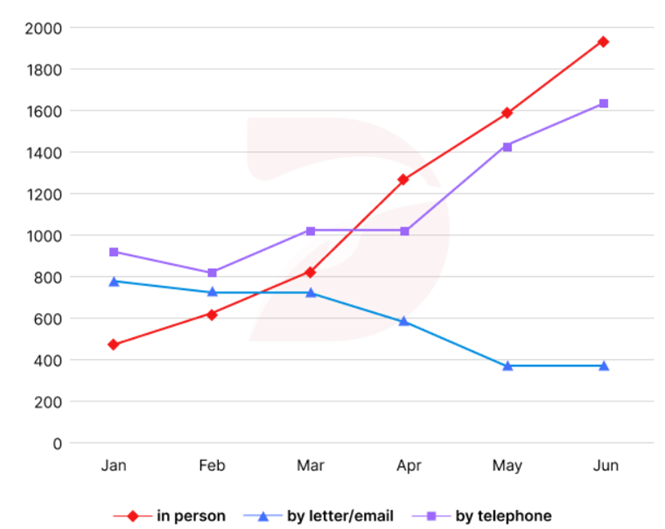
Hướng dẫn giải:
Gợi ý 1:
The line graph illustrates the number of inquiries received by the Tourist Information Office in one city from January to June 2011, categorized by three methods: in person, by letter/email, and by telephone.
Overall, the total number of inquiries increased over the period, with in-person and telephone inquiries rising significantly, while those made by letter or email declined steadily.
In January, the office received around 400 inquiries in person, 800 by letter/email, and 900 by telephone. Over the next few months, in-person inquiries grew rapidly, surpassing the other two methods in April and reaching about 1900 by June. Telephone inquiries fluctuated slightly at first but then increased sharply from April onwards, ending at around 1600 in June.
In contrast, inquiries by letter or email showed a downward trend. Starting at 800 in January, they fell gradually to 400 by May and remained constant thereafter.
In summary, the Tourist Information Office experienced a clear shift in communication preferences, with more people choosing to make inquiries in person or by phone rather than through written correspondence.
(Biểu đồ đường thể hiện số lượng yêu cầu thông tin mà Văn phòng Du lịch nhận được tại một thành phố từ tháng 1 đến tháng 6 năm 2011, được phân loại theo ba hình thức: trực tiếp, qua thư/email và qua điện thoại.
Nhìn chung, tổng số yêu cầu tăng trong suốt giai đoạn, trong đó các yêu cầu trực tiếp và qua điện thoại tăng mạnh, còn các yêu cầu qua thư/email giảm đều.
Vào tháng 1, văn phòng nhận khoảng 400 yêu cầu trực tiếp, 800 qua thư/email và 900 qua điện thoại. Trong những tháng tiếp theo, số yêu cầu trực tiếp tăng nhanh, vượt hai hình thức còn lại vào tháng 4 và đạt khoảng 1900 vào tháng 6. Các yêu cầu qua điện thoại dao động nhẹ ban đầu nhưng sau đó tăng mạnh từ tháng 4, kết thúc ở mức khoảng 1600 vào tháng 6.
Ngược lại, các yêu cầu qua thư/email có xu hướng giảm. Bắt đầu ở mức 800 vào tháng 1, chúng giảm dần xuống 400 vào tháng 5 và giữ nguyên sau đó.
Tóm lại, Văn phòng Du lịch chứng kiến sự thay đổi rõ rệt trong cách thức liên hệ, với nhiều người chọn hỏi thông tin trực tiếp hoặc qua điện thoại hơn là bằng thư/email.)
Gợi ý 2:
The line graph compares the number of inquiries received by a Tourist Information Office over six months in 2011, divided into three categories: in person, by telephone, and by letter/email.
Overall, the total number of inquiries increased, mainly due to a sharp rise in face-to-face and telephone contacts, while written inquiries declined.
At the beginning of the period, telephone inquiries were the most common, at about 900, followed by letter/email at 800 and in-person inquiries at only 400. From February to June, the number of people visiting the office in person rose dramatically, overtaking telephone inquiries in April and reaching nearly 1900 by June. Telephone inquiries also grew steadily after March, ending at around 1600.
In contrast, inquiries by letter or email fell continuously throughout the period, dropping from 800 in January to 400 by May and remaining unchanged in June.
In conclusion, the data show a clear preference shift toward more direct communication methods, with in-person and telephone inquiries becoming increasingly popular.
(Biểu đồ đường so sánh số lượng yêu cầu thông tin mà Văn phòng Du lịch nhận được trong sáu tháng năm 2011, chia thành ba hình thức: trực tiếp, qua điện thoại và qua thư/email.
Nhìn chung, tổng số yêu cầu tăng lên, chủ yếu do sự gia tăng mạnh của hình thức trực tiếp và qua điện thoại, trong khi hình thức viết giảm.
Vào đầu giai đoạn, yêu cầu qua điện thoại phổ biến nhất, khoảng 900, tiếp theo là qua thư/email 800 và trực tiếp chỉ 400. Từ tháng 2 đến tháng 6, số người đến trực tiếp tăng mạnh, vượt qua yêu cầu qua điện thoại vào tháng 4 và đạt gần 1900 vào tháng 6. Yêu cầu qua điện thoại cũng tăng đều sau tháng 3, kết thúc ở mức khoảng 1600.
Ngược lại, yêu cầu qua thư/email giảm liên tục trong suốt giai đoạn, từ 800 vào tháng 1 xuống 400 vào tháng 5 và giữ nguyên đến tháng 6.
Tóm lại, dữ liệu cho thấy sự chuyển dịch rõ rệt sang các hình thức giao tiếp trực tiếp hơn, với yêu cầu trực tiếp và qua điện thoại ngày càng phổ biến.)
Society is based on rules and laws. It could not function if individuals were free to do whatever they wanted. To what extent do you agree or disagree?
Gợi ý 1:
I completely agree that rules and laws are essential for the proper functioning of society. Without them, chaos and conflict would prevail, making it impossible for people to live safely and harmoniously.
Firstly, laws maintain order and protect citizens. They define acceptable behavior and prevent actions that harm others, such as theft, violence, or fraud. For example, traffic laws ensure road safety by regulating speed and direction. Without such rules, accidents would occur frequently, endangering lives.
Secondly, laws promote fairness and justice. They provide a framework for resolving disputes and protecting individual rights. In democratic societies, legal systems ensure equality before the law, preventing abuse of power. If everyone acted solely on personal desires, weaker members of society would suffer exploitation and discrimination.
Moreover, rules encourage social cooperation. People follow shared norms that allow communities to function smoothly — from paying taxes to respecting public property. These regulations create trust and stability, which are vital for economic and social development.
In conclusion, laws and rules are the foundation of civilized society. Absolute freedom without boundaries would lead to disorder and insecurity. Therefore, I strongly believe that regulations are necessary to ensure peace and progress.
(Tôi hoàn toàn đồng ý rằng luật lệ và quy tắc là điều cần thiết cho sự vận hành đúng đắn của xã hội. Nếu không có chúng, hỗn loạn và xung đột sẽ xảy ra, khiến con người không thể sống an toàn và hòa hợp.
Trước hết, luật pháp duy trì trật tự và bảo vệ công dân. Chúng xác định hành vi được chấp nhận và ngăn chặn các hành động gây hại cho người khác như trộm cắp, bạo lực hay lừa đảo. Ví dụ, luật giao thông đảm bảo an toàn đường bộ bằng cách quy định tốc độ và hướng đi. Nếu không có những quy tắc này, tai nạn sẽ xảy ra thường xuyên, đe dọa tính mạng con người.
Thứ hai, luật pháp thúc đẩy sự công bằng và chính nghĩa. Chúng cung cấp khuôn khổ để giải quyết tranh chấp và bảo vệ quyền cá nhân. Trong các xã hội dân chủ, hệ thống pháp luật đảm bảo mọi người bình đẳng trước pháp luật, ngăn chặn lạm quyền. Nếu ai cũng hành động theo ý muốn cá nhân, những người yếu thế sẽ bị bóc lột và phân biệt đối xử.
Hơn nữa, quy tắc khuyến khích sự hợp tác xã hội. Con người tuân theo các chuẩn mực chung giúp cộng đồng vận hành trơn tru — từ việc nộp thuế đến việc tôn trọng tài sản công. Những quy định này tạo ra niềm tin và sự ổn định, rất quan trọng cho sự phát triển kinh tế và xã hội.
Tóm lại, luật lệ và quy tắc là nền tảng của xã hội văn minh. Tự do tuyệt đối không giới hạn sẽ dẫn đến hỗn loạn và bất an. Do đó, tôi tin rằng các quy định là cần thiết để đảm bảo hòa bình và tiến bộ.)
Gợi ý 2:
While I agree that laws are vital for maintaining order, I believe that excessive restrictions can limit personal freedom and creativity. A balance between regulation and individual liberty is necessary for a healthy society.
On the one hand, laws prevent chaos and protect citizens. They define boundaries that ensure safety and fairness. For instance, criminal laws deter violence and theft, while traffic regulations reduce accidents. Without these rules, society would face instability and fear.
On the other hand, too many laws can suppress individuality. People need freedom to express opinions, make choices, and pursue their goals. Overregulation may discourage innovation and restrict human rights. For example, in some authoritarian countries, strict laws limit freedom of speech, preventing citizens from contributing to social progress.
Therefore, laws should exist to protect people but not to control every aspect of life. Governments must ensure that regulations serve the public interest while respecting personal autonomy.
In conclusion, I partly agree with the statement. Society cannot function without laws, but excessive control can hinder development. A fair balance between freedom and regulation is the key to a peaceful and progressive community.
(Mặc dù tôi đồng ý rằng luật pháp rất quan trọng để duy trì trật tự, tôi tin rằng việc hạn chế quá mức có thể làm giảm tự do và sự sáng tạo của con người. Cần có sự cân bằng giữa quy định và quyền tự do cá nhân để xã hội phát triển lành mạnh.
Một mặt, luật pháp ngăn chặn hỗn loạn và bảo vệ công dân. Chúng xác định ranh giới đảm bảo an toàn và công bằng. Ví dụ, luật hình sự ngăn chặn bạo lực và trộm cắp, trong khi luật giao thông giảm tai nạn. Nếu không có những quy tắc này, xã hội sẽ đối mặt với sự bất ổn và sợ hãi.
Mặt khác, quá nhiều luật có thể kìm hãm cá tính. Con người cần tự do để bày tỏ ý kiến, đưa ra lựa chọn và theo đuổi mục tiêu. Việc quản lý quá chặt có thể làm giảm đổi mới và hạn chế quyền con người. Ví dụ, ở một số quốc gia độc tài, luật nghiêm ngặt hạn chế tự do ngôn luận, khiến người dân không thể đóng góp cho sự tiến bộ xã hội.
Do đó, luật pháp nên tồn tại để bảo vệ con người chứ không phải kiểm soát mọi khía cạnh của cuộc sống. Chính phủ cần đảm bảo rằng các quy định phục vụ lợi ích chung đồng thời tôn trọng quyền tự do cá nhân.
Tóm lại, tôi phần nào đồng ý với nhận định này. Xã hội không thể vận hành nếu thiếu luật lệ, nhưng sự kiểm soát quá mức có thể cản trở phát triển. Sự cân bằng giữa tự do và quy định là chìa khóa cho một cộng đồng hòa bình và tiến bộ.)
Today, TV channels show more men’s sports than women’s sports. Why is this the case? Should TV channels give equal time for women’s sport and men’s sport?
Hướng dẫn giải:
It is true that men’s sports dominate television coverage, while women’s sports receive far less attention. This imbalance is largely due to commercial factors, but I believe TV channels should provide equal coverage to promote fairness and diversity.
Firstly, men’s sports attract larger audiences and generate more advertising revenue. Popular events such as football or basketball are traditionally male-dominated, and broadcasters prioritize them to maximize profits. In addition, men’s sports often have longer histories and established fan bases, making them more marketable.
Secondly, cultural stereotypes contribute to the imbalance. In many societies, men are perceived as stronger and more competitive, while women’s sports are undervalued. As a result, broadcasters assume that viewers are less interested in female athletes, reinforcing the cycle of limited coverage.
However, equal coverage is important for several reasons. It encourages gender equality and inspires young girls to participate in sports. More exposure also helps female athletes gain recognition and sponsorship, which can improve the quality and competitiveness of women’s sports. For example, when women’s football was broadcast widely during the World Cup, it attracted millions of viewers and proved its popularity.
In conclusion, although men’s sports currently dominate due to commercial and cultural reasons, TV channels should give equal time to women’s sports. This would promote fairness, inspire participation, and enrich the sporting world.
(Thực tế là thể thao nam chiếm ưu thế trên truyền hình, trong khi thể thao nữ ít được chú ý hơn. Sự mất cân bằng này chủ yếu do yếu tố thương mại, nhưng tôi tin rằng các kênh truyền hình nên cung cấp thời lượng phát sóng ngang bằng để thúc đẩy sự công bằng và đa dạng.
Thứ nhất, thể thao nam thu hút lượng khán giả lớn hơn và tạo ra nhiều doanh thu quảng cáo hơn. Các sự kiện phổ biến như bóng đá hoặc bóng rổ vốn truyền thống do nam giới thống trị, và các nhà đài ưu tiên chúng để tối đa hóa lợi nhuận. Ngoài ra, thể thao nam thường có lịch sử lâu dài và lượng người hâm mộ ổn định, khiến chúng dễ tiếp thị hơn.
Thứ hai, định kiến văn hóa góp phần vào sự mất cân bằng. Ở nhiều xã hội, nam giới được coi là mạnh mẽ và cạnh tranh hơn, trong khi thể thao nữ bị đánh giá thấp. Do đó, các nhà đài cho rằng khán giả ít quan tâm đến vận động viên nữ, từ đó củng cố vòng luẩn quẩn của việc ít phát sóng.
Tuy nhiên, việc phát sóng ngang bằng rất quan trọng. Nó khuyến khích bình đẳng giới và truyền cảm hứng cho các bé gái tham gia thể thao. Nhiều thời lượng phát sóng cũng giúp vận động viên nữ được công nhận và có thêm tài trợ, từ đó nâng cao chất lượng và tính cạnh tranh của thể thao nữ. Ví dụ, khi bóng đá nữ được phát sóng rộng rãi trong kỳ World Cup, nó đã thu hút hàng triệu khán giả và chứng minh sức hút của mình.
Tóm lại, mặc dù thể thao nam hiện đang chiếm ưu thế do yếu tố thương mại và văn hóa, các kênh truyền hình nên dành thời lượng ngang bằng cho thể thao nữ. Điều này sẽ thúc đẩy công bằng, truyền cảm hứng và làm phong phú thế giới thể thao.)
Gợi ý 2:
Men’s sports receive more coverage than women’s sports, mainly because of audience demand and commercial interests. While equal coverage is desirable, it may not always be practical unless public interest grows.
One reason for the dominance of men’s sports is their popularity. Sports such as football, cricket, and basketball have traditionally been associated with men, and they attract huge audiences worldwide. Broadcasters focus on these events because they guarantee high ratings and advertising revenue. In contrast, women’s sports often struggle to attract the same level of attention, leading to less coverage.
Another factor is investment. Men’s sports receive more funding, better facilities, and stronger promotion, which makes them more competitive and appealing to viewers. Women’s sports, with fewer resources, often lack the same visibility, creating a cycle where limited coverage leads to limited growth.
In my opinion, TV channels should aim for more balanced coverage, but equal time may not be realistic unless demand increases. Instead, broadcasters could gradually expand coverage of women’s sports, especially during major tournaments, to build interest and encourage participation. Over time, this would help narrow the gap between men’s and women’s sports.
In conclusion, men’s sports dominate coverage due to popularity and investment, but increasing exposure for women’s sports is important. A gradual approach toward balance would be more effective than enforcing strict equality immediately.
(Thể thao nam nhận được nhiều thời lượng phát sóng hơn thể thao nữ, chủ yếu do nhu cầu khán giả và lợi ích thương mại. Mặc dù phát sóng ngang bằng là điều mong muốn, nhưng nó có thể không thực tế trừ khi sự quan tâm của công chúng tăng lên.
Một lý do khiến thể thao nam chiếm ưu thế là sự phổ biến. Các môn như bóng đá, cricket và bóng rổ vốn gắn liền với nam giới và thu hút lượng khán giả khổng lồ trên toàn thế giới. Các nhà đài tập trung vào những sự kiện này vì chúng đảm bảo tỷ suất người xem cao và doanh thu quảng cáo. Ngược lại, thể thao nữ thường khó thu hút mức độ chú ý tương tự, dẫn đến ít phát sóng hơn.
Một yếu tố khác là đầu tư. Thể thao nam nhận được nhiều tài trợ, cơ sở vật chất tốt hơn và quảng bá mạnh mẽ hơn, khiến chúng cạnh tranh hơn và hấp dẫn hơn đối với khán giả. Thể thao nữ, với ít nguồn lực hơn, thường thiếu sự hiện diện, tạo ra vòng luẩn quẩn khi ít phát sóng dẫn đến ít phát triển.
Theo quan điểm của tôi, các kênh truyền hình nên hướng tới phát sóng cân bằng hơn, nhưng thời lượng ngang bằng có thể không thực tế trừ khi nhu cầu tăng lên. Thay vào đó, các nhà đài có thể dần mở rộng phát sóng thể thao nữ, đặc biệt trong các giải đấu lớn, để xây dựng sự quan tâm và khuyến khích tham gia. Theo thời gian, điều này sẽ giúp thu hẹp khoảng cách giữa thể thao nam và nữ.
Tóm lại, thể thao nam chiếm ưu thế do sự phổ biến và đầu tư, nhưng việc tăng cường phát sóng thể thao nữ là quan trọng. Cách tiếp cận dần dần hướng tới cân bằng sẽ hiệu quả hơn so với việc áp đặt sự bình đẳng ngay lập tức.)
The graph below shows the number of overseas visitors to three different areas in a European country between 1987 and 2007. Summarise the information by selecting and reporting the main features and make comparisons where relevant.
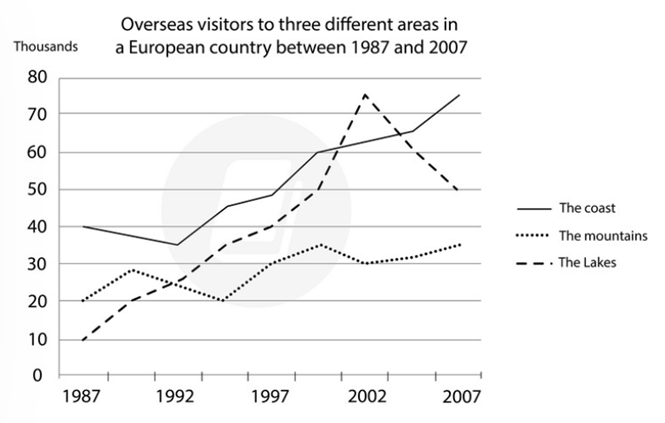
Gợi ý 1:
The line graph illustrates the number of overseas visitors to three different areas — the coast, the mountains, and the lakes — in a European country between 1987 and 2007.
Overall, the number of visitors to all three areas increased over the period, although the lakes experienced a sharp rise followed by a decline, while the coast showed steady growth and the mountains remained relatively stable.
In 1987, the coast attracted the highest number of visitors at around 40,000, followed by the mountains with about 20,000 and the lakes with only 10,000. Over the next decade, the number of visitors to the lakes rose dramatically, surpassing the other two areas by 2002, when it peaked at approximately 75,000. However, this figure fell sharply to around 50,000 by 2007.
Meanwhile, the number of visitors to the coast declined slightly until 1992 but then increased steadily, reaching about 70,000 by the end of the period. In contrast, the mountains saw only modest growth, rising from 20,000 in 1987 to roughly 30,000 in 2007.
In summary, although all three areas became more popular among overseas tourists, the coast showed the most consistent upward trend, while the lakes experienced the most dramatic fluctuations.
(Biểu đồ đường thể hiện số lượng du khách nước ngoài đến ba khu vực khác nhau — vùng ven biển, vùng núi và vùng hồ — ở một quốc gia châu Âu trong giai đoạn từ năm 1987 đến 2007.
Nhìn chung, số lượng du khách đến cả ba khu vực đều tăng trong suốt giai đoạn, mặc dù vùng hồ có sự tăng mạnh rồi giảm, trong khi vùng ven biển tăng đều và vùng núi tương đối ổn định.
Năm 1987, vùng ven biển thu hút số lượng du khách cao nhất, khoảng 40.000 người, tiếp theo là vùng núi với khoảng 20.000 và vùng hồ chỉ có 10.000. Trong thập kỷ tiếp theo, số du khách đến vùng hồ tăng mạnh, vượt qua hai khu vực còn lại vào năm 2002 khi đạt đỉnh khoảng 75.000 người. Tuy nhiên, con số này giảm nhanh xuống khoảng 50.000 vào năm 2007.
Trong khi đó, số du khách đến vùng ven biển giảm nhẹ đến năm 1992 nhưng sau đó tăng đều, đạt khoảng 70.000 vào cuối giai đoạn. Ngược lại, vùng núi chỉ tăng nhẹ, từ 20.000 năm 1987 lên khoảng 30.000 năm 2007.
Tóm lại, mặc dù cả ba khu vực đều trở nên phổ biến hơn với du khách nước ngoài, vùng ven biển có xu hướng tăng ổn định nhất, còn vùng hồ biến động mạnh nhất.)
Gơi ý 2:
The line graph compares the number of overseas visitors to three areas — the coast, the mountains, and the lakes — in a European country between 1987 and 2007.
Overall, the number of visitors to all areas rose, but the lakes experienced the most dramatic changes, while the coast showed continuous growth and the mountains remained comparatively low.
In 1987, the coast was the most visited area with around 40,000 tourists, followed by the mountains at 20,000 and the lakes at 10,000. Visitor numbers to the coast fell slightly by 1992 but then increased steadily, reaching about 70,000 by 2007. The mountains saw a gradual rise to roughly 30,000 visitors by the end of the period.
By contrast, the lakes showed a striking upward trend until 2002, when the number of visitors peaked at approximately 75,000. After that, it declined sharply to around 50,000 in 2007, though still higher than its initial figure.
In conclusion, while all three areas attracted more overseas visitors over the 20-year period, the coast maintained steady growth, the lakes fluctuated sharply, and the mountains remained the least popular destination.
(Biểu đồ đường so sánh số lượng du khách nước ngoài đến ba khu vực — vùng ven biển, vùng núi và vùng hồ — ở một quốc gia châu Âu trong giai đoạn từ năm 1987 đến 2007.
Nhìn chung, số lượng du khách đến tất cả các khu vực đều tăng, nhưng vùng hồ có sự thay đổi mạnh nhất, trong khi vùng ven biển tăng liên tục và vùng núi vẫn ở mức thấp hơn.
Năm 1987, vùng ven biển là nơi được ghé thăm nhiều nhất với khoảng 40.000 du khách, tiếp theo là vùng núi 20.000 và vùng hồ 10.000. Số du khách đến vùng ven biển giảm nhẹ đến năm 1992 nhưng sau đó tăng đều, đạt khoảng 70.000 vào năm 2007. Vùng núi tăng dần lên khoảng 30.000 du khách vào cuối giai đoạn.
Ngược lại, vùng hồ có xu hướng tăng mạnh đến năm 2002, khi số du khách đạt đỉnh khoảng 75.000. Sau đó, con số này giảm nhanh xuống khoảng 50.000 vào năm 2007, dù vẫn cao hơn mức ban đầu.
Tóm lại, trong suốt 20 năm, cả ba khu vực đều thu hút nhiều du khách nước ngoài hơn, vùng ven biển tăng ổn định, vùng hồ biến động mạnh, còn vùng núi vẫn là điểm đến ít phổ biến nhất.)
Some people think that resources should be spent on protecting wild animals, while others think those would be better used for the human population.
Discuss both sides and give your own opinion.
Hướng dẫn giải:
Gợi ý 1:
There is debate over whether governments should allocate resources to protect wild animals or focus on human needs. While supporting people is essential, I believe that protecting wildlife is equally important for maintaining ecological balance and long-term survival.
On the one hand, many argue that resources should be used for human welfare. Poverty, healthcare, and education remain pressing issues in many countries. Governments must prioritize improving living standards, building infrastructure, and providing social services. For example, investing in hospitals and schools directly benefits citizens and contributes to national development. From this perspective, spending money on wildlife may seem less urgent compared to solving human problems.
On the other hand, protecting wild animals is vital for environmental sustainability. Wildlife plays a crucial role in maintaining ecosystems, which humans depend on for food, water, and clean air. If species become extinct, ecosystems may collapse, leading to severe consequences for humanity. Moreover, preserving biodiversity supports tourism and scientific research, both of which generate economic benefits. For instance, national parks attract millions of visitors each year, creating jobs and revenue.
In my opinion, governments should strike a balance between human development and wildlife protection. Humans and animals coexist within the same environment, and neglecting one will ultimately harm the other. Sustainable policies that protect nature while addressing human needs are the best approach.
(Có nhiều tranh luận về việc chính phủ nên dành nguồn lực để bảo vệ động vật hoang dã hay tập trung vào nhu cầu của con người. Mặc dù việc hỗ trợ con người là cần thiết, tôi tin rằng bảo vệ động vật hoang dã cũng quan trọng không kém để duy trì cân bằng sinh thái và sự tồn tại lâu dài.
Một mặt, nhiều người cho rằng nguồn lực nên được sử dụng cho phúc lợi con người. Nghèo đói, y tế và giáo dục vẫn là những vấn đề cấp bách ở nhiều quốc gia. Chính phủ cần ưu tiên cải thiện mức sống, xây dựng cơ sở hạ tầng và cung cấp dịch vụ xã hội. Ví dụ, đầu tư vào bệnh viện và trường học mang lại lợi ích trực tiếp cho người dân và thúc đẩy phát triển quốc gia. Từ góc nhìn này, chi tiền cho động vật hoang dã có vẻ ít cấp thiết hơn so với việc giải quyết vấn đề của con người.
Mặt khác, việc bảo vệ động vật hoang dã rất quan trọng đối với sự bền vững của môi trường. Động vật hoang dã đóng vai trò thiết yếu trong việc duy trì hệ sinh thái, mà con người phụ thuộc vào để có thực phẩm, nước và không khí sạch. Nếu các loài tuyệt chủng, hệ sinh thái có thể sụp đổ, gây hậu quả nghiêm trọng cho nhân loại. Hơn nữa, việc bảo tồn đa dạng sinh học hỗ trợ du lịch và nghiên cứu khoa học, cả hai đều mang lại lợi ích kinh tế. Ví dụ, các công viên quốc gia thu hút hàng triệu du khách mỗi năm, tạo việc làm và doanh thu.
Theo quan điểm của tôi, chính phủ nên cân bằng giữa phát triển con người và bảo vệ động vật hoang dã. Con người và động vật cùng tồn tại trong một môi trường, và việc bỏ qua một bên cuối cùng sẽ gây hại cho bên kia. Các chính sách bền vững bảo vệ thiên nhiên đồng thời đáp ứng nhu cầu con người là hướng đi tốt nhất.)
Gợi ý 2:
While some believe that protecting wild animals is essential, others argue that limited resources should be directed toward human needs. I agree that helping people should take priority, especially in developing countries where basic necessities are still lacking.
Supporters of wildlife protection emphasize the importance of biodiversity. Wild animals are part of the natural ecosystem, and their extinction can disrupt food chains and environmental stability. For example, if predators disappear, certain species may overpopulate, damaging crops and forests. Furthermore, many animals are endangered due to human activities, so it is our moral duty to protect them.
However, human welfare should come first. Millions of people around the world suffer from hunger, disease, and lack of education. Governments must allocate funds to improve healthcare, housing, and employment rather than spending heavily on wildlife conservation. In poor nations, protecting animals may seem irrelevant when citizens struggle to survive. Once basic human needs are met, societies can then afford to invest more in environmental protection.
In conclusion, although wildlife conservation is important, I believe that resources should primarily be used to improve human living conditions. After achieving social stability, countries can focus more on protecting animals and the environment.
(Trong khi một số người tin rằng việc bảo vệ động vật hoang dã là cần thiết, những người khác cho rằng nguồn lực hạn chế nên được dành cho nhu cầu của con người. Tôi đồng ý rằng giúp đỡ con người nên được ưu tiên, đặc biệt ở các quốc gia đang phát triển nơi nhu cầu cơ bản vẫn chưa được đáp ứng.
Những người ủng hộ bảo vệ động vật hoang dã nhấn mạnh tầm quan trọng của đa dạng sinh học. Động vật hoang dã là một phần của hệ sinh thái tự nhiên, và sự tuyệt chủng của chúng có thể phá vỡ chuỗi thức ăn và sự ổn định môi trường. Ví dụ, nếu các loài săn mồi biến mất, một số loài khác có thể phát triển quá mức, gây hại cho cây trồng và rừng. Hơn nữa, nhiều loài đang bị đe dọa do hoạt động của con người, vì vậy chúng ta có trách nhiệm đạo đức phải bảo vệ chúng.
Tuy nhiên, phúc lợi con người nên được đặt lên hàng đầu. Hàng triệu người trên thế giới đang chịu cảnh đói nghèo, bệnh tật và thiếu giáo dục. Chính phủ cần phân bổ ngân sách để cải thiện y tế, nhà ở và việc làm thay vì chi nhiều cho bảo tồn động vật hoang dã. Ở các quốc gia nghèo, việc bảo vệ động vật có thể bị coi là không liên quan khi người dân còn đang vật lộn để tồn tại. Khi nhu cầu cơ bản của con người được đáp ứng, xã hội mới có thể đầu tư nhiều hơn vào bảo vệ môi trường.
Tóm lại, mặc dù việc bảo tồn động vật hoang dã quan trọng, tôi tin rằng nguồn lực nên được sử dụng chủ yếu để cải thiện điều kiện sống của con người. Sau khi đạt được sự ổn định xã hội, các quốc gia có thể tập trung hơn vào việc bảo vệ động vật và môi trường.)
The charts below give information about the world’s top three producers of four different dairy products in 2012.
Summarise the information by selecting and reporting the main features, and make comparisons where relevant.

Gợi ý 1:
The charts illustrate the world’s top three producers of four different dairy products — milk, cheese, butter, and milk powder — in 2012, measured in metric tons.
Overall, the European Union (EU) was the leading producer of most dairy products, except for butter, which was dominated by India. Meanwhile, China and New Zealand were the main producers of milk powder.
In terms of milk production, the EU ranked first with 142,970 metric tons, followed by India (127,000) and the United States (90,038). The EU also led cheese production at 7,120 metric tons, nearly 2,000 more than the United States, while Brazil produced only 700 metric tons.
For butter, India was the largest producer, with 7,500 metric tons — more than three times the EU’s output (2,040) and nearly ten times that of the United States (810). In contrast, milk powder production was highest in China (1,200 metric tons), slightly ahead of New Zealand (1,110), while the EU produced the least (770).
In summary, the EU dominated global dairy production in 2012, particularly in milk and cheese, whereas India led in butter and China in milk powder.
(Các biểu đồ thể hiện ba quốc gia hoặc khu vực sản xuất hàng đầu thế giới về bốn loại sản phẩm từ sữa — sữa, phô mai, bơ và sữa bột — vào năm 2012, tính bằng tấn mét.
Nhìn chung, Liên minh châu Âu (EU) là nhà sản xuất hàng đầu của hầu hết các sản phẩm từ sữa, ngoại trừ bơ, vốn do Ấn Độ dẫn đầu. Trong khi đó, Trung Quốc và New Zealand là những nhà sản xuất chính của sữa bột.
Về sản xuất sữa, EU đứng đầu với 142.970 tấn, tiếp theo là Ấn Độ (127.000) và Hoa Kỳ (90.038). EU cũng dẫn đầu về sản xuất phô mai với 7.120 tấn, cao hơn gần 2.000 tấn so với Hoa Kỳ, trong khi Brazil chỉ sản xuất 700 tấn.
Đối với bơ, Ấn Độ là nhà sản xuất lớn nhất với 7.500 tấn — gấp hơn ba lần sản lượng của EU (2.040) và gần gấp mười lần của Hoa Kỳ (810). Ngược lại, sản xuất sữa bột cao nhất ở Trung Quốc (1.200 tấn), nhỉnh hơn New Zealand (1.110), trong khi EU sản xuất ít nhất (770).
Tóm lại, EU thống trị ngành sản xuất sữa toàn cầu năm 2012, đặc biệt trong lĩnh vực sữa và phô mai, trong khi Ấn Độ dẫn đầu về bơ và Trung Quốc về sữa bột.)
Gợi ý 2:
The charts compare the top three producers of milk, cheese, butter, and milk powder worldwide in 2012, measured in metric tons.
Overall, the European Union was the largest producer of milk and cheese, India led butter production, and China produced the most milk powder.
The EU produced the highest amount of milk at 142,970 metric tons, followed by India (127,000) and the United States (90,038). Similarly, the EU dominated cheese production with 7,120 metric tons, while the United States produced 4,925 and Brazil only 700.
In contrast, India was the leading butter producer, with 7,500 metric tons, far exceeding the EU (2,040) and the United States (810). For milk powder, China ranked first with 1,200 metric tons, slightly ahead of New Zealand (1,110), whereas the EU produced the least at 770.
In conclusion, the EU was the top producer of most dairy products, but India and China led in butter and milk powder respectively, showing regional specialization in dairy production.
(Các biểu đồ so sánh ba nhà sản xuất hàng đầu thế giới về sữa, phô mai, bơ và sữa bột vào năm 2012, tính bằng tấn mét.
Nhìn chung, Liên minh châu Âu là nhà sản xuất lớn nhất về sữa và phô mai, Ấn Độ dẫn đầu về sản xuất bơ, và Trung Quốc sản xuất nhiều sữa bột nhất.
EU sản xuất lượng sữa cao nhất với 142.970 tấn, tiếp theo là Ấn Độ (127.000) và Hoa Kỳ (90.038). Tương tự, EU thống trị sản xuất phô mai với 7.120 tấn, trong khi Hoa Kỳ sản xuất 4.925 và Brazil chỉ 700.
Ngược lại, Ấn Độ là nhà sản xuất bơ hàng đầu với 7.500 tấn, vượt xa EU (2.040) và Hoa Kỳ (810). Đối với sữa bột, Trung Quốc đứng đầu với 1.200 tấn, nhỉnh hơn New Zealand (1.110), trong khi EU sản xuất ít nhất với 770.
Tóm lại, EU là nhà sản xuất hàng đầu của hầu hết các sản phẩm từ sữa, nhưng Ấn Độ và Trung Quốc lần lượt dẫn đầu về bơ và sữa bột, cho thấy sự chuyên môn hóa theo khu vực trong ngành sữa toàn cầu.)
You should spend about 20 minutes on this task.
The diagram below shows the small-scope about the production of smoked fish.
Summarise the information by selecting and reporting the main features, and making comparisons where relevant.
Write at least 150 words.

Hướng dẫn giải:
Gợi ý 1:
The diagram illustrates the small-scale process of producing smoked fish, showing several stages from preparation to packaging.
Overall, the process involves six main steps, beginning with cleaning and salting the fish and ending with transportation of the finished product. The procedure combines soaking, heating, coloring, and smoking.
Initially, the fish are cleaned and soaked in salt water for 30 minutes. After that, they are heated for five minutes to remove excess moisture. In the next stage, the fish are coated with yellow coloring to improve their appearance. They are then placed in a smoking vat containing wood, where they undergo smudging for 30 minutes. This step gives the fish their distinctive smoky flavor and preserves them for longer storage. Finally, the smoked fish are packed and transported by truck for distribution.
In summary, the production of smoked fish is a straightforward process that uses simple equipment and natural materials such as salt and wood to prepare, flavor, and preserve the fish before delivery.
(Sơ đồ minh họa quy trình sản xuất cá hun khói quy mô nhỏ, bao gồm nhiều giai đoạn từ khâu chuẩn bị đến đóng gói.
Nhìn chung, quy trình gồm sáu bước chính, bắt đầu bằng việc làm sạch và ngâm cá trong nước muối, kết thúc bằng việc vận chuyển sản phẩm hoàn thiện. Quy trình kết hợp các bước ngâm, gia nhiệt, tạo màu và hun khói.
Ban đầu, cá được làm sạch và ngâm trong nước muối trong 30 phút. Sau đó, chúng được đun nóng trong 5 phút để loại bỏ độ ẩm dư thừa. Ở giai đoạn tiếp theo, cá được phủ màu vàng để tăng tính thẩm mỹ. Tiếp đó, cá được đặt trong thùng hun khói có chứa gỗ, nơi chúng được hun trong 30 phút. Bước này giúp cá có hương vị đặc trưng và bảo quản được lâu hơn. Cuối cùng, cá hun khói được đóng gói và vận chuyển bằng xe tải để phân phối.
Tóm lại, quy trình sản xuất cá hun khói khá đơn giản, sử dụng thiết bị cơ bản và nguyên liệu tự nhiên như muối và gỗ để chế biến, tạo hương vị và bảo quản cá trước khi giao hàng.)
Gợi ý 2:
The diagram shows the small-scale production process of smoked fish, consisting of six stages from salting to delivery.
Overall, the process is simple and manual, involving soaking, heating, coloring, smoking, and packaging. The main purpose is to preserve the fish and enhance its flavor and appearance.
First, the fish are cleaned and soaked in salt water for 30 minutes. Next, they are heated for five minutes. After this, yellow coloring is added to the fish to improve their look. The fish are then placed in a smoking vat containing wood, where they are smudged for 30 minutes. This smoking process gives the fish a distinctive taste and longer shelf life. Finally, the smoked fish are packed and transported by truck to be sold.
In conclusion, the small-scale production of smoked fish is a straightforward process that relies on traditional methods of salting and smoking to produce a flavorful and preserved product.
(Sơ đồ cho thấy quy trình sản xuất cá hun khói quy mô nhỏ, gồm sáu giai đoạn từ ngâm muối đến vận chuyển.
Nhìn chung, quy trình này đơn giản và mang tính thủ công, bao gồm các bước ngâm, gia nhiệt, tạo màu, hun khói và đóng gói. Mục đích chính là bảo quản cá và tăng hương vị cũng như hình thức.
Đầu tiên, cá được làm sạch và ngâm trong nước muối trong 30 phút. Tiếp theo, chúng được đun nóng trong 5 phút. Sau đó, cá được thêm màu vàng để cải thiện vẻ ngoài. Tiếp đó, cá được đặt trong thùng hun khói có chứa gỗ, nơi chúng được hun trong 30 phút. Quá trình này giúp cá có hương vị đặc trưng và bảo quản được lâu hơn. Cuối cùng, cá hun khói được đóng gói và vận chuyển bằng xe tải để tiêu thụ.
Tóm lại, quy trình sản xuất cá hun khói quy mô nhỏ khá đơn giản, dựa trên phương pháp truyền thống ngâm muối và hun khói để tạo ra sản phẩm thơm ngon và bảo quản lâu dài.)
The line graph shows the number of overseas visitors who came to the UK for different purposes between 1989 and 2009. Summarize the information by describing the main features of the charts and making comparisons where appropriate.
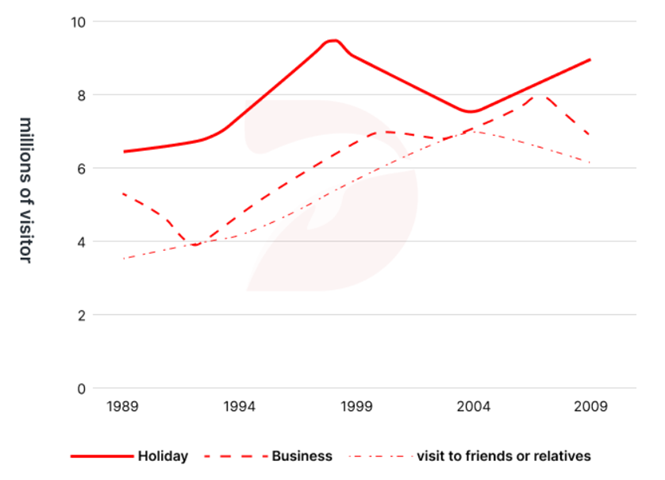
Hướng dẫn giải:
Gợi ý 1:
The line graph illustrates the number of overseas visitors who came to the UK for three different purposes — holidays, business, and visiting friends or relatives — between 1989 and 2009.
Overall, the number of visitors for all three purposes increased over the period, although holiday travel remained the most popular reason throughout. Business travel and visits to friends or relatives also showed upward trends but with some fluctuations.
In 1989, around 6 million people visited the UK for holidays, compared with about 5 million for business and 4 million to see friends or relatives. The number of holiday visitors rose steadily, peaking at nearly 10 million in 1999 before falling slightly and then rising again to around 9 million in 2009. Business travel initially declined but then grew sharply, reaching about 8 million in 2004 before dropping slightly by the end of the period. Visits to friends or relatives increased gradually from 4 million in 1989 to around 7 million in 2004, followed by a small decline in 2009.
In summary, holiday travel consistently attracted the highest number of overseas visitors, while business and social visits also became more common over time despite minor fluctuations.
(Biểu đồ đường thể hiện số lượng du khách nước ngoài đến Vương quốc Anh vì ba mục đích khác nhau — nghỉ dưỡng, công tác và thăm bạn bè hoặc người thân — trong giai đoạn từ năm 1989 đến 2009.
Nhìn chung, số lượng du khách cho cả ba mục đích đều tăng trong suốt giai đoạn, mặc dù du lịch nghỉ dưỡng vẫn là lý do phổ biến nhất. Du lịch công tác và thăm người thân cũng có xu hướng tăng nhưng có một vài biến động.
Năm 1989, khoảng 6 triệu người đến Anh để nghỉ dưỡng, so với khoảng 5 triệu đi công tác và 4 triệu thăm bạn bè hoặc người thân. Số lượng du khách nghỉ dưỡng tăng đều, đạt đỉnh gần 10 triệu vào năm 1999 trước khi giảm nhẹ rồi tăng trở lại khoảng 9 triệu vào năm 2009. Du lịch công tác ban đầu giảm nhưng sau đó tăng mạnh, đạt khoảng 8 triệu vào năm 2004 rồi giảm nhẹ vào cuối giai đoạn. Các chuyến thăm người thân tăng dần từ 4 triệu năm 1989 lên khoảng 7 triệu năm 2004, sau đó giảm nhẹ vào năm 2009.
Tóm lại, du lịch nghỉ dưỡng luôn thu hút số lượng du khách nước ngoài cao nhất, trong khi công tác và thăm người thân cũng ngày càng phổ biến hơn theo thời gian dù có một số biến động nhỏ.)
Gợi ý 2:
The line graph compares the number of overseas visitors to the UK for holidays, business, and visiting friends or relatives between 1989 and 2009.
Overall, all three categories showed growth over the 20-year period, with holidays being the most common reason for travel. Business visits fluctuated but increased overall, while visits to friends or relatives rose steadily before declining slightly at the end.
In 1989, holiday visitors numbered about 6 million, business travelers around 5 million, and those visiting friends or relatives roughly 4 million. The number of holiday visitors climbed sharply to reach a peak of nearly 10 million in 1999, then dropped and rose again to just under 9 million in 2009. Business travel fell slightly in the early years but grew significantly to around 8 million by 2004 before declining. Visits to friends or relatives followed a consistent upward trend, peaking at about 7 million in 2004 and then falling slightly to 6 million in 2009.
In conclusion, holiday travel remained the dominant purpose for overseas visitors to the UK, while business and social visits also increased, showing the country’s growing appeal for various types of travelers.
(Biểu đồ đường so sánh số lượng du khách nước ngoài đến Vương quốc Anh vì mục đích nghỉ dưỡng, công tác và thăm bạn bè hoặc người thân trong giai đoạn từ năm 1989 đến 2009.
Nhìn chung, cả ba loại hình du lịch đều tăng trong suốt 20 năm, trong đó nghỉ dưỡng là lý do phổ biến nhất. Các chuyến đi công tác có biến động nhưng nhìn chung tăng, trong khi các chuyến thăm người thân tăng đều trước khi giảm nhẹ vào cuối giai đoạn.
Năm 1989, du khách nghỉ dưỡng khoảng 6 triệu người, du khách công tác khoảng 5 triệu và du khách thăm người thân khoảng 4 triệu. Số lượng du khách nghỉ dưỡng tăng mạnh, đạt gần 10 triệu vào năm 1999, sau đó giảm rồi tăng trở lại gần 9 triệu vào năm 2009. Du lịch công tác giảm nhẹ ban đầu nhưng tăng đáng kể lên khoảng 8 triệu vào năm 2004 trước khi giảm. Các chuyến thăm người thân tăng đều, đạt đỉnh khoảng 7 triệu vào năm 2004 rồi giảm nhẹ xuống 6 triệu vào năm 2009.
Tóm lại, du lịch nghỉ dưỡng vẫn là mục đích chính của du khách nước ngoài đến Anh, trong khi công tác và thăm người thân cũng tăng, cho thấy sức hấp dẫn ngày càng lớn của quốc gia này đối với nhiều loại hình du lịch khác nhau.)
The graph shows the value in US dollars (in millions of dollars) of investment in funds of four categories from 1988 to 2014. Summarise the information by selecting and reporting the main features, and make comparisons where relevant.
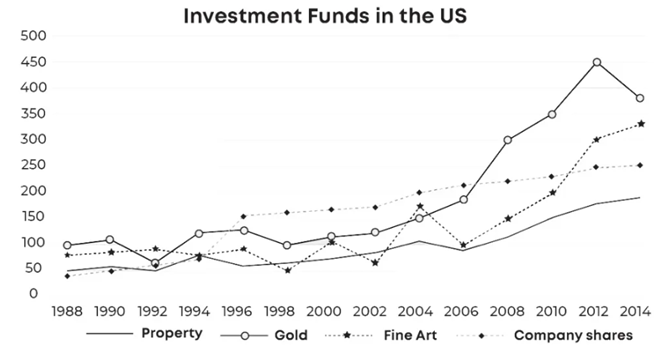
Hướng dẫn giải:
Gợi ý 1:
The line graph illustrates the value of investment funds in four categories — property, gold, fine art, and company shares — in the US between 1988 and 2014, measured in millions of dollars.
Overall, all four types of investment increased in value over the period, although gold showed the most dramatic growth, while property remained the least valuable investment throughout.
In 1988, gold had the highest value at around $100 million, followed by company shares at approximately $70 million, fine art at $50 million, and property at just under $50 million. Gold fluctuated slightly until 2004, after which it rose sharply, peaking at about $450 million in 2012 before falling to around $380 million in 2014. Company shares also grew steadily, reaching roughly $250 million by 2014. Fine art experienced several ups and downs but ended at around $300 million, while property showed a consistent upward trend, climbing gradually to nearly $200 million by the end of the period.
In summary, gold was the most profitable investment by 2014, while property remained the least lucrative, though all categories showed overall growth.
(Biểu đồ đường thể hiện giá trị của các quỹ đầu tư thuộc bốn loại — bất động sản, vàng, mỹ thuật và cổ phiếu công ty — tại Mỹ từ năm 1988 đến 2014, tính bằng triệu đô la.
Nhìn chung, cả bốn loại hình đầu tư đều tăng giá trị trong suốt giai đoạn, mặc dù vàng có mức tăng mạnh nhất, trong khi bất động sản vẫn là khoản đầu tư có giá trị thấp nhất.
Năm 1988, vàng có giá trị cao nhất khoảng 100 triệu đô la, tiếp theo là cổ phiếu công ty khoảng 70 triệu, mỹ thuật 50 triệu và bất động sản chưa đến 50 triệu. Giá trị vàng dao động nhẹ cho đến năm 2004, sau đó tăng mạnh, đạt đỉnh khoảng 450 triệu vào năm 2012 trước khi giảm xuống khoảng 380 triệu vào năm 2014. Cổ phiếu công ty cũng tăng đều, đạt khoảng 250 triệu vào năm 2014. Mỹ thuật có nhiều biến động nhưng kết thúc ở mức khoảng 300 triệu, trong khi bất động sản tăng ổn định, đạt gần 200 triệu vào cuối giai đoạn.
Tóm lại, vàng là khoản đầu tư sinh lời nhất vào năm 2014, trong khi bất động sản vẫn kém hấp dẫn nhất, dù tất cả các loại hình đều tăng trưởng tổng thể.)
Gợi ý 2:
The line graph compares the value of investment funds in property, gold, fine art, and company shares in the US from 1988 to 2014.
Overall, the value of all four investment types rose over the period, with gold showing the most significant increase, while property grew more gradually.
At the beginning of the period, gold was the most valuable investment at around $100 million, followed by company shares ($70 million), fine art ($50 million), and property ($40 million). Gold’s value fluctuated until 2004, then surged dramatically to reach a peak of $450 million in 2012 before declining slightly. Fine art and company shares also increased steadily, reaching approximately $300 million and $250 million respectively by 2014. Property showed the slowest growth, rising consistently to about $180 million at the end of the period.
In conclusion, gold experienced the most dramatic growth and remained the most valuable investment, while property was the least profitable but showed steady improvement.
(Biểu đồ đường so sánh giá trị của các quỹ đầu tư vào bất động sản, vàng, mỹ thuật và cổ phiếu công ty tại Mỹ từ năm 1988 đến 2014.
Nhìn chung, giá trị của cả bốn loại hình đầu tư đều tăng trong suốt giai đoạn, trong đó vàng có mức tăng mạnh nhất, còn bất động sản tăng chậm hơn.
Ở đầu giai đoạn, vàng là khoản đầu tư có giá trị cao nhất khoảng 100 triệu đô la, tiếp theo là cổ phiếu công ty (70 triệu), mỹ thuật (50 triệu) và bất động sản (40 triệu). Giá trị vàng dao động cho đến năm 2004, sau đó tăng mạnh, đạt đỉnh 450 triệu vào năm 2012 trước khi giảm nhẹ. Mỹ thuật và cổ phiếu công ty cũng tăng đều, đạt lần lượt khoảng 300 triệu và 250 triệu vào năm 2014. Bất động sản tăng chậm nhất nhưng ổn định, đạt khoảng 180 triệu vào cuối giai đoạn.
Tóm lại, vàng có mức tăng trưởng mạnh nhất và vẫn là khoản đầu tư có giá trị cao nhất, trong khi bất động sản ít sinh lời nhất nhưng tăng đều đặn.)
Space travel has been possible for some time and some people believe that space tourism could be developed in the future. Do you think it is a positive or negative development?
Hướng dẫn giải:
Gợi ý 1:
I believe that the development of space tourism would be a positive advancement for humanity. Although it may have some drawbacks, the potential benefits in science, technology, and global inspiration outweigh the negatives.
Firstly, space tourism could accelerate scientific progress. As private companies invest in space travel, new technologies will emerge that can later be applied to everyday life. For example, innovations in spacecraft design and energy efficiency could lead to improvements in transportation and environmental sustainability on Earth. Moreover, increased interest in space exploration may encourage governments to fund more research, leading to discoveries that benefit society.
Secondly, space tourism can inspire people and promote international cooperation. Experiencing space firsthand could change how individuals view the planet, fostering a sense of unity and responsibility toward environmental protection. It could also create new educational opportunities and motivate young people to pursue careers in science and engineering.
However, space tourism is currently expensive and accessible only to the wealthy. This inequality may raise ethical concerns. Yet, as technology advances, costs are likely to decrease, making space travel more affordable in the long term.
In conclusion, despite its initial limitations, space tourism represents a positive development that can drive innovation, inspire humanity, and strengthen global collaboration.
(Tôi tin rằng sự phát triển của du lịch vũ trụ sẽ là một bước tiến tích cực cho nhân loại. Mặc dù có thể tồn tại một số hạn chế, nhưng những lợi ích tiềm năng về khoa học, công nghệ và cảm hứng toàn cầu vượt trội hơn những mặt tiêu cực.
Trước hết, du lịch vũ trụ có thể thúc đẩy tiến bộ khoa học. Khi các công ty tư nhân đầu tư vào lĩnh vực này, những công nghệ mới sẽ ra đời và có thể được ứng dụng vào cuộc sống hàng ngày. Ví dụ, các cải tiến trong thiết kế tàu vũ trụ và hiệu quả năng lượng có thể giúp cải thiện giao thông và bảo vệ môi trường trên Trái Đất. Hơn nữa, sự quan tâm ngày càng tăng đối với khám phá không gian có thể khuyến khích chính phủ tài trợ thêm cho nghiên cứu, dẫn đến những phát hiện có lợi cho xã hội.
Thứ hai, du lịch vũ trụ có thể truyền cảm hứng và thúc đẩy hợp tác quốc tế. Trải nghiệm không gian trực tiếp có thể thay đổi cách con người nhìn nhận hành tinh, khơi dậy ý thức đoàn kết và trách nhiệm bảo vệ môi trường. Nó cũng có thể tạo ra cơ hội giáo dục mới và khuyến khích giới trẻ theo đuổi các ngành khoa học và kỹ thuật.
Tuy nhiên, du lịch vũ trụ hiện nay rất đắt đỏ và chỉ dành cho người giàu, điều này có thể gây ra vấn đề đạo đức. Dẫu vậy, khi công nghệ phát triển, chi phí sẽ giảm dần, giúp du lịch vũ trụ trở nên phổ biến hơn trong tương lai.
Tóm lại, mặc dù còn hạn chế ban đầu, du lịch vũ trụ là một sự phát triển tích cực có thể thúc đẩy đổi mới, truyền cảm hứng cho nhân loại và tăng cường hợp tác toàn cầu.)
Gợi ý 2:
While space tourism may sound exciting, I believe it is a negative development because it poses environmental risks and diverts resources from more urgent problems on Earth.
Firstly, space tourism could harm the environment. Rocket launches release large amounts of carbon dioxide and other pollutants into the atmosphere, contributing to climate change. Moreover, the growing number of satellites and spacecraft increases space debris, which can threaten future missions and even damage the Earth’s orbit. These environmental consequences outweigh the thrill of space travel.
Secondly, investing in space tourism may distract governments and corporations from addressing pressing global issues such as poverty, healthcare, and climate change. The enormous funds required for space travel could instead be used to improve living conditions and develop sustainable technologies on Earth. For instance, billions spent on sending tourists into space could be redirected toward renewable energy or education.
Although space tourism might inspire curiosity and innovation, its benefits are limited to a small group of wealthy individuals. It risks becoming a luxury experience rather than a meaningful scientific pursuit.
In conclusion, space tourism is a negative development because it harms the environment and misuses valuable resources that could be better spent solving problems on our own planet.
(Mặc dù du lịch vũ trụ nghe có vẻ hấp dẫn, tôi cho rằng đây là một sự phát triển tiêu cực vì nó gây rủi ro cho môi trường và làm lệch hướng nguồn lực khỏi những vấn đề cấp bách trên Trái Đất.
Trước hết, du lịch vũ trụ có thể gây hại cho môi trường. Các vụ phóng tên lửa thải ra lượng lớn khí CO₂ và các chất ô nhiễm khác vào khí quyển, góp phần vào biến đổi khí hậu. Hơn nữa, số lượng vệ tinh và tàu vũ trụ ngày càng tăng làm gia tăng rác thải không gian, có thể gây nguy hiểm cho các sứ mệnh tương lai và làm tổn hại quỹ đạo Trái Đất. Những hậu quả môi trường này vượt xa niềm vui mà du lịch vũ trụ mang lại.
Thứ hai, việc đầu tư vào du lịch vũ trụ có thể khiến chính phủ và doanh nghiệp sao nhãng việc giải quyết các vấn đề toàn cầu như nghèo đói, y tế và biến đổi khí hậu. Khoản tiền khổng lồ dành cho du lịch vũ trụ có thể được sử dụng để cải thiện điều kiện sống và phát triển công nghệ bền vững. Ví dụ, hàng tỷ đô la chi cho việc đưa du khách lên không gian có thể được chuyển hướng sang năng lượng tái tạo hoặc giáo dục.
Mặc dù du lịch vũ trụ có thể khơi dậy sự tò mò và đổi mới, lợi ích của nó chỉ giới hạn cho một nhóm nhỏ người giàu. Nó có nguy cơ trở thành một trải nghiệm xa xỉ hơn là một nỗ lực khoa học có ý nghĩa.
Tóm lại, du lịch vũ trụ là một sự phát triển tiêu cực vì nó gây hại cho môi trường và lãng phí nguồn lực quý giá có thể được sử dụng tốt hơn để giải quyết các vấn đề trên hành tinh của chúng ta.)
The map below show a school in 1985 and the school now.
Summarize the information by selecting and reporting the main features, and make comparisons where relevant.
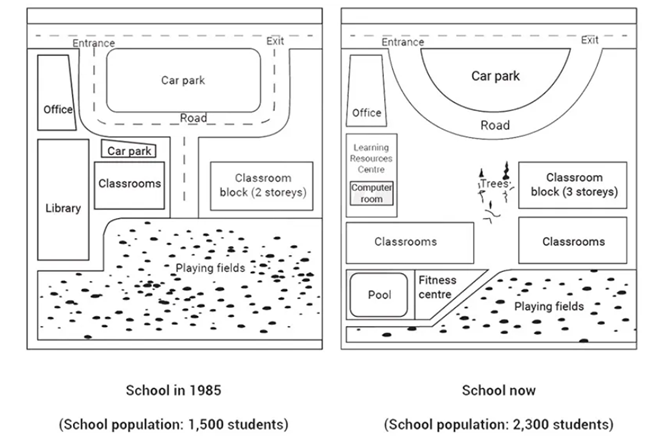
Hướng dẫn giải:
Gợi ý 1:
The two maps illustrate the layout of a school in 1985 and how it looks now. Overall, the school has undergone significant expansion and modernization to accommodate a larger student population, increasing from 1,500 to 2,300 students.
In 1985, the school consisted mainly of classrooms, a library, an office, and playing fields. There was a small car park near the classrooms and a larger one in the center, connected by a road. The classroom block had two storeys, and most of the southern area was occupied by playing fields.
Currently, the school has been considerably redeveloped. The classroom block has been extended to three storeys, and additional classrooms have been built on the left side. The small car park has been replaced by a learning resources center and a computer room. A swimming pool and a fitness center have been added near the playing fields, providing modern facilities for students. The main car park has been enlarged and redesigned with a curved shape, and trees have been planted near the classroom block.
In summary, the school has expanded both in size and facilities, reflecting its growth in student numbers and modernization of infrastructure.
(Hai sơ đồ thể hiện bố cục của một ngôi trường vào năm 1985 và hiện nay. Nhìn chung, ngôi trường đã được mở rộng và hiện đại hóa đáng kể để đáp ứng số lượng học sinh tăng từ 1.500 lên 2.300.
Năm 1985, trường chủ yếu gồm các phòng học, thư viện, văn phòng và sân chơi. Có một bãi đỗ xe nhỏ gần khu phòng học và một bãi lớn hơn ở trung tâm, được nối bằng con đường chính. Khu phòng học có hai tầng, và phần lớn khu vực phía nam là sân chơi.
Hiện nay, trường đã được cải tạo đáng kể. Khu phòng học được mở rộng lên ba tầng, và thêm các phòng học mới ở phía bên trái. Bãi đỗ xe nhỏ đã được thay thế bằng trung tâm học liệu và phòng máy tính. Một hồ bơi và trung tâm thể hình được xây dựng gần sân chơi, mang lại cơ sở vật chất hiện đại cho học sinh. Bãi đỗ xe chính được mở rộng và thiết kế lại theo hình cong, đồng thời trồng thêm cây gần khu phòng học.
Tóm lại, ngôi trường đã phát triển cả về quy mô lẫn cơ sở vật chất, phản ánh sự gia tăng số lượng học sinh và quá trình hiện đại hóa hạ tầng.)
Gợi ý 2:
The maps compare the layout of a school in 1985 with its current design. Overall, the school has been expanded and modernized, with new facilities added and existing ones upgraded to serve a larger student population.
In 1985, the school had a simple layout with an office, library, classrooms, and playing fields. The classroom block had two storeys, and there were two car parks — one small near the classrooms and one large in the center. The playing fields occupied the southern part of the school.
At present, the school has grown significantly. The classroom block now has three storeys, and additional classrooms have been built. The small car park has been replaced by a learning resources center and a computer room. New facilities such as a swimming pool and a fitness center have been added near the playing fields. The main car park has been enlarged and redesigned, and trees have been planted near the classroom block, improving the environment.
In conclusion, the school has transformed from a modest institution into a modern educational facility with improved infrastructure and amenities to accommodate more students.
(Các sơ đồ so sánh bố cục của một ngôi trường vào năm 1985 với thiết kế hiện nay. Nhìn chung, ngôi trường đã được mở rộng và hiện đại hóa, với nhiều cơ sở mới được bổ sung và các khu vực hiện có được nâng cấp để phục vụ số lượng học sinh lớn hơn.
Năm 1985, trường có bố cục đơn giản gồm văn phòng, thư viện, phòng học và sân chơi. Khu phòng học có hai tầng, và có hai bãi đỗ xe — một nhỏ gần phòng học và một lớn ở trung tâm. Sân chơi chiếm phần phía nam của trường.
Hiện nay, trường đã phát triển đáng kể. Khu phòng học hiện có ba tầng, và thêm các phòng học mới được xây dựng. Bãi đỗ xe nhỏ được thay thế bằng trung tâm học liệu và phòng máy tính. Các cơ sở mới như hồ bơi và trung tâm thể hình được bổ sung gần sân chơi. Bãi đỗ xe chính được mở rộng và thiết kế lại, đồng thời trồng thêm cây gần khu phòng học, giúp cải thiện môi trường học tập.
Tóm lại, ngôi trường đã chuyển mình từ một cơ sở đơn giản thành một trường học hiện đại với hạ tầng và tiện nghi được nâng cấp để đáp ứng số lượng học sinh ngày càng tăng.)
The diagram shows how chocolate is produced. Summarize the information by selecting and reporting the main features and make comparisons where relevant.
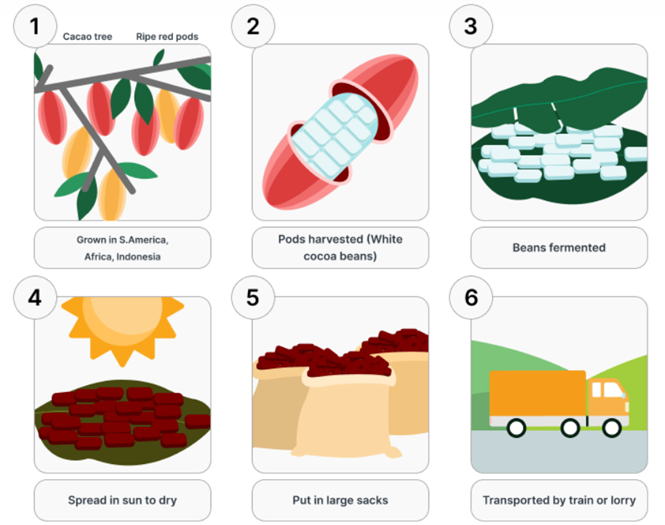
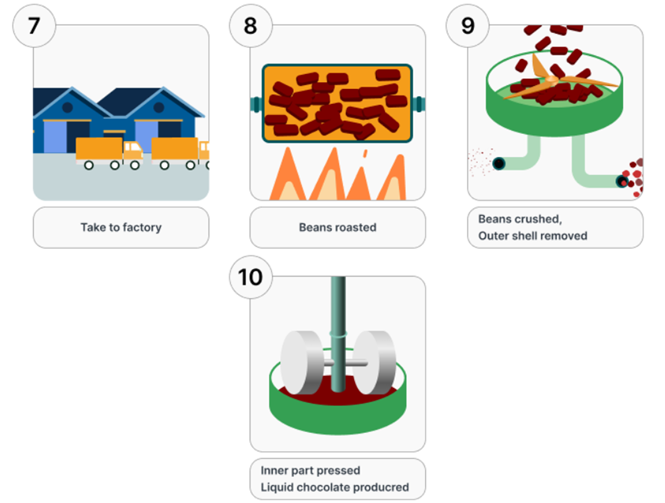
Hướng dẫn giải:
Gợi ý 1:
The diagrams illustrate the process of producing chocolate from cacao beans. Overall, there are ten stages, beginning with the growth of cacao trees and ending with the production of liquid chocolate.
The process starts with cacao trees, which are grown in South America, Africa, and Indonesia. When the red pods on these trees ripen, they are harvested to obtain white cocoa beans. These beans are then fermented and spread under the sun to dry. Once dried, they are packed into large sacks and transported by train or lorry to factories.
At the factory, the beans undergo several steps to become chocolate. First, they are roasted, and then crushed to remove the outer shells. The inner parts are pressed, producing liquid chocolate as the final product.
In summary, chocolate production involves both agricultural and industrial stages, starting from cacao cultivation and ending with the extraction of liquid chocolate through roasting and pressing.
(Các sơ đồ minh họa quy trình sản xuất sô-cô-la từ hạt cacao. Nhìn chung, có mười giai đoạn, bắt đầu từ việc trồng cây cacao và kết thúc với việc tạo ra sô-cô-la dạng lỏng.
Quy trình bắt đầu với cây cacao, được trồng ở Nam Mỹ, châu Phi và Indonesia. Khi các quả cacao đỏ chín, chúng được thu hoạch để lấy hạt cacao trắng. Những hạt này sau đó được lên men và phơi dưới ánh nắng mặt trời để khô. Sau khi khô, chúng được đóng vào bao lớn và vận chuyển bằng tàu hoặc xe tải đến nhà máy.
Tại nhà máy, hạt cacao trải qua nhiều bước để trở thành sô-cô-la. Đầu tiên, chúng được rang, sau đó nghiền để loại bỏ lớp vỏ ngoài. Phần bên trong được ép, tạo ra sô-cô-la dạng lỏng là sản phẩm cuối cùng.
Tóm lại, quá trình sản xuất sô-cô-la bao gồm cả giai đoạn nông nghiệp và công nghiệp, bắt đầu từ việc trồng cacao và kết thúc bằng việc ép hạt để tạo ra sô-cô-la lỏng.)
Gợi ý 2:
The diagrams show the ten-step process of chocolate production, starting from cacao cultivation and ending with the creation of liquid chocolate.
Cacao trees are grown in tropical regions such as South America, Africa, and Indonesia. When the red pods ripen, they are harvested to collect white cocoa beans. These beans are fermented, dried under the sun, and packed into large sacks. They are then transported by train or lorry to factories for further processing.
At the factory, the beans are roasted and crushed to remove their outer shells. The inner parts are pressed, resulting in liquid chocolate. This marks the final stage of the process.
Overall, chocolate production is a complex procedure that combines natural growth and industrial processing, transforming raw cacao beans into a finished product ready for consumption.
(Các sơ đồ cho thấy quy trình mười bước sản xuất sô-cô-la, bắt đầu từ việc trồng cacao và kết thúc với việc tạo ra sô-cô-la dạng lỏng.
Cây cacao được trồng ở các vùng nhiệt đới như Nam Mỹ, châu Phi và Indonesia. Khi quả cacao đỏ chín, chúng được thu hoạch để lấy hạt cacao trắng. Những hạt này được lên men, phơi dưới ánh nắng mặt trời và đóng vào bao lớn. Sau đó, chúng được vận chuyển bằng tàu hoặc xe tải đến nhà máy để tiếp tục xử lý.
Tại nhà máy, hạt cacao được rang và nghiền để loại bỏ lớp vỏ ngoài. Phần bên trong được ép, tạo ra sô-cô-la dạng lỏng — đây là giai đoạn cuối cùng của quy trình.
Nhìn chung, sản xuất sô-cô-la là một quy trình phức tạp kết hợp giữa trồng trọt tự nhiên và xử lý công nghiệp, biến hạt cacao thô thành sản phẩm hoàn thiện sẵn sàng cho tiêu dùng.)
Nowadays, celebrities are more famous for their glamour and wealth than for their achievements, and this has set a bad example for young children. To what extent do you agree or disagree?
Hướng dẫn giải:
Gợi ý 1:
I agree that many modern celebrities are admired more for their luxurious lifestyles than for their genuine accomplishments, and this trend can negatively influence young people’s values and aspirations.
Firstly, the media often focuses on the glamour and wealth of celebrities rather than their talents or contributions. Social media platforms and entertainment news highlight expensive clothes, cars, and parties, making fame appear easy and superficial. As a result, children may grow up believing that success is measured by appearance and money rather than hard work or skill. For example, influencers who gain popularity through fashion or gossip often overshadow scientists, writers, or athletes who achieve success through dedication.
Secondly, this obsession with fame can distort young people’s priorities. Many teenagers now dream of becoming famous rather than pursuing meaningful careers. They may imitate celebrities’ lifestyles, spending excessively or seeking attention online. This can lead to frustration and low self-esteem when they fail to achieve unrealistic goals.
However, not all celebrities are bad role models. Some use their fame to promote education, charity, and social awareness. Figures like Malala Yousafzai or Leonardo DiCaprio inspire young people to make positive changes.
In conclusion, although some celebrities set good examples, the growing focus on glamour and wealth has a harmful impact on children’s values. Society should encourage admiration for achievement rather than material success.
(Tôi đồng ý rằng nhiều người nổi tiếng hiện nay được ngưỡng mộ vì lối sống xa hoa hơn là thành tựu thực sự, và xu hướng này có thể ảnh hưởng tiêu cực đến giá trị và khát vọng của giới trẻ.
Trước hết, truyền thông thường tập trung vào sự hào nhoáng và giàu có của người nổi tiếng thay vì tài năng hay đóng góp của họ. Các nền tảng mạng xã hội và tin tức giải trí thường nhấn mạnh quần áo đắt tiền, xe hơi và tiệc tùng, khiến danh tiếng trở nên dễ dàng và nông cạn. Kết quả là trẻ em có thể lớn lên với niềm tin rằng thành công được đo bằng ngoại hình và tiền bạc thay vì sự chăm chỉ hay kỹ năng. Ví dụ, những người có ảnh hưởng nổi tiếng nhờ thời trang hoặc tin đồn thường lấn át các nhà khoa học, nhà văn hay vận động viên đạt được thành công bằng nỗ lực.
Thứ hai, sự ám ảnh với danh tiếng có thể làm lệch hướng ưu tiên của giới trẻ. Nhiều thanh thiếu niên hiện nay mơ ước trở nên nổi tiếng hơn là theo đuổi sự nghiệp có ý nghĩa. Họ có thể bắt chước lối sống của người nổi tiếng, tiêu xài hoang phí hoặc tìm kiếm sự chú ý trên mạng. Điều này có thể dẫn đến thất vọng và tự ti khi họ không đạt được mục tiêu phi thực tế.
Tuy nhiên, không phải tất cả người nổi tiếng đều là hình mẫu xấu. Một số người sử dụng danh tiếng để thúc đẩy giáo dục, từ thiện và nhận thức xã hội. Những nhân vật như Malala Yousafzai hay Leonardo DiCaprio truyền cảm hứng cho giới trẻ tạo ra thay đổi tích cực.
Tóm lại, mặc dù có những người nổi tiếng là hình mẫu tốt, việc tập trung quá mức vào sự hào nhoáng và giàu có đang ảnh hưởng tiêu cực đến giá trị của trẻ em. Xã hội nên khuyến khích sự ngưỡng mộ đối với thành tựu hơn là thành công vật chất.)
Gợi ý 2:
While it is true that many celebrities today are admired for their wealth and appearance, I believe this trend is not entirely negative, as fame can also be used to inspire and educate young people.
On one hand, the focus on glamour and luxury can mislead children. Constant exposure to celebrities’ extravagant lifestyles on social media may cause young people to value money and beauty over effort and intelligence. This can lead to unrealistic expectations and materialism. For instance, many teenagers idolize pop stars or influencers who flaunt designer brands rather than those who achieve success through talent or perseverance.
On the other hand, fame can be a powerful tool for positive influence. Many celebrities use their popularity to raise awareness about social issues, environmental protection, and mental health. When children see famous figures supporting good causes, they can learn compassion and responsibility. Moreover, celebrities who succeed through hard work — such as athletes or actors — can motivate young people to pursue their dreams.
In conclusion, although the obsession with glamour and wealth can have negative effects, celebrity culture also has the potential to inspire positive behavior. The key lies in promoting role models who combine success with integrity and social contribution.
(Mặc dù đúng là nhiều người nổi tiếng ngày nay được ngưỡng mộ vì sự giàu có và ngoại hình, tôi tin rằng xu hướng này không hoàn toàn tiêu cực, vì danh tiếng cũng có thể được sử dụng để truyền cảm hứng và giáo dục giới trẻ.
Một mặt, việc tập trung vào sự hào nhoáng và xa xỉ có thể khiến trẻ em hiểu sai giá trị. Việc tiếp xúc thường xuyên với lối sống xa hoa của người nổi tiếng trên mạng xã hội có thể khiến giới trẻ coi trọng tiền bạc và sắc đẹp hơn là nỗ lực và trí tuệ. Điều này dẫn đến kỳ vọng phi thực tế và chủ nghĩa vật chất. Ví dụ, nhiều thanh thiếu niên thần tượng các ngôi sao nhạc pop hoặc người có ảnh hưởng khoe hàng hiệu hơn là những người đạt được thành công nhờ tài năng hoặc sự kiên trì.
Mặt khác, danh tiếng có thể là công cụ mạnh mẽ để tạo ảnh hưởng tích cực. Nhiều người nổi tiếng sử dụng sự nổi tiếng của mình để nâng cao nhận thức về các vấn đề xã hội, bảo vệ môi trường và sức khỏe tinh thần. Khi trẻ em thấy những nhân vật nổi tiếng ủng hộ các hoạt động tốt, chúng có thể học được lòng nhân ái và trách nhiệm. Hơn nữa, những người nổi tiếng thành công nhờ nỗ lực — như vận động viên hoặc diễn viên — có thể truyền động lực cho giới trẻ theo đuổi ước mơ.
Tóm lại, mặc dù sự ám ảnh với sự hào nhoáng và giàu có có thể gây tác động tiêu cực, văn hóa người nổi tiếng cũng có tiềm năng truyền cảm hứng cho hành vi tích cực. Điều quan trọng là thúc đẩy những hình mẫu kết hợp giữa thành công, đạo đức và đóng góp xã hội.)
Space travel has been possible for some time and some people believe that space tourism could be developed in the future. Do you think it is a positive or negative development?
Hướng dẫn giải:
Gợi ý 1:
I believe space tourism would be a positive development for humanity, despite its challenges. It has the potential to advance science, inspire people, and create new economic opportunities.
Firstly, space tourism could accelerate technological innovation. Private companies investing in spacecraft design and safety systems may produce breakthroughs that benefit other industries, such as aviation or renewable energy. For example, improvements in fuel efficiency or materials could later be applied to everyday transport.
Secondly, space tourism can inspire global curiosity and education. Experiencing space firsthand may change how people view Earth, fostering environmental awareness and international cooperation. It could also motivate young people to pursue careers in science and engineering, strengthening future generations.
Finally, space tourism could generate economic growth. New jobs in engineering, research, and hospitality would emerge, and countries investing in this industry could benefit from tourism revenue.
Of course, space tourism is currently expensive and limited to the wealthy. However, as technology develops, costs are likely to decrease, making it more accessible.
In conclusion, space tourism represents a positive development because it promotes innovation, inspiration, and economic growth, even though affordability remains a challenge in the short term.
(Tôi tin rằng du lịch vũ trụ sẽ là một sự phát triển tích cực cho nhân loại, mặc dù có những thách thức. Nó có tiềm năng thúc đẩy khoa học, truyền cảm hứng cho con người và tạo ra cơ hội kinh tế mới.
Trước hết, du lịch vũ trụ có thể thúc đẩy đổi mới công nghệ. Các công ty tư nhân đầu tư vào thiết kế tàu vũ trụ và hệ thống an toàn có thể tạo ra những đột phá mang lại lợi ích cho các ngành khác, chẳng hạn như hàng không hoặc năng lượng tái tạo. Ví dụ, cải tiến về hiệu quả nhiên liệu hoặc vật liệu có thể được áp dụng vào giao thông hàng ngày.
Thứ hai, du lịch vũ trụ có thể khơi dậy sự tò mò và giáo dục toàn cầu. Trải nghiệm không gian trực tiếp có thể thay đổi cách con người nhìn nhận Trái Đất, thúc đẩy ý thức bảo vệ môi trường và hợp tác quốc tế. Nó cũng có thể truyền động lực cho giới trẻ theo đuổi sự nghiệp khoa học và kỹ thuật, củng cố thế hệ tương lai.
Cuối cùng, du lịch vũ trụ có thể tạo ra tăng trưởng kinh tế. Những công việc mới trong kỹ thuật, nghiên cứu và dịch vụ sẽ xuất hiện, và các quốc gia đầu tư vào ngành này có thể hưởng lợi từ doanh thu du lịch.
Tất nhiên, du lịch vũ trụ hiện nay rất đắt đỏ và chỉ dành cho người giàu. Tuy nhiên, khi công nghệ phát triển, chi phí có khả năng giảm, giúp nó trở nên phổ biến hơn.
Tóm lại, du lịch vũ trụ là một sự phát triển tích cực vì nó thúc đẩy đổi mới, truyền cảm hứng và tăng trưởng kinh tế, mặc dù khả năng chi trả vẫn là thách thức trong ngắn hạn.)
Gợi ý 2:
I believe space tourism would be a negative development because it poses environmental risks and diverts resources from more urgent problems on Earth.
Firstly, rocket launches release large amounts of greenhouse gases and pollutants into the atmosphere. This contributes to climate change and damages the environment. Moreover, the growing number of spacecraft increases space debris, which can threaten future missions and satellites.
Secondly, space tourism requires enormous financial investment. Governments and companies may spend billions on developing luxury trips for the wealthy, while millions of people still suffer from poverty, hunger, and lack of healthcare. These resources could be better used to improve living standards and develop sustainable technologies on Earth.
Finally, space tourism benefits only a small group of rich individuals. It risks becoming a symbol of inequality, where the privileged enjoy extraordinary experiences while ordinary people struggle with everyday challenges.
In conclusion, space tourism is a negative development because it harms the environment, misuses valuable resources, and increases social inequality. Efforts should instead focus on solving pressing issues on Earth before investing in luxury travel beyond it.
(Tôi cho rằng du lịch vũ trụ là một sự phát triển tiêu cực vì nó gây rủi ro cho môi trường và làm lệch hướng nguồn lực khỏi những vấn đề cấp bách trên Trái Đất.
Trước hết, các vụ phóng tên lửa thải ra lượng lớn khí nhà kính và chất ô nhiễm vào khí quyển. Điều này góp phần vào biến đổi khí hậu và gây hại cho môi trường. Hơn nữa, số lượng tàu vũ trụ ngày càng tăng làm gia tăng rác thải không gian, có thể đe dọa các sứ mệnh và vệ tinh trong tương lai.
Thứ hai, du lịch vũ trụ đòi hỏi khoản đầu tư tài chính khổng lồ. Chính phủ và doanh nghiệp có thể chi hàng tỷ đô la để phát triển chuyến đi xa xỉ cho người giàu, trong khi hàng triệu người vẫn chịu cảnh nghèo đói, đói ăn và thiếu chăm sóc y tế. Những nguồn lực này nên được sử dụng để cải thiện mức sống và phát triển công nghệ bền vững trên Trái Đất.
Cuối cùng, du lịch vũ trụ chỉ mang lại lợi ích cho một nhóm nhỏ người giàu. Nó có nguy cơ trở thành biểu tượng của bất bình đẳng, khi người đặc quyền tận hưởng trải nghiệm phi thường trong khi người bình thường vẫn vật lộn với khó khăn hàng ngày.
Tóm lại, du lịch vũ trụ là một sự phát triển tiêu cực vì nó gây hại cho môi trường, lãng phí nguồn lực quý giá và làm gia tăng bất bình đẳng xã hội. Nỗ lực nên tập trung vào việc giải quyết các vấn đề cấp bách trên Trái Đất trước khi đầu tư vào du lịch xa xỉ ngoài không gian.)