Topic 38: Research
50 câu hỏi
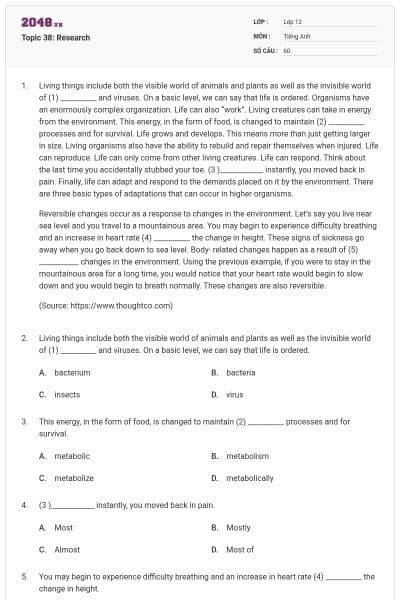
Living things include both the visible world of animals and plants as well as the invisible world of (1) __________ and viruses. On a basic level, we can say that life is ordered. Organisms have an enormously complex organization. Life can also “work”. Living creatures can take in energy from the environment. This energy, in the form of food, is changed to maintain (2) __________ processes and for survival. Life grows and develops. This means more than just getting larger in size. Living organisms also have the ability to rebuild and repair themselves when injured. Life can reproduce. Life can only come from other living creatures. Life can respond. Think about the last time you accidentally stubbed your toe. (3 )____________ instantly, you moved back in pain. Finally, life can adapt and respond to the demands placed on it by the environment. There are three basic types of adaptations that can occur in higher organisms.
Reversible changes occur as a response to changes in the environment. Let’s say you live near sea level and you travel to a mountainous area. You may begin to experience difficulty breathing and an increase in heart rate (4) __________ the change in height. These signs of sickness go away when you go back down to sea level. Body- related changes happen as a result of (5) ___________ changes in the environment. Using the previous example, if you were to stay in the mountainous area for a long time, you would notice that your heart rate would begin to slow down and you would begin to breath normally. These changes are also reversible.
(Source: https://www.thoughtco.com)
bacterium
bacteria
insects
virus
Sinh vật sống bao gồm cả thế giới động vật và thực vật nhìn thấy được cũng như thế giới vô hình của các loại vi khuẩn và vi rút. Trên một mức độ cơ bản, chúng ta có thể nói rằng cuộc sống được sắp xếp có tổ chức. Các sinh vật có một tổ chức vô cùng phức tạp. Cuộc sống cũng có thể “lao động”. Các sinh vật sống có thể lấy năng lượng từ môi trường. Năng lượng này, dưới dạng thực phẩm, được thay đổi để duy trì các quá trình trao đổi chất và sự sống. Cuộc sống ngày một phát triển. Điều này có nghĩa là các sinh vật phát triển nhiều hơn về số lượng chứ không chỉ lớn hơn về kích thước. Sinh vật sống cũng có khả năng tự tái tạo lại và tự phục hồi khi bị thương tổn. Cuộc sống có thể tái tạo. Cuộc sống chỉ có thể có được từ những sinh vật sống khác nhau. Cuộc sống có thể đáp ứng. Hãy suy nghĩ về lần cuối cùng bạn vô tình bị vấp. Gần như ngay lập tức, bạn lại cảm thấy đau đớn. Cuối cùng, cuộc sống có thể thích nghi và đáp ứng với các yêu cầu đặt ra bởi môi trường. Có ba loại thích ứng cơ bản có thể xảy ra ở các sinh vật cao hơn.
Những thay đổi có thể đảo ngược xảy ra như một phản ứng với những thay đổi trong môi trường. Hãy nói đến việc bạn sống gần mực nước biển và bạn đi du lịch đến một khu vực miền núi. Bạn có thể cảm thấy khó thở và tăng nhịp tim do sự thay đổi độ cao. Những dấu hiệu của bệnh tật biến mất khi bạn quay trở lại với nơi gần mực nước biển. Thay đổi liên quan đến cơ thể xảy ra là kết quả của những thay đổi kéo dài trong môi trường. Cũng ví dụ trên, nếu bạn ở vùng núi trong một thời gian dài, bạn sẽ nhận thấy nhịp tim của bạn sẽ bắt đầu chậm lại và bạn sẽ bắt đầu thở bình thường. Những thay đổi này cũng có thể đảo ngược.
Đáp án B
Kiến thức về từ vựng
A. bacterium: vi khuẩn (số ít)
B. bacteria: vi khuẩn (số nhiều)
C. insects: sâu bọ, côn trùng
D. virus: vi rút, mầm bệnh, nguồn gây bệnh
Căn cứ vào nghĩa của câu: “Living things include both the visible world of animals and plants as well as the invisible world of (1) ______ and viruses.”
(Sinh vật sống bao gồm cả thế giới động vật và thực vật nhìn thấy được cũng như thế giới vô hình của vi khuẩn và vi rút.)
metabolic
metabolism
metabolize
metabolically
Đáp án A
Kiến thức về từ loại
A. metabolic (adj): thuộc trao đổi chất, chuyển hóa (metabolic processes: các quá trình trao đổi chất)
B. metabolism (n) sự trao đổi chất, sự chuyển hóa
C. metabolize (v): chuyển hóa
D. metabolically (adv): trao đổi chất, chuyển hóa
Căn cứ vào nghĩa của câu: “This energy, in the form of food, is changed to maintain (2)______ processes and for survival.”
(Nguồn năng lượng này, dưới dạng thực phẩm, được thay đổi để duy trì các quá trình trao đổi chất và sự sống còn.)
Most
Mostly
Almost
Most of
Đáp án C
Kiến thức về lượng từ
A. Most (adj) + N(không xác định): hầu hết; (adv) = very/ extremely
B. Mostly (adv): = mainly: chủ yếu là, thường là
C. Almost (adv) = rearly: hầu như, gần như
D. Most of (pro): hầu hết + N(xác định)
Căn cứ vào nghĩa của câu: “(3)____________instantly, you moved back in pain.”
(Gần như ngay lập tức, bạn lại cảm thấy đau đớn.)
because
on account
as a result
as a result of
Đáp án D
Kiến thức về liên từ
A. because: bởi vì/ vì (+clause)
B. on account (of): bởi vì/ do là (+ N)
C. as a result: vì thế mà (+clause)
D. as a result of: do/ vì (+N)
Căn cứ vào nghĩa của câu: “You may begin to experience difficulty breathing and an increase in heart rate (4) __________ the change in height.”
(Bạn có thể bắt đầu gặp khó thở và tăng nhịp tim do sự thay đổi độ cao)
prolonged
enduring
lasting
long
Đáp án A
Kiến thức về từ vựng
A. prolonged (adj): tiếp tục trong một thời gian dài, kéo dài
B. enduring (adj) lâu dài, vĩnh viễn
C. lasting (adj): bền vững, lâu dài
D. long (adj): dài
Căn cứ vào nghĩa của câu: “Body- related changes happen as a result of (5) ___________ changes in the environment.”
All the different plants and animals in a natural community are in a state of balance. This balance is achieved by the plants and animals interacting (1) _______ each other and with their non-living surroundings. An example of a natural community is a woodland, and a woodland is usually dominated by a particular species of plant, such as the oak tree in an oak wood. The oak tree in this example is therefore called the dominant species but there are also many other types of plants, from brambles, bushes, and small trees to mosses, lichens and algae (2) __________ on tree trunks and rocks.
The plants of a community are the producers: they use carbon dioxide, oxygen, nitrogen to build up their tissues using energy in the form of sunlight. The plant tissues form food for the plant-eating animals (herbivores) (3) _______ are in turn eaten by flesh-eating animals (carnivores). Thus, plants produce the basic food supply for all the animals of a community. The animals themselves are the consumers, and are either herbivores or carnivores.
Examples of herbivores in a woodland community are rabbits, deer, mice and snails, and insects such as aphids and caterpillars. The herbivores are sometimes eaten by the carnivores. Woodland carnivores are of all sizes, from insects such as beetles and lacewings to animals such as owls, shrews and foxes. Some carnivores feed on herbivores, some feed on the smaller carnivores, (4) _______ some feed on both: a tawny owl will eat beetles and shrews as well as voles and mice. These food relationships between the different members of the community are known as food chains or food (5) ______. All food chains start with plants. The links of the chain are formed by the herbivores that eat the plants and the carnivores that feed on the herbivores. There are more organisms at the base of the food chain than at the top; for example, there are many more green plants than carnivores in a community.
(Source: https://en.wikipedia.org/wiki/Balance_of_nature)
with
to
for
at
Tất cả các loại thực vật và động vật khác nhau trong một cộng đồng tự nhiên đều ở trạng thái cân bằng. Sự cân bằng này đạt được bởi các loài thực vật và động vật tương tác với nhau và với môi trường sống xung quanh của chúng. Một ví dụ về một cộng đồng tự nhiên là một khu rừng, và một khu rừng thường bị chi phối bởi một loài thực vật cụ thể, chẳng hạn như cây sồi trong rừng sồi. Cây sồi trong ví dụ này do đó được gọi là loài ưu thế nhưng cũng có nhiều loại thực vật khác, từ những bụi gai, bụi cây, và các cây nhỏ để rêu, địa y và tảo phát triển trên thân chúng và đá.
Thực vật của một quần thể chính là những nhà sản xuất: chúng sử dụng các-bon-đi-ô-xít, oxy, nitơ để xây dựng mô của chúng bằng cách sử dụng năng lượng dưới dạng ánh sáng mặt trời. Các mô thực vật tạo thành thức ăn cho động vật ăn thực vật (động vật ăn cỏ) mà lần lượt được ăn bởi động vật ăn thịt (động vật ăn thịt). Do đó, thực vật tạo ra nguồn cung cấp thực phẩm cơ bản cho tất cả các loài động vật của một cộng đồng. Bản thân động vật là người tiêu thụ, và vừa là động vật ăn cỏ hoặc là động vật ăn thịt.
Ví dụ về động vật ăn cỏ trong một cộng đồng rừng là thỏ, nai, chuột và ốc, và côn trùng như rệp và sâu bướm. Các động vật ăn cỏ đôi khi là thức ăn của các loài động vật ăn thịt. Những loài động vật ăn thịt gồm nhiều chủng loại, từ côn trùng như bọ cánh cứng và bọ cánh ren đến động vật như cú, chuột chù và cáo. Các loài động vật ăn thịt gồm nhiều loài, từ côn trùng như bọ cánh cứng và cánh ren đến các loài động vật như cú, chồn và cáo. Một số loài động vật ăn thịt ăn động vật ăn cỏ, một số ăn thịt loài nhỏ hơn, trong khi có một số loài ăn cả hai: một con cú nâu sẽ ăn bọ cánh cứng và chuột chù, chuột đồng và các loài chuột khác. Những mối quan hệ về thức ăn giữa các thành viên khác nhau của cộng đồng được gọi là chuỗi thức ăn hoặc mạng lưới thức ăn. Tất cả các chuỗi thức ăn đều bắt đầu từ thực vật. Các liên kết của chuỗi được hình thành bởi các động vật ăn cỏ ăn thực vật và động vật ăn thịt ăn ăn động vật ăn cỏ. Có nhiều sinh vật hơn ở gốc của chuỗi thức ăn hơn là ở trên cùng; ví dụ, có nhiều cây xanh hơn các loài động vật ăn thịt trong quần thể.
Đáp án A
Kiến thức về giới từ
Ta có cụm giới từ: interact with /ˌɪntəˈrækt wɪð/: tương tác, tác động ảnh hưởng lẫn nhau
grow
growing
to grow
grown
Đáp án B
Kiến thức về rút gọn mệnh đề quan hệ
Ta sử dụng hiện tại phân từ (V-ing) để tạo mệnh đề quan hệ rút gọn khi động từ trong mệnh đề quan hệ đó ở thể chủ động.
Trong câu này “growing” được hiểu là: “which grow”
whom
who
when
which
Đáp án D
Kiến thức về đại từ quan hệ
A. whom /huːm/: Là đại từ quan hệ chỉ người, đứng sau danh từ chỉ người để làm tân ngữ cho động từ đứng sau nó.
B. who /huː/: Là đại từ quan hệ chỉ người, đứng sau danh từ chỉ người để làm chủ ngữ hoặc tân ngữ cho động từ đứng sau nó.
C. when /wen/: Là trạng từ qua hệ chỉ thời gian, đứng sau danh từ chỉ thời gian
D.which /wɪtʃ/: Là đại từ quan hệ chỉ vật, sự vật, sự việc làm chủ ngữ hoặc tân ngữ cho động từ đứng sau.
while
when
as
since
Đáp án A
Kiến thức về liên từ
A. while /waɪl/ (conj): trong khi: Dùng để chỉ các hành động và sự kiện diễn ra cùng một lúc tại quá khứ, hiện tại và tương lai.
B. when /wen/ (conj): khi: được dùng khi nói về một thời điểm cụ thể mà ở đó một hành động hay một sự kiện đã xảy ra hoặc sẽ xảy ra
C. as /æz/ (conj) = when
D. since /sɪns/ (conj): từ, từ khi
Căn cứ vào nghĩa của câu: “Some carnivores feed on herbivores, some feedon the smaller carnivores, (4)__________ some feed on both: a tawny owl will eat beetles and shrews as well as voles and mice.”
(Một số loài động vật ăn thịt ăn động vật ăn cỏ, một số ăn thịt loài nhỏ hơn, trong khi có một số loài ăn cả hai: một con cú nâu sẽ ăn bọ cánh cứng và chuột chù, chuột đồng và các loài chuột khác.)
webs
stores
loads
amounts
Đáp án A
Kiến thức về cụm từ cố định
A. webs /webs/ (n): mạng, tơ, tấm vải, cuộn giấy, súc giấy
B. stores /stɔːr/ (n): cửa hàng, của hiệu, kho, dự trữ, bộ lưu trữ
C. loads /ləʊd/ (n): vật nặng, gánh nặng, trọng tải
D. amounts /əˈmaʊnt/ (n): lượng, số lượng
Ta có cụm từ cố định: “food chain”: chuỗi thức ăn; “food webs”: lưới thức ăn
All birds have feathers, and feathers are unique to birds. No other major group of animals is so easy to categorize. All birds have wings, too, but wings are not (1) ___________ to birds. Many adaptations are found in both feathers and wings. Feathers form the soft down of geese and ducks, the long showy plumes of ostriches and egrets, and the strong flight feathers of eagles and condors. Wings (2) _____________ from the short, broad ones of chickens, who seldom fly, to the long slim ones of albatrosses, who spend almost all their lives soaring on air currents. In penguins, wings have been modified (3) ________ flippers, and feathers into a waterproof covering. In kiwis, the wings are almost impossible to detect. Yet diversity among birds is no so striking as it is among mammals. The (4) ___________ between a hummingbird and a penguin is immense, but hardly as startling as that between a bat and a whale. It is variations in details rather than in fundamental patterns (5) _____________ have been important in the adaptation of birds to many kinds of ecosystems.
(www.studfiles.ru/preview/4467344)
peculiar
particular
unusual
special
Tất cả các loài chim đều có lông vũ, và lông vũ duy nhất có ở chim. Không có nhóm động vật nào khác có thể dễ dàng phân loại như vậy. Tất cả các loài chim cũng có cánh, nhưng đôi cánh không đặc biệt với chim. Nhiều sự thay đổi thích nghi được tìm thấy ở cả lông và cánh. Lông vũ tạo thành sự mềm mại của ngỗng và vịt, những chùm lông dài của đà điểu và con diệc, và lông trên cánh hay đuôi của đại bàng và kền kền. Những đôi cánh thì khác nhau, từ những con gà với đôi cánh ngắn, rộng, ít khi bay đến những con hải âu với đôi cánh mảnh khảnh và dài, chúng dành gần như cả cuộc đời để bay vút lên không trung. Đối với chim cánh cụt, đôi cánh đã được thoái hóa thành chân chèo, và lông vũ trở thành một lớp phủ không thấm nước. Đối với chim kiwi, đôi cánh gần như không thể nhìn thấy. Tuy nhiên, sự đa dạng giữa các loài chim không quá nổi bật như ở các loài động vật có vú. Sự khác biệt giữa chim ruồi và chim cánh cụt là rất lớn, nhưng hầu như không nổi bật như giữa dơi và cá voi. Đó là các biến thể chi tiết hơn là các kiểu mẫu chủ yếu, cái mà có tầm quan trọng trong việc thích nghi của chim đối với nhiều loại hệ sinh thái.
Đáp án A
Kiến thức về từ cùng trường nghĩa
A. peculiar /pi’kju:ljə/ (a): riêng biệt, lạ => be peculiar to st: độc/lạ so với
B. particular /pə’tikjulə/ (a): riêng, đặc biệt, đặc thù
C. unusual /ʌn’ju:ʒl/ (a): khác thường
D. special /’speʃəl/ (a): đặc biệt, riêng biệt
Peculiar: khác lạ đối với ai đó/ cái gì đó
Particular = special: đặc biệt đối với ai đó/ cái gì đó
Tạm dịch: All birds have feathers, and feathers are unique to birds. No other major group of animals is so easy to categorize. All birds have wings, too, but wings are not (1)___________ to birds.
(Tất cả các loài chim đều có lông, và lông là nét độc đáo cho chim. Không có nhóm động vật chính nào khác dễ dàng phân loại như vậy. Tất cả các loài chim cũng có cánh, nhưng đôi cánh không phải chỉ độc nhất với chim.)
transfer
modify
vary
change
Đáp án C
Kiến thức về từ vựng
A. transfer /’trænsfə:/ (v): di chuyển
B. modify /’mɔdifai/ (v): chuyển đổi
C. vary /’veəri/ (v): dao động
D. change /tʃeindʤ/ (v): thay đổi
Tạm dịch: Feathers form the soft down of geese and ducks, the long showy plumes of ostriches and egrets, and the strong flight feathers of eagles and condors. Wings (2) _______________ from the short, broad ones of chickens, who seldom fly, to the long slim ones of albatrosses, who spend almost all their lives soaring on air currents.
(Lông vũ tạo thành sự mềm mại của ngỗng và vịt, những chùm lông dài của đà điểu và vượn, và lông bay mạnh mẽ của đại bàng và kền kền. Những đôi cánh khác nhau, từ cánh của những con gà ngắn, rộng, ít khi bay đến những con hải âu mảnh khảnh dài, chúng dành gần như cả cuộc đời để bay vút lên dòng không khí.)
from
with
onto
into
Đáp án D
Kiến thức về giới từ
Tạm dịch: In penguins, wings have been modified (3) ________ flippers, and feathers into a waterproof covering.
(Ở chim cánh cụt, đôi cánh đã được chuyển đổi thành chân chèo, và lông vũ thành một lớp phủ không thấm nước.)
Ở câu này hai vế cân nhau nên ta đều dùng giới từ into.
similarity
difference
comparison
division
Đáp án B
Kiến thức về từ vựng
A. similarity /simi’læriti/ (n): sự giống nhau
B. difference /’difrəns/ (n): sự khác nhau
C. comparison /kəm’pærisn/ (n): sự so sánh
D. division /di’viʤn/ (n): sự phân chia
Ta có cụm: difference between…: sự khác nhau giữa….
Tạm dịch: The (4) ___________ between a hummingbird and a penguin is immense, but hardly as startling as that between a bat and a whale.
(Sự khác nhau giữa một con chim ruồi và một con chim cánh cụt là rất lớn, nhưng hầu như không có sự khác biệt như giữa một con dơi và một con cá voi.)
It is variations in details rather than in fundamental patterns (5) _____________ have been important in the adaptation of birds to many kinds of ecosystems.
which
whether
what
that
Đáp án D
Kiến thức về mệnh đề quan hệ
Tạm dịch: It is variations in details rather than in fundamental patterns (5) _____________ have been important in the adaptation of birds to many kinds of ecosystems.
(Đó là các biến thể trong chi tiết chứ không phải trong các mẫu cơ bản mà nó rất quan trọng trong việc thích nghi của chim với nhiều loại hệ sinh thái.).
Ta dùng “that” trong câu nhấn mạnh
It + be + thành phần nhấn mạnh + that + S + V
Bacteria are the smallest known living things with a cellular structure. These colorless, one-celled micro-organisms exist (1) ______ organic matter is found: in soil, in water and in the air. Since most of them have no chlorophyll, they cannot use light energy to synthesize their food, (2) ________ green plants do. They must get their food in other ways. In this, bacteria resemble animals. However, since/as they are enclosed in a cell wall, they can only (3) _______ dissolved food like plants do.
Although most bacteria do not contain chlorophyll, some of them can make their own organic food from simple inorganic (4)________. They do not, however, use light energy for this purpose. Others get ready-made food from dead plants and animals. Still others are parasites. Parasites are (5)______ to enter other living organisms and take food from them. In doing so, they often cause diseases or the death of their hosts.
(http://www.englishdaily626.com/cloze_passagew.php?115)
whenever
wherever
whatever
however
Vi khuẩn là những sinh vật nhỏ nhất được biết đến với cấu trúc tế bào. Những vi sinh vật không màu, đơn bào này tồn tại ở bất cứ nơi nào có thể tìm thấy chất hữu cơ: trong đất, trong nước và trong không khí. Vì hầu hết chúng không có diệp lục, chúng không thể sử dụng năng lượng ánh sáng để tổng hợp thức ăn của chúng, như thực vật. Chúng phải lấy thức ăn theo cách khác. Do đó, vi khuẩn giống như động vật. Tuy nhiên, vì chúng được bao bọc trong thành tế bào, nên chúng chỉ có thể hấp thụ thức ăn đã phân hủy như thực vật.
Mặc dù hầu hết các vi khuẩn không chứa chất diệp lục, một số chúng có thể tự tổng hợp thực phẩm hữu cơ từ các vật liệu vô cơ đơn giản. Tuy nhiên, chúng không sử dụng năng lượng ánh sáng cho mục đích này. Những sinh vật khác lấy thức ăn có sẵn từ thực vật và động vật chết. Vẫn còn những sinh vật khác là ký sinh trùng. Ký sinh trùng có thể xâm nhập vào các sinh vật sống khác và lấy thức ăn từ chúng. Khi làm như vậy, chúng thường gây bệnh hoặc cái chết cho vật chủ.
Đáp án B
Kiến thức về wh-ever words
These colorless, one-celled micro-organisms exist (1) ______ organic matter is found: in soil, in water and in the air.
Tạm dịch: Những vi sinh vật đơn bào không màu này tồn tại ở bất cứ nơi nào có tồn tại chất hữu cơ: trong đất, trong nước và trong không khí.
=> Ta dùng wherever: bất cứ nơi nào, các đáp án còn lại không hợp nghĩa và ngữ pháp.
since
if
as
so
Đáp án C
Kiến thức về liên từ
Since most of them have no chlorophyll, they cannot use light energy to synthesize their food, (2)________ green plants do.
Tạm dịch: Vì hầu hết chúng không có chất diệp lục, chúng không thể sử dụng năng lượng ánh sáng để tổng hợp thức ăn, như thực vật xanh.
Xét các đáp án:
A. since: bởi vì, kể từ
B. if: nếu
C. as: giống như
D. so: vì vậy
However, since/as they are enclosed in a cell wall, they can only (3) _______ dissolved food like plants do.
absorb
attract
eat
consume
Đáp án A
Kiến thức về từ vựng
However, since/as they are enclosed in a cell wall, they can only(3)_______ dissolved food like plants do.
Tạm dịch: Tuy nhiên, chúng được bao quanh bởi một vách tế bào, chúng chỉ có thể hấp thụ thức ăn đã phân hủy giống như là thực vật.
Xét các đáp án:
A. absorb: hấp thụ
B. attract: thu hút
C. eat: ăn
D. consume: dùng, tiêu thụ
=> A (thực vật hấp thụ chất, thức ăn chứ không nói là thực vật ăn chất, thức ăn)
resources
supplies
materials
foodstuffs
Đáp án C
Kiến thức về từ vựng
Although most bacteria do not contain chlorophyll, some of them can make their own organic food from simple inorganic (4) ________.
Tạm dịch: Mặc dù hầu hết các vi khuẩn không chứa chất diệp lục, nhưng một vài loại trong số đó có thể tự tạo ra thức ăn hữu cơ từ nguyên liệu vô cơ đơn thuần.
Xét các đáp án:
A. resources: tài nguyên
B. supplies: những nguồn cung cấp
C. materials: những nguyên liệu
D. foodstuffs: bất cứ chất nào dùng làm thức ăn, thực phẩm (gà, dầu ăn,…)
effective
competent
skilled
able
Đáp án D
Kiến thức về cụm từ
Parasites are (5)______ to enter other living organisms and take food from them.
Tạm dịch: Động (thực) vật kí sinh có thể xâm nhập vào các sinh vật sống khác và lấy thức ăn từ chúng.
Xét các đáp án còn lại:
A. effective: có hiệu quả
B. competent: giỏi, thạo
C. skilled: khéo léo
D. be able to: có thể
Ta có công thức: Be skilled in/at something/doing something: khôn khéo trong việc gì
Sociologists have been carrying out research into the social pressures of being a teenager. Many adolescents are unhappy at school because they find it difficult to (1) ______ friends. This stress can bring on illness or result in poor grades. They may also worry about their appearance and often feel (2) ______ enormous pressure to dress, talk and behave the same as (3) ______. This phenomenon is called peer pressure, and it is very common in today’s society. Advertising contributes a lot to the social pressures teenagers feel. Advertisers know how important it is to feel that you belong to a group when you are in your teens, so they try to persuade teenagers that certain products will make them (4) ______ with their classmates. Sadly, many teenagers act irresponsibly and even do dangerous things just to make others accept them. Peer pressure is often the reason for teenage smoking, drug (5) ______ or dangerous driving. Teenagers need to learn to say no to social pressure and to find friends who they can talk things over with when they have a problem.
(https://books.google.com.vn)
make
keep
remain
create
Các nhà xã hội học đã tiến hành các nghiên cứu về áp lực xã hội mà một thiếu niên phải chịu. Nhiều thanh thiếu niên không vui khi ở trường vì họ thấy khó khăn trong việc kết bạn. Sự căng thẳng này có thể mang lại bệnh tật hoặc dẫn đến điểm kém. Họ cũng lo lắng về ngoại hình và cảm thấy áp lực lớn về cách ăn mặc, nói chuyện và cư xử giống như những người khác. Hiện tượng này được gọi là áp lực đồng trang lứa, và nó rất phổ biến trong xã hội hiện nay. Quảng cáo góp phần lớn vào các áp lực xã hội ảnh hưởng lên thiếu niên. Các nhà làm quảng cáo biết rằng việc cảm thấy bản thân thuộc về một tập thể khi là một thiếu niên quan trọng như thế nào, nên họ cố gắng thuyết phục thanh thiếu niên rằng một số sản phẩm sẽ khiến họ nổi tiếng với bạn cùng lớp. Đáng buồn thay, nhiều thiếu niên cư xử vô trách nhiệm và thậm chí còn làm những việc nguy hiểm chỉ để được người khác chấp nhận. Áp lực đồng trang lứa thường là nguyên nhân thanh thiếu niên hút thuốc, lạm dụng thuốc gây nghiện hoặc lái xe gây nguy hiểm. Thiếu niên cần phải nói “không” với áp lực xã hội và tìm những người bạn họ có thể chia sẻ khi gặp vấn đề.
Đáp án A
Kiến thức: Cụm từ
A. make friends: làm bạn
B. keep (v): giữ
C. remain (v): còn lại, vẫn
D. create (v): tạo ra
Many adolescents are unhappy at school because they find it difficult to (1) make friends.
Tạm dịch: Nhiều thanh thiếu niên không vui khi ở trường vì họ thấy khó khăn trong việc kết bạn.
under
below
in
over
Đáp án A
Kiến thức: Cụm từ
A. under pressure: chịu áp lực
B. below (adj): dưới, ở dưới
C. in (adj): ở, tại, trong
D. over (adj): trên, lên trên
They may also worry about their appearance and often feel (2) under enormous pressure to dress.
Tạm dịch: Họ cũng lo lắng về ngoại hình và cảm thấy áp lực lớn về cách ăn mặc.
another
others
the other
other
Đáp án B
Kiến thức: Từ vựngGiải thích:
another + N(số ít): một… khác
others = other + N(số nhiều): những … khác
the other + N(số ít): một … còn lại cuối cùng
=> others = other adolescents
They may also worry about their appearance and often feel under enormous pressure to dress, talk and behave the same as (3) others.
Tạm dịch: Họ cũng lo lắng về ngoại hình và cảm thấy áp lực lớn về cách ăn mặc, nói chuyện và cư xử giống như những người khác.
popular
common
favourite
open
Đáp án A
Kiến thức: Từ vựng
Giải thích:
A. popular (adj): nổi tiếng
B. common (adj): phổ biến
C. favourite (adj): ưa thích
D. open (adj): cởi mở
=> popular with: phổ biến, nổi tiếng với ai
Advertisers know how important it is to feel that you belong to a group when you are in your teens, so they try to persuade teenagers that certain products will make them (4) popular with their classmates.
Tạm dịch: Các nhà làm quảng cáo biết rằng việc cảm thấy bản thân thuộc về một tập thể khi là một thiếu niên quan trọng như thế nào, nên họ cố gắng thuyết phục thanh thiếu niên rằng một số sản phẩm sẽ khiến họ nổi tiếng với bạn cùng lớp.
overuse
overdose
addict
abuse
Đáp án D
Kiến thức: Cụm từ
Giải thích:
drug abuse: lạm dụng thuốc
A. overuse (n): sự dùng quá nhiều
B. overdose (n): quá liều
C. addict (n): người nghiện
Peer pressure is often the reason for teenage smoking, drug (5) abuse or dangerous driving.
Tạm dịch: Áp lực đồng trang lứa thường là nguyên nhân thanh thiếu niên hút thuốc, lạm dụng thuốc gây nghiện hoặc lái xe gây nguy hiểm.
Many people believe the glare from snow causes snow-blindness. Yet, dark glasses or not, they find themselves suffering from headaches and watering eyes, and even snow-blindness, when exposed to several hours of “snow light”.
The United States Army has now determined that the glare from snow does not cause snow-blindness in troops in a snow-covered country. Rather, a man’s eyes frequently find nothing to focus on in a broad expanse of a snow-covered area. So his gaze continually shifts and jumps back and forth over the entire landscape in search of something to look at. Finding nothing, hour after hour, the eyes never stop searching and the eyeballs become sore and the eye muscles ache. Nature balances this annoyance by producing more and more liquid which covers the eyeballs. The liquid covers the eyeballs in increasing quantity until vision blurs. And the result is total, even though temporary, snow-blindness.
Experiments led the Army to a simple method of overcoming this problem. Scouts ahead of a main body of troops are trained to shake snow from evergreen bushes, creating a dotted line as they cross completely snow-covered landscape. Even the scouts themselves throw lightweight, dark-colored objects ahead on which they too can focus. The men following can then see something. Their gaze is arrested. Their eyes focus on a bush and having found something to see, stop searching through the snow-blanketed landscape. By focusing their attention on one object at a time, the men can cross the snow without becoming hopelessly snow-blind or lost: In this way the problem of crossing a solid white area is overcome.
To prevent headaches, watering eyes and blindness caused by the glare from snow, dark glasses are ____.
indispensable
useful
ineffective
available
Đáp án C
Chủ đề về MEDICINE
Để ngăn ngừa đau đầu, chảy nước mắt và bị mù do ánh sáng chói từ tuyết, kính dâm là ____.
A. không thể thiếu
B. hữu ích
C. không hiệu quả
D. có sẵn
Căn cứ vào thông tin của đoạn văn
“Many people believe the glare from snow causes snow-blindness. Yet, dark glasses or not, they find themselves suffering from headaches and watering eyes, and even snow-blindness, when exposed to several hours of “snow light”.
(Nhiều người tin rằng ánh sáng chói từ tuyết gây ra sự bị chói mắt. Tuy nhiên, dù có kính dâm hay không, họ đều cảm thấy mình bị đau đầu và chảy nước mắt, và thậm chí chói mắt, khi tiếp xúc vài giờ với “ánh sáng tuyết”.)
The eyeballs become sore and the eye muscles ache because __________ .
tears cover the eyeballs
the eyes are annoyed by blinding sunlight
the eyes are annoyed by blinding snow
there is nothing to focus on
Đáp án D
Nhãn cầu bị đau và cơ mắt bị đau nhức bởi vì __________ .
A. nước mắt che phủ nhãn cầu
B. mắt bị ảnh hưởng bởi ánh sáng mặt trời chói
C. mắt bị ảnh hưởng bởi tuyết chói
D. không có gì để tập trung vào
Căn cứ vào thông tin của đoạn văn
“So his gaze continually shifts and jumps back and forth over the entire landscape in search of something to look at. Finding nothing, hour after hour, the eyes never stop searching and the eyeballs become sore and the eye muscles ache.
(Vì vậy, ánh mắt của anh ta liên tục thay đổi và di chuyển qua lại trên toàn bộ khung cảnh để tìm kiếm thứ gì đó để nhìn vào. Không tìm thấy gì sau nhiều giờ liên tục, đôi mắt không bao giờ ngừng tìm kiếm và nhãn cầu sẽ bị đau và cơ mắt đau nhức)
According to the passage, snow-blindness may be avoided by ____.
concentrating on the solid white terrain
searching for something to look at in snow-covered
providing the eyes with something to focus on
covering the eyeballs with fluid
Đáp án C
Theo đoạn văn, sự bị loá vì tuyết có thể tránh được __________ .
A. tập trung vào địa hình trắng rắn
B. tìm kiếm thứ gì đó để nhìn trong địa hình phủ đầy tuyết
C. cung cấp cho đôi mắt một cái gì đó để tập trung vào
D. che nhãn cầu bằng chất lỏng
Căn cứ vào thông tin của đoạn văn
By focusing their attention on one object at a time, the men can cross the snow without becoming hopelessly snow-blind or lost: In this way the problem of crossing a solid white area is overcome.
(Bằng cách tập trung sự chú ý của họ vào một tại điểm tại một lúc, đội quân này có thể băng qua tuyết mà không bị loá vì tuyết hoặc bị lạc một cách vô vọng: Bằng cách này, vấn đề vượt qua một khu vực toàn màu trắng đã được khắc phục.)
The underlined word “they” in the third paragraph refers to ____.
experiments
scouts
main troops
bushes
Đáp án B
Từ được gạch chân “they” trong đoạn thứ ba đề cập đến ____.
A. thí nghiệm
B. đội trinh thám
C. đội quân chính
D. bụi cây
Căn cứ vào ngữ cảnh của câu sau
Scouts ahead of a main body of troops are trained to shake snow from evergreen bushes, creating a dotted line as they cross completely snow-covered landscape.
(Đội trinh sát của một đội quân chính được huấn luyện để làm rung tuyết từ những bụi cây thường xanh, tạo ra một đường chấm khi họ băng qua phong cảnh phủ đầy tuyết.)
=> they = scouts.
A suitable title for this passage would be ____.
Snow-blindness and How to Overcome It
Nature’s Cure for Snow-blindness
Soldiers Marching in the Snow
Snow Vision and Its Effect on Eyesight
Đáp án A
Một tiêu đề phù hợp cho đoạn văn này sẽ là __________ .
A. Sự bị loá vì tuyết và cách khắc phục
B. Phương pháp chữa sự bị loá vì tuyết
C. Lính diễu hành trong tuyết
D. Tầm nhìn tuyết và ảnh hưởng của nó đến thị lực
=> Suy ra từ toàn bài: bài đọc đưa ra những thông tin về sự bị lóa vì tuyết như nguyên nhân của nó và cách để khắc phục vấn đề này.
The walnut tree produces wood that is used for countless purposes, and is considered the finest wood in the world. The wood is easy to work with, yet it is very hard and durable - and when it is polished, it produces a rich, dark luster. It also shrinks and swells less than any other wood, which makes it especially desirable for fine furniture, flooring, and even gun stocks.
In fact, just about every part of the walnut is unusually hard and strong. The nut of the tree is encased inside a very hard shell, which itself is enclosed in a leathery outer covering called a husk. It requires real effort to break through those layers to get at the tasty meat inside.
Yet every part of the walnut is useful to people. The outer husk produces a dark reddish stain that is hard to remove from the hands of the person who opens the nut, and this pigment is widely used in dyes and wood stains. The inner shell is used as an abrasive to clean jet engines. And the meat of the nut is extensively used in cooking, ice cream, flavourings - and just eaten raw.
Walnut trees exude a chemical into the soil near their roots which can be poisonous to some trees and shrubs. Fruit trees, for example, will not survive if planted too close to a walnut. Many other plants, such as maple trees or ivy, are not affected by the walnut’s presence, and are well-suited to grow in its vicinity.
The underlined word “It” in the first paragraph refers to ____.
walnut tree
walnut wood
furniture
flooring
Đáp án B
Chủ đề về THE WALNUT TREE
Từ in đậm “It” trong đoạn đầu tiên đề cập đến __________ .
Xét các đáp án:
A. Walnut tree: cây óc chó
B. Walnut wood: gỗ cây óc chó
C. Furniture /ˈfɜː.nɪ.tʃər/ (n): nội thất
D. Flooring /ˈflɔː.rɪŋ/ (n): nguyên vật liệu làm sàn
Căn cứ vào thông tin đoạn 1:
- “The wood is easy to work with, yet it is very hard and durable - and when it is polished, it produces a rich, dark luster. It also shrinks and swells less than any other wood, which makes it especially desirable for fine furniture, flooring, and even gun stocks.”
The walnut tree is believed to produce ____.
the best wood in the world
the most delicious meat for cooking
poisonous roots for people
some plants such as maple trees or ivy
Đáp án A
Người ta tin rằng cây óc chó sản xuất ra _______ .
Xét các đáp án:
A. Loại gỗ tốt nhất thế giới
B. Loại thịt quả ngon nhất để nấu đồ ăn
C. Bộ rễ gây độc hại cho con người
D. Một vài loài thực vật như cây chi phong và cây thường xuân
Căn cứ vào thông tin đoạn 1:
- “The walnut tree produces wood that is used for countless purposes, and is considered the finest wood in the world.”
(Cây óc chó cho ra loại gỗ được sử dụng cho vô số mục đích, và được xem là loại gỗ tốt nhất trên thế giới.)
As used in the passage, the underlined word "pigment” most nearly means ____.
colour
meat
fruit
fragrance
Đáp án A
Được sử dụng trong đoạn văn, từ được in đậm “pigment” gần nghĩa với ____ .
Xét các đáp án:
A. Colour /ˈkʌl.ər/ (n): màu sắc
B. Meat /miːt/ (n): thịt
C. Fruit /fruːt/ (n): trái cây
D. Fragrance /ˈfreɪ.ɡrəns/ (n): hương thơm, mùi thơm phức
Căn cứ vào thông tin đoạn 3:
“The outer husk produces a dark reddish stain that is hard to remove from the hands of the person who opens the nut, and this pigment is widely used in dyes and wood stains.”
(Vỏ trấu bên ngoài cho ra một vết bẩn màu đỏ sẫm rất khó loại bỏ nếu bàn tay của một người mà bóc cái vỏ hạch đó, và chất màu đó được sử dụng rộng rãi trong nhuộm và sơn gỗ.)
Từ đồng nghĩa: Pigment (chất màu) = Colour
The author of the passage probably believes that ____.
walnut trees are endangered
people should recycle more
people should grow walnut trees if possible
maple trees are not good for furniture making
Đáp án C
Tác giả của đoạn văn có lẽ tin rằng ________ .
Xét các đáp án:
A. Các cây óc chó đang sắp bị tuyệt chủng
B. Con người nên tái chế nhiều hơn
C. Mọi người nên trồng cây óc chó nhiều hơn nếu có thể
D. Cây chi phong không phù hợp cho việc làm đồ nội thất
Căn cứ vào thông tin trong bài:
- “Yet every part of the walnut is useful to people.”
(Tuy nhiên, tất cả các phần của cây óc chó đều hữu ích đối với con người.)
- “Many other plants, such as maple trees or ivy, are not affected by the walnut’s presence, and are well-suited to grow in its vicinity.”
What is the main idea of the passage?
Trees are used for many things.
Maple trees grow well with walnuts.
Walnuts can kill other trees.
Walnut trees are valuable when planted correctly.
Đáp án D
Ý chính của đoạn văn là gì?
Xét các đáp án:
A. Cây được sử dụng cho rất nhiều mục đích
B. Cây chi thông có thể trồng với cây óc chó
C. Cây óc chó có thể giết chết những cây khác
D. Cây óc chó cực kỳ có giá trị khi được trồng một cách đúng đắn
Căn cứ vào thông tin trong bài:
- “The walnut tree produces wood that is used for countless purposes, and is considered the finest wood in the world.”
(Cây óc chó cho ra loại gỗ tốt nhất thế giới được sử dụng cho vô số mục đích, và được xem là loại gỗ tốt nhất thế giới.)
- “Yet every part of the walnut is useful to people.”
(Mọi phần của cây óc chó đều rất hữu ích đối với con người.)
- “Walnut trees exude a chemical into the soil near their roots which can be poisonous to some trees and shrubs. Fruit trees, for example, will not survive if planted too close to a walnut. Many other plants, such as maple trees or ivy, are not affected by the walnut’s presence, and are well-suited to grow in its vicinity.”
(Cây óc chó thải ra chất độc trong đất gần bộ rễ của chúng cái mà có thể độc hại đối với một vài cây và cây bụi. Ví dụ như cây ăn quả, sẽ không thể tồn tại nếu được trồng quá gần cây óc chó. Rất nhiều loại cây khác, như là cây chi phong hay cây thường xuân, không bị ảnh hưởng bởi sự có mặt của cây óc chó, và rất thích hợp để trồng trong khu vực lân cận của nó.)
Insects’ lives are very short and they have many enemies but they must survive long enough to breed and perpetuate their kind. The less insect-like they look, the better their chance of survival. To look “inedible” by imitating plants is a way frequently used by insects to survive. Mammals rarely imitate plants, but many fish and invertebrates do.
The stick caterpillar is well named. It is hardly distinguishable from a brown or green twig. This caterpillar is quite common and can be found almost anywhere in North America. It is also called “measuring worm” or “inchworm”. It walks by arching its body, then stretching out and grasping the branch with its front feet then looping its body again to bring the hind fed forward. When danger threatens, the stick caterpillar stretches its body away from the branch at an angle and remains rigid and still, like a twig, until the danger has passed.
Walking sticks, or stick insects, do not have to assume a rigid, twig-like pose to find protection: they look like inedible twigs in any position. There are many kinds of walking sticks, ranging in size from the few inches of the North American variety to some tropical species that may be over a foot long. When at rest their front legs are stretched out, heightening their camouflage. Some of the tropical species are adorned with spines or ridges, imitating the thorny bushes or trees in which they live.
Leaves also seem to be a favorite object for insects to imitate. Many butterflies can suddenly disappear from view by folding their wings and sitting quietly among the plants that they resemble.
What is the main subject of the passage?
Caterpillars that live in trees
The feeling habits of insects
How some insects camouflage themselves?
Insects that are threatened with extinction
Đáp án C
Chủ đề chính của đoạn văn là gì?
A. Loài sâu bọ sống trên cây
B. Thói quen cảm nhận của côn trùng
C. Làm thế nào một số côn trùng ngụy trang?
D. Côn trùng đang bị đe dọa tuyệt chủng
Đây là câu hỏi đòi hỏi chúng ta phải nắm được ý tưởng chính của toàn bài. Vì vậy, khi gặp câu này nên để làm cuối.
=> Suy ra từ toàn bài: bài đọc đưa những thông tin về việc côn trùng bắt chước giả dạng môi trường xung quanh để chống lại kẻ thù và sinh tồn.
The word “enemies” in the passage mostly means_____.
other creatures competing for space
extreme weather conditions
creatures that eat insects
incredible insects
Đáp án C
Từ “enemies” /ˈen.ə.miz/ trong đoạn văn chủ yếu có nghĩa là __________ .
A. các sinh vật khác cạnh tranh không gian
B. điều kiện thời tiết khắc nghiệt
C. sinh vật ăn côn trùng
D. côn trùng đáng kinh ngạc
Căn cứ vào ngữ cảnh của câu sau:
“Insects’ lives are very short and they have many enemies but they must survive long enough to breed and erpetuate their kind.”
(Cuộc sống của loài côn trùng rất ngắn ngủi và chúng có nhiều kẻ thù nhưng chúng phải sống đủ lâu để sinh sản và duy trì giống nòi của mình.)
=> enemy (n): kẻ thù; kẻ thù của côn trùng chính là những kẻ ăn chúng.
According to the passage, how does the stick caterpillar make itself look like a twig?
By holding its body stiff and motionless
By looping itself around a stick
By changing the color of its skin
By laying its body flat against a branch
Đáp án A
Theo đoạn văn, làm thế nào để con sâu bọ gậy làm cho mình trông giống như một cành cây?
A. Bằng cách giữ cơ thể cứng và bất động
B. Bằng cách tự vòng quanh một cây gậy
C. Bằng cách thay đổi màu da của nó
D. Bằng cách đặt cơ thể của nó bằng phẳng trên cành
Căn cứ vào thông tin sau:
“When danger threatens, the stick caterpillar stretches its body away from the branch at an angle and remains rigid and still, like a twig, until the danger has passed.”
(Khi nguy hiểm đe dọa, con sâu bướm dính cây kéo dài cơ thể ra khỏi cành cây ở một góc và vẫn cứng nhắc và bất động giống như một cành cây, cho đến khi nguy hiểm qua đi.)
Which of the following is true of stick insects?
They resemble their surroundings all the time
They make themselves look like other insects
They are camouflaged only when walking
They change color to make themselves in visible
Đáp án A
Điều nào sau đây là đúng với bọ gậy?
A. Chúng làm mình giống với môi trường xung quanh mọi lúc
B. Chúng làm cho mình trông giống như các côn trùng khác
C. Chúng chỉ được ngụy trang khi đi bộ
D. Chúng thay đổi màu sắc để trở nên vô hình
Căn cứ vào thông tin sau:
Walking sticks, or stick insects, do not have to assume a rigid, twig-like pose to find protection: they look like inedible twigs in any position.
(Bọ gậy, hoặc côn trùng dính, không cần phải có một tư thế cứng nhắc, giống như cành cây để tìm sự bảo vệ: chúng trông giống như cành cây không ăn được ở bất kỳ vị trí nào.)
Which of the following are NOT mentioned in the passage as objects that are imitated as a means of protection?
Thorns
Flowers
Leaves
Sticks
Đáp án B
Điều nào sau đây KHÔNG được đề cập trong đoạn văn là các vật được bắt chước như một phương tiện bảo vệ?
A. Gai
B. Hoa
C. Lá
D. Gậy
Căn cứ vào các thông tin sau:
Some of the tropical species are adorned with spines or ridges, imitating the thorny bushes or trees in which they live.
(Một số loài nhiệt đới được trang trí bằng gai hoặc rặng, bắt chước những bụi cây gai hoặc cây mà chúng sống.)
Leaves also seem to be a favorite object for insects to imitate.
(Lá dường như cũng là một đối tượng yêu thích để côn trùng bắt chước.)
=> Đoạn văn không hề nhắc đến việc giả dạng làm hoa.
IN ONE CUBIC FOOT
In any environment - forest, mountain or water - you always see big animals first: birds, mammals, fish. But under your feet, on land or in water there are many smaller organisms: insects, tiny plants, miniature sea creatures. They seem unimportant, but, in fact, these sea creatures and ground dwellers are “the heart of life on the Earth”, say naturalist E.O Wilson. Without them, our world would change dramatically.
Most organisms on the Earth live on the ground or just below it. Here, they are part of an important cycle. Plants and animals fall to the ground when they die. Later, tiny insects and other organisms break down the dead plant and animal material. This process eventually returns nutrients to the soil and give plants energy. Plants can then help to maintain healthy environment for humans and other animals.
Despite their importance, scientists know very little about most ground organisms. To learn more, photographer David Liittschwager went to different places around the world, including a forest, a river, a mountain, and a coral reef. In each place, he put a green 12-inch cube on the ground or in the water. Then he and his team counted and photographed the organisms that lived in or moved through the cube. Often they discovered hundreds, some only a millimeter in size. “It was like finding little germs”, he says. In the coral reef in French Polynesia, he saw thousands of creatures in the cube and photographed 600. The team identified as many as possible, but it was difficult. Many of the animals they found were new species.
(https://www.nationalgeographic.com)
Another tile for the passage could be?
Dangers to the ground creatures.
The importance of tiny organisms.
Saving small animals in Cubes
The life of nutrients.
Đáp án B
Một tiêu đề khác cho đoạn văn có thể là?
A. Nguy hiểm cho các sinh vật trên mặt đất.
B. Tầm quan trọng của sinh vật nhỏ bé.
C. Cứu động vật nhỏ ở Cubes.
D. Cuộc sống của chất dinh dưỡng.
Xuyên suốt đoạn văn, tác giả đề cập đến vai trò quan trọng của sinh vật nhỏ bé.
The word "miniature" in paragraph 1 mean __________ .
very small
very large
very beautiful
very important
Đáp án A
Từ “miniature” /ˈmɪn.ə.tʃər/ trong đoạn 1 có nghĩa __________ .
A. rất nhỏ.
B. rất lớn.
C. rất đẹp.
D. rất quan trọng.
miniature /ˈmɪn.ə.tʃər/ (n): vật thu nhỏ = very small
In any environment - forest, mountain or water - you always see big animals first: birds, mammals, fish. But under your feet, on land or in water there are many smaller organisms: insects, tiny plants, miniature sea creatures. They seem unimportant, but, in fact, these sea creatures and ground dwellers are “the heart of life on the Earth”, say naturalist E.O Wilson. Without them, our world would change dramatically.
(Trong bất kỳ môi trường nào - rừng, núi hay nước - bạn luôn nhìn thấy động vật lớn trước tiên: chim, động vật có vú, cá. Nhưng dưới chân bạn, trên đất liền hoặc dưới nước có nhiều sinh vật nhỏ hơn: côn trùng, thực vật nhỏ bé, sinh vật biển thu nhỏ. Chúng có vẻ không quan trọng, nhưng trên thực tế, những sinh vật biển và cư dân trên mặt đất này là “trái tim của sự sống trên Trái đất”, nhà tự nhiên học E.O Wilson nói. Không có chúng, thế giới của chúng ta sẽ thay đổi đáng kể.)
The word "their" in paragraph 3 refers to ___________.
scientists
ground organisms
cubes
nutrients
Đáp án B
Từ “their” trong đoạn 3 dùng để chỉ __________.
A. nhà khoa học.
B. sinh vật dưới đất.
C. khối.
D. chất dinh dưỡng.
Căn cứ vào nghĩa của câu:
"Despite their importance, scientists know very little about most ground organisms."
(Dù cho có sự quan trọng của chúng, các nhà khoa học biết rất ít về hầu hết những sinh vật sống dưới đất.)
=> Như vậy, “their” ở đây ám chỉ đến “ground organisms”.
Liittschwager and his team use the cube to __________.
collect different species for research.
test the quality of soil and water
count and photograph animal species
protect animals from human activities.
Đáp án C
Liittschwager và nhóm của anh ấy sử dụng khối lập phương để __________.
A. thu thập các loài khác nhau để nghiên cứu.
B. kiểm tra chất lượng đất và nước.
C. đếm và chụp ảnh các loài động vật.
D. bảo vệ động vật khỏi các hoạt động của con người.
Căn cứ vào thông tin đoạn văn sau:
To learn more, photographer David Liittschwager went to different places around the world, including a forest, a river, a mountain, and a coral reef. In each place, he put a green 12-inch cube on the ground or in the water. Then he and his team counted and photographed the organisms that lived in or moved through the cube.
(Để tìm hiểu thêm, nhiếp ảnh gia David Liittschwager đã đến những nơi khác nhau trên thế giới, bao gồm một khu rừng, một dòng sông, một ngọn núi và một rạn san hô. Ở mỗi nơi, anh đặt một khối 12 inch màu xanh lá cây trên mặt đất hoặc trong nước. Sau đó, anh và nhóm của mình đếm và chụp ảnh các sinh vật sống hoặc di chuyển qua khối lập phương.)
All of the following are true about Liittschwager and his team EXCEPT that _______.
They went to various places in the world.
They discovered numerous organisms in small size.
They examined cubes by putting them on the ground or in the water.
They did some experiments with the organisms.
Đáp án D
Tất cả những điều sau đây là đúng về Liittschwager và nhóm của anh ấy NGOẠI TRỪ rằng ______.
A. Họ đã đi đến nhiều nơi trên thế giới.
B. Họ đã phát hiện ra nhiều sinh vật có kích thước nhỏ.
C. Họ kiểm tra các hình khối bằng cách đặt chúng trên mặt đất hoặc trong nước.
D. Họ đã làm một số thí nghiệm với các sinh vật.
Căn cứ vào thông tin đoạn văn sau:
To learn more, photographer David Liittschwager went to different places around the world, including a forest, a river, a mountain, and a coral reef. In each place, he put a green 12-inch cube on the ground or in the water. Then he and his team counted and photographed the organisms that lived in or moved through the cube. Often they discovered hundreds, some only a millimeter in size.
(Để tìm hiểu thêm, nhiếp ảnh gia David Liittschwager đã đến những nơi khác nhau trên thế giới, bao gồm một khu rừng, một dòng sông, một ngọn núi và một rạn san hô. Ở mỗi nơi, anh đặt một khối 12 inch màu xanh lá cây trên mặt đất hoặc trong nước. Sau đó, anh và nhóm của mình đếm và chụp ảnh các sinh vật sống hoặc di chuyển qua khối lập phương. Thường thì họ phát hiện ra hàng trăm, một số chỉ có kích thước một milimet.)
There have never been so many people living in cities in quake zones because the worse the damage can be from a big quake, bringing fires, tsunamis, and the loss of life, property, and maybe an entire city.
We understand how earthquakes happen but not exactly where or when they will occur. Until recently, quakes seemed to occur at random. In Japan, government research is now showing that quakes can be predicted. At the Earthquake Research Institute, University of Tokyo, Koshun Yamaoka says earthquakes do follow a pattern—pressure builds in a zone and must be released. But a colleague, Naoyuki Kato, adds that laboratory experiments indicate that a fault slips a little before it breaks. If this is true, predictions can be made based on the detection of slips.
Research in the U.S. may support Kato’s theory. In Parkfield, California earthquakes occur about every 22 years on the San Andreas fault. In the 1980s, scientists drilled into the fault and set up equipment to record activity to look for warning signs. When an earthquake hit again, it was years off schedule. At first the event seemed random but scientists drilled deeper. By 2005 they reached the bottom of the fault, two miles down, and found something. Data from two quakes reported in 2008 show there were two “slips’—places where the plates widened—before the fault line broke and the quakes occurred.
We are learning more about these destructive events every day. In the future we may be able to track earthquakes and design an early-warning system. So if the next great earthquake does happen in Tokai, about 100 miles southwest of Tokyo, as some scientists think, the citizens of Tokai may have advance warning.
(Adapted from Reading Explorer 3, Nancy Douglas et al., 2010)
What is the main idea of the passage?
We can predict earthquakes using pre-slip theory.
There are now many theories about earthquakes.
Research is showing that we may be able to predict earthquakes.
Earthquakes are the most destructive natural disaster on earth.
Đáp án C
Ý nào sau đây là ý chính của đoạn văn?
Xét các đáp án:
A. Chúng ta có thể dự đoán động đất bằng cách sử dụng lý thuyết biên độ trượt
B. Có rất nhiều giả thuyết về động đất
C. Nghiên cứu đang chỉ ra rằng chúng ta có thể dự đoán được các trận động đất
D. Các trận động đất là thảm họa thiên nhiên tàn phá nhất trên thế giới
Căn cứ vào thông tin trong bài:
- “In Japan, government research is now showing that quakes can be predicted. At the Earthquake Research Institute, University of Tokyo, Koshun Yamaoka says earthquakes do follow a pattern - pressure builds in a zone and must be released.”
(Ở Nhật Bản, một nghiên cứu của chính phủ đang cho thấy rằng các trận rung lắc có thể được dự đoán. Tại Viện Nghiên cứu Động đất, trường đại học Tokyo, Koshun Yamaoka nói rằng các trận động đất đều diễn biến theo một xu hướng - sức ép tạo ra phía dưới lớp đất và chắc chắn bị giải phóng ra sau đó.)
- “Research in the U.S. may support Kato’s theory. In Parkfield, California earthquakes occur about every 22 years on the San Andreas fault. In the 1980s, scientists drilled into the fault and set up equipment to record activity to look for warning signs.”
(Một nghiên cứu ở nước Mỹ có khả năng sẽ khiến cho học thuyết của Kato vững vàng hơn. Tại Parkfield, các trận động đất ở California xảy ra khoảng 22 năm một lần tại đường đứt gãy San Andreas. Vào những năm 1980, các nhà khoa học đào sâu xuống phần đứt gãy đó và lắp đặt thiết bị để ghi lại hoạt động để tìm kiếm các dấu hiệu cảnh báo.)
- “We are learning more about these destructive events every day. In the future we may be able to track earthquakes and design an early-warning system.”
Dịch bài đọc
Chưa bao giờ có nhiều người sống ở các thành phố trong vùng động đất như vậy vì thiệt hại do một trận động đất lớn gây ra có thể tồi tệ hơn, gây ra hỏa hoạn, sóng thần và mất mát về người, tài sản và có thể là cả một thành phố.
Chúng ta hiểu động đất xảy ra như thế nào nhưng không biết chính xác chúng sẽ xảy ra ở đâu hoặc khi nào. Cho đến gần đây, động đất dường như xảy ra ngẫu nhiên. Tại Nhật Bản, nghiên cứu của chính phủ hiện đang chỉ ra rằng có thể dự đoán được động đất. Tại Viện nghiên cứu động đất, Đại học Tokyo, Koshun Yamaoka cho biết động đất thực sự tuân theo một mô hình - áp suất tích tụ trong một vùng và phải được giải phóng. Nhưng một đồng nghiệp, Naoyuki Kato, nói thêm rằng các thí nghiệm trong phòng thí nghiệm chỉ ra rằng một đứt gãy trượt một chút trước khi nó vỡ. Nếu điều này là đúng, có thể đưa ra dự đoán dựa trên việc phát hiện ra các vết trượt.
Nghiên cứu tại Hoa Kỳ có thể ủng hộ lý thuyết của Kato. Tại Parkfield, California, động đất xảy ra khoảng 22 năm một lần trên đứt gãy San Andreas. Vào những năm 1980, các nhà khoa học đã khoan vào đứt gãy và lắp đặt thiết bị để ghi lại hoạt động nhằm tìm kiếm các dấu hiệu cảnh báo. Khi một trận động đất xảy ra lần nữa, nó đã lệch nhiều năm so với lịch trình. Lúc đầu, sự kiện này có vẻ ngẫu nhiên nhưng các nhà khoa học đã khoan sâu hơn. Đến năm 2005, họ đã chạm đến đáy của đứt gãy, sâu hai dặm, và phát hiện ra điều gì đó. Dữ liệu từ hai trận động đất được báo cáo vào năm 2008 cho thấy có hai "vết trượt" - nơi các mảng kiến tạo mở rộng - trước khi đường đứt gãy bị phá vỡ và các trận động đất xảy ra.
Chúng ta đang tìm hiểu thêm về những sự kiện tàn phá này mỗi ngày. Trong tương lai, chúng ta có thể theo dõi động đất và thiết kế một hệ thống cảnh báo sớm. Vì vậy, nếu trận động đất lớn tiếp theo xảy ra ở Tokai, cách Tokyo khoảng 100 dặm về phía tây nam, như một số nhà khoa học nghĩ, thì người dân Tokai có thể được cảnh báo trước.
(Chuyển thể từ Reading Explorer 3, Nancy Douglas và cộng sự, 2010)
The underlined phrase “the worse the damage” in the passage means ___________.
The result of a great earthquake is a tsunami or fire that causes great damage.
Greater damage will occur from earthquakes in highly populated cities in danger zones.
Tsunamis and fire are caused by big earthquakes that we have not been able to predict.
Cities and other populous areas may suffer from worse earthquakes than other places.
Đáp án B
Cụm từ được gạch dưới “the worse the damage” trong đoạn văn có nghĩa là __________ .
Xét các đáp án:
A. Kết quả của một trận động đất là một cơn sóng thần hoặc một đám cháy gây ra thiệt hại rất lớn.
B. Thiệt hại càng lớn hơn sẽ xảy ra từ những trận động đất ở các thành phố đông đúc dân cư trong vùng nguy hiểm.
C. Sóng thần và các đám cháy bị gây ra bởi các trận động đất lớn mà chúng ta không thể dự đoán trước được.
D. Các thành phố và các khu vực đông dân cư khác có thể phải gánh chịu từ các trận động đất lớn hơn những nơi khác.
Căn cứ vào thông tin trong đoạn 1:
- “There have never been so many people living in cities in quake zones because the worse the damage can be from a big quake, bringing fires, tsunamis, and the loss of life, property, and maybe an entire city.”
The underlined word “it” in the passage refers to _____________.
a fault
a little
an experiment
a pattern
Đáp án A
Từ được gạch dưới “it” trong đoạn văn đề cập tới ________ .
Xét các đáp án:
A. Một khe nứt
B. Một ít
C. Một thí nghiệm
D. Mẫu
Căn cứ vào thông tin trong đoạn 2:
“But a colleague, Naoyuki Kato, adds that laboratory experiments indicate that a fault slips a little before it breaks. If this is true, predictions can be made based on the detection of slips.”
(Nhưng mà một người đồng nghiệp khác, Naoyuki Kato, nói thêm rằng các thí nghiệm trong phòng thí nghiệm cho thấy rằng một khe nứt trượt đi một ít trước khi nó vỡ ra.)
Which of the following statements is NOT true?
The San Andreas fault is two miles deep.
Scientists in the U.S. found slips in the fault in the 1980’s.
Earthquakes occur about every 22 years along the San Andreas Fault.
The slip at a fault can predict when the fault will break.
Đáp án B
Điều nào sau đây không đúng?
A. Khe nứt San Andreas sâu 2 dặm
B. Các nhà khoa học ở Mỹ tìm thấy các vết trượt trong khe nứt vào những năm 1980
C. Các trận động đất xảy ra khoảng 22 năm một lần dọc theo khe nứt San Andreas
D. Một khe nứt tại vết nứt có thể dự đoán khi nào khe nứt đó vỡ
Căn cứ vào thông tin trong đoạn 3:
“In the 1980s, scientists drilled into the fault and set up equipment to record activity to look for warning signs.”
(Vào những năm 1980, các nhà khoa học đào sâu vào khe nứt và gắn thiết bị để ghi lại hoạt động để tìm các dấu hiệu cảnh báo.)
Evidence for the pre-slip theory has been found by scientists in __________.
Japan and the United States
Tokai and San Andreas
Parkfield and Kato
California and Tokyo
Đáp án A
Các chứng cứ cho học thuyết biên độ trượt được tìm thấy bởi các nhà khoa học tại _______ .
Xét các đáp án:
A. Nhật Bản và Mỹ
B. Tokai và San Andreas
C. Parkfield và Kato
D. California và Tokyo
Căn cứ vào thông tin trong bài:
- “At the Earthquake Research Institute, University of Tokyo, Koshun Yamaoka says earthquakes do follow a pattern—pressure builds in a zone and must be released.”
(Tại Viện Nghiên cứu Động đất, trường đại học Tokyo, Koshun Yamaoka nói rằng các trận động đất đều diễn biến theo một xu hướng - sức ép tạo ra phía dưới lớp đất và chắc chắn bị giải phóng ra sau đó.)
- “Research in the U.S. may support Kato’s theory. In Parkfield, California earthquakes occur about every 22 years on the San Andreas fault.”
(Một nghiên cứu ở nước Mỹ có khả năng sẽ khiến cho học thuyết của Kato vững vàng hơn.)
Bạn có thích hoạt động này không?