Topic 37: Space conquest
65 câu hỏi
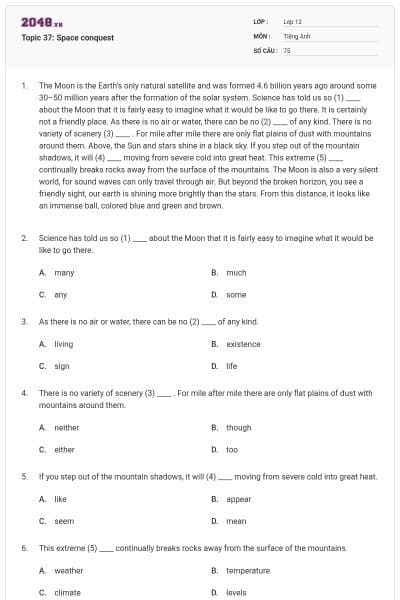
The Moon is the Earth’s only natural satellite and was formed 4.6 billion years ago around some 30–50 million years after the formation of the solar system. Science has told us so (1) ____ about the Moon that it is fairly easy to imagine what it would be like to go there. It is certainly not a friendly place. As there is no air or water, there can be no (2) ____ of any kind. There is no variety of scenery (3) ____ . For mile after mile there are only flat plains of dust with mountains around them. Above, the Sun and stars shine in a black sky. If you step out of the mountain shadows, it will (4) ____ moving from severe cold into great heat. This extreme (5) ____ continually breaks rocks away from the surface of the mountains. The Moon is also a very silent world, for sound waves can only travel through air. But beyond the broken horizon, you see a friendly sight, our earth is shining more brightly than the stars. From this distance, it looks like an immense ball, colored blue and green and brown.
many
much
any
some
Mặt Trăng là vệ tinh tự nhiên duy nhất của Trái Đất và được hình thành cách đây 4,6 tỷ năm khoảng 30 - 50 triệu năm sau khi hệ mặt trời hình thành. Khoa học đã nói với chúng ta rất nhiều về Mặt Trăng đến mức khá dễ để tưởng tượng nó sẽ như thế nào khi đến đó. Đó chắc chắn không phải là một nơi thân thiện. Vì không có không khí hay nước, không thể có bất kỳ sự sống nào. Không có sự đa dạng của phong cảnh. Hằng dặm kéo dài cũng chỉ có đồng bằng bụi với những ngọn núi xung quanh chúng. Ở trên cao, Mặt Trời và các ngôi sao tỏa sáng trên bầu trời đen. Nếu bạn bước ra khỏi bóng râm của núi, điều đó có nghĩa là bạn chuyển từ cái lạnh khắc nghiệt sang sức nóng mãnh liệt. Nhiệt độ cực đoan này liên tục phá vỡ các tảng đá khỏi bề mặt của các ngọn núi. Mặt Trăng cũng là một thế giới rất im lặng, vì sóng âm chỉ có thể truyền qua không khí. Nhưng ở phía ngoài đường chân trời, bạn có thể nhìn thấy một cảnh tượng hết sức thân thiện, trái đất của chúng ta đang tỏa sáng rực rỡ hơn những vì sao khác. Từ khoảng cách này, nó trông giống như một quả bóng lớn tạo thành bởi 3 màu là xanh lam, xanh lá cây và màu nâu.
Đáp án B
Kiến thức về lượng từ
Much + N(uncountable): nhiều
Many + N(countable): nhiều
Any + N(unc, c): dùng trong câu phủ định và nghi vấn (cái gì đó) và dùng trong câu khẳng định (bất cứ cái gì)
Some + N(unc, c): dùng trong câu khẳng định (một vài) và trong câu nghi vấn (mời, xin phép)
Tạm dịch: “Science has told us so ____ about the Moon that it is fairly easy to imagine what it would be like to go there.”
Khoa học đã nói với chúng tôi rất nhiều về Mặt Trăng đến nỗi mà dễ tưởng tượng rằng nó sẽ thế nào khi đến đó.)
living
existence
sign
life
Đáp án D
Kiến thức về từ vựng
A. living /ˈlɪvɪŋ/ (adj): sinh hoạt, cách sinh nhai
B. existence /ɪɡˈzɪstəns/ (n): sự sống sót
C. sign /saɪn/ (n): dấu hiệu
D. life /laɪf/ (n): sự sống
Sau no + N nên ta loại A, căn cứ vào nghĩa ta chọn D
Tạm dịch: “As there is no air or water, there can be no _____ of any kind.”
(Vì ở đây không có không khí hay nước nên có thể không có sự sống của bất kì loại nào)
neither
though
either
too
Đáp án C
Kiến thức về liên từ
A. neither /ˈniːðər/: không có cả hai (dùng trong câu khẳng định)
B. though /ðoʊ/: mặc dù
C. either /ˈiːðər/: không có một trong hai (dùng trong câu phủ định)
D. too /tuː/: cũng vậy (dùng trong câu khẳng định)
Tạm dịch: “There is no variety of scenery ______.”
(Không có sự đa dạng nào trong phong cảnh nơi đây)
like
appear
seem
mean
Đáp án D
Kiến thức về từ vựng
A. like /laɪk/ (pre): giống
B. appear /əˈpɪr/ (v): xuất hiện, dường như
C. seem /siːm/ (linking v): cảm thấy
D. mean /miːn/ (v): có nghĩa là
Tạm dịch: “If you step out of the mountain shadows, it will _____ moving from severe cold into great heat.”
(Nếu bạn bước khỏi bóng núi, nó cũng có nghĩa là bạn di chuyển từ nơi vô cùng lạnh đến nơi rất nóng)
weather
temperature
climate
levels
Đáp án C
Kiến thức về từ vựng
A. weather /ˈweðər/ (n): thời tiết
B. temperature /ˈtemprətʃər/ (n) : nhiệt độ
C. climate /ˈklaɪmət/ (n): khí hậu
D. levels /ˈlevl/ (n): mức độ
Tạm dịch: “This extreme ______ continually breaks rocks away from the surface of the mountains.”
(Khí hậu cực đoan liên tục phá vỡ đá khỏi bề mặt núi)
An astronaut living in space begins a day in much the same way as he would on Earth. The astronaut is able to brush his teeth and use the toilet in space. It is, however, rather challenging as the water droplets will (1) _________ around. The astronaut will also have to make to do with sponge baths.
There is a special plan for the astronaut on (2) _______ a spaceship which includes beverages and food items. The astronaut is allowed to have a maximum of three main meals a day. The meal varies each day until the sixth day. On that day, the menu is (3) _______ and the astronaut eats the meals he had on the first day. The food that is brought on a shuttle mission can be dehydrated, in natural (4) _________ for fresh. Sometimes, they are kept in thermostabilized cans or sealed pouches. It takes only thirty minutes to cook a delicious meal for a (5) ____________ of up to seven people on a space mission. However, astronauts have to eat slowly and carefully or the food will float away.
dive
fall
float
fly
Một phi hành gia sống trong không gian bắt đầu một ngày theo cách tương tự như trên Trái Đất. Phi hành gia có thể đánh răng và sử dụng nhà vệ sinh trong không gian. Tuy nhiên, điều đó khá khó khăn vì những giọt nước sẽ nổi xung quanh. Các phi hành gia cũng sẽ phải tắm bằng miếng bọt biển.
Có một kế hoạch đặc biệt cho phi hành gia trên tàu vũ trụ bao gồm đồ uống và thực phẩm. Phi hành gia được phép có tối đa ba bữa ăn chính mỗi ngày. Các bữa ăn đa dạng mỗi ngày cho đến ngày thứ sáu. Vào ngày hôm đó, thực đơn được lặp đi lặp lại và phi hành gia ăn những bữa ăn anh ta có trong ngày đầu tiên. Thực phẩm được mang theo trong một nhiệm vụ tàu con thoi có thể được loại bỏ nước, ở dạng tự nhiên cho tươi. Đôi khi, chúng được giữ trong các hộp ổn định nhiệt hoặc túi kín. Chỉ mất ba mươi phút để nấu một bữa ăn ngon cho một phi hành đoàn lên đến bảy người trong một nhiệm vụ không gian. Tuy nhiên, các phi hành gia phải ăn chậm và cẩn thận nếu không thức ăn sẽ trôi đi.
Đáp án C
Kiến thức về cụm động từ
A. dive through: lặn qua
B. fall through: không thành công, thất bại
C. float through: di chuyển chậm, nhẹ nhàng
D. fly through: bay qua
Giải thích: The astronaut is able to brush his teeth and use the toilet in space. It is, however, rather challenging as the water droplets will float through around.
(Phi hành gia có thể đánh răng và sử dụng nhà vệ sinh trong không gian. Tuy nhiên, điều đó khá khó khăn vì những giọt nước sẽ nhè nhẹ trôi qua xung quanh.)
board
work
stay
business
Đáp án A
Kiến thức về cụm từ
A. board /bɔ:d/ (n/v): bảng/lên tàu, đáp tàu
B. work /wɜ:k/ (n/v): công việc/ làm việc
C. stay /stei/ (v): ở lại, ở
D. business /’biznis/ (n): nhiệm vụ; công việc
Giải thích: cụm từ on board: trên tàu, trên máy bay
There is a special plan for the astronaut on board a spaceship which includes beverages and food items. (Có một kế hoạch đặc biệt cho phi hành gia trên tàu vũ trụ bao gồm đồ uống và thực phẩm.)
renewed
transformed
exchanged
repeated
Đáp án D
Kiến thức về từ vựng
A. renewed: làm mới
B. transformed: biến đổi
C. exchanged: trao đổi
D. repeated: lặp lại
Giải thích: The meal varies each day until the sixth day. On that day, the menu is repeated and the astronaut eats the meals he had on the first day.
(Các bữa ăn thay đổi mỗi ngày cho đến ngày thứ sáu. Vào ngày hôm đó (tức sau ngày thứ 6), thực đơn được lặp lại và phi hành gia ăn những bữa ăn anh ta có trong ngày đầu tiên.)
mode
form
appearance
shape
Đáp án B
Kiến thức về từ vựng
A. mode /məʊd/ (n): phương thức, lối
B. form /fɔ:m/ (n): dạng; hình thức
C. appearance /ə’piərəns/ (n): vẻ ngoai
D. shape /∫eip/ (n): hình dạng, khuôn
Giải thích: form là dạng, bản chất bên trong của sự vật, hiện tượng nào đó, thực phẩm tươi => dùng form
The food that is brought on a shuttle mission can be dehydrated, in natural form for fresh.
(Thức ăn được mang theo đi trên tàu sứ mệnh có thể bị mất nước, ở dạng tự nhiên cho tươi.)
crew
flock
troop
band
Đáp án A
Kiến thức về lượng từ:
A. crew /kru:/ (n): phi đội; đoàn, đội, nhóm
B. flock /flɒk/ (n): đàn (chim, cừu…)
C. troop /tru:p/ (n): đoàn quân, tiểu đội
D. band /bænd/ (n): băng (đảng), nhóm (nhạc)
Giải thích: It takes only thirty minutes to cook a delicious meal for a crew of up to seven people on a space mission.
(Chỉ mất ba mươi phút để nấu một bữa ăn ngon cho một phi hành đoàn lên đến bảy người trên một sứ mệnh không gian.)
The idea of life in (1) ____________ space has been talked about for a long time. Some scientists say that life development on Earth was far too unlikely for it to have happened anywhere else. Things had to be perfect for us to make it on this planet. Other scientists say that space is too big. Stars and other planets are far too numerous for there to be no other life in the universe.
For many years, there have been reports of visitors from other planets. People all around the world have claimed to see alien spaceships or even aliens themselves. There have been (2)________of these so-called UFOs (unidentified flying objects) flying through the air and they have even been captured on video. Some Americans believe that the U.S. Army found an alien spaceship crashed in the desert and then lied to the press about it. (3)________these sightings may be true, scientists have not found significant evidence that aliens exist.
If you go out into the countryside on a clear night and look up, you can see thousands of stars. Those stars (4)_____a tiny part of our unniverse. There are more stars, planets, and galaxies than we can count. Even the smartest scientists can’t even come close to defining how big space is. The number of possible stars and planets out there is bigger than our ability to count. If we are really on the only planet that can (5)_________life, then we are very special in a universe full of amazing things.
(Source: https://www.nationalgeographic.com)
inter
outer
outside
inside
Ý tưởng về cuộc sống ngoài vũ trụ đã được nói đến từ lâu. Một số nhà khoa học nói rằng sự phát triển sự sống trên Trái Đất quá khó cho nó để có thể xảy ra ở bất kỳ nơi nào khác. Mọi thứ phải hoàn hảo đối với chúng ta để có thể làm điều đó trên hành tinh này. Các nhà khoa học khác nói rằng vũ trụ quá lớn. Các ngôi sao và các hành tinh khác là quá nhiều đến nỗi mà không có sự sống nào khác trong vũ trụ.
Trong nhiều năm, đã có báo cáo của khách từ các hành tinh khác. Mọi người trên khắp thế giới đã tuyên bố nhìn thấy tàu vũ trụ của người ngoài hành tinh hoặc thậm chí chính người ngoài hành tinh. Đã có những cái nhìn thoáng qua về những cái người ta gọi là UFO (vật thể bay không xác định) bay trong không trung và chúng thậm chí đã được thu lại trên video. Một số người Mỹ tin rằng Quân đội Hoa Kỳ đã tìm thấy một tàu vũ trụ của người ngoài hành tinh bị đâm sầm xuống sa mạc và sau đó nói dối với báo chí về nó. Mặc dù những cảnh tượng này có thể là sự thật, nhưng các nhà khoa học vẫn chưa tìm thấy bằng chứng quan trọng cho thấy người ngoài hành tinh tồn tại.
Nếu bạn đi tới vùng nông thôn vào một đêm trời trong và nhìn lên, bạn có thể thấy hàng ngàn ngôi sao. Những ngôi sao đó tạo nên một phần nhỏ bé của vũ trụ chúng ta. Có nhiều ngôi sao, hành tinh và thiên hà hơn những gì chúng ta có thể đếm được. Ngay cả những nhà khoa học thông minh nhất cũng gần như không thể xác định được vũ trụ rộng lớn như thế nào. Số lượng sao và hành tinh có thể ngoài đó lớn hơn khả năng đếm của chúng ta. Nếu chúng ta thực sự ở trên hành tinh duy nhất có thể duy trì sự sống, thì chúng ta rất đặc biệt trong một vũ trụ đầy những điều đáng kinh ngạc.
Đáp án B
A. inter /ɪnˈtɜːr/ (v): chôn
B. outer /ˈaʊtər/ (a): ở phía ngoài
C. outside /aʊtˈsaɪd/ (pre): ở ngoài
D. inside /ɪnˈsaɪd/ (pre): ở trong
Ta có sau giới từ “in” và trước danh từ “space” ta cần một tính từ.
The idea of life in (1) __________ space has been talked about for a long time.
(Ý tưởng về cuộc sống ngoài vũ trụ đã được nói đến từ rất lâu.)
glimpses
glance
binocular
stare
Đáp án A
A. glimpse /ɡlɪmps/ (v): lướt nhìn, nhìn thoáng qua
B. glance /ɡlɑːns/ (v): liếc nhìn
C. binocular /bɪˈnɒkjʊlə/ (v): nhìn bằng cả 2 mắt
D. stare /steər/ (v): nhìm chằm chằm
Căn cứ vào nghĩa của câu:
There have been (2) __________ of these so-called UFOs (unidentified flying objects) flying through the air and they have even been captured on video.
Đã có nhiều người thoáng thấy những cái được gọi là UFO (vật thể bay không xác định) bay trong không khí và chúng thậm chí đã được quay lại bằng video.
(3)________these sightings may be true, scientists have not found significant evidence that aliens exist.
Because
Therefore
However
Although
Đáp án D
A. Because /bɪˈkəz/: bởi vì
B. Therefore /ˈðeəfɔːr/: do đó
C. However /haʊˈevər/: tuy nhiên
D. Although /ɔːlˈðəʊ/: mặc dù
Ta thấy vế trước và vế sau có ý trái ngược nghĩa nhau:
Some Americans believe that the U.S. Army found an alien spaceship crashed in the desert and then lied to the press about it. (3) __________ these sightings may be true, scientists have not found significant evidence that aliens exist.
(Một số người Mỹ tin rằng Quân đội Hoa Kỳ đã tìm thấy tàu vũ trụ của một người ngoài hành tinh bị rơi trong sa mạc và sau đó nói dối với báo chí về nó. Mặc dù những cảnh tượng này có thể là thật, nhưng các nhà khoa học vẫn không tìm thấy bằng chứng quan trọng cho thấy người ngoài hành tinh tồn tại.)
take up
make up
catch up
go up
Đáp án B
A. take up: theo đuổi
B. make up: trang điểm, bịa đặt, làm hòa, tạo nên
C. catch up: bắt kịp
D. go up: tăng lên
Căn cứ vào nghĩa của câu:
Those stars (4) __________ a tiny part of our unniverse.
(Những ngôi sao đó tạo nên một phần nhỏ bé trong vũ trụ của chúng ta.)
If we are really on the only planet that can (5)_________life, then we are very special in a universe full of amazing things.
keep
maintain
sustain
preserve
Đáp án C
A. keep /kiːp/ (v): giữ
B. maintain /meɪnˈteɪn/ (v): duy trì
C. sustain /səˈsteɪn/ (v): tồn tại
D. preserve /prɪˈzɜːv/ (v): bảo tồn, giữ gìn
Căn cứ vào nghĩa của câu:
If we are really on the only planet that can (5) __________ life, then we are very special in a universe full of amazing things.
(Nếu chúng ta thực sự ở trên hành tinh duy nhất có thể tồn tại sự sống, thì chúng ta rất đặc biệt trong một vũ trụ đầy những điều đáng kinh ngạc.)
NASA continues to plan a flight to Mars. The technological challenge is immense, first of all, because it will be very difficult to carry tons of material for the construction of a habitat. This is why NASA is looking for alternative solutions, such as the possibility of growing structures out of fungi to become our future homes in the stars. The concept of these “houses” is based on three distinct layers. The first is made of ice. It must protect people from radiation, but also provide the resources necessary for the second layer. This is made of photosynthesizing microbes or cyanobacteria, which produce oxygen for astronauts and nutrients for the final layer of mycelia. That last layer of mycelia is what organically grows into a sturdy home, first activated to grow in a contained environment and then baked to kill the lifeforms.
Researchers have already experimented with creating objects using mycelia. A team from Stanford and Brown universities grew a stool as part of a myco-architecture project at NASA’s Ames research center in 2018. After two weeks of growth, the stool looked like something that would have been long forgotten in a refrigerator. It was then baked that leads to a clean and functional piece of furniture. From the point of view of space conquest, mushrooms could also be used to filter water for future explorers and extract minerals. Once these prototypes are designed for other worlds, we can bring them back to ours. Building this kind of housing could reduce the huge carbon footprint of the construction industry. This research project is still in its infancy, but it shows us how scientists are able to broaden horizons, and it’s exciting.
Which best serves as the title for the passage?
Habitats on Mars could be made from fungi.
Using Martian dirt to build houses on Mars.
Human must learn to live off the land.
Competition for Martian housing design.
Đáp án A
Tiêu đề hay nhất cho đoạn văn trên là?
Xét các đáp án:
A. Môi trường sống trên Sao Hỏa có thể được hình thành từ nấm
B. Sử dụng bụi trên Sao Hỏa để xây nhà trên Sao Hỏa
C. Loài người phải học cách sống nhờ đất
D. Sự cạnh tranh trong việc thiết kế nhà trên Sao Hỏa
Căn cứ vào thông tin trong bài:
- “NASA continues to plan a flight to Mars. The technological challenge is immense, first of all, because it will be very difficult to carry tons of material for the construction of a habitat. This is why NASA is looking for alternative solutions, such as the possibility of growing structures out of fungi to become our future homes in the stars.”
(NASA tiếp tục lên kế hoạch cho một chuyến bay đến Sao Hỏa. Thách thức về công nghệ là rất lớn, đầu tiên, bởi vì sẽ rất khó để mà mang theo cả tấn vật chất lên đấy cho việc xây dựng môi trường sống. Đó là lý do tại sao NASA đang tìm kiếm các phương pháp thay thế, như là khả năng lớn lên của các cấu trúc từ nấm để trở thành ngôi nhà tương lai của chúng ta tại ngôi sao này.)
The word “sturdy” in paragraph 1 is closest in meaning to ______.
stalwart
resilient
robust
stable
Đáp án D
Từ “sturdy” trong đoạn 1 gần nghĩa với ________ .
Xét các đáp án:
A. Khỏe mạnh
B. Kiên cường
C. Tráng kiện
D. Bền vững
Từ đồng nghĩa: Sturdy (cứng cáp, bền vững) = Stable
According to paragraph 1, what is the discussed objective for NASA’s space research?
Collecting the information regarding the habitable conditions on Mars.
Making the most of every trip to space to minimise the cost of operation.
Figuring out where the astronauts will live when they arrive at their destination.
Designing houses and buildings for future’s mass migration to space of the human.
Đáp án C
Theo như đoạn 1, điều nào sau đây là vật cản được thảo luận trong nghiên cứu của NASA?
Xét các đáp án:
A. Thu thập thông tin xem xét tới các điều kiện về môi trường sống trên SAo Hỏa
B. Khiến cho tất cả các chuyến đi lên không gian giảm tối đa chi phí vận hành
C. Tìm ra nơi nào mà các phi hành gia sẽ sống khi mà họ đến nơi
D. Thiết kế các ngôi nhà và tòa nhà cho cuộc di cư lớn trong tương lai của con người lên không gian
Căn cứ vào thông tin trong đoạn 1:
- “NASA continues to plan a flight to Mars. The technological challenge is immense, first of all, because it will be very difficult to carry tons of material for the construction of a habitat. This is why NASA is looking for alternative solutions, such as the possibility of growing structures out of fungi to become our future homes in the stars.”
The word “It” in paragraph 2 refers to _______.
Project
Stool
Refrigerator
Furniture
Đáp án B
Từ “It” trong đoạn thứ 2 đề cập tới _______ .
Xét các đáp án:
A. Dự án
B. Ghế đệm
C. Tủ lạnh
D. Đồ nội thất
Căn cứ vào thông tin trong đoạn 2:
- “Researchers have already experimented with creating objects using mycelia. A team from Stanford and Brown universities grew a stool as part of a myco-architecture project at NASA’s Ames research center in 2018. After two weeks of growth, the stool looked like something that would have been long forgotten in a refrigerator. It was then baked that leads to a clean and functional piece of furniture.”
(Các nghiên cứu sinh mới đây đã thí nghiệm cùng với việc tạo ra các vật thể bằng việc sử dụng thể sợi. Một nhóm từ trường đại học Stanford và Brown đã phát triển một cái ghế đệm như là một phần của các dự án Myco-architecture tại trung tâm nghiên cứu Ames của NASA. Sau hai tuần phát triển, cái ghế đẩu trông giống như những thứ mà bị bỏ quên trong tủ lạnh vậy. Nó sau đó được nung lên và kết quả là một mảnh nội thất sạch sẽ và có đủ chức năng.)
According to paragraph 2, what is correct about the developing materials project?
The experiment currently only succeed in forming some small furniture.
The idea could also potentially be applied to building needs on the Earth.
The programme has been developed to its final stage with serviceable products.
The operation is a secret due to its controversial nature and potential usages.
Đáp án B
Theo như đoạn 2, điều nào sau đây là đúng về sự phát triển của các dự án phát triển vật chất?
Xét các đáp án:
A. Thí nghiệm hiện nay chỉ thành công trong việc định hình một vài đồ nội thất nhỏ
B. Ý tưởng có khả năng được ứng dụng để xây dựng các vật dụng cần thiết trên Trái Đất
C. Chương trình được phát triển cho đến giai đoạn cuối cùng để cho ra các sản phẩm có ích
D. Việc vận hành còn là một bí mật bởi vì sự sử dụng tiềm năng và thiên nhiên gây tranh cãi của chúng
Căn cứ vào thông tin trong đoạn 2:
- “Once these prototypes are designed for other worlds, we can bring them back to ours. Building this kind of housing could reduce the huge carbon footprint of the construction industry.”
(Một khi Prototypes được thiết kế cho những thế giới khác, chúng ta có thể mang chúng quay về hành tinh của chúng ta. Xây dựng loại nhà như vậy có thể làm giảm một lượng lớn số khí cacbon mà chúng ta thải ra trong ngành công nghiệp xây dựng.)
After World War II drew to a close in the mid-20th century, a new conflict began. Known as the Cold War, this battle pitted the world’s two great powers–the democratic, capitalist United States and the communist Soviet Union–against each other. By the mid-1950s, the U.S.-Soviet Cold War had worked its way into the fabric of everyday life in both countries, fueled by the arms race and the growing threat of nuclear weapons, wide-ranging espionage and counter-espionage between the two countries, war in Korea and a clash of words and ideas carried out in the media. These tensions would continue throughout the space race, exacerbated by such events as the construction of the Berlin Wall in 1961, the Cuban missile crisis of 1962 and the outbreak of war in Southeast Asia.
Space exploration served as another dramatic arena for Cold War competition. On October 4, 1957, a Soviet R-7 intercontinental ballistic missile launched Sputnik (Russian for “traveler”), the world’s first artificial satellite and the first man-made object to be placed into the Earth’s orbit. Sputnik’s launch came as a surprise, and not a pleasant one, to most Americans. In the United States, space was seen as the next frontier, a logical extension of the grand American tradition of exploration, and it was crucial not to lose too much ground to the Soviets. In addition, this demonstration of the overwhelming power of the R-7 missile–seemingly capable of delivering a nuclear warhead into U.S. air space–made gathering intelligence about Soviet military activities particularly urgent.
Beginning in the late 1950s, space would become another platform for the competition, as each side sought to prove the superiority of its technology, its military firepower and–by extension–its political-economic system.
(Source: https://www.history.com/)
Which best serves as the title for the passage?
Sputnik in context.
Space race heats up.
Conclusion of the space race.
A new urgency.
Đáp án A
Đâu là tiêu đề thích hợp nhất cho bài văn?
A. Sputnik trong bối cảnh lịch sử của nó.
B. Cuộc đua vào không gian trở nên mãnh liệt hơn.
C. Kết thúc cho cuộc đua vào vũ trụ.
D. Một tình huống cấp bách mới.
Căn cứ thông tin đoạn 1:
After World War II drew to a close in the mid-20th century, a new conflict began. Known as the Cold War, this battle pitted the world’s two great powers – the democratic, capitalist United States and the communist Soviet Union – against each other. By the mid-1950s, the U.S.-Soviet Cold War had worked its way into the fabric of everyday life in both countries, fueled by the arms race and the growing threat of nuclear weapons, wide-ranging espionage and counter-espionage between the two countries, war in Korea and a clash of words and ideas carried out in the media. These tensions would continue throughout the space race, exacerbated by such events as the construction of the Berlin Wall in 1961, the Cuban missile crisis of 1962 and the outbreak of war in Southeast Asia.
(Sau khi thế chiến thứ II kết thúc vào giữa thế kỷ 29, một mâu thuẫn mới lại bắt đầu. Đó là chiến tranh lạnh, nổ ra giữa hai cường quốc – phe dân tư bản là Mỹ và phe cộng sản là Liên Bang Soviet. Đến khoảng giữa những năm 50 của thế kỉ 20, cuộc chiến tranh lạnh đã thâm nhập vào từng mảng của cuộc sống trong nhân dân hai nước, được kích động bằng chạy đua vũ trang và nỗi đe doạ từ vũ khí hạt nhân, công tác gián điệp và phản gián trên mọi mặt gữa hai nữa, cuộc chiến ở Hàn và mâu thuẫn về tư tưởng nổ ra trên khắp các phương tiện thông tin đại chúng. Những tranh chấp này tiếp tục ngay cả khi khi cuộc chạy đua không gian xuất hiện, bị làm trở nên tồi tệ hơn bằng các sự kiện như Bức tường Berlin 1961, Khủng hoảng tên lửa Cuba 1962, và cuộc chiến tranh nổ ra ở Đông Nam Á.)
Giải thích:
Đáp án B sai vì đây là phần mở đầu của cuộc chiến công nghệ vũ trụ, chưa đến lúc đối chọi gay gắt.
Đáp án C sai vì là nội dung là lúc bắt đầu chứ không phải kết thúc.
Đáp án D sai vì không rõ ràng “cấp bách” ở đây chỉ cái gì, thiếu thông tin so với đáp án A
According to paragraph 1, what is NOT one of the manifestations of the Cold War between the two systems?
Cuban Missile Crisis which almost resulted in a nuclear war between the two superpowers.
The 1958 political and religious crisis of Lebanon requiring U.S. military intervention.
The Berlin Wall as a symbol of the world’s separation into two distinct ideological blocs.
Korean War which is documented as the first proxy war of the U.S.-Soviet Cold War.
Đáp án B
Theo đoạn 1, điều nào không phải là một trong những biểu hiện của Chiến tranh Lạnh giữa hai hệ thống?
A. Khủng hoảng tên lửa Cuba gần như dẫn đến một cuộc chiến tranh hạt nhân giữa hai siêu cường
B. Cuộc khủng hoảng chính trị và tôn giáo năm 1958 ở Lebanon đòi hỏi sự can thiệp của quân đội Hoa Kỳ
C. Bức tường Berlin như một biểu tượng của sự tách biệt thế giới thành hai khối ý thức hệ riêng biệt
D. Chiến tranh Triều Tiên được ghi nhận là cuộc chiến ủy nhiệm đầu tiên của Chiến tranh Lạnh Liên Xô -Hoa Kỳ
Căn cứ vào thông tin đoạn đầu:
By the mid-1950s, the U.S. - Soviet Cold War had worked its way into the fabric of everyday life in both countries, fueled by the arms race and the growing threat of nuclear weapons, wide-ranging espionage and counter-espionage between the two countries, war in Korea and a clash of words and ideas carried out in the media. These tensions would continue throughout the space race, exacerbated by such events as the construction of the Berlin Wall in 1961, the Cuban missile crisis of 1962 and the outbreak of war in Southeast Asia.
(Vào giữa những năm 1950, Chiến tranh lạnh giữa Liên Xô - Hoa Kỳ đã phát huy tác dụng của nó đi vào kết cấu của cuộc sống hàng ngày ở cả hai quốc gia, được thúc đẩy bởi cuộc chạy đua vũ trang và mối đe dọa ngày càng tăng của vũ khí hạt nhân, gián điệp trên diện rộng và hoạt động gián điệp giữa hai nước, chiến tranh ở Hàn Quốc và một loạt các phát biểu và ý tưởng được tiến hành trên các phương tiện truyền thông. Những căng thẳng sẽ tiếp tục trong suốt cuộc đua không gian, trở nên trầm trọng hơn bởi những sự kiện như việc xây dựng Bức tường Berlin năm 1961, cuộc khủng hoảng tên lửa Cuba năm 1962 và chiến tranh bùng nổ ở Đông Nam Á.)
The word “its” in paragraph 1 refers to _______.
Berlin Wall’s
World War’s
Cold War’s
Space exploration’s
Đáp án C
Từ “its” trong đoạn 1 đề cập đến ____.
A. Bức tường Berlin
B. Chiến tranh thế giới
C. Chiến tranh lạnh
D. Khám phá vũ trụ
Từ “its” trong đoạn văn dùng để thay thế cho sở hữu của danh từ chiến tranh lạnh được nhắc tới trước đó.
By the mid-1950s, the U.S. - Soviet Cold War had worked its way into the fabric of everyday life in both countries, fueled by the arms race and the growing threat of nuclear weapons, wide-ranging espionage and counter - espionage between the two countries, war in Korea and a clash of words and ideas carried out in the media.
(Vào giữa những năm 1950, Chiến tranh lạnh giữa Liên Xô - Hoa Kỳ đã phát huy tác dụng của nó đi vào kết cấu của cuộc sống hàng ngày ở cả hai quốc gia, được thúc đẩy bởi cuộc chạy đua vũ trang và mối đe dọa ngày càng tăng của vũ khí hạt nhân, hoạt động gián điệp trên diện rộng và hoạt động gián điệp giữa hai nước, chiến tranh ở Hàn Quốc và một loạt các phát biểu và ý tưởng được tiến hành trên các phương tiện truyền thông.)
According to paragraph 2, why did most Americans harbour an unanimous displease toward Soviet’s achievement?
The global technopolitics of space exploration at that time only revolved around collaboration.
It was a matter of national pride that compelled the Americans to follow suit and triumph.
Soviet’s ability to collaborate on and disseminate scientific advances was envied by America scientists.
The first moon landing meant a massive propaganda feat for the achieving nation.
Đáp án B
Theo đoạn 2, tại sao hầu hết người Mỹ lại đồng lòng có một sự bất mãn với những thành tựu của Liên Xô?
A. Công nghệ toàn cầu về thám hiểm không gian tại thời điểm đó chỉ xoay quanh sự hợp tác
B. Đó là một vấn đề của niềm tự hào dân tộc đã buộc người Mỹ phải làm theo và giành chiến thắng
C. Khả năng của Xô Viết để hợp tác và phổ biến những tiến bộ khoa học được các nhà khoa học Mỹ ghen tị
D. Cuộc đổ bộ lên mặt trăng đầu tiên có nghĩa là một kỳ tích tuyên truyền lớn cho quốc gia thành công
Căn cứ vào thông tin đoạn hai:
Sputnik’s launch came as a surprise, and not a pleasant one, to most Americans. In the United States, space was seen as the next frontier, a logical extension of the grand American tradition of exploration, and it was crucial not to lose too much ground to the Soviets.
(Sự kiện ra mắt Sputnik như một điều bất ngờ, và không phải là một điều dễ chịu, đối với hầu hết người Mỹ. Ở Hoa Kỳ, không gian vũ trụ được xem là biên giới tiếp theo, một phần mở rộng hợp lý của truyền thống khám phá lớn của Mỹ, và điều quan trọng là không để mất quá nhiều đất cho Liên Xô.)
The word “superiority” in paragraph 3 is closest in meaning to ______.
influence
dictatorship
guidance
supremacy
Đáp án D
Từ “superiority” trong đoạn 3 có nghĩa gần nhất với____.
A. ảnh hưởng
B. chế độ độc tài
C. hướng dẫn
D. sự mạnh hơn
Từ đồng nghĩa superiority (sự mạnh hơn) = supremacy
Beginning in the late 1950s, space would become another platform for the competition, as each side sought to prove the superiority of its technology, its military firepower and-by extension-its political- economic system.
(Bắt đầu từ những năm cuối thập niên 50, không gian sẽ trở thành một nền tảng khác cho cuộc cạnh tranh, vì mỗi bên tìm cách chứng minh sự mạnh hơn về công nghệ của nó, hỏa lực quân sự và - bằng cách mở rộng - chính trị của nó - hệ thống kinh tế.)
NASA is developing the capabilities needed to send humans to an asteroid by 2025 and Mars in the 2030s – goals outlined in the bipartisan NASA Authorization Act of 2010 and in the U.S. National Space Policy, also issued in 2010.
Mars is a rich destination for scientific discovery and robotic and human exploration as we expand our presence into the solar system. Its formation and evolution are comparable to Earth, helping us learn more about our own planet’s history and future. Mars had conditions suitable for life in its past. Future exploration could uncover evidence of life, answering one of the fundamental mysteries of the cosmos: Does life exist beyond Earth?
While robotic explorers have studied Mars for more than 40 years, NASA’s path for the human exploration of Mars begins in low-Earth orbit aboard the International Space Station. Astronauts on the orbiting laboratory are helping us prove many of the technologies and communications systems needed for human missions to deep space, including Mars. The space station also advances our understanding of how the body changes in space and how to protect astronaut health.
Our next step is deep space, where NASA will send a robotic mission to capture and redirect an asteroid to orbit the moon. Astronauts aboard the Orion spacecraft will explore the asteroid in the 2020s, returning to Earth with samples. This experience in human spaceflight beyond low-Earth orbit will help NASA test new systems and capabilities, such as Solar Electric Propulsion, which we’ll need to send cargo as part of human missions to Mars. Beginning in FY 2018, NASA’s powerful Space Launch System rocket will enable these “proving ground” missions to test new capabilities. Human missions to Mars will rely on Orion and an evolved version of SLS that will be the most powerful launch vehicle ever flown.
A fleet of robotic spacecraft and rovers already are on and around Mars, dramatically increasing our knowledge about the Red Planet and paving the way for future human explorers. The Mars Science Laboratory Curiosity Rover measured radiation on the way to Mars and is sending back radiation data from the surface. This data will help us plan how to protect the astronauts who will explore Mars. Future missions like the Mars 2020 rover, seeking signs of past life, also will demonstrate new technologies that could help astronauts survive on Mars.
Engineers and scientists around the U.S. are working hard to develop the technologies astronauts will use to one day live and work on Mars, and safely return home from the next giant leap for humanity. NASA also is a leader in a Global Exploration Roadmap, working with international partners and the U.S. commercial space industry on a coordinated expansion of human presence into the solar system, with human missions to the surface of Mars as the driving goal.
(Source: https://www.nasa.gov/content/nasas-journey-to-mars)
What is the passage mainly about?
Conditions suitable for life on Mars
NASA’s Journey to Mars
Human exploration of Mars
Astronauts aboard the Orion spacecraft
Đáp án B
Đoạn văn chủ yếu nói về vấn đề gì?
A. Điều kiện thích hợp cho sự sống trên Sao Hỏa
B. Chuyến đi của NASA đến Sao Hỏa
C. Cuộc thám hiểm của con người đến Sao Hỏa
D. Các nhà du hành trên khoang tàu vũ trụ Orion
Căn cứ thông tin toàn bài, đặc biệt là đoạn đầu và đoạn cuối:
NASA is developing the capabilities needed to send humans to an asteroid by 2025 and Mars in the 2030s – goals outlined in the bipartisan NASA Authorization Act of 2010 and in the U.S. National Space Policy, also issued in 2010.
(NASA đang phát triển các khả năng cần thiết để đưa con người đến một tiểu hành tinh vào năm 2025 và Sao Hỏa vào những năm 2030 - các mục tiêu được nêu trong Đạo luật ủy quyền của NASA năm 2010 và Chính sách không gian quốc gia của Hoa Kỳ, cũng được ban hành vào năm 2010.)
Engineers and scientists around the U.S. are working hard to develop the technologies astronauts will use to one day live and work on Mars, and safely return home from the next giant leap for humanity. NASA also is a leader in a Global Exploration Roadmap, working with international partners and the U.S. commercial space industry on a coordinated expansion of human presence into the solar system, with human missions to the surface of Mars as the driving goal.
(Các kỹ sư và nhà khoa học trên khắp nước Mỹ đang làm việc tích cực để phát triển công nghệ mà các phi hành gia sẽ sử dụng cho một ngày sống và làm việc trên Sao Hỏa, và trở về nhà một cách an toàn từ bước nhảy khổng lồ tiếp theo của nhân loại. NASA cũng là một đơn vị đi đầu trong Lộ trình Thăm dò Toàn cầu, làm việc với các đối tác quốc tế và ngành công nghiệp vũ trụ Mỹ về việc mở rộng sự hiện diện của con người vào hệ Mặt Trời, với nhiệm vụ của con người trên bề mặt Sao Hỏa như một mục tiêu có tính định hướng.)
The word "comparable" in paragraph 2 mostly means ______.
important
confidential
different
similar
Đáp án D
Từ “comparable” trong đoạn 2 gần nghĩa nhất với từ _______.
A. quan trọng
B. bí mật
C. khác
D. tương tự
Từ đồng nghĩa: comparable (có thể so sánh với) = similar
Mars is a rich destination for scientific discovery and robotic and human exploration as we expand our presence into the solar system. Its formation and evolution are comparable to Earth, helping us learn more about our own planet’s history and future.
(Sao Hỏa là một điểm đến hứa hẹn cho khám phá khoa học và khám phá robot và con người khi chúng ta mở rộng sự hiện diện của chúng ta vào hệ Mặt Trời. Sự hình thành và tiến hóa của nó có thể so sánh với Trái Đất, giúp chúng ta tìm hiểu thêm về lịch sử và tương lai của hành tinh chúng ta.)
According to paragraph 2, what is one of the fundamental mysteries of the cosmos?
Does life exist beyond Earth?
Can we expand our presence into the solar system?
Did Mars have conditions suitable for life in its past?
How can we learn more about our own planet’s history and future?
Đáp án A
Theo thông tin trong đoạn 2, điều gì là một trong những bí ẩn cơ bản của vũ trụ?
A. Cuộc sống có tồn tại ngoài Trái Đất không?
B. Chúng ta có thể mở rộng sự hiện diện trong hệ Mặt Trời không?
C. Sao Hỏa có điều kiện thích hợp cho sự sống trong quá khứ không?
D. Chúng ta có thể biết thêm về quá khứ và tương lai của hành tinh của chúng ta bằng cách nào?
Căn cứ thông tin cuối đoạn 2:
Future exploration could uncover evidence of life, answering one of the fundamental mysteries of the cosmos: Does life exist beyond Earth?
(Những khám phá trong tương lai có thể mở ra bằng chứng về sự sống, trả lời một trong những bí ẩn cơ bản của vũ trụ: Liệu cuộc sống có tồn tại bên ngoài Trái Đất?)
The word "advances" in paragraph 3 is closest in meaning to ______.
lengthens
proves
increases
confirms
Đáp án C
Từ “advances” trong đoạn 3 gần nghĩa nhất với từ ______.
A. kéo dài
B. chứng minh
C. tăng thêm
D. xác nhận
Từ đồng nghĩa: to advance (nâng cao) = to increase
The space station also advances our understanding of how the body changes in space and how to protect astronaut health.
(Trạm không gian cũng nâng cao hiểu biết của chúng ta về cách cơ thể thay đổi trong không gian và cách bảo vệ sức khỏe phi hành gia.)
The word “capture” in the paragraph 4 could be best replaced by __________.
catch
chase
move
lift
Từ “capture” trong đoạn 4 có thể được thay thế bằng từ __________ .
A. bắt kịp
B. đuổi theo
C. chuyển động
D. nhấc lên
Từ đồng nghĩa: to capture (bắt kịp) = to catch
Our next step is deep space, where NASA will send a robotic mission to capture and redirect an asteroid to orbit the moon. Astronauts aboard the Orion spacecraft will explore the asteroid in the 2020s, returning to Earth with samples.
(Bước tiếp theo của chúng tôi là không gian sâu, nơi NASA sẽ gửi một nhiệm vụ dành cho robot nhằm bắt kịp và chuyển hướng một tiểu hành tinh để nó quay quanh Mặt Trăng. Các phi hành gia trên tàu vũ trụ Orion sẽ khám phá tiểu hành tinh vào những năm 2020, trở về Trái Đất với các mẫu vật.)
According to paragraph 4, which of the following statements is INCORRECT?
NASA will send a robotic mission to capture and redirect an asteroid to orbit the Moon.
Astronauts aboard the Orion spacecraft will explore the asteroid in the 2020s, returning to Earth with samples.
We’ll need new systems and capabilities such as Solar Electric Propulsion to send man as part of human missions to Mars.
Human missions to Mars will rely on Orion and an evolved version of SLS.
Đáp án C
Theo thông tin trong đoạn 4, thông tin nào sau đây KHÔNG ĐÚNG?
A. NASA sẽ gửi đi nhiệm vụ cho robot để bắt kịp và điều hướng một tiểu hành tinh sao cho nó quay quanh Mặt Trăng.
B. Các nhà du hành trên khoang tàu vũ trụ Orion sẽ khám phá tiểu hành tinh vào những năm 2020 và trở về với các mẫu vật
C. Chúng ta sẽ cần những hệ thống và năng lực mới như Hệ thống đẩy dùng điện mặt trời để gửi con người lên Sao Hỏa.
D. Nhiệm vụ của con người tới Sao Hỏa phụ thuộc vào con tàu Orion và phiên bản của SLS tham gia vào nhiệm vụ này.
Căn cứ thông tin đoạn 4:
Our next step is deep space, where NASA will send a robotic mission to capture and redirect an asteroid to orbit the moon. Astronauts aboard the Orion spacecraft will explore the asteroid in the 2020s, returning to Earth with samples. This experience in human spaceflight beyond low-Earth orbit will help NASA test new systems and capabilities, such as Solar Electric Propulsion, which we’ll need to send cargo as part of human missions to Mars. Beginning in FY 2018, NASA’s powerful Space Launch System rocket will enable these “proving ground” missions to test new capabilities. Human missions to Mars will rely on Orion and an evolved version of SLS that will be the most powerful launch vehicle ever flown.
(Bước tiếp theo của chúng tôi là không gian sâu, nơi NASA sẽ gửi một nhiệm vụ dành cho robot nhằm bắt kịp và chuyển hướng một tiểu hành tinh để nó quay quanh mặt trăng. Các phi hành gia trên tàu vũ trụ Orion sẽ khám phá tiểu hành tinh vào những năm 2020, trở về Trái đất với các mẫu vật. Kinh nghiệm này trong không gian vũ trụ của con người ngoài quỹ đạo thấp sẽ giúp NASA kiểm tra các hệ thống và khả năng mới, như Solar Electric Propulsion, mà chúng ta cần gửi hàng hóa như một phần của nhiệm vụ của con người tới sao Hỏa. Bắt đầu từ năm 2018, tên lửa Hệ thống khởi động không gian mạnh mẽ của NASA sẽ cho phép các nhiệm vụ “chứng minh mặt đất” này thử nghiệm các khả năng mới. Nhiệm vụ của con người đến sao Hỏa sẽ dựa vào Orion và một phiên bản phát triển của SLS sẽ là phương tiện phóng mạnh nhất từng bay.)
According to paragraph 5, what will help us plan how to protect the astronauts who will explore Mars?
A fleet of robotic spacecraft and rovers
The Mars Science Laboratory Curiosity Rover
Radiation data from the surface of Mars sent back by The Mars Science Laboratory Curiosity Rover
Future missions like the Mars 2020 Rover
Đáp án C
Theo thông tin đoạn 5, điều gì sẽ giúp chúng ta lên kế hoạch về việc làm thế nào để bảo vệ các nhà du hành – những người sẽ khám phá Sao Hỏa?
A. Một phi đội tàu vũ trụ robot
B. Phòng thí nghiệm khoa học Sao Hỏa Curiosity Rover
C. Dữ liệu về phóng xạ từ bề mặt Sao Hỏa gửi về bởi Phòng thí nghiệm khoa học Sao Hỏa Curiosity Rover
D. Nhiệm vụ trong tương lai như Mars 2020 Rover
The Mars Science Laboratory Curiosity Rover measured radiation on the way to Mars and is sending back radiation data from the surface. This data will help us plan how to protect the astronauts who will explore Mars.
(Phòng thí nghiệm khoa học Sao Hỏa Curiosity Rover đo bức xạ trên đường đến Sao Hỏa và gửi lại dữ liệu bức xạ từ bề mặt của nó. Dữ liệu này sẽ giúp chúng ta lên kế hoạch bảo vệ các phi hành gia, những người sẽ khám phá Sao Hỏa.)
It can be inferred from the passage that ___________.
It is sure that Mars has conditions suitable for life.
Orion spacecraft will send man to Mars.
A fleet of robotic spacecraft and rovers will demonstrate new technologies that could help astronauts survive on Mars.
Engineers and scientists around the U.S. are working hard to expand human presence into the solar system.
Đáp án D
Có thể suy ra từ đoạn văn rằng _______.
A. Chắc chắn Sao Hỏa có điều kiện thích hợp cho sự sống.
B. Tàu vũ trụ Orion sẽ đưa con người lên Sao Hỏa.
C. Một phi đội tàu thăm dò vũ trụ sẽ minh họa việc công nghệ mới có thể giúp các nhà du hành sống được tên Sao Hỏa.
D. Các kỹ sư và các nhà khoa học trên khắp nước Mỹ đang làm việc tích cực để mở rộng sự hiện diện của con người trong hệ Mặt Trời.
Căn cứ thông tin đoạn cuối:
Engineers and scientists around the U.S. are working hard to develop the technologies astronauts will use to one day live and work on Mars, and safely return home from the next giant leap for humanity. NASA also is a leader in a Global Exploration Roadmap, working with international partners and the U.S. commercial space industry on a coordinated expansion of human presence into the solar system, with human missions to the surface of Mars as the driving goal.
(Các kỹ sư và nhà khoa học trên khắp nước Mỹ đang làm việc tích cực để phát triển công nghệ mà các phi hành gia sẽ sử dụng cho một ngày sống và làm việc trên Sao Hỏa, và trở về nhà một cách an toàn từ bước nhảy khổng lồ tiếp theo của nhân loại. NASA cũng là một đơn vị đi đầu trong Lộ trình Thăm dò Toàn cầu, làm việc với các đối tác quốc tế và ngành công nghiệp vũ trụ Mỹ về việc mở rộng sự hiện diện của con người vào hệ Mặt Trời, với nhiệm vụ của con người trên bề mặt Sao Hỏa như một mục tiêu có tính định hướng.)
A satellite is best understood as a projectile, or an object that has only one force acting on it — gravity. Technically speaking, anything that crosses the Karman Line at an altitude of 100 kilometers (62 miles) is considered in space. However, a satellite needs to be going fast — at least 8 km (5 miles) a second — to stop from falling back down to Earth immediately.
If a satellite is traveling fast enough, it will perpetually “fall” toward Earth, but the Earth’s curvature means that the satellite will fall around our planet instead of crashing back on the surface. Satellites that travel closer to Earth are at risk of falling because the drag of atmospheric molecules will slow the satellites down. Those that orbit farther away from Earth have fewer molecules to contend with.
There are several accepted “zones” of orbits around the Earth. One is called low-Earth-orbit, which extends from about 160 to 2,000 km (about 100 to 1,250 miles). This is the zone where the ISS orbits and where the space shuttle used to do its work. In fact, all human missions except for the Apollo flights to the moon took place in this zone. Most satellites also work in this zone.
Geostationary or geosynchronous orbit is the best spot for communications satellites to use, however. This is a zone above Earth’s equator at an altitude of 35,786 km (22,236 mi). At this altitude, the rate of “fall” around the Earth is about the same as Earth’s rotation, which allows the satellite to stay above the same spot on Earth almost constantly. The satellite thus keeps a perpetual connection with a fixed antenna on the ground, allowing for reliable communications. When geostationary satellites reach the end of their life, protocol dictates they’re moved out of the way for a new satellite to take their place. That’s because there is only so much room, or so many “slots” in that orbit, to allow the satellites to operate without interference.
While some satellites are best used around the equator, others are better suited to more polar orbits — those that circle the Earth from pole to pole so that their coverage zones include the north and south poles. Examples of polar-orbiting satellites include weather satellites and reconnaissance satellites.
(Source: https://www.space.com/24839-satellites.html)
Which of the following best serves as the title for the passage?
What keeps a satellite from falling to Earth?
Moons around other worlds
What stops a satellite from crashing into another satellite?
Parts of a satellite
Đáp án A
Phương án nào sau đây là lựa chọn tốt nhất cho tiêu đề đoạn văn?
A. Điều gì giữ cho vệ tinh không bị rơi xuống Trái Đất?
B. Mặt Trăng xoay quanh các thế giới khác
C. Điều gì ngăn các vệ tinh khỏi va vào nhau?
D. Các bộ phận của vệ tinh
Căn cứ thông tin đoạn 1:
A satellite is best understood as a projectile, or an object that has only one force acting on it — gravity. Technically speaking, anything that crosses the Karman Line at an altitude of 100 kilometers (62 miles) is considered in space. However, a satellite needs to be going fast — at least 8 km (5 miles) a second — to stop from falling back down to Earth immediately.
(Vệ tinh nên được hiểu là một viên đạn, hoặc một vật thể chỉ có một lực tác động lên nó - lực hấp dẫn. Về mặt kỹ thuật, bất cứ vật gì đi qua Đường Karman ở độ cao 100 km (62 dặm) được coi như là nằm trong không gian. Tuy nhiên, một vệ tinh cần phải di chuyển nhanh - ít nhất là 8 km (5 dặm) một giây - để ngăn nó khỏi rơi xuống Trái Đất ngay lập tức.)
The word "perpetually" in paragraph 2 is closest in meaning to ______.
quickly
technically
gradually
continuously
Đáp án D
Từ “perpetually” trong đoạn 2 gần nghĩa nhất với từ __________.
A. nhanh chóng
B. kỹ thuật
C. từ từ
D. liên tục
Từ đồng nghĩa perpetually (liên tục) = continuously
If a satellite is traveling fast enough, it will perpetually “fall” toward Earth, but the Earth’s curvature means that the satellite will fall around our planet instead of crashing back on the surface.
(Nếu một vệ tinh di chuyển đủ nhanh, nó sẽ vĩnh viễn “rơi” về phía Trái Đất, nhưng độ cong của Trái Đất khiến cho vệ tinh sẽ rơi xung quanh hành tinh của chúng ta thay vì rơi trở lại trên bề mặt của nó.)
The word "Those" in paragraph 2 refers to _______.
surfaces
satellites
planet
molecules
Đáp án B
Từ “Those” trong đoạn 2 ám chỉ __________.
A. bề mặt
B. vệ tinh
C. hành tinh
D. phân tử
Căn cứ thông tin đoạn 2:
Từ “Those” thay thế cho chủ ngữ của câu trước là “satellites” để tránh lặp lại.
Satellites that travel closer to Earth are at risk of falling because the drag of atmospheric molecules will slow the satellites down. Those that orbit farther away from Earth have fewer molecules to contend with.
(Các vệ tinh di chuyển gần Trái Đất có nguy cơ bị rơi vì lực kéo của các phân tử khí quyển sẽ làm chậm tốc độ bay của các vệ tinh. Những vệ tinh có quỹ đạo xa Trái Đất hơn phải chống lại lực kéo của ít phân tử khí quyển hơn.)
The word “took place” in the third paragraph could be best replaced by __________.
moved
changed
happened
appeared
Đáp án C
Từ “took place” trong đoạn 3 có thể được thay thế bằng __________.
A. di chuyển
B. thay đổi
C. xảy ra
D. xuất hiện
Từ đồng nghĩa: take place (diễn ra, xảy ra) = happen
In fact, all human missions except for the Apollo flights to the moon took place in this zone. Most satellites also work in this zone.
(Trong thực tế, tất cả các nhiệm vụ của con người ngoại trừ các chuyến bay Apollo đến mặt trăng đã diễn ra trong khu vực này. Hầu hết các vệ tinh cũng hoạt động trong vùng này.)
Which of the following is mentioned in paragraph 4 as a element that makes a satellite stay above the same spot on Earth?
The zone above Earth’s equator
The rate of “fall” around the Earth
Earth’s rotation
Geostationary or geosynchronous orbit
Lựa chọn nào sau đây được nhắc đến trong đoạn 4 như là yếu tố khiến vệ tinh ở yên một điểm so với trái đất?
A. Vùng bên trên đường xích đạo Trái Đất
B. Tốc độ “rơi” xung quanh Trái Đất
C. Chuyển động quay của Trái Đất
D. Vệ tinh địa tĩnh
Căn cứ thông tin đoạn 4:
Geostationary or geosynchronous orbit is the best spot for communications satellites to use, however. This is a zone above Earth’s equator at an altitude of 35,786 km (22,236 mi). At this altitude, the rate of “fall” around the Earth is about the same as Earth’s rotation, which allows the satellite to stay above the same spot on Earth almost constantly.
(Tuy nhiên, Vệ tinh địa tĩnh là lựa chọn tốt nhất trong số các vệ tinh dùng cho thông tin liên lạc. Đây là một vùng trên đường xích đạo của Trái đất ở độ cao 35.786 km (22.236 dặm). Ở độ cao này, tốc độ “rơi” xung quanh Trái Đất giống như tốc độ xoay vòng của Trái Đất, cho phép vệ tinh ở trên cùng một vị trí trên Trái Đất gần như liên tục.)
According to paragraph 4, which of the following is the reason why satellites move out of the way?
They reaches the end of their life.
They takes too much room.
There are not enough “slots” for them.
They fail to operate without interference.
Đáp án A
Theo thông tin trong đoạn 4, điều gì trong số các thông tin sau là lí do một vệ tinh phải di chuyển ra khỏi đường bay?
A. Chúng đã đến cuối vòng đời sử dụng.
B. Chúng chiếm quá nhiều chỗ.
C. Không có đủ “slot” cho chúng
D. Chúng không hoạt động một cách trơn tru
Căn cứ thông tin đoạn 4:
When geostationary satellites reach the end of their life, protocol dictates they’re moved out of the way for a new satellite to take their place.
(Khi các vệ tinh địa tĩnh hoạt động đến cuối vòng đời, giao thức ra lệnh cho chúng di chuyển ra khỏi đường bay, nhường chỗ cho một vệ tinh mới thay thế vào vị trí của chúng.)
Which of the following best summaries paragraph 5?
Satellites are best used around the equator.
All satellites circle the Earth from pole to pole.
Satellites include weather satellites and reconnaissance satellites.
Orbit of satellites depends on their coverage zones and using purpose.
Đáp án D
Phương án nào sau đây tóm tắt đoạn 5 đầy đủ nhất?
A. Vệ tinh dùng tốt nhất khi quay quanh xích đạo.
B. Tất cả vệ tinh quay quanh Trái Đất từ cực này đến cực kia.
C. Vệ tinh bao gồm vệ tinh thời tiết và vệ tinh do thám.
D. Quỹ đạo của vệ tinh phụ thuộc vào vùng bao phủ của chúng và mục đích sử dụng của con người.
Căn cứ thông tin đoạn 5:
While some satellites are best used around the equator, others are better suited to more polar orbits — those that circle the Earth from pole to pole so that their coverage zones include the north and south poles. Examples of polar-orbiting satellites include weather satellites and reconnaissance satellites.
(Trong khi một số vệ tinh được sử dụng tốt nhất xung quanh đường xích đạo, các vệ tinh khác phù hợp hơn với quỹ đạo cực hơn – các vệ tinh này quay quanh Trái Đất từ cực này đến cực kia để các vùng bao phủ của chúng bao gồm cực bắc và cực nam. Ví dụ về vệ tinh có quỹ đạo quay quanh các cực bao gồm vệ tinh thời tiết và vệ tinh trinh sát.)
Which of the following is NOT true according to the passage?
A satellite needs to be going fast — at least 8 km (5 miles) a second.
Satellites that travel closer to Earth contend with drag of more atmospheric molecules.
The Apollo flights to the moon took place in low-Earth-orbit, which extends from about 160 to 2,000 km (about 100 to 1,250 miles).
Satellites keep a perpetual connection with a fixed antenna on the ground.
Đáp án C
Câu nào sau đây KHÔNG đúng theo thông tin trong bài đọc?
A. Vệ tinh cần di chuyển nhanh, ít nhất là 8km (5 dặm) một giây.
B. Vệ tinh di chuyển gần Trái Đất hơn phải chống chịu lực kéo của nhiều phân tử khí quyển hơn.
C. Các chuyến bay của tàu Apollo đến Mặt Trăng diễn ra trong vùng Quỹ đạo Trái Đất thấp, trong khoảng từ 160 đến 2.000 km (khoảng 100 đến 1.250 dặm).
D. Các vệ tinh giữ liên lạc liên tục với ăng-ten cố định trên mặt đất.
Căn cứ thông tin đoạn 1:
A satellite needs to be going fast — at least 8 km (5 miles) a second — to stop from falling back down to Earth immediately.
(Một vệ tinh cần phải di chuyển nhanh - ít nhất là 8 km (5 dặm) một giây - để ngăn nó khỏi rơi xuống Trái Đất ngay lập tức.)
Căn cứ thông tin đoạn 2:
Satellites that travel closer to Earth are at risk of falling because the drag of atmospheric molecules will slow the satellites down. Those that orbit farther away from Earth have fewer molecules to contend with.
(Các vệ tinh di chuyển gần Trái Đất có nguy cơ bị rơi vì lực kéo của các phân tử khí quyển sẽ làm chậm tốc độ bay của các vệ tinh. Những vệ tinh có quỹ đạo xa Trái Đất hơn phải chống lại lực kéo của ít phân tử khí quyển hơn.)
Căn cứ thông tin đoạn 3:
There are several accepted “zones” of orbits around the Earth. One is called low-Earth-orbit, which extends from about 160 to 2,000 km (about 100 to 1,250 miles). This is the zone where the ISS orbits and where the space shuttle used to do its work. In fact, all human missions except for the Apollo flights to the moon took place in this zone.
(Có một số “vùng” chấp nhận vệ tinh thuộc quỹ đạo quay quanh Trái Đất. Một vùng được gọi là quỹ đạo Trái Đất thấp, kéo dài từ khoảng 160 đến 2.000 km (khoảng 100 đến 1.250 dặm). Đây là khu vực có quỹ đạo ISS và nơi tàu con thoi được sử dụng để thực hiện công việc của nó. Trong thực tế, tất cả các nhiệm vụ của con người ngoại trừ các chuyến bay Apollo đến Mặt Trăng đã diễn ra trong khu vực này.)
Căn cứ thông tin đoạn 4:
The satellite thus keeps a perpetual connection with a fixed antenna on the ground, allowing for reliable communications.
(Các vệ tinh giữ một kết nối liên tục với một ăng-ten cố định trên mặt đất, cho phép truyền thông tin một cách đáng tin cậy.)
Despite the fact that humans haven’t returned to the Moon since the cancellation of the Apollo program in 1972, there have nonetheless been incredible advances in space exploration in recent years. All across the world, human time is the most valuable commodity – particularly when it comes to solving problems. Far from stealing jobs, the majority of advances in artificial intelligence and machine learning are designed to automate relatively “simple” processes and free up time for humans to do what they do best.
Already we have had a taste of what AI can achieve from space, even as far back as the early 2000s with the launch of the Earth Observing-1 (EO-1) satellite, which helps analyse and inform the appropriate response in the event of a disaster, such as hurricanes and volcanic eruptions. In some cases, the systems in place on EO-1 began capturing satellite images of disaster zones before ground personnel were even aware that a disaster had occurred. More recently, AI has been used on the Mars Curiosity rover, where AEGIS software is able to identify intriguing rock or soil patches that should be targeted for analysis. This significantly expedites the process of collecting data from the surface of Mars as the robot isn’t relying solely on human commands.
Richard Branson’s Virgin Galactic – which hopes to soon begin conducting commercial flights – charges between $200,000 to $250,000 per ticket for a flight where passengers will experience just several minutes of weightlessness beyond the Karman line where space officially begins. Therefore, previous space missions have always needed to consider very carefully which astronauts they send to space, with the ultimate decision often coming down to an astronaut’s ability to act as a ‘jack-of-all-trade’. In future, it should be possible to automate the computing and engineering tasks that historically astronauts have had to train for. This would mean sending individuals with specialised expertise in science and research in place of the all-rounder astronauts of yesteryear.
For success in space exploration in the years to come, we will need to continue along the exponential curve of open source uptake and see advances in the approach to how spacecraft software, hardware and infrastructure is developed and deployed. With this baseline in place, advances in AI-driven scientific research have the potential to propel us forwards.
(Source: https://www.scitecheuropa.eu/)
Which best serves as the title for the passage?
Human capital and AI.
The importance of being open.
Innovation in infrastructure.
Reaching the Moon, Mars and beyond.
Đáp án A
Câu nào sau đây là tiêu đề hay nhất cho đoạn văn?
Xét các đáp án:
A. Vốn nhân lực và trí tuệ nhân tạo
B. Sự quan trọng trong việc mở rộng
C. Sự đổi mới cơ sở hạ tầng
D. Việc chạm đến Mặt Trăng, Sao Hỏa và hơn thế nữa
Căn cứ vào thông tin trong bài:
- “Despite the fact that humans haven’t returned to the Moon since the cancellation of the Apollo program in 1972, there have nonetheless been incredible advances in space exploration in recent years. All across the world, human time is the most valuable commodity – particularly when it comes to solving problems. Far from stealing jobs, the majority of advances in artificial intelligence and machine learning are designed to automate relatively “simple” processes and free up time for humans to do what they do best.”
(Mặc dù sự thật rằng con người đã không quay trở lại Mặt Trăng kể từ sau lần hủy bỏ chương trình Apollo vào năm 1972, tuy nhiên vẫn có những sự tiến bộ đáng kể trong lĩnh vực khám phá vũ trụ ở những năm gần đây. Trên thế giới, thời gian của con người là điều quan trọng nhất - đặc biệt là khi giải quyết những vấn đề. Khác hoàn toàn với việc chúng sẽ ăn cắp công việc của chúng ta, những cải tiến đáng kể về trí tuệ nhân tạo và học máy được thiết kế để tự động hóa các nhiệm vụ khá đơn giản và cho phép con người có được khoảng thời gian để làm những gì mà họ giỏi nhất.)
- “For success in space exploration in the years to come, we will need to continue along the exponential curve of open source uptake and see advances in the approach to how spacecraft software, hardware and infrastructure is developed and deployed. With this baseline in place, advances in AI-driven scientific research have the potential to propel us forwards.”
The word “they” in paragraph 1 refers to _____.
jobs
advances
processes
humans
Đáp án D
Từ “they” trong đoạn 1 đề cập tới _________ .
Xét các đáp án:
A. Các công việc
B. Các tiến bộ
C. Các quá trình
D. Con người
Căn cứ vào thông tin trong đoạn 1:
- “Far from stealing jobs, the majority of advances in artificial intelligence and machine learning are designed to automate relatively “simple” processes and free up time for humans to do what they do best.”
(Khác hoàn toàn với việc chúng sẽ ăn cắp công việc của chúng ta, những cải tiến đáng kể về trí tuệ nhân tạo và học máy được thiết kế để tự động hóa các nhiệm vụ khá đơn giản và tạo cho phép con người có được khoảng thời gian để làm những gì mà họ giỏi nhất.)
According to paragraph 2, for what purpose did the author list out various applications of AI?
To demonstrate how AI researchers have been going on the wrong track.
To point out that space-related innovation is currently limited to AI only.
To illustrate the advance in application of AI technologies over the years.
To elicit from the readers the admiration for the brilliance of human brain.
Đáp án C
Theo như đoạn 2, tác giả lập ra các ứng dụng đa dạng của trí tuệ nhân tạo với mục đích?
Xét các đáp án:
A. Để cho thấy rằng các nghiên cứu sinh về trí tuệ nhân tạo đã đi theo một lối mòn sai.
B. Để chỉ ra rằng sự đổi mới liên quan đến không gian hiện nay chỉ giới hạn dành cho trí tuệ nhân tạo mà thôi.
C. Để thể hiện rằng sự cải tiến trong ứng dụng của công nghệ trí tuệ nhân tạo qua các năm.
D. Để gợi ra cho người đọc sự ngưỡng mộ đối với sự thông minh của bộ não con người.
Căn cứ vào thông tin trong đoạn 2:
- “Already we have had a taste of what AI can achieve from space, even as far back as the early 2000s with the launch of the Earth Observing-1 (EO-1) satellite, which helps analyse and inform the appropriate response in the event of a disaster, such as hurricanes and volcanic eruptions. In some cases, the systems in place on EO-1 began capturing satellite images of disaster zones before ground personnel were even aware that a disaster had occurred. More recently, AI has been used on the Mars Curiosity rover, where
AEGIS software is able to identify intriguing rock or soil patches that should be targeted for analysis. This significantly expedites the process of collecting data from the surface of Mars as the robot isn’t relying solely on human commands.”
The word “expedites” in paragraph 2 is closest in meaning to _______.
dispatches
accelerates
precipitates
facilitates
Đáp án B
Từ “expedites” trong đoạn 2 gần nghĩa với __________ .
Xét các đáp án:
A. Gửi đi
B. Thúc đẩy
C. Lao xuống
D. Tạo điều kiện thuận lợi
Từ đồng nghĩa: Expedite (xúc tiến) = Accelerate
According to paragraph 3, what is the challenge that paint the AI advances so valuable?
There are too many people meeting the missions’ criteria.
It is incredibly expensive to send a human into space.
The physical constraints in space is harmful to human.
The competition between space companies is fierce.
Đáp án B
Theo như đoạn 3, đâu là thử thách khiến cho sự cải tiến của trí tuệ nhân tạo lại có giá trị đến vậy?
Xét các đáp án:
A. Có quá nhiều người đáp ứng được điều kiện của sứ mệnh.
B. Thật sự rất tốn kém nếu đưa con người lên không gian.
C. Sức ép về mặt vật lý trong không gian rất có hại đối với con người.
D. Sự cạnh tranh giữa các doanh nghiệp về không gian là rất dữ dội.
Căn cứ vào thông tin trong đoạn 3:
- “Richard Branson’s Virgin Galactic – which hopes to soon begin conducting commercial flights – charges between $200,000 to $250,000 per ticket for a flight where passengers will experience just several minutes of weightlessness beyond the Karman line where space officially begins. Therefore, previous space missions have always needed to consider very carefully which astronauts they send to space, with the ultimate decision often coming down to an astronaut’s ability to act as a ‘jack-of-all-trade’.”
(Richard Branson’s Virgin Galactic - doanh nghiệp hy vọng rằng sẽ sớm bắt đầu thực hiện các chuyến bay thương mại - có giá từ 200000 đô đến 250000 đô cho một vé trên chuyến bay nơi mà các hành khách sẽ được trải nghiệm một vài phút không trọng lượng ở phía trên tầng Karman nơi mà không gian của vũ trụ bắt đầu mở ra. Vì vậy, các sứ mệnh không gian trước đây luôn phải xem xét rất cẩn thận về việc phi hành gia nào sẽ được họ gửi lên không gian, cùng với quyết định cuối cùng thường chung quy là khả năng của phi hành gia làm việc với nhiều kỹ năng linh hoạt.)
The word “propel” in paragraph 4 is closest in meaning to _______.
force
progress
catapult
push
Đáp án D
Từ “propel” trong đoạn thứ 4 gần nghĩa với _______ .
Xét các đáp án:
A. Ép buộc
B. Tiến bộ
C. Phóng máy bay bằng máy phóng
D. Thúc đẩy
Từ đồng nghĩa: Propel (thúc đẩy) = Push
Which of the following statements is TRUE, according to the passage?
Spacecraft hardware should be adaptable as their purpose can change over time.
Some of the implementations of AI technologies on Earth are more than 100 years old.
Advances in AI research help to take advantage of human knowledge and expertise.
AEGIS is the promising technology currently undergoing the NASA’s testing period.
Đáp án C
Khẳng định nào sau đây là đúng, theo như đoạn văn?
Xét các đáp án:
A. Phần cứng của các thiết bị vũ trụ nên thích nghi tốt vì mục đích của nó có thể thay đổi qua thời gian.
B. Một vài sự thực thi về công nghệ trí tuệ nhân tạo trên Trái Đất đã trải qua hơn 100 năm.
C. Các sự cải tiến trong nghiên cứu trí tuệ nhân tạo đã giúp tận dụng kiến thức và sự chuyên môn của con người.
D. AEGIS là công nghệ đầy hứa hẹn hiện nay đang trải qua các đợt kiểm tra của NASA.
Căn cứ vào thông tin trong đoạn 3:
- “Far from stealing jobs, the majority of advances in artificial intelligence and machine learning are designed to automate relatively “simple” processes and free up time for humans to do what they do best.”
(Khác hoàn toàn với việc chúng sẽ ăn cắp công việc của chúng ta, những cải tiến đáng kể về trí tuệ nhân tạo và học máy được thiết kế để tự động hóa các nhiệm vụ khá đơn giản và cho phép con người có được khoảng thời gian để làm những gì mà họ giỏi nhất.)
Which of the following can be inferred from the passage?
Future technologies and innovations will enable us to accomplish the unimaginable.
This era is undeniably an exciting time to be involved in space exploration.
We need a standard set of tools for operating rockers that are applicable and accessible.
Technologies devised in earthbound laboratory cannot satisfy space conditions.
Đáp án A
Điều nào sau đây có thể rút ra từ đoạn văn?
Xét các đáp án:
A. Các công nghệ và sự cải tiến trong tương lai sẽ cho phép chúng ta đạt được những điều tưởng chừng như không thể.
B. Kỷ nguyên này chắc chắn là khoảng thời gian thú vị để tham gia vào việc khám phá không gian.
C. Chúng ta cần có một bộ thiết bị chuẩn để vận hành các bộ phận thăng bằng mà có thể áp dụng được và tiếp cận được.
D. Các công nghệ được trang bị trong các phòng thí nghiệm dưới mặt đất không thể thỏa mãn các điều kiện trong không gian.
Căn cứ vào thông tin trong đoạn cuối:
- “For success in space exploration in the years to come, we will need to continue along the exponential curve of open source uptake and see advances in the approach to how spacecraft software, hardware and infrastructure is developed and deployed. With this baseline in place, advances in AI-driven scientific research have the potential to propel us forwards.”
(Bởi vì sự thành công trong việc khám phá không gian vài năm nữa sẽ xuất hiện, chúng ta sẽ cần phải tiếp tục dọc theo sự tăng trưởng của nguồn mở theo cấp số nhân và chứng kiến những sự tiến bộ trong việc tiếp cận làm thế nào mà các phần mềm về thiết bị vũ trụ không gian, phần cứng và cơ sở hạ tầng được phát triển và đưa vào sử dụng. Với đường cơ sở tại chỗ, các tiến bộ trong các nghiên cứu về khoa học được tiến hành bằng trí tuệ nhân tạo có khả năng đưa chúng ta tiến về phía trước.)
The Moon is our close cosmic neighbor, and humans have been exploring its surface ever since they first developed telescopes. The first lunar exploration vehicles of the 1950s were primitive pioneers. But aerospace technology developed so rapidly that only about a decade separated the first flyby forays and Neil Armstrong’s history-making steps on the Moon’s surface.
In January 1959, a small Soviet sphere bristling with antennas, dubbed Luna 1, flew by the Moon at a distance of some 3,725 miles (5,995 kilometers). Though Luna 1 did not impact the Moon’s surface, as was likely intended, its suite of scientific equipment revealed for the first time that the Moon had no magnetic field. The craft also returned evidence of space phenomena, such as the steady flow of ionized plasma now known as solar wind. Later in 1959, Luna 2 became the first spacecraft to land on the Moon’s surface when it impacted near the Aristides, Archimedes, and Autolycus craters. A third Luna mission subsequently captured the first blurry images of the far–or dark–side of the Moon. In 1962 NASA placed its first spacecraft on the Moon—Ranger 4. The Ranger missions were kamikaze missions; the spacecraft were engineered to streak straight toward the Moon and capture as many images as possible before crashing onto its surface. Unfortunately, Ranger 4 was unable to return any scientific data before slamming into the far side of the Moon. Two years later, however, Ranger 7 streaked toward the Moon with cameras blazing and captured more than 4,000 photos in the 17 minutes before it smashed onto the surface. Images from all the Ranger missions, particularly Ranger 9, showed that the Moon’s surface was rough. They spotlighted the challenges of finding a smooth landing site on its surface.
In 1966 the Soviet spacecraft Luna 9 overcame the Moon’s topographic hurdles and became the first vehicle to soft-land safely on the surface. The small craft was stocked with scientific and communications equipment and photographed a ground level lunar panorama. Luna 10 launched later that year and became the first spacecraft to successfully orbit the Moon. The Surveyor space probes (1966-68) were the first NASA craft to perform controlled landings on the Moon’s surface. Surveyor carried cameras to explore the Moon’s surface terrain, as well as soil samplers that analyzed the nature of lunar rock and dirt. In 1966 and 1967 NASA launched lunar orbiters that were designed to circle the Moon and chart its surface in preparation for future manned landings. In total, five lunar orbiter missions photographed about 99 percent of the Moon’s surface.
On July 20, 1969, Neil Armstrong and Edwin “Buzz” Aldrin became the first people to reach the Moon when their Apollo 11 lunar lander touched down in the Sea of Tranquility.
Later missions carried a lunar rover that was driven across the satellite’s surface, and saw astronauts spend as long as three days on the Moon. Before the Apollo project ended in 1972, five other missions and a dozen men had visited the Moon. After the dramatic successes of the 1960s and 1970s, the major space programs turned their attention elsewhere for a period of several decades.
(Source: https://www.nationalgeographic.com/)
What topic does the passage mainly discuss?
The history of the Moon exploration.
The spacecrafts ever launched to explore the Moon.
The development of technology in the Moon exploration of the Soviet Union.
The importance of the Moon exploration in the history of human beings.
Đáp án A
Đoạn văn chủ yếu thảo luận về vấn đề nào?
A. Lịch sử thám hiểm Mặt Trăng.
B. Tàu vũ trụ từng được phóng lên để khám phá Mặt Trăng.
C. Sự phát triển của công nghệ trong cuộc thám hiểm Mặt Trăng của Liên Xô.
D. Tầm quan trọng của việc thám hiểm Mặt Trăng trong lịch sử loài người.
Căn cứ vào thông tin đoạn đầu:
The Moon is our close cosmic neighbor, and humans have been exploring its surface ever since they first developed telescopes. The first lunar exploration vehicles of the 1950s were primitive pioneers.
(Mặt Trăng là hàng xóm gần gũi trong vũ trụ của chúng ta và con người đã khám phá bề mặt của nó kể từ khi họ lần đầu tiên phát triển kính thiên văn. Những phương tiện thám hiểm Mặt Trăng đầu tiên của thập niên 1950 là nhà tiên phong nguyên thủy.)
Như vậy, đoạn văn đang nói về lịch sử của việc khám phá Mặt Trăng.
According to the paragraph 2, which sentence is CORRECT about the Luna spheres?
The Luna 1 did not fulfil its mission in its lift off into space.
The Luna 2 was the first space shuttle to land successfully on the Moon.
The scientists discovered that the magnetic field on the Moon had no effect on the Lunas.
The Lunar 3 transmitted plenty of unclear pictures about the Moon to the Earth.
Đáp án D
Theo đoạn 2, câu nào đúng về các quả cầu Luna?
A. Luna 1 đã không hoàn thành nhiệm vụ khi được đưa lên vũ trụ.
B. Luna 2 là tàu con thoi đầu tiên hạ cánh thành công trên Mặt Trăng.
C. Các nhà khoa học phát hiện ra rằng từ trường trên Mặt Trăng không có tác dụng gì với Lunas.
D. Lunar 3 đã truyền rất nhiều hình ảnh không rõ ràng của Mặt Trăng về Trái Đất.
Căn cứ vào thông tin đoạn hai:
A third Luna mission subsequently captured the first blurry images of the far-or dark-side of the Moon.
(Một nhiệm vụ thứ ba của Luna sau đó chụp những hình ảnh không rõ ràng đầu tiên của phía xa hoặc mặt tối của Mặt Trăng.)
What does the author mean by stating “The Ranger missions were kamikaze mission” in paragraph 2?
This spacecraft was programmed to fly around the Moon to take photos.
This spacecraft was not designed to return to the Earth after fulfill its missions.
There was a lot of equipment enclosed in this spacecraft to help it fulfil its designed missions.
The Ranger only manufactured to send as many photos it took as possible round the dark side of the Moon.
Đáp án B
Tác giả có ý gì khi nói “Nhiệm vụ của Ranger là nhiệm vụ tự sát” trong đoạn 2?
A. Tàu vũ trụ này được lập trình để bay vòng quanh Mặt Trăng để chụp ảnh.
B. Tàu vũ trụ này không được thiết kế để trở về Trái Đất sau khi hoàn thành nhiệm vụ.
C. Có rất nhiều thiết bị kèm theo trong tàu vũ trụ này để giúp nó hoàn thành các nhiệm vụ được thiết kế.
D. Ranger chỉ được sản xuất để gửi càng nhiều ảnh càng tốt càng tốt cho mặt tối của Mặt Trăng
Căn cứ vào thông tin đoạn hai:
The Ranger missions were kamikaze missions; the spacecraft were engineered to streak straight toward the Moon and capture as many images as possible before crashing onto its surface.
(Các nhiệm vụ của Ranger là các nhiệm vụ tự sát; tàu vũ trụ này được thiết kế để đi thẳng về phía Mặt Trăng và chụp càng nhiều hình ảnh càng tốt trước đó đâm vào bề mặt của Mặt Trăng.)
The phrase “slamming into” in the second paragraph is closest in meaning to _________.
flying over
crashing into
taking off
going off
Đáp án B
Cụm từ “slamming into” trong đoạn thứ hai có nghĩa gần nhất với ________.
A. bay qua
B. đâm vào
C. cất cánh
D. đi tắt
Từ đồng nghĩa slam into (đâm vào) = crash into
Unfortunately, Ranger 4 was unable to return any scientific data before slamming into the far side of the Moon.
(Thật không may, Ranger 4 không thể trả lại bất kỳ dữ liệu khoa học nào trước khi đâm sầm vào phía xa của Mặt Trăng.)
The word “they” in paragraph 2 refers to ________________.
Ranger missions
cameras
images
4000 photos
Đáp án C
Từ “they” trong đoạn 2 đề cập đến __________.
A. nhiệm vụ kiểm lâm
B. máy ảnh
C. hình ảnh
D. 4000 hình ảnh
Từ “they” ở đây dùng để thay thế cho danh từ hình ảnh được nhắc tới trước đó.
Images from all the Ranger missions, particularly Ranger 9, showed that the Moon’s surface was rough. They spotlighted the challenges of finding a smooth landing site on its surface.
(Hình ảnh từ tất cả các nhiệm vụ của Ranger, đặc biệt là Ranger 9, cho thấy bề mặt của Mặt Trăng là thô. Chúng đã làm sáng tỏ những thách thức của việc tìm kiếm sự suôn sẻ vị trí đáp an toàn trên bề mặt của nó.)
What is the synonym of the word “panorama” in paragraph 3?
picture
situation
appearance
view
Đáp án D
Từ đồng nghĩa của từ “panorama” trong đoạn 3 là gì?
A. hình
B. tình huống
C. ngoại hình
D. quang cảnh
Từ đồng nghĩa panorama (toàn cảnh) = view
The small craft was stocked with scientific and communications equipment and photographed a ground level lunar panorama. Luna 10 launched later that year and became the first spacecraft to successfully orbit the Moon.
(Các con tàu nhỏ đã được thả với thiết bị khoa học và truyền thông và chụp ảnh toàn cảnh Mặt Trăng. Luna 10 được phóng vào cuối năm đó và trở thành tàu vũ trụ đầu tiên quay quanh Mặt Trăng thành công.)
Which of the following is NOT true about the Moon exploration at the end of 1960s?
Although there were numerous geographical obstacles on the Moon’s surface, the Luna 9 landed without any harm.
The Soviet Union launched 2 spacecrafts in the same year.
The Soviet Union successfully lifted off a spacecraft that could explore the Moon’s surface and analyze its samples.
After five orbiter missions, scientists had almost complete picture of the Moon’s surface.
Đáp án C
Điều nào sau đây không đúng về việc thám hiểm Mặt Trăng vào cuối những năm 1960?
A. Mặc dù có nhiều chướng ngại vật địa lý trên bề mặt Mặt Trăng, Luna 9 hạ cánh mà không có hư hại nào.
B. Liên Xô đã phóng 2 tàu vũ trụ trong cùng một năm.
C. Liên Xô đã phóng thành công một tàu vũ trụ có thể khám phá bề mặt của Mặt Trăng và phân tích các mẫu của nó.
D. Sau năm nhiệm vụ quỹ đạo, các nhà khoa học đã có bức tranh gần như hoàn chỉnh về bề mặt của Mặt Trăng.
Căn cứ vào thông tin các đoạn:
In 1966 the Soviet spacecraft Luna 9 overcame the Moon’s topographic hurdles and became the first vehicle to soft-land safely on the surface.
(Năm 1966, tàu vũ trụ Liên Xô Luna 9 đã vượt qua những rào cản địa hình của Mặt Trăng và trở thành phương tiện đầu tiên hạ cánh an toàn trên bề mặt.)
Luna 10 launched later that year and became the first spacecraft to successfully orbit the Moon.
(Luna 10 được phóng vào cuối năm đó và trở thành tàu vũ trụ đầu tiên quay quanh Mặt Trăng thành công.)
Images from all the Ranger missions, particularly Ranger 9, showed that the Moon’s surface was rough. They spotlighted the challenges of finding a smooth landing site on its surface.
(Hình ảnh từ tất cả các nhiệm vụ của Ranger, đặc biệt là Ranger 9, cho thấy bề mặt của Mặt Trăng là thô. Chúng đã làm sáng tỏ những thách thức của việc tìm kiếm sự suôn sẻ vị trí đáp an toàn trên bề mặt của nó.)
It can be inferred from the passage that __________.
It took scientists a decade to try out the safety before the first humans stepped on the Moon’s surface.
The Apollo project has been carrying many astronauts to discover the Moon’s surface.
Although the Soviet Union began exploring the Moon’s surface first, the success of NASA’s spacecrafts played a more important part in the Moon exploration.
After the first landing on the Moon’s surface, scientists paid attention to discover its influence on the Earth.
Đáp án A
Nó có thể được suy ra từ đoạn văn ________.
A. Các nhà khoa học phải mất một thập kỷ để thử sự an toàn trước khi những người đầu tiên bước lên bề mặt của Mặt Trăng.
B. Dự án Apollo đã mang theo nhiều phi hành gia để khám phá bề mặt của Mặt Trăng.
C. Mặc dù Liên Xô đã bắt đầu khám phá bề mặt Mặt Trăng trước tiên, nhưng thành công của NASA tàu vũ trụ đã đóng một phần quan trọng hơn trong cuộc thám hiểm Mặt Trăng.
D. Sau lần hạ cánh đầu tiên trên bề mặt Mặt Trăng, các nhà khoa học đã chú ý khám phá ảnh hưởng của nó trên trái đất.
Căn cứ vào thông tin đoạn ba:
In January 1959, a small Soviet sphere bristling with antennas, dubbed Luna 1, flew by the Moon at a distance of some 3,725 miles (5,995 kilometers).
(Vào tháng 1 năm 1959, một quả cầu nhỏ của Liên Xô có ăng ten, được đặt tên là Luna 1, bay ngang qua Mặt Trăng ở khoảng cách số 3725 dặm (5.995 km).)
On July 20, 1969, Neil Armstrong and Edwin “Buzz” Aldrin became the first people to reach the Moon when their Apollo 11 lunar lander touched down in the Sea of Tranquility.
(Vào ngày 20 tháng 7 năm 1969, Neil Armstrong và Edwin “Buzz” Aldrin trở thành những người đầu tiên đặt chân lên bề mặt Mặt Trăng khi tàu đổ bộ Mặt Trăng Apollo 11 của họ chạm xuống an toàn.)
Như vậy, ta thấy vào năm 1959 con người đã phóng tàu vũ trụ để khám phá bề mặt Mặt Trăng trước và đến tận năm 1969 thì con người mới lần đầu tiên đặt chân lên Mặt Trăng.
Last week, China declared “mission accomplished” after landing a spacecraft, Chang’e-4, on the far side of the Moon. It was a remarkable endeavour. As the far side of the Moon never faces the Earth, mission control cannot communicate directly with the spacecraft, but only via an orbiting satellite. The terrain is more broken and cratered than the near side, so landing a craft is that much more difficult. Even Nasa was impressed: “a first for humanity and an impressive accomplishment!”.
Yet mixed with admiration was trepidation. China, a latecomer to the space race, is now beginning to threaten the supremacy of America and Russia. But then Russia and America have long played their space exploration programmes for propaganda purposes. From the beginning, the space race was intimately bound up with the needs of the cold war. In 1957, the Soviet Union launched Sputnik, the first human craft to orbit the Earth. Four years later, Yuri Gagarin became the first man in space.
Eight years later, on 21 July 1969, Neil Armstrong and Buzz Aldrin became the first humans to tread on the Moon. Their journey may have been fuelled in part by cold war desperation, but it was also an extraordinary triumph of knowledge and will, an act of the technological sublime. Once America was satisfied that the Soviet Union had been put in its place, space exploration became politically less important. As America downgraded its space ambitions, Chinese aspirations took flight. In 1992, the Chinese government approved the Shenzhou manned spaceflight programme. Eleven years later, Yang Liwei became the first Chinese astronaut in space.
Fears about Chinese ambitions have been heightened by the changing context of the space race. During the cold war, America feared the Soviet Union, but was determined to thwart Moscow’s aims. Today, American apprehension stems from the worry that China’s emergence as the dominant global force cannot be checked, nor Beijing’s brutal despotism challenged. As liberal democracy frays in the west and authoritarian capitalism becomes entrenched in the east, self-doubt shapes US attitudes to China.
Space exploration has long been fuelled by a mixture of humanistic dreams, technological leaps and tawdry politics. The Chang’e-4 mission is no different. How the space race will play out over the next decade, and what role China will adopt in global politics, remains uncertain. In the meantime, let us celebrate our new perspective of the dark side of the Moon.
(Source: https://www.theguardian.com/)
Which best serves as the title for the passage?
Power politics always drives space conquest.
Half-century in space.
Conquest is the way forward.
Taking off despite many hurdles.
Đáp án A
Câu nào sau đây là thích hợp nhất làm tiêu đề cho đoạn văn?
A. Quyền lực chính trị luôn thúc đẩy cuộc chinh phục không gian.
B. Nửa thế kỷ trong không gian.
C. Chinh phục là con đường phía trước.
D. Bắt đầu mặc dù có nhiều rào cản.
Căn cứ vào thông tin đoạn cuối:
Space exploration has long been fuelled by a mixture of humanistic dreams, technological leaps and tawdry politics.
(Khám phá vũ trụ từ lâu đã được thúc đẩy bởi một hỗn hợp của những giấc mơ nhân văn, những bước nhảy vọt về công nghệ và tham vọng về chính trị.)
Như vậy, đoạn văn đang đề cập đến việc quyền lực về chính trị đã tác động đến cuộc chạy đua không gian.
The word “endeavor” in paragraph 1 is closest in meaning to _______.
experience
labour
industry
venture
Đáp án D
Từ "endeavor" trong đoạn 1 có nghĩa gần nhất với __________ .
A. kinh nghiệm
B. lao động
C. công nghiệp
D. việc liều lĩnh
Từ đồng nghĩa endeavor (nỗ lực) = venture
Last week, China declared “mission accomplished” after landing a spacecraft, Chang’e-4, on the far side of the Moon. It was a remarkable endeavour. As the far side of the Moon never faces the Earth, mission control cannot communicate directly with the spacecraft, but only via an orbiting satellite.
(Tuần trước, Trung Quốc tuyên bố “nhiệm vụ đã hoàn thành” sau khi hạ cánh một con tàu vũ trụ, Chang’e-4, trên phía xa của Mặt Trăng. Đó là một nỗ lực đáng chú ý. Vì phía xa của Mặt Trăng không bao giờ phải đối mặt với Trái Đất, điều khiển nhiệm vụ không thể giao tiếp trực tiếp với tàu vũ trụ, mà chỉ thông qua một vệ tinh quay quanh.)
According to paragraph, why was the space run triggered in the 1960s?
Geopolitical tension was such a hot potato that it was even taken to the Moon.
The cold war was what incited the space competition between the two superpowers.
The socialism and fascism formed an alliance to fund space mining.
Both Russia and America intended to hinder a rising hegemon that was China.
Đáp án B
Theo đoạn văn, tại sao cuộc chạy đua không gian được kích hoạt vào những năm 1960?
A. Căng thẳng địa chính trị là một chủ đề nóng đến nỗi nó thậm chí còn được đưa lên Mặt Trăng.
B. Chiến tranh lạnh là điều kích động cuộc chạy đua không gian giữa hai siêu cường.
C. Chủ nghĩa xã hội và chủ nghĩa phát xít đã hình thành một liên minh để tài trợ cho việc khai thác không gian.
D. Cả Nga và Mỹ đều có ý định cản trở một bá chủ đang trỗi dậy là Trung Quốc.
Căn cứ vào thông tin đoạn hai:
But then Russia and America have long played their space exploration programmes for propaganda purposes. From the beginning, the space race was intimately bound up with the needs of the cold war.
(Nhưng sau đó Nga và Mỹ đã tiến hành từ lâu chương trình khám phá không gian của họ cho mục đích tuyên truyền. Ngay từ đầu, cuộc đua không gian đã bị ràng buộc chặt chẽ với nhu cầu của chiến tranh lạnh.)
Their journey may have been fuelled in part by cold war desperation, but it was also an extraordinary triumph of knowledge and will, an act of the technological sublime.
(Hành trình của họ có thể được thúc đẩy một phần bởi sự tuyệt vọng của chiến tranh lạnh, nhưng đó là cũng là một chiến thắng phi thường của kiến thức và ý chí, một hành động của công nghệ siêu phàm.)
The word “it” in paragraph 3 refers to _____.
the Moon
journey
cold war
knowledge
Đáp án B
Từ “it” trong đoạn 3 đề cập đến _______.
A. Mặt Trăng
B. hành trình
C. chiến tranh lạnh
D. kiến thức
Từ “it” ở đây được dùng để thay thế cho danh từ hành trình được nhắc tới trước đó.
Their journey may have been fuelled in part by cold war desperation, but it was also an extraordinary triumph of knowledge and will, an act of the technological sublime.
(Hành trình của họ có thể được thúc đẩy một phần bởi sự tuyệt vọng của chiến tranh lạnh, nhưng đó là cũng là một chiến thắng phi thường của kiến thức và ý chí, một hành động của công nghệ siêu phàm.)
According to paragraph 4, what is the current attitude of America concerning space conquest?
America continues to oppose Russia in space conquest due to it being the socialism representative.
America trusts and aids other nations in the mission of space exploration.
America feels threatened when losing the considerable lead in space to middling powers
America has long abandoned its ambition for Moon expeditions.
Đáp án C
Theo đoạn 4, thái độ hiện tại của nước Mỹ liên quan đến sự chinh phục không gian như thế nào?
A. Mỹ tiếp tục phản đối Nga trong cuộc chinh phục không gian do nước này là chủ nghĩa xã hội tiêu biểu.
B. Mỹ tin tưởng và hỗ trợ các quốc gia khác trong sứ mệnh thám hiểm không gian.
C. Nước Mỹ cảm thấy bị đe dọa khi mất đi vị trí dẫn đầu đáng kể trong không gian đối với các cường quốc.
D. Nước Mỹ từ lâu đã từ bỏ tham vọng của mình cho các cuộc thám hiểm Mặt Trăng.
Căn cứ vào thông tin đoạn bốn:
Today, American apprehension stems from the worry that China’s emergence as the dominant global force cannot be checked, nor Beijing’s brutal despotism challenged.
(Ngày nay, sự e ngại của người Mỹ bắt nguồn từ nỗi lo rằng Trung Quốc nổi lên như là lực lượng thống trị toàn cầu, không thể bị kiểm tra, cũng như thách thức tàn bạo tàn bạo của Bắc Kinh.)
The word “thwart” in paragraph 4 is closest in meaning to _______.
uphold
bark
hint
block
Đáp án D
Từ "thwart" trong đoạn 4 có nghĩa gần nhất với _______.
A. bảo vệ
B. vỏ cây
C. gợi ý
D. cản trở
Từ đồng nghĩa thwart (cản trở) = block
During the cold war, America feared the Soviet Union, but was determined to thwart Moscow’s aims.
(Trong chiến tranh lạnh, Mỹ đã lo sợ với Liên Xô, nhưng đã quyết tâm cản trở mục đích của Moscow.)
The following sentences are true, EXCEPT _______.
The underlying roots of space conquest is to showcase a nation’s image and power.
Neil Armstrong is an American astronaut and the first person to set foot on the Moon.
China have developed from an impoverished, agrarian backwater into a competitive country.
China became the first country to make it to the fabled dark side of the Moon.
Đáp án C
Các câu sau đây là đúng, ngoại trừ_______.
A. Nguồn gốc cơ bản của việc chinh phục không gian là thể hiện hình ảnh và sức mạnh của một quốc gia.
B. Neil Armstrong là một phi hành gia người Mỹ và là người đầu tiên đặt chân lên Mặt Trăng.
C. Trung Quốc đã phát triển từ một nước nghèo, nông nghiệp thành một quốc gia cạnh tranh.
D. Trung Quốc trở thành quốc gia đầu tiên lọt vào mặt tối huyền thoại của Mặt Trăng.
Căn cứ vào thông tin các đoạn:
Eight years later, on 21 July 1969, Neil Armstrong and Buzz Aldrin became the first humans to tread on the Moon.
(Tám năm sau, vào ngày 21 tháng 7 năm 1969, Neil Armstrong và Buzz Aldrin trở thành những người đầu tiên bước đi trên Mặt Trăng.)
The terrain is more broken and cratered than the near side, so landing a craft is that much more difficult. Even Nasa was impressed: “a first for humanity and an impressive accomplishment!”.
(Địa hình bị phá vỡ và bị phá hủy nhiều hơn so với mặt gần, vì vậy hạ cánh một chiếc máy bay là nhiều khó khăn hơn. Ngay cả Nasa cũng rất ấn tượng: “lần đầu tiên cho nhân loại và là một thành tựu ấn tượng!”.)
But then Russia and America have long played their space exploration programmes for propaganda purposes.
(Nhưng sau đó Nga và Mỹ đã tiến hành từ lâu chương trình khám phá không gian của họ cho mục đích tuyên truyền.)
Which of the following can be inferred from the passage?
China has proven itself as an emerging force in the space age.
Space tourism is set to become a booming sector.
Preparing for living in space is a large element of the Chinese programme.
Nationalism is the key ingredient for space exploration.
Đáp án A
Điều nào sau đây có thể được suy ra từ đoạn văn?
A. Trung Quốc đã chứng tỏ mình là một thế lực mới nổi trong thời đại vũ trụ.
B. Du lịch vũ trụ được thiết lập để trở thành một ngành đang bùng nổ.
C. Chuẩn bị cho việc sống trong không gian là một yếu tố lớn trong chương trình của Trung Quốc.
D. Chủ nghĩa dân tộc là thành phần chính để khám phá không gian.
Căn cứ vào thông tin đoạn hai:
Yet mixed with admiration was trepidation. China, a latecomer to the space race, is now beginning to threaten the supremacy of America and Russia.
(Nhưng trộn lẫn với sự ngưỡng mộ là sự lo lắng. Trung Quốc, một quốc gia tham gia muộn trong cuộc đua vũ trụ, nhưng hiện đang bắt đầu trở thành một mối đe dọa cực kỳ cao cho Mỹ và Nga.)
Bạn có thích hoạt động này không?