Topic 33: Green movements
49 câu hỏi
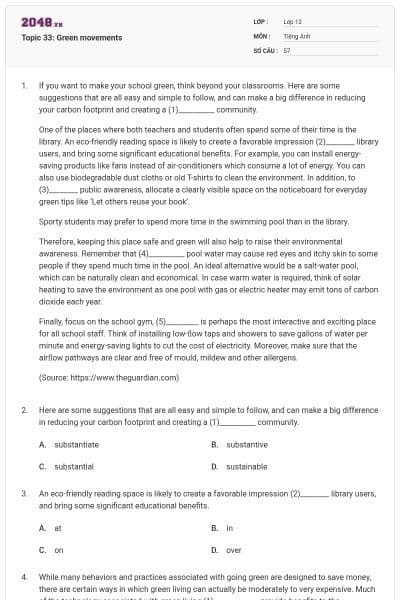
If you want to make your school green, think beyond your classrooms. Here are some suggestions that are all easy and simple to follow, and can make a big difference in reducing your carbon footprint and creating a (1)__________ community.
One of the places where both teachers and students often spend some of their time is the library. An eco-friendly reading space is likely to create a favorable impression (2)________ library users, and bring some significant educational benefits. For example, you can install energy-saving products like fans instead of air-conditioners which consume a lot of energy. You can also use biodegradable dust cloths or old T-shirts to clean the environment. In addition, to (3)________ public awareness, allocate a clearly visible space on the noticeboard for everyday green tips like ‘Let others reuse your book’.
Sporty students may prefer to spend more time in the swimming pool than in the library.
Therefore, keeping this place safe and green will also help to raise their environmental awareness. Remember that (4)__________ pool water may cause red eyes and itchy skin to some people if they spend much time in the pool. An ideal alternative would be a salt-water pool, which can be naturally clean and economical. In case warm water is required, think of solar heating to save the environment as one pool with gas or electric heater may emit tons of carbon dioxide each year.
Finally, focus on the school gym, (5)_________ is perhaps the most interactive and exciting place for all school staff. Think of installing low-flow taps and showers to save gallons of water per minute and energy-saving lights to cut the cost of electricity. Moreover, make sure that the airflow pathways are clear and free of mould, mildew and other allergens.
(Source: https://www.theguardian.com)
Here are some suggestions that are all easy and simple to follow, and can make a big difference in reducing your carbon footprint and creating a (1)__________ community.
substantiate
substantive
substantial
sustainable
Nếu bạn muốn làm cho ngôi trường của bạn trở nên xanh hơn, hãy suy nghĩ vượt ra khỏi lớp học của bạn. Dưới đây là một số gợi ý đơn giản dễ thực hiện và có thể tạo ra sự khác biệt lớn trong việc giảm lượng khí thải carbon và tạo ra một cộng đồng bền vững.
Một trong những nơi mà cả giáo viên và học sinh thường dành một chút thời gian của họ là thư viện. Một không gian đọc thân thiện với môi trường có khả năng tạo ấn tượng tốt cho người sử dụng thư viện và mang lại một số lợi ích giáo dục quan trọng. Ví dụ, bạn có thể lắp đặt các sản phẩm tiết kiệm năng lượng như quạt thay vì điều hòa không khí thứ tiêu thụ rất nhiều năng lượng. Bạn cũng có thể sử dụng vải bụi phân hủy sinh học hoặc áo phông cũ để làm sạch môi trường. Ngoài ra, để nâng cao nhận thức của cộng đồng, hãy thể hiện rõ ràng trên bảng thông báo những thông điệp xanh hàng ngày như ‘Cho phép người khác sử dụng lại sách của bạn’.
Sinh viên thể thao có thể thích dành nhiều thời gian hơn trong hồ bơi hơn là trong thư viện.
Do đó, việc giữ nơi này an toàn và xanh cũng sẽ giúp nâng cao môi trường của họ. Hãy nhớ rằng nước hồ bơi chứa clo có thể gây mắt đỏ và ngứa da cho một số người nếu họ dành nhiều thời gian trong hồ bơi. Một lựa chọn lý tưởng sẽ là một hồ bơi nước mặn, nơi có thể sạch sẽ tự nhiên và tiết kiệm. Trong trường hợp cần có nước ấm, hãy nghĩ đến việc sưởi ấm bằng năng lượng mặt trời để tiết kiệm môi trường bởi vì một hồ bơi sử dụng khí đốt hoặc dùng điện có thể thải ra hàng tấn các-bon đi-ô-xít mỗi năm.
Cuối cùng, tập trung vào phòng tập thể dục của trường học, có lẽ đây là nơi giao lưu và tập trung thú vị nhất cho tất cả nhân viên nhà trường. Hãy suy nghĩ về việc lắp đặt vòi rửa và vòi sen thấp để tiết kiệm nước và lắp đặt đèn tiết kiệm năng lượng để cắt giảm chi phí điện. Hơn nữa, luôn đảm bảo rằng các đường lưu thông không khí luôn sạch sẽ, không có nấm mốc và các chất gây dị ứng khác.
Đáp án D
Kiến thức về từ loại
A. substantiate (v): chứng minh
B. substantive (a): tồn tại riêng biệt, tồn tại độc lập
C. substantial (a): có thật, sự thật, đáng kể, lớn lao, quan trọng
D. sustainable (a) bền vững, lâu dài
=> Căn cứ vào danh từ “community” nên vị trí trống cần một tính từ. Vì theo quy tắc, trước danh từ cần một tính từ. Nên ta loại đáp án A.
Căn cứ vào nghĩa của câu:
“Here are some suggestions that are all easy and simple to follow, and can make a big difference in reducing your carbon footprint and creating a (1) __________ community.”
(Dưới đây là một số gợi ý đơn giản dễ thực hiện và có thể tạo ra sự khác biệt lớn trong việc giảm lượng khí thải carbon và tạo ra một cộng đồng bền vững.)
at
in
on
over
Đáp án C
Kiến thức về giới từ
To create a favorable impression on sb = To make a strong impression on sb: tạo ấn tượng tốt đối với ai
enhance
rise
raise
make
Đáp án C
Kiến thức về cụm từ cố định
Cụm từ: To raise one’s awareness: Nâng cao nhận thức của ai…
chlorinated
chemical
pollutant
cozy
Đáp án A
Kiến thức về từ vựng
A. chlorinated: Clo
B. chemical (a): thuộc về hóa học; (n) hóa chất, chất hóa học
C. pollutant (n): chất gây ô nhiễm, chất thải ô nhiễm
D. cozy (a): ấm cúng, thoải mái, dễ chịu
Tạm dịch: Remember that (4)__________ pool water may cause red eyes and itchy skin to some people if they spend much time in the pool.
(Hãy nhớ rằng nước hồ bơi chứa clo có thể gây mắt đỏ và ngứa da cho một số người nếu họ dành nhiều thời gian trong hồ bơi.)
that
which
whom
whose
Đáp án B
Kiến thức về đại từ quan hệ
A. That: Đại từ quan hệ từ chỉ người hay chỉ vật, có thể được dùng thay thế cho who, whom, which trong mệnh đề quan hệ xác định.
B. Which: Đại từ quan hệ chỉ vật, sự vật, sự việc, làm chủ ngữ hoặc tân ngữ cho động từ sau nó.
C. Whom: Đại từ quan hệ chỉ người (tân ngữ)
D. Whose: Đại từ quan hệ chỉ quyền sở hữu, whose luôn đi kèm với một danh từ
Căn cứ vào dấu phẩy (,) ta loại đáp án A. (Không dùng “that” sau dấu phẩy.)
Căn cứ vào “the school gym” (phòng tập thể dục của trường) nên ta chọn đáp án B.
While many behaviors and practices associated with going green are designed to save money, there are certain ways in which green living can actually be moderately to very expensive. Much of the technology associated with green living (1) ____________ provide benefits to the environment but often at a much higher cost than their traditional counterparts. For instance, the use of solar panels can potentially save you money on your energy bills, but they can (2) ______________ thousands of dollars to install. Energy-efficient appliances are designed to use less electricity and water but they often come with a high price tag.
Going green can also potentially have a negative effect on the environment. For (3) __________, the development of alternative fuels is an innovation in the green movement in an effort to reduce reliance on (4) ___________ natural resources. While these fuels are intended to reduce the toxic emissions caused by the burning of traditional gasoline, they may have unintentionally caused the opposite effect. One of these alternative fuels, E85, actually (5) ___________ more ozone into the atmosphere than traditional fuel. While ozone is a natural part of the Earth’s upper atmosphere, if it becomes concentrated in the lower atmosphere, it can potentially increase air pollution in areas where smog is a concern, which can in turn impact the health of those living in these areas.
(http://www.livestrong.com/article/137345-what-are-disadvantages-going-green/)
does
did
has
is
Trong khi nhiều biểu hiện và hành vi liên quan đến việc chuyển sang lối sống xanh được đưa ra để tiết kiệm tiền, có một số trường hợp nhất định mà lối sống xanh thực sự có thể từ mức độ vừa phải đến rất tốn kém. Nhiều công nghệ liên quan đến lối sống xanh mang đến lợi ích cho môi trường nhưng thường ở mức chi phí cao hơn nhiều so với cách thức truyền thống. Ví dụ, việc sử dụng pin mặt trời có thể tiết kiệm hóa đơn tiền điện nhưng nó lại tốn hàng nghìn đô để để lắp đặt. Thiết bị tiết kiệm năng lượng được thiết kế để tiêu tốn ít điện và nước nhưng chúng thường đi kèm với mức giá cao.
Việc sống thân thiện với môi trường có thể gây những tác động tiêu cực đối với môi trường. Ví dụ, sự phát triển của nhiên liệu thay thế là một sự đổi mới theo phong trào sống xanh trong khả năng để giảm sự phụ thuộc vào nguồn năng lượng tự nhiên không thể thay thế được. Mặc dù khi những năng lượng này có xu hướng là để làm giảm khí thải độc hại của việc đốt xăng truyền thống, nhưng chúng có thể vô tình gây ra tác dụng ngược lại. Một trong những nhiên liệu thay thế, E85, thật ra lại thải ra nhiều khí ozon vào trong không khí hơn là nhiên liệu truyền thống. Trong khi khí ozon lại là một phần của khí quyển trên cao của Trái Đất, nếu nó trở nên càng tập trung trong bầu khí quyển thấp hơn, nó có khả năng làm tăng ô nhiễm bầu không khí ở những khu vực nơi mà khói bụi là mối lo ngại, điều này có thể gây ảnh hưởng tới sức khỏe của những người sống ở những khu vực này.
Đáp án A
Chủ đề về DISADVANTAGES OF GOING GREEN
Kiến thức về thì động từ
A. does /dʌz/: trợ động từ của thì hiện tại đơn
B. did /dɪd/: trợ động từ của thì quá khứ đơn
C. has /hæz/ (v): có được
D. is /ɪz/ (v): động từ to be
Ta có: Khi muốn nhấn mạnh một hành động nào đó, ta dùng công thức:
* Trợ động từ + động từ nguyên mẫu
Tạm dịch: “Much of the technology associated with green living (1) ____________ provide benefits to the environment but often at a much higher cost than their traditional counterparts.”
(Rất nhiều công nghệ ngày nay gắn liền với việc sống xanh cũng cung cấp những lợi ích cho môi trường tuy nhiên thường thì chúng có giá cao hơn rất nhiều so với những công nghệ truyền thống.)
spend
take
cost
charge
Đáp án C
Kiến thức về từ vựng
A. spend /spend/ (v): dành, dùng
B. take /teɪk/ (v): mang, lấy
C. cost /kɒst/ (v): có giá, tiêu tốn
D. charge /tʃɑːdʒ/ (v): nạp, tích trữ
Tạm dịch: “For instance, the use of solar panels can potentially save you money on your energy bills, but they can (2) ______________ thousands of dollars to install.”
(Ví dụ, việc sử dụng năng lượng mặt trời có thể tiết kiệm tiền trên mỗi hóa đơn tiền điện của bạn, nhưng chúng có thể tiêu tốn hàng ngàn đô la để lắp đặt.)
goodness
sure
evidence
example
Đáp án D
Kiến thức về từ vựng
A. goodness /ˈɡʊd.nəs/ (n): lòng tốt, bản chất tốt
B. sure /ʃɔːr/ (a): chắc chắn
C. evidence /ˈev.ɪ.dəns/ (n): chứng cứ
D. example /ɪɡˈzɑːm.pəl/ (n): ví dụ
Tạm dịch: “For (3) _________________, the development of alternative fuels is an innovation in the green movement in an effort to reduce…”
(Ví dụ, sự phát triển của năng lượng thay thế là một sự đổi mới sáng tạo trong phong trào xanh với nỗ lực làm giảm….
advanced
alternative
nonstop
nonrenewable
Đáp án D
Kiến thức về từ vựng
A. advanced /ədˈvɑːnst/ (a): tân tiến
B. alternative /ɒlˈtɜː.nə.tɪv/ (a): thay thế
C. nonstop /ˌnɑnˈstɑp/ (a): không dừng
D. nonrenewable /ˌnɒn.rɪˈnjuː.ə.bəl/ (a): không thể tái tạo được
Tạm dịch: “… an innovation in the green movement in an effort to reduce reliance on (4) ___________ natural resources.”
(… một sự đổi mới sáng tạo trong phong trào xanh với nỗ lực làm giảm sự phụ thuộc vào những năng lượng không thể tái tạo.)
reports
repeats
releases
returns
Đáp án C
Kiến thức về từ vựng
A. report /rɪˈpɔːt/ (v): báo cáo
B. repeat /rɪˈpiːt/ (v): lặp lại
C. release /rɪˈliːs/ (v): thải ra
D. return /rɪˈtɜːn/ (v): quay trở lại
Tạm dịch: “One of these alternative fuels, E85, actually (5) _________ more ozone into the atmosphere than traditional fuel.”
(Một trong những nhiên liệu thay thế, E85, thật sự thải ra nhiều khí ozone vào khí quyển hơn là nhiên liệu truyền thống.)
A NEW APPROACH TO DESIGNING BUILDINGS
Some experts fear that many people are becoming overweight. Adults are encouraged to exercise for a minimum of thirty minutes, five times a week, and the average person is (1) ____ to take 10,000 steps per day to maintain basic fitness, but it is a fact that few office workers manage to take more than 5,000.
Now architects have designed ‘fit’ office buildings which encourage employees to become healthier because they have to walk while they are at work. In these buildings, meeting rooms and car parks are placed a long way from office desks so that workers have to walk to (2) ____ them. In one building the cafe is located in the furthest section so that some workers have to walk as (3) ____ as half a kilometer to and from lunch. There is special emphasis on (4) ____ people to use stairs instead of lifts, and long staircases are broken into flights of no more than nine stairs, so that they don’t look so difficult to climb. There are also large windows which provide attractive views over the city. (9) ____, the lifts are not easy to get access to, and in some buildings, they only stop at one floor in three.
It’s a design policy for a fitter environment which encourages people to walk without making it appear to be hard work - but will it be successful? Only time will tell.
Adults are encouraged to exercise for a minimum of thirty minutes, five times a week, and the average person is (1) ____ to take 10,000 steps per day to maintain basic fitness, but it is a fact that few office workers manage to take more than 5,000.
recommended
suggested
proposed
approved
Một vài chuyên gia lo sợ rằng rất nhiều người đang trở nên thừa cân. Người lớn được khuyến cáo là nên tập thể dục ít nhất ba mươi phút, 5 ngày một tuần, và trung bình một người nên thực hiện 10,000 bước mỗi ngày để duy trì sức khỏe cơ bản, nhưng thực tế là rất ít nhân viên văn phòng nào có thể thực hiện hơn 5000.
Ngày nay những kiến trúc sư đã thiết kế một tòa nhà ‘thon thả’ để khuyến khích nhân viên trở nên khỏe mạnh hơn bởi vì họ phải đi bộ ngay cả khi đang làm việc. Trong những tòa nhà này, phòng họp và bãi đỗ xe được đặt ở cách xa bàn làm việc để mà nhân viên sẽ phải đi bộ tới đó. Trong một tòa nhà, quán cà phê được đặt ở địa điểm xa nhất để mà các nhân viên phải đi bộ khoảng nửa kilomet để đến đi ăn trưa và quay về. Có một điều đặc biệt được nhấn mạnh trong việc thuyết phục mọi người đi thang bộ thay vì dùng thang máy, và cầu thang dài bị thay thành những cầu thang không quá 9 bậc, để mà mọi người không thấy quá khó khăn để leo lên. Cũng có những cửa sổ lớn cho thấy cảnh vật rất thu hút trong thành phố. Mặt khác, thang máy không dễ dàng để sử dụng, và trong vài tòa nhà, chúng chỉ dừng ở một trong ba tầng.
Nó là một chính sách được thiết kế cho một môi trường khỏe mạnh để khuyến khích mọi người đi bộ mà không khiến nó trở nên khó khăn – nhưng mà liệu rằng nó có thành công? Chỉ có thời gian mới có thể cho biết điều này.
Đáp án A
Kiến thức về từ vựng
A. recommend (v): đề xuất, tiến cử (người, vật…), khuyên
Recommend sb to st/to do st: khuyên bảo, đề nghị, khuyến khích ai đó làm gì có ích, hoặc có lợi cho người đó hay việc đó là việc đúng = advise sb to do st = encourage sb to do st = motivate sb to do st
Bị động: sb be recommended to st/ to do st
B. suggest (v): đề nghị, gợi ý
Suggest + doing st: đề xuất làm gì
Suggest that sb do st: gợi ý ai đó làm gì
Bị động: … suggested that st should be done
C. propose (v): đề nghị, đề xuất, dự định
Propose + V-ing = suggest (đề nghị)
Propose + to V = intend to do st (có ý định làm gì ) = offer (đề nghị)
D. approve (v): tán thành, chấp thuận
Approve of sb doing st: ủng hộ, tán thành, đồng ý ai đó làm gì = to incline to do st = to be in favor of doing st/st
Approve of sb/st: chấp nhận, đồng ý với ai/cái gì
Tạm dịch: Some experts fear that many people are becoming overweight. Adults are encouraged to exercise for a minimum of thirty minutes, five times a week, and the average person is (1) _________ to take 10,000 steps per day to maintain basic fitness, but it is a fact that few office workers manage to take more than 5,000.
(Một số chuyên gia sợ rằng nhiều người đang trở nên thừa cân. Người trưởng thành được khuyến khích tập thể dục tối thiểu ba mươi phút, năm lần một tuần và người bình thường được khuyến nghị thực hiện 10.000 bước mỗi ngày để duy trì thể lực cơ bản, nhưng thực tế là rất ít nhân viên văn phòng quản lý thực hiện được hơn 5000.)
arrive
get
reach
come
Đáp án C
Kiến thức về từ vựngA. arrive (v): đến
Arrive at/in: đến một nơi nào đó ( “at” khi đến 1 địa điểm nơi chốn, “in” khi đến 1 quốc gia, thành phố)
Không dùng giới từ đi kèm với arrive trước các từ: home, here, there, anywhere, somewhere.
B. get (v): lấy được, có được, nhận được
Get sb to do st: nhờ, thuê ai làm gì
C. reach (v): chạm đến, chạm tới, vươn tới, với tới
Reach (v) luôn luôn cần một bổ ngữ trực tiếp. (tức không vó giới từ ngay sau)
D. come (v): đến
Tạm dịch: Now architects have designed ‘fit’ office buildings which encourage employees to become healthier because they have to walk while they are at work. In these buildings, meeting rooms and car parks are placed a long way from office desks so that workers have to walk to (2) __________ them.
(Bây giờ các kiến trúc sư đã thiết kế các tòa nhà văn phòng ‘phù hợp’ để khuyến khích nhân viên trở nên khỏe mạnh hơn vì họ phải đi bộ trong khi họ đang làm việc. Trong các tòa nhà này, phòng họp và bãi đỗ xe được đặt cách xa bàn làm việc để công nhân phải đi bộ để đến đó)
well
far
soon
little
Đáp án B
Kiến thức về so sánh
A. well (adv): tốt, tuyệt
B. far (adv, adj): xa
C. soon (adv): sớm
D. little (adj, adv): ít, nhỏ, bé
Tạm dịch: In one building the cafe is located in the furthest section so that some workers have to walk as (3)________ as half a kilometer to and from lunch.
(Trong một toà nhà, quán cà phê nằm ở khu vực xa nhất để một số công nhân phải đi bộ một quãng đường xa bằng nửa km để đến.)
making
letting
persuading
bringing
Đáp án C
Kiến thức về từ vựng, ngữ pháp
A. make (v): làm, tạo ra
B. let (v): để cho, cho phép, hãy
C. persuade (v): thuyết phục; Persuade someone to do st: thuyết phục ai đó làm gì (vì hợp lý)
D. bring (v): mang, đem
Tạm dịch: There is special emphasis on (4) _________ people to use stairs instead of lifts, and long staircases are broken into flights of no more than nine stairs, so that they don’t look so difficult to climb.
(Có sự nhấn mạnh đặc biệt vào việc thuyết phục mọi người sử dụng cầu thang thay vì thang máy, và cầu thang dài được chia thành các lần đi không quá chín cầu thang, để chúng trông không quá khó để leo lên.)
(9) ____, the lifts are not easy to get access to, and in some buildings, they only stop at one floor in three.
On the other hand
Although
In spite of
So that
Đáp án A
Kiến thức về liên từ
A. On the other hand: mặt khác
B. Although: mặc dù; Although + SVO
C. In spite of: mặc dù; In spite of + N/V-ing/ cụm danh từ/ the fact that SVO
D. So that: vì vậy
Tạm dịch: There are also large windows which provide attractive views over the city. (9) __________ , the lifts are not easy to get access to, and in some buildings, they only stop at one floor in three.
(Ngoài ra còn có các cửa sổ lớn mà cung cấp những khung cảnh lí tưởng qua thành phố. Mặt khác, thang máy là không dễ dàng để có được quyền truy cập vào, và trong một số tòa nhà, họ chỉ dừng lại ở một trong ba tầng.)
There is no conflict between big business and the green movement towards the fight against climate change and the two are “totally compatible”. That’s according to Mike Hughes, Zone President, Schneider Electric UK & Ireland, who believes while there may be differences on how organisations play their part in the move towards the net zero target and the speed at which it happens, the two are “totally aligned”.
Speaking to ELN at the Energy Live Expo event last week, which attracted more than 450 people from across the industry, he said: “Big business goes where there is opportunity. Big business is a force for good. It has to be involved in this transition, in this change, in this climate change. If you look at it, there are two things that have happened in the last five to seven years that have really accelerated this topic. One is the general public getting on board with the whole concept of climate change, the emergency. The second is actually the business community and particularly the financial community starting to look at the financial risks around climate change and moving its money and where it will invest.”
Mr Hughes added the UK’s target for net zero carbon emissions by 2050 is a “hugely ambitious step” and it shows leadership, direction and ambition, enabling businesses to focus on where they can invest. He is also “extremely optimistic” and from a technology point of view, he believes there are technologies available to support the transition. He said: “It’s now around awareness, incentives from government, the right regulations to get people to make the right step and boosting the use of these technologies. I’m extremely positive.”
(Source: https://www.energylivenews.com/)
Which best serves as the title for the passage?
Achieving the meeting point.
Never forget the hard workers.
Evaluating the final results.
Reference to the developed countries.
Đáp án A
Câu nào sau đây thích hợp nhất làm tiêu đề cho đoạn văn?
A. Đạt được quan điểm đã đề ra
B. Không bao giờ quên những người lao động chăm chỉ
C. Đánh giá kết quả cuối cùng
D. Tham khảo các nước phát triển
Căn cứ vào thông tin đoạn đầu:
There is no conflict between big business and the green movement towards the fight against climate change and the two are “totally compatible”. That’s according to Mike Hughes, Zone President, Schneider Electric UK & Ireland, who believes while there may be differences on how organisations play their part in the move towards the net zero target and the speed at which it happens, the two are “totally aligned”.
(Không có sự xung đột giữa doanh nghiệp lớn và phong trào xanh hướng tới cuộc chiến chống lại biến đổi khí hậu và cả hai hoàn toàn tương thích”. Đó là theo Mike Hughes, chủ tịch khu Schneider Electric UK & Ireland, người tin tưởng rằng trong khi có thể có sự khác biệt về cách thức các tổ chức vai trò của họ trong việc đạt đến mục tiêu và tốc độ mà nó xảy ra, cả hai đều “hoàn toàn phù hợp với nhau”.)
Đầu tiên, ta thấy tác giả đã đưa ra quan điểm và cuối đoạn kết luận lại quan điểm đó. Như vậy, ta có thể suy ra bài đọc nói về việc đạt được một quan điểm đã đề ra.
According to paragraph 1, what is the common goal for big corporates in environmental movement?
Nomination as the most active pioneering company in the battle against pollution.
Overall balance between emissions produced and emissions taken out of the atmosphere.
Complete eradication of the electric pulse fishing practice as well as the use of electric nets.
The utilisation of total green machines and materials in the manufacturing process.
Đáp án B
Theo đoạn 1, mục tiêu chung cho các tập đoàn lớn trong phong trào môi trường là gì?
A. Sự đề cử rằng công ty tiên phong tích cực nhất trong cuộc chiến chống ô nhiễm.
B. Sự cân bằng tổng thể giữa khí thải được tạo ra và khí thải được loại ra khỏi khí quyển.
C. Xóa bỏ hoàn toàn việc thực hành đánh bắt xung điện cũng như sử dụng lưới điện.
D. Việc sử dụng tổng số máy móc và vật liệu xanh trong quá trình sản xuất.
=> Theo thông tin đoạn 1 như sau:
“There is no conflict between big business and the green movement towards the fight against climate change and the two are “totally compatible”. That’s according to Mike Hughes, Zone President, Schneider Electric UK & Ireland, who believes while there may be differences on how organisations play their part in the move towards the net zero target and the speed at which it happens, the two are “totally aligned”."
(Không có sự mâu thuẫn nào giữa những doanh nghiệp lớn và phong trào xanh hướng tới cuộc chiến chống lại sự biến đổi khí hậu và hai điều này “hoàn toàn có thể kết hợp được”. Theo chủ tịch của Schneider Electric, Mike Hughes, người tin rằng có nhiều sự khác biệt giữa việc các tổ chức đóng vai trò như thế nào trong việc tiến tới mục tiêu cân bằng (đưa về con số 0) lượng khí thải và tốc độ điều đó xảy ra, cả hai đều “hoàn toàn phù hợp”.)
=> Thông tin được highlight đồng nghĩa rằng mục tiêu chung cho các tập đoàn lớn trong phong trào môi trường là sự cân bằng tổng thể giữa khí thải được tạo ra và khí thải được loại ra khỏi khí quyển.
According to paragraph 2, what can be generalised about the role of businesses in the ecological movement?
It serves as one of the two secondary forces of the long-term environment battle.
It is a direct consequence from the previous generation’s green battle.
It is a pivotal and constructive element for the development of green movement.
It serves a conflicting role of an impetus and a root of the current environmental plight.
Đáp án C
Theo đoạn 2, những gì có thể được khái quát về vai trò của các doanh nghiệp trong phong trào sinh thái?
A. Nó đóng vai trò là một trong hai lực lượng thứ cấp của trận chiến môi trường dài hạn
B. Đó là hậu quả trực tiếp từ trận chiến xanh của thế hệ trước
C. Nó là một yếu tố then chốt và mang tính xây dựng cho sự phát triển của phong trào xanh
D. Nó phục vụ một vai trò mâu thuẫn của một động lực và gốc rễ của hoàn cảnh môi trường hiện tại
Căn cứ vào thông tin đoạn hai:
“Big business goes where there is opportunity. Big business is a force for good. It has to be involved in this transition, in this change, in this climate change. If you look at it, there are two things that have happened in the last five to seven years that have really accelerated this topic. One is the general public getting on board with the whole concept of climate change, the emergency. The second is actually the business community and particularly the financial community starting to look at the financial risks around climate change and moving its money and where it will invest.”
The word “it” in paragraph 3 refers to _______.
money
target
concept
technology
Đáp án B
Từ “it” trong đoạn 3 nói đến .
A.tiền bạc
B. mục tiêu
C. ý tưởng
D. công nghệ
Từ “it” ở đây dùng để thay thế cho danh từ mục tiêu được nhắc tới trước đó.
Mr Hughes added the UK’s target for net zero carbon emissions by 2050 is a “hugely ambitious step” and it shows leadership, direction and ambition, enabling businesses to focus on where they can invest.
(Ông Hughes nói thêm mục tiêu của vương quốc Anh về lượng khí thải carbon bằng 0 vào năm 2050 là một “tham vọng to lớn” và nó cho thấy sự lãnh đạo, định hướng và tham vọng, cho phép các doanh nghiệp tập trung vào nơi họ có thể đầu tư.)
The word “incentives” in paragraph 3 is closest in meaning to ______.
permissions
presents
acknowledgements
subsidies
Đáp án D
Từ “incentives” trong đoạn 3 có nghĩa gần nhất với .
A. quyền
B. quà
C. sự nhìn nhận
D. trợ cấp
Từ đồng nghĩa incentive (khuyến khích) = subsidy
He said: “It’s now around awareness, incentives from government, the right regulations to get people to make the right step and boosting the use of these technologies. I’m extremely positive.”
(Anh ấy nói: “Bây giờ xung quanh sự nhận thức, khuyến khích từ chính phủ, các quy định đúng đắn để khiến mọi người thực hiện bước đi đúng đắn và thúc đẩy việc sử dụng các công nghệ này. Tôi cực kỳ lạc quan.”)
Like many social and political movements, the green movement has been strengthened and annealed by the forces that oppose it. After James Watt was appointed to lead the Department of the Interior, for instance, membership in the Sierra Club grew from 183,000 to 245,000 in just 12 months.
Today, the green movement is again defined and galvanized by its command of issues like global warming and climate change, wetlands preservation, the Keystone pipeline, nuclear proliferation, hydraulic fracturing or “fracking,” fisheries depletion, species extinction and other important environmental concerns.
What distinguishes the green movement today from the earlier conservation movement is its emphasis on science and research. Speaking in spiritual tones and using religious metaphors, early environmentalists like Muir and Thoreau celebrated nature for its profound impact on man’s emotions and our souls. When Hetch Hetchy Valley in California was threatened by a dam, Muir exclaimed, “Dam Hetch Hetchy! As well dam for water-tanks the people’s cathedrals and churches, for no holier temple has ever been consecrated by the heart of man.”
Now, however, we are far more likely to call upon scientific data and empirical research to buttress arguments in favor of wilderness preservation, or against polluting industries. Politicians cite the work of polar researchers and use computerized climate models to battle global warming, and medical researchers rely on public health statistics to argue against mercury pollution. Whether these arguments succeed or fail, however, still depends on the vision, the passion and the commitment of the people who make up the green movement.
(Source: https://www.thoughtco.com)
Which best serves as the title for the passage?
The Green Movement: Science vs Spiritualism.
Science has finally triumphed over nature.
Reverence for nature and spiritual values.
Abandon the old way of thinking.
Đáp án A
Câu nào sau đây là thích hợp nhất để làm tiêu đề cho đoạn văn?
A. Phong trào xanh: Khoa học vs Tâm linh.
B. Khoa học cuối cùng đã chiến thắng thiên nhiên.
C. Tôn trọng thiên nhiên và giá trị tinh thần.
D. Từ bỏ lối suy nghĩ cũ.
Căn cứ vào thông tin trong đoạn 1:
Like many social and political movements, the green movement has been strengthened and annealed /əˈniːl/ by the forces that oppose it.
(Giống như nhiều phong trào chính trị xã hội, phong trào xanh đã được tăng cường và tôi luyện bởi các lực lượng chống lại nó.)
Như vậy, đoạn văn đang thảo luận về phong trào xanh.
According to paragraph 3, what did Muir’s protest try to express?
A battle cry to mobilize the forces against any other proposals.
Warning against what happens when environmental concerns are ignored.
Singing praises to the construction of dams as a human way to conquer nature.
Nature should be enjoyed for its beauty, and not merely used for its resources.
Đáp án D
Theo đoạn 3, cuộc biểu tình của Muir đã cố gắng thể hiện điều gì?
A. Một tiếng hô hào để huy động các lực lượng để chống lại bất kỳ đề xuất nào khác.
B. Cảnh báo chống lại những gì xảy ra khi mối quan tâm về môi trường bị bỏ qua.
C. Ca hát ca ngợi về việc xây dựng những con đập như một cách con người chinh phục thiên nhiên.
D. Thiên nhiên nên được chiêm ngưỡng vì vẻ đẹp của nó, chứ không chỉ đơn thuần sử dụng những tài nguyên của nó.
Căn cứ vào thông tin trong đoạn ba:
Early environmentalists like Muir and Thoreau celebrated nature for its profound impact on man’s emotions and our souls.
(Các nhà môi trường đầu tiên như Muir và Thoreau tôn vinh thiên nhiên vì tác động sâu sắc của nó đối với cảm xúc và tâm hồn của con người.)
The word “galvanized” in paragraph 2 is closest in meaning to ______.
mobilized
excited
powered
created
Đáp án B
Từ “galvanized /ˈɡæl.və.naɪzd/ ” trong đoạn 2 có nghĩa gần nhất với .
A. huy động
B. kích động
C. cung cấp năng lượng
D. tạo ra
Từ đồng nghĩa galvanized (khuấy động) = excited
Today, the green movement is again defined and galvanized by its command of issues like global warming and climate change, wetlands preservation,
(Ngày nay, phong trào xanh một lần nữa được định nghĩa và khuấy động bởi yêu cầu của nó về các vấn đề như sự nóng lên toàn cầu và biến đổi khí hậu, bảo tồn khu đầm lầy,)
The word “its” in paragraph 3 refers to _______.
earlier conservation movement
green movement
command
extinction
Đáp án B
Từ “its” trong đoạn 3 đề cập đến _______.
A. phong trào bảo tồn sớm
B. phong trào xanh
C. sự chỉ huy
D. sự tuyệt chủng
Từ “its” dùng để thay thế cho danh từ phong trào xanh.
What distinguishes the green movement today from the earlier conservation movement is its emphasis on science and research.
(Điều khác biệt giữa phong trào xanh ngày nay với phong trào bảo tồn trước đó, là nó nhấn mạnh vào khoa học và nghiên cứu.)
According to paragraph 4, which statement generalizes the development of conservation movement?
Green movement still maintains its traditional approach.
We moved away from talk of spirituality to concentrate solely on a rational, scientific analysis.
Environmentalism has evolved to become a multifaceted movement.
The environment should now be used in a conscientious manner to benefit society.
Đáp án C
Theo đoạn 4, câu nào có thể khái quát được sự phát triển của phong trào bảo vệ môi trường?
A. Phong trào vì màu xanh vẫn giữ nguyên phương hướng hoạt động cũ.
B. Chúng ta ngừng quan tâm về mặt tâm linh mà tập trung vào các bản phân tích khoa học, thực tế.
C. Hành động vì môi trường đã trở thành một hoạt động đa dạng
D. Môi trường nên được đối xử/ khai thác một cách có lương tâm để có thể có lợi cho xã hội
Căn cứ thông tin đoạn 4:
Now, however, we are far more likely to call upon scientific data and empirical research to buttress arguments in favor of wilderness preservation, or against polluting industries. Politicians cite the work of polar researchers and use computerized climate models to battle global warming, and medical researchers rely on public health statistics to argue against mercury pollution. Whether these arguments succeed or fail, however, still depends on the vision, the passion and the commitment of the people who make up the green movement.
(Tuy nhiên thì ngày nay, chúng ta thường sử dụng thông tin có tính khoa học và nghiên cứu thực tế để làm cơ sở cho các luận cứ ủng hộ sự bảo tồn thiên nhiên hoang dã, hoặc là để chống lại những ngành công nghiệp gây ô nhiễm. Các chính khách trích dẫn nghiên cứu của các nhà khoa học ở vùng cực và sử dụng mô hình khí hậu dựng trên máy tính để ngăn sự nóng lên toàn cầu, còn các nhà nghiên cứu dược học dựa vào số liệu về sức khoẻ cộng đồng để phản đối ô nhiễm thuỷ ngân. Dù các cuộc tranh luận này thành công hay thất bại, thì vẫn phụ thuộc vào tầm nhìn, sự đam mê, lòng cống hiến của những người hoạt động vì phong trào xanh.)
→ Phong trào xanh không ngừng lại ở mức vấn đề của các nhà môi trường mà là sự quan tâm từ các bộ môn, các giới khác nhau. Đáp án B. có ý đúng nhưng sai vì sử dụng từ “solely” (chỉ riêng/ hoàn toàn) nhưng trong đoạn văn không nói một cách triệt để như vậy: “likely” (có xu hướng)
Saving the planet is very much in vogue. It’s also in Harper’s Bazaar, Elle and Mademoiselle. It’s the message on fashion runways, in marketing strategies, in jewelry and accessory designs, on shopping bags and totes, in advertisements and on price tags.
A naked fashion model wearing a hat of birch branches and lichen, as shown in Vogue this month, may not be everyone’s idea of environmental awareness. But the pervasiveness of ecological themes in the images and marketing of fashion is undeniable. It is also somewhat paradoxical. The fashion industry, whose driving philosophy involves encouraging consumers to discard the old and embrace the new, is now trying to push itself to the forefront of efforts to conserve and preserve.
The environmental theme in fashion began as wispy touches and graphic exhortations in designer collections, not as some well-thought-out strategy of “green” marketing in which the environmental advantages of a product become part of the sales approach. Tendrils of ivy dangled from the ceiling at a Paris fashion show; a carpet of grass covered a runway in New York; models marched along in T-shirts or carrying signs all bearing slogans like “Clean Up or Die,” “Save the Sphere,” and “Environmental Protection Agents”.
The environmental spin on fashion has now moved into the mass market, where ‘’clothes with conscience’‘ make an extra tug at the buyer’s self-image. Bonjour, a jeans and sportswear company based in New York, has embarked on a program to ’‘change the individual’s outlook toward saving the environment’’ through educational tags. This summer, the first wave of what Bonjour executives said would be 50 million fashion items a year are to arrive in stores carrying tags with environmental tips from how to save water to how to reduce pollutants.
Whether these tributes to nature will benefit the environment or even raise environmental awareness, with concomitant changes in individual behavior, is not clear. There is some skepticism. Professor Ewen says the new environmental symbolism should be viewed as part of an overall change in America’s economy, from one built on industrial production of hard goods to one based on “pure representation”. “Going back to fashion, the environment has become a commercial cliche separated from real concerns. What can be attached to this year’s fashion is merely the symbolism of environmental sanity.”
(Source: https://www.nytimes.com)
Which best serves as the title for the passage?
The green movement in the fashion world
The long-forgotten theme of the fashion industry.
Fashion and environment can never go hand in hand.
Going green is the new big thing.
Đáp án A
Câu nào sau đây là thích hợp nhất để làm tiêu đề cho đoạn văn?
A. Phong trào xanh trong thế giới thời trang.
B. Chủ đề bị lãng quên từ lâu của ngành thời trang.
C. Thời trang và môi trường không bao giờ có thể đi đôi với nhau.
D. Sống thân thiện với môi trường là điều lớn lao mới.
Căn cứ vào thông tin đoạn đầu:
Saving the planet is very much in vogue. It’s also in Harper’s Bazaar, Elie and Mademoiselle. It’s the message on fashion runways, in marketing strategies, in jewelry and accessory designs, on shopping bags and totes, in advertisements and on price tags.
(Thông điệp cứu hành tinh xuất hiện ở thương hiệu Vogue. Nó cũng có ở các thương hiệu như Harper’s Bazaar, Elie và Mademoiselle. Nó là thông điệp trên sàn diễn thời trang, trong chiến lược tiếp thị, thiết kế trang sức và phụ kiện, trên túi mua sắm và túi xách, trong những quảng cáo và trên thẻ giá.)
Như vậy, đoạn văn đang nói về thông điệp cứu hành tinh trong thế giới thời trang.
Dịch bài đọc
Cứu lấy hành tinh đang rất thịnh hành. Nó cũng xuất hiện trên Harper’s Bazaar, Elle và Mademoiselle. Đó là thông điệp trên sàn diễn thời trang, trong các chiến lược tiếp thị, trong thiết kế trang sức và phụ kiện, trên túi mua sắm và túi tote, trong quảng cáo và trên nhãn giá.
Một người mẫu thời trang khỏa thân đội mũ làm từ cành bạch dương và địa y, như được thể hiện trên tạp chí Vogue tháng này, có thể không phải là ý tưởng của mọi người về nhận thức về môi trường. Nhưng sự phổ biến của các chủ đề sinh thái trong hình ảnh và hoạt động tiếp thị thời trang là không thể phủ nhận. Nó cũng có phần nghịch lý. Ngành công nghiệp thời trang, với triết lý thúc đẩy là khuyến khích người tiêu dùng từ bỏ cái cũ và đón nhận cái mới, hiện đang cố gắng đưa mình lên hàng đầu trong các nỗ lực bảo tồn và gìn giữ.
Chủ đề về môi trường trong thời trang bắt đầu bằng những nét chấm phá mỏng manh và lời khuyên đồ họa trong các bộ sưu tập của nhà thiết kế, chứ không phải là một chiến lược tiếp thị “xanh” được cân nhắc kỹ lưỡng, trong đó lợi thế về môi trường của sản phẩm trở thành một phần của phương pháp tiếp cận bán hàng. Những tua rua của cây thường xuân treo lủng lẳng trên trần nhà tại một buổi trình diễn thời trang ở Paris; một thảm cỏ phủ kín đường băng ở New York; các người mẫu diễu hành trong áo phông hoặc mang theo những tấm biển có khẩu hiệu như "Clean Up or Die", "Save the Sphere" và "Environmental Protection Agents".
Xu hướng thời trang vì môi trường hiện đã chuyển sang thị trường đại chúng, nơi mà "trang phục có lương tâm" tạo nên sức hút đặc biệt đối với hình ảnh bản thân của người mua. Bonjour, một công ty quần jean và đồ thể thao có trụ sở tại New York, đã bắt tay vào một chương trình nhằm "thay đổi quan điểm của cá nhân đối với việc bảo vệ môi trường" thông qua các thẻ giáo dục. Mùa hè năm nay, đợt đầu tiên trong số những gì mà các giám đốc điều hành của Bonjour cho biết sẽ là 50 triệu mặt hàng thời trang mỗi năm sẽ đến các cửa hàng với những thẻ có các mẹo về môi trường từ cách tiết kiệm nước đến cách giảm thiểu chất gây ô nhiễm.
Liệu những sự tôn vinh thiên nhiên này có mang lại lợi ích cho môi trường hay thậm chí nâng cao nhận thức về môi trường, cùng với những thay đổi đi kèm trong hành vi của cá nhân, vẫn chưa rõ ràng. Có một số sự hoài nghi. Giáo sư Ewen cho biết biểu tượng môi trường mới nên được xem như một phần của sự thay đổi toàn diện trong nền kinh tế Hoa Kỳ, từ nền kinh tế dựa trên sản xuất công nghiệp hàng hóa cứng sang nền kinh tế dựa trên “đại diện thuần túy”. “Quay trở lại thời trang, môi trường đã trở thành một câu sáo rỗng thương mại tách biệt với những mối quan tâm thực sự. Những gì có thể gắn liền với thời trang năm nay chỉ đơn thuần là biểu tượng của sự lành mạnh về môi trường”.
(Nguồn: https://www.nytimes.com)
The word “paradoxical” in paragraph 2 is closest in meaning to _______.
inconsistent
conflicting
confusing
zealous
Đáp án B
Từ " paradoxical " trong đoạn 2 có nghĩa gần nhất với .
A. không nhất quán
B. xung đột
C. gây nhầm lẫn
D. sốt sắng
Từ đồng nghĩa paradoxical (nghịch lý) = conflicting
But the pervasiveness of ecological themes in the images and marketing of fashion is undeniable. It is also somewhat paradoxical.
(Nhưng tính phổ biến của chủ đề sinh thái trong hình ảnh và tiếp thị của thời trang là không thể phủ nhận. Nó cũng có phần nghịch lý.)
According to paragraph 2, why is the green effort of fashion world so much of an irony?
No one has ever imagined the harmonious future of fashion and environment.
Fast fashion’s main features are premeditated waste and disposability.
It is predicted that the green trend can only remain as a niche market.
The concept of ethical fashion was once rejected by the industry.
Đáp án B
Theo đoạn 2, tại sao nỗ lực của thế giới thời trang “xanh” hoá lại là một điều vô cùng mỉa mai?
A. Chưa một ai tưởng tượng được về tương lai hoà hợp giữa thời trang và thời tiết.
B. Những đặc điểm chính của thời trang nhanh là sự lãng phí đã được dự tính từ trước và dễ dàng vứt bỏ sau khi sử dụng chỉ một thời gian ngắn.
C. Có thể dự đoán rằng xu hướng xanh chỉ có thể là một thị trường nhỏ.
D. Khái niệm về thời trang đạo đức từng bị bác bỏ bởi giới thời trang.
Căn cứ thông tin đoạn 2:
It is also somewhat paradoxical. The fashion industry, whose driving philosophy involves encouraging consumers to discard the old and embrace the new, is now trying to push itself to the forefront of efforts to conserve and preserve.
(Điều này có chút mâu thuẫn. Ngành công nghiệp may mặc, nơi mà triết lý phát triển là khuyến khích người tiêu dùng thải đồ cũ và mua đồ mới, thì đang cố gắng đẩy mình ra nơi chiến tuyến của công cuộc bảo tồn và gìn giữ.)
=> Theo thông tin đó, ta hiểu rằng nỗ lực của thế giới thời trang “xanh” hoá lại là một điều vô cùng mỉa mai hay có chút gây mâu thuẫn, đó là bởi nơi mà công nghiệp may mặc lại cùng lúc vừa khuyến khích người tiêu dùng lãng phí quần áo (vứt hết đồ cũ để mua đồ mới); nhưng đồng thời cũng đang cố gắng để theo trào lưu là công cuộc bảo tồn và gìn giữ môi trường.
=> Do đó, đáp án phù hợp nhất là B. Vì nó thể hiện được ý là có thể dự tính trước được xu thế của thời trang nhanh, đó là họ khuyến khích con người lãng phí hay dễ dàng vứt bỏ đồ quần áo sau khi mới sử dụng một thời gian ngắn nhưng đồng thời cũng hướng đến mục tiêu là “thời trang xanh”
=> và đó là hai mặt trái của vấn đề cùng tồn tại khiến cho nỗ lực về một thế giới “thời trang xanh” trở nên thật kỳ cục, mỉa mai và gây mâu thuẫn.
The word “wispy” in paragraph 3 is closest in meaning to _______.
fine
small
silvery
flamboyant
Đáp án A
Từ “wispy” trong đoạn 3 có nghĩa gần nhất với từ _______.
A. tinh tế
B. nhỏ
C. bạc
D. hào nhoáng
Từ đồng nghĩa: wispy (mỏng manh) = fine
Căn cứ thông tin đoạn 2:
The environmental theme in fashion began as wispy touches and graphic exhortations in designer collections, not as some well-thought-out strategy of “green” marketing in which the environmental advantages of a product become part of the sales approach.
(Đề tài về môi trường trong giới thời trang bắt đầu từ những chi tiết tinh tế và lời kêu gọi bằng hình ảnh nghệ thuật trong các bộ sưu tập nổi tiếng, không phải từ những chiến lược tiếp thị “xanh” được tính toán kỹ lưỡng, cái mà biến những lợi ích về mặt môi trường của sản phẩm thành một mánh lới bán hàng. )
According to paragraph 4, what is the main focus of the current green fashion?
Attracting wider consumers through the promotion of self-concept.
The combination of aesthetics and sustainability.
Realistic strategy to deliver a positive message for the environment.
Raising global awareness of the environmental conservation.
Đáp án A
Theo đoạn 4, đâu là trọng tâm của thời trang xanh hiện nay?
A. Thu hút nhiều người tiêu dùng hơn thông qua việc thúc đẩy việc tự khái niệm.
B. Sự kết hợp giữa tính thẩm mỹ và tính bền vững.
C. Chiến lược thực tế để cung cấp thông điệp tích cực về môi trường.
D. Nâng cao nhận thức chung của người dân toàn cầu về bảo vệ môi trường.
Căn cứ thông tin đoạn 4:
The environmental spin on fashion has now moved into the mass market, where “clothes with conscience” make an extra tug at the buyer’s self-image. Bonjour, a jeans and sportswear company based in New York, has embarked on a program to “change the individual’s outlook toward saving the environment” through educational tags. This summer, the first wave of what Bonjour executives said would be 50 million fashion items a year are to arrive in stores carrying tags with environmental tips from how to save water to how to reduce pollutants.
(Vòng xoáy môi trường về thời trang đang tiến quân vào thị trường đại chúng, nơi mà “thời trang với lương tâm” tạo thêm sức hút cho hình ảnh của người mua chúng. Bonjour, một công ty quần jeans và đồ thể thao có trụ sở tại New York, đã tiến hành một chương trình để “tay đổi cái nhìn cá nhân về việc bảo vệ môi trường” thông qua việc sử dụng các nhãn có tính giáo dục. Trong hè này, đợt hàng đầu tiên theo như giám đốc điều hành Bonjour cho biết sẽ có 50 triệu mặt hàng thời trang mỗi năm được phân đến các cửa hàng và có gắn thẻ về các lời khuyên về môi trường từ cách tiết kiệm nước cho đến cách giảm chất gây ô nhiễm)
→ thời trang xanh đánh vào tâm lý muốn thể hiện bản thân là một người bảo vệ môi trường của người tiêu dùng.
Which of the following statements is TRUE, according to the passage?
The initial manifestation of the green fashion is relatively superficial.
Creating eco-conscious fashion does not take away anything from the beauty of the garments.
Not many fashion brands pay attention to the prospect of eco-friendly element.
The contradiction between green fashion’ s approach and motto is unreal.
Đáp án A
Phát biểu nào sau đây là đúng, theo đoạn văn?
A. Biểu hiện ban đầu của thời trang xanh là tương đối hời hợt.
B. Tạo ra thời trang có ý thức sinh thái không lấy đi bất cứ thứ gì từ vẻ đẹp của quần áo
C. Không nhiều thương hiệu thời trang chú ý đến triển vọng của yếu tố thân thiện với môi trường.
D. Mâu thuẫn giữa phương pháp và phương châm của thời trang xanh là không thực tế.
Căn cứ vào thông tin đoạn cuối:
Whether these tributes to nature will benefit the environment or even raise environmental awareness, with concomitant changes in individual behavior, is not clear. There is some skepticism.
(Liệu những cống nạp cho thiên nhiên sẽ có lợi cho môi trường hay thậm chí là nâng cao nhận thức về môi trường, với những thay đổi đồng thời trong hành vi cá nhân, là không rõ ràng. Có một số hoài nghi.)
The word “one” in paragraph 5 refers to _____.
economy
change
symbolism
environment
Đáp án A
Từ “one” trong đoạn 5 nói đến .
A. kinh tế
B. thay đổi
C. tượng trưng
D. môi trường
Ta thấy từ “one” dùng để thay thế danh từ nền kinh tế ở trước đó.
Professor Ewen says the new environmental symbolism should be viewed as part of an overall change in America’s economy, from one built on industrial production of hard goods to one based on “pure representation”.
(Giáo sư Ewen nói rằng biểu tượng môi trường mới nên được xem như là một phần của một sự thay đổi tổng thể trong nền kinh tế của nước Mỹ, từ một nền kinh tế được xây dựng dựa trên sản xuất hàng hóa cứng đến một nền kinh tế dựa trên “đại diện thuần túy”.)
Which of the following can be inferred from the passage?
Skeptical voices have been proven wrong in terms of sustainable products.
The more fashionable a garment is, the more likely it will be out of fashion.
Environmentalism is moving into the clothing line.
Sustainable fashion isn’t a passing trend and the future is certainly looking greener.
Đáp án C
Điều nào sau đây có thể được suy ra từ đoạn văn?
A. Những tiếng nói hoài nghi đã được chứng minh là sai về các sản phẩm bền vững.
B. Quần áo càng thời trang thì càng dễ bị lỗi mốt.
C. Chủ nghĩa môi trường đang di chuyển vào xu hướng quần áo.
D. Thời trang bền vững không phải là một xu hướng đi qua và tương lai chắc chắn sẽ thân thiện hơn.
Căn cứ vào thông tin đoạn cuối:
What can be attached to this year’s fashion is merely the symbolism of environmental sanity.
(Những gì có thể gắn liền với thời trang năm nay là chỉ đơn thuần là biểu tượng của vệ sinh môi trường.)
Như vậy, ta có thể suy ra rằng chủ nghĩa môi trường đang di chuyển vào xu hướng quần áo.
Modern society has given significant attention to the promises of the digital economy over the past decade. But it has given little attention to its negative environmental footprint.
Our smartphones rely on rare earth metals, and cloud computing, data centers, artificial intelligence and cryptocurrencies consume large amounts of electricity, often sourced from coal-fired power plants. These are crucial blind spots we must address if we hope to capture the full potential of the digital economy. Without urgent system-wide actions, the digital economy and green economy will be incompatible with each other and could lead to more greenhouse gas emissions, accelerate climate change and pose great threats to humanity. The world’s data centers-the storehouses for enormous quantities of information - consume about three percent of the global electricity supply (more than the entire United Kingdom), and produce two percent of global greenhouse gas emissions-roughly the same as global air travel. A report by Greenpeace East Asia and the North China Electric Power University found that China’s data centers produced 99 million tonnes of carbon dioxide in 2018, the equivalent of about 21 million cars driven for one year. Greenhouse gases aren’t the only type of pollution to be concerned about.
Electronic waste (e-waste), which is a byproduct of data center activities, accounts for two percent of solid waste and 70 percent of toxic waste in the United States. Globally, the world produces as much as 50 million tonnes of electronic e-waste a year, worth over US$62.5 billion and more than the GDP of most countries. Only 20 percent of this e-waste is recycled.
The world and its intractable challenges are not linear-everything connects to everything else. We must raise awareness about these major blind spots, embrace systems leadership (leading across boundaries), boost circular economy ideas (decoupling economic activity from the consumption of finite resources), leverage an eco-economics approach (an environmentally sustainable economy) and encourage policy-makers to explore the interrelationships between government-wide, system-wide and societal results. We must also consider collective problem-solving by bringing together diverse perspectives from both the Global North and the Global South. We should take an inventory of the global and local damages caused by electronic devices, platforms and data systems, and frame issues about the digital economy and its environmental impact in broad societal terms.
(Source: https://phys.org/news/)
What does the passage mainly discuss?
Digital economy’s environmental footprint.
The climate movement’s diversity problem.
Environmental movement in time of war.
Modern technology’s destructiveness.
Đáp án A
Đoạn văn chủ yếu thảo luận là gì?
A. Dấu chân môi trường của nền kinh tế kỹ thuật số
B. Vấn đề đa dạng của phong trào khí hậu
C. Phong trào môi trường trong thời chiến
D. Sức tàn phá của công nghệ hiện đại
Căn cứ vào thông tin đoạn đầu:
Modern society has given significant attention to the promises of the digital economy over the past decade. But it has given little attention to its negative environmental footprint.
(Xã hội hiện đại đã dành sự quan tâm đáng kể cho những triển vọng của nền kinh tế kỹ thuật số đối với thập kỷ qua. Nhưng nó đã ít chú ý đến dấu chân môi trường tiêu cực của nó.)
Như vậy, bài văn đang đề cập về dấu chân môi trường tiêu cực của nền kinh tế kỹ thuật số.
The word “it” in paragraph 1 refers to _____.
economy
society
attention
decade
Đáp án B
Từ “it” trong đoạn 1 đề cập đến .
A. kinh tế
B. xã hội
C. chú ý
D. thập kỷ
Từ “it” ở đây dùng để thay thế cho danh từ xã hội được nhắc tới trước đó.
Modern society has given significant attention to the promises of the digital economy over the past decade. But it has given little attention to its negative environmental footprint.
(Xã hội hiện đại đã dành sự quan tâm đáng kể cho những triển vọng của nền kinh tế kỹ thuật số đối với thập kỷ qua. Nhưng nó đã ít chú ý đến dấu chân môi trường tiêu cực của nó.)
According to paragraph 2, what is the overall concern for the bilateral relationship between technology and nature?
Coal is one of the world’s largest sources of electricity and a key contributor to climate change.
Rare earth elements which form the backbone of our modern digital technologies are depleting.
The excessive disposal of electronic devices due to human’s digitalised consumerism.
The misalignment between the workings of technological economy and environmental economy.
Đáp án D
Theo đoạn 2, mối quan tâm chung đối với mối quan hệ song phương giữa công nghệ và thiên nhiên là gì?
A. Than là một trong những nguồn điện lớn nhất thế giới và là nhân tố chính tạo ra biến đổi khí hậu
B. Các nguyên tố đất hiếm tạo thành xương sống của các công nghệ kỹ thuật số hiện đại của chúng ta bị cạn kiệt
C. Việc xử lý quá mức các thiết bị điện tử do chủ nghĩa tiêu dùng số hóa của con người
D. Sự sai lệch giữa hoạt động của nền kinh tế công nghệ và nền kinh tế môi trường
Căn cứ vào thông tin đoạn hai:
Without urgent system-wide actions, the digital economy and green economy will be incompatible with each other and could lead to more greenhouse gas emissions, accelerate climate change and pose great threats to humanity.
(Không có các hành động khẩn cấp trên toàn hệ thống, nền kinh tế kỹ thuật số và nền kinh tế xanh sẽ không tương thích với nhau và có thể dẫn đến nhiều khí thải nhà kính hơn, tăng tốc sự biến đổi khí hậu và gây ra mối đe dọa lớn cho nhân loại.)
The word “byproduct” in paragraph 3 is closest in meaning to _______.
heritage
backlash
externality
aftertaste
Đáp án C
Từ “byproduct” trong đoạn 3 có nghĩa gần nhất với .
A. di sản
B. phản ứng dữ dội
C. những cái bên ngoài
D. dư vị
Từ đồng nghĩa byproduct (sản phẩm phụ) = externality
Electronic waste (e-waste), which is a byproduct of data center activities, accounts for two percent of solid waste and 70 percent of toxic waste in the United States.
(Chất thải điện tử (viết tắt e-waste), là sản phẩm phụ của các hoạt động của trung tâm dữ liệu, chiếm 2% chất thải rắn và 70% chất thải độc hại ở Hoa Kỳ.)
The word “linear” in paragraph 4 is closest in meaning to _______.
straightforward
evasive
plain
logical
Đáp án A
Từ “linear” trong đoạn 4 có nghĩa gần nhất với .
A. đơn giản
B. lảng tránh
C. trơn
D. logic
Từ đồng nghĩa linear (đơn giản) = straightforward
The world and its intractable challenges are not linear - everything connects to everything else.
(Thế giới và những thách thức khó khăn của nó không phải là đơn giản, mọi thứ đều kết nối với những thứ khác.)
According to paragraph 4, what direction should the global citizens follow to better the situation?
Gathering the world leaders to discuss about setting the world on a sustainable human trajectory.
Thinking differently about what we can collectively do for both the digital economy and the environment.
Doubling the annual income of 10 million people living below the poverty line worldwide.
Pondering over the possibilities of the human actually being the root of all pollution problems.
Đáp án B
Theo đoạn 4, công dân toàn cầu nên đi theo hướng nào để cải thiện tình huống này?
A. Tập hợp các nhà lãnh đạo thế giới để thảo luận về việc thiết lập trên thế giới một quỹ đạo con người bền vững
B. Suy nghĩ khác nhau về những gì chúng ta có thể làm cho cả nền kinh tế kỹ thuật số và môi trường
C. Nhân đôi thu nhập hàng năm của 10 triệu người sống dưới mức nghèo khổ trên toàn thế giới
D. Suy ngẫm về khả năng của con người thực sự là gốc rễ của mọi vấn đề ô nhiễm
Căn cứ vào thông tin đoạn bốn:
We must raise awareness about these major blind spots, embrace systems leadership (leading across boundaries), boost circular economy ideas (decoupling economic activity from the consumption of finite resources), leverage an eco-economics approach (an environmentally sustainable economy) and encourage policy-makers to explore the interrelationships between government-wide, system-wide and societal results. We must also consider collective problem- solving by bringing together diverse perspectives from both the Global North and the Global South.
Chúng ta phải nâng cao nhận thức về những điểm mù lớn này, nắm lấy sự lãnh đạo của hệ thống (các ranh giới dẫn đầu), thúc đẩy các ý tưởng kinh tế tuần hoàn (tách hoạt động kinh tế từ việc tiêu thụ tài nguyên hữu hạn), thúc đẩy cách tiếp cận kinh tế sinh thái (một nền kinh tế môi trường bền vững) và khuyến khích các nhà hoạch định chính sách khám phá mối quan hệ tương quan giữa kết quả toàn chính phủ, toàn hệ thống và xã hội. Chúng ta cũng phải xem xét giải quyết vấn đề tập thể bằng cách tập hợp các quan điểm đa dạng từ cả Bắc bán cầu và Nam bán cầu.
Which of the following statements is TRUE, according to the passage?
Developing and impoverished countries can offer viable solutions often ignored by the global discourse.
The world discharged a total amount of 99 million tonnes of greenhouse gases in 2018.
China is the leading country in terms of the volume of yearly generated carbon dioxide.
The digital employment of medium for financial transactions requires large amount of electricity.
Đáp án D
Phát biểu nào sau đây là đúng, theo đoạn văn?
A. Các nước đang phát triển và nghèo khó có thể đưa ra các giải pháp khả thi thường bị các cuộc thảo luận toàn cầu bỏ qua
B. Thế giới đã thải ra tổng cộng 99 triệu tấn khí nhà kính vào năm 2018
C. Trung Quốc là quốc gia dẫn đầu về khối lượng carbon dioxide được tạo ra hàng năm
D. Việc làm kỹ thuật số của phương tiện cho các giao dịch tài chính đòi hỏi số lượng điện rất lớn
Căn cứ vào thông tin đoạn hai:
Our smartphones rely on rare earth metals, and cloud computing, data centers, artificial intelligence and cryptocurrencies consume large amounts of electricity, often sourced from coal- fired power plants.
(Điện thoại thông minh của chúng ta dựa vào kim loại hiếm, và điện toán đám mây, trung tâm dữ liệu, trí thông minh nhân tạo và tiền điện tử tiêu thụ một lượng điện rất lớn, thường có nguồn gốc từ các nhà máy nhiệt điện.)
Which of the following can be inferred from the passage?
Human should take the environment into consideration, especially the unthinkable aspects.
The ecological consequences are incalculable for the current rate of natural resources utilisation.
Climate movement will force the youth to take off blindfolds of privilege and see the harsh reality.
A multitude of proposals previously ignored can be implemented for good of the green economy.
Đáp án A
Điều nào sau đây có thể được suy ra từ đoạn văn?
A. Con người nên xem xét môi trường, đặc biệt là những khía cạnh không thể tưởng tượng được
B. Hậu quả sinh thái là không thể đo lường được đối với tỷ lệ sử dụng tài nguyên thiên nhiên hiện nay
C. Phong trào khí hậu sẽ buộc thanh niên phải cởi bỏ những đặc quyền và thấy sự khắc nghiệt thực tế
D. Vô số các đề xuất trước đây bị bỏ qua có thể được thực hiện vì lợi ích của nên kinh tế xanh
Căn cứ vào thông tin đoạn
Our smartphones rely on rare earth metals, and cloud computing, data centers, artificial intelligence and cryptocurrencies consume large amounts of electricity, often sourced from coal- fired power plants. These are crucial blind spots we must address if we hope to capture the full potential of the digital economy.
(Điện thoại thông minh của chúng ta dựa vào kim loại hiếm, và điện toán đám mây, trung tâm dữ liệu, trí thông minh nhân tạo và tiền điện tử tiêu thụ một lượng điện rất lớn, thường có nguồn gốc từ các nhà máy nhiệt điện. Đây là những điểm mù quan trọng mà chúng ta phải giải quyết nếu chúng ta hy vọng nắm bắt được toàn bộ tiềm năng của nền kinh tế kỹ thuật số.)
Green-space facilities are contributing to an important extent to the quality of the urban environment. Fortunately it is no longer necessary that every lecture or every book about this subject has to start with the proof of this idea. At present, it is generally accepted, although more as a self-evident statement than on the base of a closely-reasoned scientific proof. The recognition of the importance of green-spaces in the urban environment is a first step on the right way; this does not mean, however, that sufficient details are known about the functions of green-space in towns and about the way in which the inhabitants are using these spaces. As to this rather complex subject I shall, within the scope of this lecture, enter into one aspect only, namely the recreative function of green-space facilities.
The theoretical separation of living, working, traffic and recreation which for many years has been used in town-and-country planning, has in my opinion resulted in disproportionate attention for forms of recreation far from home, whereas there was relatively little attention for improvement of recreative possibilities in the direct neighbourhood of the home. We have come to the conclusion that this is not right, because an important part of the time which we do not pass in sleeping or working, is used for activities as possible, and the design of these has to be such that more obligatory activities can also have a recreative aspect.
The very best standard of living is nothing if it is not possible to take a pleasant walk in the district, if the children cannot be allowed to play in the streets, because the risks of traffic are too great, if during shopping you can nowhere find a spot for enjoying for a moment the nice weather, in short, if you only feel yourself at home after the street-door of you house is closed after you.
(http://jiandati.com/q/4bBbbB)
According to the author, the importance of green-spaces in the urban environment ________.
is still unknown
is usually neglected
is being closely studied
has been fully recognized
Đáp án D
Chủ đề về GREEN - SPACE IN CITIES
Theo tác giả, tầm quan trọng của không gian xanh trong môi trường đô thị ________.
A. vẫn chưa rõ
B. thường bị làm ngơ
C. đang được nghiên cứu chặt chẽ
D. đã hoàn toàn được công nhận
Căn cứ vào thông tin:
“Green-space facilities are contributing to an important extent to the quality of the urban environment. Fortunately it is no longer necessary that every lecture or every book about this subject has to start with the proof of this idea. At present, it is generally accepted, although more as a self-evident statement than on the base of a closely-reasoned scientific proof.”
(Không gian xanh đang góp một phần rất quan trọng đối với chất lượng môi trường ở đô thị. May mắn là tất cả bài giảng hay các cuốn sách về chủ đề này không cần phải bắt đầu chứng minh tầm quan trọng của nó. Hiện nay, nói chung là nó đã được công nhận, mặc dù nó là một phát biểu tự chứng minh hơn là trên cơ sở khoa học có bằng chứng chặt chẽ.)
The underlined word “which” in the passage refers to ________.
way
inhabitants
spaces
subject
Đáp án A
Từ “which” được trong đoạn văn đề cập đến ________.
A. phương thức
B. những cư dân
C. những không gian
D. chủ đề
Căn cứ vào thông tin:
“The recognition of the importance of green-spaces in the urban environment is a first step on the right way; this does not mean, however, that sufficient details are known about the functions of green-space in towns and about the way in which the inhabitants are using these spaces.”
(Sự công nhận tầm quan trọng của không gian xanh trong môi trường đô thị là bước đúng đắn đầu tiên; tuy nhiên, điều này không có nghĩa là con người biết các thông tin đầy đủ về các chức năng của không gian xanh trong thị trấn và về cách cư dân sử dụng những không gian này.)
=> Từ “which” được tác giả dùng ở đây như một đại từ quan hệ thay thế cho danh từ đứng trước đó và chính là “the way”.
the disproportion of recreation facilities in the neighbourhood
the location of recreation facilities far from home
relatively little attention for recreative possibilities
the improvement of recreative possibilities in the neighbourhood
Đáp án B
Sự tách biệt về mặt lý thuyết giữa sống, làm việc, giao thông và giải trí đã dẫn đến ________.
A. sự mất cân đối của các phương tiện giải trí trong khu vực lân cận
B. vị trí của các phương tiện giải trí xa nhà
C. tương đối ít chú ý đến khả năng giải trí
D. sự cải thiện khả năng giải trí trong vùng lân cận
Căn cứ vào thông tin:
“The theoretical separation of living, working, traffic and recreation which for many years has been used in town-and-country planning, has in my opinion resulted in disproportionate attention for forms of recreation far from home, whereas there was relatively little attention for improvement of recreative possibilities in the direct neighbourhood of the home.”
“Sự tách biệt mang tính lý thuyết giữa sống, làm việc, giao thông và giải trí mà nhiều năm qua đã được sử dụng trong quy hoạch thị trấn và quốc gia, theo tôi, dẫn đến sự thiếu cân đối trong việc chú ý đến các hình thức giải trí xa nhà, trong khi có rất ít sự chú ý đến việc cải thiện khả năng giải trí trong khu vực lân cận của ngôi nhà.”
The underlined word “disproportionate“ in the passage probably means __________.
inconvenient
unbalanced
disaffected
uneasy
Đáp án B
Từ “disproportionate” được in đậm trong đoạn văn có nghĩa là __________.
A. bất tiện
B. mất cân bằng
C. không bị ảnh hưởng
D. không dễ dàng
Căn cứ vào thông tin:
“The theoretical separation of living, working, traffic and recreation which for many years has been used in town-and-country planning, has in my opinion resulted in disproportionate attention for forms of recreation far from home,…….”
(Sự tách biệt mang tính lý thuyết giữa sống, làm việc, giao thông và giải trí mà nhiều năm qua đã được sử dụng trong quy hoạch thị trấn và quốc gia, theo tôi, dẫn đến sự thiếu cân đối trong việc chú ý đến các hình thức giải trí xa nhà,….)
=> disproportionate /ˌdɪsprəˈpɔːʃənət/ (adj): không cân bằng, không cân đối = unbalanced (adj).
The author suggests that the recreative possibilities of green-space should be provided ____.
in special areas
in the suburbs
in the neighbourhood
in gardens and parks
Đáp án C
Tác giả cho rằng các chức năng giải trí của không gian xanh nên được cung cấp __________ .
A. trong các khu vực đặc biệt
B. ở ngoại ô
C. trong khu vực gần nhà
D. trong vườn và công viên
Căn cứ vào thông tin:
“The very best standard of living is nothing if it is not possible to take a pleasant walk in the district, if the children cannot be allowed to play in the streets, because the risks of traffic are too great, in short, if you only feel yourself at home after the street-door of your house is closed after you.”
(Điều kiện sống có tốt đến mấy cũng sẽ không là gì nếu không thể đi bộ thoải mái trong khu vực gần nhà, nếu trẻ em không được phép chơi trên đường phố, vì rủi ro giao thông là quá lớn, nếu bạn chỉ cảm thấy an tâm như ở nhà sau chỉ khi cách cửa nhà bạn đóng lại.)
=> Tác giả khẳng định rằng điều kiện sống của chúng ta dù có tốt đến đâu cũng không là gì so với việc có thể thoải mái, an toàn đi lại, chơi đùa, giải trí ở khu vực gần nhà. Vì vậy tác giả gợi ý nên có không gian xanh ở khu vực gần nhà.
According to the author, green-space facilities should be designed in such a way that _____.
more obligatory activities might take on a recreative aspect
more and more people might have access to them
an increasing number of recreative might be developed
recreative activities might be brought into our homes
Đáp án A
Theo tác giả, các cơ sở không gian xanh nên được thiết kế theo cách sao cho ___.
A. các hoạt động cần thiết hơn có thể có một khía cạnh giải trí
B. ngày càng nhiều người có thể tiếp cận với
C. mức độ giải trí ngày càng được phát triển
D. các hoạt động giải trí có thể được đưa vào ngôi nhà của chúng ta
Căn cứ vào thông tin:
“… because an important part of the time which we do not pass in sleeping or working, is used for activities, and the design of these has to be such that more obligatory activities can also have a recreative aspect.”
(… bởi vì một phần thời gian quan trọng mà chúng ta không dành cho việc ngủ hoặc làm việc, được sử dụng cho các hoạt động và thiết kế của không gian xanh nên được làm ra để những hoạt động bắt buộc hơn cũng có thể có hiệu quả giải trí.)
The underlined word “spot” in the passage is closest in meaning to _________.
dirty mark
spotlight
small amount
particular place
Đáp án D
Từ “spot” được gạch chân trong đoạn văn có nghĩa gần nhất với _________.
A. dấu bẩn
B. ánh đèn sân khấu
C. số lượng nhỏ
D. địa điểm cụ thể
Căn cứ vào thông tin:
“The very best standard of living is nothing if it is not possible to take a pleasant walk in the district, if the children cannot be allowed to play in the streets, because the risks of traffic are too great, if during shopping you can nowhere find a spot for enjoying for a moment the nice weather.”
(Điều kiện sống có tốt đến mấy cũng sẽ không là gì nếu không thể đi bộ thoải mái trong khu vực gần nhà, nếu trẻ em không được phép chơi trên đường phố, vì rủi ro giao thông là quá lớn, nếu trong khi bạn đi mua sắm mà không thể tìm được một chỗ nào để thưởng thức thời tiết đẹp một lúc.)
=> spot /spɒt/ (n): địa điểm, nơi, chỗ = particular place
The main idea of this passage is that _______.
better use of green-space facilities should be made to improve the quality of our life
attention must be directed to the improvement of recreative possibilities
the urban environment is providing more recreation activities than it did ears ago.
priority must be given to the development of obligatory activities
Đáp án A
Ý chính của đoạn văn này là _______.
A. nên sử dụng tốt hơn các hình thức không gian xanh để cải thiện chất lượng cuộc sống của chúng ta
B. phải chú ý đến việc cải thiện các khả năng giải trí
C. môi trường đô thị đang cung cấp nhiều hoạt động giải trí hơn so với trước đây.
D. phải ưu tiên cho việc phát triển các hoạt động cần thiết bắt buộc
=> Câu hỏi này yêu cầu phải nắm được nội dung thông tin của toàn bài văn.
- Ngay đầu bài văn tác giả viết:
“Green-space facilities are contributing to an important extent to the quality of the urban environment.”
(Không gian xanh đang góp một phần rất quan trọng đối với chất lượng môi trường ở đô thị.)
=> Khẳng định sự quan trọng của không gian xanh trong việc cải thiện chất lượng môi trường ở đô thị.
- Theo tác giả thấy, sự quy hoạch đô thị đã làm cho người dân quá chú ý đến các khu giải trí ở xa nhà của họ và không chú tâm đến phát triển địa điểm giải trí ở ngay trong khu vực gần nhà. Hơn nữa tác giả khẳng định ở đoạn cuối:
“The very best standard of living is nothing if it is not possible to take a pleasant walk in the district, if the children cannot be allowed to play in the streets, if during shopping you can nowhere find a spot for enjoying the nice weather…”
(Điều kiện sống có tốt đến mấy cũng sẽ không là gì nếu không thể đi bộ thoải mái trong khu vực gần nhà, nếu trẻ em không được phép chơi trên đường phố, nếu trong khi bạn đi mua sắm mà không thể tìm được một chỗ nào để thưởng thức thời tiết đẹp…)
=> Thông qua tất cả những điều đó, tác giả khuyên mọi người nên biết phát triển tốt hơn hình thức không gian xanh để nâng cao chất lượng cuộc sống.
Bạn có thích hoạt động này không?