Topic 30: Environments
46 câu hỏi
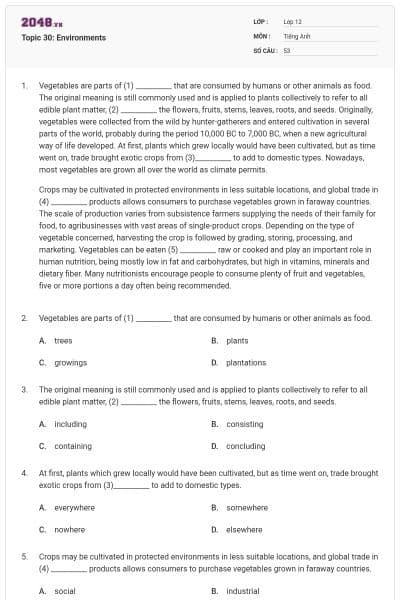
Vegetables are parts of (1) __________ that are consumed by humans or other animals as food. The original meaning is still commonly used and is applied to plants collectively to refer to all edible plant matter, (2) __________ the flowers, fruits, stems, leaves, roots, and seeds. Originally, vegetables were collected from the wild by hunter-gatherers and entered cultivation in several parts of the world, probably during the period 10,000 BC to 7,000 BC, when a new agricultural way of life developed. At first, plants which grew locally would have been cultivated, but as time went on, trade brought exotic crops from (3)__________ to add to domestic types. Nowadays, most vegetables are grown all over the world as climate permits.
Crops may be cultivated in protected environments in less suitable locations, and global trade in (4) __________ products allows consumers to purchase vegetables grown in faraway countries. The scale of production varies from subsistence farmers supplying the needs of their family for food, to agribusinesses with vast areas of single-product crops. Depending on the type of vegetable concerned, harvesting the crop is followed by grading, storing, processing, and marketing. Vegetables can be eaten (5) __________ raw or cooked and play an important role in human nutrition, being mostly low in fat and carbohydrates, but high in vitamins, minerals and dietary fiber. Many nutritionists encourage people to consume plenty of fruit and vegetables, five or more portions a day often being recommended.
trees
plants
growings
plantations
Rau củ là một phần của thực vật được con người hoặc động vật khác tiêu thụ làm thực phẩm. Nghĩa gốc vẫn được sử dụng phổ biến và được áp dụng chung cho thực vật để chỉ tất cả các bộ phận ăn được của cây bao gồm cả hoa, quả, thân, lá, rễ và hạt. Ban đầu, rau được thu thập từ tự nhiên bởi những người săn bắn hái lượm và được đưa vào trồng trọt ở một số nơi trên thế giới, có lẽ trong giai đoạn 10.000 năm trước Công nguyên đến 7.000 năm trước Công nguyên, khi lối sống nông nghiệp mới phát triển. Lúc đầu, những cây ở địa phương sẽ được gieo trồng, nhưng khi thời gian trôi qua, thương mại đã mang những cây ngoại lai từ nơi khác đến để bổ sung cho các giống cây trong nước. Ngày nay, khi khí hậu cho phép thì hầu hết các loại rau sẽ được trồng khắp mọi nơi trên thế giới.
Cây trồng có thể được trồng trong môi trường được bảo vệ ở những địa điểm ít phù hợp hơn và việc buôn bán các sản phẩm nông nghiệp toàn cầu cho phép người tiêu dùng mua rau được trồng ở các nước xa xôi. Quy mô sản xuất thay đổi từ nhà nông tự túc phục vụ nhu cầu ăn uống của gia đình họ, đến các doanh nghiệp nông nghiệp với diện tích rộng lớn của các loại cây trồng độc canh. Tùy thuộc vào loại rau có liên quan, thu hoạch vụ mùa được theo sau bởi các bước phân loại, lưu trữ, chế biến và tiếp thị. Rau củ có thể được ăn sống hoặc nấu chín và giữ một vai trò quan trọng trong chế độ dinh dưỡng cho con người, chủ yếu là ít chất béo và carbohydrate, nhưng nhiều vitamin, khoáng chất và chất xơ. Nhiều chuyên gia dinh dưỡng khuyến khích mọi người tiêu thụ nhiều trái cây và rau quả, khuyến nghị nên ăn năm phần ăn hoặc nhiều hơn mỗi ngày.
Đáp án B
Kiến thức về từ vựng
A. trees /tri:/ (n): cái cây
B. plants /plɑ:nt/ (n): thực vật
C. growings /’grouiɳ/ (n): sự lớn lên, sự trồng
D. plantations /plɑːnteɪʃn/ (n): đồn điền
Tạm dịch : Vegetables are parts of (1) __________ that are consumed by humans or other animals as food.
(Rau là một phần của thực vật được con người hoặc động vật khác tiêu thụ làm thực phẩm.)
including
consisting
containing
concluding
Đáp án A
Kiến thức về từ vựng
A. including /in’klu:diɳ/ (a): bao gồm
B. consisting /kən’sistiɳ/ (a): gồm có
C. containing /kən’teiniɳ/ (v): chứa
D. concluding /kən’klu:diɳ/ (v): kết luận
Tạm dịch: The original meaning is still commonly used and is applied to plants collectively to refer to all edible plant matter, (2) ____________ the flowers, fruits, stems, leaves, roots, and seeds.
(Ý nghĩa ban đầu vẫn được sử dụng phổ biến và được áp dụng cho thực vật để chỉ tất cả các chất thực vật có thể ăn được, bao gồm cả hoa, quả, thân, lá, rễ và hạt.)
everywhere
somewhere
nowhere
elsewhere
Đáp án D
Kiến thức về từ vựngA. everywhere: mọi nơi
B. somewhere: một vài nơi
C. nowhere: không nơi nào
D. elsewhere: nơi khác
Tạm dịch: At first, plants which grew locally would have been cultivated, but as time went on, trade brought exotic crops from (3) _____________ to add to domestic types.
(Lúc đầu, những cây trồng ở địa phương sẽ được trồng, nhưng thời gian trôi qua, thương mại đã mang những cây trồng kỳ lạ từ nơi khác đến để thêm vào các loại trong nước.)
social
industrial
agricultural
natural
Đáp án C
Kiến thức về từ vựng
A. social /’souʃəl/ (a): mang tính chất xã hội
B. industrial /in’dʌstriəl/ (a): (thuộc) công nghiệp
C. agricultural /ægri’kʌltʃərəl/ (a): (thuộc) nông nghiệp
D. natural /’nætʃrəl/ (a): (thuộc) tự nhiên, (thuộc) thiên nhiên
=> agricultural products: nông sản
Tạm dịch: Crops may be cultivated in protected environments in less suitable locations, and global trade in (4) __________ products allows consumers to purchase vegetables grown in faraway countries.
(Cây trồng có thể được trồng trong môi trường được bảo vệ ở những địa điểm ít phù hợp hơn và thương mại toàn cầu về nông sản cho phép người tiêu dùng mua rau được trồng ở các nước xa xôi.)
either
both
neither
only
Đáp án A
Kiến thức về liên từ
Either… or (hoặc… hoặc)
Both… and (vừa… vừa)
Neither… nor (không… cũng không)
Căn cứ vào “or” phía sau, ta chọn câu A
Tạm dịch: Vegetables can be eaten (5) __________ raw or cooked and play an important role in human nutrition, being mostly low in fat and carbohydrates, but high in vitamins, minerals and dietary fiber.
(Rau có thể được ăn sống hoặc nấu chín và đóng một vai trò quan trọng trong dinh dưỡng của con người, chủ yếu là ít chất béo và carbohydrate, nhưng nhiều vitamin, khoáng chất và chất xơ)
The “balance of nature” is not an empty phrase. Nature provides a population to occupy a suitable environment and cuts down surplus on population to fit the available food supply. One means of reducing surplus population is predators; others are parasites and diseases. Also, population density produces nervous disorders and even drivers animals to mass migrations, like the lemmings of Norway who plunge into the sea.
That predator populations increase to control other animals has long been known. Many years ago, the Hudsons Bay Company records revealed that the fox population went up and down about a year after the rabbit population had gone up and down.
Sometimes a situation occurs in which the predator population is reduced to a level below that which nature can readily replace. On Valcour Island in Lake Champlain (New York), a costly campaign resulted in the elimination of predatory animals only to have birds and small animals (including grouse and hares, popular game) increase for four years afterward. Then, lacking predator control, nature resorted to disease to cut down on these populations.
Jamaica had an example of natures persistence in providing animals for existing habits. Sugar planters, about 75 years ago, imported mongooses to control rats. The mongooses killed off the rats and, with plentiful food, multiplied. Rats became scarce and the mongooses ate lambs, puppies, and wildlife. Eventually, food became scarce and the mongooses’ population declined.
The phrase "balance of nature” in the first paragraph means ____.
reducing the population of predators
keeping the right number of animals for the right amount of food
keeping the ration of small game to predators
driving animals in certain areas of the world to mass migrations
Đáp án B
Đề bài: Cụm từ “balance of nature”trong đoạn đầu tiên có nghĩa là ____.
A. giảm số lượng động vật ăn thịt
B. giữ đúng số lượng động vật cho đúng lượng thức ăn
C. giữ tỉ lệ của động vật nhỏ với động vật ăn thịt
D. khiến động vật ở một số khu vực trên thế giới di cư hàng loạt
Căn cứ vào thông tin:
The “balance of nature” is not an empty phrase. Nature provides a population to occupy a suitable environment and cuts down surplus on population to fit the available food supply.
Dịch: Sự cân bằng tự nhiên không phải là một cụm từ trống rỗng. Thiên nhiên cung cấp một mật độ dân số để giữ một môi trường phù hợp và cắt giảm lượng thừa dân số để phù hợp với nguồn cung cấp thực phẩm có sẵn.
The fact that number of predators has much to do with that of other animals ____.
is not recent knowledge
has just been learned
has not proved yet
is not important now
Đáp án A
Đề bài: Thực tế là số lượng động vật ăn thịt có liên quan nhiều đến động vật khác ____.
A. không phải là kiến thức gần đây
B. vừa mới được nghiên cứu
C. chưa chứng minh được
D. hiện tại không quan trọng
Căn cứ vào thông tin:
That predator populations increase to control other animals has long been known. Many years ago, the Hudsons Bay Company records revealed that the fox population went up and down about a year after the rabbit population had gone up and down.
Dịch: Số lượng động vật ăn thịt tăng lên để kiểm soát các động vật khác đã được biết đến từ lâu. Cách đây nhiều năm, hồ sơ của Công ty Hudsons Bay tiết lộ rằng quần thể cáo biến động khoảng một năm sau khi số lượng thỏ tăng giảm.
=> Số lượng động vật ăn thịt có liên quan nhiều đến động vật khác đã được tìm ra từ lâu, không phải là kiến thức mới đây.
When predators control fails, nature brings animal population into balance by ____.
eliminating the number of predators
increasing the number of other animals
seeping the help of diseases to reduce other animals
replacing the number of predators immediately
Đáp án C
Đề bài: Khi kiểm soát động vật ăn thịt thất bại, thiên nhiên làm cho quần thể động vật trở lại cân bằng bằng cách____.
A. loại bỏ số lượng động vật ăn thịt
B. tăng số lượng động vật khác
C. tìm sự giúp đỡ của các bệnh để giảm các động vật khác
D. ngay lập tức thay thế số lượng động vật ăn thịt
Căn cứ vào thông tin:
Sometimes a situation occurs in which the predator population is reduced to a level below that which nature can readily replace….Then, lacking predator control, nature resorted to disease to cut down on these populations.
Dịch: Đôi khi có tình huống xảy ra mà số lượng động vật ăn thịt bị giảm xuống mức dưới tự nhiên có thể dễ dàng thay thế được… Sau đó, thiếu sự kiểm soát của động vật ăn thịt, thiên nhiên dùng đến bệnh tật để cắt giảm những quần thể này.
When the mongooses in Jamaica killed off the rats, they ____.
attacked humans
ate the sugar crop
became problems themselves
had nothing to eat
Đáp án C
Đề bài: Khi những con cầy mangut ở Jamaica giết chết lũ chuột, chúng ____.
A. tấn công con người
B. ăn vụ mùa
C. tự gây ra rắc rối cho bản thân
D. không có gì để ăn
Căn cứ vào thông tin:
The mongooses killed off the rats and, with plentiful food, multiplied. Rats became scarce and the mongooses ate lambs, puppies, and wildlife. Eventually, food became scarce and the mongooses’ population declined.
Dịch: Cầy mangut giết sạch chuột và, với nguồn thức ăn phong phú, chúng tăng lên gấp nhiều lần. Chuột trở nên khan hiếm và cầy mangut ăn thịt cừu, chó con, và động vật hoang dã. Cuối cùng, thực phẩm trở nên khan hiếm và dân số của cầy mangut giảm.
=> Những con cầy mangut giết sạch chuột, nó đã mang lại nguồn thức ăn phong phú cho chúng. Tuy nhiên, đến lúc số lượng giảm dần và hết sạch thì chúng phải thay đổi là ăn các động vật khác như chó con, thịt cừu, động vật hoang giã. Sau khi những nguồn thức ăn này cũng cạn kiệt thì chúng không có gì để ăn và chết dần.
=> Tuy nhiên, câu hỏi là: Khi những con cầy mangut ở Jamaica giết chết lũ chuột thì vấn đề với chúng là gì?
=> Ở giai đoạn hết chuột này, chúng chưa phải trải qua không có gì để ăn, mà chỉ là không có chuột để ăn, nhưng lại ăn các nguồn khác (chó con, thịt cừu, động vật hoang giã) => Có thể nói là chúng đang tự gây rắc rối cho mình khi ăn hết nguồn thức ăn phong phú của chính mình.It is implied in the passage that ____.
sugar planters imported mongooses to control rats
man should never kill animals
man has complete control over nature
to upset the balance of nature can be troublesome
Đáp án D
Đề bài: Đoạn văn ngụ ý rằng_______
A. người trồng mía nhập khẩu cầy mangut để kiểm soát chuột
B. con người không bao giờ nên giết động vật
C. con người hoàn toàn kiểm soát tự nhiên
D. làm đảo lộn sự cân bằng của tự nhiên có thể gây rắc rối
=> Thông tin suy ra từ nội dung toàn bài.
Vì các loài trong tự nhiên có mối liên hệ chặt chẽ với nhau, nên tác động vào một loài sẽ làm ảnh hưởng đến các loài khác. Như là:
- Population density produces nervous disorders and even drivers animals to mass migrations.
(Mật độ dân số đông tạo ra sự mất trật tự và thậm chí đẩy động vật đến sự di cư hàng loạt.)
- … the fox population went up and down about a year after the rabbit population had gone up and down.
(… quần thể cáo biến động khoảng một năm sau khi số lượng thỏ tăng giảm.)
Ý A. có xuất hiện trong bài nhưng không nói lên được ý chính của bài văn nên loại.
Trees are useful to man in three very important ways: they provide him with wood and other products; they give him shade; and they help to prevent droughts and floods.
Unfortunately, in many parts of the world, man has not realized that the third of these services is the most important. In his eagerness to draw quick profit from the trees, he has cut them down in large numbers.
Two thousand years ago, a rich and powerful country cut down its trees to build warships, with which to gain itself an empire. It gained the empire but, without its trees, its soil became bare and poor. When the empire fell to pieces, the country found itself faced by floods and starvation.
Even though government realizes the importance of a plentiful supply of trees, it is difficult sometimes to make the people realize this. They cut down the trees but are too careless to plant and look after new trees. So, unless the government has a good system of control, or can educate the people, the forests will slowly disappear.
This does not only mean that there will be fewer trees. The results are even more serious: for where there are trees, their roots break the soil up, allowing the rain to sink in, and also bind the soil. This prevents the soil from being washed away. But where there are no trees, the rain falls on hard ground and flows away on the surface, and this causes floods and the rain carries away the rich topsoil in which crops grow. When all the topsoil is gone, nothing remains but worthless desert.
(Source: www.cmr.com.cn/teach/tongkao/tksV200505_dxyyb_st.doc)
Trees are useful to man mainly in three ways, the most important of which is that they can _______.
keep him from the hot sunshine
enable him to build warships
make him draw quick profit from them
protect him from droughts and floods
Đáp án D
Chủ đề về TREES’ IMPORTANCE
Cây cối rất hữu ích cho con người chủ yếu theo ba cách, trong đó quan trọng nhất là chúng có thể _______.
A. giữ con người tranh khỏi ánh nắng mặt trời nóng bức
B. cho phép con người chế tạo tàu chiến
C. làm cho con người kiếm được lợi nhuận nhanh chóng từ chúng
D. bảo vệ con người khỏi hạn hán và lũ lụt
Căn cứ vào thông tin:
“Trees are useful to man in three very important ways: they provide him with wood and other products, they give him shade, and they help to prevent drought and floods.
Unfortunately, in many parts of the world man has not realized that the third of these services is the most important.
(Cây xanh có lợi cho con người theo ba cách rất quan trọng: chúng cung cấp cho một người gỗ và các sản phẩm khác, chúng cho người đó bóng mát, và giúp ngăn chặn hạn hán và lũ lụt.
Thật không may, ở nhiều nơi trên thế giới, con người đã không nhận ra rằng lợi ích thứ ba trong số đó là quan trọng nhất.)
=> Lợi ích quan trọng nhất của cây xanh là giúp con người ngăn chặn hạn hán và lũ lụt.
It’s a great pity that in many places__________.
man is only interested in building empires
man is not eager to make profits from trees
man hasn’t realized the importance of trees to him
man hasn’t found out that he has lost all trees
Đáp án C
Thật đáng tiếc khi ở nhiều nơi __________ .A. con người chỉ quan tâm đến việc xây dựng các đế chế
B. con người không thiết tha kiếm lợi nhuận từ cây xanh
C. con người chưa nhận ra tầm quan trọng của cây đối với mình
D. con người chưa nhận thấy được rằng mình đã mất đi toàn bộ cây cối
Căn cứ vào thông tin:
“Two thousand years ago, a rich and powerful country cut down its trees to build warships, with which to gain itself an empire. It gained the empire but, without its trees, its soil became bare and poor. When the empire fell to pieces, the country found itself faced by floods and starvation. Even though a government realizes the importance of a plentiful supply of trees, it is difficult for it to persuade the villager to see this.”
(Hai ngàn năm trước, một quốc gia giàu có và hùng mạnh đã chặt hạ nhiều cây cối để chế tạo tàu chiến, để tự mình trở thành một đế chế. Nó đã giành được đế chế, nhưng không có cây cối, đất đai của nó trở nên khô cứng và bạc màu. Khi đế chế sụp đổ, đất nước này phải đối mặt với lũ lụt và nạn đói. Mặc dù chính phủ nhận ra tầm quan trọng của nguồn cung cấp dồi dao từ cây xanh, thuyết phục người dân thấy được điều này vẫn rất khó.)
The word “bind” in paragraph 5 probably means___________.
to wash away
to make wet
to make stay together
to improve
Đáp án C
Từ “bind” trong đoạn 5 có nghĩa:
A. rửa trôi
B. làm ướt
C. làm cho gắn với nhau
D. cải thiện, nâng cao
Căn cứ vào thông tin:
“This does not only mean that there will be fewer trees. The results are even more serious: for where there are trees, their roots break the soil up, allowing the rain to sink in, and also bind the soil.”
(Điều này không chỉ có nghĩa là sẽ có ít cây hơn. Kết quả thậm chí còn nghiêm trọng hơn: đối với những nơi có cây, rễ của chúng xuyên vào đất, cho phép mưa ngấm xuống, và cũng gắn chặt với đất.)
=> bind /baɪnd/ (v): kết lại với nhau, gắn chặt vào = to make stay together
Land becomes desert after all trees are cut down because _________.
roots of trees break up the soil and wash it away
there are no larger trees to keep rain and protect the topsoil
there are too many rainfalls
strong winds bring a lot of sand
Đáp án B
Đất trở thành sa mạc sau khi tất cả cây cối bị chặt hạ vì _______A. rễ cây phá vỡ lớp đất và rửa trôi
B. không có cây lớn hơn để chặn mưa và bảo vệ bề mặt lớp đất
C. có quá nhiều mưa
D. gió mạnh mang nhiều cát
Căn cứ vào thông tin:
“… where there are trees, their roots break the soil up, allowing the rain to sink in, and also bind the soil. This prevents the soil from being washed away. But where there are no trees, the rain falls on hard ground and flows away on the surface, and this causes floods and the rain carries away the rich topsoil in which crops grow. When all the topsoil is gone, nothing remains but worthless desert.”
(… nơi mà có nhiều cây, rễ của chúng xuyên vào đất, cho phép mưa ngấm vào, và cũng gắn chặt với đất. Điều này ngăn chặn đất bị cuốn trôi. Nhưng nơi không có cây, mưa rơi trên mặt đất và chảy trên bề mặt, và điều này gây ra lũ lụt và mưa mang theo lớp bề mặt màu mỡ mà cây trồng phát triển. Khi tất cả lớp đất mặt đã biến mất, sẽ không còn gì ngoài sa mạc vô giá trị.)
=> Như vậy nguyên nhân chính dẫn đến việc đất đai bị sa mạc hóa là do không có cây chắn mưa.
Which title best fits the passage?
Trees and Man
Preventing Droughts and Floods
How an Empire Fell
A Story about Trees
Đáp án A
Tiêu đề nào phù hợp nhất với đoạn văn?
A. Cây cối và con người
B. Ngăn chặn hạn hán và lũ lụt
C. Một đế chế sụp đổ như thế nào
D. Câu chuyện về cây cối
=> Đây là câu hỏi yêu cầu thông tin từ toàn bài văn. Ngay từ đầu tác giả viết:
“Trees are useful to man in three very important ways: they provide him with wood and other products; they give him shade; and they help to prevent droughts and floods.”
(Cây xanh có lợi cho con người theo ba cách rất quan trọng: chúng cung cấp cho một người gỗ và các sản phẩm khác, chúng cho người đó bóng mát, và giúp ngăn chặn hạn hán và lũ lụt.)
=> lợi ích của cây cối đối với loài người.
Sau đó tác giả đưa ra các ví dụ để chứng minh cuộc sống của con người sẽ bị ảnh hưởng thế nào nếu không có cây cối.
=> Đáp án A nêu ra được nội dung toàn bài.
Scientists have uncovered a new threat to the world’s endangered coral reefs. They have found that most are incapable of growing quickly enough to compensate for rising sea levels triggered by global warming. The study suggests that reefs – which are already suffering serious degradation because the world’s seas are warming and becoming more acidic – could also become overwhelmed by rising oceans.
The research – led by scientists at Exeter University and published in Nature this week – involved studying growth rates for more than 200 tropical western Atlantic and Indian Ocean reefs. It was found only 9% of these reefs had the ability to keep up with even the most optimistic rates of sea-level rises forecast by the Intergovernmental Panel on Climate Change. “For many reefs across the Caribbean and Indian Ocean regions, where the study focused, rates of growth are slowing due to coral reef degradation,” said Professor Chris Perry, of Exeter University. “Meanwhile, rates of sea-level rise are increasing – and our results suggest reefs will be unable to keep up. As a result, water depths above most reefs will increase rapidly through this century.”
Sea levels rose by several inches over the past century and measurements indicate the speed of this increase is now rising significantly. Two key factors are involved: climate change is making ocean water warmer and so it expands. And as ice sheets and glaciers melt, they increase amounts of water in the oceans.
At the same time, reefs are being weakened by ocean warming and also by ocean acidification, triggered as the seas absorb more and more carbon dioxide. These effects lead to bleaching events that kill off vast stretches of coral and limits their ability to grow.
“Our predictions, even under the best case scenarios, suggest that by 2100, the inundation of reefs will expose coastal communities to significant threats of shoreline change,” said co-author Prof Peter Mumby of Queensland University. This point was backed by US marine scientist Ilsa Kuffner writing in a separate comment piece for Nature. “The implications of the study are dire. Many island nations and territories are set to quickly lose crucial natural resources.”
(Source: https://www.theguardian.com/)
Which of the following does the passage mainly discuss?
Sea levels will become the main factor of bleaching.
Coral reefs will be overwhelmed by rising oceans.
Coral reefs may escape from extinction because of the increase in sea levels.
Global warming will cause the rise of sea levels.
Đáp án B
Câu nào trong các câu sau là nội dung chính mà đoạn văn thảo luận?
A. Mực nước biển sẽ trở thành tác nhân chính của sự tẩy trắng.
B. Các rạn san hô sẽ bị tràn ngập bởi các đại dương đang dâng nước lên.
C. Các rạn san hô có thể thoát khỏi tuyệt chủng nhờ vào sự tăng lên của mực nước biển.
D. Sự nóng lên toàn cầu sẽ làm mực nước biển tăng lên.
Căn cứ vào thông tin đoạn 1:
The study suggests that reefs – which are already suffering serious degradation because the world’s seas are warming and becoming more acidic – could also become overwhelmed by rising oceans.
(Nghiên cứu cho thấy rằng các rạn san hô - đã bị suy thoái nghiêm trọng bởi vì biển trên thế giới đang ấm lên và trở nên chua hơn - cũng có thể bị tràn ngập bởi những đại dương đang dâng nước lên.)
What does the word “compensate” in the first paragraph probably mean?
recompense
keep up with
develop
benefit
Đáp án A
Từ “compensate” trong đoạn 1 có thể có nghĩa là __________.
A. đền bù, bồi thường
B. theo kịp
C. phát triển
D. có lợi ích
=> Từ đồng nghĩa: compensate (đền bù, bù đắp) = recompense
Tạm dịch: They have found that most are incapable of growing quickly enough to compensate for rising sea levels triggered by global warming.
(Họ đã phát hiện ra rằng hầu hết san hô không có khả năng phát triển đủ nhanh để bù đắp cho mực nước biển dâng cao do sự nóng lên toàn cầu).
What did scientists at Exeter University find in their research
Tropical coral reefs are increasing more quickly than others in Pacific Ocean.
The majority of tropical coral reefs cannot keep pace with the increasing rate of sea levels.
Many coral reefs are developing in spite of their degradation.
The rapid rise in sea levels does not affect the density of coral reefs.
Đáp án B
Các nhà khoa học tại Đại học Exeter đã tìm thấy điều gì trong nghiên cứu của họ?
A. Các rạn san hô nhiệt đới đang tăng lên nhanh hơn các rạn san hô ở Thái Bình Dương.
B. Đa số các rạn san hô nhiệt đới không thể bắt kịp tốc độ tăng lên của mực nước biển.
C. Nhiều rạn san hô vẫn đang phát triển mặc dù sự thoái hoá của chúng.
D. Sự tăng nhanh của mực nước biển không ảnh hưởng đến mật độ các rạn san hô.
Căn cứ vào thông tin đoạn 2:
The research – led by scientists at Exeter University and published in Nature this week – involved studying growth rates for more than 200 tropical western Atlantic and Indian Ocean reefs. It was found only 9% of these reefs had the ability to keep up with even the most optimistic rates of sea-level rises forecast by the Intergovernmental Panel on Climate Change. “For many reefs across the Caribbean and Indian Ocean regions, where the study focused, rates of growth are slowing due to coral reef degradation,” said Professor Chris Perry, of Exeter University. “Meanwhile, rates of sea-level rise are increasing – and our results suggest reefs will be unable to keep up. As a result, water depths above most reefs will increase rapidly through this century.”
(Nghiên cứu - được dẫn dắt bởi các nhà khoa học tại Đại học Exeter và được công bố trên tờ Nature tuần này - liên quan đến tốc độ tăng trưởng của hơn 200 rạn san hô vùng nhiệt đới Tây Đại Tây Dương và Ấn Độ Dương. Chỉ có 9% trong số các rạn san hô này có khả năng theo kịp ngay cả những mức độ lạc quan nhất của mực nước biển dâng do dự báo của Ủy ban liên chính phủ về biến đổi khí hậu. “Đối với nhiều rạn san hô trên vùng Caribê và Ấn Độ Dương, nơi nghiên cứu tập trung, tốc độ tăng trưởng chậm lại do suy thoái rạn san hô”, Giáo sư Chris Perry, thuộc Đại học Exeter cho biết. “Trong khi đó, tỷ lệ mực nước biển dâng đang gia tăng - và kết quả của chúng tôi cho thấy rạn san hô sẽ không thể theo kịp. Kết quả là, độ sâu của nước trên hầu hết các rạn san hô sẽ tăng nhanh qua thế kỷ này.”)
According to the passage, the two factors causing the rise of sea levels are ___________.
global warming and freeze
severe weather and climate change
climate change and ice expansion
climate change and ice melt
Đáp án D
Theo đoạn văn, 2 nhân tố gây ra sự tăng lên của mực nước biển là ____________.
A. sự nóng lên toàn cầu và sự băng giá
B. thời tiết cực đoan và biến đổi khí hậu
C. biến đổi khí hậu và sự mở rộng của băng
D. biến đổi khí hậu và băng tan
Căn cứ thông tin đoạn 3:
Two key factors are involved: climate change is making ocean water warmer and so it expands. And as ice sheets and glaciers melt, they increase amounts of water in the oceans.
(Hai yếu tố chính có liên quan là biến đổi khí hậu đang làm cho nước biển ấm hơn và do đó nó mở rộng. Và khi những tảng băng và sông băng tan chảy, chúng làm tăng lượng nước trong đại dương.)
What does the phrase “these effects” in paragraph 4 refer to?
ocean warming and ocean acidification
reef weakening and ocean warming
reef weakening and ocean acidification
ocean warming and CO2 absorb
Đáp án A
Cụm từ “these effects” trong đoạn 4 đề cập đến ____________.
A. sự nóng lên của địa dương và axit đại dương hoá
B. sự yếu đi của các rạn san hô và sự nóng lên của đại dương
C. sự yếu đi của các rạn san hô và axit đại dương hoá
D. sự nóng lên của đại dương và sự hấp thụ CO2
Căn cứ thông tin đoạn 4:
Từ “these effects” đang nhắc đến sự nóng lên của địa dương và axit đại dương hoá.
At the same time, reefs are being weakened by ocean warming and also by ocean acidification, triggered as the seas absorb more and more carbon dioxide. These effects lead to bleaching events that kill off vast stretches of coral and limits their ability to grow.
(Đồng thời, các rạn san hô đang bị suy yếu bởi sự nóng lên của đại dương và cũng bởi sự axit hóa đại dương, được kích hoạt khi các vùng biển hấp thụ ngày càng nhiều khí CO2. Những tác động này dẫn đến các sự kiện tẩy trắng diệt hết các dải san hô rộng lớn và hạn chế khả năng phát triển của chúng.)
The word “inundation” is closest in meaning to ______________.
drought
extinction
flood
tsunami
Đáp án C
Từ “inundation” gần nghĩa nhất với từ ____________.
A. hạn hán
B. sự tuyệt chủng
C. lũ lụt
D. sóng thần
Từ đồng nghĩa: inundation (sự ngập lụt) = flood
“Our predictions, even under the best case scenarios, suggest that by 2100, the inundation of reefs will expose coastal communities to significant threats of shoreline change,” said co-author Prof Peter Mumby of Queensland University.
“Dự đoán của chúng tôi, ngay cả trong các kịch bản tốt nhất, cho thấy rằng vào năm 2100, sự ngập lụt các rạn san hô sẽ đặt các cộng đồng ven biển vào các mối đe dọa đáng kể về sự thay đổi bờ biển”, giáo sư Peter Mumby thuộc Đại học Queensland cho biết.
The author implies in the last paragraph that _____________.
even in the most optimistic prediction, coral reefs will experience their extinction.
the results of the study are more serious than what scientists have predicted.
human activities will not only affect marine life but also put themselves at risk.
people often exploit natural resources in island nations and territories.
Đáp án C
Tác giả hàm ý trong đoạn cuối rằng ____________.
A. Ngay cả trong dự đoán lạc quan nhất, các rạn san hô vẫn sẽ bị tuyệt chủng.
B. Kết quả của cuộc nghiên cứu thì nghiêm trọng hơn những gì các nhà khoa học đã dự đoán.
C. Các hoạt động của con người không chỉ ảnh hưởng đến thế giới dưới biển mà còn đặt chính họ vào nguy hiểm.
D. Con người thường khai thác tài nguyên thiên nhiên ở các quốc đảo và vùng lãnh thổ.
Căn cứ thông tin đoạn cuối:
“Our predictions, even under the best case scenarios, suggest that by 2100, the inundation of reefs will expose coastal communities to significant threats of shoreline change,” said co-author Prof Peter Mumby of Queensland University. This point was backed by US marine scientist Ilsa Kuffner writing in a separate comment piece for Nature. “The implications of the study are dire. Many island nations and territories are set to quickly lose crucial natural resources.”
“Dự đoán của chúng tôi, ngay cả trong các kịch bản tốt nhất, cho thấy rằng vào năm 2100, sự ngập lụt các rạn san hô sẽ đặt các cộng đồng ven biển vào các mối đe dọa đáng kể về sự thay đổi bờ biển”, giáo sư Peter Mumby thuộc Đại học Queensland cho biết. Điểm này được ủng hộ bởi nhà khoa học biển người Mỹ Ilsa Kuffner viết trong một phần bình luận riêng cho tờ Nature. “Hàm ý của nghiên cứu rất nghiêm trọng. Nhiều quốc đảo và vùng lãnh thổ được thiết lập đã nhanh chóng làm mất đi các nguồn tài nguyên thiên nhiên quan trọng.”
Như vậy, tác giả đã hàm ý rằng, các hoạt động của con người như thành lập các quốc đảo và vùng lãnh thổ đã làm mất đi các nguồn tài nguyên thiên nhiên quan trọng và việc các rạn san hô bị ảnh hưởng của biến đổi khí hậu và nóng lên toàn cầu sẽ khiến các vùng duyên hải chịu nhiều mối đe doạ.
Far from being barren wastelands, deserts are biologically rich habitats with a vast array of animals and plants that have adapted to the harsh conditions there. Some deserts are among the planet’s last remaining areas of total wilderness. Yet more than one billion people, one-sixth of the Earth’s population, actually live in desert regions.
Deserts cover more than one fifth of the Earth’s land, and they are found on every continent. A place that receives less than 10 inches (25 centimeters) of rain per year is considered a desert. Deserts are part of a wider classification of regions called “dry lands.” These areas exist under a moisture deficit, which means they can frequently lose more moisture through evaporation than they receive from annual precipitation.
And despite the common conceptions of deserts as dry and hot, there are cold deserts as well. The largest hot desert in the world, northern Africa’s Sahara, reaches temperatures of up to 122 degrees Fahrenheit (50 degrees Celsius) during the day. But some deserts are always cold, like the Gobi desert in Asia and the desert on the continent of Antarctica. Others are mountainous. Only about 10 percent of deserts are covered by sand dunes. The driest deserts get less than half an inch (one centimeter) of precipitation each year, and that is from condensed fog not rain.
Desert animals have adapted ways to help them keep cool and use less water. Camels, for example, can go for days without food and water. Many desert animals are nocturnal, coming out only when the brutal sun has descended to hunt. Some animals, like the desert tortoise in the south-western United States, spend much of their time underground. Most desert birds are nomadic, crisscrossing the skies in search of food. Because of their very special adaptations, desert animals are extremely vulnerable to introduced predators and changes to their habitat.
Some of the world’s semi-arid regions are turning into desert at an alarming rate. This process, known as “desertification,” is not caused by drought, but usually arises from the demands of human populations that settle on the semi-arid lands to grow crops and graze animals. The pounding of the soil by the hooves of livestock may degrade the soil and encourage erosion by wind and water.
Which of the followings best replaces the word “precipitation” in the second paragraph?
Rainfall
Water
Wetness
Storm
Đáp án A
Từ nào dưới đây có thể thay thế tốt nhất cho từ “precipitation /prɪˌsɪp.ɪˈteɪ.ʃən/” trong đoạn văn thứ hai?
A. Rainfall /ˈreɪnfɑːl/ (n): lượng mưa
B. Water /ˈwɔːtər/ (n): nước
C. Wetness /ˈwetnəs/ (n): tình trạng ẩm ướt
D. Storm /stɔːrm/ (n): bão tố
Căn cứ vào ngữ cảnh trong câu:
“A place that receives less than 10 inches (25 centimetres) of rain per year is considered a desert /ˈdez.ət/. Deserts are part of a wider classification of regions called ”drylands." These areas exist under a moisture deficit, which means they can frequently lose more moisture through evaporation than they receive from annual precipitation.”
(Một nơi nhận được mưa dưới 10 inch (25 cm) mỗi năm được coi là sa mạc. Các sa mạc là một phần của phân loại rộng hơn gọi là “vùng đất khô hạn”. Những khu vực này tồn tại dưới sự thiếu hụt độ ẩm, có nghĩa là chúng có thể thường xuyên mất độ ẩm nhiều hơn thông qua sự bốc hơi so với lượng mưa chúng nhận được hàng năm.)
=> Precipitation /prɪˌsɪpɪˈteɪʃn/ (n): lượng mưa ~ Rainfall
It is assumed that deserts are _____.
recently promising farmland
densely populated areas
home for no plants or animals
completely out of water
Đáp án B
Người ta tin rằng các vùng sa mạc là ____________.
A. vùng đất nông nghiệp gần đây có nhiều hứa hẹn
B. các khu vực dân cư dày đặc
C. nhà không dành cho động và thực vật
D. hoàn toàn cạn kiệt nước
Căn cứ vào thông tin trong đoạn đầu:
“Far from being barren wastelands, deserts are biologically rich habitats with a vast array of animals and plants that have adapted to the harsh conditions there. Some deserts are among the planet’s last remaining areas of total wilderness. Yet more than one billion people, one-sixth of the Earth’s population, actually live in desert regions.”
(Khác xa với những hoang mạc cằn cỗi, sa mạc là môi trường sống phong phú về mặt sinh học với vô số động vật và thực vật thích nghi với điều kiện khắc nghiệt. Một số sa mạc nằm trong số những vùng hoang dã cuối cùng còn lại của hành tinh. Tuy nhiên, hơn một tỷ người, một phần sáu dân số trái đất, thực sự sống ở các vùng sa mạc.)
=> Con số theo thông tin trên đã cho thấy các vùng sa mạc thực sự là các khu vực dân cư dày đặc.
Which feature of desert animals is NOT mentioned?
Adapting to new environment quickly
Being active when night falls
Moving often from place to place
Being underground to avoid sunshine
Đáp án A
Đặc điểm nào của động vật hoang dã KHÔNG được đề cập đến?
A. Thích nghi với môi trường mới một cách nhanh chóng
B. Hoạt động khi về đêm
C. Thường xuyên di chuyển từ một nơi đến một nơi khác
D. Ở dưới đất để tránh mặt trời
Căn cứ vào thông tin trong đoạn 3:
“Many desert animals are nocturnal, coming out only when the brutal sun has descended to hunt. Some animals, like the desert tortoise in the south-western United States, spend much of their time underground. Most desert birds are nomadic, crisscrossing the skies in search of food. Because of their very special adaptations, desert animals are extremely vulnerable to introduced predators and changes to their habitat.”
(Nhiều động vật sa mạc sống hoạt động về đêm, chỉ xuất hiện khi mặt trời tàn khốc đã xuống để săn bắt mồi. Một số động vật dành phần lớn thời gian dưới lòng đất như rùa sa mạc ở phía tây nam Hoa Kỳ. Hầu hết các loài chim sa mạc là động vật du cư, chúng bay theo từng cặp trên bầu trời để tìm kiếm thức ăn. Do sự thích nghi rất đặc biệt của chúng, động vật sa mạc cực kỳ dễ bị tổn thương trước những dã thú săn mồi và thay đổi môi trường sống của chúng.)
=> Ngay thông tin câu cuối đã thấy ngay A sai vì động vật sa mạc cực kỳ dễ bị tổn thương bởi việc thay đổi môi trường sống của chúng, thì chúng sẽ không thể dễ dàng thích nghi với môi trường mới một cách nhanh chóng được.
What is the direct cause of desertification?
Drought for a long times
Sparsely populated areas
Strong winds and water flows
Animals kept on farms
Đáp án C
Nguyên nhân trực tiếp gây ra sự sa mạc hóa là gì?
A. Hạn hán trong suốt một thời gian dài
B. Những khu vực dân cư thưa thớt
C. Gió mạnh và dòng chảy của nước
D. Gia súc được nuôi giữ trong các trang trại
Căn cứ vào thông tin cuối đoạn 3:
“Some of the world’s semi-arid regions are turning into desert at an alarming rate. This process, known as “desertification”, is not caused by drought, but usually arises from the demands of human populations that settle on the semi-arid lands to grow crops and graze animals. The pounding of the soil by the hooves of livestock may degrade the soil and encourage erosion by wind and water.”
(Một số khu vực sắp khô hạn của thế giới đang biến thành sa mạc với tốc độ đáng báo động. Quá trình này, được biết đến là “sa mạc hóa”, không phải do hạn hán gây ra, mà thường xuất phát từ các nhu cầu của người dân định cư trên vùng đất sắp khô cằn để trồng trọt và chăn thả gia súc. Việc móng guốc của gia súc nghiền giã đất đai có thể làm suy thoái đất và càng làm xói mòn thêm bởi gió và nước.)
=> Từ các thông tin trên, ta có thể loại ngay A vì mâu thuẫn với thông tin trong bài; loại B vì không có thông tin được nhắc đến và đáp án D chưa chính xác vì gia súc ở đây được chăn thả trên các vùng đất sắp bị khô hạn rồi, chúng dẫm lên đất nhiều làm cho đất càng bị suy thoái hơn, chứ không phải là chúng được nuôi giữ trong các nông trại.
What may make the diversity of deserts’ plants and animals poorer?
The lack of water for years at a time
The increase in the temperature of the Earth’s atmosphere
The appearance of grasses besides trees and shrubs
The considerable number of people living in desert areas
Đáp án B
Điều gì có thể khiến cho sự đa dạng của động và thực vật trở nên nghèo nàn hơn?
A. Thiếu nước một thời gian dài ở một thời điểm cụ thể nào đó
B. Tăng nhiệt độ không khí Trái Đất
C. Diện mạo của đồng cỏ bên cạnh cây cối và cây bụi
D. Số lượng người đáng kể sống ở các khu vực sa mạc
Câu hỏi với “may” như này thì thường sẽ không có thông tin trong bài cụ thể, mà chúng ta phải dùng phương pháp suy luận và loại trừ:
- Ta loại đáp án A vì:
“This process, known as ”desertification”, is not caused by drought…”
(Quá trình này, được biết đến là “sa mạc hóa”, không phải do hạn hán gây ra…)
=> Hạn hán không thể là điều khiến suy giảm sự đa dạng của động thực vật, hơn nữa nó chỉ xảy ra ở một thời điểm nhất định nào đó.
- Ta loại đáp án C vì không có thông tin được đề cập đến trong bài
- Ta loại đáp án D vì:
“This process, known as ”desertification”, is not caused by drought, but usually arises from the demands of human populations that settle on the semi-arid lands to grow crops and graze animals.”
(Quá trình này, được biết đến là “sa mạc hóa”, không phải do hạn hán gây ra, mà thường xuất phát từ các nhu cầu của người dân định cư trên vùng đất sắp khô cằn để trồng trọt và chăn thả gia súc.)
=> Mặc dù có ảnh hưởng của con người do nhu cầu của họ về việc trồng trọt và chăn thả gia súc nhưng đó chỉ giới hạn bởi những người dân định cư sống ở vùng đất sắp khô cằn, chứ không phải là tất cả những con người sinh sống trên vùng đất sa mạc nói chung, do đó, số lượng dân số đông sinh sống trên sa mạc không phải là nguyên nhân.
What is NOT true about desserts?
They are biologically rich habitats with a wide number of plants and animals.
They are the planet’s last remaining areas of total wilderness.
They cover more than 20% of the Earth’s land.
They are found on all of the six continents.
Cái nào KHÔNG đúng về các sa mạc?
A. Chúng là các môi trường sống dồi dào về sinh học với một số lượng lớn động và thực vật.
B. Chúng là những khu vực còn lại cuối cùng của hành tinh của các khu vực hoang dã nói chung.
C. Chúng bao phủ hơn 20% đất trên Trái Đất.
D. Chúng được tìm thấy trên 6 lục địa.
Căn cứ vào các thông tin sau:
“Far from being barren wastelands, deserts are biologically rich habitats with a vast array of animals and plants that have adapted to the harsh conditions there. Some deserts are among the planet’s last remaining areas of total wilderness.”
(Khác xa với những hoang mạc cằn cỗi, các sa mạc là những môi trường sống phong phú về mặt sinh học với vô số động vật và thực vật thích nghi với điều kiện khắc nghiệt. Một số sa mạc nằm trong số những vùng hoang dã cuối cùng còn lại của hành tinh.)
“Deserts cover more than one fifth of the Earth’s land, and they are found on every continent.”
(Các sa mạc bao phủ hơn một phần năm đất đai của Trái Đất và chúng được tìm thấy ở mọi châu lục.)
=> Suy ra B sai vì chính xác phải là “một số trong số tất cả các vùng sa mạc trên Trái Đất” chứ không phải “tất cả chúng” là thuộc những vùng hoang dã cuối cùng còn lại của hành tinh.
What subject is this text probably found in?
Biology
History
Geography
Literature
Đáp án C
Chủ đề của đoạn văn có thể được tìm ở đâu?
A. Sinh vật học
B. Lịch sử học
C. Địa lý học
D. Văn học
=> Có thể thấy bài văn chủ yếu bàn về một loại địa hình chiếm đến 20% diện tích Trái Đất đó là các vùng sa mạc. Trong đó, nhà văn có bàn đến sự phát triển và các nguy cơ liên quan đến các loài động thực vật tồn tại ở các vùng sa mạc này. Do đó, chủ đề chính của đoạn là về chủ đề địa lý học.
What is the best title for the text?
Deserts: General introduction
Deserts: Facts and myths
Biological features of deserts
How to survive in deserts
Đáp án A
Chủ đề chính của đoạn văn là gì?
A. Các vùng sa mạc: sự giới thiệu tổng quan
B. Các vùng sa mạc: thực tế và hoang đường
C. Các đặc điểm sinh học của các vùng sa mạc
D. Làm thế nào để tồn tại trên các vùng sa mạc
=> Như đã giải thích ở trên, bàn về chủ đề địa lý học, cụ thể là các vùng sa mạc, nhà văn đã đưa ra sự giới thiệu tổng quan về dạng địa hình này, từ diện tích đến các hiện trạng đã và đang xảy ra ở đó.
Đáp án A là phù hợp nhất.
Because the low latitudes of the Earth, the areas near the equator, receive more heat than the latitudes near the poles, and because the nature of heat is to expand and move, heat is transported from the tropics to the middle and high latitudes. Some of this heat is moved by winds and some by ocean currents, and some gets stored in the atmosphere in the form of latent heat. The term “latent heat” refers to the energy that has to be used to convert liquid water to water vapor. We know that if we warm a pan of water on a stove, it will evaporate, or turn into vapor, faster than if it is allowed to sit at room temperature. We also know that if we hang wet clothes outside in the summertime they will dry faster than in winter, when temperatures are colder. The energy used in both cases to change liquid water to water vapor is supplied by heat – supplied by the stove in the first case and by the Sun in the latter case. This energy is not lost. It is stored in water vapor in the atmosphere as latent heat. Eventually, the water stored as vapor in the atmosphere will condense to liquid again, and the energy will be released to the atmosphere.
In the atmosphere, a large portion of the Sun’s incoming energy is used to evaporate water, primarily in the tropical oceans. Scientists have tried to quantify this proportion of the Sun’s energy. By analyzing temperature, water vapor, and wind data around the globe, they have estimated the quantity to be about 90 watts per square meter, or nearly 30 percent of the Sun’s energy. Once this latent heat is stored within the atmosphere, it can be transported, primarily to higher latitudes, by prevailing, large-scale winds. Or it can be transported vertically to higher levels in the atmosphere, where it forms clouds and subsequent storms, which then release the energy back to the atmosphere.
(civilserviceguide.com > topics > reading-comprehension…)
The passage mainly discusses how heat ______________.
is transformed and transported in the Earth’s atmosphere.
is transported by ocean currents.
can be measured and analyzed by scientists.
moves about the Earth’s equator.
Đáp án A
Đoạn văn chủ yếu thảo luận về cách mà nhiệt _________
A. Được biến đổi và vận chuyển trong bầu khí quyển Trái Đất.
B. Được vận chuyển bằng dòng hải lưu.
C. Có thể đo lường và thống kê bởi các nhà khoa học.
D. Di chuyển về xích đạo Trái Đất.
Đây là câu hỏi cần phải nắm được ý chính toàn bài. Vì vậy, khi gặp câu này nên để làm cuối.
Căn cứ vào thông tin của câu sau: “Heat is transported from the tropics to the middle and high latitudes. Some of this heat is moved by winds and some by ocean currents, and some gets stored in the atmosphere in the form of latent heat.”
(Nhiệt độ được chuyển từ vùng nhiệt đới tới vùng vĩ độ trung bình và cao. Một phần nhiệt được di chuyển bởi gió và phần khác bởi dòng hải lưu đại dương, và phần còn lại được lưu trữ trong không khí dưới dạng nhiệt độ ẩn.)
The passage mentions that the tropics differ from the Earth’s polar regions on which of the following ways?
The height of cloud formation in the atmosphere.
The amount of heat they receive from the Sun.
The strength of their large scale winds.
The strength of their oceanic currents.
Đáp án B
Đoạn văn đề cập rằng vùng nhiệt đới khác với vùng cực của Trái Đất theo những khía cạnh nào?
A. Chiều cao của sự hình thành đám mây trong khí quyển.
B. Lượng nhiệt chúng nhận được từ mặt trời.
C. Sức mạnh gió quy mô lớn của chúng.
D. Sức mạnh dòng hải lưu của chúng.
Căn cứ vào thông tin của đoạn sau:
“Because the low latitudes of the Earth, the areas near the equator, receive more heat than the latitudes near the poles, and because the nature of heat is to expand and move, heat is transported from the tropics to the middle and high latitudes.”
(Vì các vĩ độ thấp của Trái Đất, các khu vực gần xích đạo nhận được nhiệt nhiều hơn các vĩ độ ở gần các cực, và vì bản chất của nhiệt độ là mở rộng và di chuyển, nên nhiệt được chuyển từ vùng nhiệt đới tới vùng có vĩ độ trung bình và cao.)
“The energy used in both cases to change liquid water to water vapor is supplied by heat”
(Năng lượng được sử dụng trong cả hai trường hợp để thay đổi nước lỏng thành hơi nước được cung cấp bởi nhiệt độ)
“Once this latent heat is stored within the atmosphere, it can be transported, primarily to higher latitudes, by prevailing, large-scale winds. Or it can be transported vertically to higher levels in the atmosphere, where it forms clouds and subsequent storms, which then release the energy back to the atmosphere.”
(Một khi nhiệt độ ẩn được lưu trữ trong bầu khí quyển, nó có thể được vận chuyển, chủ yếu đến các vĩ độ cao hơn bằng các ngọn gió phổ biến, quy mô lớn. Hoặc nó có thể được vận chuyển lên các cấp cao hơn của bầu khí quyển, nơi nó hình thành đám mây và bão, thứ mà sau đó sẽ giải phóng năng lượng trở lại bầu khí quyển)
The underlined word “it” in the first paragraph refers to _______________.
pan
water
stove
temperature
Đáp án B
Từ “nó” trong đoạn 1 nhắc tới __________ .
A. chảo
B. nước
C. lò sưởi
D. nhiệt độ
Căn cứ vào ngữ cảnh của câu sau: “We know that if we warm a pan of water on a stove, it will evaporate, or turn into vapor, faster than if it is allowed to sit at room temperature.”
(Chúng ta biết rằng nếu ta làm ấm một chảo nước trên bếp, nó sẽ bay hơi, hoặc biến thành hơi, nhanh hơn nếu nó được đặt ở nhiệt độ phòng.)
Why does the author mention “the stove” in the first paragraph?
To describe the heat of the Sun.
To illustrate how water vapor is stored.
To give an example of a heat source.
To show how energy is stored.
Đáp án C
Tại sao tác giả lại nhắc tới “bếp lò” trong đoạn văn đầu tiên?
A. Miêu tả nhiệt độ của mặt trời
B. Minh họa cách lưu trữ hơi nước
C. Đưa ra ví dụ về một nguồn nhiệt
D. Cho thấy cách mà năng lượng dự trữ.
Căn cứ vào ngữ cảnh câu sau: “The energy used in both cases to change liquid water to water vapor is supplied by heat – supplied by the stove in the first case and by the Sun in the latter case.”
(Năng lượng được sử dụng trong cả hai trường hợp để thay đổi nước lỏng thành hơi nước được cung cấp bởi nhiệt độ - được cung cấp bởi bếp lò ở trường hợp đầu và Mặt Trời ở trường hợp sau.)
According to the passage, most ocean water evaporation occurs especially __________.
around the higher latitudes
in the tropics
because of large-scale winds
because of strong ocean currents
Đáp án B
Theo như đoạn văn, hầu hết sự bốc hơi nước đại dương xảy ra đặc biệt ______
A. xung quanh vùng vĩ độ cao hơn
B. ở những vùng nhiệt đới
C. vì các ngọn gió quy mô lớn.
D. vì dòng hải lưu mạnh
Căn cứ vào thông tin của câu sau: “In the atmosphere, a large portion of the Sun’s incoming energy is used to evaporate water, primarily in the tropical oceans.”
(Trong khí quyển, phần lớn năng lượng mới đến của Mặt Trời được sử dụng để làm bay hơi nước, chủ yếu ở những đại dương nhiệt đới.)
According to the passage, 30 percent of the Sun’s incoming energy _____________.
is stored in clouds in the lower latitudes
is transported by ocean currents
never leaves the upper atmosphere
gets stored as latent heat
Đáp án D
Theo đoạn văn, 30% của năng lượng mới đến của mặt trời ______
A. lưu trữ trong các đám mây ở vĩ độ thấp.
B. được vận chuyển bởi dòng hải lưu.
C. không bao giờ rời khỏi bầu không khí phía trên.
D. được lưu trữ dưới dạng nhiệt ẩn.
Căn cứ vào thông tin của câu sau: “Scientists have tried to quantify this proportion of the Sun’s energy. By analyzing temperature, water vapor, and wind data around the globe, they have estimated the quantity to be about 90 watts per square meter, or nearly 30 percent of the Sun’s energy. Once this latent heat is stored within the atmosphere, it can be transported, primarily to higher latitudes, by prevailing, large-scale winds.”
(Các nhà khoa học đã cố gắng định lượng tỷ lệ năng lượng mới đến của Mặt Trời. Bằng cách phân tích nhiệt độ, hơi nước và dữ liệu gió trên toàn cầu, họ ước tính số lượng khoảng 90 wat trên 1 mét vuông, hoặc gần 30% năng lượng Mặt Trời. Một khi nhiệt độ ẩn được lưu trữ trong bầu khí quyển, nó có thể được vận chuyển, chủ yếu đến các vĩ độ cao hơn bằng các ngọn gió phổ biến, quy mô lớn.)
The underlined word “prevailing” in the second paragraph is closet in meaning to _______.
essential
circular
dominant
closet
Đáp án C
Từ “prevailing” /prɪˈveɪ.lɪŋ/ ở trong đoạn 2 có nghĩa là ______
A. essential /əˈsɛnʃəl/ (adj): cần thiết
B. circular /sɜː.kjʊ.lər/ (adj): vòng tròn xung quanh
C. dominant /´dɔminənt/: ưu thế hơn, có ảnh hưởng lớn
D. closet /’klɔzit/ (adj): bí mật
Căn cứ vào thông tin của câu sau: “Once this latent heat is stored within the atmosphere, it can be transported, primarily to higher latitudes, by prevailing, large-scale winds.”
(Một khi nhiệt độ ẩn được lưu trữ trong bầu khí quyển, nó có thể được vận chuyển, chủ yếu đến các vĩ độ cao hơn bằng các ngọn gió phổ biến, quy mô lớn)
All of the following words (in the first paragraph) are defined in the passage EXCEPT _____.
low latitudes
latent heat
evaporate
atmosphere
Đáp án D
Tất cả các từ sau đây (trong đoạn 1) được định nghĩa theo như đoạn văn ngoại trừ __________ .
A. vĩ độ thấp
B. nhiệt độ tiềm ẩn
C. bay hơi
D. không khí
Căn cứ vào thông tin đoạn sau:
“The term “latent heat” refers to the energy that has to be used to convert liquid water to water vapor.”
(Thuật ngữ “nhiệt độ tiềm ẩn” nhắc tới năng lượng được sử dụng để chuyển nước lỏng thành hơi nước)
“Because the low latitudes of the Earth, the areas near the equator, receive more heat than the latitudes near the poles, and because the nature of heat is to expand and move, heat is transported from the tropics to the middle and high latitudes.”
(Vì các vĩ độ thấp của Trái Đất, các khu vực gần xích đạo nhận được nhiệt nhiều hơn các vĩ độ ở gần các cực, và vì bản chất của nhiệt độ là mở rộng và di chuyển, nên nhiệt được chuyển từ vùng nhiệt đới tới vùng có vĩ độ trung bình và cao)
We know that if we warm a pan of water on a stove, it will evaporate, or turn into vapor, faster than if it is allowed to sit at room temperature. We also know that if we hang wet clothes outside in the summertime they will dry faster than in winter, when temperatures are colder. The energy used in both cases to change liquid water to water vapor is supplied by heat – supplied by the stove in the first case and by the Sun in the latter case.
(Chúng ta biết rằng nếu chúng ta làm ấm một chảo nước trên bếp, nó sẽ bay hơi hoặc biến thành hơi, nhanh hơn nếu nó được đặt ở nhiệt độ phòng. Chúng ta cũng biết rằng nếu chúng ta treo quần áo ướt bên ngoài vào mùa hè, chúng sẽ khô nhanh hơn vào mùa đông, khi nhiệt độ lạnh hơn. Năng lượng được sử dụng trong cả hai trường hợp để thay đổi nước lỏng thành hơi nước được cung cấp bởi nhiệt - được cung cấp bởi bếp trong trường hợp đầu tiên và bởi Mặt trời trong trường hợp sau.)
Hidden beneath the waves of the Tyrrhenian Sea near southwestern Italy lies a newfound volcanic mosaic dotted with geothermal chimneys and flat-topped seamounts. This complex is new to both science and the planet, geologically speaking; it’s only about 780,000 years old. Scientists aren’t particularly surprised to find volcanism in the region, which is home to active volcanoes like Mount Vesuvius and Mount Etna. But the new complex is unusual because it was created by a rare kind of fault, said study leader Fabrizio Pepe.
The western Mediterranean is seismically restless because of the collision of three tectonic plates: the African, the Eurasian and the Anatolian. Making matters more complex is a small chunk of crust called the Adriatic-Ionian microplate, which broke off of the African Plate more than 65 million years ago and is now being pushed under the larger Eurasian Plate in a process called subduction. Previously, scientists discovered a series of undersea volcanic arcs created by this tectonic unrest, starting near the Sardinian coast, with increasingly younger arcs southward and eastward. These arcs were like an arrow pointing ever farther eastward, prompting Pepe and his colleagues to search for an even younger arc about 9 miles off the coast of Calabria.
There, based on seafloor mapping, seismic data and magnetic anomalies, the researchers found a 772-square-mile region of lava flows, volcanic mountains and hydrothermal chimneys; vents in the seafloor allow hot minerals to spew out and form chimney-like structures. They dubbed the new area the Diamante‐Enotrio‐Ovidio Volcanic‐Intrusive Complex, after three flat-topped seamounts that dominate the seafloor. Those fractures are what allowed magma to rise to the surface at the Diamonte-Enotrio-Ovidio complex, creating an undersea landscape of lava flows and mountainous volcanoes. These volcanic seamounts are now plateaus because they protruded from the ocean when the sea level was lower, and they eroded into their present, flat-topped shape, Pepe said.
The volcanic complex is inactive, but there are small intrusions of lava in some parts of the seafloor there. However, the area could become active in the future, Pepe said, and active volcanism is ongoing on the eastern side of the Tyrrhenian Sea. The researchers are working to build a volcanic risk map of the complex to better understand if it could endanger human life or property. They are also investigating the possibility of tapping the complex to produce geothermal energy.
(Source: https://www.sciencedaily.com/)
Which best serves as the title for the passage?
Hidden world of undersea volcanoes and lava flows discovered.
The fishy problem of underwater noise pollution.
The giant undersea rivers we know very little about.
Sea life thrives at otherworldly hydrothermal vent system.
Đáp án A
Câu nào sau đây thích hợp nhất để làm tiêu đề cho đoạn văn?
A. Thế giới ẩn của núi lửa và dòng dung nham dưới đáy biển được phát hiện
B. Vấn đề của ô nhiễm tiếng ồn dưới nước
C. Những con sông khổng lồ dưới đáy biển mà chúng ta biết rất ít
D. Sinh vật biển phát triển mạnh ở hệ thống thông gió thủy nhiệt thế giới khác
Căn cứ vào thông tin đoạn đầu:
Hidden beneath the waves of the Tyrrhenian Sea near southwestern Italy lies a newfound volcanic mosaic dotted with geothermal chimneys and flat-topped seamounts.
(Ẩn dưới những con sóng của biển Tyrrhenian gần tây nam nước Ý là một ngọn núi lửa mới được tìm thấy khảm rải rác với các ống khói địa nhiệt và đỉnh núi phẳng dưới biển.)
Như vậy, đoạn văn đang nói về ngọn núi lửa dưới biển mới được tìm thấy.
The word “fault” in paragraph 1 is closest in meaning to _______.
mistake
defect
fracture
merit
Đáp án C
Từ “fault” trong đoạn 1 có nghĩa gần nhất với __________ .
A. sai lầm, lỗi lầm
B. khuyết tật
C. vết đứt gãy, sự rạn nứt
D. công đức
=> Dựa vào ngữ cảnh của câu để đoán nghĩa của từ:
But the new complex is unusual because it was created by a rare kind of fault, said study leader Fabrizio Pepe.
(Nhưng khu phức hợp mới là không bình thường bởi vì nó được tạo ra bởi một vết đứt gãy hiếm gặp, nhà lãnh đạo nghiên cứu Fabrizio Pepe nói.)
=> Theo ngữ cảnh đó, ta có: Fault (n): vết đứt gãy, đứt đoạn (vết nứt giữa các lớp đá trong lớp vỏ trái đất, cái tạo thành núi lửa) ~ Fracture
*Note: “Fault” với nghĩa thông thường ta gặp là mang nghĩa “lỗi (thường trong thể thao; hoặc lỗi lầm cá nhân gây ra)”, tương tự “mistake”. Nhưng trong ngữ cảnh này, không thể dịch nó theo nghĩa như vậy nên cần lưu ý dựa vào ngữ cảnh câu để chọn từ đồng nghĩa mặc dù đáp án A cũng là một trong những từ đồng nghĩa của nó ở một trường nghĩa khác.
The word “it” in paragraph 1 refers to _____.
science
complex
planet
region
Đáp án B
Từ “it” trong đoạn 1 đề cập đến .
A. khoa học
B. phức tạp
C. hành tinh
D. khu vực
Từ “it” ở đây dùng để thay thế cho danh từ khu phức hợp được nhắc tới trước đó.
But the new complex is unusual because it was created by a rare kind of fault, said study leader Fabrizio Pepe.
(Nhưng khu phức hợp mới không bình thường bởi vì nó được tạo ra bởi một cách làm hiếm gặp, nhà lãnh đạo nghiên cứu Fabrizio Pepe nói.)
According to paragraph 2, what does NOT contribute to the seismic disturbance in the Mediterranean region?
The process of the Eurasian Plate underthrusting the Adriatic-Ionian microplate.
The split-up of the smaller Adriatic-Ionian plate from its original African Plate.
The three-way clash of the tectonic plates, namely the African, the Eurasian and the Anatolian.
The constant volcanic activities around the Sardinian coast, which perturb accurate analysis.
Đáp án D
Theo đoạn 2, những gì không đóng góp vào sự xáo trộn địa chấn trong khu vực Địa Trung Hải?
A. Quá trình của mảng Á-Âu làm suy yếu bản vi mô Adriatic-Ionia.
B. Sự phân tách của mảng Adriatic-Ionia nhỏ hơn từ mảng gốc châu Phi của nó.
C. Cuộc đụng độ ba chiều của các mảng kiến tạo, cụ thể là châu Phi, Âu-Á và Anatilian.
D. Các hoạt động núi lửa không đổi xung quanh bờ biển Sardinia, phân tích chính xác.
Căn cứ vào thông tin đoạn hai:
The western Mediterranean is seismically restless because of the collision of three tectonic plates: the African, the Eurasian and the Anatolian. Making matters more complex is a small chunk of crust called the Adriatic-Ionian microplate, which broke off of the African Plate more than 65 million years ago and is now being pushed under the larger Eurasian Plate in a process called subduction.
(Phía tây Địa Trung Hải không ngừng bị địa chấn vì sự va chạm của ba mảng kiến tạo: châu Phi, Âu-Á và Anatilian. Làm cho vấn đề phức tạp hơn là bởi một phần nhỏ của lớp vỏ được gọi là tấm vi mạch Adriatic-Ionia, cái mà đã phá vỡ mảng châu Phi hơn 65 hàng triệu năm trước và hiện đang được đẩy dưới mảng Á-Âu lớn hơn trong một quá trình gọi là hút chìm.)
According to paragraph 3, what did they label the newly discovered complex after?
It was benempt after melting of mantle material at the northern edge of the Ionian slab.
It was named after three most distinguished volcanic buildings rising above the seabed.
It was termed randomly after the three most world renowned underwater volcanoes.
It was entitled so due to magma upwellings caused by subduction-induced mantle flow.
Đáp án B
Theo đoạn 3, họ đã dán nhãn gì cho phức hợp mới được phát hiện sau đó?
A. Nó được gọi tên theo sự tan chảy vật liệu lớp phủ ở rìa phía bắc của phiến Ionia
B. Nó được đặt tên theo ba đỉnh núi lửa nổi bật nhất nằm dưới đáy biển
C. Nó được gọi ngẫu nhiên sau ba ngọn núi lửa dưới nước nổi tiếng nhất thế giới
D. Nó được hưởng như vậy do sự gia tăng magma gây ra bởi dòng chảy lớp phủ gây
Căn cứ vào thông tin đoạn ba:
They dubbed the new area the Diamante-Enotrio-Ovidio Volcanic-Intrusive Complex, after three flat-topped seamounts that dominate the seafloor.
(Họ đặt tên là khu vực mới, khu phức hợp núi lửa Diamante-Enotrio-Ovidio, sau ba đỉnh núi phẳng dưới đáy biển, cái mà thống trị đáy biển.)
*Note: “Benempt” - Vp2 của “bename” (v) = name/call by a name: gọi tên
What is the tone of the passage?
Subjective
Humanistic
Speculative
Technical
Giọng điệu của đoạn văn là gì?
A. Chủ quan
B. Nhân văn
C. Có tính chất suy đoán, tự biện
D. Chuyên môn
Ta thấy đoạn văn đang đề cập đến những vấn đề mang tính học thuật như núi lửa, mảng kiến tạo, sự hút đẩy giữa các mảng kiến tạo … nên ta có thể suy ra giọng điệu của đoạn văn mang tính chuyên môn.
The word “tapping” in paragraph 4 is closest in meaning to _______.
exploiting
wringing
abusing
bugging
Đáp án A
Từ “tapping” trong đoạn 4 có nghĩa gần nhất với __________ .
A. khai thác
B. vắt
C. lạm dụng
D. lỗi
Từ đồng nghĩa tap (khai thác) = exploit
They are also investigating the possibility of tapping the complex to produce geothermal energy.
(Họ cũng đang điều tra khả năng khai thác khu liên hợp để sản xuất năng lượng địa nhiệt.)
Which of the following can be inferred from the passage?
In the water, things get one hundred times more complicated, especially for geology.
The area helps to understand the timing of past eruptions and the evolution of the volcanic system.
Earth’s crust is literally and geologically tearing apart to form the mentioned volcanic seascape.
The volcanic rock rarely seems to stand a chance against the relentless ocean.
Đáp án C
Từ toàn bài văn có thể suy ra rằng:
A. Dưới nước, mọi thứ trở nên phức tạp hơn gấp trăm lần, đặc biệt là đối với địa chất.
B. Khu vực này giúp tìm hiểu thời điểm của các vụ phun trào trước kia và quá trình phát triển của hệ thống núi lửa.
C. Lớp vỏ trái đất bị đứt gãy theo nghĩa đen và về mặt địa lý để tách ra thành rặng núi lửa dưới biển được nhắc tới.
D. Đá núi lửa hiếm khi có cơ hội chống lại được sức chảy không ngừng của đại dương.
Giải thích:
Đáp án A sai vì câu kết luận phải trực quan, không dùng từ ngữ khuếch đại “gấp trăm lần”
Đáp án B sai vì bài viết chỉ nói là các nhà khoa học tìm ra, khám phá ra thời gian và quá trình phun trào nhưng không nhắc đến khu vực này giúp các nhà khoa học tìm ra.
Đáp án C đúng vì bài viết, đặc biệt đoạn 2 có nói về quá trình tách ra của mảng kiến tạo.
Đáp án D sai vì nội dung bài viết không nhắc đến việc nước biển thay đổi núi lửa như thế nào.
Bạn có thích hoạt động này không?