Topic 29: Endangered species
71 câu hỏi
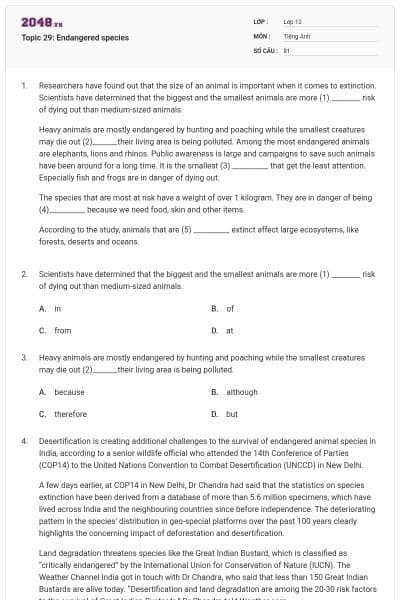
Researchers have found out that the size of an animal is important when it comes to extinction. Scientists have determined that the biggest and the smallest animals are more (1) ________ risk of dying out than medium-sized animals.
Heavy animals are mostly endangered by hunting and poaching while the smallest creatures may die out (2)_______their living area is being polluted. Among the most endangered animals are elephants, lions and rhinos. Public awareness is large and campaigns to save such animals have been around for a long time. It is the smallest (3) __________ that get the least attention. Especially fish and frogs are in danger of dying out.
The species that are most at risk have a weight of over 1 kilogram. They are in danger of being (4)__________ because we need food, skin and other items.
According to the study, animals that are (5) __________ extinct affect large ecosystems, like forests, deserts and oceans.
Scientists have determined that the biggest and the smallest animals are more (1) ________ risk of dying out than medium-sized animals.
in
of
from
at
Các nhà nghiên cứu đã phát hiện ra rằng kích thước của một con vật rất quan trọng khi nói đến sự tuyệt chủng. Các nhà khoa học đã xác định rằng động vật lớn nhất và nhỏ nhất có nguy cơ tử vong cao hơn động vật cỡ trung bình.
Động vật to lớn hủ yếu bị đe dọa bởi sự săn bắn và săn trộm trong khi những sinh vật nhỏ nhất có thể chết vì khu vực sinh sống của chúng đang bị ô nhiễm. Những loài động vật có nguy cơ tuyệt chủng cao nhất là voi, sư tử và tê giác. Nhận thức cộng đồng là rất lớn và các chiến dịch để cứu những động vật như vậy đã có từ lâu. Những loài nhỏ nhất thường ít được chú ý nhất. Đặc biệt là cá và ếch có nguy cơ chết dần chết mòn.
Những loài có nguy cơ cao nhất có trọng lượng chỉ hơn 1 kg. Chúng có nguy cơ bị giết vì chúng ta cần thực phẩm, da và các mặt hàng khác.
Theo nghiên cứu, động vật đang bị tuyệt chủng ảnh hưởng đến các hệ sinh thái lớn, như rừng, sa mạc và đại dương.
Đáp án D
Chủ đề ENVIROMENT
Kiến thức về cụm từ cố định
Ta có cụm từ: At risk of = in danger of: gặp nguy hiểm
Tạm dịch: Scientists have determined that the biggest and the smallest animals are more (1)____ risk of dying out than medium-sized animals.
(Các nhà khoa học đã xác định rằng động vật lớn nhất và động vật nhỏ nhất có nhiều nguy cơ bị đe dọa tuyệt chủng hơn là động vật cỡ trung bình.)
because
although
therefore
but
Đáp án A
Kiến thức về liên từ
A. because /bɪˈkəz/: bởi vì
B. although /ɔːlˈðəʊ/: mặc dù
C. therefore /ˈðeəfɔːr/: do đó
D. but /bʌt/: nhưng
Căn cứ vào nghĩa của câu ta thấy đây là quan hệ nhân quả.
Tạm dịch: Heavy animals are mostly endangered by hunting and poaching while the smallest creatures may die out (2) ________their living area is being polluted.
(Động vật lớn chủ yếu bị đe doạ bởi việc săn bắn và săn trộm trong khi các sinh vật nhỏ nhất có thể chết bởi vì khu vực sinh sống của chúng đang bị ô nhiễm.)
variety
species
groups
classes
Đáp án B
Kiến thức về từ vựng
A. variety /vəˈraɪəti/ (n): sự đa dạng
B. species /ˈspiːʃiːz/ (n): loài
C. group /ɡruːp/ (n): nhóm
D. class /klɑːs/ (n): tầng, lớp
Tạm dịch: It is the smallest (3) ____ that get the least attention. Especially fish and frogs are in danger of dying out.
(Chính những loài nhỏ nhất nhận được ít sự chú ý nhất. Đặc biệt là cá và ếch có nguy cơ tuyệt chủng.)
Các cấu trúc khác cần lưu ý:
in danger of: có nguy cơ bị
die out: tuyệt chủng
They are in danger of being (4)__________ because we need food, skin and other items.
raised
arrested
killed
purchased
Đáp án C
Kiến thức về từ vựng
A. raise /reɪz/ (v): nâng lên
B. arrest /əˈrest/ (v): bắt giữ
C. kill /kɪl/ (v): giết
D. purchase /ˈpɜːtʃəs/ (v): mua
Tạm dịch: The species that are most at risk have a weight of over 1 kilogram. They are in danger of being (4) ____ because we need food, skin and other items.
(Những loài gặp nguy hiểm cao nhất có trọng lượng lớn hơn 1 kg. Chúng có nguy cơ bị giết vì chúng ta cần thực phẩm, da và các mặt hàng khác.)
According to the study, animals that are (5) __________ extinct affect large ecosystems, like forests, deserts and oceans.
running
reaching
becoming
involving
Đáp án C
Kiến thức về cụm từ cố định
Ta có cấu trúc: Become extinct: bị tuyệt chủng
Tạm dịch: According to the study, animals that are (5) ____ extinct affect large ecosystems, like forests, deserts and oceans.
(Theo nghiên cứu, những động vật bị tuyệt chủng ảnh hưởng đến các hệ sinh thái lớn, như rừng, sa mạc và đại dương.)
Desertification is creating additional challenges to the survival of endangered animal species in India, according to a senior wildlife official who attended the 14th Conference of Parties (COP14) to the United Nations Convention to Combat Desertification (UNCCD) in New Delhi.
A few days earlier, at COP14 in New Delhi, Dr Chandra had said that the statistics on species extinction have been derived from a database of more than 5.6 million specimens, which have lived across India and the neighbouring countries since before independence. The deteriorating pattern in the species’ distribution in geo-special platforms over the past 100 years clearly highlights the concerning impact of deforestation and desertification.
Land degradation threatens species like the Great Indian Bustard, which is classified as “critically endangered” by the International Union for Conservation of Nature (IUCN). The Weather Channel India got in touch with Dr Chandra, who said that less than 150 Great Indian Bustards are alive today. “Desertification and land degradation are among the 20-30 risk factors to the survival of Great Indian Bustards,” Dr Chandra told Weather.com.
In simple terms, desertification is a process wherein fertile land becomes unusable, typically as a result of a long drought, deforestation, salinisation, intensive agricultural practices, and the excessive usage of insecticides, pesticides and chemicals. Desertification leads to hazardous effects on not just animals, but also on the food chain and the overall biodiversity—right from microscopic organisms to human beings.
Deforestation has affected over 30% of the land in India due to over-cultivation, soil erosion and depletion of wetlands. Along with India, the planet as a whole currently stares at the fast-growing threat of land degradation.
(Source: https://weather.com/)
The passage mainly discuss_______.
Miraculous recovery from the very edge of extinction.
Saving endangered species with the aid of laws and regulations.
Desertification, land degradation threatening endangered species.
Final changes to the Endangered Species Act.
Đáp án C
Đoạn văn chủ yếu thảo luận _______.
A. Phục hồi kỳ diệu từ chính bờ vực tuyệt chủng
B. Cứu các loài có nguy cơ tuyệt chủng với sự trợ giúp của pháp luật và các quy định
C. Sa mạc hóa, sự suy thoái đất đe dọa các loài có nguy cơ tuyệt chủng
D. Những thay đổi cuối cùng đối với Đạo luật về các loài có nguy cơ tuyệt chủng
Căn cứ vào thông tin đoạn đầu:
Desertification is creating additional challenges to the survival of endangered animal species in India, according to a senior wildlife official who attended the 14th Conference of Parties (COP14) to the United Nations Convention to Combat Desertification (UNCCD) in New Delhi.
(Sa mạc hóa đang tạo ra những thách thức thêm cho sự sống còn của các loài động vật có nguy cơ tuyệt chủng ở Ấn Độ, theo một quan chức động vật hoang dã cấp cao, người tham dự Hội nghị các bên lần thứ 14 (COP14) tham gia Công ước Liên hợp quốc về chống sa mạc hóa (UNCCD) tại New Delhi.)
=> Như vậy, đoạn văn đang nói về việc sa mạc hóa đe dọa đến các loài có nguy cơ tuyệt chủng.
The word “which” in paragraph 2 refers to _______.
samples
groups
news
packs
Đáp án A
Từ “which” trong đoạn 2 đề cập đến _______.
A. mẫu
B. nhóm
C. Tin tức
D. gói
Từ “which” ở đây dùng để thay thế cho danh từ mẫu được nhắc tới trước đó.
A few days earlier, at C0P14 in New Delhi, Dr Chandra had said that the statistics on species extinction have been derived from a database of more than 5.6 million specimens, which have lived across India and the neighbouring countries since before independence.
(Vài ngày trước đó, tại C0P14 ở New Delhi, Tiến sĩ Chandra đã nói rằng các số liệu thống kê về sự tuyệt chủng các loài đã được bắt nguồn từ một cơ sở dữ liệu của hơn 5,6 triệu mẫu vật, đã sống trên khắp Ấn Độ và các nước láng giềng từ trước khi giành độc lập.)
According to paragraph 3, why is the Great Indian Bustard labelled as “critically endangered”?
The statistics on the largest pack of the Great Indian Bustard stands at 150.
The total number of the species surviving is only a staggering 150 or less.
It is reported that the species has been completely eradicated in some areas.
The artificial environment like nature reserve is not suitable for this species.
Đáp án B
Theo đoạn 3, tại sao linh dương đen châu Phi được gắn nhãn là “nguy cấp nghiêm trọng”?
A. Số liệu thống kê về bầy linh dương đen châu Phi đông nhất nằm ở mức 150
B. Tổng số loài còn sống chỉ còn 150 hoặc ít hơn
C. Được biết, loài này đã bị xóa sổ hoàn toàn ở một số khu vực
D. Môi trường nhân tạo như khu bảo tồn thiên nhiên không phù hợp với loài này
Căn cứ vào thông tin đoạn ba:
The Weather Channel India got in touch with Dr Chandra, who said that less than 150 Great Indian Bustards are alive today.
(Kênh thời tiết Ấn Độ đã liên lạc với Tiến sĩ Chandra, người nói rằng chưa đến 150 con linh dương đen Ấn Độ còn sống đến ngày hôm nay.)
According to paragraph 4, which is NOT the cause of desertification?
A prolonged period of abnormally low rainfall, leading to a shortage of water.
The pollution in the natural areas such as the water sources.
Unsustainable agricultural techniques and overgrazing.
The abundance of vegetation that covers most of the ground from sunlight.
Đáp án D
Theo đoạn 4, đâu không phải là nguyên nhân của sa mạc hóa?
A. Một thời gian dài có lượng mưa thấp bất thường dẫn đến thiếu nước
B. Sự ô nhiễm trong các khu vực tự nhiên như các nguồn nước
C. Kỹ thuật nông nghiệp không bền vững và tăng nặng
D. Sự phong phú của thảm thực vật bao phủ hầu hết mặt đất từ ánh sáng mặt trời
Căn cứ vào thông tin đoạn bốn:
In simple terms, desertification is a process wherein fertile land becomes unusable, typically as a result of a long drought, deforestation, salinisation, intensive agricultural practices, and the excessive usage of insecticides, pesticides and chemicals.
(Nói một cách đơn giản, sa mạc hóa là một quá trình trong đó đất đai màu mỡ trở nên không thể sử dụng được, điển hình là kết quả của một đợt hạn hán kéo dài, sự phá rừng, nhiễm mặn, thâm canh thực hành và sử dụng quá nhiều thuốc trừ sâu, thuốc trừ sâu và hóa chất.)
The word “depletion” in paragraph 5 is closest in meaning to ______.
diminution
mistake
strand
consumption
Đáp án A
Từ “depletion” trong đoạn 5 có nghĩa gần nhất với_________.
A. giảm dần
B. sai lầm
C. sợi
D. tiêu dùng
Từ đồng nghĩa depletion (sự cạn kiệt) = diminution
Deforestation has affected over 30% of the land in India due to over-cultivation, soil erosion and depletion of wetlands.
(Phá rừng đã ảnh hưởng đến hơn 30% đất đai ở Ấn Độ do canh tác quá mức, xói mòn đất đai và sự cạn kiệt các vùng đất ngập nước.)
A new method for analyzing DNA collected from waterways which can help identify endangered bird species has been developed with the help of researchers from The University of Western Australia. The DNA analysis method developed also with researchers from Charles Darwin University and the Northern Territory’s Department of Environment and Natural Resources provides a new way of understanding the distribution of endangered birds by analyzing DNA collected in the waterways where they drink.
The research, which will be published in Endangered Species Research Journal, offers new possibilities to support conservation efforts and increase understanding of birds that are scarce and otherwise hard to capture data on. The team developed a probe to locate DNA in water samples of the critically endangered Gouldian Finch (Erythrura gouldiae), a rainbow-colored grassfinch endemic to the savanna woodlands of northern Australia.
UWA Professor Simon Jarman from the School of Biological Sciences said the researchers thought it would be hard to detect bird DNA in tropical conditions where the rate of DNA breakdown was high. “We were also sampling from pools where the water was not flowing and there was a lot of sediment and algal and bacterial growth,” Professor Jarman said. “However we were really pleased to get reliable bird detections from our methods showing DNA can be used to detect many species from the poles to the equator.”
Professor Jarman said the Gouldian Finch was a beautiful and iconic species that was endangered due to habitat loss from being hunted extensively. "The DNA method will help to map where the finches are currently found with great accuracy, which will help persuade people to conserve the areas where they live," he said.
(Source: https://phys.org/)
Which best serves as the title for the passage?
DNA may hold the clue to protecting endangered species.
Researching the genome of different wildlife animals.
Meeting the dead-end of conservation efforts.
Biologists carrying the same mission as geneticists.
Đáp án A
Câu nào sau đây thích hợp nhất làm tiêu đề cho đoạn văn?
A. DNA có thể giữ đầu mối để bảo vệ các loài có nguy cơ tuyệt chủng
B. Nghiên cứu bộ gen của động vật hoang dã khác nhau
C. Đáp ứng ngõ cụt của những nỗ lực bảo tồn
D. Các nhà sinh học mang sứ mệnh giống như các nhà di truyền học
Căn cứ vào thông tin đoạn đầu:
A new method for analyzing DNA collected from waterways which can help identify endangered bird species has been developed with the help of researchers from The University of Western Australia.
(Một phương pháp mới để phân tích DNA được thu thập từ đường thủy có thể giúp xác định các loài chim có nguy cơ tuyệt chủng đã được phát triển với sự giúp đỡ của các nhà nghiên cứu từ đại học miền tây nước Úc.)
=> Như vậy, đoạn văn đang nói về việc phân tích DNA có thể giúp bảo vệ các loài có nguy cơ tuyệt chủng.
According to paragraph 1, how many sides contributed to the development of the new DNA analysis practice?
Two universities and one government department.
One government-funded team.
Two universities and one independent organization.
Three different universities.
Đáp án A
Theo đoạn 1, có bao nhiêu tổ chức đã đóng góp cho việc phát triển phương pháp phân tích DNA mới?
A. Hai trường đại học và một cơ quan thuộc quốc gia.
B. Một đoàn đội được chính phủ tài trợ.
C. Hai trường đại học và một tổ chức tư nhân.
D. Bốn trường đại học khác nhau
Căn cứ thông tin đoạn 1:
A new method for analyzing DNA collected from waterways which can help identify endangered bird species has been developed with the help of researchers from The University of Western Australia. The DNA analysis method developed also with researchers from Charles Darwin University and the Northern Territory’s Department of Environment and Natural Resources provides a new way of understanding the distribution of endangered birds by analyzing DNA collected in the waterways where they drink.
(Một phương pháp mới để phân tích DNA thu thập từ đường thủy có thể giúp xác định các loài chim có nguy cơ tuyệt chủng đã được phát triển với sự giúp đỡ của các nhà nghiên cứu từ Đại học Tây Úc. Phương pháp phân tích DNA, được phát triển với các nhà nghiên cứu từ Đại học Charles Darwin và Bộ Tài nguyên và Môi trường của Lãnh thổ phía Bắc, cung cấp một cách hiểu mới về sự phân bố của các loài chim đang bị đe dọa bằng cách phân tích DNA thu thập trong đường thủy nơi chúng uống nước.)
The word “endemic” in paragraph 2 is closest in meaning to ______.
local
colonial
foreign
native
Đáp án D
Từ “endemic” trong đoạn 2 có nghĩa gần nhất với ______.
A. địa phương
B. thuộc địa
C. ngoại quốc
D. bản địa
=> Từ đồng nghĩa: Endemic (đặc hữu) = native
Tạm dịch: The team developed a probe to locate DNA in water samples of the critically endangered Gouldian Finch (Erythrura gouldiae), a rainbow- colored grassflnch endemic to the savanna woodlands of northern Australia.
Nhóm nghiên cứu đã phát triển một máy dò để xác định vị trí DNA trong mẫu nước của Gouldian Finch cực kỳ nguy cấp (Erythrura gouldiae), một loại cỏ có màu bảy sắc cầu vồng đặc hữu của vùng rừng savanna ở miền bắc Australia.
According to paragraph 3, why did Professor Simon Jarman describe the investigated area?
To contrast with the previous misdirected research’s methodology.
To demonstrate how the area can yield environmental DNA data.
To illustrate the rich biodiversity living in the examined spots.
To exemplify the typical working environment of biology on-site researchers.
Đáp án B
Theo đoạn 3, tại sao giáo sư Simon Jarman mô tả khu vực điều tra?
A. Để tương phản với phương pháp nghiên cứu sai lầm trước đây
B. Để chứng minh làm thế nào khu vực có thể mang lại dữ liệu DNA về môi trường
C. Để minh họa sự đa dạng sinh học phong phú sống trong các điểm được kiểm tra
D. Để minh họa môi trường làm việc điển hình của các nhà nghiên cứu sinh học tại chỗ
Căn cứ vào thông tin đoạn ba:
“We were also sampling from pools where the water was not flowing and there was a lot of sediment and algal and bacterial growth,” Professor Jarman said.” However we were really pleased to get reliable bird detections from our methods showing DNA can be used to detect many species from the poles to the equator.”
(“Chúng tôi cũng đã lấy mẫu từ các hồ bơi, nơi nước không chảy và có rất nhiều trầm tích, tảo và vi khuẩn phát triển.” Giáo sư Jarman nói. Tuy nhiên chúng tôi đã thực sự hài lòng khi nhận được các phát hiện về loài chim đáng tin cậy từ các phương pháp của chúng tôi, cho thấy DNA có thể được sử dụng để phát hiện nhiều loài từ cực đến xích đạo.”)
The word “they” in paragraph 4 refers to _______.
species
finches
areas
people
Đáp án B
Từ “they” trong đoạn 4 đề cập đến_______.
A. loài
B. chim họ sẻ
C. khu vực
D. người
=> Từ “they” dùng để thay thế cho danh từ chim họ sẻ được nhắc tới trước đó.
“The DNA method will help to map where the Finches are currently found with great accuracy, which will help persuade people to conserve the areas where they live,” he said.
“Phương pháp DNA sẽ giúp sắp xếp nơi chim họ sẻ được tìm thấy gần đây với độ chính xác cao, điều này sẽ giúp thuyết phục mọi người để bảo tồn các khu vực chúng sống,” ông nói.
Elephants need a large amount of habitat because they eat so much. Humans have become their direct competitors for living space. Human populations in Africa and Asia have quadrupled since the turn of the century, the fastest growth rate on the planet. Forest and savanna habitat has been converted to cropland, pastureland for livestock, and timber for housing and fuel.
Humans do not regard elephants as good neighbors. When humans and elephants live close together, elephants raid crops, and rogue elephants rampage through villages. Local people shoot elephants because they fear them and regard them as pests. Some countries have established culling programs: park officials or hunters kill a predetermined number of elephants to keep herds manageable and minimize human-elephant conflicts.
Hunting has been a major cause of the decline in elephant populations. Elephants became prized trophies for big-game hunters after Europeans arrived in Africa. More recently, and more devastatingly, hunters have slaughtered elephants for their ivory tusks. The ivory trade became a serious threat to elephants in the 1970s.
A sudden oil shortage caused the world economy to collapse, and ivory became more valuable than gold. In fact, ivory has been called “white gold” because it is beautiful, easily carved, durable, and pleasing to the touch. Most of the world’s ivory is carved in Japan, Hong Kong, and other Asian countries, where skilled carvers depend on a supply of ivory for their livelihoods.
Hunting elephants is no longer legal in many African countries, but poaching was widespread until very recently. For many the high price of ivory, about $100 a pound in the 1980s, was too tempting to resist. Local people often had few other ways to make a living, and subsistence farmers or herders could make more by selling the tusks of one elephant than they could make in a dozen years of farming or herding.
As the price of ivory soared, poachers became more organized, using automatic weapons, motorized vehicles, and airplanes to chase and kill thousands of elephants. To governments and revolutionaries mired in civil wars and strapped for cash, poaching ivory became a way to pay for more firearms and supplies.
Poaching has caused the collapse of elephants’ social structure as well as decimating their numbers. Poachers target the biggest elephants because their tusks are larger. They often kill all the adults in the group, leaving young elephants without any adults to teach them migration routes, dry-season water sources, and other learned behavior. Many of Africa’s remaining elephant groups are leaderless subadults and juveniles.
(Source: http://www.bagheera.com)
What is the main idea of the passage?
Elephants and their valuable tusk
Reasons why elephants are in danger
Ivory trade in the world
Elephant poaching in the past
Đáp án B
Ý chính của đoạn văn trên là gì?
A. Voi và cặp ngà giá trị của chúng
B. Lý do vì sao loài voi bị đe dọa
C. Buôn bán ngà voi trên thế giới
D. Săn trộm voi trong quá khứ
Căn cứ thông tin toàn bài, đọc để khái quát ý chủ đạo của cả đoạn văn:
Đoạn 2: Local people shoot elephants because they fear them and regard them as pests.
(Người dân địa phương bắn voi vì họ sợ chúng và coi chúng là loài gây hại.)
Đoạn 3: Hunting has been a major cause of the decline in elephant populations. Elephants became prized trophies for big-game hunters after Europeans arrived in Africa. More recently, and more devastatingly, hunters have slaughtered elephants for their ivory tusks. The ivory trade became a serious threat to elephants in the 1970s.
(Săn bắn là nguyên nhân chính gây ra sự suy giảm số lượng voi. Voi trở thành những giải thưởng được đánh giá cao cho những thợ săn lớn sau khi người châu Âu đến châu Phi. Gần đây hơn, và càng tàn phá hơn, thợ săn đã tàn sát voi để lấy ngà của chúng. Buôn bán ngà voi trở thành mối đe dọa nghiêm trọng đối với voi trong thập niên 1970.)
Đoạn 4: A sudden oil shortage caused the world economy to collapse, and ivory became more valuable than gold. In fact, ivory has been called “white gold” because it is beautiful, easily carved, durable, and pleasing to the touch.
(Sự thiếu hụt dầu mỏ đột ngột khiến nền kinh tế thế giới sụp đổ, và ngà voi trở nên có giá trị hơn vàng. Trong thực tế, ngà voi được gọi là “vàng trắng” vì nó đẹp, dễ chạm khắc, bền và dễ chịu khi chạm vào.)
Đoạn 5: Local people often had few other ways to make a living, and subsistence farmers or herders could make more by selling the tusks of one elephant than they could make in a dozen years of farming or herding.
(Người dân địa phương thường có vài cách khác để kiếm sống, và nông dân hoặc người chăn nuôi có thể kiếm được nhiều tiền hơn bằng cách bán ngà voi so với số tiền họ có thể kiếm được trong hàng chục năm canh tác hoặc chăn gia súc.)
Đoạn 6: To governments and revolutionaries mired in civil wars and strapped for cash, poaching ivory became a way to pay for more firearms and supplies.
(Đối với các chính phủ và các nhà cách mạng bị sa lầy trong các cuộc nội chiến và bị kẹt tiền mặt, ngà voi săn trộm đã trở thành một cách để trả tiền cho nhiều vũ khí và vật dụng hơn.)
What does the word “them” in the second paragraph refer to?
elephants
people
villages
neighbors
Đáp án A
Từ “them” trong đoạn 2 chỉ điều gì?
A. voi
B. con người
C. làng
D. hàng xóm
Kiến thức ngữ pháp và cấu trúc câu:
Local people shoot elephants because they fear them and regard them as pests.
(Người dân địa phương bắn voi vì họ sợ chúng và coi chúng là loài gây hại.)
According to the second paragraph, culling programs have been established as a method to ______.
manage the heard of elephants better
make elephants humans’ neighbor
stop them from rampaging through villages
eliminate fear of elephant
Đáp án A
Theo đoạn 2, chương trình loại bỏ bớt voi được thành lập như một phương pháp để ______.
A. quản lý đàn voi tốt hơn
B. biến voi trở thành hàng xóm
C. ngăn chúng không tàn phá làng mạc
D. loại bỏ nỗi sợ voi
Căn cứ thông tin đoạn 2:
Some countries have established culling programs: park officials or hunters kill a predetermined number of elephants to keep herds manageable and minimize human-elephant conflicts.
(Một số quốc gia đã thiết lập các chương trình tiêu hủy: cán bộ công viên hoặc thợ săn giết số lượng voi được xác định trước để giữ cho đàn voi có thể quản lý được và giảm thiểu xung đột giữa con người và voi.)
The word “trophies” in the third paragraph can be best replaced by ____.
prizes
victories
awards
triumphs
Đáp án C
Từ “trophies” trong đoạn 3 được thay thế tốt nhất bởi ______.
A. giải thưởng (thứ gì có giá trị, chẳng hạn tiền bạc được trao tặng cho ai nếu họ thắng cuộc thi, game,…)
B. chiến thắng
C. phần thưởng, vật kỷ niệm chiến thắng (trong cuộc thi, cuộc đua, săn bắn,…)
D. thành công, thắng lợi
Kiến thức từ đồng nghĩa: trophy (phần thưởng) = award
Elephants became prized trophies for big-game hunters after Europeans arrived in Africa.
(Voi trở thành những phần thưởng được đánh giá cao cho những thợ săn lớn sau khi người châu Âu đến châu Phi.
Which of the following is NOT mentioned as a reason why ivory is valuable?
beauty
symbol of luck
durability
high price
Đáp án B
Thông tin nào sau đây KHÔNG được nhắc đến như một lý do vì sao ngà voi giá trị?
A. vẻ đẹp
B. biểu tượng may mắn
C. sự bền bỉ
D. giá cao
Căn cứ thông tin đoạn 4:
A sudden oil shortage caused the world economy to collapse, and ivory became more valuable than gold. In fact, ivory has been called “white gold” because it is beautiful, easily carved, durable, and pleasing to the touch.
(Sự thiếu hụt dầu mỏ đột ngột khiến nền kinh tế thế giới sụp đổ, và ngà voi trở nên có giá trị hơn vàng. Trong thực tế, ngà voi được gọi là “vàng trắng” vì nó đẹp, dễ chạm khắc, bền và dễ chịu khi chạm vào.)
What does the word “durable” in the forth paragraph mostly mean?
long-tongued
long-limbed
long-lasting
long-wearing
Đáp án D
Từ “durable” trong đoạn 4 có nghĩa là gì?
A. nói nhiều
B. chi dài
C. lâu dài
D. bền bỉ
Kiến thức từ vựng, từ đồng nghĩa: durable (bền bỉ) = long-wear
In fact, ivory has been called “white gold” because it is beautiful, easily carved, durable, and pleasing to the touch.
(Trong thực tế, ngà voi được gọi là “vàng trắng” vì nó đẹp, dễ chạm khắc, bền và dễ chịu khi chạm vào.)
What is the main idea of the fifth paragraph?
Hunting elephants is no longer legal in many African countries.
Poaching was widespread until very recently.
Hunting elephant is illegal, but poaching was popular recently due to the high value of ivory.
The high price of ivory was too tempting to resist.
Đáp án C
Ý chính của đoạn 5 là gì?
A. Săn voi không còn là hợp pháp ở nhiều nước châu Phi.
B. Gần đây nạn săn trộm đã lan rộng.
C. Săn voi là bất hợp pháp nhưng nạn săn trộm vẫn phổ biến do giá trị cao của ngà voi.
D. Giá ngà voi cao, quá hấp dẫn, không thể cưỡng lại.
Căn cứ thông tin đoạn 5, đọc và khái quát ý chính:
Hunting elephants is no longer legal in many African countries, but poaching was widespread until very recently. For many the high price of ivory, about $100 a pound in the 1980s, was too tempting to resist. Local people often had few other ways to make a living, and subsistence farmers or herders could make more by selling the tusks of one elephant than they could make in a dozen years of farming or herding.
(Săn voi không còn hợp pháp ở nhiều nước châu Phi, nhưng nạn săn trộm đã lan rộng cho đến gần đây. Đối với nhiều người, giá ngà voi cao, khoảng 100 đô la một pound trong thập niên 1980, là quá hấp dẫn để cưỡng lại. Người dân địa phương thường có vài cách khác để kiếm sống, và nông dân hoặc người chăn nuôi có thể kiếm được nhiều tiền hơn bằng cách bán ngà voi so với số tiền họ có thể kiếm được trong hàng chục năm canh tác hoặc chăn gia súc.
What can be inferred from the last paragraph?
Poachers want to make elephants’ social structure collapse.
Poachers target the biggest elephants to make the heard leaderless.
Poachers want to give the subadults and juveniles no chance to learn from the adult elephants.
Poachers kill the biggest adult elephants for their big ivory and make the heard leaderless.
Đáp án D
Thông tin nào có thể được suy ra từ đoạn cuối?
A. Những kẻ săn trộm muốn làm cho cấu trúc quần thể voi sụp đổ.
B. Những kẻ săn trộm nhắm đến những con voi lớn nhất để làm cho đàn voi không có con đầu đàn.
C. Những kẻ săn trộm không muốn cho những con voi non cơ hội học hỏi từ voi trưởng thành.
D. Những kẻ săn trộm giết voi trưởng thành lớn nhất để lấy ngà to và khiến đàn voi trở nên không có voi đầu đàn.
Căn cứ thông tin đoạn cuối:
Poaching has caused the collapse of elephants’ social structure as well as decimating their numbers. Poachers target the biggest elephants because their tusks are larger. They often kill all the adults in the group, leaving young elephants without any adults to teach them migration routes, dry-season water sources, and other learned behavior. Many of Africa’s remaining elephant groups are leaderless subadults and juveniles.
(Săn trộm đã gây ra sự phá vỡ của cấu trúc quần thể voi cũng như làm giảm số lượng của chúng. Những kẻ săn trộm nhắm vào những con voi lớn nhất bởi vì ngà của chúng lớn hơn. Họ thường giết tất cả voi trưởng thành trong đàn, để lại những con voi non mà không có bất kỳ voi trưởng thành nào dạy cho chúng những con đường di cư, nguồn nước trong mùa khô và những hành vi cần học khác. Nhiều nhóm voi còn lại của châu Phi là những con voi chưa trưởng thành và non nớt.)
Human’s avarice for ivory has resulted in thousands of unfathomable elephant atrocities and senseless suffering that has pushed the species to the brink of extinction. In 2015, the U.S. and China announced they will work together to enact a near complete ban on the import and export of ivory. As an industry that has largely been driven by China and, if substantiated, these claims could be a ray of light for one of the most endangered animals in the kingdom.
However, as the famous saying goes, “for every action, there is an equal and opposite reaction.” With the worldwide attention on elephant ivory, hippo teeth, which can grow up to three-feet-long, have become the next target. Since the United Nations Convention on International Trade in Endangered Species officially imposed a ban on ivory trading in 1990, about 30,000 pounds per year of hippo teeth have been exported from Africa.
On a recent trip to Kenya, I had the unfortunate displeasure of meeting these facts face-to-face. On the banks of the Mara River, the infamous transient point of the great wildebeest migration, I met a Conservancy Ranger, a local Kenyan, named Ivan. He led me along a narrow path above the riverbed to view pods of hippos. They clumped together in the river, every few minutes lifting their heads above the waterline to welcome my arrival. Despite their label as one of the most dangerous animals in Africa, they were playful to watch. Their tiny ears and eyes would appear from the murky river and then, with a splash, they would disappear. The river is everything to the hippo, Ivan explained, it is their lifeline. The only real time they leave the river is during their nightly ritual of traveling to nearby plains to consume grasses. Contrary to their aggressiveness, they are vegetarians.
As we neared the end of our trek, we reached the Mara Bridge, spanning the divide between Kenya and Tanzania. An undeniable stench filled the air. Our gaze fell to the water beneath the structure, and as if to mark the metaphorical significance of the passage, lay a poached hippo. It had been killed the previous night, probably as it grazed unsuspectingly under the cover of darkness. They had found spear punctures in its body, and its teeth were missing. It had somehow, in unthinkable pain, made its way back to the river, its home, to die.
(Source: http://www.onegreenplanet.org)
What is the main idea of the passage?
China and The U.S will work together to stop poachers.
How poachers in Kenya get hippo’s teeth.
Hippos are dangerous and funny to watch.
Endangered hippos are being poached for their teeth.
Đáp án D
Ý chính của đoạn văn là gì?
A. Trung Quốc và Hoa Kỳ sẽ làm việc cùng nhau để ngăn chặn những kẻ săn trộm.
B. Làm thế nào những kẻ săn trộm ở Kenya có được răng của hà mã.
C. Hà mã nguy hiểm và quan sát chúng rất vui.
D. Những con hà mã đang bị đe dọa đang bị săn lùng để lấy răng.
Căn cứ thông tin toàn bài và đoạn mở đầu:
Human’s avarice for ivory has resulted in thousands of unfathomable elephant atrocities and senseless suffering that has pushed the species to the brink of extinction. In 2015, the U.S. and China announced they will work together to enact a near complete ban on the import and export of ivory. As an industry that has largely been driven by China and, if substantiated, these claims could be a ray of light for one of the most endangered animals in the kingdom.
(Nhu cầu sở hữu ngà voi của con người đã dẫn đến hàng ngàn tội ác không thể biết hết được đối với voi và sự đau khổ vô nghĩa đó đã đẩy các loài đến bờ vực tuyệt chủng. Vào năm 2015, Mỹ và Trung Quốc tuyên bố họ sẽ làm việc cùng nhau để ban hành lệnh cấm nhập khẩu và xuất khẩu ngà voi gần như hoàn toàn. Là một ngành công nghiệp phần lớn do Trung Quốc điều hành và nếu được chứng minh thì những tuyên bố này có thể là một tia hy vọng cho một trong những loài động vật có nguy cơ tuyệt chủng cao nhất trong vương quốc động vật.)
What does the first paragraph mainly discuss?
Many species have been pushed to the brink of extinction because of their ivory and teeth.
Animals have been pushed to the brink of extinction and actions of The U.S and China to stop it.
China will work to end the importation of ivory and animal teeth from the U.S.
A ray of light for one of the most endangered animals is being substantiated by China.
Đáp án B
Đoạn văn đầu tiên chủ yếu thảo luận điều gì?
A. Nhiều loài đã bị đẩy đến bờ vực tuyệt chủng vì ngà và răng của chúng.
B. Động vật đã bị đẩy đến bờ vực tuyệt chủng và hành động của Hoa Kỳ và Trung Quốc để ngăn chặn nó.
C. Trung Quốc sẽ làm việc để chấm dứt việc nhập khẩu ngà voi và răng động vật từ Hoa Kỳ.
D. Một tia hi vọng cho một trong những động vật đang bị đe dọa nhất đang được Trung Quốc chứng minh.
Căn cứ thông tin đoạn 1:
Human’s avarice for ivory has resulted in thousands of unfathomable elephant atrocities and senseless suffering that has pushed the species to the brink of extinction. In 2015, the U.S. and China announced they will work together to enact a near complete ban on the import and export of ivory.
(Nhu cầu sở hữu ngà voi của con người đã dẫn đến hàng ngàn tội ác không thể biết hết được đối với voi và sự đau khổ vô nghĩa đó đã đẩy các loài đến bờ vực tuyệt chủng. Vào năm 2015, Mỹ và Trung Quốc tuyên bố họ sẽ làm việc cùng nhau để ban hành lệnh cấm nhập khẩu và xuất khẩu ngà voi gần như hoàn toàn.)
What does the word “substantiated” in the first paragraph mostly mean?
to provide information or evidence to prove that something is true
to take a number or an amount away from another number or amount
to make something begin
to produce a change in somebody/something
Đáp án A
Từ “substantiated” trong đoạn đầu tiên có ý nghĩa gì?
A. Cung cấp thông tin hoặc bằng chứng để chứng minh rằng điều gì đó là đúng.
B. Lấy một số hoặc một lượng đi từ một số hoặc một lượng khác.
C. Làm cho một cái gì đó bắt đầu.
D. Tạo ra một sự thay đổi đối với ai đó / một cái gì đó.
Kiến thức từ vựng: to substantiate = chứng minh
As an industry that has largely been driven by China and, if substantiated, these claims could be a ray of light for one of the most endangered animals in the kingdom.
(Là một ngành công nghiệp phần lớn do Trung Quốc điều hành và nếu được chứng minh thì những tuyên bố này có thể là một tia hy vọng cho một trong những loài động vật có nguy cơ tuyệt chủng cao nhất trong vương quốc động vật.)
What does the word “which” in the second paragraph refer to?
saying
action
elephant ivory
hippo teeth
Từ “which” trong đoạn thứ hai đề cập đến?
A. nói
B. hành động
C. ngà voi
D. răng hà mã
Kiến thức ngữ pháp và khả năng suy luận, phán đoán:
With the worldwide attention on elephant ivory, hippo teeth, which can grow up to three-feet-long, have become the next target.
(Với sự chú ý trên toàn thế giới đối với ngà voi, răng hà mã, có thể phát triển dài đến ba feet, đã trở thành mục tiêu tiếp theo.)
According to the third paragraph, which of the following information is NOT true about hippos?
Hippos are friendly and playful to watch.
Hippos have tiny ears and eyes.
Hippos are carnivorous.
Hippos live in the river.
Đáp án C
Theo đoạn thứ ba, thông tin nào sau đây KHÔNG đúng về hà mã?
A. Hà mã thân thiện và vui nhộn để xem.
B. Hà mã có đôi tai và đôi mắt nhỏ.
C. Hà mã là loài ăn thịt.
D. Hà mã sống ở sông.
Căn cứ nội dung đoạn 3, tất cả các thông tin đều đúng trừ việc “Hà mã là loài ăn thịt”:
The only real time they leave the river is during their nightly ritual of traveling to nearby plains to consume grasses. Contrary to their aggressiveness, they are vegetarians.
(Thời gian thực duy nhất chúng rời sông là những chuyến đi hàng đêm của chúng đến vùng đồng bằng gần đó để ăn cỏ. Trái với sự hung hăng của chúng, hà mã là loài chỉ ăn thực vật.)
The word “aggressiveness” in the third paragraph be best replaced by ______.
hospitability
hostility
responsibility
ability
Từ “agressiveness” trong đoạn thứ ba được thay thế tốt nhất bởi ______.
A. hiếu khách
B. thù địch
C. resposibility
D. khả năng
Kiến thức từ vựng và từ đồng nghĩa: agressiveness (sự hung hăng) = hostility
Contrary to their aggressiveness, they are vegetarians.
(Trái với sự hung hăng của chúng, hà mã là loài chỉ ăn thực vật.)
Which of the following best describe author’s feeling about the hippo in the last paragraph?
pleasant
satisfied
unhappy
neutral
Đáp án C
Từ nào sau đây mô tả đúng nhất về cảm nhận của tác giả về hà mã trong đoạn cuối?
A. dễ chịu
B. hài lòng
C. không hài lòng
D. trung lập
Căn cứ thông tin đoạn cuối, khái quát và đánh giá cảm nhận của tác giả thông qua cách viết, ngôn từ:
As we neared the end of our trek, we reached the Mara Bridge, spanning the divide between Kenya and Tanzania. An undeniable stench filled the air. Our gaze fell to the water beneath the structure, and as if to mark the metaphorical significance of the passage, lay a poached hippo. It had been killed the previous night, probably as it grazed unsuspectingly under the cover of darkness. They had found spear punctures in its body, and its teeth were missing. It had somehow, in unthinkable pain, made its way back to the river, its home, to die.
(Khi chúng tôi gần cuối chuyến đi của mình, chúng tôi đã đến Cầu Mara, bắc qua đường phân nước giữa Kenya và Tanzania. Mùi hôi thối nồng nặc tràn ngập không khí. Ánh mắt của chúng tôi rơi xuống mặt nước bên dưới cấu trúc cây cầu, và như thể để đánh dấu ý nghĩa ẩn dụ của việc chúng tôi qua đây, một con hà mã bị săn trộm. Nó đã bị giết vào đêm hôm trước, có lẽ vì nó đã đi ăn một cách ngây thơ trong bóng tối. Họ đã tìm thấy các vết thương trên thân con hà mã và răng của nó đã bị mất. Bằng cách nào đó, trong cơn đau không thể tưởng tượng nổi, nó đã quay trở lại dòng sông - ngôi nhà của nó - để chết.)
Which of the following best serves as the title for the passage?
Endangered hippos
Value of hippos teeth
Hippos habitat
Hippos are vegetarians
Đáp án A
Phương án nào sau đây có thể là tiêu đề cho đoạn văn?
A. Hà mã bị đe dọa
B. Giá trị của răng hà mã
C. Môi trường sống của hà mã
D. Hà mã là loài ăn chay
Căn cứ thông tin toàn bài để tìm ra phương án khải quát và phù hợp nhất:
Đoạn 1: Human’s avarice for ivory has resulted in thousands of unfathomable elephant atrocities and senseless suffering that has pushed the species to the brink of extinction.
(Nhu cầu sở hữu ngà voi của con người đã dẫn đến hàng ngàn tội ác không thể biết hết được đối với voi và sự đau khổ vô nghĩa đó đã đẩy các loài đến bờ vực tuyệt chủng.)
Đoạn 2: With the worldwide attention on elephant ivory, hippo teeth, which can grow up to three-feet-long, have become the next target.
(Với sự chú ý trên toàn thế giới đối với ngà voi, răng hà mã, có thể phát triển dài đến ba feet, đã trở thành mục tiêu tiếp theo.)
Đoạn cuối: Our gaze fell to the water beneath the structure, and as if to mark the metaphorical significance of the passage, lay a poached hippo. It had been killed the previous night, probably as it grazed unsuspectingly under the cover of darkness. They had found spear punctures in its body, and its teeth were missing. It had somehow, in unthinkable pain, made its way back to the river, its home, to die.
(Ánh mắt của chúng tôi rơi xuống mặt nước bên dưới cấu trúc cây cầu, và như thể để đánh dấu ý nghĩa ẩn dụ của việc chúng tôi qua đây, một con hà mã bị săn trộm. Nó đã bị giết vào đêm hôm trước, có lẽ vì nó đã đi kiếm ăn một cách ngây thơ trong bóng tối. Họ đã tìm thấy các vết thương trên thân con hà mã và răng của nó đã bị mất. Bằng cách nào đó, trong cơn đau không thể tưởng tượng nổi, nó đã quay trở lại dòng sông - ngôi nhà của nó - để chết.)
The climate crisis is poised to deliver a severe blow to America’s most threatened animals, with a new study finding that almost every species considered endangered is vulnerable in some way to global heating. Of the 459 animal species listed as endangered by the US government, researchers found that all but one, or 99.8%, have characteristics that will make it difficult for them to adapt to rising temperatures.
The California condor, once close to being completely wiped out, faces increased risk of contamination in hotter conditions. Key deer, found only in the Florida Keys, face losing habitat to the rising seas. Whole classes of animals including amphibians, mollusks and arthropods are sensitive to the greatest number of climate-related threats, such as changes in water quality, shifting seasons and harmful invasive species that move in as temperatures climb. Mammals, such as the north Atlantic right whale and Florida panther, also face increased hardships, albeit on fewer fronts than amphibians, mollusks and arthropods.
Despite the overwhelming peril faced by America’s endangered species due to the climate crisis, the report, published in Nature Climate Change, found a patchy response from the US government. Federal agencies consider just 64% of endangered species to be threatened by the climate crisis, while just 18% of listed species have protection plans in place. Astrid Caldas, a study co-author and a climate scientist at the Union of Concerned Scientists said: “While agencies have increasingly listed climate change as a growing threat to species whose survival is already precarious, many have not translated this concern into tangible actions, meaning a significant protection gap still exists.”
Nearly half of Australian species are threatened by the climate crisis, researchers have found. A spokesman for the US Fish and Wildlife Service, which oversees the endangered species list, said that while a species may be sensitive to changes in the climate, this sensitivity may not be so severe as to warrant being put on the list. “Our process for determining this looks at five factors: threats to a species’ habitat, overutilization, disease or predation, existing regulatory mechanisms, and other factors that may affect its continued existence,” he said. “Through this scientifically rigorous process we examine and account for the effects of climate change.
(Source: https://www.theguardian.com/)
Which best serves as the title for the passage?
The widespread effects of global warming.
Government’s negligence in preserving nature heritage.
The animals that will survive the climate change.
Endangered species struggling to adapt to climate crisis.
Đáp án D
Câu nào sau đây thích hợp nhất làm tiêu đề cho đoạn văn?
A. Những ảnh hưởng rộng rãi của sự nóng lên toàn cầu
B. Sự cẩu thả của chính phủ trong việc bảo tồn di sản thiên nhiên
C. Những động vật sẽ sống sót qua biến đổi khí hậu
D. Các loài có nguy cơ tuyệt chủng đang phải vật lộn để thích nghi với khủng hoảng khí hậu
Căn cứ vào thông tin đoạn đầu:
The climate crisis is poised to deliver a severe blow to America’s most threatened animals, … Of the 459 animal species listed as endangered by the US government, researchers found that all but one, or 99.8%, have characteristics that will make it difficult for them to adapt to rising temperatures.
(Cuộc khủng hoảng khí hậu đã sẵn sàng giáng một đòn nặng nề vào phần lớn động vật đã bị đe dọa ở Mỹ, … Trong số 459 loài động vật được liệt kê là có nguy cơ tuyệt chủng của chính phủ Hoa Kỳ, các nhà nghiên cứu đã phát hiện ra rằng tất cả, ngoại trừ một, hoặc 99,8%, có những đặc điểm sẽ gây cho chúng khó khăn cho h để thích nghi với nhiệt độ tăng.)
Như vậy, đoạn văn đang nói về việc các loài có nguy cơ tuyệt chủng đang phải vật lộn để thích nghi với khủng hoảng khí hậu.
The word “poised” in paragraph 1 is closest in meaning to _______.
prepared
organised
equipped
designed
Đáp án A
Từ “poised” trong đoạn 1 có nghĩa gần nhất với______.
A. chuẩn bị
B. tổ chức
C. trang bị
D. thiết kế
Từ đồng nghĩa poise (sẵn sàng) = prepare
The climate crisis is poised to deliver a severe blow to America’s most threatened animals, …
(Cuộc khủng hoảng khí hậu đã sẵn sàng giáng một đòn nặng nề vào phần lớn động vật đã bị đe dọa ở Mỹ)
According to paragraph 2, what did the author imply when listing several species and their situation?
The reported cases were a small fraction of what is really happening.
An array of threats faces many already endangered species.
The level of animal suffering is proportion to human’s ignorance.
The impacts of climate change are getting out of hand.
Đáp án B
Theo đoạn 2, tác giả đã ngụ ý gì khi liệt kê một số loài và tình hình của chúng?
A. Các trường hợp được báo cáo là một phần nhỏ của những gì đang thực sự xảy ra
B. Một loạt các mối đe dọa đang đến với nhiều loài vốn đã bị đe dọa
C. Mức độ đau khổ của động vật tỷ lệ thuận với sự thiếu hiểu biết của con người
D. Các tác động của biến đổi khí hậu đang vượt ra khỏi sự kiểm soát
Căn cứ vào thông tin đoạn hai:
The California condor, once close to being completely wiped out, faces increased risk of contamination in hotter conditions. Key deer, found only in the Florida Keys, face losing habitat to the rising seas. Whole classes of animals including amphibians, mollusks and arthropods are sensitive to the greatest number of climate-related threats, such as changes in water quality, shifting seasons and harmful invasive species that move in as temperatures climb. Mammals, such as the north Atlantic right whale and Florida panther, also face increased hardships, albeit on fewer fronts than amphibians, mollusks and arthropods.
(Kền kền California, đã từng gần như bị xóa sổ hoàn toàn, đang đối mặt với nguy hiểm ngày càng tăng của ô nhiễm trong điều kiện nóng hơn. Hươu Key, chỉ được tìm thấy ở Florida Keys, đang đối mặt với việc mất môi trường sống do mực nước biển đang lên. Toàn bộ các lớp động vật bao gồm động vật lưỡng cư, động vật thân mềm và động vật chân đốt nhạy cảm với nhiều mối đe dọa liên quan đến khí hậu nhất, chẳng hạn như thay đổi chất lượng nước, sự thay đổi mùa và các loài xâm lấn có hại khi nhiệt độ tăng cao. Động vật có vú, chẳng hạn như cá voi phía bắc Đại Tây Dương và báo Florida, cũng phải đối mặt với những khó khăn gia tăng, mặc dù trên ít khía cạnh hơn động vật lưỡng cư, động vật thân mềm và động vật chân đốt.)
According to paragraph 3, which word best describe the reaction of the government to the problem?
Slow
Random
Inadequate
Constant
Đáp án C
Theo đoạn 3, từ nào mô tả đúng nhất phản ứng của chính phủ vấn đề này?
A. Chậm
B. Ngẫu nhiên
C. Không đầy đủ
D. Không đổi
Căn cứ vào thông tin đoạn ba:
Federal agencies consider just 64% of endangered species to be threatened by the climate crisis, while just 18% of listed species have protection plans in place.
(Các cơ quan liên bang xem xét chỉ 64% các loài có nguy cơ tuyệt chủng bị đe dọa bởi khủng hoảng khí hậu, trong khi chỉ có 18% các loài được liệt kê có kế hoạch bảo vệ.)
The word “mechanisms” in paragraph 4 is closest in meaning to _______.
instruments
machines
techniques
systems
Đáp án D
Từ “mechanisms” trong đoạn 4 có nghĩa gần nhất với _____.
A. dụng cụ
B. máy móc
C. kỹ thuật
D. hệ thống
Từ đồng nghĩa mechanism (cơ chế) = system
“Our process for determining this looks at five factors: threats to a species’ habitat, overutilization, disease or predation, existing regulatory mechanisms, and other factors that may affect its continued existence,” he said.
“Quá trình của chúng tôi để xác định điều này nhìn vào năm yếu tố: mối đe dọa đối với môi trường sống của loài, sự sử dụng quá mức, dịch bệnh hoặc sự ăn thịt, cơ chế quy định hiện hành và các yếu tố khác có thể ảnh hưởng đến sự tồn tại liên tục của nó,” ông ấy nói.
The word “its” in paragraph 4 refers to _____.
process’s
habitat’s
fish’s
species’
Đáp án D
Từ “its” trong đoạn 4 đề cập đến ______.
A. quá trình
B. môi trường sống
C. cá
D. các loài
Từ “its” ở đây dùng để thay thế cho sở hữu của danh từ các loài được nhắc tới trước đó.
“Our process for determining this looks at five factors: threats to a species’ habitat, overutilization, disease or predation, existing regulatory mechanisms, and other factors that may affect its continued existence,” he said.
“Quá trình của chúng tôi để xác định điều này nhìn vào năm yếu tố: mối đe dọa đối với môi trường sống của các loài, sự sử dụng quá mức, dịch bệnh hoặc sự ăn thịt, cơ chế quy định hiện hành và các yếu tố khác có thể ảnh hưởng đến sự tồn tại liên tục của chúng,” ông ấy nói.
Which of the following statements is TRUE, according to the passage?
Nearly three fifths of the species recorded as endangered own conservation projects.
Increased sea level is the threat from nature’s anomaly to the Key deer.
The most recent species that has been completely eradicated is the California condor.
Mammals are the most threatened class among the other Red List candidates.
Đáp án B
Phát biểu nào sau đây là đúng, theo đoạn văn?
A. Gần ba phần năm các loài được ghi nhận là dự án bảo tồn của chính chúng đang bị đe dọa.
B. Mực nước biển tăng là mối đe dọa từ thiên nhiên một cách dị thường đối với hươu Key.
C. Loài gần đây nhất đã bị diệt trừ hoàn toàn là kền kền California.
D. Động vật có vú là nhóm bị đe dọa nhiều nhất trong số các loài khác trong sách đỏ.
Căn cứ vào thông tin đoạn hai:
Key deer, found only in the Florida Keys, face losing habitat to the rising seas.
(Hươu Key, chỉ được tìm thấy ở Florida Keys, đang đối mặt với việc mất môi trường sống do mực nước biển đang lên.)
Which of the following can be inferred from the passage?
Global heating is one of the main pressure points on biodiversity.
No one knows how warming effects will play out for species vulnerability.
Transformative actions should be taken in researching efforts.
Mass extinctions so far are the normal evolutionary course of nature.
Đáp án A
Điều nào sau đây có thể được suy ra từ đoạn văn?
A. Sự nóng lên toàn cầu là một trong những áp lực chính đối với sự đa dạng sinh học.
B. Không ai biết là sự ấm lên sẽ diễn ra như thế nào đối với tính dễ bị tổn thương của loài.
C. Hành động biến đổi nên được thực hiện trong nỗ lực nghiên cứu.
D. Sự tuyệt chủng hàng loạt cho đến nay là quá trình tiến hóa bình thường của tự nhiên.
Căn cứ vào thông tin đoạn hai:
The California condor, once close to being completely wiped out, faces increased risk of contamination in hotter conditions. Key deer, found only in the Florida Keys, face losing habitat to the rising seas. Whole classes of animals including amphibians, mollusks and arthropods are sensitive to the greatest number of climate-related threats, such as changes in water quality, shifting seasons and harmful invasive species that move in as temperatures climb. Mammals, such as the north Atlantic right whale and Florida panther, also face increased hardships, albeit on fewer fronts than amphibians, mollusks and arthropods.
(Kền kền California, đã từng bị xóa sổ hoàn toàn, đang đối mặt với nguy hiểm ngày càng tăng của ô nhiễm trong điều kiện nóng hơn. Hươu Key, chỉ được tìm thấy ở Florida Keys, đang đối mặt với việc mất môi trường sống do mực nước biển đang lên. Toàn bộ các lớp động vật bao gồm động vật lưỡng cư, động vật thân mềm và động vật chân đốt nhạy cảm với nhiều mối đe dọa liên quan đến khí hậu nhất, chẳng hạn như thay đổi chất lượng nước, sự thay đổi mùa và các loài xâm lấn có hại khi nhiệt độ tăng cao. Động vật có vú, chẳng hạn như cá voi phía bắc Đại Tây Dương và báo Florida, cũng phải đối mặt với những khó khăn gia tăng, mặc dù trên ít khía cạnh hơn động vật lưỡng cư, động vật thân mềm và động vật chân đốt.)
Some of the senses that we and other terrestrial mammals take for granted are either reduced or absent in cetaceans or fail to function well in water. For example, it appears from their brain structure that toothed species are unable to smell. Baleen species, on the other hand, appear to have some related brain structures but it is not known whether these are functional. It has been speculated that, as the blowholes evolved and migrated to the top of the head, the neural pathways serving sense of smell may have been nearly all sacrificed. Similarly, although at least some cetaceans have taste buds, the nerves serving these have degenerated or are rudimentary.
The sense of touch has sometimes been described as weak too, but this view is probably mistaken. Trainers of captive dolphins and small whales often remark on their animals’ responsiveness to being touched or rubbed, and both captive and free ranging cetacean individuals of all species (particularly adults and calves, or members of the same subgroup) appear to make frequent contact. This contact may help to maintain order within a group, and stroking or touching are part of the courtship ritual in most species. The area around the blowhole is also particularly sensitive and captive animals often object strongly to being touched there.
The sense of vision is developed to different degrees in different species. Baleen species studied at close quarters underwater – specifically a grey whale calf in captivity for a year, and free-ranging right whales and humpback whales studied and filmed off Argentina and Hawaii – have obviously tracked objects with vision underwater, and they can apparently see moderately well both in water and in air. However, the position of the eyes so restricts the field of vision in baleen whales that they probably do not have stereoscopic vision.
On the other hand, the position of the eyes in most dolphins and porpoises suggests that they have stereoscopic vision forward and downward. Eye position in freshwater dolphins, which often swim on their side or upside down while feeding, suggests that what vision they have is stereoscopic forward and upward. By comparison, the bottlenose dolphin has an extremely keen vision in water. Judging from the way it watches and tracks airborne flying fish, it can apparently see fairly well through the air–water interface as well. And although preliminary experimental evidence suggests that their in-air vision is poor, the accuracy with which dolphins leap high to take small fish out of a trainer’s hand provides anecdotal evidence to the contrary.
(Adapted from https://www.ielts-mentor.com)
Which of the following could best reflect the main purpose of the author in the passage?
To describe how different terrestrial and marine mammals are.
To prove the truth that cetaceans are shortage of some senses.
To provide information about cetaceans’ ability.
To affirm that the senses of marine mammals are better than terrestrial counterparts.
Đáp án B
Điều nào sau đây có thể phản ánh đúng nhất mục đích chính của tác giả trong đoạn văn?
A. Để mô tả các động vật có vú trên cạn và dưới biển khác nhau như thế nào.
B. Để chứng minh sự thật rằng động vật biển có vú đang bị thiếu một số giác quan.
C. Để cung cấp thông tin về khả năng của động vật biển có vú.
D. Để khẳng định rằng các giác quan của động vật có vú dưới biển tốt hơn so với trên cạn.
Căn cứ vào thông tin đoạn đầu:
Some of the senses that we and other terrestrial mammals take for granted are either reduced or absent in cetaceans or fail to function well in water.
(Một số giác quan mà chúng ta và các động vật có vú trên cạn khác có, được cho là giảm hoặc không có ở động vật có vú dưới biển hoặc không hoạt động tốt dưới nước.)
Như vậy, tác giả đang nói về việc động vật có vú dưới biển sẽ có một số giác quan bị giảm, không có hoặc hoạt động không tốt dưới nước.
Dịch bài đọc
Một số giác quan mà chúng ta và các loài động vật có vú trên cạn khác coi là hiển nhiên thì lại bị suy giảm hoặc không có ở cá voi hoặc không hoạt động tốt trong nước. Ví dụ, có vẻ như từ cấu trúc não của chúng, các loài có răng không có khả năng ngửi. Mặt khác, các loài tấm sừng hàm dường như có một số cấu trúc não liên quan nhưng không biết liệu chúng có hoạt động hay không. Người ta suy đoán rằng, khi các lỗ phun nước tiến hóa và di chuyển lên đỉnh đầu, các đường dẫn thần kinh phục vụ cho khứu giác có thể đã gần như bị mất hết. Tương tự như vậy, mặc dù ít nhất một số loài cá voi có nụ vị giác, nhưng các dây thần kinh phục vụ cho chúng đã thoái hóa hoặc còn thô sơ.
Đôi khi, giác quan xúc giác cũng được mô tả là yếu, nhưng quan điểm này có lẽ là sai lầm. Những người huấn luyện cá heo và cá voi nhỏ bị nuôi nhốt thường nhận xét về khả năng phản ứng của động vật khi bị chạm hoặc cọ xát, và cả những cá thể cá voi bị nuôi nhốt và thả rông thuộc mọi loài (đặc biệt là cá trưởng thành và cá con, hoặc các thành viên cùng nhóm) dường như thường xuyên tiếp xúc. Tiếp xúc này có thể giúp duy trì trật tự trong một nhóm, và vuốt ve hoặc chạm vào là một phần của nghi thức tán tỉnh ở hầu hết các loài. Khu vực xung quanh lỗ phun nước cũng đặc biệt nhạy cảm và động vật nuôi nhốt thường phản đối mạnh mẽ khi bị chạm vào đó.
Thị giác phát triển ở các mức độ khác nhau ở các loài khác nhau. Các loài cá voi tấm sừng được nghiên cứu ở cự ly gần dưới nước - cụ thể là một con cá voi xám con bị nuôi nhốt trong một năm, và cá voi phải và cá voi lưng gù được nghiên cứu và quay phim ngoài khơi Argentina và Hawaii - rõ ràng đã theo dõi các vật thể bằng thị lực dưới nước và chúng dường như có thể nhìn khá tốt cả trong nước và trên không. Tuy nhiên, vị trí của mắt hạn chế trường nhìn ở cá voi tấm sừng đến mức chúng có thể không có thị lực lập thể.
Mặt khác, vị trí của mắt ở hầu hết cá heo và cá heo chuột cho thấy chúng có thị lực lập thể về phía trước và phía dưới. Vị trí mắt ở cá heo nước ngọt, thường bơi nghiêng hoặc lộn ngược khi kiếm ăn, cho thấy thị lực của chúng là thị lực lập thể về phía trước và phía trên. Để so sánh, cá heo mũi chai có thị lực cực kỳ nhạy bén trong nước. Xét theo cách nó quan sát và theo dõi những con cá bay trên không, thì rõ ràng là nó cũng có thể nhìn khá tốt qua giao diện không khí-nước. Và mặc dù bằng chứng thực nghiệm sơ bộ cho thấy tầm nhìn trên không của chúng kém, độ chính xác mà cá heo nhảy cao để bắt những con cá nhỏ từ tay người huấn luyện lại cung cấp bằng chứng giai thoại ngược lại.
(Chuyển thể từ https://www.ielts-mentor.com)
What does the word “these” in the first paragraph refer to?
taste buds
cetaceans
neural pathways
nerves
Đáp án A
Từ “these” trong đoạn đầu tiên đề cập đến điều gì?
A. vị giác
B. động vật có vú dưới biển
C. con đường thần kinh
D. dây thần kinh
Từ “these” thay thế cho danh từ động vật có vú dưới biển ở trước đó
Căn cứ bào thông tin đoạn 1:
Similarly, although at least some cetaceans have taste buds, the nerves serving these have degenerated or are rudimentary.
(Tương tự như vậy, mặc dù ít nhất một số động vật có vú dưới biển có vị giác, các dây thần kinh, cái mà phục vụ chúng đã thoái hóa hoặc là thô sơ.)
The word “rudimentary” in paragraph 1 could be best replaced by ____________.
intricate
sophisticated
elaborate
elementary
Đáp án D
Từ “rudimentary” trong đoạn 1 có thể được thay thế bởi ________.
A. phức tạp
B. phức tạp
C. kỹ lưỡng
D. sơ đẳng, sơ cấp
Từ đồng nghĩa rudimentary (sơ bộ, thô sơ) = elementary
Similarly, although at least some cetaceans have taste buds, the nerves serving these have degenerated or are rudimentary.
(Tương tự như vậy, mặc dù ít nhất một số động vật có vú dưới biển có vị giác, các dây thần kinh, cái mà phục vụ chúng đã thoái hóa hoặc là thô sơ.)
According to the passage, which of the following is TRUE?
There are some undersea toothed populations which are good at both smelling and tasting.
Imprisoned dolphins are more sensitive to being touched by the trainers.
People strongly believe that cetaceans’ sense of touch is moderately weak.
We should not touch at the area around the blowhole of captive animals.
Đáp án D
Theo đoạn văn, điều nào sau đây là đúng?
A. Có một số quần thể có răng dưới biển giỏi cả về khứu giác lẫn vị giác.
B. Cá heo bị giam cầm nhạy cảm hơn khi được các huấn luyện viên chạm vào.
C. Mọi người tin tưởng rằng giác quan cảm giác của động vật có vú dưới biển là tương đối yếu.
D. Chúng ta không nên chạm vào khu vực xung quanh lỗ hổng của động vật bị giam cầm.
Căn cứ vào thông tin đoạn 2:
The area around the blowhole is also particularly sensitive and captive animals often object strongly to being touched there.
(Khu vực xung quanh lỗ hổng trên đầu để thở cũng đặc biệt nhạy cảm và động vật nuôi nhốt thường phản đối mạnh mẽ bị chạm vào đó.)
=> Chúng ta không nên chạm vào khu vực xung quanh lỗ hổng của động vật bị giam cầm.
The word “captivity” in paragraph 3 mostly means _______.
confinement
freedom
sovereignty
emancipation
Đáp án A
Từ “captivity” trong đoạn 3 có nghĩa gần nhất là ________.
A. sự giam cầm
B. sự tự do
C. chủ quyền
D. sự giải phóng
Từ đồng nghĩa captivity (tình trạng bị giam cầm) = confinement
Baleen species studied at close quarters underwater - specifically a grey whale calf in captivity for a year.
(Các loài có tấm sừng trên lưng được nghiên cứu ở khoảng cách gần dưới nước - đặc biệt là một con cá voi xám con bị giam cầm khoảng một năm)
As mentioned in paragraph 3, grey whale calf _____________.
is unable to see clearly in water after a year being imprisoned.
sees better in water than in the air.
is unlikely to have stereoscopic vision because of the inconvenient eye positions.
may develop its visual ability when it becomes more mature.
Đáp án C
Như đã đề cập trong đoạn 3, con cá voi xám ________.
A. Không thể nhìn rõ trong nước sau một năm bị giam cầm.
B. Nhìn thấy trong nước tốt hơn trong không khí.
C. Không có khả năng nhìn lập thể vì các vị trí mắt bất tiện.
D. Có thể phát triển khả năng thị giác của nó khi nó trưởng thành hơn.
Căn cứ vào nội dung đoạn 3:
However, the position of the eyes so restricts the field of vision in baleen whales that they probably do not have stereoscopic vision.
(Tuy nhiên, vì vị trí của mắt nên đã hạn chế tầm nhìn của cá voi có tấm sừng trên lưng đến mức chúng không thể nhìn lập thể.)
According to the passage, which of the following cetaceans can see best in water?
grey whales
humpback whales
porpoises
bottlenose dolphins
Đáp án D
Theo đoạn văn, loài nào sau đây có thể nhìn thấy tốt nhất trong nước?
A. cá voi xám
B. cá voi lưng gù
C. cá heo
D. cá heo mũi chai
Căn cứ vào thông tin đoạn cuối:
By comparison, the bottlenose dolphin has an extremely keen vision in water.
(Bằng việc so sánh, loài cá heo mũi chai có một tầm nhìn cực kỳ nhạy bén trong nước.)
What might be discussed in the paragraph after the last one of the passage?
How the optic sense affects cetaceans’ lives.
How the acoustic sense of marine mammals develops.
How undersea mammals react to the shortage of taste buds.
How important the sense of smell is in the life of dolphins and whales.
Đáp án B
Điều gì có thể được thảo luận trong đoạn văn sau đoạn cuối của đoạn văn?
A. Cảm giác quang ảnh hưởng đến cuộc sống của động vật có vú dưới biển như thế nào.
B. Thính giác của động vật có vú biển phát triển như thế nào.
C. Động vật có vú dưới biển phản ứng với sự thiếu hụt vị giác như thế nào.
D. Khứu giác trong cuộc sống của cá heo và cá voi quan trọng như thế nào.
=> Căn cứ vào cấu trúc toàn bài và thông tin đoạn cuối:
"On the other hand, the position of the eyes in most dolphins and porpoises suggests that they have stereoscopic vision forward and downward. Eye position in freshwater dolphins, which often swim on their side or upside down while feeding, suggests that what vision they have is stereoscopic forward and upward. By comparison, the bottlenose dolphin has an extremely keen vision in water."
(Mặt khác, vị trí của mắt ở phần lớn cá heo và những loài giống cá heo chỉ ra rằng chúng có thị giác lập thể ở trước và ở sau. Vị trí mắt của cá heo ở vùng nước ngọt, loài có thể bơi một bên hoặc bơi ngược trong khi cho ăn, chỉ ra rằng thị giác của chúng có lập thể trước và sau. Trái lại, cá heo mũi chai có tầm nhìn cực kỳ nhạy bén trong nước.)
=> Quan sát cấu trúc toàn bài, ta thấy bài đang nói đến các giác quan của động vật có vú. Từ đoạn đầu, tác giả bàn đến thính giác - vị giác - cảm giác và cuối cùng là thị giác. Do đó, ta có thể suy ra rằng đoạn sau đoạn cuối rất có thể sẽ bàn đến giác quan còn lại - đó là thính giác.
If you go back far enough, everything lived in the sea. At various points in evolutionary history, enterprising individuals within many different animal groups moved out onto the land, sometimes even to the most parched deserts, taking their own private seawater with them in blood and cellular fluids. In addition to the reptiles, birds, mammals and insects which we see all around us, other groups that have succeeded out of water include scorpions, snails, crustaceans such as woodlice and land crabs, millipedes and centipedes, spiders and various worms. And we mustn’t forget the plants, without whose prior invasion of the land, none of the other migrations could have happened.
Moving from water to land involved a major redesign of every aspect of life, including breathing and reproduction. Nevertheless, a good number of thoroughgoing land animals later turned around, abandoned their hard-earned terrestrial re-tooling, and returned to the water again. Seals have only gone part way back. They show us what the intermediates might have been like, on the way to extreme cases such as whales and dugongs. Whales (including the small whales we call dolphins) and dugongs, with their close cousins, the manatees, ceased to be land creatures altogether and reverted to the full marine habits of their remote ancestors. They don’t even come ashore to breed. They do, however, still breathe air, having never developed anything equivalent to the gills of their earlier marine incarnation. Turtles went back to the sea a very long time ago and, like all vertebrate returnees to the water, they breathe air. However, they are, in one respect, less fully given back to the water than whales or dugongs, for turtles still lay their eggs on beaches.
There is evidence that all modern turtles are descended from a terrestrial ancestor which lived before most of the dinosaurs. There are two key fossils called Proganochelys quenstedti and Palaeochersis talampayensis dating from early dinosaur times, which appear to be close to the ancestry of all modern turtles and tortoise. You might wonder how we can tell whether fossil animals lived in land or in water, especially if only fragments are found. Sometimes it’s obvious. Ichthyosaurs were reptilian contemporaries of the dinosaurs, with fins and streamlined bodies. The fossils look like dolphins and they surely lived like dolphins, in the water. With turtles it is a little less obvious. One way to tell is by measuring the bones of their forelimbs.
(Adapted from Cambridge English IELTS 9)
Which of the following best serves as the main idea for the passage?
The evidences of the time marine animals moved to land.
The relationship between terrestrial species and marine creatures.
The reasons why species had to change their living place.
The evolution of marine species in changing places to live.
Đáp án D
Câu nào trong các câu sau thể hiện tốt nhất ý chính của đoạn văn?
A. Những bằng chứng về thời điểm các loài động vật dưới nước di chuyển lên cạn.
B. Mối quan hệ giữa các loài sống trên cạn và các loài ở dưới nước.
C. Những nguyên nhân tại sao các loài phải thay đổi nơi sống.
D. Sự tiến hóa của các loài vật dưới nước khi thay đổi môi trường sống.
Căn cứ vào thông tin đoạn 1:
If you go back far enough, everything lived in the sea. At various points in evolutionary history, enterprising individuals within many different animal groups moved out onto the land, sometimes even to the most parched deserts, taking their own private seawater with them in blood and cellular fluids.
(Nếu bạn quay trở lại đủ xa, mọi sinh vật đều sống dưới biển. Ở những thời điểm khác nhau trong lịch sử tiến hóa, những cá thể mạnh dạn trong nhiều loài khác nhau đã di chuyển lên đất liền, đôi khi còn đến tận những sa mạc khô cằn nhất, mang theo nước biển trong máu và dịch tế bào của chúng.)
Dịch bài đọc
Nếu bạn quay ngược lại đủ xa, mọi thứ đều sống dưới biển. Tại nhiều thời điểm khác nhau trong lịch sử tiến hóa, những cá thể năng động trong nhiều nhóm động vật khác nhau đã di chuyển ra đất liền, đôi khi thậm chí đến những sa mạc khô cằn nhất, mang theo nước biển riêng của chúng trong máu và dịch tế bào. Ngoài các loài bò sát, chim, động vật có vú và côn trùng mà chúng ta thấy xung quanh mình, các nhóm khác đã thành công khi thoát khỏi nước bao gồm bọ cạp, ốc sên, giáp xác như rận gỗ và cua đất, rết và rết, nhện và nhiều loại giun. Và chúng ta không được quên các loài thực vật, nếu không có sự xâm chiếm đất liền trước đó của chúng, thì không có cuộc di cư nào khác có thể xảy ra.
Việc di chuyển từ nước lên đất liền đòi hỏi phải thiết kế lại toàn bộ mọi khía cạnh của cuộc sống, bao gồm cả hô hấp và sinh sản. Tuy nhiên, một số lượng lớn các loài động vật trên cạn sau đó đã quay lại, từ bỏ quá trình tái thiết trên cạn khó khăn của chúng và quay trở lại với nước một lần nữa. Hải cẩu chỉ quay trở lại một phần chặng đường. Chúng cho chúng ta thấy những sinh vật trung gian có thể như thế nào, trên con đường đến những trường hợp cực đoan như cá voi và cá cúi. Cá voi (bao gồm cả cá voi nhỏ mà chúng ta gọi là cá heo) và cá cúi, cùng với họ hàng gần của chúng, cá cúi, đã không còn là sinh vật trên cạn nữa và quay trở lại với thói quen sống hoàn toàn dưới nước của tổ tiên xa xưa của chúng. Chúng thậm chí không lên bờ để sinh sản. Tuy nhiên, chúng vẫn hít thở không khí, mặc dù chưa bao giờ phát triển bất cứ thứ gì tương đương với mang của quá trình sinh sống trước đó của chúng ở biển. Rùa đã quay trở lại biển từ rất lâu trước đây và giống như tất cả các loài động vật có xương sống trở lại nước, chúng hít thở không khí. Tuy nhiên, theo một khía cạnh nào đó, chúng ít được trở lại với nước hoàn toàn hơn cá voi hoặc cá cúi, vì rùa vẫn đẻ trứng trên bãi biển.
Có bằng chứng cho thấy tất cả các loài rùa hiện đại đều là hậu duệ của một tổ tiên trên cạn đã sống trước hầu hết các loài khủng long. Có hai hóa thạch chính có tên là Proganochelys quenstedti và Palaeochersis talampayensis có niên đại từ thời kỳ đầu của khủng long, có vẻ gần với tổ tiên của tất cả các loài rùa và rùa cạn hiện đại. Bạn có thể tự hỏi làm thế nào chúng ta có thể biết được liệu các loài động vật hóa thạch sống trên cạn hay dưới nước, đặc biệt là nếu chỉ tìm thấy các mảnh vỡ. Đôi khi điều đó rất rõ ràng. Ichthyosaurs là loài bò sát cùng thời với khủng long, với vây và thân hình thon dài. Các hóa thạch trông giống như cá heo và chúng chắc chắn sống như cá heo, dưới nước. Đối với rùa, điều đó ít rõ ràng hơn một chút. Một cách để biết là đo xương chi trước của chúng.
(Chuyển thể từ Cambridge English IELTS 9)
According to the first paragraph, reptiles, birds, mammals and insects __________.
were the ones living on the marine organisms.
moved to deserts to find feeding grounds.
left the water at the same time of scorpions, snails and crustaceans.
are the species whose ancestors succeeded in moving from water to land.
Đáp án D
Theo đoạn văn số 1, bò sát, chim, động vật có vú và côn trùng _________.
A. là những loài sống nhờ vào sinh vật dưới nước.
B. di chuyển đến sa mạc để tìm khu vực kiếm thức ăn.
C. rời khỏi môi trường nước cùng thời điểm của bò cạp, ốc sên và loài giáp xác.
D. là những loài mà tổ tiên chúng đã thành công trong việc rời khỏi môi trường nước để lên cạn.
Từ khóa: reptiles, birds, mammals and insects
Căn cứ vào đoạn văn đầu tiên:
In addition to the reptiles, birds, mammals and insects which we see all around us, other groups that have succeeded out of water include scorpions, snails, crustaceans such as woodlice and land crabs, millipedes and centipedes, spiders and various worms.
(Ngoài các loài bò sát, chim, động vật có vú và côn trùng mà chúng ta nhìn thấy hiện nay, các loài khác cũng đã thành công trong việc rời khỏi môi trường nước bao gồm bọ cạp, ốc sên, động vật giáp xác như con mối và cua đất, động vật nhiều chân và con rết, nhện và nhiều loài giun khác.)
As mentioned in paragraph 2, which of the following species returned to the water least completely?
whales
manatees
turtles
dugongs
Đáp án C
Như được đề cập trong đoạn 2, loài vật nào sau đây không hoàn toàn trở về môi trường nước nhất?
A. cá voi
B. lợn biển
C. rùa
D. cá nược
Từ khóa: returned to the water least completely
Căn cứ thông tin đoạn 2:
Whales (including the small whales we call dolphins) and dugongs, with their close cousins, the manatees, ceased to be land creatures altogether and reverted to the full marine habits of their remote ancestors. They don’t even come ashore to breed. They do, however, still breathe air, having never developed anything equivalent to the gills of their earlier marine incarnation. Turtles went back to the sea a very long time ago and, like all vertebrate returnees to the water, they breathe air. However, they are, in one respect, less fully given back to the water than whales or dugongs, for turtles still lay their eggs on beaches.
Cá voi (bao gồm cả những con cá voi nhỏ mà chúng ta gọi là cá heo) và cá nược, với những người anh em họ thân thiết của chúng – lợn biển, đã hoàn toàn không còn là sinh vật trên cạn và trở lại tất cả thói quen ở biển của tổ tiên xa xôi. Chúng thậm chí còn không lên bờ để sinh sản. Tuy nhiên, chúng vẫn hít thở không khí, chúng cũng chưa từng phát triển bất cứ thứ gì tương đương với mang của hiện thân dưới biển trước đây của họ. Rùa đã quay trở lại biển cách đây rất lâu và giống như tất cả những động vật có xương sống trở về sống ở dưới nước, chúng hít thở không khí. Tuy nhiên, xét về một khía cạnh nào đó, chúng trở lại môi trường nước không hoàn toàn như cá voi hoặc cá nược, vì rùa vẫn đẻ trứng trên các bãi biển.
The word “ceased” in paragraph 2 mostly means ______________.
stopped happening or existing
got familiar
began to happen or exist
decided to become
Đáp án A
Từ “ceased” trong đoạn 2 có nghĩa là ____________.
A. dừng xảy ra hay tồn tại
B. quen với
C. bắt đầu diễn ra hay tồn tại
D. quyết định trở thành
Từ đồng nghĩa: ceased (chấm dứt) = stopped happening or existing
Whales (including the small whales we call dolphins) and dugongs, with their close cousins the manatees, ceased to be land creatures altogether and reverted to the full marine habits of their remote ancestors.
Cá voi (bao gồm cả những con cá voi nhỏ mà chúng ta gọi là cá heo) và cá nược, với những người anh em họ thân thiết của chúng – lợn biển, đã hoàn toàn không còn là sinh vật trên cạn và trở lại tất cả thói quen ở biển của tổ tiên xa xôi.
The word “incarnation” in the second paragraph could be best replaced by __________.
ancestor
embodiment
evolution
natural selection
Đáp án B
Từ “incarnation” trong đoạn 2 có thể được thay thế tốt nhất bằng từ ________.
A. tổ tiên
B. hiện thân
C. sự tiến hóa
D. chọn lọc tự nhiên
Từ đồng nghĩa: incarnation (hiện thân) = embodiment
They do, however, still breathe air, having never developed anything equivalent to the gills of their earlier marine incarnation.
(Tuy nhiên, chúng vẫn hít thở không khí, chưa từng phát triển bất cứ thứ gì tương đương với mang của hiện thân dưới biển trước đây của họ).
According to the passage, which of the following is NOT true?
Seals are able to live on land and in the water.
Some terrestrial habits were remained when the species reverted to water life.
Apart from breathing and breeding, marine species were expected to change nothing to live on land.
Ichthyosaurs might have resembled dolphins.
Đáp án C
Theo đoạn văn, câu nào sau đây không đúng?
A. Hải cẩu có thể sống được ở cả trên cạn lẫn dưới nước.
B. Một vài thói quen trên cạn vẫn được duy trì khi các loài quay trở về sống dưới biển.
C. Ngoại trừ hô hấp và sinh sản, các loài dưới nước không phải thay đổi gì khi di chuyển lên cạn.
D. Thằn lằn cá có nét tương đồng với cá heo.
Từ khóa: NOT TRUE
Căn cứ thông tin trong đoạn văn:
- Seals have only gone part way back. They show us what the intermediates might have been like.
(Hải cẩu chỉ quay trở về một phần. Chúng cho ta thấy những sinh vật trung gian sống như thế nào).
- Turtles went back to the sea a very long time ago and, like all vertebrate returnees to the water, they breathe air. However, they are, in one respect, less fully given back to the water than whales or dugongs, for turtles still lay their eggs on beaches.
(Rùa đã quay trở lại biển cách đây rất lâu và giống như tất cả những động vật có xương sống trở về sống ở dưới nước, chúng hít thở không khí. Tuy nhiên, xét về một khía cạnh nào đó, chúng trở lại môi trường nước không hoàn toàn như cá voi hoặc cá nược, vì rùa vẫn đẻ trứng trên các bãi biển.)
- Moving from water to land involved a major redesign of every aspect of life, including breathing and reproduction.
(Di chuyển từ môi trường nước lên cạn đòi hỏi phải thiết kế lại mọi mặt của cuộc sống, bao gồm hô hấp và sinh sản).
- Ichthyosaurs were reptilian contemporaries of the dinosaurs, with fins and streamlined bodies. The fossils look like dolphins and they surely lived like dolphins, in the water.
(Thằn lằn cá là loài bò sát sống cùng thời với khủng long, với vây cá và cơ thể được sắp xếp hợp lý. Hóa thạch của chúng trông giống như cá heo và chúng chắc chắn giống cá heo là sống trong môi trường nước.)
What does the word “they” in the last paragraph refer to?
dinosaurs
fins and streamlined bodies
ichthyosaurs
dolphins
Đáp án C
Từ “they” trong đoạn cuối đề cập đến từ nào?
A. khủng long
B. vây cá và cơ thể được sắp xếp hợp lý
C. thằn lằn cá
D. cá heo
Căn cứ thông tin đoạn cuối:
Ichthyosaurs were reptilian contemporaries of the dinosaurs, with fins and streamlined bodies. The fossils look like dolphins and they surely lived like dolphins, in the water.
(Thằn lằn cá là loài bò sát sống cùng thời với khủng long, với vây cá và cơ thể được sắp xếp hợp lý. Hóa thạch của chúng trông giống như cá heo và chúng chắc chắn giống cá heo là sống trong môi trường nước.)
It can be inferred from the last passage that _____________.
the body features of the fossil animals help scientists to distinguish the terrestrial and marine species.
turtles’ ancestor and dinosaurs became extinct contemporarily.
it’s clear to determine the living places of all species through the fragments found.
the fossils of turtles and tortoises might have the similar appearances with dolphins.
Đáp án A
Có thể suy ra từ đoạn cuối rằng _______________.
A. đặc điểm cơ thể của các động vật hóa thạch giúp các nhà khoa học phân biệt được loài sống trên cạn và dưới nước.
B. tổ tiên loài rùa và khủng long tuyệt chủng cùng thời.
C. rất rõ ràng để phân biệt nơi sống của tất cả các loài thông qua các mảnh vỡ được tìm thấy.
D. hóa thạch của rùa cạn và rùa biển có thể có ngoại hình giống với cá heo.
Căn cứ thông tin đoạn cuối:
You might wonder how we can tell whether fossil animals lived in land or in water, especially if only fragments are found. Sometimes it’s obvious. Ichthyosaurs were reptilian contemporaries of the dinosaurs, with fins and streamlined bodies. The fossils look like dolphins and they surely lived like dolphins, in the water. With turtles it is a little less obvious. One way to tell is by measuring the bones of their forelimbs.
(Bạn có thể tự hỏi chúng ta có thể biết liệu động vật hóa thạch đó sống trên cạn hay dưới nước bằng cách nào, đặc biệt là nếu chỉ tìm thấy các mảnh vỡ. Đôi khi nó rất rõ ràng. Thằn lằn cá là loài bò sát sống cùng thời với khủng long, với vây cá và cơ thể được sắp xếp hợp lý. Hóa thạch của chúng trông giống như cá heo và chúng chắc chắn giống cá heo là sống trong môi trường nước. Với rùa thì ít rõ ràng hơn. Một cách để xác định được là đo xương bàn chân trước của chúng).
Whether a species is endangered—meaning at risk of extinction—depends on which definition you use. The International Union for Conservation of Nature’s Red List of Threatened Species classifies an animal as endangered when its numbers in the wild have dropped so low that it’s at “extremely high risk” of extinction. Meanwhile, the United States’ Endangered Species Act of 1973 takes into consideration any destruction to a species’ habitat, whether it has been over-consumed, any disease or predation that threaten it, whether any other man-made factors put it in danger, and what policies currently exist to protect it.
When members of the public or a state agency propose to the U.S. Fish & Wildlife Service or the National Marine Fisheries Service that a species be listed as endangered under the law, research and management plans are formed to help those species survive. It is illegal under the Endangered Species Act to capture, hunt, shoot, or otherwise harm an animal that’s listed as endangered. Sometimes, federal agencies decide that although a species could be considered endangered, other species are higher priorities. In those cases, the animal or plant gets limited protections.
One animal whose numbers have increased through conservation is the bald eagle. There were only about 500 bald eagles in the continental United States in the 1960s because of pesticides that damaged the shells of their eggs. Conservation efforts including captive breeding programs, habitat protection, and a ban on the insecticide DDT helped the bald eagle’s numbers soar back into the thousands. Another is the giant panda, which was declared no longer endangered in 2016 thanks to 50 years of efforts to save it.
U.S. Rep. John Dingell, who wrote the Endangered Species Act, argued that “only natural extinction is part of natural order.” Scientists believe that 227 species - including the grizzly bear, the peregrine falcon and the gray wolf - were saved from extinction in the first 33 years of the law’s existence. Still, critics argue that the act is expensive and ineffective because it protects so many species. Several federal courts have heard and rejected arguments that the Endangered Species Act is unconstitutional, and members of Congress have tried to weaken the law in small ways.
(Source: https://www.nationalgeographic.com/)
Which best serves as the title for the passage?
Off the endangered list.
Conservation successes and failures.
Imminent conservation challenges
Endangered species, explained.
Đáp án D
Câu nào sau đây thích hợp nhất làm tiêu đề cho đoạn văn?
A. Ra khỏi danh sách có nguy cơ tuyệt chủng
B. Thành công và thất bại của cuộc bảo tồn
C. Những thách thức bảo tồn sắp xảy ra
D. Loài có nguy cơ tuyệt chủng, giải thích
Căn cứ vào thông tin đoạn đầu:
Whether a species is endangered - meaning at risk of extinction - depends on which definition you use.
(Việc một loài bị nguy hiểm có nghĩa là có nguy cơ tuyệt chủng hay không tùy thuộc vào định nghĩa bạn sử dụng.)
Như vậy, đoạn văn đang giải thích về định nghĩa “loài có nguy cơ tuyệt chủng”.
According to paragraph 1, what is the fundamental difference between the two definition of endangered species?
The Endangered Species Act of 1973 takes into consideration many more well-rounded aspects.
The Red List of Threatened Species shows great flexibility in the breeding criteria.
The International Union’s definition has lower bar for minimum viable population.
The United States’ Endangered Species Act excludes the protection of insects.
Đáp án A
Theo đoạn 1, sự khác biệt cơ bản giữa hai định nghĩa về loài có nguy cơ tuyệt chủng?
A. Đạo luật về các loài có nguy cơ tuyệt chủng năm 1973 được xem xét nhiều hơn nữa các khía cạnh
B. Sách đỏ các loài bị đe dọa cho thấy tính linh hoạt cao trong các tiêu chí nhân giống
C. Định nghĩa Liên minh Quốc tế có mức thấp hơn cho dân số khả thi tối thiểu
D. Đạo luật về các loài có nguy cơ tuyệt chủng của Hoa Kỳ không bao gồm việc bảo vệ côn trùng
Căn cứ vào thông tin đoạn một:
The International Union for Conservation of Nature’s Red List of Threatened Species classifies an animal as endangered when its numbers in the wild have dropped so low that it’s at “extremely high risk” of extinction. Meanwhile, the United States’ Endangered Species Act of 1973 takes into consideration any destruction to a species’ habitat, whether it has been over-consumed, any disease or predation that threaten it, whether any other man-made factors put it in danger, and what policies currently exist to protect it.
(Liên minh quốc tế về bảo tồn thiên nhiên danh sách đỏ các loài bị đe dọa sẽ phân loại một loài động vật đang bị đe dọa khi số lượng của nó trong tự nhiên có giảm xuống thấp đến mức mà “nguy cơ tuyệt chủng cực kỳ cao”. Trong khi đó, Đạo luật về các loài có nguy cơ tuyệt chủng của Hoa Kỳ năm 1973 có cân nhắc đến bất kỳ sự phá hủy nào đối với môi trường sống của một loài, cho dù nó đã bị tiêu thụ quá mức, bất kỳ bệnh hoặc dự đoán nào đe dọa nó, cho dù bất kỳ yếu tố nhân tạo nào khác khiến nó gặp nguy hiểm, và chính sách nào hiện đang tồn tại để bảo vệ nó.)
The word “propose” in 2 paragraph is closest in meaning to _______.
withdraw
locate
present
nominate
Đáp án C
Từ “propose” trong 2 đoạn có nghĩa gần nhất với _______.
A. rút tiền
B. xác định vị trí
C. trình bày
D. đề cử
Từ đồng nghĩa propose (đề xuất) = present
When members of the public or a state agency propose to the U.S. Fish & Wildlife Service or the National Marine Fisheries Service that a species be listed as endangered under the law,
(Khi các thành viên của cộng đồng hoặc cơ quan nhà nước đề xuất với cục Cá & Động vật hoang dã Hoa Kỳ hoặc Dịch vụ thủy sản biển quốc gia, cái mà một loài được liệt kê là có nguy cơ tuyệt chủng theo luật)
According to paragraph 2, what can happen to the species filed under the endangered list?
They are kept safe in the nature reserve funded by international organisations.
They are neglected until there is proof of profitable gain from their species.
They are protected thoroughly from external influences in all cases.
They are guaranteed free from human’s damage by the prohibitive law.
Đáp án D
Theo đoạn 2, điều gì có thể xảy ra với các loài được sắp xếp theo danh sách có nguy cơ tuyệt chủng?
A. Chúng được bảo vệ an toàn trong khu bảo tồn thiên nhiên do các tổ chức quốc tế tài trợ
B. Chúng bị bỏ rơi cho đến khi có bằng chứng về lợi nhuận thu được từ loài của chúng
C. Chúng được bảo vệ kỹ lưỡng khỏi các tác động bên ngoài trong mọi trường hợp
D. Chúng được bảo vệ khỏi các phá hoại của con người theo luật cấm
Căn cứ vào thông tin đoạn hai:
It is illegal under the Endangered Species Act to capture, hunt, shoot, or otherwise harm an animal that’s listed as endangered.
(Nó là bất hợp pháp theo Đạo luật về các loài có nguy cơ tuyệt chủng để bắt giữ, săn bắn, bắn hoặc làm hại một động vật được liệt kê là có nguy cơ tuyệt chủng.)
The word “it” in paragraph 3 refers to _____.
eagle
panda
habitat
falcon
Đáp án B
Từ “it” trong đoạn 3 nói đến ________.
A. đại bàng
B. gấu trúc
C. môi trường sống
D. chim ưng
Từ “it” ở đây dùng để thay thế cho danh từ gấu trúc được nhắc tới trước đó.
Another is the giant panda, which was declared no longer endangered in 2016 thanks to 50 years of efforts to save it.
(Một con khác là gấu trúc khổng lồ, loài đã được tuyên bố không còn nguy hiểm trong năm 2016 nhờ 50 năm nỗ lực để cứu nó.)
Which of the following statements is TRUE, according to the passage?
Approximately 500 eagles survived well and were capable of breeding in the United States in 1960.
Pesticides can cause harm to the embryo of a bird’s egg in spite of the shell protection.
More than 200 species have been brought back from the brink of extinction thanks to the Endangered Species Act.
The species of giant panda was announced endangered in the Red List in 2016.
Đáp án C
Phát biểu nào sau đây là đúng, theo đoạn văn?
A. Khoảng 500 con đại bàng sống sót tốt và có khả năng sinh sản ở Hoa Kỳ vào năm 1960
B. Thuốc trừ sâu có thể gây hại cho phôi của trứng chim mặc dù có lớp vỏ bảo vệ
C. Hơn 200 loài đã được đưa trở lại từ bờ vực tuyệt chủng nhờ Đạo luật về các loài có nguy cơ tuyệt chủng
D. Loài gấu trúc khổng lồ được công bố có nguy cơ tuyệt chủng trong Danh sách đỏ vào năm 2016
Căn cứ vào thông tin đoạn cuối:
U.S. Rep. John Dingell, who wrote the Endangered Species Act, argued that “only natural extinction is part of natural order.” Scientists believe that 227 species - including the grizzly bear, the peregrine falcon and the gray wolf - were saved from extinction in the first 33 years of the law’s existence.
(Đại diện Hoa Kỳ John Dunell, người đã viết Đạo luật về các loài có nguy cơ tuyệt chủng, đã lập luận rằng "chỉ sự tuyệt chủng tự nhiên là một phần của trật tự tự nhiên. Các nhà khoa học tin rằng 227 loài bao gồm gấu xám, chim ưng peregrine và sói xám đã được cứu khỏi sự tuyệt chủng trong 33 năm đầu tiên của sự tồn tại của pháp luật.)
The word “act” in paragraph 4 is closest in meaning to _______.
pretense
decree
activity
deed
Đáp án B
Từ “act” trong đoạn 4 có nghĩa gần nhất với _______.
A. sự giả vờ
B. nghị định
C. hoạt động
D. chứng thư
Từ đồng nghĩa act (hành động) = decree
Still, critics argue that the act is expensive and ineffective because it protects so many species.
(Tuy nhiên, các nhà phê bình cho rằng hành động này là tốn kém và không hiệu quả vì nó bảo vệ rất nhiều loài.)
Which of the following can be inferred from the passage?
It is important to make species’ populations healthy and vital enough to be delisted from the Red List.
The old rules created a perverse incentive not to preserve habitat.
Many candidate species are going to be added to the Endangered List next year.
The extinction of species is proven to be natural process that will happen sooner or later.
Đáp án A
Có thể suy ra điều gì từ cả bài văn?
A. Việc làm cho quần thể của các loài khỏe mạnh và đủ sức sống để được xóa khỏi Sách Đỏ là rất quan trọng.
B. Những luật lệ cũ tạo ra sự thúc đẩy không lành mạnh chống lại việc bảo tồn môi trường sống cho sinh vật.
C. Có rất nhiều loài sẽ được đưa vào Sách Đỏ trong năm tiếp theo.
D. Sự tuyệt chủng của các loài sinh vật được chứng minh là một quá trình tự nhiên tất yếu.
Giải thích:
Bài viết liên tục nhắc đến các cách bảo tồn động vật có nguy cơ tuyệt chủng, các luật bảo vệ liên quan và các trường hợp đã cứu giúp được số lượng của một vài loài.
Human beings are plagued by all kinds of diseases and millions of people die from them. Many of these diseases such as diabetes, polio, whooping cough and diphtheria can be fatal and in the past, people used to die from them. However, with modern technology and a lot of research, scientists and doctors have come up with various ways to cure these diseases, and consequently, many lives are saved.
In doing the medical research, doctors have come face to face with many problems. One such problem is the opposition that comes from animal activists. They are against the inhuman treatment of animals. They argue that in conducting their medical research, doctors put animals through a very painful process and this should be stopped. According to the fiercest animal activists, nothing justifies the use of animals in medical experiments, even if lives might be saved.
To get their message across, animal activists are even willing to resort to the use of violence. Many animal protection groups, like the Animal Liberation Front (ALF), have broken into laboratories illegally to ‘rescue’ animals. They take away whatever animals they can find and free them. These people also make their case by threatening the researchers. They vandalize medical equipment, and in the most serious cases, they even .
In stealing the animals, the activists are actually hindering the progress of medicine. In many cases, the animals were part of research for the cure for various diseases and visual defects in babies. Cures for problems that people face, therefore, come slower and in the waiting period, more people die.
Researchers have come up with many cures in the process of working with animals and on animals. Organ transplants are so common today, but we forget that they became only possible after they were tested on animals. Doctors were able to come up with a cure for river blindness, a disease that affects millions of people in South America and Africa. These are only a few examples, and there are many more. In spite of what animal activists think, most researchers do not treat animals cruelly. In fact, mistreated animals which are in agony will affect the quality of research so that results obtained are not really reliable. Thus, researchers do try to treat animals as well as possible.
In the long run, animal activists can cause serious damage to the future of medicine. With their persistent campaigning, much of the public supports their cause. People with AIDS or cancer need doctors to do research to save their lives, and often it is a case where animal research is crucial before any cure can be found.
(http://www.englishdaily62.com/reading_comprehension.php?120)
The belief of animal activists is that animals ____.
should not be sacrificed in experiments
should experience no pain in experiments
can be used in experiments to cure human diseases
must be treated well so that they can do research
Đáp án A
Đề bài: Quan điểm của các nhà động vật học là động vật…
A. Không nên bị hi sinh trong những thí nghiệm (không lấy động vật làm vật thí nghiệm)
B. Nên trải qua thí nghiệm một cách không đau đớn
C. Có thể được sử dụng trong những thí nghiệm để chữa bệnh cho con người
D. Phải được đối xử tốt để chúng có thể thực hiện nghiên cứu
Căn cứ vào thông tin:
They are against the inhuman treatment of animals. They argue that in conducting their medical research, doctors put animals through a very painful process and this should be stopped. According to the fiercest animal activists, nothing justifies the use of animals in medical experiments, even if lives might be saved.
Dịch: Họ chống lại sự đối xử vô nhân đạo của động vật. Họ tranh cãi rằng khi tiến hành nghiên cứu y học, các bác sĩ đã đưa động vật qua một quá trình rất đau đớn và điều này nên được dừng lại. Theo các nhà động vật học hung dữ nhất, không có gì biện minh cho việc sử dụng động vật trong các thí nghiệm y tế, ngay cả khi mạng sống có thể được cứu.
According to paragraph 3, animal activists may resort to brute force ____.
to stand up for the researchers
to debate about their case
to champion their cause
to cure the animals
Đáp án C
Đề bài: Theo đoạn 3, các nhà hoạt động vì động vật có thể dùng đến vũ lực __________.
A. để ủng hộ các nhà nghiên cứu
B. để tranh luận về trường hợp của họ
C. để dành chiến thắng cho lí lẽ của họ
D. để chữa bệnh cho động vật
Căn cứ vào thông tin: To get their message across, animal activists are even willing to resort to the use of violence.
Dịch: Để các thông điệp của họ được thông qua, các nhà hoạt động vì động vật thậm chí sẵn sàng sử dụng bạo lực.
Cấu trúc cần lưu ý:
- stand up for sth/sb: bảo vệ, ủng hộ ai, cái gì
- resort to sth: phải sử dụng đến; phải viện đến
- be willing to do sth: sẵn lòng, sẵn sàng làm gì
The phrase “resort to” in paragraph 3 is closest in meaning to ____.
turn to something as another choice
come to a decision on second thoughts
refuse to take drastic action
take full advantage of
Đáp án A
Đề bài: Cụm từ "resort to" trong đoạn 3 có nghĩa gần nhất với ____.
A. chuyển sang cái khác như một lựa chọn khác
B. nghĩ lại về việc đưa ra quyết định
C. từ chối thực hiện hành động quyết liệt
D. tận dụng tối đa của
Thông tin: To get their message across, animal activists are even willing to resort to the use of violence.
Dịch: Để các thông điệp của họ được thông qua , các nhà hoạt động vì động vật thậm chí sẵn sàng sử dụng đến bạo lực.
=> resort to: phải sử dụng đến; phải viện đến = A.
Thanks to tests on animals, doctors succeeded in ____.
discovering river blindness
finding a cure for river blindness
revealing what animal activists think
treating animals as well as possible
Đáp án B
Đề bài: Nhờ các thử nghiệm trên động vật, các bác sĩ đã thành công trong ____________.
A. phát hiện bệnh mù lòa do giun chỉ
B. tìm cách chữa bệnh mù lòa do giun chỉ
C. tiết lộ những gì các nhà động vật học nghĩ
D. đối xử với động vật tốt nhất có thể
Căn cứ vào thông tin: Organ transplants are so common today, but we forget they became only possible after they were tested on animals. Doctors were able to come up with a cure for river blindness, a disease that affects millions of people in South America and Africa.
Dịch: Cấy ghép nội tạng rất phổ biến ngày nay, nhưng chúng ta quên rằng chúng chỉ trở nên khả thi sau khi chúng được thử nghiệm trên động vật. Các bác sĩ đã có thể đưa ra một phương pháp chữa bệnh mù lòa do giun chỉ, một căn bệnh ảnh hưởng đến hàng triệu người ở Nam Mỹ và Châu Phi.
Which of the following might NOT be the purpose of doing medical researches?
Finding the cure for diseases
Developing medical equipment
Making better medicine for the rich
Improving the well-being of humans
Đáp án C
Đề bài: Điều nào sau đây KHÔNG thể là mục đích của việc nghiên cứu y học?
A. Tìm cách chữa bệnh
B. Phát triển thiết bị y tế
C. Làm thuốc tốt hơn cho người giàu
D. Cải thiện sức khỏe của con người
Căn cứ vào thông tin: However, with modern technology and a lot of research, scientists and doctors have come up with various ways to cure these diseases, and consequently, many lives are saved.
Dịch: Tuy nhiên, với công nghệ hiện đại và rất nhiều nghiên cứu, các nhà khoa học và bác sĩ đã đưa ra nhiều cách khác nhau để chữa các bệnh này, và do đó, nhiều sinh mạng đã được cứu.
=> Tức là những nghiên cứu này để tìm cách chữa bệnh, cũng đồng nghĩa với việc cải thiện sức khỏe, và nghiên cứu cũng giúp phát triển các thiết bị y tế nhờ vào công nghệ hiện đại.
The highlighted word "they" in paragraph 5 refers to ____.
researchers
many cures
organ transplants
animals
Đáp án C
Đề bài: Từ in đậm "they"trong đoạn 5 đề cập đến ____.
A. nhà nghiên cứu
B. nhiều phương pháp chữa bệnh
C. cấy ghép nội tạng
D. động vật
Căn cứ vào thông tin:
Organ transplants are so common today, but we forget that they became only possible after they were tested on animals.
Dịch: Cấy ghép nội tạng rất phổ biến ngày nay, nhưng chúng ta quên rằng chúng chỉ trở nên khả dụng sau khi chúng được thử nghiệm trên động vật.
=> "They" được dùng ở đây để thay thế cho cụm từ "transplants".
Which of the following statements is NOT true, according to the passage?
Fatal diseases like diabetes and AIDS are a thing of the past.
A majority of researchers are against cruelty to animals used in research.
River blindness is a disease that affects millions of people.
A result of the campaign by animal activists is getting people’s support.
Đáp án A
Đề bài: Phát biểu nào sau đây KHÔNG đúng, theo đoạn văn?
A. Các bệnh gây tử vong như tiểu đường và AIDS đã là quá khứ.
B. Phần lớn các nhà nghiên cứu chống lại sự tàn ác đối với động vật được sử dụng trong nghiên cứu.
C. Bệnh mù do giun chỉ là căn bệnh ảnh hưởng đến hàng triệu người.
D. Kết quả của chiến dịch của các nhà hoạt động vì động vật là nhận được sự ủng hộ của mọi người.
Căn cứ vào các thông tin:
- Animal activists are against the inhuman treatment of animals. They argue that in conducting their medical research, doctors put animals through a very painful process and this should be stopped.
(Các động vật học chống lại sự đối xử vô nhân đạo với động vật. Họ cho rằng khi tiến hành nghiên cứu y học, các bác sĩ đã khiến động vật chịu một quá trình rất đau đớn và điều này nên được dừng lại.)
- Doctors were able to come up with a cure for river blindness, a disease that affects millions of people in South America and Africa.
(Các bác sĩ đã có thể đưa ra một phương pháp chữa trị cho bệnh mù do giun chỉ, một căn bệnh ảnh hưởng đến hàng triệu người ở Nam Mỹ và Châu Phi.)
- With their persistent campaigning, much of the public supports their cause. People with AIDS or cancer need doctors to do research to save their lives, and often it is a case where animal research is crucial before any cure can be found.
(Với chiến dịch liên tục của họ, phần lớn công chúng ủng hộ sự nghiệp của họ. Người bị AIDS hoặc ung thư cần các bác sĩ thực hiện nghiên cứu để cứu sống họ và thường thì các trường hợp nghiên cứu trên động vật là rất quan trọng trước khi bất kỳ phương pháp chữa bệnh có thể được tìm thấy.)
=> Các bệnh gây tử vong như AIDS, ung thư…. hiện tại vẫn chưa có thuốc chữa, vẫn cần các nhà khoa học nghiên cứu trên động vật để tìm cách chữa trị.
=> Đáp án A không đúng với đoạn văn.
Which of the following would the author probably agree with?
With modern technology, doctors can now cure all kinds of disease.
Animal activists are doing a good job for the community.
Organ transplants are impossible unless they are carried out on animals.
Animal research is essential to find a remedy for fatal diseases.
Đáp án D
Đề bài: Điều nào sau đây tác giả có thể đồng ý với?
A. Với công nghệ hiện đại, các bác sĩ hiện có thể chữa được tất cả các loại bệnh.
B. Các nhà hoạt động động vật đang làm một công việc tốt cho cộng đồng.
C. Cấy ghép nội tạng là không thể trừ khi chúng được thực hiện trên động vật.
D. Nghiên cứu động vật là điều cần thiết để tìm ra phương thuốc cho các bệnh gây tử vong.
Căn cứ vào thông tin: People with AIDS or cancer need doctors to do research to save their lives, and often it is a case where animal research is crucial before nay cure can be found.
Dịch: Những người bị AIDS hoặc ung thư (các bệnh gây tử vong) cần các bác sĩ thực hiện nghiên cứu để cứu sống họ, và thường thì đó là trường hợp nghiên cứu trên động vật là rất quan trọng trước khi phương pháp này có thể được tìm thấy.)
Bạn có thích hoạt động này không?