Topic 28: Nature in danger (Phần 2)
16 câu hỏi
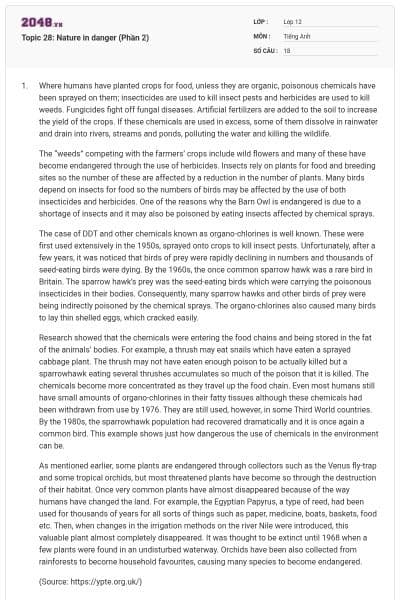
Where humans have planted crops for food, unless they are organic, poisonous chemicals have been sprayed on them; insecticides are used to kill insect pests and herbicides are used to kill weeds. Fungicides fight off fungal diseases. Artificial fertilizers are added to the soil to increase the yield of the crops. If these chemicals are used in excess, some of them dissolve in rainwater and drain into rivers, streams and ponds, polluting the water and killing the wildlife.
The “weeds” competing with the farmers’ crops include wild flowers and many of these have become endangered through the use of herbicides. Insects rely on plants for food and breeding sites so the number of these are affected by a reduction in the number of plants. Many birds depend on insects for food so the numbers of birds may be affected by the use of both insecticides and herbicides. One of the reasons why the Barn Owl is endangered is due to a shortage of insects and it may also be poisoned by eating insects affected by chemical sprays.
The case of DDT and other chemicals known as organo-chlorines is well known. These were first used extensively in the 1950s, sprayed onto crops to kill insect pests. Unfortunately, after a few years, it was noticed that birds of prey were rapidly declining in numbers and thousands of seed-eating birds were dying. By the 1960s, the once common sparrow hawk was a rare bird in Britain. The sparrow hawk’s prey was the seed-eating birds which were carrying the poisonous insecticides in their bodies. Consequently, many sparrow hawks and other birds of prey were being indirectly poisoned by the chemical sprays. The organo-chlorines also caused many birds to lay thin shelled eggs, which cracked easily.
Research showed that the chemicals were entering the food chains and being stored in the fat of the animals’ bodies. For example, a thrush may eat snails which have eaten a sprayed cabbage plant. The thrush may not have eaten enough poison to be actually killed but a sparrowhawk eating several thrushes accumulates so much of the poison that it is killed. The chemicals become more concentrated as they travel up the food chain. Even most humans still have small amounts of organo-chlorines in their fatty tissues although these chemicals had been withdrawn from use by 1976. They are still used, however, in some Third World countries. By the 1980s, the sparrowhawk population had recovered dramatically and it is once again a common bird. This example shows just how dangerous the use of chemicals in the environment can be.
As mentioned earlier, some plants are endangered through collectors such as the Venus fly-trap and some tropical orchids, but most threatened plants have become so through the destruction of their habitat. Once very common plants have almost disappeared because of the way humans have changed the land. For example, the Egyptian Papyrus, a type of reed, had been used for thousands of years for all sorts of things such as paper, medicine, boats, baskets, food etc. Then, when changes in the irrigation methods on the river Nile were introduced, this valuable plant almost completely disappeared. It was thought to be extinct until 1968 when a few plants were found in an undisturbed waterway. Orchids have been also collected from rainforests to become household favourites, causing many species to become endangered.
(Source: https://ypte.org.uk/)
Which of the following could best reflect the purpose of the author in the passage?
The author wishes to raise people’s awareness of how species are disappeared.
The author wants to imply that human activities are responsible for species extinction.
The author tries to provide evidence of species that have already been eliminated.
The author wants to indicate how chemicals and pollution contribute to animal extinction.
Đáp án B
Điều nào sau đây có thể phản ánh đúng nhất mục đích của tác giả trong đoạn văn?
A. Tác giả muốn nâng cao nhận thức của mọi người về các loài biến mất như thế nào.
B. Tác giả muốn ám chỉ rằng các hoạt động của con người chịu trách nhiệm cho sự tuyệt chủng của loài
C. Tác giả cố gắng cung cấp bằng chứng về các loài đã bị loại bỏ.
D. Tác giả muốn chỉ ra làm thế nào hóa chất và ô nhiễm góp phần tuyệt chủng động vật.
Căn cứ vào thông tin đoạn đầu:
Where humans have planted crops for food, unless they are organic, poisonous chemicals have been sprayed on them; insecticides are used to kill insect pests and herbicides are used to kill weeds. Fungicides fight off fungal diseases. Artificial fertilizers are added to the soil to increase the yield of the crops. If these chemicals are used in excess, some of them dissolve in rainwater and drain into rivers, streams and ponds, polluting the water and killing the wildlife.
(Nơi con người trồng cây làm thức ăn, trừ khi chúng là chất hữu cơ, những hóa chất độc hại đã được phun lên chúng; thuốc trừ sâu được sử dụng để diệt côn trùng và thuốc diệt cỏ được sử dụng để diệt cỏ dại. Thuốc diệt nấm chống lại bệnh nấm. Phân bón nhân tạo được thêm vào đất để tăng năng suất của cây trồng. Nếu các hóa chất này được sử dụng quá mức, một số trong số chúng hòa tan trong nước mưa và thoát ra sông, suối và ao, gây ô nhiễm nước và giết chết động vật hoang dã.)
Như vậy, đoạn văn đang nói về những hoạt động trong nông nghiệp có thể làm ảnh hưởng lớn đến môi trường tự nhiên.
The word “yield” in the first paragraph is closest in meaning to __________.
production
nutrition
quality
fertility
Đáp án A
Từ “yield” trong đoạn đầu tiên có nghĩa gần nhất với __________.
A. sự sản xuất
B. dinh dưỡng
C. chất lượng
D. khả năng sinh sản
Từ đồng nghĩa yield (năng suất) = production
Artificial fertilizers are added to the soil to increase the yield of the crops. If these chemicals are used in excess, some of them dissolve in rainwater and drain into rivers, streams and ponds, polluting the water and killing the wildlife.
(Phân bón nhân tạo được thêm vào đất để tăng năng suất của cây trồng. Nếu các hóa chất này được sử dụng quá mức, một số trong số chúng hòa tan vào trong nước mưa và thoát ra sông, suối và ao, gây ô nhiễm nước và giết chết động vật hoang dã.)
What will happen to the insect-eating birds if the weeds are in danger?
They will not have materials to make nests in breeding seasons.
They must find rely on other kinds of insects when the vegetation is limited.
They will experience a downward trend in the number on account of food shortage.
They may compete with many species to have crops for food.
Đáp án C
Điều gì sẽ xảy ra với những con chim ăn côn trùng nếu cỏ dại gặp nguy hiểm?
A. Chúng sẽ không có nguyên liệu để làm tổ trong mùa sinh sản.
B. Chúng phải tìm cách dựa vào các loại côn trùng khác khi thảm thực vật bị hạn chế.
C. Chúng sẽ trải qua một xu hướng giảm về số lượng vì thiếu lương thực.
D. Chúng có thể cạnh tranh với nhiều loài để có cây trồng làm thức ăn.
Căn cứ vào thông tin đoạn hai:
Insects rely on plants for food and breeding sites so the number of these are affected by a reduction in the number of plants. Many birds depend on insects for food so the numbers of birds may be affected by the use of both insecticides and herbicides.
(Côn trùng dựa vào thực vật để làm thức ăn và nơi sinh sản vì vậy số lượng của chúng sẽ bị ảnh hưởng bởi việc giảm số lượng cây trồng. Nhiều loài chim phụ thuộc vào côn trùng làm thức ăn nên số lượng chim có thể bị ảnh hưởng bởi việc sử dụng cả thuốc trừ sâu và thuốc diệt cỏ.)
According to the passage, sparrow hawks are described as a species that ___________.
depended on their enemy to survive when the number of seeds declined.
was killed by the toxics of insecticides used for crops containing inside the insects’ body.
was poisoned by eating the chemical sprays on the weeds.
laid broken eggs due to the consequences of lack of nutrient insect pests.
Đáp án B
Theo đoạn văn, chim bồ két được mô tả là một loài mà __________.
A. phụ thuộc vào kẻ thù của họ để sống sót khi số lượng hạt giống giảm.
B. đã bị giết bởi chất độc của thuốc trừ sâu được sử dụng cho các loại cây trồng có chứa bên trong cơ thể côn trùng.
C. đã bị đầu độc bằng cách ăn thuốc xịt hóa học trên cỏ dại.
D. đẻ trứng vỡ do hậu quả của việc thiếu côn trùng gây hại.
Căn cứ vào thông tin đoạn ba:
By the 1960s, the once common sparrow hawk was a rare bird in Britain. The sparrow hawk’s prey was the seed-eating birds which were carrying the poisonous insecticides in their bodies. Consequently, many sparrow hawks and other birds of prey were being indirectly poisoned by the chemical sprays.
(Đến thập niên 1960, chim bồ két phổ biến một thời là loài chim quý hiếm ở Anh. Chim bồ két là loài chim ăn hạt giống, loài mà mang theo thuốc trừ sâu độc hại bên trong cơ thể chúng. Do đó, nhiều chim bồ két và các loài chim săn mồi khác đang gián tiếp bị nhiễm độc bởi thuốc xịt hóa học.)
The word “their” in paragraph 3 refers to ______________.
insecticides
sparrow hawks
seed-eating birds
insect-eating birds
Đáp án C
Từ “their” trong đoạn 3 nói đến __________.
A. thuốc trừ sâu
B. chim bồ cắt
C. chim ăn hạt giống
D. chim ăn côn trùng
Từ “their” ở đây dùng để thay thế cho sở hữu của loài chim ăn hạt giống được nhắc tới trước đó.
By the 1960s, the once common sparrow hawk was a rare bird in Britain. The sparrow hawk’s prey was the seed-eating birds which were carrying the poisonous insecticides in their bodies. Consequently, many sparrow hawks and other birds of prey were being indirectly poisoned by the chemical sprays.
(Đến thập niên 1960, chim bồ két phổ biến một thời là loài chim quý hiếm ở Anh. Chim bồ két là loài chim ăn hạt giống, loài mà mang theo thuốc trừ sâu độc hại bên trong cơ thể chúng. Do đó, nhiều chim bồ cắt và các loài chim săn mồi khác đang gián tiếp bị nhiễm độc bởi thuốc xịt hóa học.)
What does the word “accumulates” in paragraph 4 mean?
gradually gets more and more of something over a period of time.
removes or gets rid of something.
happens or makes something happen faster or earlier than expected.
makes something seem larger, better, worse or more important than it really is.
Đáp án A
Từ “accumulates” trong đoạn 4 có nghĩa là gì?
A. dần dần nhận được nhiều hơn một cái gì đó trong một khoảng thời gian.
B. di chuyển hoặc loại bỏ một cái gì đó.
C. xảy ra hoặc làm cho một cái gì đó xảy ra nhanh hơn hoặc sớm hơn dự kiến.
D. làm cho một cái gì đó dường như lớn hơn, tốt hơn, tồi tệ hơn hoặc quan trọng hơn thực tế.
Ta có: accumulate (v): tích lũy
The thrush may not have eaten enough poison to be actually killed but a sparrow hawk eating several thrushes accumulates so much of the poison that it is killed.
(Chim hét có thể đã không ăn đủ lượng chất độc để thực sự bị giết nhưng một con chim bồ cắt ăn một số con chim hét tích tụ quá nhiều chất độc đến nỗi nó bị giết.)
According to the last paragraph, which of the following is NOT true?
Deforestation is the primary reason of flora disappearance.
Many valuable plants have provided people with invaluable products.
Flora biodiversity remains unchanged when humans interfere with the supply of water for cultivation.
Keeping some kinds of plants for recreation at home may not be a good way to save endangered species.
Đáp án C
Theo đoạn cuối, điều nào sau đây không đúng?
A. Phá rừng là nguyên nhân chính của sự biến mất của hệ thực vật.
B. Nhiều nhà máy có giá trị đã cung cấp cho mọi người những sản phẩm vô giá.
C. Đa dạng sinh học thực vật không thay đổi khi con người can thiệp vào việc cung cấp nước cho trồng trọt.
D. Giữ một số loại cây cho thú tiêu khiển ở nhà có lẽ không phải một cách tốt để cứu các loài có nguy cơ tuyệt chủng.
=> Căn cứ vào thông tin đoạn cuối:
“As mentioned earlier, some plants are endangered through collectors such as the Venus fly-trap and some tropical orchids, but most threatened plants have become so through the destruction of their habitat. Once very common plants have almost disappeared because of the way humans have changed the land.”
(Như đã đề cập trước đó, một số loài thực vật như là cây bẫy ruồi Venus và một số loài lan nhiệt đới đang bị đe dọa bởi các nhà sưu tập, thế nhưng, hầu hết các loài thực vật bị như vậy là do việc phá hủy môi trường sống của chúng. Một loài thực vật đã từng rất phổ biến hiện nay gần như biến mất vì con người đã thay đổi đất đai.)
For example, the Egyptian Papyrus, a type of reed, had been used for thousands of years for all sorts of things such as paper, medicine, boats, baskets, food etc. Then, when changes in the irrigation methods on the river Nile were introduced, this valuable plant almost completely disappeared.
(Ví dụ, cây cói giấy Ai Cập, một loại sậy, đã được sử dụng khoảng hàng ngàn năm cho tất cả các loại như giấy, thuốc, thuyền, giỏ, thực phẩm,… Sau đó, khi những thay đổi trong phương pháp tưới tiêu trên sông Nin được giới thiệu, loài cây có giá trị này gần như biến mất hoàn toàn.)
“As mentioned earlier, some plants are endangered through collectors such as the Venus fly-trap and some tropical orchids, but most threatened plants have become so through the destruction of their habitat. […] Orchids have been also collected from rainforests to become household favourites, causing many species to become endangered.”
(Như đã đề cập trước đó, một số loài thực vật như là cây bẫy ruồi Venus và một số loài lan nhiệt đới đang bị đe dọa bởi các nhà sưu tập, thế nhưng, hầu hết các loài thực vật bị như vậy là do việc phá hủy môi trường sống của chúng. […] Hoa lan cũng đã được thu thập từ các khu rừng mưa nhiệt đới để trở thành loài hoa yêu thích của các hộ gia đình, điều này đã khiến nhiều loài trở nên gặp nguy hiểm.)
=> Do đó, C là phương án cần lựa chọn vì nó hoàn toàn sai lệch thông tin so với trong bài.
It can be inferred from the passage that _____________.
There are many alternative ways for humans to save species from extinction.
The chemicals used for agriculture have an influence on both the species and their enemy.
Many endangered species are only preserved by humans’ effort in changing the environment.
Whenever chemicals are used, humans should think of their impact on biodiversity.
Đáp án B
Nó có thể được suy ra từ đoạn văn là_________.
A. Có nhiều cách khác nhau để con người cứu loài khỏi sự tuyệt chủng.
B. Các hóa chất được sử dụng cho nông nghiệp có ảnh hưởng đến cả loài và kẻ thù của chúng.
C. Nhiều loài có nguy cơ tuyệt chủng chỉ được bảo tồn bởi nỗ lực của con người trong việc thay đổi môi trường
D. Bất cứ khi nào hóa chất được sử dụng, con người nên nghĩ về tác động của chúng đối với đa dạng sinh học.
=> Căn cứ vào
+ thông tin đoạn 2 như sau:
“The ”weeds" competing with the farmers’ crops include wild flowers and many of these have become endangered through the use of herbicides. Insects rely on plants for food and breeding sites so the number of these are affected by a reduction in the number of plants. Many birds depend on insects for food so the numbers of birds may be affected by the use of both insecticides and herbicides. One of the reasons why the Barn Owl is endangered is due to a shortage of insects and it may also be poisoned by eating insects affected by chemical sprays.”
(“Cỏ dại”, bao gồm cả hoa dại, đã cạnh tranh với cây trồng của nông dân và phần lớn cây trồng đã bị đe dọa thông qua việc sử dụng thuốc diệt cỏ. Côn trùng dựa vào thực vật để làm thức ăn và nơi sinh sản nên số lượng chúng bị ảnh hưởng do số lượng cây giảm xuống. Nhiều loài chim phụ thuộc vào côn trùng làm thức ăn nên số lượng chim có thể bị ảnh hưởng bởi việc sử dụng cả thuốc trừ sâu và thuốc diệt cỏ. Một trong những lý do khiến cho loài cú lợn bị đe dọa là do thiếu côn trùng để ăn và nó bị nhiễm độc do ăn phải côn trùng bị ảnh hưởng bởi hóa chất.)
=> ta thấy thuốc diệt cỏ, trừ sâu gây đe dọa đến thực vật => côn trùng => chim ăn côn trùng và loài cú lợn
+ thông tin đoạn 3 như sau:
“Unfortunately, after a few years, it was noticed that birds of prey were rapidly declining in numbers and thousands of seed-eating birds were dying. By the 1960s, the once common sparrow hawk was a rare bird in Britain. The sparrow hawk’s prey was the seed-eating birds which were carrying the poisonous insecticides in their bodies. Consequently, many sparrow hawks and other birds of prey were being indirectly poisoned by the chemical sprays.”
(Thật không may, sau một vài năm, người ta nhận thấy rằng những con chim săn mồi đang suy giảm nhanh chóng về số lượng và hàng ngàn con chim ăn hạt giống đang chết dần. Đến thập niên 1960, chim cắt hỏa mai trở thành loài chim hiếm ở Anh. Con mồi của chúng là những chú chim ăn hạt, trong cơ thể chúng những chú chim này chứa thuốc trừ sâu độc. Hậu quả là, nhiều con chim cắt hỏa mai và các loài chim săn mồi khác đã bị gián tiếp đầu độc bằng chất hóa học.)
=> chim săn mồi suy giảm và các loài chim chuyên ăn hạt giống giảm => trở nên loài hiếm do thức ăn của chúng là các con chim chuyên ăn hạt này bị ảnh hưởng từ thuốc trừ sâu trong hạt.
+ thông tin đoạn 4 như sau:
“The thrush may not have eaten enough poison to be actually killed but a sparrow hawk eating several thrushes accumulates so much of the poison that it is killed.”
(Chim hét có thể đã không ăn đủ lượng chất độc để thực sự bị giết nhưng một con chim bồ cắt ăn một số con chim hét tích tụ quá nhiều chất độc đến nỗi nó bị giết.)
=> Như vậy, ta có thể thấy hóa chất độc hại không chỉ ảnh hưởng đến chim hét mà còn ảnh hưởng đến chim bồ két, loài mà ăn thịt chim hét.
=> toàn bài đưa ra nhiều ví dụ về chuỗi thức ăn, quan hệ con mồi - kẻ săn mồi dưới tác động các loại thuốc diệt cỏ, trừ sâu,… nên có thể được suy ra từ đoạn văn là các hóa chất được sử dụng cho nông nghiệp có ảnh hưởng trực tiếp đến cả loài và kẻ thù của chúng.
*Note: + The thrush: loài chim hoét hoặc chim hét
Most people have heard about how PTSD can unravel a person. Fewer have heard about posttraumatic growth, the process that lifted Curry out of his despair and into his new role as a leader in the veteran community. The term - defined as “positive change that occurs as a result of the struggle with highly challenging life crises” - was coined in the mid-1990s by Richard Tedeschi, PhD, and Lawrence Calhoun, PhD, after studying how people develop wisdom.
They identified five specific ways people can grow after a crisis. First, their relationships strengthen. One woman diagnosed with breast cancer, for example, said she realized her relationships “are the most important things you have.” Bereaved parents told Tedeschi and Calhoun that losing a child had made them more compassionate. Second, they discover new paths and purposes in life. Sometimes these are related to a particular survivor mission. One interviewee became an oncology nurse after losing her child to cancer. Other times, the crisis becomes the catalyst for a more general reconsideration of priorities, as Christine discovered when she started attending The Dinner Party in the aftermath of her mother’s death.
Third, the trauma allows them to find their inner strength. The common thread among those Tedeschi and Calhoun studied is a “vulnerable yet stronger” narrative. This paradoxical outlook defined the attitude of a rape survivor who admitted the world seemed more dangerous after the assault, but that, at the same time, she felt more resilient as a result of the inner strength she’d built. Fourth, their spiritual life deepens. That could mean they renew their faith in God, or it could mean they grapple with existential questions more broadly, coming to know certain deep truths about the world or themselves, as one interviewee did after his spinal-cord surgery.
Finally, they feel a renewed appreciation for life. Rather than taking for granted a stranger’s kindness or the vivid colors of autumn leaves, they savor the small moments of beauty that light up each day.
The difference between those who are able to grow from adversity and those who are stymied lies in what Tedeschi and Calhoun call “deliberate rumination” or introspection. The participants they studied spent a lot of time trying to make sense of their painful experiences, reflecting on how the events changed them. Doing so helped them make the life changes associated with posttraumatic growth.
(Source: https://www.awpnow.com)
Which best serves as the title for the passage?
How adversity can lead to personal growth.
A century of “sink or swim” situation.
Positive thinking won’t change your life.
Action quotient (AQ) is something you should remember!
Đáp án A
Câu nào thích hợp nhất làm tiêu đề cho đoạn văn?
A. Làm thế nào nghịch cảnh có thể dẫn đến sự phát triển cá nhân.
B. Một thế kỷ của tình trạng “chìm hoặc bơi”.
C. Suy nghĩ tích cực sẽ không thay đổi cuộc sống của bạn.
D. Chỉ số hành động (AQ) là điều bạn nên nhớ!
Căn cứ vào thông tin đoạn đầu:
Fewer have heard about posttraumatic growth, the process that lifted Curry out of his despair and into his new role as a leader in the veteran community. The term - defined as “positive change that occurs as a result of the struggle with highly challenging life crises” - was coined in the mid-1990s by Richard Tedeschi, PhD, and Lawrence Calhoun, PhD, after studying how people develop wisdom.
(Ít người đã nghe nói về sự tăng trưởng sau chấn thương, quá trình đưa Curry thoát khỏi sự tuyệt vọng và trở thành vai trò mới của anh như một nhà lãnh đạo trong cộng đồng kỳ cựu. Thuật ngữ này - được định nghĩa là sự thay đổi tích cực xảy ra như một kết quả của cuộc đấu tranh với cuộc sống đầy thách thức khủng hoảng, đã được đặt ra vào giữa những năm 1990 bởi Tiến sĩ Richard Tedeschi và Tiến sĩ Lawrence Calhoun, sau khi nghiên cứu cách mọi người phát triển sự khôn ngoan.)
Như vậy, đoạn văn đang nói về những khó khăn, thử thách trong cuộc sống đã giúp chúng ta trưởng thành như thế nào.
The word “catalyst” in paragraph 2 can be replaced by _______.
plunge
shoot
pressure
impetus
Đáp án D
Từ “catalyst” trong đoạn 2 có thể được thay thế bằng _________.
A. lao xuống
B. bắn
C. áp lực
D. xúc tác
Từ đồng nghĩa catalyst (chất xúc tác) = impetus
Other times, the crisis becomes the catalyst for a more general reconsideration of priorities, as Christine discovered when she started attending The Dinner Party in the aftermath of her mother’s death.
(Những lần khác, khủng hoảng trở thành chất xúc tác cho sự xem xét lại các ưu tiên tổng quát hơn, như Christine đã khám phá ra khi cô bắt đầu tham dự Bữa tiệc tối sau cái chết của mẹ mình.)
According to paragraph 2, which situation represents the second growing approach?
The daughter died in fire, which made the father become an arsonist for vengeance.
The mother going down with a deadly disease led the son to be constantly grieving.
The brother became a policemen due to his sister once getting kidnapped.
A highschool boy played truant and got himself into trouble with bad people.
Đáp án C
Theo đoạn 2, tình huống nào thể hiện sự tiếp cận phát triển thứ hai?
A. Con gái chết trong lửa, khiến người cha trở thành kẻ chủ mưu để báo thù.
B. Người mẹ suy sụp với căn bệnh hiểm nghèo khiến con trai liên tục đau buồn.
C. Người anh trai trở thành cảnh sát do em gái anh ta bị bắt cóc.
D. Một cậu bé học trung học chơi trốn học và gặp rắc rối với những người xấu.
Căn cứ vào thông tin đoạn hai:
Bereaved parents told Tedeschi and Calhoun that losing a child had made them more compassionate. Second, they discover new paths and purposes in life. Sometimes these are related to a particular survivor mission. One interviewee became an oncology nurse after losing her child to cancer.
(Cha mẹ bị mất con nói với Tedeschi và Calhoun rằng mất một đứa trẻ đã khiến họ trở nên từ bi hơn. Thứ hai, họ phát hiện ra con đường và mục đích mới trong cuộc sống. Đôi khi những điều này có liên quan đến một nhiệm vụ sống còn cụ thể. Một người được phỏng vấn trở thành một y tá chuyên khoa ung thư sau khi mất con vì căn bệnh ung thư.)
The word “these” in paragraph 2 refers to _____.
relationships
life crises
important things
paths and purposes
Đáp án D
Từ “these” này trong đoạn 2 đề cập đến_________.
A. con đường và mục đích
B. cuộc sống khủng hoảng
C. những điều quan trọng
D. mối quan hệ
=> Từ “these” ở đây được dùng để thay thế cho danh từ “con đường và mục đích” được nhắc tới trước đó.
Second, they discover new paths and purposes in life. Sometimes these are related to a particular survivor mission.
(Thứ hai, họ phát hiện ra con đường và mục đích mới trong cuộc sống. Đôi khi những điều này có liên quan đến một nhiệm vụ sống còn cụ thể.)
According to paragraph 3, what does the term “vulnerable yet stronger” want to get at?
People accept the contradiction between their fragility and others’ power.
When overcoming hardships people learn that they are stronger than they have thought.
People generally forget that their weakness can be someone’s strength and vice versa.
People recognize the helpfulness of trauma restoration seminars.
Đáp án B
Theo đoạn 3, thuật ngữ “dễ bị tổn thương nhưng mạnh hơn” muốn chỉ tới điều gì?
A. Mọi người chấp nhận mâu thuẫn giữa sự mong manh của họ và sức mạnh của người khác.
B. Khi vượt qua khó khăn, mọi người biết rằng họ mạnh hơn họ nghĩ,
C. Mọi người thường quên rằng điểm yếu của họ có thể là điểm mạnh của ai đó và ngược lại.
D. Mọi người nhận ra sự hữu ích của các hội thảo phục hồi chấn thương.
Căn cứ vào thông tin đoạn ba:
Third, the trauma allows them to find their inner strength. The common thread among those Tedeschi and Calhoun studied is a “vulnerable yet stronger” narrative. This paradoxical outlook defined the attitude of a rape survivor who admitted the world seemed more dangerous after the assault, but that, at the same time, she felt more resilient as a result of the inner strength she’d built.
(Thứ ba, chấn thương cho phép họ phát hiện ra sức mạnh bên trong của họ. Chủ đề chung trong số Tedeschi và Calhoun nghiên cứu là một câu chuyện “dễ bị tổn thương nhưng mạnh mẽ hơn”. Triển vọng nghịch lý này định nghĩa thái độ của một người sống sót bị hãm hiếp đã thừa nhận thế giới dường như nguy hiểm hơn sau khi cuộc tấn công, nhưng đồng thời, cô cảm thấy kiên cường hơn nhờ vào sức mạnh bên trong mà cô ấy đã xây dựng.)
Which of the following statements is TRUE, according to the passage?
Only people once experiencing the loss of loved ones can be empathetic with others.
The examination of one’s own mental and emotional processes is what set people apart.
PTSD is a mild disorder that is easy to recover from.
The concept of posttraumatic growth originated in the early 1990s.
Đáp án B
Phát biểu nào sau đây là đúng, theo đoạn văn?
A. Chỉ những người từng trải qua mất mát người thân mới có thể đồng cảm với người khác.
B. Việc kiểm tra các quá trình tinh thần và cảm xúc của chính mình là điều khiến mọi người khác biệt.
C. PTSD là một rối loạn nhẹ, dễ dàng phục hồi.
D. Khái niệm tăng trưởng sau chấn thương bắt nguồn từ đầu những năm 1990.
Căn cứ vào thông tin đoạn cuối:
The difference between those who are able to grow from adversity and those who are stymied lies in what Tedeschi and Calhoun call “deliberate rumination” or introspection.
(Sự khác biệt giữa những người có khả năng phát triển từ nghịch cảnh và những người bị cản trở trong cái mà Tedeschi và Calhoun gọi là “sự trầm tư có chủ ý” hoặc sự hướng nội.)
The word “stymied” in paragraph 5 can be replaced by _______.
controlled
removed
stalled
disappointed
Đáp án C
Từ “stymied” trong đoạn 5 có thể được thay thế bằng ________.
A. kiểm soát
B. loại bỏ
C. ngăn cản
D. thất vọng
Từ đồng nghĩa: stymy (cản trở) = stall
The difference between those who are able to grow from adversity and those who are stymied lies in what Tedeschi and Calhoun call “deliberate rumination” or introspection.
(Sự khác biệt giữa những người có khả năng phát triển từ nghịch cảnh và những người bị cản trở trong cái mà Tedeschi và Calhoun gọi là “sự trầm tư có chủ ý” hoặc sự hướng nội.)
Which of the following can be inferred from the passage?
In order to keep life going, you need to offer up all the experiences of your life for joy to consume .
Preparation is not precisely better than going with the flow.
The best way out is always through.
Gaining perspective on negative events contributes to self-development.
Đáp án D
Điều nào sau đây có thể được suy ra từ đoạn văn?
A. Để giữ cho cuộc sống tiếp diễn, bạn cần cung cấp tất cả những trải nghiệm trong cuộc sống của bạn niềm vui để hưởng thụ.
B. Chuẩn bị không chính xác hơn là đi với dòng chảy.
C. Cách tốt nhất là luôn luôn thông qua.
D. Đạt được quan điểm về các sự kiện tiêu cực góp phần phát triển bản thân.
Căn cứ vào thông tin đoạn cuối:
The participants they studied spent a lot of time trying to make sense of their painful experiences, reflecting on how the events changed them. Doing so helped them make the life changes associated with posttraumatic growth.
(Những người tham gia mà họ nghiên cứu đã dành rất nhiều thời gian để cố gắng hiểu được những trải nghiệm đau đớn của họ, phản ánh về cách các sự kiện thay đổi chúng. Làm như vậy đã giúp họ làm cho cuộc sống thay đổi gắn liền với tăng trưởng sau chấn thương.)
Bạn có thích hoạt động này không?