Topic 27: Pollution (Phần 2)
16 câu hỏi
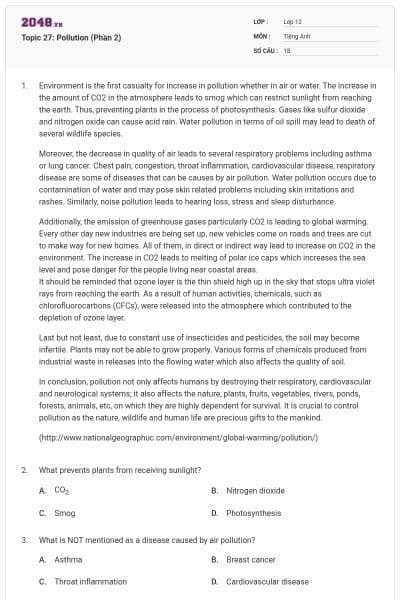
Environment is the first casualty for increase in pollution whether in air or water. The increase in the amount of CO2 in the atmosphere leads to smog which can restrict sunlight from reaching the earth. Thus, preventing plants in the process of photosynthesis. Gases like sulfur dioxide and nitrogen oxide can cause acid rain. Water pollution in terms of oil spill may lead to death of several wildlife species.
Moreover, the decrease in quality of air leads to several respiratory problems including asthma or lung cancer. Chest pain, congestion, throat inflammation, cardiovascular disease, respiratory disease are some of diseases that can be causes by air pollution. Water pollution occurs due to contamination of water and may pose skin related problems including skin irritations and rashes. Similarly, noise pollution leads to hearing loss, stress and sleep disturbance.
Additionally, the emission of greenhouse gases particularly CO2 is leading to global warming. Every other day new industries are being set up, new vehicles come on roads and trees are cut to make way for new homes. All of them, in direct or indirect way lead to increase on CO2 in the environment. The increase in CO2 leads to melting of polar ice caps which increases the sea level and pose danger for the people living near coastal areas.
It should be reminded that ozone layer is the thin shield high up in the sky that stops ultra violet rays from reaching the earth. As a result of human activities, chemicals, such as chlorofluorocarbons (CFCs), were released into the atmosphere which contributed to the depletion of ozone layer.
Last but not least, due to constant use of insecticides and pesticides, the soil may become infertile. Plants may not be able to grow properly. Various forms of chemicals produced from industrial waste in releases into the flowing water which also affects the quality of soil.
In conclusion, pollution not only affects humans by destroying their respiratory, cardiovascular and neurological systems; it also affects the nature, plants, fruits, vegetables, rivers, ponds, forests, animals, etc, on which they are highly dependent for survival. It is crucial to control pollution as the nature, wildlife and human life are precious gifts to the mankind.
(http://www.nationalgeographuc.com/environment/global-warming/pollution/)
What prevents plants from receiving sunlight?
CO2
Nitrogen dioxide
Smog
Photosynthesis
Đáp án C
Điều gì ngăn cản cây tiếp nhận ánh sáng mặt trời?
A. CO2
B. Nitơ điôxít
C. Khói bụi
D. Quang hợp
Căn cứ vào thông tin sau trong đoạn văn:
The increase in the amount of CO2 in the atmosphere leads to smog which can restrict sunlight from reaching the earth. Thus, preventing plants in the process of photosynthesis.
(Sự gia tăng lượng CO2 trong khí quyển dẫn đến khói bụi có thể hạn chế ánh sáng mặt trời đến trái đất. Do đó, ngăn chặn thực vật trong quá trình quang hợp.)
What is NOT mentioned as a disease caused by air pollution?
Asthma
Breast cancer
Throat inflammation
Cardiovascular disease
Đáp án B
Điều gì KHÔNG được đề cập đến như một căn bệnh gây ra bởi ô nhiễm không khí?
A. Hen suyễn
B. Ung thư vú
C. Viêm họng
D. Bệnh tim mạch
Căn cứ vào thông tin sau trong đoạn văn:
Moreover, the decrease in quality of air leads to several respiratory problems including asthma or lung cancer. Chest pain, congestion, throat inflammation, cardiovascular disease, respiratory disease are some of diseases that can be causes by air pollution
(Hơn nữa, chất lượng không khí giảm dẫn đến một số vấn đề về hô hấp bao gồm hen suyễn hoặc ung thư phổi. Đau ngực, sung huyết, viêm họng, bệnh tim mạch, bệnh hô hấp là một số bệnh có thể là do ô nhiễm không khí.)
What is NOT mentioned as a cause of increase in CO2?
Transportation
Deforestation
Industrialization
Urbanization
Đáp án D
Điều gì KHÔNG được đề cập là nguyên nhân làm tăng CO2?
A. Giao thông vận tải
B. Phá rừng
C. Công nghiệp hóa
D. Đô thị hóa
Căn cứ vào thông tin sau trong đoạn văn:
Every other day new industries are being set up, new vehicles come on roads and trees are cut to make way for new homes. All of them, in direct or indirect way lead to increase on CO2 in the environment.
(Mỗi ngày các ngành công nghiệp mới đang được thiết lập, các phương tiện mới xuất hiện trên đường và cây cối bị chặt để nhường chỗ cho những ngôi nhà mới. Tất cả chúng, theo cách trực tiếp hoặc gián tiếp dẫn đến tăng CO2 trong môi trường.)
What is true about ozone layer?
It consists of chlorofluorocarbons.
It protects the earth from ultra violet rays.
It is above the atmosphere.
It contributes to the decrease of CFCs.
Đáp án B
Điều gì đúng về tầng ozone?
A. Nó bao gồm chlorofluorocarbons.
B. Nó bảo vệ trái đất khỏi các tia cực tím.
C. Nó ở trên bầu khí quyển.
D. Nó góp phần làm giảm CFC.
Căn cứ vào thông tin sau trong đoạn văn:
It should be reminded that ozone layer is the thin shield high up in the sky that stops ultra violet rays from reaching the earth. As a result of human activities, chemicals, such as chlorofluorocarbons (CFCs), were released into the atmosphere which contributed to the depletion of ozone layer.
(Cần lưu ý rằng tầng ozone là lá chắn mỏng cao trên bầu trời ngăn chặn các tia cực tím đến trái đất. Kết quả của các hoạt động của con người, các hóa chất, như chlorofluorocarbons (CFC), đã được giải phóng vào bầu khí quyển góp phần làm suy giảm tầng ozone.)
What does the infertile soil result in?
The increase of waste chemicals.
The amount of industrial waste
The development of trees
The use of insecticides and pesticides
Đáp án C
Đất vô sinh dẫn đến kết quả gì?
A. Sự gia tăng của hóa chất thải.
B. Lượng chất thải công nghiệp
C. Sự phát triển của cây xanh
D. Việc sử dụng thuốc trừ sâu và thuốc trừ sâu
Căn cứ vào thông tin sau trong đoạn văn:
Last but not least, due to constant use of insecticides and pesticides, the soil may become infertile. Plants may not be able to grow properly.
(Cuối cùng nhưng không kém phần quan trọng, do sử dụng thuốc trừ sâu và thuốc trừ sâu liên tục, đất có thể trở nên vô sinh. Cây có thể không thể phát triển đúng.)
Which of the following is closet in meaning to the word precious in the last paragraph?
various
valuable
beautiful
scare
Đáp án B
Từ nào sau đây có nghĩa gần giống với từ “precious” trong đoạn văn cuối.
A. various /’veəriəs/ (a): khác nhau
B. valuable /’væljuəbl/ (a): quý giá
C. beautiful /’bju:təful/ (a): đẹp, tốt đẹp
D. scare /skeə/ (n): sự sợ hãi
Căn cứ vào ngữ cảnh của đoạn văn:
In conclusion, pollution not only affects humans by destroying their respiratory, cardiovascular and neurological systems; it also affects the nature, plants, fruits, vegetables, rivers, ponds, forests, animals, etc, on which they are highly dependent for survival. It is crucial to control pollution as the nature, wildlife and human life are precious gifts to the mankind.
(Tóm lại, ô nhiễm không chỉ ảnh hưởng đến con người bằng cách phá hủy hệ thống hô hấp, tim mạch và thần kinh; nó cũng ảnh hưởng đến thiên nhiên, thực vật, trái cây, rau, sông, ao, rừng, động vật, v.v … mà chúng ta phụ thuộc rất nhiều vào sự sống. Rất quan trọng để kiểm soát ô nhiễm vì thiên nhiên, động vật hoang dã và cuộc sống của con người là những món quà quý giá cho nhân loại.)
=> precious /’preʃəs/ (a): quý báu, quý giá
What does the word “it” in the last paragraph refer to?
pollution
nature
environment
human life
Đáp án A
Từ “it” trong đoạn cuối đề cập đến điều gì?
A. pollution
B. nature
C. environment
D. human life
Căn cứ vào ngữ cảnh của đoạn văn:
In conclusion, pollution not only affects humans by destroying their respiratory, cardiovascular and neurological systems; it also affects the nature, plants, fruits, vegetables, rivers, ponds, forests, animals, etc, on which they are highly dependent for survival.
(Tóm lại, ô nhiễm không chỉ ảnh hưởng đến con người bằng cách phá hủy hệ thống hô hấp, tim mạch và thần kinh; nó cũng ảnh hưởng đến thiên nhiên, thực vật, trái cây, rau, sông, ao, rừng, động vật, v.v … mà chúng ta phụ thuộc rất nhiều vào sự sống.)
What is the passage mainly about?
Causes of pollution
Effects of pollution
Solutions for pollution
Humans and pollution
Đáp án B
Ý chính của bài văn là gì?
A. Nguyên nhân gây ô nhiễm
B. Ảnh hưởng của ô nhiễm
C. Giải pháp cho ô nhiễm
D. Con người và ô nhiễm
=> Ô nhiễm môi trường ảnh hưởng rất nhiều đến sức khỏe của con người và ảnh hưởng đến thiên nhiên, hệ động thực vật.
Khi làm dạng bài này ta thường căn cứ vào thông tin ở đoạn đầu hoặc đoạn cuối, ở cả đoạn đầu và đoạn cuối của bài văn đều đề cập đến các ảnh hưởng của ô nhiễm môi trường.
Air pollution is the most prominent and dangerous form of pollution. It occurs dues to many reasons. Excessive burning of fuel which is a necessity of our daily lives for cooking, driving and other industrial activities releases a huge amount of chemical substances in the air every day; as a result, these pollute the air.
Smoke from chimneys, factories, vehicles or burning of wood basically occurs due to coal burning. This releases sulphur dioxide into the air making it toxic. The effects of air pollution are evident too. Release of sulphur dioxide and hazardous gases into the air causes global warming and acid rain which in turn have increased temperatures, erratic rains and droughts worldwide making it tough for animals to survive. We breathe in every polluted particle from the air, the result is an increase in asthma and cancer in the lungs.
Another effect of air pollution is ozone layer depletion. Ozone layer is the thin shield high up in the sky that prevents ultra violet rays from reaching the Earth. As a result of human activities, chemicals, such as chlorofluorocarbons (CFCs) which play a key role, were released into the atmosphere which contributed to the destruction of ozone layer.
Water pollution has taken toll of all the surviving species of the earth. Almost 60% of the species live in water bodies. It occurs due to several factors; the industrial wastes dumped into the rivers and other water bodies cause an imbalance in the water leading to its severe contamination and death of aquatic species. If you suspect that nearby water sources have been contaminated by a corporation then it might be a good idea to hire an expert to see you options.
Moreover, spraying insecticides, pesticides like DDT on plants also pollutes the ground water system and oil spills in the oceans have caused irreparable damage to the water bodies. Eutrophication is another big source; it occurs due to daily activities like washing clothes or utensils near lakes, ponds or rivers; this forces detergents to go into water which blocks sunlight from penetrating, thus reducing oxygen and making it inhabitable.
Water pollution not only harms the aquatic beings but it also contaminates the entire food chain by severely affecting humans dependents on these. Waterborne disease like cholera, diarrhea have also increased in all places.
Another type of pollution common in the countryside is soil pollution. Soil pollution occurs due to the incorporation of unwanted chemicals in the soil due to human activities. Insecticides and pesticides absorb the nitrogen compounds in the soil making it unfit for plants to derive nutrition. Release of industrial waste, mining and deforestation also damages the soil. Since plants can’t grow properly, they can’t hold the soil and this leads to soil erosion.
(http://www.nationalgeographic.com/environment/global-warming/pollution/)
What is NOT mentioned as a cause of air pollution?
Excessive fuel burning
Large scale deforestation
Industrial production
Driving gasoline cars
Đáp án B
Điều nào dưới đây KHÔNG được đề cập là một nguyên nhân gây ô nhiễm không khí?
Xét các đáp án:
A. Đốt cháy nhiên liệu quá mức
B. Phá rừng quy mô lớn
C. Sản xuất công nghiệp
D. Lái xe ô tô chạy bằng xăng
Căn cứ vào thông tin đoạn 1:
Air pollution is the most prominent and dangerous form of pollution. It occurs dues to many reasons. Excessive burning of fuel which is a necessity of our daily lives for cooking, driving and other industrial activities releases a huge amount of chemical substances in the air every day; as a result, these pollute the air.
(Ô nhiễm không khí là hình thức ô nhiễm nổi bật và nguy hiểm nhất. Nó xảy ra do nhiều lý do. Đốt cháy nhiên liệu quá mức cần thiết trong cuộc sống hàng ngày của chúng ta để nấu ăn, lái xe và các hoạt động công nghiệp khác giải phóng một lượng lớn các chất hóa học trong không khí mỗi ngày; kết quả là, những thứ này gây ô nhiễm không khí.)
What is NOT mentioned as a consequence of the increase in air pollution?
Ozone layer depletion
Worldwide droughts
Global warming
Industrialization
Đáp án D
Điều nào dưới đây KHÔNG được đề cập là hậu quả của sự gia tăng ô nhiễm không khí?
Xét các đáp án:
A. Suy giảm tầng ozone
B. Hạn hán trên toàn thế giới
C. Sự nóng lên toàn cầu
D. Công nghiệp hóa
Căn cứ vào thông tin đoạn 2,3:
Release of sulphur dioxide and hazardous gases into the air causes global warming and acid rain which in turn have increased temperatures, erratic rains and droughts worldwide making it tough for animals to survive. We breathe in every polluted particle from the air, the result is an increase in asthma and cancer in the lungs.
Another effect of air pollution is ozone layer depletion. Ozone layer is the thin shield high up in the sky that prevents ultra violet rays from reaching the earth. As a result of human activities, chemicals, such as chlorofluorocarbons (CFCs) which play a key role, were released into the atmosphere which contributed to the destruction of ozone layer.
(Thải ra khí lưu huỳnh điôxit và các khí độc hại vào không khí gây ra hiện tượng nóng lên toàn cầu và mưa axit dẫn đến nhiệt độ tăng, mưa thất thường và hạn hán trên toàn thế giới khiến động vật khó sống sót. Chúng tôi hít vào từng hạt ô nhiễm từ không khí, kết quả là sự gia tăng bệnh hen suyễn và ung thư trong phổi. Một tác động khác của ô nhiễm không khí là sự suy giảm tầng ozone. Tầng ôzôn là tấm khiên mỏng cao trên bầu trời ngăn chặn tia cực tím đến Trái Đất. Là kết quả của các hoạt động của con người, hóa chất, như chlorofluorocarbons (CFC) đóng vai trò chính, đã bị thải vào khí quyển dẫn đến đến sự phá hủy tầng ozone.)
What is possibly the main factor that damages the ozone layer according to the passage?
Ultra violet rays
Smoke from factories
Chlorofluorocarbons
Sulphur dioxide
Đáp án C
Điều gì có thể là yếu tố chính làm hỏng tầng ozone theo đoạn văn?
Xét các đáp án:
A. Tia cực tím
B. Hạn hán trên toàn thế giới
C. Chlorofluorocarbons
D. Lưu huỳnh đi-ô-xít
Căn cứ vào thông tin đoạn 3:
Another effect of air pollution is ozone layer depletion. Ozone layer is the thin shield high up in the sky that prevents ultra violet rays from reaching the earth. As a result of human activities, chemicals, such as chlorofluorocarbons (CFCs) which play a key role, were released into the atmosphere which contributed to the destruction of ozone layer.
(Một tác động khác của ô nhiễm không khí là sự suy giảm tầng ozone. Tầng ôzôn là tấm khiên mỏng cao trên bầu trờingăn chặn tia cực tím đến trái đất. Là kết quả của các hoạt động của con người, hóa chất, như chlorofluorocarbons (CFC) đóng vai trò chính, đã bị thải vào khí quyển dẫn đến đến sự phá hủy tầng ozone.)
What is affected by water pollution?
All surviving species
Only animals living in water
The rivers in industrial countries
Water bodies other than rivers
Đáp án A
Điều gì bị ảnh hưởng bởi ô nhiễm nguồn nước?
Xét các đáp án:
A. Tất cả các sinh vật sống
B. Chỉ có động vật sống trong nước
C. Những con sông ở các nước công nghiệp
D. Vùng nước khác với sông
Căn cứ vào thông tin đoạn 4:
Water pollution has taken toll of all the surviving species of the earth. Almost 60% of the species live in water bodies. It occurs due to several factors; the industrial wastes dumped into the rivers and other water bodies cause an imbalance in the water leading to its severe contamination and death of aquatic species.
(Ô nhiễm nước đã gây thiệt hại cho tất cả các loài còn sống trên trái đất. Gần 60% số loài sống trong các thủy vực. Nó xảy ra do một số yếu tố; chất thải công nghiệp đổ xuống sông và các chất thải khác ở các vùng nước gây mất cân bằng trong nước dẫn đến ô nhiễm nghiêm trọng và làm chết các sinh vật biển.)
What is NOT mentioned as a cause of water pollution?
The use of chemicals in farming
Oil spills in the oceans
Daily activities like cleaning
The practice of organic farming
Đáp án D
Điều nào dưới đây KHÔNG được đề cập là nguyên nhân gây ô nhiễm nước?
Xét các đáp án:
A. Việc sử dụng hóa chất trong canh tác
B. Sự cố tràn dầu trên đại dương
C. Các hoạt động hàng ngày như dọn dẹp
D. Thực hành canh tác hữu cơ
Căn cứ vào thông tin đoạn 5,6:
Moreover, spraying insecticides, pesticides like DDT on plants also pollutes the ground water system and oil spills in the oceans have caused irreparable damage to the water bodies. Eutrophication is another big source; it occurs due to daily activities like washing clothes or utensils near lakes, ponds or rivers; this forces detergents to go into water which blocks sunlight from penetrating, thus reducing oxygen and making it inhabitable.
(Hơn nữa, phun thuốc trừ sâu, thuốc trừ sâu như DDT lên cây cũng gây ô nhiễm hệ thống nước ngầm và sự cố tràn dầu trong các đại dương đã gây ra thiệt hại không thể khắc phục cho các vùng nước. Sự phú dưỡng là một nguồn lớn khác; nó xảy ra do các hoạt động hàng ngày như giặt quần áo hoặc dụng cụ gần hồ, ao hoặc sông; điều này buộc các chất tẩy rửa đi vào nước ngăn ánh sáng mặt trời xâm nhập, do đó làm giảm oxy và làm cho nó có thể ở được.)
Water pollution not only harms the aquatic beings but it also contaminates the entire food chain by severely affecting humans dependents on these. Waterborne disease like cholera, diarrhea have also increased in all places.
(Ô nhiễm nước không chỉ gây hại cho sinh vật dưới nước mà còn làm ô nhiễm toàn bộ chuỗi thức ăn ảnh hưởng nghiêm trọng đến con người phụ thuộc vào những điều này. Bệnh do nước như dịch tả, tiêu chảy cũng gia tăng ở tất cả mọi nơi.)
What nutrition do plants need from the soil?
Nitrogen compounds
Oxygen compounds
Carbon dioxide
Sulphur dioxide
Đáp án A
Cây cần dinh dưỡng gì từ đất?
Xét các đáp án:
A. Hợp chất nitơ
B. Hợp chất oxy
C. Cac-bon đi-ô-xít
D. Lưu huỳnh đi-ô-xít
Căn cứ vào thông tin đoạn 7:
Insecticides and pesticides absorb the nitrogen compounds in the soil making it unfit for plants to derive nutrition.
(Thuốc trừ sâu và thuốc trừ sâu hấp thụ các hợp chất nitơ trong đất làm cho cây không có khả năng hấp thụ chất dinh dưỡng.)
What is NOT mentioned as a cause of soil erosion?
Industrial waste
Heavy rain
Mining
Deforestation
Đáp án B
Điều nào dưới đây KHÔNG được đề cập là một nguyên nhân gây xói mòn đất?
Xét các đáp án:
A. Chất thải công nghiệp
B. Mưa nặng hạt
C. Khai thác mỏ
D. Nạn phá rừng
Căn cứ vào thông tin đoạn cuối:
Another type of pollution common in the countryside is soil pollution. Soil pollution occurs due to the incorporation of unwanted chemicals in the soil due to human activities. Insecticides and pesticides absorb the nitrogen compounds in the soil making it unfit for plants to derive nutrition. Release of industrial waste, mining and deforestation also damages.
(Một loại ô nhiễm phổ biến ở nông thôn là ô nhiễm đất. Ô nhiễm đất xảy ra do kết hợp các hóa chất không mong muốn vào đất do các hoạt động của con người. Thuốc trừ sâu và thuốc trừ sâu hấp thụ các hợp chất nitơ trong đất làm cho cây không thể hấp thụ các chất dinh dưỡng. Thải ra chất thải công nghiệp, khai thác mỏ và nạ phá rừng cũng gây thiệt hại.)
What is the result of using chemicals in farming?
Plants may not be able to grow properly.
Industrial waste produces chemicals.
Industrial waste is released into the flowing water.
Insecticides and pesticides are used constantly.
Đáp án A
Kết quả của việc sử dụng hóa chất trong nông nghiệp là gì?
Xét các đáp án:
A. Cây có thể không thể phát triển đúng cách.
B. Chất thải công nghiệp sản xuất hóa chất.
C. Chất thải công nghiệp được thải vào nguồn nước chảy.
D. Thuốc trừ sâu và thuốc diệt loài gây hại được sử dụng liên tục.
Căn cứ vào thông tin đoạn cuối:
Release of industrial waste, mining and deforestation also damages the soil. Since plants can’t grow properly, they can’t hold the soil and this leads to soil erosion.
(Thải ra chất thải công nghiệp, khai thác mỏ và nạ phá rừng cũng gây thiệt hại.Vì thực vật có thể phát triển đúng cách, chúng không thể giữ đất và điều này dẫn đến xói mòn đất.)
Bạn có thích hoạt động này không?