Topic 27: Pollution
62 câu hỏi
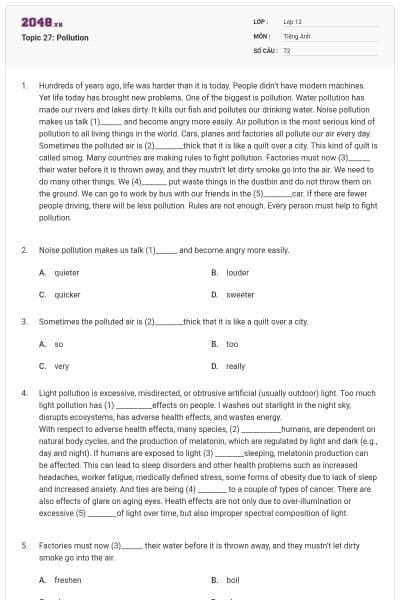
Hundreds of years ago, life was harder than it is today. People didn’t have modern machines. Yet life today has brought new problems. One of the biggest is pollution. Water pollution has made our rivers and lakes dirty. It kills our fish and pollutes our drinking water. Noise pollution makes us talk (1)______ and become angry more easily. Air pollution is the most serious kind of pollution to all living things in the world. Cars, planes and factories all pollute our air every day. Sometimes the polluted air is (2)________thick that it is like a quilt over a city. This kind of quilt is called smog. Many countries are making rules to fight pollution. Factories must now (3)______ their water before it is thrown away, and they mustn’t let dirty smoke go into the air. We need to do many other things. We (4)_______ put waste things in the dustbin and do not throw them on the ground. We can go to work by bus with our friends in the (5)________car. If there are fewer people driving, there will be less pollution. Rules are not enough. Every person must help to fight pollution.
quieter
louder
quicker
sweeter
Hàng triệu năm trước đây, cuộc sống khó khăn hơn bây giờ. Con người không có các thiết bị hiện đại. Tuy nhiên, cuộc sống bây giờ cũng mang đến nhiều rắc rối. Một trong những vấn đề nghiêm trọng nhất là ô nhiễm. Ô nhiễm nước khiến các sông, hồ bị bẩn. Nó giết chết cá và làm ô nhiễm nguồn nước uống. Ô nhiễm âm thanh khiến chúng ta nói lớn hơn và dễ dàng nỗi giận hơn. Ô nhiễm không khí là loại ô nhiễm nghiêm trọng nhất với mọi sinh vật sống trên thế giới. Xe hơi, máy bay và các công ty mỗi ngày đều làm ô nhiễm không khí. Thỉnh thoảng không khí bị ô nhiễm quá dày đến mức mà nó giống một tấm chăn bao trùm cả thành phố. Loại chăn này được gọi là khói. Nhiều nước đang ra đưa ra các luật lệ để chống lại ô nhiễm. Các công ty phải làm sạch nước trước khi thải ra ngoài và họ không được phép để khói bẩn bay vào không khí. Chúng ta cần phải làm nhiều thứ khác nữa. Chúng ta có thể bỏ đồ không dùng đến vào thùng rác và không vứt chúng trên đất. Chúng ta có thể đi làm bằng xe buýt hoặc đi với bạn bè trong cùng một xe. Càng ít người lái xe, ô nhiễm càng ít. Quy tắc là chưa đủ. Mỗi người phải cùng giúp đỡ để chống lại ô nhiễm.
Đáp án B
Kiến thức về từ vựng
A. quiet /’kwaiət/ (a): yên lặng, yên tĩnh; êm ả
B. loud /laʊd/ (a): to, ầm ĩ, inh ỏi (tiếng)
C. quick /kwik/ (a): nhanh, mau, lẹ
D. sweet /swi:t/ (a): ngọt
Tạm dịch: “Noise pollution makes us talk (1)______ and become angry more easily.”
(Ô nhiễm tiếng ồn làm cho chúng ta nói to hơn và trở nên dễ dàng tức giận hơn.).
so
too
very
really
Đáp án A
Kiến thức về cấu trúc
Cấu trúc S + be + so + adj + that + S + V (quá…. đến nỗi).
Tạm dịch: “Sometimes the polluted air is (2)_____ thick that it is like a quilt over a city.”
(Đôi khi không khí ô nhiễm quá dày đến nỗi giống như một tấm chăn trùm lên trên thành phố.)
freshen
boil
clear
clean
Đáp án D
Kiến thức về từ vựng
A. freshen /’fre∫n/ (v): làm cho mới ra, làm cho tươi mát
B. boil /bɔil/ (v): sôi
C. clear /kliə[r]/ (v): xóa bỏ, loại bỏ cái gì không mong muốn
D. clean /kli:n/ (v): làm sạch, lau sạch, đánh sạch, tẩy sạch…
Tạm dịch: “Factories must now (3)______ their water before it is thrown away, and they mustn’t let dirty smoke go into the air.”
(Các nhà máy bây giờ phải làm sạch nước của họ trước khi thải ra, và họ cấm được để khói bẩn bay vào không khí.)
need
might
can
ought
Đáp án C
Kiến thức về cách sử dụng từ
- need: được dùng để diễn tả sự cần thiết
- might: được dùng để diễn tả một dự đoán về khả năng của sự việc trong hiện tại/tương lai với mức độ chắc chắn không cao, ngoài ra nó còn có thể diễn đạt một khả năng trong quá khứ với vai trò là dạng quá khứ của “may”.
- can: thường dùng để diễn tả về một khả năng có thể làm gì hay không
- ought: cũng có nghĩa là “phải”, “nên” nhưng nó hàm ý một sự việc mang tính đúng đắn hay sai trái, ought phải đi với to.
=> Căn cứ vào nghĩa của câu, ta xác định được đáp án chính xác là C. Hoặc có thể căn cứ vào câu đi sau nó cũng dùng “can” - và hai câu liên tiếp theo dạng hình thức liệt kê, ta có thể hiểu đó là cấu trúc song song.
Tạm dịch: “We (4)_______ put waste things in the dustbin and do not throw them on the ground.”
(Chúng ta có thể bỏ rác thải vào thùng rác và không ném chúng xuống đất.)
similar
same
different
separate
Đáp án B
Kiến thức về từ
Ta có the luôn đứng trước same
Tạm dịch: “We can go to work by bus with our friends in the (5)________car.”
(Chúng ta có thể đi làm bằng xe buýt với bạn bè trong cùng một chiếc xe.)
Light pollution is excessive, misdirected, or obtrusive artificial (usually outdoor) light. Too much light pollution has (1) __________effects on people. I washes out starlight in the night sky, disrupts ecosystems, has adverse health effects, and wastes energy.
With respect to adverse health effects, many species, (2) ___________humans, are dependent on natural body cycles, and the production of melatonin, which are regulated by light and dark (e.g., day and night). If humans are exposed to light (3) ________sleeping, melatonin production can be affected. This can lead to sleep disorders and other health problems such as increased headaches, worker fatigue, medically defined stress, some forms of obesity due to lack of sleep and increased anxiety. And ties are being (4) ________ to a couple of types of cancer. There are also effects of glare on aging eyes. Heath effects are not only due to over-illumination or excessive (5) ________of light over time, but also improper spectral composition of light.
positive
negative
helpful
essential
Ô nhiễm ánh sáng là ánh sáng nhân tạo quá mức, hoặc gây khó chịu (thường là ngoài trời). Quá nhiều ô nhiễm ánh sáng sẽ có tác động xấu đến con người. Nó làm mất đi sao vào bầu trời đêm, gián đoạn hệ sinh thái, có ảnh ảnh hưởng xấu với sức khỏe và làm mất đi năng lượng. Về khía cạnh ảnh hưởng tới sức khỏe, đối với nhiều loài nhất là con người, loài đang phụ thuộc vào tuần hoàn tự nhiên của cơ thể, và sự sản xuất ra metatonin, chất được điều hòa bởi ánh sáng và bóng tối (chẳng hạn ngày và đêm). Nếu như con người tiếp xúc với ánh sáng khi đang ngủ, việc sản xuất melatonin sẽ bị ảnh hưởng. Điều này có thể dẫn đến chứng khó ngủ và các vấn đề sức khỏe khác như tăng các cơn nhức đầu, chứng mệt mõi, căng thẳng y khoa và một vài hình thức béo phì do thiếu ngủ và nỗi sợ tăng cao. Nó được nhận thấy là có liên quan đến một vài căn bệnh ung thư. Nó cũng ảnh hưởng với việc nhìn của mắt. Ảnh hưởng về sức khỏe không chỉ do lượng ánh sáng quá mức hay là sự tiếp xúc quá nhiều với ánh sáng theo thời gian, mà còn do sự hợp thành hợp phổ của ánh sáng.
Đáp án B
Kiến thức về từ vựng
Xét các đáp án:
A. positive /ˈpɒz.ə.tɪv/ (adj): tích cực, lạc quan
B. negative /ˈneɡ.ə.tɪv/ (adj): tiêu cực, phủ định
C. helpful /ˈhelp.fəl/ (adj): giúp ích, có ích
D. essential /ɪˈsen.ʃəl/ (adj): cần thiết, chủ yếu
Tạm dịch: Light pollution is excessive, misdirected, or obtrusive artificial (usually outdoor) light. Too much light pollution has (1) __________effects on people
Ô nhiễm ánh sáng là ánh sáng nhân tạo quá mức, bị sai hướng hoặc gây khó chịu (thường là ngoài trời). Ô nhiễm ánh sáng quá nhiều có ảnh hưởng tiêu cực đến con người.
especially
generally
extremely
additionally
Đáp án A
Kiến thức về từ vựng:
Xét các đáp án:
A. especially /ɪˈspeʃ.əl.i/ (adv): đặc biệt, nhất là
B. generally /ˈdʒen.ə r.əl.i/ (adv): nói chung, thông thường
C. extremely /ɪkˈstriːm.li/ (adv): vô cùng, cực kỳ
D. additionally /əˈdɪʃ.ən.əl.i/ (adv): thêm nữa, ngoài ra
Tạm dịch: With respect to adverse health effects, many species, (2) ___________humans, are dependent on natural body cycles, and the production of melatonin, which are regulated by light and dark (e.g., day and night).
Liên quan đến các tác động xấu đến sức khỏe, nhiều loài, đặc biệt là con người, phụ thuộc vào chu kỳ cơ thể tự nhiên và sản xuất melatonin, được điều chỉnh bởi ánh sáng và bóng tối (ví dụ: ngày và đêm).
whereas
whenever
though
while
Đáp án D
Kiến thức về liên từ
Xét các đáp án:
A. whereas /weərˈæz/ (adv): trái lại, trong khi
B. whenever /wenˈev.ər/ (adv): bất cứ khi nào
C. though /ðəʊ/ (adv): mặc dù, dù vậy
D. while /waɪl/ (adv): trong khoảng, vào lúc mà
Tạm dịch: If humans are exposed to light (3) ________sleeping, melatonin production can be affected.
(Nếu con người tiếp xúc với ánh sáng trong khi ngủ, việc sản xuất melatonin có thể bị ảnh hưởng.)
founded
found
invented
located
Đáp án B
Kiến thức về từ vựng:
Xét các đáp án:
A. founded /faʊndɪd / (v): căn cứ, dựa trên; thành lập
B. found /faʊnd/ (v): tìm thấy
C. invented /ɪnˈventɪd/ (v): phát minh, sáng chế
D. located /ləʊˈkeɪtɪd/ (v): xác định vị trí, định vị
Tạm dịch: This can lead to sleep disorders and other health problems such as increased headaches, worker fatigue, medically defined stress, some forms of obesity due to lack of sleep and increased anxiety. And ties are being (4) ______to a couple of types of cancer.
(Điều này có thể dẫn đến rối loạn giấc ngủ và các vấn đề sức khỏe khác như đau đầu, mệt mỏi của công nhân, những căng thẳng được xác định về mặt y tế, một số dạng béo phì do thiếu ngủ và sự gia tăng lo lắng. Và mối quan hệ này đang được tìm thấy cho một vài loại ung thư.)
Heath effects are not only due to over-illumination or excessive (5) ________of light over time, but also improper spectral composition of light.
introduction
contact
exposure
coverage
Đáp án C
Kiến thức về từ vựng:
Xét các đáp án:
A. introduction /ˌɪn.trəˈdʌk.ʃən/ (n): sự giới thiệu
B. contact /ˈkɒn.tækt/ (n): sự tiếp xúc
C. exposure /ɪkˈspəʊ.ʒər/ (n): sự phơi nhiễm, tiếp xúc với
D. coverage /ˈkʌv.ər.ɪdʒ/ (n): sự bao phủ
Tạm dịch: Heath effects are not only due to over-illumination or excessive (5) ________of light over time, but also improper spectral composition of light.
(Những ảnh hưởng sức khỏe không chỉ do chiếu sáng quá mức hoặc tiếp xúc với ánh sáng quá mức theo thời gian, mà còn do quang phổ không phù hợp với thành phần của ánh sáng.)
As the world’s population continues to grow, so does the amount of garbage that people produce. On-the-go lifestyles require easily (1) ___________ products, such as soda cans or bottles of water, but the accumulation of these products has led to increasing amounts of plastic pollution around the world. As plastic is composed of major (2) ______________ pollutants, it has the potential to cause great harm to the environment in the form of air, water and land pollution.
Put simply, plastic pollution is when plastic has gathered in an area and has begun to (3) _________ impact the natural environment and create problems for plants, wildlife and even human population. Often this includes killing plant life and posing dangers to local animals. Plastic is an incredibly useful material, but it is also made from toxic compounds known to cause illness, and because it is meant for (4) _______, it is not biodegradable.
Next time you go for a shopping, don’t forget to carry a paper or cloth bag. Also, try to (5) ______ bringing plastic bags at home and purchasing items with too much of packing. This way you can help in contributing towards the environment in the form of reducing plastic pollution whose ill effects are irreversible.
(http://www.conserve-energy-future.com/causes-effects-solutions-of-plastic-pollution.php)
usable
needless
thrown
disposable
Khi dân số thế giới tăng lên, đồng nghĩa với số lượng rác thải được sử dụng cũng tăng lên. Trong lối sống bận rộn, người ta thường dùng những sản phẩm có sẵn, ví dụ lon soda hay chai nước, nhưng sự tích tụ của những sản phẩm này đã dẫn đến sự tăng lên về ô nhiễm nhựa. Vì nhựa được cấu tạo từ chất thải độc hại, nó có khả năng gây hại nghiêm trọng đến môi trường, dưới dạng ô nhiễm không khí, nước và đất.
Nói đơn giản là, ô nhiễm nhựa là khi nhựa được hợp lại trong một khu vực và đã bắt đầu ảnh hưởng tiêu cực lên môi trường tự nhiên và gây ra các vấn đề cho cây trồng, môi trường hoang đã và thậm chí là cả con người. Các vấn đề thường bao gồm làm chết đi cuộc sống của cây cối và gây nguy hiểm cho động vật địa phương. Nhựa là vật liệu hữu ích, nhưng nó cũng tạo ra các hợp chất độc hại được biết sẽ gây bệnh và bởi vì nó bền, nhưng nó không thể tự phân hủy được.
Lần tới nếu bạn đi mua sắm, đừng quên mang theo một túi giấy hoặc vải. Đồng thời, cố gắng tránh mang túi nhựa về nhà hoặc đồ phải dùng quá nhiều túi. Bằng cách đó bạn đang góp phần bảo vệ môi trường bằng hình thức giảm ô nhiễm nhựa, tác động căn bệnh tất của chúng không thể thay đổi được.
Đáp án D
Kiến thức về từ vựng
A. usable /’ju:z bl/ (a) : có thể sử dụng được
B. needless /’ni:dlis/ (a): không cần thiết, vô ích
C. thrown /θroʊn/ (v): vứt, ném
D. disposable /dɪspoʊzəbəl/ (a): dùng một lần
Tạm dịch: As the world’s population continues to grow, so does the amount of garbage that people produce. On-the-go lifestyles require easily (1) _____ products, such as soda cans or bottles of water, but the accumulation of these products has led to increasing amounts of plastic pollution around the world.
(Khi dân số thế giới tiếp tục tăng, lượng rác mà con người tạo ra cũng tăng theo. Lối sống di chuyển đòi hỏi các sản phẩm dùng một lần dễ dàng, chẳng hạn như lon soda hoặc chai nước, nhưng việc tích lũy các sản phẩm này đã dẫn đến sự gia tăng ô nhiễm nhựa trên toàn thế giới.)
As plastic is composed of major (2) ______________ pollutants, it has the potential to cause great harm to the environment in the form of air, water and land pollution.
deadly
harmless
industrial
toxic
Đáp án D
Kiến thức về từ vựng
A. deadly /’dedli/ (a): làm chết người, trí mạng
B. harmless /’hɑ:mlis/ (a): vô hại
C. industrial /in’dʌstriəl/ (a): (thuộc) công nghiệp
D. toxic /’tɔksik/ (a): độc
Tạm dịch: As plastic is composed of major (2) _____________ pollutants, it has the potential to cause great harm to the environment in the form of air, water and land pollution.
(Vì nhựa bao gồm các chất gây ô nhiễm độc hại lớn, nó có khả năng gây hại lớn cho môi trường dưới dạng ô nhiễm không khí, nước và đất.)
frankly
immediately
negatively
probably
Đáp án C
Kiến thức về từ vựng
A. frankly /’fræηkli/ (adv): thẳng thắn
B. immediately /i’mi:djətli/ (adv): tức thì, ngay lập tức
C. negatively /’negətivli/ (adv): tiêu cực
D. probably /’prɔbəbli/ (adv): hầu như chắc chắn
=> negatively impact: tác động tiêu cực
Tạm dịch: Put simply, plastic pollution is when plastic has gathered in an area and has begun to (3) _____ impact the natural environment and create problems for plants, wildlife and even human population.
(Nói một cách đơn giản, ô nhiễm nhựa là khi nhựa đã tập trung tại một khu vực và bắt đầu tác động tiêu cực đến môi trường tự nhiên và gây ra vấn đề cho thực vật, động vật hoang dã và thậm chí cả con người.)
Plastic is an incredibly useful material, but it is also made from toxic compounds known to cause illness, and because it is meant for (4) _______, it is not biodegradable.
durability
length
timeless
permanence
Đáp án A
Kiến thức về từ vựng
A. durability /djuərə’biliti/ (n): độ bền, khả năng có thể bền vững lâu dài (ám chỉ đến chất lượng, độ bền của sản phẩm mà không bị yếu hay vỡ đi)
B. length /leɳθ/ (n): chiều dài
C. timeless /’taimlis/ (n): vô tận
D. permanence /’pə:mənəns/ (n): sự vĩnh viễn, tình trạng trường tồn mãi mãi theo thời gian (nhấn mạnh đến thời gian trường tồn)
Tạm dịch: Plastic is an incredibly useful material, but it is also made from toxic compounds known to cause illness, and because it is meant for (4)_______, it is not biodegradable.
(Nhựa là một vật liệu cực kỳ hữu ích, nhưng nó cũng được làm từ các hợp chất độc hại được biết là gây bệnh, và vì nó có chất lượng về độ bền, nên nó không bị phân hủy sinh học.)
avoid
refuse
prevent
skip
Đáp án A
Cấu trúc:
Avoid + V-ing: tránh làm gì
Refuse + to V: từ chối làm gì
Prevent sb from doing sth: ngăn cản ai khỏi làm việc gì
Căn cứ vào đằng sau khoảng trống có “bringing” ta chọn câu A
Tạm dịch: Next time you go for a shopping, don’t forget to carry a paper or cloth bag. Also, try to (5) ____________ bringing plastic bags at home and purchasing items with too much of packing.
(Lần tới khi đi mua sắm, đừng quên mang theo túi giấy hoặc túi vải. Ngoài ra, cố gắng tránh mang túi nhựa ở nhà và mua các mặt hàng có quá nhiều bao bì.)
INDUSTRIALIZATION AND POLLUTION
Industrialization has provided us with material comfort and modem (1) ____. Electrical appliances and efficient gadgets ease our daily chores. Yet, there is a heavy price tag attached to this convenience. Large-scale industrialization is killing the world.
Today there is a strong emphasis on the halt of CFC usage. CFCs, otherwise known as chloro-fluoro-carbons, are ozone depleting chemicals. They (2) ____ burn a hole in the earth’s atmosphere and we, on the Earth, suffer from the strong radiation (3) ____ by the sun’s rays. Household (4) ____ like refrigerators, aerosol cans, air-conditioners and styrofoam containers contain ozone depleting chemicals.
The hole in the sky allows harmful radiation to reach the Earth. As a result, the temperature on the Earth will (5) ____. This is alarming because polar ice-caps will melt in the heat. Ocean levels will rise and islands will gradually be flooded.
convenient
convenience
conveniences
inconveniences
Công nghiệp hóa đã cung cấp cho chúng ta những tiện nghi hiện đại và thoải mái về vật chất. Những thiết bị điện và những dụng cụ hiệu quả đã giảm bớt những công việc hàng ngày. Tuy nhiên, cái giá phải kèm theo có liên quan đến những tiện nghi này là vô cùng lớn. Công nghiệp hóa quy mô rộng đang dần giết chết Trái Đất.
Hiện nay, việc giảm thiểu lượng tiêu thụ khí CFC đang được nhấn mạnh rất nhiều. CFCs, nói theo cách khác, khí đó là chloro-fluoro-carbons, một loại khí hóa học đang phá hủy tầng ozon. Trên thực tế, chúng tạo ra những lỗ hổng ở tầng khí quyển và chúng ta, ở trên bề mặt Trái Đất, chịu những tia bức xạ mạnh được phát ra từ tia mặt trời. Những vật dụng trong nhà như tủ lạnh, bình xịt, máy điều hòa và hộp xốp chứa những chất phá hủy tầng ozon.
Những lỗ hổng trên bầu trời đã cho phép những tia bức xạ nguy hiểm chạm đến Trái Đất. Kết quả là, nhiệt độ Trái Đất sẽ tăng cao. Đây là một điều đáng báo động bởi băng ở hai cực sẽ tan ra dưới sức nóng. Mực nước biển tăng và nhiều quần đảo dần dần sẽ bị nhấn chìm.
Đáp án C
Kiến thức về từ loại
A. convenient /kən’vi:njənt/ (a): tiện lợi, thuận lợi
B. convenience /kən’vi:njəns/ (n): sự tiện lợi, sự thuận lợi; sự thích hợp
C. conveniences /kən’vi:njəns/ (n): sự tiện lợi, sự thuận lợi; sự thích hợp
D. inconveniences /inkən’vi:njəns/ (n): sự bất tiện, sự phiền phức
Căn cứ vào từ “modern” là tính từ nên khoảng trống phải là một danh từ.
=> modern conveniences: tiện nghi hiện đại, các thiết bị tiện nghi của một ngôi nhà hiên đại.
Tạm dịch:
Industrialization has provided us with material comfort and modern (1) ____. Electrical appliances and efficient gadgets ease our daily chores.
(Công nghiệp hóa đã cung cấp cho chúng ta sự thoải mái về vật chất và tiện nghi hiện đại. Các thiết bị điện và thiết bị có năng suất cao làm giảm bớt lượng công việc hàng ngày của chúng tôi.)
truly
hardly
already
practically
Đáp án D
Kiến thức về từ vựng
A. truly /truːli/ (adv): thành thật
B. hardly /’hɑ:dli/ (adv): khắc nghiệt, nghiêm khắc
C. already /ɔ:l’redi/ (adv): đã, rồi; đã… rồi
D. practically /’præktikəli/ (adv): thực tế, thực tiễn, thiết thực
Tạm dịch:
CFCs, otherwise known as chlorofluoro-carbons, are ozone depleting chemicals. They (2) ____ burn a hole in the earth’s atmosphere and we, on the Earth, suffer from the strong radiation (3) ____ by the sun’s rays.
(CFC, còn được gọi là chlorofluoro-carbons, là hóa chất làm suy giảm tầng ozone. Chúng thực tế làm thủng một lỗ trên bầu khí quyển của Trái đất và chúng ta, trên Trái đất, chịu đựng bức xạ mạnh (3) ____ bởi các tia mặt trời.)
emit
emits
emitting
emitted
Đáp án D
Kiến thức về rút gọn mệnh đề quan hệ
Có 3 cách rút gọn mệnh đề quan hệ:
- Nếu động từ của mệnh đề quan hệ ở dạng chủ động thì ta dùng V-ing để rút gọn mệnh đề quan hệ
- Nếu động từ của mệnh đề quan hệ ở dạng bị động thì ta dùng Vp2 để rút gọn mệnh đề quan hệ
- Nếu động từ của mệnh đề quan hệ thay thế cho các từ có chứa số thứ tự/ last/ only/ so sánh nhất thì ta dùng To V để rút gọn mệnh đề quan hệ.
Căn cứ vào cụm “by the sun’s rays” => là bị động
Tạm dịch:
CFCs, otherwise known as chlorofluoro-carbons, are ozone depleting chemicals. They practically burn a hole in the earth’s atmosphere and we, on the Earth, suffer from the strong radiation (3) ____ by the sun’s rays.
(CFC, còn được gọi là chlorofluoro-carbons, là hóa chất làm suy giảm tầng ozone. Chúng thực tế làm thủng một lỗ trên bầu khí quyển Trái đất và chúng ta, trên Trái đất, chịu đựng bức xạ mạnh được phát ra từ các tia mặt trời.)
Household (4) ____ like refrigerators, aerosol cans, air-conditioners and styrofoam containers contain ozone depleting chemicals.
things
items
pieces
amounts
Đáp án B
Kiến thức về từ vựng
A. things /θiɳ/ (n): đồ, vật
B. items /’aitem/ (n): món (ghi trong đơn hàng)
C. pieces /ˈpiːsɪz/ (n): linh kiện
D. amounts /ə’maunt/ (n): số lượng, lượng
=> Household items: đồ gia dụng
Tạm dịch: Household (4) ____ like refrigerators, aerosol cans, air-conditioners and styrofoam containers contain ozone depleting chemicals.
(Các đồ gia dụng như tủ lạnh, bình xịt, máy điều hòa không khí và thùng xốp chứa hóa chất làm suy giảm tầng ozone.)
raise
raising
rise
rising
Đáp án C
Kiến thức về từ loại
A. raise /reiz/ (v): nâng lên
B. raising /’reiziη/ (n): sự nâng lên
C. rise /raiz/ (v): đứng lên, nâng lên
D. rising /’raiziɳ/ (n): sự mọc, sự dậy
*Sự khác nhau giữa raise và rise:
Raise: nâng nó lên một vị trí cao hơn hoặc gia tăng nó
Rise: di chuyển từ một vị trí thấp hơn sang một vị trí cao hơn
Rise còn có nghĩa là “gia tăng về số hay lượng”
Tạm dịch: The hole in the sky allows harmful radiation to reach the Earth. As a result, the temperature on the Earth will (5) ____.
(Lỗ thủng trên bầu trời cho phép bức xạ có hại đến Trái Đất. Kết quả là, nhiệt độ trên Trái Đất sẽ tăng lên.)
The annual mortality burden in the UK from exposure to outdoor air pollution is equivalent to around 40,000 deaths. To this can be (1) ____ further impacts from exposure to indoor air pollutants such as radon and second-hand smoke.
The health problems resulting from exposure to air pollution also have a (2) ____ cost to society and business, our health services, and people who suffer from illness and premature death. In the UK, these costs add up to more than £20 billion every year.
Vulnerable people are prisoners of air pollution, having to stay indoors and limit their (3) ____when pollution levels are high. This is not only unjust; it carries a cost to these individuals and the community from missed work and school, from more health problems (4) ____ lack of exercise, and from social isolation.
Taking action will reduce pain, suffering and demands on the National Health Service (NHS), while (5) ____ people back to work, learning, and an active life. The value of these benefits far exceeds the cost of reducing emissions.
To this can be (1) ____ further impacts from exposure to indoor air pollutants such as radon and second-hand smoke.
afforded
calculated
contributed
added
Gánh nặng về số lượng người tử vong hàng năm ở nước Anh từ việc tiếp xúc với không khí ô nhiễm bên ngoài tương đương với 40,000 ca chết. Điều này càng bị tác động sâu sắc hơn bởi việc tiếp xúc với chất ô nhiễm bên ngoài như radon và khói thuốc bị động.
Tình trạng sức khỏe do tiếp xúc với không khí ô nhiễm khiến xã hội và doanh nghiệp phải trả một cái giá rất lớn, các dịch vụ y tế, và những người mà phải chịu hậu quả từ việc ốm đau và chết sớm. Ở nước Anh, số tiền chi trả cho nó lên đến 20 tỷ Euro hàng năm.
Những người dễ bị tổn thương là nạn nhân của ô nhiễm không khí, họ phải ở trong nhà và hạn chế các hoạt động khi mức độ ô nhiễm tăng cao. Đây không chỉ là sự bất công, mà nó còn mang lại một cái giá phải trả cho những cá nhân và xã hội từ việc phải bỏ lỡ công việc và học tập, từ việc có thêm nhiều vấn đề sức khỏe vì thiếu vận động thể thao, đến việc bị tách biệt với xã hội.
Nhiều giải pháp đưa ra để giảm thiểu nỗi đau, tổn thương và nhu cầu đối với Dịch vụ Y tế Quốc gia (NHS), trong khi con người vẫn trở lại với việc đi làm, học tập và với cuộc sống năng động. Giá trị mà lợi ích này mang lại vượt xa chi phí để giảm thiểu khí thải.
Đáp án D
Kiến thức về từ vựng
A. afforded /ə’fɔ:d/ (v): có thể, có đủ sức, có đủ khả năng
B. calculated /kælkjʊleɪtɪd/ (v): tính, tính toán
C. contributed /kən’tribju:tid/ (v): đóng góp, góp phần
D. added /ædid/ (v): thêm vào
Tạm dịch: The annual mortality burden in the UK from exposure to outdoor air pollution is equivalent to around 40,000 deaths. To this can be (1) ____ further impacts from exposure to indoor air pollutants such as radon and second-hand smoke.
(Gánh nặng số người tử vong hàng năm ở Anh do tiếp xúc với ô nhiễm không khí ngoài trời tương đương với khoảng 40.000 ca tử vong. Điều này có thể được thêm vào bởi các tác động khác từ việc tiếp xúc với các chất gây ô nhiễm không khí trong nhà như radon và khói thuốc phụ.)
expensive
great
high
average
Đáp án C
Kiến thức về từ vựng
A. expensive /iks’pensiv/ (a): đắt tiền
B. great /greit/ (a): lớn, to lớn, vĩ đại
C. high /hai/ (a): cao
D. average /’ævəridʤ/ (a): trung bình
Tạm dịch: The health problems resulting from exposure to air pollution also have a (2) ____ cost to society and business, our health services, and people who suffer from illness and premature death. In the UK, these costs add up to more than £20 billion every year.
(Các vấn đề sức khỏe do tiếp xúc với ô nhiễm không khí cũng tốn chi phí cao cho xã hội và doanh nghiệp, các dịch vụ y tế và những người mắc bệnh và tử vong sớm. Ở Anh, những chi phí này lên tới hơn 20 tỷ bảng mỗi năm.)
activity
motion
vocation
doing
Đáp án A
Kiến thức về từ vựng
A. activity /æk’tiviti/ (n): sự tích cực, sự hoạt động
B. motion /’mouʃn/ (n): sự vận động, sự chuyển động, sự di động
C. vocation /vou’keiʃn/ (n): thiên hướng, nghề, nghề nghiệp
D. doing /’du:iɳ/ (n): sự làm (việc gì…)
Tạm dịch: Vulnerable people are prisoners of air pollution, having to stay indoors and limit their (3) ____ when pollution levels are high.
(Những người dễ bị tổn thương là những tù nhân của ô nhiễm không khí, họ phải ở trong nhà và hạn chế hoạt động khi mức độ ô nhiễm cao.)
*Note: “Activity” trong nghĩa “hoạt động giải trí, tiêu khiển” mới là danh từ đếm được, khi đó ta mới cần số nhiều. Còn trong câu này, nó mang nghĩa “hoạt động nói chung trong cuộc sống, hoặc một tình huống có nhiều hoạt động diễn ra hay được làm” - khi đó nó là danh từ không đếm được nên không chia được số nhiều.
This is not only unjust; it carries a cost to these individuals and the community from missed work and school, from more health problems (4) ____ lack of exercise, and from social isolation.
resulting in
regardless of
just as
due to
Đáp án D
Kiến thức về liên từ
Resulting in: dẫn đến
Regardless of: bất kể
Just as : ngay khi
Due to: do, bởi vì
Tạm dịch: This is not only unjust; it carries a cost to these individuals and the community from missed work and school, from more health problems (4) ____ lack of exercise, and from social isolation.
(Điều này không chỉ bất công; nó mang lại một chi phí cho những cá nhân này và cộng đồng từ việc bỏ lỡ công việc và trường học, từ nhiều vấn đề sức khỏe hơn do thiếu luyện tập thể dục và sự cô lập xã hội.)
making
getting
forcing
turning
Đáp án B
Kiến thức về thành ngữ
Cấu trúc: get someone’s back: giúp đỡ ai
Tạm dịch: Taking action will reduce pain, suffering and demands on the National Health Service (NHS), while (5) ____ people back to work, learning, and an active life. The value of these benefits far exceeds the cost of reducing emissions.
(Hành động sẽ giảm bớt đau đớn, đau khổ và yêu cầu đối với Dịch vụ Y tế Quốc gia (NHS), đồng thời giúp đỡ mọi người trở lại làm việc, học tập và một cuộc sống năng động. Giá trị của những lợi ích này vượt xa chi phí giảm khí thải)
While light at night can be beneficial, neutral, or damaging for individual species, its presence invariably disturbs ecosystems. For example, some species of spiders avoid lit areas, while other species are happy to build their spider web directly on a lamp post. Since lamp posts attract many flying insects, the spiders that don’t mind light gain an advantage over the spiders that avoid it.
Light pollution poses a serious threat in particular to nocturnal wildlife, having negative impacts on plant and animal physiology. It can confuse animal navigation, alter competitive interactions, change predator-prey relations, and cause physiological harm. The rhythm of life is orchestrated by the natural patterns of light and dark, so disruption to these patterns impacts the ecological dynamics.
Studies suggest that light pollution around lakes prevents zooplankton, such as Daphnia, from eating surface algae, causing algal blooms that can kill off the lakes’ plants and lower water quality. Light pollution may also affect ecosystems in other ways. For example, scientists have documented that night time light may interfere with the ability of moths and other nocturnal insects to navigate. Night-blooming flowers that depend on moths for pollination may be affected by night lighting, as there is no replacement pollinator that would not be affected by the artificial light. This can lead to species decline of plants that are unable to reproduce, and change an area’s long term ecology.
Reducing light pollution implies many things, such as reducing sky glow, reducing glare, reducing light trespass, and reducing clutter. The method for best reducing light pollution, therefore, depends on exactly what the problem is in any given instance. Adjusting the type of lights used, so that the light waves emitted are those that are likely to cause severe light pollution problems.
(http://en.wikipedia.org/wiki/Light_pollution)
This passage is mainly about ________________.
the rise in demand for better lighting
how light pollutes the environment
the toxic substances plants and insects produce under light
decreasing the amount of light pollution
Đáp án B
Nội dung chính của đoạn văn này là về ________________.
A. sự gia tăng nhu cầu về ánh sáng tốt hơn
B. ánh sáng gây ô nhiễm môi trường như thế nào
C. các chất độc hại thực vật và côn trùng sản xuất dưới ánh sáng
D. giảm lượng ô nhiễm ánh sáng
Căn cứ vào thông tin trong đoạn 1, ta thấy rằng tác giả đưa ra các ví dụ về ảnh hưởng của ô nhiễm ánh sáng gây ra cho môi trường.
All of the following impact the ecological dynamics EXCEPT ______________.
light’s confusing animal navigation
animals’ altering competitive interactions
predator-prey relations changing
wildlife’s inability to reproduce
Đáp án D
Tất cả những điều sau đây tác động đến động lực sinh thái NGOẠI TRỪ ____________.
A. ánh sáng gây nhầm lẫn điều hướng động vật
B. động vật thay đổi tương tác cạnh tranh
C. mối quan hệ động vật ăn thịt-con mồi thay đổi
D. động vật hoang dã không có khả năng sinh sản
Căn cứ vào thông tin sau trong đoạn văn:
Light pollution poses a serious threat in particular to nocturnal wildlife, having negative impacts on plant and animal physiology. It can confuse animal navigation, alter competitive interactions, change predator-prey relations, and cause physiological harm.
(Ô nhiễm ánh sáng đặt ra một mối đe dọa nghiêm trọng đặc biệt đối với động vật hoang dã về đêm, có tác động tiêu cực đến sinh lý thực vật và động vật. Nó có thể gây nhầm lẫn điều hướng động vật, thay đổi tương tác cạnh tranh, thay đổi mối quan hệ động vật ăn thịt và gây hại cho sinh lý.)
Which of the following can be concluded from the passage?
Reducing lighting at night is beneficial.
Wildlife needs less light than we may think.
Reducing lighting is a necessity.
There are different light wave lengths.
Đáp án A
Điều nào sau đây có thể được kết luận từ đoạn văn?
A. Giảm ánh sáng vào ban đêm có lợi.
B. Động vật hoang dã cần ít ánh sáng hơn chúng ta tưởng.
C. Giảm ánh sáng là một điều cần thiết.
D. Có độ dài sóng ánh sáng khác nhau
Đọc toàn bài văn ta thấy ô nhiễm ánh sáng gây hại cho những động vật hoang dã vào ban đêm, cản trở khả năng của bướm đêm và các loại côn trùng sống về đêm khác, vì vậy nên ta cần giảm ánh sáng vào ban đêm.
The phrase “interfere with” in the passage can be used interchangeably with __________.
go with
decrease
prevent
hold
Đáp án C
Cụm từ “interfere with” trong đoạn văn có thể được sử dụng thay thế cho nhau với _____________.
A. go with: kết hợp, phù hợp
B. decrease /’di:kri:s/ (n): sự giảm sút
C. prevent /pri’vent/ (v): ngăn ngừa
D. hold /hould/ (v): nắm giữ
Căn cứ vào ngữ cảnh của đoạn văn:
Light pollution may also affect ecosystems in other ways. For example, scientists have documented that night time light may interfere with the ability of moths and other nocturnal insects to navigate.
(Ô nhiễm ánh sáng cũng có thể ảnh hưởng đến hệ sinh thái theo những cách khác. Ví dụ, các nhà khoa học đã ghi nhận rằng ánh sáng ban đêm có thể cản trở khả năng của bướm đêm và các loài côn trùng sống về đêm khác.)
=> interfere with: cản trở, can thiệp
The writer’s tone in the passage is __________________.
critical
negative
neutral
positive
Đáp án C
Giọng điệu của nhà văn trong đoạn văn là __________________.
A. Chỉ trích, phê phán
B. Phủ nhận, phản đối
C. Trung lập
D. Khẳng định
=> Sau khi làm toàn bài văn ta thấy rằng tác giả chỉ cung cấp thông tin, nói về ảnh hưởng của ô nhiễm ánh sáng đối với hệ sinh thái và phương pháp làm giảm ô nhiễm ánh sáng. Vì vậy, bài văn mang giọng điệu trung lập.
Global sea level has been rising over the past century, and the rate has increased in recent decades. In 2014, global sea level was 2.6 inches above the 1993 average-the highest annual average in the satellite record (1993-present). Sea level continues to rise at a rate of about one-eighth of an inch per year.
Higher sea levels mean that deadly and destructive storm surges push farther inland than they once did, which also means more frequent nuisance flooding. Disruptive and expensive, nuisance flooding is estimated to be from 300 percent to 900 percent more frequent within U.S. coastal communities than it was just 50 years ago.
The two major causes of global sea level rise are thermal expansion caused by warming of the ocean since water expands as it warms, and increased melting of land-based ice, such as glaciers and ice sheets. The oceans are absorbing more than 90 percent of the increased atmospheric heat associated with emissions from human activity.
With continued ocean and atmospheric warming, sea levels will likely rise for many centuries at rates higher than that of the current century. In the United States, almost 40 percent of the population lives in relatively high-population-density coastal areas, where sea level plays a role in flooding, shoreline erosion, and hazards from storms. Globally, eight of the world’s 10 largest cities are near a coast, according to the U.N. Atlas of the Oceans.
Sea level rise at specific locations may be more or less than the global average due to local factors such as land subsidence from natural processes and withdrawal of groundwater and fossil fuels, changes in regional ocean currents, and whether the land is still rebounding from the compressive weight of Ice Age glaciers. In urban settings, rising seas threaten infrastructure necessary for local jobs and regional industries. Roads, bridges, subways, water supplies, oil and gas wells, power plants, sewage treatment plants, landfills-virtually all human infrastructure-is at risk from sea level rise.
(Source: https://oceanservice.noaa.gov)
Which of the following could be the main idea of the passage?
Sea level within U.S. coastal communities
Sea level and emissions from human activity
Sea level is rising at an increasing rate
Sea level and its effects on the world’s 10 largest cities
Đáp án C
Thông tin nào sau đây có thể là ý chính của đoạn văn?
A. Mực nước biển trong khu vực ven biển của Mỹ
B. Mực nước biển và khí thải từ hoạt động của con người
C. Mực nước biển dâng với tốc độ tăng lên
D. Mực nước biển và tác động của nó đối với 10 thành phố lớn nhất
Căn cứ thông tin toàn bài và phần mở đầu ở đoạn 1:
Global sea level has been rising over the past century, and the rate has increased in recent decades. In 2014, global sea level was 2.6 inches above the 1993 average - the highest annual average in the satellite record (1993-present). Sea level continues to rise at a rate of about one-eighth of an inch per year.
(Mực nước biển toàn cầu đã tăng lên trong thế kỷ qua, và tỷ lệ này đã tăng lên trong những thập kỷ gần đây. Trong năm 2014, mực nước biển toàn cầu cao hơn 2,6 inch so với mức trung bình năm 1993 - mức trung bình hàng năm cao nhất trong hồ sơ vệ tinh (1993-nay). Mực nước biển tiếp tục tăng với tốc độ khoảng một phần tám inch mỗi năm.)
The word “deadly” in paragraph 2 is closest in meaning to ______.
huge
lethal
fast
rainy
Đáp án B
Từ “deadly” trong đoạn 2 gần nghĩa nhất với từ ______.
A. to lớn
B. chết người
C. nhanh chóng
D. có mưa
Kiến thức từ đồng nghĩa: deadly (chết người) = lethal
Higher sea levels mean that deadly and destructive storm surges push farther inland than they once did, which also means more frequent nuisance flooding.
(Mực nước biển cao hơn có nghĩa là những cơn bão chết người có sức tàn phá đi sâu vào trong nội địa hơn những lần trước, điều này cũng có nghĩa là sự phiền toái do lũ lụt sẽ xảy ra thường xuyên hơn.)
What is the main idea of paragraph 2?
Storms will become more deadly and destructive.
Nuisance flooding is becoming more and more frequent.
Coastal communities in U.S suffer from less flooding than 50 years ago.
Storm surges push farther inland, and are 3 to 9 times more frequent within U.S.
Đáp án B
Ý chính của đoạn 2 là gì?
A. Bão sẽ trở nên chết chóc và tàn phá nhiều hơn
B. Lũ lụt gây thiệt hại sẽ trở nên ngày càng thường xuyên hơn
C. Những khu vực ven biển ở Mỹ chịu ít lũ lụt hơn so với 50 năm trước
D. Ở Mỹ, bão sẽ tiến sâu hơn vào nội địa và thường xuyên hơn từ 3 đến 9 lần
Căn cứ thông tin đoạn 2, đọc và khái quát ý chính để chọn câu tóm tắt ý toàn đoạn:
Higher sea levels mean that deadly and destructive storm surges push farther inland than they once did, which also means more frequent nuisance flooding. Disruptive and expensive, nuisance flooding is estimated to be from 300 percent to 900 percent more frequent within U.S. coastal communities than it was just 50 years ago.
(Mực nước biển cao hơn có nghĩa là những cơn bão chết người có sức tàn phá đi sâu vào trong nội địa hơn những lần trước, điều này cũng có nghĩa là sự phiền toái do lũ lụt sẽ xảy ra thường xuyên hơn. Tàn phá và gây tốn kém, lũ lụt gây thiệt hại được ước tính là sẽ xảy ra thường xuyên hơn từ 300 phần trăm đến 900 phần trăm tại các vùng ven biển Hoa Kỳ so với chỉ 50 năm trước đây.)
=> Do đó, ta thấy ý chính của đoạn là: Lũ lụt gây phiền toái sẽ trở nên ngày càng thường xuyên hơn.
What does the word “it” in paragraph 3 refer to?
water
sea level
ocean
ice
Đáp án A
Từ “it” trong đoạn 3 ám chỉ ______.
A. nước
B. mực nước biển
C. đại dương
D. biển
Căn cứ thông tin các câu trước câu chứa từ “it” trong đoạn 3, đọc kỹ để hiểu từ “it” thay thế danh từ nào được nhắc đến trước đó:
The two major causes of global sea level rise are thermal expansion caused by warming of the ocean since water expands as it warms, and increased melting of land-based ice, such as glaciers and ice sheets.
(Hai nguyên nhân chính của sự gia tăng mực nước biển toàn cầu là sự giãn nở nhiệt gây ra bởi sự ấm lên của đại dương vì nước mở rộng khi nó ấm lên, và làm tan chảy băng đá trên đất liền, chẳng hạn như sông băng và các lớp băng.)
Which of the following statements is TRUE according to paragraph 4?
Sea levels will likely rise for many centuries at rates of the current century.
40 percent of the population of the U.S lives in densely populated coastal areas.
Sea level plays no role in flooding, shoreline erosion, and hazards from storms.
Sea level rise will only affect the world’s 10 largest cities near the coast.
Đáp án B
Thông tin nào sau đây ĐÚNG theo thông tin đoạn 4?
A. Mực nước biển có thể sẽ tăng trong nhiều thế kỷ với tốc độ của thế kỷ hiện tại.
B. 40 phần trăm dân số của Mỹ sống ở các khu vực ven biển đông dân cư.
C. Mực nước biển không có vai trò trong lũ lụt, xói lở bờ biển và các nguy cơ từ bão.
D. Mực nước biển dâng sẽ chỉ ảnh hưởng đến 10 thành phố lớn nhất thế giới gần bờ biển.
Căn cứ thông tin đoạn 4:
With continued ocean and atmospheric warming, sea levels will likely rise for many centuries at rates higher than that of the current century. In the United States, almost 40 percent of the population lives in relatively high-population-density coastal areas, where sea level plays a role in flooding, shoreline erosion, and hazards from storms. Globally, eight of the world’s 10 largest cities are near a coast, according to the U.N. Atlas of the Oceans.
(Với sự nóng lên không ngừng của đại dương và khí quyển, mực nước biển có thể sẽ tăng trong nhiều thế kỷ với tốc độ cao hơn so với thế kỷ hiện tại. Tại Hoa Kỳ, gần 40% dân số sống ở các khu vực ven biển có mật độ dân số tương đối cao, nơi mực nước biển ảnh hưởng đến lũ lụt, xói lở bờ biển và các mối nguy hiểm từ bão. Trên toàn cầu, tám trong số mười thành phố lớn nhất thế giới ở gần bờ biển theo Atlas đại dương của Liên hợp quốc.)
The word “relatively” in the paragraph 4 could be best replaced by ______.
comparatively
responsibly
extremely
accurately
Đáp án A
Từ “relative” trong đoạn 4 có thể được thay thế tốt nhất bởi từ ______.
A. tương đối
B. trách nhiệm
C. cực kỳ
D. đúng đắn
Kiến thức từ đồng nghĩa: relative (tương đối) = comparatively
In the United States, almost 40 percent of the population lives in relatively high-population-density coastal areas, where sea level plays a role in flooding, shoreline erosion, and hazards from storms.
(Tại Mỹ, gần 40% dân số sống ở các khu vực ven biển có mật độ dân số tương đối cao, nơi mực nước biển ảnh hưởng đến lũ lụt, xói lở bờ biển và các mối nguy hiểm từ bão.)
Which of the following best summarizes the last paragraph?
Sea level rise are different from location to location due to many factors.
Sea level rise only depends on whether the land is still rebounding from the compressive weight of Ice Age glaciers.
Virtually all human infrastructure except roads, bridges, subways, water supplies, oil and gas wells, power plants, sewage treatment plants, landfills is at risk from sea level rise.
Sea level rise may be regionally various but it still threatens infrastructure necessary for local jobs and regional industries in urban setting.
Đáp án D
Lựa chọn nào sau đây tóm tắt đầy đủ nhất đoạn cuối?
A. Mực nước biển dâng khác nhau từ vị trí này đến vị trí khác do nhiều yếu tố.
B. Mực nước biển dâng chỉ phụ thuộc vào việc đất đàn hồi lại trọng lực nén của các dòng sông băng lâu năm.
C. Hầu như tất cả các cơ sở hạ tầng của con người ngoại trừ đường xá, cầu, tàu điện ngầm, nguồn cấp nước, giếng dầu và khí đốt, nhà máy điện, nhà máy xử lý nước thải, bãi chôn lấp đều chịu nguy cơ do nước biển dâng.
D. Mực nước biển dâng có thể khác nhau theo từng khu vực nhưng nó vẫn đe dọa cơ sở hạ tầng cần thiết cho công việc địa phương và các ngành công nghiệp trong khu vực đô thị.
Dựa vào thông tin đoạn cuối, khái quát ý toàn đoạn để chọn câu tóm tắt đầy đủ nhất nội dung đoạn này:
Sea level rise at specific locations may be more or less than the global average due to local factors such as land subsidence from natural processes and withdrawal of groundwater and fossil fuels, changes in regional ocean currents, and whether the land is still rebounding from the compressive weight of Ice Age glaciers. In urban settings, rising seas threaten infrastructure necessary for local jobs and regional industries. Roads, bridges, subways, water supplies, oil and gas wells, power plants, sewage treatment plants, landfills - virtually all human infrastructure - is at risk from sea level rise.
(Mực nước biển dâng tại các vị trí cụ thể có thể nhiều hơn hoặc ít hơn mức trung bình toàn cầu do các yếu tố địa phương như sụt lún đất từ các quá trình tự nhiên và rút nước ngầm và nhiên liệu hóa thạch, thay đổi dòng hải lưu trong khu vực và liệu đất này có đàn hồi trở lại trọng lượng nén của các dòng sông băng lâu năm. Trong môi trường đô thị, nước biển dâng đe dọa cơ sở hạ tầng cần thiết cho công việc tại các địa phương và các ngành công nghiệp trong khu vực. Đường, cầu, tàu điện ngầm, nguồn cấp nước, giếng dầu và khí đốt, nhà máy điện, nhà máy xử lý nước thải, bãi chôn lấp - hầu như tất cả cơ sở hạ tầng của con người đều đối mặt với những nguy cơ do việc nước biển dâng.)
Which of the following is the passage likely extracted from?
Sci-fi document
Research record
Scientific magazine
Weather forecast
Đáp án C
Đoạn văn có khả năng được trích xuất từ loại tài liệu nào sau đây?
A. Tài liệu khoa học viễn tưởng
B. Báo cáo nghiên cứu
C. Tạp chí khoa học
D. Dự báo thời tiết
Căn cứ thông tin toàn bài ta thấy bài đọc nói về hiện tượng thực tế, không liên quan đến khoa học viễn tưởng, báo cáo nghiên cứu thì quá sơ sài và dự báo thời tiết thì càng không đúng.
Global sea level has been rising over the past century, and the rate has increased in recent decades. In 2014, global sea level was 2.6 inches above the 1993 average - the highest annual average in the satellite record (1993-present). Sea level continues to rise at a rate of about one-eighth of an inch per year.
(Mực nước biển toàn cầu đã tăng lên trong thế kỷ qua, và tỷ lệ này đã tăng lên trong những thập kỷ gần đây. Trong năm 2014, mực nước biển toàn cầu cao hơn 2,6 inch so với mức trung bình năm 1993 - mức trung bình hàng năm cao nhất trong hồ sơ vệ tinh (1993-nay). Mực nước biển tiếp tục tăng với tốc độ khoảng một phần tám inch mỗi năm.)
Previously, people often only considered second-hand smoke as a welfare issue, focusing on the smell and the irritation that tobacco smoke causes to eyes, nose and throat. But now the weight of evidence for much more serious risks to health from second-hand smoke has grown too great to ignore.
Tobacco smoke contains around 4,000 chemicals, including arsenic, benzene, formaldehyde and ammonia. Around 60 of these chemicals are known or suspected to cause cancer. Many of the toxic chemicals are actually more concentrated in the smoke that’s given off by the burning tip of a cigarette (sidestream smoke). Around 85 per cent of the smoke in a room where people are smoking is the more toxic sidestream smoke. By breathing in it in the atmosphere, the non-smoker is exposed to many of the same health risks as the smoker.
The best known risk to smokers, lung cancer, is also more common in people regularly exposed to second-hand smoke. The Government’s Scientific Committee on Tobacco and Health (SCOTH) reported in 1998 that exposure to second-hand smoke increases the risk of lung cancer in non-smokers by 20-30 per cent.
Even though they inhale only 1% of the smoke, non-smokers exposed to second-hand smoke may suffer 25 per cent of the increased risk of heart disease associated with active smoking (one recent study suggests it might be as much as 50 per cent). Just 30 minutes of breathing second-hand smoke can reduce the coronary blood supply of a non-smoker to the same level as that of a smoker.
A study in New Zealand found that exposure to second-hand smoke increases the risk of stroke by 82 per cent in non-smokers. This is a serious concern, as stroke is such a common condition. Moreover, around 3.4 million people in the UK have asthma and for most of these, tobacco smoke is a trigger for an asthma attack. For someone with asthma, just one hour of exposure to second-hand smoke can cause a 20 per cent deterioration in lung function. During pregnancy, breathing in second-hand smoke increases the risk of having a baby with a low birth weight. Small babies are at much greater risk of infections and other health problems.
A recent review of international research on the immediate health impact of smoke-free workplace legislation found rapid and dramatic improvements. Air quality, respiratory health and levels of heart attacks and heart disease all improved substantially within months of the legislation being introduced.
There has been greater focus on the dangers of second-hand smoke since .
the government accepted it as a great welfare issue
overwhelming proof of its dangers emerged
people realized the irritation it caused to eyes, nose and throat
so many people ignored the warnings
Đáp án B
Đã có sự tập trung nhiều hơn vào sự nguy hiểm của khói thuốc lá kể từ khi .
A. chính phủ chấp nhận nó như là một vấn đề sức khỏe quan trọng
B. bằng chứng áp đảo về sự nguy hiểm của nó xuất hiện
C. mọi người nhận ra sự kích thích mà nó gây ra cho mắt, mũi và cổ họng
D. rất nhiều người bỏ qua các cảnh báo
Căn cứ vào thông tin đoạn văn:
But now the weight of evidence for much more serious risks to health from second-hand smoke has grown too great to ignore.
(Nhưng bây giờ bằng chứng đanh thép về những nguy hiểm nghiêm trọng hơn nhiều đối với sức khỏe từ khói thuốc lá đã tăng lên quá mức để có thể bỏ qua.)
Sidestream smoke
has a higher proportion of dangerous chemicals than inhaled smoke
contains 4,000 chemicals, 60 of which are known to cause cancer
contains 85% of the chemicals found in inhaled smoke
increases the risk of cancer to 60%
Đáp án A
Khói thuốc tỏa ra .
A. có tỷ lệ hóa chất nguy hiểm cao hơn khói hít vào
B. chứa 4.000 hóa chất, 60 trong số đó được biết là gây ung thư
C. chứa 85% hóa chất được tìm thấy trong khói hít vào
D. làm tăng nguy cơ ung thư lên 60%
Căn cứ vào thông tin đoạn văn:
Many of the toxic chemicals are actually more concentrated in the smoke that’s given off by the burning tip of a cigarette (sidestream smoke).
(Nhiều hóa chất độc hại thực sự tập trung nhiều hơn trong khói mà được thải ra từ đầu đốt của một điếu thuốc (khói phụ).)
The highlighted word "it" in the passage refers to
the room
a cigarette
toxic
sidestream smoke
Đáp án D
Từ “it” được tô sáng trong đoạn văn đề cập đến .
A. phòng
B. một điếu thuốc
C. độc
D. khói thuốc tỏa ra
Căn cứ vào ngữ cảnh của câu:
Around 85 per cent of the smoke in a room where people are smoking is the more toxic sidestream smoke. By breathing in it in the atmosphere, the non-smoker is exposed to many of the same health risks as the smoker.
(Khoảng 85% khói trong phòng nơi mọi người đang hút thuốc là khói thuốc phụ độc hại hơn. Bằng cách hít nó trong không khí, người không hút thuốc cũng gặp nhiều nguy hiểm về sức khỏe như người hút thuốc.)
=> it = sidestream smoke (khói thuốc phụ)
Lung cancer______ .
affects 20-30% of non-smokers
is the most common disease in non-smokers that is caused by second-hand smoke
is 20-30% more likely to occur if people are exposed to second-hand smoke
is the risk of only smokers
Đáp án C
Ung thư phổi_____ .
A. ảnh hưởng đến 20-30% người không hút thuốc
B. là bệnh phổ biến nhất ở những người không hút thuốc do khói thuốc phụ
C. có khả năng xảy ra cao hơn 20-30% nếu mọi người tiếp xúc với khói thuốc phụ
D. là nguy hiểm chỉ với những người hút thuốc
Căn cứ vào thông tin đoạn văn:
The Government’s Scientific Committee on Tobacco and Health (SCOTH) reported in 1998 that exposure to second-hand smoke increases the risk of lung cancer in non-smokers by 20-30 per cent.
(Năm 1998, Ủy ban khoa học chính phủ về thuốc lá và sức khỏe (SCOTH) đã báo cáo rằng tiếp xúc với khói thuốc phụ làm tăng nguy cơ ung thư phổi ở những người không hút thuốc lên 20-30%.)
In New Zealand, it was discovered that ______________.
people exposed to second-hand smoke are 82% more likely to get a stroke
82% of people exposed to second-hand smoke suffer from a stroke
the risk of stroke to second-hand smoke is 82% of the risk of stroke to smokers
stroke is accepted wildly by the majority of the smokers
Đáp án A
Ở New Zealand, người ta đã phát hiện ra rằng__________.
A. những người tiếp xúc với khói thuốc phụ có nguy cơ bị đột quỵ cao hơn 82%
B. 82% số người tiếp xúc với khói thuốc phụ bị đột quỵ
C. nguy cơ đột quỵ với khói thuốc phụ là 82% so với nguy cơ đột quỵ đối với người hút thuốc
D. đột quỵ được chấp nhận bởi đa số những người hút thuốc
Căn cứ vào thông tin đoạn văn:
A study in New Zealand found that exposure to second-hand smoke increases the risk of stroke by 82 per cent in non-smokers.
(Một nghiên cứu ở New Zealand cho thấy việc tiếp xúc với khói thuốc phụ làm tăng nguy cơ đột quỵ lên đến 82 % ở những người không hút thuốc.)
The article states that ___________
most asthma attacks are triggered by second-hand smoke.
20% of asthma sufferers are exposed to second-hand smoke.
lung function of asthma sufferers decreases by 20% when exposed to second-hand smoke.
3,4 million people who have asthma smoke.
Bài báo nói rằng_________.
A. hầu hết các cơn hen bị gây ra bởi khói thuốc phụ
B. 20% bệnh nhân hen suyễn tiếp xúc với khói thuốc phụ
C. chức năng phổi của bệnh nhân hen suyễn giảm 20% khi tiếp xúc với khói thuốc phụ
D. 3,4 triệu người mắc bệnh hen suyễn
Căn cứ vào thông tin đoạn văn:
For someone with asthma, just one hour of exposure to second-hand smoke can cause a 20 per cent deterioration in lung function.
(Đối với người bị hen suyễn, chỉ một giờ tiếp xúc với khói thuốc phụ có thể làm suy giảm chức năng phổi đi 20%.)
The highlighted word "immediate" in the passage is closest in meaning to _________
slow
existing
curable
instant
Đáp án D
Từ “immediate” trong đoạn văn có nghĩa gần nhất với________.
A. chậm
B. hiện có
C. chữa được
D. tức thì
A recent review of international research on the immediate health impact of smoke-free workplace legislation found rapid and dramatic improvements.
(Một đánh giá gần đây của nghiên cứu quốc tế về tác động sức khỏe tức thời của luật nơi làm việc không có khói thuốc đã nhận thấy những cải tiến nhanh chóng và ấn tượng.)
=> immediate = instant (tức thời)
People exposed to second-hand smoke for 30 minutes ____________.
are 25-50% more likely to get heart disease than people who are unexposed
experience the same reduced blood supply to the heart as that of a smoker
experience a 25-50% reduction in coronary blood supply
inhale 1% of the smoke
Đáp án B
Những người tiếp xúc với khói thuốc trong 30 phút__________.
A. có nguy cơ mắc bệnh tim cao hơn 25-50% so với những người không tiếp xúc
B. trải qua việc giảm lượng cung cấp máu cho tim giống như người hút thuốc
C. giảm 25-50% nguồn cung cấp máu mạch vành
D. hít 1% khói
Căn cứ vào thông tin đoạn văn:
Just 30 minutes of breathing second-hand smoke can reduce the coronary blood supply of a non-smoker to the same level as that of a smoker.
(Chỉ cần 30 phút hít thở hói thuốc phụ có thể làm giảm lượng máu cung cấp ở người không hút thuốc bằng mức như của một người hút thuốc.)
Pollutants in the air aren’t always visible and come from many different sources. Smog hanging over cities is the most familiar and obvious form of air pollution. But there are different kinds of pollution - some visible, some invisible - that contribute to global warming. Generally any substance that people introduce into the atmosphere that has damaging effects on living things and the environment is considered air pollution.
Carbon dioxide, a greenhouse gas, is the main pollutant that is warming Earth. Though living things emit carbon dioxide when they breathe, carbon dioxide is widely considered to be a pollutant when associated with cars, planes, power plants, and other human activities that involve the burning of fossil fuels such as gasoline and natural gas. In the past 150 years, such activities have pumped enough carbon dioxide into the atmosphere to raise its levels higher than they have been for hundreds of thousands of years.
Other greenhouse gases include methane - which comes from such sources as swamps and gas emitted by livestock - and chlorofluorocarbons (CFCs), which were used in refrigerants and aerosol propellants until they were banned because of their deteriorating effect on Earth’s ozone layer.
Another pollutant associated with climate change is sulfur dioxide, a component of smog. Sulfur dioxide and closely related chemicals are known primarily as a cause of acid rain. But they also reflect light when released in the atmosphere, which keeps sunlight out and causes Earth to cool. Volcanic eruptions can spew massive amounts of sulfur dioxide into the atmosphere, sometimes causing cooling that lasts for years. In fact, volcanoes used to be the main source of atmospheric sulfur dioxide; today people are.
Industrialized countries have worked to reduce levels of sulfur dioxide, smog, and smoke in order to improve people’s health. But a result, not predicted until recently, is that the lower sulfur dioxide levels may actually make global warming worse. Just as sulfur dioxide from volcanoes can cool the planet by blocking sunlight, cutting the amount of the compound in the atmosphere lets more sunlight through, warming the Earth. This effect is exaggerated when elevated levels of other greenhouse gases in the atmosphere trap the additional heat.
According to the passage, some kind of air pollution ____.
are not introduced into the atmosphere
do not damage the environment
cannot be seen with our naked eyes
do not affect living things seriously
Đáp án C
Theo như bài đọc, một vài loại ô nhiễm không khí…
A. Không được đưa vào khi quyển
B. Không hủy hoại môi trường
C. Không thể nhìn thấy bằng mắt thường
D. Không ảnh hưởng nghiêm tọng đến sinh vật sống
Căn cứ vào thông tin đoạn 1:
“Pollutants in the air aren’t always visible and come from many different sources. Smog hanging over cities is the most familiar and obvious form of air pollution. But there are different kinds of pollution - some visible, some invisible - that contribute to global warming.”
(Các chất ô nhiễm trong không khí không thể luôn luôn có thể nhìn thấy và đến từ nhiều nguồn khác nhau. Sương khói trôi lơ lửng trên các thành phố là hình thức ô nhiễm quen thuộc và rõ ràng nhất. Nhưng có nhiều loại ô nhiễm khác nhau – một số có thể thấy, một số thì không – điều này góp phần cảnh báo toàn cầu.)
What is the main origin of carbon dioxide in the air?
Living things’ breathing
Manufacturing cars
Building power plants
Burning coals and petrol
Đáp án D
Nguồn gốc chính của Cacbon Dioxit là gì?
A. Hơi thở của sinh vật
B. Sản xuất ô tô
C. Xây dựng nhà máy điện
D. Đốt than và xăng
Căn cứ vào thông tin đoạn 2:
“Though living things emit carbon dioxide when they breathe, carbon dioxide widely considered to be a pollutant when associated with cars, planes, power plants, and other human activities that involve the burning of fossil fuels such as gasoline and natural gas.”
(Mặc dù các sinh vật sống thảo ra khí carbon dioxide khi chúng thở, nhưng carbon được coi là chất ô nhiễm khi liên quan đến ô tô, máy bay, nhà máy điện, và các hoạt động khác của con người liên quan đến việc đốt nhiên liệu hóa thạch như xăng và khí tự nhiên.)
What were banned because of their damaging the ozone layer?
Chlorofluorocarbons
Methane and gas
Refrigerants
Aerosol propellants
Đáp án A
Điều gì đã bị cấm vì làm hỏng tầng o-zone?
A. Chlorofluorocarbon
B. Metan và khí
C. Chất làm lạnh
D. Chất đẩy khí
Căn cứ vào thông tin đoạn 3:
“- and chlorofluorocarbons (CFCs), which were used in refrigerants and aerosol propellants until they were banned because of their deteriorating effect on Earth’s ozone layer.”
(Và CFCs được sử dụng trong chất làm lạnh và chất đẩy khí dung cho đến khi chúng bị cấm vì ảnh hưởng xấu đến tầng ozone của Trái Đất.)
What is NOT mentioned as a feature of sulfur dioxide?
Creating smog
Causing acid rain
Reflecting light
Warming the Earth up
Đáp án D
Cái gì không được đề cập như 1 đặc tính của Sunfua điôxít?
A. Tạo khói bụi
B. Gây ra mưa axit
C. Phản chiếu ánh sáng
D. Làm ấm trái đất
Căn cứ vào thông tin đoạn 4:
“Another pollutant associated with climate change is sulfur dioxide, a component of smog. Sulfur dioxide and closely related chemicals are known primarily as a cause of acid rain. But they also reflect light when released in the atmosphere, which keeps sunlight out and causes Earth to cool.”
(Một chất gây ô nhiễm khác liên quan đến biển đổi khí hậu là sulfur dioxide, một thành phần của khói bụi. Sulfur và các hóa chất liên quan khác được biết đến như nguyên nhân của mưa acid. Nhưng chúng cũng phản chiếu ánh sáng khi thải vào khí quyển, khiến ánh sáng mặt bị tắt và làm cho Trái Đất ấm hơn.)
What has been the main source of atmospheric sulfur dioxide recently?
Human activities
Volcanic eruptions
Forest fires
Earthquakes
Đáp án A
Điều gì là nguồn gốc chính của Sunfua điôxít trong không khí ngày nay?
A. Những hoạt động của con người
B. Phun trào núi lửa
C. Cháy rừng
D. Động đất
Căn cứ vào thông tin đoạn 4:
“In fact, volcanoes used to be the main source of atmospheric sulfur dioxide; today people are.”
(Thực tế, núi lửa đã từng là nguồn chính của lưu hình dioxide trong khí quyển nhưng ngày nay con người là nguyên nhân chính.)
What does the word "the compound” in the last paragraph refer to?
carbon dioxide
methane
chlorofluorocarbons
sulfur dioxide
Đáp án D
Từ “the compound” liên quan đến từ nào trong đoạn văn cuối?
A. Cacbon dioxit
B. Metan
C. Chlorofluorocarbon
D. Sunfua điôxít
Căn cứ vào bối cảnh đoạn cuối cùng:
“Just as sulfur dioxide from volcanoes can cool the planet by blocking sunlight, cutting the amount of the compound in the atmosphere lets more sunlight through, warming the Earth.”
(Giống như sulfur dioxide từ núi lửa có thể làm mái hành tinh bằng cách ngăn chặn ánh sáng mặt trời, cắt giảm lượng hợp chất trong khí quyển để nhận được nhiều ánh sáng hơn, làm ấm Trái Đất.)
What is the word "exaggerated" in the last sentence closest in meaning to?
overdone
understated
overestimated
over-invested
Đáp án C
Từ “exaggerated” trong câu văn cuối gần nghĩa với?
A. Làm quá sức
B. Hiểu
C. Đánh giá cao
D. Đầu tư quá mức
=> Exaggerated = overestimated: phóng đại lên, làm cho nó vượt xa so với thực tế
What is the text about?
Ocean pollution
Air pollutants
Tropical environment
How to reduce pollution
Đáp án B
Bài viết trên về cái gì?
A. Ô nhiễm đại dương
B. Chất ô nhiễm không khí
C. Môi trường nhiệt đới
D. Làm cách nào để giảm bớt ô nhiễm
=> Suốt toàn bài ta thấy tác giả đều nói về chất ô nhiễm không khí.
The word noise is derived from the Latin word nausea, meaning “seasickness”. Noise is among the most pervasive pollutants today. Noise pollution can broadly be defined as unwanted or offensive sounds that unreasonably intrude into our daily activities. Noises from traffic, jet engines, barking dogs, garbage trucks, construction equipment, factories, lawn mowers, leaf blowers, televisions, boom boxes and car radios, to name a few, are among the audible litter that is routinely broadcast into the air.
One measure of pollution is the danger it poses to health. Noise negatively affects human health and well-being. Problems related to noise include hearing loss, stress, high blood pressure, sleeplessness, fright, distraction, and lost productivity. Noise pollution also contributes to a general reduction in the quality of life and eliminates opportunities for tranquility.
We experience noise in a number of ways. On some occasions, we can be both the cause and the victim of noise, such as when we are operating noisy appliances or equipment. There are also instances when we experience noise generated by others, just as people experience secondhand smoke. In both instances, noise is equally damaging physically. Secondhand noise is generally more troubling, however, because it is put into the environment by others, without our consent.
The air into which secondhand noise is emitted and on which it travels is “a commons”. It belongs not to an individual person or a group, but to everyone. Please, businesses and organizations, therefore, do not have unlimited rights to broadcast noise the as they please, as if the effects of noise were limited only to their private property. Those that disregard the obligation to not interfere with other’ use and enjoyment of the commons by producing noise pollution are, in many ways, acting like a bully in a schoolyard. Although they may do so unknowingly, they disregard the rights of others and claim for themselves rights that are not theirs.
The actual loudness of a sound is only one component of the negative effect noise pollution has on human beings. Other factors that have to be considered are the time and place, the duration, the source of the sound, and even the mood of the affected person. Most people would not be bothered by the sound of a 21-gun salute on a special occasion. On the other hand, the thump-thump of music coming from the apartment downstairs at 2a.m, even if barely audible, might be a major source of stress. The sound of neighbor’s lawn mower may be unobjectionable on a summer afternoon, but if someone is hoping to sleep late on a Saturday morning, the sound of a lawn mower starting up just after sunrise is an irritant.
Which of the following is NOT mentioned as a problem caused by noise?
sleeplessness
loss of appetite
distraction
lost productivity
Đáp án B
Điều nào sau đây KHÔNG được đề cập là một vấn đề bị gây ra bởi tiếng ồn?
A. mất ngủ
B. mất khẩu vị
C. mất tập trung
D. mất năng suất.
Căn cứ vào nghĩa của câu:
Noise negatively affects human health and well-being. Problems related to noise include hearing loss, stress, high blood pressure, sleeplessness, fright, distraction, and lost productivity.
(Tiếng ồn ảnh hưởng xấu đến sức khỏe và hạnh phúc của con người. Các vấn đề liên quan đến tiếng ồn bao gồm mất thính giác, căng thẳng, huyết áp cao, mất ngủ, sợ hãi, mất tập trung và mất năng suất.)
The author explains the concept of interfering with others’ use and enjoyment of a common by ______.
comparing it to another common negative experience.
pointing out ways in which people, businesses, organizations interfere with other’ rights.
explaining that sometimes this interference is intentional and sometimes unintentional.
giving examples of various forms of commons and of ways people interfere with them
Đáp án A
Tác giả giải thích khái niệm can thiệp vào việc sử dụng và hưởng thụ chung của người khác bằng cách________.
A. so sánh nó với một trải nghiệm tiêu cực phổ biến khác.
B. chỉ ra những cách thức mà mọi người, doanh nghiệp, tổ chức can thiệp vào các quyền khác.
C. giải thích rằng đôi khi sự can thiệp này là chủ ý và đôi khi vô tình.
D. đưa ra ví dụ về các hình thức chung khác nhau và về cách mọi người can thiệp vào chúng.
Căn cứ vào nghĩa của câu:
- Those that disregard the obligation to not interfere with other’ use and enjoyment of the commons by producing noise pollution are, in many ways, acting like a bully in a schoolyard. Although they may do so unknowingly, they disregard the rights of others and claim for themselves rights that are not theirs. (Những người coi thường nghĩa vụ không can thiệp vào việc sử dụng và hưởng thụ chung của người khác bằng cách gây ô nhiễm tiếng ồn, theo nhiều cách, là hành động như một kẻ bắt nạt trong sân trường. Mặc dù họ có thể vô tình làm như vậy, nhưng họ coi thường quyền của người khác và tự cho mình những quyền không phải là của họ.)
=> tác giả đưa ra một trải nghiệm cá nhân tiêu cực chung gây ô nhiễm tiếng ồn như một kẻ bắt nạt trong sân trường để giải thích khái niệm can thiệp vào việc sử dụng và hưởng thụ chung của người khác.
The author of the passage implies that secondhand noise pollution ______.
is not as damaging physically as noise that one generates oneself.
damages a person’s health as much as secondhand smoke.
makes people both the cause and the victim of noise pollution.
is usually more annoying because it is out of one’s control
Đáp án D
Tác giả bài văn ngụ ý rằng ô nhiễm tiếng ồn gián tiếp______.
A. không gây hại về thể chất như tiếng ồn mà nó ta tự tạo ra.
B. gây thiệt hại cho sức khỏe mọi người nhiều như hút thuốc lá gián tiếp.
C. khiến cho mọi người trở thành cả nguyên nhân và nạn nhân của ô nhiễm tiếng ồn.
D. thường khó chịu hơn vì nằm ngoài tầm kiểm soát của một người.
Căn cứ vào thông tin sau:
On some occasions, we can be both the cause and the victim of noise, such as when we are operating noisy appliances or equipment. There are also instances when we experience noise generated by others, just as people experience secondhand smoke. In both instances, noise is equally damaging physically. Secondhand noise is generally more troubling, however, because it is put into the environment by others, without our consent.
(Có một số trường hợp, chúng ta có thể là nguyên nhân và là nạn nhân của tiếng ồn, chẳng hạn như khi chúng ta vận hành các thiết bị hoặc máy móc gây ồn. Cũng có những trường hợp khi chúng ta trải nghiệm tiếng ồn do người khác tạo ra, giống như mọi người gián tiếp hít khói thuốc lá. Trong cả hai trường hợp, tiếng ồn đều gây tổn hại như nhau về thể chất. Tuy nhiên, tiếng ồn gián tiếp thường gây rắc rối hơn bởi vì nó được đưa vào môi trường bởi những người khác mà không có sự đồng ý của chúng ta.)
=> tiếng ồn được đưa vào môi trường bởi người khác khi chưa có sự cho phép của chúng ta nên gây phiền phức, khó chịu nhiều hơn.
The word “which” in paragraph 4 refers to _____.
air
noise
an individual
a group
Đáp án A
Từ “which” trong đoạn 4 liên quan đến _______
A. không khí
B. tiếng ồn
C. một cá nhân
D. một nhóm.
Căn cứ vào thông tin sau:
In both instances, noise is equally damaging physically. Secondhand noise is generally more troubling, however, because it is put into the environment by others, without our consent. The air into which secondhand noise is emitted and on which it travels is “a commons”.
(Trong cả hai trường hợp, tiếng ồn đều gây tổn hại như nhau về thể chất. Tuy nhiên, tiếng ồn gián tiếp thường gây rắc rối hơn bởi vì nó được đưa vào môi trường bởi những người khác mà không có sự đồng ý của chúng ta. Không khí mà tiếng ồn của người khác phát ra và trong đó nó truyền đi là một dạng công cộng.)
- which = air: không khí.
Secondhand noise and secondhand smoke are similar in that _____.
we are both their cause and victim
they are generated by others
they are equally damaging physically
they belong to everyone
Đáp án B
Tiếng ồn và khói thuốc lá của người khác tương tự nhau ở chỗ_______.
A. chúng ta là cả nguyên nhân và nạn nhân.
B. chúng được tạo ra bởi những người/cái khác.
C. chúng gây tổn hại như nhau về thể chất.
D. chúng thuộc về mọi người.
Căn cứ vào các thông tin sau:
- On some occasions, we can be both the cause and the victim of noise…
(Trong một số trường hợp, chúng ta có thể là nguyên nhân và là nạn nhân của tiếng ồn.)
=> Loại A vì chúng ta chỉ là nạn nhân của tiếng ồn chứ không phải là của nạn nhân của khói thuốc.
- In both instances, noise is equally damaging physically.
(Trong cả hai trường hợp, tiếng ồn đều gây tổn hại như nhau về thể chất.)
=> Loại C vì chỉ tiếng ồn mới gây tổn hại về thể chất chứ không phải là khói thuốc cũng vậy.
- The air into which secondhand noise is emitted and on which it travels is “a commons”. It belongs not to an individual person or a group, but to everyone.
(Không khí mà tiếng ồn của người khác phát ra và trong đó nó truyền đi là một dạng công cộng. Nó không thuộc về một cá nhân hay một nhóm, mà thuộc về tất cả mọi người.)
=> Loại D. Vì không phải cả hai đều thuộc về mọi người.
=> Đáp án B đúng vì:
“There are also instances when we experience noise generated by others, just as people experience secondhand smoke.”
(Có nhiều trường hợp là chúng ta chịu đựng những tiếng ồn gây ra bởi người khác, cũng giống như việc hút thuốc thụ động.)
"The air into which secondhand noise is emitted and on which it travels is “a commons”."
(Tiếng ồn được tạo ra ở bên ngoài không khí và những tiếng ồn đó di chuyển trong không khí dường như là “một hiện tượng bình thường”.)
=> Hút thuốc lá thụ động hay tiếng ồn được tạo ra bên ngoài không khí đều là dấu hiệu cho thấy chúng có điểm chung là được tạo ra từ những người/cái khác.
The word “disregard” in paragraph 4 is closest in meaning to _____.
disable
discount
ignore
notice
Đáp án C
Từ “disregard” trong đoạn 4 có nghĩa gần nhất với ____________.
A. disable /dɪˈseɪ.bəl/ (v): khuyết tật
B. discount /ˈdɪs.kaʊnt/ (v): giảm giá.
C. ignore /ɪɡˈnɔːr/ (v): phất lờ.
D. notice /ˈnəʊ.tɪs/ (v): chú ý.
- disregard = ignore (v): phất lờ, không coi trọng
Which of the following is NOT one of the components of the negative effects that noise pollution has on people?
the volume of the sound
the time when the sound is heard
the source of the sound
the combination of one sound and another
Đáp án D
Điều nào sau đây KHÔNG phải là một trong những thành phần của các tác động tiêu cực mà ô nhiễm tiếng ồn gây ra cho người?
A. âm lượng của âm thanh.
B. thời gian nghe thấy âm thanh.
C. nguồn âm thanh.
D. sự kết hợp giữa âm này và âm khác.
Căn cứ vào nghĩa của câu:
The actual loudness of a sound is only one component of the negative effect noise pollution has on human beings. Other factors that have to be considered are the time and place, the duration, the source of the sound, and even the mood of the affected person.
(Độ ồn thực tế của âm thanh chỉ là một thành phần của ô nhiễm ảnh hưởng tiêu cực đối với con người. Các yếu tố khác phải được xem xét là thời gian và địa điểm, thời lượng, nguồn âm thanh và thậm chí tâm trạng của người bị ảnh hưởng tâm trạng.)
In the last paragraph, the author mentions a 21-gun salute as an example of _____.
a particularly irritating form of noise pollution.
a type of noise pollution that can cause physical damage and fright.
a loud noise that most people tolerate on a special occasion.
a noise that is much more annoying than soft music.
Đáp án C
Trong đoạn cuối, tác giả đề cập đến một lời chào 21 khẩu súng như một ví dụ về _____.
A. một dạng ô nhiễm tiếng ồn đặc biệt khó chịu.
B. một loại ô nhiễm tiếng ồn có thể gây ra tổn hại về thể chất và sợ hãi.
C. một tiếng ồn lớn mà hầu hết mọi người chấp nhận trong một dịp đặc biệt.
D. một tiếng ồn khó chịu hơn nhiều so với nhạc nhẹ.
Căn cứ vào nghĩa của câu:
Most people would not be bothered by the sound of a 21-gun salute on a special occasion. On the other hand, the thump-thump of music coming from the apartment downstairs at 2a.m, even if barely audible, might be a major source of stress. The sound of neighbor’s lawn mower may be unobjectionable on a summer afternoon, but if someone is hoping to sleep late on a Saturday morning, the sound of a lawn mower starting up just after sunrise is an irritant.
(Mọi người sẽ không bị làm phiền bởi âm thanh của 21 phát súng chào mừng trong một dịp đặc biệt. Mặt khác, tiếng nhạc rộn rã phát ra từ căn hộ tầng trên lúc 2 giờ sáng, ngay cả khi hầu như không nghe thấy được, có thể là một nguồn gây căng thẳng lớn. Âm thanh của máy cắt cỏ của hàng xóm có thể không thể nghe được vào một buổi chiều mùa hè, nhưng nếu ai đó hy vọng ngủ muộn vào sáng thứ bảy, âm thanh của máy cắt cỏ bắt đầu ngay sau khi mặt trời mọc là một điều khó chịu.)
Bạn có thích hoạt động này không?