Topic 26: Artificial intelligence (Phần 2)
16 câu hỏi
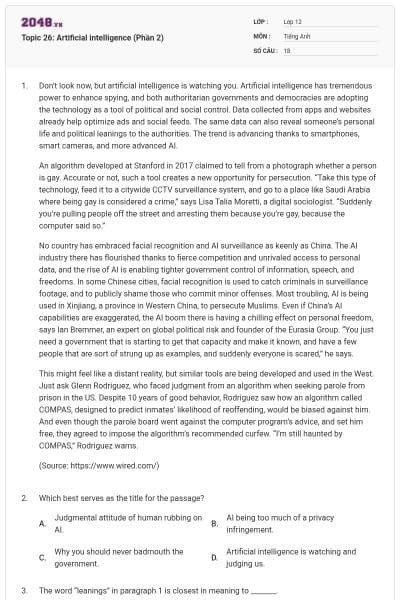
Don’t look now, but artificial intelligence is watching you. Artificial intelligence has tremendous power to enhance spying, and both authoritarian governments and democracies are adopting the technology as a tool of political and social control. Data collected from apps and websites already help optimize ads and social feeds. The same data can also reveal someone’s personal life and political leanings to the authorities. The trend is advancing thanks to smartphones, smart cameras, and more advanced AI.
An algorithm developed at Stanford in 2017 claimed to tell from a photograph whether a person is gay. Accurate or not, such a tool creates a new opportunity for persecution. “Take this type of technology, feed it to a citywide CCTV surveillance system, and go to a place like Saudi Arabia where being gay is considered a crime,” says Lisa Talia Moretti, a digital sociologist. “Suddenly you’re pulling people off the street and arresting them because you’re gay, because the computer said so.”
No country has embraced facial recognition and AI surveillance as keenly as China. The AI industry there has flourished thanks to fierce competition and unrivaled access to personal data, and the rise of AI is enabling tighter government control of information, speech, and freedoms. In some Chinese cities, facial recognition is used to catch criminals in surveillance footage, and to publicly shame those who commit minor offenses. Most troubling, AI is being used in Xinjiang, a province in Western China, to persecute Muslims. Even if China’s AI capabilities are exaggerated, the AI boom there is having a chilling effect on personal freedom, says Ian Bremmer, an expert on global political risk and founder of the Eurasia Group. “You just need a government that is starting to get that capacity and make it known, and have a few people that are sort of strung up as examples, and suddenly everyone is scared,” he says.
This might feel like a distant reality, but similar tools are being developed and used in the West. Just ask Glenn Rodriguez, who faced judgment from an algorithm when seeking parole from prison in the US. Despite 10 years of good behavior, Rodriguez saw how an algorithm called COMPAS, designed to predict inmates’ likelihood of reoffending, would be biased against him. And even though the parole board went against the computer program’s advice, and set him free, they agreed to impose the algorithm’s recommended curfew. “I’m still haunted by COMPAS,” Rodriguez warns.
(Source: https://www.wired.com/)
Which best serves as the title for the passage?
Judgmental attitude of human rubbing on AI.
AI being too much of a privacy infringement.
Why you should never badmouth the government.
Artificial intelligence is watching and judging us.
Đáp án D
Câu nào thích hợp nhất làm tiêu đề cho đoạn văn?
A. Thái độ phán xét của con người với AI
B. AI bị xâm phạm quyền riêng tư quá nhiều
C. Tại sao bạn không bao giờ nên làm xấu chính phủ?
D. Trí tuệ nhân tạo đang theo dõi và đánh giá chúng ta
Căn cứ vào thông tin đoạn đầu:
Don’t look now, but artificial intelligence is watching you. Artificial intelligence has tremendous power to enhance spying, and both authoritarian governments and democracies are adopting the technology as a tool of political and social control.
(Đừng nhìn bây giờ, nhưng trí tuệ nhân tạo đang theo dõi bạn. Trí tuệ nhân tạo có sức mạnh to lớn để tăng cường gián điệp, và cả chính phủ độc tài và dân chủ đang áp dụng công nghệ như một công cụ kiểm soát chính trị và xã hội.)
=> Như vậy, đoạn văn đang nói về việc trí tuệ nhân tạo đang theo dõi và kiểm soát chúng ta.
The word “leanings” in paragraph 1 is closest in meaning to _______.
bias
preference
fondness
link
Đáp án A
Từ “leanings” trong đoạn 1 có nghĩa gần nhất với __________.
A. bias /ˈbaɪəs/ (a): thiên vị (mang tính ưu tiên không công bằng cho cả hai đối tượng khi đưa ra đánh giá); thiên hướng, khuynh hướng thiên về một cái gì cụ thể
B. preference /ˈprefrəns/ (n): sự thích hơn, ưu tiên cái nào hơn cái nào (mang tính chất so sánh giữa của cá nhân giữa các sở thích bản thân)
C. fondness /ˈfɑːndnəs/ (n): sự thích, yêu
D. link /lɪŋk/ (n): mối quan hệ, mối liên kết
=> Từ đồng nghĩa: leaning /ˈliːnɪŋ/ (n): khuynh hướng, xu hướng thích, thiên về một vật/chủ đề/lĩnh vực cụ thể ~ bias
=> Theo ngữ cảnh thì ta dùng “bias” là chính xác hơn vì nó mang hàm nghĩa “thiên hướng, khuynh hướng thiên về một cái gì cụ thể” chứ không mang tính chất so sánh, lựa chọn cá nhân về một thú vui, sở thích nào đó.
Tạm dịch: "The same data can also reveal someone’s personal life and political leanings to the authorities."
(Dữ liệu tương tự cũng có thể tiết lộ cuộc sống cá nhân của ai đó và khuynh hướng chính trị là thiên về chính quyền.)
The word “persecution” in paragraph 2 is closest in meaning to _______.
tyranny
punishment
torture
discrimination
Đáp án D
Từ “persecution” trong đoạn 2 có nghĩa gần nhất với .
A. chuyên chế
B. hình phạt
C. tra tấn
D. phân biệt đối xử
Từ đồng nghĩa persecution (sự ngược đãi) = discrimination
Accurate or not, such a tool creates a new opportunity for persecution.
(Chính xác hay không, một công cụ như vậy tạo ra một cơ hội mới cho sự ngược đãi.)
The word “it” in paragraph 2 refers to _____.
tool
opportunity
photograph
technology
Đáp án D
Từ “it” trong đoạn 2 nói đến .
A. dụng cụ
B. cơ hội
C. ảnh chụp
D. công nghệ
Từ “it” dùng để thay thế cho danh từ công nghệ được nhắc tới trước đó.
“Take this type of technology, feed it to a citywide CCTV surveillance system, and go to a place like Saudi Arabia where being gay is considered a crime,” says Lisa Talia Moretti, a digital sociologist.
(“Sử dụng loại công nghệ này, đưa nó vào hệ thống camera giám sát quan sát toàn thành phố và đến một nơi như Ả Rập Saudi, nơi mà đồng tính được coi là một tội ác,” Lisa Talia Moretti, một nhà xã hội học kỹ thuật số nói.)
According to paragraph 3, which job is NOT performed by AI surveillance system in China?
Tracking down outlaws through biometric identification of faces.
Pinpointing followers of religion of Islam to secretly dispose of.
Exposing people who committing petty crimes to the public.
Acting as a vehicle for the governing body to monitor citizens.
Đáp án B
Theo đoạn 3, công việc nào không được thực hiện bởi hệ thống giám sát AI ở Trung Quốc?
A. Theo dõi ngoài vòng pháp luật thông qua nhận dạng sinh trắc học của khuôn mặt
B. Xác định tín đồ của Hồi giáo để bí mật xử lý
C. Phơi bày những người phạm tội nhẹ với công chúng
D. Hành động như là phương tiện cho cơ quan chủ quản để giám sát công dân
Căn cứ vào thông tin đoạn ba:
The AI industry there has flourished thanks to fierce competition and unrivaled access to personal data, and the rise of AI is enabling tighter government control of information, speech, and freedoms. In some Chinese cities, facial recognition is used to catch criminals in surveillance footage, and to publicly shame those who commit minor offenses.
(Ngành công nghiệp AI đã phát triển mạnh nhờ sự cạnh tranh khốc liệt và khả năng tiếp cận dữ liệu cá nhân không có đối thủ, và sự trỗi dậy của AI đang cho phép chính phủ kiểm soát chặt chẽ hơn thông tin, lời nói và quyền tự do của công dân. Ở một số thành phố của Trung Quốc, nhận dạng khuôn mặt được sử dụng để bắt tội phạm trong các cảnh quay giám sát và công khai những người phạm tội nhẹ.)
According to paragraph 4, what can the AI system in the US do?
AI’s analysis ability is put to good use in identifying terrorists hidden among citizens.
The application of artificial intelligence to public use is currently illegal in the US.
As the prison judging reference, algorithms determine whether people get locked up.
In the US, ubiquitous surveillance cameras constantly monitor restive behaviors.
Đáp án C
Theo đoạn 4, hệ thống AI ở Mỹ có thể làm gì?
A. Khả năng phân tích của AI được sử dụng tốt trong việc xác định những kẻ khủng bố ẩn trong công dân.
B. Việc áp dụng trí tuệ nhân tạo vào sử dụng công cộng hiện đang là bất hợp pháp ở Mỹ.
C. Là tài liệu tham khảo xét xử của nhà tù, các thuật toán xác định xem một người có bị bắt hay không.
D. Ở Mỹ, các camera giám sát có mặt khắp nơi liên tục theo dõi các hành vi.
Căn cứ vào thông tin đoạn bốn:
Just ask Glenn Rodríguez, who faced judgment from an algorithm when seeking parole from prison in the US. Despite 10 years of good behavior, Rodríguez saw how an algorithm called COMPAS, designed to predict inmates’ likelihood of reoffending, would be biased against him. And even though the parole board went against the computer program’s advice, and set him free, they agreed to impose the algorithm’s recommended curfew.
(Chỉ cần hỏi Glenn Rodríguez, người phải đối mặt với sự phán xét từ một thuật toán khi tìm kiếm sự tạm tha từ nhà tù ở Mỹ. Mặc dù có 10 năm hành xử tốt, Rodríguez đã nhìn thấy một thuật toán được gọi COMPAS được thiết kế để dự đoán khả năng tái phạm của tù nhân, đã có thành kiến đối với anh ta như thế nào. Và mặc dù bảng tạm tha đã đi ngược lại lời khuyên của chương trình máy tính và thả anh ta tự do, họ đồng ý áp dụng thuật toán khuyến nghị giới thiệu)
Which of the following statements is TRUE, according to the passage?
There exists an AI system which can reveal people’s sexualities though images.
Cyber espionage is among the bewildering array of artificial intelligence’s potentials.
COMPAS is a super intelligence system developed by the Chinese government.
Researchers are finding ways to limit the power of AI for fear of a robotic rebellion.
Đáp án B
Phát biểu nào sau đây là đúng, theo đoạn văn?
A. Tồn tại một hệ thống AI có thể tiết lộ cho mọi người về tính chất tình dục qua hình ảnh
B. Hoạt động gián điệp mạng là một trong những tiềm năng đáng kinh ngạc của trí tuệ nhân tạo
C. COMPAS là một hệ thống siêu trí tuệ được phát triển bởi chính phủ Trung Quốc
D. Các nhà nghiên cứu đang tìm cách hạn chế sức mạnh của AI vì sợ một cuộc nổi loạn của robot
Căn cứ vào thông tin đoạn đầu:
Artificial intelligence has tremendous power to enhance spying, and both authoritarian governments and democracies are adopting the technology as a tool of political and social control.
(Trí tuệ nhân tạo có sức mạnh to lớn để tăng cường hoạt động gián điệp, và cả chính phủ độc tài và dân chủ đang áp dụng công nghệ như một công cụ kiểm soát chính trị và xã hội.)
Which of the following can be inferred from the passage?
Surveillance combined with artificial intelligence displays both pluses and minuses.
There is a lack of adherence to common privacy principles in technology companies.
Surveillance is increasingly used by businesses seeking commercial advantage.
The liberty in America which people taken for granted is actually hard-won and fragile.
Đáp án A
Điều nào sau đây có thể được suy ra từ đoạn văn?
A. Giám sát kết hợp với trí thông minh nhân tạo có cả ưu điểm và nhược điểm
B. Không tuân thủ các nguyên tắc bảo mật chung trong các công ty công nghệ
C. Giám sát ngày càng được sử dụng nhiều bởi các doanh nghiệp để tìm kiếm lợi thế thương mại
D. Sự tự do ở Mỹ, cái mà mọi người coi là thực sự khó giành được và mong manh
Căn cứ vào thông tin các đoạn:
Artificial intelligence has tremendous power to enhance spying, and both authoritarian governments and democracies are adopting the technology as a tool of political and social control.
(Trí tuệ nhân tạo có sức mạnh to lớn để tăng cường gián điệp, và cả chính phủ độc tài và dân chủ đang áp dụng công nghệ như một công cụ kiểm soát chính trị và xã hội.)
The rise of AI is enabling tighter government control of information, speech, and freedoms. In some Chinese cities, facial recognition is used to catch criminals in surveillance footage, and to publicly shame those who commit minor offenses.
(Sự trỗi dậy của AI đang cho phép chính phủ kiểm soát chặt chẽ hơn thông tin, lời nói và quyền tự do của công dân. Ở một số thành phố của Trung Quốc, nhận dạng khuôn mặt được sử dụng để bắt tội phạm trong các cảnh quay giám sát và công khai những người phạm tội nhẹ.)
Just ask Glenn Rodríguez, who faced judgment from an algorithm when seeking parole from prison in the US. Despite 10 years of good behavior, Rodríguez saw how an algorithm called COMPAS, designed to predict inmates’ likelihood of reoffending, would be biased against him. And even though the parole board went against the computer program’s advice, and set him free, they agreed to impose the algorithm’s recommended curfew.
(Chỉ cần hỏi Glenn Rodríguez, người phải đối mặt với sự phán xét từ một thuật toán khi tìm kiếm sự tạm tha từ nhà tù ở Mỹ. Mặc dù có 10 năm hành xử tốt, Rodríguez đã nhìn thấy một thuật toán được gọi COMPAS được thiết kế để dự đoán khả năng tái phạm của tù nhân, đã có thành kiến đối với anh ta như thế nào. Và mặc dù bảng tạm tha đã đi ngược lại lời khuyên của chương trình máy tính và thả anh ta tự do, họ đồng ý áp dụng thuật toán khuyến nghị giới thiệu)
Sophia is a humanoid robot developed by Hong Kong-based company Hanson Robotics. She has been designed to learn and adapt to human behavior and work with humans, and has been interviewed around the world. In October 2017, she became a Saudi Arabian citizen, the first robot to receive citizenship of a country.
According to herself, Sophia was activated on April 19, 2015. She is modeled after actress Audrey Hepbum,and is known for her human-like appearance and behavior compared to previous robotic variants. According to manufacturer, David Hanson, Sophia has artificial intelligence, visual data processing and facial recognition. Sophia also imitates human gestures and facial expressions and is able to answer certain questions and to make simple conversations on predefined topics (e.g. on the weather). The robot uses voice recognition technology from Alphabet Inc. (parent company of Google) and is designed to get smarter over time. Sophia’s intelligence software is designed by SingularityNET. The AI program analyses conversations and extracts data that allows her to improve responses in the future. It is conceptually similar to the computer program ELIZA, which was one of the first attempts at simulating a human conversation.
Hanson designed Sophia to be a suitable companion for the elderly at nursing homes, or to help crowds at large events or parks. He hopes that she can ultimately interact with other humans sufficiently to gain social skills.
Sophia has been interviewed in the same manner as a human, striking up conversations with hosts. Some replies have been nonsensical, while others have been impressive, such as lengthy discussions with Charlie Rose on 60 Minutes. In a piece for CNBC, when the interviewer expressed concerns about robot behavior, Sophia joked that he had “been reading too much Elon Musk, and watching too many Hollywood movies”. Musk tweeted that Sophia could watch The Godfather and suggested “What’s the worst that could happen?”.
On October 11, 2017, Sophia was introduced to the United Nations with a brief conversation with the United Nations Deputy Secretary-General, Amina J. Mohammed. On October 25, at the Future Investment Summit in Riyadh, she was granted Saudi Arabian citizenship, becoming the first robot ever to have a nationality. This attracted controversy as some commentators wondered if this implied that Sophia could vote or marry, or whether a deliberate system shutdown could be considered murder. Social media users used Sophia’s citizenship to criticize Saudi Arabia’s human rights record.
(Source: https://en.wikipedia.org/wiki/Sophia_robot)
The passage mainly discusses________.
what electronic life will exist in the future
how a robot can become an electronic citizen
a robot who has received citizenship of a country
a company having made a breakthrough in robotics
Đáp án C
Đoạn văn chủ yếu thảo luận ______.
A. cuộc sống điện tử sẽ tồn tại trong tương lai
B. làm thế nào một robot có thể trở thành một công dân điện tử
C. một robot đã nhận được quyền công dân của một quốc gia
D. một công ty đã tạo ra một bước đột phá trong công nghệ người máy
Đây là câu hỏi đòi hỏi chúng ta phải nắm được ý chính của toàn bài. Vì vậy, khi gặp câu này nên để làm cuối.
=> Suy ra từ toàn bài: bài đọc đưa ra thông tin về Sophia và việc cô ấy nhận được quyền công dân.
Paragraph 2 mainly discusses_________.
what Sophia can do in die same way as humans do
how Sophia has been developed to be most human-like
why Sophia has cut over ELIZA in interacting with humans
how Sophia has become the best robotic variant these days
Đáp án B
Đoạn 2 chủ yếu thảo luận______.
A. những gì Sophia có thể làm là chết giống như con người
B. cách Sophia được phát triển để giống con người nhất
C. tại sao Sophia cắt giảm ELIZA trong việc tương tác với con người
D. cách Sophia đã trở thành biến thể robot tốt nhất trong những ngày này
Căn cứ vào thông tin đoạn đoạn 2:
“She is modeled after actress Audrey Hepbum,and is known for her human-like appearance and behavior compared to previous robotic variants.”
(Cô ấy được mô phỏng theo nữ diễn viên Audrey Hepbum, và được biết đến với ngoại hình và hành vi giống con người so với các biến thể robot trước đây.)
“Sophia also imitates human gestures and facial expressions and is able to answer certain questions and to make simple conversations on predefined topics (e.g. on the weather).”
Sophia cũng bắt chước cử chỉ và nét mặt của con người và có thể trả lời một số câu hỏi nhất định và thực hiện các cuộc hội thoại đơn giản về các chủ đề được xác định trước (ví dụ: về thời tiết).
=> Đoạn 2 chủ yếu nói về cách Sophia phát triển để giống con người.
Which of the following statements is NOT true about Sophia according to the passage?
Sophia can detect human gestures and facial expressions.
Sophia can speak all languages with any accent as programed.
Sophia can talk about the topics she has been programed to.
Sophia can respond impressively in conversations with humans.
Đáp án B
Phát biểu nào sau đây KHÔNG đúng về Sophia theo đoạn văn?
A. Sophia có thể phát hiện cử chỉ và nét mặt của con người.
B. Sophia có thể nói tất cả các ngôn ngữ với bất kỳ giọng nói nào được lập trình.
C. Sophia có thể nói về các chủ đề cô ấy đã được lập trình.
D. Sophia có thể trả lời một cách ấn tượng trong các cuộc trò chuyện với con người.
Căn cứ vào thông tin đoạn 2 và 4:
“According to manufacturer, David Hanson, Sophia has artificial intelligence, visual data processing and facial recognition. Sophia also imitates human gestures and facial expressions and is able to answer certain questions and to make simple conversations on predefined topics (e.g. on the weather).”
Theo nhà sản xuất, David Hanson, Sophia có trí thông minh nhân tạo, xử lý dữ liệu trực quan và nhận dạng khuôn mặt. Sophia cũng bắt chước cử chỉ và nét mặt của con người và có thể trả lời một số câu hỏi nhất định và thực hiện các cuộc trò chuyện đơn giản trên chủ đề được xác định trước (ví dụ: về thời tiết).
“Sophia has been interviewed in the same manner as a human, striking up conversations with hosts. Some replies have been nonsensical, while others have been impressive, such as lengthy discussions with Charlie Rose on 60 Minutes.”
(Sophia đã được phỏng vấn theo cách tương tự như một con người, bắt chuyện với chủ nhà. Một số câu trả lời là vô nghĩa, trong khi những câu trả lời khác rất ấn tượng, chẳng hạn như các cuộc thảo luận kéo dài với Charlie Rose trong 60 phút.)
=> Chỉ có ý B là KHÔNG đúng về Sophia
According to the passage, all of the following statements are true EXCEPT_________.
Google has been a part of Alphabet Incorporation
ELIZA could not simulate human conversations
Sophia was intended to work at nursing homes
Sophia can make jokes when talking with humans
Đáp án B
Theo đoạn văn, tất cả các tuyên bố sau đây là đúng NGOẠI TRỪ ______.
A. Google là một phần của tập đoàn Alphabet
B. ELIZA không thể mô phỏng các cuộc hội thoại của con người
C. Sophia đã dự định làm việc tại viện dưỡng lão
D. Sophia có thể pha trò khi nói chuyện với con người
Căn cứ vào thông tin đoạn 2,3 và 4:
“The robot uses voice recognition technology from Alphabet Inc. (parent company of Google).”
Robot này sử dụng công nghệ nhận dạng giọng nói từ Alphabet Inc. (công ty mẹ của Google).
“It is conceptually similar to the computer program ELIZA, which was one of the first attempts at simulating a human conversation.”
(Nó có khái niệm tương tự như chương trình máy tính ELIZA, đây là một trong những nỗ lực đầu tiên trong việc mô phỏng cuộc trò chuyện của con người.)
“Hanson designed Sophia to be a suitable companion for the elderly at nursing homes, or to help crowds at large events or parks.”
(Hanson đã thiết kế Sophia để trở thành người bạn đồng hành phù hợp cho người già tại các viện dưỡng lão, hoặc để giúp đỡ đám đông tại các sự kiện hoặc công viên lớn.)
In a piece for CNBC, when the interviewer expressed concerns about robot behavior, Sophia joked that he had “been reading too much Elon Musk, and watching too many Hollywood movies”.
(Trong một bài phỏng vấn cho CNBC, khi người phỏng vấn bày tỏ lo ngại về hành vi của robot, Sophia đã nói đùa rằng anh ta đã đọc quá nhiều Elon Musk và xem quá nhiều phim Hollywood rồi.)
The word “piece” in paragraph 4 mostly means__________.
article
argument
interview
lecture
Đáp án C
Từ “piece” trong đoạn 4 có nghĩa là____.
A. article /ˈɑːtɪkəl/ (n): bài báo
B. argument /ˈɑːɡjəmənt/ (n): cuộc tranh luận
C. interview /ˈɪntəvjuː/ (n): bài phỏng vấn
D. lecture /ˈlektʃər/ (n): bài giảng, thuyết trình
Từ đồng nghĩa: piece (bài phỏng vấn) = interview
In a piece for CNBC, when the interviewer expressed concerns about robot behavior, Sophia joked that he had “been reading too much Elon Musk, and watching too many Hollywood movies”.
(Trong một bài phỏng vấn cho CNBC, khi người phỏng vấn bày tỏ lo ngại về hành vi của robot, Sophia đã nói đùa rằng anh ta đã đọc quá nhiều Elon Musk và xem quá nhiều phim Hollywood rồi.)
The word “granted” in the last paragraph is closest in meaning to________ .
entitled
prompted
activated
noted
Đáp án A
Từ “granted” trong đoạn cuối có nghĩa gần nhất với______.
A. entitled /ɪnˈtaɪtəld/ (v): được có quyền/ cấp quyền
B. prompted /prɒmptɪd/ (v): được nhắc nhở
C. activated /ˈæktɪveɪtɪd/ (v): được kích hoạt
D. noted /ˈnəʊtɪd/ (v): được ghi chú
Từ đồng nghĩa: granted (được cho quyền) = entitled
“On October 25, at the Future Investment Summit in Riyadh, she was granted Saudi Arabian citizenship, becoming the first robot ever to have a nationality.”
(Vào ngày 25 tháng 10, tại Hội nghị thượng đỉnh đầu tư tương lai ở Riyadh, cô ấy đã được cấp quốc tịch Ả Rập Xê-Út, trở thành robot đầu tiên có quốc tịch.)
The word “this” in the last paragraph refers to_______.
the fact that Sophia was granted citizenship
the nationality a robot has gained after being activated
the controversy among commentators about Sophia’s citizenship
the Future Investment Summit granting Sophia citizenship
Đáp án A
Từ “this” trong đoạn cuối đề cập đến______.
A. thực tế là Sophia đã được cấp quyền công dân
B. quốc tịch mà robot đã đạt được sau khi được kích hoạt
C. cuộc tranh cãi giữa các nhà bình luận về quyền công dân của Sophia
D. Hội nghị thượng đỉnh đầu tư trong tương lai trao quyền công dân cho Sophia
Căn cứ vào thông tin đoạn cuối:
“On October 25, at the Future Investment Summit in Riyadh, she was granted Saudi Arabian citizenship, becoming the first robot ever to have a nationality. This attracted controversy as some commentators wondered if this implied that Sophia could vote or marry, or whether a deliberate system shutdown could be considered murder.”
(Vào ngày 25 tháng 10, tại Hội nghị thượng đỉnh đầu tư tương lai ở Riyadh, cô ấy đã được cấp quốc tịch Ả Rập Xê-út, trở thành robot đầu tiên có quốc tịch. Điều này đã gây tranh cãi khi một số nhà bình luận tự hỏi liệu điều này có ngụ ý rằng Sophia có thể bỏ phiếu hoặc kết hôn hay không, hay là cố tình tắt hệ thống có thể được coi là giết người.)
The passage following this passage would be mostly about__________.
how social media users criticize Saudi Arabia’s human rights record
how Sophia faces with controversy over her newly granted citizenship
worries about the future of human and electronic citizens living together
concerns that countries are showing towards the future electronic lifestyle
Đáp án B
Đoạn văn sau đoạn văn này sẽ chủ yếu là về______.
A. cách người dùng phương tiện truyền thông xã hội chỉ trích hồ sơ nhân quyền của Ả Rập Xê-Út
B. cách Sophia đối mặt với tranh cãi về quyền công dân mới được cấp của cô ấy
C. lo lắng về tương lai của con người và công dân điện tử sống cùng nhau
D. lo ngại rằng các quốc gia đang thể hiện lối sống điện tử trong tương lai
Đoạn cuối nói về việc Sophia dược cấp quyền công dân và mọi người đang tranh cãi về việc đó.
=> Đoạn văn sau sẽ chủ yếu viết về cách Shophia đối mặt với việc này.
Bạn có thích hoạt động này không?