Topic 25: Urbanization
55 câu hỏi
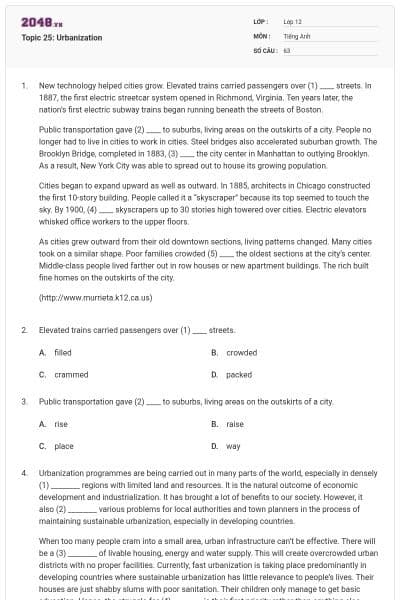
New technology helped cities grow. Elevated trains carried passengers over (1) ____ streets. In 1887, the first electric streetcar system opened in Richmond, Virginia. Ten years later, the nation’s first electric subway trains began running beneath the streets of Boston.
Public transportation gave (2) ____ to suburbs, living areas on the outskirts of a city. People no longer had to live in cities to work in cities. Steel bridges also accelerated suburban growth. The Brooklyn Bridge, completed in 1883, (3) ____ the city center in Manhattan to outlying Brooklyn. As a result, New York City was able to spread out to house its growing population.
Cities began to expand upward as well as outward. In 1885, architects in Chicago constructed the first 10-story building. People called it a “skyscraper” because its top seemed to touch the sky. By 1900, (4) ____ skyscrapers up to 30 stories high towered over cities. Electric elevators whisked office workers to the upper floors.
As cities grew outward from their old downtown sections, living patterns changed. Many cities took on a similar shape. Poor families crowded (5) ____ the oldest sections at the city’s center. Middle-class people lived farther out in row houses or new apartment buildings. The rich built fine homes on the outskirts of the city.
(http://www.murrieta.k12.ca.us)
filled
crowded
crammed
packed
Công nghệ mới giúp các thành phố phát triển. Tàu hỏa trên cao đưa những hành khách qua nhưng con đường đông đúc.Vào năm 1887, hệ thống tàu điện đầu tiên được mở ở Richmond, Virginia. Mười năm sau, những tàu điện ngầm đầu tiên bắt đầu chạy dưới những con đường của Boston.
Phương tiện công cộng làm phát sinh khu vực ngoại ô, sinh sống ở vùng ngoài của một thành phố. Con người không còn phải sống trong các thành phố để làm việc ở thành phố. Những chiếc cầu cốt thép cũng thúc đẩy sư phát triển của vùng ngoại thành. Cầu Brooklyn, được hoàn thành năm 1883, nối trung tâm thành phố ở Manhattan với vùng cách xa Brooklyn. Kết quả là, thành phố New York đã có thể mở rộng để cung cấp chỗ ở cho số dân đang tăng lên.
Những thành phố bắt đầu mở rộng lên cao cũng như rộng hơn. Trong năm 1885, các kiến trúc sư ở Chicago xây dựng tòa nhà 10 tầng đầu tiên. Mọi người gọi nó là một “tòa nhà chọc trời” vì đỉnh của nó nhìn có vẻ chạm tới bầu trời. Trước năm 1900, những tòa nhà chọc trời với kết cấu khung thép cao tới 30 tầng vượt hẳn lên trên những thành phố. Những thang máy điện đưa các nhân viên văn phòng lên những tầng cao nhanh chóng.
Khi những thành phố phát triển rộng hơn từ những khu trung tâm cũ của chúng, khuôn mẫu cuộc sống đã thay đổi. Nhiều thành phố khoác lên dáng vẻ tương tự nhau. Những gia đình nghèo chen chúc trong những khu vực cũ kĩ nhất ở trung tâm thành phố. Người thuộc tầng lớp trung lưu sống xa hơn ở những ngôi nhà theo dãy hoặc những chung cư mới. Người giàu thì xây những ngôi nhà đẹp ở vùng ngoại ô thành phố.
Đáp án B
Kiến thức về từ vựng
A. filled /fild/ (a): đầy
B. crowded /’kraudid/ (a): đông đúc
C. crammed /kræmd/ (n): đám đông chật ních
D. packed /pæktid/ (a): nhồi nhét
Tạm dịch:
New technology helped cities grow. Elevated trains carried passengers over (1) ____ streets.
(Công nghệ mới giúp các thành phố phát triển. Những chuyến tàu cao tốc chở hành khách trên đường phố đông đúc.)
rise
raise
place
way
Đáp án A
Kiến thức về cụm từ cố định
Give rise to: dẫn đến, gây ra điều gì; làm phát sinh vấn đề gì
Give place to: nhường chỗ cho
Give way to: nhường đường cho
Tạm dịch:
Public transportation gave (2) ____ to suburbs, living areas on the outskirts of a city. People no longer had to live in cities to work in cities.
(Giao thông công cộng đã đến vùng ngoại ô, khu vực sinh sống ở ngoại ô của một thành phố. Mọi người không còn phải sống ở thành phố để làm việc trong thành phố.)
related
associated
connected
linked
Đáp án D
Kiến thức về từ vựng
A. related /ri’leitd/ (v): kết nối, có mối liên quan với cái gì
=> Cấu trúc: Relate sth to sth: kết nối cái gì với cái gì (thể hiện mối liên quan lẫn nhau)
B. associated /ə’souʃiitid/ (v): kết giao, kết hợp, liên kết
=> Cấu trúc: Associate sth/sb with sth/sb else: kết nối, kết giao ai/cái gì với ai/cái gì khác
C. connected /kə’nektid/ (v): nối, kết nối
=> Cấu trúc: Connect sth to sth: kết hợp lại cái gì và cái gì với nhau (cho kết hợp lại để tham gia vào cùng nhau hoặc có mối liên quan với nhau)
D. linked /liɳkt/ (v): liên kết, kết hợp, ràng buộc
=> Cấu trúc: Link sth to sth: kết nối lại, cho cái gì/nơi nào lại gần với cái gì/nơi nào khác (kết hợp lại để chúng gần nhau, nằm cạnh nhau hoặc tiếp xúc nhau)
Tạm dịch: The Brooklyn Bridge, completed in 1883, (3) ____ the city center in Manhattan to outlying Brooklyn. As a result, New York City was able to spread out to house its growing population.
(Cầu Brooklyn, được hoàn thành vào năm 1883, đã liên kết trung tâm thành phố ở Manhattan với Brooklyn xa xôi. Do đó, thành phố New York có thể lan rộng để chứa dân số ngày càng tăng.)
=> Trong câu này, ta hiểu là liên kết hai nơi xa xôi lại gần nhau, nằm cạnh nhau nên ta dùng “link”.
steel-framed
steel-framing
frame-steeled
frame-steeling
Đáp án A
Kiến thức về danh từ ghép
Steel – framed (a): được bọc khung thép
Tạm dịch: By 1900, (4) ____ skyscrapers up to 30 stories high towered over cities. Electric elevators whisked office workers to the upper floors.
(Đến năm 1900, các tòa nhà chọc trời được bọc khung thép cao tới 30 tầng bao phủ thành phố. Thang máy điện đưa nhân viên văn phòng lên các tầng trên.)
out of
into
at
with
Đáp án B
Kiến thức về cụm động từ
Crowd into: chen chúc
Crowd with: đầy, đông đúc
Tạm dịch:
Poor families crowded (5) ____ the oldest sections at the city’s center. Middle-class people lived farther out in row houses or new apartment buildings. The rich built fine homes on the outskirts of the city.
(Các gia đình nghèo chen chúc vào các khu vực lâu đời nhất tại trung tâm thành phố. Những người trung lưu sống xa hơn trong các dãy nhà hoặc các tòa nhà chung cư mới. Người giàu xây nhà đẹp ở ngoại ô thành phố.)
Urbanization programmes are being carried out in many parts of the world, especially in densely (1) ________ regions with limited land and resources. It is the natural outcome of economic development and industrialization. It has brought a lot of benefits to our society. However, it also (2) ________ various problems for local authorities and town planners in the process of maintaining sustainable urbanization, especially in developing countries.
When too many people cram into a small area, urban infrastructure can’t be effective. There will be a (3) ________ of livable housing, energy and water supply. This will create overcrowded urban districts with no proper facilities. Currently, fast urbanization is taking place predominantly in developing countries where sustainable urbanization has little relevance to people’s lives. Their houses are just shabby slums with poor sanitation. Their children only manage to get basic education. Hence, the struggle for (4) ________ is their first priority rather than anything else. Only when the quality of their existence is improved, can they seek (5) ________ other high values in their life.
popular
crowed
populated
numerous
Các chương trình đô thị hóa đang được thực hiện ở nhiều nơi trên thế giới, đặc biệt là ở các khu vực đông dân cư mà có đất đai và tài nguyên hạn chế. Đó là kết quả tự nhiên của sự phát triển kinh tế và công nghiệp hóa. Nó đã mang lại rất nhiều lợi ích cho xã hội của chúng ta. Tuy nhiên, nó cũng đặt ra nhiều vấn đề khác nhau cho chính quyền địa phương và các nhà quy hoạch thị trấn trong quá trình duy trì đô thị hóa bền vững, đặc biệt là ở các nước đang phát triển.
Khi quá nhiều người chen chúc vào một khu vực nhỏ, cơ sở hạ tầng đô thị không thể hoạt động hiệu quả. Sẽ xảy ra sự thiếu hụt nhà ở, nguồn cung cấp năng lượng và nước. Điều này sẽ tạo ra các quận đô thị quá đông đúc mà không có cơ sở vật chất thích hợp. Hiện nay, quá trình đô thị hóa nhanh đang diễn ra chủ yếu ở các nước đang phát triển nơi đô thị hóa bền vững ít liên quan đến cuộc sống của người dân. Những căn nhà của họ chỉ là những khu ổ chuột tồi tàn với điều kiện vệ sinh kém. Con cái của họ chỉ có được giáo dục cơ bản. Do đó, cuộc đấu tranh sinh tồn là ưu tiên hàng đầu của họ hơn là bất cứ điều gì khác. Chỉ khi chất lượng của sự tồn tại của họ được cải thiện, họ mới có thể tìm kiếm những giá trị khác cao hơn trong cuộc sống của mình.
Đáp án C
Kiến thức: Sự kết hợp từ
Giải thích:
popular (adj): phổ biến
crowded (adj): đông đúc
densely populated (adj): dân cư đông đúc
numerous (adj): đông đảo, nhiều
Urbanisation programmes are being carried out in many parts of the world, especially in densely (1) populated regions with limited land and resources.
Tạm dịch: Các chương trình đô thị hóa đang được thực hiện ở nhiều nơi trên thế giới, đặc biệt là ở các khu vực đông dân cư nơi có đất đai và tài nguyên hạn chế.
However, it also (2) ________ various problems for local authorities and town planners in the process of maintaining sustainable urbanization, especially in developing countries.
poses
offers
leads
imposes
Đáp án A
Kiến thức: Sự kết hợp từ
Giải thích:
pose (v): tạo ra, gây ra một vấn đề,… cần được giải quyết
offer (v): tạo cơ hội, sẵn sàng làm điều gì cho ai
lead (v): chỉ đường (lead to: gây ra cái gì)
impose (v): đưa ra/ áp đặt một đạo luật, thuế, …
pose problem: gây ra vấn đề
However, it also (2) poses various problems for local authorities and town planners in the process of maintaining sustainable urbanization, especially in developing countries.
Tạm dịch: Tuy nhiên, nó cũng đặt ra nhiều vấn đề khác nhau cho chính quyền địa phương và các nhà quy hoạch thị trấn trong quá trình duy trì đô thị hóa bền vững, đặc biệt là ở các nước đang phát triển.
appearance
plenty
loss
lack
Đáp án D
Kiến thức: Từ vựng
Giải thích:
appearance (n): sự xuất hiện/ vẻ bề ngoài
plenty (n): sự phong phú, sự dồi dào
loss (n): sự mất mát
lack (n): sự thiếu hụt
lack of something: sự thiếu hụt cái gì
There will be a (3) lack of livable housing, energy and water supply.
Tạm dịch: Sẽ có sự thiếu hụt nhà ở, nguồn cung cấp năng lượng và nước.
survive
survival
survivor
survived
Đáp án B
Kiến thức: Từ vựng, từ loại
Giải thích:
Sau giới từ “for” cần một danh từ.
survive (v): sống sót
survival (n): sự sống còn
survivor (n): người sống sót
struggle for survival: cuộc đấu tranh sinh tồn
Hence, the struggle for (4) survival is their first priority rather than anything else.
Tạm dịch: Do đó, cuộc đấu tranh sinh tồn là ưu tiên hàng đầu của họ hơn là bất cứ điều gì khác.
Only when the quality of their existence is improved, can they seek (5) ________ other high values in their life.
about
for
with
on
Đáp án B
Kiến thức: Giới từ
Giải thích:
seek for something/somebody: tìm kiếm ai/ cái gì
Only when the quality of their existence is improved, can they seek (5) for other high values in their life.
Tạm dịch: Chỉ khi chất lượng của sự tồn tại của họ được cải thiện, họ mới có thể tìm kiếm những giá trị cao khác trong cuộc sống của mình.
As communities across the U.S. replace forests and woodlands with housing developments and other new construction, researchers are noting an increase in Lyme disease. To help prevent the spread of Lyme disease, Dr. Ivan Castro-Arellano, a disease ecologist and wildlife researcher at Texas State University, is exploring how urbanization and its effects on mammals impact the spread of pathogens.
Lyme disease, which spreads from animals to humans, is one of the fastest growing zoonotic diseases in the United States. Counties considered high-risk for Lyme disease grew 300% between 1993 and 2012. Caught quickly, Lyme disease is easily treated with antibiotics, but if it goes untreated it can lead to chronic issues such as Lyme arthritis, facial palsy and impaired memory. Many such zoonotic diseases have been increasing globally, researchers say, partially because of the displacement of animals. While medium- and large-sized mammals are displaced or eradicated by the removal of forested areas, white-footed mice and deer thrive in small patches of green space. Mice and deer are contributing to favorable conditions for an increase in the ticks that spread the pathogens causing Lyme disease.
Although East Texas has a similar pattern of woodland space compared to new construction as the northeast United States, Texas contract the disease at lower rates. This fact piqued the interest of Castro-Arellano. In addition to studying the area where the disease is prevalent, he decided to study where the disease is not prevalent to find keys to prevention. Castro-Arellano is part of a team of biologists, veterinarians and biomedical researchers that have been collecting samples and trying to understand what makes East Texas different. He believes that the climate, or certain species of East Texas mammals who kill ticks, could be contributing to the reduced tick population in East Texas.
(Source: https://www.infectioncontroltoday.com/)
Which best serves as the title for the passage?
Countries around the world under attack of bacteria.
Ways to take precautions against Lyme disease.
How urbanization affects spread of Lyme disease.
Biological scientists encountering a new challenge.
Đáp án C
Câu nào thích hợp nhất để làm tiêu đề cho đoạn văn?
A. Các nước trên thế giới bị vi khuẩn tấn công
B. Cách phòng ngừa bệnh Lyme
C. Quá trình đô thị hóa ảnh hưởng đến sự lây lan của bệnh Lyme
D. Các nhà khoa học sinh học gặp phải một thách thức mới
To help prevent the spread of Lyme disease, Dr. Ivan Castro-Arellano, a disease ecologist and wildlife researcher at Texas State University, is exploring how urbanization and its effects on mammals impact the spread of pathogens.
(Để giúp ngăn chặn lây lan bệnh Lyme, Tiến sĩ Ivan Castro-Arellano, một nhà sinh thái học về bệnh và nhà nghiên cứu động vật hoang dã tại Đại học bang Texas, đang khám phá cách đô thị hóa và ảnh hưởng của nó đối với động vật có vú tác động đến sự lây lan mầm bệnh.)
Như vậy, có thể suy ra đô thị hóa có ảnh hưởng đến sự lây lan mầm bệnh Lyme.
The word “its” in paragraph 1 refers to _______.
disease’s
urbanization’s
construction’s
wildlife’s
Đáp án B
Từ “its” trong đoạn 1 đề cập đến .
A. bệnh
B. đô thị hóa
C. sự xây dựng
D. động vật hoang dã
Từ “its” ở đây dùng để thay thế cho sự sở hữu của danh từ đô thị hóa được nhắc tới trước đó.
Dr. Ivan Castro-Arellano, a disease ecologist and wildlife researcher at Texas State University, is exploring how urbanization and its effects on mammals impact the spread of pathogens.
(Tiến sĩ Ivan Castro-Arellano, một nhà sinh thái học về bệnh và nhà nghiên cứu động vật hoang dã tại Đại học bang Texas, đang tìm hiểu cách đô thị hóa và ảnh hưởng của nó đối với động vật có vú tác động đến sự lây lan mầm bệnh.)
According to paragraph 2, which statement is correct about the Lyme disease?
The number of nations with excessive reported cases of Lyme disease tripled between 1993 and 2002.
Lyme disease is not the only one in zoonotic family that has displayed a widespread outburst.
The proliferation rate of Lyme disease in the is the most rapid compared to other regions.
Lyme disease growth is currently limited with the utilization of mice as its archenemy.
Đáp án B
Theo đoạn 2, phát biểu nào là đúng về bệnh Lyme?
A. Số lượng quốc gia có các trường hợp mắc bệnh Lyme được báo cáo tăng gấp ba lần giữa năm 1993 và 2002
B. Bệnh Lyme không phải là bệnh duy nhất ở động vật có biểu hiện bùng phát rộng rãi
C. Tốc độ tăng sinh của bệnh Lyme là nhanh nhất so với các bệnh khác
D. Sự phát triển bệnh Lyme hiện bị hạn chế với việc sử dụng chuột làm kẻ thù của nó
Căn cứ vào thông tin đoạn hai:
Caught quickly, Lyme disease is easily treated with antibiotics, but if it goes untreated it can lead to chronic issues such as Lyme arthritis, facial palsy and impaired memory. Many such zoonotic diseases have been increasing globally, researchers say, partially because of the displacement of animals.
The word “palsy” in paragraph 2 is closest in meaning to ______.
shudder
paroxysm
contusion
paralysis
Đáp án D
Từ “palsy” trong đoạn 2 có nghĩa gần nhất với .
A. rùng mình
B. paroxysm
C. truyền nhiễm
D. tê liệt
Từ đồng nghĩa palsy (liệt) = paralysis
Caught quickly, Lyme disease is easily treated with antibiotics, but if it goes untreated it can lead to chronic issues such as Lyme arthritis, facial palsy and impaired memory. Many such zoonotic diseases have been increasing globally, researchers say, partially because of the displacement of animals.
(Mắc bệnh nhanh chóng, bệnh Lyme dễ dàng được điều trị bằng kháng sinh, nhưng nếu nó không được điều trị, nó có thể dẫn đến các vấn đề mãn tính như viêm khớp Lyme, liệt mặt và suy giảm trí nhớ. Các nhà nghiên cứu cho biết nhiều bệnh như vậy đã gia tăng trên toàn cầu, một phần vì sự dịch chuyển của động vật.)
According to paragraph 4, why did Castro-Arellano choose to study East Texas area?
To understand a disease’s context and contributory factors to prevent the spread of pathogens.
To map out the areas of severe infection to conclude a consistent pattern of involving elements.
To build a computational model based on the statistics of Texas’s unique conditions.
To save East Texas from the devastation of uncontrollable Lyme disease because it is his hometown.
Đáp án A
Theo đoạn 4, tại sao Fidel-Arellano lại chọn nghiên cứu khu vực East Texas?
A. Để hiểu một bối cảnh bệnh tật và các yếu tố góp phần để ngăn chặn sự lây lan của mầm bệnh
B. Để vạch ra các khu vực nhiễm trùng nặng để kết luận một mô hình nhất quán liên quan đến các yếu tố
C. Để xây dựng một mô hình tính toán dựa trên số liệu thống kê về các điều kiện độc đáo của Texas
D. Để cứu Đông Texas khỏi sự tàn phá của bệnh Lyme không thể kiểm soát được vì đó là quê nhà của anh ta
Căn cứ vào thông tin đoạn bốn:
Although East Texas has a similar pattern of woodland space compared to new construction as the northeast United States, Texas contract the disease at lower rates. This fact piqued the interest of Castro-Arellano. In addition to studying the area where the disease is prevalent, he decided to study where the disease is not prevalent to find keys to prevention.
(Mặc dù East Texas có mô hình không gian rừng tương tự so với sự xây dựng mới như vùng đông bắc Hoa Kỳ, nhưng Texas mắc bệnh với mức độ thấp hơn. Thực tế này đã thu hút sự quan tâm của Fidel-Arellano. Ngoài việc nghiên cứu về khu vực phổ biến bệnh, anh ấy quyết định nghiên cứu nơi bệnh không phổ biến để tìm biện pháp để phòng ngừa.)
Today, population growth largely means urban population growth. UN projections show the world’s rural population has already stopped growing, but the world can expect to add close to 1.5 billion urbanites in the next 15 years, and 3 billion by 2050. How the world meets the challenge of sustainable development will be intimately tied to this process.
For many people, cities represent a world of new opportunities, including jobs. There is a powerful link between urbanization and economic growth. Around the world, towns and cities are responsible for over 80 per cent of gross national product. While urban poverty is growing around the world, this is largely because many people – including the poor – are moving to urban areas.
The opportunities there extend beyond just jobs. Cities also offer greater opportunities for social mobilization and women’s empowerment. Many young people, especially young women, regard the move to cities as an opportunity to escape traditional patriarchy and experience new freedoms. Urban areas also offer greater access to education and health services, including sexual and reproductive health care, further promoting women’s empowerment and the realization of their reproductive rights. This contributes to significantly reduced fertility in urban areas, changing the trajectory of overall population growth.
The urbanization process – which is particularly pronounced in Africa and Asia, where much of the world’s population growth is taking place – is also an enormous opportunity for sustainability, if the right policies are put in place. Urban living has the potential to use resources more efficiently, to create more sustainable land use and to protect the biodiversity of natural ecosystems.
Still, the face of inequality is increasingly an urban one. Too many urban residents grapple with extreme poverty, exclusion, vulnerability and marginalization. Urban land is expanding much faster than urban population, a phenomenon known as urban sprawl. It is driven in part by increasing urban land consumption by the wealthy and the increasing separation of rich and poor communities within cities. Sprawl undermines the efficiencies of urban living, and it marginalizes poor people in remote or peripheral parts of cities, often in dense informal settlements or slums.
This phenomenon can eliminate the very opportunities people seek when they move to cities. Many people in slums lack ready access to health facilities. Others rely on private, unregulated providers for health services that are free in rural areas. In some urban slums, poor women have fertility rates closer to those of rural women. The urban poor also face risky and unhealthy living conditions, such heavy pollution or high vulnerability to disasters.
The total estimated number of slum dwellers is rising – from over 650 million in 1990 to about 863 million in 2012. Almost 62 per cent of the urban population in sub-Saharan Africa lived slums in 2010, the highest proportion of any region. But slum growth is not the same as urbanization. Most evidence suggests that global urbanization is an inevitable trend, while slum growth results from the decisions to limit poor people’s access to cities, through limited service provision to informal settlements or by forced evictions and resettlement of the urban poor to peripheral or under-serviced areas.
(Source: https://www.unfpa.org/urbanization)
What does the passage mainly discuss
Population growth by 2050
Education and health services in urban areas
Urbanization process in Africa and Asia
An urbanizing world of opportunity, inequality and vulnerability
Đáp án D
Đoạn văn chủ yếu thảo luận vấn đề gì?
A. Dân số tăng trưởng vào năm 2050
B. Dịch vụ giáo dục và y tế ở khu vực đô thị
C. Quá trình đô thị hoá ở châu Phi và châu Á
D. Một thế giới đô thị hóa với cơ hội, bất bình đẳng và dễ bị tổn thương
Căn cứ thông tin toàn bài:
Đoạn đầu miêu tả một thế giới đang bị đô thị hóa:
Today, population growth largely means urban population growth. UN projections show the world’s rural population has already stopped growing, but the world can expect to add close to 1.5 billion urbanites in the next 15 years, and 3 billion by 2050. How the world meets the challenge of sustainable development will be intimately tied to this process.
(Ngày nay, dân số tăng trưởng phần lớn có nghĩa là tăng dân số đô thị. Các dự báo của LHQ cho thấy dân số nông thôn trên thế giới đã ngừng phát triển, nhưng thế giới có thể hy vọng sẽ thêm gần 1,5 tỷ dân đô thị trong vòng 15 năm tới, và 3 tỷ vào năm 2050. Làm thế nào để thế giới đáp ứng thách thức phát triển bền vững sẽ gắn liền với quá trình này.)
Đoạn 2, 3, 4 viết về cơ hội:
For many people, cities represent a world of new opportunities, including jobs. There is a powerful link between urbanization and economic growth. Around the world, towns and cities are responsible for over 80 per cent of gross national product. While urban poverty is growing around the world, this is largely because many people – including the poor – are moving to urban areas.
(Đối với nhiều người, các thành phố đại diện cho một thế giới các cơ hội mới, bao gồm cả việc làm. Có một liên kết mạnh mẽ giữa đô thị hóa và tăng trưởng kinh tế. Trên toàn thế giới, các thị trấn và thành phố chịu trách nhiệm cho hơn 80 phần trăm tổng sản phẩm quốc gia. Trong khi đói nghèo đô thị đang phát triển trên toàn thế giới, điều này chủ yếu là do nhiều người - kể cả người nghèo - đang di chuyển đến các khu vực đô thị.)
Đoạn 5, 6, 7 viết về sự mất cân bằng và tính dễ tổn thương:
Still, the face of inequality is increasingly an urban one. Too many urban residents grapple with extreme poverty, exclusion, vulnerability and marginalization. Urban land is expanding much faster than urban population, a phenomenon known as urban sprawl. It is driven in part by increasing urban land consumption by the wealthy and the increasing separation of rich and poor communities within cities. Sprawl undermines the efficiencies of urban living, and it marginalizes poor people in remote or peripheral parts of cities, often in dense informal settlements or slums.
(Tuy nhiên, diện mạo của sự bất bình đẳng ngày càng được thể hiện ở đô thị. Quá nhiều cư dân đô thị vật lộn với tình trạng nghèo cùng cực, kỳ thị, dễ bị tổn thương và bị đẩy ra ngoài lề của xã hội. Đất đô thị đang mở rộng nhanh hơn nhiều so với dân số đô thị, một hiện tượng được gọi là sự mở rộng đô thị. Nó được thúc đẩy một phần bằng cách tăng mức tiêu thụ đất đô thị của người giàu và sự phân chia ngày càng tăng của các cộng đồng giàu và nghèo trong các thành phố. Vùng mở rộng làm suy yếu hiệu quả của cuộc sống đô thị, và nó làm thiệt thòi người nghèo ở các vùng xa xôi hoặc ngoại vi của thành phố, thường ở những khu định cư không chính thức hoặc khu ổ chuột.)
The word “sustainable” in the first paragraph is closest in meaning to _____.
steady
increasing
dependable
slow
Đáp án A
Từ “sustainable” trong đoạn đầu tiên gần nghĩa nhất với _____.
A. ổn định
B. tăng lên
C. đáng tin cậy
D. chậm
Kiến thức từ đồng nghĩa: sustainable (bền vững) = steady
How the world meets the challenge of sustainable development will be intimately tied to this process. (Làm thế nào để thế giới đáp ứng thách thức phát triển bền vững sẽ gắn liền với quá trình này.)
According to the second paragraph, 80 per cent of gross national product comes from _____.
urbanization
economic growth
towns and cities
urban poverty
Đáp án C
Theo đoạn hai, 80 phần trăm tổng sản phẩm quốc gia đến từ _____.
A. đô thị hóa
B. tăng trưởng kinh tế
C. thị xã và thành phố
D. nghèo đô thị
Căn cứ thông tin đoạn 2:
Around the world, towns and cities are responsible for over 80 per cent of gross national product. While urban poverty is growing around the world, this is largely because many people – including the poor – are moving to urban areas.
(Trên toàn thế giới, các thị trấn và thành phố chịu trách nhiệm cho hơn 80 phần trăm tổng sản phẩm quốc gia. Trong khi đói nghèo đô thị đang phát triển trên toàn thế giới, điều này chủ yếu là do nhiều người - kể cả người nghèo - đang di chuyển đến các khu vực đô thị.)
What does author imply in the third paragraph?
Opportunities in the cities are beyond just jobs because people can find greater opportunities there.
Apart form jobs, cities offer many others things including realization of women’s reproductive rights which changes the trajectory of overall population growth.
Many young people move to cities as an opportunity to escape traditional patriarchy and experience new freedoms.
Urban areas also offer greater access to education and health services, the realization of women’s reproductive rights.
Đáp án B
Tác giả ngụ ý gì trong đoạn thứ ba?
A. Cơ hội ở các thành phố không chỉ là việc làm bởi vì mọi người có thể tìm thấy những cơ hội lớn hơn ở đó.
B. Ngoài việc làm, các thành phố cung cấp nhiều thứ khác bao gồm việc thực hiện các quyền sinh sản của phụ nữ làm thay đổi quỹ đạo của tăng trưởng dân số nói chung.
C. Nhiều thanh niên di chuyển đến các thành phố như một cơ hội để thoát khỏi chế độ gia trưởng truyền thống và trải nghiệm các quyền tự do mới.
D. Các khu đô thị cũng cung cấp sự tiếp cận lớn hơn với các dịch vụ giáo dục và y tế, việc thực hiện các quyền sinh sản của phụ nữ.
Căn cứ thông tin đoạn 3:
The opportunities there extend beyond just jobs. Cities also offer greater opportunities for social mobilization and women’s empowerment. Many young people, especially young women, regard the move to cities as an opportunity to escape traditional patriarchy and experience new freedoms. Urban areas also offer greater access to education and health services, including sexual and reproductive health care, further promoting women’s empowerment and the realization of their reproductive rights. This contributes to significantly reduced fertility in urban areas, changing the trajectory of overall population growth.
(Các cơ hội mở rộng ra ngoài công việc. Các thành phố cũng mang đến nhiều cơ hội hơn cho việc huy động xã hội và trao quyền cho phụ nữ. Nhiều thanh niên, đặc biệt là phụ nữ trẻ, coi việc di chuyển đến các thành phố như một cơ hội để thoát khỏi chế độ gia trưởng truyền thống và trải nghiệm các quyền tự do mới. Các khu đô thị cũng cung cấp sự tiếp cận lớn hơn với các dịch vụ giáo dục và y tế, bao gồm chăm sóc sức khỏe tình dục và sinh sản, thúc đẩy hơn nữa sự trao quyền cho phụ nữ và việc thực hiện các quyền sinh sản của họ. Điều này góp phần làm giảm đáng kể khả năng sinh sản ở các khu vực đô thị, thay đổi quỹ đạo tăng trưởng dân số nói chung.)
The word “potential” in the fourth paragraph can be best replaced by _____.
responsibility
hospitability
possibility
reality
Đáp án C
Từ “potential” trong đoạn thứ tư có thể được thay thế tốt nhất bởi _____.
A. trách nhiệm
B. hiếu khách
C. khả năng
D. thực tế
Kiến thức từ đồng nghĩa: potential (tiềm năng, khả năng) = possibility
Urban living has the potential to use resources more efficiently, to create more sustainable land use and to protect the biodiversity of natural ecosystems.
(Đời sống đô thị có tiềm năng sử dụng tài nguyên hiệu quả hơn, tạo ra việc sử dụng đất bền vững hơn và bảo vệ đa dạng sinh học của các hệ sinh thái tự nhiên.)
What does the word “It” in the fifth paragraph refer to?
urban resident
urban land
urban population
urban sprawl
Đáp án D
Từ “It” trong đoạn thứ năm đề cập đến điều gì?
A. dân cư đô thị
B. đất đô thị
C. dân số đô thị
D. sự mở rộng đô thị
Kiến thức ngữ pháp, cấu trúc câu. “It” ở đây thay cho “urban sprawl” đã nhắc đến ở câu trước:
Urban land is expanding much faster than urban population, a phenomenon known as urban sprawl. It is driven in part by increasing urban land consumption by the wealthy and the increasing separation of rich and poor communities within cities.
(Đất đô thị đang mở rộng nhanh hơn nhiều so với dân số đô thị, một hiện tượng được gọi là sự mở rộng đô thị. Nó được thúc đẩy một phần bằng cách tăng mức tiêu thụ đất đô thị của người giàu và sự phân chia ngày càng tăng của các cộng đồng giàu và nghèo trong các thành phố.)
According to the sixth paragraph, the urban poor face high vulnerability to disasters because of _____.
no opportunities to move to the cities
lack ready access to health facilities
fertility rates closer to those of rural women
unhealthy living conditions
Đáp án B
Theo đoạn thứ sáu, người nghèo đô thị phải đối mặt với sự dễ bị tổn thương cao do các thảm họa vì _____.
A. không có cơ hội để di chuyển đến các thành phố
B. thiếu khả năng tiếp cận với các tiện nghi y tế
C. tỷ suất sinh gần bằng với phụ nữ nông thôn
D. điều kiện sống không lành mạnh
Căn cứ thông tin đoạn 6:
This phenomenon can eliminate the very opportunities people seek when they move to cities. Many people in slums lack ready access to health facilities. Others rely on private, unregulated providers for health services that are free in rural areas. In some urban slums, poor women have fertility rates closer to those of rural women. The urban poor also face risky and unhealthy living conditions, such heavy pollution or high vulnerability to disasters.
(Hiện tượng này có thể làm mất đi những cơ hội mà mọi người tìm kiếm khi họ chuyển đến các thành phố. Nhiều người trong khu ổ chuột thiếu sự tiếp cận sẵn có với các tiện nghi y tế. Những người khác dựa vào các nhà cung cấp tư nhân, không được kiểm soát cho các dịch vụ y tế miễn phí ở các vùng nông thôn. Ở một số khu ổ chuột đô thị, phụ nữ nghèo có tỷ suất sinh gần bằng với phụ nữ nông thôn. Người nghèo đô thị cũng phải đối mặt với những điều kiện sống nguy hiểm và không lành mạnh, ô nhiễm quá là nặng nề hoặc dễ bị tổn thương cao đối với thiên tai.)
=> Ở đây ta không chọn D vì việc người nghèo đô thị phải đối mặt với sự dễ bị tổn thương cao do các thảm họa là một ví dụ của “những điều kiện sống nguy hiểm và không lành mạnh”, chứ không phải là hậu quả của nó.
=> Có thể dùng phương án loại trừ, ta dễ dàng chọn B là phương án phù hợp nhất. Ta hiểu rằng khi họ ít cơ hội được tiếp cận với các tiện nghi y tế sẵn có, hậu quả để lại sẽ rất lớn mà ít có khả năng phục sinh khi có thiên tai ập đến. Nói cách khác, họ dễ bị tổn thương cao do các thảm họa.
*Note: “such” ở đây là để nhấn mạnh mức độ ô nhiễm nặng nề.
“such as” mới dùng để đưa ra ví dụ mang nghĩa “như, chẳng hạn…”.
Còn câu trên vế sau ta hiểu đó là mệnh đề quan hệ rút gọn: “….., (which is) such heavy pollution or high vulnerability to disasters.” thì nó vẫn mang ý là mệnh đề quan hệ phía sau là một ví dụ bổ nghĩa cho “risky and unhealthy living conditions”.
What is the main idea of the last paragraph?
The number of slum dwellers is rising and many methods have been applied to limit poor people’s access to cities.
Slum growth is not the same as urbanization.
Global urbanization is an inevitable trend.
Slum growth results from the decisions to limit poor people’s access to cities.
Đáp án A
Ý chính của đoạn cuối là gì?
A. Số lượng cư dân khu ổ chuột đang tăng lên và nhiều phương pháp đã được áp dụng để hạn chế người nghèo tiếp cận các thành phố.
B. Sự tăng trưởng của khu ổ chuột không giống như đô thị hóa.
C. Đô thị hóa toàn cầu là một xu hướng tất yếu.
D. Kết quả tăng trưởng chậm phát sinh từ các quyết định nhằm hạn chế người nghèo tiếp cận các thành phố
Căn cứ thông tin đoạn cuối để khái quát ý chính toàn đoạn:
The total estimated number of slum dwellers is rising – from over 650 million in 1990 to about 863 million in 2012. Almost 62 per cent of the urban population in sub-Saharan Africa lived slums in 2010, the highest proportion of any region. But slum growth is not the same as urbanization. Most evidence suggests that global urbanization is an inevitable trend, while slum growth results from the decisions to limit poor people’s access to cities, through limited service provision to informal settlements or by forced evictions and resettlement of the urban poor to peripheral or under-serviced areas.
(Tổng số ước tính của cư dân khu ổ chuột đang tăng lên - từ trên 650 triệu năm 1990 lên khoảng 863 triệu vào năm 2012. Gần 62% dân số đô thị ở vùng hạ Sahara châu Phi sống ở khu ổ chuột vào năm 2010, tỷ lệ cao nhất trong bất kỳ khu vực nào. Nhưng sự tăng trưởng ổ chuột không giống như đô thị hóa. Hầu hết các bằng chứng cho thấy rằng đô thị hóa toàn cầu là một xu hướng tất yếu, trong khi sự gia tăng các khu ổ chuột là kết quả của các quyết định nhằm hạn chế người nghèo tiếp cận các thành phố, thông qua việc cung cấp dịch vụ hạn chế cho các khu định cư không chính thức hoặc cưỡng bức và tái định cư cho người nghèo đô thị.)
A new study shows that urbanization shifts this seasonal cue in nuanced ways, with cities in cold climates triggering earlier spring plant growth and cities in warm climates delaying it. The study also found that the urban heat island effect, the phenomenon in which cities are warmer than their surroundings, is not the only culprit behind the shift, suggesting that other aspects of urbanization, such as pollution, changes in humidity and fertilizer runoff, may also influence plants’ seasonal patterns.
Researchers analyzed millions of observations of 136 plant species across the U.S. and Europe to study how regional temperature and the local density of people-a proxy for urbanization—affect when plants sprout leaves and blossoms. Their results revealed a complex story: Separately, warmer temperatures and higher population density each spurred earlier springs. A 3.6-degree Fahrenheit increase in temperature bumped up plants’ production of leaves and flowers by about five and six days, respectively. A fourfold increase in human population density advanced flowering and leaf production dates by about three days. But the team found that when these two factors worked together, local temperature had an outsized influence.
In cold regions—areas with an average November-to-May temperature of about 18 degrees-plants produced leaves and flowers about 20 days earlier in locations with about 26,000 people per square mile, compared with equally frigid wildland. When an area’s average November-to-May temperature jumped to 68, however, leaves and flowers appeared four and six days later, respectively, in locations with about 26,000 people per square mile, compared with equally balmy wildland. In New York, for example, plants are likely sprouting leaves about 9.5 days earlier and blossoms eight days earlier than uninhabited regions with the same temperature. Jacksonville, in contrast, is likely pushing leaf production later by about one day and flowers by about half a day, with leaves appearing two days later and flowers a day later in Houston.
Even after accounting for urban heat islands, the team’s models revealed cities significantly affect plants’ springtime growth. “Not only are there other things going on, but they actually matter quite a lot,” said study co-author Brian Stucky, Florida Museum research scientist. Plants may not be the only organisms affected by seasonal shifts, he added. “Seasons are such a big part of our lives. We define our world around seasonal things. Those rhythms are what we think of as the normal way the world works.”
(Source: https://phys.org/)
Which best serves as the title for the passage?
Fauna and flora reply to human influences.
Embracing the urbanization challenges.
Urbanization may hold key to plant survival.
Urbanization affects spring plant growth.
Đáp án D
Câu nào thích hợp nhất làm tiêu đề cho đoạn văn?
A. Động vật và thực vật trả lời cho ảnh hưởng của con người
B. Chấp nhận những thách thức đô thị hóa
C. Đô thị hóa có thể giữ chìa khóa để tồn tại của thực vật
D. Đô thị hóa ảnh hưởng đến sự phát triển của cây trồng mùa xuân
Căn cứ vào thông tin đoạn đầu:
"A new study shows that urbanization shifts this seasonal cue in nuanced ways, with cities in cold climates triggering earlier spring plant growth and cities in warm climates delaying it. The study also found that the urban heat island effect, the phenomenon in which cities are warmer than their surroundings, is not the only culprit behind the shift, suggesting that other aspects of urbanization, such as pollution, changes in humidity and fertilizer runoff, may also influence plants’ seasonal patterns."
(Một nghiên cứu mới cho thấy sự đô thị hóa làm thay đổi dấu hiệu theo mùa này theo nhiều cách khác nhau, với các thành phố ở vùng khí hậu lạnh kích thích sự phát triển của cây mùa xuân sớm hơn và các thành phố ở vùng khí hậu ấm áp làm trì hoãn nó.)
=> Tiếp theo đó, ta thấy;
+ Đoạn 2, 3,4: chỉ ra nghiên cứu trước đây của các nhà nghiên cứu trong ảnh hưởng của sự thay đổi nhiệt độ đối với tiến độ phát triển của hoa, lá vào mùa xuân: bình thường là nhiệt độ ấm áp sẽ giúp thúc đẩy hoa lá phát triển sớm hơn; nhưng khi có đan xen các ảnh hưởng của mật độ dân số (đô thị hóa) thì tiến trình lại bị đảo ngược (cây cối phát triển muộn hơn).
=> Từ đó, ta thấy thành phố/sự đô thị hóa đã gây ảnh hưởng đến sự sinh trưởng vào mùa xuân của cây.
The word “nuanced” in paragraph 1 is closest in meaning to _______.
subtle
trivial
obvious
refined
Đáp án A
Từ “nuanced” trong đoạn 1 có nghĩa gần nhất với .
A. tinh tế
B. tầm thường
C. hiển nhiên
D. tinh chế
Từ đồng nghĩa nuanced (tinh vi) = subtle
A new study shows that urbanization shifts this seasonal cue in nuanced ways, with cities in cold climates triggering earlier spring plant growth and cities in warm climates delaying it.
(Một nghiên cứu mới cho thấy đô thị hóa làm thay đổi tín hiệu theo mùa này theo nhiều cách tinh vi, với các thành phố khí hậu lạnh làm cho sự phát triển của cây mùa xuân sớm hơn và các thành phố ở vùng khí hậu ấm áp lại làm trì hoãn nó.)
The word “it” in paragraph 1 refers to _____.
warm climate
spring plant
seasonal cue
plant growth
Đáp án D
Từ “it” trong đoạn 1 đề cập đến .
A. khí hậu ấm áp
B. cây mùa xuân
C. ám hiệu theo mùa
D. phát triển của cây
Từ “it” ở đây dùng để thay thế cho danh từ sự phát triển của cây được nhắc tới trước đó.
A new study shows that urbanization shifts this seasonal cue in nuanced ways, with cities in cold climates triggering earlier spring plant growth and cities in warm climates delaying it.
(Một nghiên cứu mới cho thấy đô thị hóa làm thay đổi tín hiệu theo mùa này theo nhiều cách tinh vi, với các thành phố khí hậu lạnh làm cho sự phát triển của cây mùa xuân sớm hơn và các thành phố ở vùng khí hậu ấm áp lại làm trì hoãn nó.)
According to paragraph 2, what will rising temperature combining with increased crowdedness cause?
The plants that are supposed to be summer species will bloom in springtime.
The stimulating effect prompted by temperature increase will be immense.
The two forces will cancel each other and deliver a normal spring outcome.
The fruits will ripe before the appearance of leaves due to early blossom.
Đáp án B
Theo đoạn 2, nhiệt độ tăng sẽ kết hợp với sự đông đúc tăng sẽ gây ra?
A. Những cây được cho là loài cây của mùa hè sẽ nở hoa vào mùa xuân.
B. Hiệu ứng kích thích được thúc đẩy bởi sự gia tăng nhiệt độ sẽ rất lớn.
C. Hai lực lượng sẽ triệt tiêu lẫn nhau và mang lại một kết quả mùa xuân bình thường.
D. Quả sẽ chín trước khi xuất hiện lá do ra hoa sớm.
Căn cứ vào thông tin đoạn hai:
Their results revealed a complex story: Separately, warmer temperatures and higher population density each spurred earlier springs. A 3.6-degree Fahrenheit increase in temperature bumped up plants’ production of leaves and flowers by about five and six days, respectively. A fourfold increase in human population density advanced flowering and leaf production dates by about three days. But the team found that when these two factors worked together, local temperature had an outsized influence.
(Kết quả của họ đã tiết lộ một câu chuyện phức tạp: Một cách riêng biệt, nhiệt độ ấm hơn và mật độ dân số cao hơn từng thúc đẩy mùa xuân trước đó. Nhiệt độ tăng 3,6 độ F đã cản trở quá trình ra lá và hoa của cây tương ứng khoảng năm và sáu ngày. Sự gia tăng gấp bốn lần mật độ dân số của loài người làm trễ việc ra hoa và lá khoảng ba ngày. Nhưng nhóm nghiên cứu thấy rằng khi hai yếu tố này kết hợp cùng nhau, nhiệt độ địa phương sẽ có ảnh hưởng quá mức.)
The word “proxy” in paragraph 2 is closest in meaning to _______.
guide
proof
demonstration
representative
Đáp án D
Từ “proxy” trong đoạn 2 có nghĩa gần nhất với .
A. người hướng dẫn
B. bằng chứng
C. trình diễn
D. đại diện
Từ đồng nghĩa proxy (đại diện) = representative
Researchers analyzed millions of observations of 136 plant species across the U.S. and Europe to study how regional temperature and the local density of people - a proxy for urbanization- affect when plants sprout leaves and blossoms.
(Các nhà nghiên cứu đã phân tích hàng triệu quan sát từ 136 loài thực vật trên khắp Hoa Kỳ và Châu Âu để nghiên cứu cách nhiệt độ khu vực và mật độ địa phương - một đại diện cho quá trình đô thị hóa - ảnh hưởng đến khi cây mọc lá và ra hoa.)
According to paragraph 3, what can be generalized from different pairs of comparison cases?
One is place where residents use the Celsius scale while the other favors Fahrenheit.
Both investigated areas are selected due to their typicality for research purpose.
One is populous region while the other is desolate with the same weather settings.
Both places have immigrants traveling from countries with opposite climate.
Đáp án C
Theo đoạn 3, những gì có thể được khái quát từ các trường hợp so sánh khác nhau?
A. Một là nơi cư dân sử dụng thang đo độ C trong khi những người khác ủng hộ thang đo độ F
B. Cả hai khu vực điều tra được lựa chọn do tính điển hình của chúng cho mục đích nghiên cứu
C. Một là khu vực đông dân trong khi khu vực còn lại hoang vắng với cùng kiểu thời tiết
D. Cả hai nơi đều có người nhập cư từ các nước có khí hậu trái ngược
Căn cứ vào thông tin đoạn ba:
In cold regions - with an average November-to-May temperature of about 18 degrees - plants produced leaves and flowers about 20 days earlier in locations with about 26,000 people per square mile, compared with equally frigid wildland. When an area’s average November-to-May temperature jumped to 68, however, leaves and flowers appeared four and six days later, respectively, in locations with about 26,000 people per square mile, compared with equally balmy wildland.
(Ở vùng lạnh, khu vực có nhiệt độ trung bình từ tháng 11 đến tháng 5 khoảng 18 độ, cây ra lá và hoa sớm hơn khoảng 20 ngày tại các địa điểm với khoảng 26.000 người/dặm vuông so với vùng đất hoang dã lạnh lẽo không kém. Khi một khu vực nhiệt độ trung bình từ tháng 11 đến tháng 5 nhiệt độ có thể tăng lên 68 độ, tuy nhiên, lá và hoa tương ứng xuất hiện bốn và sáu ngày sau đó, ở các vị trí có khoảng 26.000 người/dặm vuông so với vùng đất hoang vu tương đương.)
Which of the following statements is TRUE, according to the passage?
Human activities within urban environments only affect the biogeochemical cycles.
One key area for future temperature research is climate change in suburbs and exurbs.
The frigid areas from November to May boast an average temperature of 18 Celsius degree.
Pollution is one of the aspects of urbanization leading to disrupted plant growth.
Đáp án D
Phát biểu nào sau đây là đúng, theo đoạn văn?
A. Hoạt động của con người trong môi trường đô thị chỉ ảnh hưởng đến các chu trình hóa sinh
B. Một lĩnh vực quan trọng cho nghiên cứu nhiệt độ trong tương lai là biến đổi khí hậu ở vùng ngoại ô và ngoại ô
C. Các khu vực lạnh lẽo từ tháng 11 đến tháng 5 tự hào với nhiệt độ trung bình là 18 độ C
D. Ô nhiễm là một trong những khía cạnh của đô thị hóa dẫn đến sự tăng trưởng thực vật bị gián đoạn
Căn cứ vào thông tin đoạn một:
The study also found that the urban heat island effect, the phenomenon in which cities are warmer than their surroundings, is not the only culprit behind the shift, suggesting that other aspects of urbanization, such as pollution, changes in humidity and fertilizer runoff, may also influence plants’ seasonal patterns.
(Nghiên cứu cũng thấy rằng hiệu ứng đảo nhiệt đô thị, hiện tượng mà ở đó thành phố ấm hơn môi trường xung quanh của nó, không phải là thủ phạm duy nhất đằng sau sự thay đổi, nghiên cứu còn cho thấy các khía cạnh khác của đô thị hóa, như ô nhiễm, thay đổi độ ẩm và dòng chảy phân bón, cũng có thể ảnh hưởng mô hình theo mùa của thực vật.)
Which of the following can be inferred from the passage?
Plant phenology is shifting in response with urbanization and its relating elements.
The direction and magnitude of animal response to urbanization have not yet emerged.
High population density advances plant growth in warm areas but this effect reverses in cold areas.
Urbanization has the potential to shape the ecology and evolution of plants.
Đáp án A
Có thể suy ra điều gì từ cả bài văn?
A. Hiện tượng học thực vật đang thay đổi cùng với sự đô thị hóa và các yếu tố liên quan.
B. Hướng và mức độ phản ứng của động vật đối với đô thị hóa vẫn chưa hề biểu hiện ra.
C. Mật độ dân số cao thúc đẩy tăng trưởng thực vật ở vùng ấm và ngược lại ở vùng lạnh.
D. Đô thị hóa có khả năng định hình hệ sinh thái và sự tiến hóa của thực vật.
=> Căn cứ thông tin đoạn 1:
A new study shows that urbanization shifts this seasonal cue in nuanced ways, with cities in cold climates triggering earlier spring plant growth and cities in warm climates delaying it. The study also found that the urban heat island effect, the phenomenon in which cities are warmer than their surroundings, is not the only culprit behind the shift, suggesting that other aspects of urbanization, such as pollution, changes in humidity and fertilizer runoff, may also influence plants’ seasonal patterns.
Some cities are located by chance. A wagon breaks down, the driver spends some time in repairs, finds that he is in a congenial spot, and settles down. Later another person builds a house near his, and later someone adds an inn. Someone else starts selling farm produce there. Soon there is a little market, which grows to a town, and later to a city.
Other places were destined by nature to become cities. London, for example, is on what is called the head of navigation - the point where it becomes too difficult for ocean-going ships to continue upriver, and must transfer their cargoes. As with London, the head of navigation is also the point where the river can be conveniently bridged. In fact, the location of a bridge is often the reason for the birth of a town - as Cambridge or Weybridge in England show. Again, a good harbour will generally lead to a city growing up about it. New York and San Francisco began life as ports, as did Cape Town in South Africa.
Some places were created mainly for military purposes, such as Milan, and the host of English cities finishing with - cester, which is derived from castra which means camp in Latin. Chester itself, created to guard the Welsh border, is a very good example. Other such military bases are Manchester, Doncaster, and of course, Newcastle.
A few cites are not created by accident, but by intention. This was the case with Milton Keynes in England, but the most famous examples of such cities are capitals. Brasilia, Canberra and Washington are capitals created in modern times, but even their greatest admirers will admit that they lack a certain character. It is no co-incidence that there are famous pop songs about New York, (“New York, New York”) Chicago (“My kind of Town”) San Francisco (“Going to San Francisco”) and many other US cities, but none about the nation’s capital. On the other hand any Londoner can give you at least three songs about the place.
This reading passage is mainly about ____
why capital cities are created
places where cities might begin
famous cities and urban life
why some city sites are chosen
Đáp án D
Chủ đề về URBANIZATION
Đoạn văn này chủ yếu nói về ____.
A. tại sao thành phố thủ đô được tạo ra
B. nơi các thành phố có thể bắt đầu
C. thành phố nổi tiếng và đời sống đô thị
D. tại sao một số vị trí thành phố được chọn
=> Suy ra từ toàn bài: bài đọc đang lần lượt nói về các lý do tại sao một thành phố được hình thành, từ do một sự kiện ngẫu nhiên, đến do mục đích về thương mại hay quân sự.
Dịch bài đọc
Một số thành phố được định vị một cách tình cờ. Một chiếc xe ngựa bị hỏng, người đánh xe dành thời gian để sửa chữa, thấy rằng mình đang ở một vị trí thuận lợi và định cư tại đó. Sau đó, một người khác xây một ngôi nhà gần đó, và sau đó một người khác xây thêm một nhà trọ. Một người khác bắt đầu bán nông sản ở đó. Chẳng mấy chốc, có một khu chợ nhỏ, phát triển thành một thị trấn, và sau đó thành một thành phố.
Những nơi khác được thiên nhiên định sẵn sẽ trở thành thành phố. Ví dụ, London nằm trên cái gọi là đầu mối hàng hải - điểm mà các tàu biển không thể tiếp tục đi ngược dòng sông và phải chuyển hàng hóa của mình. Giống như London, đầu mối hàng hải cũng là điểm mà sông có thể được bắc cầu một cách thuận tiện. Trên thực tế, vị trí của một cây cầu thường là lý do cho sự ra đời của một thị trấn - như Cambridge hoặc Weybridge ở Anh cho thấy. Một lần nữa, một bến cảng tốt thường sẽ dẫn đến một thành phố phát triển xung quanh nó. New York và San Francisco bắt đầu cuộc sống như những cảng, cũng giống như Cape Town ở Nam Phi.
Một số địa điểm được tạo ra chủ yếu cho mục đích quân sự, chẳng hạn như Milan, và một loạt các thành phố Anh kết thúc bằng - cester, bắt nguồn từ castra có nghĩa là trại trong tiếng Latin. Bản thân Chester, được tạo ra để bảo vệ biên giới xứ Wales, là một ví dụ rất hay. Các căn cứ quân sự khác như vậy là Manchester, Doncaster và tất nhiên là Newcastle.
Một số thành phố không được tạo ra một cách tình cờ mà là có chủ đích. Đây là trường hợp của Milton Keynes ở Anh, nhưng những ví dụ nổi tiếng nhất về các thành phố như vậy là các thủ đô. Brasilia, Canberra và Washington là các thủ đô được tạo ra trong thời hiện đại, nhưng ngay cả những người ngưỡng mộ nhất của họ cũng sẽ thừa nhận rằng chúng thiếu một tính cách nhất định. Không phải ngẫu nhiên mà có những bài hát nhạc pop nổi tiếng về New York, ("New York, New York") Chicago ("My kind of Town") San Francisco ("Going to San Francisco") và nhiều thành phố khác của Hoa Kỳ, nhưng không có bài hát nào về thủ đô của quốc gia này. Mặt khác, bất kỳ người London nào cũng có thể cho bạn ít nhất ba bài hát về nơi này.
The word "congenial” in the first paragraph probably means ____.
pleasing
noisy
related
favorable
Đáp án D
Từ “congenial /kənˈdʒiː.ni.əl/” trong đoạn đầu tiên có lẽ có nghĩa là ____.
A. vừa lòng
B. ồn ào
C. liên quan
D. thuận lợi
Căn cứ vào nghĩa của ngữ cảnh của câu
A wagon breaks down, the driver spends some time in repairs, finds that he is in a congenial spot, and settles down.
(Một toa xe bị hỏng, tài xế dành chút thời gian sửa chữa, nhận thấy rằng anh ta đang ở một vị trí thuận lợi, và bắt đầu cuộc sống ổn định.)
=> congenial = favorable
Các cấu trúc khác cần lưu ý:
break down: bị hỏng
settle down: bắt đầu ổn định cuộc sống
According to the passage, London owes its origin to ____.
a river
a bridge
an army camp
a countryside ship
Đáp án A
Theo đoạn văn, London có nguồn gốc từ ____.
A. một dòng sông
B. một cây cầu
C. một doanh trại quân đội
D. một con tàu nông thôn
=> Căn cứ vào thông tin của đoạn văn:
London, for example, is on what is called the head of navigation - the point where it becomes too difficult for ocean-going ships to continue upriver, and must transfer their cargoes. As with London, the head of navigation is also the point where the river can be conveniently bridged.
(Chẳng hạn London, nằm ở nơi được gọi là đầu tàu hàng hải - nơi mà việc các tàu đi biển có thể tiếp tục ngược dòng trở nên quá khó khăn và bắt buộc phải chuyển hàng hóa của họ vào đó. Cũng như London, nơi đầu tầu về hàng hải cũng là điểm mà dòng sông có thể được bắc thuận tiện.)
The passage suggests that a large harbor ____.
may lead to the development of a big city
is important for import/export
is a place where wars start
is always located in capital cities
Đáp án A
Đoạn văn gợi ý rằng một bến cảng lớn ____.
A. có thể dẫn đến sự phát triển của một thành phố lớn
B. quan trọng đối với xuất nhập khẩu
C. là nơi bắt đầu chiến tranh
D. luôn nằm ở thành phố thủ đô
Căn cứ vào thông tin của đoạn văn
Again, a good harbour will generally lead to a city growing up about it. New York and San Francisco began life as ports, as did Cape Town in South Africa.
(Một lần nữa, một bến cảng lớn thường sẽ dẫn đến một thành phố phát triển. New York và San Francisco đã bắt đầu sự phát triển từ những thành phố cảng, cũng như Cape Town ở Nam Phi.)
Các cấu trúc khác cần lưu ý:
lead to: dẫn đến
grow up: trưởng thành, lớn lên, phát triển
The passage suggests that English cities of military origin ____.
can be found from their locations
can be found from their names
are more common than other cities
always end with -cester
Đáp án B
Đoạn văn gợi ý rằng các thành phố của Anh có nguồn gốc quân sự ____.
A. có thể được tìm thấy từ vị trí của chúng
B. có thể được tìm thấy từ tên của chúng
C. phổ biến hơn các thành phố khác
D. luôn luôn kết thúc với -cester
Căn cứ vào thông tin của đoạn văn
Some places were created mainly for military purposes, such as Milan, and the host of English cities finishing with - cester, which is derived from castra which means camp in Latin.
(Một số nơi được tạo ra chủ yếu cho mục đích quân sự, chẳng hạn như Milan, và các thành phố ở Anh kết thúc với - cester, có nguồn gốc từ castra có nghĩa là trại theo tiếng Latin.)
It can be inferred from the passage that the word “Chester" has ____ roots.
Italian
Roman
Latin
Latin American
Đáp án C
Có thể suy ra từ đoạn văn từ “chester” có nguồn gốc từ ____.
A. Ý
B. La Mã
C. Latin
D. Mỹ Latinh
Căn cứ vào thông tin của đoạn văn
Some places were created mainly for military purposes, such as Milan, and the host of English cities finishing with - cester, which is derived from castra which means camp in Latin.
(Một số nơi được tạo ra chủ yếu cho mục đích quân sự, chẳng hạn như Milan, và các thành phố ở Anh kết thúc với - cester, có nguồn gốc từ từ castra có nghĩa là trại theo tiếng Latin.)
Which of the following is NOT given as a reason for a new city?
Random events
Wars
Trade
Politics
Đáp án D
Điều nào sau đây không phải là lý do của việc tạo ra một thành phố mới?
A. Sự kiện ngẫu nhiên
B. Chiến tranh
C. Thương mại
D. Chính trị
Căn cứ vào thông tin của đoạn văn
Some cities are located by chance. A wagon breaks down, the driver spends some time in repairs, finds that he is in a congenial spot, and settles down.
(Một số thành phố được xác định ngẫu nhiên. Một toa xe bị hỏng, tài xế dành chút thời gian để sửa chữa, nhận thấy rằng anh ta đang ở một vị trí thích hợp, và bắt đầu ổn định cuộc sống.)
Other places were destined by nature to become cities. London, for example, is on what is called the head of navigation - the point where it becomes too difficult for ocean-going ships to continue upriver, and must transfer their cargoes.
(Những nơi khác đã được thiên nhiên định sẵn để trở thành thành phố. Ví dụ London là nơi được gọi là nơi dẫn đầu về hàng hải - điểm mà nó trở nên quá khó khăn đối với các tàu đi biển để tiếp tục ngược dòng, và phải chuyển hàng hóa của họ.)
Some places were created mainly for military purposes, such as Milan, and the host of English cities finishing with - cester, which is derived from castra which means camp in Latin.
(Một số nơi được tạo ra chủ yếu cho mục đích quân sự, chẳng hạn như Milan, và các thành phố ở Anh kết thúc với - cester, có nguồn gốc từ từ castra có nghĩa là trại theo tiếng Latin.)
There are no songs about Washington because ____.
it is the national capital
it is too modern
the city has little character
songwriters don’t like politics
Đáp án C
Không có bài hát nào về Washington vì ____.
A. đó là thủ đô quốc gia
B. nó quá hiện đại
C. thành phố có ít đặc trưng
D. nhạc sĩ không thích chính trị
Căn cứ vào thông tin của đoạn văn
Brasilia, Canberra and Washington are capitals created in modern times, but even their greatest admirers will admit that they lack a certain character. It is no co-incidence that there are famous pop songs about New York, (“New York, New York”) Chicago (“My kind of Town”) San Francisco (“Going to San Francisco”) and many other US cities, but none about the nation’s capital.
Brasilia, Canberra và Washington là những thủ đô được tạo ra trong thời hiện đại, nhưng ngay cả những người ngưỡng mộ nó nhất cũng thừa nhận rằng nó thiếu một đặc trưng nhất định. Không phải ngẫu nhiên mà có những bài hát pop nổi tiếng về New York, (“New York, New York”), Chicago (“My kind of Town”), San Francisco (“Going to San Francisco”) và nhiều thành phố khác của Hoa Kỳ, nhưng không có bài nào về thủ đô của quốc gia này.
In 1903 the members of the governing board of the University of Washington in Seattle engaged a firm of landscape architects, specialists in the design of outdoor environments - Olmsted Brothers of Brookline, Massachusetts - to advise them on an appropriate layout for the university grounds. The plan impressed the university officials, and in time many of its recommendations were implemented. City officials in Seattle, the largest city in the northwestern United States, were also impressed, for they employed the same organization to study Seattle’s public park needs. John Olmsted did the investigation and subsequent report on Seattle’s parks. He and his brothers believed that parks should be adapted to the local topography, utilize the area’s trees and shrubs, and be available to the entire community. They especially emphasized the need for natural, serene settings where hurried urban dwellers could periodically escape from the city. The essence of the Olmsted park plan was to develop a continuous driveway, twenty miles long, that would tie together a whole series of parks, playgrounds, and parkways. There would be local parks and squares too, but all of this was meant to supplement the major driveway, which was to remain the unifying factor for the entire system.
In November of 1903 the city council of Seattle adopted the Olmsted Report, and it automatically became the master plan for the city’s park system. Prior to this report, Seattle’s park development was very limited and funding meager. All this changed after the report. Between 1907 and 1913, city voters approved special funding measures amounting to $4,000,000. With such unparalleled sums at their disposal, with the Olmsted guidelines to follow, and with the added incentive of wanting to have the city at its best for the Alaska-Yukon-Pacific Exposition of 1909, the Parks Board bought aggressively. By 1913 Seattle had 25 parks amounting to 1,400 acres, as well as 400 acres in playgrounds, pathways, boulevards, and triangles. More lands would be added in the future, but for all practical purposes it was the great land surge of 1907-1913 that established Seattle’s park system.
What does the passage mainly discuss?
The planned development of Seattle’s public park system
The organization of the Seattle city government
The history of the Olmsted Brothers architectural firm
The design and building of the University of Washington campus
Đáp án A
Đoạn văn chủ yếu thảo luận gì?
A. Kế hoạch phát triển hệ thống công viên công cộng của Seattle
B. Tổ chức của chính quyền thành phố Seattle
C. Lịch sử của công ty kiến trúc Olmsted Brothers
D. Thiết kế và xây dựng khuôn viên trường Đại học Washington
Căn cứ vào thông tin:
Thông tin đầu đoạn 1 là các thành viên của hội đồng quản trị của Đại học Washington thuê công ty kiến trúc Olmsted Brothers để tư vấn cho họ cách bố trí sân trường và vì thấy ấn tượng mà các quan chức thành phố ở Seattle đã thuê cùng một tổ chức để nghiên cứu nhu cầu công viên công cộng của Seattle và xuyên suốt từ đó đến hết bài đều nói đến việc xây dựng và phát triển công viên công cộng của Seattle.
The word "engaged” in paragraph 1 is closest in meaning to ____.
trained
hired
described
evaluated
Đáp án B
Từ “engage” trong đoạn 1 có nghĩa gần nhất với ____.
A. trained: đào tạo
B. hired: thuê
C. described: mô tả
D. evaluated: đánh giá
Dựa vào ngữ cảnh:
In 1903 the members of the governing board of the University of Washington in Seattle engaged a firm of landscape architects, specialists in the design of outdoor environments.
(Năm 1903, các thành viên của hội đồng quản trị của Đại học Washington ở Seattle đã thuê một công ty kiến trúc sư cảnh quan, chuyên gia thiết kế môi trường ngoài trời.)
The word "subsequent" in paragraph 1 is closest in meaning to ____.
complicated
alternate
later
detailed
Đáp án C
Từ “subsequent” trong đoạn 1 có nghĩa gần nhất với ____.
A. complicated /’kɒmplikeitid/ (a): phức tạp, rắc rối
B. alternate /ɔ:l’tɜ:nət/ (a): xen kẽ
C. later /ˈleɪ.tər/ (a): sau đó, sau này
D. detailed /’di:teild/ (a): chi tiết
Dựa vào ngữ cảnh:
John Olmsted did the investigation and subsequent report on Seattle’s parks.
(John Olmsted đã điều tra và sau đó điều tra về các công viên của Seattle.)
Which of the following statements about parks does NOT reflect the views of the Olmsted Brothers firm?
They should be planted with trees that grow locally.
They should provide a quiet, restful environment.
They should be protected by limiting the number of visitors from the community.
They should be designed to conform to the topography of the area.
Đáp án C
Phát biểu nào sau đây về công viên KHÔNG phản ánh quan điểm của công ty Olmsted Brothers?
A. Chúng nên được trồng với cây mọc ở địa phương.
B. Chúng nên cung cấp một môi trường yên tĩnh, yên lặng.
C. Chúng cần được bảo vệ bằng cách giới hạn số lượng khách truy cập từ cộng đồng.
D. Chúng nên được thiết kế để phù hợp với địa hình của khu vực.
Căn cứ vào thông tin:
He (John Olmsted) and his brothers believed that parks should be adapted to the local topography, utilize the area’s trees and shrubs, and be available to the entire community. => C sai so với bài
Why does the author mention “local parks and squares” when talking about the Olmsted plan?
To emphasize the difficulties facing adoption of the plan
To illustrate the comprehensive nature of the plan
To demonstrate an omission in the plan
To describe Seattle’s landscape prior to implementation of the plan
Đáp án B
Tại sao tác giả lại đề cập đến “parks and squares ” khi nói về kế hoạch Olmsted?
A. Để nhấn mạnh những khó khăn phải đối mặt với việc áp dụng kế hoạch
B. Để minh họa bản chất toàn diện của kế hoạch
C. Để chứng minh một thiếu sót trong kế hoạch
D. Để mô tả cảnh quan của Seattle trước khi thực hiện kế hoạch
Căn cứ vào thông tin:
There would be local parks and squares too, but all of this was meant to supplement the major driveway, which was to remain the unifying factor for the entire system.
(Cũng sẽ có các công viên và quảng trường địa phương, nhưng tất cả những điều này nhằm bổ sung cho đường lái xe chính, vẫn là yếu tố thống nhất cho toàn bộ hệ thống.)
Dựa vào thông tin thấy “parks and squares ” là một yếu tố cần thiết cho một kế hoạch thống nhất và toàn diện.
Which of the following can be inferred from the passage about how citizens of Seattle received the Olmsted Report?
They were hostile to the report’s conclusions.
They ignored the Olmsteds’ findings.
They supported the Olmsteds’ plans.
They favored the city council’s seeking advice from another firm.
Đáp án C
Điều nào sau đây có thể được suy ra từ đoạn văn về cách công dân Seattle nhận được Báo cáo Olmsted?
A. Họ đã thù địch với kết luận của báo cáo.
B. Họ đã bỏ qua những phát hiện của Olmsteds.
C. Họ ủng hộ kế hoạch của Olmsteds.
D. Họ ủng hộ lời khuyên của hội đồng thành phố từ một công ty khác.
Căn cứ vào thông tin:
Between 1907 and 1913, city voters approved special funding measures amounting to $4,000,000.
(Từ năm 1907 đến 1913, các cử tri thành phố đã tán thành các biện pháp tài trợ đặc biệt lên tới 4.000.000 đô la.)
According to the passage, when was the Olmsted Report officially accepted as the master plan for the Seattle public park system?
1903
1907
1909
1913
Đáp án A
Theo đoạn văn, khi nào Báo cáo Olmsted chính thức được chấp nhận là kế hoạch tổng thể cho hệ thống công viên công cộng Seattle?
A. 1903
B. 1907
C. 1909
D. 1913
Căn cứ vào thông tin:
In November of 1903 the city council of Seattle adopted the Olmsted Report, and it automatically became the master plan for the city’s park system.
(Vào tháng 11 năm 1903, hội đồng thành phố Seattle đã thông qua Báo cáo Olmsted và nó tự động trở thành kế hoạch tổng thể cho hệ thống công viên của thành phố.)
According to the passage, which of the following was most directly influenced by the Alaska-Yukon-Pacific Exposition?
The University of Washington
Brookline, Massachusetts
The mayor of Seattle
The Seattle Parks Board
Đáp án D
Theo đoạn văn, cái nào sau đây chịu ảnh hưởng trực tiếp nhất từ Triển lãm Alaska-Yukon-Pacific?
A. Đại học Washington
B. Brookline, Massachusetts
C. Thị trưởng Seattle
D. Hội đồng Công viên Seattle
Căn cứ vào thông tin:
… with the added incentive of wanting to have the city at its best for the Alaska- Yukon-Pacific Exposition of 1909, the Parks Board bought aggressively.
(với các hướng dẫn của Olmsted để tuân theo, và với sự khuyến khích bổ sung muốn có thành phố tốt nhất cho Triển lãm Alaska-Yukon-Pacific năm 1909, Hội đồng Công viên Seattle đã tấn công mua.)
In 1860 the United States was predominantly rural. Most people were engaged in agriculture, and about 80 percent of the population actually resided on farms or in small villages. Only 20 percent lived in towns and cities of 2,500 or more, the census definition of an urban area after 1880. New York alone in 1860 had more than 1 million people, and only 8 cities could boast about a population of more than 100,000. Thereafter the transition from a rural to a predominantly urban nation was especially remarkable because of its speed. By 1900, urbanization, with all of its benefits, problems, and prospects for a fuller life, became the mark of modern America.
The changing physical landscape reflected the shift to an urbanized society. Railroad terminals, factories, skyscrapers, apartment houses, streetcars, electric engines, department stores, and the increased pace of life were all signs of an emerging urban America. Indeed, the vitality, dynamic quality, variety, and restless experimentalism in society centered in the urban communities where the only constant factor was change itself.
Urbanization did not proceed uniformly throughout the nation. New England and the Middle Atlantic states contained the highest percentage of city dwellers. In the Middle West, the growth of cities such as Chicago, Milwaukee, Cleveland, and St. Louis showed the importance of urbanization in that region. The three West Coast states also experienced rapid urban growth. In the South, urbanization developed much more slowly, although by 1910 the expansion of transportation, commerce, and industry had greatly increased the population of older cities such as New Orleans and stimulated the growth of new urban centers such as Birmingham. However, the South remained predominantly rural. Only somewhat more than 20 percent of the population in that region was urban by 1910.
In some regions the urban impact had a depressing effect upon the surrounding rural communities. Much of New England in the late nineteenth century presented a discouraging picture of abandoned farms and sickly villages as people forsook the countryside and rushed to the larger towns and cities. In the Middle West, particularly Ohio and Illinois, hundreds of townships lost population in the 1880’s.
What does the passage mainly discuss?
The benefits brought about by urbanization in the 1800’s
The population of large urban areas in the 1800’s
The problems associated with urban areas in the United States
The history of the urbanization of the United States
Đáp án D
Đoạn văn chủ yếu thảo luận về?
A. Những lợi ích do đô thị hóa mang lại trong những năm 1800
B. Dân số của các khu vực đô thị lớn trong những năm 1800
C. Các vấn đề liên quan đến các khu vực đô thị ở Hoa Kỳ
D. Lịch sử đô thị hóa của Hoa Kỳ
Cả đoạn văn tác giả nói về lịch sử đô thị hóa ở Hoa Kỳ. Từ một nước có khoảng 80% dân số sống ở trang trại hoặc các ngôi làng trở thành một nước có nhiều đô thị.
According to the passage, which of the following was the census definition of an urban area after 1880?
An area with a population that had recently increased by 20 percent
A city with a population of 1 million or more people
A town or city with a population of at least 2,500
An area or region with a population of at least 100,000
Đáp án C
Theo đoạn văn, điều nào sau đây là định nghĩa điều tra dân số của một khu đô thị sau năm 1880?
A. Một khu vực có dân số gần đây đã tăng 20 phần trăm
B. Thành phố có dân số từ 1 triệu người trở lên
C. Một thị trấn hoặc thành phố có dân số ít nhất 2.500
D. Một khu vực hoặc khu vực có dân số ít nhất 100.000
Căn cứ vào thông tin sau trong đoạn văn:
In 1860 the United States was predominantly rural. Most people were engaged in agriculture, and about 80 percent of the population actually resided on farms or in small villages. Only 20 percent lived in towns and cities of 2,500 or more, the census definition of an urban area after 1880.
(Năm 1860 Hoa Kỳ chủ yếu là nông thôn. Hầu hết mọi người tham gia vào nông nghiệp, và khoảng 80 phần trăm dân số cư trú tại các trang trại hoặc trong các ngôi làng nhỏ. Chỉ có 20 phần trăm sống ở các thị trấn và thành phố từ 2.500 trở lên, định nghĩa điều tra dân số về một khu đô thị sau năm 1880.)
It is implied in paragraph 1 that people were attracted to urban because of ____.
the existence of public transportation
the possibility for a fuller life
the lack of agricultural work
the availability of housing
Đáp án B
Được ám chỉ trong đoạn 1 rằng mọi người bị thu hút bởi đô thị vì ____.
A. sự tồn tại của giao thông công cộng
B. khả năng cho một cuộc sống đầy đủ hơn
C. thiếu việc làm nông nghiệp
D. nhà ở có sẵn
Căn cứ vào thông tin sau trong đoạn văn:
By 1900, urbanization, with all of its benefits, problems, and prospects for a fuller life, became the mark of modern America.
(Đến năm 1900, đô thị hóa, với tất cả các lợi ích, vấn đề và triển vọng cho một cuộc sống đầy đủ hơn, đã trở thành dấu ấn của nước Mỹ hiện đại.)
The word "shift" in the passage is closest in meaning to ____.
position
resource
change
returns
Đáp án C
Từ ‘shift’ trong đoạn văn có nghĩa gần nhất với ____.
A. position /pə’ziʃn/ (n): vị trí, chỗ (của một vật gì)
B. resource /ri’sɔ:s/ (n): nguồn, tài nguyên
C. change /tʃeindʤ/ (n): sự đổi, sự thay đổi, sự biến đổi
D. returns /ri’tə:nz/ (n): sự trở lại, sự trở về, sự quay trở lại
Căn cứ vào ngữ cảnh của đoạn văn:
The changing physical landscape reflected the shift to an urbanized society. Railroad terminals, factories, skyscrapers, apartment houses, streetcars, electric engines, department stores, and the increased pace of life were all signs of an emerging urban America.
(Cảnh quan vật lý thay đổi phản ánh sự dịch chuyển sang một xã hội đô thị hóa. Nhà ga đường sắt, nhà máy, tòa nhà chọc trời, nhà chung cư, xe điện, động cơ điện, cửa hàng bách hóa và nhịp sống gia tăng đều là những dấu hiệu của một đô thị mới nổi ở Mỹ.)
=> shift /ʃift/ (n): sự thay đổi vị trí, di chuyển
Which of the following are mentioned in the passage as a sign of urbanized society in the United States in the late 1800’s?
Streetcars
Schools
Cultural activities
Roads and highways
Đáp án A
Điều nào sau đây được đề cập trong đoạn văn là một dấu hiệu của xã hội đô thị hóa ở Hoa Kỳ vào cuối những năm 1800?
A. Xe điện
B. Trường học
C. Hoạt động văn hóa
D. Những con đường và đường cao tốc
Căn cứ vào thông tin sau trong đoạn văn:
The changing physical landscape reflected the shift to an urbanized society. Railroad terminals, factories, skyscrapers, apartment houses, streetcars, electric engines, department stores, and the increased pace of life were all signs of an emerging urban America.
(Cảnh quan vật lý thay đổi phản ánh sự chuyển dịch sang một xã hội đô thị hóa. Nhà ga đường sắt, nhà máy, tòa nhà chọc trời, nhà chung cư, xe điện, động cơ điện, cửa hàng bách hóa và nhịp sống gia tăng đều là những dấu hiệu của một đô thị mới nổi ở Mỹ.)
Which of the following areas of the United States can be inferred to be the most urbanized at the end of the 1800’s?
The states in the Middle West
The three states on the West Coast
The New England and the Middle Atlantic states
The states in the South
Đáp án C
Khu vực nào sau đây của Hoa Kỳ có thể được suy ra là đô thị hóa nhất vào cuối những năm 1800?
A. Các bang ở Trung Tây
B. Ba tiểu bang trên Bờ Tây
C. Các nước New England và Trung Đại Tây Dương
D. Các bang ở miền Nam
Căn cứ vào thông tin sau trong đoạn văn:
Urbanization did not proceed uniformly throughout the nation. New England and the Middle Atlantic states contained the highest percentage of city dwellers. In the Middle West, the growth of cities such as Chicago, Milwaukee, Cleveland, and St. Louis showed the importance of urbanization in that region.
(Đô thị hóa đã không tiến hành thống nhất trong cả nước. New England và các quốc gia Trung Đại Tây Dương có tỷ lệ dân cư thành phố cao nhất. Ở Trung Tây, sự phát triển của các thành phố như Chicago, Milwaukee, Cleveland và St. Louis cho thấy tầm quan trọng của đô thị hóa ở khu vực đó.)
The author’s main purpose in paragraph 4 is to ____.
establish that urban areas were important in contributing to the economic growth of the United States
demonstrate that the population of the United States increased dramatically during the late nineteenth century
prove that the Middle West was the most adversely affected by large shifts in population
knowledge that urbanization had a negative impact on some communities in the United States
Đáp án D
Mục đích chính của tác giả trong đoạn 4 là ____.
A. chứng minh rằng các khu vực đô thị rất quan trọng trong việc đóng góp cho sự tăng trưởng kinh tế của Hoa Kỳ
B. chứng minh rằng dân số Hoa Kỳ tăng mạnh trong cuối thế kỷ XIX
C. chứng minh rằng Trung Tây chịu ảnh hưởng bất lợi nhất bởi sự dịch chuyển dân số lớn
D. biết rằng đô thị hóa đã có tác động tiêu cực đến một số cộng đồng ở Hoa Kỳ Cả đoạn 4 tác giả nêu các tác hại của đô thị hóa đối với các vùng nông thôn. Đô thị hóa làm cho người dân bỏ quê đi đến các thành phố, các trang trại bị bỏ hoang,…
Which of the following does the passage support?
The percentage of the population of the United States engaged in agriculture decreased between 1860 and 1900.
The economic factors that caused large population shifts in the 1800’s were unique to the United States.
The changing physical landscape that resulted from urbanization created more disadvantages than advantages.
The number of people who lived in the southern region of the United States in 1900 was significantly less than in 1860.
Đáp án A
Đoạn văn ủng hộ điều gì sau đây?
A. Tỷ lệ phần trăm dân số Hoa Kỳ tham gia vào nông nghiệp giảm từ năm 1860 đến 1900.
B. Các yếu tố kinh tế là yếu tố duy nhất gây ra sự thay đổi dân số lớn trong những năm 1800 đối với Hoa Kỳ.
C. Cảnh quan vật lý thay đổi do quá trình đô thị hóa tạo ra nhiều bất lợi hơn lợi thế.
D. Số người sống ở khu vực phía Nam Hoa Kỳ năm 1900 ít hơn đáng kể so với năm 1860.
Căn cứ vào thông tin sau trong đoạn văn:
The changing physical landscape reflected the shift to an urbanized society. Railroad terminals, factories, skyscrapers, apartment houses, streetcars, electric engines, department stores, and the increased pace of life were all signs of an emerging urban America. Indeed, the vitality, dynamic quality, variety, and restless experimentalism in society centered in the urban communities where the only constant factor was change itself.
(Cảnh quan vật lý thay đổi phản ánh sự chuyển dịch sang một xã hội đô thị hóa. Nhà ga đường sắt, nhà máy, tòa nhà chọc trời, nhà chung cư, xe điện, động cơ điện, cửa hàng bách hóa và nhịp sống gia tăng đều là những dấu hiệu của một đô thị mới nổi ở Mỹ. Thật vậy, sức sống, chất lượng năng động, sự đa dạng và chủ nghĩa thực nghiệm không ngừng nghỉ trong xã hội tập trung ở các cộng đồng đô thị nơi yếu tố duy nhất không đổi là chính nó thay đổi.)
=> Trong đoạn văn tác giả chỉ nêu lợi thế chứ không nêu bất lợi => Phương án C sai
In the South, urbanization developed much more slowly, although by 1910 the expansion of transportation, commerce, and industry had greatly increased the population of older cities such as New Orleans and stimulated the growth of new urban centers such as Birmingham.
(Ở miền Nam, đô thị hóa phát triển chậm hơn rất nhiều, mặc dù đến năm 1910, việc mở rộng giao thông, thương mại và công nghiệp đã làm tăng đáng kể dân số của các thành phố cũ như New Orleans và kích thích sự phát triển của các trung tâm đô thị mới như Birmingham.)
=> Phương án B và D sai
Bạn có thích hoạt động này không?