Topic 24: Population
60 câu hỏi
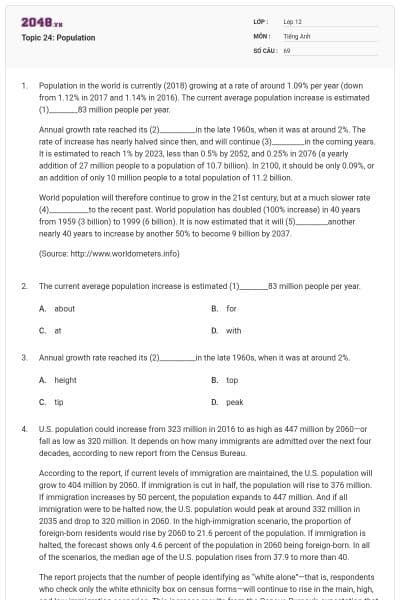
Population in the world is currently (2018) growing at a rate of around 1.09% per year (down from 1.12% in 2017 and 1.14% in 2016). The current average population increase is estimated (1)________83 million people per year.
Annual growth rate reached its (2)__________in the late 1960s, when it was at around 2%. The rate of increase has nearly halved since then, and will continue (3)_________in the coming years. It is estimated to reach 1% by 2023, less than 0.5% by 2052, and 0.25% in 2076 (a yearly addition of 27 million people to a population of 10.7 billion). In 2100, it should be only 0.09%, or an addition of only 10 million people to a total population of 11.2 billion.
World population will therefore continue to grow in the 21st century, but at a much slower rate (4)___________to the recent past. World population has doubled (100% increase) in 40 years from 1959 (3 billion) to 1999 (6 billion). It is now estimated that it will (5)_________another nearly 40 years to increase by another 50% to become 9 billion by 2037.
(Source: http://www.worldometers.info)
about
for
at
with
Dân số trên thế giới hiện nay (2018) đang tăng với tốc độ khoảng 1,09% mỗi năm (giảm từ mức 1,12% trong năm 2017 và 1,14% trong năm 2016). Sự gia tăng dân số trung bình hiện nay ước tính khoảng 83 triệu người mỗi năm.
Tốc độ tăng trưởng hàng năm đạt đến đỉnh điểm vào cuối những năm 1960, ở mức khoảng 2%. Tốc độ tăng đã giảm gần một nửa kể từ đó, và sẽ tiếp tục giảm trong những năm tới. Ước tính sẽ đạt 1% vào năm 2023, dưới 0,5% vào năm 2052 và 0,25% vào năm 2076 (hằng năm tăng thêm 27 triệu người và tổng dân số là 10,7 tỷ người). Năm 2100, chỉ khoảng 0,09%, hoặc chỉ tăng thêm 10 triệu người vào tổng dân số 11,2 tỷ người.
Do đó dân số thế giới sẽ tiếp tục tăng trong thế kỷ 21, nhưng với tốc độ chậm hơn nhiều so với quá khứ. Dân số thế giới đã tăng gấp đôi (tăng 100%) trong 40 năm từ 1959 (3 tỷ) đến 1999 (6 tỷ). Hiện tại ước tính sẽ mất gần 40 năm nữa để tăng thêm 50% nữa để đạt 9 tỷ vào năm 2037.
Đáp án C
Kiến thức về giới từ
Xét các đáp án:
A. about /əˈbaʊt/ (prep): khoảng chừng, xấp xỉ
B. for /fə(r)/ (prep): dành cho, để, với mục đích là
C. at /ət/ (prep): với (chỉ giá cả, tỉ lệ, tốc độ…)
D. with /wɪð/ (prep): với, cùng, cùng với
Tạm dịch: Population in the world is currently (2018) growing at a rate of around 1.09% per year (down from 1.12% in 2017 and 1.14% in 2016). The current average population increase is estimated (1) _____ at 83 million people per year.
Dân số thế giới hiện (năm 2018) đang ngày càng tăng với tỷ lệ vào khoảng 1.09% mỗi năm (giảm từ 1.12% trong 2017 và 1.14% vào năm 2016). Hiện tại trung bình gia tăng dân số ước tính vào khoảng 83 triệu người mỗi năm.
height
top
tip
peak
Đáp án D
Kiến thức về từ vựng
Xét các đáp án:
A. height /haɪt/ (n): chiều cao, độ cao
B. top /tɒp/ (n): đỉnh, phần cao nhất
C. tip /tɪp/ (n): đầu, mút, đỉnh
D. peak /piːk/ (n): tột đỉnh, cao điểm; tối đa
Tạm dịch: "Annual growth rate reached its (2) __________ peak in the late 1960s, when it was at around 2%."
(Tốc độ tăng trưởng hàng năm đạt đến đỉnh điểm vào cuối những năm 1960, khi nó ở mức khoảng 2%.)
to decline
decline
to be declined
being declined
Đáp án A
Kiến thức về dạng của động từ
Ta có: continue to do sth/ doing sth: tiếp tục làm việc gì
Xét các đáp án:
A. to decline => đúng cấu trúc
B. decline => sai cấu trúc
C. to be declined => không đúng vì “decline” là nội động từ nên không có dạng bị động.
D. being declined => không đúng vì “decline” là nội động từ nên không có dạng bị động.
Tạm dịch: The rate of increase has nearly halved since then, and will continue (3) __________ to decline in the coming years.
(Tốc độ tăng đã giảm gần một nửa kể từ lúc đó, và sẽ tiếp tục giảm trong những năm tới.)
to compare
comparing
compared
comparison
Đáp án C
Kiến thức về dạng của từ
Xét các đáp án:
A. to compare /kəmˈpeə(r)/ (v): so sánh; ví
B. comparing /kəmˈpeərɪŋ/ (V-ing): so sánh; ví
C. compared / kəmˈpeəd/ (V-ed): được so sánh
D. comparison /kəmˈpærɪsn/ (n): sự so sánh, phép so sánh
Tạm dịch: World population will therefore continue to grow in the 21st century, but at a much slower rate (4) __________ compared to the recent past.
(Do đó dân số thế giới sẽ tiếp tục tăng lên trong thế kỷ 21, nhưng với tốc độ chậm hơn nhiều so với những năm gần đây.)
It is now estimated that it will (5)_________another nearly 40 years to increase by another 50% to become 9 billion by 2037.
spend
take
consume
make
Đáp án B
Kiến thức về từ vựng
Xét các đáp án:
A. spend /spend/ (v): sử dụng, chi tiêu
B. take /teɪk/ (v): cầm, nắm, giữ, lấy
C. consume /kənˈsjuːm/ (v): dùng; tiêu thụ
D. make /meɪk/ (v): làm, gây ra, khiến cho
Ta có cấu trúc:
It takes sb + time + to do sth: mất bao nhiêu thời gian để làm việc gì
Tạm dịch: It is now estimated that it will (5) __________ take another nearly 40 years to increase by another 50% to become 9 billion by 2037.
(Bây giờ ước tính rằng sẽ phải mất gần 40 năm nữa mới có thể tăng thêm 50% để đạt được 9 tỷ vào năm 2037.)
U.S. population could increase from 323 million in 2016 to as high as 447 million by 2060—or fall as low as 320 million. It depends on how many immigrants are admitted over the next four decades, according to new report from the Census Bureau.
According to the report, if current levels of immigration are maintained, the U.S. population will grow to 404 million by 2060. If immigration is cut in half, the population will rise to 376 million. If immigration increases by 50 percent, the population expands to 447 million. And if all immigration were to be halted now, the U.S. population would peak at around 332 million in 2035 and drop to 320 million in 2060. In the high-immigration scenario, the proportion of foreign-born residents would rise by 2060 to 21.6 percent of the population. If immigration is halted, the forecast shows only 4.6 percent of the population in 2060 being foreign-born. In all of the scenarios, the median age of the U.S. population rises from 37.9 to more than 40.
The report projects that the number of people identifying as “white alone”—that is, respondents who check only the white ethnicity box on census forms—will continue to rise in the main, high, and low immigration scenarios. This increase results from the Census Bureau’s expectation that the children of Hispanic immigrants will probably, like the children of Italian, Polish, Greek, and other earlier immigrant groups, choose to identify increasingly as white. But the share of the population in the white alone category will decline in each scenario, due to faster increases in the numbers of Americans in the other racial and ethnic groups. America is an ideal, not a tribe.
(Source: https://reason.com/2020/02/14/)
Which best serves as the title for the passage?
Different outcomes for the U.S. regarding immigration rate.
Immigration should be made a right issue.
Illegal and legal immigrations are the same with the U.S. policy.
The political aspect of the U.S. immigration.
Đáp án A
Đâu là tiêu đề phù hợp nhất cho đoạn văn?
A. Kết quả khác nhau của Hoa Kỳ về tỷ lệ nhập cư.
B. Nhập cư nên được coi là một vấn đề đúng.
C. Người nhập cư bất hợp pháp và hợp pháp là giống nhau với chính sách của Hoa Kỳ.
D. Các khía cạnh chính trị của nhập cư Hoa Kỳ.
Khi đọc cả đoạn văn ta thấy cả đoạn văn nói về các kết quả khác nhau liên quan đến tỷ lệ người nhập cư ở Mỹ, trong các trường hợp nếu như tỷ lệ người nhập cư giữ nguyên, hoặc bị giảm xuống một nửa, hoặc bị dừng lại.
The word “It” in paragraph 1 refers to _______.
When U.S. growth rate will peak.
How U.S. population will change.
Where U.S population will concentrate.
Why U.S population will not stay the same.
Đáp án B
Từ “it” trong đoạn 1 ám chỉ_________
A. Khi tốc độ tăng trưởng của Mỹ sẽ đạt đỉnh
B. Dân số Hoa Kỳ sẽ thay đổi như thế nào
C. Nơi dân cư Hoa Kỳ sẽ tập trung
D. Tại sao dân số Hoa Kỳ sẽ không giữ nguyên
Căn cứ vào ngữ cảnh đoạn 1:
U.S. population could increase from 323 million in 2016 to as high as 447 million by 2060— or fall as low as 320 million. It depends on how many immigrants are admitted over the next four decades, according to new report from the Census Bureau.
(Dân số Hoa Kỳ có thể tăng từ 323 triệu trong năm 2016 lên cao tới 447 triệu vào năm 2060, hoặc giảm xuống mức 320 triệu. Nó phụ thuộc vào số lượng người nhập cư được nhận trong bốn thập kỷ tới, theo báo cáo mới từ Cục điều tra dân số.)
According to paragraph 2, how many situations sketched out by the report for the population in 2060?
2
3
4
5
Đáp án C
Theo đoạn 2, có bao nhiêu tình huống được phác thảo trong báo cáo dân số năm 2060?
A. 2
B. 3
C. 4
D. 5
Căn cứ vào thông tin đoạn 2:
According to the report, if current levels of immigration are maintained, the U.S. population will grow to 404 million by 2060. If immigration is cut in half, the population will rise to 376 million. If immigration increases by 50 percent, the population expands to 447 million. And if all immigration were to be halted now, the U.S. population would peak at around 332 million in 2035 and drop to 320 million in 2060.
=> có 4 tình huống: tỷ lệ nhập cư giữ nguyên, tỷ lệ nhập cư giảm một nửa, tỷ lệ nhập cư tăng lên một nửa, tỷ lệ nhập cư dừng lại.
The word “median” in paragraph 2 is closest in meaning to ______.
mean
optimal
average
middle
Đáp án C
Từ “median” trong đoạn 2 gần nghĩa nhất với từ______
A. thấp kém, tầm thường
B. tối ưu
C. trung bình (giá trị trung bình của một tổng số lượng nào đó)
D. ở giữa (phần giữa của một khoảng cách địa lý hoặc của một khoảng thời gian)
Căn cứ vào thông tin đoạn 2:
In all of the scenarios, the median age of the U.S. population rises from 37.9 to more than 40.
(Trong tất cả các kịch bản, độ tuổi trung bình của dân số Hoa Kỳ tăng từ 37,9 lên hơn 40.)
=> median /’mi:diən/ (a): ở giữa (về vị trí); trung bình (về giá trị, giá cả, con số,…)
=> Trong câu này nó mang nghĩa thứ hai là ‘trung bình về con số’.
=> median ~ average
According to paragraph 3, what is the author trying to get at by discussing the process of ethnic identification?
Reducing immigration will not stop America’s rising diversity in races and ethnics.
The reported ethnic makeup of the American population will make no sense.
Zero immigration would be demographically unsustainable and unlikely to occur.
The America will lose its cultural identity with the current rate of immigration.
Đáp án B
Theo đoạn 3, tác giả đang cố gắng hiểu ra điều gì khi thảo luận về quá trình nhận diện dân tộc?
A. Giảm nhập cư sẽ không ngăn được sự đa dạng gia tăng của Mỹ trong các chủng tộc và dân tộc học.
B. Sự cấu thành của chủng tộc được báo cáo của dân số Mỹ sẽ trở nên vô lý.
C. Không nhập cư sẽ không bền vững về mặt nhân khẩu học và không có khả năng xảy ra.
D. Nước Mỹ sẽ mất bản sắc văn hóa với tỷ lệ nhập cư hiện tại.
Căn cứ vào thông tin đoạn 3:
The report projects that the number of people identifying as “white alone” - that is, respondents who check only the white ethnicity box on census forms - will continue to rise in the main, high, and low immigration scenarios. This increase results from the Census Bureau’s expectation that the children of Hispanic immigrants will probably, like the children of Italian, Polish, Greek, and other earlier immigrant groups, choose to identify increasingly as white. But the share of the population in the white alone category will decline in each scenario, due to faster increases in the numbers of Americans in the other racial and ethnic groups. America is an ideal, not a tribe.
(Báo cáo ước tính số lượng người mà xác định là “chỉ là người da trắng” - tức là những người trả lời mà họ đánh dấu tích vào ô dân tộc da trắng trên các mẫu điều tra dân số, sẽ tiếp tục tăng trong các kịch bản nhập cư với mức ổn định, cao và thấp. Sự gia tăng này xuất phát từ sự kỳ vọng của Cục điều tra dân số rằng trẻ em của người nhập cư gốc Tây Ban Nha có thể sẽ giống như con cái của các nhóm người nhập cư Ý, Ba Lan, Hy Lạp và các nhóm nhập cư trước đó, chọn nhận dạng như là người da trắng đang trở nên gia tăng. Nhưng tỷ lệ dân số trong nhóm người da trắng sẽ giảm trong mỗi kịch bản, do sự gia tăng nhanh hơn số lượng người Mỹ thuộc các nhóm chủng tộc và sắc tộc khác. Mỹ là một mô hình lý tưởng, không phải là một bộ tộc.)
=> Do đó, có thể thấy rằng khi thảo luận về quá trình nhận diện dân tộc tác giả đang cố gắng hiểu ra rằng sự cấu thành của chủng tộc được báo cáo của dân số Mỹ sẽ trở nên vô lý.
Ask about “the population problem” to people of a certain age, and the first and perhaps only thing that comes to mind is the “population bomb” or “population explosion.” And they would be right - for their time. In the second half of the 20th century, rapid population growth - especially but not exclusively in the developing countries - created unprecedented increases in the number of people on the earth. And this growth was accompanied by crowding, malnutrition, disease, and poverty. Indeed, for many Americans, the coming “population explosion” was, along with the Cold War, the most unsettling fact about our world.
But “population problems” have been part of American discourse for over 100 years. In the 1930s and 1940s, for instance, many observers feared that depopulation due to plummeting birth rates would cause chronic economic depression as the numbers of U.S. consumers and workers declined. In the 1920s, the U.S. “population problem” was rapid urbanization, reflected in a 1920 census count showing that for the first time more than one-half the population lived in urban areas. Rural incumbents in the House of Representatives, fearing they would be voted out of office by their new urban constituents, succeeded in blocking reapportionment of the House’s seats on the basis of the census counts as mandated by the U.S. Constitution.
The century’s first “population problem” was mass xenophobia about immigration. Beginning in 1880, wave after wave of European immigrants was creating congestion and social change at an unprecedented rate. In response to widespread anxiety and anger, Congress in 1924 passed the country’s most restrictive immigration legislation ever. Each problem was based in hard numbers. Each generated private emotions and public fears. Each suffered exaggeration and manipulation. And each commanded the attention of opinion leaders and elected officials.
(Source: https://www.prb.org/)
Which best serves as the title for the passage?
Different world’s population problems.
The world’s first population problem.
Why the population explosion was unique
A direct response to the confusion.
Đáp án A
Đâu là tiêu đề thích hợp nhất cho bài văn?
A. Những vấn đề khác nhau về dân số.
B. Vấn đề đầu tiên về dân số của thế giới.
C. Tại sao bùng nổ dân số là vấn đề đặc biệt.
D. Cách giải quyết trực tiếp cho sự hỗn loạn.
Giải thích:
Đáp án A đúng vì bài văn nhắc đến nhiều vấn đề về dân số khác nhau qua từng giai đoạn, từ sự giảm dân số (depopulation), đô thị hoá (urbanization) đến bùng nổ dân số (population explosion) và tình trạng bài ngoại và nhập cư (xenophobia about immigration)
According to paragraph 1, what did the author imply when writing “And they would be right - for their time”?
People cannot imagine problems beyond their fixed chronological framework of thinking.
Rapid population growth is quantitatively and qualitatively different from previous population problems.
For a century, every generation of Americans has seen some aspects of population as a problem.
Mordenisation has robbed people of their caring side, leaving only apathy and indifference.
Đáp án C
Theo đoạn 1, tác giả đã ám chỉ điều gì khi viết “Và họ có lẽ đúng – với thời của họ” ?
A. Mọi người không thể tưởng tượng ra những vấn đề vượt ra ngoài khuôn khổ suy nghĩ cố định của họ
B. Tăng trưởng dân số nhanh chóng khác biệt về cả số lượng và chất lượng so với các vấn đề dân số trước
C. Trong một thế kỷ, mỗi thế hệ người Mỹ đã nhìn nhận một số khía cạnh của dân số là một vấn đề
D. Hiện đại hóa đã cướp đi sự quan tâm của mọi người, chỉ để lại sự thờ ơ và thờ ơ
Căn cứ vào thông tin đoạn đầu:
Ask about “the population problem” to people of a certain age, and the first and perhaps only thing that comes to mind is the “population bomb” or “population explosion.” And they would be right—for their time.
(Hỏi về “vấn đề dân số” với những người ở một độ tuổi nhất định, vấn đề đầu tiên và có lẽ là duy nhất xuất hiện trong đầu họ là “bùng nổ dân số”. Và họ có lẽ đúng – với thời của họ.)
The word “they” in paragraph 2 is closest in meaning to ______.
workers
urban constituents
consumers
rural incumbents
Đáp án D
Từ “they” trong đoạn 2 có nghĩa gần nhất với .
A. công nhân
B. thành phần đô thị
C. người tiêu dùng
D. người đương nhiệm ở nông thôn
Từ “they” ở đây được dùng để thay thế cho danh từ người đương nhiệm ở nông thôn được nhắc tới trước đó.
Rural incumbents in the House of Representatives, fearing they would be voted out of office by their new urban constituents, …
(Những người đương nhiệm ở nông thôn tại Hạ viện, sợ rằng họ sẽ bị bỏ phiếu mãn nhiệm bởi các thành phần đô thị mới, …)
According to paragraph 2, what were the two problems mentioned as population concerns?
Economic recession and urbanisation.
Population decline and urban sprawl.
Depopulation and metropolitanisation.
Sub-replacement fertility and discrimination.
Đáp án B
Theo đoạn 2, hai vấn đề được đề cập là mối quan tâm về dân số là gì?
A. Suy thoái kinh tế và đô thị hóa
B. Dân số suy giảm và đô thị hóa bừa bãi
C. Suy giảm và đô thị hóa
D. Khả năng sinh sản và phân biệt đối xử thay thế
Căn cứ vào thông tin đoạn hai:
In the 1930s and 1940s, for instance, many observers feared that depopulation due to plummeting birth rates would cause chronic economic depression as the numbers of U.S. consumers and workers declined. In the 1920s, the U.S. “population problem” was rapid urbanization, reflected in a 1920 census count showing that for the first time more than one-half the population lived in urban areas.
(Chẳng hạn, vào những năm 1930 và những năm 1940, nhiều nhà quan sát sợ rằng sự suy giảm do tỷ lệ sinh giảm mạnh sẽ gây ra suy thoái kinh tế lâu dài vì số lượng người tiêu dùng và công nhân Hoa Kỳ giảm. Vào những năm 1920, vấn đề dân số của Hoa Kỳ là đô thị hóa nhanh chóng, được phản ánh trong số liệu thống kê dân số năm 1920 cho thấy lần đầu tiên hơn một nửa dân số sống ở thành thị khu vực.)
The word “unprecedented” in paragraph 3 refers to _______.
unrivaled
unexampled
original
singular
Đáp án B
Từ “unprecedented” trong đoạn 3 đề cập đến .
A. không có đối thủ
B. không gì sánh kịp
C. căn nguyên
D. số ít
Từ đồng nghĩa unprecedented (chưa từng thấy) = unexampled
Beginning in 1880, wave after wave of European immigrants was creating congestion and social change at an unprecedented rate.
(Bắt đầu vào năm 1880, làn sóng sau làn sóng người nhập cư châu Âu đang tạo ra sự tắc nghẽn và sự thay đổi xã hội với một tốc độ chưa từng thấy.)
Vietnam’s population is ageing quickly. In 2017, more than 10 per cent of the population will be 60 and older, and in 15–20 years the elderly will account for one third of the total population. This raises concerns about healthcare, welfare and pensions for the elderly at a time when Vietnam is focusing on economic integration and requires a large labor force. So far two solutions have been proposed: to loosen the two-child policy and to increase the retirement age to 58 for women and 62 for men. By ending the two-child policy the government expects to make up for the ageing population within the next 20 years. But its effect could be creating an uncontrollable boom in the Vietnamese population. When the government loosened the two-child policy in 2015 in a trial period, in the first 6 months of 2016 the third child birth rate increased remarkably by 7.5 per cent.
Raising the retirement age has been proposed by the Ministry of Labor pending parliamentary evaluation in May 2017. While the policy is beneficial in utilizing the work experience of the elderly while creating savings in the pension budget, it also means fewer job prospects and promotion opportunities for younger generations. It is also not in the interest of all the elderly, especially the 70 per cent of Vietnam’s labor force working in manual labor-intensive sectors such as agriculture, manufacturing and construction where working above the age of 50 can be dangerous and unproductive. Despite these drawbacks, raising the retirement age is still considered by policymakers as one of the key solutions to the ageing population problem in Vietnam. However, these are only temporary solutions.
(Adapted from http://www.eastasiaforum.org/2017/01/25/)
The best title for this passage could be ______________________.
Vietnam struggling with ageing population
Stopping the two-child policy in Vietnam
Raising the retirement age in Vietnam
How to solve the aging population in Vietnam
Đáp án A
Chủ đề về POPULATION
Tiêu đề tốt nhất cho đoạn văn này có thể là ______________.
A. Việt Nam đấu tranh với việc già hóa dân số
B. Chấm dứt chính sách 2 con ở Việt Nam
C. Tăng tuổi nghỉ hưu ở Việt Nam
D. Cách giải quyết vấn đề già hóa dân số ở Việt Nam
Căn cứ vào thông tin toàn bài:
Thông tin “ hính sách 2 con; tăng tuổi nghỉ hưu; cách giải quyết vấn đề già hóa dân số” đều được đề cập trong bài nhưng chưa bao quát toàn bài.
Which statement is probably TRUE according to the information in the paragraph 1?
In 2017, the elderly take up for one third of the total population, this leads to more concerns about healthcare, welfare and pensions for the elderly.
In 2015, the two-child policy has been officially tightened and succeeded.
The government would promote families to have two children to compensate for the ageing population within the next 20 years.
In the next 15-17 years, Vietnam’s economy will need a large labor force to integrate with global economy.
Đáp án D
Phát biểu nào có lẽ là ĐÚNG theo thông tin trong đoạn văn 1?
A. Năm 2017, dân số già ở Việt Nam chiếm tới 1/3 dân số cả nước, điều này dẫn đến những lo ngại về chăm sóc sức khỏe, phúc lợi xã hội và lương hưu cho người già.
B. Năm 2015, chính sách 2 con đã chính thức được thắt chặt và đã thành công.
C. Chính phủ khuyến khích các gia đình có 2 con để bù đắp cho việc già hóa dân số trong 20 năm tới.
D. Trong 15-17 năm tới, nền kinh tế Việt Nam sẽ cần một lực lượng lao động lớn để hội nhập với nền kinh tế toàn cầu.
Căn cứ vào thông tin đoạn 1:
Tạm dịch: “…. in 15 - 20 years the elderly will account for one third of the total population. This raises concerns about healthcare, welfare and pensions for the elderly at a time when Vietnam is focusing on economic integration and requires a large labor force.”
(…trong 15 tuổi 20, người cao tuổi sẽ chiếm một phần ba tổng dân số. Điều này làm tăng mối lo ngại về chăm sóc sức khỏe, phúc lợi và lương hưu cho người cao tuổi tại thời điểm Việt Nam đang tập trung vào hội nhập kinh tế và đòi hỏi một lực lượng lao động lớn.)
The word “its” in paragraph 1 refers to_______________?
the end of two-child policy
aging population
retirement age
economic integration
Đáp án A
Từ “ its” trong đoạn 1 ám chỉ đến____________________
A. việc chấm dứt chính sách 2 con
B. sự già hóa dân số
C. tuổi nghỉ hưu
D. việc hội nhập kinh tế
Căn cứ vào thông tin đoạn 1:
Tạm dịch: “By ending the two-child policy the government expects to make up for the ageing population within the next 20 years. But its effect could be creating an uncontrollable boom in the Vietnamese population.”
(Bằng cách chấm dứt chính sách hai con, chính phủ hy vọng sẽ bù đắp cho dân số già trong vòng 20 năm tới. Nhưng tác động của nó có thể tạo ra sự bùng nổ không thể kiểm soát trong dân số Việt Nam.)
=> Do đó, ta thấy “its” ở đây đang ám chỉ đến “việc chấm dứt chính sách hai con”.
In the 2rd paragraph, the writer suggests that_________________.
The Ministry of Labor has applied raising the retirement age in May 2017.
Raising the retirement age can reduce job opportunities for younger generations.
The elderly whose age are 50 would be dangerous if they continued to work
Raising the retirement age and stopping two-child policy can be considered as long-term and effective solutions.
Đáp án B
Trong đoạn 2, tác giả gợi ý rằng ______________________
A. Bộ Lao động đã áp dụng việc nâng tuổi nghỉ hưu từ tháng 5 năm 2017
B. Nâng tuổi nghỉ hưu có thể làm giảm cơ hội việc làm cho thế hệ trẻ.
C. Những người 50 tuổi có thể sẽ gặp nguy hiểm nếu tiếp tục làm việc
D. Nâng tuổi nghỉ hưu và dừng chính sách 2 con được coi là những giải pháp lâu dài và hiệu quả.
Căn cứ vào thông tin đoạn 2:
Tạm dịch: “While the policy is beneficial in utilizing the work experience of the elderly while creating savings in the pension budget, it also means fewer job prospects and promotion opportunities for younger generations.”
(Mặc dù chính sách này có lợi trong việc sử dụng kinh nghiệm làm việc của người cao tuổi trong khi tạo ra các khoản tiết kiệm trong ngân sách lương hưu, nhưng điều đó cũng có nghĩa là ít triển vọng việc làm và cơ hội thăng tiến cho thế hệ trẻ.)
The word “temporary” in paragraph 2 means_______________.
constant
permanent
short-term
long-term
Đáp án C
Từ “ temporatory” trong đoạn 2 có nghĩa là_______________
A. consistant (a): kiên trì
B. permanent (a): lâu dài
C. short-term (a): ngắn hạn
D. long-term (a): dài hạn
Temporatory = short-term
Căn cứ vào thông tin đoạn 2:
Tạm dịch: “Despite these drawbacks, raising the retirement age is still considered by policymakers as one of the key solutions to the ageing population problem in Vietnam. But these are only temporary solutions.”
(Bất chấp những hạn chế này, việc tăng tuổi nghỉ hưu vẫn được các nhà hoạch định chính sách coi là một trong những giải pháp chính cho vấn đề dân số già ở Việt Nam. Nhưng đây chỉ là những giải pháp tạm thời.)
Overpopulation is an undesirable condition where the number of existing human population exceeds the carrying capacity of Earth. Overpopulation is caused by number of factors. Reduced mortality rate, better medical facilities, depletion of precious resources are few of the causes which results in overpopulation. It is possible for a sparsely populated area to become densely populated if it is not able to sustain life.
The effects of overpopulation are quite severe. The first of these is the depletion of resources. The Earth can only produce a limited amount of water and food, which is falling short of the current needs. Most of the environmental damage being seen in the last fifty odd years is because of the growing number of people on the planet. They are cutting down forests, hunting wildlife in a reckless manner, causing pollution and creating a host of problems. Those engaged in talking about overpopulation have noticed that acts of violence and aggression outside of a war zone have increased tremendously while competing for resources.
With the overuse of coal, oil and natural gas, it has started producing some serious effects on our environment. Rise in the number of vehicles and industries have badly affected the quality of air. Rise in amount of CO2 emissions leads to global warming. Melting of polar ice caps, changing climate patterns, rise in sea level are few of the consequences that we might we have to face due to environment pollution.
Overpopulation in developing countries puts a major strain on the resources it should be utilizing for development. Conflicts over water are becoming a source of tension between countries, which could result in wars. It causes more diseases to spread and makes them harder to control. Starvation is a huge issue facing the world and the mortality rate for children is being fuelled by it. Poverty is the biggest hallmark we see when talking about overpopulation. All of this will only become worse if solutions are not sought out for the factors affecting our population. We can no longer prevent it, but there are ways to control it.
When a country becomes overpopulated, it gives rise to unemployment as there fewer jobs to support large number of people. Rise in unemployment gives rise to crime as people will steal various items to feed their family and provide them basic amenities of life.
As difference between demand and supply continues to expand due to overpopulation, it raises the prices of various commodities including food, shelter and healthcare. This means that people have to pay more to survive and feed their families.
(Source: https://www.conserve-energy-future.com)
Which of the following does the passage mainly discuss?
Effects of overpopulation
Reasons of overpopulation
Periods of overpopulation
Areas of overpopulation
Đáp án A
Đoạn văn chủ yếu bàn về vấn đề gì sau đây?
A. Những ảnh hưởng của dân số quá đông
B. Nguyên nhân gây dân số quá đông
C. Thời kỳ dân số quá đông
D. Khu vực có dân số quá đông
Căn cứ nội dung toàn bài, đặc biệt là đoạn đầu đoạn 2:
The effects of overpopulation are quite severe. The first of these is the depletion of resources. The Earth can only produce a limited amount of water and food, which is falling short of the current needs.
(Sự suy giảm tài nguyên thiên nhiên: Các tác động của dân số quá đông là khá nghiêm trọng. Đầu tiên trong số này là sự suy giảm tài nguyên. Trái đất chỉ có thể sản xuất một lượng nước và thực phẩm hạn chế, vốn đang thiếu hụt các nhu cầu hiện tại.)
Dịch bài đọc
Quá tải dân số là tình trạng không mong muốn khi số lượng dân số hiện tại vượt quá sức chứa của Trái đất. Quá tải dân số là do nhiều yếu tố gây ra. Tỷ lệ tử vong giảm, cơ sở y tế tốt hơn, cạn kiệt tài nguyên quý giá là một số nguyên nhân dẫn đến quá tải dân số. Một khu vực dân cư thưa thớt có thể trở nên đông đúc nếu không thể duy trì sự sống.
Hậu quả của quá tải dân số khá nghiêm trọng. Đầu tiên là cạn kiệt tài nguyên. Trái đất chỉ có thể sản xuất một lượng nước và thực phẩm hạn chế, không đáp ứng đủ nhu cầu hiện tại. Hầu hết thiệt hại về môi trường được nhìn thấy trong hơn năm mươi năm qua là do số lượng người trên hành tinh ngày càng tăng. Họ đang chặt phá rừng, săn bắt động vật hoang dã một cách liều lĩnh, gây ô nhiễm và tạo ra vô số vấn đề. Những người tham gia thảo luận về quá tải dân số đã nhận thấy rằng các hành vi bạo lực và xâm lược bên ngoài vùng chiến sự đã gia tăng rất nhiều trong khi cạnh tranh giành tài nguyên.
Với việc sử dụng quá mức than, dầu và khí đốt tự nhiên, nó đã bắt đầu gây ra một số tác động nghiêm trọng đến môi trường của chúng ta. Sự gia tăng số lượng phương tiện và ngành công nghiệp đã ảnh hưởng nghiêm trọng đến chất lượng không khí. Lượng khí thải CO2 tăng dẫn đến hiện tượng nóng lên toàn cầu. Băng ở hai cực tan chảy, thay đổi mô hình khí hậu, mực nước biển dâng là một số hậu quả mà chúng ta có thể phải đối mặt do ô nhiễm môi trường.
Tình trạng quá tải dân số ở các nước đang phát triển gây sức ép lớn lên các nguồn tài nguyên mà họ nên sử dụng để phát triển. Xung đột về nước đang trở thành nguồn căng thẳng giữa các quốc gia, có thể dẫn đến chiến tranh. Điều này khiến nhiều bệnh tật lây lan hơn và khiến chúng khó kiểm soát hơn. Nạn đói là vấn đề lớn mà thế giới đang phải đối mặt và tỷ lệ tử vong ở trẻ em đang bị thúc đẩy bởi nó. Nghèo đói là dấu hiệu rõ ràng nhất mà chúng ta thấy khi nói về tình trạng quá tải dân số. Tất cả những điều này sẽ chỉ trở nên tồi tệ hơn nếu không tìm ra giải pháp cho các yếu tố ảnh hưởng đến dân số của chúng ta. Chúng ta không còn có thể ngăn chặn được nữa, nhưng vẫn có cách để kiểm soát nó.
Khi một quốc gia trở nên quá tải dân số, nó sẽ dẫn đến tình trạng thất nghiệp vì có ít việc làm hơn để hỗ trợ cho số lượng lớn người dân. Tình trạng thất nghiệp gia tăng sẽ dẫn đến tội phạm vì mọi người sẽ ăn cắp nhiều mặt hàng khác nhau để nuôi sống gia đình và cung cấp cho họ những tiện nghi cơ bản của cuộc sống.
Khi chênh lệch giữa cung và cầu tiếp tục gia tăng do tình trạng quá tải dân số, giá cả của nhiều mặt hàng khác nhau bao gồm thực phẩm, nơi ở và chăm sóc sức khỏe sẽ tăng cao. Điều này có nghĩa là mọi người phải trả nhiều tiền hơn để tồn tại và nuôi sống gia đình.
(Nguồn: https://www.conserve-energy-future.com)
The word "sustain" in paragraph 1 is closest in meaning to ______.
prolong
provide
withstand
maintain
Đáp án D
Từ “sustain” trong đoạn 1 gần nghĩa nhất với từ _____.
A. kéo dài
B. cung cấp
C. chịu đựng
D. duy trì
Từ đồng nghĩa: to sustain (duy trì) = to maintain
Reduced mortality rate, better medical facilities, depletion of precious resources are few of the causes which results in overpopulation. It is possible for a sparsely populated area to become densely populated if it is not able to sustain life.
(Giảm tỷ lệ tử vong, cơ sở y tế tốt hơn, sự suy giảm tài nguyên quý hiếm là một trong những nguyên nhân dẫn đến tình trạng dân số quá đông. Khu dân cư thưa thớt cũng có thể trở thành đông dân cư nếu nó không thể duy trì sự sống.)
According to paragraph 2, what is the reasons why violence and aggression have increased remarkably?
People are cutting down forests.
People are hunting wildlife in a reckless manner.
People are struggling for resources.
People are causing pollution.
Đáp án C
Theo đoạn 2, nguyên nhân của việc bạo lực và sự gây hấn tăng lên đáng kể là gì?
A. Con người chặt phá rừng.
B. Con người săn bắt các loài hoang dã vô tội vạ.
C. Con người chiến đấu giành tài nguyên.
D. Con người gây ra ô nhiễm.
Căn cứ thông tin đoạn 2:
Those engaged in talking about overpopulation have noticed that acts of violence and aggression outside of a war zone have increased tremendously while competing for resources.
(Những người tham gia thảo luận về tình trạng dân số quá đông đã nhận thấy rằng các hành vi bạo lực và xâm lược bên ngoài khu vực chiến tranh đã tăng lên rất nhiều khi con người cạnh tranh để sở hữu các nguồn tài nguyên.)
What is the main idea of paragraph 3?
Depletion of Natural Resources
Degradation of Environment
Conflicts and Wars
High Cost of Living
Đáp án B
Ý chính của đoạn 3 là gì?
A. Sự cạn kiệt tài nguyên thiên nhiên.
B. Sự xuống cấp của môi trường.
C. Xung đột và chiến tranh.
D. Chi phí cuộc sống cao.
Căn cứ thông tin đoạn 3:
With the overuse of coal, oil and natural gas, it has started producing some serious effects on our environment. Rise in the number of vehicles and industries have badly affected the quality of air. Rise in amount of CO2 emissions leads to global warming. Melting of polar ice caps, changing climate patterns, rise in sea level are few of the consequences that we might we have to face due to environment pollution. (Suy thoái môi trường: Việc lạm dụng than, dầu mỏ và khí tự nhiên đã bắt đầu tạo ra một số ảnh hưởng nghiêm trọng đến môi trường của chúng ta. Sự tăng lên về số lượng phương tiện và sự phát triển mạnh của ngành công nghiệp có ảnh hưởng xấu đến chất lượng không khí. Tăng lượng phát thải CO2 dẫn đến sự nóng lên toàn cầu. Tan băng ở các cực trái đất, thay đổi mô hình khí hậu, mực nước biển dâng là số ít trong những hậu quả mà chúng ta có thể phải đối mặt do ô nhiễm môi trường.)
The word "affected" in paragraph 3 can be best replaced by ______.
influenced
aspired
disturbed
overcome
Đáp án A
Từ “affected” trong đoạn 3 được thay thế tốt nhất bởi từ ______.
A. ảnh hưởng
B. khao khát
C. quấy rầy
D. vượt qua
Từ đồng nghĩa: to affect (ảnh hưởng) = to influence
Rise in the number of vehicles and industries have badly affected the quality of air. Rise in amount of CO2 emissions leads to global warming.
(Sự tăng lên về số lượng phương tiện và sự phát triển mạnh của ngành công nghiệp có ảnh hưởng xấu đến chất lượng không khí. Tăng lượng phát thải CO2 dẫn đến sự nóng lên toàn cầu.)
Which of the following is NOT mentioned in the passage?
The Earth can only produce a limited amount of water and food, which is falling short of the current needs.
Rise in amount of CO2 emissions leads to global warming.
High cost of living in big cities has resulted in overpopulation.
Poverty is the biggest hallmark we see when talking about overpopulation
Đáp án C
Vấn đề gì sau đây KHÔNG được đề cập trong đoạn văn?
A. Trái đất chỉ có thể sản xuất một lượng nước và thực phẩm hạn chế, vốn đang thiếu hụt cho nhu cầu hiện tại.
B. Tăng lượng phát thải CO2 dẫn đến sự nóng lên toàn cầu.
C. Chi phí sinh hoạt cao ở các thành phố lớn đã dẫn đến tình trạng dân số quá đông.
D. Nghèo đói là dấu hiệu lớn nhất mà chúng ta thấy khi nói về sự bùng nổ dân số.
Căn cứ thông tin toàn bài, đoạn cuối nói về tăng chi phí sinh hoạt nhưng không coi nó như nguyên nhân gây ra tình trạng dân số quá đông:
As difference between demand and supply continues to expand due to overpopulation, it raises the prices of various commodities including food, shelter and healthcare. This means that people have to pay more to survive and feed their families.
(Khi sự khác biệt giữa cung và cầu tiếp tục mở rộng do sự bùng nổ dân số, nó làm tăng giá các mặt hàng khác nhau bao gồm lương thực, chỗ ở và chăm sóc sức khỏe. Điều này có nghĩa là mọi người phải trả nhiều tiền hơn để tồn tại và nuôi sống gia đình mình.)
What does the word "It" in paragraph 4 refers to?
conflict
war
tension
water
Đáp án B
Từ “It” trong đoạn 4 đề cập đến điều gì?
A. xung đột
B. chiến tranh
C. căng thẳng
D. nước
Conflicts over water are becoming a source of tension between countries, which could result in wars. It causes more diseases to spread and makes them harder to control.
(Xung đột về nguồn nước đang trở thành nguồn căng thẳng giữa các quốc gia, điều này có thể dẫn đến các cuộc chiến tranh. Nó gây ra sự lây lan của bệnh tật và làm cho việc kiểm soát chúng khó khăn hơn.)
Which of the following can be inferred from the passage?
The effects of overpopulation are quite severe because the Earth can only produce a limited amount of water and food, which is falling short of the current needs.
Rise in the number of vehicles and industries is due to overpopulation.
Overpopulation in developing countries causes more diseases to spread and makes them harder to control.
Overpopulation is caused by number of factors, and it creates many effect including depletion of natural resources, degradation of environment, conflicts and wars, rise in unemployment, and high cost of living.
Đáp án D
Điều nào sau đây có thể được suy ra từ đoạn văn?
A. Các tác động của tình trạng dân số quá đông là khá nghiêm trọng vì Trái đất chỉ có thể sản xuất một lượng nước và thực phẩm hạn chế, vốn đang thiếu hụt cho các nhu cầu hiện tại.
B. Sự gia tăng số lượng xe cộ và các ngành công nghiệp là do quá đông người.
C. Tình trạng vdân số quá đông ở các nước đang phát triển gây ra nhiều bệnh lây lan và khiến chúng khó kiểm soát hơn.
D. Tình trạng dân số quá đông gây ra bởi nhiều yếu tố, và nó tạo ra nhiều hiệu ứng bao gồm cạn kiệt tài nguyên thiên nhiên, xuống cấp môi trường, xung đột và chiến tranh, tăng tỷ lệ thất nghiệp và chi phí sinh hoạt cao.
Căn cứ thông tin toàn bài thông qua khả năng tổng hợp thông tin ta thấy phương án D đúng và đầy đủ nhất.
Đoạn 1: Overpopulation is caused by number of factors. Reduced mortality rate, better medical facilities, depletion of precious resources are few of the causes which results in overpopulation.
(Tình trạng dân số quá đông gây ra bởi nhiều yếu tố. Giảm tỷ lệ tử vong, cơ sở y tế tốt hơn, sự suy giảm tài nguyên quý hiếm là một trong những nguyên nhân dẫn đến tình trạng dân số quá đông.)
Đoạn 2: The effects of overpopulation are quite severe. The first of these is the depletion of resources. The Earth can only produce a limited amount of water and food, which is falling short of the current needs.
(Các tác động của dân số quá đông là khá nghiêm trọng. Đầu tiên trong số này là sự suy giảm tài nguyên. Trái Đất chỉ có thể sản xuất một lượng nước và thực phẩm hạn chế, vốn đang thiếu hụt cho các nhu cầu hiện tại.)
Đoạn 3: Melting of polar ice caps, changing climate patterns, rise in sea level are few of the consequences that we might we have to face due to environment pollution.
(Tan băng ở các cực trái đất, thay đổi mô hình khí hậu, mực nước biển dâng là số ít trong những hậu quả mà chúng ta có thể phải đối mặt do ô nhiễm môi trường.)
Đoạn 4: Overpopulation in developing countries puts a major strain on the resources it should be utilizing for development. Conflicts over water are becoming a source of tension between countries, which could result in wars.
(Tình trạng dân số quá đông ở các nước đang phát triển gây ra sự căng thẳng lớn đối với các nguồn tài nguyên cần sử dụng để phát triển. Xung đột về nguồn nước đang trở thành nguồn căng thẳng giữa các quốc gia, điều này có thể dẫn đến các cuộc chiến tranh.)
Đoạn 5: When a country becomes overpopulated, it gives rise to unemployment as there fewer jobs to support large number of people.
(Khi dân số một quốc gia trở nên quá đông, nó làm tăng tỷ lệ thất nghiệp vì có ít việc làm hơn để nuôi sống số lượng người lớn hơn.)
Đoạn cuối: As difference between demand and supply continues to expand due to overpopulation, it raises the prices of various commodities including food, shelter and healthcare. This means that people have to pay more to survive and feed their families.
(Khi sự khác biệt giữa cung và cầu tiếp tục mở rộng do sự bùng nổ dân số, nó làm tăng giá các mặt hàng khác nhau bao gồm lương thực, chỗ ở và chăm sóc sức khỏe. Điều này có nghĩa là mọi người phải trả nhiều tiền hơn để tồn tại và nuôi sống gia đình mình.)
200 years ago there were less than one billion humans living on earth. Today, according to UN calculations there are over 7 billion of us. Recent estimates suggest that today’s population size is roughly equivalent to 6.9% of the total number of people ever born. This is the most conspicuous fact about world population growth: for thousands of years, the population grew only slowly but in recent centuries, it has jumped dramatically. Between 1900 and 2000, the increase in world population was three times greater than during the entire previous history of humanity—an increase from 1.5 to 6.1 billion in just 100 years.
How the world population is changing is of great importance for humanity’s impact on the Earth’s natural environment, but it also gives reasons to hope for a good future. This is because we have a bigger team of better educated people who can contribute to the solutions that improve global well-being.
A picture of the world population in the very long-run shows extremely rapid growth. Indeed, for a long time the world population grew at an increasing rate. However, if we focus on the last couple of decades, we see that this pattern no longer holds, as the annual rate of population growth has been recently going down. 1962 saw the growth rate peak at 2.1%, and it has since fallen to almost half. A long historical period of accelerated growth has thus come to an end.
Based on these observations, world history can be divided into three periods marked by distinct trends in population growth. The first period, pre-modernity, was a very long age of very slow population growth. The second period, beginning with the onset of modernity—which was characterized by rising standards of living and improving health—had an increasing growth rate that continued to rise through 1962. Today, the second period is over, and the third period is unfolding; the population growth rate is falling and will likely continue to fall, leading to an end of population growth towards the end of this century.
(Source: https://ourworldindata.org/world-population-growth)
What is the passage mainly about?
World population between 1900 and 2000
World population 200 years ago
A picture of the world population
World population growth
Đáp án D
Đoạn văn trên chủ yếu nói đến vấn đề gì?
A. Dân số thế giới giữa năm 1900 và năm 2000
B. Dân số thế giới 200 năm trước
C. Bức tranh về dân số thế giới
D. Sự tăng trưởng dân số thế giới
Căn cứ thông tin toàn bài nói chung, đặc biệt là đoạn 1. Đoạn này đã nêu ra số liệu thống kê dân số thế giới 200 năm trước và hiện nay.
200 years ago there were less than one billion humans living on earth. Today, according to UN calculations there are over 7 billion of us. Recent estimates suggest that today’s population size is roughly equivalent to 6.9% of the total number of people ever born. This is the most conspicuous fact about world population growth: for thousands of years, the population grew only slowly but in recent centuries, it has jumped dramatically. Between 1900 and 2000, the increase in world population was three times greater than during the entire previous history of humanity - an increase from 1.5 to 6.1 billion in just 100 years.
(200 năm trước, có ít hơn một tỷ người sống trên trái đất. Ngày nay, theo tính toán của Liên hợp quốc, có hơn 7 tỷ người. Các ước tính gần đây cho thấy quy mô dân số hiện nay tương đương với 6,9% tổng số người đã từng sinh ra. Đây là thực tế dễ thấy nhất về tăng trưởng dân số thế giới: trong hàng nghìn năm, dân số chỉ tăng trưởng chậm nhưng trong những thế kỷ gần đây, nó đã tăng lên đáng kể. Giữa năm 1900 và 2000, sự gia tăng dân số thế giới gấp ba lần so với toàn bộ lịch sử nhân loại trước đó - tăng từ 1,5 lên 6,1 tỷ chỉ trong 100 năm.)
According to paragraph 1, what is the most conspicuous fact about world population growth?
There were less than one billion humans living on earth 200 years ago.
Today’s population size is over 7 billion.
Today’s population size is roughly equivalent to 6.9% of the total number of people ever born.
Between 1900 and 2000, the increase in world population was three times greater than during the entire previous history of humanity.
Đáp án D
Theo đoạn 1, sự thật hiển nhiên nhất về tăng trưởng dân số thế giới là gì?
A. Có dưới một tỷ người sống trên trái đất 200 năm trước.
B. Dân số thế giới ngày nay trên 7 tỷ người.
C. Quy mô dân số ngày nay khoảng tương đương 6,9% tổng số người đã từng được sinh ra.
D. Giữ năm 1900 và năm 2000, mức tăng dân số thế giới lớn hơn ba lần so với toàn bộ giai đoạn lịch sử trước đó của nhân loại.
Căn cứ thông tin đoạn 1:
This is the most conspicuous fact about world population growth: for thousands of years, the population grew only slowly but in recent centuries, it has jumped dramatically. Between 1900 and 2000, the increase in world population was three times greater than during the entire previous history of humanity - an increase from 1.5 to 6.1 billion in just 100 years.
(Đây là thực tế dễ thấy nhất về tăng trưởng dân số thế giới: trong hàng nghìn năm, dân số chỉ tăng trưởng chậm nhưng trong những thế kỷ gần đây, nó đã tăng lên đáng kể. Giữa năm 1900 và 2000, sự gia tăng dân số thế giới gấp ba lần so với toàn bộ lịch sử nhân loại trước đó - tăng từ 1,5 lên 6,1 tỷ chỉ trong 100 năm.)
The word "conspicuous" in paragraph 1 is closest in meaning to ______.
humorous
obvious
gigantic
enormous
Đáp án B
Từ “conspicuous” trong đoạn 1 gần nghĩa nhất với từ ______.
A. hài hước
B. hiển nhiên
C. khổng lồ
D. to lớn
Kiến thức từ đồng nghĩa: conspicuous (dễ thấy, hiển nhiên) = obvious
This is the most conspicuous fact about world population growth: for thousands of years, the population grew only slowly but in recent centuries, it has jumped dramatically.
(Đây là thực tế dễ thấy nhất về tăng trưởng dân số thế giới: trong hàng nghìn năm, dân số chỉ tăng trưởng chậm nhưng trong những thế kỷ gần đây, nó đã tăng lên đáng kể.)
What is the main content of paragraph 2?
The world population is changing greatly.
The world population has impact on the Earth’s natural environment.
The changing in world population has great impact on environment, and gives reasons to hope for a good future because we have a bigger team of better educated people.
The world’s crowded population is the reason to hope for a good future.
Đáp án C
Nội dung chính của đoạn 2 là gì?
A. Dân số thế giới thay đổi to lớn.
B. Dân số thế giới có ảnh hưởng đến môi trường tự nhiên của Trái Đất.
C. Sự thay đổi của dân số thế giới có tác động lớn đến môi trường, và tạo ra lý do để hy vọng cho một tương lai tốt đẹp bởi vì chúng ta có một đội ngũ lớn hơn những người có học vấn tốt hơn.
D. Dân số đông đúc trên thế giới là lý do để hy vọng cho một tương lai tốt đẹp.
Căn cứ thông tin đoạn 2:
How the world population is changing is of great importance for humanity’s impact on the Earth’s natural environment, but it also gives reasons to hope for a good future. This is because we have a bigger team of better educated people who can contribute to the solutions that improve global well-being.
(Cách dân số thế giới đang thay đổi có tầm quan trọng lớn đối với tác động của con người đối với môi trường tự nhiên trên Trái Đất nhưng nó cũng đưa ra lý do để hy vọng cho một tương lai tốt đẹp. Điều này là do chúng ta có một đội ngũ lớn hơn những người có học vấn tốt hơn, những người có thể đóng góp vào các giải pháp cải thiện hạnh phúc toàn cầu.)
What does the word “it” in paragraph 3 refer to?
Growth rate
Increasing population
World population
Growth rate peak
Đáp án A
Từ “it” trong đoạn 3 ám chỉ điều gì?
A. Tỷ lệ tăng trưởng
B. Dân số tăng
C. Dân số thế giới
D. Đỉnh tỷ lệ tăng trưởng
=> Câu trước đang nói đến “tỷ lệ tăng trưởng” là 2,1%. Chữ “it” trong câu sau thay cho cụm từ này (growth rate).
Tạm dịch: 1962 saw the growth rate peak at 2.1%, and it has since fallen to almost half.
(Năm 1962, tỷ lệ tăng trưởng đạt 2,1% và kể từ đó nó đã giảm xuống gần một nửa.)
=> Cấu trúc: See sth do sth: chứng kiến điều gì (toàn bộ hành động)
=> Peak at sth: đạt đến đỉnh, cột mốc có giá trị cao nhất
=> Peak ở đây là một động từ.
The word “trend” in the last paragraph can be best replaced by ______.
way
manner
tendency
fashion
Đáp án C
Từ “trend” trong đoạn cuối có thể được thay thế tốt nhất bới ______.
A. cách
B. phương thức
C. xu hướng
D. kiểu cách
Kiến thức từ đồng nghĩa: trend (xu hướng) = tendency
Based on these observations, world history can be divided into three periods marked by distinct trends in population growth.
(Dựa trên những dữ liệu theo dõi này, lịch sử thế giới có thể được chia thành ba giai đoạn được đánh dấu bằng các xu hướng khác nhau về tăng trưởng dân số.)
Which of the following is NOT mentioned as a period marked by distinct trends in population growth?
Accelerated population growth
Pre-modernity
Onset of modernity
Falling population growth
Đáp án A
Điều gì sau đây KHÔNG được đề cập đến như một thời kỳ đánh dấu bởi xu hướng dễ thấy trong quá trình tăng trưởng dân số?
A. Tăng trưởng dân số nhanh chóng
B. Tiền hiện đại
C. Sự bắt đầu của cuộc sống hiện đại
D. Tăng trưởng dân số giảm sút
Căn cứ thông tin đoạn cuối:
Based on these observations, world history can be divided into three periods marked by distinct trends in population growth. The first period, pre-modernity, was a very long age of very slow population growth. The second period, beginning with the onset of modernity - which was characterized by rising standards of living and improving health - had an increasing growth rate that continued to rise through 1962. Today, the second period is over, and the third period is unfolding; the population growth rate is falling and will likely continue to fall, leading to an end of population growth towards the end of this century.
(Dựa trên những dữ liệu theo dõi này, lịch sử thế giới có thể được chia thành ba giai đoạn được đánh dấu bằng các xu hướng khác nhau về tăng trưởng dân số. Giai đoạn đầu tiên là tiền hiện đại, một thời kỳ rất dài của sự tăng trưởng dân số rất chậm. Giai đoạn thứ hai, bắt đầu với sự khởi đầu của tính hiện đại - được đặc trưng bởi các tiêu chuẩn sống và nâng cao sức khỏe - có tốc độ tăng trưởng liên tục tăng lên đến năm 1962. Ngày nay, giai đoạn thứ hai kết thúc và giai đoạn thứ ba đang diễn ra; tốc độ tăng dân số đang giảm và có khả năng sẽ tiếp tục giảm, dẫn đến sự kết thúc của quá trình tăng trưởng dân số vào cuối thế kỷ này.)
According to the passage, which of the following statements about the world population is TRUE?
The world population was about 6.1 billion 100 years ago.
Bigger team of better educated people have made the world population increase dramatically.
The world population growth will slow down, causing an end of population growth to the end of this century.
The world population has grown remarkably 100 years after 1962.
Đáp án C
Theo đoạn văn, câu nào sau đây về dân số thế giới là ĐÚNG?
A. Dân số thế giới khoảng 6,1 tỷ 100 năm trước.
B. Đội ngũ những người có trình độ học vấn cao hơn đã làm cho dân số thế giới tăng lên đáng kể.
C. Tăng trưởng dân số thế giới sẽ chậm lại, gây ra sự kết thúc tăng trưởng dân số vào cuối thế kỷ này.
D. Dân số thế giới đã tăng lên đáng kể trong 100 năm sau năm 1962.
Căn cứ thông tin toàn bài, thông tin đúng nằm ở đoạn cuối:
The population growth rate is falling and will likely continue to fall, leading to an end of population growth towards the end of this century.
(Tốc độ tăng dân số đang giảm và có khả năng sẽ tiếp tục giảm, dẫn đến sự kết thúc của quá trình tăng trưởng dân số vào cuối thế kỷ này.)
For nearly all of human history, there haven’t been that many of us. Around the year zero, Earth’s population is estimated to have been 190 million. A thousand years later, it was probably around 250 million. Then the Industrial Revolution happened, and human population went into overdrive. It took hundreds of thousands of years for humans to hit the 1 billion mark, in 1800. We added the next billion by 1928. In 1960, we hit 3 billion. In 1975, 4 billion.
That sounds like the route to an overpopulation apocalypse, right? To many midcentury demographers, futurists, and science fiction writers, it certainly predicted one. Extending the timeline, they saw a nightmarish future ahead for humanity: human civilizations constantly on the brink of starvation, desperately crowded under horrendous conditions, draconian population control laws imposed worldwide. Stanford biologist Paul Ehrlich wrote in his best-selling book, “In the 1970’s, hundreds of millions of people will starve to death” because of overpopulation.
None of that ever came to pass. The world we live in now, despite approaching a population of nearly 8 billion, looks almost nothing like the one doomsayers were anticipating. Starting in the 19th century in Britain and reaching most of the world by the end of the 20th century, birthrates plummeted — mostly because of women’s education and access to contraception, not draconian population laws. In wealthy societies where women have opportunities outside the home, the average family size is small; in fact, it’s below replacement level. Called the demographic transition, it is one of the most important phenomena for understanding trends in global development.
There’s still significant debate among population researchers about the extent of the sea change in population trends. Researchers disagree on whether global populations are currently on track to start declining by midcentury. There’s also disagreement on what the ideal global population figure would be, or whether it’s morally acceptable to aim for such a figure. While academic research seeks to nail down these questions, it’s important to be clear what is consensus among researchers.
Our projections around population are used to make global health and development policy. They’re critical for planning, especially about climate change. Fears of overpopulation sometimes turn into hostility to immigrants, those who choose to have large families, and countries in an earlier stage of their population transition. Having an informed conversation about population is crucial if we are to get humanity’s future right.
(Source: https://www.vox.com/)
What is the main topic of the passage?
Our worry about overpopulation for centuries.
How we figure out population trends
World’s fastest and slowest-growing cities.
The possibility of planet Earth feeding 10 billion people.
Đáp án A
Chủ đề chính của đoạn văn là gì?
A. Lo lắng của chúng ta về bùng nổ dân số trong nhiều thế kỷ.
B. Cách chúng ta tìm ra xu hướng dân số
C. Thành phố phát triển nhanh nhất và phát triển chậm nhất của thế giới.
D. Khả năng hành tinh Trái đất nuôi sống 10 tỷ người.
Căn cứ vào thông tin đoạn đầu:
For nearly all of human history, there haven’t been that many of US. Around the year zero. Earth’s population is estimated to have been 190 million. A thousand years later, it was probably around 250 million. Then the Industrial Revolution happened, and human population went into overdrive. It took hundreds of thousands of years for humans to hit the 1 billion mark, in 1800. We added the next billion by 1928. In 1960, we hit 3 billion. In 1975,4 billion.
(Trong gần như toàn bộ lịch sử loài người, không có nhiều người Mỹ. Vào năm không. Dân số trái đất được ước tính là 190 triệu. Một ngàn năm sau, nó có lẽ là khoảng 250 triệu. Sau đó, cuộc cách mạng công nghiệp đã xảy ra và dân số loài người rơi vào tình trạng quá tải. Phải mất hàng trăm ngàn năm để con người đạt mốc 1 tỷ, vào năm 1800. Chúng ta đã có thêm một tỷ tiếp theo vào năm 1928. Năm 1960, chúng tôi đạt 3 tỷ. Năm 1975,4 tỷ.)
Như vậy, đoạn văn đang nói về mối lo lắng về vấn đề bùng nổ dân số.
Dịch bài đọc
Trong hầu hết lịch sử loài người, không có nhiều người như vậy. Vào khoảng năm 0, dân số Trái đất ước tính là 190 triệu người. Một nghìn năm sau, có lẽ chỉ còn khoảng 250 triệu người. Sau đó, Cách mạng Công nghiệp diễn ra và dân số loài người tăng vọt. Phải mất hàng trăm nghìn năm để loài người đạt mốc 1 tỷ người vào năm 1800. Chúng ta đã thêm một tỷ người nữa vào năm 1928. Năm 1960, chúng ta đạt 3 tỷ người. Năm 1975, đạt 4 tỷ người.
Nghe có vẻ giống như con đường dẫn đến ngày tận thế do quá tải dân số, phải không? Đối với nhiều nhà nhân khẩu học, nhà tương lai học và nhà văn khoa học viễn tưởng vào giữa thế kỷ, điều đó chắc chắn đã dự đoán một ngày tận thế. Mở rộng dòng thời gian, họ thấy một tương lai ác mộng phía trước cho nhân loại: nền văn minh loài người liên tục bên bờ vực của nạn đói, đông đúc tuyệt vọng trong điều kiện khủng khiếp, luật kiểm soát dân số hà khắc được áp dụng trên toàn thế giới. Nhà sinh vật học Paul Ehrlich của Stanford đã viết trong cuốn sách bán chạy nhất của mình rằng "Vào những năm 1970, hàng trăm triệu người sẽ chết đói" vì tình trạng quá tải dân số.
Không có điều gì trong số đó xảy ra. Thế giới mà chúng ta đang sống hiện nay, mặc dù dân số đang tiến gần đến con số gần 8 tỷ người, nhưng trông gần như không giống với thế giới mà những người bi quan dự đoán. Bắt đầu từ thế kỷ 19 ở Anh và lan rộng ra hầu hết thế giới vào cuối thế kỷ 20, tỷ lệ sinh đã giảm mạnh — chủ yếu là do giáo dục của phụ nữ và khả năng tiếp cận biện pháp tránh thai, chứ không phải do luật dân số hà khắc. Ở những xã hội giàu có, nơi phụ nữ có nhiều cơ hội bên ngoài gia đình, quy mô gia đình trung bình là nhỏ; trên thực tế, quy mô này thấp hơn mức thay thế. Được gọi là quá trình chuyển đổi nhân khẩu học, đây là một trong những hiện tượng quan trọng nhất để hiểu các xu hướng phát triển toàn cầu.
Các nhà nghiên cứu dân số vẫn đang tranh luận đáng kể về mức độ thay đổi lớn trong xu hướng dân số. Các nhà nghiên cứu không đồng tình về việc liệu dân số toàn cầu hiện đang trên đà suy giảm vào giữa thế kỷ hay không. Cũng có sự bất đồng về con số dân số toàn cầu lý tưởng sẽ là bao nhiêu, hoặc liệu có thể chấp nhận được về mặt đạo đức khi hướng tới con số như vậy hay không. Trong khi nghiên cứu học thuật tìm cách giải quyết những câu hỏi này, điều quan trọng là phải làm rõ sự đồng thuận giữa các nhà nghiên cứu.
Dự báo của chúng tôi về dân số được sử dụng để đưa ra chính sách phát triển và sức khỏe toàn cầu. Chúng rất quan trọng đối với việc lập kế hoạch, đặc biệt là về biến đổi khí hậu. Nỗi sợ hãi về tình trạng quá tải dân số đôi khi chuyển thành sự thù địch với những người nhập cư, những người chọn sinh nhiều con và các quốc gia đang trong giai đoạn đầu của quá trình chuyển đổi dân số. Việc có một cuộc trò chuyện có hiểu biết về dân số là rất quan trọng nếu chúng ta muốn định hình đúng tương lai của nhân loại.
(Nguồn: https://www.vox.com/)
The word “brink” in paragraph is closest in meaning to _______.
circumference
limit
verge
hem
Đáp án C
Từ “brink” trong đoạn hai có nghĩa gần nhất với .
A. chu vi
B. giới hạn
C. bờ vực
D. hem
Từ đồng nghĩa blink (bờ vực) = verge
Extending the timeline, they saw a nightmarish future ahead for humanity: human civilizations constantly on the brink of starvation, desperately crowded under horrendous conditions, draconian population control laws imposed worldwide.
(Mở rộng dòng thời gian, họ đã nhìn thấy một tương lai ác mộng trước mắt nhân loại: nền văn minh của loài người không ngừng trên bờ vực của sự đói khát, đông đúc tuyệt vọng trong điều kiện khủng khiếp, luật kiểm soát dân số hà khắc được áp đặt trên toàn thế giới.)
According to paragraph 2, what was the situation for population concerns in the late 1900s?
Overpopulation was treated as science fiction materials for its absurdity.
Citizens were numb to the issues due to constantly living under proliferation burden.
Not many people took the matter seriously as they believed in science advancement.
Overpopulation hysteria was in vogue due to alarming demographic data.
Đáp án D
Theo đoạn 2, tình hình cho những mối lo ngại về dân số vào cuối những năm 1900?
A. Bùng nổ dân số được coi là tài liệu khoa học viễn tưởng vì sự vô lý của nó.
B. Công dân tê liệt vì các vấn đề do liên tục phải sống dưới gánh nặng tăng sinh,
C. Không nhiều người coi trọng vấn đề này vì họ tin vào tiến bộ của khoa học.
D. Sự cuồng loạn bùng nổ dân số đang phổ biến do dữ liệu nhân khẩu học đáng báo động.
Căn cứ vào thông tin đoạn hai:
That sounds like the route to an overpopulation apocalypse, right? To many midcentury demographers, futurists, and science fiction writers, it certainly predicted one.
(Nghe có vẻ như con đường dẫn đến ngày tận thế bùng nổ dân số phải không? Với nhiều nhà nhân khẩu học, nhà tương lai học, và nhà văn khoa học viễn tưởng, nó chắc chắn đã dự đoán.)
The word “draconian” in paragraph 3 is closest in meaning to _______.
complicated
strict
unfair
clear
Đáp án B
Từ “draconian” trong đoạn 3 có nghĩa gần nhất với .
A. phức tạp
B. nghiêm ngặt
C. không công bằng
D. rõ ràng
Từ đồng nghĩa draconian (hà khắc) = strict
Starting in the 19th century in Britain and reaching most of the world by the end of the 20th century, birthrates plummeted - mostly because of women’s education and access to contraception, not draconian population laws.
(Bắt đầu từ thế kỷ 19 ở Anh và phổ biến hầu hết thế giới vào thế kỷ 20, tỷ lệ sinh giảm mạnh - chủ yếu là do sự giáo dục của phụ nữ và tiếp cận với biện pháp tránh thai, không phải luật dân số hà khắc.)
The word “it” in paragraph 3 refers to _____.
size
transition
home
development
Đáp án A
Từ “it” trong đoạn 3 đề cập đến .
A. quy mô
B. quá trình chuyển đổi
C. nhà
D. sự phát triển
Từ “it” ở đây dùng để thay thế cho danh từ quy mô ở trước đó.
In wealthy societies where women have opportunities outside the home, the average family size is small; in fact, it’s below replacement level. Called the demographic transition, it is one of the most important phenomena for understanding trends in global development.
(Trong những xã hội giàu có nơi phụ nữ có cơ hội bên ngoài, quy mô gia đình trung bình là nhỏ; Trên thực tế, nó ở bên dưới cấp độ thay thế. Được gọi là quá trình chuyển đổi nhân khẩu học, nó là một trong những hiện tượng quan trọng nhất đối với việc hiểu xu hướng phát triển toàn cầu.)
According to paragraph 3, what is the reason for dwindling replacement rate?
It only seems to reduce in comparison with the baby boom period.
The enforcement of authoritarian laws on birth planning and one-child policy.
There is a connection between societies growing wealthier and people desiring smaller families.
Death rates increase owing to heavy pollution and costly medical services.
Đáp án C
Theo đoạn 3, lý do cho tỷ lệ thay thế giảm dần là gì?
A. Nó chỉ có vẻ giảm so với thời kỳ bùng nổ số lượng em bé được sinh ra.
B. Việc thực thi luật độc đoán về kế hoạch sinh và chính sách một con.
C. Có một mối liên hệ giữa các xã hội ngày càng giàu có và những người mong muốn các gia đình nhỏ hơn.
D. Tỷ lệ tử vong tăng do ô nhiễm nặng và các dịch vụ y tế tốn kém.
=> Căn cứ vào thông tin đoạn ba:
In wealthy societies where women have opportunities outside the home, the average family size is small; in fact, it’s below replacement level. Called the demographic transition, it is one of the most important phenomena for understanding trends in global development.
(Trong những xã hội giàu có nơi phụ nữ có những cơ hội bên ngoài, trung bình quy mô gia đình chỉ ở mức độ nhỏ; Trên thực tế, nó thấp hơn tỷ lệ mức sinh sản cần thiết. Được gọi là quá trình chuyển đổi nhân khẩu học, nó là một trong những hiện tượng quan trọng nhất đối với việc hiểu xu hướng phát triển toàn cầu.)
*Note: Replacement rate (n): tỷ lệ, mức độ sinh sản cần thiết để giữ cho mức dân số luôn cân bằng, ổn định từ thế hệ này sang thế hệ khác (không tăng, không giảm)
Which of the following statements is TRUE, according to the passage?
Every issue related to population holds great disparity in views among researchers.
It took 1800 years for human population to reach the 1 billion threshold.
Scientists pay undivided attention to the matter of depleting resources.
Panic about overpopulation has led to human rights abuses and pointless suffering.
Đáp án D
Phát biểu nào sau đây là đúng, theo đoạn văn?
A. Mọi vấn đề liên quan đến dân số đều có sự chênh lệch lớn về quan điểm giữa các nhà nghiên cứu.
B. Phải mất 1800 năm để dân số con người đạt đến ngưỡng 1 tỷ.
C. Các nhà khoa học chú ý đến vấn đề cạn kiệt tài nguyên.
D. Hoảng loạn về bùng nổ dân số đã dẫn đến lạm dụng nhân quyền và sự đau khổ vô nghĩa.
Căn cứ vào thông tin đoạn cuối:
Fears of overpopulation sometimes turn into hostility to immigrants, those who choose to have large families, and countries in an earlier stage of their population transition. Having an informed conversation about population is crucial if we are to get humanity’s future right.
(Nỗi sợ bùng nổ dân số đôi khi biến thành sự thù địch với những người nhập cư, những người chọn có gia đình đông người, và các quốc gia trong giai đoạn đầu của quá trình chuyển đổi dân số. Có một cuộc trò chuyện về dân số là rất quan trọng nếu chúng ta có được tương lai nhân loại.)
Which of the following can be inferred from the passage?
Population explosion was proven to be a problem without an expiration date.
We’ve always been wrong about the overpopulation problem.
Alarmism and extreme measures to combat proliferation are absolutely necessary.
Reliable demographic statistics and estimates count for nothing in the 21st century.
Đáp án B
Có thể suy ra điều gì từ cả bài văn?
A. Bùng nổ dân số được chứng minh là một vấn đề không có điểm kết thúc.
B. Chúng ta đã luôn hiểu sai về vấn đề gia tăng dân số quá mức.
C. Ngăn chặn bùng nổ dân số bằng tinh thần báo động và những biện pháp triệt để là hoàn toàn cần thiết.
D. Những thông kê dân số và dự báo xác thực không có tác dụng gì trong thế kỷ 21.
=> Căn cứ thông tin đoạn 3:
None of that ever came to pass. The world we live in now, despite approaching a population of nearly 8 billion, looks almost nothing like the one doomsayers were anticipating.
(Nhưng những chuyện đó đều không xảy ra. Thế giới mà chúng ta đang sống đây, dù đang sắp chạm mốc 8 tỷ dân, vẫn chưa đến mức giống như những nhà tiên đoán thảm hoạ đã dự kiến.)
Spend just a minute watching the world population counter tick up on Worldometers and you’ll see just how quickly we’re swelling in numbers. The current figure stands at around 7.7 billion, and this is projected to become 9.8 billion by 2050, according to the UN.
More people means more carbon footprints - more cars, waste and emissions, more houses and infrastructure to be constructed using the world’s limited resources, more mouths to be fed using more water and energy in food production. Governments recognise the severity of the situation and have mostly come together over global policies like the UN’s Paris Agreement, to limit carbon emissions and their impact on climate change. In addition, new technologies are being developed to make our use of resources more efficient.
As for controlling population growth, the education of women is one key factor. Research shows the higher level to which a woman is educated, the fewer children she is likely to have. In Ghana, for example, women who have been to high school, have a fertility rate of between two and three children, compared with six for those who have no education. This could be for several reasons including learning about desired family size and understanding child health better. This means that the mother is more confident her children will survive. She is also likely to hold more sway within the family, arguing for fewer children if that is what she wants.
There is also plenty that individuals can do to reduce their personal footprint. Earth Overshoot Day is defined as the day when humanity has used up nature’s resource budget for the year. The Global Footprint Network calculates that moving Earth Overshoot day back by five days every year would mean that, by 2050, we’d be using the resources of less than one planet.
Just eating 50% less meat and replacing it with vegetarian alternatives could save the planet five days. As David Attenborough says, if we want to save Earth, we can no longer afford to keep eating meat: “We are omnivores, so biologically, if you could have a biological morality, you can say, yes we evolved to eat pretty well everything. But now we’ve got to a stage in our own social evolution in which that is no longer practical.” Sir David says he himself now eats less meat and is bolstered by the knowledge that it’s helping the planet.
(Source: https://www.weforum.org/)
Which best serves as the title for the passage?
What can be done about overpopulation?
The planet can’t cope with overpopulation.
Lower life expectancy in the fast growing countries.
Earth’s human carrying capacity is a myth.
Đáp án A
Câu nào sau đây thích hợp nhất làm tiêu đề cho đoạn văn?
A. Có thể làm điều gì cho vấn đề bùng nổ dân số?
B. Hành tinh có thể đối phó với dân số quá mức
C. Tuổi thọ thấp hơn ở các nước đang phát triển nhanh
D. Khả năng chứa đựng con người của trái đất là một huyền thoại
Căn cứ vào thông tin đoạn đầu:
The current figure stands at around 7.7 billion, and this is projected to become 9.8 billion by 2050, according to the UN.
(Con số hiện tại là khoảng 7,7 tỷ, và con số này được dự đoán sẽ lên đến 9,8 tỷ vào năm 2050, theo Liên Hợp Quốc.)
Như vậy, đoạn văn đầu đang dự đoán về vấn đề bùng nổ dân số, vậy có thể suy ra đoạn văn ở đây đặt ra một câu hỏi là có thể làm điều gì cho vấn đề này không?
The word “swelling” in paragraph 1 is closest in meaning to _______.
bloating
shrinking
expanding
brimming
Đáp án C
Từ “swelling” trong đoạn 1 có nghĩa gần nhất với .
A. đầy hơi
B. co lại
C. mở rộng
D. tràn đầy
Từ đồng nghĩa swelling (tăng) = expanding
Spend just a minute watching the world population counter tick up on Worldometers and you’ll see just how quickly we’re swelling in numbers.
(Hãy dành một phút để xem dân số thế giới được ghi ở trang Worldmeter và bạn sẽ chỉ cần xem chúng ta tăng lên nhanh chóng như thế nào về số lượng.)
According to paragraph 2, what is NOT mentioned as the cause of rise in the amount of CO2 emission?
Exploitation of depleting materials for construction.
Increasing exhaust fumes from vehicles.
Resources consumption for agriculture.
Unplanned Land use and forestry.
Đáp án D
Theo đoạn 2, những gì không được đề cập là nguyên nhân gây tăng lượng phát thải CO2?
A. Khai thác vật liệu cạn kiệt cho xây dựng
B. Tăng khói thải từ xe cộ
C. Tài nguyên tiêu thụ cho nông nghiệp
D. Sử dụng đất không có kế hoạch và lâm nghiệp
Căn cứ vào thông tin đoạn hai:
More people means more carbon footprints - more cars, waste and emissions, more houses and infrastructure to be constructed using the world’s limited resources, more mouths to be fed using more water and energy in food production.
(Nhiều người hơn có nghĩa là nhiều dấu chân carbon hơn - nhiều xe hơi, chất thải và khí thải hơn, nhiều ngôi nhà hơn và cơ sở hạ tầng sẽ được xây dựng bằng cách sử dụng các nguồn tài nguyên lực hạn chế của thế giới, nhiều miệng hơn sẽ sử dụng nhiều nước và năng lượng trong sản xuất thực phẩm.)
According to paragraph 3, why does the education of women hold significance to population issue?
When nurtured early in life, women are more likely to gain confidence.
Women are awaken to the importance of birth control and healthy family.
Parental support play an essential aspect in children’ education.
Parents’ ability to generate wealth may be transferred to their children.
Đáp án B
Theo đoạn 3, tại sao việc giáo dục phụ nữ lại có ý nghĩa đối với vấn đề dân số?
A. Khi được giáo dục sớm trong đời, phụ nữ có nhiều khả năng đạt được sự tự tin
B. Phụ nữ được đánh thức về tầm quan trọng của việc kiểm soát sinh sản và gia đình khỏe mạnh
C. Hỗ trợ của cha mẹ đóng một vai trò quan trọng trong giáo dục trẻ em
D. Cha mẹ có khả năng tạo ra sự giàu có có thể được chuyển giao cho con cái của họ
Căn cứ vào thông tin đoạn ba:
As for controlling population growth, the education of women is one key factor. Research shows the higher level to which a woman is educated, the fewer children she is likely to have… This could be for several reasons including learning about desired family size and understanding child health better.
(Đối với việc kiểm soát sự gia tăng dân số, giáo dục phụ nữ là một yếu tố chính. Nghiên cứu cho thấy một người phụ nữ được giáo dục càng cao, thì cô ấy sẽ có ít con hơn… Điều này có thể vì nhiều lý do bao gồm học về quy mô gia đình lý tưởng và hiểu biết sức khỏe trẻ em tốt hơn.)
The word “footprint” in paragraph 4 is closest in meaning to _______.
area
impact
mark
limit
Đáp án B
Từ “footprint” trong đoạn 4 có nghĩa gần nhất với ________.
A. khu vực
B. tác động
C. dấu
D. giới hạn
=> Từ đồng nghĩa footprint (tác động) = impact
There is also plenty that individuals can do to reduce their personal footprint.
The word “it” in paragraph 5 refers to _____.
planet
meat
budget
food
Đáp án B
Từ “it” trong đoạn 5 đề cập đến .
A. hành tinh
B. thịt
C. ngân sách
D. thức ăn
Từ “it” dùng để thay thế cho danh từ thịt được nhắc tới trước đó.
Just eating 50% less meat and replacing it with vegetarian alternatives could save the planet five days.
(Chỉ cần ăn ít hơn 50% thịt và thay thế nó bằng món chay có thể cứu được hành tinh năm ngày.)
Which of the following statements is TRUE, according to the passage?
Overpopulation is the largest single threat to the ecology and biodiversity of the planet.
Human turning to a complete herbivorous lifestyle is an inevitable step of evolution.
Earth Overshoot Day is defined and popularised by the Global Footprint Network.
The world population is estimated to reach 9.8 billion in the mid 21st century.
Đáp án D
Phát biểu nào sau đây là đúng, theo đoạn văn?
A. Bùng nổ dân số là mối đe dọa lớn nhất đối với hệ sinh thái và đa dạng sinh học của hành tinh.
B. Con người chuyển sang lối sống ăn cỏ hoàn chỉnh là một bước tiến hóa không thể tránh khỏi.
C. Ngày trái đất vượt hạn được xác định và phổ biến bởi mạng lưới dấu chân toàn cầu.
D. Dân số thế giới ước tính đạt 9,8 tỷ vào giữa thế kỷ 21.
Căn cứ vào thông tin đoạn đầu:
The current figure stands at around 7.7 billion, and this is projected to become 9.8 billion by 2050, according to the UN.
(Con số hiện tại là khoảng 7,7 tỷ, và con số này được dự đoán sẽ lên đến 9,8 tỷ vào năm 2050, theo Liên Hợp Quốc.)
Which of the following can be inferred from the passage?
We are borrowing the Earth’s future resources to operate our economies in the present.
In the long run, population growth will definitely be forced to come to an end.
Small individual actions will together help to ensure a better future for the planet.
The consumption of resources varies massively from regions to regions across the globe.
Đáp án C
Điều nào sau đây có thể được suy ra từ đoạn văn?
A. Chúng tôi đang mượn các tài nguyên tương lai của Trái Đất để vận hành nền kinh tế của chúng tôi trong hiện tại.
B. Về lâu dài, tăng trưởng dân số chắc chắn sẽ buộc phải chấm dứt.
C. Những hành động cá nhân nhỏ sẽ cùng nhau giúp đảm bảo một tương lai tốt hơn cho hành tinh.
D. Mức tiêu thụ tài nguyên thay đổi ồ ạt từ vùng này sang vùng khác trên toàn cầu.
Căn cứ vào thông tin đoạn cuối:
Just eating 50% less meat and replacing it with vegetarian alternatives could save the planet five days.
(Chỉ cần ăn ít hơn 50% thịt và thay thế nó bằng món chay có thể cứu được hành tinh năm ngày.)
Egypt’s 100 millionth citizen was born last week, undoubtedly a happy occasion for one family, but a moment filled with foreboding for a country struggling to contain a population explosion.
In the past year the government has scrambled to stem the birth rate with a new program called “Two is Enough.” It is establishing family planning clinics throughout the country, where Egyptians can purchase heavily subsidized contraceptives. But many doctors and activists fear that this is too little, and comes too late to reverse the uptick in population growth.
Doctors complain that the new “Two is Enough” program lacks in a clear strategy to bring down birthrates. The financial resources deployed thus far have been a fraction of previous efforts; some family-planning clinics have reportedly run out of contraceptives. While clinics funded by the campaign to provide some reproductive health education, sexual education remains taboo in Egyptian schools. There is also a lack of adequate services for the poor and pensioners. Many Egyptians opt to have more children in the hope they will look after them as they age, a phenomenon common in countries with high levels of poverty and inadequate safety nets. While over 30 million Egyptians live in poverty, only 9.4 million receive means-tested cash transfers from the government’s welfare programs. Economic reforms undertaken as part of a recently completed International Monetary Fund program have cut subsidies in a number of areas, contributing a spike in inflation that at one point exceeded 30%.
For newborns like the 100-millionth Egyptian, the outlook is grim. A burgeoning population exacerbates many problems. Despite Egypt’s limited supply - it depends almost exclusively on the Nile - there has been a systemic failure to adequately address water waste. From wasteful megaprojects draining the Nile to literally dumping waste in the river, Egyptian officials have consistently failed to prudently protect what is perhaps the country’s most vital natural resource. In 2018, Egypt temporarily reduced the farming of rice, a water intensive crop - only to expand cultivation the following year. The New Administrative Capital that Sisi has set out to erect is projected to need 650,000 cubic meters of water per day when finished. Failure to quickly and dramatically improve water management practices in Egypt could be disastrous, and the risk is the greater for the country’s rapid population growth.
(Source: https://www.bloomberg.com/)
Which best serves as the title for the passage?
Egypt’s population growth requires nuclear energy.
The fate of Egypt is with the people.
Birth control considered as national security issue.
Egypt’s population boom is no boon.
Đáp án D
Đâu là tiêu đề phù hợp nhất với đoạn văn?
A. Gia tăng dân số Ai Cập đòi hỏi năng lượng hạt nhân
B. Số phận của Ai Cập là với người dân
C. Kiểm soát sinh sản được coi là vấn đề an ninh quốc gia
D. Ai Cập bùng nổ dân số là không có lợi
Căn cứ vào thông tin ở đoạn 1:
Egypt’s 100 millionth citizen was born last week, undoubtedly a happy occasion for one family, but a moment filled with foreboding for a country struggling to contain a population explosion.
The word “foreboding” in paragraph 1 is closest in meaning to _______.
portent
inkling
perturbation
foreshadowing
Đáp án A
Từ “foreboding” trong đoạn 1 gần nghĩa nhất với từ
A. điềm, triệu (thường là xấu)
B. sự hiểu biết qua loa, ý niệm mơ hồ
C. sự xao xuyến, mối quan tâm lo lắng
D. báo hiệu, báo trước
Căn cứ vào ngữ cảnh trong câu:
Egypt’s 100 millionth citizen was born last week, undoubtedly a happy occasion for one family, but a moment filled with foreboding for a country struggling to contain a population explosion.
(Công dân thứ 100 triệu của Ai Cập đã được sinh ra vào tuần trước, chắc chắn là một dịp hạnh phúc cho một gia đình, nhưng là một khoảnh khắc đầy điềm báo cho một quốc gia đang đấu tranh để ngăn chặn một sự bùng nổ dân số.)
=> foreboding /fɔ:’bəʊdiη/ (n): linh tính (báo trước điểm gở) = portent
The word “stem” in paragraph 2 is closest in meaning to _______.
shoot
originate
remove
restrain
Đáp án D
Từ “stem” trong đoạn 2 gần nghĩa nhất với______
A. bắn
B. bắt nguồn từ
C. dời, di chuyển, đuổi
D. kiềm chế, kìm
Căn cứ vào ngữ cảnh của câu:
In the past year the government has scrambled to stem the birth rate with a new program called “Two is Enough.”
(Trong năm vừa qua, chính phủ đã cố gắng kìm tỷ lệ sinh với một chương trình mới có tên là “Hai là đủ”)
=> stem /stem/ (v): ngăn = restrain
According to paragraph 3, what is NOT a failure in Egypt government’s population controlling effort?
Scant attention towards the vulnerable group of Egypt.
The mindset of Egyptians to have more children than necessary.
Many people have little knowledge regarding sex education.
Unmet needs due to insufficient provision of birth control facilities.
Đáp án B
Theo đoạn 3, điều gì KHÔNG phải là một thất bại trong nỗ lực kiểm soát dân số của chính phủ Ai Cập?
A. Sự chú ý ít ỏi đối với nhóm người dễ bị tổn thương của Ai Cập
B. Suy nghĩ của người Ai Cập có nhiều con hơn mức cần thiết
C. Nhiều người có ít kiến thức về giáo dục giới tính
D. Nhu cầu chưa được đáp ứng do không đủ điều kiện của các cơ sở kiểm soát sinh sản
Căn cứ vào thông tin đoạn 3:
While clinics funded by the campaign to provide some reproductive health education, sexual education remains taboo in Egyptian schools. There is also a lack of adequate services for the poor and pensioners.
Many Egyptians opt to have more children in the hope they will look after them as they age, a phenomenon common in countries with high levels of poverty and inadequate safety nets. While over 30 million Egyptians live in poverty, only 9.4 million receive means-tested cash transfers from the government’s welfare programs.
(Trong khi các phòng khám được tài trợ bởi chiến dịch cung cấp một số giáo dục sức khỏe sinh sản, giáo dục tình dục vẫn là điều cấm kỵ ở các trường học Ai Cập. Ngoài ra còn thiếu các dịch vụ đầy đủ cho người nghèo và người về hưu. Nhiều người Ai Cập lựa chọn sinh thêm con với hy vọng chúng sẽ chăm sóc họ khi có tuổi, một hiện tượng phổ biến ở các quốc gia có mức độ nghèo đói cao và mạng lưới an toàn không đầy đủ. Trong khi hơn 30 triệu người Ai Cập sống trong nghèo đói, chỉ có 9,4 triệu người nhận được khoản tiền mặt được thử nghiệm từ các chương trình phúc lợi của chính phủ.)
The word “they” in paragraph 3 refers to _____.
services
pensioners
Egyptians
children
Đáp án D
Từ “they” trong đoạn 3 ám chỉ
A. sự phục vụ
B. người hưởng lương hưu
C. người Ai Cập
D. những đứa con
Căn cứ vào thông tin đoạn 3:
Many Egyptians opt to have more children in the hope they will look after them as they age, a phenomenon common in countries with high levels of poverty and inadequate safety nets.
(Nhiều người Ai Cập lựa chọn sinh thêm con với hy vọng chúng sẽ chăm sóc họ khi có tuổi, một hiện tượng phổ biến ở các quốc gia có mức độ nghèo đói cao và mạng lưới an toàn không đầy đủ.)
According to paragraph 4, what is the problem in general resulted from overpopulation?
Food security.
Global warming.
Water pollution and scarcity.
Health issues.
Đáp án C
Theo đoạn 4, vấn đề chung do dân số quá mức là gì?
A. an toàn thực phẩm
B. sự nóng lên toàn cầu.
C. vấn đề ô nhiễm và khan hiếm nước
D. các vấn đề về sức khoẻ
Căn cứ vào thông tin đoạn 4:
"A burgeoning population exacerbates many problems. Despite Egypt’s limited supply—it depends almost exclusively on the Nile—there has been a systemic failure to adequately address water waste. From wasteful megaprojects draining the Nile to literally dumping waste in the river, Egyptian officials have consistently failed to prudently protect what is perhaps the country’s most vital natural resource. In 2018, Egypt temporarily reduced the farming of rice, a water intensive crop—only to expand cultivation the following year. The New Administrative Capital that Sisi has set out to erect is projected to need 650,000 cubic meters of water per day when finished. Failure to quickly and dramatically improve water management practices in Egypt could be disastrous, and the risk is the greater for the country’s rapid population growth."
(Một nền dân số đang phát triển làm trầm trọng thêm nhiều vấn đề. Mặc dù Ai Cập có nguồn cung cấp hạn chế - nó phụ thuộc hầu hết vào sông Nile - đã có một sự thất bại mang tính hệ thống trong việc xử lý nước thải một cách thỏa đáng. Từ các siêu dự án lãng phí rút cạn sông Nile đến sự thật đổ rác thải trên sông, các quan chức Ai Cập đã liên tục thất bại trong việc bảo vệ một cách thận trọng những gì có lẽ là tài nguyên thiên nhiên quan trọng nhất của đất nước. Năm 2018, Ai Cập tạm thời giảm việc trồng lúa, một loại cây thâm canh nước chỉ để mở rộng canh tác vào năm sau. Thủ đô hành chính mới mà Sisi đã đặt ra dự kiến sẽ cần 650.000 m3 nước mỗi ngày khi hoàn thành. Thất bại trong việc cải thiện nhanh chóng và mạnh mẽ các hoạt động quản lý nước ở Ai Cập có thể là thảm họa, và rủi ro càng lớn đối với sự tăng trưởng dân số nhanh chóng của đất nước này.)
=> Ta thấy vấn đề chung do dân số quá mức là cả vấn đề khan hiếm nước và ô nhiễm nước.
The following statements are true, EXCEPT ________.
There is an imbalance between population rate and the volume of resources in Egypt.
Egypt has gradually cut down on rice production since 2018.
Approximately one out of three people are living below the poverty line in Egypt.
The “Two is Enough” program is criticized as being disorganized.
Đáp án B
Những câu sau đây đúng, NGOẠI TRỪ _________.
A. Có sự mất cân bằng giữa tỷ lệ dân số và khối lượng tài nguyên ở Ai Cập.
B. Ai Cập đã dần cắt giảm sản lượng lúa gạo kể từ năm 2018.
C. xấp xỉ cứ ba người sẽ có một người đang sống dưới mức nghèo khổ ở Ai Cập.
D. Chương trình “Hai là đủ” bị chỉ trích vì thiếu tổ chức
Căn cứ vào các thông tin:
For newborns like the 100-millionth Egyptian, the outlook is grim. A burgeoning population exacerbates many problems.
(Đối với những đứa trẻ sơ sinh như người Ai Cập thứ 100 triệu, viễn cảnh thật nghiệt ngã. Một dân số đang phát triển làm trầm trọng thêm nhiều vấn đề.)
While over 30 million Egyptians live in poverty, only 9.4 million receive means-tested cash transfers
from the government’s welfare programs.
(Trong khi hơn 30 triệu người Ai Cập sống trong nghèo đói, chỉ có 9,4 triệu người nhận được chuyển khoản tiền mặt được thử nghiệm từ các chương trình phúc lợi của chính phủ.)
Doctors complain that the new “Two is Enough” program lacks in a clear strategy to bring down birthrates.
Which of the following can be inferred from the passage?
The birth of the 100-millionth Egyptian is a reminder of failures of governance.
Egypt has been fighting the problem of population explosion for the past 10 years.
The problem is not overpopulation but the concentration of Egyptians in one metropolis.
As the country’s population continues to grow, the direction of the country turns astray.
Đáp án A
Điều nào sau đây có thể được suy ra từ đoạn văn?
A. Sự ra đời của người Ai Cập thứ 100 triệu là một lời nhắc nhở về những thất bại của hệ thống cai trị.
B. Ai Cập đã chiến đấu với vấn đề bùng nổ dân số trong 10 năm qua.
C. Vấn đề không phải là dân số quá mức mà là sự tập trung của người Ai Cập trong một đô thị.
D. Khi dân số đất nước tiếp tục tăng, hướng đi của đất nước trở nên lạc lối.
Căn cứ vào thông tin đoạn 1:
Egypt’s 100 millionth citizen was born last week, undoubtedly a happy occasion for one family, but a moment filled with foreboding for a country struggling to contain a population explosion.
(Công dân thứ 100 triệu của Ai Cập đã được sinh ra vào tuần trước, chắc chắn là một dịp hạnh phúc cho một gia đình, nhưng là một khoảnh khắc đầy điềm báo cho một quốc gia đang đấu tranh để ngăn chặn một sự bùng nổ dân số.)
Bạn có thích hoạt động này không?