Topic 16: Mass media ( Phần 2)
61 câu hỏi
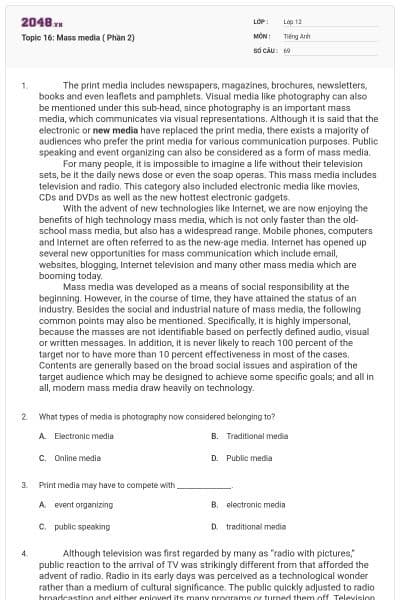
The print media includes newspapers, magazines, brochures, newsletters, books and even leaflets and pamphlets. Visual media like photography can also be mentioned under this sub-head, since photography is an important mass media, which communicates via visual representations. Although it is said that the electronic or new media have replaced the print media, there exists a majority of audiences who prefer the print media for various communication purposes. Public speaking and event organizing can also be considered as a form of mass media.
For many people, it is impossible to imagine a life without their television sets, be it the daily news dose or even the soap operas. This mass media includes television and radio. This category also included electronic media like movies, CDs and DVDs as well as the new hottest electronic gadgets.
With the advent of new technologies like Internet, we are now enjoying the benefits of high technology mass media, which is not only faster than the old-school mass media, but also has a widespread range. Mobile phones, computers and Internet are often referred to as the new-age media. Internet has opened up several new opportunities for mass communication which include email, websites, blogging, Internet television and many other mass media which are booming today.
Mass media was developed as a means of social responsibility at the beginning. However, in the course of time, they have attained the status of an industry. Besides the social and industrial nature of mass media, the following common points may also be mentioned. Specifically, it is highly impersonal, because the masses are not identifiable based on perfectly defined audio, visual or written messages. In addition, it is never likely to reach 100 percent of the target nor to have more than 10 percent effectiveness in most of the cases. Contents are generally based on the broad social issues and aspiration of the target audience which may be designed to achieve some specific goals; and all in all, modern mass media draw heavily on technology.
What types of media is photography now considered belonging to?
Electronic media
Traditional media
Online media
Public media
Đáp án A
Thuật nhiếp ảnh ngày nay được xem là thuộc về loại phương tiện truyền thông nào?A. Truyền thông điện tử
B. Truyền thông truyền thống
C. Truyền thông trực tuyến
D. Truyền thông cộng đồng
=> Theo thông tin đầu đoạn 1, ta có:
“The print media includes newspapers, magazines, brochures, newsletters, books and even leaflets and pamphlets. Visual media like photography can also be mentioned under this sub-head, since photography is an important mass media, which communicates via visual representations. Although it is said that the electronic or new media have replaced the print media, there exists a majority of audiences who prefer the print media for various communication purposes.”
(Các phương tiện truyền thông in ấn bao gồm báo, tạp chí, tài liệu quảng cáo, bản tin, sách và thậm chí tờ rơi và những cuốn sách tuyên truyền. Phương tiện truyền thông trực quan như thuật nhiếp ảnh cũng có thể được đề cập dưới tiêu đề phụ này, vì nhiếp ảnh là một phương tiện truyền thông đại chúng quan trọng,cái mà giao tiếp thông qua các trình bày trực quan. Mặc dù người ta nói rằng phương tiện truyền thông điện tử hoặc phương tiện truyền thông mới đã và đang dần thay thế phương tiện truyền thông in ấn, nhưng vẫn tồn tại phần lớn khán giả thích phương tiện truyền thông in ấn cho các mục đích liên lạc khác nhau.)
=> Qua thông tin đó, ta hiểu rằng từ trước người ta xem truyền thông nhiếp ảnh thuộc về loại truyền thông in ấn, nhưng ngày nay người ta đã thay thế phương tiện truyền thông in ấn thành truyền thông điện tử/truyền thông mới. Hay nói cách khác, truyền thông nhiếp ảnh thuộc về truyền thông điện tử/truyền thông mới.
=> Do đó, A là phương án cần lựa chọn.
Which of the following is mentioned as a favourite TV programme?
Documentary
Game shows
Comedy
The news
Đáp án D
Cái nào dưới đây được xem là một chương trình TV được yêu thích?
A. Tài liệu
B. Các trò chơi truyền hình
C. Hài kịch
D. Tin tức, thời sự
=> Dựa vào thông tin trong đoạn 2:
“For many people, it is impossible to imagine a life without their television sets, be it the daily news dose or even the soap operas. This mass media includes television and radio.”
(Đối với nhiều người, không thể tưởng tượng được một cuộc sống mà không có đài truyền hình, có thể là lượng tin tức hàng ngày hoặc thậm chí là các bộ phim dài ký. Phương tiện truyền thông đại chúng này bao gồm truyền hình và đài phát thanh.)
=> Ở đây tác giả đề cập đến việc con người không thể sống mà không có truyền hình, và nêu ra điển hình có các chương trình là tin tức, thời sự hàng ngày; hay các bộ phim dài ký (một loạt các chương trình truyền hình hoặc đài phát thanh về cuộc sống và các vấn đề trong cuộc sống của một nhóm nhân vật cụ thể) đều thuộc về loại tin tức, thời sự.
=> Vì vậy, kết luận là chương trình được yêu thích nhiều chính là tin tức, thời sự.
What does the phrase “new media” in the first paragraph refer to?
Newly aged mass media
Widespread mass media
High technology mass media
Universal mass media
Đáp án C
Cụm từ “new media” trong đoạn đầu ám chỉ cái gì?
A. Truyền thông đại chúng gần như cũ kỹ
B. Truyền thông đại chúng rộng rãi
C. Truyền thông đại chúng công nghệ cao
D. Truyền thông đại chúng phổ cập
=> Theo ngữ cảnh trong câu, ta có:
“Although it is said that the electronic or new media have replaced the print media, there exists a majority of audiences who prefer the print media for various communication purposes.”
(Mặc dù người ta nói rằng phương tiện truyền thông điện tử hoặc phương tiện truyền thông mới đã và đang dần thay thế phương tiện truyền thông in ấn, nhưng vẫn tồn tại phần lớn khán giả thích phương tiện truyền thông in ấn cho các mục đích liên lạc khác nhau.)
=> Qua đó, có thể thấy “new media” tương đương với “electronic media”, mang nghĩa “truyền thông mới” hay “truyền thông điện tử”. Dễ thấy rằng chúng ám chỉ đến loại truyền thông hiện đại nhất hiện nay, mang tính công nghệ tiến tiến, công nghệ cao.
=> Do đó, ta chọn đáp án C.
Which is NOT mentioned as an example of mass communication?
Emails
Blogs
Websites
Talk shows
Đáp án D
Cái nào KHÔNG được đề cập như một ví dụ của truyền thông đại chúng?
A. Thư email
B. Các blog
C. Các trang website
D. Các chương trình talk show
=> Theo thông tin cuối đoạn 3 như sau:
“Internet has opened up several new opportunities for mass communication which include email, websites, blogging, Internet television and many other mass media which are booming today.”
(Internet đã mở ra một số cơ hội mới cho truyền thông đại chúng bao gồm email, trang web, blog, truyền hình Internet và nhiều phương tiện truyền thông đại chúng khác đang bùng nổ ngày nay.)
=> Như vậy, ta thấy chỉ có đáp án D không được đề cập đến ở đây như một loại phương tiện truyền thông đại chúng.
Print media may have to compete with _______________.
event organizing
electronic media
public speaking
traditional media
Đáp án B
Truyền thông in ấn có thể phải cạnh tranh với _____________.A. việc tổ chức sự kiện
B. truyền thông điện tử
C. việc phát ngôn trước công chúng
D. truyền thông truyền thống
=> Cũng trong thông tin trong đoạn 1 như câu trên, ta có:
“Although it is said that the electronic or new media have replaced the print media, there exists a majority of audiences who prefer the print media for various communication purposes.”
(Mặc dù người ta nói rằng phương tiện truyền thông điện tử hoặc phương tiện truyền thông mới đã và đang dần thay thế phương tiện truyền thông in ấn, nhưng vẫn tồn tại phần lớn khán giả thích phương tiện truyền thông in ấn cho các mục đích liên lạc khác nhau.)
=> Do đó, ta thấy đối thủ cạnh tranh của truyền thông in ấn là truyền thông điện
Although television was first regarded by many as “radio with pictures,” public reaction to the arrival of TV was strikingly different from that afforded the advent of radio. Radio in its early days was perceived as a technological wonder rather than a medium of cultural significance. The public quickly adjusted to radio broadcasting and either enjoyed its many programs or turned them off. Television, however, prompted a tendency to criticize and evaluate rather than a simple on-off response.
One aspect of early television that can never be recaptured is the combined sense of astonishment and glamour that greeted the medium during its infancy. At the midpoint of the 20th century, the public was properly agog about being able to see and hear actual events that were happening across town or hundreds of miles away. Relatively few people had sets in their homes, but popular fascination with TV was so pronounced that crowds would gather on the sidewalks in front of stores that displayed a working television set or two. The same thing happened in the typical tavern, where a set behind the bar virtually guaranteed a full house. Sports events that might attract a crowd of 30,000 or 40,000 suddenly, with the addition of TV cameras, had audiences numbering in the millions. By the end of television’s first decade, it was widely believed to have greater influence on American culture than parents, schools, churches, and government-institutions that had been until then the dominant influences on popular conduct. All were superseded by this one cultural juggernaut.
The 1950s was a time of remarkable achievement in television, but this was not the case for the entire medium. American viewers old enough to remember TV in the ’50s may fondly recall the shows of Sid Caesar, Jackie Gleason, Milton Berle, and Lucille Ball, but such high-quality programs were the exception; most of television during its formative years could be aptly described, as it was by one Broadway playwright, as “amateurs playing at home movies.” The underlying problem was not a shortage of talented writers, producers, and performers; there were plenty, but they were already busily involved on the Broadway stage and in vaudeville, radio, and motion pictures. Consequently, television drew chiefly on a talent pool of individuals who had not achieved success in the more popular media and on the young and inexperienced who were years from reaching their potential. Nevertheless, the new medium ultimately proved so fascinating a technical novelty that in the early stages of its development the quality of its content seemed almost not to matter.
Fortunately, the dearth of talent was short-lived. Although it would take at least another decade before areas such as news and sports coverage approached their potential, more than enough excellence in the categories of comedy and drama emerged in the 1950s to deserve the attention of discriminating viewers. They are the most fondly remembered of the Golden Age genres for both emotional and intellectual reasons. Live TV drama was, in essence, the legitimate theatre’s contribution to the new medium; such shows were regarded as “prestige” events and were afforded respect accordingly. The comedies of the era are remembered for the same reason that comedy itself endures: human suffering and the ever-elusive pursuit of happiness render laughter a necessary palliative, and people therefore have a particular fondness for those who amuse them.
Which of the following best serves as the title for the passage?
Television development in comparison with radio
Sport events on television
High-quality programs enjoyed by American
Television in the United States
Đáp án D
Lựa chọn nào sau đây là tiêu đề tốt nhất cho đoạn văn?
A. Sự phát triển của truyền hình so với phát thanh
B. Sự kiện thể thao trên truyền hình
C. Các chương trình chất lượng cao được người Mỹ ưa thích
D. Truyền hình tại Hoa Kỳ
Căn cứ thông tin toàn bài và đoạn mở đầu:
Although television was first regarded by many as “radio with pictures,” public reaction to the arrival of TV was strikingly different from that afforded the advent of radio. Radio in its early days was perceived as a technological wonder rather than a medium of cultural significance. The public quickly adjusted to radio broadcasting and either enjoyed its many programs or turned them off. Television, however, prompted a tendency to criticize and evaluate rather than a simple on-off response.
Dịch bài đọc
Mặc dù nhiều người coi tivi là "radio có hình ảnh", nhưng phản ứng của công chúng đối với sự ra đời của tivi lại rất khác so với phản ứng khi radio ra đời. Radio trong những ngày đầu được coi là một kỳ quan công nghệ hơn là một phương tiện có ý nghĩa văn hóa. Công chúng nhanh chóng thích nghi với phát thanh và hoặc thích nhiều chương trình của nó hoặc tắt chúng đi. Tuy nhiên, tivi đã thúc đẩy xu hướng chỉ trích và đánh giá thay vì phản ứng đơn giản là bật-tắt.
Một khía cạnh của truyền hình thời kỳ đầu không bao giờ có thể tái hiện lại được là cảm giác kinh ngạc và quyến rũ kết hợp chào đón phương tiện này trong thời kỳ đầu. Vào giữa thế kỷ 20, công chúng thực sự phấn khích khi có thể nhìn thấy và nghe thấy các sự kiện thực tế đang diễn ra trên khắp thị trấn hoặc cách xa hàng trăm dặm. Tương đối ít người có tivi trong nhà, nhưng sự say mê của công chúng đối với tivi lại rõ rệt đến mức đám đông sẽ tụ tập trên vỉa hè trước các cửa hàng trưng bày một hoặc hai chiếc tivi đang hoạt động. Điều tương tự cũng xảy ra ở quán rượu thông thường, nơi một chiếc tivi sau quầy bar hầu như đảm bảo sẽ có một quán đầy khách. Các sự kiện thể thao có thể thu hút đám đông 30.000 hoặc 40.000 người đột nhiên, với sự bổ sung của máy quay truyền hình, đã thu hút hàng triệu khán giả. Vào cuối thập kỷ đầu tiên của truyền hình, người ta tin rằng nó có ảnh hưởng lớn hơn đến văn hóa Mỹ so với cha mẹ, trường học, nhà thờ và các tổ chức chính phủ vốn cho đến lúc đó vẫn là những người có ảnh hưởng chủ đạo đến hành vi của công chúng. Tất cả đều đã bị thay thế bởi một thế lực văn hóa này.
Những năm 1950 là thời kỳ đạt được những thành tựu đáng chú ý trong truyền hình, nhưng điều này không đúng với toàn bộ phương tiện truyền thông. Những người xem Mỹ đủ lớn để nhớ về truyền hình trong những năm 50 có thể nhớ lại những chương trình của Sid Caesar, Jackie Gleason, Milton Berle và Lucille Ball, nhưng những chương trình chất lượng cao như vậy là ngoại lệ; hầu hết các chương trình truyền hình trong những năm hình thành của nó có thể được mô tả một cách chính xác, như một nhà viết kịch Broadway đã mô tả, là "những người nghiệp dư đóng phim tại nhà". Vấn đề cơ bản không phải là thiếu các nhà biên kịch, nhà sản xuất và nghệ sĩ biểu diễn tài năng; có rất nhiều, nhưng họ đã bận rộn tham gia vào sân khấu Broadway và trong tạp kỹ, phát thanh và phim ảnh. Do đó, truyền hình chủ yếu thu hút một nhóm tài năng gồm những cá nhân chưa đạt được thành công trong các phương tiện truyền thông phổ biến hơn và những người trẻ tuổi và thiếu kinh nghiệm, những người còn nhiều năm nữa mới đạt được tiềm năng của mình. Tuy nhiên, phương tiện truyền thông mới này cuối cùng đã chứng minh được sự mới lạ về mặt kỹ thuật hấp dẫn đến mức trong giai đoạn đầu phát triển, chất lượng nội dung của nó dường như không quan trọng.
May mắn thay, sự thiếu hụt tài năng chỉ tồn tại trong thời gian ngắn. Mặc dù phải mất ít nhất một thập kỷ nữa trước khi các lĩnh vực như tin tức và đưa tin thể thao đạt đến tiềm năng của chúng, nhưng đã có quá đủ sự xuất sắc trong các thể loại hài kịch và chính kịch xuất hiện vào những năm 1950 để xứng đáng nhận được sự chú ý của những người xem có hiểu biết. Chúng được nhắc đến nhiều nhất về thể loại Thời kỳ hoàng kim vì cả lý do cảm xúc và trí tuệ. Về bản chất, phim truyền hình trực tiếp là sự đóng góp hợp pháp của nhà hát cho phương tiện truyền thông mới; Những chương trình như vậy được coi là sự kiện "uy tín" và được tôn trọng theo đó. Những vở hài kịch của thời đại đó được nhớ đến vì cùng lý do mà bản thân hài kịch vẫn trường tồn: nỗi đau khổ của con người và việc theo đuổi hạnh phúc luôn khó nắm bắt khiến tiếng cười trở thành liều thuốc xoa dịu cần thiết, và do đó, mọi người đặc biệt yêu thích những ai thích chúng.
The phrase “agog about” in paragraph 2 can be best replaced by _____.
looking forward to
interested in
involved in
keen on
Đáp án A
Cụm từ “agog about” trong đoạn 2 có thể được thay thế bằng _____.
A. mong chờ
B. quan tâm đến
C. tham gia vào
D. thích thú
Kiến thức từ vựng và các cấu trúc cùng nghĩa: to be agog about (mong mỏi) = to look forwad to
At the midpoint of the 20th century, the public was properly agog about being able to see and hear actual events that were happening across town or hundreds of miles away.
(Giữa thế kỷ 20, công chúng mong mỏi việc có thể để xem và nghe các sự kiện thực tế đã được diễn ra trên khắp thị trấn hoặc cách xa hàng trăm dặm.)
According to paragraph 2, why would the public gather on the sidewalks in front of stores?
They had no work
They had sense of astonishment
Because of their fascination with TV
They went to the tavern together
Đáp án C
Theo đoạn 2, tại sao công chúng tụ tập trên vỉa hè trước cửa hàng?
A. Họ không có việc
B. Họ có cảm giác ngạc nhiên
C. Bởi vì niềm đam mê của họ với TV
D. Họ cùng nhau đến quán rượu
Căn cứ thông tin đoạn 2:
Relatively few people had sets in their homes, but popular fascination with TV was so pronounced that crowds would gather on the sidewalks in front of stores that displayed a working television set or two. (Tương đối ít người có tivi trong nhà, nhưng niềm đam mê phổ biến với truyền hình rõ ràng đến mức đám đông sẽ tập trung trên vỉa hè phía trước các cửa hàng có một hoặc hai màn hình tivi đang mở.)
Which of the following does the word “aptly” in paragraph 3 probably mean?
at a slow speed; not quickly
in a way that is suitable or appropriate in the circumstanc
happening in a short time or without delay
the whole of; as much as
Đáp án B
Từ “aptly” trong đoạn 3 có thể có ý nghĩa nào sau đây?
A. ở tốc độ chậm; không nhanh chóng
B. theo cách phù hợp hoặc thích hợp trong hoàn cảnh
C. xảy ra trong một thời gian ngắn hoặc không chậm trễ
D. toàn bộ; nhiều như
Kiến thức từ vựng: aptly (adv) = một cách thích hợp
American viewers old enough to remember TV in the ’50s may fondly recall the shows of Sid Caesar, Jackie Gleason, Milton Berle, and Lucille Ball, but such high-quality programs were the exception; most of television during its formative years could be aptly described, as it was by one Broadway playwright, as “amateurs playing at home movies.”
(Người xem Mỹ đủ lớn tuổi để nhớ các chương trình tivi vào những năm 50 có thể nhớ lại những chương trình của Sid Caesar, Jackie Gleason, Milton Berle, và Lucille Ball, nhưng những chương trình chất lượng cao như vậy chỉ là ngoại lệ; hầu hết các chương trình truyền hình trong những năm mới hình thành có thể được mô tả một cách khéo léo giống như một nhà soạn kịch Broadway đã mô tả là “những người nghiệp dư đang dạo chơi trong phim”.)
According to paragraph 3, why is television described as “amateurs playing at home movies”?
Writers, producers, and performers don’t have enough money to invest on television.
There are no high-quality programs.
Because talented writers, producers, and performers are busy with Broadway stage and in vaudeville, radio, and motion pictures.
There are no talented writers, producers, and performers.
Đáp án C
Theo đoạn 3, tại sao truyền hình được mô tả là “những người nghiệp dư đang dạo chơi trong phim”?
A. Các nhà văn, nhà sản xuất và người biểu diễn không có đủ tiền để đầu tư vào truyền hình.
B. Không có chương trình chất lượng cao.
C. Bởi vì các nhà văn, nhà sản xuất và người biểu diễn tài năng đang bận rộn với sân khấu Broadway, kịch vui, đài phát thanh và phim điện ảnh.
D. Không có nhà văn, nhà sản xuất và người biểu diễn tài năng nào.
Căn cứ thông tin đoạn 3:
The underlying problem was not a shortage of talented writers, producers, and performers; there were plenty, but they were already busily involved on the Broadway stage and in vaudeville, radio, and motion pictures.
(Vấn đề cơ bản không phải là thiếu nhà văn, nhà sản xuất và người biểu diễn tài năng; có rất nhiều nhưng họ lại bận tham gia vào sân khấu Broadway, kịch vui, đài phát thanh và phim điện ảnh.)
The word “dearth” in the last paragraph is closest in meaning to ______.
lack
plenty
absence
empty
Đáp án A
Từ “dearth” trong đoạn cuối cùng gần nghĩa nhất với từ ______.
A. thiếu
B. nhiều
C. vắng mặt
D. trống rỗng
Kiến thức từ vựng, từ đồng nghĩa: dearth (thiếu thốn) = lack
Fortunately, the dearth of talent was short-lived. Although it would take at least another decade before areas such as news and sports coverage approached their potential, more than enough excellence in the categories of comedy and drama emerged in the 1950s to deserve the attention of discriminating viewers. (May mắn thay, sự thiếu thốn tài năng chỉ diễn ra trong một thời gian ngắn. Mặc dù phải mất ít nhất một thập kỷ nữa trước khi những chương trình như tin tức và thể thao đạt được kỳ vọng, sự xuất sắc của các chương trình kịch và hài kịch xuất hiện những năm 1950 xứng đáng có được sự quan tâm của những khán giả sành sỏi.)
Which of the following is TRUE according to the paragraph?
Television in its early days was perceived as a technological wonder rather than a medium of cultural significance.
Few people had TV set at home but they all enjoyed watching programs especially sports on TV.
Television could draw chiefly on a talent pool of individuals who had achieved success in the more popular media.
The categories of comedy and drama emerged in the 1950s were not good enough to attract viewers.
Đáp án B
Thông tin nào sau đây là ĐÚNG theo đoạn văn?
A. Truyền hình trong những ngày đầu của nó được coi là một kỳ quan công nghệ hơn là một phương tiện có ý nghĩa văn hóa.
B. Rất ít người có TV ở nhà nhưng tất cả họ đều thích xem các chương trình đặc biệt là thể thao trên TV.
C. Truyền hình có thể thu hút chủ yếu một nhóm tài năng của các cá nhân đã đạt được thành công trong các phương tiện truyền thông phổ biến hơn.
D. Các thể loại hài kịch và phim truyền hình nổi lên trong những năm 1950 không đủ tốt để thu hút người xem.
Căn cứ thông tin các đoạn:
Đoạn 1: Radio in its early days was perceived as a technological wonder rather than a medium of cultural significance.
(Phát thanh trong những ngày đầu của nó đã được coi là một kỳ quan công nghệ hơn là một phương tiện có ý nghĩa văn hóa.)
Đoạn 2: Relatively few people had sets in their homes, but popular fascination with TV was so pronounced that crowds would gather on the sidewalks in front of stores that displayed a working television set or two.
(Tương đối ít người có tivi trong nhà, nhưng niềm đam mê phổ biến với truyền hình rõ ràng đến mức đám đông sẽ tập trung trên vỉa hè phía trước các cửa hàng có một hoặc hai màn hình tivi đang mở.)
Đoạn 3: Consequently, television drew chiefly on a talent pool of individuals who had not achieved success in the more popular media and on the young and inexperienced who were years from reaching their potential.
(Do đó, truyền hình chỉ chủ yếu thu hút vào một nhóm tài năng của những cá nhân đã không đạt được thành công trong các phương tiện truyền thông phổ biến hơn và nhưng người trẻ chưa có đủ kinh nghiệm để đạt tới thành công tương xứng với năng lực của họ.)
Đoạn 4: Although it would take at least another decade before areas such as news and sports coverage approached their potential, more than enough excellence in the categories of comedy and drama emerged in the 1950s to deserve the attention of discriminating viewers.
(Mặc dù phải mất ít nhất một thập kỷ nữa trước khi những chương trình như tin tức và thể thao đạt được kỳ vọng, sự xuất sắc của các chương trình kịch và hài kịch xuất hiện những năm 1950 xứng đáng có được sự quan tâm của những khán giả sành sỏi.)
The passage can probably extracted from which of the following?
History book
Textbook
Daily newspaper
Encyclopedia
Đáp án D
Đoạn văn có khả năng được trích xuất từ nguồn nào sau đây?
A. Sách lịch sử
B. Sách giáo khoa
C. Báo hàng ngày
D. Bách khoa toàn thư
Căn cứ thông tin và các viết toàn bài, suy đoán để chọn đáp án:
The comedies of the era are remembered for the same reason that comedy itself endures: human suffering and the ever-elusive pursuit of happiness render laughter a necessary palliative, and people therefore have a particular fondness for those who amuse them.
(Những vở hài kịch thời đó được nhớ đến vì những lý do tương tự, rằng bản thân hài kịch cũng phải trải qua: sự chịu đựng của con người và việc mưu cầu hạnh phúc khiến tiếng cười trở thành liều thuốc xoa dịu cần thiết, và từ đó con người ta nảy sinh niềm yêu quý đặc biệt dành cho những người khiến họ thích thú.)
While trust in media as a whole may be at an all-time low, a new study by the EBU has shown the public’s trust in traditional media (broadcast and the written press) is actually on the rise. However, people’s trust in new media continues to fall: 61% of European countries distrust the internet while 97% have no faith in social networks.
The EBU’s new report – Trust in Media 2018 – shows the figures illustrating the differences between people’s trust in traditional and new media. Broadcast media remain the most trusted forms of media with 59% of people tending to trust radio (equivalent to 2017) and 51% trusting TV in the EU (an increase of 1 percentage point on 2017). Trust in the written press has also slowly improved over the last 5 years and it is now trusted by 47% of EU citizens. At the same time, people’s trust in the internet and social media has been eroded by fake news, misinformation and disinformation. Only 34% of EU citizens trust the internet and a mere 20% now trust social networks (down from 36% and 21% respectively in 2017).
Trust in Media 2018 is based on data published in the 88th Eurobarometer survey and gives an idea of European citizens’ perception of the trustworthiness of different types of media. The survey consists of approximately 1000 face-to-face interviews in the 33 countries covered by the study. The report shows how European citizens’ trust in broadcast media is closely connected with a free and independent press. The higher the level of trust in a country’s radio and TV, the higher press freedom in that country tends to be. There are also strong regional differences with the Nordics and Albania tending to trust traditional media the most while Eastern Europeans tend to trust social networks and the internet more.
The EBU’s Head of Strategy and the Media Intelligence Service Roberto Suárez Candel said: “The results of our research show that good quality, impartial media is highly valued by the public. “Public service media play an important role in that and, together, our Members make an invaluable contribution to society. The role of our public service Members in upholding democratic values and supporting media freedom is clearly demonstrated by the results of our research.”
Which best serves as the title for the passage?
Trust in traditional media increases over the globe.
Restoring public trust in the media credibility.
New survey explores media trust crisis in Europe.
Unreliable narration and transparency in digital journalism.
Đáp án A
Câu nào phù hợp nhất để làm đầu đề của đoạn văn?
A. Niềm tin vào phương tiện truyền thông truyền thống tăng lên ở khắp châu Âu
B. Khôi phục niềm tin của công chúng vào sự đáng tin cậy của truyền thông
C. Cuộc điều tra mới khám phá về khủng hoảng niềm tin truyền thông
D. Sự tường thuật và minh bạch đáng ngờ trong báo chí dạng số
Căn cứ vào thông tin đoạn 1
While trust in media as a whole may be at an all-time low, a new study by the EBU has shown the public’s trust in traditional media is actually on the rise.
(Trong khi niềm tin vào truyền thông nhìn tổng thể vào tất cả mọi khoảng thời gian là thấp, một nghiên cứu mới bởi EBU đã chỉ ra rằng niềm tin của công chúng vào phương tiện truyền thông truyền thống thực sự đang trên đà tăng lên).
The word “press” in paragraph 1 is closest in meaning to _______.
column
newspaper
report
wedge
Đáp án B
Từ “press” trong đoạn 1 gần nghĩa nhất với từ nào…
A. cột, mục (báo)
B. tờ báo, báo
C. báo cáo
D. nêm
Từ đồng nghĩa: press (báo) = newspaper
According to paragraph 2, what is the conclusion drawn from the statistics provided?
Traditional media encompasses all the means of communication that existed before new media technology.
New media can certainly displace existing media but it can also have a complementary effect.
The gap between public faith in the old and modern media displays widening pattern
The Internet adds a new democratic dimension to communication, making it superior to the traditional media.
Đáp án C
Theo đoạn 2, kết luận gì có thể rút ra từ số liệu được cung cấp?
A. Phương tiện truyền thông truyền thống chứa đựng tất cả các hình thức giao tiếp đã tồn tại trước khi có công nghệ truyền thông mới
B. Phương tiện truyền thông mới có thể chắc chắn thay thế phương tiện truyền thông đang tồn tại nhưng nó cũng có thể mang đến hiệu quả bổ sung
C. Khoảng cách giữa niềm tin của công chúng vào truyền thông truyền thống và hiện đại thể hiện ở mô hình mở rộng
D. Internet đã thêm một quy mô dân chủ mới đến truyền thông, làm cho nó tốt hơn truyền thông truyền thống
Broadcast media remain the most trusted forms of media with 59% of people tending to trust radio (equivalent to 2017) and 51% trusting TV in the EU (an increase of 1 percentage point on 2017)…Only 34% of EU citizens trust the Internet and a mere 20% now trust social networks (down from 36% and 21% respectively in 2017).
(Chương trình phát thanh và truyền hình vẫn là hình thức truyền thông được tin tưởng nhất với 59% người có xu hướng tin tưởng đài (tương đương với 2017) và 51% tin vào TV ở châu Âu (tăng 1% so với năm 2017) … chỉ 34% người châu Âu tin vào Internet và chỉ 20% tin vào mạng lưới xã hội (giảm xuống lần lượt từ 36% và 21% vào năm 2017) )
The word “it” in paragraph 2 refers to _____.
misinformation
social media
written press
press freedom
Đáp án C
Từ “it” trong đoạn 2 ám chỉ…
A. sự báo tin tức sai
B. truyền thông xã hội
C. báo viết
D. tự do báo chí
Trust in the written press has also slowly improved over the last 5 years and it is now trusted by 47% of EU citizens.
(Niềm tin vào báo viết đã tăng từ từ trong 5 năm qua và bây giờ nó được tin tưởng bởi 47% dân cư Châu Âu).
According to paragraph 3, all the statements can be supported by the research, EXCEPT ____.
The Nordics and Albania repliers hold opposite views toward the supremacy of the two media generations.
There is a positive correlation between broadcast media credibility and press liberty.
The poll were conducted on 1000 respondents with 33 different nationalities.
Media associations or image exerts the higher influence on customer-based brand value.
Đáp án A
Theo đoạn 3, tất cả những tuyên bố dưới đây có thể được ủng hộ bởi nghiên cứu, ngoại trừ ______.
A. Những người Bắc Âu và người Albania có quan điểm trái ngược trước uy thế của hai thế hệ truyền thông
B. Có một sự liên quan tích cực giữa sự tin tưởng truyền thông phát thanh và tự do báo chí
C. Cuộc điều tra được thực hiện với 1000 người đến từ 33 quốc gia khác nhau
D. Sự kết hợp truyền thông hoặc sự ấn tượng đối với cộng đồng (hình ảnh theo nghĩa bóng) đưa đến tầm ảnh hưởng cao hơn đối với giá trị nhãn hàng dựa trên khách hàng.
=> Căn cứ vào câu thứ 2 đoạn 3:
The survey consists of approximately 1000 face-to-face interviews in the 33 countries covered by the study.
(Một nghiên cứu bao gồm xấp xỉ 1000 người phỏng vấn trực tiếp đến từ 33 quốc gia)
+ Câu thứ 3 đoạn 3
The report shows how European citizens’ trust in broadcast media is closely connected with a free and independent press.
(Báo cáo cho thấy người dân châu Âu tin tưởng như thế nào vào truyền thông phát thanh có liên quan gần gũi với tự do và độc lập của báo chí)
+ Đoạn cuối:
"The EBU’s Head of Strategy and the Media Intelligence Service Roberto Suárez Candel said: “The results of our research show that good quality, impartial media is highly valued by the public. “Public service media play an important role in that and, together, our Members make an invaluable contribution to society. The role of our public service Members in upholding democratic values and supporting media freedom is clearly demonstrated by the results of our research.”
(Trưởng phòng Chiến lược và Dịch vụ Tình báo Truyền thông của EBU, ông Roberto Suárez Candel cho biết: “Những kết quả nghiên cứu của chúng tôi cho thấy rằng phương tiện truyền thông chất lượng, công bằng được công chúng đánh giá cao. Dịch vụ Truyền thông công cộng đóng một vai trò quan trọng, các thành viên cùng nhau tạo nên những đóng góp vô giá cho xã hội. Vai trò của các thành viên dịch vụ công cộng của chúng tôi trong việc duy trì các giá trị dân chủ và hỗ trợ tự do truyền thông được thể hiện rõ ràng qua kết quả của nghiên cứu.”)
=> Do đó, đáp án A sai thông tin so với trong bài. Theo câu cuối đoạn 3:
There are also strong regional differences with the Nordics and Albania tending to trust traditional media the most while Eastern Europeans tend to trust social networks and the Internet more.
Which of the following statements is TRUE, according to the passage?
General trend of public opinion towards the mass media is obvious distrust.
The viewers of mass media deem excellence and objectivity meritorious features.
Media brand equity is positively associated with image and media loyalty.
Public belief in digital media was betrayed by manipulative manner of news corporates.
Đáp án B
Theo đoạn văn, câu nào sau đây đúng?
A. Xu hướng chung của ý kiến công chúng trước truyền thông đại chúng là hoài nghi rõ ràng
B. người quan sát của truyền thông đại chúng cho rằng sự vượt trội và tính khách quan là những đặc điểm đáng khen ngợi nhất
C. Tính công bằng của thương hiệu truyền thông được liên kết một cách tích cực với hình ảnh và lòng trung thành của truyền thông
D. Niềm tin của công chúng vào phương tiện kỹ thuật số đã bị lừa gạt bởi cách cư xử quỷ quyệt của những doanh nghiệp tin tức
Căn cứ vào thông tin đoạn cuối
The results of our research show that good quality, impartial media is highly valued by the public.
(Kết quả của nghiên cứu cho thấy rằng chất lượng tốt, truyền thông công bằng không thiện vị được đánh giá cao bởi công chúng).
The word “upholding” in paragraph 4 is closest in meaning to _______.
verifying
abandoning
nurturing
endorsing
Đáp án D
Từ “upholding” trong đoạn 4 gần nghĩa nhất với __________.
A. xác minh, kiểm tra xem cái gì đó có đúng hay không
B. bỏ rơi, bỏ mặc
C. nuôi dưỡng, ủng hộ
D. hỗ trợ, ủng hộ ai/cái gì và giúp duy trì nó
=> Dựa vào ngữ cảnh trong câu:
"The role of our public service Members in upholding democratic values and supporting media freedom is clearly demonstrated by the results of our research."
(Vai trò của các thành viên dịch vụ công cộng của chúng tôi trong việc duy trì các giá trị dân chủ và hỗ trợ tự do truyền thông được thể hiện rõ ràng qua kết quả của nghiên cứu.)
=> Uphold (v): duy trì, ủng hộ để đảm bảo cái gì tiếp tục tồn tại ~ endorse
Which of the following can be inferred from the passage?
There are contrasting tendencies concerning public attitude towards traditional and digital media platforms.
Media credibility are very crucial in today’s climate of increasing political polarization.
Politicians and political activists aggressively attacked the institutional media’s trustworthiness.
The credential of more professionalized forms of journalism is under steady assault.
Đáp án A
Điều nào dưới đây có thể suy ra từ đoạn văn?
A. Có những xu hướng tương phản liên quan đến thái độ của công chúng trước phương tiện truyền thông truyền thống và kỹ thuật số
B. Sự tin tưởng truyền thông rất cần thiết trong xu thế tăng sự phân cực chính trị ngày nay
C. Chính trị gia và những người hoạt động chính trị tấn công một cách hung hăng tính chất đáng tin cậy của cơ quan truyền thông
D. Sự đáng tin cậy của các hình thức chuyên nghiệp hoá báo chí đang chịu công kích đều đặn
=> Căn cứ vào thông tin đoạn 2:
Đoạn 2 đưa ra các số liệu chỉ số lượng người tin tưởng truyền thông truyền thống và truyền thống kỹ thuật số.
Simmons Research conducted a survey of American adults in order to learn how much Americans at large trust the media, and we are pleased to present the results in this first Simmons News Media Trust Index. We asked respondents to let us know how trustworthy or untrustworthy they found 38 of the largest and most well-known news sources commonly available in the US. News sources included represented a wide variety of mediums, including print, online, radio, and television with many of them operating across platforms.
The average percentage of respondents who rated news sources as trustworthy or very trustworthy was just 40.1% - not a ringing endorsement for journalism in general. Topping the list across all news sources, and the only newspaper in the top five, was the Wall Street Journal with 57.7% of Americans trusting them.
The major television network news organizations also fared quite well in our survey, taking the second (ABC 55.9%), third (CBS 55.4%), and sixth (NBC 54.1%) most trusted positions. Among cable news, the most trusted network in the US was ironically not American. BBC News was trusted by 55.2% of Americans and was the fourth most trusted news source. CNN, which touts itself as the “most trusted name in news,” trailed the list at number 14 with the trust of 46.1% of Americans. Forbes was the most trusted magazine and rounded out the top five, trusted by 54.2% of Americans. The New York Times and the Washington Post were both among the most trusted news organizations in our survey. The New York Times came in at the seventh position trusted by 53.8% of Americans, and the Washington Post in eighth trusted by 53.6%. USA Today (51.1%) and the Washington Times (50.0%) were the final two sources trusted by at least a majority of Americans.
The least trusted news sources were all Internet-first and hyper-partisan in nature representing brands that have been consistently rated as misleading and inaccurate by fact-checkers. The six organizations trusted least were split evenly between far-left and far-right news sources, and on average were trusted by only about one in four Americans. Daily Caller was the bottom of our list, with just 22.5% trusting them. They were followed by another extremely conservative platform, InfoWars, at 24.3% which was recently banned or had content deleted from Facebook, YouTube, iTunes, and Spotify for violating terms of service around hate speech, harassment, and bullying.Which best serves as the title for the passage?
Social media: the good, the bad, and the ugly.
Deciding what news to trust on social media.
Assessing online media content trustworthiness.
Consumers weigh-in on media trustworthiness.
Đáp án D
Câu nào thích hợp nhất làm tiêu đề cho đoạn văn?
A. Phương tiện truyền thông xã hội: mặt tốt, mặt xấu
B. Quyết định loại tin tức nào để tin tưởng trên phương tiện truyền thông xã hội
C. Đánh giá độ tin cậy của nội dung truyền thông trực tuyến
D. Người tiêu dùng tham gia vào việc tranh luận về độ tin cậy của truyền thông
Căn cứ vào thông tin đoạn đầu:
Simmons Research conducted a survey of American adults in order to learn how much Americans at large trust the media, and we are pleased to present the results in this first Simmons News Media Trust Index. (Nghiên cứu Simmons đã thực hiện một cuộc khảo sát về người Mỹ trưởng thành để tìm hiểu xem có bao nhiêu người Mỹ tin tưởng nhiều vào truyền thông và chúng tôi xin được trình bày kết quả trong chỉ số tin cậy tin tức truyền thông Simmons đầu tiên này)
=> Như vậy, đoạn văn đang nói về độ tin cậy vào truyền thông của người tiêu dùng.
The word “they” in paragraph 1 refers to _____.
results
Americans
sources
respondents
Đáp án D
Từ “they” trong đoạn 1 đề cập đến .
A. kết quả
B. Người Mỹ
C. nguồn
D. người trả lời
Từ “they” ở đây dùng để thay thế cho danh từ người trả lời được nhắc tới trước đó.
We asked respondents to let us know how trustworthy or untrustworthy they found 38 of the largest and most well-known news sources commonly available in the US.
(Chúng tôi đã yêu cầu người trả lời cho chúng tôi biết sự đáng tin hoặc không đáng tin mà họ cảm thấy ở 38 trong số các nguồn tin tức lớn nhất và nổi tiếng nhất có sẵn ở Mỹ là như thế nào.)
The word “mediums” in paragraph 1 is closest in meaning to _______.
channels
instruments
forums
techniques
Đáp án A
Từ “mediums” trong đoạn 1 có nghĩa gần nhất với .
A. kênh
B. dụng cụ
C. diễn đàn
D. kỹ thuật
Từ đồng nghĩa medium (phương tiện) = channel
News sources included represented a wide variety of mediums, including print, online, radio, and television with many of them operating across platforms.
(Các nguồn tin tức bao gồm đại diện cho nhiều phương tiện khác nhau, bao gồm in ấn, trực tuyến, radio và truyền hình với nhiều người trong số chúng hoạt động trên các nền tảng.)
The word “ringing” in paragraph 2 is closest in meaning to _______.
deep
energetic
thrilling
proud
Đáp án D
Từ “ringing” trong đoạn 2 có nghĩa gần nhất với .
A. sâu
B. tràn đầy năng lượng
C. kịch tính
D. tự hào
Từ đồng nghĩa ringing (đáng tự hào) = proud
The average percentage of respondents who rated news sources as trustworthy or very trustworthy was just 40.1% - not a ringing endorsement for journalism in general.
(Tỷ lệ trung bình những người được hỏi đánh giá các nguồn tin là đáng tin cậy hoặc rất đáng tin cậy chỉ là 40,1% - không phải là một sự chứng thực đáng tự hào cho báo chí nói chung.)
According to paragraph 3, which statement is correct about the sources order in terms of reliability?
NBC channel claimed the sixth position in the list of all cable news sources.
The New York Times arrived at the seventh place at 53.8% as a trustworthy source.
The most esteemed and trusted source position unexpectedly belonged to CNN.
Wall Street Journal boasted the statistics of 55.4%, tying with the CBS channel.
Đáp án B
Theo đoạn 3, phát biểu nào là đúng về thứ tự các nguồn về mặt độ tin cậy?
A. Kênh NBC khẳng định vị trí thứ sáu trong danh sách tất cả các nguồn tin tức
B. Thời báo New York đứng vị trí thứ bảy với 53,8% là một nguồn đáng tin cậy
C. Vị trí nguồn tin đáng tin cậy nhất bất ngờ thuộc về CNN
D. Tạp chí Wall Street tự hào với số liệu thống kê 55,4%, gắn với kênh CBS
Căn cứ vào thông tin đoạn ba:
The New York Times came in at the seventh position trusted by 53.8% of Americans,
(Thời báo New York đứng ở vị trí thứ bảy, được tin tưởng bởi 53,8% người Mỹ,)
According to paragraph 4, what made the worst rankers evaluated as “misleading and inaccurate”?
Their characteristic of being diffused, disorganized and ambiguous in meaning.
Their characteristic of staying balanced in the matter of emphasis and complements.
Their characteristic of being extremely biased in favor of a political party.
Their characteristic of seeing the events as a prejudiced eye might see.
Đáp án D
Theo đoạn 4, điều khiến những người xếp hạng thấp nhất bị đánh giá là “sai lệch và không chính xác”?
A. Đặc điểm của chúng là được khuếch tán, vô tổ chức và mơ hồ về ý nghĩa
B. Đặc điểm của họ là giữ cân bằng trong vấn đề nhấn mạnh và bổ sung
C. Đặc điểm của họ là cực kỳ thiên vị ủng hộ một đảng chính trị
D. Đặc điểm của họ là xem xét các sự kiện bằng một con mắt định kiến.
Căn cứ vào thông tin đoạn bốn:
The six organizations trusted least were split evenly between far-left and far-right news sources, and on average were trusted by only about one in four Americans. Daily Caller was the bottom of our list, with just 22.5% trusting them. They were followed by another extremely conservative platform,
(Sáu tổ chức đáng tin cậy nhất được phân chia đồng đều giữa các nguồn tin tức cực tả và cực hữu, và trên trung bình chỉ được tin tưởng bởi khoảng một trong bốn người Mỹ. Daily Caller đứng cuối danh sách của chúng tôi, chỉ với 22,5% tin tưởng. Họ đã được theo sau bởi một nền tảng cực kỳ bảo thủ,)
Which of the following statements is TRUE, according to the passage?
InfoWars triumphed over several prestigious channels as the most trusted source.
The study by Simmons Research was carried out in America about 38 news sources.
The research provides information on the credibility of news media in three countries.
The ratings of trust or accuracy changed people’s expectations about a news article.
Đáp án B
Phát biểu nào sau đây là đúng, theo đoạn văn?
A. InfoWars đã chiến thắng một số kênh uy tín là nguồn đáng tin cậy nhất
B. Nghiên cứu của Simmons được thực hiện ở Mỹ khoảng 38 nguồn tin tức
C. Nghiên cứu cung cấp thông tin về độ tin cậy của phương tiện truyền thông tại ba quốc gia
D. Xếp hạng của niềm tin hoặc độ chính xác đã thay đổi kỳ vọng của mọi người về một bài báo
Căn cứ vào thông tin đoạn một: We asked respondents to let us know how trustworthy or untrustworthy they found 38 of the largest and most well-known news sources commonly available in the US.
(Chúng tôi đã yêu cầu người trả lời cho chúng tôi biết sự đáng tin hoặc không đáng tin mà họ cảm thấy ở 38 trong số các nguồn tin tức lớn nhất và nổi tiếng nhất có sẵn ở Mỹ là như thế nào.)
The author implies that _________.
News media is undoubtedly in crisis overall.
The social media is doing better than traditional media.
The news media has experienced a very public honour.
Many found none of news sources to be trustworthy.
Đáp án A
Tác giả ngụ ý rằng _______.
A. Tin tức truyền thông chắc chắn gặp cuộc khủng hoảng nói chung
B. Các phương tiện truyền thông xã hội đang làm tốt hơn phương tiện truyền thống
C. Các phương tiện truyền thông đã trải qua một vinh dự rất công khai
D. Nhiều người không tìm thấy nguồn tin nào đáng tin cậy
Căn cứ vào thông tin đoạn hai:
The average percentage of respondents who rated news sources as trustworthy or very trustworthy was just 40.1% - not a ringing endorsement for journalism in general. Topping the list across all news sources, and the only newspaper in the top five, was the Wall Street Journal with 57.7% of Americans trusting them.
=> Ta thấy tỷ lệ sự tin tưởng của người Mỹ với báo chí là khá thấp nên ta có thể suy ra báo chí đang gặp khủng hoảng
More than a decade ago the UK investigative journalist Nick Davies published Flat Earth News, an exposé of how the mass media had abdicated its responsibility to the truth. Newsroom pressure to publish more stories, faster than their competitors had, Davies argued, led to journalists becoming mere “churnalists”. Shocking as Davies’ revelations seemed in 2008, they seem pretty tame by today’s standards, writes Ben Lorica, Chief Data Scientist at O’Reilly.
We now live in a post-truth world of Fake News and “alternative facts”; where activists don’t just seek to manipulate the news agenda with PR but now use advanced technology to fake images and footage. A particularly troubling aspect of these ‘”deepfake” videos is their use of artificial intelligence to fabricate people saying or doing things with almost undetectable accuracy. The result is that publishers risk running completely erroneous stories – as inaccurate as stating that the world is flat – with little or any ability to check their source material and confirm whether it is genuine. The rise of unchecked fakery has serious implications for our liberal democracy and our ability to understand what’s truly going on in the world.
The technology to manipulate imagery has come a long way since Stalin had people airbrushed out of history. Creating convincing yet fake digital content no longer requires advanced skills or a well-resourced (mis)information bureau. Anyone with a degree of technical proficiency can create content that will fool even the experts. Take the faked footage of Nancy Pelosi earlier this year, which was doctored to make her look incoherent and was viewed two and a half million times before Facebook took it down. This story shows how social media is giving new life to the old aphorism that “a lie can go halfway around the world before the truth has a chance to put its boots on”.
The propagation of lies and misinformation is immeasurably enhanced by platforms like Twitter and Facebook that enable virality. What’s more, the incentives for creating fake content now favour malicious actors, with clear economic and political advantages for disseminating false footage. Put simply, the more shocking or extreme the content, the more people will share it and the longer they will stay on the platform. Meanwhile, counterfeiters can manipulate the very tools being developed to detect and mitigate deepfake content, just as the security industry inadvertently supplies software that can be misused for cybercrime.
What does the passage mainly discuss?
The revolution of mass media.
The good and bad sides of media.
Faking the news with technology.
Combating the counterfeiters.
Đáp án C
Đoạn văn chủ yếu thảo luận cái gì?
A. Cuộc cách mạng của truyền thông đại chúng.
B. Mặt tốt và mặt xấu của truyền thông.
C. Làm giả tin tức với công nghệ.
D. Kết hợp hàng giả.
- Xuyên suốt đoạn văn đề cập đến vấn đề công nghệ có thể bị thao túng để làm giả các dữ liệu bởi những kẻ xấu.
According to paragraph 1, why did Davis label the current news workers as “churnalists?
The profit is prioritised over the ethical conduct of an information medium.
The news agencies force their reporters to overexaggerating the information.
Journalists are rushing out articles too fast to check on the truth of their reports.
The informants for well-known news channels have become unreliable.
Đáp án C
Theo đoạn 1, tại sao Davis lại gán cho những người làm công việc thời sự là những người theo chủ nghĩa thời vụ?
A. Lợi nhuận được ưu tiên hơn các hành vi đạo đức của một phương tiện thông tin.
B. Các cơ quan báo chí buộc các phóng viên của họ phóng đại thông tin.
C. Các nhà báo đang gấp rút đưa ra các bài báo quá nhanh để kiểm tra sự thật của các báo cáo của họ.
D. Người cung cấp thông tin cho các kênh tin tức nổi tiếng đã trở nên không đáng tin cậy.
- Trong đoạn đầu đề cập đến ý: “Newsroom pressure to publish more stories, faster than their competitors had, Davies argued, led to journalists becoming mere “churnalists”.”
According to paragraph 2, what is the most discernible feature of deepfake video?
It has raised an array of challenges for the Internet policymakers.
It is extremely powerful when used to undermine a person’s reputation.
It is a subcategory of artificial information study.
It is the falsification of imagery information with the aid of technology.
Đáp án D
Theo đoạn 2, tính năng rõ ràng nhất của video deepfake là gì?
A. Nó đã đưa ra một loạt các thách thức cho các nhà hoạch định chính sách Internet.
B. Nó cực kỳ mạnh khi được sử dụng để làm suy yếu danh tiếng của một người.
C. Đây là một tiểu thể loại của nghiên cứu thông tin nhân tạo.
D. Đó là sự giả mạo thông tin hình ảnh với sự trợ giúp của công nghệ.
- Trong đoạn hai đề cập đến ý: “A particularly troubling aspect of these ‘”deepfake” videos is their use of artificial intelligence to fabricate people saying or doing things with almost undetectable accuracy.”
(Một khía cạnh đặc biệt đáng lo ngại của các video deepfake này là việc họ sử dụng trí thông minh nhân tạo để chế tạo mọi người nói hoặc làm mọi việc với độ chính xác gần như không thể phát hiện được.)
The word “it” in paragraph 3 refers to _____.
degree
bureau
content
footage
Đáp án D
Từ “it” trong đoạn 3 đề cập đến______________ .
A. độ, trình độ, địa vị, bằng cấp.
B. cục, nha, vụ, bàn giấy.
C. nội dung, toại nguyện, bằng lòng.
D. cảnh, chiều dài tính bằng phút (của cuộn phim).
Căn cứ vào nghĩa của câu:
Take the faked footage of Nancy Pelosi earlier this year, which was doctored to make her look incoherent and was viewed two and a half million times before Facebook took it down.
(Lấy đoạn phim giả mạo của Nancy Pelosi vào đầu năm nay, được ghi lại để khiến cô ấy trông rời rạc và được xem hai triệu rưỡi lượt xem trước khi Facebook gỡ xuống.)
Which of the following statements is TRUE, according to the passage?
Deepfake technology has obscured and distorted our vision of the world.
That the earth is fact is a legitimate statement proven by the media.
Stalin was the founding father of the information manipulating industry.
Ben Lorica whose video was forcefully taken down was a victim of misinformation
Đáp án A
Phát biểu nào sau đây là ĐÚNG, theo đoạn văn?
A. Công nghệ Deepfake đã che khuất và bóp méo tầm nhìn của chúng ta về thế giới.
B. Rằng trái đất là một tuyên bố hợp pháp được chứng minh bởi các phương tiện truyền thông.
C. Stalin là cha đẻ của ngành công nghiệp thao túng thông tin.
D. Ben Lorica có video bị gỡ xuống một cách mạnh mẽ là nạn nhân của thông tin sai lệch.
- Xuyên suốt đoạn trích nói về công nghệ làm giả thông tin, đặc biệt deepfake chính là một trong những công cụ hỗ trợ việc làm giả thông tin.
The word “disseminating” in paragraph 4 is closest in meaning to _______.
spreading
implementing
communicating
passing
Đáp án A
Từ “disseminating” trong đoạn 4 có nghĩa gần nhất với ______________.A. lan truyền, phổ biến.
B. thực hiện.
C. giao tiếp.
D. đi qua.
- disseminating: phổ biến, gieo rắc = spreading
The word “inadvertently” in paragraph 4 is closest in meaning to _______.
mistakenly
unwittingly
deliberately
innocently
Đáp án B
Từ “inadvertently” trong đoạn 4 có nghĩa gần nhất với _______.
A. nhầm lẫn.
B. vô tình.
C. cố tình.
D. vô tội.
Which of the following can be inferred from the passage?
Technology such as artificial intelligence is crucial in the fight against deepfakes.
Technology risks the emergence of a new industry that focuses on obfuscation and lies
The viewers who stay vigilant can identify footage that has been manipulated.
Improved regulation of media platforms will be key to the battle against deepfakes.
Đáp án B
Điều nào sau đây có thể được suy ra từ đoạn văn?
A. Công nghệ như trí tuệ nhân tạo là rất quan trọng trong cuộc chiến chống lại các hố sâu.
B. Công nghệ có nguy cơ là sự xuất hiện của một ngành công nghiệp mới tập trung vào sự xáo trộn và dối trá.
C. Những người xem luôn cảnh giác có thể xác định các cảnh quay đã bị thao túng.
D. Cải thiện quy định của các nền tảng truyền thông sẽ là chìa khóa cho cuộc chiến chống lại các hố sâu.
=> Căn cứ vào thông tin đoạn cuối:
"The propagation of lies and misinformation is immeasurably enhanced by platforms like Twitter and Facebook that enable virality. What’s more, the incentives for creating fake content now favour malicious actors, with clear economic and political advantages for disseminating false footage. Put simply, the more shocking or extreme the content, the more people will share it and the longer they will stay on the platform. Meanwhile, counterfeiters can manipulate the very tools being developed to detect and mitigate deepfake content, just as the security industry inadvertently supplies software that can be misused for cybercrime."
(Việc truyền bá những lời nói dối và thông tin sai lệch được hỗ trợ đáng kể bởi các nền tảng có tính lan truyền thông tin Twitter và Facebook. Hơn thế nữa, các diễn viên có ý đồ xấu đã trục lợi trong kinh tế và chính trị thông qua việc lan truyền cảnh quay giả nhờ sự sự thúc đẩy của việc tạo nội dung sai sự thật. Nói một cách đơn giản, nội dung càng gây sốc hoặc cực đoan thì càng nhiều người chia sẻ và nội dung đó tồn tại trên nền tảng lâu hơn. Trong khi đó, các công cụ đang được phát triển để phát hiện và giảm thiểu nội dung giả mạo có thể bị chính những người chuyên làm đồ giả thao túng, giống như ngành công nghiệp bảo mật vô tình cung cấp phần mềm có thể bị lạm dụng cho tội phạm mạng.)
There is a new type of advertisement becoming increasingly common in newspaper classified columns. It is sometimes placed among “situations vacant”, although it does not offer anyone a job, and sometimes it appears “situations wanted”, although it is not placed by someone looking for a job, either. What it does is to offer help in applying for a job.
“Contact us before writing your application”, or "Make use of our long experience in preparing your curriculum vitae or job history”, is how it is usually expressed. The growth and apparent success of such a specialized service is, of course, a reflection on the current high levels of unemployment. It is also an indication of the growing importance of the curriculum vitae (or job history), with the suggestion that it may now qualify as an art form in its own right.
There was a time when job seekers simply wrote letters of application. “Just put down your name, address, age and whether you have passed any exams”, was about the average level of advice offered to young people applying for their first jobs when I left school. The letter was really just for openers, it was explained, everything else could and should be saved for the interview. And in those days of full employment, the technique worked. The letter proved that you could write and were available for work. Your eager face and intelligent replies did the rest.
Later, as you moved up the ladder, something slightly more sophisticated was called for. The advice then was to put something in the letter which would distinguish you from the rest. It might be the aggressive approach. “Your search is over. I am the person you are looking for,” was a widely used trick that occasionally succeeded. Or it might be some special feature specially designed for the job in view.
There is no doubt, however, that it is the increasing number of applicants with university education at all points in the process of engaging staff that has led to the greater importance of the curriculum vitae.
What does the phrase “Make use of” in the second paragraph probably mean?
Make a day of
Benefit from
Get on with
Put up with
Đáp án B
Cụm từ “Make use of” trong đoạn hai có thể có nghĩa là gì?
A. dành cả ngày để làm điều gì đó, đặc biệt là việc mà thấy thích thú
B. lợi ích từ
C. hòa thuận với
D. chịu đựng
Căn cứ vào ngữ cảnh của câu:
“Contact us before writing your application”, or “Make use of our long experience in preparing your curriculum vitae or job history”, is how it is usually expressed.
(Liên hệ với chúng tôi trước khi viết đơn đăng ký” hoặc “Tận dụng kinh nghiệm lâu năm của chúng tôi trong việc chuẩn bị sơ yếu lý lịch hoặc lí lịch công tác của bạn, là cách nó thường được thể hiện.)
=> Make use of = benefit from (lợi ích từ)
The new type of advertisement, which is appearing in newspaper columns, ____.
informs job hunters of the opportunities available
promises useful advice to those looking for employment
divides available jobs into various types
informs employers that people are available for work
Đáp án B
Loại quảng cáo mới xuất hiện trong các mục báo, ____.
A. thông báo cho những người tìm việc làm những cơ hội có sẵn
B. đưa những lời khuyên hữu ích cho những người đang tìm kiếm việc làm
C. chia các công việc có sẵn thành nhiều loại
D. thông báo cho người sử dụng lao động rằng những người đang cần việc
Căn cứ vào nội dung đoạn văn:
It is sometimes placed among “situations vacant”, although it does not offer anyone a job, and sometimes it appears “situations wanted”, although it is not placed by someone looking for a job, either. What it does is to offer help in applying for a job.
(Đôi khi nó được đặt trong mục cần tuyển, mặc dù nó không cung cấp cho bất cứ ai một công việc nào, và đôi khi nó xuất hiện ở mục cần tìm việc làm, mặc dù nó không được đề bởi ai đó mà đang tìm kiếm một công việc. Những gì nó làm là cung cấp sự trợ giúp trong việc xin việc)
Nowadays a demand for this specialized type of service has been created because ____.
there is a lack of jobs available for artistic people
there are so may top-level jobs available
there are so many people out of work
the job history is considered to be a work of art
Đáp án C
Ngày nay một nhu cầu về loại dịch vụ chuyên biệt đã được tạo ra bởi vì ____.
A. thiếu công việc có sẵn cho các nghệ sĩ
B. có quá nhiều công việc cần trình độ cao có sẵn
C. có quá nhiều người thất nghiệp
D. lịch sử của công việc được xem là một tác phẩm nghệ thuật
Căn cứ vào nội dung đoạn văn:
The growth and apparent success of such a specialized service is, of course, a reflection on the current high levels of unemployment.
(Sự tăng trưởng và thành công rõ rệt của một dịch vụ chuyên biệt như vậy là một sự phản ánh về mức độ thất nghiệp cao ở hiện tại.)
Các cấu trúc khác cần lưu ý:
Out of work: thất nghiệp
In the past it was expected that first-job hunters would ____.
write an initial letter giving their life history
pass some exams before applying for a job
have no qualifications other than being able to read and write
keep any detailed information until they obtained an interview
Đáp án D
Trước đây, người ta mong đợi những người tìm công việc đầu tiên sẽ ____.
A. viết một lá thư ban đầu về tiểu sử của mình
B. vượt qua một số kỳ thi trước khi đi xin việc
C. không có bằng cấp nào khác ngoài khả năng đọc và viết
D. giữ những thông tin chi tiết cho đến khi họ có được một cuộc phỏng vấn
Căn cứ vào nội dung đoạn văn:
There was a time when job seekers simply wrote letters of application. “Just put down your name, address, age and whether you have passed any exams”, was about the average level of advice offered to young people applying for their first jobs when I left school. The letter was really just for openers, it was explained, everything else could and should be saved for the interview.
(Đã có lúc người tìm việc chỉ đơn giản là viết thư xin việc. Chỉ cần viết tên, địa chỉ, tuổi và liệu bạn có vượt qua bất kỳ kỳ thi nào hay không”, là lời khuyên ở mức trung bình dành cho những người trẻ tuổi xin việc làm đầu tiên khi tôi rời trường. Bức thư thực sự chỉ dành cho người mở, nó đã được giải thích, mọi thứ khác có thể và nên được giữ lại cho buổi phỏng vấn.)
Later, as one went on to apply for more important jobs, one was advised to include in the letter ____.
something that would distinguish one from other applicants
hinted information about the personality of the applicant
one’s advantages over others in applying for the job
an occasional trick with the progressive approach
Đáp án A
Sau đó, khi một người tiếp tục xin một việc quan trọng hơn, được khuyên nên đính kèm trong thư ____.
A. một cái gì đó sẽ phân biệt người nộp đơn với những người khác
B. thông tin gợi ý về tính cách của người nộp đơn
C. lợi thế của người đó so với những người khác trong việc xin việc
D. một thủ thuật không thường xuyên với cách tiếp cận tiến bộ
Căn cứ vào nội dung đoạn văn:
The advice then was to put something in the letter which would distinguish you from the rest. It might be the aggressive approach.
(Lời khuyên sau đó là đính kèm một cái gì đó trong bức thư sẽ phân biệt bạn với những người còn lại. Nó có thể là cách tiếp cận tích cực.)
The word "worked” in the third paragraph is closest in meaning to ____.
earned money
was used
was effective
functioned
Đáp án C
Từ “worked” trong đoạn thứ ba có nghĩa gần nhất với ____.
A. kiếm tiền
B. được sử dụng
C. có hiệu quả
D. hoạt động
Căn cứ vào ngữ cảnh của câu:
The letter was really just for openers, it was explained, every thing else could and should be saved for the interview. And in those days of full employment, the technique worked. The letter proved that you could write and were available for work.
(Bức thư thực sự chỉ dành cho người mở, nó đã được giải thích, mọi thứ khác có thể và nên được dành cho buổi phỏng vấn. Và trong những ngày toàn dụng lao động, kỹ thuật này đã có hiệu quả. Bức thư đã chứng minh rằng bạn có thể viết và sẵn sàng cho công việc.)
=> Worked = was effective (có hiệu quả)
What does the word "which” in the fourth paragraph refer to?
the advice
the letter
the rest
approach
Đáp án B
Từ “which” trong đoạn thứ tư nói đến điều gì?
A. lời khuyên
B. bức thư
C. phần còn lại
D. cách tiếp cận
Căn cứ vào ngữ cảnh của câu:
The advice then was to put something in the letter which would distinguish you from the rest. It might be the aggressive approach.
(Lời khuyên sau đó là đính kèm một cái gì đó trong bức thư sẽ làm bạn khác biệt với những người còn lại. Nó có thể là cách tiếp cận tích cực.)
=> Which = the letter (bức thư)
The curriculum vitae has become such an important document because ____.
there has been an increase in the number of applicants with degrees
there has been an increase in the number of jobs advertised
jobs are becoming much more complicated nowadays
the other processes of applying for jobs are more complicated
Đáp án A
Sơ yếu lý lịch đã trở thành một tài liệu quan trọng như vậy bởi vì ____.
A. đã có sự gia tăng số lượng ứng viên có bằng cấp
B. đã có sự gia tăng số lượng việc làm được quảng cáo
C. công việc ngày càng trở nên phức tạp hơn
D. các quá trình xin việc khác phức tạp hơn
Căn cứ vào nội dung đoạn văn:
There is no doubt, however, that it is the increasing number of applicants with university education at all points in the process of engaging staff that has led to the greater importance of the curriculum vitae.
(Tuy nhiên, chắc chắn rằng sự gia tăng số lượng ứng viên có trình độ đại học tại tất cả các thời điểm trong quá trình thu hút nhân viên nên đã dẫn đến tầm quan trọng hơn của sơ yếu lý lịch.)
[1] Advertising helps people recognize a particular brand, persuades them to try it, and tries to keep them loyal to it. Brand loyalty is perhaps the most important goal of consumer advertising. Whether they produce cars, canned foods or cosmetics, manufacturers want their customers to make repeated purchases. [2] The quality of the product will encourage this, of course, but so, too, will affect advertising.
Advertising relies on the techniques of market research to identify potential users of a product. [3] Are they homemakers or professional people? Are they young or old? Are they city dwellers or country dwellers? Such questions have a bearing on where and when ads should be placed. By studying readership breakdowns for newspapers and magazines as well as television ratings and other statistics, an advertising agency can decide on the best way of reaching potential buyers. Detailed research and marketing expertise are essential today when advertising budgets can run into thousands of millions of dollars. [4]
Advertising is a fast-paced, high-pressure industry. There is a constant need for creative ideas that will establish a personality for a product in the public’s mind. Current developments in advertising increase the need for talented workers.
In the past, the majority of advertising was aimed at the traditional white family - breadwinner father, non-working mother, and two children. Research now reveals that only about 6 percent of American households fit this stereotype. Instead, society is fragmented into many groups, with working mothers, single people and older people on the rise. To be most successful, advertising must identify a particular segment and aim its message toward that group.
Advertising is also making use of new technologies. Computer graphics are used to grab the attention of consumers and to help them see products in a new light. The use of computer graphics in a commercial for canned goods, for instance, gave a new image to the tin can.
What does the passage mainly discuss?
How to develop a successful advertising plan.
New techniques and technologies of market research
The central role of advertising in selling products.
The history of advertising in the United States.
Đáp án C
Kiến thức: Đọc hiểu
Giải thích:
Đoạn văn chủ yếu thảo luận gì?
A. Làm thế nào để phát triển một kế hoạch quảng cáo thành công.
B. Kỹ thuật và công nghệ mới của nghiên cứu thị trường
C. Vai trò trung tâm của quảng cáo trong việc bán sản phẩm.
D. Lịch sử quảng cáo tại Hoa Kỳ.
Thông tin: Advertising helps people recognize a particular brand, persuades them to try it, and tries to keep them loyal to it
Tạm dịch: Quảng cáo giúp mọi người nhận ra một thương hiệu cụ thể, thuyết phục họ thử nó và cố gắng giữ họ trung thành với nó
=> Các đáp án còn lại chỉ là ý chính của từng đoạn trong bài.
The word “this” in the first paragraph refers to ___________.
repeatedly buying the same brand
the most important goal
the quality of the product
effective advertising
Đáp án A
Kiến thức: Đọc hiểu
Giải thích:
Từ “this” trong đoạn đầu tiên đề cập đến
A. liên tục mua cùng một thương hiệu
B. mục tiêu quan trọng nhất
C. chất lượng sản phẩm
D. quảng cáo hiệu quả
Whether they produce cars, canned foods or cosmetics, manufacturers want their customers to make repeated purchases. The quality of the product will encourage this, of course, but so, too, will affect advertising
Tạm dịch: Cho dù họ sản xuất ô tô, thực phẩm đóng hộp hay mĩ phẩm, thì nhà sản xuất vẫn muốn khách hàng mua hàng lại lần nữa. Chất lượng của sản phẩm tất nhiên sẽ khuyến khích điều này, nhưng sẽ tác động tới tới quảng cáo
Chọn A
It can be inferred from the second paragraph that advertisers must ___________.
aim their message at homemakers and professional people
know about the people who will buy the product
place several ads in newspapers and magazines
encourage people to try new products
Đáp án B
Kiến thức: Đọc hiểu
Giải thích:
Có thể suy ra từ đoạn thứ hai rằng các nhà quảng cáo phải
A. nhắm thông điệp của họ vào người nội trợ và những người chuyên nghiệp
B. biết về những người sẽ mua sản phẩm
C. đặt một số quảng cáo trên báo và tạp chí
D. khuyến khích mọi người dùng thử sản phẩm mới
Thông tin: Advertising relies on the techniques of market research to identify potential users of a product. Are they homemakers or professional people? Are they young or old? Are they city dwellers or country dwellers?
Tạm dịch: Quảng cáo dựa vào các kỹ thuật nghiên cứu thị trường để xác định những người dùng tiềm năng của một sản phẩm. Họ là những người nội trợ hay những người chuyên nghiệp? Họ trẻ hay già? Họ là những người sống ở thành phố hay những người sống ở vùng quê?
Chọn B
According to paragraph 2, market research includes ___________.
searching for talented workers
hiring researchers with background in many fields
studying television ratings
determining the price of a product
Đáp án C
Kiến thức: Đọc hiểu
Giải thích:
Theo đoạn 2, nghiên cứu thị trường bao gồm
A. tìm kiếm công nhân tài năng
B. thuê các nhà nghiên cứu có nền tảng trong nhiều lĩnh vực
C. nghiên cứu xếp hạng truyền hình
D. xác định giá của sản phẩm
Thông tin: By studying readership breakdowns for newspapers and magazines as well as television ratings and other statistics, an advertising agency can decide on the best way of reaching potential buyers
Tạm dịch: Bằng cách nghiên cứu thống kê các độc giả của những tờ báo hoặc tạp chí cũng như là các xếp hạng trên truyền hình và những số liệu thống kê khác, một cơ quan quảng các có thể đi đến quyết định sáng suốt nhất trong việc tiếp cận những khách hàng tiềm năng
Chọn C
The author implies that the advertising industry requires ___________.
a college-educated workforce
government regulation
innovative thinking
millions of dollars
Đáp án C
Kiến thức: Đọc hiểu
Giải thích:
Tác giả ngụ ý rằng ngành quảng cáo yêu cầu
A. một lực lượng lao động có trình độ đại học
B. quy định của chính phủ
C. tư duy đổi mới
D. hàng triệu đô la
Thông tin: Advertising is a fast-paced, high-pressure industry. There is a constant need for creative ideas that will establish a personality for a product in the public’s mind
Tạm dịch: Quảng cáo là ngành công nghiệp tốc độ nhanh và áp lực cao. Luôn có nhu cầu về các ý tưởng sáng tạo để thiết lập nên một đặc điểm tiêu biểu cho một sản phẩm trong lòng công chúng
Chọn C
According to the passage, most advertising used to be directed at ___________.
working mothers with children
older adults
unmarried people
two-parent families with children
Đáp án D
Kiến thức: Đọc hiểu
Giải thích:
Theo đoạn văn, hầu hết các quảng cáo từng hướng tới
A. bà mẹ làm việc có con
B. người lớn tuổi
C. người chưa lập gia đình
D. gia đình hai bố mẹ có con cái
Thông tin: In the past, the majority of advertising was aimed at the traditional white family - breadwinner father, non- working mother, and two children
Tạm dịch: Trong quá khứ, phần lớn quảng cáo nhắm vào những gia đình truyền thống - có người cha là trụ cột trong gia đình, người mẹ nội trợ và 2 đứa con.
Chọn D
The word “fragmented” in the fourth paragraph is closest in meaning to ___________.
divided
moved
forced
collated
Đáp án A
Kiến thức: Đọc hiểu
Giải thích:
Từ “fragmented” trong đoạn thứ tư có nghĩa là
A. phân chia
B. di chuyển
C. ép buộc
D. đối chiếu
fragmented = divided: phân chia, chia nhỏ
Chọn A
The following sentence can be added to the passage.
Advertising is an essential part of the marketing process that can be tremendously influential in selling products. Where would it best fit in the passage?
[1]
[2]
[3]
[4]
Đáp án A
Kiến thức: Đọc hiểu
Giải thích:
Câu văn phù hợp ở vị trí [1] nhất, vì câu sau [1] nói rõ hơn về tác dụng của quảng cáo trong việc bán hàng
Advertising is an essential part of the marketing process that can be tremendously influential in selling products. Advertising helps people recognize a particular brand, persuades them to try it, and tries to keep them loyal to it.
Tạm dịch: Quảng cáo là một phần thiết yếu của quá trình tiếp thị có thể có ảnh hưởng rất lớn trong việc bán sản phẩm. Quảng cáo giúp mọi người nhận ra được một thương hiệu cụ thể, thuyết phục họ thử nó và cố gắng giữ họ trung thành với nó.
Chọn A
My children can’t live without media. At age 14, 15 and 18, my daughters Sussy and Anni and my son Bill don’t use media. They inhabit media. And they do so exactly as fish inhabit a pond. Gracefully, and without consciousness and curiosity as to how they got there. They don’t remember a time before email or instant messaging or Google.
When my children laugh, they don’t say “Ha, ha”. They say “LOL”. These are children who shrug indifferently when they lose their iPods, with all 5000 tunes plus video clips, feature films, and TV shows (like who watches TV on a television anymore?). “There is plenty more where that came from”, their attitude says. And they seem right. The digital content that powers their world can never truly be destroyed.
As a social scientist, journalist, and mother, I’ve always been an enthusiastic user of information technology. But I’d noticed that the more we seemed to communicate as individuals, the less we seemed to function together as a family. And on a broader scale, that the more facts we have at our fingertips, the less we seem to know. That the “convenience” of messaging media (email, SMS, IM) consumes ever larger amounts of our time. That as a culture we are practically swimming in entertainment, yet remain more depressed than any people who have ever lived. Our family’s self-imposed exile from the information age changed our lives infinitely for the better. I watched as my children became more focused. I watched as their attention spans increased, allowing them to read for hours at a time; to hold longer and more complex conversations with adults and among themselves. They probably did no more homework during The Experiment than they had done before, but they all completed it far more efficiently and far more quickly.
The Experiment also forced us to notice food more. Before, eating had been a side dish. Now it was the main course, or at least one of them. Our approach to cooking changed, too, especially for the girls. They’d started out as reasonably competent cooks, but by the end of The Experiment they were capable of turning out entire meals with ease.
The Experiment also confirmed my strong suspicion that media has been robbing Sussy of sleep for years. Unplugged, the changes to her sleep patterns were dramatic. The evidence strongly suggests she is no isolated case. One study found that children who spend more time online also drink more caffeinated beverages, with a resulting effect on their prospects of sleeping well.
The writer says her children “inhabit media… as fish inhabit a pond” to show that _______.
they have little interest in the outside world
electronic media are a natural part of their lives
electronic media have made them less intelligent
their memory has been affected by using electronic media
Đáp án B
Chủ đề về MEDIA
Tác giả viết “inhabit media… as fish inhabit a pond” để cho thấy rằng _______.
A. Chúng hầu như không quan tâm với thế giới bên ngoài.
B. Phương tiện điện tử là một phần tự nhiên trong cuộc sống của chúng.
C. Phương tiện điện tử khiến cho chúng kém thông minh hơn.
D. Trí nhớ của chúng đã bị ảnh hưởng bởi việc sử dụng phương tiện truyền thông.
Căn cứ vào thông tin ở đoạn 1:
- “My children can’t live without media. At age 14, 15 and 18, my daughters Sussy and Anni and my son Bill don’t use media. They inhabit media. And they do so exactly as fish inhabit a pond.”
(Những đứa con của tôi không thể sống mà không có truyền thông. Vào độ tuổi 14, 15 và 18, những đứa con gái của tôi Sussy và Anni và thằng con trai Bill của tôi không chỉ đơn thuần là sử dụng truyền thông. Chúng sống trong truyền thông. Và chúng cần truyền thông giống như cá cần nước vậy.)
=> Đáp án là B
How does the writer describe her children’s reaction to losing their iPods?
tearful
amused
indignant
unconcerned
Đáp án D
Tác giả đã mô tả phản ứng của bọn trẻ khi mất những chiếc iPod của họ như thế nào?
A. Đẫm lệ, buồn phát khóc
B. Vui, thích thú
C. Phẫn nộ, căm phẫn
D. Hờ hững, không quan tâm
Căn cứ vào thông tin trong đoạn 2:
- “These are children who shrug indifferently when they lose their iPods, with all 5000 tunes plus video clips, feature films, and TV shows (like who watches TV on a television anymore?”
(Đó là những đứa trẻ mà nhún vai một cách thờ ơ khi chúng làm mất iPod của mình, cùng với hơn 5000 giai điệu và các đoạn video, phim điện ảnh, và các chương trình truyền hình (giống như người mà xem chương trình TV trên một chiếc tivi nữa nữa cơ chứ?)
=> Đáp án là D
What does the writer say about information technology in paragraph 3?
It has created a number of contradictions.
It is the main cause of depression today.
It is an unreliable source of information.
It has helped to simplify our daily lives.
Đáp án A
Tác giả nói gì về công nghệ thông tin trong đoạn 3?
A. Nó đã tạo ra rất nhiều mâu thuẫn.
B. Nó là nguyên nhân chính gây ra chứng trầm cảm ngày nay.
C. Nó là nguồn không tin không đáng tin cậy.
D. Nó giúp đơn giản hóa cuộc sống của chúng ta ngày nay.
Căn cứ vào thông tin ở đoạn 3:
- “As a social scientist, journalist, and mother, I’ve always been an enthusiastic user of information technology. But I’d noticed that the more we seemed to communicate as individuals, the less we
seemed to function together as a family. And on a broader scale, that the more facts we have at our fingertips, the less we seem to know. That the “convenience” of messaging media (email, SMS, IM) consumes ever larger amounts of our time.”
(Là một nhà khoa học xã hội, nhà báo, và một người mẹ, tôi luôn luôn là một người rất thường dùng công nghệ thông tin. Nhưng tôi nhận thấy rằng chúng ta càng giao tiếp như một cá thể tách biệt, thì chúng ta càng ít hoạt động như một gia đình. Và ở quy mô rộng hơn, chúng ta càng có nhiều thứ có sẵn, thì chúng ta càng ít hiểu biết hơn. Sự thuận tiện trong các phương tiện tin nhắn (thư điện tử, tin nhắn, tin nhắn tức thời) tiêu tốn rất nhiều thời gian của chúng ta.)
=> Đáp án là A
The writer says that the period without electronic media enabled her children .
to get to know a wide range of people
to pay more attention to news events
to concentrate for longer periods at a time
to devote more time to doing their homework
Đáp án C
Tác giả đã nói rằng trong khoảng thời gian mà không có phương tiện truyền thông điện tử thì đã cho phép những đứa con của cô ấy _________ .
A. Biết được nhiều người hơn
B. Chú ý các sự kiện tin tức hơn
C. Tập trung trong khoảng thời gian dài hơn
D. Dành nhiều thời gian hơn để làm bài tập về nhà
Căn cứ vào thông tin ở đoạn 4:
- “Our family’s self-imposed exile from the information age changed our lives infinitely for the better. I watched as my children became more focused. I watched as their attention spans increased, allowing them to read for hours at a time; to hold longer and more complex conversations with adults and among themselves. They probably did no more homework during The Experiment than they had done before, but they all completed it far more efficiently and far more quickly.”
(Việc tự tránh xa thời đại thông tin đã thay đổi cuộc sống của chúng tôi theo hướng tốt hơn. Tôi nhận thấy con mình trở nên tập trung hơn. Tôi nhận thấy thời gian tập trung của chúng dài thêm, cho phép chúng đọc sách trong hàng giờ đồng hồ vào thời gian đó; có được một cuộc trò chuyện dài hơn và phức tạp hơn với người lớn và giữa bản thân chúng. Chúng có thể không làm nhiều bài tập hơn trong thí nghiệm so với quá khứ, nhưng chúng làm bài tập một cách hiệu quả hơn và nhanh chóng hơn.)
=> Đáp án là C
In what way did the relationship with food change?
They ate larger portions of everything.
They attached more important things to it.
They all took turns to cook meals.
They prepared healthier dishes.
Đáp án B
Mối quan hệ với thức ăn thay đổi như thế nào?
A. Chúng ăn mọi thứ với khẩu phần nhiều hơn.
B. Chúng cho thêm nhiều thứ quan trọng vào trong thức ăn.
C. Chúng luân phiên nhau nấu ăn.
D. Chúng chuẩn bị những bữa ăn bổ dưỡng hơn.
Căn cứ vào thông tin ở đoạn 5:
- “The Experiment also forced us to notice food more. Before, eating had been a side dish. Now it was the main course, or at least one of them. Our approach to cooking changed, too, especially for the girls. They’d started out as reasonably competent cooks, but by the end of The Experiment they were capable of turning out entire meals with ease.”
(Thí nghiệm đó cũng ép chúng tôi quan tâm nhiều hơn tới thức ăn. Trước đó, việc ăn uống chỉ toàn ăn vớ vẩn. Bây giờ nó đã gồm toàn món chính, hoặc ít nhất là có một trong số những món chính. Sự tiếp cận của chúng tôi đối việc nấu ăn thay đổi, đặc biệt là đối với những đứa con gái. Chúng bắt đầu cuộc hành trình chỉ là những đầu bếp khá là thạo nghề, nhưng khi kết thúc cuộc thí nghiệm chúng đã đưa ra một kết quả không ngờ đó là có thể nấu toàn bộ bữa ăn một cách dễ dàng.)
=> Đáp án là B
Lưu ý:
main course: món chính (thường là các món ăn mặn)
side dish: các món ăn kèm (có thể là salad, nộm v.v)
What does the writer mean by “she is no isolated case”?
Sussy sleeps better when she shares her bedroom.
No one in Sussy’s family sleeps very well at night.
Sussy prefers using media in the company of other children
Other children who use media suffer in the same way as Sussy.
Đáp án D
Tác giả có ý gì khi viết ‘she is no isolated case’?
A. Sussy ngủ ngon hơn khi cô ấy ngủ chung phòng với người khác.
B. Không ai trong gia đình của Sussy ngủ ngon vào buổi tối.
C. Sussy thích sử dụng truyền thông cùng với bọn trẻ.
D. Những đứa trẻ khác mà sử dụng truyền thông đều chịu đựng giống như Sussy.
Căn cứ vào thông tin ở đoạn cuối:
- “The Experiment also confirmed my strong suspicion that media has been robbing Sussy of sleep for years. Unplugged, the changes to her sleep patterns were dramatic. The evidence strongly suggests she is no isolated case. One study found that children who spend more time online also drink more caffeinated beverages, with a resulting effect on their prospects of sleeping well.”
(Cuộc thí nghiệm cũng xác nhận sự nghi ngờ mạnh mẽ của tôi rằng truyền thông đã lấy đi giấc ngủ của Sussy trong nhiều năm trời. Được tách khỏi truyền thông, sự thay đổi trong giấc ngủ của con bé là rất đáng kể. Bằng chứng cho thấy rõ ràng con bé không phải là một trường hợp ngoại lệ. Một nghiên cứu chỉ ra rằng những đứa trẻ mà dành thời gian quá nhiều trên mạng uống nhiều nước uống có chứa caffeine, cùng với hậu quả là làm ảnh hưởng khả năng có một giấc ngủ ngon của chúng.)
=> Đáp án là D
The highlighted word "that" in the passage refers to
television
content in the lost iPod
the iPod
the digital content
Đáp án B
Từ in đậm “that” trong đoạn văn đề cập đến ____ .
A. Tivi
B. Nội dung trong những cái iPod bị mất
C. Chiếc iPod /ˈaɪ.pɒd/
D. Nội dung số
Căn cứ vào thông tin ở đoạn 2:
- “These are children who shrug indifferently when they lose their iPods, with all 5000 tunes plus video clips, feature films, and TV shows (like who watches TV on a television anymore?). “There is plenty more where that came from”, their attitude says.”
(Đó là những đứa trẻ mà nhún vai một cách thờ ơ khi chúng làm mất iPod của mình, cùng với hơn 5000 giai điệu và các đoạn video, phim điện ảnh, và các chương trình truyền hình (giống như là ai mà còn xem TV trên một chiếc tivi nữa nữa cơ chứ?.”Có rất nhiều nguồn để xem những thứ đó.)
=> Đáp án là B
The highlighted word "exile" in the passage is closest in meaning to __________ .
separation
requirement
access
division
Đáp án A
Từ in đậm “exile /ˈek.saɪl/” trong đoạn văn gần nghĩa với _____ .
A. Sự tách khỏi, sự phân tách
B. Sự yêu cầu
C. Sự tiếp cận
D. Sự phân chia
Từ đồng nghĩa: Exile (sự tách biệt) = Separation
=> Đáp án là A
Bạn có thích hoạt động này không?