Topic 1: Family life
56 câu hỏi
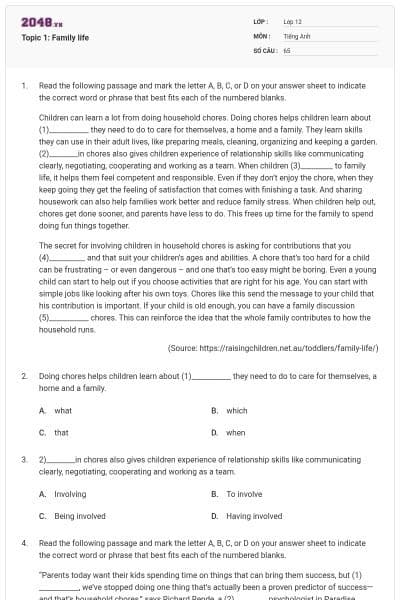
Read the following passage and mark the letter A, B, C, or D on your answer sheet to indicate the correct word or phrase that best fits each of the numbered blanks.
Children can learn a lot from doing household chores. Doing chores helps children learn about (1)___________ they need to do to care for themselves, a home and a family. They learn skills they can use in their adult lives, like preparing meals, cleaning, organizing and keeping a garden. (2)________in chores also gives children experience of relationship skills like communicating clearly, negotiating, cooperating and working as a team. When children (3)_________ to family life, it helps them feel competent and responsible. Even if they don’t enjoy the chore, when they keep going they get the feeling of satisfaction that comes with finishing a task. And sharing housework can also help families work better and reduce family stress. When children help out, chores get done sooner, and parents have less to do. This frees up time for the family to spend doing fun things together.
The secret for involving children in household chores is asking for contributions that you (4)__________ and that suit your children’s ages and abilities. A chore that’s too hard for a child can be frustrating – or even dangerous – and one that’s too easy might be boring. Even a young child can start to help out if you choose activities that are right for his age. You can start with simple jobs like looking after his own toys. Chores like this send the message to your child that his contribution is important. If your child is old enough, you can have a family discussion (5)___________ chores. This can reinforce the idea that the whole family contributes to how the household runs.
(Source: https://raisingchildren.net.au/toddlers/family-life/)
what
which
that
when
Trẻ em có thể học được rất nhiều từ làm việc nhà. Làm việc vặt giúp trẻ biết về những gì trẻ cần làm để chăm sóc bản thân, nhà và gia đình. Trẻ học các kỹ năng mà chúng có thể sử dụng cho mai này lớn lên, như chuẩn bị bữa ăn, dọn dẹp, trồng và chăm sóc một khu vườn. Được tham gia vào công việc cũng mang đến cho trẻ trải nghiệm các kỹ năng quan hệ như giao tiếp rõ ràng, đàm phán, hợp tác và làm việc theo nhóm. Khi trẻ em đóng góp vào cuộc sống gia đình, điều đó giúp chúng cảm thấy có năng lực và có trách nhiệm. Ngay cả khi chúng không thích làm việc nhà, khi chúng tiếp tục chúng sẽ có cảm giác hài lòng khi hoàn thành một nhiệm vụ. Và việc chia sẻ công việc gia đình cũng có thể giúp các gia đình sinh hoạt tốt hơn và giảm bớt căng thẳng trong gia đình. Khi trẻ em giúp đỡ, các việc vặt được thực hiện sớm hơn, và cha mẹ có ít việc phải làm hơn. Điều này giải phóng thời gian cho gia đình để dành những điều thú vị với nhau.
Bí quyết để trẻ tham gia vào việc nhà là yêu cầu những đóng góp mà bạn đánh giá và cho là phù hợp với tuổi và khả năng của trẻ. Một việc vặt quá khó cho một đứa trẻ có thể gây phiền toái - hoặc thậm chí nguy hiểm - và việc quá dễ có thể nhàm chán. Ngay cả một đứa trẻ nhỏ cũng có thể bắt đầu giúp đỡ nếu bạn chọn các hoạt động phù hợp với lứa tuổi của trẻ. Bạn có thể bắt đầu với các công việc đơn giản như chăm sóc đồ chơi của riêng mình. Các công việc như thế cho con bạn biết rằng sự đóng góp của nó là quan trọng. Nếu con bạn đủ tuổi, bạn có thể có thảo luận gia đình về công việc. Điều này có thể củng cố ý tưởng rằng cả gia đình đều làm việc nhà.
Đáp án A
Kiến thức về mệnh đề danh từ
Căn cứ vào nghĩa của câu sau: “Doing chores helps children learn about (1)___________ they need to do to care for themselves, a home and a family.”
(Làm việc vặt giúp trẻ học về những gì trẻ cần làm để chăm sóc bản thân, nhà và gia đình.)
=> Ta dùng mệnh đề danh từ với “what” để trả lời cho câu hỏi “làm gì”, đóng vai trò làm tân ngữ cho động từ “to do”.
Involving
To involve
Being involved
Having involved
Đáp án C
Kiến thức về ngữ pháp
Vị trí trống số 2 cần một chủ ngữ nên ta phải dùng dạng danh động từ của từ “involve”.
Căn cứ vào nghĩa của câu:
“(2)________in chores also gives children experience of relationship skills like communicating clearly, negotiating, cooperating and working as a team.”
(Được tham gia vào công việc nhà cũng mang đến cho trẻ trải nghiệm các kỹ năng quan hệ như giao tiếp rõ ràng, đàm phán, hợp tác và làm việc theo nhóm.)
=> Theo các cấu trúc của “involve” như sau:
+ Involve sth (v): tham gia vào cái gì
+ Involve sb in sth/doing sth: khiến cho ai tham gia vào cái gì
+ Be involved in sth (adj) = take part in sth (phr.v) = involve sth (v): tham gia vào cái gì; có liên quan đến cái gì
=> Vì có giới từ “in” đi kèm, và cần mang nghĩa là “tham gia vào” nên ta phải dùng “involved” với chức năng như một tính từ.
=> Đứng đầu câu cần một danh động từ làm chủ ngữ nên ta dùng “Being + adj”.
devote
contribute
introduce
encourage
Đáp án B
Kiến thức về cấu trúc
A. devote time to st/doing st: hi sinh/dành thời gian làm gì
B. contribute to st: đóng góp/góp phần vào cái gì
C. introduce sb to sb: giới thiệu ai với ai
D. encourage sb to do st: khuyến khích ai làm gì
Căn cứ vào nghĩa của câu sau: “When children (3)_________ to family life, it helps them feel competent and responsible.”
(Khi trẻ em đóng góp vào cuộc sống gia đình, điều đó giúp chúng cảm thấy có năng lực và có trách nhiệm.)
valued
value
valuable
valueless
Đáp án B
Kiến thức về từ vựng
A. valued /ˈvæljuːd/ (a): quý, được chuộng, được quý trọng
B. value /ˈvæljuː/ (n/v): giá trị/đánh giá
C. valuable /’væljuəbl/ (a): có giá trị, đáng giá, quan trọng
D. valueless /’væljuəlis/ (a): không có giá trị, không có tác dụng, không đáng giá
Ở vị trí trống số 4 cần một động từ nên đáp án là B.
on
over
about
in
Đáp án C
Kiến thức về giới từ
Have a discussion about st = discuss st: thảo luận cái gì
Read the following passage and mark the letter A, B, C, or D on your answer sheet to indicate the correct word or phrase that best fits each of the numbered blanks.
“Parents today want their kids spending time on things that can bring them success, but (1) ___________, we’ve stopped doing one thing that’s actually been a proven predictor of success—and that’s household chores,” says Richard Rende, a (2)_________ psychologist in Paradise Valley, Ariz., and co-author of the forthcoming book “Raising Can-Do Kids.” Decades of studies show the benefits of chores—academically, emotionally and even professionally. Giving children household chores at an early age (3)_____ to build a lasting sense of mastery, responsibility and self-reliance, according to research by Marty Rossmann, professor emeritus at the University of Minnesota. In 2002, Dr. Rossmann analyzed data from a longitudinal study (4)____________ followed 84 children across four periods in their lives—in preschool, around ages 10 and 15, and in their mid-20s. She found that young adults who began chores at ages 3 and 4 were more likely to have good relationships with family and friends, to achieve academic and early career success and to be self-sufficient, as (5)__________ with those who didn’t have chores or who started them as teens. Chores also teach children how to be empathetic and responsive to others’ needs, notes psychologist Richard Weissbourd of the Harvard Graduate School of Education.
(Source: https://www.wsj.com/articles/why-children-need-chores)
ironically
especially
brutally
bitterly
“Cha mẹ ngày nay muốn con cái của họ dành thời gian cho những thứ có thể mang lại thành công, nhưng trớ trêu thay, chúng ta đã ngừng làm một điều thực sự là một yếu tố dự đoán thành công - và đó là công việc gia đình”, Richard Rende, nhà tâm lý học phát triển ở Paradise, Valley, Ariz và là đồng tác giả của cuốn sách sắp tới “Nuôi dạy trẻ em có thể làm” nói. Nhiều thập kỷ nghiên cứu cho thấy lợi ích của việc vặt trong nhà — về mặt học thuật, tình cảm và thậm chí là chuyên nghiệp. Theo nghiên cứu của Marty Rossmann, giáo sư danh dự tại Đại học Minnesota, giao các việc vặt cho trẻ ở độ tuổi sớm giúp xây dựng một ý thức lâu dài về sự thành thạo, trách nhiệm và tự lực. Năm 2002, Tiến sĩ Rossmann đã phân tích dữ liệu từ một nghiên cứu theo chiều dọc, theo dõi 84 trẻ trong bốn giai đoạn trong cuộc sống của chúng — ở tuổi mầm non, khoảng 10 và 15 tuổi, và vào khoảng giữa những năm 20 tuổi. Bà thấy rằng thanh niên bắt đầu làm việc vặt trong nhà ở độ tuổi 3 và 4 có nhiều khả năng có mối quan hệ tốt với gia đình và bạn bè, đạt được thành công trong học tập và sự nghiệp sớm, tự chủ so với những người không làm việc nhà hoặc những người bắt đầu làm ở độ tuổi thanh thiếu niên. Nhà tâm lý học Richard Weissbourd thuộc Trường Giáo dục Sau đại học Harvard ghi nhận rằng các công việc nhà cũng dạy trẻ cách cảm thông và đáp ứng nhu cầu của người khác.
Đáp án A
Kiến thức về từ vựng
A. ironically/aɪˈrɒnɪkəli/ (adv): một cách mỉa mai, trớ trêu thay
B. especially/ɪˈspeʃəli/ (adv): một cách đặc biệt, đặc biệt là, nhất là
C. brutally/ˈbruːtəli/(adv): một cách hung bạo, một cách tàn nhẫn
D. bitterly/ˈbɪtəli/ (adv): một cách cay đắng, chua chát
Căn cứ vào nghĩa của câu: “Parents today want their kids spending time on things that can bring them success, but (1) ___________, we’ve stopped doing one thing that’s actually been a proven predictor of success—and that’s household chores,”
(Cha mẹ ngày nay muốn con cái của họ dành thời gian cho những thứ có thể mang lại thành công, nhưng trớ trêu thay, chúng ta đã ngừng làm một điều thực sự là một yếu tố dự đoán thành công – và đó là công việc gia đình, )
develop
developing
developed
developmental
Đáp án D
Kiến thức về từ loại
A. develop/dɪˈveləp/ (v): mở rộng, phát triển
B. developing /dɪˈveləpɪŋ/(a): đang phát triển, trên đà phát triển
C. developed/dɪˈveləpt/ (a): phát triển
D. developmental /dɪˌveləpˈmentəl/(a): phát triển, nảy nở, tiến triển
Ta có cụm từ:
- Developmental psychology: Ngành tâm lý học phát triển
- Developmental psychologist: Nhà tâm lý học phát triển (Nhà tâm lý học nghiên cứu ngành tâm lý học phát triển)
help
helps
helped
has helped
Đáp án B
Kiến thức về thì động từ
“Decades of studies show the benefits of chores—academically, emotionally and even professionally. Giving children household chores at an early age (3)_____ to build a lasting sense of mastery, responsibility and self-reliance, according to research by Marty Rossmann, professor emeritus at the University of Minnesota.”
=> Hai câu trên là hai câu nói liên tiếp thuật lại kết quả của các nghiên cứu. Căn cứ vào động từ “show”, thì câu tiếp theo phải dùng thì hiện tại đơn.
=> “Giving children household chores at an early age” là cụm danh từ số ít, do đó phương án đúng là: B
what
that
whom
when
Đáp án B
Kiến thức về đại từ quan hệ
Ta dùng đại từ quan hệ “that” thay thế cho cả danh từ chỉ người lẫn vật hay sự việc trong mệnh đề quan hệ thuộc loại mệnh đề xác định. Đóng vai trò làm tân ngữ/chủ ngữ của câu.
Từ “study” trong câu “Dr. Rossmann analyzed data from a longitudinal study (4)____________ followed 84 children across four periods in their lives—in preschool, around ages 10 and 15, and in their mid-20s.” là một danh từ “nghiên cứu/ công trình nghiên cứu”
=> Nên ta chọn phương án: B
compared
compare
comparing
to compare
Đáp án A
Kiến thức về rút gọn mệnh đề quan hệ
Ta dùng quá khứ phân từ để tạo mệnh đề quan hệ rút gọn đối với câu bị động. Trong câu này “compared” được hiểu là “who was compared with”
Tạm dịch: “She found that young adults who began chores at ages 3 and 4 were more likely to have good relationships with family and friends, to achieve academic and early career success and to be self-sufficient, as (5)__________ with those who didn’t have chores or who started them as teens.”
(Bà nhận thấy rằng những người trẻ tuổi bắt đầu công việc ở độ tuổi 3 và 4 có nhiều khả năng có mối quan hệ tốt với gia đình và bạn bè, sớm đạt được thành công trong học tập và sự nghiệp và sớm tự lập, so với những người không làm việc nhà hoặc người bắt đầu làm việc nhà ở tuổi thanh thiếu niên.)
Read the following passage and mark the letter A, B, C or D on your answer sheet to indicate the correct word or phrase that best fits each of the numbered blanks.
Families can function well if everyone is able to communicate their needs and wants to communicate with each other in a respectful way. This can be hard if you are feeling frustrated, angry, hurt or sad. Sometimes it can be better to wait until intense feelings have (1)_____ , so that you can more calmly communicate what is going on for you and what you need and want. You may not always get what you want straight away and you might have to be patient and/ or learn the (2)______ of negotiation and compromise. Learning to negotiate is a great way to (3)_____ things out so everyone come out winning. For example, you might agree to help with chores around the house so you can go to the movies. It’s important to stick to your side of the agreement - this builds trust and respect. Talking things (4)_______ can be really helpful, particularly if you are worried about your family relationships. It’s important to identify someone in your family who you feel is understanding and supportive. This could be a parent, brother, sister, cousin, aunty, uncle, a grandparent or a (5) ______ family friend.
blown
given
moved
passed
Gia đình có thể hoạt động tốt nếu mọi người có thể chia sẻ với nhau về nhu cầu của họ và muốn trò chuyện với nhau với một thái độ tôn trọng. Điều này có thể sẽ khó nếu bạn đang cảm thấy thất vọng, tức giận, đau đớn hay buồn bã. Đôi khi, tốt hơn hết là bạn nên đợi đến lúc những cái cảm xúc mãnh liệt này qua đi, để mà bạn có thể trò chuyện một cách bình tĩnh về những gì đang xảy ra với bạn và bạn cần cái gì, muốn cái gì. Bạn không thể luôn luôn đạt được điều mình muốn ngay lập tức và bạn cần phải kiên nhẫn hay học cách để đàm phán và thỏa hiệp. Học cách đàm phán là một cách tuyệt vời để giải quyết mọi chuyện để mọi người đều có thể thành công. Ví dụ, bạn có thể đồng ý giúp làm những công việc vặt nhà để bạn có thể đi xem phim. Quan trọng là bạn phải tuân thủ theo thỏa thuận của mình – điều này tạo nên sự tin tưởng và tôn trọng. Thảo luận kỹ lưỡng cùng nhau đôi khi thực sự rất hữu ích, đặc biệt là nếu bạn lo lắng về mối quan hệ của gia đình mình. Điều này cực kỳ quan trọng để nhận biết được trong gia đình bạn ai là người mà bạn thấy thấu hiểu và ủng hộ nhất. Người này có thể là bố mẹ, anh em trai, chị em gái, anh em họ, cô dì, chú bác, ông bà hay là một người bạn thân.
Đáp án D
Kiến thức về từ vựng
Tạm dịch: “Sometimes it can be better to wait until intense feelings have passed, so that you can more calmly communicate what is going on for you and what you need and want.”
(Đôi khi có thể tốt hơn để chờ đến lúc các cảm xúc tức giận đó mất đi, để bạn có thể diễn đạt bình tĩnh hơn về những gì diễn ra và bạn cần và muốn cái gì.)
art
course
craft
school
Đáp án A
Kiến thức về từ vựng
A. art (n): nghệ thuật
B. course (n): khóa học
C. craft (n): nghề thủ công
D. school (n): trường học
Tạm dịch: “You may not always get what you want straight away and you might have to be patient and learn the art of negotiation and compromise.”
(Bạn có lẽ không phải lúc nào cũng có được thứ bạn muốn ngay lập tức và bạn có lẽ phải kiên nhẫn và học nghệ thuật đàm phán và thỏa hiệp.)
control
go
labor
work
Đáp án D
Kiến thức về cụm động từ
work sth out: giải quyết việc gì
Tạm dịch: “Learning to negotiate /nəˈɡəʊ.ʃi.eɪt/ is a great way to work things out so everyone come out winning.”
(Học cách thương lượng là một cách tốt để giải quyết các việc và như vậy mọi người đều thắng.)
out
over
through
up
Đáp án C
Kiến thức về cụm động từ
*Xét các cụm từ sau:
- talk sth through (phr.v): bàn luận, bàn bạc một cách kỹ lưỡng đến từng chi tiết về cái gì (cho đến khi hiểu được thực sự vấn đề đó hoặc trước khi đưa ra quyết định) => cụm này sẽ mang tính kỹ lưỡng, chi tiết, cụ thể hơn hết
- talk out sth (phr.v): thảo luận về vấn đề hoặc một kế hoạch cẩn thận (trước khi đưa ra quyết định; hoặc để đưa ra giải pháp giải quyết một rắc rối, hay một thỏa thuận)
- talk st over (with sb) (phr.v): thảo luận về một vấn đề gì đó (với ai) (để đưa ra quyết định cuối cùng hoặc đi đến thỏa thuận cuối cùng cùng họ) => cụm này thường dùng khi có đề cập đến “with sb” để thể hiện tính tương tác, thảo luận để hiểu được quan điểm đối phương và đi đến thỏa thuận.
Tạm dịch: “Talking things through can be really helpful, particularly if you are worried about your family relationships. It’s important to identify someone in your family who you feel is understanding and supportive.”
(Thảo luận kỹ lưỡng cùng nhau đôi khi thực sự rất hữu ích, đặc biệt là nếu bạn lo lắng về mối quan hệ của gia đình mình. Điều này cực kỳ quan trọng để nhận biết được trong gia đình bạn ai là người mà bạn thấy thấu hiểu và ủng hộ nhất.)
=> Ngữ cảnh cho thấy câu cần dùng cụm thể hiện tính thấu hiểu vấn đề, và đòi hỏi sự thảo luận kỹ lưỡng, chi tiết nên ta chọn C.
near
close
warm
convenient
Đáp án B
Kiến thức về từ vựng
A. near (a): gần
B. close (a): gần gũi, thân thiết
C. warm (a): ấm
D. convenient (a): thuận tiện
Tạm dịch: “This could be a parent, brother, sister, cousin, aunty, uncle, a grandparent or a close family friend.”
(Đó có thể là bố hay mẹ, anh em trai, chị em gái, dì, bác, ông hay bà hay một người bạn thân thiết của gia đình.)
Read the following passage and mark the letter A, B, C or D on your answer sheet to indicate the correct word or phrase that best fits each of the numbered blanks.
All families face challenges and hurdles as a normal part of life and getting through these times requires respectful communication and care for each other. However, some families face significant (1) _______ like not having a place to live, a parent going to court, a parent having a long-term illness, or parents having to work (2) ________ from home or for long hours.
Some families seem to fight and argue a lot, which can be really scary and stressful. Sometimes, family relationships can be so stressful that you feel unsafe and scared. These types of things make relationships (3) _________ and negative and it can make it difficult to feel like talking things through.
As a teenager you are going through a lot of changes within yourself physically, mentally, emotionally and socially. Often these changes (4) _________ at different rates and at different times. It is important for you to be aware of what is going on and how this may affect you at school, home and/or around family and friends having an understanding of adolescent development can be very (5) _______.
doubts
obstacles
problems
troubles
Tất cả các gia đình đều phải đối mặt với những thách thức và rào cản như một lẽ thường tình của cuộc sống, và việc vượt qua những khoảng thời gian đó yêu cầu việc trò chuyện, chăm sóc tôn trọng lẫn nhau. Tuy nhiên một số gia đình có thể sẽ phải đối mặt với những vấn đề nghiêm trọng như không có nơi để sinh sống, cha mẹ li hôn, phải chống chịu với bệnh tật lâu ngày hay bố mẹ phải làm việc xa nhà hoặc làm việc trong một khoảng thời gian dài.
Một số gia đình có vẻ thường xuyên xuất hiện với những cuộc cãi vã, tranh chấp, có thể gây ra sự sợ hãi và vô cùng căng thẳng. Đôi khi, những mối quan hệ gia đình trở nên áp lực khiến bạn cảm thấy không an toàn và thực sự sợ hãi. Điều này làm mối quan hệ căng thẳng tiêu cực hơn và nó trở nên khó khăn để mà cùng nói chuyện và giải quyết chúng.
Ở tuổi thiếu niên bạn đang trải qua rất nhiều những biến đổi về mặt thể chất, tinh thần, tình cảm và xã hội. Thường thì những thay đổi này xảy ra ở các mức độ khác nhau và thời điểm khác nhau. Điều quan trọng là bạn phải nhận thức được những gì đang xảy ra và chúng có ảnh hưởng thế nào với bạn khi ở trường, ở nhà, xung quanh gia đình và bạn bè với những hiểu biết về sự phát triển ở lứa tuổi vị thành niên có thể sẽ trở nên rất hữu ích.
Đáp án C
Kiến thức về từ vựng
A. doubt /daʊt/ (n): sự nghi ngờ
B. obstacle /ˈɒbstəkəl/ (n): sự cản trở
C. problem /ˈprɒbləm/ (n): vấn đề
D. trouble /ˈtrʌbəl/ (n): điều phiền muộn
However, some families face significant (1) _____ like not having a place to live, a parent going to court.
(Tuy nhiên, một số gia đình phải đối mặt với những vấn đề quan trọng như không có nơi ở, cha mẹ sẽ ra tòa.)
a parent going to court, a parent having a long-term illness, or parents having to work (2) ________ from home or for long hours.
apart
away
off
over
Đáp án B
Kiến thức về cụm từ cố định
Ta có cụm từ:
away from sth/sb: xa với cái gì/ ai
However, some families face significant (28) like not having a place to live, a parent going to court, a parent having a long-term illness, or parents having to work (29) from home or for long hours.
(Tuy nhiên, một số gia đình phải đối mặt với những vấn đề quan trọng như không có nơi ở, cha mẹ ra tòa, cha mẹ bị bệnh lâu năm, hoặc cha mẹ phải làm việc xa gia đình hoặc nhiều giờ.)
These types of things make relationships (3) _________ and negative and it can make it difficult to feel like talking things through.
last
straight
proper
tense
Đáp án D
Kiến thức về từ vựng
A. last /lɑːst/ (a): cuối cùng
B. straight /streɪt/ (a): thẳng
C. proper /ˈprɒpər/ (a): thích hợp
D. tense /tens/ (a): căng thẳng
These types of things make relationships (30)______ and negative and it can make it difficult to feel like talking things through.
(Những điều như thế này làm cho mối quan hệ trở nên căng thẳng và tiêu cực và nó có thể gây khó khăn để cảm thấy thích thảo luận về các vấn đề.)
occur
operate
run
progress
Đáp án A
Kiến thức về từ vựng
A. occur /əˈkɜːr/ (v): xảy ra, diễn ra
B. operate /ˈɒpəreɪt/ (v): hoạt động
C. run /rʌn/ (v): chạy
D. progress /ˈprəʊɡres/ (v): tiến triển, phát triển
Often these changes (31) at different rates and at different times.
(Thông thường những thay đổi này xảy ra ở các mức độ khác nhau và thời gian khác nhau.)
It is important for you to be aware of what is going on and how this may affect you at school, home and/or around family and friends having an understanding of adolescent development can be very (5) _______.
detrimental
helpful
complicated
attractive
Đáp án B
Kiến thức về từ vựng
A. detrimental /detrɪˈmentəl/ (a): có hại
B. helpful /ˈhelpfəl/ (a): có ích, có lợi
C. complicated /ˈkɒmplɪkeɪtɪd/ (a): phức tạp
D. attractive/əˈtræktɪv/ (a): thu hút, cuốn hút
It is important for you to be aware of what is going on and how this may affect you at school, home and/or around family and friends having an understanding of adolescent development can be very (32) .
(Điều quan trọng là bạn phải nhận thức được những gì đang xảy ra và điều này có thể ảnh hưởng đến bạn như thế nào ở trường, ở nhà và/hoặc xung quanh gia đình và bạn bè, có sự hiểu biết về sự phát triển của thanh thiếu niên có thể rất hữu ích.)
Read the following passage and mark the letter A, B, C or D to indicate the correct word or phrase that best fits each of the numbered blanks.
The majority of Americans can live comfortable lives on the salaries they earn, without the support of a universal public-welfare system. These so-called middle-class Americans generally own their own homes and cars, spend some time each year on vacation, and can pay – at least in part - for a college education for their children. Most Americans set (1) _______ money in savings accounts to help pay major expenses; many invest in the stock market in hopes of earning a healthy return on their investments.
Most buy insurance, especially life and medical insurance, frequently with contributions (2) _____ the companies for which they work. Many companies also have retirement plans which they and their employees put aside money for their retirement pensions. When added to Social Security payments, pensions (3) _______ many tired Americans to live comfortably. On the other hand, for older Americans who require long-term care outside of a hospital, a nursing home can be very expensive.
In 1993, a family of four with a yearly income of $14,763 or less was considered poor by American standards; 15.1 percent of American families fell into this category. In addition to the benefits discussed above, many families below the (4) ________line receive welfare payments, sums of money provided by the government each month to those whose income is too low to obtain such necessities as food, clothing and shelter. The most common form of welfare payment has been through a program called Aid to Families With Dependent Children (AFDC). Originally (5) _______to help children whose fathers had died, AFDC evolved into the main source of regular income for millions of poor American families.
Most Americans set (1) _______ money in savings accounts to help pay major expenses; many invest in the stock market in hopes of earning a healthy return on their investments.
away
apart
aside
against
Đa số người Mỹ có thể sống một cuộc sống thoải mái với số tiền lương họ kiếm được, mà không cần tới sự hỗ trợ của hệ thống phúc lợi công cộng phổ thông. Những người Mỹ thuộc tầng lớp trung lưu thường sở hữu nhà và xe hơi riêng, dành chút thời gian mỗi năm cho những kì nghỉ, và có thể trả - ít nhất là một phần cho nền giáo dục đại học của con cái họ. Hầu hết người Mỹ đều để dành tiền trong tài khoản tiết kiệm để chi trả vào những dịp tiêu tốn; nhiều người thì đầu tư vào thị trường chứng khoán với hy vọng kiếm lợi nhuận an toàn với sự đầu tư của họ.
Nhiều người thì lại mua bảo hiểm, đặc biệt là bảo hiểm nhân thọ và bảo hiểm y tế, với sự đóng góp thường xuyên từ các công ty mà họ làm việc. Nhiều công ty cũng có kế hoạch nghỉ hưu cho họ và nhân viên của họ, tiết kiệm một khoản cho tiền lương hưu của họ. Khi tham gia vào thanh toán an sinh xã hội, lương hưu giúp nhiều người nghỉ hưu ở Mỹ sống một cách thoải mái. Mặt khác, đối với người Mỹ lớn tuổi, người mà có nhu cầu được chăm sóc lâu dài bên ngoài của một bệnh viện, viện dưỡng lão có thể rất tốn kém.
Năm 1993, một gia đình bốn người với thu nhập bình quân hàng năm khoảng $14.763 hoặc ít hơn được coi là nghèo bởi tiêu chuẩn của Mỹ và 15,1% của các gia đình Mỹ thuộc phạm trù này. Ngoài những lợi ích nêu trên, nhiều gia đình sống dưới mức nghèo nhận được phúc lợi thanh toán, khoản tiền được cung cấp bởi chính phủ mỗi tháng cho những người có thu nhập quá thấp để có được thứ cần thiết như thức ăn, quần áo và nơi sinh sống. Các hình thức phổ biến nhất của thanh toán phúc lợi thông qua một chương trình gọi là Quỹ viện trợ cho các gia đình có trẻ em phụ thuộc (AFDC). Ban đầu nó được thành lập giúp đỡ cho trẻ em mồ côi cha, AFDC phát triển thành nguồn thu nhập chính thường xuyên cho hàng triệu gia đình nghèo ở Mỹ.
Đáp án C
Kiến thức về cụm động từ
A. set away => không có cụm động từ này
B. set apart (v): làm cho khác biệt
C. set aside (v):để dành, tiết kiệm cái gì/ bỏ qua, làm ngơ
D. set against (v): so sánh, đối chiếu
Tạm dịch: These so-called middle-class Americans generally own their own homes and cars, spend some time each year on vacation, and can pay – at least in part – at least in part- for a college education for their children. Most Americans set (1) _______money in savings accounts to help pay major expenses; many invest in the stock market in hopes of earning a healthy return on their investments.
(Những người Mỹ được gọi là tầng lớp trung lưu này thường sở hữu nhà và xe hơi riêng của họ, dành thời gian mỗi năm đi du lịch và có thể trả tiền - ít nhất là một phần - vào việc giáo dục đại học cho con cái họ. Hầu hết người Mỹ để dành tiền trong tài khoản tiết kiệm để giúp trả các chi phí lớn; nhiều người đầu tư vào thị trường chứng khoán với hy vọng kiếm được lợi nhuận tốt cho khoản đầu tư của họ.)
from
to
with
into
Đáp án A
Kiến thức về giới từ
Cấu trúc:
- contribution to st: đóng góp cho cái gì
- contribution by/from sb/st: đóng góp từ/bởi ai/cái gìTạm dịch: Most buy insurance, especially life and medical insurance, frequently with contributions (2) __________ the companies for which they work. Many companies also have retirement plans which they and their employees put aside money for their retirement pensions.
(Hầu hết người Mỹ mua bảo hiểm, đặc biệt là bảo hiểm nhân thọ và bảo hiểm y tế, thường xuyên có sự góp phần từ các công ty mà họ đang làm. Nhiều công ty cũng có những kế hoạch nghỉ hưu, kế hoạch mà họ và nhân viên để dành tiền cho lương hưu của mình.)
allow
permit
enable
allocate
Đáp án C
Kiến thức về từ vựng
A. allow /əˈlaʊ/(v): cho phép, để cho làm
B. permit /pəˈmɪt/ (v): cho phép, cho cơ hội
C. enable /ɪˈneɪbl/ (v): giúp cho, tạo cho; tạo khả năng
D. allocate /ˈæləkeɪt/ (v): phân phối, phân phát
Ta có cấu trúc:
- allow sb/ sth to do sth: cho phép làm gì
- enable sb/ sth to do sth: tạo cơ hội, giúp cho có thể xảy ra
Tạm dịch: When added to Social Security payments, pensions (3) _______ many tired Americans to live comfortably. On the other hand, for older Americans who require long-term care outside of a hospital, a nursing home can be very expensive.
(Khi được thêm vào các khoản thanh toán An sinh xã hội, lương hưu tạo cơ hội cho nhiều người Mỹ cực khổ có thể sống thoải mái. Mặt khác, đối với những người Mỹ lớn tuổi cần chăm sóc dài hạn bên ngoài bệnh viện thì sống ở một viện dưỡng lão có thể rất tốn kém.)
poor
poverty
famine
shortage
Đáp án B
Kiến thức về từ vựng
A. poor /pɔː(r)/ (adj): nghèo túng
B. poverty /ˈpɒvəti/ (n): sự nghèo túng, sự thiếu thốn
C. famine /ˈfæmɪn/ (n): sự đói, nạn đói
D. shortage /ˈʃɔːtɪdʒ/ (n): sự thiếu hụt
Tạm dịch: In 1993, a family of four with a yearly income of $14,763 or less was considered poor by American standards; 15.1 percent of American families fell into this category. In addition to the benefits discussed above, many families below the (4) ________line receive welfare payments, sums of money provided by the government each month to those whose income is too low to obtain such necessities as food, clothing and shelter.
(Năm 1993, một gia đình bốn người có thu nhập hàng năm từ 14.763 đô la trở xuống được coi là nghèo theo tiêu chuẩn Mỹ; 15,1 phần trăm các gia đình Mỹ rơi vào loại này. Ngoài những lợi ích được thảo luận ở trên, nhiều gia đình dưới mức nghèo nhận được các khoản thanh toán phúc lợi, các khoản tiền do chính phủ cung cấp mỗi tháng cho những người mà có thu nhập quá thấp để có được nhu yếu phẩm như thức ăn, quần áo và chỗ ở.)
=> Tuy đằng sau chỗ trống cần điền là danh từ nhưng không chọn tính từ “poor” vì nó chỉ tính chất, đặc điểm của danh từ. Còn chọn danh từ “poverty” trước danh từ “line” để nói về chức năng hoặc phân loại cho danh từ đó.
Originally (5) _______to help children whose fathers had died, AFDC evolved into the main source of regular income for millions of poor American families.
design
designed
designing
having designed
Đáp án B
Kiến thức về câu bị động rút gọnA. design /dɪˈzaɪn/ (v): thiết kế,tạo ra, dự kiến
B. designed => dạng quá khứ của design
C. designing => dạng tiếp diễn/ danh động từ của design
D. having designed => dạng quá khứ hoàn thành
=> Vì “design” là ngoại động từ nên đằng sau “design” phải có tân ngữ.
=> Nhưng xét trong câu văn, đằng sau chỗ trống không có tân ngữ nên cần chọn dạng bị động rút gọn là " designed".
Tạm dịch: The most common form of welfare payment has been through a program called Aid to Families With Dependent Children (AFDC). Originally (5) _______to help children whose fathers had died, AFDC evolved into the main source of regular income for millions of poor American families.
(Hình thức thanh toán phúc lợi phổ biến nhất là thông qua một chương trình có tên là Trợ giúp cho các gia đình có trẻ em phụ thuộc vào cha mẹ(AFDC). Ban đầu được tạo ra để giúp đỡ những đứa trẻ có cha đã qua đời, AFDC đã phát triển thành nguồn thu nhập chính của hàng triệu gia đình nghèo ở Mỹ.)
Read the following passage and mark the letter A, B, C, or D to indicate the correct answer to each of the question.
Nuclear family, also called elementary family, in sociology and anthropology, is a group of people who are united by ties of partnership and parenthood and consisting of a pair of adults and their socially recognized children. Typically, but not always, the adults in a nuclear family are married. Although such couples are most often a man and a woman, the definition of the nuclear family has expanded with the advent of same-sex marriage. Children in a nuclear family may be the couple’s biological or adopted offspring.
Thus defined, the nuclear family was once widely held to be the most basic and universal form of social organization. Anthropological research, however, has illuminated so much variability of this form that it is safer to assume that what is universal is a “nuclear family complex” in which the roles of husband, wife, mother, father, son, daughter, brother, and sister are embodied by people whose biological relationships do not necessarily conform to the Western definitions of these terms. In matrilineal societies, for example, a child may be the responsibility not of his biological genitor but of his mother’s brother, who fulfills the roles typical of Western fatherhood.
Closely related in form to the predominant nuclear-family unit are the conjugal family and the consanguineal family. As its name implies, the conjugal family is knit together primarily by the marriage tie and consists of mother, father, their children, and some close relatives. The consanguineal family, on the other hand, typically groups itself around a unlineal descent group known as a lineage, a form that reckons kinship through either the father’s or the mother’s line but not both. Whether a culture is patrilineal or matrilineal, a consanguineal family comprises lineage relatives and consists of parents, their children, and their children’s children. Rules regarding lineage exogamy are common in these groups; within a given community, marriages thus create cross-cutting social and political ties between lineages.
The stability of the conjugal family depends on the quality of the marriage of the husband and wife, a relationship that is more emphasized in the kinds of industrialized, highly mobile societies that frequently demand that people reside away from their kin groups. The consanguineal family derives its stability from its corporate nature and its permanence, as its relationships emphasize the perpetuation of the line.
(Source: https://www.britannica.com/)
What does the passage mainly discuss?
The definition of nuclear family
The types of nuclear family
The component of nuclear family
The relationship of nuclear family
Trong xã hội học và nhân chủng học, gia đình hạt nhân, còn được gọi là gia đình cơ bản, là một nhóm người được hợp nhất nhờ sự ràng buộc về mặt cộng tác và tình cảm cha mẹ, và bao gồm một cặp người trưởng thành và những đứa con được công nhận trong xã hội của họ. Thông thường, nhưng không phải tất cả, những người trưởng thành trong một gia đình hạt nhân đã kết hôn với nhau. Mặc dù các cặp vợ chồng như vậy thường là một người đàn ông và một người phụ nữ, nhưng định nghĩa của gia đình hạt nhân đã mở rộng với sự ra đời của hôn nhân đồng giới tính. Con cái trong một gia đình hạt nhân có thể là con cái do họ sinh ra hoặc là con nuôi của cặp đôi.
Như đã định nghĩa, gia đình hạt nhân đã từng được tổ chức rộng rãi trở thành hình thức cơ bản và phổ biến nhất của tổ chức xã hội. Tuy nhiên, nghiên cứu nhân học đã làm sáng tỏ rất nhiều biến đổi của hình thức này, nó an toàn hơn khi giả định đó là “phức hợp gia đình hạt nhân” trong đó vai trò của chồng, vợ, mẹ, cha, con trai, con gái, anh trai, và em gái được thể hiện bởi những người mà mối quan hệ huyết thống của họ không nhất thiết phải tuân thủ các định nghĩa phương Tây về các thuật ngữ này. Ví dụ, trong chế độ mẫu hệ, một đứa trẻ có thể không thuộc trách nhiệm của người cha cùng huyết thống, mà thuộc về anh trai của người mẹ, là người hoàn thành các vai trò điển hình của người cha phương Tây.
Có liên quan chặt chẽ dưới hình thức đơn vị gia đình hạt nhân nổi bật là gia đình dựa vào hôn nhân và gia đình cùng huyết thống. Như hàm ý trong tên gọi của nó, gia đình dựa vào hôn nhân được gắn kết với nhau chủ yếu bằng sự ràng buộc hôn nhân và bao gồm người mẹ, người cha, con cái của họ, và một số họ hàng gần gũi. Mặt khác, gia đình cùng huyết thống thường bao gồm một nhóm người cùng dòng giống được gọi là dòng truyền thừa, một hình thức có quan hệ họ hàng thông qua dòng họ bên cha hoặc mẹ nhưng không phải cùng của cả hai dòng họ. Cho dù một nền văn hóa là chế độ phụ hệ hay mẫu hệ, thì một gia đình cùng huyết thống đều bao gồm họ hàng thân cận và cha mẹ, con cái của họ và con cái của con cái họ (cháu của họ). Các quy tắc liên quan đến chế độ hôn nhân ngoài dòng họ cũng phổ biến trong các nhóm người này; trong một cộng đồng nhất định, các cuộc hôn nhân đó tạo ra quan hệ xã hội và chính trị chéo giữa các dòng họ.
Sự ổn định của gia đình dựa vào hôn nhân phụ thuộc vào chất lượng hôn nhân của vợ chồng, một mối quan hệ được coi trọng hơn trong xã hội công nghiệp hóa, có tính di động cao, thường đòi hỏi người dân sống xa người thân của họ. Các gia đình cùng huyết thống có được sự ổn định từ bản chất chia sẻ và tính bền vững của nó, vì các mối quan hệ này nhấn mạnh sự tồn tại của nòi giống.
Đáp án A
Đoạn văn chủ yếu thảo luận về điều gì?
A. Định nghĩa của gia đình hạt nhân
B. Các loại gia đình hạt nhân
C. Thành phần của gia đình hạt nhân
D. Mối quan hệ của gia đình hạt nhân
Căn cứ thông tin đoạn 1:
Nuclear family, also called elementary family, in sociology and anthropology, a group of people who are united by ties of partnership and parenthood and consisting of a pair of adults and their socially recognized children.
According to the passage, the following are members forming a nuclear family, EXCEPT _________.
a man and a woman
a man and a man
a woman and a woman
children and children
Đáp án D
Theo đoạn văn, những người sau đây là thành viên tạo ra một gia đình hạt nhân, ngoại trừ _______.
A. một người đàn ông và một người phụ nữ
B. một người đàn ông và một người đàn ông
C. một người phụ nữ và một người phụ nữ
D. trẻ em và trẻ em
Căn cứ thông tin đoạn 1:
Typically, but not always, the adults in a nuclear family are married. Although such couples are most often a man and a woman, the definition of the nuclear family has expanded with the advent of same-sex marriage. Children in a nuclear family may be the couple’s biological or adopted offspring.
(Thông thường, nhưng không phải tất cả, những người trưởng thành trong một gia đình hạt nhân đã kết hôn với nhau. Mặc dù các cặp vợ chồng như vậy thường là một người đàn ông và một người phụ nữ, nhưng định nghĩa của gia đình hạt nhân đã mở rộng với sự ra đời của hôn nhân đồng giới tính. Con cái trong một gia đình hạt nhân có thể là con cái do họ sinh ra hoặc là con nuôi của cặp đôi.)
The word “illuminated” in the second paragraph is closest in meaning to __________.
changed
clarified
improved
confused
Đáp án B
Từ “illuminated” trong đoạn 2 gần nghĩa nhất với từ __________.
A. thay đổi
B. làm sáng tỏ
C. cải thiện
D. nhầm lẫn
Từ đồng nghĩa: illuminated (làm sáng tỏ) = clarified
Thus defined, the nuclear family was once widely held to be the most basic and universal form of social organization. Anthropological research, however, has illuminated so much variability of this form that it is safer to assume that what is universal is a “nuclear family complex” in which the roles of husband, wife, mother, father, son, daughter, brother, and sister are embodied by people whose biological relationships do not necessarily conform to the Western definitions of these terms.
(Như đã định nghĩa, gia đình hạt nhân đã từng được tổ chức rộng rãi trở thành hình thức cơ bản và phổ biến nhất của tổ chức xã hội. Tuy nhiên, nghiên cứu nhân loại học đã làm sáng tỏ rất nhiều biến đổi của hình thức này, nó an toàn hơn khi giả định đó là “phức hợp gia đình hạt nhân” trong đó vai trò của chồng, vợ, mẹ, cha, con trai, con gái, anh trai, và em gái được thể hiện bởi những người mà mối quan hệ huyết thống của họ không nhất thiết phải tuân thủ các định nghĩa phương Tây về các thuật ngữ này.)
In which societies, a father may not be the one taking responsibility for his child?
patrilineal
celibacy
matrilineal
consanguinity
Đáp án C
Trong xã hội nào, một người cha có thể không phải là người chịu trách nhiệm cho đứa con của anh ta?
A. chế độ phụ hệ
B. chế độ độc thân
C. chế độ mẫu hệ
D. quan hệ máu mủ
Căn cứ thông tin đoạn 2:
In matrilineal societies, for example, a child may be the responsibility not of his biological genitor but of his mother’s brother, who fulfills the roles typical of Western fatherhood.
(Ví dụ, trong chế độ mẫu hệ, một đứa trẻ có thể không thuộc trách nhiệm của người cha cùng huyết thống, mà thuộc về anh trai của người mẹ, là người hoàn thành các vai trò điển hình của người cha phương Tây.)
According to paragraph 3, which of the following is TRUE?
There are some similarities between conjugal and consanguineous family.
The conjugal family depends on marriage to knit its members and close relatives.
The consanguineous family relies on both father’s and mother’s line to form its group.
The consanguineous family only consists parents and their children.
Đáp án B
Theo đoạn 3, câu nào là đúng?
A. Có một vài điểm giống nhau giữa gia đình dựa vào hôn nhân và gia đình cùng huyết thống.
B. Gia đình dựa vào hôn nhân phụ thuộc vào hôn nhân để gắn kết các thành viên và họ hàng thân thuộc của nó.
C. Gia đình cùng huyết thống dựa vào cả dòng họ bên bố và mẹ để tạo ra nhóm của nó.
D. Gia đình cùng huyết thống chỉ bao gồm bố mẹ và con cái.
Căn cứ thông tin đoạn 3:
Closely related in form to the predominant nuclear-family unit are the conjugal family and the consanguineal family. As its name implies, the conjugal family is knit together primarily by the marriage tie and consists of mother, father, their children, and some close relatives. The consanguineal family, on the other hand, typically groups itself around a unlineal descent group known as a lineage, a form that reckons kinship through either the father’s or the mother’s line but not both. Whether a culture is patrilineal or matrilineal, a consanguineal family comprises lineage relatives and consists of parents, their children, and their children’s children.
(Có liên quan chặt chẽ dưới hình thức đơn vị gia đình hạt nhân nổi bật là gia đình dựa vào hôn nhân và gia đình cùng huyết thống. Như hàm ý trong tên gọi của nó, gia đình dựa vào hôn nhân được gắn kết với nhau chủ yếu bằng sự ràng buộc hôn nhân và bao gồm người mẹ, người cha, con cái của họ, và một số họ hàng gần gũi. Mặt khác, gia đình cùng huyết thống thường bao gồm một nhóm người cùng dòng giống được gọi là dòng truyền thừa, một hình thức có quan hệ họ hàng thông qua dòng họ bên cha hoặc mẹ nhưng không phải cùng của cả hai dòng họ. Cho dù một nền văn hóa là chế độ phụ hệ hay mẫu hệ, thì một gia đình cùng huyết thống đều bao gồm họ hàng thân cận và cha mẹ, con cái của họ và con cái của con cái họ (cháu của họ)).
The word “lineage” in paragraph 3 could be best replaced by ___________.
ancestry
generation
insertion
incorporation
Đáp án A
Từ “lineage” trong đoạn 3 có thể được thay thế bởi từ __________.
A. dòng họ, tổ tông B. thế hệ
C. sự chèn vào D. sự hợp nhất, đoàn thể
Từ đồng nghĩa: lineage (dòng họ) = ancestry
The consanguineal family, on the other hand, typically groups itself around a unlineal descent group known as a lineage, a form that reckons kinship through either the father’s or the mother’s line but not both.
(Mặt khác, gia đình cùng huyết thống thường bao gồm một nhóm người cùng dòng giống được gọi là dòng truyền thừa, một hình thức có quan hệ họ hàng thông qua dòng họ bên cha hoặc mẹ nhưng không phải cùng của cả hai dòng họ.)
What does the word “its” in the last paragraph refer to?
the permanence’s
the nature’s
the stability’s
the consanguineous family’s
Đáp án D
Từ “its” trong đoạn cuối đề cập tới từ nào?
A. của tính bền vững B. của bản chất
C. của tính ổn định
D. của gia đình cùng huyết thống
Căn cứ thông tin đoạn cuối:
Từ “its” thay thế cho cụm từ “của gia đình cùng huyết thống”.
The consanguineal family derives its stability from its corporate nature and its permanence, as its relationships emphasize the perpetuation of the line.
(Các gia đình cùng huyết thống có được sự ổn định từ bản chất chia sẻ và tính bền vững của nó, vì các mối quan hệ này nhấn mạnh sự tồn tại của nòi giống.)
What does the author imply in the last paragraph?
The married couples must maintain the quality of their marriage to meet the demand of modern society.
Members in each family must preserve their family’s basement to protect their stability.
The permanence of the consanguineous family may emphasize its line in society.
The industrialized society probably causes many difficulties for the consanguineous family.
Đáp án B
Tác giả hàm ý điều gì trong đoạn cuối?A. Những cặp đôi đã kết hôn phải duy trì chất lượng cuộc hôn nhân của họ để đáp ứng yêu cầu của xã hội hiện đại.
B. Các thành viên trong gia đình phải duy trì nền tảng chính của gia đình để bảo vệ sự ổn định của họ.
C. Tính bền vững của gia đình cùng huyết thống có thể nhấn mạnh dòng họ của nó trong xã hội.
D. Xã hội công nghiệp hoá có thể gây ra nhiều khó khăn cho gia đình có cùng huyết thống.
Căn cứ thông tin đoạn cuối:
The stability of the conjugal family depends on the quality of the marriage of the husband and wife, a relationship that is more emphasized in the kinds of industrialized, highly mobile societies that frequently demand that people reside away from their kin groups. The consanguineal family derives its stability from its corporate nature and its permanence, as its relationships emphasize the perpetuation of the line.
(Sự ổn định của gia đình dựa vào hôn nhân phụ thuộc vào chất lượng hôn nhân của vợ chồng, một mối quan hệ được coi trọng hơn trong xã hội công nghiệp hóa, có tính di động cao, thường đòi hỏi người dân sống xa người thân của họ. Các gia đình cùng huyết thống có được sự ổn định từ bản chất chia sẻ và tính bền vững của nó, vì các mối quan hệ này nhấn mạnh sự tồn tại của nòi giống.)
Individual differences in temperament or behavioral styles are important in family life in several ways because they affect the nature of the interactions among family members. Some children adapt quickly and easily to family daily routines and get along well with their siblings. Others, especially highly active, intense and “prickly” children have a more difficult time adjusting to everyday demands, and their interactions with parents and siblings may lead to friction and stress. Consider how an active, impulsive child can bother an older sibling who is trying to complete a school project, or how a distractible child who is low in persistence can frustrate parents’ efforts to get him to complete his homework or to finish a household chore.
It is important to note that parents, like children, also differ in temperament. Some are quick reacting and intense, while others are quiet and slow to respond; some are flexible and adaptable, and others are not. The “mix” between parents’ and children’s temperaments has a strong effect on family life, sometimes leading to positive interactions, sometimes to frustrations, and sometimes even to conflicts.
It is interesting to note that parents also differ in the expectations they have about their children’s behavior, and how they view and tolerate differences in temperaments. For example, certain constellations of temperament such as high activity, intensity, and persistence may be tolerated and valued in boys, but not in girls. Conversely, shyness and sensitivity may be viewed as acceptable in girls, but not in boys.
This leads to the notion of “goodness of fit”, which can be a useful framework for helping parents figure out how temperament affects relationships in the family. “Goodness of fit” refers to the match or mismatch between a child and other family members. For example, a high-activity, intense child may upset and irritate a quiet, slow-paced, reflective parent. An active, quick-responding parent may be impatient with a slow-to-warm-up child, whom the parent may see as lazy or indifferent. Sparks may fly when both parent and child are intense and quick responding.
Life in a family is not the same for all children, and temperament is one of the ingredients in the “fit” between child and family. Don’t assume family friction is a result of your child having LD or ADHD. It could be because of your child’s temperament — and yours!
(source: https://www.greatschools.org)
Which best serves as the title for the passage?
How temperament influences family life.
Look at yourselves before you look at others.
Handling difficult children is an art
One person one temperament.
Sự khác biệt cá nhân trong tính khí hoặc phong cách hành vi rất quan trọng trong cuộc sống gia đình theo nhiều cách vì chúng ảnh hưởng đến bản chất của sự tương tác giữa các thành viên trong gia đình. Một số trẻ sẽ thích nghi nhanh chóng và dễ dàng với các thói quen hàng ngày của gia đình và hòa đồng với anh chị em của chúng. Những người khác, đặc biệt là trẻ em hiếu động, mạnh bạo và “ dễ cáu giận” có một thời gian khó khăn hơn để thích nghi với nhu cầu hàng ngày, và sự tương tác của chúng với cha mẹ và anh chị em có thể dẫn đến xích mích và căng thẳng. Xem xét làm thế nào một đứa trẻ năng động, bốc đồng có thể làm phiền anh chị chúng người mà đang cố gắng hoàn thành một dự án ở trường, hoặc làm thế nào một đứa trẻ mất tập trung người mà thiếu kiên trì có thể làm cha mẹ thất bại trong nỗ lực của mình để bắt chúng hoàn thành bài tập về nhà hoặc hoàn tất công việc nhà.
Điều quan trọng cần lưu ý là cha mẹ, giống như trẻ em, cũng khác nhau về tính khí. Một số phản ứng nhanh và dữ dội, trong khi những người khác phản ứng nhẹ nhàng và chậm; một số là linh hoạt và dễ thích nghi, và một số khác thì không. Sự pha trộn giữa tính khí của cha mẹ và con cái có ảnh hưởng lớn đến cuộc sống gia đình, đôi khi dẫn đến những tương tác tích cực, đôi khi gây ra sự thất vọng và thậm chí đôi khi là xung đột.
Thật thú vị khi nhận ra rằng cha mẹ cũng khác nhau về những kỳ vọng mà họ đặt ra về hành vi của con cái họ, và cách họ nhìn và chịu đựng sự khác biệt về tính khí. Ví dụ, một số nhóm tính cách như tăng động, tính cách mạnh bạo và sự bền bỉ có thể có và được đánh giá cao ở nam, chứ không phải ở nữ. Ngược lại, sự ngại ngùng và nhạy cảm có thể được xem là được chấp nhận ở nữ, chứ không phải ở nam.
Điều này dẫn đến đến khái niệm “mức độ phù hợp”, thứ có thể là một khuôn khổ hữu ích giúp cha mẹ tìm ra tính khí ảnh hưởng đến các mối quan hệ gia đình như thế nào. “Mức độ phù hợp” đề cập đến sự hoà hợp, hoặc không hoà hợp của một đứa trẻ với các thành viên khác trong gia đình. Ví dụ, một đứa trẻ tăng động, mạnh bạo có thể làm buồn bã và gây cáu gắt với một phụ huynh trầm lặng, chậm rãi và trầm tính. Một phụ huynh năng động, phản ứng nhanh có thể thiếu kiên nhẫn với một đứa trẻ chậm hoà nhập, người mà cha mẹ có thể thấy là lười biếng hoặc lơ đễnh. Tranh cãi nảy lửa sẽ xảy ra khi cả cha mẹ và con cái đều phản ứng nhanh và dữ dội.
Cuộc sống trong một gia đình không giống nhau đối với tất cả trẻ em và tính khí là một trong những điều quan trọng nhất trong “sự phù hợp” giữa trẻ em và gia đình. Đừng cho rằng sự xích mích gia đình là kết quả của việc con bạn bị LD hoặc ADHD. Nó có thể là do tính khí của con bạn – và của bạn!
Đáp án A
Câu nào sau đây thích hợp nhất để làm tiêu đề cho đoạn văn?
A. Tính khí ảnh hưởng đến cuộc sống gia đình như thế nào?
B. Hãy nhìn chính mình trước khi bạn nhìn người khác.
C. Xử lý trẻ em khó khăn là một nghệ thuật.
D. Mỗi người một tính khí.
Căn cứ vào thông tin đoạn đầu:
Individual differences in temperament or behavioral styles are important in family life in several ways because they affect the nature of the interactions among family members.
(Sự khác biệt cá nhân trong tính khí hoặc cách cư xử rất quan trọng trong cuộc sống gia đình ở một số phương diện vì chúng ảnh hưởng đến bản chất của sự tương tác giữa các thành viên trong gia đình.)
=> Như vậy, đoạn văn đang nói về tác động của tính khí ảnh hưởng đến cuộc sống gia đình như thế nào.
The word “prickly” in paragraph 1 is closest in meaning to _______.
hateful
sulky
cheerful
childish
Đáp án B
Từ “prickly /ˈprɪk.əl.i/” trong đoạn 1 có nghĩa gần nhất với .
A. đáng ghét
B. hờn dỗi
C. vui lòng
D. trẻ con
Từ đồng nghĩa prickly (dễ giận, hay giận dỗi) = sulky
Others, especially highly active, intense and “prickly” children have a more difficult time adjusting to everyday demands, and their interactions with parents and siblings may lead to friction and stress.
(Những đứa trẻ khác, đặc biệt là những đứa trẻ rất năng động, dữ dội và hay giận dỗi sẽ có một thời gian khó khăn hơn để thích nghi với nhu cầu hàng ngày, và sự tương tác của chúng với cha mẹ và anh chị em có thể dẫn đến xích mích và áp lực.)
According to paragraph 1, why does a clash of temperaments cause problem?
Because punitive or hostile parenting cannot control rebellious attitude.
It is difficult for the live wire to understand the quiet soul.
Because they are personality flaws and mental health disorders
Because of the lack of flexibility element in interactions.
Đáp án D
Theo đoạn 1, tại sao một cuộc xung đột về tính khí lại gây ra vấn đề?
A. Bởi vì việc nuôi dạy con cái theo kiểu phạt hay thù hằn không thể kiểm soát thái độ nổi loạn.
B. Thật khó để người năng động hiểu được người thụ động.
C. Bởi vì chúng là những sai sót trong tính cách và rối loạn sức khỏe tâm thần.
D. Bởi vì thiếu yếu tố linh hoạt trong các tương tác.
Căn cứ vào thông tin đoạn một:
“Some children adapt quickly and easily to family daily routines and get along well with their siblings. Others, especially highly active, intense and “prickly” children have a more difficult time adjusting to everyday demands, and their interactions with parents and siblings may lead to friction and stress. Consider how an active, impulsive child can bother an older sibling who is trying to complete a school project, or how a distractible child who is low in persistence can frustrate parents’ efforts to get him to complete his homework or to finish a household chore.”
(Một số trẻ thích nghi nhanh chóng và dễ dàng với các thói quen hàng ngày của gia đình và hòa đồng với anh chị em của họ. Những người khác, đặc biệt là trẻ em hiếu động, mạnh mẽ, và hay hờn dỗi có thời gian khó khăn hơn để thích nghi với nhu cầu hàng ngày và sự tương tác của chúng với cha mẹ và anh chị em có thể dẫn đến xích mích và căng thẳng. Xem xét cách một đứa trẻ năng động, bốc đồng có thể làm phiền một anh chị lớn đang cố gắng hoàn thành một dự án ở trường, hoặc một đứa trẻ mất tập trung, thiếu kiên trì khi cố gắng hoàn thành bài tập về nhà hoặc hoàn thành công việc gia đình có thể làm cha mẹ thất vọng như nào.)
*Note: Live wire (n): người rất năng động, năng nổ và lúc nào cũng tràn trề năng lượng.
The word “Some” in paragraph refers to _____.
temperaments
children
parents
styles
Đáp án C
Từ “some” trong đoạn văn đề cập đến .
A. khí chất
B. trẻ em
C. cha mẹ
D. phong cách
Từ “some” thay thế cho danh từ cha mẹ ở phía trước.
It is important to note that parents, like children, also differ in temperament. Some are quick reacting and intense, while others are quiet and slow to respond; some are flexible and adaptable, and others are not. (Điều quan trọng cần lưu ý là cha mẹ, giống như trẻ em, cũng khác nhau về tính khí. Một số nhanh phản ứng và nóng vội, trong khi những người khác thường im lặng và chậm phản ứng; một số linh hoạt và thích nghi, và những người khác thì không.)
According to paragraph 4, which statement best describes the rule of “goodness of fit”?
Temperaments that complement each other are what we seek.
It is ideal to have a similar temperament as your child.
Emotional reactions can be contagious.
Opposites can sometimes balance one another out.
Đáp án A
Theo đoạn 4, câu nào mô tả đúng nhất quy tắc “sự phù hợp”?
A. Tính khí bổ sung cho nhau là những gì chúng ta tìm kiếm.
B. Thật lý tưởng để có một tính khí tương tự như con của bạn.
C. Phản ứng cảm xúc có thể lây lan.
D. Sự đối lập đôi khi có thể cân bằng lại giá trị lẫn nhau.
Căn cứ vào thông tin đoạn bốn:
“Goodness of fit” refers to the match or mismatch between a child and other family members. For example, a high- activity, intense child may upset and irritate a quiet, slow-paced, reflective parent.
(Quy tắc “sự phù hợp” ám chỉ sự phù hợp hoặc không phù hợp giữa một đứa trẻ và các thành viên khác trong gia đình. Ví dụ, một đứa trẻ năng động, nóng vội có thể buồn bã và cáu gắt với một phụ huynh trầm tính, chậm rãi, biết suy nghĩ.)
=> Do đó, ta thấy rằng quy tắc “sự phù hợp” có thể hiểu đó là sự bổ sung lẫn nhau, bù trừ cho nhau trong tính khí con người, để giúp cuộc sống trong gia đình luôn êm ấm và hòa thuận, tránh ít có xung đột khúc mắc xảy ra.
* Note: Đáp án D sẽ gây dễ nhầm nhưng nó chưa thực sự chinh xác. Vì phạm vi mà cụm “goodness of fit” hướng tới đó là trong tính cách, trong hành vi con người. Còn câu D thì nó nói chung chung là “sự đối lập” - ta hiểu rằng đó là sự đối lập về mọi thứ. Thực tế thì xét về sự đối lập trong tính khí mới có thể làm cân bằng được cuộc sống gia đình, nhưng không có nghĩa là nó cũng đúng trong mọi vấn đề mọi khía cạnh của cuộc sống. Do đó, đáp án D chưa chính xác.
The word “persistence” in paragraph 3 is closest in meaning to _______.
stubbornness
commitment
carelessness
perseverance
Đáp án D
Từ “persistence” trong đoạn 3 có nghĩa gần nhất với .
A. sự bướng bỉnh
B. sự cam kết
C. sự bất cẩn
D. sự kiên trì
Từ đồng nghĩa persistence (tính bền bỉ) = perseverance
For example, certain constellations/ˌkɒn.stəˈleɪ.ʃən/ of temperament such as high activity, intensity, and persistence may be tolerated and valued in boys, but not in girls.
(Ví dụ, một số chòm sao tính cách như năng động, mạnh mẽ và bền bỉ có thể có ở những đứa con trai, nhưng không phải ở con gái.)
Which of the following statements is TRUE, according to the passage?
Parents set different criteria for each gender’s disposition.
Each person’s personalities depends on their birth stars.
Interactions of temperament only happen between children and parents.
There are cases of changing one’s temperament as growing up.
Đáp án A
Phát biểu nào sau đây là đúng, theo đoạn văn?
A. Cha mẹ nên đặt ra các tiêu chí khác nhau cho từng xu hướng của giới tính.
B. Tính cách của mỗi người phụ thuộc vào chòm sao của họ.
C. Tương tác của tính khí chỉ xảy ra giữa trẻ em và cha mẹ.
D. Có những trường hợp thay đổi tính khí ở một người khi lớn lên.
Căn cứ vào thông tin đoạn ba:
It is interesting to note that parents also differ in the expectations they have about their children’s behavior, and how they view and tolerate differences in temperaments. For example, certain constellations of temperament such as high activity, intensity, and persistence may be tolerated and valued in boys, but not in girls. Conversely, shyness and sensitivity may be viewed as acceptable in girls, but not in boys.
(Thật thú vị để lưu ý rằng cha mẹ cũng nên nghĩ khác về những kỳ vọng mà họ đặt cho hành vi của con mình, và cách họ nhìn và chịu đựng sự khác biệt về tính khí. Ví dụ, một số chòm sao của tính khí như năng động, mạnh mẽ và bền bỉ có thể có ở con trai, nhưng không phải ở con gái. Ngược lại, sự nhút nhát và nhạy cảm có thấy ở con gái, nhưng không phải ở con trai.)
Which of the following can be inferred from the passage?
Family should go beyond blood and into harmony.
What matters is not the best but the fittest.
Problematic children lies at the roots of every conflicts within family.
Family bonding is where quality time should be spent.
Đáp án B
Điều nào sau đây có thể được suy ra từ đoạn văn?
A. Gia đình nên vượt lên huyết thống và hòa thuận.
B. Điều quan trọng không phải là tốt nhất mà là phù hợp nhất.
C. Những đứa trẻ có vấn đề là gốc rễ của mọi mâu thuẫn trong gia đình.
D. Liên kết gia đình là nơi, mà khoảng thời gian tốt đẹp nên được dành cho.
Căn cứ vào thông tin đoạn cuối:
Life in a family is not the same for all children, and temperament is one of the ingredients in the “fit” between child and family. Don’t assume family friction is a result of your child having LD or ADHD. It could be because of your child’s temperament — and yours!
(Cuộc sống trong một gia đình không giống nhau đối với tất cả trẻ em và tính khí là một trong những gia vị để tạo thành sự hòa hợp giữa trẻ em và gia đình. Đừng cho rằng sự xích mích trong gia đình là do con bạn có LD hoặc ADHD. Nó có thể là do tính khí của con bạn - và của bạn!
Read the following passage and mark the letter A, B, C or D on your answer sheet to indicate the correct answer to each of the questions.
WHO WORKS? WHO STAYS HOME?
Most Americans agree that the workplace and the home are very different from the way they were thirty years ago. The world of work is no longer a man’s world. Between 1970 and 1995, the percentage of women who worked outside the home went from 50 percent to 76 percent: In the year 2000, of the more than 5.5 million married couples in the United States, 10.5 million women were making more money than their husbands, and 2 million men were stay-at-home dads.
Author, husband, and father Mark Wertman writes about being a stay-at-home dad in his book True Confessions of a Real Mr. Mom. His story will help others who are learning how to live with the changing gender, roles in our society.
Mark and his wife, Georgenes, were a two-income couple, but things changed when their first baby was born. Georgenes wanted to continue her work as a lawyer, but someone needed to stay home to take care of the baby. Georgenes had the higher paying job, so she became the provider. Mark stayed home to raise the children. In his book he tells many stories about his role in the family.
At first, it was difficult to change roles. The Wertman kids often went to Mark first to talk about their problems. Georgenes was jealous of the time the children spent with their father. Mark had some hard times too. People often asked him, ‘When are you going to get a real job?’. Even in the 21st century, society respects the role of provider more than the role of child raiser. Mark found out all about this.
Mark and Georgenes learned that it is very important to talk about their problems. In the beginning, Mark thought Georgenes had the easy job, and Georgenes thought that Mark had it easy. Later they talked it over and discovered that both jobs were difficult and rewarding. Georgenes and Mark agree that talking things over and making decisions together helps their relationship.
The Wertmans are happy with the results of their decision. Their children are ready for a world where men and women can choose their roles. Wertman’s book is entertaining and educational, especially for couples who want to switch roles. As Mark Wertman says "We are society. We make the changes one by one. People have to decide on what’s best for them and their families.”
Why is the workplace no longer a man’s world?
Because more women are jealous.
Because men are not strong.
Because fewer men are stay-at-home dads.
Because more women are in the workplace.
Đáp án D
Tại sao nơi làm việc không còn là thế giới của đàn ông?
A. Vì nhiều phụ nữ đố kỵ.
B. Vì đàn ông không mạnh mẽ.
C. Vì ít đàn ông nội trợ.
D. Vì nhiều phụ nữ ở nơi làm việc.
Căn cứ vào thông tin đoạn 1:
“The world of work is no longer a man’s world. Between 1970 and 1995, the percentage of women who worked outside the home went from 50 percent to 76 percent…”
(Thế giới công việc không còn là thế giới của đàn ông. Giữa năm 1970 và 1995, tỷ lệ phụ nữ làm việc bên ngoài nhà đã tăng từ 50% lên 76%..)
Mark Wertman’s book about?
his writing job
his life as a stay-at-home dad
his first baby
his wife’s job
Đáp án B
Cuốn sách của Mark Wertman nói về?
A. công việc viết lách của anh ấy
B. cuộc sống của anh ấy như một người đàn ông nội trợ
C. đứa con đầu lòng của anh ấy
D. công việc của vợ anh ấy
Căn cứ vào thông tin đoạn 2:
“Author, husband, and father Mark Wertman writes about being a stay-at-home dad in his book True Confessions of a Real Mr. Mom.”
(Nhà văn, người chồng và người cha Mark Wertman viết về việc trở thành một người đàn ông nội trợ trong cuốn sách True Confession of a Real Mr. Mom. )
Why is Georgenes the provider in the family?
Mark does not want to be the provider.
Mark lost his job when their first baby was born.
She had the higher paying job when their first baby was born.
She hated staying home looking after baby.
Đáp án C
Tại sao Georgenes là người trụ cột trong gia đình?
A. Mark đã không muốn trở thành người trụ cột.
B. Mark đã mất việc khi đứa con đầu lòng của họ chào đời.
C. Cô ấy đã có công việc được trả lương cao hơn khi đứa con đầu lòng của họ chào đời.
D. Cô ấy ghét ở nhà chăm sóc em bé.
Căn cứ vào thông tin đoạn 3:
“Mark and his wife, Georgenes, were a two-income couple, but things changed when their first baby was born…Georgenes had the higher paying job, so she became the provider.”
(Mark và vợ anh ấy, Georgenes, là một cặp vợ chồng có hai thu nhập, nhưng mọi thứ đã thay đổi khi đứa con đầu lòng của họ chào đời…Georg Georgenes đã có công việc lương cao hơn, vì vậy cô ấy trở thành người trụ cột.)
How do the Wertmans feel about their decision?
They’re happy because they’re entertaining.
They’re happy because their children are ready for the modern world.
They’re unhappy because they want to change jobs.
They’re unhappy because people don’t respect Mark.
Đáp án B
Nhà Wertmans cảm thấy thế nào về quyết định của họ?
A. Họ hạnh phúc vì họ cảm thấy thú vị.
B. Họ hạnh phúc vì con cái họ đã sẵn sàng cho thế giới hiện đại.
C. Họ không hạnh phúc vì họ muốn thay đổi công việc.
D. Họ không vui vì mọi người không tôn trọng Mark.
Căn cứ vào thông tin đoạn cuối:
“The Wertmans are happy with the results of their decision. Their children are ready for a world where men and women can choose their roles.”
(Nhà Wertmans hài lòng với kết quả của quyết định của họ. Con cái của họ đã sẵn sàng cho một thế giới nơi mà đàn ông và phụ nữ có thể chọn vai trò của họ.)
The phrase "talked it over" in paragraph 5 mostly means
found it easy
reached the conclusion
said it again and again
discussed the problem
Đáp án D
Cụm từ “talked it over” trong đoạn 5 gần nghĩa nhất với
A. found it easy: thấy nó dễ dàng
B. reached the conclusion: đi đến kết luận
C. said it again and again: nói đi nói lại
D. discussed the problem: thảo luận vấn đề
Từ đồng nghĩa: talked it over: thảo luận vấn đề
“Later they talked it over and discovered that both jobs were difficult and rewarding.”
(Sau đó, họ đã thảo luận vấn đề và phát hiện ra rằng cả hai công việc đều khó khăn và đáng làm.)
The phrase "one by one" in paragraph 6 mostly means
step by step
one out of many
one before the next
on behalf of one
Đáp án C
Cụm từ “one by one” trong đoạn 6 gần nghĩa nhất với ___.
A. step by step: từ từ, từng bước một
B. one out of many
C. one before the next: người trước người kế tiếp (lần lượt từng người)
D. on behalf of one: thay mặt, đại diện ai
“We are society. We make the changes one by one. People have to decide on what’s best for them and their families.”
(Chúng ta chính là xã hội. Chúng ta thay đổi từng người một. Mọi người phải quyết định những gì tốt nhất cho họ và gia đình họ.)
Which of the following is NOT mentioned in the passage?
More and more men in US prefer to stay at home to raise children.
The breadwinner of the family is likely to be more respected.
Neither Mark nor Georgenes was satisfied at first.
Wertman’s book is entertaining and useful for young couples.
Đáp án A
Điều nào sau đây KHÔNG được đề cập trong đoạn văn?
A. Ngày càng có nhiều đàn ông ở Mỹ thích ở nhà để nuôi con.
B. Người trụ cột trong gia đình có khả năng được tôn trọng hơn.
C. Cả Mark và Georgenes đều không hài lòng lúc đầu.
D. Cuốn sách của Wertman mang tính giải trí và hữu ích cho các cặp vợ chồng trẻ.
Căn cứ vào thông tin đoạn văn:
“ Even in the 21st century, society respects the role of provider more than the role of child raiser.”
(Ngay cả trong thế kỷ 21, xã hội tôn trọng vai trò của người trụ cột trong gia đình hơn là vai trò của người chăm sóc con cái.)
“In the beginning, Mark thought Georgenes had the easy job, and Georgenes thought that Mark had it easy. Later they talked it over and discovered that both jobs were difficult and rewarding.”
(Ban đầu, Mark đã nghĩ rằng Georgenes có công việc dễ dàng và Georgenes nghĩ rằng Mark cũng vậy. Sau đó, họ đã thảo luận vấn đề đó và phát hiện ra rằng cả hai công việc đều khó khăn và đáng làm.)
“Wertman’s book is entertaining and educational, especially for couples who want to switch roles.”
While family relationships can bring support, joy, and other wonderful benefits into our lives, these relationships can also bring stress, particularly when there’s unresolved conflict. Because it’s more difficult to let go of conflicted relationships with family than it would be if these relationships were mere friendships, unresolved conflicts with family members can be particularly painful.
We have certain expectations of trust and closeness toward family members, and it can be more than merely disappointing to realize that this may not be possible with all family members. Unresolved family conflicts bring additional stress at family gatherings in particular. Past unresolved conflicts can become the elephant in the room, felt by everyone, but not directly addressed in the situation. This can be stressful for everyone before and during the family gatherings, sometimes leaving a lasting sense of stress afterward as well.
Without a heartfelt discussion, an apology or another form of resolution, the trust on both sides is compromised, and may not know what to expect from this person in the future. For example, that one time your mother-in-law criticized your cooking may come up in your mind every time she comes for a visit, and others may sense your tension. This leads many people to assume the worst when they interpret each other’s behavior in the present and future interactions rather than giving the benefit of the doubt as most of us do with people we trust. Also, references or reminders of past conflicts can sting and create new pain.
Once a conflict has gone on a while, even if both parties move on and remain polite, the feelings of pain and mistrust are usually lingering under the surface, and are difficult to resolve: bringing up old hurts in an effort to resolve them can often backfire, as the other party may feel attacked; avoiding the issue altogether but holding onto resentment can poison feelings in the present.
So what do you do at a family gathering when there’s someone there with whom you’ve had an unresolved conflict? Just be polite. Contrary to how many people feel, a family gathering is not the time to rehash old conflicts, as such conversations often get messy before they get resolved — if they get resolved. Again, be polite, redirect conversations that get into areas that may cause conflict, and try to avoid the person as much as you politely can.
(source: https://www.verywellmind.com)
Which best serves as the title for the passage?
The stress of unresolved family disputes.
The unexpected inner problems of a family.
Peaceful ways to settle disagreement between family members.
Conflicts at home are the most challenging to face.
Trong khi các mối quan hệ gia đình có thể mang lại sự hỗ trợ, niềm vui và những lợi ích tuyệt vời khác trong cuộc sống của chúng ta, thì những mối quan hệ này cũng có thể mang lại căng thẳng, đặc biệt là khi có xung đột chưa được giải quyết. Bởi vì việc từ bỏ các mối quan hệ mâu thuẫn với gia đình sẽ khó khăn hơn so với nếu các mối quan hệ này chỉ là tình bạn, những xung đột chưa được giải quyết với các thành viên trong gia đình có thể đặc biệt đau đớn.
Chúng ta có những kỳ vọng nhất định về sự tin tưởng và gần gũi với các thành viên trong gia đình, và nó có thể hơn thế nữa thay vì chỉ thất vọng khi nhận ra rằng điều này có thể không thể xảy ra với tất cả thành viên trong gia đình. Xung đột gia đình chưa được giải quyết mang lại thêm căng thẳng tại các cuộc họp mặt gia đình nói riêng. Xung đột chưa được giải quyết trong quá khứ có thể trở thành một vấn đề lớn cần được giải quyết nhưng ai cũng sẽ phớt lờ, được mọi người cảm nhận, nhưng không được giải quyết trực tiếp trong tình huống. Điều này có thể gây căng thẳng cho tất cả mọi người trước và trong các cuộc họp mặt gia đình, đôi khi cũng để lại cảm giác căng thẳng kéo dài.
Nếu không có một cuộc thảo luận chân thành, một lời xin lỗi hoặc một hình thức giải quyết khác, sự tin tưởng từ cả hai phía sẽ bị tổn hại và có thể không biết mong đợi những gì từ người này trong tương lai. Ví dụ, lần mẹ chồng bạn chỉ trích việc nấu ăn của bạn có thể xuất hiện trong tâm trí của bạn mỗi khi bà ấy đến thăm nhà và người khác có thể cảm nhận sự căng thẳng của bạn. Điều này khiến nhiều người cho rằng điều tồi tệ nhất là khi họ hiểu hành vi của nhau trong các tương tác hiện tại và tương lai thay vì đưa ra lợi ích của sự nghi ngờ như hầu hết chúng ta làm với những người mà chúng ta tin tưởng. Ngoài ra, sự nhắc đến hoặc nhắc nhở về các xung đột trong quá khứ có thể chọc tức và tạo ra nỗi đau mới.
Một khi mâu thuẫn đã xảy ra, ngay cả khi hai bên vẫn tiếp tục và lịch sự, cảm giác đau đớn và ngờ vực thường ẩn dưới khuôn mặt đó, và rất khó để giải quyết: gây ra những tổn thương cũ trong nỗ lực giải quyết chúng thường có thể phản tác dụng, vì bên kia có thể cảm thấy bị tấn công; tránh vấn đề hoàn toàn nhưng giữ sự oán giận có thể đầu độc cảm xúc trong hiện tại.
Vậy bạn sẽ làm gì trong một buổi họp mặt gia đình khi có ai đó ở đó, người mà bạn đã có một cuộc xung đột chưa được giải quyết? Chỉ cần lịch sự. Trái với bao nhiêu người cảm thấy, một cuộc họp mặt gia đình không phải là thời gian để xử lí lại những xung đột cũ, vì những cuộc trò chuyện như vậy thường trở lên lộn xộn trước khi chúng được giải quyết – nếu chúng được giải quyết. Một lần nữa, hãy lịch sự, chuyển hướng các cuộc trò chuyện, cái mà có thể gây ra xung đột và cố gắng tránh người đó nhiều nhất có thể.
Đáp án A
Câu nào sau đây là thích hợp nhất để làm tiêu đề cho đoạn văn?
A. Sự căng thẳng của việc tranh chấp gia đình chưa được giải quyết.
B. Những vấn đề nội tâm bất ngờ của một gia đình.
C. Cách hòa bình để giải quyết những bất đồng giữa các thành viên trong gia đình.
D. Xung đột ở nhà là những thách thức nhất phải đối mặt.
Căn cứ vào thông tin đoạn đầu:
While family relationships can bring support, joy, and other wonderful benefits into our lives, these relationships can also bring stress, particularly when there’s unresolved conflict.
(Trong khi các mối quan hệ gia đình có thể mang lại sự hỗ trợ, niềm vui và những lợi ích tuyệt vời khác trong cuộc sống của chúng ta, những mối quan hệ này cũng có thể mang lại căng thẳng, đặc biệt là khi có xung đột chưa được giải quyết.)
=> Như vậy, đoạn văn đang nói về sự căng thẳng của việc tranh chấp gia đình khi chưa được giải quyết đem lại.
The word “this” in paragraph 2 refers to _____.
stress
expectation
trust
conflict
Đáp án B
Từ “this” trong đoạn 2 đề cập đến .
A. sự căng thẳng
B. sự kỳ vọng
C. lòng tin
D. sự xung đột
Từ “this” dùng để thay thế cho danh từ sự kỳ vọng ở trước đó.
We have certain expectations of trust and closeness toward family members, and it can be more than merely disappointing to realize that this may not be possible with all family members.
(Chúng tôi có những kỳ vọng nhất định về sự tin tưởng và sự gần gũi đối với các thành viên trong gia đình, và nó có thể hơn thế nữa thay vì chỉ thất vọng khi nhận ra rằng điều này có thể không thể xảy ra với tất cả các thành viên trong gia đình.)
According to paragraph 3, what is the consequence for unsettled discord?
Indifference towards each other among parties of the disagreement.
It brings about all kinds of criticism imaginable.
Other uninvolved members may feel uncomfortable.
Misunderstanding only take a turn for the worse.
Đáp án D
Theo đoạn 3, hậu quả của sự bất hòa không ổn định là gì?
A. Sự thờ ơ đối với nhau giữa các bên bất đồng.
B. Nó mang lại tất cả các loại chỉ trích có thể tưởng tượng.
C. Các thành viên khác có thể cảm thấy không thoải mái.
D. Hiểu lầm chỉ trở nên tồi tệ hơn.
Căn cứ vào thông tin đoạn 3:
Also, references or reminders of past conflicts can sting and create new pain.
(Ngoài ra, sự nhắc đến hoặc sự nhắc nhở về những xung đột trong quá khứ có thể xúc phạm và tạo ra nỗi đau mới.)
The word “compromised” in paragraph 3 is closest in meaning to _______.
fixed
contracted
damaged
built
Đáp án C
Từ “compromised” trong đoạn 3 có nghĩa gần nhất với .
A. được cố định
B. được cam kết
C. bị phá hoại
D. được xây dựng
=> Dựa vào ngữ cảnh trong bài:
Without a heartfelt discussion, an apology or another form of resolution, the trust on both sides is compromised, and may not know what to expect from this person in the future.
(Không có một cuộc thảo luận chân thành, một lời xin lỗi hoặc một hình thức giải quyết khác, sự tin tưởng từ cả hai phía bị làm hại, và có thể không biết mong đợi cái gì từ người này trong tương lai.)
=> Từ đồng nghĩa: Compromised (bị làm hại) = damaged
According to paragraph 4, why should prolonged conflict be avoided?
Resolving problems half-heartedly is not a smart thing to do.
The longer people hold onto their bitterness, the harder it is to compromise.
Because deeply discontented people are easy to respond to provocation.
Nobody enjoyed being held grudge against themselves.
Đáp án B
Theo đoạn 4, tại sao nên tránh xung đột kéo dài?
A. Giải quyết vấn đề nửa chừng không phải là một việc làm thông minh.
B. Người càng giữ sự đau khổ của mình càng lâu thì càng khó thỏa hiệp.
C. Bởi vì những người bất mãn sâu sắc rất dễ phản ứng với sự khiêu khích.
D. Không ai thích bị giữ mối hận thù với chính mình.
Căn cứ vào thông tin đoạn bốn:
Once a conflict has gone on a while, even if both parties move on and remain polite, the feelings of pain and mistrust are usually lingering under the surface, and are difficult to resolve.
Which of the following statements is TRUE, according to the passage?
If you can’t reach a compromise, you might have to “agree to disagree”.
Acting nicely is the last resort for unsolved conflicts.
No matter how loving a family is, all families can go through conflict.
Other family members must not settle the dispute on behalf of the involved sides.
Đáp án B
Theo bài văn, câu nào dưới đây là đúng?
A. Nếu không thể đạt được sự thoả hiệp, bạn có thể sẽ phải chấp nhận “agree to disagree”
B. Tỏ ra tử tế là cách xử lý cuối cùng của các mâu thuẫn chưa được giải quyết.
C. Dù một gia đình có yêu thương nhau cỡ nào, thì mọi gia đình đều có thể trải qua xung đột.
D. Các thành viên khác trong gia đình không được giải quyết mâu thuẫn thay mặt cho các bên có mâu thuẫn.
Căn cứ thông tin đoạn cuối:
So what do you do at a family gathering when there’s someone there with whom you’ve had an unresolved conflict? Just be polite. Contrary to how many people feel, a family gathering is not the time to rehash old conflicts, as such conversations often get messy before they get resolved — if they get resolved. Again, be polite, redirect conversations that get into areas that may cause conflict, and try to avoid the person as much as you politely can.
(Vậy bạn sẽ làm gì trong một buổi họp mặt gia đình khi có ai đó ở đó, người mà bạn đã có một cuộc xung đột chưa được giải quyết? Chỉ cần lịch sự. Trái với bao nhiêu người cảm thấy, một cuộc họp mặt gia đình không phải là thời gian để xử lí lại những xung đột cũ, vì những cuộc trò chuyện như vậy thường trở lên lộn xộn trước khi chúng được giải quyết – nếu chúng được giải quyết. Một lần nữa, hãy lịch sự, chuyển hướng các cuộc trò chuyện, mà có thể gây ra xung đột và cố gắng tránh người đó nhiều nhất có thể.)
The word “backfire” in paragraph 4 is closest in meaning to _______.
elevate
rebound
misfire
deepen
Đáp án B
Từ “backfire” trong đoạn 4 có nghĩa gần nhất với .
A. nâng cao
B. có ảnh hưởng ngược lại
C. không phù hợp
D. làm sâu hơn
Từ đồng nghĩa backfire (đem lại kết quả ngược lại sự mong đợi) = rebound
Bringing up old hurts in an effort to resolve them can often backfire.
(Gợi lại những nỗi đau cũ trong cố gắng để giải quyết chúng thường có thể gây ra tác dụng ngược.)
Which of the following can be inferred from the passage?
Conflict can be resolved, transformed, and experienced as a gift from life.
Being polite is the key to solving all the disputes.
It is inadvisable to keep hard feelings to yourself.
People should handle problems constructively not destructively.
Đáp án D
Có thể suy ra điều gì từ cả bài văn?
A. Xung đột có thể được giải quyết, chuyển hoá và trải nghiệm như một món quà từ cuộc sống.
B. Lịch sự là chìa khoá để giải quyết mọi cuộc tranh chấp.
C. Việc giữ những cảm xúc tiêu cực trong mình là điều không nên.
D. Mọi người cần đối xử với những vấn đề một cách có lợi mà không phải là phá huỷ.
Căn cứ thông tin đoạn 4:
Again, be polite, redirect conversations that get into areas that may cause conflict, and try to avoid the person as much as you politely can.
(Nhắc lại, hãy tỏ ra lịch sự, chuyển hướng cuộc nói chuyện đang sắp chạm đến các đề tài dễ gây tranh chấp, và hãy cố gắng tránh mặt người đang xảy ra tranh chấp một cách lịch sự nhất có thể.)
→ nhấn mạnh việc giải quyết mâu thuẫn, nhưng nếu gặp mâu thuẫn không thể hoà giải được thì không được cứng đối cứng mà phải mềm dẻo tránh khỏi những điều gây ra vấn đề.
Bạn có thích hoạt động này không?