Ôn thi Tốt nghiệp THPT môn Tiếng Anh (Đề 2)
50 câu hỏi
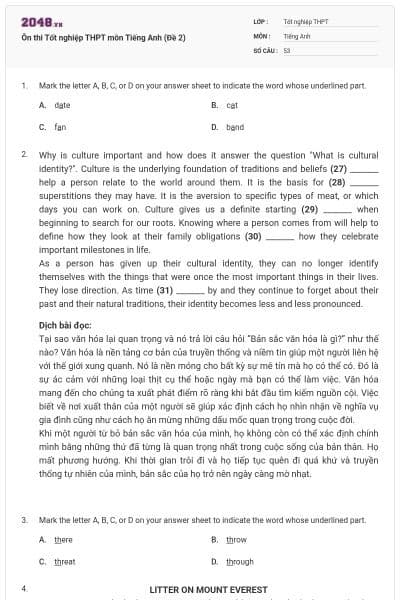
Mark the letter A, B, C, or D on your answer sheet to indicate the word whose underlined part.
date
cat
fan
band
A
Kiến thức: Phát âm “a”
Giải thích:
A. date /deɪt/ (n): ngày
B. cat /kæt/ (n): con mèo
C. fan /fæn/ (n): cây quạt
D. band /bænd/ (n): ban nhạc
Đáp án A có âm “a” phát âm là /eɪ/, các đáp án còn lại phát âm là /æ/.
Mark the letter A, B, C, or D on your answer sheet to indicate the word whose underlined part.
there
throw
threat
through
A
Kiến thức: Phát âm “th”
Giải thích:
A. there /ðeər/ (adv): ở đó
B. throw /θrəʊ/ (v): ném, vứt
C. threat /θret/ (n): mối đe dọa
D. through /θruː/ (prep): xuyên qua, thông qua
Đáp án A có âm “th” phát âm là /ð/, các đáp án còn lại phát âm là /θ/.
Sarah quit smoking two months ago. She broke a _______ she had had for more than half of her life.
sweat
habit
fire
favour
B
Kiến thức: Cụm từ
Giải thích:
A. sweat (n): mồ hôi
B. habit (n): thói quen → break/kick a habit: bỏ thói quen
C. fire (n): lửa, đám cháy
D. favour (n): sự giúp đỡ
Dịch nghĩa: Sarah đã bỏ hút thuốc vào hai tháng trước. Cô ấy đã bỏ một thói quen mà cô ấy có hơn nửa đời mình.
during
on
at
in
D
Kiến thức: Giới từ
Giải thích:
Trước năm → dùng “in”
Dịch nghĩa: Chúng tôi cuối cùng cũng đã hoàn thành dự án vào năm 2020.
has built
build
builds
was built
D
Kiến thức: Câu bị động
Giải thích:
Câu bị động ở thì QKĐ: was/were + V3/V-ed
Dịch nghĩa: Một ngôi nhà cộng đồng mới đã được xây dựng ở khu tôi sống.
I will call and tell you something interesting _______.
when I come home after work
when I had come home after work
when I was coming home after work
when I came home after work
A
Kiến thức: Sự hòa hợp thì
Giải thích:
TLĐ + liên từ + HTĐ/HTHT
Dịch nghĩa: Tôi sẽ gọi điện và kể cho bạn nghe vài chuyện thú vị khi tôi về nhà sau giờ làm.
looks up
turns on
takes after
stands for
A
Kiến thức: Cụm động từ
Giải thích:
A. look up something: tra cứu cái gì
B. turn on something: bật cái gì
C. take after somebody/something: giống ai/cái gì
D. stand for something: viết tắt cho cái gì
Dịch nghĩa: Jane tra cứu từ trong từ điển mỗi khi cô ấy không chắc về cách phát âm hoặc nghĩa của nó.
will have
is having
had
has
C
Kiến thức: Sự hòa hợp thì
Giải thích:
HTHT/HTHTTD + since + QKĐ
Dịch nghĩa: Cô ấy đã viết thư cho anh ấy kể từ khi có được email của anh ấy.
Your sister is cooking lunch in the kitchen, _______?
is she
was she
wasn’t she
isn’t she
D
Kiến thức: Câu hỏi đuôi
Giải thích:
Mệnh đề chính khẳng định → câu hỏi đuôi phủ định
Mệnh đề chính dùng “tobe” ở thì HTTD → câu hỏi đuôi dùng “am/is/are”
→ Câu hỏi đuôi dùng “isn’t she”
Dịch nghĩa: Chị của bạn đang nấu bữa trưa ở trong bếp, có đúng không?
The police _______ their attention to the events that led up to the accident.
confined
confirmed
completed
contained
A
Kiến thức: Từ vựng
Giải thích:
A. confine (v): hạn chế, giới hạn → confine something to something: giới hạn cái gì với cái gì
B. confirm (v): xác nhận
C. complete (v): hoàn thành
D. contain (v): chứa, kiềm chế
Dịch nghĩa: Cảnh sát chỉ giới hạn sự quan tâm với những sự kiện dẫn đến vụ tai nạn.
have talked
talked
talking
was talking
C
Kiến thức: Rút gọn mệnh đề quan hệ
Giải thích:
Mệnh đề quan hệ dạng chủ động rút gọn bằng cách lược bỏ đại từ và chuyển V sang V-ing.
Dịch nghĩa: Tôi muốn chụp hình người đàn ông đang nói chuyện với một trong những vị khách đứng cạnh cửa sổ.
The faster you drive, _______ it is.
dangerous
most dangerous
more dangerous
the more dangerous
D
Kiến thức: So sánh kép
Giải thích:
Cấu trúc so sánh kép: The + so sánh hơn + S + V, the + so sánh hơn + S + V: càng…càng…
Dịch nghĩa: Bạn càng lái xe nhanh, thì càng nguy hiểm.
People should stop smoking _______ it is extremely detrimental to health.
because
despite
because of
although
A
Kiến thức: Liên từ/Trạng từ
Giải thích:
A. because + clause: vì
B. despite + N/N-phrase: mặc dù
C. because of + N/N-phrase: vì
D. although + clause: mặc dù
Chỗ trống đứng trước mệnh đề → chọn A hoặc D
Dịch nghĩa: Mọi người nên ngừng hút thuốc vì nó cực kỳ gây hại cho sức khỏe.
Could you _______ your name here, please?
signature
sign
signal
signing
B
Kiến thức: Từ vựng
Giải thích:
A. signature (n): chữ ký
B. sign (v): ký
C. signal (n): tín hiệu
D. signing (n): việc ký kết, việc ký tên
Chỗ trống đứng sau chủ ngữ “you” và “could” → cần động từ
Dịch nghĩa: Bạn vui lòng kí tên vào đây được không?
Paul's ability to _______ a challenge made him the perfect candidate to head up the new sales division.
handle
control
run
order
A
Kiến thức: Từ vựng
Giải thích:
A. handle (v): xử lý, giải quyết
B. control (v): kiểm soát
C. run (v): chạy
D. order (v): ra lệnh
Dịch nghĩa: Khả năng vượt qua khó khăn của Paul đã khiến anh trở thành ứng viên hoàn hảo cho việc dẫn dắt đội ngũ bán hàng mới.
John lost the _______ bicycle last week and his parents were very angry with him.
beautiful new Japanese
new beautiful Japanese
Japanese beautiful new
beautiful Japanese new
A
Kiến thức: Trật tự tính từ
Giải thích:
Trật tự tính từ: OSASCOMP: Opinion - Size - Age - Shape - Color - Origin - Material - Purpose
opinion → beautiful
age → new
origin → Japanese
Dịch nghĩa: John đã làm mất chiếc xe đạp Nhật mới và rất đẹp vào tuần trước và bố mẹ cậu đã rất tức giận với cậu.
Mrs. Robinson _______ great pride in her cooking.
has
takes
gets
finds
B
Kiến thức: Cụm từ
Giải thích:
take pride in somebody/something: tự hào về ai/cái gì
Dịch nghĩa: Bà Robinson rất tự hào về tài nấu nướng của mình.
Mark the letter A, B, C, or D on your answer sheet to indicate the word(s) OPPOSITE in meaning to the underlined word(s) in each of the following questions.
Adverse weather conditions made it difficult to play the game.
bad
favourable
comfortable
severe
B
Kiến thức: Từ trái nghĩa
Giải thích:
adverse (adj): bất lợi
A. bad (adj): tệ
B. favourable (adj): thuận lợi
C. comfortable (adj): thoải mái
D. severe (adj): nghiêm trọng
→ adverse >< favourable
Dịch nghĩa: Điều kiện thời tiết bất lợi khiến việc chơi trò chơi trở nên khó khăn.
Mark the letter A, B, C, or D on your answer sheet to indicate the word(s) OPPOSITE in meaning to the underlined word(s) in each of the following questions.
Despite careful preparation, the candidate got cold feet when asked a challenging question and gave an unsatisfactory answer.
had a fever
stayed confident
became aggressive
got nervous
B
Kiến thức: Từ trái nghĩa
Giải thích:
get cold feet: lo lắng, sợ hãi
A. had a fever: bị sốt
B. stayed confident: tự tin
C. became aggressive: trở nên hung hăng
D. became aggressive: lo lắng
→ get cold feet >< stay confident
Dịch nghĩa: Mặc dù đã chuẩn bị kỹ lưỡng, ứng viên vẫn run sợ khi bị hỏi một câu hỏi khó và đã đưa ra một câu trả lời không thỏa đáng.
Mark the letter A, B, C, or D on your answer sheet to indicate the underlined part that needs correction in each of the following questions.
The participants in the workshop learned how to communicate, negotiate, and work with his partners for the most effective outcome.
how
how
his
outcome
C
Kiến thức: Tính từ sở hữu
Giải thích:
Chủ ngữ số nhiều chỉ người ‘the participants’→ dùng tính từ sở hữu ‘their’ để quy chiếu.
Sửa: his → their
Dịch nghĩa: Những người tham gia buổi hội thảo đã học cách giao tiếp, đàm phán, và làm việc với các đối tác của mình để mang lại kết quả hiệu quả nhất.
Mark the letter A, B, C, or D on your answer sheet to indicate the underlined part that needs correction in each of the following questions.
The effect of this drug has been proven to be extremely harmful a long time ago.
to be
has been
harmful
this drug
B
Kiến thức: Chia thì
Giải thích:
“a long time ago” → dấu hiệu nhận biết thì QKĐ
Sửa: has been → was
Dịch nghĩa: Tác dụng của loại thuốc này đã được chứng minh là vô cùng có hại từ rất lâu trước đây.
Mark the letter A, B, C, or D on your answer sheet to indicate the underlined part that needs correction in each of the following questions.
Strict and severe as he was with his soldiers, he was particularly considerable to the people generally, and made their burdens as light as possible.
Strict and severe
considerable
their burdens
soldiers
B
Kiến thức: Từ vựng
Giải thích:
- considerable (adj): đáng kể
- considerate (adj): chu đáo, ân cần
Sửa: considerable → considerate
Dịch nghĩa: Mặc dù ông ấy rất nghiêm khắc và khắc nghiệt với các binh sĩ của mình, ông lại đặc biệt ân cần với người dân nói chung, và làm giảm gánh nặng của họ nhiều nhất có thể.
Laura is thanking Tom for his present.
- Laura: “Thank you for your lovely present, Tom.”
- Tom: “________”
You're welcome.
Good idea
Same to you
That's not good
A
Kiến thức: Ngôn ngữ giao tiếp
Giải thích:
Laura đang cảm ơn Tom vì món quà của anh ấy.
- Laura: “Cảm ơn vì món quà dễ thương của bạn, Tom.”
- Tom: “__________.”
A. Không có gì. B. Ý hay đó.
C. Bạn cũng vậy. D. Việc đó không tốt đâu.
Daisy is in a restaurant near her house.
- Waiter: “May I take your order now, madam?”
- Daisy: “________”
Ok, here is my bill.
Thanks, I've really had enough.
Sure, it's delicious.
Yes, I'd like some fish and chips.
D
Kiến thức: Ngôn ngữ giao tiếp
Giải thích:
Daisy đang ở trong 1 nhà hàng gần nhà cô ấy.
- Bồi bàn: “Thưa bà, bà gọi món gì ạ?”
- Daisy: “____________”
A. Được, hóa đơn của tôi đây. B. Cảm ơn, tôi đã có đủ rồi.
C. Chắc chắn rồi, nó rất ngon. D. Vâng, cho tôi một ít cá và khoai tây chiên.
Mark the letter A, B, c, or D on your answer sheet to indicate the sentence that best combines.
If only Joe were here with us to help fix this technical issue.
Provided that Joe is here with us, he won't know how to fix this technical issue.
Joe will know how to fix this technical issue even if he is not here with us.
We wish Joe had been here with us and fix this technical issue.
A
Kiến thức: Câu điều kiện/ Câu ước
Giải thích:
Joe không có ở đây cùng chúng ta. Anh ấy sẽ biết cách khắc phục sự cố kỹ thuật này.
A. Giá mà Joe ở đây với chúng ta để giúp khắc phục sự cố kỹ thuật này. → Đúng
B. Nếu Joe ở đây với chúng ta, anh ấy sẽ không biết cách khắc phục sự cố kỹ thuật này.
→ Sai nghĩa
C. Joe sẽ biết cách khắc phục sự cố kỹ thuật này ngay cả khi anh ấy không có ở đây cùng chúng ta. → Sai nghĩa
D. Chúng tôi ước gì Joe có mặt ở đây cùng chúng tôi và khắc phục sự cố kỹ thuật này.
→ Sai vì chỉ cần lùi về thì QKĐ.
Dịch nghĩa: Joe không có ở đây cùng chúng ta. Anh ấy sẽ biết cách sửa vấn đề kỹ thuật này. = Giá mà Joe ở đây với chúng ta để giúp sửa vấn đề kỹ thuật này.
The marketing team knew they couldn't sign the contract. They soon started to blame each other.
No sooner had the marketing team started to blame each other than they knew they couldn't sign the contract.
As soon as they blamed each other, the marketing team knew they couldn't sign the contract.
Hardly had the marketing team known they couldn't sign the contract when they started to blame each other.
Not only could the marketing team sign the contract but they also blamed each other.
C
Kiến thức: Đảo ngữ
Giải thích:
Đội ngũ marketing biết rằng họ không thể ký kết hợp đồng. Họ liền bắt đầu đổ lỗi cho nhau.
A. Ngay khi đội ngũ marketing bắt đầu đổ lỗi cho nhau thì họ biết rằng họ không thể ký kết hợp đồng. → Sai nghĩa
B. Ngay khi họ đổ lỗi cho nhau, đội ngũ marketing biết rằng họ không thể ký kết hợp đồng. → Sai nghĩa
C. Ngay khi đội ngũ marketing biết rằng họ không thể ký kết hợp đồng thì họ bắt đầu đổ lỗi cho nhau. → Đúng
D. Đội ngũ marketing không chỉ có thể ký kết hợp đồng mà còn đổ lỗi cho nhau. → Sai nghĩa
Dịch nghĩa: Đội ngũ marketing biết rằng họ không thể ký kết hợp đồng. Họ liền bắt đầu đổ lỗi cho nhau. = Ngay khi đội ngũ marketing biết rằng họ không thể ký kết hợp đồng thì họ bắt đầu đổ lỗi cho nhau.
Why is culture important and how does it answer the question "What is cultural identity?". Culture is the underlying foundation of traditions and beliefs (27) _______ help a person relate to the world around them. It is the basis for (28) _______ superstitions they may have. It is the aversion to specific types of meat, or which days you can work on. Culture gives us a definite starting (29) _______ when beginning to search for our roots. Knowing where a person comes from will help to define how they look at their family obligations (30) _______ how they celebrate important milestones in life.
As a person has given up their cultural identity, they can no longer identify themselves with the things that were once the most important things in their lives. They lose direction. As time (31) _______ by and they continue to forget about their past and their natural traditions, their identity becomes less and less pronounced.
Dịch bài đọc:
Tại sao văn hóa lại quan trọng và nó trả lời câu hỏi “Bản sắc văn hóa là gì?” như thế nào? Văn hóa là nền tảng cơ bản của truyền thống và niềm tin giúp một người liên hệ với thế giới xung quanh. Nó là nền móng cho bất kỳ sự mê tín mà họ có thể có. Đó là sự ác cảm với những loại thịt cụ thể hoặc ngày mà bạn có thể làm việc. Văn hóa mang đến cho chúng ta xuất phát điểm rõ ràng khi bắt đầu tìm kiếm nguồn cội. Việc biết về nơi xuất thân của một người sẽ giúp xác định cách họ nhìn nhận về nghĩa vụ gia đình cũng như cách họ ăn mừng những dấu mốc quan trọng trong cuộc đời.
Khi một người từ bỏ bản sắc văn hóa của mình, họ không còn có thể xác định chính mình bằng những thứ đã từng là quan trọng nhất trong cuộc sống của bản thân. Họ mất phương hướng. Khi thời gian trôi đi và họ tiếp tục quên đi quá khứ và truyền thống tự nhiên của mình, bản sắc của họ trở nên ngày càng mờ nhạt.
who
that
what
where
B
Kiến thức: Mệnh đề quan hệ
Giải thích:
Dùng đại từ quan hệ “that” làm chủ ngữ thay thế cho danh từ chỉ vật đứng trước.
Dịch nghĩa: Văn hóa là nền tảng cơ bản của truyền thống và niềm tin giúp một người liên hệ với thế giới xung quanh.
much
each
any
every
C
Kiến thức: Lượng từ
Giải thích:
A. much + N (không đếm được): nhiều
B. each + N (số ít): mỗi
C. any + N (đếm được/không đếm được): bất kỳ
D. every + N (số ít): mọi
Dịch nghĩa: Nó là nền móng cho bất kỳ sự mê tín mà họ có thể có.
look
place
point
mark
C
Kiến thức: Cụm từ
Giải thích:
A. look (n): cái nhìn
B. place (n): địa điểm
C. point (n): điểm → a starting point: điểm bắt đầu
D. mark (n): điểm số
Dịch nghĩa: Văn hóa mang đến cho chúng ta xuất phát điểm rõ ràng khi bắt đầu tìm kiếm nguồn cội.
Knowing where a person comes from will help to define how they look at their family obligations (30) _______ how they celebrate important milestones in life.
as well as
but
because
so
A
Kiến thức: Liên từ/ Trạng từ
Giải thích:
A. as well as (conj): cũng như, và
B. but (conj): nhưng
C. because: bởi vì
D. so (conj): vì thế
Dịch nghĩa: Việc biết về nơi xuất thân của một người sẽ giúp xác định cách họ nhìn nhận về nghĩa vụ gia đình cũng như cách họ ăn mừng những dấu mốc quan trọng trong cuộc đời.
As time (31) _______ by and they continue to forget about their past and their natural traditions, their identity becomes less and less pronounced.
flies
walks
passes
goes
D
Kiến thức: Cụm động từ
Giải thích:
go by: trôi qua (thời gian)
Dịch nghĩa: Khi thời gian trôi qua và họ tiếp tục quên đi quá khứ và truyền thống tự nhiên của mình, bản sắc của họ trở nên ngày càng mờ nhạt.
LITTER ON MOUNT EVEREST
Mount Everest is the highest mountain in the world. It is also the highest trash pile in the world. About 400 people try to reach the top every year. Having many climbers means a lot of trash.
It is very dangerous to climb Mt. Everest. The air is very thin and cold. Most people carry bottles of oxygen; they could die without it. When the oxygen bottles are empty, people throw them on the ground. When strong winds rip their tents, people leave them behind. They don't have the energy to take the trash away. They only have enough energy to go down the mountain safely.
Trash is a terrible problem. Since people first began to climb Mt. Everest, they have
left 50,000 kilos of trash on the mountain. Several groups have climbed the mountain just to pick up the trash. When people plan to climb the mountain, they have to plan to take away their trash.
Dịch bài đọc:
RÁC TRÊN NÚI EVEREST
Núi Everest là núi cao nhất trên thế giới. Nó cũng là đống rác cao nhất thế giới. Khoảng 400 người cố gắng leo lên đỉnh mỗi năm. Việc có nhiều người leo núi đồng nghĩa với việc có rất nhiều rác.
Việc leo lên núi Everest rất nguy hiểm. Không khí rất loãng và lạnh. Hầu hết mọi người đều mang theo bình khí oxi; họ có thể chết nếu không có nó. Khi bình khí oxi cạn, họ vứt chúng trên mặt đất. Khi những cơn gió mạnh xé toạc lều của họ, họ bỏ nó lại. Họ không có sức để mang rác đi. Họ chỉ có đủ sức để an toàn xuống núi.
Rác là một vấn đề tồi tệ. Kể từ lần đầu tiên mọi người bắt đầu leo lên núi Everest, họ đã để lại 50.000 kg rác trên núi. Một số nhóm đã leo lên núi chỉ để thu dọn rác. Khi mọi người lên kế hoạch leo núi, họ phải lên kế hoạch để dọn dẹp rác của mình.
What is the main topic of the passage?
Climbing safely
A problem with trash
A dangerous mountain
Wind on the mountain
B
Kiến thức: Đọc hiểu ý chính
Giải thích:
Dịch câu hỏi: Chủ đề chính của đoạn văn là gì?
A. Leo núi an toàn B. Vấn đề với rác thải
C. Một ngọn núi nguy hiểm D. Gió trên núi
Tóm tắt: Đoạn văn nói về tình trạng rác bị vứt bừa bãi trên núi Everest.
→ Vấn đề với rác thải
Other climbers
Oxygen bottles
Strong winds
Tents
D
Kiến thức: Đọc hiểu chi tiết
Giải thích:
Dịch câu hỏi: Từ “them” trong đoạn văn đề cập đến gì?
A. Những người leo núi khác B. Các bình khí oxi
C. Những cơn gió mạnh D. Những căn lều
Thông tin: When the oxygen bottles are empty, people throw them on the ground. When strong winds rip their tents, people leave them behind.
Dịch nghĩa: Khi bình khí oxi cạn đi, họ vứt chúng trên mặt đất. Khi những cơn gió mạnh xé toạc lều của họ, họ bỏ chúng lại.
The word "problem" in paragraph 3 could be best replaced by _______.
damage
event
advantage
trouble
D
Kiến thức: Đọc hiểu chi tiết
Giải thích:
Dịch câu hỏi: Từ “problem” trong đoạn 3 có hể được thay thế bởi từ ____.
A. damage (n): thiệt hại
B. event (n): sự kiện
C. advantage (n): lợi ích
D. trouble (n): rắc rối, vấn đề
→ problem (n): vấn đề = trouble
Thông tin: Trash is a terrible problem. Since people first began to climb Mt. Everest, they have left 50,000 kilos of trash on the mountain.
Dịch nghĩa: Rác là một vấn đề tồi tệ. Kể từ lần đầu tiên mọi người bắt đầu leo lên núi Everest, họ đã để lại 50.000 kg rác trên núi.
All of the following statements are false about trash in Mt. Everest EXCEPT _______.
Special groups will pick up all the trash.
The wind will blow the trash away.
All climbers leave the trash in Mt. Everest.
Other climbers will use the trash later.
A
Kiến thức: Đọc hiểu chi tiết
Giải thích:
Dịch câu hỏi: Tất cả những nhận định sau về rác ở núi Everest đều sai NGOẠI TRỪ____.
A. Các nhóm đặc biệt sẽ thu nhặt tất cả rác.
B. Gió sẽ thổi rác đi.
C. Tất cả những người leo núi đều để lại rác trên núi Everest.
D. Những người leo núi khác sẽ sử dụng rác sau.
Thông tin: Several groups have climbed the mountain just to pick up the trash.
Dịch nghĩa: Một số nhóm đã leo lên núi chỉ để thu dọn rác.
Where do climbers put their empty oxygen bottles?
On their back
On the ground
In their tents
In trash cans
B
Kiến thức: Đọc hiểu chi tiết
Giải thích:
Dịch câu hỏi: Những người đi leo núi bỏ bình oxi rỗng của họ ở đâu?
A. Sau lưng họ B. Trên mặt đất
C. Trong lều của họ D. Trong thùng rác
Thông tin: When the oxygen bottles are empty, people throw them on the ground.
Dịch nghĩa: Khi bình khí oxi cạn, họ vứt chúng trên mặt đấtMark the letter A, B, C, or D on your answer sheet to indicate the word(s) CLOSEST in meaning to the underlined word(s) in each of the following questions.
conceal
reveal
open
shut
B
Kiến thức: Từ đồng nghĩa
Giải thích:
disclose (v): tiết lộ
A. conceal (v): che giấu
B. reveal (v): tiết lộ
C. open (v): mở
D. shut (v): đóng lại
→ disclose = reveal
Dịch nghĩa: Nhà báo đã từ chối tiết lộ nguồn tin.
Mark the letter A, B, C, or D on your answer sheet to indicate the word(s) CLOSEST in meaning to the underlined word(s) in each of the following questions.
delicious
soft
tough
awful
A
Kiến thức: Từ đồng nghĩa
Giải thích:
tasty (adj): ngon
A. delicious (adj): ngon
B. soft (adj): mềm
C. tough (adj): dai
D. awful (adj): tệ, khủng khiếp
→ tasty = delicious
Dịch nghĩa: Món súp ngon đến nỗi Harry đã gọi thêm một phần khác.
How do children learn about wildlife? And is what they learn the sort of thing they should be learning? It is my belief that children should not just be acquiring knowledge of animals but also developing attitudes and feelings towards them based on exposure to the real lives of animals in their natural habitats. But is this happening?
Some research in this area indicates that it is not. Learning about animals in school is often completely disconnected from the real lives of real animals, with the result that children often end up with little or no understanding or lasting knowledge of them. They learn factual information about animals, aimed at enabling them to identify them and have various abstract ideas about them, but that is the extent of their learning. Children's storybooks tend to personify animals as characters rather than teach about them.
For direct contact with wild and international animals, the only opportunity most children have is visiting a zoo. The educational benefit of this for children is often given as the main reason for doing it but research has shown that zoo visits seldom add to children's knowledge of animals – the animals are simply like exhibits in a museum that the children look at without engaging with them as living creatures. Children who belong to wildlife or environmental organizations or who watch wildlife TV programmes, however, show significantly higher knowledge than any other group of children studied in research. The studies show that if children learn about animals in their natural habitats, particularly through wildlife-based activities, they know more about them than they do as a result of visiting zoos or learning about them in the classroom.
Research has also been done into the attitudes of children towards animals. It shows that in general terms, children form strong attachments to individual animals, usually their pets, but do not have strong feelings for animals in general. This attitude is the norm regardless of the amount or kind of learning about animals they have at school. However, those children who watch television wildlife programs show an interest in and affection for wildlife in its natural environment, and their regard for animals in general is higher.
(Adapted from New English File, by Christina Latham -Koenig, Oxford University Press)
Dịch bài đọc:
Trẻ em học về động vật hoang dã như thế nào? Và những gì chúng học liệu có phải điều chúng nên học không? Tôi tin rằng trẻ em không chỉ nên tiếp thu kiến thức về động vật mà còn nên phát triển thái độ và cảm xúc đối với chúng dựa trên sự tiếp xúc với đời sống thực của động vật trong môi trường sống tự nhiên. Nhưng điều này có đang diễn ra hay không?
Một số nghiên cứu trong lĩnh vực này chỉ ra rằng việc đó không hề xảy ra. Việc học về động vật ở trường thường xa rời hoàn toàn với đời sống thực của các con vật, với hậu quả là trẻ em thường có rất ít hoặc không có hiểu biết hoặc không có kiến thức lâu dài về chúng. Trẻ em tìm hiểu những thông tin thực tế về động vật, những thứ cho phép chúng xác định các con vật và có những quan điểm trừu tượng về chúng, nhưng đó là phạm vi học của trẻ. Sách truyện dành cho trẻ em có xu hướng nhân hóa động vật thành các nhân vật thay vì dạy về chúng.
Để tiếp xúc trực tiếp với động vật hoang dã và quốc tế, cơ hội duy nhất mà đa số trẻ em có chính là đi thăm quan sở thú. Lợi ích giáo dục của việc này đối với trẻ em thường được coi là lý do chính để thực hiện nhưng nghiên cứu đã cho thấy rằng những chuyến đi sở thú hiếm khi bổ sung kiến thức về động vật cho trẻ em - các con vật đơn giản giống như những vật trưng bày trong một bảo tàng để trẻ em nhìn mà không tương tác với chúng như các sinh vật sống. Tuy nhiên, những đứa trẻ thuộc các tổ chức động vật hoang dã hoặc tổ chức môi trường hoặc những trẻ xem các chương trình động vật trên TV thể hiện kiến thức cao hơn đáng kể so với bất kỳ nhóm trẻ em nào khác trong nghiên cứu. Các nghiên cứu nói rằng nếu trẻ học về động vật trong môi trường sống tự nhiên của chúng, nhất là qua các hoạt động liên quan đến động vật hoang dã, chúng sẽ hiểu biết về động vật nhiều hơn là đi thăm quan sở thú hoặc học trong lớp.
Nghiên cứu cũng được thực hiện về thái độ của trẻ em đối với động vật. Nó cho thấy rằng nhìn chung, trẻ em hình thành mối gắn kết sâu đậm với từng động vật, thường là thú cưng, nhưng không có cảm xúc mạnh mẽ với động vật nói chung. Thái độ này không đổi bất chấp lượng hay kiểu học về động vật ở trường. Tuy nhiên, những đứa trẻ xem chương trình động vật hoang dã trên truyền hình thể hiện sự quan tâm và tình cảm đối với động vật hoang dã trong môi trường tự nhiên của nó, và sự quan tâm về động vật của chúng nhìn chung là nhiều hơn.
What could be the best title for the passage?
Zoos: The Best Opportunity to Learn About Animals
Methods of Learning About Animals at School
Research on Learning About Animals
Learning About Animals at School
D
Kiến thức: Đọc hiểu ý chính
Giải thích:
Dịch câu hỏi: Đâu là tiêu đề phù hợp nhất cho đoạn văn?
A. Sở thú: cơ hội tốt nhất để học tập về động vật
B. Các phương pháp học về động vật ở trường
C. Nghiên cứu về việc học tập về động vật
D. Việc học tập về động vật ở trường
Tóm tắt: Đoạn văn nói về cách học tập về động vật ở trường và nhược điểm của nó.
→ Việc học tập về động vật ở trường
The word "disconnected" in paragraph 2 is closest in meaning to _______.
removed
separated
disagreed
divided
B
Kiến thức: Từ vựng
Giải thích:
Dịch câu hỏi: Từ “disconnected” trong đoạn 2 đồng nghĩa với từ _____.
A. loại bỏ B. tách biệt C. không đồng ý D. phân chia
→ disconnect (v): không liên quan, bị tách biệt = separated
Thông tin: Some research in this area indicates that it is not. Learning about animals in school is often completely disconnected from the real lives of real animals, with the result that children often end up with little or no understanding or lasting knowledge of them.
Dịch nghĩa: Một số nghiên cứu trong lĩnh vực này chỉ ra rằng việc đó không hề xảy ra. Việc học về động vật ở trường thường xa rời hoàn toàn với đời sống thực của các con vật, với hậu quả là trẻ em thường có rất ít hoặc không có hiểu biết hoặc không có kiến thức lâu dài về chúng.
What opinion does the writer express in the second paragraph?
The amount of acquired knowledge about animals at school is adequate.
Children's storybooks are an effective way of teaching them about animals.
Children's learning about animals at school has the wrong emphasis.
What children learn about animals at school is often inaccurate.
C
Kiến thức: Đọc hiểu chi tiết
Giải thích:
Dịch câu hỏi: Người viết bày tỏ ý kiến gì trong đoạn 2?
A. Lượng kiến thức về động vật được tiếp thu ở trường là đủ.
B. Sách truyện của trẻ em là một cách dạy hiệu quả về động vật.
C. Việc học về động vật ở trường của trẻ đã bị sai trọng tâm.
D. Những gì trẻ em học về động vật ở trường thường không chính xác.
Thông tin: Learning about animals in school is often completely disconnected from the real lives of real animals, with the result that children often end up with little or no understanding or lasting knowledge of them.
Dịch nghĩa: Việc học về động vật ở trường thường xa rời hoàn toàn với đời sống thực của các con vật, với hậu quả là trẻ em thường có rất ít hoặc không có hiểu biết hoặc không có kiến thức lâu dài về chúng.
The word "They" in paragraph 2 refers to _______.
animals
ideas
children
storybooks
C
Kiến thức: Đọc hiểu chi tiết
Giải thích:
Dịch câu hỏi: Từ “They” trong đoạn 2 đề cập đến ____.
A. các động vật B. các ý nghĩ
C. trẻ em D. những sách truyện
Thông tin: Learning about animals in school is often completely disconnected from the real lives of real animals, with the result that children often end up with little or no understanding or lasting knowledge of them. They learn factual information about animals, aimed at enabling them to identify them and have various abstract ideas about them, but that is the extent of their learning.
Dịch nghĩa: Việc học về động vật ở trường thường xa rời hoàn toàn với đời sống thực của các con vật, với hậu quả là trẻ em thường có rất ít hoặc không có hiểu biết hoặc không có kiến thức lâu dài về chúng. Trẻ em tìm hiểu những thông tin thực tế về động vật, những thứ cho phép chúng xác định các con vật và có những quan điểm trừu tượng về chúng, nhưng đó là mức độ của việc học.
Which of the following is NOT true according to the passage?
Learning about animals in their natural habitats teaches children more about animals than other methods.
Children's storybooks give factual information about animals.
Zoo visits have less educational benefit than they are believed to have.
The writer raises the issue of the outcome of what children learn about animals.
B
Kiến thức: Đọc hiểu chi tiết
Giải thích:
Dịch câu hỏi: Điều nào sau đây KHÔNG đúng theo đoạn văn?
A. Việc học về động vật trong môi trường sống tự nhiên của chúng dạy trẻ về động vật nhiều hơn các phương pháp khác.
B. Sách truyện của trẻ em đưa thông tin thực tế về động vật.
C. Những chuyến thăm quan sở thú có ít lợi ích giáo dục hơn là mọi người nghĩ.
D. Người viết đã nêu lên vấn đề về kết quả của những gì trẻ em học về động vật.
Thông tin:
- The studies show that if children learn about animals in their natural habitats, particularly through wildlife-based activities, they know more about them than they do as a result of visiting zoos or learning about them in the classroom.
- The educational benefit of this for children is often given as the main reason for doing it but research has shown that zoo visits seldom add to children's knowledge of animals – the animals are simply like exhibits in a museum that the children look at without engaging with them as living creatures.
- Learning about animals in school is often completely disconnected from the real lives of real animals, with the result that children often end up with little or no understanding or lasting knowledge of them.
- Children's storybooks tend to personify animals as characters rather than teach about them.
Dịch nghĩa:
- Các nghiên cứu nói rằng nếu trẻ học về động vật trong môi trường sống tự nhiên của chúng, nhất là qua các hoạt động liên quan đến động vật hoang dã, chúng sẽ hiểu biết về động vật nhiều hơn là đi thăm quan sở thú hoặc học trong lớp. → A đúng
- Lợi ích giáo dục của việc này đối với trẻ em thường được coi là lý do chính để thực hiện nhưng nghiên cứu đã cho thấy rằng những chuyến đi sở thú hiếm khi bổ sung kiến thức về động vật cho trẻ em - các con vật đơn giản giống như những vật trưng bày trong một bảo tàng để trẻ em nhìn mà không tương tác với chúng như các sinh vật sống. → C đúng
- Việc học về động vật ở trường thường xa rời hoàn toàn với đời sống thực của các con vật, với hậu quả là trẻ em thường có rất ít hoặc không có hiểu biết hoặc không có kiến thức lâu dài về chúng. → D đúng
- Sách truyện dành cho trẻ em có xu hướng nhân hóa động vật thành các nhân vật thay vì dạy về chúng. → B sai
It can be inferred from paragraph 4 that children's attitudes to animals _______.
depend on whether or not they have pets
differ from what adults might expect them to be
based on how much they know about the animals
are not affected by what they learn about them at school
D
Kiến thức: Đọc hiểu chi tiết
Giải thích:
Dịch câu hỏi: Có thể suy ra từ đoạn 4 rằng thái độ của trẻ em đối với các động vật ____.
A. phụ thuộc vào việc liệu chúng có thú cưng hay không
B. khác với những gì người lớn kỳ vọng
C. dựa vào việc chúng hiểu biết bao nhiêu về các loài động vật
D. không bị ảnh hưởng bởi những gì họ học về chúng ở trường
Thông tin: Research has also been done into the attitudes of children towards animals. It shows that in general terms, children form strong attachments to individual animals, usually their pets, but do not have strong feelings for animals in general. This attitude is the norm regardless of the amount or kind of learning about animals they have at school.
Dịch nghĩa: Nghiên cứu cũng được thực hiện về thái độ của trẻ em đối với động vật. Nó cho thấy rằng nhìn chung, trẻ em hình thành mối gắn kết sâu đậm với từng động vật, thường là thú cưng, nhưng không có cảm xúc mạnh mẽ với động vật nói chung. Thái độ này không đổi bất chấp lượng hay kiểu học về động vật ở trường.
The word "regard" in paragraph 4 is closest in meaning to _______.
sympathy
opinion
attitude
attitude
D
Kiến thức: Từ vựng
Giải thích:
Dịch câu hỏi: Từ “regard” trong đoạn văn 4 đồng nghĩa với từ _____.
A. sympathy (n): sự đồng cảm
B. opinion (n): ý kiến, quan điểm
C. attitude (n): thái độ
D. respect (n): sự tôn trọng
→ regard (n): sự quan tâm, sự tôn trọng = respect
Thông tin: However, those children who watch television wildlife programs show an interest in and affection for wildlife in its natural environment, and their regard for animals in general is higher.
Dịch nghĩa: Tuy nhiên, những đứa trẻ xem chương trình động vật hoang dã trên truyền hình thể hiện sự quan tâm và tình cảm đối với động vật hoang dã trong môi trường tự nhiên của nó, và sự quan tâm về động vật của chúng nhìn chung là nhiều hơn.
Mark the letter A, B, C, or D on your answer sheet to indicate the word that differs from the other three in the position of primary stress in each of the following questions.
singer
hostel
effect
beauty
C
Kiến thức: Trọng âm của từ 2 âm tiết
Giải thích:
A. singer /ˈsɪŋ.ər/ (n): ca sĩ
B. hostel /ˈhɒs.təl/ (n): nhà nghỉ tập thể
C. effect /ɪˈfekt/ (n): ảnh hưởng
D. beauty /ˈbjuː.ti/ (n): vẻ đẹp
Đáp án C có trọng âm rơi vào âm tiết thứ 2, các đáp án còn lại trọng âm rơi vào âm tiết thứ nhất.
Mark the letter A, B, C, or D on your answer sheet to indicate the word that differs from the other three in the position of primary stress in each of the following questions.
furniture
attention
investment
computer
A
Kiến thức: Trọng âm của từ 3 âm tiết
Giải thích:
A. furniture /ˈfɜː.nɪ.tʃər/ (n): nội thất
B. attention /əˈten.ʃən/ (n): sự chú ý, sự quan tâm
C. investment /ɪnˈvest.mənt/ (n): sự đầu tư
D. computer /kəmˈpjuː.tər/ (n): máy tính
Đáp án A có trọng âm rơi vào âm tiết thứ nhất, các đáp án còn lại trọng âm rơi vào âm tiết thứ 2.
Mark the letter A, B, C, or D on your answer sheet to indicate the sentence that is closest in meaning to each of the following questions.
"I'll tell you about this tomorrow, Mary." said Tom.
Tom told Mary that he will tell her about that tomorrow.
Tom told Mary that she would tell him about that the day before.
Tom told Mary that I would tell you about that the next day.
Tom told Mary that he would tell her about that the next day.
D
Kiến thức: Câu gián tiếp
Giải thích:
A. Sai ngữ pháp
B. Sai ngữ pháp
C. Tom nói với Mary rằng tôi sẽ kể cho bạn nghe về chuyện đó vào ngày hôm sau. → sai nghĩa
D. Tom nói với Mary rằng anh ấy sẽ kể cho cô ấy nghe về chuyện đó vào ngày hôm sau. → đúng
Câu tường thuật (Reported speech):
Động từ tường thuật ở thì quá khứ (told), mệnh đề được tường thuật phải lùi thì: will tell → would tell
Thay đổi trạng từ chỉ thời gian, nơi chốn khi chuyển sang câu gián tiếp: tomorrow → the next day
Dịch nghĩa: “Tôi sẽ kể cho bạn nghe chuyện này vào ngày mai, Mary.”, Tom đã nói. = Tom nói với Mary rằng anh ấy sẽ kể cho cô ấy nghe về chuyện đó vào ngày hôm sau.
Mark the letter A, B, C, or D on your answer sheet to indicate the sentence that is closest in meaning to each of the following questions.
Freshmen shouldn't register this course.
Freshmen don't have to register this course.
Freshmen can't register this course.
Freshmen ought not to register this course.
B
Kiến thức: Động từ khuyết thiếu
Giải thích:
be not compulsory to do sth: không bắt buộc làm gì = not have to do sth: không cần phải làm gì
shouldn’t do sth: không nên làm gì
can’t do sth: không thể làm gì
ought not to do sth: không nên làm gì
Dịch nghĩa: Không bắt buộc sinh viên năm nhất đăng ký khóa học này. = Sinh viên năm nhất không cần phải đăng ký khóa học này.
Mark the letter A, B, C, or D on your answer sheet to indicate the sentence that is closest in meaning to each of the following questions.
My brother started studying French three years ago.
My brother hasn't studied French for three years.
My brother studied French for three years ago.
My brother studies French for three years.
My brother has studied French for three years.
D
Kiến thức: Câu đồng nghĩa
Giải thích:
Cấu trúc:
S + started V-ing + (time) ago = S + have/has + V3/V-ed + for (time)
Dịch nghĩa: Anh trai tôi đã bắt đầu học tiếng Pháp vào 3 năm trước. = Anh trai tôi đã học tiếng Pháp được 3 năm rồi.