Đề thi Tiếng anh mới 9 Giữa kì 1 có đáp án (Đề 7)
49 câu hỏi
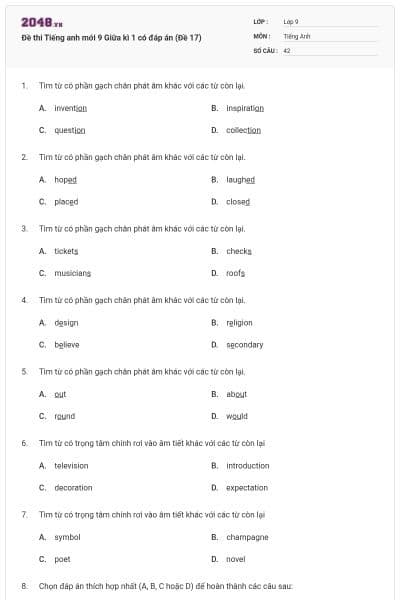
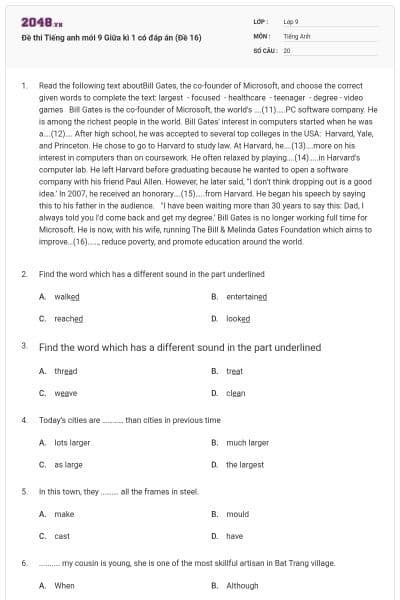
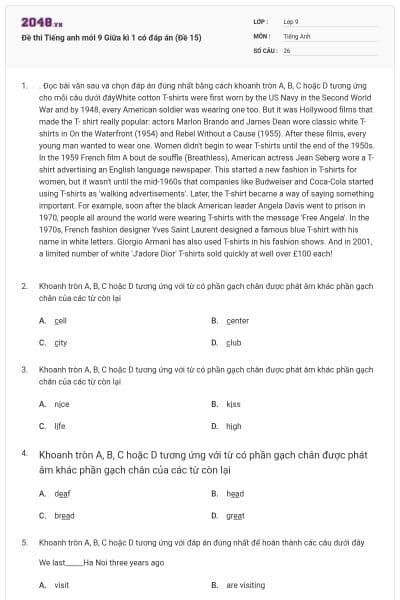
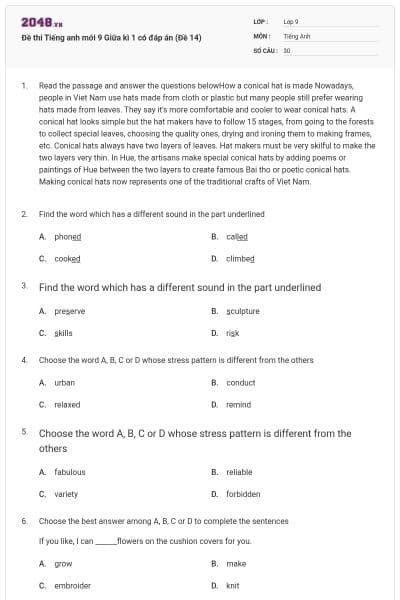
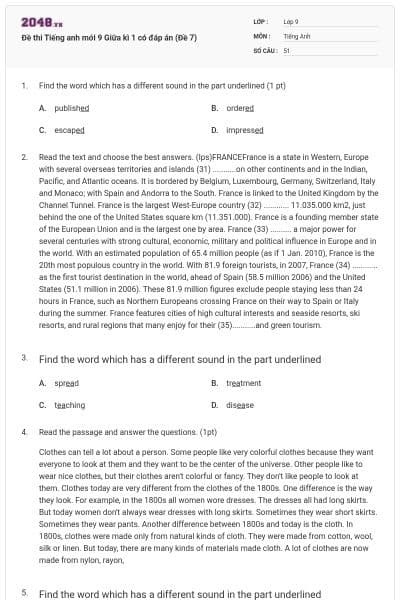
Find the word which has a different sound in the part underlined (1 pt)
published
ordered
escaped
impressed
Đáp án B
Giải thích: đáp án B phát âm là /d/ còn lại là /t/
Find the word which has a different sound in the part underlined
spread
treatment
teaching
disease
Đáp án A
Giải thích: đáp án A phát âm là /e/ còn lại là /ɪ:/
Find the word which has a different sound in the part underlined
deny
terrify
energy
liquefy
Đáp án C
Giải thích: đáp án C phát âm là /ɪ/ còn lại là /aɪ/
Find the word which has a different sound in the part underlined
anyway
imagine
pray
federation
Đáp án B
Giải thích: đáp án B phát âm là /æ/ còn lại là /eɪ/
Choose the word having different stress from the others. (1 pt)
atmosphere
capital
climate
activity
Đáp án D
Giải thích: đáp án D nhấn âm thứ 2 còn lại nhấn âm đầu
Choose the word having different stress from the others.
association
federation
population
correspond
Đáp án A
Giải thích: đáp án A nhấn âm thứ 4 còn lại nhấn âm thứ 3
Choose the word having different stress from the others.
beauty
museum
outline
Tamil
Đáp án B
Giải thích: đáp án B nhấn âm thứ 2 còn lại nhấn âm đầu
Choose the word having different stress from the others.
friendliness
official
separate
puppet
Đáp án B
Giải thích: đáp án B nhấn âm thứ 2 còn lại nhấn âm đầu
Choose the word having different stress from the others.
relative
territory
vacation
currency
Đáp án C
Giải thích: đáp án C nhấn âm thứ 2 còn lại nhấn âm đầu
Choose the best answer to complete the sentences. (3 pts)
The students used to ........... football in that stadium.
play
playing
are playing
played
Đáp án A
Giải thích: used to V: hành động thường xảy ra trong quá khứ và bây giờ không còn nữa
Dịch: Học sinh thường chơi bóng đá ở sân vận động.
He wishes he .......... a billionaire.
will be
is
can be
were
Đáp án D
Giải thích: điều ước ở hiện tại lùi 1 thì về quá khứ đơn
Dịch: Anh ấy ước anh ấy là một tỉ phú.
My car .......... repaired yet.
wasn't
haven't been
hasn't been
isn't
Đáp án C
Giải thích:
- yet =>chia hiện tại hoàn thành
- chủ ngữ số ít nên phải chia động từ
Dịch: Xe hơi của tôi vẫn chưa được sửa.
Lan enjoyed the peaceful atmosphere .......... Maryam was praying.
while
during
because
until
Đáp án A
Giải thích:
- while: trong khi (sau nó là mệnh đề)
- during: trong khi (sau nó là danh từ)
- because: bởi vì
- until: cho đến khi
Dịch: Lan yêu thích bầu không khi yên bình trong khi Maryam đang cầu nguyện.
Some new energy-saving bulbs ......... in the dining-room.
will put
will be putting
will be put
will being put
Đáp án C
Giải thích: câu bị động thì tương lai đơn: will be Vp2
Dịch: Một số đèn tròn tiết kiệm năng lượng sẽ được đặt ở phòng ăn.
We must learn English at school. It's a(n) .......... subject.
primary
compulsory
national
optional
Đáp án B
Giải thích: must (phải) =>compulsory (bắt buộc)
Dịch: Chúng tôi phải học tiếng Anh ở trường. Nó là môn học bắt buộc.
She often goes to the .......... to pray because her religion is Islam.
church
pagoda
temple
mosque
Đáp án D
Giải thích:
- church: nhà thờ
- pagoda: chùa
- temple: đền
- mosque: nhà thờ Hồi giáo
Dịch: Cô ấy thường tới nhà thờ Hồi giáo để cầu nguyện vì cô ấy theo đạo Hồi.
He ................... with his friends in an apartment in Hue since last week.
has lived
living
lives
lived
Đáp án A
Giải thích: có since last week =>chia thì hiện tại hoàn thành
Dịch: Anh ấy đã sống với bạn trong một căn hộ ở Huế từ tuần trước.
. ............ were you born? - In Ha Tay province
When
How
Why
Where
Đáp án D
Giải thích: câu trả lời chỉ địa điểm =>where
Dịch: Bạn sinh ra ở đâu? - Ở tỉnh Hà Tây.
Young people are excited about .... modern clothing instead of traditional ones.
will wear
wearing
being worn
are wearing
Đáp án B
Giải thích: be excited about Ving: hào hứng, thích thú làm gì
Dịch: Những người trẻ thích mặc quần áo hiện đại hơn là những quần áo truyền thống.
Ngoc Anh's father has five daughters - Hong, Hoa, Nhung, Hang, and ... What is the fifth daughter's name?
Nhung
Ngọc Anh
Hoa
Hang
Đáp án B
Giải thích: bố của Ngọc Anh có con gái, liệt kê 4 người và chưa đề cập tới Ngọc Anh =>Ngọc Anh là người con thứ 5
Dịch: Bố của Ngọc Anh có 5 người con gái – Hồng, Hoa, Nhung, Hằng và Ngọc Anh.
I object to ............ unfairly.
criticize
criticizing
criticized
being criticized
Đáp án D
Giải thích: object to being Vp2: phản đối bị làm gì
Dịch: Tôi phản đối việc bị chỉ trích một cách không công bằng.
I've got so much spare time. I'm thinking of taking ............... a new hobby like stamp collecting
in
off
up
over
Đáp án C
Giải thích: take up: bắt đầu một thói quen, sở thích
Dịch: Tôi có rất nhiều thời gian rảnh. Tôi đang nghĩ về việc bắt đầu một sở thích mới chẳng hạn như sưu tập tem.
Workers loved wearing it because the material was very strong and it doesn’t not wear ............ easily.
up
out
in
down
Đáp án B
Giải thích: wear out: sờn, cũ
Dịch: Những người công nhân thích mặc nó vì nguyên liệu rất bền và nó không dễ bị sờn.
If it is icy outdoor. There's a good chance you just might want to put us on your hands. So you can avoid frostbite. What are we?
scarves
gloves
shoes
pants
Đáp án B
Giải thích:
- scarves: khăn
- gloves: găng tay
- shoes: giày
- pants: quần
Dịch: Nếu nó lạnh băng bên ngoài. Nó là cơ hội tốt mà bạn có lẽ muốn mang nó vào tay.
Give the correct form of the words provided to complete the sentences. (1pt)
We're very impressed by the ............... of your town's people.
friendly
friendless
friendiliness
friendship
Đáp án: C
Giải thích:
Kiến thức: Từ vựng – Từ loại
A. friendly (adj): thân thiện
B. friendless (adj): không có bạn
C. friendliness (n): sự thân thiện
D. friendship (n): tình bạn
Vị trí cần điền là một danh từ do đứng sau mạo từ “the”, dựa vào nghĩa chọn C.
Dịch: Chúng tôi rất ấn tượng với sự thân thiện của người dân thị trấn bạn.
Is Buddhism the country's .................. religion of Thailand?
official
offician
officially
officer
Đáp án: A
Giải thích:
Kiến thức: Từ vựng – Từ loại
A. official (adj): chính thức
B. offician: không có từ này
C. officially (adv): một cách chính thức
D. officer (n): sĩ quan, công chức
Vị trí cần điền là một tính từ đứng trước danh từ “religion” (tôn giáo) và bổ nghĩa cho danh từ này. Chọn A.
Dịch: Phật giáo có phải là tôn giáo chính thức của Thái Lan không?
Should English be a ................. foreign language in Viet Nam?
compulsion
compulsory
compel
compulsative
Đáp án B
Giải thích: đứng trước bổ nghĩa cho danh từ cần tính từ
Dịch: Tiếng anh có nên là một ngoại ngữ bắt buộc ở Việt Nam.
Malaysia is a member country of the ............ of South East Asian Nations.
association
associable
associationist
associate
Đáp án A
Giải thích:
- sau the cần một danh từ =>loại B, D
- D không hợp nghĩa
Dịch: Malaysia là một nước thành viên của hiệp hội các quốc gia Đông Nam Á.
In ............., there are other religions such as Buddhism and Hinduism in Malaysia.
add
addition
additional
additionally
Đáp án B
Giải thích: in addition: thêm vào đó
Dịch: Thêm vào đó, có những tôn giáo khác như đạo Phật, đạo Hindu ở Malaysia.
France is a state in Western, Europe with several overseas territories and islands (31) ...........on other continents and in the Indian, Pacific, and Atlantic oceans.
located
locating
locates
locate
Đáp án A
Giải thích: located on: nằm ở
Dịch: Pháp là một quốc gia ở Tây Âu với một số lãnh thổ và hải đảo vượt biển.
France is the largest West-Europe country (32) ............ 11.035.000 km2, just behind the one of the United States square km (11.351.000).
covers
covering
to cover
covered
Đáp án B
Giải thích: rút gọn mệnh đề ở dạng chủ động
Dịch: Pháp là quốc gia lớn nhất ở Tây Âu, bao bọc 11.035.000 km2.
France (33) .......... a major power for several centuries with strong cultural, economic, military and political influence in Europe and in the world.
is
was
has been
will be
Đáp án A
Giải thích: sự thật hiển nhiên =>chia thì hiện tại đơn
Dịch: Pháp là một cường quốc trong nhiều thế kỷ với ảnh hưởng mạnh mẽ về văn hóa, kinh tế, quân sự và chính trị ở châu Âu và trên thế giới.
With 81.9 foreign tourists, in 2007, France (34) ............ as the first tourist destination in the world, ahead of Spain (58.5 million 2006) and the United States (51.1 million in 2006).
is ranked
ranks
ranking
was ranked
Đáp án D
Giải thích: in 2007 =>chia thì quá khứ đơn
Dịch: Với 81,9 khách du lịch nước ngoài, năm 2007, Pháp được xếp hạng là điểm đến du lịch đầu tiên trên thế giới, xếp sau Tây Ban Nha (58,5 triệu năm 2006) và Hoa Kỳ (51,1 triệu năm 2006).
France features cities of high cultural interests and seaside resorts, ski resorts, and rural regions that many enjoy for their (35)...........and green tourism.
beautiful
beautician
beauty
beautify
Đáp án C
Giải thích: sau tính từ sở hữu cần danh từ
Dịch: Pháp có các thành phố có lợi ích văn hóa cao và các khu nghỉ mát bên bờ biển, khu trượt tuyết và các vùng nông thôn mà nhiều người thích thú vì vẻ đẹp và du lịch xanh.
Read the passage and answer the questions. (1pt)
Clothes can tell a lot about a person. Some people like very colorful clothes because they want everyone to look at them and they want to be the center of the universe. Other people like to wear nice clothes, but their clothes aren't colorful or fancy. They don't like people to look at them. Clothes today are very different from the clothes of the 1800s. One difference is the way they look. For example, in the 1800s all women wore dresses. The dresses all had long skirts. But today women don't always wear dresses with long skirts. Sometimes they wear short skirts. Sometimes they wear pants. Another difference between 1800s and today is the cloth. In 1800s, clothes were made only from natural kinds of cloth. They were made from cotton, wool, silk or linen. But today, there are many kinds of materials made cloth. A lot of clothes are now made from nylon, rayon,
Why do some people like very colorful clothes ?
Because they like different colors.
Because they want to be the center of the universe.
Because they don't want everyone to look at them.
Because colorful clothes are always nice.
Đáp án B
Giải thích: dựa vào câu “Some people like very colorful clothes because they want everyone to look at them, and they want to be the center of the universe.”
Dịch: Một số người thích quần áo sặc sỡ vì họ muốn mọi người nhìn vào họ và họ muốn trở thành trung tâm của vũ trụ.
Dịch bài đọc
Quần áo có thể nói lên rất nhiều điều về một người. Một số người thích quần áo rất nhiều màu sắc vì họ muốn mọi người nhìn vào họ và họ muốn trở thành trung tâm của vũ trụ. Những người khác thích mặc quần áo đẹp, nhưng quần áo của họ không nhiều màu sắc hoặc cầu kỳ. Họ không thích mọi người nhìn vào họ. Quần áo ngày nay rất khác so với quần áo của những năm 1800. Một điểm khác biệt là cách chúng trông như thế nào. Ví dụ, vào những năm 1800, tất cả phụ nữ đều mặc váy. Tất cả các loại váy đều có váy dài. Nhưng ngày nay, phụ nữ không phải lúc nào cũng mặc váy có váy dài. Đôi khi họ mặc váy ngắn. Đôi khi họ mặc quần. Một điểm khác biệt nữa giữa những năm 1800 và ngày nay là vải. Vào những năm 1800, quần áo chỉ được làm từ các loại vải tự nhiên. Chúng được làm từ cotton, len, lụa hoặc vải lanh. Nhưng ngày nay, có rất nhiều loại chất liệu làm vải. Rất nhiều quần áo hiện được làm từ nylon, tơ nhân tạo.
What kind of clothes do other people like to wear?
They like to wear modern clothes.
They like to wear colorful clothes.
They like to wear beautiful clothes.
They like to wear traditional clothes.
Đáp án C
Giải thích: dựa vào câu “Other people like to wear nice clothes, but their clothes are not colorful or fancy.”
Dịch: Những người khác thích mặc quần áo đẹp những quần áo của họ thì không sặc sỡ và bóng bẩy.
Were the clothes of the 1800s the same as clothes today?
Yes, the clothes of the 1800s were the same as clothes today.
No, clothes today are very different from the clothes of the 1800s.
No, the clothes of the 1800s were the same as clothes today.
Yes, clothes today are not different from the clothes of the 1800s.
Đáp án B
Giải thích: dựa vào câu “Clothes today are very different from the clothes of the 1800s.”
Dịch: Quần áo ngày nay thì rất khác so với quần áo của những thập niên 1800.
And what kind of clothes did all women wear in the 1800s ?
In the 1800s, all women wore dark skirts.
In the 1800s, all women wore long-sleeved blouses.
In the 1800s, all women wore modern clothing.
In the 1800s, all women wore dresses.
Đáp án D
Giải thích: dựa vào câu “in the 1800s all women wore dresses.”
Dịch: Vào thập niên 1800 tất cả phụ nữ đều mặc váy.
What do sometimes women wear today?
They wear short skirts and pants.
They wear short - sleeved skirts and suits.
They wear T-shirts and pants.
They wear long skirts and jeans.
Đáp án A
Giải thích: dựa vào câu “Sometimes they wear short skirts. Sometimes they wear pants.”
Dịch: Thỉnh thoảng họ mặc váy ngắn. Thỉnh thoảng họ mặc quần.
Write full sentences, do as directed in the parentheses (1 pt)
We haven't eaten meat since last month. (Make the questions for the underlined part)
Đáp án: How long haven’t you eaten meat?
Giải thích: since last month (từ tháng trước) =>long long (bao lâu)
Dịch: Bao lâu bạn chưa ăn thịt rồi?
farm/ meat/ the/ kept/ produce/ cows/milk/ on/ are/ and/to/.(Rearrange the words to make meaningful sentence)
Đáp án: Cows are kept on the farm to produce meat and milk.
Dịch: Bò được giữ ở trang trại để sản xuất thịt và sữa.
tourists / feel/ happy/ when/they/ go/ Ha Noi (Write a complete sentence using the words given)
Đáp án: The tourists felt happy when they went to Ha Noi.
Dịch: Du khách thấy vui vẻ khi họ đến Hà Nội.
Some designers have modernized the Ao Dai by printing lines of poetry on it. (Change the sentence into passive voice)
Đáp án: The Ao Dai has been modernized by printing lines of poetry by some designers.
Giải thích: câu bị động: tobe+Vp2
Dịch: Áo Dài được hiện đại hóa bằng việc in những dòng thơ bởi một số nhà thiết kế.
"Do you live in the city, Maryam?" said Lan. (Change the sentence into reported speech)
→ ............
Đáp án: Lan asked Maryam if she lived in the city.
Giải thích: câu gián tiếp với Yes/No question: A asked B if/whether+mệnh đề lùi 1 thì
Dịch: Lan hỏi Maryam có phải cô ấy sống ở thành phố không.
Complete the sentences so that it has a similar meaning to the first (1pt)
When did she begin to work for this company?
→ How long
Đáp án: How long has she been working for this company?
Giải thích: When+did+S+begin+to V…? = How long+have/has+S+been Ving…?
Dịch: Khi nào anh ấy bắt đầu làm việc ở công ty này?
What a pity! I don't have a mobile phone here.
->I wish........
Đáp án: I wish I had a mobile phone here.
Giải thích: câu ước ở hiện tại lùi 1 thì về quá khứ
Dịch: Tôi ước tôi có điện thoại di động ở đây.
David has never been to Ha Noi, the capital of Vietnam before.
→ This is the first
Đáp án: This is the first time David has been to Ha Noi, the capital of Vietnam.
Giải thích: This is first/second…time+mệnh đề ở thì hiện tại hoàn thành
Dịch: Đây là lần đầu tiên David tới Hà Nội, thủ đô của Việt Nam.
People won't burn fossil fuels for energy in the future.
→ Fossil fuels
Đáp án: Fossil fuels won’t be burnt for energy in the future.
Giải thích: câu bị động: tobe Vp2
Dịch: Nhiên liệu hóa thạch sẽ không được đốt để lấy năng lượng trong tương lai.
John smoked a lot a year ago, but now he doesn't smoke any more.
→ John used
Đáp án: John used to smoke a lot a year ago.
Giải thích: used to V: hành động thường xảy ra trong quá khứ và bây giờ không còn nữa
Dịch: John từng hút thuốc rất nhiều một năm trước.
Bạn có thích hoạt động này không?