Đề thi Tiếng Anh 9 Học kì 1 có đáp án (Đề 3)
26 câu hỏi
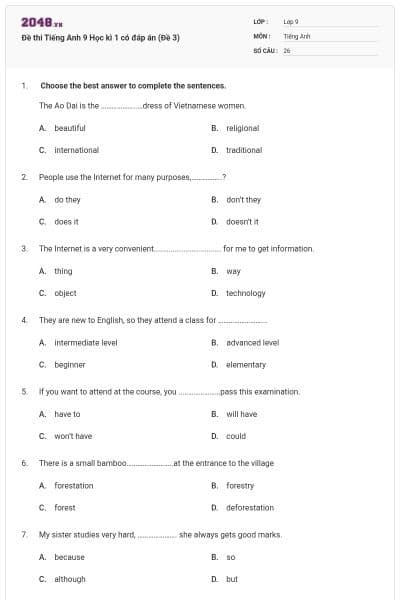
Choose the best answer to complete the sentences.
The Ao Dai is the ………………..…dress of Vietnamese women.
beautiful
religional
international
traditional
Đáp án: D
People use the Internet for many purposes,……………..?
do they
don’t they
does it
doesn’t it
Đáp án: B
The Internet is a very convenient................................ for me to get information.
thing
way
object
technology
Đáp án: B
They are new to English, so they attend a class for ……………………...
intermediate level
advanced level
beginner
elementary
Đáp án: C
If you want to attend at the course, you ..…………………pass this examination.
have to
will have
won’t have
could
Đáp án: A
There is a small bamboo……………………..at the entrance to the village
forestation
forestry
forest
deforestation
Đáp án: C
My sister studies very hard, …………………. she always gets good marks.
because
so
although
but
Đáp án: B
Choose the word that has the different underlined part:
primary
divide
comprise
religion
Đáp án: D
Use the correct form of the word given in each sentence.
Do you surf the Internet for fun or ……………………….? (educate)
Đáp án: education
The singer’s voice is …………………….. (excellence)
Đáp án: excellent
Read the passage and decide statements T (True) or F (False)
Dong Nai province is at the Eastern approach to Ho Chi Minh city. Its provincial city is Bien Hoa city. The Kinh people account for 82.8% of the total population. The ethnic minority groups are Tay, Kho Mu, Nung, Dao and Ma . This area is famous throughout the eastern part of south Vietnam for its picturesque landscapes .This is a very suitable destination ror Saigonese to make some short picnics.
Question: Dong Nai province is at the Western approach to Ho Chi Minh City.
True
False
Đáp án: B
Read the passage and decide statements T (True) or F (False)
Dong Nai province is at the Eastern approach to Ho Chi Minh city. Its provincial city is Bien Hoa city. The Kinh people account for 82.8% of the total population. The ethnic minority groups are Tay, Kho Mu, Nung, Dao and Ma . This area is famous throughout the eastern part of south Vietnam for its picturesque landscapes .This is a very suitable destination ror Saigonese to make some short picnics.
Question: The Kinh people account over 80%.
True
False
Đáp án: A
Read the passage and decide statements T (True) or F (False)
Dong Nai province is at the Eastern approach to Ho Chi Minh city. Its provincial city is Bien Hoa city. The Kinh people account for 82.8% of the total population. The ethnic minority groups are Tay, Kho Mu, Nung, Dao and Ma . This area is famous throughout the eastern part of south Vietnam for its picturesque landscapes .This is a very suitable destination ror Saigonese to make some short picnics.
Question: There are 5 ethnic groups in Dong Nai.
True
False
Đáp án: B
Read the passage and decide statements T (True) or F (False)
Dong Nai province is at the Eastern approach to Ho Chi Minh city. Its provincial city is Bien Hoa city. The Kinh people account for 82.8% of the total population. The ethnic minority groups are Tay, Kho Mu, Nung, Dao and Ma . This area is famous throughout the eastern part of south Vietnam for its picturesque landscapes .This is a very suitable destination ror Saigonese to make some short picnics.
Question: Nobody comes to Dong Nai for recreation.
True
False
Đáp án: B
Read the passage and decide statements T (True) or F (False)
Dong Nai province is at the Eastern approach to Ho Chi Minh city. Its provincial city is Bien Hoa city. The Kinh people account for 82.8% of the total population. The ethnic minority groups are Tay, Kho Mu, Nung, Dao and Ma . This area is famous throughout the eastern part of south Vietnam for its picturesque landscapes .This is a very suitable destination ror Saigonese to make some short picnics.
Question: Saigonese usually have short picnics in Dong Nai.
True
False
Đáp án: A
Read the passage about clothes, then answer the questions below.
Clothes can tell a lot about a person. Some people like very colorful clothes because they want everyone to look at them and they want to be the center of things. Other people like to wear nice clothes, but their clothes are not colorful or fancy. They do not like people to look at them. Clothes today are very different from the clothes of the 1800s. One difference is the way they look. For example, in the 1800s all women wore dresses. The dresses all had long skirts.
But today women do not always wear dresses with long skirts .Sometimes they wear short skirts. Sometimes they wear pants. Another difference between1800s and today is the cloth. In the 1800s, clothes were made only from natural kinds of cloth. They were made from cotton, wool, silk, or linen. But today, there are many kinds of man–made cloth. A lot of clothes are now made from nylon, rayon, or polyester.
Why do some people like very colorful clothes?
→ …………………………………………………………………………
Đáp án: Because they want everyone to look at them and they want to be the center of things.
Read the passage about clothes, then answer the questions below.
Clothes can tell a lot about a person. Some people like very colorful clothes because they want everyone to look at them and they want to be the center of things. Other people like to wear nice clothes, but their clothes are not colorful or fancy. They do not like people to look at them. Clothes today are very different from the clothes of the 1800s. One difference is the way they look. For example, in the 1800s all women wore dresses. The dresses all had long skirts.
But today women do not always wear dresses with long skirts .Sometimes they wear short skirts. Sometimes they wear pants. Another difference between1800s and today is the cloth. In the 1800s, clothes were made only from natural kinds of cloth. They were made from cotton, wool, silk, or linen. But today, there are many kinds of man–made cloth. A lot of clothes are now made from nylon, rayon, or polyester.
Were the clothes of the 1800s the same as clothes today?
→ …………………………………………………………………………
Đáp án: No, they weren’t.
Read the passage about clothes, then answer the questions below.
Clothes can tell a lot about a person. Some people like very colorful clothes because they want everyone to look at them and they want to be the center of things. Other people like to wear nice clothes, but their clothes are not colorful or fancy. They do not like people to look at them. Clothes today are very different from the clothes of the 1800s. One difference is the way they look. For example, in the 1800s all women wore dresses. The dresses all had long skirts.
But today women do not always wear dresses with long skirts .Sometimes they wear short skirts. Sometimes they wear pants. Another difference between1800s and today is the cloth. In the 1800s, clothes were made only from natural kinds of cloth. They were made from cotton, wool, silk, or linen. But today, there are many kinds of man–made cloth. A lot of clothes are now made from nylon, rayon, or polyester.
Who wore dresses with long skirts in the 1800s?
→ ……………………………………………………………………
Đáp án: In the 1800s all women wore dresses.
Read the passage about clothes, then answer the questions below.
Clothes can tell a lot about a person. Some people like very colorful clothes because they want everyone to look at them and they want to be the center of things. Other people like to wear nice clothes, but their clothes are not colorful or fancy. They do not like people to look at them. Clothes today are very different from the clothes of the 1800s. One difference is the way they look. For example, in the 1800s all women wore dresses. The dresses all had long skirts.
But today women do not always wear dresses with long skirts .Sometimes they wear short skirts. Sometimes they wear pants. Another difference between1800s and today is the cloth. In the 1800s, clothes were made only from natural kinds of cloth. They were made from cotton, wool, silk, or linen. But today, there are many kinds of man–made cloth. A lot of clothes are now made from nylon, rayon, or polyester.
What is another difference between 1800s and today?
→ ………………………………………………………………….
Đáp án: Another difference between1800s and today is the cloth.
Read the passage about clothes, then answer the questions below.
Clothes can tell a lot about a person. Some people like very colorful clothes because they want everyone to look at them and they want to be the center of things. Other people like to wear nice clothes, but their clothes are not colorful or fancy. They do not like people to look at them. Clothes today are very different from the clothes of the 1800s. One difference is the way they look. For example, in the 1800s all women wore dresses. The dresses all had long skirts.
But today women do not always wear dresses with long skirts .Sometimes they wear short skirts. Sometimes they wear pants. Another difference between1800s and today is the cloth. In the 1800s, clothes were made only from natural kinds of cloth. They were made from cotton, wool, silk, or linen. But today, there are many kinds of man–made cloth. A lot of clothes are now made from nylon, rayon, or polyester.
Are there many kinds of man –made cloth?
→ ………………………………………………………………….
Đáp án: Yes, they are.
Complete the second sentence so that it has a similar meaning to the first.
It’s a pity I can’t play the guitar well.
→ I wish……………………………………..………………………………..
Đáp án: I wish I could play the guitar well.
I have been doing homework for two hours.
→ I started …………………………………………………………………
Đáp án: I started doing homework two hours ago.
Study hard or you will fail the final exam.
→ If you………………………………………………………..
Đáp án: If you don’t study hard, you will fail the final exam.
Giải thích:
Kiến thức: Câu điều kiện loại 1
Câu đầu ta thấy diễn tả điều kiện và kết quả có thể xảy ra trong tương lai, nên đây là câu điều kiện loại 1.
Cấu trúc:
If + mệnh đề hiện tại đơn, mệnh đề tương lai đơn.
Dịch: Hãy học chăm chỉ nếu không bạn sẽ trượt kỳ thi cuối kỳ.
→ Nếu bạn không học chăm chỉ, bạn sẽ trượt kỳ thi cuối kỳ.
They will build a new market near my house.
→ A new market………………………………………………………….
Đáp án: A new market will be built near my house.
“Are you going to my party tonight?” She asked me.
→ She asked me ……
Đáp án: She asked me if / whether I was going to her party that night.
“Why don’t you come to class today?” she asked me.
→ She asked me………………………………………………………
Đáp án: She asked me why I didn’t come to class that day.
Giải thích:
Kiến thức: Câu gián tiếp
Khi chuyển từ câu trực tiếp sang câu tường thuật:
Lùi thì: Hiện tại đơn (don't… come) → Quá khứ đơn (didn't come).
Đổi trạng từ chỉ thời gian:
today → that day
Đổi cấu trúc câu hỏi gián tiếp: Đưa về dạng trần thuật (Subject + Verb), không đảo ngữ.
Dịch: “Sao hôm nay bạn không đến lớp?” cô ấy hỏi tôi.
→ Cô ấy hỏi tôi tại sao hôm đó tôi không đến lớp.
Bạn có thích hoạt động này không?