Đề thi Tiếng anh mới 9 Giữa kì 1 có đáp án (Đề 6)
40 câu hỏi
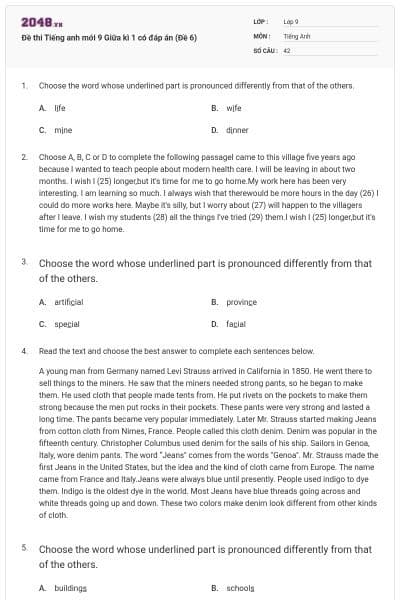
Choose the word whose underlined part is pronounced differently from that of the others.
life
wife
mine
dinner
Đáp án D
Giải thích: đáp án D phát âm là /ɪ/, các đáp án còn lại phát âm là /ai/
Choose the word whose underlined part is pronounced differently from that of the others.
artificial
province
special
facial
Đáp án B
Giải thích: đáp án B phát âm là /s/, các đáp án còn lại phát âm là /ʃ/
Choose the word whose underlined part is pronounced differently from that of the others.
buildings
schools
zoos
markets
Đáp án D
Giải thích: đáp án D phát âm là /s/, các đáp án còn lại phát âm là /z/
Choose the word whose underlined part is pronounced differently from that of the others.
invited
visited
wished
rested
Đáp án C
Giải thích: đáp án C phát âm là /t/, các đáp án còn lại phát âm là /id/
Choose the word whose underlined part is pronounced differently from that of the others.
what
who
where
which
Đáp án B
Giải thích: Đáp án B phát âm là /h/, các đáp án còn lại phát âm là /w/
Choose A, B, C, or D to comptete the following sentences.
Miss Hoa is very ____. She goes to church every morning.
religious
religiously
religion
religioner
Đáp án A
Giải thích: chỗ trống ở đây cần một tính từ, các đáp án còn lại là trạng từ và danh từ
Dịch: Cô Hoa là người sùng đạo. Cô ấy tới nhà thờ mỗi sáng.
Did he_____live in the country when he was young?
use to
used to
get used to
be used to
Đáp án A
Giải thích: Did+S+use to V…?: câu hỏi về hành động thường xuyên xảy ra trong quá khứ và bây giờ không còn nữa
Dich: Anh ấy từng hay sống ở nông thôn khi anh ấy còn trẻ không?
Jame wishes his father_____here now to help him
is
were
will be
would be
Đáp án B
Giải thích:
- Câu ước ở hiện tại lùi 1 thì về quá khứ đơn
- Đối vs câu ước, tobe sau wish dùng were với mọi chủ ngữ
Dịch: Jame ước gì bố anh ấy ở đây bây giờ để giúp anh ấy.
_______ French with native people yet ?
Did you learn
Were you learning
Do you learn
Have you learnt
Đáp án D
Giải thích: dùng thì hiện tại hoàn thành (vì có “yet”)
Dịch: Bạn đã từng học tiếng Pháp với người bản ngữ chưa?
Is this the second time you_____a car ?
drive
drove
have driven
are driving
Đáp án C
Giải thích: dùng thì hiện tại hoàn thành (vì có “the second time”)
Dịch: Đây có phải lần thứ hai bạn lái xe hơi không?
No one knows why the man_____
killed
kills
is killed
was killed
Đáp án D
Giải thích:
- Chỗ trống ở đây cần ở dạng bị động
- Hành động đã xảy ra trong quá khứ =>chia QKĐ
Dịch: Không ai biết vì sao anh ấy đã bị giết.
She has worked in this company______seven days
in
on
at
for
Đáp án D
Giải thích:
- Ở thì hiện tại hoàn thành: for+khoảng thời gian: trong bao lâu
Dịch: Cô ấy đã làm việc ở công ty này được 7 ngày rồi.
Where is your home village? It is_____the north of Ho Chi Minh city
on
at
to
after
Đáp án A
Giải thích: on the north of: ở miền Bắc của
Dịch: Làng quê của bạn ở đâu? Nó ở phía Bắc của thành phố Hồ Chí Minh.
Choose the best answer to complete the short dialogues.
“How do you do?’’ – “_______”
How do you do?
Not too bad.
I’m well. Thank you.
Yeah, OK.
Đáp án A
Giải thích: “How do you do” dùng để chào hỏi và cũng dùng “How do you do” để đáp lại
“Happy Christmas!” – “_______”
The same to you!
Happy Christmas with you!
You are the same!
Same for you!
Đáp án: A
Giải thích:
Dịch:
“Giáng sinh vui vẻ!”
“______”
A. Chúc bạn cũng vậy!
B. Sai ở “with”
C. Bạn cũng giống thế mà!
D. Không dùng “same for”
Chọn A phù hợp nhất về nghĩa.
Choose the word or phrase that is CLOSET in meaning to the underlined part in each of the following sentences
It is risky to travel across the mountain at night.
safe
unsafe
convenient
inconvenient
Đáp án B
Giải thích: risky = unsafe: không an toàn
Dịch: Nó thì nguy hiểm để băng qua núi vào ban đêm.
Nam would like to find out more about the customs and traditions of Tay people
to see
to look for
to learn
to watch
Đáp án C
Giải thích: to find out = to learn: khám phá, tìm hiểu
Dịch: Nam muốn tìm hiểu thêm về những tập quán và truyền thống của người Tày.
Choose the word or phrase that is OPPOSITE in meaning to the underlined part in each of the following sentences
The majority of The Viet live along the Red River and The Mekong Delta
a half
all
minority
none
Đáp án C
Giải thích: majority (đa số) >< minority (thiểu số)
Dịch: Đa số người Việt sống dọc đồng bằng sông Hồng và sông Mê Kông.
</>
Gong is considered a unique musical instrument of Tay Nguyen people
rare
special
typical
common
Đáp án D
Giải thích: unique (độc nhất) >< common (phổ biến)
Dịch: Gông được xem như một nhạc cụ độc nhất của người Tây Nguyên.
</>
Choose the underlined part that needs correcting in each sentence below
My dad has been (A) a (B)stamp collection (C) for more (D)than 20 years
Đáp án A
Giải thích: has been =>has been had
Dịch: Bố tôi đã có một bộ sưu tập tem được 20 năm nay.
Traditional (A), people in this mountainous (B)area live (C)a nomadic (D)life
Đáp án A
Giải thích: Traditional =>Traditionally (đứng mình ở đầu câu trước dấu phẩy cần dùng một trạng từ)
Dịch: Theo truyền thống, người dân ở những khu vực miền núi sống nay đây mai đó.
Question 22: How many (A)month is (B)Huong Pagoda Festival held (C) in (D)?
Đáp án A
Giải thích: how many =>which (vì đang hỏi một tháng cụ thể)
Dịch: Lễ hội chùa Hương được tổ chức vào tháng nào?
How many (A)month is (B)Huong Pagoda Festival held (C) in (D)?
Đáp án A
Giải thích: how many =>which (vì đang hỏi một tháng cụ thể)
Dịch: Lễ hội chùa Hương được tổ chức vào tháng nào?
Books can be used (A)as a tool opening (B) up (C)new worlds for (D)children
Đáp án B
Giải thích: opening =>to open (be used as …to V: được sử dụng như …để làm gì
Dịch: Sách có thể được sử dụng như một công cụ mở ra những thế giới mới cho trẻ em.
Spend (A)time with famil can always be (B)the most precious (C) experience (D)to anyone.
Đáp án A
Giải thích: Spend =>spending (động từ đứng đầu làm chủ ngữ cần để dạng Ving)
Dịch: Dành thời gian cho gia đình có thể là những trải nghiệm quý giá nhất với mỗi người.
I wish I (25) longer,but it's time for me to go home.
can stay
could stay
stay
will stay
Đáp án B
Giải thích: Điều ước ở hiện tại lùi 1 thì về quá khứ đơn
Dịch: Tôi ước rằng tôi có thể ở lại lâu hơn.
I always wish that therewould be more hours in the day (26) I could do more works here.
so that
but
and
because
Đáp án A
Giải thích:
- so that: để làm gì
- but: nhưng
- and: và
- because: bởi vì
Dịch: Tôi ước rằng một ngày có nhiều tiếng hơn để tôi có thể làm nhiều việc hơn ở đây.
Maybe it's silly, but I worry about (27) will happen to the villagers after I leave.
which
what
why
when
Đáp án B
Giải thích:
- which: cái gì (thường hỏi sự lựa chọn)
- what: cái gì
- why: vì sao
- when: khi nào
Dịch: Có lẽ nó thì ngu ngốc nhưng tôi lo lắng về những thứ sẽ xảy ra với dân làng sau khi tôi dời đi.
I wish my students (28) all the things I've tried (29) them.
remember
remembered
can remember
will remember
Đáp án B
Giải thích: điều ước ở hiện tại lùi 1 thì về quá khứ đơn
Dịch: Tôi ước những học sinh của tôi sẽ nhớ được những thứ.
I wish my students remembered all the things I've tried (29) them.
taught
teaching
to teach
to teaching
Đáp án C
Giải thích: try to V: cố gắng để làm gì
Dịch: Tôi ước những học sinh của tôi sẽ nhớ được những thứ mà tôi đã cố gắng để dạy họ.
Read the text and choose the best answer to complete each sentences below.
A young man from Germany named Levi Strauss arrived in California in 1850. He went there to sell things to the miners. He saw that the miners needed strong pants, so he began to make them. He used cloth that people made tents from. He put rivets on the pockets to make them strong because the men put rocks in their pockets. These pants were very strong and lasted a long time. The pants became very popular immediately. Later Mr. Strauss started making Jeans from cotton cloth from Nimes, France. People called this cloth denim. Denim was popular in the fifteenth century. Christopher Columbus used denim for the sails of his ship. Sailors in Genoa, Italy, wore denim pants. The word “Jeans" comes from the words "Genoa". Mr. Strauss made the first Jeans in the United States, but the idea and the kind of cloth came from Europe. The name came from France and Italy.Jeans were always blue until presently. People used indigo to dye them. Indigo is the oldest dye in the world. Most Jeans have blue threads going across and white threads going up and down. These two colors make denim look different from other kinds of cloth.
The word denim comes from the name of a city in....
France
India
Italy
Germany
Đáp án A
Giải thích: Dẫn chứng ở câu “Later Mr. Strauss started making Jeans from cotton cloth from Nimes, France. People called this cloth denim.”
Dịch: Sau đấy, ông Strauss đã bắt đầu làm quần jean từ vải cốt-tông từ Nimes, France. Người ta gọi loại vải này là denim.
The word “jeans” is from the name of a city in.........
France
The United States
Italy
Germany
Đáp án C
Giải thích: Dẫn chứng ở câu “Sailors in Genoa, Italy, wore denim pants. The word “Jeans" comes from the words "Genoa".
Dịch: những thủy thủ ở Genoa, Ý, đã từng mặc quần denim. Từ “jeans” bắt nguồn từ từ “Genoa”.
Levi Strauss went to California to_______
sell things to miners
look for gold
make jeans
be a sailor
Đáp án A
Giải thích: dẫn chứng ở câu “A young man from Germany named Levi Strauss arrived in California in 1850. He went there to sell things to the miners.”
Dịch: Một người trẻ tuổi đến từ Đức tên Levi Strauss đến California vào năm 1850. Anh ấy đến đây đẻ bán đồ cho thợ mỏ.
Rivets...........
make good sails
make tents strong
come from Genoa
make the pockets of jeans strong
Đáp án D
Giải thích: dẫn chứng ở câu “He put rivets on the pockets to make them strong because the men put rocks in their pockets.”
Dịch: Họ gắn đinh tán lên túi để làm chúng mạnh mẽ hơn bởi vì những người thợ đặt đá vào túi của họ.
Cloth is made from thousands of .........
tents
sails
factories
threads
Đáp án A
Giải thích: dẫn chứng ở câu “He used cloth that people made tents from.”
Dịch: Anh ấy sử dụng vải mà người ta làm ra lều.
Choose the best answer (a.b.c or d.) that is the same meaning with the italic sentence.
What a pity ! you aren't here with us now.
I wish you aren't here with us now.
I wish you weren't here with us now.
I wish you were here with us now.
I wish you would be here wish us now.
Đáp án C
Giải thích: Câu ước ở hiện tại lùi một thì về quá khứ đơn (B, D sai vì không hợp nghĩa)
Dịch: Tôi ước rằng bạn ở đây với chúng tôi.
Playing board games is very interesting.
It is very interested in playing board games.
It is very interested to play board games.
It is very interesting playing board games.
It is very interesting to play board games.
Đáp án D
Giải thích:
- Bản chất của một vật =>dùng tính từ ở dạng đuôi ing not ed
- be adj to V: như thế nào để làm gì
Dịch: Nó thì thú vị khi chơi trò chơi điện tử.
He usually plays the piano at night.
He used to play the piano at night.
He is used to play the piano at night.
He is used to playing the piano at night.
He was used to playing the piano at night.
Đáp án C
Giải thích: be used to Ving: đã quen với việc gì
Dịch: Anh ấy đã quen với việc chơi piano vào ban đêm.
Circle the correct sentence (A,B, C or D) made from the suggested words.
there / many /jeans / are / in /my /store /clothing.
There many jeans are in my clothing store.
There are many jeans in my clothing store.
Many jeans are there in my clothing store.
In my clothing store are many jeans there.
Đáp án B
Dịch: Có rất nhiều quần jean trong cửa hàng quần áo của tôi.
haven't / Sue / we/ a / time / seen / for / long /.
Sue haven't seen we for a long time.
We haven't seen Sue for a time long.
We haven't seen Sue for long a time.
We haven't seen Sue for a long time.
Đáp án D
Dịch: Chúng tôi đã không gặp Sue trong một khoảng thời gian dài.
being / it / that / unsafe / block / down /of / because / is / flats / pulled / is /.
That block of flats is being pulled down because it is unsafe.
That block is being pulled down because it is unsafe of flats.
It is unsafe because that block of flats is being down pulled.
That block of flats is pulled down because it is being unsafe.
Đáp án A
Dịch: Tòa chung cư kia đang bị tháo dỡ vì nó không an toàn.
Bạn có thích hoạt động này không?