Đề thi chính thức Tiếng Anh vào 10 năm 2020-2021 (Đề 20)
25 câu hỏi
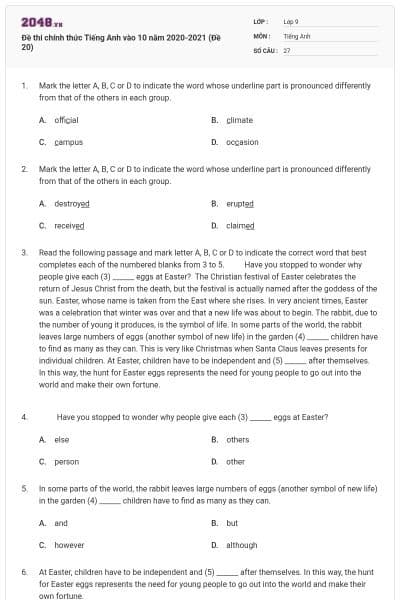
Mark the letter A, B, C or D to indicate the word whose underline part is pronounced differently from that of the others in each group.
official
climate
campus
occasion
Đáp án A
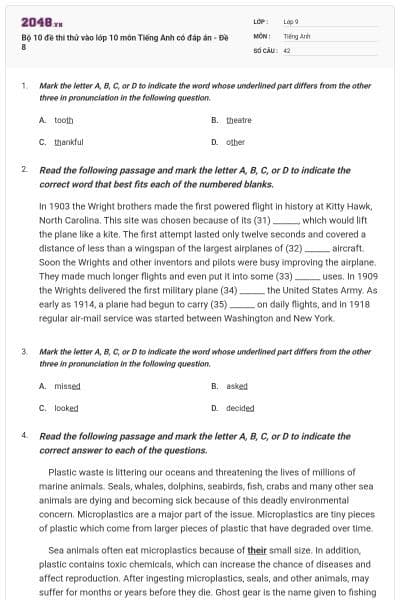
Mark the letter A, B, C or D to indicate the word whose underline part is pronounced differently from that of the others in each group.
destroyed
erupted
received
claimed
Đáp án B
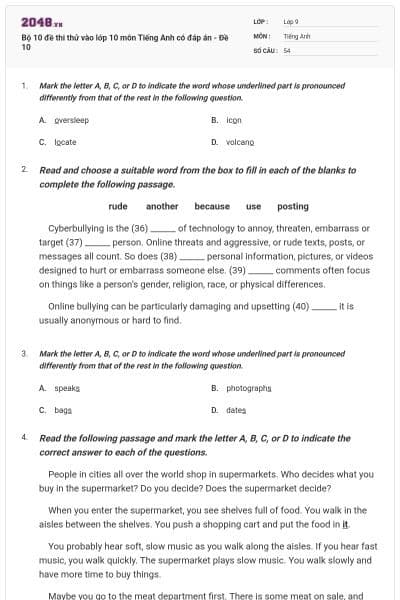
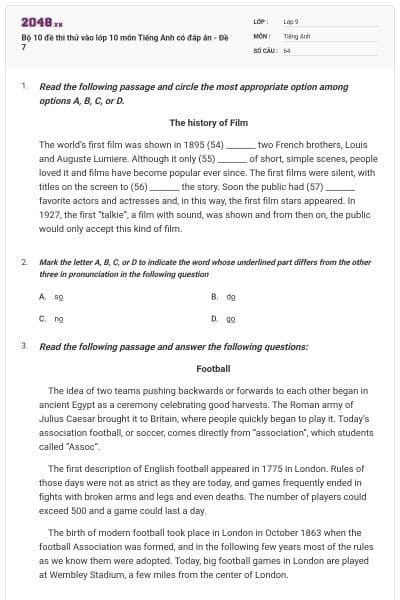
Have you stopped to wonder why people give each (3) ______ eggs at Easter?
else
others
person
other
Đáp án D
and
but
however
although
Đáp án A
carry
get
look
take
Đáp án C
Mark letter A, B, C or D to indicate the part that is incorrect.
Mike, as well as his classmates, are excited about the trip to the countryside next weekend.
about
the
as
are
Đáp án D
happens
who
of
typhoon
Đáp án B
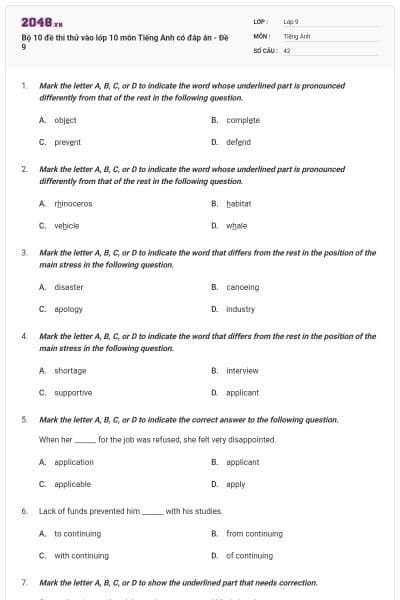
Mark letter A, B, C or D to indicate the word whose main stress position is placed differently from that of the others in each group
modern
prefer
hobby
village
Đáp án B
Mark letter A, B, C or D to indicate the word whose main stress position is placed differently from that of the others in each group
volcanic
disaster
separate
addition
Đáp án C
Mark letter A, B, C or D to indicate the word OPPOSITE in meaning to the underlined word.
Sarah was unhappy as she did badly in her exams.hard
carelessly
well
quickly
Đáp án C
Mark letter A, B, C, or D to indicate the correct preposition or adverb particle that completes each of the sentences.
In the 18th century, workers loved jean cloth because it did not wear ______ easily.
by
up
out
over
Đáp án C
at
to
of
in
Đáp án B
Read the following passage and mark letter A, B, C or D to indicate the correct answer to each of the questions.
English is one of the most popular languages in the world. It comes second in the number of speakers after Chinese. In Vietnam, more and more people are studying English and they consider it a key to success. However, not everyone knows how to learn English effectively. The best way to improve the four skills: speaking, listening, reading, and writing is to practice regularly. You should make use of every opportunity to speak English with friends in class or at English speaking clubs or yourselves in front of the mirror. Learning by heart all the words does not help much if you do not read a lot because you will easily forget what you have learnt. Reading books, listening to radio and watching films are better ways to memorize words. Besides, English learners should not be so shy because making mistakes is unavoidable in learning foreign languages. Practicing speaking a lot is a good way to correct your mistakes.
According to the passage, which of the following statements is TRUE?
Practicing regularly is the best way to improve English skills.
English is the most popular language in the world.
English is spoken by more people than Chinese.
You should never speak English with yourselves.
Đáp án: A
Giải thích:
Dịch: Theo đoạn văn, câu nào sau đây là ĐÚNG?
A. Luyện tập thường xuyên là cách tốt nhất để cải thiện kỹ năng tiếng Anh.
B. Tiếng Anh là ngôn ngữ phổ biến nhất trên thế giới.
C. Tiếng Anh được nhiều người nói hơn tiếng Trung.
D. Bạn không bao giờ nên nói tiếng Anh với chính mình.
Trong đoạn văn có câu:
"The best way to improve the four skills: speaking, listening, reading, and writing is to practice regularly."
(“Cách tốt nhất để cải thiện bốn kỹ năng: nói, nghe, đọc và viết là luyện tập thường xuyên.”)
Câu này khẳng định rằng luyện tập thường xuyên là cách tốt nhất để nâng cao kỹ năng tiếng Anh, nên đáp án A là đúng.
Xét các đáp án khác:
B. English is the most popular language in the world. → Sai vì đoạn văn nói rằng tiếng Anh là một trong những ngôn ngữ phổ biến nhất, nhưng đứng thứ hai sau tiếng Trung.
C. English is spoken by more people than Chinese. → Sai vì đoạn văn nói rằng tiếng Anh có số người nói đứng thứ hai sau tiếng Trung.
D. You should never speak English with yourselves. → Sai vì đoạn văn có khuyến khích tự luyện tập nói tiếng Anh trước gương.
success
reading books
Chinese
English
Đáp án: D
Giải thích:
Thông tin: “In Vietnam, more and more people are studying English and they consider it a key to success.”
(Ở Việt Nam, ngày càng có nhiều người học tiếng Anh và họ coi nó – tiếng Anh là chìa khóa thành công.)
5
3
2
4
Đáp án: D
Giải thích:
Dịch: Có bao nhiêu kỹ năng được đề cập trong đoạn 2?
Thông tin: “The best way to improve the four skills: speaking, listening, reading, and writing is to practice regularly.”
(Cách tốt nhất để cải thiện bốn kỹ năng: nói, nghe, đọc và viết là luyện tập thường xuyên.)
how to learn English effectively
people who study English in Vietnam
how to read books, listen to radio and watch films
making mistakes in learning English
Đáp án: A
Giải thích:
Dịch: Đoạn văn chủ yếu nói về _______.
A. cách học tiếng Anh hiệu quả
B. những người học tiếng Anh ở Việt Nam
C. cách đọc sách, nghe radio và xem phim
D. mắc lỗi khi học tiếng Anh
Bài đọc nói về tầm quan trọng của tiếng Anh và cách học tiếng Anh hiệu quả, đặc biệt nhấn mạnh vào việc rèn luyện các kỹ năng nghe, nói, đọc, viết và phương pháp học tập.
Xét các đáp án khác:
B. people who study English in Vietnam → Sai vì bài đọc chỉ đề cập đến việc nhiều người Việt Nam học tiếng Anh, nhưng nội dung chính không tập trung vào đối tượng này.
C. how to read books, listen to radio and watch films → Sai vì đây chỉ là một phần nhỏ trong cách học tiếng Anh, không phải nội dung chính của bài.
D. making mistakes in learning English → Sai vì bài chỉ nhấn mạnh rằng mắc lỗi là bình thường khi học ngoại ngữ, không phải nội dung chính.
Chọn A.
Dịch: Bài đọc chủ yếu nói về cách học tiếng Anh hiệu quả.
stopping learning English
reading English books a lot
avoiding speaking English
practicing speaking English a lot
Đáp án: D
Giải thích:
Dịch: Theo đoạn văn, một cách tốt để sửa lỗi của bạn là ______.
A. ngừng học tiếng Anh
B. đọc nhiều sách tiếng Anh
C. tránh nói tiếng Anh
D. luyện nói tiếng Anh nhiều
Thông tin: “Practicing speaking a lot is a good way to correct your mistakes.”
(Luyện nói nhiều là cách tốt để sửa lỗi.)
Dịch bài đọc
Tiếng Anh là một trong những ngôn ngữ phổ biến nhất trên thế giới. Nó đứng thứ hai về số lượng người nói sau tiếng Trung Quốc. Ở Việt Nam, ngày càng có nhiều người học tiếng Anh và họ coi đó là chìa khóa để thành công. Tuy nhiên, không phải ai cũng biết cách học tiếng Anh hiệu quả.
Cách tốt nhất để cải thiện bốn kỹ năng: nói, nghe, đọc và viết là thực hành thường xuyên. Bạn nên tận dụng mọi cơ hội để nói tiếng Anh với bạn bè trong lớp, tại các câu lạc bộ nói tiếng Anh hoặc tự nói trước gương. Học thuộc lòng tất cả các từ vựng không giúp ích nhiều nếu bạn không đọc nhiều, vì bạn sẽ dễ quên những gì đã học. Đọc sách, nghe radio và xem phim là những cách tốt hơn để ghi nhớ từ vựng.
Ngoài ra, người học tiếng Anh không nên quá nhút nhát vì việc mắc lỗi là điều không thể tránh khỏi khi học ngoại ngữ. Thực hành nói nhiều là một cách tốt để sửa lỗi sai.
Mark letter A, B, C or D to indicate the correct word or phrase to complete each of the sentences.
His friend suggested ______ to the gym after work.
going
goes
to go
go
Đáp án A
Science
Scientific
Scientists
Scientifically
Đáp án C
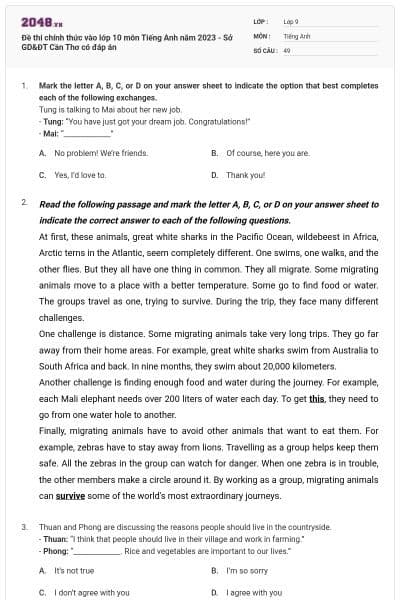
Anita: “Do you mind if I use your dictionary, Mary?”
Mary: "______”
Yes, please.
No, please do.
No, thanks.
Yes, here it is.
Đáp án: B
Giải thích:
Dịch: Anita: “Bạn có phiền nếu tôi dùng từ điển của bạn không, Mary?”
Mary: "______”
A. Phiền, làm ơn.
B. Không phiền, bạn dùng đi.
C. Không phiền, cảm ơn.
D. Phiền, nó đây.
Dựa vào nghĩa, chọn B.
was building
has been built
has built
will be built
Đáp án B
Mark letter A, B, C or D to indicate the sentence that is closest in meaning to the given one.
Daisy arrived late, but she finished her work earlier than the others.
Daisy arrived late, so she finished her work earlier than the others.
Daisy finished her work earlier than the others because she arrived late.
Daisy finished her work earlier than the others although she arrived late.
Though Daisy arrived late, but she finished her work earlier than the others.
Đáp án C
My brother is the taller student in his class.
My brother is the tallest student in his class.
My brother is the most tall student in his class.
My brother is the most tallest student in his class.
Đáp án B
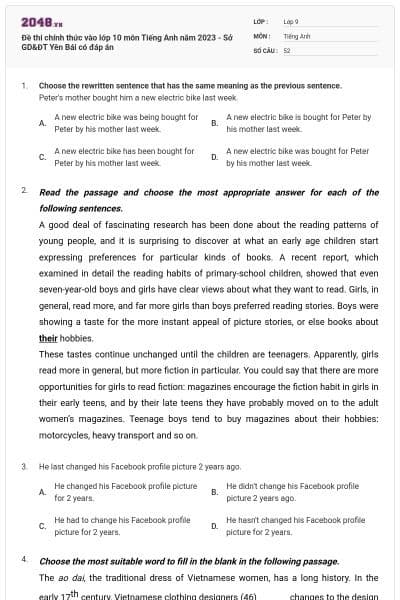
If you hurry up, you will miss the bus.
If you won’t hurry up, you miss the bus.
You won’t miss the bus unless you hurry up.
If you don't hurry up, you will miss the bus.
Đáp án D
Câu điều kiện loại 1 dùng để diễn tả sự việc có thể xảy ra ở hiện tại hoặc tương lai: If + S + V(s/es), S + will/may/.. + Vinf
Dịch nghĩa: Nếu bạn không nhanh lên thì bạn sẽ bị lỡ xe buýt.
“How do you go to school on rainy days, Kevin?” said the teacher.
The teacher asked Kevin how he went to school on rainy days.
The teacher asked Kevin how you went to school on rainy days.
The teacher asked Kevin how do you go to school on rainy days.
The teacher asked Kevin how he goes to school on rainy days.
Đáp án: A
Giải thích:
Kiến thức: Câu gián tiếp
Câu trực tiếp: “How do you go to school on rainy days, Kevin?” said the teacher.
→ Đây là câu hỏi gián tiếp (reported question) ở thì quá khứ đơn (said → asked), nên ta cần lùi thì trong phần tường thuật.
Cấu trúc chuyển câu hỏi trực tiếp sang gián tiếp:
Question word + S + V (lùi thì nếu cần)
"do you go" (hiện tại đơn) → "he went" (quá khứ đơn)
Xét các đáp án khác:
B. "how you went..." → sai đại từ (đáng lẽ phải là he, không phải you).
C. "how do you go..." → sai vì giữ nguyên cấu trúc câu hỏi trực tiếp, không lùi thì, sai ngữ pháp khi chuyển sang câu gián tiếp.
D. "how he goes..." → sai vì không lùi thì (hiện tại đơn → quá khứ đơn).
Chọn A.
Dịch: Giáo viên hỏi Kevin rằng cậu ấy đi học như thế nào vào những ngày mưa.