Đề thi chính thức Tiếng Anh vào 10 năm 2020-2021 (Đề 18)
60 câu hỏi
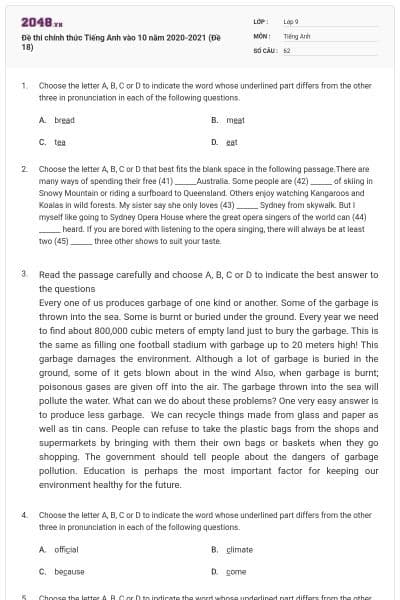
bread
meat
tea
eat
Đáp án A
official
climate
because
come
Đáp án A
arrived
enjoyed
decided
believed
Đáp án C
roofs
students
books
poems
Đáp án D
line
fit
fine
nice
Đáp án B
Choose the letter A, B, C or D to indicate the best answer to complete the following sentences.
I saw that film ______ 7 p.m. last Sunday.
on
in
for
at
Đáp án D
take
would take
will take
took
Đáp án B
casual
national
special
additional
Đáp án C
isn’t he
does he
is he
doesn’t he
Đáp án A
buy
to buy
bought
buying
Đáp án D
gets
is getting
got
has got
Đáp án A
exit
entrance
way
road
Đáp án B
so
but
and
because
Đáp án D
who
which
whom
whose
Đáp án B
an
a
some
any
Đáp án A
beauty
beautiful
beautify
beautifully
Đáp án A
at
in
about
for
Đáp án A
will be cleaned
is cleaned
was cleaned
has been cleaned
Đáp án B
earned
earn
had earned
has earned
Đáp án A
ought to
must
can
should
Đáp án C
No, I don't.
Well, I love volleyball and soccer.
Yes, it's my favorite sport.
I think it's boring.
Đáp án B
was collecting
has collected
collected
will collect
Đáp án B
she enjoyed
she will enjoy
did she enjoy
she enjoys
Đáp án A
things
photos
signs
views
Đáp án B
How far
How long
How many
How often
Đáp án B
is used to
uses to
used to
gets used to
Đáp án C
are holding
held
will hold
should hold
Đáp án D
ought to
have to
might
should
Đáp án C
Despite
However
Although
Because
Đáp án C
apply
applied
would apply
will apply
Đáp án C
looks for
looks at
looks up
looks after
Đáp án D
bad
badly
good
well
Đáp án B
That's a good idea.
That's a fine day.
Yes, please do.
Yes, let’s.
Đáp án A
No, you're welcome.
No, thank you.
Yes, you're right.
Yes, I am OK.
Đáp án B
the longest
longest
the longer
longer
Đáp án A
Choose the letter A, B, C or D to indicate the underlined word/phrase that needs correcting.
It isn't good for children eating too many sweets.
eating
dictionary
However
to spending
tiring
There are many ways of spending their free (41) ______Australia.
in
at
of
for
Đáp án A
keen
interested
surprised
fond
Đáp án D
watch
watches
watching
watched
Đáp án C
been
being
be
to be
Đáp án C
if
or
but
so
Đáp án B
Read the passage carefully and choose A, B, C or D to indicate the best answer to the questions
Every one of us produces garbage of one kind or another. Some of the garbage is thrown into the sea. Some is burnt or buried under the ground. Every year we need to find about 800,000 cubic meters of empty land just to bury the garbage. This is the same as filling one football stadium with garbage up to 20 meters high! This garbage damages the environment. Although a lot of garbage is buried in the ground, some of it gets blown about in the wind Also, when garbage is burnt; poisonous gases are given off into the air. The garbage thrown into the sea will pollute the water. What can we do about these problems? One very easy answer is to produce less garbage. We can recycle things made from glass and paper as well as tin cans. People can refuse to take the plastic bags from the shops and supermarkets by bringing with them their own bags or baskets when they go shopping. The government should tell people about the dangers of garbage pollution. Education is perhaps the most important factor for keeping our environment healthy for the future.
Which of these don't we do with our garbage?
bury it in football stadium
burn it
throw it into the sea
bury it in the ground
Đáp án: A
Giải thích:
Dịch: Chúng ta không làm gì với rác thải của mình?
A. chôn rác ở sân vận động bóng đá
B. đốt rác
C. ném rác xuống biển
D. chôn rác xuống đất
Thông tin: “Every year we need to find about 800,000 cubic meters of empty land just to bury the garbage. This is the same as filling one football stadium with garbage up to 20 meters high!”
(Mỗi năm chúng ta cần tìm khoảng 800.000 mét khối đất trống chỉ để chôn rác. Điều này tương đương với việc lấp đầy một sân vận động bóng đá bằng rác cao tới 20 mét!)
→ Ở đây, “burying garbage in a football stadium” chỉ là hình ảnh so sánh để người đọc dễ hình dung về khối lượng rác cần chôn lấp mỗi năm, chứ không phải hành động thật.
→ Do đó, chúng ta không thực sự chôn rác trong sân vận động.
Poisonous gases are given off when we _______.
throw the garbage into the sea
burn the garbage
recycle the garbage
let the garbage blow around in the wind
Đáp án: B
Giải thích:
Dịch: Khí độc được thải ra khi chúng ta _______.
A. vứt rác xuống biển
B. đốt rác
C. tái chế rác
D. để rác bay trong gió
Thông tin: “Also, when garbage is burnt; poisonous gases are given off into the air.”
(Ngoài ra, khi đốt rác, khí độc sẽ được thải ra không khí.)
→ Điều này cho thấy rằng khí độc được thải ra khi chúng ta đốt rác.
What should we do when we go shopping?
ask for more plastic bags
tell other people about recycling
use our own baskets or bags
buy less food
Đáp án: C
Giải thích:
Dịch: Chúng ta nên làm gì khi đi mua sắm?
A. xin thêm túi nilon
B. nói với người khác về việc tái chế
C. sử dụng giỏ hoặc túi của riêng mình
D. mua ít thực phẩm hơn
Thông tin: “People can refuse to take the plastic bags from the shops and supermarkets by bringing with them their own bags or baskets when they go shopping.”
(Mọi người có thể từ chối nhận túi nilon từ các cửa hàng và siêu thị bằng cách mang theo túi hoặc giỏ đựng của riêng mình khi đi mua sắm.)
→ Điều này nhấn mạnh rằng chúng ta nên mang theo túi hoặc giỏ của mình khi đi mua sắm để giảm thiểu việc sử dụng túi ni-lông.
Which of these can’t be recycled?
glass
paper
tin cans
poisonous gases
Đáp án: D
Giải thích:
Dịch: Cái nào sau đây không thể tái chế được?
A. thủy tinh
B. giấy
C. lon thiếc
D. khí độc
Thông tin: “We can recycle things made from glass and paper as well as tin cans.”
(Chúng ta có thể tái chế những đồ vật làm từ thủy tinh, giấy cũng như lon thiếc.)
→ Như vậy, glass, paper, tin cans đều có thể tái chế.
Poisonous gases (khí độc) không thể tái chế — đây là sản phẩm phụ gây hại khi đốt rác, chứ không phải vật liệu có thể xử lý lại được.
Which is probably the most important way to protect the environment?
recycle more garbage
educate people
stay away from shop
throw more garbage into the ocean
Đáp án: B
Giải thích:
Dịch: Có lẽ cách quan trọng nhất để bảo vệ môi trường là gì?
A. tái chế nhiều rác hơn
B. giáo dục mọi người
C. tránh xa cửa hàng
D. vứt nhiều rác hơn xuống đại dương
Thông tin: “Education is perhaps the most important factor for keeping our environment healthy for the future.”
(Giáo dục có lẽ là yếu tố quan trọng nhất để duy trì môi trường lành mạnh cho tương lai.)
→ Câu này khẳng định rằng giáo dục là yếu tố quan trọng nhất để bảo vệ môi trường.
Dịch bài đọc
Mỗi người trong chúng ta đều tạo ra rác thải dưới hình thức này hay hình thức khác. Một phần rác thải được vứt xuống biển. Một phần khác thì bị đốt hoặc chôn dưới lòng đất. Mỗi năm, chúng ta cần tìm khoảng 800.000 mét khối đất trống chỉ để chôn rác – điều này tương đương với việc lấp đầy một sân vận động bóng đá bằng rác cao tới 20 mét!
Rác thải này gây hại cho môi trường. Dù nhiều rác được chôn dưới đất, một số vẫn bị gió thổi bay đi. Ngoài ra, khi rác bị đốt, các khí độc hại sẽ phát tán vào không khí. Rác thải bị ném xuống biển sẽ làm ô nhiễm nước.
Vậy chúng ta có thể làm gì với những vấn đề này? Một cách đơn giản là giảm lượng rác thải sinh ra. Chúng ta có thể tái chế các vật làm từ thủy tinh, giấy cũng như lon thiếc. Mọi người có thể từ chối lấy túi ni-lông từ cửa hàng và siêu thị bằng cách mang theo túi hoặc giỏ riêng khi đi mua sắm.
Chính phủ nên tuyên truyền cho người dân về mối nguy hại từ ô nhiễm rác thải.
Giáo dục có lẽ là yếu tố quan trọng nhất để giữ cho môi trường của chúng ta khỏe mạnh trong tương lai.
Put the verbs in parentheses in the correct tense.
The boy fell and hurt himself while he (play)___football.
Tom likes speed. He (ride) ________ his motorbike too fast now.
Tom likes speed. He is riding his motorbike too fast now.
Rewrite the sentences so that they are closest in meaning to the given ones.
Why don’t we put more dustbins around the school?=> Mr. Nam said (that) he wanted to send his son to a university in the UK.
They have planted a lot of trees around their house recently.
Reorder the given words or phrases to make meaningful sentences.
our letters/ were/ We/ that/ disappointed/ he/ replied/ never/.
We were disappointed that he never replied our letters.
It was a beautiful day so I decided to go for a picnic with my friend.
The Prime Minister will open more three schools in the town next autumn.