Bộ câu hỏi: Bài tập bổ trợ tuần 7 - đọc hiểu (có đáp án)
12 câu hỏi
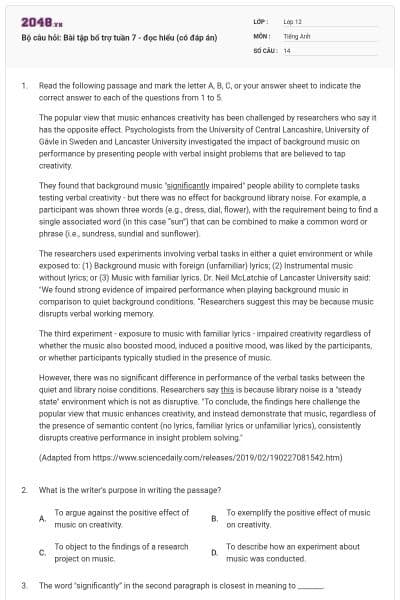
Read the following passage and mark the letter A, B, C, or your answer sheet to indicate the correct answer to each of the questions from 1 to 5.
The popular view that music enhances creativity has been challenged by researchers who say it has the opposite effect. Psychologists from the University of Central Lancashire, University of Gävle in Sweden and Lancaster University investigated the impact of background music on performance by presenting people with verbal insight problems that are believed to tap creativity.
They found that background music "significantly impaired" people ability to complete tasks testing verbal creativity - but there was no effect for background library noise. For example, a participant was shown three words (e.g., dress, dial, flower), with the requirement being to find a single associated word (in this case “sun”) that can be combined to make a common word or phrase (i.e., sundress, sundial and sunflower).
The researchers used experiments involving verbal tasks in either a quiet environment or while exposed to: (1) Background music with foreign (unfamiliar) lyrics; (2) Instrumental music without lyrics; or (3) Music with familiar lyrics. Dr. Neil McLatchie of Lancaster University said: "We found strong evidence of impaired performance when playing background music in comparison to quiet background conditions. “Researchers suggest this may be because music disrupts verbal working memory.
The third experiment - exposure to music with familiar lyrics - impaired creativity regardless of whether the music also boosted mood, induced a positive mood, was liked by the participants, or whether participants typically studied in the presence of music.
However, there was no significant difference in performance of the verbal tasks between the quiet and library noise conditions. Researchers say this is because library noise is a "steady state" environment which is not as disruptive. "To conclude, the findings here challenge the popular view that music enhances creativity, and instead demonstrate that music, regardless of the presence of semantic content (no lyrics, familiar lyrics or unfamiliar lyrics), consistently disrupts creative performance in insight problem solving."
(Adapted from https://www.sciencedaily.com/releases/2019/02/190227081542.htm)
What is the writer's purpose in writing the passage?
To argue against the positive effect of music on creativity.
To exemplify the positive effect of music on creativity.
To object to the findings of a research project on music.
To describe how an experiment about music was conducted.
Chọn đáp án A
Đâu là mục đích của người viết trong đoạn văn?
A. Để lập luận chống lại ảnh hưởng tích cực của âm nhạc đến sự sáng tạo.
B. Để chứng minh ảnh hưởng tích cực của âm nhạc đến sự sáng tạo.
C. Để phản đối các phát hiện của một dự án nghiên cứu về âm nhạc.
D. Để miêu tả một thí nghiệm về âm nhạc được tiến hành như thế nào.
Tóm tắt:
Bài viết nêu ra những tác động tiêu cực của âm nhạc đối với khả năng sáng tạo như: làm suy giảm khả năng, giảm hiệu suất, giảm sự sáng tạo.
==> Đoạn văn viết về các lập luận chống lại ảnh hưởng tích cực của âm nhạc đến sự sáng tạo
The word "significantly” in the second paragraph is closest in meaning to _______.
steadily
noticeably
slightly
marginally
Chọn đáp án B
Từ “significantly” trong đoạn 2 đồng nghĩa với từ ________.
A. steadily (adv): một cách ổn định
B. noticeably (adv): một cách dễ thấy
C. slightly (adv): một ít, một chút
D. marginally (adv): một chút
significantly (adv): một cách đáng kể = noticeably
According to the passage, which of the following statements is TRUE?
Music disrupts verbal working memory.
Instrumental music disrupts working environment.
Music with familiar lyrics is disruptive.
Background music boosted negative mood.
Chọn đáp án A
Theo đoạn văn, nhận định nào sau đây là đúng?
A. Âm nhạc làm gián đoạn trí nhớ ngắn hạn bằng lời nói.
B. Nhạc không lời làm gián đoạn môi trường làm việc.
C. Âm nhạc có lời quen thuộc có tính gây gián đoạn.
D. Nhạc nền đã thúc đẩy tâm trạng tiêu cực.
Thông tin:
Researchers suggest this may be because music disrupts verbal working memory. (Các nhà nghiên cứu cho rằng điều này có thể vì âm nhạc gây gián đoạn trí nhớ ngắn hạn bằng lời nói.)
Library noise was found to be ________ .
less distracting than music
is more distracting than music
not relevant to the study
is as distracting as music
Chọn đáp án A
Tiếng ồn thư viện được nhận thấy rằng ________.
A. ít gây mất tập trung hơn âm nhạc
B. gây mất tập trung hơn âm nhạc
C. không liên quan đến việc học
D. gây mất tập trung như âm nhạc
Thông tin:
However, there was no significant difference in performance of the verbal tasks between the quiet and library noise conditions. Researchers say this is because library noise is a "steady state" environment which is not as disruptive. (Tuy nhiên, không có sự khác biệt đáng kể về hiệu suất làm nhiệm vụ bằng lời nói giữa điều kiện yên tĩnh và ồn ào của thư viện. Các nhà nghiên cứu nói rằng điều này là do tiếng ồn thư viện là một môi trường “trạng thái ổn định” không có tính gây gián đoạn.)
The word "this" in the last paragraph refers to _______.
no significant difference
performance of the verbal tasks
the significant difference
the quiet environment
Từ “this” trong đoạn cuối đề cập đến _______.
A. không có sự khác biệt đáng kể
B. hiệu suất làm nhiệm vụ qua lời nói
C. sự khác biệt đáng kể
D. môi trường tĩnh lặng
Thông tin:
However, there was no significant difference in performance of the verbal tasks between the quiet and library noise conditions. Researchers say this is because library noise is a "steady state" environment which is not as disruptive. (Tuy nhiên, không có sự khác biệt đáng kể về hiệu suất làm nhiệm vụ bằng lời nói giữa điều kiện yên tĩnh và ồn ào của thư viện. Các nhà nghiên cứu nói rằng điều này là do tiếng ồn thư viện là một môi trường “trạng thái ổn định” không có tính gây gián đoạn.)
Read the following passage and mark the letter A, B, C, or D on your answer sheet to indicate the correct answer to each of the questions from 6 to 12.
Although the private ownership of cars has steadily increased as it has become more affordable, there is still a demand for public transport. The cost of a new car has fallen in real terms so that now it is cheaper than ever to own one. Nevertheless, a minority of the population will never be in a position to do without public transport for even the shortest journey.
Successive governments, under pressure from middle class car-owning voters, have poured money into the building of new roads and the widening of existing ones. Better facilities for drivers have tended to attract more drivers. The result is overcrowding on an overstretched and expensive road system. Now governments are faced with huge bills and dissatisfied voters who resent paying taxes for a poor service.
When people travel to other towns, the problem might be eased by getting them to park on the outskirts of town. Buses could be provided to take them into the center. These Park and Ride schemes are increasingly popular and early results from large scale studies seem positive. At Southerton, for example, a council-funded scheme led to a 15% drop in city center traffic over five months.
What the council found, though, was that the measure proved somewhat unpopular with shops and retail outlets in the areas outside the center. Many of these relied on passing traffic for some of their trade. As the number of people driving past dropped, so did incomes. It was discovered that visitors found it more difficult to get around without their cars and so they were not stopping on their way into the city center.
Making car driving expensive is another way of making sure that people use public transport more. Road taxes and tolls on roads to pay for repairs tend to mean that people use their cars less. Fining drivers who are in areas where cars have been banned can also tend to encourage them to leave their car behind. There is one point that has to be got right for any solution to succeed. If we expect people to give up the habits of a lifetime, we must give them an alternative they can depend on. Constant delays, unannounced changes to the timetable, and sudden cancellations all discourage people from using public transport. People will only see it as a real option if the buses and trains are on time.
Education about the threat posed to the environment by our driving culture will prove vital. As people realize that the rate of road building cannot be sustained and that driving is likely to become the right of a privileged, wealthy few, so they will start to take seriously the problem of getting from A to B on public transport.
(Adapted from Reading and Writing by Malcom Mann and Steve Taylore-Knowles, Macmillan)
Weighing the pros and cons of several ways to encourage people to use public transport more.
Explaining how the increase in the number of cars on the streets can harm the environment
Persuading people about the benefits of cutting down on the amount of driving they do
Discussing the possible negative effects of banning private vehicles on local businesses
Người viết cố gắng làm gì trong đoạn văn?
A. Cân nhắc ưu và nhược điểm của vài cách khuyến khích mọi người sử dụng phương tiện giao thông công cộng nhiều hơn.
B. Giải thích sự tăng số lượng xe ô tô có thể gây hại cho môi trường ra sao.
C. Thuyết phục mọi người về lợi ích của việc cắt giảm lượng lái xe.
D. Thảo luận về các ảnh hưởng tiêu cực có thể có của việc cấm phương tiện tư nhân đối với các doanh nghiệp địa phương.
Tóm tắt:
Đoạn văn viết về một số ưu nhược điểm của các cách nhằm tăng lượng sử dụng phương tiện công cộng.
the lower price of cars
the increase in population
the decrease in demand for public transport
the infrequency of public transport
Đâu sau đây là một nhân tố góp phần vào sự gia tăng lượng ô tô tư nhân?
A. giá xe ô tô thấp hơn
B. sự tăng dân số
C. sự giảm nhu cầu đối với phương tiện công cộng
D. sự không thường xuyên của phương tiện công cộng
Thông tin:
Although the private ownership of cars has steadily increased as it has become more affordable, there is still a demand for public transport. The cost of a new car has fallen in real terms so that now it is cheaper than ever to own one. (Mặc dù việc sở hữu tư nhân đối với ô tô đã tăng lên đều đặn vì nó ngày càng có giá cả phải chăng hơn, nhưng vẫn tồn tại nhu cầu về phương tiện giao thông công cộng. Chi phí cho một xe ô tô mới đã giảm xuống trong điều kiện thực tế vì thế bây giờ việc sở hữu một chiếc ô tô đang rẻ hơn bao giờ hết.)
Investment in the roads has led to _______.
objection from dissatisfied voters
people's having to park in the outskirts
greater use of private vehicles
from middle class car-owners
Chọn đáp án C
Sự đầu tư vào đường xá đã dẫn đến _______.
A. sự phản đối từ các cử tri bất mãn
B. việc phải đỗ xe ở ngoại ô của mọi người
C. sự sử dụng phương tiện tư nhân nhiều hơn
D. từ những người thuộc tầng lớp trung lưu sở hữu ô tô
Thông tin: Successive governments, under pressure from middle class car-owning voters, have poured money into the building of new roads and the widening of existing ones. Better facilities for drivers have tended to attract more drivers. (Các chính phủ kế nhiệm, dưới áp lực từ các cử tri sở hữu ô tô, đã rót tiền vào việc xây dựng đường xá mới và mở rộng các con đường hiện thời. Các tiện ích tốt hơn cho các tài xế đã thu hút nhiều người hơn.)
A sai vì khi nhiều phương tiện đi lại thì các cử tri mới bất mãn về dịch vụ yếu kém.
prefer
regret
object to
resemble
Chọn đáp án C
Từ “resent” trong đoạn 2 đồng nghĩa với từ ________.
A. prefer (v): thích
B. regret (v): hối hận
C. object to: phản đối
D. resemble (v): giống
resent (v): không bằng lòng = object to
The phrase "their" in the fourth paragraph refers to
passing traffic
areas outside the center
people
outlets
Chọn đáp án D
Từ “their” trong đoạn 4 đề cập đến _____.
A. giao thông qua lại
B. khu vực ngoài vùng trung tâm
C. mọi người
D. cửa hàng
Thông tin: What the council found, though, was that the measure proved somewhat unpopular with shops and retail outlets in the areas outside the center. Many of these relied on passing traffic for some of their trade. (Mặc dù vậy, những gì mà hội đồng nhận thấy chính là biện pháp này có vẻ không được lòng các cửa hàng và các điểm bán lẻ ở khu vực ngoài trung tâm. Nhiều người này phụ thuộc vào giao thông qua lại để buôn bán.)
Local business may _______schemes to limit traffic.
be in favor of
not care about
benefit from
oppose to
Chọn đáp án D
Các doanh nghiệp địa phương _________ các chương trình nhằm hạn chế lưu lượng xe.
A. ủng hộ
B. không quan tâm về
C. hưởng lợi từ
D. phản đối
Thông tin:
What the council found, though, was that the measure proved somewhat unpopular with shops and retail outlets in the areas outside the center. Many of these relied on passing traffic for some of their trade. As the number of people driving past dropped, so did incomes. (Mặc dù vậy, những gì mà hội đồng nhận thấy chính là biện pháp này có vẻ không được lòng các cửa hàng và các điểm bán lẻ ở khu vực ngoài trung tâm. Nhiều người này phụ thuộc vào giao thông qua lại để buôn bán. Vì số người lái xe ngang qua tụt giảm, vì thế thu nhập cũng giảm.)
high fares
long delays
unexpected changes in schedules
unexpected cancellations
Chọn đáp án A
Đâu sau đây không được đề cập là một nhân tố khiến mọi người không muốn sử dụng phương tiện công cộng?
A. phí cầu đường cao
B. sự chậm trễ kéo dài
C. những thay đổi không báo trước về lịch trình
D. sự hủy đột ngột
Thông tin: Constant delays, unannounced changes to the timetable, and sudden cancellations all discourage people from using public transport. (Sự chậm trễ liên tục, sự thay đổi không báo trước, và việc hủy chuyến đột ngột đều làm giảm động lực sử dụng phương tiện công cộng.)
Bạn có thích hoạt động này không?