Bộ câu hỏi: Bài tập bổ trợ tuần 3 - đọc hiểu (Có đáp án)
12 câu hỏi
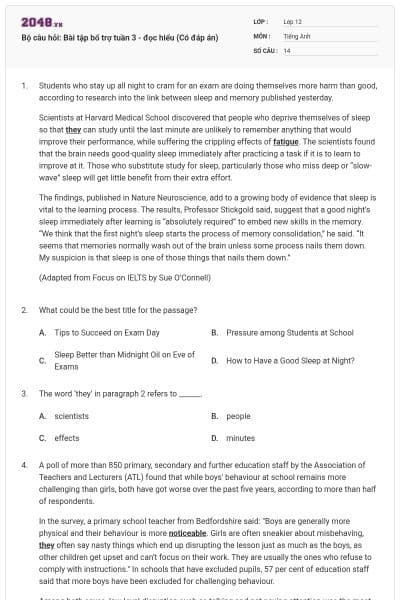
Students who stay up all night to cram for an exam are doing themselves more harm than good, according to research into the link between sleep and memory published yesterday.
Scientists at Harvard Medical School discovered that people who deprive themselves of sleep so that they can study until the last minute are unlikely to remember anything that would improve their performance, while suffering the crippling effects of fatigue. The scientists found that the brain needs good-quality sleep immediately after practicing a task if it is to learn to improve at it. Those who substitute study for sleep, particularly those who miss deep or “slow-wave” sleep will get little benefit from their extra effort.
The findings, published in Nature Neuroscience, add to a growing body of evidence that sleep is vital to the learning process. The results, Professor Stickgold said, suggest that a good night’s sleep immediately after learning is “absolutely required” to embed new skills in the memory. “We think that the first night’s sleep starts the process of memory consolidation,” he said. “It seems that memories normally wash out of the brain unless some process nails them down. My suspicion is that sleep is one of those things that nails them down.”
(Adapted from Focus on IELTS by Sue O’Connell)
Tips to Succeed on Exam Day
Pressure among Students at School
Sleep Better than Midnight Oil on Eve of Exams
How to Have a Good Sleep at Night?
Đâu là tiêu đề hay nhất cho đoạn văn?
A. Mẹo để thành công trong ngày thi
B. Áp lực giữa các học sinh ở trường
C. Ngủ tốt hơn việc thức khuya để học trước khi thi
D. Làm thế nào để có một giấc ngủ ngon vào ban đêm?
Đoạn văn nói về việc nhiều học sinh thức đêm trước khi thi và điều đó không tốt bằng việc ngủ đủ giấc. Việc ngủ đủ giấc sẽ giúp học sinh lưu giữ thông tin tốt hơn, và giúp chúng thành công hơn trong các kỳ thi.
The word ‘they’ in paragraph 2 refers to ______.
scientists
people
effects
minutes
Từ "they" trong đoạn 2 đề cập đến ___________
A. các nhà khoa học
B. người
C. hiệu ứng, ảnh hưởng
D. phút
Căn cứ vào ngữ nghĩa của câu:
Scientists at Harvard Medical School discovered that people who deprive themselves of sleep so that they can study until the last minute are unlikely to remember anything that would improve their performance, while suffering the crippling effects of fatigue.
Tạm dịch: Các nhà khoa học tại Trường Y Harvard đã phát hiện ra rằng những người không ngủ để có thể học đến phút cuối cùng khó có thể nhớ bất cứ điều gì mà giúp cải thiện hiệu suất của họ, trong khi chịu hậu quả nghiêm trọng do bị mệt mỏi.
=> they = people
happiness
sadness
tiredness
boredom
Đáp án C
Từ 'fatigue' trong đoạn 2 gần nghĩa nhất với _________
A. hạnh phúc
B. nỗi buồn
C. sự mệt mỏi
D. buồn chán
=> fatigue = sự mệt mỏi = tiredness
According to paragraph 2, what did the Harvard Medical School discover?
Exhaustion is the biggest reason why students fail their exams.
People will have a better memory if they sleep only 3 hours a day.
‘Deep sleep’ is not essential for studying and memory recollection.
Those who study instead of sleeping have little chance of passing their exams.
Theo đoạn 2, trường Y Harvard đã khám phá ra điều gì?
A. Kiệt sức là lý do lớn nhất khiến học sinh thi trượt.
B. Mọi người sẽ có trí nhớ tốt hơn nếu họ chỉ ngủ 3 tiếng 1 ngày.
C. ‘Giấc ngủ sâu’ không cần thiết cho việc học tập và hồi tưởng trí nhớ.
D. Những người học thay vì ngủ có rất ít cơ hội vượt qua kỳ thi của họ.
Thông tin: Those who substitute study for sleep, particularly those who miss deep or “slow-wave” sleep will get little benefit from their extra effort.
Tạm dịch: Những người thay thế việc học cho giấc ngủ, đặc biệt là những người bỏ lỡ giấc ngủ sâu hoặc "sóng chậm" sẽ nhận được rất ít lợi ích từ nỗ lực thêm của họ.
Sleep is the only thing that can help a learner process new information.
It’s not a good idea for students to stay up late to study for their exams instead of sleeping.
Sleep kickstarts a process of memory retention.
A good night’s sleep is vital if a person wants to improve their memory.
Đáp án A
Điều nào sau đây KHÔNG đúng, theo đoạn văn?
A. Ngủ là thứ duy nhất có thể giúp người học xử lý thông tin mới.
B. Học sinh thức khuya để ôn thi thay vì đi ngủ không phải là ý kiến hay.
C. Giấc ngủ khởi động quá trình lưu giữ trí nhớ.
D. Một giấc ngủ ngon là rất quan trọng nếu một người muốn cải thiện trí nhớ của họ.
B đúng vì: Students who stay up all night to cram for an exam are doing themselves more harm than good, according to research into the link between sleep and memory published yesterday.
Tạm dịch: Theo một nghiên cứu về mối liên hệ giữa giấc ngủ và trí nhớ được công bố hôm qua, những học sinh thức cả đêm để ôn thi cho kỳ thi đang làm hại bản thân nhiều hơn lợi.
C đúng vì: We think that the first night’s sleep starts the process of memory consolidation.
Tạm dịch: Chúng tôi nghĩ rằng giấc ngủ đêm đầu tiên kích hoạt quá trình củng cố trí nhớ.
D đúng vì: The scientists found that the brain needs good-quality sleep immediately after practicing a task if it is to learn to improve at it.
Tạm dịch: Các nhà khoa học phát hiện ra rằng bộ não cần có giấc ngủ chất lượng ngay sau khi thực hành một nhiệm vụ nếu muốn cải thiện trí nhớ.
=> Trong bài không đề cập ngủ có phải là thứ duy nhất giúp người học xử lý thông tin mới không.
A poll of more than 850 primary, secondary and further education staff by the Association of Teachers and Lecturers (ATL) found that while boys' behaviour at school remains more challenging than girls, both have got worse over the past five years, according to more than half of respondents.
In the survey, a primary school teacher from Bedfordshire said: "Boys are generally more physical and their behaviour is more noticeable. Girls are often sneakier about misbehaving, they often say nasty things which end up disrupting the lesson just as much as the boys, as other children get upset and can’t focus on their work. They are usually the ones who refuse to comply with instructions." In schools that have excluded pupils, 57 per cent of education staff said that more boys have been excluded for challenging behaviour.
Among both sexes, low-level disruption such as talking and not paying attention was the most problematic behaviour for 70 per cent of respondents. For girls, most staff said bullying such as spreading rumours was the biggest problem. Among boys the most challenging behaviour was physical aggression. Staff thought the main reasons for challenging behaviour within their schools and colleges were family breakdowns, followed by a lack of positive role models and poor emotional health. ATL general secretary Dr Mary Bousted said: "The behaviour of both boys and girls can pose huge challenges for those working in schools and colleges. Staff get ground down daily by the chatting and messing around, which disrupts lessons for other pupils and takes the pleasure out of teaching. "Even more worrying is the physical aggression, most often among boys but also among some girls, which puts other pupils and staff at risk.
Schools need to have firm and consistent discipline policies and work with parents to keep schools and colleges safe places for pupils and staff alike."
(Adapted from https://www.cypnow.co.uk/)
Education among Boys and Girls
Worsening School Students’ Behaviour
A Bias against Girls in Class
Students Suffer from Bullying at School
Chọn đáp án B
Tiêu đề nào sau đây phù hợp nhất trong đoạn văn?
A. Giáo dục giữa học sinh nam và học sinh nữ
B. Hành vi của học sinh trở nên tồi tệ hơn
C. Thành kiến chống lại các học sinh nữ trong lớp
D. Học sinh bị bắt nạt ở trường
Cả bài nhắc tới vấn đề các hành động gây hấn, gây rối loạn trong lớp học của nam sinh và nữ sinh, nó gây vấn đề ra sao, nguyên nhân và đề xuất để giải quyết vấn đề này.
Boy’s behaviour at school remains unchanged.
Both boys and girls show improved behaviour.
Girls are naturally talkative than boys.
Students’ behaviour, irrespective of sex, has got worse.
Chọn đáp án D
Theo đoạn 1, cuộc khảo sát của ATL đã tìm ra điều gì?
A. Hành vi của nam sinh ở trường vẫn không thay đổi.
B. Cả nam sinh và nữ sinh đều cho thấy hành vi được cải thiện.
C. Nữ sinh bẩm sinh nói nhiều hơn nam sinh.
D. Hành vi của học sinh, không phân biệt giới tính, trở nên tồi tệ hơn.
Thông tin: …. Association of Teachers and Lecturers (ATL) found that while boys' behaviour at school remains more challenging than girls, both have got worse over the past five years, according to more than half of respondents. (Một cuộc thăm dò ý kiến của hơn 850 nhân viên giáo dục tiểu học, trung học và đại học của Hiệp hội Giáo viên và Giảng viên (ATL) cho thấy mặc dù hành vi của nam sinh ở trường gây nhiều thách thức hơn so với nữ sinh, nhưng cả hai đều trở nên tồi tệ hơn trong năm năm qua, theo hơn một nửa số người được khảo sát.)
clear
gentle
bad
effective
Chọn đáp án A
A. clear (adj): rõ ràng
B. gentle (adj): dịu dàng
C. bad (adj): tồi tệ
D. effective (adj): hiệu quả
noticeable (adj): đáng chú ý~ clear
The word ‘they’ in paragraph 2 refers to ______.
lessons
boys
girls
teachers
Từ "they" trong đoạn 2 dùng để chỉ:
A. bài học
B. nam sinh
C. nữ sinh
D. giáo viên
Thông tin: “Girls are often sneakier about misbehaving, they often say nasty things which end up disrupting the lesson just as much as the boys, as other children get upset and can’t focus on their work. (Các nữ sinh thường lén lút quậy phá, các em thường nói những điều khó chịu khiến bài học bị gián đoạn giống như nam sinh và những học sinh khác cảm thấy khó chịu và không thể tập trung vào bài học.)
=> “they” thay thế cho danh từ “girls”
easy to notice
difficult to deal with
interesting to study
happy to get
Chọn đáp án B
A. easy to notice: dễ thấy/nhận ra
B. difficult to deal with (phr): khó xử lí, đối phó
C. interesting to study: thú vị để nghiên cứu
D. happy to get: hạnh phúc khi có được
problematic (adj): gây rắc rối ~ difficult to deal with
Boys’ misbehaviour is easier to recognise.
Other students can’t concentrate on the lessons because of some students’ unpleasant behaviour.
Only boys have been expelled from school due to their misbehaviour.
Spreading rumours is one of the commonest bullying behaviours among girls.
Chọn đáp án C
Điều nào sau đây KHÔNG đúng, theo đoạn văn?
A. Hành vi quậy phá của nam sinh dễ nhận ra hơn.
B. Các học sinh khác không thể tập trung vào bài học vì hành vi khó chịu của một số học sinh.
C. Chỉ có nam sinh bị đuổi học do hạnh kiểm xấu.
D. Lan truyền tin đồn là một trong những hành vi bắt nạt phổ biến nhất ở nữ sinh.
+ Thông tin: In schools that have excluded pupils, 57 per cent of education staff said that more boys have been excluded for challenging behaviour.
Tạm dịch: Ở các trường có đuổi học học sinh, 57% nhân viên giáo dục cho biết rằng có nhiều nam sinh bị đuổi học hơn do hành vi quậy phá
=> C sai, vì chỉ nói là nam sinh bị đuổi nhiều hơn, chứ không phải là chỉ có nam sinh bị đuổi.
Các đáp án còn lại:
+ Thông tin: Boys are generally more physical and their behaviour is more noticeable.
Tạm dịch: Các nam sinh nhìn chung có thể chất tốt hơn và hành vi của chúng gây chú ý hơn.
=> A đúng
+ Thông tin: Staff get ground down daily by the chatting and messing around, which disrupts lessons for other pupils and takes the pleasure out of teaching.
Tạm dịch: Nhân viên bị ảnh hưởng tinh thần hàng ngày bởi việc nói chuyện riêng và gây rối, điều này làm gián đoạn bài học của các học sinh khác và mất niềm vui khi giảng dạy.
=> B đúng.
+ Thông tin: For girls, most staff said bullying such as spreading rumours was the biggest problem.
Tạm dịch: Đối với các nữ sinh, hầu hết các nhân viên cho biết việc bắt nạt như tung tin đồn là vấn đề lớn nhất.
=> D đúng
Education staff find that low-level disruption can be dealt with easily.
There are many factors that lead to unacceptable behaviour among school students.
School and university staff are most affected by challenging behaviour of boys and girls.
Many discipline policies have been adopted to deal with the problem of bullying at school.
Chọn đáp án B
Điều nào sau đây có thể được suy ra từ đoạn văn?
A. Nhân viên giáo dục nhận thấy rằng sự gián đoạn ở cấp độ thấp có thể được giải quyết dễ dàng.
B. Có nhiều yếu tố dẫn đến hành vi không thể chấp nhận được của các học sinh.
C. Nhân viên ở các trường bị ảnh hưởng nhiều nhất bởi hành vi quậy phá của nam sinh và nữ sinh.
D. Nhiều chính sách kỷ luật đã được áp dụng để đối phó với vấn nạn bắt nạt ở trường học.
+ Thông tin: Staff thought the main reasons for challenging behaviour within their schools and colleges were family breakdowns, followed by a lack of positive role models and poor emotional health.
Tạm dịch: Nhân viên cho rằng lý do chính dẫn đến hành vi quậy phá trong các trường học là do gia đình tan vỡ, tiếp theo là thiếu các hình mẫu tích cực và sức khỏe tinh thần kém.
=> B đúng.
Các đáp án còn lại:
+ Thông tin: Among both sexes, low-level disruption such as talking and not paying attention was the most problematic behaviour for 70 per cent of respondents.
Tạm dịch: Ở cả hai giới, hành vi gây rối ở mức thấp như nói chuyện và không chú ý là hành vi rắc rối nhất đối với 70% số người được hỏi.
=> A sai, vì đây là các hành vi rắc rối nhất, chứ không phải dễ dàng giải quyết.
+ Thông tin: Staff get ground down daily by the chatting and messing around
Tạm dịch: Nhân viên bị ảnh hưởng tinh thần hàng ngày bởi việc nói chuyện riêng và gây rối
=> C sai, vì không có nói nhân viên bị ảnh hưởng nhiều nhất hay không.
+ Thông tin: Schools need to have firm and consistent discipline policies and work with parents to keep schools and colleges safe places for pupils and staff alike."
Tạm dịch: Các trường học cần có chính sách kỷ luật kiên định và nhất quán và làm việc với phụ huynh để giữ cho trường học là nơi an toàn cho học sinh và nhân viên. "
=> D sai, hiện chưa có chính sách kỷ luật.
Bạn có thích hoạt động này không?