40 câu hỏi
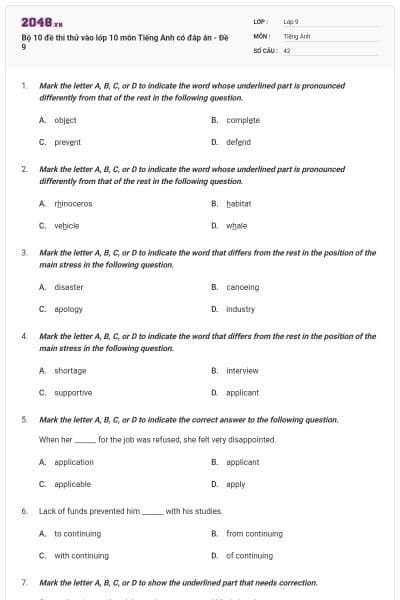
around
mouse
count
country
Đáp án đúng: D
Đáp án D có phần gạch chân được phát âm là /ʌ/, các đáp án còn lại có phần gạch chân được phát âm là /aʊ/.
church
chemical
chore
channel
Đáp án: B
Giải thích:
A. church /tʃɜːtʃ/ (n): nhà thờ
B. chemical /ˈkemɪkl/ (n): chất hoá học; hoá chất
C. chore /tʃɔː(r)/ (n): việc vặt
D. channel /ˈtʃænl/ (n): kênh
Đáp án B có phần gạch chân được phát âm là /k/, các đáp án còn lại có phần gạch chân được phát âm là /tʃ/.
companion
comparison
company
command
Đáp án đúng: C
Đáp án C có phần gạch chân được phát âm là /kʌm/, các đáp án còn lại có phần gạch chân được phát âm là /kəm/.
access
process
success
progress
Đáp án đúng: C
Đáp án C có trọng âm rơi vào âm tiết thứ 2, các đáp án còn lại có trọng âm rơi vào âm tiết thứ 1.
immigrant
visitor
monument
commuter
Đáp án đúng: D
Đáp án D có trọng âm rơi vào âm tiết thứ 2, các đáp án còn lại có trọng âm rơi vào âm tiết thứ 1.
everybody
somebody
anybody
nobody
Đáp án đúng: D
everybody: mọi người
somebody: một ai đó
anybody: bất kì ai
nobody: không ai
Dịch: Jack rất thất vọng vì không ai thông báo cho anh ấy về cuộc họp.
would have sent
might have sent
must send
could send
Đáp án đúng: B
might have P2: có thể đã làm gì đó trong quá khứ, dùng để đưa ra dự đoán 1 sự việc đã diễn ra trong quá khứ nhưng mang tính không chắc chắn.
Dịch: Susan có thể đã gửi tin nhắn cho bạn, nhưng tôi không chắc.

Học thông minh hơn mỗi ngày
Xem toàn bộ 40 câu hỏi và nhiều hơn nữa với tài khoản miễn phí
that
what
which
when
Đáp án đúng: A
Câu chẻ nhấn mạnh chủ ngữ chỉ vật: It + be + phần nhấn mạnh + that + V + O.
Dịch: Chính sự thiếu tự tin đã ngăn cản người trẻ thành công.
Spend
To spend
Spending
Having spent
Đáp án đúng: D
Rút gọn 2 mệnh đề cùng chủ ngữ, hành động ở mệnh đề đầu xảy ra trước → dùng ‘having P2’
Dịch: Sau khi dành vài tuần trong kí túc xá, Ken hiện tại đã có cuộc sống học đường thú vị.
is served
serve
are being served
will be served
Đáp án đúng: A
Bị động với TLĐ: will be P2
Dịch: Trong suốt chuyến tham quan, cứ 3 giờ sẽ phục vụ đồ uống giải khát cho du khách.
has it fixed
had it fix
had it fixed
has it fix
Đáp án đúng: C
Đây là câu kể lại → chia thì quá khứ đơn
Bị động với động từ truyền khiển “have”: have sth done
Dịch: Anh ấy không tự sửa xe mà anh ấy sửa nó ở gara.
would not have been
were not
would be not
will not be
Đáp án đúng: A
Câu điều kiện loại 3 (không có thật trong quá khứ):
If + S + had + P2 + O, S + would/could/should + have + P2 + O.
Dịch: Nếu bọn trẻ không dậy muộn thì chúng ta đã không trễ tàu.
giving
to give
and give
gave
Đáp án đúng: B
agree to do sth: đồng ý làm gì
Dịch: Hướng dẫn viên du lịch đã đồng ý cho chúng tôi thêm 30 phút mua sắm.
even if
even though
in spite of
despite
Đáp án đúng: B
even if: ngay cả khi
even though + clause = in spite of/despite + N/V-ing: mặc dù
Dịch: Cô ấy đã bỏ anh ta mặc dù vẫn yêu anh ta.
to
with
in
on
Đáp án đúng: A
be addicted to sth: nghiện cái gì đó
Dịch: Trẻ em dành quá nhiều thời gian cho máy tính bảng hoặc điện thoại thông minh đến mức chúng trở nên nghiện chúng.
owns
own
owned
has owned
Đáp án đúng: A
Câu hỏi gián tiếp: Chúng ta có thể dùng câu hỏi gián tiếp bằng cách thêm một mệnh đề phụ bắt đầu với từ để hỏi hoặc với 'if/ whether'.
Câu này đang diễn tả 1 việc ở hiện tại nên chia HTĐ.
Dịch: Tôi đang cố gắng tìm ra ai là người sở hữu tòa nhà này.
up with
away with
down with
through with
Đáp án đúng: C
go down with: nhiễm (bệnh)
Dịch: Tội nghiệp Jane! Cô ấy đã nhiễm cúm nặng ngay trước kì nghỉ.
will you
won’t you
shall we
shall you
Đáp án đúng: C
Câu hỏi đuôi có mệnh đề chính bắt đầu là “Let’s” thì vế câu hỏi đuôi là “shall we?”
Dịch: Chúng ta hãy đi xa vài ngày đi, có được không?
Not at all.
Thanks.
Never mind.
Good idea.
Đáp án đúng: D
Dịch: Anna: “Chúng ta hãy trò chuyện trực tuyến đi.” - Bill: “_______”
A. Không hề. B. Cảm ơn. C. Đừng bận tâm. D. Ý tưởng hay đấy.
Tell me about it!
Needless to say.
Welcome to the club!
Oh thanks. That means a lot to me.
Đáp án đúng: D
Dịch: Tom: “Bạn có giọng hát hay quá!” - Susan: “_________”
A. Hãy kể cho tôi nghe về điều đó!
B. Không cần phải nói.
C. Chào mừng đến với câu lạc bộ!
D. Ồ cảm ơn. Điều đó có nghĩa rất nhiều với tôi.
careless
trustworthy
carefree
diligent
Đáp án đúng: A
responsible (adj): có trách nhiệm >< careless (adj): bất cẩn
trustworthy (adj): đáng tin cậy
carefree (adj): vô tư
diligent (adj): siêng năng
Dịch: Mike tuy còn nhỏ nhưng đã nhận thức được việc mình phải làm và có trách nhiệm với việc học tập của mình.
permanently
briefly
momentarily
lengthy
Đáp án đúng: A
temporarily (adv): tạm thời >< permanently (adv): lâu dài, vĩnh viễn
briefly (adv): ngắn gọn
momentarily (adv): trong giây lát
lengthy (adj): dài
Dịch: Chương trình truyền hình thực tế tạm thời bị hủy do lượng lượt xem giảm.
Modesty
Open-mindedness
Empathy
Friendliness
Đáp án đúng: D
Sociability (n): tính hòa đồng = Friendliness (n): sự thân thiện
Modesty (n): tính khiêm tốn
Open-mindness (n): tính cởi mở
Empathy (n): sự đồng cảm
Dịch: Tính hòa đồng là tài sản lớn của người bán hàng.
export
neglect
invent
bring about
Đáp án đúng: C
innovate (v): đổi mới = invent (v): phát minh
export (v): xuất khẩu
neglect (v): bỏ bê
bring about (phr. v): mang lại
Dịch: Ngành công nghiệp đòi hỏi họ phải đổi mới không ngừng để theo kịp đối thủ.
did
made
took
set
Đáp án đúng: B
make advances: tạo ra các tiến bộ
Dịch: Những tiến bộ mà Albert Einstein, nhà khoa học vĩ đại nhất kể từ Newton, đã đạt được trong khoa học là không thể đo lường được.
breakdowns
breakups
breakthroughs
breakouts
Đáp án đúng: C
breakdowns (n): sự cố
breakups (n): chia tay
breakthroughs (n): đột phá
breakouts (n): nổi mụn, lẩn trốn, tăng đột ngột
Dịch: Thuyết tương đối của Einstein vẫn ngự trị như một trong những đột phá có ảnh hưởng nhất trong lịch sử.
in
on
about
of
Đáp án đúng: A
earn a Nobel Prize in + lĩnh vực: giành giải Nobel trong lĩnh vực nào đó
Dịch: Là người phát triển phương trình nổi tiếng nhất trong lịch sử: E = mc2, ông đã hoàn toàn đúng khi giành được giải Nobel Vật lý năm 1921…
until
before
only
much
Đáp án đúng: C
Đảo ngữ với “not only…but also…”:
Not only + đảo ngữ + S + O, (but) S + also + V + O.
Dịch: Ông không chỉ là một nhà khoa học đáng gờm mà còn là tiếng nói tích cực cho nhân quyền,…
campaign
to campaign
being campaigned
campaigning
Đáp án đúng: D
Rút gọn mệnh đề quan hệ ở thể chủ động → dùng V-ing.
Câu đầy đủ: Not only was he a formidable scientist, he was also an active voice for human rights, who campaigned for a more peaceful world and ardently denounced the creation of atomic bombs.
Dịch: Ông không chỉ là một nhà khoa học đáng gờm mà còn là tiếng nói tích cực cho nhân quyền, vận động vì một thế giới hòa bình hơn và kịch liệt lên án việc chế tạo bom nguyên tử.
Dịch bài đọc:
Những tiến bộ mà Albert Einstein, nhà khoa học vĩ đại nhất kể từ Newton, đã đạt được trong khoa học là không thể đo lường được. Thuyết tương đối của Einstein vẫn ngự trị như một trong những đột phá có ảnh hưởng nhất trong lịch sử. Là người phát triển phương trình nổi tiếng nhất trong lịch sử: E = mc2, ông đã hoàn toàn đúng khi giành được giải Nobel Vật lý năm 1921 và xuất bản hơn 300 bài báo trong suốt cuộc đời của mình, khiến tên tuổi của ông đồng nghĩa với thuật ngữ ‘thiên tài’. Ông không chỉ là một nhà khoa học đáng gờm mà còn là tiếng nói tích cực cho nhân quyền, vận động vì một thế giới hòa bình hơn và kịch liệt lên án việc chế tạo bom nguyên tử.
How mythologies were used in operas.
How operas were formed.
How operas attracted early supporters.
How operas became the most successful art form.
Đáp án đúng: B
Dịch: Ý chính của đoạn văn là gì?
A. Thần thoại được sử dụng như thế nào trong các vở opera.
B. Các vở opera được hình thành như thế nào.
C. Làm thế nào các vở opera thu hút được những người ủng hộ ban đầu.
D. Opera đã trở thành loại hình nghệ thuật thành công nhất như thế nào.
transforming
separating
adding
prescribing
Đáp án đúng: C
Dịch: Từ được gạch chân “injection” ở đoạn 1 gần nghĩa nhất với _______.
A. biến đổi B. tách C. thêm D. kê đơn
Thông tin: The art form of the opera was first developed in the Italian city of Florence during the 1590s. At the time a group of composers and artists known as the Camerata were interested in injecting storytelling into music. (Hình thức nghệ thuật opera lần đầu tiên được phát triển ở thành phố Florence của Ý vào những năm 1590. Vào thời điểm đó, một nhóm nhà soạn nhạc và nghệ sĩ được gọi là Camerata quan tâm đến việc đưa câu chuyện vào âm nhạc.)
early operas were chiefly based on religious topics.
a group of Greek artists composed the first operas.
operas were considered as a substitute for the old-fashioned music at the time.
it was believed that ancient plays should only be acted to highlight their complicated plots.
Đáp án đúng: C
Dịch: Có thể suy ra từ đoạn 1 rằng _______.
A. những vở opera đầu tiên chủ yếu dựa trên chủ đề tôn giáo.
B. một nhóm nghệ sĩ Hy Lạp sáng tác những vở opera đầu tiên.
C. opera được coi là sự thay thế cho âm nhạc lỗi thời vào thời điểm đó.
D. người ta tin rằng các vở kịch cổ chỉ nên được diễn để làm nổi bật những âm mưu phức tạp của chúng.
Thông tin: At the time a group of composers and artists known as the Camerata were interested in injecting storytelling into music. They were inspired by the belief that the great tragic plays of ancient Greece had been sung rather than simply acted. Another motivation may have been the desire of the composers to find an alternative to the production of music for the Church, which they found rigid, conventional, and oppressive. (Vào thời điểm đó, một nhóm nhà soạn nhạc và nghệ sĩ được gọi là Camerata quan tâm đến việc đưa câu chuyện vào âm nhạc. Họ được truyền cảm hứng từ niềm tin rằng những vở kịch bi kịch vĩ đại của Hy Lạp cổ đại đã được hát chứ không chỉ đơn giản là diễn. Một động lực khác có thể là mong muốn của các nhà soạn nhạc tìm ra giải pháp thay thế cho việc sản xuất âm nhạc cho Nhà thờ, điều mà họ cho là cứng nhắc, lễ nghi và áp bức.)
operas
composers
performances
rich people
Đáp án đúng: D
Dịch: Từ được gạch chân “them” ở đoạn 2 đề cập đến _______.
A. các vở opera B. các nhà soạn nhạc
C. các màn trình diễn D. người giàu
Thông tin: Wealthy nobles supported the opera because its elaborate and expensive performances allowed them to display their wealth as well as their sophistication. (Các quý tộc giàu có ủng hộ opera vì những buổi biểu diễn công phu và đắt tiền của nó cho phép họ thể hiện sự giàu có cũng như sự tinh tế của mình.)
Operas failed to attract Italian people’s attention at first.
Different kinds of instruments had been used before the main format of operas was settled.
Operas offered composers a wider range of chances and creativity when writing.
Ancient elites chose operas as a way to show off their privileged backgrounds.
Đáp án đúng: A
Dịch: Theo đoạn văn, điều nào KHÔNG đúng?
A. Ban đầu, các vở opera không thu hút được sự chú ý của người dân Ý.
B. Các loại nhạc cụ khác nhau đã được sử dụng trước khi hình thức chính của các vở opera được hình thành.
C. Opera mang đến cho các nhà soạn nhạc nhiều cơ hội và khả năng sáng tạo hơn khi viết.
D. Giới tinh hoa cổ đại đã chọn các vở opera như một cách để thể hiện xuất thân đặc quyền của họ.
Thông tin:
- Opera was an almost immediate success in Italy. (Opera gần như thành công ngay lập tức ở Ý.)
- Early composers experimented with the structure, subject material, and organization of the opera. They tried different placements for the orchestra, as well as different sizes. (Các nhà soạn nhạc ban đầu đã thử nghiệm cấu trúc, chất liệu chủ đề và cách tổ chức vở opera. Họ đã thử các vị trí khác nhau cho dàn nhạc cũng như các kích cỡ khác nhau.)
- Composers quickly embraced the new art form for the opportunities and creative freedom it offered. (Các nhà soạn nhạc nhanh chóng đón nhận loại hình nghệ thuật mới vì những cơ hội và sự tự do sáng tạo mà nó mang lại.)
- Wealthy nobles supported the opera because its elaborate and expensive performances allowed them to display their wealth as well as their sophistication. (Các quý tộc giàu có ủng hộ opera vì những buổi biểu diễn công phu và đắt tiền của nó cho phép họ thể hiện sự giàu có cũng như sự tinh tế của mình.)
Limited experimentation
Established format and structure
Rapid acceptance and success
Uniformity in orchestra placement and size
Đáp án đúng: C
Dịch: Đặc điểm chính của những năm đầu của opera là gì?
A. Thử nghiệm hạn chế
B. Định dạng và cấu trúc được thiết lập
C. Sự chấp nhận và thành công nhanh chóng
D. Tính đồng nhất trong vị trí và quy mô dàn nhạc
Thông tin: Ta thấy opera lần đầu được phát triển vào những năm 1590, sau nhiều năm phát triển, thử nghiệm thì đến những năm 1600, hình thức của nó đã giống với ngày nay và được mọi người đón nhận ở Ý.
Dịch bài đọc:
Hình thức nghệ thuật opera lần đầu tiên được phát triển ở thành phố Florence của Ý vào những năm 1590. Vào thời điểm đó, một nhóm nhà soạn nhạc và nghệ sĩ được gọi là Camerata quan tâm đến việc đưa câu chuyện vào âm nhạc. Họ được truyền cảm hứng từ niềm tin rằng những vở kịch bi kịch vĩ đại của Hy Lạp cổ đại đã được hát chứ không chỉ đơn giản là diễn. Một động lực khác có thể là mong muốn của các nhà soạn nhạc tìm ra giải pháp thay thế cho việc sản xuất âm nhạc cho Nhà thờ, điều mà họ cho là cứng nhắc, lễ nghi và áp bức. Điều này được hỗ trợ bởi việc lựa chọn chất liệu cho vở opera. Các nhà soạn nhạc ban đầu đã lấy chất liệu từ thần thoại của La Mã và Hy Lạp cổ đại, nơi chứa đầy những tình tiết bất ngờ, sự phản bội và những cuộc tình. Ngay từ đầu, sự tỉnh táo của Nhà thờ đã có rất ít chỗ đứng trong opera.
Opera gần như thành công ngay lập tức ở Ý. Các nhà soạn nhạc nhanh chóng đón nhận loại hình nghệ thuật mới vì những cơ hội và sự tự do sáng tạo mà nó mang lại. Các quý tộc giàu có ủng hộ opera vì những buổi biểu diễn công phu và đắt tiền của nó cho phép họ thể hiện sự giàu có cũng như sự tinh tế của mình. Những năm đầu của opera chủ yếu được đánh dấu bằng sự thử nghiệm. Vì đây là một loại hình nghệ thuật mới nên mọi thứ đều mới và chưa được thử nghiệm. Các nhà soạn nhạc ban đầu đã thử nghiệm cấu trúc, chất liệu chủ đề và cách tổ chức vở opera. Họ đã thử các vị trí khác nhau cho dàn nhạc cũng như các kích cỡ khác nhau. Tuy nhiên, đến đầu những năm 1600, hình thức của vở opera đã tiến gần đến những gì chúng ta biết ngày nay.
It was because of Katie’s lack of confidence that she couldn’t get the job.
If Katie was confident, she could get the job.
Katie wished she were more confident because she couldn’t get the job.
Not getting the job, Katie wasn’t confident.
Đáp án đúng: A
Câu chẻ nhấn mạnh cụm từ chỉ lí do: It + be + phần nhấn mạnh + that + S + V + O.
Dịch: Katie đã không nhận được công việc vì cô ấy không tự tin. = Chính vì sự không tự tin của Katie mà cô ấy không nhận được công việc.
Try as he might, he couldn’t understand the problem.
Although he had tried, he couldn’t understand the problem.
In spite of his try-out, he couldn’t understand the problem.
He couldn’t understand the problem but he didn’t try.
Đáp án đúng: A
No matter how + adv/adj + S + V, clause: cho dù…như thế nào đi nữa thì…
= Try as (hard as) S + may/ might, S + V + O: cố gắng hết sức có thể nhưng…
Dịch: Dù có cố gắng đến đâu, anh cũng không thể hiểu được vấn đề. = Cố gắng hết sức nhưng anh ấy vẫn không thể hiểu được vấn đề.
It’s not necessary for you to use a dictionary during the test.
You are not allowed to use a dictionary during the test.
You shouldn’t use a dictionary during the test.
You don’t have to use a dictionary during the test.
Đáp án đúng: B
mustn’t + V-inf = be not allowed to V: không được phép làm gì
Dịch: Bạn không được phép sử dụng từ điển trong khi thi.
Were Emma to eat less seafood, she wouldn’t have got food poisoning.
If Emma hadn’t eaten too much seafood, she wouldn’t have got food poisoning.
Unless Emma stops eating seafood, she would go down with food poisoning.
Because of the food poisoning, Emma couldn’t eat seafood anymore.
Đáp án đúng: B
Câu điều kiện loại 2 (dùng để đặt giả thuyết 1 việc trái ngược, không có thật trong quá khứ và kết quả của nó nếu giả thuyết xảy ra):
If + S + had + P2 + O, S + would/could/should + have + P2 + O.
Dịch: Emma đã ăn quá nhiều hải sản trong bữa tiệc. Cô ấy bị ngộ độc thực phẩm. = Nếu Emma không ăn quá nhiều hải sản thì cô ấy đã không bị ngộ độc thực phẩm.
A young man has been arrested while stealing a famous stamp collection.
A famous stamp collection stolen by a young man, who has arrested.
A young man stealing a famous stamp collection two weeks ago has been arrested.
After stealing a famous stamp two weeks ago, a young man arrested.
Đáp án đúng: C
Bị động với thì hiện tại hoàn thành: have/has been P2
Rút gọn mệnh đề quan hệ ở thể chủ động → dùng V-ing
Câu đầy đủ: A young man who/that stole a famous stamp collection two weeks ago has been arrested.
Dịch: Cảnh sát đã bắt giữ một nam thanh niên. Một bộ sưu tập tem nổi tiếng đã bị anh ta đánh cắp hai tuần trước. = Một thanh niên ăn trộm bộ sưu tập tem nổi tiếng cách đây hai tuần đã bị bắt.
Bạn có thích hoạt động này không?
Ý kiến của bạn sẽ giúp chúng tôi đề xuất nội dung phù hợp hơn.
![[Năm 2022] Đề thi thử môn Vật lí THPT Quốc gia có lời giải - Đề số 21](/_next/image?url=https%3A%2F%2Fvideo.vietjack.com%2Fupload%2Fimages%2Fvj-image%2Fimage-3izficdefgfoel0s9j8s-1786772791.jpg&w=3840&q=75)
![[Năm 2022] Đề thi thử môn Vật lí THPT Quốc gia có lời giải - Đề số 20](/_next/image?url=https%3A%2F%2Fvideo.vietjack.com%2Fupload%2Fimages%2Fvj-image%2Fimage-emy0gtcksawvorajezvv-1786772460.jpg&w=3840&q=75)