
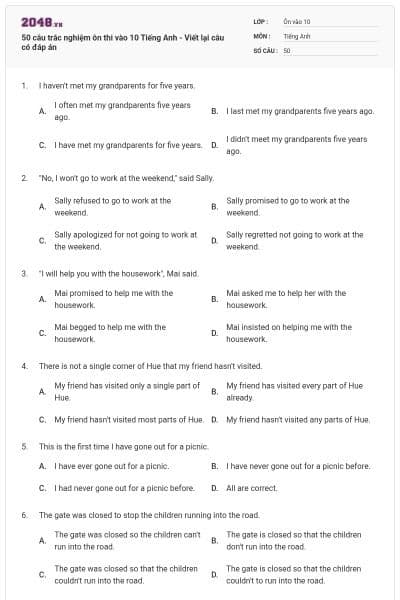
50 câu trắc nghiệm ôn thi vào 10 Tiếng Anh - Viết lại câu có đáp án
50 câu hỏi
I haven't met my grandparents for five years.
I often met my grandparents five years ago.
I last met my grandparents five years ago.
I have met my grandparents for five years.
I didn't meet my grandparents five years ago.
B
S + haven't/ hasn't + Vp2 + for + khoảng thời gian = S + last + V (QKĐ) + khoảng thời gian + ago.
Dịch nghĩa: Tôi đã không gặp ông bà mình được 5 năm rồi. = Lần cuối tôi gặp ông bà mình là 5 năm trước.
Sally refused to go to work at the weekend.
Sally promised to go to work at the weekend.
Sally apologized for not going to work at the weekend.
Sally regretted not going to work at the weekend.
A
refuse to do sth: từ chối làm gì
Dịch nghĩa: Sally nói "Không, tôi sẽ không đi làm vào cuối tuần đâu." = Sally từ chối đi làm vào cuối tuần.
"I will help you with the housework", Mai said.
Mai promised to help me with the housework.
Mai asked me to help her with the housework.
Mai begged to help me with the housework.
Mai insisted on helping me with the housework.
A
promise to do sth: hứa làm gì
Dịch nghĩa: Mai nói "Tôi sẽ giúp bạn làm việc nhà." = Mai hứa giúp tôi làm việc nhà.
There is not a single corner of Hue that my friend hasn't visited.
My friend has visited only a single part of Hue.
My friend has visited every part of Hue already.
My friend hasn't visited most parts of Hue.
My friend hasn't visited any parts of Hue.
B
Dịch nghĩa: Không có một góc nào của Huế mà bạn tôi chưa ghé thăm. = Bạn tôi đã ghé thăm mọi nơi ở Huế rồi.
This is the first time I have gone out for a picnic.
I have ever gone out for a picnic.
I have never gone out for a picnic before.
I had never gone out for a picnic before.
All are correct.
B
This is the first time + S + have/has Vp2 + O. = S + have/has + never Vp2 + O + before.
Dịch nghĩa: Đây là lần đầu tiên tôi ra ngoài đi dã ngoại. = Tôi chưa bao giờ ra ngoài đi dã ngoại trước kia.
The gate was closed to stop the children running into the road.
The gate was closed so the children can't run into the road.
The gate is closed so that the children don't run into the road.
The gate was closed so that the children couldn't run into the road.
The gate is closed so that the children couldn't to run into the road.
C
so that + clause: để…
Dịch nghĩa: Cửa cổng được đóng lại để ngăn trẻ con chạy ra đường. = Cửa cổng được đóng lại để trẻ con không thể chạy ra đường.
"Don't forget to hand in the report, Pete!" said Kate.
Kate reminded Pete of handing in the report.
Kate said that Pete had forgotten to hand in the report.
Kate forgot to hand in the report to Pete.
Kate reminded Pete to hand in the report.
D
don't forget + to V: đừng quên làm gì = remind sb to do sth: nhắc nhở ai làm gì
Dịch nghĩa: "Đừng quên nộp báo cáo nhé, Pete!" Kate nói. = Kate nhắc nhở Pete nộp báo cáo.
If you practise harder, you will have better results.
The harder you practise, the best results you will have.
The more hardly you practise, the better results you will have.
The hardest you practise, the most results you will have.
The harder you practise, the better results you will have.
D
Cấu trúc so sánh kép (càng…thì càng…):
The + so sánh hơn + S + V/be, the + so sánh hơn + S + V/be.
Dịch nghĩa: Nếu bạn luyện tập chăm chỉ hơn, bạn sẽ đạt được kết quả tốt hơn. = Bạn càng luyện tập chăm chỉ, bạn càng đạt được kết quả tốt.
They believe a single gunman carried out the attack.
The attack is believed to have carried out a single gunman.
A single gunman is believed to have carried out the attack.
It is believed to be carried out the attack by a single gunman.
It is believed that the attack has been carried out by a single gunman.
B
Câu bị động khách quan:
Chủ động: People/ They + V1 + (that) + S + V2 + O.
Bị động: It + be + Vp2 (V1) + that + S + V2 + O.
Hoặc: S + be + Vp2 (V1) + to V/ to have Vp2 (V2) + O.
Hoặc: S (O) + be + Vp2 (V1) + to be Vp2/ to have been Vp2 (V2) +...+ (by S)
Trong trường hợp này: believe (HTĐ) và carried out (QKĐ) nên dùng to have Vp2 (V2).
Dịch nghĩa: Họ tin rằng một tay súng duy nhất đã thực hiện vụ tấn công. = Một tay súng duy nhất được tin rằng đã thực hiện vụ tấn công.
"I'm sorry. I didn't do the homework." said the boy.
The boy admitted not doing the homework.
The boy said that he was sorry and he wouldn't do the homework.
The boy denied not doing the homework.
The boy refused to do the homework.
A
admit (not) doing sth: thừa nhận đã (không) làm gì
Dịch nghĩa: Cậu bé nói "Em xin lỗi. Em đã không làm bài tập về nhà." = Cậu bé thừa nhận đã không làm bài tập về nhà.
People believe that Chinese people invented paper.
Paper is believed to have been invented by Chinese people.
Paper is believed to be invented by Chinese people.
It was believed that Chinese people invent paper.
Chinese people are believed to invent paper.
A
Câu bị động khách quan:
Chủ động: People/ They + V1 + (that) + S + V2 + O.
Bị động: It + be + Vp2 (V1) + that + S + V2 + O.
Hoặc: S + be + Vp2 (V1) + to V/ to have Vp2 (V2) + O.
Hoặc: S (O) + be + Vp2 (V1) + to be Vp2/ to have been Vp2 (V2) +...+ (by S)
Trong trường hợp này: believe (HTĐ) và invented (QKĐ) nên dùng to have been Vp2 (V2).
Dịch nghĩa: Mọi người tin rằng người Trung Quốc đã phát minh ra giấy. = Giấy được tin là đã được phát minh bởi người Trung Quốc.
I haven't gone to the cinema for ten years.
It's ten years I haven't gone to the cinema.
I last went to the cinema ten years ago.
It was ten years ago I went to the cinema.
The last time I went to the cinema was ten years.
B
S + haven't/ hasn't + Vp2 + for + khoảng thời gian = S + last + V (QKĐ) + khoảng thời gian + ago.
Dịch nghĩa: Tôi đã không đến rạp chiếu phim được 10 năm rồi. = Lần cuối tôi đến rạp chiếu phim là 10 năm trước.
He smokes too much; perhaps that's why he can't get rid of his cough.
If he didn't smoke so much, he may get rid of his cough.
If he smoked less, he might be able to get rid of his cough.
If he smoked so much, he couldn't get rid of his cough.
If he does not smoke, he may not have his cough.
B
Câu điều kiện loại 2 (không có thật ở hiện tại):
If + S + V (QKĐ/ were) + O, S + would/could/should/might + V-inf + O.
Trong câu điều kiện, ta phải nếu ngược lại với hoàn cảnh.
Dịch nghĩa: Anh ấy hút thuốc quá nhiều; có lẽ đó là lí do tại sao anh ấy không thể khỏi ho. = Nếu anh ấy hút thuốc ít lại, anh ấy có thể khỏi ho.
The manager promised to be very open-minded.
The manager admitted not having been very open-minded.
The manager denied having been very open-minded.
The manager refused to have been very open-minded.
B
admit (not) doing sth: thừa nhận đã (không) làm gì
Dịch nghĩa: Người quản lí nói "Tôi đã không quá cởi mở." = Người quản lí thừa nhận đã không quá cởi mở.
Peter enjoyed working as a journalist for a local newspaper.
Peter no longer likes the job as a journalist for a local newspaper.
Peter has stopped working as a journalist for a local newspaper.
Peter refused to work as a journalist for a local newspaper.
C
used to + V-inf: đã từng làm gì đó trong quá khứ (hiện tại không còn làm nữa)
Thì hiện tại hoàn thành diễn tả 1 hành động xảy ra trong quá khứ, kết quả để lại ở hiện tại.
Dịch nghĩa: Peter đã từng làm nhà báo cho 1 tờ báo địa phương. = Peter đã không còn làm nhà báo cho 1 tờ báo địa phương.
"Do you believe in what the boy says, Mary?" said Tom.
Tom asked Mary if she believed in what the boy said.
Tom asked Mary to believe in what the boy said.
Tom asked Mary whether she believes in what the boy says.
Tom said that Mary believed in what the boy said.
A
Câu gián tiếp của câu hỏi Yes/No question:
S + asked (sb)/ wanted to know/ wondered + if/ whether + S + V (lùi thì) + O.
Dịch nghĩa: Tom nói "Bạn có tin vào những gì cậu bé nói không, Mary?" = Tom hỏi Mary liệu cô ấy có tin vào những gì cậu bé nói không.
John is fat because he eats so many chips.
If John didn't eat so many chips, he would not be fat.
John is fat though he eats so many chips.
Being fat, John eats so many chips.
If John doesn't eat so many chips, he will not be fat.
A
Câu điều kiện loại 2 (không có thật ở hiện tại):
If + S + V (QKĐ/ were) + O, S + would/could/should/might + V-inf + O.
Dịch nghĩa: John béo vì anh ấy ăn quá nhiều khoai tây chiên. = Nếu John không ăn quá nhiều khoai tây chiên, anh ấy sẽ không béo.
People say he won a lot of money on the lottery.
He is said to have won a lot of money on the lottery.
He was said to win a lot of money on the lottery.
He is said that he won a lot of money on the lottery.
He won a lot of money on the lottery, it is said.
A
Câu bị động khách quan:
Chủ động: People/ They + V1 + (that) + S + V2 + O.
Bị động: It + be + Vp2 (V1) + that + S + V2 + O.
Hoặc: S + be + Vp2 (V1) + to V/ to have Vp2 (V2) + O.
Hoặc: S (O) + be + Vp2 (V1) + to be Vp2/ to have been Vp2 (V2) +...+ (by S)
Trong trường hợp này, say (HTĐ) và won (QKĐ) → dùng to have Vp2 (V2)
Dịch nghĩa: Mọi người cho rằng anh ấy đã trúng số rất nhiều tiền. = Anh ấy được cho rằng đã trúng số rất nhiều tiền.
Tom asked Jean to sit beside him.
Tom invited Jean to sit beside him.
Tom requested Jean if he could sit beside Jean.
Tom asked Jean if he could sit beside her.
D
Câu gián tiếp của câu hỏi Yes/No question:
S + asked (sb)/ wanted to know/ wondered + if/ whether + S + V (lùi thì) + O.
Dịch nghĩa: Tom hỏi "Tôi có thể ngồi cạnh bạn không, Jean?" = Tom hỏi Jean liệu anh ấy có thể ngồi cạnh cô ấy không.
They allow to play in the garden.
We are allowed to play in the garden.
They allow us playing in the garden.
We are let to play in the garden.
B
let sb do sth: cho phép ai làm gì = be allowed to do sth: được phép làm gì
Dịch nghĩa: Họ cho phép chúng tôi chơi trong vườn. = Chúng tôi được hép chơi trong vườn.
There was not enough time to hold the meeting.
People wanted to get away, so the meeting began early.
The meeting is planned to start in a short time.
The meeting lasted much longer than usual.
A
the pressure of time = not enough time
Dịch nghĩa: Cuộc họp đã bị hoãn do áp lực thời gian. = Đã không có đủ thời gian để tổ chức cuộc họp.
They had such a fierce dog that nobody would visit them.
So fierce was their dog that nobody would visit them.
Their dog was fierce enough for anybody to visit them.
If their dog weren't fierce, somebody would visit them.
So fierce a dog did they had that nobody would visit them
A
S + V/be + such + (a/an) + adj + N + that + clause = So + adj + be + S + that + clause: quá…đến nỗi mà…
Dịch nghĩa: Họ có một con chó hung dữ đến nỗi không ai đến thăm họ. = Con chó của họ quá hung dữ đến nỗi không ai đến thăm họ được.
Mr. Smith is very interested in our plan to whom I spoke on the phone last night.
Mr. Smith, who is very interested in our plan, I spoke to on the phone last night.
Mr. Smith, who I spoke on the phone last night, is very interested in our plan.
Mr. Smith, to whom I spoke on the phone last night, is very interested in our plan.
D
Đại từ quan hệ "whom" thay thế cho danh từ chỉ người phía trước và đóng vai trò làm tân ngữ trong mệnh đề quan hệ, có thể đứng sau giới từ.
Dịch nghĩa: Ông Smith rất hứng thú với kế hoạch của chúng tôi. Tôi đã nói chuyện với ông ấy qua điện thoại tối qua. = Ông Smith, người tôi đã nói chuyện qua điện thoại tối qua, rất hứng thú với kế hoạch của chúng tôi.
"I didn't break the window." Jim said.
Jim refused to break the window.
Jim denied breaking the window.
Jim admitted breaking the window.
Jim told he didn't break the window.
B
deny doing sth: phủ nhận đã làm gì
Dịch nghĩa: Jim nói "Tôi không làm vỡ cửa sổ." = Jim phủ nhận đã làm vỡ cửa sổ.
They are not allowed to go out in the evening by their parents.
Their parents do not want them to go out in the evening.
Going out in the evening is permitted by their parents.
Their parents never let them go out in the evening.
Although their parents do not allow, they still go out in the evening.
C
be not allowed to do sth: không được phép làm gì = never let sb do sth: không bao giờ cho phép ai làm gì
Dịch nghĩa: Họ không được bố mẹ cho phép ra ngoài vào buổi tối. = Bố mẹ họ không bao giờ cho phép họ ra ngoài vào buổi tối.
Luisa must be very disappointed when she failed the exam.
Luisa must have been very disappointed when she failed the exam.
Luisa may be very disappointed when she failed the exam.
Luisa could have been very disappointed when she failed the exam.
B
must + have + Vp2: chắc hẳn đã làm gì đó trong quá khứ → dùng để phán đoán về 1 sự việc đã diễn ra trong quá khứ, mang tính chắc chắn.
Dịch nghĩa: Tôi chắc rằng Luisa đã rất thất vọng khi trượt kì thi. = Lusia chắc hẳn đã rất thất vọng khi trượt kì thi.
The children couldn't go swimming because the sea was too rough.
The sea was too rough for the children to go swimming.
The sea was rough enough for the children to swim in.
The sea was too rough to the children's swimming.
The children were not calm enough to swim in the sea.
A
S + be + too + adj + (for sb) + to V + O: quá…(để ai) làm gì
Dịch nghĩa: Trẻ con không thể đi bơi vì biển động quá. = Biển quá động để trẻ con có thể đi bơi.
She is the most intelligent woman I have ever met.
I have never met a more intelligent woman than her.
She is not as intelligent as the women I have ever met.
I have ever met such an intelligent woman.
She is more intelligent than I am.
A
S1 + be + so sánh nhất + N + S2 + have/has + ever + Vp2. = S2 + have/has + never + Vp2 + a/an + so sánh hơn + N + than + S1.
Dịch nghĩa: Cô ấy là người phụ nữ thông minh nhất mà tôi từng gặp. = Tôi chưa bao giờ gặp 1 người phụ nữ thông minh hơn cô ấy.
Jim's bike has been stolen yesterday.
Jim had someone steal his bike yesterday.
Jim's bike is stolen.
Jim had his bike stolen yesterday.
D
Bị động với "have": have sth done
Dịch nghĩa: Hôm qua ai đó đã ăn trộm chiếc xe đạp của Jim. = Jim đã bị trộm mất chiếc xe đạp ngày hôm qua.
It is the first time Susan goes by car.
It is the first time Susan has driven a car.
It is the first time Susan goes in a car.
It is the first time Susan is driving a car.
B
S + haven't/ hasn't + Vp2 + O + before. = It is the first time + S + have/has + Vp2 + O.
Dịch nghĩa: Susan chưa từng lái xe trước kia. = Đây là lần đầu tiên Susan lái xe.
Although she is intelligent, she doesn't do well at school.
In spite of intelligent, she doesn't do well at school.
Despite being intelligent, she doesn't do well at school.
Even though her intelligence, she doesn't do well at school.
In spite the fact that she is intelligent, she doesn't do well at school.
B
Although/ even though + clause = in spite of/ despite + N/V-ing = in spite of/ despite + the fact that + clause: mặc dù
Dịch nghĩa: Mặc dù cô ấy thông minh nhưng cô ấy học không giỏi trên trường. = Mặc dù thông minh nhưng cô ấy học không giỏi trên trường.
You are in this mess right now because you didn't listen to my advice in the first place.
If you had listened to my advice in the first place, you wouldn't have been in this mess right now.
If you listened to my advice in the first place, you wouldn't be in this mess right now.
If you listen to my advice in the first place, you will not be in this mess right now.
If you had listened to my advice in the first place, you wouldn't be in this mess right now.
D
Câu điều kiện loại kết hợp: If + S + had + Vp2 + O, S + would + V-inf + O.
Dịch nghĩa: Hiện tại bạn đang gặp rắc rối này vì ngay từ đầu bạn đã không nghe theo lời khuyên của tôi. = Nếu ngay từ đầu bạn nghe theo lời khuyên của tôi thì hiện tại bạn sẽ không gặp rắc rối này.
My friend sometimes eats fast food.
My friend doesn't like eating fast food.
My friend no longer eats fast food.
My friend has never eaten fast food
C
no longer: không còn…nữa
Dịch nghĩa: Bạn tôi đã ngừng ăn đồ ăn nhanh. = Bạn tôi không còn ăn đồ ăn nhanh nữa.
The living room isn't as big as the kitchen.
The living room is bigger than the kitchen.
The kitchen is smaller than the living room.
The kitchen is bigger than the living room.
The kitchen is not bigger than the living room.
C
So sánh hơn với tính từ ngắn: S + be + adj + er + than + O.
Dịch nghĩa: Phòng khách không to bằng phòng bếp. = Phòng bếp to hơn phòng khách.
In spite of heavy rain, my brother went to work.
In spite it rain heavily, my brother went to work.
Despite it rained heavily, my brother went to work.
Though rain was heavily, my brother went to work.
Although it rained heavily, my brother went to work.
D
Although/ though + clause = in spite of/ despite + N/V-ing: mặc dù
Dịch nghĩa: Mặc dù mưa to nhưng bố tôi vẫn đi làm. = Mặc dù trời mưa to nhưng bố tôi vẫn đi làm.
The policeman asked the woman what did she do the night before.
The policeman asked the woman what she had done the night before.
The policeman asked the woman what had she done the night before.
The policeman asked the woman what she did the night before.
B
Câu gián tiếp của câu hỏi wh-question:
S + asked (sb)/ wanted to know/ wondered + wh-word + S + V (lùi thì) + O.
Dịch nghĩa: Cảnh sát hỏi người phụ nữ "Cô đã làm gì tối hôm qua?" = Cảnh sát đã hỏi người phụ nữ xem cô ấy đã làm gì tối hôm trước.
Bill drives more carelessly than he used to.
Bill doesn't drive as carefully as he used to.
Bill doesn't more drive carefully than he used to.
Bill doesn't drive as carefully he used to.
Bill doesn't drive as carefully as he used.
A
So sánh hơn với trạng từ dài: S + V + more + adv + than + O.
So sánh ngang bằng với trạng từ dài: S + V + as + adv + as + O.
Dịch nghĩa: Bill lái xe bất cẩn hơn trước kia. = Bill không lái xe cẩn thận bằng trước kia.
She didn't arrive late for the bus.
She arrived too early for the bus.
She was too late to catch the bus.
She wasn't late for the bus.
C
S + be + not + adj + enough + to V + O. = S + be + too + adj + to V + O.
Dịch nghĩa: Cô ấy đến không đủ sớm để bắt xe buýt. = Cô ấy đến quá muộn để bắt xe buýt.
It usually takes her an hour to drive to work.
She never spends an hour driving to work.
She used to drive to work in an hour.
She doesn't usually drive to work in an hour.
She usually spends an hour driving to work.
D
It + take(s) + (sb) + khoảng thời gian + to V + O.
= S + spend(s) + khoảng thời gian + V-ing + O.
Dịch nghĩa: Cô ấy thường mất 1 giờ đồng hồ để lái xe đi làm. = Cô ấy thường dành 1 giờ đồng hồ lái xe đi làm.
Anna reminded Bella to go to the show with her.
Anna persuaded Bella to go to the show with her.
Anna invited Bella to go to the show with her.
Anna encouraged Bella to go to the show with her.
C
invite sb to do sth: mời ai làm gì
Dịch nghĩa: Anna nói với Bella "Bạn có muốn đi cùng tôi tới buổi biểu diễn không?" = Anna mời Bella tới buổi biểu diễn cùng cô ấy.
You didn't help me and I didn't succeed.
I succeeded even you didn't help me.
In spite of your help, I wasn't successful.
I was successful due to your help.
D
due to + N/V-ing: do, vì
Dịch nghĩa: Nếu không có sự giúp đỡ của bạn, tôi đã không thể thành công được. = Tôi đã thành công nhờ có sự giúp đỡ của bạn.
I could not get the job because I did not speak English well.
I failed to get the job because of my poor English.
Despite my poor English, I was successful in the job.
I wish I had got the job so that I could speak English well.
I would have spoken English well if I could get that Job.
A
because + clause = because of + N/V-ing: vì, bởi vì
Dịch nghĩa: Tôi không thể có được công việc vì tôi nói tiếng Anh không tốt. = Tôi không thể có được công việc do tiếng Anh của tôi kém.
People believe Pho is the most typical food in Vietnam.
It is believed that Pho has been the most typical food in Vietnam.
A more typical food than Pho is believed in Vietnam.
Pho is believed to be the most typical food in Vietnam.
No food in Vietnam is less typical than Pho.
C
Câu bị động khách quan:
Chủ động: People/ They + V1 + (that) + S + V2 + O.
Bị động: It + be + Vp2 (V1) + that + S + V2 + O.
Hoặc: S + be + Vp2 (V1) + to V/ to have Vp2 (V2) + O.
Hoặc: S (O) + be + Vp2 (V1) + to be Vp2/ to have been Vp2 (V2) +...+ (by S)
Trong trường hợp này: believe (HTĐ) và is (HTĐ) nên dùng to V (V2).
Dịch nghĩa: Mọi người tin rằng Phở là món ăn đặc trưng nhất ở Việt Nam. = Phở được tin là món ăn đặc trưng nhất ở Việt Nam.
There were so many people on the bus that Sally couldn't get a seat.
The bus was too crowded for Sally not to get a seat.
The bus was so crowded that there was nowhere for Sally to sit.
So crowded the bus was that Sally couldn't get a seat.
The crowded bus did not prevent Sally from getting a seat.
B
S + be + so + adj + that + a clause: quá ... đến nỗi mà ...
Dịch nghĩa: Có quá nhiều người trên xe buýt đến nỗi Sally không có ghế ngồi. = Xe buýt quá đông đến nỗi không có chỗ cho Sally ngồi.
I haven't been sent that letter.
I wasn't sent that letter.
That letter hasn't been sent me.
That letter has sent to me by no one.
A
Bị động với động từ có 2 tân ngữ:
Chủ động: S + V + Oi + Od
Bị động: S (Oi) + be + Vp2 + Od hoặc: S (Od) + be + Vp2 + giới từ + Oi
Dịch nghĩa: Không ai gửi cho tôi bức thư đó. = Tôi đã không được gửi bức thư đó.
Bill's English is much better than it was.
Bill speaks English better now than he did before.
Bill has started to learn English but doesn't speak it well.
Bill has always spoken good English.
Bill's English was much better than it is now.
A
So sánh hơn với trạng từ ngắn: S + V + adv + er + than + O.
Dịch nghĩa: Tiếng Anh của Bill tốt hơn nhiều so với trước kia. = Hiện tại Bill nói tiếng Anh tốt hơn trước kia.
The car was expensive so that she couldn't buy it.
The car was too expensive for her to buy.
She was rich enough to buy the car.
She was so poor but she bought the car.
B
S + be + too + adj + (for sb) + to V + O: quá…(cho ai) làm gì
Dịch nghĩa: Chiếc xe hơi rất đắt và cô ấy không có khả năng mua nó. = Chiếc xe hơi quá đất để cô ấy mua.
The woman was too weak to lift the basket.
Although the woman was weak, she could lift the basket.
The woman shouldn't have lifted the basket because she was so weak.
The woman was so weak that she couldn't lift the basket.
The woman lifted the basket, so she wasn't very weak.
C
S + be + so + adj + that + clause: quá…đến nỗi mà…
Dịch nghĩa: Người phụ nữ quá yếu để có thể nâng được chiếc rổ. = Người phụ nữ quá yếu đến nỗi cô ấy không thể nâng được chiếc rổ.
They got success since they took my advice.
They took my advice, and failed.
If they did not take my advice, they would not get success.
But for taking my advice, they would not have got success.
My advice stopped them from getting success.
C
Câu điều kiện loại 3 (không có thật trong quá khứ):
But for + N/V-ing, S + would/could + have + Vp2 + O: Nếu không nhờ vào…thì…
Dịch nghĩa: Họ đã thành công vì họ đã nghe theo lời khuyên của tôi. = Nếu không nhờ vào việc nghe theo lời khuyên của tôi, họ đã không thể thành công.
His eel soup is better than any other soups I have ever eaten.
Of all the soups I have ever eaten, his eel soup is the best.
I have ever eaten many soups that are better than his eel soup.
His eel soup is the worst of all soups I have eaten.
His eel soup is good but I have ever eaten many others better.
A
Dịch nghĩa: Món súp lươn của anh ấy ngon hơn bất kỳ món súp nào tôi từng ăn. = Trong tất cả các món súp tôi từng ăn, món súp lươn của anh ấy là ngon nhất.