
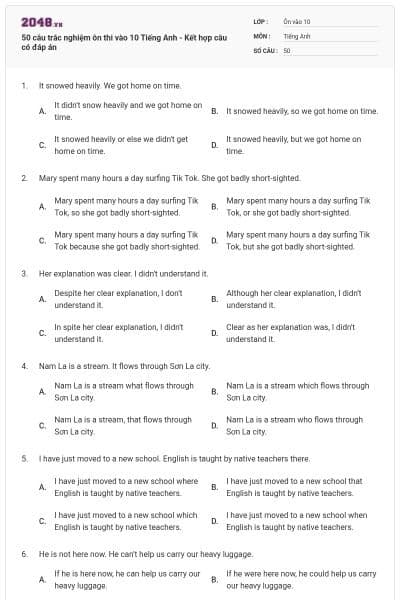
50 câu trắc nghiệm ôn thi vào 10 Tiếng Anh - Kết hợp câu có đáp án
50 câu hỏi
It snowed heavily. We got home on time.
It didn't snow heavily and we got home on time.
It snowed heavily, so we got home on time.
It snowed heavily or else we didn't get home on time.
It snowed heavily, but we got home on time.
D
but: nhưng
Dịch nghĩa: Trời đổ tuyết dầy. Chúng tôi về nhà đúng giờ. = Trời đổ tuyết dầy, nhưng chúng tôi vẫn về nhà đúng giờ.
Mary spent many hours a day surfing Tik Tok, so she got badly short-sighted.
Mary spent many hours a day surfing Tik Tok, or she got badly short-sighted.
Mary spent many hours a day surfing Tik Tok because she got badly short-sighted.
Mary spent many hours a day surfing Tik Tok, but she got badly short-sighted.
A
so: vì vậy nên, do vậy
Dịch nghĩa: Mary dành nhiều giờ mỗi ngày để lướt Tik Tok. Cô ấy bị cận thị nặng. = Mary dành nhiều giờ mỗi ngày để lướt Tik Tok, vì vậy nên cô ấy bị cận thị nặng.
Her explanation was clear. I didn't understand it.
Despite her clear explanation, I don't understand it.
Although her clear explanation, I didn't understand it.
In spite her clear explanation, I didn't understand it.
Clear as her explanation was, I didn't understand it.
D
Despite/ In spite of + N/V-ing, clause = Although + clause, clause = Adj/adv + as/though + S + be/V, clause: mặc dù…
Dịch nghĩa: Lời giải thích của cô ấy rất rõ ràng. Tôi không thể hiểu được nó. = Mặc dù lời giải thích của cô ấy rất rõ ràng nhưng tôi vẫn không thể hiểu được nó.
Nam La is a stream. It flows through Sơn La city.
Nam La is a stream what flows through Sơn La city.
Nam La is a stream which flows through Sơn La city.
Nam La is a stream, that flows through Sơn La city.
Nam La is a stream who flows through Sơn La city.
B
Đại từ quan hệ "which" thay thế cho danh từ chỉ vật phía trước và đóng vai trò làm tân ngữ/chủ ngữ trong mệnh đề quan hệ.
Dịch nghĩa: Nam La là 1 con suối. Nó chảy qua thành phố Sơn La. = Nam La là 1 con suối chảy qua thành phố Sơn La.
I have just moved to a new school where English is taught by native teachers.
I have just moved to a new school that English is taught by native teachers.
I have just moved to a new school which English is taught by native teachers.
I have just moved to a new school when English is taught by native teachers.
A
Trạng từ quan hệ "where" thay thế cho danh từ chỉ nơi chốn phía trước và đóng vai trò làm tân ngữ trong mệnh đề quan hệ.
Dịch nghĩa: Tôi vừa mới chuyển đến ngôi trường mới. Tiếng Anh được dạy bởi giáo viên bản xứ ở đó. = Tôi vừa mới chuyển đến ngôi trường mới nơi tiếng Anh được dạy bởi giáo viên bản xứ.
He is not here now. He can't help us carry our heavy luggage.
If he is here now, he can help us carry our heavy luggage.
If he were here now, he could help us carry our heavy luggage.
If he weren't here now, he could help us carry our heavy luggage.
If he were here now, he can help us carry our heavy luggage.
B
Câu điều kiện loại 2 (không có thật ở hiện tại):
If + S + V (QKĐ/ were) + O, S + would/could/should/might + V-inf + O.
Dịch nghĩa: Anh ấy hiện tại không có ở đây. Anh ấy không thể giúp chúng ta xách hành lí nặng. = Nếu hiện tại anh ấy có ở đây, anh ấy có thể giúp chúng ta xách hành lí nặng.
She is very busy at work. She still takes good care of her children.
Because of being busy at work, she takes good care of her children.
As she very busy at work, she takes good care of her children.
When she is very busy at work, she takes good care of her children.
Despite being busy at work, she takes good care of her children.
D
The exercise was very long. I couldn't do it in thirty minutes.
The exercise was so long that I couldn't do it in thirty minutes.
The exercise was long enough for me to do in thirty minutes.
The exercise was very long, so I had to do it in thirty minutes.
The exercise was long so that I couldn't do it in thirty minutes.
A
Cấu trúc "so…that…" (quá…đến nỗi mà…): S + be + so + adj + that + S + V + O.
Dịch nghĩa: Bài tập rất dài. Tôi không thể làm nó trong vòng 30 phút được. = Bài tập quá dài đến nỗi tôi không thể làm nó trong vòng 30 phút được.
His English isn't good. He doesn't understand the essay.
If his English is good, he can understand the essay.
If his English were good, he would understand the essay.
If his English were good, he couldn't understand the essay.
If his English is good, he can't understand the essay.
B
Câu điều kiện loại 2 (không có thật ở hiện tại):
If + S + V (QKĐ/ were) + O, S + would/could/should/might + V-inf + O.
Dịch nghĩa: Tiếng Anh của anh ấy không tốt. Anh ấy không hiểu bài luận. = Nếu tiếng Anh của anh ấy tốt, anh ấy sẽ hiểu bài luận.
Albert decided to buy a motorbike. His car was stolen last week.
Albert, whose car was stolen last week, decided to buy a motorbike.
Albert decided to buy a motorbike instead of a car last week.
Albert decided to buy a motorbike like his stolen car last week.
Albert decided to buy a motorbike before his car was stolen last week.
A
Đại từ quan hệ "whose" chỉ sự sở hữu: …N (chỉ người/vật) + whose + N + V + O…
Dịch nghĩa: Albert đã quyết định mua 1 chiếc xe máy. Chiếc xe hơi của anh ấy đã bị lấy cắp vào tuần trước. = Albert, người bị lấy cắp chiếc xe hơi vào tuần trước, đã quyết định mua 1 chiếc xe máy.
Peter dislikes jazz music. Tom does, too.
Either Peter or Tom likes jazz music.
Neither Peter nor Tom likes jazz music.
Not only Peter but also Tom likes jazz music.
Both Peter and Tom like jazz music.
B
Neither A nor B: không A cũng không B (động từ theo sau chia theo B)
Dịch nghĩa: Peter không thích nhạc jazz. Tom cũng vậy. = Cả Pater và Tom đều không thích nhạc jazz.
Because it was a fine day, so we decided to go on a trip to the countryside.
Because it was a fine day, we decided to go on a trip to the countryside.
Despite it was a fine day, we decided to go on a trip to the countryside.
Although it was a fine day, we decided to go on a trip to the countryside.
B
Because + clause, clause: bởi vì…
Dịch nghĩa: Đó là 1 ngày đẹp trời. Do đó, chúng tôi đã quyết định đi du lịch ở vùng nông thôn. = Bởi vì đó là 1 ngày đẹp trời nên chúng tôi đã quyết định đi du lịch ở vùng nông thôn.
Most of the classmates couldn't come. He invited them to the birthday party.
Most of the classmates whom he invited to the birthday party couldn't come.
Most of the classmates which he invited to the birthday party couldn't come.
Most of the classmates that he invited them to the birthday party couldn't come.
Most of the classmates whom he was invited to the birthday party couldn't come.
A
Đại từ quan hệ "whom" thay thế cho danh từ chỉ người, đóng vai trò làm tân ngữ trong mệnh đề quan hệ.
Dịch nghĩa: Hầu hết bạn cùng lớp không thể đến. Anh ấy đã mời họ đến dự tiệc sinh nhật. = Hầu hết bạn cùng lớp những người anh ấy mời đến dự tiệc sinh nhật không thể đến.
Nam didn't take his close friend's advice. That's why he is out of work.
If Nam had taken his close friend's advice, he wouldn't have been out of work.
If Nam had taken his close friend's advice, he wouldn't be out of work.
If Nam took his close friend's advice, he wouldn't be out of work.
If Nam takes his close friend's advice, he will not be out of work.
B
Câu điều kiện loại kết hợp: If + S + had + Vp2 + O, S + would + V-inf + O.
→ Giả thiết về một hành động, sự việc sẽ xảy ra ở hiện tại nếu điều kiện nói tới trong quá khứ có thật.
Dịch nghĩa: Nam đã không nghe theo lời khuyên của bạn thân. Đó là lí do tại sao anh ấy thất nghiệp. = Nếu Nam nghe theo lời khuyên của bạn thân, anh ấy sẽ không bị thất nghiệp.
It was raining heavily. However, the explorers decided to continue their journey.
The explorers put off their journey due to the heavy rain.
The heavy rain could not prevent the explorers from continuing their journey.
If it had rained heavily, the explorers would not have continued their journey.
It rained so heavily that explorers could not continue their journey.
B
prevent sb/sth from doing sth: ngăn cản ai/cái gì làm gì
Dịch nghĩa: Trời đang mưa rất nặng hạt. Tuy nhiên, những nhà thám hiểm vẫn quyết định tiếp tục cuộc hành trình. = Cơn mưa nặng hạt không thể ngăn cản những nhà thám hiểm tiếp tục cuộc hành trình.
Ally wants to buy that dress. However, she doesn't have enough money.
If Ally had enough money, she could buy that dress.
If Ally has enough money, she can buy that dress.
If Ally have enough money, she could buy that dress.
If Ally had enough money, she will buy that dress.
A
Câu điều kiện loại 2 (không có thật ở hiện tại):
If + S + V (QKĐ/ were) + O, S + would/could/should/might + V-inf + O.
Dịch nghĩa: Ally muốn mua chiếc váy đó. Tuy nhiên, cô ấy không có đủ tiền. = Nếu Ally có đủ tiền, cô ấy có thể mua chiếc váy đó.
Tina loves cooking. However, she doesn’t have much time to do it.
Tina doesn't have much time to do cooking because of her love of cooking.
Tina doesn't have much time to do cooking despite her love of cooking.
Tina doesn't have much time to do cooking, so she loves cooking.
Tina doesn't do any cooking even though she loves cooking.
B
Despite + N/V-ing: mặc dù…
Dịch nghĩa: Tina yêu thích nấu nướng. Tuy nhiên, cô ấy không có nhiều thời gian để làm việc đó. = Tina không có nhiều thời gian nấu nướng mặc dù yêu thích điều đó.
Jack is an excellent swimmer. He used to practice swimming every day.
Jack, who used to practice swimming every day, is an excellent swimmer.
Jack practices swimming every day but he is an excellent swimmer.
Jack, who practices swimming every day, was an excellent swimmer.
Jack practicing swimming every day was an excellent swimmer.
A
Đại từ quan hệ "who" thay thế cho danh từ chỉ người phía trước, đóng vai trò làm chủ ngữ trong mệnh đề quan hệ.
Dịch nghĩa: Jack là một người bơi giỏi. Anh ấy từng tập bơi mỗi ngày. = Jack, người từng tập bơi mỗi ngày, là một người bơi giỏi.
Jenny is good at playing sports. She also does judo well.
Jenny doesn't like both doing judo and playing sports.
Jenny is not only good at playing sports but she is also doing judo well.
Jenny is not interested in both playing sports and doing judo.
Jenny isn't fond of doing judo but she loves playing sports.
B
not only A but also B: không những A mà còn B
Dịch nghĩa: Jenny chơi thể thao giỏi. Cô ấy cũng chơi judo giỏi. = Jenny không những chơi thể thao giỏi mà còn chơi judo giỏi.
Linda likes living in the countryside. She will move here next week.
Linda likes living in the countryside so she won't move here next week.
Linda likes living in the countryside but she will move here next week.
Linda likes living in the countryside so she will move here next week.
Although Linda likes living in the countryside, she will move here next week.
C
so: vì vậy nên, do đó
Dịch nghĩa: Linda thích sống ở vùng nông thôn. Cô ấy sẽ chuyển đến đây vào tuần tới. = Linda thích sống ở vùng nông thôn vì vậy nên cô ấy sẽ chuyển đến đây vào tuần tới.
Jack will visit Phú Thọ. The Hùng King Festival is held in there.
Jack will visit Phú Thọ, who Hùng King Festival is held.
Jack will visit Phú Thọ, when Hùng King Festival is held.
Jack will visit Phú Thọ, which Hùng King Festival is held.
Jack will visit Phú Thọ, where Hùng King Festival is held.
D
Trạng từ quan hệ "where" thay thế cho danh từ chỉ nơi chốn phía trước, đóng vai trò làm tân ngữ trong mệnh đề quan hệ.
Dịch nghĩa: Jack sẽ tới thăm Phú Thọ. Giỗ Tổ Hùng Vương được tổ chức ở đó. = Jack sẽ tới thăm Phú Thọ, nơi Giỗ Tổ Hùng Vương được tổ chức.
My father went to a market in Kon Tum. He bought a costume of the Bahnar there.
My father bought a costume of the Bahnar at a market in Kon Tum.
My father bought a Bahnar costume before going to a market in Kon Tum.
My father bought a Bahnar costume after going to a market in Kon Tum.
My father sold a costume of the Bahnar at a market in Kon Tum.
A
Ta thấy trạng từ "there" ở vế sau ám chỉ "at a market in Kon Tum".
Dịch nghĩa: Bố tôi đã đến 1 khu chợ ở Kon Tum. Ông ấy đã mua 1 bộ trang phục của người Bahnar ở đó. = Bố tôi đã mua 1 bộ trang phục của người Bahnar ở 1 khu chợ ở Kon Tum.
I want to buy a new laptop. I have no money.
I want to buy a new laptop so I have no money.
I want to buy a new laptop but I have no money.
I want to buy a new laptop for I have no money.
I want to buy a new laptop and I have no money.
B
but: nhưng
Dịch nghĩa: Tôi muốn mua 1 chiếc máy tính xách tay mới. Tôi không có tiền. = Tôi muốn mua 1 chiếc máy tính xách tay mới nhưng tôi không có tiền.
It's raining. I will stay at home and do homework.
It's raining, because I'll stay at home and do homework.
It's raining, and I'll stay at home and do homework.
It's raining, or I'll stay at home and do homework.
It's raining, so I'll stay at home and do homework.
D
so: vì vậy nên, do đó
Dịch nghĩa: Trời đang mưa. Tôi sẽ ở nhà và làm bài tập về nhà. = Trời đang mưa, vì vậy nên tôi sẽ ở nhà và làm bài tập về nhà.
Mai passed the test. Her parents took her to the zoo.
Mai passed the test when her parents took her to the zoo.
Mai passed the test, therefore, her parents took her to the zoo.
Mai passed the test because her parents took her to the zoo.
Mai passed the test, however, her parents took her to the zoo.
B
Clause, therefore, clause: do đó…
Dịch nghĩa: Mai đã vượt qua bài kiểm tra. Bố mẹ cô bé đã đưa cô bé đi sở thú. = Mai đã vượt qua bài kiểm tra, do đó, bố mẹ cô bé đã đưa cô bé đi sở thú.
I feel sleepy. I must finish the essay.
I feel sleepy although I must finish the essay.
I feel sleepy because I must finish the essay.
I feel sleepy, otherwise, I must finish the essay.
I feel sleepy, however, I must finish the essay.
D
Clause, however, clause: tuy nhiên…
Dịch nghĩa: Tôi thấy buồn ngủ. Tôi phải hoàn thành bài luận. = Tôi thấy buồn ngủ, tuy nhiên, tôi phải hoàn thành bài luận.
Ann always keeps up with the latest fashions so as not to work for a famous fashion house.
Ann works for a famous fashion house, so she always keeps up with the latest fashion.
Not working for a famous fashion house, Ann always keeps up with the latest fashion.
Despite working for a famous fashion house, Ann hardly keeps up with the latest fashion.
B
so: vì vậy nên, do đó
Dịch nghĩa: Ann luôn theo kịp các xu hướng thời trang mới nhất. Cô ấy làm việc cho một hãng thời trang nổi tiếng. = Ann làm việc cho một hãng thời trang nổi tiếng vì vậy nên cô ấy luôn theo kịp các xu hướng thời trang mới nhất.
The agreement ended six-month negotiation. It was signed yesterday.
The agreement which ends six-month negotiation was signed yesterday.
The agreement which was signed yesterday lasted six months.
The negotiation which lasted six months was signed yesterday.
The agreement which was signed yesterday ended six-month negotiation.
D
Đại từ quan hệ "which" thay thế cho danh từ chỉ vật phía trước và đóng vai trò làm chủ ngữ/tân ngữ trong mệnh đề quan hệ.
Dịch nghĩa: Thỏa thuận đã kết thúc đàm phán kéo dài sáu tháng. Thỏa thuận đã được ký kết vào hôm qua. = Thỏa thuận được ký kết vào hôm qua đã kết thúc đàm phán kéo dài sáu tháng.
Bill said that he had never been to Russia and he thought he would go there the next year.
Bill said that he would have never been to Russia and he thinks he would go there the next year.
Bill said that he had never been to Russia and he thinks he will go there the next year.
Bill said that he has never been to Russia and he thinks he would go there the next year.
A
Câu gián tiếp của câu kể: S + told (sb)/said (to sb) + (that) + S + V (lùi thì) + O.
Dịch nghĩa: "Tôi chưa bao giờ đến Nga. Tôi nghĩ tôi sẽ đến đó vào năm sau." Bill nói. = Bill nói rằng anh ấy chưa bao giờ đến Nga và anh ấy nghĩ anh ấy sẽ đến đó vào năm sau.
Peter, who is an excellent student, is very good at drawing.
Peter, that an excellent student, is very good at drawing.
That's Peter who he's an excellent student, is very good at drawing.
Peter, whom is an excellent student, is very good at drawing.
A
Đại từ quan hệ "who" thay thế cho danh từ chỉ người phía trước và đóng vai trò làm chủ ngữ trong mệnh đề quan hệ.
Dịch nghĩa: Peter vẽ rất giỏi. Cậu ấy là 1 học sinh xuất sắc. = Peter, người là 1 học sinh xuất sắc, vẽ rất giỏi.
We cut down many forests. The Earth becomes hot.
The more forests we cut down, the hotter the Earth becomes.
The more we cut down forests, the hotter the Earth becomes.
The more forests we cut down, the Earth becomes hotter.
The more we cut down forests, the Earth becomes hotter.
A
So sánh kép (càng…thì càng…):
The + so sánh hơn + S + V, the + so sánh hơn + S + V.
Dịch nghĩa: Chúng ta chặt phá nhiều rừng. Trái đất trở nên nóng hơn. = Chúng ta chặt phá càng nhiều rừng thì Trái đất càng nóng hơn.
The film last night was thrilling. It was about a bank robbery.
The film last night, which was about a bank robbery, was thrilling.
It which was about a bank robbery was thrilling last night.
The bank robbery which was last night was thrilling.
The film last night was thrilling which was about a bank robbery.
A
Đại từ quan hệ "which" thay thế cho danh từ chỉ vật phía trước, đóng vai trò làm chủ ngữ/tân ngữ trong mệnh đề quan hệ.
Dịch nghĩa: Bộ phim tối qua thật ly kỳ. Phim nói về một vụ cướp ngân hàng. = Bộ phim tối qua, nói về một vụ cướp ngân hàng, thật ly kỳ.
I can't remember the name of the speaker who will come to talk with William Shakespeare.
A speaker who will come to talk about William Shakespeare, I can't remember his name.
The speaker whose name I can't remember will come to talk about William Shakespeare.
The speaker will come to talk about William Shakespeare whose name I can't remember.
C
Đại từ quan hệ "whose" chỉ sự sở hữu: …N (chỉ người/vật) + whose + N + V + O…
Dịch nghĩa: Một diễn giả sẽ đến để nói về William Shakespeare. Tôi không nhớ tên của ông ấy. = Diễn giả mà tôi không nhớ tên của ông ấy sẽ đến để nói về William Shakespeare.
The student next to me kept chewing gum. That bothered me a lot.
The student next to me kept chewing gum bothered me a lot.
The student next to me kept chewing gum, which bothered me a lot.
The student next to me kept chewing gum, that bothered me a lot.
The student next to me kept chewing gum bothering me a lot.
B
Đại từ quan hệ "which" dùng để bổ nghĩa cho cả mệnh đề phía trước, ta dùng dấu phẩy để ngăn cách mệnh đề quan hệ với phần còn lại của câu.
Dịch nghĩa: Học sinh ngồi cạnh tôi cứ nhai kẹo cao su. Điều đó làm tôi rất khó chịu. = Học sinh ngồi cạnh tôi cứ nhai kẹo cao su, điều đó làm tôi rất khó chịu.
My dad has a wide range of practical life skills. He can solve most problems by himself.
Without a wide range of practical life skills, my dad couldn't solve most problems by himself.
If my dad had a wide range of practical life skills, he could solve most problems by himself.
Were my dad to have a wide range of practical life skills, he couldn't solve most problems by himself.
Because of having a wide range of practical life skills, my dad cannot solve most problems by himself.
A
Câu điều kiện loại 2 (không có thật ở hiện tại):
If + S + V (QKĐ/ were) + O, S + would/ could/ should + V-inf + O.
= Without + N/V-ing, S + would/ could/ should + V-inf + O.
Dịch nghĩa: Bố tôi có nhiều kỹ năng sống thực tế. Ông có thể tự mình giải quyết hầu hết các vấn đề. = Nếu không có nhiều kỹ năng sống thực tế, bố tôi không thể tự mình giải quyết hầu hết các vấn đề.
Gagarin and Armstrong together will fly into space and walk on the moon.
Armstrong walks on the moon and then Gagarin flies into space.
Gagarin didn't fly into space and Armstrong didn't walk on the moon.
Gagarin had flown into space before Armstrong walked on the moon.
D
Quá khứ hoàn thành + before + quá khứ đơn: Một hành động xảy ra trước một hành động khác trong quá khứ.
Dịch nghĩa: Gagarin đã bay vào không gian. Sau đó Armstrong đã đi bộ trên mặt trăng. = Gagarin đã bay vào không gian trước khi Armstrong đi bộ trên mặt trăng.
Ms. Young is a dedicated teacher. I admire her very much.
Ms. Young, who I admire her very much, is a dedicated teacher.
Ms. Young, that I admire her very much, is a dedicated teacher.
Ms. Young, whom I admire very much, is a dedicated teacher.
Ms. Young, which I admire very much, is a dedicated teacher.
C
Đại từ quan hệ "whom" thay thế cho danh từ chỉ người phía trước, đóng vai trò làm tân ngữ trong mệnh đề quan hệ.
Dịch nghĩa: Cô Young là một giáo viên tận tụy. Tôi rất ngưỡng mộ cô ấy. = Cô Young, người tôi rất ngưỡng mộ, là một giáo viên tận tụy.
It rained heavily. However, the match continued.
The match didn't continue in spite of the heavy rain.
The match continued because it rained heavily.
Although it rained heavily, the match continued.
Because of the heavy rain, the match didn't continue.
C
Clause. However, clause: tuy nhiên… = Although + clause, clause: mặc dù…nhưng…
Dịch nghĩa: Trời mưa rất to. Tuy nhiên, trận đấu vẫn tiếp tục. = Mặc dù trời mưa rất to nhưng trận đấu vẫn tiếp tục.
Peter has so much English homework. He won't go to my birthday party.
If Peter has so much English homework, he wouldn't go to my birthday party.
If Peter didn't have so much English homework, he would go to my birthday party.
If Peter has so much English homework, he will go to my birthday party.
If Peter had so much English homework, he will not go to my birthday party.
B
Câu điều kiện loại 2 (không có thật ở hiện tại):
If + S + V (QKĐ/ were) + O, S + would/ could/ should + V-inf + O.
Dịch nghĩa: Peter có quá nhiều bài tập về nhà môn tiếng Anh. Cậu ấy sẽ không đến bữa tiệc sinh nhật của tôi. = Nếu Peter không có quá nhiều bài tập về nhà môn tiếng Anh, cậu ấy sẽ đến bữa tiệc sinh nhật của tôi.
Jim went out of the room. He did not say anything.
Jim went out of the room without saying anything.
Jim went out of the room, wanting to say anything.
When saying something, Jim went out of the room.
Since he said nothing, Jim went out of the room.
A
without + N/V-ing: mà không
Dịch nghĩa: Jim đi ra khỏi phòng. Anh ấy không nói gì cả. = Jim đi ra khỏi phòng mà không nói gì cả.
In spite of the traffic was bad yesterday, I arrived at the meeting on time.
Despite the bad traffic yesterday, I arrived at the meeting on time.
Because the traffic was bad yesterday, I arrived at the meeting on time.
So bad was the traffic yesterday that I arrived at the meeting on time.
B
In spite of/ Despite + N/V-ing, clause: mặc dù…
Dịch nghĩa: Hôm qua giao thông tệ. Tuy nhiên, tôi vẫn đến cuộc họp đúng giờ. = Mặc dù giao thông hôm qua rất tệ, tôi vẫn đến cuộc họp đúng giờ.
He lowered his voice. He didn't want anyone to hear what he was saying.
He lowered his voice so that no one could hear what he was saying.
He lowered his voice so as to no one could hear what he was saying.
He lowered his voice in order that anyone could hear what he was saying.
He lowered his voice in order for everyone to hear what he was saying.
A
so as to/ in order to + V-inf = so that/ in order that + clause: để…
in order for sb/sth to do sth: để ai/cái gì làm gì
Dịch nghĩa: Anh ta hạ giọng. Anh ta không muốn ai nghe thấy những gì anh ta nói. = Anh ta hạ giọng để không ai nghe thấy những gì anh ta nói.
I saw many houses. They were destroyed by the storm.
I saw many houses were destroyed by the storm.
I saw many houses which were destroyed by the storm.
I saw many houses which destroyed by the storm.
I saw many houses being destroyed by the storm.
B
Đại từ quan hệ "which" thay thế cho danh từ chỉ vật phía trước, đóng vai trò làm tân ngữ/chủ ngữ trong mệnh đề quan hệ. Ta thấy có "by the storm" → bị động: which were destroyed
Dịch nghĩa: Tôi đã nhìn thấy rất nhiều ngôi nhà. Chúng đã bị phá hủy bởi trận bão. = Tôi đã nhìn thấy rất nhiều ngôi nhà bị phá hủy bởi trận bão.
My father was a teacher. He had a strong influence on my early childhood.
My father, who was a teacher, had a strong influence on my early childhood.
My father whose was a teacher had a strong influence on my early childhood.
My father, whom was a teacher, had a strong influence on my early childhood.
My father who was a teacher had a strong influence on my early childhood.
A
Đại từ quan hệ "who" thay thế cho danh từ chỉ người phía trước, đóng vai trò làm chủ ngữ trong mệnh đề quan hệ.
Danh từ "My father" đã xác định nên ta dùng dấu phẩy ngăn cách mệnh đề quan hệ với các phần còn lại của câu → Mệnh đề quan hệ không xác định
Dịch nghĩa: Bố tôi là 1 giáo viên. Ông có ảnh hưởng lớn đến thời thơ ấu của tôi. = Bố tôi, người là 1 giáo viên, có ảnh hưởng lớn đến thời thơ ấu của tôi.
Mary is not tall. She can't take part in the basketball team although she'd like to.
Mary wishes she hadn't been tall enough to take part in the basketball team.
If only Mary weren't tall enough to take part in the basketball team.
Mary wishes she isn't tall enough to take part in the basketball team.
Mary wishes she were tall enough to take part in the basketball team.
D
Câu ước ở hiện tại: S + wish(es) + (that) + S + V (QKĐ/ were) + O.
Dịch nghĩa: Mary không cao. Cô ấy không thể tham gia đội bóng rổ mặc dù cô ấy muốn. = Mary ước cô ấy đủ cao để tham gia đội bóng rổ.
The house belongs to my grandparents. It was built in 1975.
The house who belongs to my grandparents was built in 1975.
The house what belongs to my grandparents was built in 1975.
The house which it belongs to my grandparents was built in 1975.
The house which belongs to my grandparents was built in 1975.
D
Đại từ quan hệ "which" thay thế cho danh từ chỉ vật phía trước, đóng vai trò làm tân ngữ/chủ ngữ trong mệnh đề quan hệ.
Dịch nghĩa: Ngôi nhà thuộc về ông bà tôi. Nó được xây dựng vào năm 1975. = Ngôi nhà cái mà thuộc về ông bà tôi được xây dựng vào năm 1975.
No man has given me a lift this morning.
I have never met the man who gave me a lift this morning.
I met the man who gave a lift this morning.
This morning I met the man who gave me a lift.
B
Đại từ quan hệ "who" thay thế cho danh từ chỉ người phía trước, đóng vai trò làm chủ ngữ trong mệnh đề quan hệ.
Dịch nghĩa: Tôi chưa từng gặp người đàn ông đó. Anh ấy đã chở tôi đi sáng nay. = Tôi chưa từng gặp người đàn ông đó, người đã chở tôi đi sáng nay.
My uncle lives far away from the office. He walks to work.
Because my uncle lives far away from the office, he walks to work.
My uncle lives far away from the office, so he walks to work.
My uncle lives far away from the office, but he walks to work.
My uncle lives far away from the office because he walks to work.
C
but: nhưng
Dịch nghĩa: Chú tôi sống xa văn phòng. Chú đi bộ đến nơi làm việc. = Chú tôi sống xa văn phòng nhưng chú đi bộ đến nơi làm việc.
The taxi driver is friendly. He took me to the airport yesterday.
The taxi driver which took me to the airport yesterday is friendly.
The taxi driver who took me to the airport yesterday is friendly.
The taxi driver whom took me to the airport yesterday is friendly.
The taxi driver is friendly who took me to the airport yesterday.
B
Đại từ quan hệ "who" thay thế cho danh từ chỉ người phía trước, đóng vai trò làm chủ ngữ trong mệnh đề quan hệ.
Dịch nghĩa: Tài xế taxi rất thân thiện. Anh ấy đã chở tôi đến sân bay ngày hôm qua. = Tài xế taxi người đã chở tôi đến sân bay ngày hôm qua rất thân thiện.
He smokes too much. He can't get rid of his cough.
If he didn't smoke so much, he could get rid of his cough.
If he smokes so much, he can't get rid of his cough.
If he didn't smoke so much, he can get rid of his cough.
If he smoked so much, he could get rid of his cough.
A
Câu điều kiện loại 2 (không có thật ở hiện tại):
If + S + V (QKĐ/ were) + O, S + would/could/should/might + V-inf + O.
Dịch nghĩa: Anh ấy hút thuốc quá nhiều. Anh ấy không thể hết ho. = Nếu anh ấy không hút thuốc quá nhiều, anh ấy có thể hết ho.