250 câu trắc nghiệm Câu đồng nghĩa trong Tiếng Anh nâng cao (P2)
21 câu hỏi
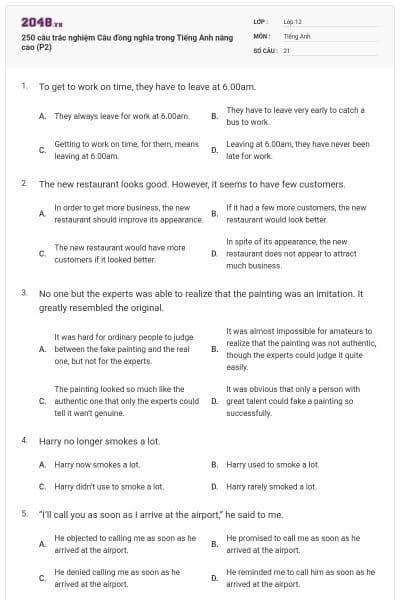
To get to work on time, they have to leave at 6.00am.
They always leave for work at 6.00am.
They have to leave very early to catch a bus to work.
Getting to work on time, for them, means leaving at 6.00am.
Leaving at 6.00am, they have never been late for work.
Đáp án C
Tạm dịch: Để đi làm đúng giờ, họ phải rời khỏi nhà lúc 6 giờ sáng.
A. Họ luôn luôn đi làm lúc 6 giờ sáng.
B. Họ phải rời khỏi nhà rất sớm để bắt xe buýt đi làm.
C. Đi làm đúng giờ, đối với họ, có nghĩa là rời khỏi nhà lúc 6 giờ sáng.
D. Rời khỏi nhà vào lúc 6 giờ sáng, họ chưa bao giờ đi làm muộn.
The new restaurant looks good. However, it seems to have few customers.
In order to get more business, the new restaurant should improve its appearance.
If it had a few more customers, the new restaurant would look better.
The new restaurant would have more customers if it looked better.
In spite of its appearance, the new restaurant does not appear to attract much business.
Đáp án D
Tạm dịch: Nhà hàng mới trông có vẻ đẹp. Tuy nhiên, dường như có ít khách hàng.
A. Để kinh doanh tốt hơn, nhà hàng mới nên cải thiện diện mạo của nó.
B. Nếu có thêm một vài khách hàng, nhà hàng mới sẽ trông đẹp hơn.
C. Nhà hàng mới sẽ có nhiều khách hàng hơn nếu nó trông đẹp hơn.
D. Dù cho diện mạo của nó, nhà hàng mới dường như không thu hút nhiều khách hàng.
No one but the experts was able to realize that the painting was an imitation. It greatly resembled the original.
It was hard for ordinary people to judge between the fake painting and the real one, but not for the experts.
It was almost impossible for amateurs to realize that the painting was not authentic, though the experts could judge it quite easily.
The painting looked so much like the authentic one that only the experts could tell it wan’t genuine.
It was obvious that only a person with great talent could fake a painting so successfully.
Đáp án C
Tạm dịch: Không ai ngoài các chuyên gia có thể nhận ra rằng bức tranh là một sự bắt chước. Nó rất giống với bản gốc.
A. Thật khó cho những người bình thường để đánh giá giữa bức tranh giả và thật, nhưng không phải với các chuyên gia.
B. Những người nghiệp dư hầu như không thể nhận ra rằng bức tranh không phải là thật, mặc dù các chuyên gia có thể đánh giá nó khá dễ dàng.
C. Bức tranh trông rất giống với tranh thật đến mức chỉ có các chuyên gia mới có thể nhận ra nó không phải thật.
D. Rõ ràng rằng chỉ có người với tài năng lớn mới có thể giả mạo một bức tranh thành công đến vậy.
Harry no longer smokes a lot.
Harry now smokes a lot.
Harry used to smoke a lot.
Harry didn’t use to smoke a lot.
Harry rarely smoked a lot.
Đáp án B
Câu ban đầu: Harry không còn hút thuốc nhiều nữa.
A. Harry bây giờ hút nhiều thuốc.
B. Harry đã từng hút nhiều thuốc.
C. Harry đã không hút nhiều thuốc.
D. Harry thỉnh thoảng hút nhiều.
Câu này chúng ta dựa vào nghĩa để làm vì các đáp án không có lỗi ngữ pháp.
“I’ll call you as soon as I arrive at the airport,” he said to me.
He objected to calling me as soon as he arrived at the airport.
He promised to call me as soon as he arrived at the airport.
He denied calling me as soon as he arrived at the airport.
He reminded me to call him as soon as he arrived at the airport.
Đáp án B
Câu ban đầu: “Tôi sẽ gọi cho bạn ngay khi tối đến sân bay” anh ấy nói với tôi.
A. Anh ấy phản đối việc gọi cho tôi khi anh ấy đến sân bay.
B. Anh ấy hứa gọi cho tôi khi anh ấy đến sân bay.
C. Anh ấy phản đối việc gọi cho tôi khi anh ấy đến sân bay.
D. Anh ấy nhắc tôi gọi cho anh ấy ngay khi anh ấy đến sân bay.
Câu này chúng ta dựa vào nghĩa để làm vì các đáp án không có lỗi ngữ pháp.
People think that traffic congestion in the downtown area is due to the increasing number of private cars.
Traffic congestion in the downtown area is blamed for the increasing number of private cars.
The increasing number of private cars is thought to be responsible for traffic congestion in the downtown area.
The increasing number of private cars is attributed to traffic congestion in the downtown area.
Traffic congestion in the downtown area is thought to result in the increasing number of private cars.
Đáp án B
Câu ban đầu là cấu trúc: People think that ....... (Người ta nghĩ rằng ......) thì ta sẽ chuyển sang dạng bị động rất đơn giản.
The young girl has great experience of nursing. She has worked as a hospital volunteer for years.
Before she worked as a hospital volunteer for years, the young girl has great experience of nursing.
Much as she has worked as a hospital volunteer for years, the young girl has great experience of nursing.
Having worked as a hospital volunteer for years, the young girl has great experience of nursing.
With great experience of nursing, the young girl has worked as a hospital volunteer for years.
Đáp án C
Câu ban đầu: Cô gái trẻ có nhiều kinh nghiệm trong việc làm y tá, cô đã làm tình nguyện viên trong bệnh viện nhiều năm.
A. Trước khi làm tình nguyện viên trong bệnh viện nhiều năm, cô gái trẻ đã có nhiều kinh nghiệm trong việc làm y tá.
B. Sai ngữ pháp.
C. Làm tình nguyện viên trong bệnh viện nhiều năm, cô gái trẻ có nhiều kinh nghiệm trong việc làm y tá.
D. Với kinh nghiệm tốt trong việc làm y tá, cô gái trẻ đã làm tình nguyện viên trong bệnh viện nhiều năm.

Học thông minh hơn mỗi ngày
Xem toàn bộ 21 câu hỏi và nhiều hơn nữa với tài khoản miễn phí
Peter told us about his leaving the school. He did it on his arrival at the meeting.
Only after his leaving the school did Peter inform us of his arrival at the meeting.
Not until Peter told us that he would leave the school did he arrive at the meeting.
Hardly had Peter informed us about his leaving the school when he arrived at the meeting.
No sooner had Peter arrived at the meeting than he told us about his leaving the school.
Đáp án D
Câu này kiểm tra kiến thức đảo ngữ (tất cả các đáp án đều đúng ngữ pháp). Tuy nhiên các đáp án khác sai về mặt nghĩa. Nghĩa đúng phải là vừa đến buổi họp thì nói chuyện rời trường.
I didn’t arrive in time. I was not able to see her off.
I arrived very late to say goodbye to her.
She had left because I was not on time.
I was not early enough to see her off.
I didn’t go there , so I could not see her off.
Đáp án C
Tôi đã không tới kịp giờ. Tôi đã không thể chào tạm biệt với cô ấy.
= Tôi đã không tới đủ sớm để chào tạm biệt với cô ấy (đáp án C)
Các đáp án còn lại:
A. Tôi đã tới rất muộn để nói lời chào tạm biệt tới cô ấy.
B. Cô ấy đã đi bởi vì tôi tới không đúng giờ.
D. Tôi đã không tới đó, nên tôi đã không thể chào tạm biệt với cô ấy.
We spent about one-third of our lives sleeping. We know relatively little about sleep.
We know relatively little about sleep, as a result, we spend about one-third of our lives sleeping.
We shall know more about sleep if we spend more than one-third of our lives sleeping.
We spend about one-third of our lives sleeping so that we know relatively little about sleep.
Despite spending about one-third of our lives sleeping, we know relatively little about sleep.
Đáp án D
Chúng ta đã dành ra 1/3 cuộc đời để ngủ. Chúng ta biết rất ít về giấc ngủ.
= Mặc dù dành ra 1/3 cuộc đời để ngủ, nhưng chúng ta biết rất ít về giấc ngủ.
Cấu trúc câu tương phản, đối lập: Despite N/V-ing, S V O (Mặc dù…, nhưng…).
I didn’t know you were coming, so I didn’t wait for you.
If I had known you were coming, I wouldn’t have waited for you.
I would have waited for you if I knew you were coming.
If I had know you were coming, I would wait for you.
Had I known you were coming, I would have waited for you.
Đáp án D
Câu điều kiện loại 3: If S had PII, S would have PII => Dạng đảo ngữ: Had S PII, S would have PII Chỉ một giả định không có thật trong quá khứ.
No sooner had she put the telephone down than her boss rang back.
Scarcely had she put the telephone down when her boss rang back.
She had hardly put the telephone down without her boss rang back.
Hardly she had hung up, she rang her boss immediately.
As soon as her boss rang back, she put down the telephone.
Đáp án A
Kiến thức đảo ngữ: No sooner had S PII than S V-ed O (Vừa mới….thì….).
= Hardly/Scarcely/Barely had S PII when S V-ed O.
Dịch: Cô ấy vừa mới đặt điện thoại xuống thì ông chủ gọi điện lại.
Unless we protect the environment, our life will be badly affected.
If our life is badly affected, we will protect the environment.
If we protect the environment, our life will be badly affected.
If we don’t protect the environment, our life won’t be badly affected.
If we don’t protect the environment, our life will be badly affected.
Đáp án D
Câu điều kiện loại 1: If S V(s/es), S will V. (Unless = If not: Trừ phi, Nếu không). Diễn tả 1 giả định có thể xảy ra ở hiện tại và tương lai.
Dịch: Nếu chúng ta không bảo vệ môi trường, cuộc sống chúng ta sẽ bị ảnh hưởng xấu.
Jack has won a jackpot prize. 10% of it was donated to flooded areas.
Jack has won a jackpot prize, 10% which half was donated to flooded areas.
Jack has won a jackpot prize, 10% of which was donated to flooded areas.
Jack has won a jackpot prize, 10% of that was donated to flooded areas.
Jack has won a jackpot prize, which was donated to flooded areas.
Đáp án B
Giải thích:Khi mệnh đề thứ hai có sở hữu dùng danh từ chỉ người thì ta dùng từ "whose", còn chỉ vật thì ta dùng "of which”
Tạm dịch: Jack đã giành được một giải thưởng jackpot, 10% trong đó đã được tặng cho các khu vực bị ngập lụt.
Had she read the reference books, she would have been able to finish the test.
If she had read the reference books, she could finish the test.
Because she read the reference books, she was able to finish the test.
Although she didn't read the reference books, she was able to finish the test.
Not having read the reference books, she couldn't finish the test.
Đáp án D
Tạm dịch: Nếu cô đã đọc cuốn sách tham khảo, cô đã có thể hoàn thành bài kiểm tra. (trong quá khứ đã không thể qua bài kiểm tra)
A. Nếu cô đã đọc cuốn sách tham khảo, cô có thể hoàn thành bài kiểm tra. (hiện tại không thể qua)
B. Bởi vì cô đã đọc cuốn sách tham khảo, cô đã có thể hoàn thành bài kiểm tra.
C. Mặc dù không đọc cuốn sách tham khảo, nhưng cô đã có thể hoàn thành bài kiểm tra.
D. Không đọc cuốn sách tham khảo, cô không thể hoàn thành bài kiểm tra.
My advice is that you get straight to the point in the next report.
If I were you, I would go straight to the bush in the next report.
If I were you, I would have the next report got started.
If I were you, I would not beat around the bush in the next report.
If I were you, I would not point out the next report.
Đáp án C
get straight to the point: đi thẳng đến vấn đề
beat about the bush: lòng vòng, lảng tránh, không đi vào vấn đề
Tạm dịch: Nếu tôi là bạn, tôi sẽ không đi lòng vòng ở bản báo cáo tiếp theo.
I whispered as I didn't want anybody to hear our conversation.
Since nobody wanted to hear our conversation, I whispered.
So as not to hear our conversation, I whispered.
Because I whispered, anybody heard our conversation.
I lowered my voice in order that our conversation couldn't be heard.
Đáp án D
Tạm dịch: Tôi thì thầm vì tôi không muốn ai nghe câu chuyện của chúng tôi.
A. Vì không ai muốn nghe cuộc nói chuyện của chúng tôi, tôi thì thầm.
B. Để không nghe cuộc nói chuyện của chúng tôi, tôi thì thầm.
C. Bởi vì tôi thì thầm, ai cũng nghe thấy cuộc nói chuyện của chúng tôi.
D. Tôi hạ thấp giọng để cuộc trò chuyện của chúng tôi không thể được nghe thấy.
Tim graduated with a good degree. He joined the ranks of the unemployed.
Tim joined the ranks of the unemployed because he graduated with a good degree.
If Tim graduated with a good degree, he would join the ranks of the unemployed.
Though Tim graduated with a good degree, he joined the ranks of the unemployed.
That Tim graduated with a good degree helped him join the ranks of the unemployed.
Đáp án C
Tạm dịch: Tim tốt nghiệp với tấm bằng giỏi. Anh gia nhập hàng ngũ những người thất nghiệp.
A. Tim gia nhập hàng ngũ những người thất nghiệp vì anh tốt nghiệp với tấm bằng giỏi.
B. Nếu Tim tốt nghiệp với một tấm bằng giỏi, anh sẽ gia nhập hàng ngũ những người thất nghiệp.
C. Mặc dù Tim đã tốt nghiệp với tấm bằng giỏi, anh gia nhập hàng ngũ những người thất nghiệp.
D. Việc Tim tốt nghiệp với tấm bằng giỏi đã gi p anh gia nhập hàng ngũ những người thất nghiệp.
“Leave my house now or I’ll call the police!” shouted the lady to the man.
The lady threatened to call the police if the man didn’t leave her house.
The lady said that she would call the police if the man didn’t leave her house.
The lady told the man that she would call the police if he didn’t leave her house.
The lady informed the man that she would call the police if he didn’t leave her house.
Đáp án A
Giải thích: Cấu trúc: To threaten (somebody) to do something: dọa (ai) sẽ làm gì
Không chọn các đáp án còn lại vì từ threaten ở đây mang sắc thái tương đương với từ shout
Dịch nghĩa: “Ra khỏi nhà tôi ngay hoặc tôi sẽ gọi cảnh sát!” Người phụ nữ hét lên với người đàn ông.
We have run out of the items you want.
We have to run out to buy the items you want
The items you want are off our shop.
For the items you want, we must run out.
The items you want have been out of stock.
Đáp án D
Giải thích: To run out of something = something out of stock: hết thứ gì
Dịch nghĩa: Chúng tôi đã hết những món đồ bạn cần.
She had only just begun to speak when people started interrupting.
She hardly had begun to speak when people started interrupting.
Hardly she had begun to speak when people started interrupting.
Hardly had she begun to speak when people started interrupting.
She hadn’t begun to speak when people started interrupting.
Đáp án C
Giải thích: Cấu trúc đảo ngữ: Hardly + trợ động từ + S + V when S + V: Ngay sau khi … thì
Không chọn đáp án B vì không đảo had lên trước chủ ngữ she.
Dịch nghĩa: Cô ấy chỉ mới bắt đầu nói khi mọi người bắt đầu xen ngang.
Bạn có thích hoạt động này không?
Ý kiến của bạn sẽ giúp chúng tôi đề xuất nội dung phù hợp hơn.
Gợi ý cho bạn
![[Năm 2022] Đề thi thử môn Vật lí THPT Quốc gia có lời giải - Đề số 21](/_next/image?url=https%3A%2F%2Fvideo.vietjack.com%2Fupload%2Fimages%2Fvj-image%2Fimage-3izficdefgfoel0s9j8s-1786772791.jpg&w=3840&q=75)
![[Năm 2022] Đề thi thử môn Vật lí THPT Quốc gia có lời giải - Đề số 20](/_next/image?url=https%3A%2F%2Fvideo.vietjack.com%2Fupload%2Fimages%2Fvj-image%2Fimage-emy0gtcksawvorajezvv-1786772460.jpg&w=3840&q=75)
Tài liệu phổ biến Lớp 12
Tài liệu phổ biến Tiếng Anh