250 câu trắc nghiệm Câu đồng nghĩa trong Tiếng Anh cơ bản (P5)
40 câu hỏi
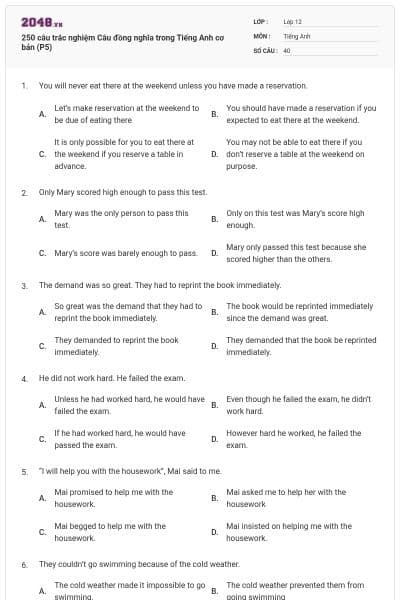
You will never eat there at the weekend unless you have made a reservation.
Let’s make reservation at the weekend to be due of eating there
You should have made a reservation if you expected to eat there at the weekend.
It is only possible for you to eat there at the weekend if you reserve a table in advance.
You may not be able to eat there if you don’t reserve a table at the weekend on purpose.
Đáp án C
You will never eat there at the weekend unless you have made a reservation. Bạn sẽ không bao giờ ăn ở đó vào cuối tuần trừ khi bạn đã đặt trước.
= C. It is only possible for you to eat there at the weekend if you reserve a table in advance.
Bạn chỉ có thể ăn ở đó vào cuối tuần nếu bạn đặt bàn trước.
Only Mary scored high enough to pass this test.
Mary was the only person to pass this test.
Only on this test was Mary’s score high enough.
Mary’s score was barely enough to pass.
Mary only passed this test because she scored higher than the others.
Đáp án A
Only Mary scored high enough to pass this test. Chỉ có Mary đạt điểm cao đủ để vượt qua bài kiểm tra này.
= A. Mary was the only person to pass this test. Mary là người duy nhất vượt qua bài kiểm tra này.
The demand was so great. They had to reprint the book immediately.
So great was the demand that they had to reprint the book immediately.
The book would be reprinted immediately since the demand was great.
They demanded to reprint the book immediately.
They demanded that the book be reprinted immediately.
Đáp án A
The demand was so great. They had to reprint the book immediately. Nhu cầu rất lớn. Họ phải tái bản cuốn sách ngay lập tức.
= A. So great was the demand that they had to reprint the book immediately. Nhu cầu lớn đến nỗi họ phải tái bản cuốn sách ngay lập tức.
He did not work hard. He failed the exam.
Unless he had worked hard, he would have failed the exam.
Even though he failed the exam, he didn’t work hard.
If he had worked hard, he would have passed the exam.
However hard he worked, he failed the exam.
Đáp án C
He did not work hard. He failed the exam. Cậu ấy ko học chăm. Cậu ấy đã trượt kỳ thi.
= C. If he had worked hard, he would have passed the exam. Nếu cậu ấy học chăm, cậu ấy đã qua kỳ thi rồi.
“I will help you with the housework”, Mai said to me.
Mai promised to help me with the housework.
Mai asked me to help her with the housework
Mai begged to help me with the housework.
Mai insisted on helping me with the housework.
Đáp án A
Dịch nghĩa: “Mình sẽ giúp cậu làm việc nhà”, Mai nói với tôi.
A. Mai hứa sẽ giúp tôi làm việc nhà.
B. Mai nhờ tôi giúp cô ấy làm việc nhà .
C. Mai van xin tôi để giúp tôi làm việc nhà.
D. Mai nằng nặc đòi giúp tôi làm việc nhà.
They couldn’t go swimming because of the cold weather.
The cold weather made it impossible to go swimming.
The cold weather prevented them from going swimming
Their going swimming was unable due to the cold weather.
The cold weather made it not capable of going swimming.
Đáp án B
Dịch nghĩa: Họ không thể đi bơi vì thời tiết lạnh.
A. Thời tiết lạnh khiến việc đi bơi là không thể.
B. Thời tiết lạnh ngăn cản họ đi bơi
C. Việc đi bơi của họ là không thể do thời tiết lạnh.
D. Thời tiết lạnh khiến việc đi bơi không thể.
I can’t help feeling worried about David.
I find it impossible not to worry about David
I don’t worry about David.
I can do nothing to help David.
I cannot help David stop worrying.
Đáp án: A
Giải thích:
Dịch: Tôi không thể không lo lắng về Tom.
Cấu trúc: can’t help V-ing: không thể không làm gì
A. Tôi thấy không thể không lo lắng về Tom.
B. Tôi không lo lắng về Tom.
C. Tôi không thể làm gì để giúp Tom.
D. Tôi không thể giúp Tom ngừng lo lắng.
Đáp án A phù hợp về nghĩa, các đáp án còn lại không đúng nghĩa.

Học thông minh hơn mỗi ngày
Xem toàn bộ 40 câu hỏi và nhiều hơn nữa với tài khoản miễn phí
A waitress served us. She was very impolite and impatient.
A waitress that served us was very impolite and impatient .
A waitress, which served us, was very impolite and impatient.
A waitress, that served us, was very impolite and impatient.
A waitress, whom served us, was very impolite and impatient.
Đáp án A
Dịch nghĩa: Nữ nhân viên đã phục vụ chúng tôi. Cô ta rất mất lịch sự và mất kiên nhẫn.
Giả thích: Đây là câu dùng mệnh đề quan hệ xác định để bổ sung ý nghĩa cho "a waitress" nếu không chúng ta sẽ không rõ người bồi bàn nữ này là người bồi bàn nào.
He was successful because he was determined to pursue personal goals. He was not talented.
It was his determination to pursue personal goals, not talent, that contributed to his success.
In addition to his determination, his talent ensured his success in pursing his goals.
His success lay in his natural ability, not his determination to pursue personal goals.
His determination to pursue personal goals made him successful and talented.
Đáp án A
Dịch nghĩa: Anh ấy thành công vì anh ấy quyết tâm theo đuổi mục tiêu cá nhân. Anh ấy không có tài năng.
A. Chính quyết tâm theo đuổi mục tiêu cá nhân của anh ấy chứ không phải tài năng đã giúp anh ấy thành công.
B. Ngoài quyết tâm, tài năng đảm bảo cho sự thành công của anh ấy trong việc theo đuổi mục tiêu cá nhân.
C. Thành công của anh ấy là nhờ vào khả năng tự nhiên, chứ không phải quyết tâm theo đuổi mục tiêu cá nhân.
D. Quyết tâm theo đuổi mục tiêu cá nhân khiến anh ấy thành công và tài năng.
Do you know the worman? She is coming toward us.
Do you know the worman who comes toward us?
Do you know the worman to come toward us?
Is the woman coming toward us who knows?
Do you know the worman coming toward us?
Đáp án D
Dịch nghĩa: Bạn có biết người phụ nữ đó? Cô ấy đang tiến lại chỗ chúng ta.
Lưu ý: Rút gọn mệnh đề quan hệ với Ving/PII
- (V ở thể chủ động) N + who/which/that + V => N + Ving
- (V ở thể bị động) N + who/which/that + tobe + PII => N + PII
Jack’s watch was ten minutes slow. That was why he was late for his interview
If Jack’s watch hadn’t been ten minutes slow, he wouldn’t be late for his interview
If Jack’s watch hadn’t been ten minutes slow, he wouldn’t have been late for his interview
If Jack hadn’t been late for his interview, his watch wouldn’t have been ten minutes slow.
If Jack’s watch weren’t ten minutes slow, he wouldn’t be late for his interview.
Đáp án B
Dịch nghĩa: Đồng hồ của Jack chạy chậm 10 phút. Đó là lý do tại sao anh ta đến buổi phỏng vấn muộn.
If + S + had (not) PII, S + would (not) have PII: Nếu ai đó đã (không) làm gì, thì ai đó sẽ đã (không)làm gì .
Câu điều kiện loại 2 diễn tả hành động không xảy ra trong hiện tại If + S + Ved, S + would + V: Nếu ai đó làm gì, thì ai đó sẽ làm gì hiện tại.
Câu điều kiện hỗn hợp, diễn tả hành động không có thực trong quá khứ, nhưng kết quả không có thực ở hiện tại: If + S + had +PII, S + would + V: Nếu ai đó đã không làm gì, ai đó hiện tại sẽ làm gì.
“I was not there at the time,” he said.
He denied to have been there at the time.
Β. He denied that he had not been there at the time.
He denied to be there at the time.
He denied having been there at the time.
Đáp án D
Câu: "Tôi không có mặt ở đấy vào lúc đó." anh ta nói
D. Anh ta phủ nhận có mặt ở đấy vào lúc đó
Cấu trúc: deny doing sth = phủ nhận làm gì
"Let's go out for a walk now," he suggested.
He suggested going out for a walk then.
Β. He suggested to go out for a walk then.
He suggested them to go out for a walk then.
He suggested them going out for a walk then.
Đáp án: A
Giải thích:
Kiến thức: Câu gián tiếp
suggest doing something: gợi ý làm gì
Đáp án A đúng cấu trúc.
Dịch: “Bây giờ chúng ta hãy ra ngoài đi dạo nhé”, anh ấy đề nghị.
→ Sau đó anh ấy đề nghị ra ngoài đi dạo."You broke my glasses," said the woman to me.
The woman blames me of breaking her glasses.
Β. The woman blamed me of breaking her glasses.
The woman blames me for having broken her glasses.
The woman blamed me for having broken her glasses.
Đáp án D
Cấu trúc: blame sb for doing sth = đỗ lỗi cho ai đấy làm gì
We started out for California. It started to rain right after that.
No sooner did we start out for California than it started to rain.
Β. No sooner had we started out for California when it started to rain.
No sooner had it started to rain than we started out for California.
No sooner had we started out for California than it started to rain.
Đáp án D
Đảo ngữ: "No sooner had S done sth than clause" = Vừa mới... thì...
We have been friends for years. It is quite easy to share secrets between us.
Having been friends for years, we find quite easy to share secrets between us.
Β. We have been friends for years so that it is quite easy to share secrets between us.
Being friends for years, we find it quite easy to share secrets between us.
We find it quite easy to share secrets, being friends.
Đáp án C
Câu cho sẵn: Chúng tôi đã là bạn trong nhiều năm. Thật là dễ dàng để chúng tôi chia sẻ những bí mật cho nhau.
Dịch nghĩa C: Là bạn trong nhiều năm, chúng tôi thấy thật dễ dàng chia sẻ những bí mật cho nhau.
The water was so cold that the children couldn't swim in it.
The water wasn't warm enough for the children to swim in.
The water was cold enough for the children to swim in.
It was such a cold water that the children couldn't swim in it.
The water was too cold for the children to swim in it.
Đáp án A
Giải thích: S + V + so + adjective + a + singular count noun + that + S + V
= S + V + such + a + adjective + singular count noun + that + S + V
= S + tobe + too + adjective to + V: quá .... để ....
Dịch: Nước lạnh đến nỗi trẻ em không thể bơi được trong đó
We got lost because we forgot to take a map with us.
Unless we had forgotten to take the map with us, we would have got lost
If we had remembered to take a map with us, we wouldn't have got lost.
Had we not forgotten to take the map with us, we would have got lost.
If we had remembered to take a map with us, we would have got lost.
Đáp án B
Câu điều kiện loại 3: If+ S+had+PP, S+would+ have+ PP. Nói về những điều trái với quá khứ.
Dịch: Chúng tôi đã bị lạc vì chúng tôi quên mất mang một tấm bản đồ theo.
His eel soup is better than any other soups I have ever eaten.
Of all the soups I have ever eaten, his eel soup is the best.
His eel soup is good but I have ever eaten many others better.
I have ever eaten many soups that are better than his eel soup.
His eel soup is the worst of all soups I have eaten.
Đáp án A
Cấu trúc tương đương giữa so sánh hơn và so sánh hơn nhất:
Of all+....+ S+ tobe+ the+ most adj/ adj-est: là cái đứng đầu trong tất cả những cái...
S+ tobe+ more adj/ adj-er+ than+ S+ have/has+ ever+ PP: hơn tất cả những cái còn lại.
Dịch: Súp lươn của anh ấy ngon hơn bất cứ loại súp nào khác mà tôi từng ăn.
My mother is very busy at work . However, she takes good care of her children.
Although my mother is very busy at work, but she takes good care of her children.
In spite of busying at work, my mother takes good care of her children.
My mother takes good care of her children but she is very busy at work.
Despite being busy at work, my mother takes good care of her children.
Đáp án D
Câu ban đầu: Mẹ tôi rất bận rộn trong công việc. Tuy nhiên, bà chăm sóc tốt cho các con.
A. Although thì thôi But
B. Sai ngữ pháp:-> inspite of being busy at work,...
C. Không hợp nghĩa.
D. Mặc dù bận rộn trong công việc, mẹ tôi chăm sóc tốt cho con cái.
However=although+ clause=despite/ in spite of +V-ing
He is very lazy. That makes his parents worried.
That he is vey lazy makes his parents worried.
The fact he is very lazy makes his parents worried.
Being very lazy makes his parents worried.
He is very lazy which makes his parents worried
Đáp án A
Câu ban đầu: Anh ấy rất lười biếng. Điều đó khiến bố mẹ anh lo lắng.
A. Việc anh ấy lười biếng khiến bố mẹ anh ấy lo lắng.
B. Thực tế rằng anh ấy rất lười biếng làm cha mẹ anh lo lắng.
C. Lười biếng làm cha mẹ anh ấy lo lắng.
D. Anh ấy rất lười điều làm cha mẹ anh lo lắng.
Mệnh đề danh từ chủ ngữ: That+ clause+ V+O...
Large cars use more gas than smaller ones.
If you own a small car, it uses more gas.
The smaller the car, the more gas it uses.
The larger the car, the more gas it uses.
Large cars don’t use as much gas as smaller ones.
Đáp án C
Câu này dịch như sau: Ô tô lớn tốn nhiều nhiên liệu hơn ô tô nhỏ hơn.
A. Nếu bạn sở hữu một chiếc ô tô nhỏ, nó tốn nhiều nhiên liệu hơn.
B. Ô tô càng nhỏ dùng càng nhiều nhiên liệu.
C. Ô tô càng lớn dùng càng nhiều nhiên liệu.
D. Ô tô lớn không tốn nhiều nhiên liệu bằng ô tô nhỏ.
Mary is crazy about her new puppy.
Mary’s new puppy drives her crazy.
Marry really likes her new puppy.
Mary’s new puppy is crazy.
Mary has a crazy dog.
Đáp án B
Crazy about = excited about: thích phát điên lên
Dịch: Mary cực kỳ yêu thích chú chó con mới.
Did you happen to run into George last week?
Was it a week ago that you last saw George?
Where do you think George was all last week?
Have you got any idea what happened to George last week?
Did you, by any chance, see George last week?
Đáp án D
Happen to Vo: tình cờ
Run into = meet sb by chance
Dịch: Bạn đã tình cờ gặp George tuần trước phải không?
Nam defeated the former champion in three sets. He finally won the inter-school table tennis championship.
Having defeated the former champion in the inter-school table tennis, Nam did not hold the title of champion.
Although Nam defeated the former champion in three sets, he did not win the title of inter-school table tennis champion.
Having defeated the former champion in three sets, Nam won the inter-school table tennis championship.
Being defeated by the former champion, Nam lost the chance to play the final game of inter-school table tennis champion.
Đáp án C
Dịch: Nam đã đánh bại đương kim vô địch trong 3 trận đấu. Anh ấy cuối cùng đã giảng danh hiệu vô địch môn bóng bàn liên trường.
A. Đã đánh bại đương kim vô địch trong trận bóng bàn liên trường, Nam đã không giữ được danh hiệu vô địch.
B. Mặc dù Nam đã đánh bại đương kim vô địch trong 3 trận đấu, anh ấy đã không giành được danh hiệu vô địch bóng bàn liên trường.
C. Đã đánh bại đương kim vô địch trong 3 trận đấu, Nam đã giành chức vô địch môn bóng bàn liên trường.
D. Bị đánh bại bởi đương kim vô địch, Nam đã mất cơ hội chơi trận chung kết tranh chức vô địch bòng bàn liên trường.
She wrote the text. She selected the illustration as well.
She not only wrote the text but also selected the illustration.
The text she wrote was not as good as the illustration she selected.
In order to select the illustration, she had to write the text.
If she had written the text, she would have selected the illustration.
Đáp án A
As well = not only...but also: không những ... mà còn
Câu này dịch như sau: Cô ấy đã viết bài văn. Cô ấy cũng đã chọn hỉnh ảnh minh họa cho nó.
The girl is talking to a man with a ponytail. She is my friend.
The girl who is talking to a man with a ponytail is my friend.
The girl, whom a man with a ponytail is talking to, is my friend.
My friend is the girl, who is talking to a man with a ponytail.
The girl, who is talking to a man with a ponytail, is my friend.
Đáp án A
Mệnh đề quan hệ "who" thay thế cho chủ ngữ là người trong câu.
There is nothing new in the use of herbs and spices.
Herbs and spices have been used for a long time.
The use of herbs and spices is no longer difficult.
People used to use herbs and spices as a source of medicine.
People are no longer interested in using herbs and spices.
Đáp án A
Không có gì mới trong việc sử dụng thảo dược và gia vị.
A.Thảo dược và gia vị đã được sử dụng từ lâu rồi.
B. Việc sử dụng thảo dược và gia vị không còn khó khăn nữa.
C. Con người đã từng dùng thảo dược và gia vị như là nguồn thuốc chữa bệnh nữa.
D. Con người không còn quan tâm đến việc dùng thảo dược và gia vị nữa.
It’s undeniable that the Internet plays a vital role in our life nowadays.
Nowadays our life without the Internet is deniable.
The Internet’s vital role is denied in our modern life.
That the Internet is important to modern life is obvious.
The Internet is hardly undeniable in our life nowadays.
Đáp án C
Không thể phủ nhận rằng ngày nay Internet đóng vai trò quan trọng trong cuộc sống của chúng ta. A. Ngày nay cuộc sống của chúng ta không có Internet là có thể phủ nhận.
B. Vai trò quan trọng của Internet bị phủ nhận trong cuộc sống hiện đại của chúng ta.
C. Việc mà Internet rất quan trọng đối với cuộc sống hiện đại là hiển nhiên/ dễ nhận thấy.
D. Internet hiếm khi không thể phủ nhận trong cuộc sống của chúng ta ngày nay.
If they eat fast food too frequently, they will soon have their waistline increased.
When eating fast food, people would loosen their waistline.
Fast food eaters will soon have their waistline fastened.
Eating fast food makes people get fat quickly.
People should loosen their belt when they eat fast.
Đáp án C
Nếu họ ăn thătức ăn nhanh quá thường xuyên, họ sẽ sớm tăng vòng eo.
A. Khi ăn thức ăn nhanh, con người sẽ nới lỏng vòng eo.
B. Những người ăn thức ăn nhanh sẽ sớm thắt chặt vòng eo.
C. Ăn thức ăn nhanh làm cho con người béo lên nhanh chóng.
D. Con người nên nới lỏng thắt lưng khi ăn nhanh.
He wore glasses and a false beard. He wanted nobody to recognize him.
He wore glasses and a false beard lest anybody could recognize him.
He wore glasses and a false beard, and so nobody could recognize him.
So as not to meet anyone who recognize him, he wore glasses and a false beard.
He could avoid being recognized because he wore glasses and a false beard.
Đáp án A
Anh ấy mang kính và râu giả. Anh ấy muốn không ai nhận ra anh ấy.
A. Anh ấy mang kính và râu giả vì sợ rằng có ai đó có thể nhận ra anh ấy.
B. Anh ấy mang kính và râu giả, và vì vậy không ai có thể nhận ra anh ấy. =>thừa “and”
C. Để mà không gặp bất cứ ai người mà nhận ra anh ấy, anh ấy mang kính và râu giả.
=> sai ngữ pháp, vì đại từ “who” thay thế cho “anyone” [chủ ngữ số ít], đề bài ở quá khứ đơn nên recongnize => recongnized
D. Anh ấy có thể tránh bị nhận ra bởi vì anh ất mang kính và râu giả. => nghĩa chưa phù hợp với đề bài
He has retired. He watches football every afternoon on cable TV.
Although he’s retired, he watches football every afternoon on cable TV.
Now that he’s retired, he watches football every afternoon on cable TV.
When he’s retired, he watches football every afternoon on cable TV.
He’s retired, so that he watches football every afternoon on cable TV.
B. Đáp án B
Ông ấy đã về hưu. Ông ấy xem bóng đá mỗi buổi chiều trên truyền hình cáp.
A. Mặc dù ông ấy đã về hưu nhưng ông ấy xem bóng đá mỗi buổi chiều trên truyền hình cáp.
B. Bởi vì ông ấy đã về hưu nhưng ông ấy xem bóng đá mỗi buổi chiều trên truyền hình cáp.
C. Khi ông ấy đã về hưu nhưng ông ấy xem bóng đá mỗi buổi chiều trên truyền hình cáp.
D. Ông ấy đã về hưu nhưng để mà xem bóng đá mỗi buổi chiều trên truyền hình cáp.
You have just passed your exam. This makes your parents happy.
Having just passed your exam making your parents happy.
You have just passed your exam makes your parents happy.
That you have just passed your exam makes your parents happy.
You have just passed your exam which it makes your parents happy.
Đáp án C
A sai vì thiếu chủ ngữ
B sai vì một câu không thể có 2 động từ chính
D sai vì đã có đại từ quan hệ "which" thì ko còn chủ ngữ "it"nữa
Dịch: Bạn vừa vượt qua kì thi của mình. Điều này làm bố mẹ bạn rất vui
That + S+ V đóng vai trò là một chủ ngữ trong câu
You cannot completely avoid stress in your life. You need to find ways to cope with it.
After you can completely avoid stress in your life, you need to find ways to cope with it.
As long as you can completely avoid stress in your lives, you need to find ways to cope with it.
As you cannot completely avoid stress in your life, you need to find ways to cope with it.
Because stress can completely be avoided in your life, you need to find ways to cope with it.
Đáp án C
Bạn không thể tránh được xì trét hoàn toàn trong cuộc sống. Bạn cân tìm cách để khắc phục nó.
A. Sau khi bạn có thể hoàn toàn tránh được xì trét, bạn cần tìm cách để khắc phục nó.
B. Miễn là bạn có thể hoàn toàn tránh được xì trét, bạn cần tìm cách để khắc phục nó.
C. Bởi vì bạn không thể hoàn toàn tránh được xì trét, bạn cần tìm cách để khắc phục nó.
D. Bởi vì xì trét có thể hoàn toàn tránh được trong cuộc sống, bạn cần tìm cách để khắc phục nó.
"If I were you, I'd ask the teacher for help" he said.
He suggested asking the teacher for help.
He said if he was me, he would ask the teacher for help.
He advised me to ask the teacher for help.
He told me that he'd ask the teacher for help.
Đáp án C
Câu gốc: "Nếu tôi là bạn, tôi sẽ hỏi nhờ thầy giáo giúp đỡ" anh ta nói
A. Anh ta gợi ý nhờ giáo viên giúp đỡ.
B sai vì trong câu điều kiện loại 2 thì động từ tobe chia là "were"
C. Anh ta khuyên tôi nhờ thầy giáo giúp đỡ
D. Anh ta nói tôi rằng anh ta sẽ nhờ thầy giáo giúp đỡ
Is it necessary to meet the manager at the airport?
Did the manager have to be met at the airport?
Does the manager have to be met at the airport?
Is the manager had to be met at the airport?
Does the manager have to meet at the airport?
Đáp án B
Có cần thiết phải gặp quản lý ở sân bay không?
A sai vì câu gốc chia ở thì hiện tại đơn còn thì của câu A là quá khứ đơn
B. Người quản lí có cần phải được gặp ở sân bay không? - Chuyển chủ động sang bị động
C sai vì "have to" đi với trợ động từ "Do" không có "tobe had to"
D. Sai vì "meet" là ngoại động từ nên cần có tân ngữ phía sau
He was successful in his career thanks to his parents' support.
But for his parents' support, he wouldn't have been successful in his career.
If his parents hadn't supported him, he would have been successful in his career.
Had it not been for his parents' support, he wouldn't be successful in his career.
Had his parents supported him, he wouldn't be successful in his career.
Đáp án D
Câu gốc: Anh ta đã thành công trong sự nghiệp nhờ có sự ủng hộ của bố mẹ
A. Nếu không có sự ủng hộ của bố mẹ, anh ta đã không thành công trong sự nghiệp của mình.
B. Nếu bố mẹ anh ta không ủng hộ, anh ta đã thành công trong sự nghiệp của mình
C. Nếu không có sự ủng hộ của bố mẹ, anh ta sẽ không thành công trong sự nghiệp của mình.
Sai vì câu gốc đưa ra một thực tế trong quá khứ nên ta dùng câu điều kiện loại 3,không dùng câu điều kiện trộn
D. Nếu bố mẹ anh ta đã ủng hộ anh ta, anh ta sẽ không thành công trong sự nghiệp.
“Don’t forget to submit your assignments by Thursday,” said the teacher to the students.
The teacher reminded the students to submit their assignments by Thursday.
The teacher allowed the students to submit their assignments by Thursday.
The teacher ordered the students to submit their assignments by Thursday.
The teacher encouraged the students to submit their assignments by Thursday.
Đáp án A.
Dịch: “Đừng quên nộp nhiệm vụ được giao của các em trước thứ 5”
A. The teacher reminded the students to submit their assignments by Thursday: Giáo viên nhắc nhở học sinh nộp nhiệm vụ được giao của họ trước thứ 5.
They expect that recent changes will bring about an overall improvement in the quality of the country’s education.
Recent changes are expected to lead to an overall improvement in the quality of the country’s education.
The quality of the country’s education is expected to be the consequence of recent changes.
It is expected that recent changes are caused by an overall improvement in the country’s education.
It was expected that recent changes would result in an overall improvement in the quality of the country’s education.
Đáp án A.
Dịch: Họ trông đợi rằng những sự thay đổi gần đây sẽ mang lại một sự cải thiện toàn diện trong chất lượng giáo dục của đất nước.
A. Những sự thay đổi gần đây được trông đợi sẽ dẫn tới một sự cải thiện toàn diện trong chất lượng giáo dục của đất nước.
B. Sai vì khác ý với câu đề bài. Theo câu đề bài, điều được trông đợi ở đây là recent changes will bring about anoverall improvement in the quality of the country’s education.
C. Sai vì ngược ý với câu đề bài. Đúng phải là: It is expected that an overall improvement in the quality of the country’s education is caused by recent changes.
D. Sai vì câu đề bài dùng thì hiện tại đơn, không dùng thì quá khứ.
She wasn’t early enough to catch the bus.
She wasn’t late for the bus.
She didn’t arrive late for the bus.
She arrived too early for the bus.
She was too late to catch the bus.
Đáp án D.
She wasn’t early enough to catch the bus: cô ấy không đủ sớm để bắt xe buýt.
Bạn có thích hoạt động này không?
Ý kiến của bạn sẽ giúp chúng tôi đề xuất nội dung phù hợp hơn.
Gợi ý cho bạn
![[Năm 2022] Đề thi thử môn Vật lí THPT Quốc gia có lời giải - Đề số 21](/_next/image?url=https%3A%2F%2Fvideo.vietjack.com%2Fupload%2Fimages%2Fvj-image%2Fimage-3izficdefgfoel0s9j8s-1786772791.jpg&w=3840&q=75)
![[Năm 2022] Đề thi thử môn Vật lí THPT Quốc gia có lời giải - Đề số 20](/_next/image?url=https%3A%2F%2Fvideo.vietjack.com%2Fupload%2Fimages%2Fvj-image%2Fimage-emy0gtcksawvorajezvv-1786772460.jpg&w=3840&q=75)
Tài liệu phổ biến Lớp 12
Tài liệu phổ biến Tiếng Anh