250 câu trắc nghiệm Câu đồng nghĩa trong Tiếng Anh cơ bản (P3)
40 câu hỏi
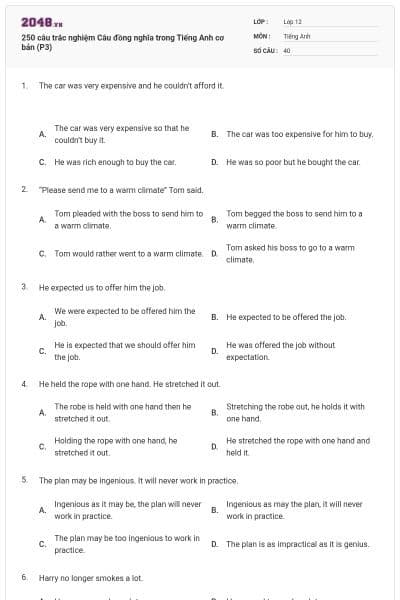
The car was very expensive and he couldn’t afford it.
The car was very expensive so that he couldn’t buy it.
The car was too expensive for him to buy.
He was rich enough to buy the car.
He was so poor but he bought the car.
Đáp án B
Dịch nghĩa: Chiếc xe rất đắt và anh ta không thể mua được nó. = B. Chiếc xe quá đắt cho anh ta mua.
too adj for somebody to do something : quá để ai làm gì
A. Chiếc xe rất đắt để anh ta không thể mua nó.
C. Anh ấy đủ giàu để mua chiếc xe đó.
D. Anh ấy rất nghèo nhưng anh ấy đã mua chiếc xe.
“Please send me to a warm climate” Tom said.
Tom pleaded with the boss to send him to a warm climate.
Tom begged the boss to send him to a warm climate.
Tom would rather went to a warm climate.
Tom asked his boss to go to a warm climate.
Đáp án B
Dịch nghĩa: “Làm ơn đưa tôi đến nơi có khí hậu ấm áp.” Tom nói
= B. Tom cầu xin ông chủ đưa ông ấy đến nơi có khí hậu ấm áp.
(to) beg someone to do something: cầu xin ai làm gì = (to) plead someone for doing something
Đáp án A sai vì plead phải đi với for doing something.
Đáp án C sai vì would rather + V-inf
Đáp án D. Tom yêu cầu ông chủ đưa ông ấy đến nơi có khí hậu ấm áp. sai vì giọng điệu ở câu này là cầu xin chứ không phải yêu cầu.
He expected us to offer him the job.
We were expected to be offered him the job.
He expected to be offered the job.
He is expected that we should offer him the job.
He was offered the job without expectation.
Đáp án B
Dịch nghĩa: Anh ta mong chúng tôi sẽ mời ông ta làm việc. = B. Anh ta mong được mời làm việc.
Đáp án A sai vì offer ở đây phải chia ở dạng chủ động.
Đáp án C sai vì câu gốc ở thì quá khứ mà câu này ở thì hiện tại.
Đáp án D. Anh ấy được mời làm việc mà không có sự kì vọng nào. sai về nghĩa so với câu gốc.
He held the rope with one hand. He stretched it out.
The robe is held with one hand then he stretched it out.
Stretching the robe out, he holds it with one hand.
Holding the rope with one hand, he stretched it out.
He stretched the rope with one hand and held it.
Đáp án C
Dịch nghĩa: Anh ta cầm dây thừng bằng một tay. Anh kéo nó ra.
= C. Cầm dây thừng bằng một tay, anh ta kéo nó ra.
The plan may be ingenious. It will never work in practice.
Ingenious as it may be, the plan will never work in practice.
Ingenious as may the plan, it will never work in practice.
The plan may be too ingenious to work in practice.
The plan is as impractical as it is genius.
Đáp án A
Dịch nghĩa: Kế hoạch có thể rất tài tình. Nó sẽ không bao giờ có tác dụng trong thực tiễn.
= A. Dù có tài tình đến thế nào đi nữa, kế hoạch sẽ không bao giờ có tác dụng trong thực tiễn.
Cấu trúc Adj + as/though + S + V, clause: dù.... đến thế nào.
Harry no longer smokes a lot.
Harry now smokes a lot.
Harry used to smoke a lot.
Harry didn’t use to smoke a lot.
Harry rarely smoked a lot.
Đáp án B
Giải thích: Harry không hút thuốc nữa.
A. Harry bây giờ hút thuốc nhiều.
B. Harry đã từng hút nhiều thuốc.
C. Harry đã từng không hút nhiều thuốc.
D. Harry hiếm khi nào hút nhiều thuốc.
“I’ll call you as soon as I arrive at the airport,” he said to me.
He objected to calling me as soon as he arrived at the airport.
He promised to call me as soon as he arrived at the airport.
He denied calling me as soon as he arrived at the airport.
He reminded me to call him as soon as he arrived at the airport.
Đáp án B
Giải thích: “ Tớ sẽ gọi cho cậu khi tớ đến sân bay.”, cậu ấy nói với tôi.
A. Cậu ta phản đối việc gọi cho tôi khi cậu ta đến sân bay.
B. Cậu ta hứa gọi cho tôi khi cậu ta đến sân bay.
C. Cậu ta phủ nhận việc gọi cho tôi khi cậu ta đến sân bay.
D. Cậu ta nhắc nhở tôi gọi cho cậu ấy khi cậu ta đến sân bay.

Học thông minh hơn mỗi ngày
Xem toàn bộ 40 câu hỏi và nhiều hơn nữa với tài khoản miễn phí
People think that traffic congestion in the downtown area is due to the increasing number of private cars.
Traffic congestion in the downtown area is blamed for the increasing number of private cars.
The increasing number of private cars is thought to be responsible for traffic congestion in the downtown area.
The increasing number of private cars is attributed to traffic congestion in the downtown area.
Traffic congestion in the downtown area is thought to result in the increasing number of private cars.
Đáp án B
Giải thích: Mọi người nghĩ rằng tắc nghẽn giao thông trong khu vực trung tâm thành phố là do sự gia tăng số lượng xe hơi tư nhân.
A. Tắc nghẽn giao thông ở khu vực trung tâm thành phố phải chịu trách nhiệm cho sự gia tăng số lượng xe hơi tư nhân.
B. Số lượng ngày càng tăng của xe ô tô tư nhân được cho là do sự tắc nghẽn giao thông trong khu vực trung tâm thành phố.
C. Sự gia tăng số lượng xe hơi tư nhân là do tắc nghẽn giao thông trong khu vực trung tâm thành phố.
D. Tắc nghẽn giao thông trong khu vực trung tâm thành phố được cho là làm tăng số lượng xe hơi tư nhân.
The young girl has great experience of nursing. She has worked as a hospital volunteer for years.
Before she worked as a hospital volunteer for years, the young girl has great experience of nursing.
Much as she has worked as a hospital volunteer for years, the young girl has great experience of nursing.
Having worked as a hospital volunteer for years, the young girl has great experience of nursing.
With great experience of nursing, the young girl has worked as a hospital volunteer for years.
Đáp án C
Giải thích: Cô gái trẻ có nhiều kinh nghiệm vè điều dưỡng. Cô đã từng làm tình nguyện viên bệnh viện trong nhiều năm.
A. Trước khi cô làm tình nguyện viên bệnh viện trong nhiều năm, cô bé có kinh nghiệm về điều dưỡng.
B. Dù cô đã làm việc như một tình nguyện viên bệnh viện trong nhiều năm, cô gái trẻ vẫn có nhiều kinh nghiệm về điều dưỡng.
C. Đã từng làm tình nguyện viên bệnh viện nhiều năm, cô bé có kinh nghiệm về điều dưỡng.
D. Với nhiều kinh nghiệm điều dưỡng, cô gái trẻ đã làm việc như một tình nguyện viên bệnh viện trong nhiều năm.
Peter told us about his leaving the school. He did it on his arrival at the meeting.
Only after his leaving the school did Peter inform us of his arrival at the meeting.
Not until Peter told us that he would leave the school did he arrive at the meeting.
Hardly had Peter informed us about his leaving the school when he arrived at the meeting.
No sooner had Peter arrived at the meeting than he told us about his leaving the school.
Đáp án D
Giải thích: Hardly…when …= No sooner …than…: ngay khi…thì…
Dịch: Peter nói với chúng tôi về việc anh ấy rời trường. Cậu ấy đã làm điều đó khi cậu đến buổi họp.
The doctor said, “You really ought to rest for a few days. Jasmine."
The doctor strongly advised Jasmine to take a few days' rest.
The doctor suggested that Jasmine should take a short rest.
Jasmine's doctor told that she should rest for a few days.
It is the doctor's recommendation that Jasmine should take a short rest.
Đáp án A
Bác sĩ nói, "Bạn thực sự nên nghỉ ngơi trong vài ngày. Jasmine. "
= A. The doctor strongly advised Jasmine to take a few days' rest. Bác sĩ khuyên Jasmine nên nghỉ ngơi vài ngày.
He is an authority on primitive religion.
He has official permission to practise primitive religion.
He is famous for his vast knowledge of primitive religion.
He has authority over the people who practise primitive religion.
He has a great influence on the people who practise primitive religion.
Đáp án B
He is an authority on primitive religion. Ông là một người có uy tín chuyên môn về tôn giáo nguyên thủy.
= B. He is famous for his vast knowledge of primitive religion. Ông nổi tiếng với kiến thức rộng lớn về tôn giáo nguyên thủy.
He failed his driving test the first time. As a result, he took it again.
He failed his driving test the first time and so he therefore took it again.
He failed his driving test the first time and he therefore took it again.
He failed his driving test the first time which he took it again.
Failing his driving test the first time and he therefore took it again.
Đáp án B
He failed his driving test the first time. As a result, he took it again.
Anh ta trượt kì thi lái xe đầu tiên. Kết quả là, anh ta thi lại
= B. He failed his driving test the first time and he therefore took it again.
Anh ta trượt kì thi lái xe đầu tiên và vì thế anh ta thi lại
You’d better take the keys. It’s possible I’ll come home late.
If I come home late, you’d better take the keys.
You’d better take the keys in case I come home late.
You'd better take the keys as I possibly come home late.
I'll probably come home late so that you’d better take the keys.
Đáp án B
You’d better take the keys. It’s possible I’ll come home late. Bạn nên lấy chìa khóa. Có thể tôi sẽ về muộn.
= B. You’d better take the keys in case I come home late. Bạn nên lấy chìa khóa trong trường hợp tôi về nhà muộn.
The president offered his congratulations to the players when they won the cup.
The president congratulated the players on their winning the match.
When they won the cup, the players had been offered some congratulations from the president.
The president would offered the players congratulations if they won the match.
The president congratulated that the players had won the cup.
Đáp án A
Giải thích: Cấu trúc: to congratulate sb on sth/doing sth: chúc mừng ai đó về cái gì/làm gì
Tạm dịch: Tổng thống chúc mừng các cầu thủ đã giành chiến thắng trong trận đấu.
He didn’t take his father’s advice. That’s why he is out of work.
If he had taken his father’s advice, he would not have been out of work.
If he took his father’s advice, he would not be out of work.
If he had taken his father’s advice, he would not be out of work.
If he takes his father’s advice, he will not be out of work.
Đáp án C.
Tạm dịch: Anh ấy không làm theo lời khuyên của cha anh. Đó là lý do vì sao anh thất nghiệp.
Trong câu này, ta cần chọn ra câu điều kiện chính xác nhất. Phân tích từ đề bài ta thấy: (QUÁ KHỨ) không nghe theo lời khuyên (HIỆN TẠI) thất nghiệp.
Do đó câu điều kiện chính xác là điều kiện hỗn hợp: NẾU (QUÁ KHỨ) nghe theo lời khuyên (điều kiện 3) (HIỆN TẠI) không thất nghiệp (điều kiện 2)
The coffee was not strong. It didn’t keep us awake
The coffee was not very strong, but it couldn’t keep us awake
We were kept awake because the coffee was strong.
The coffee was not strong enough to keep us awake
The coffee was so hot that it didn’t keep us awake.
Đáp án C.
Tạm dịch: Café không mạnh. Nó không làm chúng tôi tỉnh táo.
Ta thấy đáp án chính xác là C. Cà phê không đủ mạnh để làm chúng tôi tỉnh táo.
- enough: đủ. Ex: He is not strong enough to lift the weight.
Các đáp án còn lại sai về nghĩa.
Without your help, I couldn’t have succeeded.
You didn’t help me and I didn’t succeed
I succeeded even you didn’t help me
In spite of your help, I wasn’t successful.
I was successful due to your help.
Đáp án D.
Tạm dịch: Nếu không có sự giúp đỡ của bạn, tôi đã không thể thành công
Đáp án phù hợp là D. Tôi đã thành công là nhờ sự giúp đỡ của bạn.
- without + N: (nếu) không có
Các đáp án còn lại sai nghĩa.
Lucy always reminds me of my youngest sister.
When ever I see Lucy, I think of my youngest sister.
I always thinks of Lucty, my youngest sister
It is Lucy who is my youngest sister
My youngest sister’s name is Lucy.
Đáp án A.
Tạm dịch: Lucy luôn gợi cho tôi nhớ về đứa em gái út của mình.
Đáp án chính xác là A: Mỗi khi nhìn thấy Lucy, tôi nghĩ về đứa em gái út của mình.
Các ý còn lại sai nội dung câu gốc.
“I didn’t take your money” he said to her.
He doubted whether she had taken his money.
He denied taking her money.
He admitted taking her money.
He warned her to take his money.
Đáp án B.
Tạm dịch: “Tôi không lấy tiền của bạn” anh ta nói với cô ta. - deny + V-ing: chối không làm gì.
Các đáp án còn lại truyền đạt sai nghĩa, dùng các động từ như:
A. doubt: nghi ngờ
C. admit + Ving: thú nhận đã làm gì
D. warn sb to V: cảnh báo ai làm gì.
We spend about one-third of our lives sleeping. We know relatively little about sleep.
We know relatively little about sleep; as a result, we spend about one-third of our lives sleeping.
We shall know more about sleep if we spend more than one-third of our lives sleeping.
Despite spending about one-third of our lives sleeping, we know relatively little about sleep.
We spend about one-third of our lives sleeping so that we know relatively little about sleep.
Đáp án C
Despite spending anout one-third of our lives sleeping, we know relatively little about sleep: “Mặc dầu một phần ba thời gian của cuộc đời để ngủ, chúng ta lại biết tương đối ít ỏi về giấc ngủ”, cách này nối hai mệnh đề thích hợp và có ý nghĩa nhất.
Câu A, B và D có ý nghĩa trái ngược và không hợp lí.
Overeating is a cause of several deadly diseases. Physical inactivity is another cause of several deadly diseases.
Not only overeating but also physical inactivity may lead to several deadly diseases.
Apart from physical activities, eating too much also contributes to several deadly diseases.
Both overeating and physical inactivity result from several deadly diseases.
Overeating and physical inactivity are caused by several deadly diseases.
Đáp án A
Not only overeating but also physical inactivity may lead to several deadly diseases: “Không những chỉ có việc ăn uống quá độ mà còn cả việc cơ thể thiếu hoạt động cũng dẫn đến nhiều căn bệnh chết người”, đây là cách nối câu hợp lí nhất.
"Why don't we wear sunglasses?" our grandpa would say when we went out on bright sunny days.
Our grandpa used to suggest wearing sunglasses when we went out on bright sunny days.
Our grandpa would warn us against wearing sunglasses on bright sunny days.
Our grandpa asked us why we did not wear sunglasses when going out on bright sunny days.
Our grandpa reminded us of going out with sunglasses on bright sunny days.
Đáp án A
Câu cho sẵn là một câu nói trực tiếp có ý đề nghị, vì thế chúng ta dùng động từ “suggest” trong câu tường thuật là thích hợp.
Câu B “warn = cảnh báo”.
Câu C. tường thuật theo cách của một câu hỏi không thích hợp với ý của câu trực tiếp.
Câu D “remind = nhắc nhở” không đúng với ý của câu trực tiếp.
I am sure he did not know that his brother graduated with flying colors.
He should not have been envious of his brother's achievement.
He cannot have known that his brother graduated with very high marks.
That his brother graduated with flying colors must have been appreciated by him.
He may not know that his brother is flying gradually up in a colorful balloon.
Đáp án B
Cách dùng động từ khiếm khuyết “cannot have + Vp.p” để diễn tả một sự suy đoán về một sự việc đã xảy ra: “chắc là đã không làm điều gì”.
Cách dùng này hợp ý nghĩa với câu cho sẵn: “Tôi chắc rằng anh ấy không biết là anh trai của anh ta đã tốt nghiệp với hạng danh dự”.
People say that Mr. Goldman gave nearly a million pounds to charity last year.
Mr. Goldman is said to have given nearly a million pounds to charity last year.
Mr. Goldman was said to have given nearly a million pounds to charity last year.
Nearly a million pounds was said to have been given to charity by Mr. Goldman last year.
Nearly a million pounds is said to be given to charity by Mr. Goldman last year.
Đáp án A
Đây là cấu trúc “passive with reporting verbs: câu bị động với các động từ có ý nghĩa tường thuật”.
Chú ý: trong câu cho sẵn động từ “say”dùng ở hiện tại, nên trong câu bị động đổi thành “is said”; động từ trong câu theo sau là “gave” ở thì quá khứ đơn, nên trong câu bị động phải đổi thành “to have given”.
Câu B và C không đúng vì dùng “was said”.
Câu D không đúng vì sau “us said” dùng “to be given” là không thích hợp để diễn tả ý việc đã xảy ra (Mr Goldman gave) trong việc người ta nói hiện nay (People say).
The boy was too fat to run far.
The boy's fatness didn't stop him running far.
The boy had to run a lot because he was fat.
The boy became ill because he was too fat.
The boy was very fat and couldn't run far.
Đáp án D
Nghĩa của câu: Cậu bé quá béo nên không chạy xa được.
Nghĩa câu này hợp với nghĩa của câu nêu trong câu "The boy was very fat and couldn't run far.": Cậu bé rất béo và không thể chạy xa được.
If he wrote to her, she would be happy.
When he wrote to her, she wasn't happy.
May be he'll write to her, and then she'll be happy.
He doesn't write to her, so she isn't happy.
She's happy because he has written to her.
Đáp án C
Nghĩa của câu: Nếu anh ấy viết thư cho cô ấy, cô ấy sẽ rất hạnh phúc.
Nghĩa hợp với nghĩa câu “He doesn't write to her, so she isn't happy”: Anh ấy không viết cho cô ấy, nên cô ấy không vui.
Would you mind waiting outside the office?
Will you wait outside the office?
Did you wait outside the office?
Do you enjoy waiting outside the office?
Did you see anyone waiting outside the office?
Đáp án A
Đây là câu đề nghị, hỏi người khác có thể đợi ngoài văn phòng được không. Câu này chỉ hợp nghĩa với câu Will you wait outside the office?
The basketball team knew they lost the match. They soon started to blame each other.
Hardly had the basketball team known they lost the match when they started to blame each other.
No sooner had the basketball team started to blame each other than they knew they lost the match.
As soon as they blamed each other, the basketball team knew they lost the match.
Not only did the basketball team lose the match but they blamed each other as well.
Đáp án A
No sooner + had+S+p2 than mđ (qk)=hardly/scarely +had +S+p2+ when + mđ (qk): ngay sau khi cái gì xảy ra thì điều khác diễn ra.
The garage serviced my car last week.
I got my car serviced last week.
My car was to be serviced last week.
The garage’s service to my car was good.
Last week I went to the garage by car.
Đáp án A
Cấu trúc have/get sth done được dùng với nghĩa là thuê, sai khién, nhờ, bảo, bát ai làm gì cho mình (to cause sth to be done for you by sb else).
Như vậy ở phương án : “Tôi thuê thợ bảo dưỡng xe hơi của tôi vào tuần trước.” tương đương về nghĩa nhất với câu gốc: “Xưởng sửa xe bảo dưỡng xe hơi của tôi vào tuần trước.”
The train drivers' strike made it hard for us to get to work.
We found it difficult to get to work because of the train drivers' strike.
When the train drivers were having a strike, we could get to work.
We were unable to get to work when the train drivers' strike happened.
The train drivers' strike made it impossible for us to get to work.
Đáp án A
Dùng cấu trúc to find sth adj (to have a particular feeling or opinion about sth) để đưa ra một cảm nhận, quan điểm hay đánh giá về một vật/ sự việc nào đó.
Như vậy, ở đáp án : “Chúng tôi thấy khó đến được nơi làm việc vì cuộc đình công của các nhân viên lái tàu.” tương đương với nghĩa của câu đã cho: “Cuộc đình công của các nhân viên lái tàu khiến cho chúng tôi khó khăn trong việc đến nơi làm việc.”
The train should be here any minute now.
We know that the train is always here on time.
The train has not arrived here yet.
The train is known to be here in a minute.
We are expecting the train to arrive soon.
Đáp án D
Dùng động từ tình thái should (used to say that you expect sth to happen) để diễn tả sự chờ đợi, mong chờ một việc gì đó xảy ra.
Như vậy, câu ở phương án : “Chúng tôi mong tàu đến đây sớm.” gần nghĩa nhất với câu đã cho.
He is very intelligent. He can solve all the problems in no time.
So intelligent is he that he can solve all the problems in no time.
He is very intelligent that he can solve all the problems in no time.
An intelligent student is he that he can solve all the problems in no time.
So intelligent a student is he that he can solve all the problems in no time.
Đáp án B
Đây là cấu trúc đảo ngữ của so….that.
= He is so intelligent that he can solve all the problem in no time.
We cut down many forests. The Earth becomes hot.
The more forests we cut down, the hotter the Earth becomes.
The more we cut down forests, the hotter the Earth becomes.
The more forests we cut down, the Earth becomes hotter.
The more we cut down forests, the Earth becomes hotter.
Đáp án A
Cấu trúc càng….càng : The + so sánh hơn…………, the + so sánh hơn……..
Chúng ta càng chặt phá nhiều rừng thì trái đất càng trở nên nóng hơn.
“You have just got a promotion, haven’t you? Congratulations!” Peter said to his friend.
Peter dream of getting promotion.
Peter told his friend if his friend getting a promotion.
Peter asked his friend on getting a promotion.
Peter congratulated his friend on getting a promotion.
Đáp án D
“ Bạn vừa mới được thăng chức à? Chúc mừng nhé.”, Peter nói với bạn của anh ấy.
A. Peter mơ về việc thăng chức.Dream of + Ving: mơ về việc
B. Sai ngữ pháp vì câu tường thuật phải đổi ngôi, lùi thì [ động từ phải được chia theo các thì tương ứng]
C. Peter yêu cầu bạn anh ấy thăng chức.
D. Peter chúc mừng bạn anh ấy về việc tăng lương.
He couldn’t retake the exam because he missed too many lessons.
He would retake the exam if he didn’t miss too many lessons.
He could have retaken the exam if he hadn’t missed too many lessons.
If he missed too many lessons, he wouldn’t retake the exam.
If he had missed too many lessons, he wouldn’t have retaken the exam.
Đáp án B
Anh ấy không thể thi lại vì anh ấy bỏ lỡ quá nhiều bài học.=>Tình huống ở quá khứ => phải dùng câu điều kiện loại 2
A. câu điều kiện loại 2 => loại
B.Anh ấy có thể thi lại nếu anh ấy không bỉ lỡ quá nhiều bài học.
Câu điều kiện loại 3: If S + had + Ved/V3, S + would / could have Ved/ V3
C. câu điều kiện loại 2 => loại
D. Nếu anh ấy bỏ lỡ quá nhiều bài học, anh ấy sẽ không thi lại. => sai về quy tắc viết lại câu điều kiện phải ngược lại với ngữ cảnh.
Start at once or you will be late.
Unless you start immediately, you won’t be late.
You would be late if you didn’t start at once.
If you don’t start immediately, you will be late.
If you started at once, you wouldn’t be late.
Đáp án C
Bắt đầu ngay lập tức hoặc là bạn sẽ bị muộn.
Cấu trúc: Vo/ Don’t Vo or S + will + Vo => viết lại câu điều kiện loại 1
James did not come. He did not call either.
James did not come, so he did not call.
James did not come and he did not call, too.
James did not came but he called afterwards.
James neither came nor called.
Đáp án D
James không đến. Anh ấy cũng không gọi điện.
A. James không đến, vì vậy anh ấy đã không gọi.
B. Dùng để diễn đạt ý cũng như vậy, nhưng phía trước ở thể phủ định , không được dùng “too” phải dùng not...either hoặc neither
C. James không đến nhưng sau đó đã gọi.
D. James không đến cũng không gọi điện.
Neither...nor...: không...cũng không...
They couldn’t think of anything better to do. They decided to baby-sit for the family.
As long as they couldn’t think of anything better to do, they decided to baby-sit for the family.
They couldn’t think of anything better to do, yet they decided to baby-sit for the family.
Since they couldn’t think of anything better to do, they decided to baby-sit for the family.
As soon as they couldn’t think of anything better to do, they decided to baby-sit for the family.
Đáp án C
Họ không thể nghĩ ra việc gì tốt hơn để làm. Họ đã quyết định di trông trẻ cho gia đình đó.
A. Nếu như họ không thể nghĩ ra việc gì tốt hơn để làm, họ đã quyết định di trông trẻ cho gia đình đó.
B. Họ không thể nghĩ ra việc gì tốt hơn để làm, nhưng họ đã quyết định di trông trẻ cho gia đình đó.
C. Bởi vì họ không thể nghĩ ra việc gì tốt hơn để làm, họ đã quyết định di trông trẻ cho gia đình đó.
D. Ngay khi họ không thể nghĩ ra việc gì tốt hơn để làm, họ đã quyết định di trông trẻ cho gia đình đó.
Most people get fewer colds in the summer than in the winter.
A person is more likely to get a cold in the winter than in the summer.
More people have summer colds than winter colds.
People get colder in the summer than in the winter.
The winter is much colder than the summer.
Đáp án A
Giải thích: Hầu hết mọi người bị cảm vào mùa hè ít hơn mùa đong. (chỉ có đáp án A hợp nghĩa).
Bạn có thích hoạt động này không?
Ý kiến của bạn sẽ giúp chúng tôi đề xuất nội dung phù hợp hơn.
Gợi ý cho bạn
![[Năm 2022] Đề thi thử môn Vật lí THPT Quốc gia có lời giải - Đề số 21](/_next/image?url=https%3A%2F%2Fvideo.vietjack.com%2Fupload%2Fimages%2Fvj-image%2Fimage-3izficdefgfoel0s9j8s-1786772791.jpg&w=3840&q=75)
![[Năm 2022] Đề thi thử môn Vật lí THPT Quốc gia có lời giải - Đề số 20](/_next/image?url=https%3A%2F%2Fvideo.vietjack.com%2Fupload%2Fimages%2Fvj-image%2Fimage-emy0gtcksawvorajezvv-1786772460.jpg&w=3840&q=75)
Tài liệu phổ biến Lớp 12
Tài liệu phổ biến Tiếng Anh