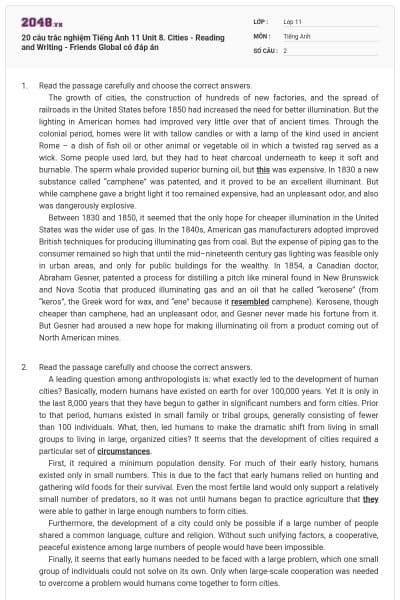
20 câu trắc nghiệm Tiếng Anh 11 Unit 8. Cities - Reading and Writing - Friends Global có đáp án
20 câu hỏi
Read the passage carefully and choose the correct answers.
The growth of cities, the construction of hundreds of new factories, and the spread of railroads in the United States before 1850 had increased the need for better illumination. But the lighting in American homes had improved very little over that of ancient times. Through the colonial period, homes were lit with tallow candles or with a lamp of the kind used in ancient Rome – a dish of fish oil or other animal or vegetable oil in which a twisted rag served as a wick. Some people used lard, but they had to heat charcoal underneath to keep it soft and burnable. The sperm whale provided superior burning oil, but this was expensive. In 1830 a new substance called “camphene” was patented, and it proved to be an excellent illuminant. But while camphene gave a bright light it too remained expensive, had an unpleasant odor, and also was dangerously explosive.
Between 1830 and 1850, it seemed that the only hope for cheaper illumination in the United States was the wider use of gas. In the 1840s, American gas manufacturers adopted improved British techniques for producing illuminating gas from coal. But the expense of piping gas to the consumer remained so high that until the mid–nineteenth century gas lighting was feasible only in urban areas, and only for public buildings for the wealthy. In 1854, a Canadian doctor, Abraham Gesner, patented a process for distilling a pitch like mineral found in New Brunswick and Nova Scotia that produced illuminating gas and an oil that he called “kerosene” (from “keros”, the Greek word for wax, and “ene” because it resembled camphene). Kerosene, though cheaper than camphene, had an unpleasant odor, and Gesner never made his fortune from it. But Gesner had aroused a new hope for making illuminating oil from a product coming out of North American mines.
increases in the number of new factories
growth of cities
development of railroads
demand for better medical facilities
Hướng dẫn giải
Đáp án đúng: D
Điều nào sau đây KHÔNG được đề cập là một lý do giải thích cho việc chiếu sáng tốt hơn trở nên cần thiết vào giữa thế kỷ XIX?
A. sự tăng số lượng nhà máy mới
B. sự tăng trưởng của các thành phố
C. sự phát triển đường sắt
D. nhu cầu về cơ sở y tế tốt hơn
Thông tin: The growth of cities, the construction of hundreds of new factories, and the spread of railroads in the United States before 1850 had increased the need for better illumination. (Sự phát triển của các thành phố, việc xây dựng hàng trăm nhà máy mới và sự mở rộng của đường sắt ở Hoa Kỳ trước năm 1850 đã làm tăng nhu cầu về chiếu sáng tốt hơn.) → A, B, C được đề cập.
oil
charcoal
lard
wick
Hướng dẫn giải
Đáp án đúng: A
Từ “this” trong đoạn 1 đề cập đến _______.
A. dầu
B. than củi
C. mỡ lợn
D. bấc đèn
Thông tin: The sperm whale provided superior burning oil, but this was expensive. (Cá nhà táng cung cấp dầu đốt tốt hơn, nhưng loại dầu này đắt đỏ.)
→ Từ “this” đề cập đến một loại dầu đốt.
It had an unpleasant smell.
It was not allowed to be used in public buildings.
It was not widely available until mid–nineteenth century.
It was first developed in the United States.
Hướng dẫn giải
Đáp án đúng: C
Điều gì có thể được suy ra về khí chiếu sáng được mô tả trong đoạn văn?
A. Nó có mùi khó chịu.
B. Nó không được phép sử dụng trong các tòa nhà công cộng.
C. Nó không được phổ biến rộng rãi cho đến giữa thế kỷ 19.
D. Nó được phát triển đầu tiên ở Hoa Kỳ.
Thông tin: In the 1840s, American gas manufacturers adopted improved British techniques for producing illuminating gas from coal. But the expense of piping gas to the consumer remained so high that until the mid–nineteenth century gas lighting was feasible only in urban areas, and only for public buildings for the wealthy.(Vào những năm 1840, các nhà sản xuất khí đốt của Mỹ đã áp dụng các kỹ thuật cải tiến của Anh để sản xuất khí đốt từ than đá. Tuy nhiên, chi phí dẫn khí đốt đến người tiêu dùng vẫn quá cao, đến giữa thế kỷ XIX, việc chiếu sáng bằng khí đốt chỉ khả thi ở khu vực đô thị và chỉ dành cho các công trình công cộng của người giàu.)
cost the same as
was made from
sounded like
was similar to
Hướng dẫn giải
Đáp án đúng: D
resembled – resemble (v): giống, tương tự
A. cost the same as: có giá tiền giống như
B. was made from: được làm từ
C. sounded like: nghe như
D. was similar to: giống như
→ resembled = was similar to
Thông tin: In 1854, a Canadian doctor, Abraham Gesner, patented a process for distilling a pitch like mineral found in New Brunswick and Nova Scotia that produced illuminating gas and an oil that he called “kerosene” (from “keros”, the Greek word for wax, and “ene” because it resembled camphene). (Năm 1854, một bác sĩ người Canada, Abraham Gesner, đã được cấp bằng sáng chế cho một quy trình chưng cất một loại khoáng chất giống như nhựa đường được tìm thấy ở New Brunswick và Nova Scotia, tạo ra khí đốt và một loại dầu mà ông gọi là dầu hỏa (từ “keros”, từ tiếng Hy Lạp có nghĩa là sáp, và “ene” vì nó giống với camphene).)
Which of the following best describes the organization of the passage?
a description of events in chronological order
a comparison of two years
an analysis of scientific findings
the statement of a theory and possible explanations
Hướng dẫn giải
Đáp án đúng: A
Điều nào dưới đây mô tả đúng nhất cách sắp xếp của bài đọc?
A. mô tả các sự kiện theo thứ tự thời gian
B. so sánh hai năm
C. phân tích kết quả khoa học
D. phát biểu của một lý thuyết và các giải thích khả thi
Bài viết tổ chức bằng cách nêu các sự kiện theo thứ tự thời gian:
– Trước 1830: chiếu sáng bằng nến hoặc dầu cá hoặc động thực vật khác
– 1930: một chất chiếu sáng mới xuất hiện gọi là “camphene”
– Từ 1930 đến 1950: sản xuất khí chiếu sáng từ than
– 1954: sáng chế ra dầu hỏa
Dịch bài đọc:
Sự phát triển của các thành phố, việc xây dựng hàng trăm nhà máy mới và sự mở rộng của đường sắt ở Hoa Kỳ trước năm 1850 đã làm tăng nhu cầu về chiếu sáng tốt hơn. Nhưng việc chiếu sáng trong nhà của người Mỹ chỉ cải thiện rất ít so với thời xưa. Xuyên suốt thời kỳ thuộc địa, trong nhà được chiếu sáng bằng thắp sáng bằng nến mỡ động vật hoặc bằng loại đèn được sử dụng ở thời La Mã cổ đại – một cái đĩa đựng dầu cá hoặc dầu động vật hoặc thực vật khác, trong đó có một miếng giẻ xoắn được dùng làm bấc. Một số người sử dụng mỡ heo, nhưng họ phải đốt than củi bên dưới để giữ cho nó mềm và dễ cháy. Cá nhà táng cung cấp dầu đốt tốt hơn, nhưng loại dầu này đắt đỏ. Vào năm 1830, một chất mới có tên là camphene đã được cấp bằng sáng chế, và là một chất chiếu sáng tuyệt vời. Mặc dù camphene cho ánh sáng rực rỡ, nhưng nó vẫn đắt tiền, có mùi khó chịu và cũng dễ cháy nổ nguy hiểm.
Từ năm 1830 đến 1850, dường như hy vọng duy nhất cho việc chiếu sáng rẻ hơn ở Hoa Kỳ là việc sử dụng khí đốt rộng rãi hơn. Vào những năm 1840, các nhà sản xuất khí đốt của Mỹ đã áp dụng các kỹ thuật cải tiến của Anh để sản xuất khí đốt từ than đá. Tuy nhiên, chi phí dẫn khí đốt đến người tiêu dùng vẫn quá cao, đến giữa thế kỷ XIX, việc chiếu sáng bằng khí đốt chỉ khả thi ở khu vực đô thị và chỉ dành cho các công trình công cộng của người giàu. Năm 1854, một bác sĩ người Canada, Abraham Gesner, đã được cấp bằng sáng chế cho một quy trình chưng cất một loại khoáng chất giống như nhựa đường được tìm thấy ở New Brunswick và Nova Scotia, tạo ra khí đốt và một loại dầu mà ông gọi là dầu hỏa (từ “keros”, từ tiếng Hy Lạp có nghĩa là sáp, và “ene” vì nó giống với camphene). Dầu hỏa, mặc dù rẻ hơn camphene, nhưng có mùi khó chịu, và Gesner chưa bao giờ làm giàu từ nó. Nhưng Gesner đã khơi dậy một niềm hy vọng mới về việc sản xuất dầu chiếu sáng từ một sản phẩm khai thác từ các mỏ ở Bắc Mỹ.
Read the passage carefully and choose the correct answers.
A leading question among anthropologists is: what exactly led to the development of human cities? Basically, modern humans have existed on earth for over 100,000 years. Yet it is only in the last 8,000 years that they have begun to gather in significant numbers and form cities. Prior to that period, humans existed in small family or tribal groups, generally consisting of fewer than 100 individuals. What, then, led humans to make the dramatic shift from living in small groups to living in large, organized cities? It seems that the development of cities required a particular set of circumstances.
First, it required a minimum population density. For much of their early history, humans existed only in small numbers. This is due to the fact that early humans relied on hunting and gathering wild foods for their survival. Even the most fertile land would only support a relatively small number of predators, so it was not until humans began to practice agriculture that they were able to gather in large enough numbers to form cities.
Furthermore, the development of a city could only be possible if a large number of people shared a common language, culture and religion. Without such unifying factors, a cooperative, peaceful existence among large numbers of people would have been impossible.
Finally, it seems that early humans needed to be faced with a large problem, which one small group of individuals could not solve on its own. Only when large-scale cooperation was needed to overcome a problem would humans come together to form cities.
Factors bringing about the development of human cities.
How population density affects the development of human cities.
Why a shared language makes a peaceful human city.
Problems solved by cooperation of a large group.
Hướng dẫn giải
Đáp án đúng: A
Bài đọc chủ yếu nói về điều gì?
A. Những yếu tố mang lại sự phát triển của các thành phố của con người.
B. Sự phân bố dân cư dày đặc ảnh hưởng thế nào đến sự phát triển của các thành phố của con người.
C. Tại sao một ngôn ngữ chung tạo ra một thành phố con người hòa bình.
D. Các vấn đề được giải quyết bằng sự hợp tác của một nhóm lớn.
→ Bài đọc nêu ra câu hỏi về những yếu tố dẫn đến sự hình thành của các thành phố của con người và đưa ra một số luận điểm. Vì vậy, A là đáp án phù hợp.
conditions
preparations
examples
events
Hướng dẫn giải
Đáp án đúng: A
Từ “circumstances” trong đoạn 1 có nghĩa là _____.
circumstances(v-s): hoàn cảnh, trường hợp, tình huống
A. conditions (n-s): hoàn cảnh, điều kiện
B. preparations (n-s): sự chuẩn bị
C. examples (n-s): ví dụ
D. events (n-s): sự kiện
→ circumstances = conditions
Thông tin: It seems that the development of cities required a particular set of circumstances. (Có vẻ như sự phát triển của các thành phố đòi hỏi một tập hợp các điều kiện đặc biệt.)

Học thông minh hơn mỗi ngày
Xem toàn bộ 20 câu hỏi và nhiều hơn nữa với tài khoản miễn phí
predators
humans
cities
foods
Hướng dẫn giải
Đáp án đúng: B
Từ “they” trong đoạn 2 đề cập tới _____.
A. predators (n-s): những kẻ săn mồi
B. humans (n-s): con người
C. cities (n-s): thành phố
D. foods (n-s): thực phẩm
Thông tin: Even the most fertile land would only support a relatively small number of predators, so it was not until humans began to practice agriculture that they were able to gather in large enough numbers to form cities. (Ngay cả vùng đất màu mỡ nhất cũng chỉ có thể nuôi sống một lượng động vật ăn thịt tương đối nhỏ, vì vậy mãi đến khi con người bắt đầu canh tác nông nghiệp thì họ mới có thể tập trung số lượng người đủ lớn để hình thành nên những thành phố.)
A large area of fertile land
A shared belief and value
A large and complicated problem
A group with a minimal number of members
Hướng dẫn giải
Đáp án đúng: B
Điều nào dưới đây cho phép con người sống cùng nhau trong hòa bình?
A. Một khu vực đất đai màu mỡ rộng lớn
B. Một giá trị và niềm tin được chia sẻ
C. Một vấn đề lớn và phức tạp
D. Một nhóm với số lượng tối thiểu thành viên
Thông tin: Furthermore, the development of a city could only be possible if a large number of people shared a common language, culture and religion. Without such unifying factors, a cooperative, peaceful existence among large numbers of people would have been impossible. (Hơn nữa, một thành phố chỉ có thể phát triển nếu một lượng lớn cư dân có chung ngôn ngữ, văn hóa và tôn giáo. Nếu không có các yếu tố thống nhất như vậy, sẽ không thể chung sống hòa bình và hợp tác giữa những lượng lớn cư dân.)
a shared culture
people’s gathering
peaceful existence
large-scale collaboration
Hướng dẫn giải
Đáp án đúng: C
Cái nào sau đây không cần thiết cho sự phát triển của thành phố?
A. Một nền văn hóa chung
B. Việc tập trung của con người
C. Việc cùng chung sống hòa bình
D. Sự hợp tác quy mô lớn
Thông tin:
- Furthermore, the development of a city could only be possible if a large number of people shared a common language, culture and religion. (Hơn nữa, một thành phố chỉ có thể phát triển nếu một lượng lớn cư dân có chung ngôn ngữ, văn hóa và tôn giáo.) → A được đề cập.
- Even the most fertile land would only support a relatively small number of predators, so it was not until humans began to practice agriculture that they were able to gather in large enough numbers to form cities. (Ngay cả vùng đất màu mỡ nhất cũng chỉ có thể nuôi sống một lượng động vật ăn thịt tương đối nhỏ, vì vậy mãi đến khi con người bắt đầu canh tác nông nghiệp thì họ mới có thể tập trung số lượng người đủ lớn để hình thành nên những thành phố.) → B được đề cập.
- Finally, it seems that early humans needed to be faced with a large problem, which one small group of individuals could not solve on its own. Only when large-scale cooperation was needed to overcome a problem would humans come together to form cities. (Cuối cùng, dường như người tiền sử cần phải đối mặt với một vấn đề lớn mà một nhóm nhỏ cá nhân không thể tự giải quyết. Chỉ khi cần sự hợp tác quy mô lớn để vượt qua vấn đề thì con người mới tập trung lại để tạo dựng những thành phố.) → D được đề cập
Dịch bài đọc:
Một câu hỏi hàng đầu trong giới nhân chủng học là: điều gì đã dẫn đến sự phát triển của các thành phố của loài người? Về cơ bản, con người hiện tại đã tồn tại trên trái đất hơn 100,000 năm. Tuy nhiên chỉ trong 8,000 năm trở lại đây thì con người mới bắt đầu tập trung với số lượng đáng kể và tạo dựng các thành phố. Trước đây, con người sống trong những gia đình hoặc các bộ lạc nhỏ, thường bao gồm ít hơn 100 người. Vậy điều gì đã dẫn đến sự chuyển đổi mạnh mẽ của loài người từ sống trong các nhóm nhỏ sang sống trong các thành phố lớn, có tổ chức? Có vẻ như sự phát triển của các thành phố đòi hỏi một tập hợp các điều kiện đặc biệt.
Thứ nhất, nó đòi hỏi một mật độ dân số tối thiểu. Trong phần lớn thời kỳ sơ khai, con người chỉ tồn tại với các nhóm số lượng nhỏ. Điều này do thực tế con người thời kì đầu phụ thuộc vào việc săn bắn và hái lượm thức ăn ngoài hoang dã để sinh tồn. Ngay cả vùng đất màu mỡ nhất cũng chỉ có thể nuôi sống một lượng động vật ăn thịt tương đối nhỏ, vì vậy mãi đến khi con người bắt đầu canh tác nông nghiệp thì họ mới có thể tập trung số lượng người đủ lớn để hình thành nên những thành phố.
Hơn nữa, một thành phố chỉ có thể phát triển nếu một lượng lớn cư dân có chung ngôn ngữ, văn hóa và tôn giáo. Nếu không có các yếu tố thống nhất như vậy, sẽ không thể chung sống hòa bình và hợp tác giữa những lượng lớn cư dân.
Cuối cùng, dường như người tiền sử cần phải đối mặt với một vấn đề lớn mà một nhóm nhỏ cá nhân không thể tự giải quyết. Chỉ khi cần sự hợp tác quy mô lớn để vượt qua vấn đề thì con người mới tập trung lại để tạo dựng những thành phố.
Choose the best option to rewrite the below sentence.
Flying taxis are unlikely to be popular.
→ Flying taxis _________.
will be common in the future
won’t be popular
are going to be famous
are sure to be popular
Hướng dẫn giải
Đáp án đúng: B
Cấu trúc: be unlikely to V - khó có khả năng làm gì/ khó có khả năng xảy ra điều gì.
Thì tương lai đơn ở dạng phủ định (won’t + V) diễn tả khả năng không thể xảy ra của một sự việc trong tương lai, mang nghĩa tương đương với câu gốc.
→ Flying taxis won’t be popular.
Chọn B.
Xét các đáp án khác:
A. will be common in the future: sẽ phổ biến trong tương lai → trái nghĩa so với câu gốc.
C. are going to be famous: sẽ trở nên nổi tiếng → sai nghĩa so với câu gốc.
D. are sure to be popular: chắc chắn sẽ phổ biến → trái nghĩa so với câu gốc.
Dịch nghĩa: Xe taxi bay có khả năng sẽ không phổ biến.
→ Xe taxi bay sẽ không phổ biến.
Choose the best option to rewrite the below sentence.
It’s impossible that humans will waste energy sources.
→ Humans _________.
might waste energy sources in the future
will use energy sources carelessly
are sure to waste energy sources
won’t waste energy sources
Hướng dẫn giải
Đáp án đúng: D
Cấu trúc: It’s impossible that + S + V - không thể nào mà... → diễn tả điều hoàn toàn không xảy ra trong tương lai.
Thì tương lai đơn ở dạng phủ định (won’t + V) diễn tả khả năng không thể xảy ra của một sự việc trong tương lai, mang nghĩa tương đương với câu gốc.
→ Humans won’t waste energy sources.
Chọn D.
Xét các đáp án khác:
A. might: có thể → trái nghĩa với “impossible”.
B. Sai nghĩa: Con người sẽ dùng các nguồn năng lượng một cách bất cẩn.
C. are sure to: chắc chắn xảy ra → trái nghĩa với “impossible”.
Dịch nghĩa: Không thể nào con người sẽ lãng phí các nguồn năng lượng.
→ Con người sẽ không lãng phí các nguồn năng lượng.
Choose the sentence with the same meaning as the given one.
I think Florence is not so interesting as Paris.
I think Florence is more interesting than Paris.
I think Paris is more interesting than Florence.
I think Florence is as interesting as Paris.
I think Florence is more interesting than other cities such as Paris.
Hướng dẫn giải
Đáp án đúng: B
Cấu trúc: S1 + be + not so/as + long adj + as + S2 = S2 + be + more + long adj + than + S1.
→ I think Paris is more interesting than Florence.
Xét các đáp án khác:
A. Tôi nghĩ Florence thú vị hơn Paris. → Ngược nghĩa với câu gốc.
C. Tôi nghĩ Florence thú vị ngang Paris. → Sai nghĩa so với câu gốc.
D. Tôi nghĩ Florence thú vị hơn nhiều thành phố khác chẳng hạn như Paris. → Sai nghĩa so với câu gốc.
Dịch nghĩa: Tôi nghĩ Florence không thú vị bằng Paris.
→ Tôi nghĩ Paris thú vị hơn Florence.
Choose the sentence with the same meaning as the given one.
I never came to this city, so I couldn't meet him.
If only I had come to this city, I could have met him.
Never do I come to this city, so I couldn't meet him.
At no time I came to this city, so I couldn't meet him.
I wished I had come to this city, I could I have met him.
Hướng dẫn giải
Đáp án đúng: A
Tôi chưa bao giờ đến thành phố này, vì vậy tôi không thể gặp anh ấy.
A. Ước gì tôi đã đến thành phố này, tôi đã có thể gặp anh ấy.
B. Tôi không bao giờ đến thành phố này, vì vậy tôi không thể gặp anh ấy. (Thì ở vế đầu tiên không phù hợp)
C. Không lúc nào tôi đến thành phố này, vì vậy tôi không thể gặp anh ấy. (Vế đầu tiên không đảo ngữ)
D. Tôi ước tôi đã đến thành phố này, tôi có thể tôi gặp anh ấy. (Vế sau thừa "I")
Choose the correct arrangement of the sentences to make a meaningful paragraph.
a. The invention quickly transformed cities, extending human activity well into the night hours.
b. When Thomas Edison first unveiled his electric light bulb in 1879, few could imagine its impact.
c. Factories could now operate around the clock, revolutionizing industrial production worldwide.
d. This simple innovation sparked numerous related inventions in power distribution and electronics.
e. Today, we’re witnessing similar revolutionary changes with artificial intelligence and quantum computing.
b-a-c-d-e
b-a-d-c-e
c-b-a-e-d
c-d-e-b-a
Hướng dẫn giải
Đáp án đúng: A
Thứ tự đúng:
b. When Thomas Edison first unveiled his electric light bulb in 1879, few could imagine its impact.
a. The invention quickly transformed cities, extending human activity well into the night hours.
c. Factories could now operate around the clock, revolutionizing industrial production worldwide.
d. This simple innovation sparked numerous related inventions in power distribution and electronics.
e. Today, we're witnessing similar revolutionary changes with artificial intelligence and quantum computing.
Dịch nghĩa:
b. Khi Thomas Edison lần đầu tiên giới thiệu bóng đèn điện của minh vào năm 1879, ít ai có thể tưởng tượng được tác động của nó.
a. Phát minh này nhanh chóng biến đổi các thành phố, kéo đài hoạt động của con người đến tận các giờ đêm.
c. Các nhà máy giờ đây có thể hoạt động suốt ngày đêm, cách mạng hóa sản xuất công nghiệp trên toàn thế giới.
d. Phát minh đơn giản này đã khơi nguồn cho nhiều phát minh liên quan trong phân phối điện và điện tử.
e. Ngày nay, chúng ta đang chứng kiến những thay đổi mang tính cách mạng tương tự với trí tuệ nhân tạo và máy tính lượng tử.
Choose the sentence that best combines the following pair of sentences.
Greenpeace has realized the seriousness of environmental pollution. It urges the government worldwide to take action soon.
Having realized the seriousness of environmental pollution, Greenpeace urges the government worldwide to take action soon.
Greenpeace has realized the seriousness of environmental pollution so that it urges the government worldwide to take action soon.
Greenpeace has realized the seriousness of environmental pollution whereas it urges the government worldwide to take action soon.
Realized the seriousness of environmental pollution, or else Greenpeace urges the government worldwide to take action soon.
Hướng dẫn giải
Đáp án đúng: A
Greenpeace đã nhận ra sự nghiêm trọng của ô nhiễm môi trường. Nó kêu gọi chính phủ trên toàn thế giới sớm hành động.
A. Nhận thấy sự nghiêm trọng của ô nhiễm môi trường, Greenpeace kêu gọi chính phủ trên toàn thế giới sớm hành động.
B. Greenpeace đã nhận ra mức độ nghiêm trọng của ô nhiễm môi trường để thúc giục chính phủ trên toàn thế giới sớm hành động.
C. Greenpeace đã nhận ra sự nghiêm trọng của ô nhiễm môi trường trong khi nó thúc giục chính phủ trên toàn thế giới sớm hành động.
D. Nhận ra mức độ nghiêm trọng của ô nhiễm môi trường, nếu không, Greenpeace kêu gọi chính phủ trên toàn thế giới sớm hành động.
Choose the sentence that is CLOSEST in meaning to the given one.
China is the country with the largest population.
China is larger than any other country.
China has more population than any other country.
China is as crowded as other countries.
Other countries are more crowded than China.
Hướng dẫn giải
Đáp án đúng: B
Dịch nghĩa: Trung Quốc là quốc gia có dân số đông nhất.
A. Trung Quốc lớn hơn bất kỳ quốc gia nào khác.
B. Trung Quốc có dân số nhiều hơn bất kỳ quốc gia nào khác.
C. Trung Quốc đông đúc như các nước khác.
D. Các nước khác đông đúc hơn Trung Quốc.
→ Theo nghĩa, ta thấy B phù hợp nhất.
Choose the sentence that is CLOSEST in meaning to the given one.
Realizing the environmental impact of the fashion industry, some bloggers, vloggers and influencers are now entering the “no-buy” movement.
It is a new trend that some bloggers, vloggers and influencers now refuse to buy new stuff regardless of the environmental impact of the fashion industry.
Instead of using the things they have already owned, some bloggers , vloggers and influencers make a commitment to buy new stuff because of the environmental impact of the fashion industry.
With the fashion industry's environmental impact under consideration, there's a move to avoid new stuff among some bloggers, vloggers and influencers.
Some bloggers, vloggers and influencers, taking fashion industry's environmental impact into account, now deny buying new products.
Hướng dẫn giải
Đáp án đúng: D
Dịch nghĩa: Nhận thấy tác động môi trường của ngành công nghiệp thời trang, một số blogger, vlogger và những người có ảnh hưởng hiện đang tham gia vào phong trào "không mua".
A. Đây là một xu hướng mới khi một số blogger, vlogger và những người có ảnh hưởng hiện nay từ chối mua đồ mới bất kể tác động môi trường của ngành thời trang.
B. Thay vì sử dụng những thứ họ đã có, một số blogger, vlogger và người có ảnh hưởng cam kết mua đồ mới vì tác động môi trường của ngành thời trang.
C. Với tác động môi trường của ngành công nghiệp thời trang đang được xem xét, có một động thái tránh những thứ mới giữa một số blogger, vlogger và những người có ảnh hưởng.
D. Một số blogger, vlogger và người có ảnh hưởng, tính đến tác động môi trường của ngành thời trang, hiện từ chối mua sản phẩm mới.
Câu A, B, C không phù hợp về nghĩa
Choose the sentence that is CLOSEST in meaning to the given one.
The city is building green roofs so that the heat island effect will be reduced and pollutants will be absorbed.
The city is building green roofs, and the heat island effect will be reduced and pollutants will be absorbed.
Having built green roofs, the heat island effect will be reduced and pollutants will be absorbed.
The city is building green roofs to reduce the heat island effect and absorb pollutants.
The city is building green roofs in order that reduce the heat island effect and absorb pollutants.
Hướng dẫn giải
Đáp án đúng: C
Câu gốc có cấu trúc chỉ mục đích với “so that + S + V”.
Đáp án C sử dụng cấu trúc rút gọn mục đích: to reduce... and absorb... (để giảm... và hấp thụ...), tương đương với “so that...”.
→ The city is building green roofs to reduce the heat island effect and absorb pollutants.
Chọn C.
Xét các đáp án khác:
A. Nối hai mệnh đề độc lập bằng liên từ “and” không rõ quan hệ nguyên nhân – kết quả như câu gốc.
B. Cấu trúc “having + V3/ed” dùng để rút gọn 2 mệnh đề đồng chủ ngữ, dùng để chỉ hành động xảy ra trước một hành động khác, nhưng ở đây mệnh đề đầu không có chủ ngữ rõ ràng (ai là người xây?), dễ hiểu nhầm là “the heat island effect” đã xây dựng những mái nhà xanh.
D. Sai ngữ pháp: in order that + clause, đúng phải là: in order that the heat island effect will be reduced and pollutants will be absorbed.
Dịch nghĩa: Thành phố đang xây dựng những mái nhà xanh để giảm hiệu ứng đảo nhiệt và hấp thụ các chất ô nhiễm.
Choose the sentence that best combines the following pair of sentences, using the given word.
There will be many electric cars in the town in the next five years. This is 100% certain. (DEFINITELY)
There will be definitely many electric cars in the town in the next five years.
There definitely will be many electric cars in the town in the next five years.
There will definitely be many electric cars in the town in the next five years.
Definitely there will be many electric cars in the town in the next five years.
Hướng dẫn giải
Đáp án đúng: C
Trạng từ “definitely” nên được đặt giữa “will” và động từ chính (“be”) trong câu khẳng định để thể hiện sự chắc chắn (100%).
Cấu trúc: S + will + definitely + V (bare-infinitive).
→ There will definitely be many electric cars in the town in the next five years.
Chọn C.
Dịch nghĩa: Sẽ có nhiều xe điện trong thị trấn trong 5 năm tới. Điều này chắc chắn 100%.
→ Chắc chắn sẽ có nhiều xe ô tô điện trong thị trấn trong 5 năm tới.
Bạn có thích hoạt động này không?
Ý kiến của bạn sẽ giúp chúng tôi đề xuất nội dung phù hợp hơn.
Gợi ý cho bạn
![[Năm 2022] Đề thi thử môn Vật lí THPT Quốc gia có lời giải - Đề số 21](/_next/image?url=https%3A%2F%2Fvideo.vietjack.com%2Fupload%2Fimages%2Fvj-image%2Fimage-3izficdefgfoel0s9j8s-1786772791.jpg&w=3840&q=75)


![[Năm 2022] Đề thi thử môn Vật lí THPT Quốc gia có lời giải - Đề số 20](/_next/image?url=https%3A%2F%2Fvideo.vietjack.com%2Fupload%2Fimages%2Fvj-image%2Fimage-emy0gtcksawvorajezvv-1786772460.jpg&w=3840&q=75)

Tài liệu phổ biến Lớp 11




Tài liệu phổ biến Tiếng Anh