20 câu trắc nghiệm Tiếng Anh 11 Unit 7. Artists - Reading and Writing - Friends Global có đáp án
20 câu hỏi
Read the passage carefully and choose the correct answers.
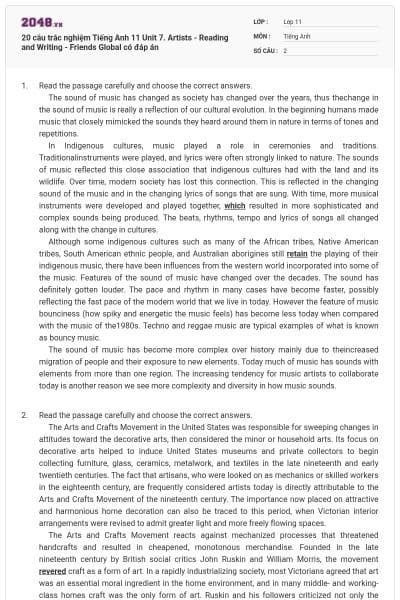
The sound of music has changed as society has changed over the years, thus thechange in the sound of music is really a reflection of our cultural evolution. In the beginning humans made music that closely mimicked the sounds they heard around them in nature in terms of tones and repetitions.
In Indigenous cultures, music played a role in ceremonies and traditions. Traditionalinstruments were played, and lyrics were often strongly linked to nature. The sounds of music reflected this close association that indigenous cultures had with the land and its wildlife. Over time, modern society has lost this connection. This is reflected in the changing sound of the music and in the changing lyrics of songs that are sung. With time, more musical instruments were developed and played together, which resulted in more sophisticated and complex sounds being produced. The beats, rhythms, tempo and lyrics of songs all changed along with the change in cultures.
Although some indigenous cultures such as many of the African tribes, Native American tribes, South American ethnic people, and Australian aborigines still retain the playing of their indigenous music, there have been influences from the western world incorporated into some of the music. Features of the sound of music have changed over the decades. The sound has definitely gotten louder. The pace and rhythm in many cases have become faster, possibly reflecting the fast pace of the modern world that we live in today. However the feature of music bounciness (how spiky and energetic the music feels) has become less today when compared with the music of the1980s. Techno and reggae music are typical examples of what is known as bouncy music.
The sound of music has become more complex over history mainly due to theincreased migration of people and their exposure to new elements. Today much of music has sounds with elements from more than one region. The increasing tendency for music artists to collaborate today is another reason we see more complexity and diversity in how music sounds.
Why People Changed the Sound of Music?
Music: Now and Then
The Role of Music in Indigenous Cultures
Nature and Music
Hướng dẫn giải
Đáp án đúng: B
Tiêu đề nào là phù hợp nhất cho bài đọc?
A. Tại sao mọi người lại thay đổi giai điệu âm nhạc?
B. Âm nhạc: Xưa và Nay
C. Vai trò của âm nhạc trong văn hóa bản địa
D. Thiên nhiên và âm nhạc
→ Nội dung xuyên suốt của bài viết là về đặc điểm và sự thay đổi của âm nhạc theo thời gian, vì thế đáp án B là nhan đề phù hợp cho bài viết này.
musical instruments
developing and playing many musical instruments together
the changing sound of the music
the changing lyrics of songs
Hướng dẫn giải
Đáp án đúng: B
Từ “which” trong đoạn 2 đề cập đến _______.
A. các nhạc cụ
B. sự phát triển và chơi nhiều nhạc cụ kết hợp
C. sự thay đổi trong giai điệu âm nhạc
D. sự thay đổi trong lời bài hát
Thông tin: With time, more musical instruments were developed and played together, which resulted in more sophisticated and complex sounds being produced. (Theo thời gian, nhiều loại nhạc cụ được phát triển và chơi kết hợp, tạo ra những âm thanh phức tạp và tinh tế hơn.)
→ Từ “which” dùng để thay thế cho việc nhạc cụ được phát triển và chơi kết hợp.
preserve
reduce
exchange
combine
Hướng dẫn giải
Đáp án đúng: A
Từ “retain” trong đoạn 3 có thể được thay thế bởi _______.
retain (v): giữ lại
A. preserve (v): gìn giữ
B. reduce (v): làm giảm
C. exchange (v): trao đổi
D. combine(v): kết hợp
→ retain = preserve
Thông tin: Although some indigenous cultures such as many of the African tribes, Native American tribes, South American ethnic people, and Australian aborigines still retain the playing of their indigenous music, there have been influences from the western world incorporated into some of the music. (Mặc dù một số nền văn hóa bản địa như nhiều bộ tộc châu Phi, bộ tộc thổ dân châu Mỹ, người dân tộc Nam Mỹ và thổ dân Úc vẫn giữ gìn âm nhạc truyền thống, nhưng một phần âm nhạc của họ vẫn chịu ảnh hưởng từ thế giới phương Tây.)
the sound volume
the pace and rhythm
the connection to nature
the sound’s complexity and diversity
Hướng dẫn giải
Đáp án đúng: C
Theo bài đọc , những đặc điểm sau đây của âm nhạc đã gia tăng theo thời gian, ngoại trừ_______.
A. âm lượng của âm thanh
B. tốc độ và nhịp điệu
C. sự kết nối với thiên nhiên
D. sự phức tạp và đa dạng của giai điệu
Thông tin:
- Features of the sound of music have changed over the decades. The sound hasdefinitely gotten louder. The pace and rhythm in many cases has become faster, possiblyreflecting the fast pace of the modern world that we live in today. (Các đặc điểm của âm nhạc đã thay đổi qua các thập kỷ. Âm lượng chắc chắn đã lớn hơn. Nhịp điệu và tốc độ trong nhiều trường hợp đã trở nên nhanh hơn, có lẽ phản ánh nhịp sống nhanh của thế giới hiện đại ngày nay.) → A, B đúng.
- The sounds of music reflected this close association that indigenous cultures hadwith the land and its wildlife. Over time, modern society has lost this connection. (Âm nhạc phản ánh mối liên kết bền chặt giữa các nền văn hóa bản địa với đất đai và sinh vật hoang dã. Theo thời gian, xã hội hiện đại đã mất đi mối liên hệ này.) → C là yếu tố không gia tăng theo thời gian.
- The increasing tendency for music artists to collaborate today is another reason we see more complexity and diversity in how music sounds. (Xu hướng hợp tác giữa các nghệ sĩ ngày càng tăng cũng là một lý do khiến âm nhạc trở nên đa dạng và phức tạp hơn.) → D đúng.
Western music has more influence on indigenous music than others.
The fast pace of life has caused the loss of connection to nature.
Almost every feature of music sounds changed when the cultures altered.
Modern music sounds contain different regional elements due to the collaboration ofmusic artists.
Hướng dẫn giải
Đáp án đúng: C
Câu nào sau đây là đúng?
A. Âm nhạc phương tây có nhiều ảnh hưởng tới âm nhạc bản địa hơn các âm nhạc khác.
B. Nhịp sống vội vã đã làm mất đi sự kết nối với tự nhiên.
C. Hầu hết mọi đặc điểm của giai điệu âm nhạc đã thay đổi khi văn hóa thay đổi.
D. Các giai điệu âm nhạc hiện đại bao gồm nhiều yếu tố vùng miền khác nhau do sự cộng tác của các nghệ sĩ âm nhạc.
Thông tin:The beats, rhythms, tempo and lyrics of songs all changed along with the change in cultures. (Nhịp điệu, tiết tấu, tốc độ và ca từ của các bài hát đều thay đổi theo cùng sự thay đổi của các nền văn hóa.)
Dịch bài đọc:
Âm nhạc đã thay đổi cùng với sự thay đổi của xã hội qua nhiều năm, do đó sự thay đổi trong âm nhạc thực sự phản ánh sự tiến hóa văn hóa của chúng ta. Ban đầu, con người tạo ra âm nhạc mô phỏng những âm thanh mà họ nghe được xung quanh trong tự nhiên về mặt âm sắc và tính lặp đi lặp lại.
Trong các nền văn hóa bản địa, âm nhạc đóng vai trò quan trọng trong các nghi lễ và truyền thống. Những nhạc cụ truyền thống được chơi và lời ca thường gắn chặt với thiên nhiên. Âm nhạc phản ánh mối liên kết bền chặt giữa các nền văn hóa bản địa với đất đai và sinh vật hoang dã. Theo thời gian, xã hội hiện đại đã mất đi mối liên hệ này. Điều đó được thể hiện qua sự thay đổi trong âm nhạc và lời bài hát. Theo thời gian, nhiều loại nhạc cụ được phát triển và chơi kết hợp, tạo ra những âm thanh phức tạp và tinh tế hơn. Nhịp điệu, tiết tấu, tốc độ và ca từ của các bài hát đều thay đổi theo cùng sự thay đổi của các nền văn hóa.
Mặc dù một số nền văn hóa bản địa như nhiều bộ tộc châu Phi, bộ tộc thổ dân châu Mỹ, người dân tộc Nam Mỹ và thổ dân Úc vẫn giữ gìn âm nhạc truyền thống, nhưng một phần âm nhạc của họ vẫn chịu ảnh hưởng từ thế giới phương Tây. Các đặc điểm của âm nhạc đã thay đổi qua các thập kỷ. Âm lượng chắc chắn đã lớn hơn. Nhịp điệu và tốc độ trong nhiều trường hợp đã trở nên nhanh hơn, có lẽ phản ánh nhịp sống nhanh của thế giới hiện đại ngày nay. Tuy nhiên, độ “nảy” của âm nhạc (mức độ sôi động và mạnh mẽ của âm thanh) ngày nay lại giảm đi so với âm nhạc những năm 1980. Nhạc techno và reggae là những ví dụ điển hình của thể loại âm nhạc có tính “nảy”.
Âm nhạc trở nên phức tạp hơn trong lịch sử chủ yếu do sự gia tăng trong việc di cư và sự tiếp xúc của con người với nhiều yếu tố mới. Ngày nay, phần lớn âm nhạc mang âm hưởng từ nhiều vùng khác nhau. Xu hướng hợp tác giữa các nghệ sĩ ngày càng tăng cũng là một lý do khiến âm nhạc trở nên đa dạng và phức tạp hơn.
Read the passage carefully and choose the correct answers.
The Arts and Crafts Movement in the United States was responsible for sweeping changes in attitudes toward the decorative arts, then considered the minor or household arts. Its focus on decorative arts helped to induce United States museums and private collectors to begin collecting furniture, glass, ceramics, metalwork, and textiles in the late nineteenth and early twentieth centuries. The fact that artisans, who were looked on as mechanics or skilled workers in the eighteenth century, are frequently considered artists today is directly attributable to the Arts and Crafts Movement of the nineteenth century. The importance now placed on attractive and harmonious home decoration can also be traced to this period, when Victorian interior arrangements were revised to admit greater light and more freely flowing spaces.
The Arts and Crafts Movement reacts against mechanized processes that threatened handcrafts and resulted in cheapened, monotonous merchandise. Founded in the late nineteenth century by British social critics John Ruskin and William Morris, the movement revered craft as a form of art. In a rapidly industrializing society, most Victorians agreed that art was an essential moral ingredient in the home environment, and in many middle- and working-class homes craft was the only form of art. Ruskin and his followers criticized not only the degradation of artisans reduced to machine operators, but also the impending loss of daily contact with handcrafted objects, fashioned with pride, integrity, and attention to beauty.
In the United States as well as in Great Britain, reformers extolled the virtues of handcrafted objects: simple, straightforward design; solid materials of good quality; and sound, enduring construction techniques. These criteria were interpreted in a variety of styles, ranging from rational and geometric to romantic or naturalistic. Whether abstract, stylized, or realistically treated, the consistent theme in virtually all Arts and Crafts design is nature.
The Arts and Crafts Movement was much more than a particular style; it was a philosophy of domestic life. Proponents believed that if simple design, high-quality materials, and honest construction were realized in the home and its appointments, then the occupants would enjoy moral and therapeutic effects. For both artisan and consumer, the Arts and Crafts doctrine was seen as a magical force against the undesirable effects of industrialization.
defenders of moral standards
creators of cheap merchandise
skilled workers
talented artists
Hướng dẫn giải
Đáp án đúng: C
Theo bài đọc, trước thế kỉ XIX, những người thợ thủ công được coi là _______.
A. những người ủng hộ các tiêu chuẩn đạo đức
B. những người sáng tạo ra hàng hoá giá rẻ
C. thợ lành nghề
D. nghệ sĩ tài năng
Thông tin: The fact that artisans, who were looked on as mechanics or skilled workers in the eighteenth century, are frequently considered artists today is directly attributable to the Arts and Crafts Movement of the nineteenth century. (Việc các nghệ nhân, những người được coi là thợ cơ khí hoặc công nhân lành nghề trong thế kỷ XVIII, ngày nay thường được coi là nghệ sĩ có thể được quy trực tiếp cho Phong trào Nghệ thuật và Thủ công của thế kỷ XIX.)
It can be inferred from the passage that the Arts and Crafts Movement would have considered all of the following to be artists EXCEPT _______.
creators of textile designs
people who produce handmade glass objects
operators of machines that automatically cut legs, for furniture
metalworkers who create unique pieces of jewelry
Hướng dẫn giải
Đáp án đúng: C
Từ đoạn trích có thể suy ra rằng những thay đổi trong nghệ thuật và thủ công có để đều được coi là nghệ sĩ ngoại trừ _______.
A. những người sáng tạo thiết kế trên vải vóc
B. những người sản xuất vật thuỷ tinh bằng tay
C. những người điều hành máy tự động cắt tay cho đồ đạc
D. thợ kim loại sản xuất những trang sức độc đáo
Thông tin: The Arts and Crafts Movement reacts against mechanized processes that threatened handcrafts and resulted in cheapened, monotonous merchandise. (Phong trào Nghệ thuật và Thủ công phản đối các quy trình cơ giới hóa đe dọa nghề thủ công và dẫn đến hàng hóa rẻ tiền, đơn điệu.)

Học thông minh hơn mỗi ngày
Xem toàn bộ 20 câu hỏi và nhiều hơn nữa với tài khoản miễn phí
respected
described
dubbed
created
Hướng dẫn giải
Đáp án đúng: A
Từ “revered” ở đoạn hai gần nghĩa với từ _______.
revered (V3): được tôn trọng
A. respected (V3): được tôn trọng
B. described(V3): được miêu tả
C. dubbed (V3): gán biệt danh
D. created(V3): được tạo ra
→ revered = respected
Thông tin: Founded in the late nineteenth century by British social critics John Ruskin and William Morris, the movement revered craft as a form of art. (Được thành lập vào cuối thế kỷ XIX bởi các nhà phê bình xã hội người Anh John Ruskin và William Morris, phong trào này tôn vinh nghề thủ công như một hình thức nghệ thuật.)
According to the passage, which of the following changes occured at the same time as the Arts and Crafts Movement?
The creation of brighter and more airy spaces inside homes.
The rejection of art that depicted nature in a realistic manner.
A decline of interest in art museum collections.
An increase in the buying of imported art objects.
Hướng dẫn giải
Đáp án đúng: A
Theo bài đọc, những thay đổi nào dưới đây xảy ra cùng lúc với sự thay đổi về Phong trào Nghệ thuật và Thủ công?
A. Sự sáng tạo về không gian sáng sủa và thông thoáng hơn trong nhà cửa.
B. Sự chối bỏ rằng nghệ thuật phác hoạ thiên nhiên một cách chân thực hơn.
C. Sự hứng thú giảm đi với các bộ sưu tập ở bảo tàng.
D. Sự tăng hứng thú với việc mua các món đồ nghệ thuật nhập khẩu.
Thông tin: The importance now placed on attractive and harmonious home decoration can also be traced to this period, when Victorian interior arrangements were revised to admit greater light and more freely flowing spaces. (Tầm quan trọng hiện nay đối với việc trang trí nhà cửa đẹp mắt và hài hòa cũng có thể bắt nguồn từ thời kỳ này, khi cách bố trí nội thất thời Victoria được sửa đổi để đón nhiều ánh sáng hơn và tạo ra không gian thông thoáng hơn.)
exposed
praised
believed
accepted
Hướng dẫn giải
Đáp án đúng: B
Từ “extolled” ở đoạn 3 gần nghĩa với ________.
extolled– extol (v): tán dương
A. exposed– expose (v): vạch trần
B. praised– praise (v): khen ngợi
C. believed– believe (v): tin rằng
D. accepted– accept (v): đồng ý
→ extolled = praised
Thông tin: In the United States as well as in Great Britain, reformers extolled the virtues of handcrafted objects: simple, straightforward design; solid materials of good quality; and sound, enduring construction techniques. (Ở Hoa Kỳ cũng như ở Anh, các nhà cải cách đã ca ngợi ưu điểm của các vật dụng thủ công: thiết kế đơn giản, dễ hiểu; vật liệu chắc chắn, chất lượng tốt; và kỹ thuật chế tạo bền chắc.)
Their naturalistic themes
Their importance in museum collections
Their British origin
Their role in an industrialized society
Hướng dẫn giải
Đáp án đúng: D
Bài đọc chủ yếu tập trung vào nghệ thuật và thủ công thế kỉ XIX ở phương diện nào dưới đây?
A. Những chủ đề thiên nhiên
B. Sự quan trọng của chúng trong các bộ sưu tập ở bảo tàng
C. Nguồn gốc Anh quốc của chúng
D. Vai trò của chúng trong một xã hội công nghiệp hoá
Thông tin:
- The Arts and Crafts Movement reacts against mechanized processes that threatened handcrafts and resulted in cheapened, monotonous merchandise. In a rapidly industrializing society, most Victorians agreed that art was an essential moral ingredient in the home environment, and in many middle- and working-class homes craft was the only form of art. Ruskin and his followers criticized not only the degradation of artisans reduced to machine operators, but also the impending loss of daily contact with handcrafted objects, fashioned with pride, integrity, and attention to beauty. (Phong trào Nghệ thuật và Thủ công phản đối các quy trình cơ giới hóa đe dọa nghề thủ công và dẫn đến hàng hóa rẻ tiền, đơn điệu. Trong một xã hội công nghiệp hóa nhanh chóng, hầu hết người thời Victoria đều đồng ý rằng nghệ thuật là một yếu tố đạo đức thiết yếu trong môi trường gia đình, và trong nhiều gia đình thuộc tầng lớp trung lưu và công nhân, nghề thủ công là hình thức nghệ thuật duy nhất. Ruskin và những người ủng hộ ông không chỉ chỉ trích sự suy thoái của những người thợ thủ công bị biến thành những người vận hành máy móc, mà còn cả sự mất mát của việc tiếp xúc hàng ngày với các vật dụng thủ công, được tạo ra với niềm tự hào, sự chính trực và sự chú trọng đến vẻ đẹp đang trên đà xảy ra.)
- For both artisan and consumer, the Arts and Crafts doctrine was seen as a magical force against the undesirable effects of industrialization. (Đối với cả người thợ thủ công và người tiêu dùng, học thuyết Nghệ thuật và Thủ công được xem như một sức mạnh kỳ diệu chống lại những tác động không mong muốn của công nghiệp hóa.)
→ Bài đọc nêu rằng phong trào Nghệ thuật và Thủ công tôn vinh nghệ thuật thủ công trong bối cảnh xã hội đẩy mạnh công nghiệp hóa, vì vậy D là đáp án đúng.
made by members of the family
the least expensive objects in their homes
regarded as being morally uplifting
thought to symbolize progress
Hướng dẫn giải
Đáp án đúng: C
Theo đoạn 2, những vật thủ công trong nhà của những gia đình lao động và trung lưu thường ________.
A. được làm bởi các thành viên trong gia đình
B. ít đắt nhất trong các đồ vật trong nhà họ
C. được coi là yếu tố thúc đẩy đạo đức
D. được cho là biểu tượng hoá quá trình
Thông tin: In a rapidly industrializing society, most Victorians agreed that art was an essential moral ingredient in the home environment, and in many middle- and working-class homes craft was the only form of art. (Trong một xã hội công nghiệp hóa nhanh chóng, hầu hết người thời Victoria đều đồng ý rằng nghệ thuật là một yếu tố đạo đức thiết yếu trong môi trường gia đình, và trong nhiều gia đình thuộc tầng lớp trung lưu và công nhân, nghề thủ công là hình thức nghệ thuật duy nhất.)
the Arts and Crafts design
nature
the Arts and Crafts Movement
a particular style
Hướng dẫn giải
Đáp án đúng: C
Từ “it” ở đoạn cuối đề cập đến ________.
A. thiết kế nghệ thuật và thủ công
B. thiên nhiên
C. Phong trào Nghệ thuật và Thủ công
D. một thể loại cụ thể
Thông tin: The Arts and Crafts Movement was much more than a particular style; it was a philosophy of domestic life. (Phong trào Nghệ thuật và Thủ công không chỉ đơn thuần là một phong cách; nó còn là một triết lý về đời sống gia đình.)
Dịch bài đọc:
Phong trào Nghệ thuật và Thủ công ở Hoa Kỳ đã tạo ra những thay đổi sâu rộng trong thái độ đối với nghệ thuật trang trí, vốn khi đó được coi là nghệ thuật thứ yếu hoặc nghệ thuật gia dụng. Việc tập trung vào nghệ thuật trang trí đã giúp các bảo tàng và nhà sưu tập tư nhân ở Hoa Kỳ bắt đầu sưu tầm đồ nội thất, thủy tinh, gốm sứ, đồ kim loại và dệt may vào cuối thế kỷ XIX và đầu thế kỷ XX. Việc các nghệ nhân, những người được coi là thợ cơ khí hoặc công nhân lành nghề trong thế kỷ XVIII, ngày nay thường được coi là nghệ sĩ có thể được quy trực tiếp cho Phong trào Nghệ thuật và Thủ công của thế kỷ XIX. Tầm quan trọng hiện nay đối với việc trang trí nhà cửa đẹp mắt và hài hòa cũng có thể bắt nguồn từ thời kỳ này, khi cách bố trí nội thất thời Victoria được sửa đổi để đón nhiều ánh sáng hơn và tạo ra không gian thông thoáng hơn.
Phong trào Nghệ thuật và Thủ công phản đối các quy trình cơ giới hóa đe dọa nghề thủ công và dẫn đến hàng hóa rẻ tiền, đơn điệu. Được thành lập vào cuối thế kỷ XIX bởi các nhà phê bình xã hội người Anh John Ruskin và William Morris, phong trào này tôn vinh nghề thủ công như một hình thức nghệ thuật. Trong một xã hội công nghiệp hóa nhanh chóng, hầu hết người thời Victoria đều đồng ý rằng nghệ thuật là một yếu tố đạo đức thiết yếu trong môi trường gia đình, và trong nhiều gia đình thuộc tầng lớp trung lưu và công nhân, nghề thủ công là hình thức nghệ thuật duy nhất. Ruskin và những người ủng hộ ông không chỉ chỉ trích sự suy thoái của những người thợ thủ công bị biến thành những người vận hành máy móc, mà còn cả sự mất mát của việc tiếp xúc hàng ngày với các vật dụng thủ công, được tạo ra với niềm tự hào, sự chính trực và sự chú trọng đến vẻ đẹp đang trên đà xảy ra.
Ở Hoa Kỳ cũng như ở Anh, các nhà cải cách đã ca ngợi ưu điểm của các vật dụng thủ công: thiết kế đơn giản, dễ hiểu; vật liệu chắc chắn, chất lượng tốt; và kỹ thuật chế tạo bền chắc. Những tiêu chí này được thể hiện qua nhiều phong cách khác nhau, từ duy lý và hình học đến lãng mạn hoặc tự nhiên. Cho dù là phong cách trừu tượng, cách điệu hay hiện thực, chủ đề xuyên suốt trong hầu hết các thiết kế thuộc phong trào Nghệ thuật và Thủ công đều là thiên nhiên.
Phong trào Nghệ thuật và Thủ công không chỉ đơn thuần là một phong cách; nó còn là một triết lý về đời sống gia đình. Những người ủng hộ tin rằng nếu thiết kế đơn giản, vật liệu chất lượng cao và kết cấu chắc chắn được thực hiện trong nhà và các vật dụng của nó, thì người ở trong nhà sẽ được hưởng những lợi ích về mặt tinh thần và trị liệu. Đối với cả người thợ thủ công và người tiêu dùng, học thuyết Nghệ thuật và Thủ công được xem như một sức mạnh kỳ diệu chống lại những tác động không mong muốn của công nghiệp hóa.
Choose the correct arrangement of the sentences to make a meaningful paragraph.
a. Lucy: Great! Graphic design is such a creative field.
b. Mark: I’m thinking about switching my career to graphic design.
c. Lucy: That’s an interesting choice! Have you taken any courses?
d. Mark: Yes, I’ve started some online classes to build my skills.
e. Mark: I know, and I’m really excited to learn more about it.
b-a-d-c-e
a-c-b-d-e
b-c-d-a-e
a-d-c-b-e
Hướng dẫn giải
Đáp án đúng: C
Thứ tự đúng:
b. Mark: I’m thinking about switching my career to graphic design.
c. Lucy: That’s an interesting choice! Have you taken any courses?
d. Mark: Yes, I’ve started some online classes to build my skills.
a. Lucy: Great! Graphic design is such a creative field.
e. Mark: I know, and I’m really excited to learn more about it.
Dịch nghĩa:
b. Mark: Tôi đang nghĩ đến việc chuyển nghề sang thiết kế đồ họa.
c. Lucy: Đó là một lựa chọn thú vị! Bạn đã tham gia khóa học nào chưa?
d. Mark: Có, tôi đã bắt đầu một số lớp học trực tuyến để nâng cao kỹ năng của mình.
a. Lucy: Tuyệt! Thiết kế đồ họa là một lĩnh vực rất sáng tạo.
e. Mark: Tôi biết, và tôi thực sự háo hức được tìm hiểu thêm về nó.
Choose the correct arrangement of the sentences to make a meaningful paragraph.
Hi Gemma,
a. But it was interesting to watch these videos.
b. Thanks so much for the guitar lesson videos you sent me last week.
c. You know, we ought to practise together for some time. What do you think?
d. Thanks also for the tip about the free websites with musical lesson videos – they are much better than the sites I’ve been following.
e. It’s really nice to learn how to play a new instrument like the guitar, but I am too busy at the moment, so I’m focusing on my violin lessons for now.
Write back soon.
Billy
d-b-a-c-e
b-e-a-d-c
a-d-b-c-e
c-a-d-b-e
Hướng dẫn giải
Đáp án đúng: B
Thứ tự đúng:
Hi Gemma,
b. Thanks so much for the guitar lesson videos you sent me last week.
e. It’s really nice to learn how to play a new instrument like the guitar, but I am too busy at the moment, so I’m focusing on my violin lessons for now.
a. But it was interesting to watch these videos.
d. Thanks also for the tip about the free websites with musical lesson videos – they are much better than the sites I’ve been following.
c. You know, we ought to practise together for some time. What do you think?
Write back soon.
Billy
Dịch nghĩa:
Chào Gemma,
b. Cảm ơn rất nhiều vì những video bài học guitar bạn đã gửi cho mình tuần trước
e. Thật tuyệt khi học cách chơi một nhạc cụ mới như guitar, nhưng hiện tại mình quá bận, vì vậy mình đang tập trung vào các bài học violin của mình.
a. Nhưng xem những video này thật thú vị.
d. Cũng cảm ơn bạn vì gợi ý về các trang web miễn phí có video bài học âm nhạc – chúng tốt hơn nhiều so với những trang mình đã theo dõi.
c. Bạn biết đấy, chúng ta nên tập luyện cùng nhau một lúc nào đó. Bạn nghĩ sao?
Hãy phản hồi sớm nhé,
Billy
Choose the best option to rewrite the below sentence.
It is believed that the thief broke into the house through the bedroom window.
The thief is believed that he broke into the house through the bedroom.
The thief is believed to have broken into the house through the bedroom window.
The thief was believed to break into the house through the bedroom window.
The thief was believed to have broken into the house through the bedroom window.
Hướng dẫn giải
Đáp án đúng: B
Cấu trúc câu bị động kép ở hiện tại:
It + is + believed/ thought/ ... + that + S + V
= S + am/is/are + thought/ said/supposed... + to + Vinf hoặc S + am/is/are + thought/ said/ supposed... + to + have + V.p.p (khi động từ trong mệnh đề chính ở thì quá khứ đơn hoặc hiện tại hoàn thành)
Câu A sai về cấu trúc, câu C, D sai về thì (dùng thì quá khứ đơn).
Choose the best option to rewrite the sentence below.
The room is too small for us to play music in.
We could play music if the room were smaller.
The room is so small that we can play music in.
The room is not large enough for us to play music in.
The room is not small enough for us to play music in.
Hướng dẫn giải
Đáp án đúng: C
Giải thích: Cấu trúc: S + tobe + adj + enough + (for O) + to Vo
Dịch nghĩa: Căn phòng quá nhỏ để chúng tôi chơi nhạc.
A. Chúng tôi có thể chơi nhạc nếu căn phòng nhỏ hơn.
B. Căn phòng nhỏ đến mức chúng ta có thể chơi nhạc.
C. Phòng không đủ rộng để chúng tôi chơi nhạc.
D. Căn phòng không đủ nhỏ để chúng tôi chơi nhạc.
Choose the sentence that best combines the following pair of sentences.
She gave a great performance at the festival. We now know she has artistic talent.
Amazing as her artistic talent is, we don't know about her great performance at the festival.
But for her great performance at the festival, we wouldn't know about her artistic talent now.
Although she gave a great performance at the festival, we know she has artistic talent.
Hardly had we know about her artistic talent when she gave a great performance at the festival.
Hướng dẫn giải
Đáp án đúng: B
Cô đã có một màn trình diễn tuyệt vời tại lễ hội. Bây giờ chúng tôi biết cô ấy có tài năng nghệ thuật.
A. Dù tài năng nghệ thuật của cô ấy tuyệt vời như thế, chúng tôi không biết về màn trình diễn tuyệt vời của cô ấy tại lễ hội.
B. Nếu không có màn trình diễn tuyệt vời của cô ấy tại lễ hội, chúng tôi sẽ không biết về tài năng nghệ thuật của cô ấy.
C. Mặc dù cô ấy đã có một màn trình diễn tuyệt vời tại lễ hội, chúng tôi biết cô ấy có tài năng nghệ thuật.
D. Ngay sau khi chúng tôi không biết về tài năng nghệ thuật của cô ấy thì cô ấy đã có một màn trình diễn tuyệt vời tại lễ hội.
Câu A, C, D sai về nghĩa.
Choose the sentence that is CLOSEST in meaning to the given one.
It is said that he broke the world record.
He is said to have broken the world record.
People said that he broke the world record.
People were said that world record has been broken by him.
He is said that he had broken world record.
Hướng dẫn giải
Đáp án đúng: A
Chủ động: People/They/... + say/said/think/… + (that) + S + V + sb/sth
→ Bị động:
Cách 1: It + be Ved/ V3 + that…
Cách 2: S + be Ved/ V3 + to + V/have P2
- Nếu động từ sau S ở câu chủ động là hiện tại thì sau “to” là V nguyên thể
- Nếu động từ sau S ở câu chủ động tính từ quá khứ trở đi thì sau “to” sẽ là “have P2”
- Nếu động từ ở vế bị động là quá khứ và động từ sau S ở câu chủ động cũng là quá khứ thì sau “to” là V nguyên thể
Dịch nghĩa: Mọi người nói rằng anh ấy phá kỷ lục thế giới. = Anh ấy được nói rằng đã phá kỉ lục thế giới.
= Anh ấy được nói rằng đã phá kỉ lục thế giới.
Choose the sentence that is CLOSEST in meaning to the given one.
I expect you were fully satisfied with the results by the end of the display.
You were fully satisfied when the display came to an end.
By the end of the display you must have been quite happy.
You must be completely satisfied with the results by the end of the display.
By the end of the display you must have been fully satisfied.
Hướng dẫn giải
Đáp án đúng: B
Tôi nghĩ bạn hoàn toàn hài lòng với kết quả vào cuối màn trình diễn.
A. Bạn đã hoàn toàn hài lòng khi màn trình diễn kết thúc.
B. Đến cuối màn trình diễn, bạn chắc hẳn đã rất vui.
C. Bạn phải hoàn toàn hài lòng với kết quả vào cuối màn trình diễn.
D. Đến cuối màn trình diễn, bạn hẳn đã phải hoàn toàn hài lòng.
Bạn có thích hoạt động này không?
Ý kiến của bạn sẽ giúp chúng tôi đề xuất nội dung phù hợp hơn.
Gợi ý cho bạn
![[Năm 2022] Đề thi thử môn Vật lí THPT Quốc gia có lời giải - Đề số 21](/_next/image?url=https%3A%2F%2Fvideo.vietjack.com%2Fupload%2Fimages%2Fvj-image%2Fimage-3izficdefgfoel0s9j8s-1786772791.jpg&w=3840&q=75)
![[Năm 2022] Đề thi thử môn Vật lí THPT Quốc gia có lời giải - Đề số 20](/_next/image?url=https%3A%2F%2Fvideo.vietjack.com%2Fupload%2Fimages%2Fvj-image%2Fimage-emy0gtcksawvorajezvv-1786772460.jpg&w=3840&q=75)
Tài liệu phổ biến Lớp 11
Tài liệu phổ biến Tiếng Anh