15000 bài tập tách từ đề thi thử môn Tiếng Anh có đáp án (Phần 87)
67 câu hỏi
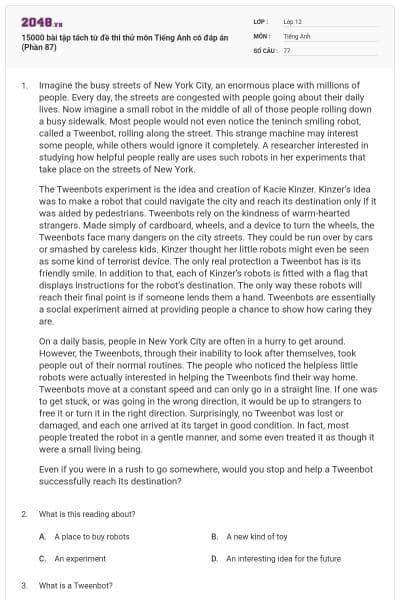
Imagine the busy streets of New York City, an enormous place with millions of people. Every day, the streets are congested with people going about their daily lives. Now imagine a small robot in the middle of all of those people rolling down a busy sidewalk. Most people would not even notice the teninch smiling robot, called a Tweenbot, rolling along the street. This strange machine may interest some people, while others would ignore it completely. A researcher interested in studying how helpful people really are uses such robots in her experiments that take place on the streets of New York.
The Tweenbots experiment is the idea and creation of Kacie Kinzer. Kinzer’s idea was to make a robot that could navigate the city and reach its destination only if it was aided by pedestrians. Tweenbots rely on the kindness of warm-hearted strangers. Made simply of cardboard, wheels, and a device to turn the wheels, the Tweenbots face many dangers on the city streets. They could be run over by cars or smashed by careless kids. Kinzer thought her little robots might even be seen as some kind of terrorist device. The only real protection a Tweenbot has is its friendly smile. In addition to that, each of Kinzer’s robots is fitted with a flag that displays instructions for the robot’s destination. The only way these robots will reach their final point is if someone lends them a hand. Tweenbots are essentially a social experiment aimed at providing people a chance to show how caring they are.
On a daily basis, people in New York City are often in a hurry to get around. However, the Tweenbots, through their inability to look after themselves, took people out of their normal routines. The people who noticed the helpless little robots were actually interested in helping the Tweenbots find their way home. Tweenbots move at a constant speed and can only go in a straight line. If one was to get stuck, or was going in the wrong direction, it would be up to strangers to free it or turn it in the right direction. Surprisingly, no Tweenbot was lost or damaged, and each one arrived at its target in good condition. In fact, most people treated the robot in a gentle manner, and some even treated it as though it were a small living being.
Even if you were in a rush to go somewhere, would you stop and help a Tweenbot successfully reach its destination?
What is this reading about?
A place to buy robots
A new kind of toy
An experiment
An interesting idea for the future
Đáp án
Bài đọc nói về cái gì?
A. Một nơi để mua ngưới máy B. Một loại đồ chơi mới
C. Một thí nghiệm D. Một ý tưởng thú vị cho tương lai
Dẫn chứng: The Tweenbots experiment is the idea and creation of Kacie Kinzer. Kinzer’s idea was to make a robot that could navigate the city and reach its destination only if it was aided by pedestrians.
What is a Tweenbot?
A person from New York City
A ten-inch smiling robot
A pedestrian
A terrorist device
Đáp án B
Tweenbot là gì?
A. Một người đến từ thành phố New York. B. Một người máy biết cười cao 10 inch.
C. Một người đi bộ. D. Một thiết bị khủng bố.
Dẫn chứng: Most people would not even notice the ten-inch smiling robot, called a Tweenbot, rolling along the street.
The word "congested" in paragraph 1 is closest in meaning to ________________.
flocked
secluded
stuffed
crowded
Đáp án D
Từ “ congetsed” [ đông đúc] ở đoạn 1 gần nghĩa nhất với
A. đô xô đến/ ồ ạt => flock to somewhere B. hẻo lánh
C. no căng/ được nhồi nhét D. đông đúc
Dẫn chứng: Imagine the busy streets of New York City, an enormous place with millions of people. Every day, the streets are congested with people going about their daily lives.
How did a Tweenbot get to its final destination?
With the help of other Tweenbots
With the help of kind pedestrians on the street
With the help of Kacie Kinzer
With the help of other robots in New York City
Đáp án B
Làm thế nào để một con Tweenbot đến được đích đến cuối cùng của nó?
A.Với sự giúp đỡ của những Tweenbot khác.
B. Với sự giúp đỡ của những người đi bộ tốt bụng trên đường.
C. Với sự giúp đỡ của Kace Kinzer
D. Với sự giúp đỡ của những ngưới máy khác ở thành phố New York.
Dẫn chứng: Kinzer’s idea was to make a robot that could navigate the city and reach its destination only if it was aided by pedestrians.
The word "is fitted with" in paragraph 2 is closest in meaning to ________________.
is armed with
is embedded with
is supplied with
is assembled with
Đáp án D
Từ “ is fitted with” [được lắp ráp với] ở đoạn 2 gần nghĩa nhất với
A. được trang bị đầy đủ vũ khí B. được gắn dính với cái gì đó
C. được cung cấp với D. được lắp ráp/ trang bị
Dẫn chứng: In addition to that, each of Kinzer’s robots is fitted with a flag that displays instructions for the robot’s destination.
Which of the following statements is NOT correct?
Most Tweenbots arrived at their destination damaged or broken.
Most people treated the Tweenbots in a gentle manner.
Tweenbots could not navigate the city on their own.
Tweenbots move at a constant speed and can only go in a straight line.
Đáp án A
Câu nào sau đây không đúng?
A. Hầu hết những Tweenbots đến đích đến bị hư hỏng hoặc gãy vỡ.
B. Hầu hết mọi người đối xứ với Tweenbots rất tốt.
C. Tweenbots không thể tự định vị thành phố
D. Tweenbots di chuyển với tốc độ không đổi và chỉ có thể đi thẳng.
Dẫn chứng: Surprisingly, no Tweenbot was lost or damaged, and each one arrived at its target in good condition.
What can be inferred about the Tweenbot?
They were useful for research.
They were ignored by most people.
They were helpful for pedestrians.
They did not work as planned.
Đáp án A
Có thể suy ra gì về Tweenbot?
A. Chúng rất có ích cho nghiên cứu. B. Chúng bị hầu hết mọi người phớt lờ.
C. Chúng có ích đối với người đi đường. D. Chúng không làm việc theo kế hoạch.
By the mid-nineteenth century, the term "icebox" had entered the American language, but ice was still only beginning to affect the diet of ordinary citizens in the United States. The ice trade grew with the growth of cities. Ice was used in hotels, taverns, and hospitals, and by some forward-looking city dealers in fresh meat, fresh fish, and butter. After the Civil War (1860-1865), as ice was used to refrigerate freight cars, it also came into household use. Even before 1880, half the ice sold in New York, Philadelphia, and Baltimore, and one-third of that sold in Boston and Chicago, went to families for their own use. This had become possible because a new household convenience, the icebox, a precursor of the modern refrigerator, had been invented.
Making an efficient icebox was not as easy as we might now suppose. In the early nineteenth century, the knowledge of the physics of heat, which was essential to a science of refrigeration, was rudimentary. The common-sense notion that the best icebox was one that prevented the ice from melting was of course mistaken, for it was the melting of the ice that performed the cooling. Nevertheless, early efforts to economize ice included wrapping the ice in blankets, which kept the ice from doing its job. Not until near the end of the nineteenth century did inventors achieve the nice balance of insulation and circulation needed for an efficient icebox.
But as early as 1803, an ingenious Maryland farmer, Thomas Moore, had been on the right track. He owned a farm about twenty miles outside the city of Washington, for which the village of Georgetown was the market center. When he used an icebox of his own design to transport his butter to market, he found that customers would pass up the rapidly melting stuff in the tubs of his competitors to pay a premium price for his butter, still fresh and hard in neat, one-pound bricks. One advantage of his icebox, Moore explained, was that farmers would no longer have to travel to market at night in order to keep their produce cool.
What does the passage mainly discuss?
The influence of ice on the diet
The development of refrigeration
The transportation of goods to market
Sources of ice in the nineteenth century
Đáp án B
Bài đọc chủ yếu thảo luận về cái gì?
A.Ảnh hưởng của đá lạnh đến chế độ ăn uống. B. Sự phát triển của tủ lạnh.
C.Vận chuyển thức ăn đến chợ D. Các nguồn đá lạnh ở thế kỷ 19.
According to the passage, when did the word "icebox" become part of the language of the United States?
In 1803
Sometime before 1850
During the Civil War
1950s
Đáp án B
Theo bài đọc, từ “icebox” trở thành một phần ngôn ngữ của nước Mỹ khi nào?
A. năm 1803 B. khoảng trước năm 1850
C. Suốt thời nội chiến D. những năm 1950
Dẫn chứng: By the mid-nineteenth century, the term "icebox" had entered the American language, butice was still only beginning to affect the diet of ordinary citizens in the United States.
After the Civil War (1860-1865), as ice was used to refrigerate freight cars, it also came into household use. Even before 1880, half the ice sold in New York, Philadelphia, and Baltimore, and one-third of that sold in Boston and Chicago, went to families for their own use.
The author mentions “fish” in the first paragraph because __________________.
many fish dealers also sold ice.
fish was shipped in refrigerated freight cars.
fish dealers were among the early commercial users of ice.
fish was not part of the ordinary person's diet before the invention of the icebox.
Đáp án C
Tác giả đề cập đến “ fish” ở đoạn đầu bởi vì
A. nhiều người bán cá cũng bán đá lạnh
B. cá được vận chuyển trong xe chở hàng đông lạnh
C. những người bán cá là trong số những người sử dụng đá lạnh vì mục đích buôn bán đầu tiên.
D. cá không phải là một phần của chế độ ăn uống bình thường hằng ngày trước khi thùng đông lạnh được phát minh.
Dẫn chứng: The ice trade grew with the growth of cities. Ice was used in hotels, taverns, and hospitals, and by some forward-looking city dealers in fresh meat, fresh fish, and butter.
According to the passage, which of the following was an obstacle to the development of the icebox?
Competition among the owners of refrigerated freight cars
The lack of a network for the distribution of ice
The use of insufficient insulation
Inadequate understanding of physics
Đáp án D
Theo bài đọc, cái nào sau đây là bất lợi đối với sự phát triển của thùng đông lạnh?
A. Sự cạnh tranh giữa những người sở hữu xe vận tải đông lạnh.
B. Sự thiếu mạng lưới việc làm để phân phối đá
C. Việc sử dụng sự cách li không đủ
D. Hiểu biết chưa đầy đủ về vật lý Dẫn chứng: In the early nineteenth century, the knowledge of the physics of heat, which was essential to a science of refrigeration, was rudimentary.
The word "rudimentary" in paragraph 2 is closest in meaning to _______________.
undeveloped
growing
necessary
uninteresting
Đáp án A
Từ “ rudimentary” [ thô sơ] ở đoạn 2 gần nghĩa nhất với
A. kém phát triển B. đang phát triển
C. cần thiết D. không thú vị
Dẫn chứng: In the early nineteenth century, the knowledge of the physics of heat, which was essential to a science of refrigeration, was rudimentary.
The author describes Thomas Moore as having been "on the right track" to indicate that ______________.
the road to the market passed close to Moore's farm
Moore was an honest merchant
Moore was a prosperous farmer
Moore's design was fairly successful
Đáp án D
Tác giả miêu tả Thomas Moore như là đã “ on the right track” [ đi đúng hướng] để ám chỉ rằng
A. con đường đến chợ băng qua gần với nông trại của Moore
B. Moore là một thương gia thật thà
C. Moore là một nông dân phát đạt
D. Thiết kế của Moore khá là thành công
Dẫn chứng: But as early as 1803, an ingenious Maryland farmer, Thomas Moore, had been on the right track. He owned a farm about twenty miles outside the city of Washington, for which the village of Georgetown was the market center.
According to the passage, Moore's icebox allowed him to _______________.
charge more for his butter
travel to market at night
manufacture butter more quickly
produce ice all year round
Đáp án A
Theo bài đọc, thùng ướp lạnh của Moore cho phép ông
A. thu phí nhiều hơn cho món bơ B. đi chợ về đêm
C. sản xuất bơ nhanh hơn D. sản xuất đá cả năm
Dẫn chứng: When he used an icebox of his own design to transport his butter to market, he found that customers would pass up the rapidly melting stuff in the tubs of his competitors to pay a premium price for his butter, still fresh and hard in neat, one-pound bricks.
The "produce" mentioned in the last paragraph could include ________________.
iceboxes
butter
ice
markets
Đáp án C
Từ “ produce” (n) [ nông sản] được đề cập ở đoạn cuối có thể bao gồm
A.thùng đá B. bơ
C. đá lạnh D. chợ
Dẫn chứng: One advantage of his icebox, Moore explained, was that farmers would no longer have to travel to market at night in order to keep their produce cool.
It isn’t difficult to imagine how increases in international commerce and in the movement of people—two defining features of globalization—might influence health. More goods go more places today than at any (261)___________ in history. More people travel farther, more frequently, and come in contact with more people and goods, than at any point in history.
This increased movement of both goods and people increases opportunities for the spread of disease around the world. And it’s not just goods and services that can travel across oceans and state borders—so can diseases like AIDS, malaria, or tuberculosis. The (262)___________ of BSE, or ―mad cow disease,‖ in several European countries is only one example of (263)___________trade can promote the spread of dangerous diseases. Mosquitoes that carry malaria have been found aboard planes thousands of miles from their primary habitats, and (264)___________ seafood carrying cholera bacteria have been shipped from Latin America to the United States and Europe.
But just as globalization increases the frequency and ease (265)___________ which diseases can move around the world, it also can improve access to the medicines, medical information, and training that can help treat or cure these diseases.
spot
end
point
position
Đáp án C
Cụm từ: at any point
[ tại bất cứ thời điểm nào]
It isn’t difficult to imagine how increases in international commerce and in the movement of people—two defining features of globalization—might influence health. More goods go more places today than at any (31)___________ in history. More people travel farther, more frequently, and come in contact with more people and goods, than at any point in history. [Không khó để tưởng sự tăng trưởng thương mại quốc tế và sự biến động của con người – hai đặc trưng xác định của toàn cầu hóa – có thể ảnh hưởng đến sức khỏe. Ngày nay ngày càng nhiều hàng hóa đến nhiều nơi hơn bất cứ thời điểm nào trong lịch sử.]
outbreak
disruption
corruption
suspension
Đáp án A
outbreak: sự bùng nổ corruption: sự tham nhũng
disruption: sự gián đoạn suspension: sự đình chỉ
This increased movement of both goods and people increases opportunities for the spread of disease around the world. And it’s not just goods and services that can travel across oceans and state borders—so can diseases like AIDS, malaria, or tuberculosis. The (32)___________ of BSE, or ―mad cow disease,‖ [Sự biến đổi ngày càng tăng này về cả hàng hóa và con người làm tăng cơ hội cho sự lây lan của các căn bệnh trên khắp thế giới. Và nó không chỉ là các hàng hóa và dịch vụ cái mà có thể đi từ đại dương và liên bang – vì vậy các căn bệnh như AIDS, bệnh sốt rét hay bệnh lao. Sự bùng phát của bệnh BSE hay “bệnh bò điên”
what
how
which
when
Đáp án B
what: cái gì which: cái mà
how: như thế nào when: khi mà
in several European countries is only one example of (33)___________trade can promote the spread of dangerous diseases
[ Ở một số nước châu Âu chỉ là một ví dụ của thương mại có thể thúc đẩy sự tràn lan của các căn bệnh nguy hiểm như thế nào.]
Mosquitoes that carry malaria have been found aboard planes thousands of miles from their primary habitats, and (264)___________ seafood carrying cholera bacteria have been shipped from Latin America to the United States and Europe.
diseased
treated
infectious
infected
Đáp án D
diseased: bị mắc bệnh infectious: có khả năng lây lan.
treated: đã được xử lý infected: đã bị nhiễm bệnh
Mosquitoes that carry malaria have been found aboard planes thousands of miles from their primary habitats, and (34)___________ seafood carrying cholera bacteria have been shipped from Latin America to the United States and Europe.
[Muỗi cái mà mang bệnh sốt rét đã được tìm thấy trên những chiếc máy bay nước ngoài cách môi trường sống chính của chúng, và hải sản đã nhiễm bệnh cái mà mang vi khuẩn dịch tả được vận chuyển từ Mỹ La tinh đến Mỹ và châu Âu.]
But just as globalization increases the frequency and ease (265)___________ which diseases can move around the world, it also can improve access to the medicines, medical information, and training that can help treat or cure these diseases.
with
for
from
by
Đáp án A
Cụm từ: with ease = easily [ một cách dễ dàng]
But just as globalization increases the frequency and ease (35)___________ which diseases can move around the world, it also can improve access to the medicines, medical information, and training that can help treat or cure these diseases.
[ Khi mà sự toàn cầu hóa làm tăng tần suất và những căn bệnh có thể đi khắp thế giới một cách dễ dàng, nó cũng có thể cải thiện khả năng tiếp cận với thuốc, thông tin y dược, và tập huấn cái mà có thể giúp chữa trị những căn bệnh này.]
Leisure activity isn’t just for fun, says a University of Florida psychologist who has developed a scale that classifies hobbies and avocations based on needs they satisfy in people. The scale can help people find more personal fulfillment by giving them insight into what they really like and by helping them to find substitutes when they can’t pursue their favorite activities.
“The surprising thing is that activities you might think are very different have similar effects on people” said Howard E.A. Tinsley, a UF psychology professor who developed the measurement. ―Probably no one would consider acting to have the same characteristics as roller-skating or playing baseball, but men and women who act as a hobby report feeling an intense sense of belonging to a group, much the same way others do in playing sports.
And activities providing the strongest sense of competition are not sports, but card, arcade and computer games, he found.
Tinsley, whose research on leisure has been published in several journals, is scheduled this spring to present some of the findings in Milwaukee at a conference of the Society for Vocational Psychology.
Based on surveys with more than 3,000 people about the satisfactions they get from various hobbies, Tinsley obtained numerical scores for values such as “challenge” and “hedonism”, and grouped some 82 leisure activities into 11 categories. For example, dining out and watching movies fall into the “sensual enjoyment” category, playing soccer and attending sports clubs meetings satisfy participants’ desires for a sense of “belongingness” and coin collecting and baking fulfill their need for “creativity”.
“With so many people in jobs they don’t care for, leisure is a prized aspect of people’s lives,” Tinsley said. “Yet it’s not something psychologists really study. Economists tell us how much money people spend skiing, but nobody explains what it is about skiing that is really appealing to people or how one activity relates to another, perhaps in unexpected ways.”
“Fishing, generally considered more of an outdoor or recreational activity, for example, is a form of self-expression like quilting or stamp collecting, because it gives people the opportunity to express themselves by doing something completely different from their daily routine,”he said.
The word "substitutes" in paragraph 1 is closest in meaning to ________________.
delight
revenge
replacement
attraction
Đáp án C
Từ “substitutes” (sự thay thế) ở đoạn 1 gần nghĩa nhất với
A. sự hài lòng C. sự thay thế
B. sự trả thù D. sự thu hút
Which of the following is NOT true?
Both acting and roller-skating give people a feeling of being a part of a team.
Collecting things satisfied people’s desire for making things.
Fishing allows you to show the type of person you are.
Researchers already know why a hobby attracts a person.
Đáp án D
Câu nào sau đây không đúng?
A. Cả diễn xuất và trượt ba – tanh đều cho con người cảm giác là thành viên của một nhóm B. Sưu tầm các vật dụng làm con người thõa mãn khát vọng làm ra các vật dụng
C. Câu cá cho phép bản thể hiện bản chất con người bạn.
D. Các nhà nghiên cứu đã biết tại 1 sở thích lại thu hút một người.
Dẫn chứng: “but nobody explains what it is about skiing that is really appealing to people or how one activity relates to another, perhaps in unexpected ways.”
Which of the following is not mentioned as a category in Tinsley’s scale?
hedonism
belongingness
initiative
sensual enjoyment
Đáp án C
Cái nào sau đây không được đề cập như là một loại thuộc thang đánh giá Tinsley’s?
A. chủ nghĩa khoái lạc C. sự chủ động/ sáng kiến
B. cảm giác thuộc về D. sự thích thú về mặt giác quan
Dẫn chứng: Based on surveys with more than 3,000 people about the satisfactions they get from various hobbies, Tinsley obtained numerical scores for values such as “challenge” and “hedonism”, and grouped some 82 leisure activities into 11 categories. For example, dining out and watching movies fall into the “sensual enjoyment” category, playing soccer and attending sports clubs meetings satisfy participants’ desires for a sense of “belongingness” and coin collecting and baking fulfill their need for “creativity.”
Taking part in sports gives you _________________.
the strongest desire to win
a need for creativity
the chance to express your feelings
a sense of being part of a team
Đáp án D
Tham gia vào các môn thể thao cho bạn
A. khao khát mạnh mẽ để chiến thắng C. cơ hội thể hiện cảm xúc
B. sự cần sáng tạo D. cảm giác là một phần của một đội
Dẫn chứng: playing soccer and attending sports clubs meetings satisfy participants’ desires for a sense of “belongingness:
The word "it" in the last paragraph refers to ________________.
fishing
activity
self-expression
stamp collecting
Đáp án A
Từ “it” ở đoạn cuối ám chỉ đến
A. việc câu cá C.tự trình bày cảm xúc
B. hoạt động D. sưu tầm tem
Dẫn chứng: “Fishing, generally considered more of an outdoor or recreational activity, for example, is a form of self-expression like quilting or stamp collecting, because it gives people the opportunity to express themselves by doing something completely different from their daily routine,” he said.
Which sentence best summarizes the passage?
Leisure activity and sport are totally different.
A person’s personality is expressed via his hobbies.
Leisure activities satisfy people’s particular desires.
Sports affect a person’s personality.
Đáp án C
Câu nào tóm tắt bài đọc này hay nhất?
A. Hoạt động thư giãn và thể thao hoàn toàn khác nhau.
B. Tính cách của một người được bộc lộ thông qua sở thích của người đó.
C. Các hoạt động thư giãn thỏa mãn những khát khao cụ thể của con người.
D. Các môn thể thao ảnh hưởng đến tính cách của con người.
The findings in the passage by Howard E.A.Tinsley are somewhat __________
funny
surprising
predictable
useless
Đáp án B
Những phát hiện trong bài đọc của Howard E Tinsley thì khá là
A.buồn cười/ hài hước C. có thể đoán trước được
B. bất ngờ / không ngờ đến D. vô dụng
Dẫn chứng: but nobody explains what it is about skiing that is really appealing to people or how one activity relates to another, perhaps in unexpected ways.”
Archaeological records - paintings, drawings and carvings of humans engaged in activities involving the use of hands - indicate that humans have been predominantly right-handed for more than 5,000 years. In ancient Egyptian artwork, for example, the right hand is depicted as the dominant one in about 90 percent of the examples. Fracture or wear patterns on tools also indicate that a majority of ancient people were right-handed. Cro-Magnon cave paintings some 27,000 years old commonly show outlines of human hands made by placing one hand against the cave wall and applying paint with the other. Children today make similar outlines of their hands with crayons on paper. With few exceptions, left hands of CroMagnons are displayed on cave walls, indicating that the paintings were usually done by right-handers.
Anthropological evidence pushes the record of handedness in early human ancestors back to at least 1.4 million years ago. One important line of evidence comes from flaking patterns of stone cores used in tool making: implements flaked with a clockwise motion (indicating a right-handed toolmaker) can be distinguished from those flaked with a counter-clockwise rotation (indicating a left-handed toolmaker).
Even scratches found on fossil human teeth offer clues. Ancient humans are thought to have cut meat into strips by holding it between their teeth and slicing it with stone knives, as do the present-day Inuit. Occasionally the knives slip and leave scratches on the users' teeth. Scratches made with a left-to-right stroke direction (by right-handers) are more common than scratches in the opposite direction (made by lefthanders).
Still other evidence comes from cranial morphology: scientists think that physical differences between the right and left sides of the interior of the skull indicate subtle physical differences between the two sides of the brain. The variation between the hemispheres corresponds to which side of the body is used to perform specific activities. Such studies, as well as studies of tool use, indicate that right- or leftsided dominance is not exclusive to modern Homo sapiens. Population of Neanderthals, such as Homo erectus and Homo Habilis, seem to have been predominantly right-handed, as we are.
What is the main idea of the passage?
Human ancestors became predominantly right-handed when they began to use tools.
It is difficult to interpret the significance of anthropological evidence concerning tool use.
Humans and their ancestors have been predominantly right-handed for over a million years.
Human ancestors were more skilled at using both hands than modern humans.
Đáp án C
Nội dung chính của bài đọc là?
A.Tổ tiên của con người trở nên thống trị về số lượng thuận tay phải khi họ bắt đầu sử dụng công cụ.
B. Khó để phiên dịch tầm quan trọng của các chứng cứ nhân chủng học liên quan đến việc sử dụng công cụ.
C. Con người và tổ tiên của họ vượt trội về số người thuận tay phải hơn 1 triệu năm qua.
D. Tổ tiên của con người khéo léo hơn về sử dụng công cụ bằng hai tay so với con người hiện đại.
Dẫn chứng: Anthropological evidence pushes the record of handedness in early human ancestors back to at least 1.4 million years ago.
The word "other" in the first paragraph refers to ______________.
outline
hand
wall
paint
Đáp án B
Từ “other” ở đoạn 1 ám chỉ đến
A. dàn ý/ bố cục C. bức tường
B. tay D. sơn
Dẫn chứng: Cro-Magnon cave paintings some 27,000 years old commonly show outlines of human hands made by placing one hand against the cave wall and applying paint with the other.
What does the author say about Cro-Magnon paintings of hands?
Some are not very old.
It is unusual to see such paintings.
Many were made by children.
The artists were mostly right-handed
Đáp án D
Tác giả nói gì về những bức tranh vẽ bằng tay của Cro Mangon?
A. Một số không cũ lắm.
B. Thật bất thường khi nhìn thấy những bức tranh như vậy.
C. Nhiều bức tranh do trẻ con vẽ.
D. Các nghệ sĩ hầu hết thuận tay phải.
Dẫn chứng: With few exceptions, left hands of Cro-Magnons are displayed on cave walls, indicating that the paintings were usually done by right-handers.
When compared with implements "flaked with a counter-clockwise rotation”, it can be inferred that "implements flaked with a clock-wise motion" are ______________.
more common
larger
more sophisticated
older
Đáp án A
Khi được so sánh với những dụng cụ được gọt đẽo theo chiều ngược kim đồng hồ”, có thể suy ra rằng “các vật dụng được gọt đẽo theo chiều kim đồng hồ” thì
A. phổ biến hơn C. phức tạp hơn
B. lớn hơn D. cũ hơn
Dẫn chứng: implements flaked with a clockwise motion (indicating a right-handed toolmaker) can be distinguished from those flaked with a counter-clockwise rotation (indicating a left-handed toolmaker).
The fact that the Inuit cut meat by holding it between their teeth is significant because _____________.
the relationship between handedness and scratches on fossil human teeth can be verified
it emphasizes the differences between contemporary humans and their ancestors
the scratch patterns produced by stone knives vary significantly from patterns produced by modern knives
it demonstrates that ancient humans were not skilled at using tools
Đáp án A
Chi tiết rằng người Inuit cắt thịt bằng cách giữ nó giữa răng rất có ý nghĩa bởi vì
A.mối quan hệ giữa việc thuận tay phải và những vết xướt trên răng của người hóa thạch có thể được xác nhận.
B. nó nhấn mạnh sự khác nhau giữa con người hiện đại và tổ tiên của họ.
C. những vết xướt được gây ra do dao được làm bằng đá khác đáng kể so với những vết do dao hiện đại gây ra.
D. nó minh họa rằng người cổ đại không giỏi sử dụng công cụ.
Dẫn chứng: Even scratches found on fossil human teeth offer clues. Ancient humans are thought to have cut meat into strips by holding it between their teeth and slicing it with stone knives, as do the present-day Inuit. Occasionally the knives slip and leave scratches on the users' teeth. Scratches made with a left-to-right stroke direction (by right-handers) are more common than scratches in the opposite direction (made by lefthanders).
Why does the author mention Homo erectus and Home Habilis in the last
paragraph?
To contrast them with modern humans
To explain when human ancestors began to make tools
To show that early humans were also predominantly right handed
To prove that the population of Neanderthals was very large
Đáp án C
Tại sao tác giả đề cập đến người nguyên thủy đi bằng 2 chân và người nguyên thủy biết sử dụng công cụ ở đoạn cuối?
A. để chỉ ra sự tương phản giữa họ với con người hiện đại.
B. để giải thích tại sao tổ tiên của con người bắt đầu tạo ra công cụ
C. để cho thấy rằng con người từ đầu cũng đã phần lớn thuận tay phải.
D. để chứng minh rắng dân số của Neaderthala rất lớn.
All of the follows are mentioned as types of evidence concerning handedness EXCEPT ____________.
ancient artwork
asymmetrical skulls
studies of tool use
fossilized hand bones
Đáp án D
Tất cả những ý nào sau đây được đề cập như là bằng chứng liên quan đến việc thuận tay phải ngoại trừ?
A. tác phẩm cổ xưa C. nghiên cứu vầ sử dụng dụng cụ
B. hộp sọ không cân xứng D. xương tay bị hóa thạch
Dẫn chứng: Still other evidence comes from cranial morphology: scientists think that physical differences between the right and left sides of the interior of the skull
Which of the following conclusions is suggested by the evidence from cranial morphology?
Differences in the hemispheres of the brain probably came about relatively recently.
There may be a link between handedness and differences in the brain's hemispheres
Left-handedness was somewhat more common among Neanderthals
Variation between the brain hemispheres was not evident in the skulls of Home Erectus and Home Habilis.
Đáp án B
Kết luận nào sau đây được đề xuất bởi các bằng chứng từ hình thái sọ?
A. Sự khác nhau giữa bán cầu não có lẽ xảy ra khá là gần đây.
B. Có một sự liên kết giữa việc thuận tay phải và sự khác nhauở bán cầu não.
C. Thuận tay trái khá là phổ biến hơn ở Neanderthals.
D. Sự khác nhau giữa các bán cầu não thì không rõ ràng trong hộp sọ của người nguyên thủy đi bằng hai chân và người nguyên thủy biết sử dụng công cụ.
Dẫn chứng: The variation between the hemispheres corresponds to which side of the body is used to perform specific activities.
In a world where 2 billion people live in homes that don't have light bulbs, technology holds the key (281)______ banishing poverty. Even the simplest technologies can transform lives and save money. Vaccines, crops, computers and sources of solar energy can all reduce poverty in developing countries. For example, cheap oral-rehydration therapy developed in Bangladesh has dramatically cut the death (282)______ from childhood diarrhoea.
But even when such technologies exist, the depressing fact is that we can’t make them cheap enough for those who most need them. Solar panels, batteries and light bulbs are still beyond the purse of many, but where they have been installed they change lives. A decent light in the evening gives children more time for homework and extends the productive day for adults.
Kenya has a thriving solar industry and six years ago Kenyan pioneers also started connecting schools to the Internet via radio links. These people were fortunate in being able to afford solar panels, radios and old computers. How much bigger would the impact be if these things (283)______ and priced specifically for poor people?
Multinationals must become part of the solution, because (284)______ they own around 60 per cent of the world's technology, they seldom make products for poor customers. Of 1,223 new drugs marketed worldwide from 1975 to 1996, for example, just 13 were for tropical diseases.
People think those enterprises should do more to provide vital products such as medicines at different prices around the world to suit (285)______ people can afford. Alternatively, they could pay a percentage of their profit towards research and development for the poor.
(Adapted from “The Price is Wrong” in “Focus on IELTS Foundations” by Sue O’Connell, Pearson Longman, 2006)
to
at
with
for
Đáp án A
Cụm từ: key to + noun/ Ving ( chìa khóa để làm gì đó)
In a world where 2 billion people live in homes that don't have light bulbs, technology holds the key (31)______ banishing poverty. Even the simplest technologies can transform lives and save money. Vaccines, crops, computers and sources of solar energy can all reduce poverty in developing countries.
[ Trong thế giới nơi mà 2 tỉ người sống trong những ngôi nhà không có bóng đèn dây tóc, công nghệ nắm giữ chìa khóa để xóa bỏ nghèo đói.]
For example, cheap oral-rehydration therapy developed in Bangladesh has dramatically cut the death (282)______ from childhood diarrhoea.
amount
penalty
toll
number
Đáp án C
Cụm danh từ: death toll = the number of people ( số lượng người chết được thống kê)
For example, cheap oral-rehydration therapy developed in Bangladesh has dramatically cut the death (32)______ from childhood diarrhoea.
[ Ví dụ, liệu pháp uống nước ở Bangladesh đã giảm đáng kể số lượng người được thống kê chết vì bệnh tiêu chảy ở trẻ em.]
How much bigger would the impact be if these things (283)______ and priced specifically for poor people?
have been made
were made
are made
made
Đáp án B
Kiến thức: Câu điều kiện loại 2 + câu bị động
If + S + Ved/ V2, S + would Vo
How much bigger would the impact be if these things (33)______ and priced specifically for poor people?
[ Ảnh hưởng sẽ lớn hơn như thế nào nếu những thứ này được tạo ra và được định giá cụ thể cho những người nghèo?]
unless
however
when
while
Đáp án D
unless: nếu không however: tuy nhiên
when: khi while: trong khi
Multinationals must become part of the solution, because (34)______ they own around 60 per cent of the world's technology, they seldom make products for poor customers. Of 1,223 new drugs marketed worldwide from 1975 to 1996, for example, just 13 were for tropical diseases.
[ Các công ty đa quốc gia phải trở thành một phần của giải pháp này, bởi vì trong khi họ sở hữu 60% công nghệ của thế giới, họ lại hiếm khi tạo ra sản phẩm cho những người tiêu dùng nghèo. Trong 1223 thuốc được bán rộng rãi khắp thế giới từ năm 1975 đến 1996, ví dụ như, chỉ 13 dành cho các căn bệnh nhiệt đới.]
which
what
where
that
Đáp án B
What = the thing that
Không dùng được which và that vì trước nó phải có danh từ.
People think those enterprises should do more to provide vital products such as medicines at different prices around the world to suit (35)______ people can afford. Alternatively, they could pay a percentage of their profit towards research and development for the poor.
[ Mọi người nghĩ rằng những doanh nghiệp đó nên làm nhiều hơn để cung cấp những sản phẩm thiết yếu với những giá khác nhau trên khắp thế giới để phù hợp với cái mà mọi người có thể mua được.Mặt khác, họ có thể chi một phần lợi nhuận hướng đến những nghiên cứu và phát triển cho người nghèo.]
In 1826, a Frenchman named Niépce needed pictures for his business. He was not a good artist, so he invented a very simple camera. He put it in a window of his house and took a picture of his yard. That was the first photograph.
The next important date in the history of photography was 1837. That year, Daguerre, another Frenchman, took a picture of his studio. He used a new kind of camera and a different process. In his pictures, you could see everything clearly, even the smallest details. This kind of photograph was called a daguerreotype.
Soon, other people began to use Daguerre's process. Travelers brought back daguerreotypes from all around the world. People photographed famous buildings, cities, and mountains.
In about 1840, the process was improved. Then photographers could take pictures of people and moving things. The process was not simple and photographers had to carry lots of film and processing equipment. However, this did not stop photographers, especially in the United States. After 1840, daguerreotype artists were popular in most cities.
Matthew Brady was one well-known American photographer. He took many portraits of famous people. The portraits were unusual because they were lifelike and full of personality. Brady was also the first person to take pictures of a war. His 1862 Civil War pictures showed dead soldiers and ruined cities. They made the war seem more real and more terrible.
In the 1880s, new inventions began to change photography. Photographers could buy film readymade in rolls, instead of having to make the film themselves. Also, they did not have to process the film immediately. They could bring it back to their studios and develop it later. They did not have to carry lots of equipment. And finally, the invention of the small handheld camera made photography less expensive.
With a small camera, anyone could be a photographer. People began to use cameras just for fun. They took pictures of their families, friends, and favorite places. They called these pictures "snapshots".
Documentary photographs became popular in newspapers in the 1890s. Soon magazines and books also used them. These pictures showed true events and people. They were much more real than drawings.
Some people began to think of photography as a form of art. They thought that photography could do more than show the real world. It could also show ideas and feelings, like other art forms. From “Reading Power” by Beatrice S. Mikulecky and Linda Jeffries
Daguerre took a picture of his studio with ______.
a new kind of camera
a very simple camera
special equipment
an electronic camera
Đáp án A
Duguerre đã chụp ảnh phim trường của anh ấy với
A. một loại máy ảnh mới C. một thiết bị đặc biệt.
B. một chiếc máy ảnh rất đơn giản D. một chiếc máy ảnh điện tử
Dẫn chứng: That year, Daguerre, another Frenchman, took a picture of his studio. He used a new kind of camera and a different process.
The word “this” in the passage refers to ______.
carrying of lots of film and processing equipment
stopping of photographers from taking photos
fact that daguerreotype artists were popular in most cities
taking of pictures of people and moving things
Đáp án A
Từ “this” trong bài đọc ám chỉ đến
A. mang theo nhiều phim và xử lý thiết bị
B. dừng các nhiếp ảnh gia chụp ảnh
C. chi tiết rằng các nghệ sỹ dùng máy chụp ảnh của Daguerre phổ biến ở hầu hết các thành phố.
D. chụp ảnh của con người và những thứ đang chuyển động
Dẫn chứng: The process was not simple and photographers had to carry lots of film and processing equipment. However, this did not stop photographers, especially in the United States. After 1840, daguerreotype artists were popular in most cities.
The word “ruined” in the passage is closest in meaning to “______”.
poorly-painted
heavily-polluted
terribly spoiled
badly damaged
Đáp án D
Từ “ ruined” trong bài đọc gần nghĩa nhất với
A.vẽ xấu C. bị phá hủy kinh khủng
B. bị ô nhiễm nặng nề D. bị tàn phá nặng nề
Dẫn chứng: His 1862 Civil War pictures showed dead soldiers and ruined cities.
[ Những bức ảnh về cuộc nội chiến năm 1862 đã thể hiện những binh lính đã chết và các thành phố bị tàn phá nặng nề.]
The latest invention mentioned in the passage is the invention of ______.
handheld cameras
processing equipment
daguerreotypes
rolls of film
Đáp án A
Phát minh mới nhất được đề cập trong bài đọc là phát minh về
A. máy ảnh cầm tay C. máy ảnh Gaguerre
B. thiết bị xử lý D. cuộn phim
Dẫn chứng: And finally, the invention of the small handheld camera made photography less expensive.
The word “handheld” in the passage is closest in meaning to “______”.
handling manually
held by hand
controlling hands
operated by hand
Đáp án B
Từ “ handheld” trong bài đọc gần nghĩa nhất với
A. xử lý thủ công C. kiểm soát bằng tay B. cầm bằng tay
B. cầm bằng tay D. vận hành bằng tay
As mentioned in the passage, photography can ______.
print old pictures
convey ideas and feelings
show the underworld
replace drawings
Đáp án B
Như được đề cập trong bài đọc, ngành nhiếp ảnh có thể
A. in những bức ảnh cũ B. truyền đặt những ý tưởng và cảm xúc
C. thể hiện thế giới ngầm D. thay thế những bản vẽ
Dẫn chứng: They thought that photography could do more than show the real world. It could also show ideas and feelings, like other art forms.
Which of the following could best serve as the title of the passage?
Different Steps in Film Processing
Story of Photography
Photography and Painting
Story of Famous Photographers
Đáp án B
Đáp án nào là tiêu đề hay nhất cho bài đọc?
A. Những bước khác nhau trong quá trình xử lý phim
B. Lịch sử của ngành nhiếp ảnh
C. Nhiếp ảnh và vẽ
D. Lịch sử của các nhiếp ảnh gia nổi tiếng.
Architecture is the practice of building design and its resulting products; customary usage refers only to those designs and structures that are culturally significant. Architecture is to building as literature is to the printed word. Vitruvius, a 1st-century BC Roman, wrote encyclopedically about architecture, and the English poet Sir Henry Wotton was quoting him in his charmingly phrased dictum: “Well building hath three conditions: Commoditie, Firmenes, and Delight.” More prosaically, one would say today that architecture must satisfy its intended uses, must be technically sound, and must convey aesthetic meaning. But the best buildings are often so well constructed that they outlast their original use. They then survive not only as beautiful objects, but as documents of the history of cultures, achievements in architecture that testify to the nature of the society that produced them. These achievements are never wholly the work of individuals. Architecture is a social art.
Architectural form is inevitably influenced by the technologies applied, but building technology is conservative and knowledge about it is cumulative. Precast concrete, for instance, has not rendered brick obsolete. Although design and construction have become highly sophisticated and are often computer directed, this complex apparatus rests on preindustrial traditions inherited from millennia during which most structures were lived in by the people who erected them. The technical demands on building remain the elemental ones – to exclude enemies, to circumvent gravity, and to avoid discomforts caused by an excess of heat or cold or by the intrusion of rain, wind, or vermin. This is no trivial assignment even with the best modern technology.
The availability of suitable materials fostered the crafts to exploit them and influenced the shapes of buildings. Large areas of the world were once forested, and their inhabitants developed carpentry. Although it has become relatively scarce, timber remains an important building material.
Many kinds of stone lend themselves to building. Stone and marble were chosen for important monuments because they are incombustible and can be expected to endure. Stone is also a sculptural material; stone architecture was often integral with stone sculpture. The use of stone has declined, however, because a number of other materials are more amenable to industrial use and assembly.
Some regions lack both timber and stone; their peoples used the earth itself, tamping certain mixtures into walls or forming them into bricks to be dried in the sun. Later they baked these substances in kilns, producing a range of bricks and tiles with greater durability.
(Extracted from Microsoft® Encarta® 2009 Encyclopedia – DVD Version)
According to the passage, the term “architecture” is normally used to refer to the designs and structures that have ______.
religious significance
social importance
technical importance
cultural significance
Đáp án D
Theo bài đọc, thuật ngữ “ architecture” thường được sử dụng để ám chỉ đến những thiết và cấu trúc cái mà có
A. tầm quan trọng về tôn giáo C. tầm quan trọng về kỹ thuật
B. tầm quan trọng xã hội D. tầm quan trọng về văn hóa
Dẫn chứng: Architecture is the practice of building design and its resulting products; customary usage refers only to those designs and structures that are culturally significant.
Which of the following is NOT considered an essential characteristic of architecture according to the passage?
Strength
Utility
Economy
Beauty
Đáp án C
Yếu tố nào sau đây không được xem như là một đặc trưng quan trọng của kiến trúc theo bài đọc?
A. kiên cố C. kinh tế
B. có ích D. vẻ đẹp
Dẫn chứng: More prosaically, one would say today that architecture must satisfy its intended uses, must be technically sound, and must convey aesthetic meaning. But the best buildings are often so well constructed that they outlast their original use. They then survive not only as beautiful objects, but as documents of the history of cultures, achievements in architecture that testify to the nature of the society that produced them.
When well-constructed buildings exist longer than their original use, they serve as ______.
monuments to ancient time heroes
museums and exhibition galleries
witnesses to major ancient wars
witnesses to their historical times
Đáp án D
Khi các công trình được xây dựng tốt tồn tại lâu hơn mục đích sử dụng ban đầu của nó, chúng đóng vai trò như là
A.những công trình dành cho các anh hùng thời cổ đại
B. các viện bảo tàng và triển lãm
C. chứng nhân của các cuộc chiến tranh lớn thời cổ đại
D. chứng nhân của những thời kỳ lịch sử của chúng
Dẫn chứng: But the best buildings are often so well constructed that they outlast their original use. They then survive not only as beautiful objects, but as documents of the history of cultures, achievements in architecture that testify to the nature of the society that produced them.
The author uses the phrase “social art” in the first paragraph to emphasise that architecture is an ______.
art that belongs to a society
art that is very much socialised
achievement of many people
achievement of many sociologists
Đáp án C
Tác giả sử dụng cụm từ “ social art” ở đoạn 1 đoạn 1 để nhấn mạnh rằng kiến trúc là một
A. nghệ thuật thuộc về một xã hội C. thành tựu của nhiều người
B. nghệ thuật rất được xã hội hóa D. thành tựu của nhiều nhà xã hội học Dẫn chứng: These achievements are never wholly the work of individuals. Architecture is a social art.
According to the passage, knowledge about building technology ______.
is always influenced by a wide range of technological applications
has experienced complete changes for generations
is based on modern technologies rather than traditions
includes the experience gained from generation to generation
Đáp án D
Theo bài đọc, kiến thức về công nghệ xây dựng
A. luôn bị ảnh hưởng bởi nhiều ứng dụng công nghệ đa dạng.
B. đã trải nghiệm những sự thay đổi hoàn toàn qua các thế hệ
C. được dựa trên những công nghệ hiện đại thay vì truyền thống
D. bao gồm kinh nghiệm đạt được từ thế hệ này sang thế hệ khác.
Dẫn chứng: Architectural form is inevitably influenced by the technologies applied, but building technology is conservative and knowledge about it is cumulative.
The word “obsolete” in paragraph 2 mostly means ______.
out of date
out of place
out of order
out of hand
Đáp án A
Từ “obsolete” ở đoạn 2 gần nghĩa nhất với
A. lỗi thời C. hỏng/ không hoạt động
B. không phù hợp D. khó kiểm soát
According to the passage, stone and marble were used for buildings of historical importance because they ______.
make structures look more attractive
are inflammable and endurable
give warmth and comfort to their owners
are non-flammable and last long
Đáp án D
Theo bài đọc, đá và cẩm thạch được sử dụng cho các tòa nhà có tầm quan trọng về lịch sử bởi vì chúng
A.làm cho các cấu trúc trông hấp dẫn hơn C. tạo nên sự thoải mái và ấm áp cho chủ sở hữu B. dễ cháy và bền bỉ D. không dễ cháy và lâu bền
Dẫn chứng: Many kinds of stone lend themselves to building. Stone and marble were chosen for important monuments because they are incombustible and can be expected to endure.
According to the passage, today stone has been used less as a building material because ______.
there have been other more suitable materials for industrial use
stone architecture is essential to the number of stone sculptures
it has less influence on the shapes of buildings and sculptures
it has become relatively scarce and more difficult to exploit
Đáp án A
Theo bài đọc, ngày nay đã ít được sử dụng làm vật liệu xây dựng bởi vì
A. có nhiều vật liệu khác thích hợp hơn cho mục đích công nghiệp.
B. kiến trúc đá quan trọng đối với một số tượng đá.
C. nó có ít ảnh hưởng đến hình dáng của các công trình và tượng
D. nó trở nên gần như khan hiếm và khó khai thác.
Dẫn chứng: Stone is also a sculptural material; stone architecture was often integral with stone sculpture. The use of stone has declined, however, because a number of other materials are more amenable to industrial use and assembly.
In addition to the challenge to be excellent, American schools have been facing novel problems. They must (301)______ with an influx of immigrant children, many of whom speak little or no English. They must respond to demands that the curriculum reflect the various cultures of all children. Schools must make sure that students develop basic skills for the job market, and they must consider the needs of nontraditional students, such as teenage mothers.
Schools are (302)______ these problems in ways that reflect the diversity of the US educational system. They are hiring or training large numbers of teachers of English as a second language and, in some communities, setting up bilingual schools. They are opening up the traditional European-centered curriculum to embrace material from African, Asian, and other cultures.
Schools are also teaching cognitive skills to the (303)______ 40 percent of American students who do not go on to higher education. In the (304)______ of a recent report by the Commission on Achieving Necessary Skills, “A strong back, the willingness to work, and a high school diploma were once all that was necessary to (305)______ a start in America. They are no longer. A well- developed mind, a continued willingness to learn and the ability to put knowledge to work are the new keys to the future of our young people, the success of our business, and the economic well-being of the nation.”
(Extracted from InfoUSA – CD Version)
do
stay
fight
cope
Đáp án D
Cope with = deal with: giải quyết Do with: làm gì với
Fight with: cãi nhau với Stay with: ở lại với
They must (31)______ with an influx of immigrant children, many of whom speak little or no English.
[Họ phải giải quyết dòng trẻ nhập cư, nhiều trong số chúng nói rất ít hoặc không nói tiếng Anh.]
addressing
delivering
distributing
discharging
Đáp án A
Address: nhắm đến/ hướng đến Distribute: phân phát/ phân phối
Deliver: giao (hàng) Discharge: phóng điện/ ra viện/ thải ra Cụm từ: address problems ( giải quyết vấn đề)
Schools are (32)______ these problems in ways that reflect the diversity of the US educational system.
[ Các trường học đang giải quyết những vấn đề này bằng các cách phản ánh sự đa dạng của hệ thống giáo dục Mỹ.]
slightly
mostly
fairly
nearly
Đáp án D
Slightly: nhẹ Fairly: tương đối/ khá là
Mostly: hầu như Nearly: gần như
Schools are also teaching cognitive skills to the (33)______ 40 percent of American students who do not go on to higher education.
[Các trường học cũng dạy những kỹ năng nhận thức cho khoảng gần 40% học sinh Mỹ người mà không tiếp tục đến bậc giáo dục cao hơn.]
minds
directions
words
ways
Đáp án C
Mind: tinh thần Words: từ Ways: cách thức
Directions: phương hướng
Cụm từ: in the words of ( trích dẫn lại) In the (34)______ of a recent report by the Commission on Achieving Necessary Skills
[Trích dẫn theo báo cáo gần đây bởi Ủy ban về phát triển những kỹ năng cần thiết]
make
take
get
bring
Đáp án A
Make: tạo ra Get: nhận
Take: cầm lấy Bring: mang
Cụm từ: make a start ( khởi đầu)
“A strong back, the willingness to work, and a high school diploma were once all that was necessary to (35)______ a start in America.
[ Một sức khỏe tốt, tinh thần sẵn sàng làm việc và bằng cấp là tất cả những thứ cần thiết đối để khởi đầu ở Mỹ]
The ability to conduct electricity is one of the key properties of a metal. Other solid materials such as silicon can conduct electricity but only effectively at certain temperatures. Also, some substances such as salt (sodium chloride) can conduct when molten or when dissolved in water. The ability of metals to conduct electricity is due to how their atoms bond together. In order to bond together the metal atoms lose at least one of their outermost electrons. This leaves the metal atoms with a positive charge and they are now strictly ions. The lost electrons are free to move in what is known as a sea of electrons. Since the electrons are negatively charged they attract the ions and this is what keeps the structure together.
An electric current is a flow of charge and since the electrons in the sea of electrons are free to move they can be made to flow in one direction when a source of electrical energy such as a battery is connected to the metal. Hence we have an electric current flowing through the wire, and this is what makes metals such good conductors of electricity. The only other common solid conducting material that pencil users are likely to encounter is graphite (what the „lead’ of a pencil is made from). Graphite is a form of carbon and again the carbon atoms bond in such a way that there is a sea of electrons that can be made to flow as an electric current. Likewise, if we have an ionic substance like salt we can make the electrically charged ions flow to create a current but only when those ions are free to move, either when the substance is a liquid or dissolved in water. In its solid state an ionic substance like salt cannot conduct electricity as its charged ions cannot flow.
Electrical insulators are substances that cannot conduct electricity well either, because they contain no charged particles or any charged particles they might contain do not flow easily. Water itself is a poor conductor of electricity as it does not contain a significant amount of fully charged particles (the ends of a water molecule are partly charged but overall the molecule is neutral). However, most water we encounter does contain dissolved charged particles, so it will be more conductive than pure water. Many of the problems that occur when touching electrical devices with wet hands result from the ever-present salt that is left on our skin through perspiration and it dissolves in the water to make it more conductive.
By Helena Gillespie and Rob Gillespie. Science for Primary School Teachers. OUP
According to the passage, a metal can conduct electricity due to ______.
the way its atoms bond together
the absence of free electrons
its atoms with a positive charge
the loss of one electron in the core of its atoms
Đáp án A
Theo bài đọc, kim loại có thể dẫn điện là do
A. cách mà các phân tử kết hợp với nhau
B. sự thiếu các electron tự do
C. các nguyên tử của nó với cực dương
D. mất 1 electron trong nhân của nguyên tử
Dẫn chứng:The ability of metals to conduct electricity is due to how their atoms bond together.
The word “outermost” in paragraph 1 mostly means ______.
the heaviest
furthest from the inside
nearest to the inside
the lightest
Đáp án B
Từ “ outermost” ( lớp ngoài cùng) ở đoạn 1 gần như có nghĩa là
A.nặng nhất C. gần nhất so với bên trong
B. xa nhất từ bên trong D. nhẹ nhất
Dẫn chứng: In order to bond together the metal atoms lose at least one of their outermost electrons.
Salt in its solid state is not able to conduct electricity because ______.
its charged ions can flow easily
it cannot create any charged ions
it has free electrons
its charged ions are not free to move
Đáp án D
Muối ở thể rắn không thể dẫn điện bởi vì
A.các ion mang điện của nó có thể chảy dễ dàng
B. nó không thể tạo ra ion mang điện
C. nó có các electron tự do
D. các ion mang điện của nó không tự do di chuyển
Dẫn chứng: In its solid state an ionic substance like salt cannot conduct electricity as its charged ions cannot flow.
Water is a poor conductor because it contains ______.
only a positive electric charge
only a small amount of fully charged particles
only a negative electric charge
no positive or negative electric charge
Đáp án B
Nước là chất dẫn điện kém bởi vì nó chứa
A.chỉ có điện tích dương
B. chỉ một lượng nhỏ các phân tử mang đầy điện
C. chỉ mang điện tích âm
D. không có điện tích âm hay điện tích dương
Dẫn chứng:Water itself is a poor conductor of electricity as it does not contain a significant amount of fully charged particles (the ends of a water molecule are partly charged but overall the molecule is neutral).
We can have problems when touching electrical devices with wet hands because ______.
the water itself is a good conductor of electricity
the water contains too many neutral molecules
the water containing no charged particles makes it more conductive
the water dissolves the salt on our skin and becomes more conductive
Đáp án D
Chúng ta có thể gặp vấn đề khi chạm vào các dụng cụ điện với tay ướt bởi vì
A.bản thân nước là chất dẫn điện tốt
B. nước chứa quá nhiều các phân tử trung hòa
C. nước không chứa những phân tử mang điện làm cho nó dẫn điện tốt hơn.
D. nước hòa tan muối trên da chúng ta và trở nên có tính dẫn điện hơn.
Dẫn chứng: Many of the problems that occur when touching electrical devices with wet hands result from the ever-present salt that is left on our skin through perspiration and it dissolves in the water to make it more conductive.
Which of the following is NOT true according to the passage?
Graphite is a common solid substance that can conduct electricity.
Salt can conduct electricity when it is molten or dissolved.
Pure water is much more conductive than most water we encounter every day.
Some materials are more conductive than others.
Đáp án C
Câu nào không đúng theo như bài đọc?
A.Than chì là chất rắn phổ biến có thể dẫn điện.
B. Muối có thể dẫn điện khi nó nóng chảy hoặc hòa tan
C. Nước tinh khiết dẫn điện tốt hơn hầu hết nước mà chúng ta gặp phải mỗi ngày.
D. Một số chất dẫn điện tốt hơn những chất khác.
Dẫn chứng: Water itself is a poor conductor of electricity as it does not contain a significant amount of fully charged particles (the ends of a water molecule are partly charged but overall the molecule is neutral).
Which of the following could best serve as the title of the passage?
Electrical Insulators
Electrical Energy
Electrical Conductivity
Electrical Devices
Đáp án C
Tiêu đề hay nhất cho bài đọc là?
A. Các chất cách điện
B. Năng lượng điện
C. Chất dẫn điện
D. Các thiết bị điện
Bạn có thích hoạt động này không?