15000 bài tập tách từ đề thi thử môn Tiếng Anh có đáp án (Phần 82)
75 câu hỏi
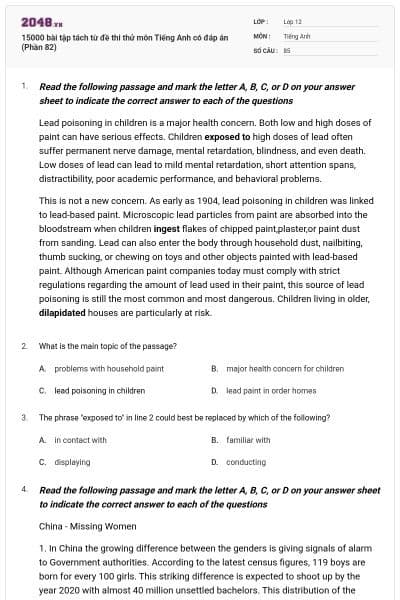
Read the following passage and mark the letter A, B, C, or D on your answer sheet to indicate the correct answer to each of the questions
Lead poisoning in children is a major health concern. Both low and high doses of paint can have serious effects. Children exposed to high doses of lead often suffer permanent nerve damage, mental retardation, blindness, and even death. Low doses of lead can lead to mild mental retardation, short attention spans, distractibility, poor academic performance, and behavioral problems.
This is not a new concern. As early as 1904, lead poisoning in children was linked to lead-based paint. Microscopic lead particles from paint are absorbed into the bloodstream when children ingest flakes of chipped paint,plaster,or paint dust from sanding. Lead can also enter the body through household dust, nailbiting, thumb sucking, or chewing on toys and other objects painted with lead-based paint. Although American paint companies today must comply with strict regulations regarding the amount of lead used in their paint, this source of lead poisoning is still the most common and most dangerous. Children living in older, dilapidated houses are particularly at risk.
What is the main topic of the passage?
problems with household paint
major health concern for children
lead poisoning in children
lead paint in order homes
Đáp án C
Kiến thức: Đọc hiểu
Giải thích:
Chủ đề chính của đoạn văn là gì?
A. các vấn đề với sơn trong gia đình
B. mối quan tâm sức khỏe nghiêm trọng đối với trẻ em
C. ngộ độc chì ở trẻ em
D. sơn có chì trong nhà
Thông tin: Lead poisoning in children is a major health concern.
The phrase "exposed to" in line 2 could best be replaced by which of the following?
in contact with
familiar with
displaying
conducting
Đáp án A
Kiến thức: Đọc hiểu
Giải thích:
Cụm từ "exposed to" ở dòng 2 có thể được thay thế bằng?
A. tiếp xúc với B. quen với
C. hiển thị D. tiến hành
"exposed to" = in contact with: tiếp xúc với
Children exposed to high doses of lead often suffer permanent nerve damage, mental retardation, blindness, and even death.
Trẻ tiếp xúc với chì ở liều lượng cao thường bị tổn thương lâu dài về thần kinh, thiểu năng trí tuệ, mù mắt, thậm chí mất mạng.
Which of the following does the passage infer?
Paint companies can no longer use lead in their paint.
Paint companies must limit the amount of lead used in their paint.
Paint companies aren't required to limit the amount of lead used in their paint.
Paint companies have always followed restrictions regarding the amount of lead used in their paint.
Đáp án B
Kiến thức: Đọc hiểu
Giải thích:
Câu nào suy ra từ đoạn văn?
A. Các công ty sơn không còn có thể sử dụng chì trong sơn.
B. Các công ty sơn phải hạn chế lượng chì trong sơn.
C. Các công ty sơn không bắt buộc phải hạn chế lượng chì trong sơn.
D. Các công ty sơn luôn tuân thủ các hạn chế về lượng chì trong sơn.
Thông tin: Although American paint companies today must comply with strict regulations regarding the amount of lead used in their paint, this source of lead poisoning is still the most common and most dangerous.
The word "ingest" could best be replaced by which of the following?
inhale
invest
inject
eat
Đáp án D
Kiến thức: Đọc hiểu
Giải thích:
Từ "ingest" có thể được thay thế bằng từ nào?
A. hít vào B. đầu tư
C. tiêm D. ăn
"ingest" = eat: ăn vào, nuốt vào
Microscopic lead particles from paint are absorbed into the bloodstream when children ingest flakes of chipped paint,plaster,or paint dust from sanding.
Hạt chì li ti trong sơn sẽ thấm vào máu khi trẻ nuốt phải những mảnh sơn, vữa bị tróc hoặc bụi sơn trong cát.
The word "dilapidated" is closest in meaning to which of the following?
unpainted
decorated
broken down
poorly painted
Đáp án C
Kiến thức: Đọc hiểu
Giải thích:
Từ "dilapidated" có ý nghĩa gần nhất với từ nào sau đây?
A. không được sơn B. trang trí
C. hỏng hóc D. được sơn một cách rất tệ
"dilapidated" = broken down: đổ nát, hỏng hóc
Children living in older, dilapidated houses are particularly at risk.
Đặc biệt là trẻ sống trong những ngôi nhà cũ đổ nát thì càng dễ bị nhiễm chì hơn nữa.
According to the passage, what is the most common source of lead poisoning in children?
household dust
lead-based paint
painted toys
dilapidated houses
Đáp án B
Kiến thức: Đọc hiểu
Giải thích:
Theo đoạn văn, nguồn gây ngộ độc chì ở trẻ em là gì?
A. bụi trong gia đình B. sơn có chì
C. đồ chơi được sơn D. nhà đổ nát
Thông tin: Lead can also enter the body through household dust, nailbiting, thumb sucking, or chewing on toys and other objects painted with lead-based paint.
What does the author imply in the final sentence of the passage?
Old homes were painted with lead – based paint.
Lead-based paint chips off more easily than newer paints.
Poor people did not comply with the regulations
Old homes need to be rebuilt in order to be safe for children.
Đáp án A
Kiến thức: Đọc hiểu
Giải thích:
Tác giả có ý gì trong câu cuối cùng của đoạn văn?
A. Nhà cũ được sơn bằng sơn có chì.
B. Các loại sơn có chì dễ bị mẻ hơn các loại sơn mới hơn.
C. Người nghèo không tuân thủ các quy định
D. Những ngôi nhà cũ cần được xây dựng lại để an toàn cho trẻ em.
Read the following passage and mark the letter A, B, C, or D on your answer sheet to indicate the correct answer to each of the questions
China - Missing Women
1. In China the growing difference between the genders is giving signals of alarm to Government authorities. According to the latest census figures, 119 boys are born for every 100 girls. This striking difference is expected to shoot up by the year 2020 with almost 40 million unsettled bachelors. This distribution of the social ecology would create havoc in the future. The social leaders are trying to pressurize the masses into producing more females. The Government has embarked on policies extending innumerable incentives to the families bearing girls. Monetary support, free education, guaranteed employment is being gifted to parents who gift the country with a girl child. The Government is trying to persuade people to suppress their personal preferences and regulate their community behavior according to the new blueprint to stimulate the girl ratio. [A■] Sometimes the Government tries to woo them and sometimes it uses stem policies to force them into it
2. Consequent to the population explosion, the Government introduced, in the 80’s, one child policy in China. Any additional pregnancy had to be terminated. This was aimed to put a check on the teeming millions. The policy had no relation to extermination of girl child in the womb. But the policymakers had no idea about its long term impact. People, with a patriarchic mindset, came up with their preference for a single male child. The idea of a happy family became ‘parents with a single male child’.
3. The Chinese culture has always promoted sons over daughters because the society has been dominated by males. In villages, where hard work is needed to sustain the agriculture, a boy is always preferable due to his superior physical strength compared to that of a girl. [B■] In such circumstances, looking forward to a male baby seems justified. If people have to limit their families, it is obvious they would prefer a boy over a girl child. This problem has been accentuated by the use of ultrasound scanning which helps determine the sex of the fetus. This technology has played a crucial role in creating gender imbalance.
4. Sociologists consider this imbalance as the aftermath of Government’s poorly thought and short-sighted policy. The Government's intentions notwithstanding, China came to develop a markedly lopsided sex ratio. Nobel Laureate Hayek feels that when Government tries to dominate the social system by making people forcibly inculcate a certain habit, such a condition is bound to happen. People try to find ways which not only fulfill their preferences but also satisfy the law makers. The Government damaged the dynamics of a healthy society and was now bearing the brunt of its past deeds.
5. Hayek argues that by no means should a centralized bureaucracy be allowed to design preferences for hundreds of thousands of people, without even consulting them. In such a system, with the passage of time, unforeseen consequences spring up. Government can bind people to its chosen course for a time but the impositions cannot limit their options for long. [C■] The quarter century that has passed since commencement of the effort to redesign the Chinese family is leaving behind its own trail.
6. The Government needs to be careful now. It has to invent new remedies to address this problem. It needs to redesign the social fabric so that programs like ‘Care for Girls’ get support of the masses, who seem to have little faith in the system. They view the new program for the girl child in the same resigned manner as the program that was forced on them in the past. Some women social workers are of the view that the fall of sex ratio has been an advantage for the women of China, as their social value has increased. [D■] The Government policy has in a way helped uplift the status of females. The real fear now is that China will soon be faced with hordes of bachelors at war with their brethren over finding their brides. The “surplus sons” of China need to stop interfering with the social system.
The word "havoc" in paragraph 1 is closest in meaning to
ordinary problem
great destruction and trouble
serious dispute
an infectious disease
Đáp án B
Kiến thức: Đọc hiểu
Giải thích:
Từ "havoc" trong đoạn 1 gần nhất có nghĩa là
A. vấn đề bất thường B. hủy hoại lớn và rắc rối
C. tranh chấp nghiêm trọng D. một bệnh truyền nhiễm
"havoc" = great destruction and trouble: tàn phá, huỷ hoại nghiêm trọng
This distribution of the social ecology would create havoc in the future.
Sự phân bố này của hệ sinh thái xã hội sẽ tạo ra sự tàn phá trong tương laiWhat is the main thrust of paragraph 1?
Government is providing incentives to girls.
Government is trying to decipher implications of the census records.
Government is devising polices to undermine the position of boys in the society.
Government is extending incentives to encourage parents with single girls
Đáp án D
Kiến thức: Đọc hiểu
Giải thích:
Nọi dung chính của đoạn 1 là gì?
A. Chính phủ đang tạo ra các ưu đãi cho trẻ em gái.
B. Chính phủ đang cố gắng để giải mã các hàm ý của các hồ sơ điều tra dân số.
C. Chính phủ đang xây dựng các chính sách để làm suy yếu vị trí của con trai trong xã hội.
D. Chính phủ đang mở rộng ưu đãi để khuyến khích cha mẹ có con gái.
Thông tin: The Government has embarked on policies extending innumerable incentives to the families bearing girls. Monetary support, free education, guaranteed employment is being gifted to parents who gift the country with a girl child.
What is the "blueprint" as discussed in paragraph 1?
It is a list of rules for the Chinese people to follow to maintain population control.
It is a rough plan for regulating community behavior.
It is the Government’s plan containing details of regulations and incentives to improve the girl child ratio.
It is a printed guide for conduct rules governing sex ratio.
Đáp án C
Kiến thức: Đọc hiểu
Giải thích:
"Kế hoạch chi tiết" như đã thảo luận trong đoạn 1 là gì?
A. Đó là một danh sách các quy tắc để người dân Trung Quốc làm theo để duy trì kiểm soát dân số.
B. Đó là một kế hoạch sơ bộ để điều chỉnh hành vi của cộng đồng.
C. Chính sách của Chính phủ bao gồm chi tiết về các quy định và khuyến khích để cải thiện tỷ lệ trẻ em gái.
D. Đó là hướng dẫn được in ra để thực hiện các quy tắc về tỷ lệ giới tính.
The word “teeming” in paragraph 2 is closest in meaning to
overflowing
female population
couples
general population
Đáp án A
Kiến thức: Đọc hiểu
Giải thích:
Từ "teeming" trong đoạn 2 gần nhất có nghĩa là
A. đầy tràn B. dân số nữ
C. cặp vợ chồng D. dân số nói chung
"teeming" = overflowing: đông đ c, nhiều, tràn đầy
What was the vision behind the government's policy discussed in paragraph 2?
The vision about China with women at top positions in the government
The vision for China to control its burgeoning population in near future
The vision about a female dominated society
The vision that Chinese young men and women would find life partners among themselves
Đáp án B
Kiến thức: Đọc hiểu
Giải thích:
Tầm nhìn phía sau chính sách của chính phủ được thảo luận trong đoạn 2 là?
A. Tầm nhìn về Trung Quốc với phụ nữ ở các vị trí hàng đầu trong chính phủ
B. Tầm nhìn cho Trung Quốc để kiểm soát dân số đang phát triển trong tương lai gần
C. Tầm nhìn về một xã hội phụ nữ thống trị
D. Tầm nhìn mà các thanh thiếu niên nam nữ Trung Quốc sẽ tìm được bạn đời
Thông tin: Consequent to the population explosion, the Government introduced, in the 80‟s, one child policy in China. Any additional pregnancy had to be terminated.
The word "inculcate" as used in paragraph 4 means
calculate the pros and cons
forting somebody to do one's bidding
get into the habit of
impressing upon the mind by persistent urging
Đáp án C
Kiến thức: Đọc hiểu
Giải thích:
Từ “inculcate” được sử dụng trong đoạn 4 có nghĩa là
A. tính toán các ưu và nhược điểm
B. khiến ai tuân theo lệnh của ai đó
C. bắt đầu một thói quen về
D. gây ấn tượng bằng sự thúc giục liên tục
Nobel Laureate Hayek feels that when Government tries to dominate the social system by making people forcibly inculcate a certain habit, such a condition is bound to happen.
Nobel Laureate Hayek cảm thấy rằng khi Chính phủ cố gắng thống trị hệ thống xã hội bằng cách buộc người ta
phải khắc sâu vào não một thói quen nhất định, chuyện như vậy chắc chắn sẽ xảy ra.
How has "One Child Policy" supposedly improved the value of females? (Refer paragraph 6)
Due to scarcity of girl child, there is a perceived sense of "value".
Government has worked hard to promote the policy.
Low female ratio has helped the cause of health of the girl child.
Females are able to get good education as family expenditure is limited.
Đáp án A
Kiến thức: Đọc hiểu
Giải thích:
"Chính sách một đứa trẻ" được cho là có thể cải thiện được giá trị của phụ nữ như thế nào? (Tham khảo đoạn 6)
A. Do sự khan hiếm của phụ nữ trẻ, có nhận thức về "giá trị".
B. Chính phủ đã làm việc tích cực để th c đẩy chính sách.
C. Tỷ lệ nữ giới thấp giúp sức khoẻ của bé gái.
D. Phụ nữ có thể nhận được nền giáo dục tốt vì chi tiêu gia đình bị hạn chế.
Look at the four squares [■] that indicate where the following sentence can be added to the passage:
“Another reason is that daughters have to leave their parents after marriage to enrich their husband's family.”
Where would the sentence best fit?
Đáp án B
Kiến thức: Đọc hiểu
Giải thích:
Nhìn vào bốn ô vuông [■] cho biết câu sau có thể được thêm vào ở đâu trong đoạn văn:
"Một lý do khác là con gái phải rời cha mẹ sau khi kết hôn làm giàu gia đình chồng họ."
Câu nào phù hợp nhất?
Đoạn văn này đang nói về lý do con trai được ưa thích hơn con gái, cho nên điền vào chỗ trống B là phù hợp.
Read the following passage and mark the letter A, B, C, or D on your answer sheet to indicate the correct word for each of the blanks.
Marriage nowadays is a choice people make on their own, but this has not always been the case in society. Thousands of years ago, the average lifespan was shorter than it is today. A man usually lived until he was about 40 years old, while women died even sooner because of childbirth. There were many wars and illnesses, and people had to protect themselves by having more children while they were still young. The parents lived through their children.
Marriage was not so much a romantic love story but a business transaction, or deal. Most marriages were arranged between parents while their children were still very young. It was the custom that the fathers made the decision on whom their children were going to marry. The mothers had little say in it since they rarely made any decisions outside the household. The fathers would meet to arrange the wedding date and the money given for the bride on her wedding date. The more money and land a girl had, the more chances she had to marry well. Therefore, it was important that her father choose the bridegroom very well. Usually, it was someone who came from a good family or who was rich too. It was very unlikely that people married outside their social class. A few well-off and rich merchants got to marry poorer noblewomen and became King’s business advisors. In a way, poor peasants had an easier choice as it was less important whom they married.
The practice of arranged marriage is still common in some countries in the Middle East, such as India or Pakistan. Here, social classes are still strongly divided and very well-kept. Often, however, arranged marriages are a sign that people do not want to let go of the past, which gives them comfort and security in an ever-changing world.
(Adapted from Longman Essence Reading, Vol. 2)
What does the passage mainly discuss?
Marriage as a business transaction today
Mothers' roles in their children's marriage.
Marriage practices in modern society.
The practice of arranged marriage.
Đáp án D
Kiến thức: Đọc hiểu
Giải thích:
Đoạn văn chủ yếu là thảo luận điều gì?
A. Hôn nhân như là một giao dịch kinh doanh ngày nay.
B. Vai trò của các bà mẹ trong cuộc hôn nhân của con họ.
C. Hôn nhân thực tế trong xã hội hiện đại.
D. Việc thực hiện hôn nhân được sắp xếp.
Thông tin:
Marriage was not so much a romantic love story but a business transaction, or deal. Most marriages were arranged between parents while their children were still very young.
Hôn nhân hầu như không phải là một câu chuyện tình lãng mạn mà là một giao dịch kinh doanh, hoặc thỏa thuận. Hầu hết các cuộc hôn nhân đã được bố trí giữa cha mẹ trong khi con của họ vẫn còn rất trẻ.
Và các câu trong đoạn 2 giúp làm rõ ý trên.
The word "it" in paragraph 1 refers to __________.
the average lifespan
a choice
society
marriage
Đáp án A
Kiến thức: Đọc hiểu
Giải thích:
Từ "nó" trong đoạn 1 đề cập đến.
A. tuổi thọ trung bình B. một sự lựa chọn
C. xã hội D. hôn nhân
Từ “it” được thay thế cho the average lifespan ở vế ngay trước đó: Thousands of years ago, the average lifespan was shorter than it is today.
Hàng ngàn năm trước, tuổi thọ trung bình ngắn hơn hiện nay.
According to paragraph 1, women died even sooner than men because of __________.
wars
childbirth
illnesses
marriage
Đáp án B
Kiến thức: Đọc hiểu
Giải thích:
Theo đoạn 1, phụ nữ chết thậm chí còn sớm hơn nam giới vì.
A. chiến tranh B. sinh đẻ
C. bệnh tật D. hôn nhân
Thông tin:
A man usually lived until he was about 40 years old, while women died even sooner because of childbirth.
Một người đàn ông thường sống cho đến khi anh ta khoảng 40 tuổi, trong khi phụ nữ thậm chí còn chết sớm hơn bởi vì sinh đẻ.
According to paragraph 2, richer girls were more likely to __________.
become noblewomen
marry well
succeed in business
marry peasants
Đáp án B
Kiến thức: Đọc hiểu
Giải thích:
Theo đoạn 2, các cô gái giàu có có nhiều khả năng ____.
A. trở thành phụ nữ quý tộc B. kết hôn tốt đẹp
C. thành công trong kinh doanh D. kết hôn với nông dân
Thông tin:
The more money and land a girl had, the more chances she had to marry well.
một cô gái càng có nhiều tiền và đất đai, thì càng có nhiều cơ hội có một cuộc kết hôn tốt đẹp.
The author mentions all of the following in the passage EXCEPT __________.
People tended to marry outside their social class
Men made almost all decisions inside the family
Marriage used to be a deal between two families
The wedding date was decided by the fathers
Đáp án A
Kiến thức: Đọc hiểu
Giải thích:
Tác giả đề cập đến tất cả những điều sau đây trong đoạn văn TRỪ.
A. Mọi người có xu hướng kết hôn bên ngoài tầng lớp xã hội của họ
B. Đàn ông đã thực hiện gần như tất cả các quyết định trong gia đình
C. Hôn nhân từng là một thỏa thuận giữa hai gia đình
D. Ngày cưới do cha quyết định
Thông tin:
It was very unlikely that people married outside their social class.
Rất khó có khả năng mọi người kết hôn bên ngoài tầng lớp xã hội của họ.
The word "bridegroom" in paragraph 2 is closest in meaning to __________.
bridesmaid
bride
son-in-law
daughter-in-law
Đáp án C
Kiến thức: Đọc hiểu
Giải thích:
Từ " bridegroom" trong đoạn 2 có ý nghĩa gần nhất với
A. phù dâu B. cô dâu
C. con rể D. con dâu
" bridegroom": chú rể, trong bài được dùng với nghĩa con rể
Therefore, it was important that her father choose the bridegroom very well.
Do đó, điều quan trọng là cha cô chọn được người con rể tốt.
The phrase "let go of" in paragraph 3 mostly means __________.
give up
turn off
save up
give in
Đáp án A
Kiến thức: Đọc hiểu
Giải thích:
Cụm từ "let go of" trong đoạn 3 chủ yếu nghĩa là
A. từ bỏ B. tắt
C. tiết kiệm D. nhượng bộ
"let go of" ~ give up: từ bỏ, buông bỏ
Often, however, arranged marriages are a sign that people do not want to let go of the past, which gives them comfort and security in an ever-changing world.
Tuy nhiên, thường thì việc sắp xếp hôn nhân là một dấu hiệu cho thấy mọi người không muốn buông bỏ quá khứ, điều mà cho họ sự thoải mái và an toàn trong một thế giới luôn thay đổi.
Read the following passage and mark the letter A, B, C, or D on your answer sheet to indicate the correct answer to each of the questions.
It's called 42 - the name taken from the answer to the meaning of life, from the science fiction series The Hitchhiker's Guide to the Galaxy. 42 was founded by French technology billionaire Xavier Niel, whose backing means there are no tuition fees and accommodation is free. Mr Niel and his co-founders come from the world of technology and start-ups, and they are trying to do to education what Facebook did to communication and Airbnb to accommodation.
Students at 42 are given a choice of projects that they might be set in a job as a software engineer - perhaps to design a website or a computer game. They complete a project using resources freely available on the Internet and by seeking help from their fellow students, who work alongside them in a large open- plan room full of computers. Another student will then be randomly assigned to mark their work.
The founders claim this method of learning makes up for shortcomings in the traditional education system, which they say encourages students to be passive recipients of knowledge. "Peer-to-peer learning develops students with the confidence to search for solutions by themselves, often in quite creative and ingenious ways."
Like in computer games, the students are asked to design and they go up a level by completing a project. They graduate when they reach level 21, which usually takes three to five years. And at the end, there is a certificate but no formal degree. Recent graduates are now working at companies including IBM, Amazon, and Tesla, as well as starting their own firms.
"The feedback we have had from employers is that our graduates are more apt to go off and find out information for themselves, rather than asking their supervisors what to do next," says Brittany Bir, chief operating officer of 42 in California and a graduate of its sister school in Paris. Ms Bir says 42's graduates will be better able to work with others and discuss and defend their ideas - an important skill in the "real world" of work. "This is particularly important in computer programming, where individuals are notorious for lacking certain human skills," she says.
But could 42's model of teacherless learning work in mainstream universities? Brittany Bir admits 42's methods do not suit all students. "It suits individuals who are very disciplined and self-motivated, and who are not scared by having the freedom to work at their own pace," she says.
(Adapted from http://www.bbc.com/news/business-37694248)
According to the passage, 42 is ______.
an innovation in technology
a tool of virtual communication
a type of accommodation
a kind of school
Đáp án D
Kiến thức: Đọc hiểu
Giải thích:
Theo đoạn văn, 42 là
A. một sự đổi mới trong công nghệ
B. một công cụ truyền thông ảo
C. một loại nhà ở
D. một loại trường học
Thông tin: Mr Niel and his co-founders come from the world of technology and start-ups, and they are trying to do to education what Facebook did to communication and Airbnb to accommodation.
Students at 42 are given a choice of projects that they might be set in a job as a software engineer - perhaps to design a website or a computer game.
The word "them" in paragraph 2 refers to ______.
students at 42
software engineers
projects
resources
Đáp án A
Kiến thức: Đọc hiểu
Giải thích:
Từ "them" trong đoạn 2 đề cập đến.
A. sinh viên ở 42 B. kỹ sư phần mềm
C. dự án D. nguồn lực
“them” đề cập đến sinh viên ở 42.
Students at 42 are given a choice of projects that they might be set in a job as a software engineer - perhaps to design a website or a computer game. They complete a project using resources freely available on the Internet and by seeking help from their fellow students, who work alongside them in a large open- plan room full of computers.
Học sinh ở 42 được lựa chọn các dự án mà họ có thể làm việc như một kỹ sư phần mềm - có lẽ để thiết kế một trang web hoặc một trò chơi máy tính. Họ hoàn thành một dự án bằng cách sử dụng các nguồn lực tự do sẵn có trên Internet và bằng cách tìm kiếm sự trợ giúp từ các nghiên cứu sinh, những người làm việc cùng họ trong một phòng kế hoạch mở rộng đầy đủ máy tính.
The author mentions "to design a website or a computer game" in paragraph 2 to illustrate .
a job that a French software engineer always does
a free resource available on the Internet
a choice of assignment that students at 42 have to complete
a help that students at 42 get for their work
Đáp án C
Kiến thức: Đọc hiểu
Giải thích:
Tác giả đề cập đến "để thiết kế một trang web hoặc một trò chơi máy tính" trong đoạn 2 để minh họa.
A. một công việc mà một kỹ sư phần mềm Pháp luôn làm
B. một nguồn tài nguyên miễn phí có sẵn trên Internet
C. một sự lựa chọn của bài tập mà học sinh ở 42 phải hoàn thành
D. một trợ giúp mà học sinh ở 42 nhận được cho công việc của họ
Thông tin: Students at 42 are given a choice of projects that they might be set in a job as a software engineer - perhaps to design a website or a computer game.
Học sinh ở 42 được lựa chọn các dự án mà họ có thể làm việc như một kỹ sư phần mềm - có lẽ để thiết kế một trang web hoặc một trò chơi máy tính.
According to Ms Bir, 42’s graduates will be able to improve ______.
the skills of searching for information
the skills of teamwork and debating
the skills of software programming
the skills of giving feedback
Đáp án B
Kiến thức: Đọc hiểu
Giải thích:
Theo bà Bir, sinh viên tốt nghiệp của 42 sẽ có thể cải thiện.
A. các kỹ năng tìm kiếm thông tin
B. các kỹ năng làm việc theo nhóm và tranh luận
C. các kỹ năng lập trình phần mềm
D. các kỹ năng đưa ra phản hồi
Thông tin: Ms Bir says 42's graduates will be better able to work with others and discuss and defend their ideas - an important skill in the "real world" of work.
What do 42’s graduates receive on completion of their course?
a degree
a design
a certificate
a project
Đáp án C
Kiến thức: Đọc hiểu
Giải thích:
Những sinh viên tốt nghiệp của 42 nhận được gì khi hoàn thành khóa học?
A. một chiếc bằng B. một thiết kế
C. một chứng nhận D. một dự án
Thông tin: They graduate when they reach level 21, which usually takes three to five years. And at the end, there is a certificate but no formal degree.
Which of the following is TRUE according to the passage
42’s peer-to-peer approach promotes active learning and working.
The students of 42 are required to play computer games during their course.
The founders of 42 share the idea of providing free service on Facebook.
It normally takes 42’s students at least five years to complete their course.
Đáp án A
Kiến thức: Đọc hiểu
Giải thích:
Câu nào sau đây là ĐÚNG theo đoạn văn?
A. Cách tiếp cận ngang hàng của 42 cho phép học tập và làm việc hiệu quả.
B. Học sinh của 42 được yêu cầu chơi các trò chơi điện tử trong suốt khóa học.
C. Những người sáng lập của 42 chia sẻ ý tưởng cung cấp dịch vụ miễn phí trên Facebook.
D. Thường phải mất ít nhất năm năm cho học sinh của 42 để hoàn thành khóa học.
Thông tin: Peer-to-peer learning develops students with the confidence to search for solutions by themselves, often in quite creative and ingenious ways.
The word "notorious" in paragraph 5 can be best replaced by ______.
incompetent
memorable
infamous
respectable
Đáp án C
Kiến thức: Đọc hiểu
Giải thích:
Từ "notorious" trong đoạn 5 có thể được thay thế tốt nhất bằng ...
A. không đủ năng lực B. đáng nhớ
C. khét tiếng D. đáng kính
"notorious" = infamous: khét tiếng, nổi tiếng
This is particularly important in computer programming, where individuals are notorious for lacking certain human skills
Điều này đặc biệt quan trọng trong việc lập trình máy tính, nơi mà các cá nhân nổi tiếng là thiếu kỹ năng nhất định của con người
It can be inferred from the passage that ______.
42’s students have to handle the task assigned without any assistance
all 42’s graduates are employed by world leading technology companies
42 is a good choice for people of all ages and nationalities
42 adopts project-based and problem-solving learning methods
Đáp án D
Kiến thức: Đọc hiểu
Giải thích:
Có thể suy luận từ đoạn văn rằng.
A. Sinh viên của 42 phải xử lý công việc được giao mà không có bất kỳ sự trợ giúp nào
B. tất cả sinh viên tốt nghiệp của 42 được tuyển dụng bởi các công ty công nghệ hàng đầu thế giới
C. 42 là một sự lựa chọn tốt cho mọi người thuộc mọi lứa tuổi và quốc tịch
D. 42 thông qua các phương pháp học tập dựa trên dự án và giải quyết vấn đề
Read the following passage and mark the letter A, B, C, or D on your answer sheet to indicate the correct answer to each of the questions
Researchers in the field of psychology have found that one of the best way to make an important decision, such as choosing a university to attend or business to invest in, involves the utilization of a decision worksheet. Psychologists who study optimization compare the actual decisions made by people to theretical ideal decisions to see how similar they are. Proponents of the worksheet procedure believe that it will yield optimal, that is, the best decisions. Although there are several variations on the exact format that worksheets cam take, they are all similar in their essential aspects.
Worksheets require defining the problem in a clear and concise way and then listing all possible solutions to the problem. Next, the pertinent considerations that all possible solutions to the problem. Next, the pertinent considerations that will be affected by each decision are listed, and the relative importance of each consideration or consequence is determined. Each consideration is assigned a numerical value to reflect its relative importance. A decision is mathematically calculated by adding these values together. The alternative with the highest number of points emerges as the best decision.
Since most important problems are multifaceted, there are several alternatives to choose from, each with unique advantages and disadvantages. One of the benefits of a pencil and paper decision-making procedure is that it permits people to deal with more variables than their minds can generally comprehend and remember. On the average, people can keep about seven ideas in their minds at once. A worksheet can be especially useful when the decision involves a large number of variables with complex relationships. A realistic example for many college students is the question "What will I do after graduation?" A graduate might seek a position that offers specialized training, pursue an advanced degree, or travel abroad for a year.
A decision-making worksheet begins with a succinct statement of the problem that will also help to narrow it. It is important to be clear about the distinction between long-range and immediate goals because long-range goals often involve a different decision than short-range ones. Focusing on long-range goals, a graduating student might revise the question above to "What will I do after graduation that will lead to a successful career?"
has the fewest variables to consider
uses the most decision worksheet
has the most points assigned to it
is agreed to by the greatest number of people
C
Kiến thức: Đọc hiểu
Giải thích:
Theo lý thuyết bảng tính quyết định, một quyết định tối ưu được định nghĩa là một quyết định
A. có các biến số nhỏ nhất để xem xét B. sử dụng bảng quyết định nhiều nhất
C. có số điểm cao nhất được gán cho nó D. được đồng ý bởi số lượng người lớn nhất
Thông tin: A decision is mathematically calculated by adding these values together. The alternative with the highest number of points emerges as the best decision.
Which of the following terms is defined in the passage?
Proponents (paragraph 1)
Optimal (paragraph 1)
Variables (paragraph 3)
Long-range goals (paragraph 4)
B
Kiến thức: Đọc hiểu
Giải thích:
Điều nào sau đây được định nghĩa trong đoạn văn?
A. Những người ủng hộ (đoạn 1) B. Tối ưu (đoạn 1)
C. Biến (đoạn 3) D. Mục tiêu tầm xa (đoạn 4)
Thông tin: Proponents of the worksheet procedure believe that it will yield optimal, that is, the best decisions. (Những người ủng hộ bảng tính tin rằng nó sẽ mang lại tối ưu, đó là, các quyết định tốt nhất.)
The word "essential" in paragraph 1 is closest in meaning to
introductory
fundamental
changeable
beneficial
B
Kiến thức: Đọc hiểu
Giải thích:
Từ "essential" trong đoạn 1 là gần nhất nghĩa với
A. giới thiệu B. cần thiết
C. có thể thay đổi D. có lợi
"essential" = fundamental: căn bản, thiết yếu
Although there are several variations on the exact format that worksheets cam take, they are all similar in their essential aspects. (Mặc dù có một số biến thể về định dạng chính xác mà các bảng tính có thể có, tất cả chúng đều giống nhau về các khía cạnh thiết yếu của chúng.)
The author states that "On the average, people can keep about seven ideas in their minds at once" (paragraph 3) to explain that
people can learn to keep more than seven ideas in their minds with practice
most decisions involve seven steps.
human mental capacity has limitations.
some people have difficulty making minor as well as major decisions.
C
Kiến thức: Đọc hiểu
Giải thích:
Tác giả nói rằng "Trung bình, mọi người có thể giữ khoảng bảy ý tưởng trong tâm trí của họ cùng một lúc" (đoạn 3) để giải thích rằng
A. mọi người có thể học cách giữ hơn bảy ý tưởng trong tâm trí của họ bằng cách thực hành
B. hầu hết các quyết định gồm bảy bước.
C. khả năng trí tuệ của con người có giới hạn.
D. một số người gặp khó khăn trong việc đưa ra những quyết định nhỏ cũng như quyết định lớn.
The word "it" in paragraph 4 refers to
worksheet
problem
distinction
decision
B
Kiến thức: Đọc hiểu
Giải thích:
Từ "it" trong đoạn 4 đề cập đến
A. bảng tính B. vấn đề
C. phân biệt D. quyết định
“it” đề cập đến “problem”: A decision-making worksheet begins with a succinct statement of the problem that will also help to narrow it. (Một bảng tính ra quyết định bắt đầu bằng một câu ngắn gọn về vấn đề cũng sẽ giúp thu hẹp nó.)
What does the passage mainly discuss?
A comparison of actual decisions and ideal decisions.
Research on how people make decisions.
A tool to assist in making complex decisions.
Differences between long-range and short-range decision making.
C
Kiến thức: Đọc hiểu
Giải thích:
Đoạn văn chủ yếu thảo luận gì?
A. So sánh các quyết định thực tế và các quyết định lý tưởng.
B. Nghiên cứu cách mọi người ra quyết định.
C. Một công cụ hỗ trợ đưa ra các quyết định phức tạp.
D. Sự khác biệt giữa việc ra quyết định tầm xa và tầm ngắn.
Bài văn thảo luận về “Một công cụ hỗ trợ đưa ra các quyết định phức tạp” đó là “decision worksheet”
Of the following steps, which occurs BEFORE the others in making a decision worksheet?
Listing the consequences of each solution.
Writing down all possible solutions.
Deciding which consequences are most important.
Calculating a numerical summary of each solution.
B
Kiến thức: Đọc hiểu
Giải thích:
Các bước sau, cái nào xảy ra TRƯỚC những cái khác trong việc đưa ra một bảng quyết định?
A. Liệt kê các hậu quả của mỗi giải pháp.
B. Viết ra tất cả các giải pháp có thể.
C. Quyết định hậu quả nào là quan trọng nhất.
D. Tính toán một bản tóm tắt bằng số của mỗi giải pháp.
Thông tin: Worksheets require defining the problem in a clear and concise way and then listing all possible solutions to the problem.
Các bước sau đó lần lượt là:
- Listing the consequences of each solution.
- Deciding which consequences are most important
- Calculating a numerical summary of each solution.
Read the following passage and mark the letter A, B, C, or D on your answer sheet to indicate the correct answer to each of the questions
TRACKING THE SNOW LEOPARD
“When a snow leopard stalks its prey among the mountain walls, it moves softly, slowly,” explains Indian biologist Raghunandan Singh Chundawat, who has studied the animal for years. “If it knocks a stone loose, it will reach out a foot to stop it from falling and making noise.” One might be moving right now, perfectly silent, maybe close by. But where? And how many are left to see?
Best known for its spotted coat and long distinctive tail, the snow leopard is one of the world’s most secretive animals. These elusive cats can only be found high in the remote, mountainous regions of central Asia. For this reason, and because they hunt primarily at night, they are very rarely seen.
Snow leopards have been officially protected since 1975, but enforcing this law has proven difficult. Many continue to be killed for their fur and body parts, which are worth a fortune on the black market. In recent years, though, conflict with local herders has also led to a number of snow leopard deaths. This is because the big cats kill the herders’ animals, and drag the bodies away to eat high up in the mountains.
As a result of these pressures, the current snow leopard population is estimated at only 4,000 to 7,000, and some fear that the actual number may already have dropped below 3,500. The only way to reverse this trend and bring these cats back from near extinction, say conservationists, is to make them more valuable alive than dead.
Because farming is difficult in Central Asia’s cold, dry landscape, traditional cultures depend mostly on livestock (mainly sheep and goats) to survive in these mountainous regions. At night, when snow leopards hunt, herders’ animals are in danger of snow leopard attacks. Losing only a few animals can push a family into desperate poverty. “The wolf comes and kills, eats, and goes somewhere else,” said one herder, “but snow leopards are always around. They have killed one or two animals many time. Everybody wanted to finish this leopard.”
To address this problem, local religious leaders have called for an end to snow leopard killings, saying that these wild animals have the right to exist peacefully. They’ve also tried to convince people that the leopards are quite rare and thus it is important to protect them. Financial incentives are also helping to slow snow leopard killings. The organization Snow Leopard Conservancy–India has established Himalayan Homestays, a program that sends visitors to the region to herders’ houses. For a clean room and bed, meals with the family, and an introduction to their culture, visitors pay about ten U.S. dollars a night. Having guests once every two weeks through the tourist season provides the herders with enough income to replace the animals lost to snow leopards. In addition, Homestays helps herders build protective fences that keep out snow leopards. The organization also conducts environmental classes at village schools and trains Homestays members as nature guides, available for hire. In exchange, the herders agree not to kill snow leopards.
In Mongolia, a project called Snow Leopard Enterprises (SLE) helps herder communities earn extra money in exchange for their promise to protect the endangered cat. Women in Mongolian herder communities make a variety of products—yarn for making clothes, decorative floor rugs, and toys—using the wool from their herds. SLE buys these items from herding families and sells them abroad. Herders must agree to protect the snow leopards and to encourage neighbors to do the same.
The arrangement increases herders’ incomes by 10 to 15 percent and “elevates” the status of the women. If no one in the community kills the protected animals over the course of a year, the program members are rewarded with a 20 percent bonus in addition to the money they’ve already made. An independent review in 2006 found no snow leopard killings in areas where SLE operates. Today the organization continues to add more communities.
Projects like the Homestays program in India and SLE’s business in Mongolia are doing well, though they cover only a small part of the snow leopard’s homeland, they make the leopards more valuable to more people each year. If these programs continue to do well, the snow leopard may just have a figting chance.
Which of these is NOT true about the Himalayan Homestays program?
The organization helps herders to build fences.
Herders provide accommodation to guests.
Some herders work as nature guides.
Visitors pay $10 a week to stay at a herder’s house.
D
Kiến thức: Đọc hiểu
Giải thích:
Điều nào trong số này KHÔNG đúng về chương trình Nhà trọ Himalaya?
A. Tổ chức giúp người chăn nuôi xây dựng hàng rào.
B. Người chăn nuôi cung cấp chỗ ở cho khách.
C. Một số người chăn nuôi làm việc như hướng dẫn viên về thiên nhiên.
D. Du khách phải trả $10 một tuần để ở tại nhà của một người chăn nuôi.
Thông tin: For a clean room and bed, meals with the family, and an introduction to their culture, visitors pay about ten U.S. dollars a night
The purpose of the projects mentioned is
to persuade herders to live on eco-tourism not raising animals
to elevate the status of the women in the communities
to increase the population of snow leopards in wildlife reserves
to make local people have a sustainable life to protect snow leopards
C
Kiến thức: Đọc hiểu
Giải thích:
Mục đích của các dự án được đề cập là
A. thuyết phục người chăn nuôi sống bằng du lịch sinh thái chứ không nuôi động vật
B. nâng cao vị thế của phụ nữ trong cộng đồng
C. để tăng dân số báo tuyết trong dự trữ động vật hoang dã
D. để làm cho người dân địa phương có một cuộc sống bền vững để bảo vệ báo tuyết
Thông tin: To address this problem, local religious leaders have called for an end to snow leopard killings, saying that these wild animals have the right to exist peacefully. They’ve also tried to convince people that the leopards are quite rare and thus it is important to protect them.
The phrase “this trend” in paragraph 4 refers to
the fall in the snow leopard population
the pressures caused by the black market
increasing conflict with the herders
the opinions of conservationists
A
Kiến thức: Đọc hiểu
Giải thích:
Cụm từ "xu hướng này" trong đoạn 4 đề cập đến
A. sự suy giảm trong dân số báo tuyết B. áp lực gây ra bởi thị trường chợ đen
C. gia tăng xung đột với những người chăn nuôi D. ý kiến của các nhà bảo tồn
“this trend” đề cập đến “the fall in the snow leopard population”
As a result of these pressures, the current snow leopard population is estimated at only 4,000 to 7,000, and some fear that the actual number may already have dropped below 3,500. The only way to reverse this trend and bring these cats back from near extinction… (Như là kết quả của sức ép này, dân số báo tuyết hiện tại ước tính chỉ có 4.000 đến 7.000, và một số người lo ngại rằng con số thực tế có thể đã giảm xuống dưới 3.500. Cách duy nhất để đảo ngược xu hướng này và mang những con mèo này trở lại từ gần như tuyệt chủng…)
What is the main idea of the third paragraph?
Local herders are uncooperative in attempts to save snow leopards.
The snow leopard’s endangerment is due to in part to the black market.
Snow leopards are killed for their fur and body parts.
It is difficult to enforce the laws made to protect the snow leopard.
D
Kiến thức: Đọc hiểu
Giải thích:
Ý chính của đoạn thứ ba là gì?
A. Người chăn nuôi địa phương không hợp tác trong nỗ lực cứu báo tuyết.
B. Sự đe doạ của báo tuyết là do một phần thị trường chợ đen.
C. Báo tuyết bị giết lấy lông và bộ phận cơ thể của chúng.
D. Rất khó để thực thi các luật được soạn thảo để bảo vệ báo tuyết.
Thông tin: Snow leopards have been officially protected since 1975, but enforcing this law has proven difficult.
The word “address” in in paragraph 6 can be replaced by
solve
locate
discuss
change
A
Kiến thức: Đọc hiểu
Giải thích:
Từ "address" trong đoạn 6 có thể được thay thế bằng
A. giải quyết B. xác định vị trí
C. thảo luận D. thay đổi
"address" = solve: giải quyết
To address this problem, local religious leaders have called for an end to snow leopard killings, saying that these wild animals have the right to exist peacefully. (Để giải quyết vấn đề này, các nhà lãnh đạo tôn giáo địa phương đã kêu gọi chấm dứt các vụ giết báo tuyết, nói rằng những động vật hoang dã này có quyền tồn tại một cách hòa bình.)
Why is the Mongolian women's status in the community “elevated”?
They can encourage their neighbours.
They are saving money for the snow leopards.
They are earning money for the community.
They are living higher up in the mountain.
C
Kiến thức: Đọc hiểu
Giải thích:
Tại sao vị thế của phụ nữ Mông Cổ trong cộng đồng "được nâng lên"?
A. Họ có thể khuyến khích hàng xóm của họ.
B. Họ đang tiết kiệm tiền cho báo tuyết.
C. Họ đang kiếm tiền cho cộng đồng.
D. Họ đang sống cao hơn trên núi.
Thông tin: Women in Mongolian herder communities make a variety of products—yarn for making clothes, decorative floor rugs, and toys—using the wool from their herds. SLE buys these items from herding families and sells them abroad. […]The arrangement increases herders’ incomes by 10 to 15 percent and “elevates” the status of the women.
According to conservationists, what is the best way to save the snow leopard?
Create a nature park where they can be free
Move herders away from where the snow leopard lives
Pass laws to punish people who kill snow leopards for their fur
Make people recognize the value of living snow leopards.
D
Kiến thức: Đọc hiểu
Giải thích:
Theo các nhà bảo tồn, cách tốt nhất để cứu báo tuyết là gì?
A. Tạo một công viên thiên nhiên nơi chúng có thể được tự do
B. Di chuyển các người chăn nuôi ra khỏi nơi mà báo tuyết sống
C. Ban hành luật để trừng phạt những người giết báo tuyết để lấy lông của chúng
D. Làm cho mọi người nhận ra giá trị của báo tuyết sống.
Thông tin: The only way to reverse this trend and bring these cats back from near extinction, say conservationists, is to make them more valuable alive than dead.
The word “bodies” in paragraph 3 refers to
the big cats
snow leopards
local herders
the herders’ animals
D
Kiến thức: Đọc hiểu
Giải thích:
Chữ “bodies” trong đoạn 3 ám chỉ đến
A. những con mèo lớn
B. báo tuyết
C. người chăn nuôi địa phương
D. con vật của người chăn nuôi
“bodies” đề cập đến “the herders’ animals”
This is because the big cats kill the herders’ animals, and drag the bodies away to eat high up in the mountains. (Điều này là do những con mèo lớn giết động vật của những người chăn nuôi gia súc, và kéo các xác chết đi để ăn ở cao trên núi.)
Read the following passage and mark the letter A, B, C, or D on your answer sheet to indicate the correct answer to each of the questions
No educational medium better serves as a means of spatial communication than the atlas. Atlases deal with such invaluable information as population distribution and density. One of the best, Pennycooke’s World Atlas, has been widely accepted as a standard owing to the quality of its maps and photographs, which not only show various settlements but also portray them in a variety of scales. In fact , the very first map in the atlas is a cleverly designed population cartogram that projects the size of each country if geographical size were proportional to population. Following the proportional layout , a sequence of smaller maps shows the world’s population density, each country’s birth and death rates, population increase and decrease , industrialization, urbanization , gross national product in terms of per capita income, the quality of medical care, literacy, and language. To give readers a perspective on how their own country fits in with the global view, additional projections despite the world’s patterns in nutrition, calorie and protein consumption, health care, number of physicians per unit of population, and life expectancy by region. Population density maps on a subcontinental scale, as well as political maps, convey the diverse demographic phenomena of the world in a broad array of scales.
What is the main topic of this passage ?
The educational benefits of atlases.
Physical maps in an atlas.
The ideal in the making of atlases.
Partial maps and their uses.
Đáp án A
Đâu là chủ đề chính của bài?
A. Những lợi ích giáo dục của atlas.
B. Những bản đồ vật lý trong atlas.
C. Ý tưởng trong việc tạo ra atlas.
D. Một phần bản đồ và cách sử dụng chúng.
Dựa vào một số dẫn chứng tiêu biểu trong bài như:
+ “Atlases deal with such invaluable information as population distribution and density” – (Atlas xử lý các thông tin vô giá như sự phân bố và mật độ dân số).
+ “Following the proportional layout , a sequence of smaller maps shows the world’s population density, each country’s birth and death rates, population increase and decrease , industrialization, urbanization , gross national product in terms of per capita income, the quality of medical care, literacy, and language. To give readers a perspective on how their own country fits in with the global view, additional projections despite the world’s patterns in nutrition, calorie and protein consumption , health care, number of physicians per unit of population, and life expectancy by region.”- (Theo bố cục tỷ lệ, một chuỗi những bản đồ nhỏ hơn cho thấy mật độ dân số thế giới, tỷ lệ sinh và tử của mỗi quốc gia, dân số tăng và giảm, công nghiệp hoá, đô thị hoá, tổng sản lượng quốc dân trên số thu nhập bình quân đầu người, chất lượng chăm sóc y tế, trình độ học vấn và ngôn ngữ. Để cho độc giả có được cái nhìn về đất nước họ hợp với viễn cảnh toàn cầu như thế nào, các mô phỏng được thêm vào bất kể những khía cạnh của thế giới trong dinh dưỡng, mức tiêu thụ ca-lo và protein, chăm sóc sức khỏe, số bác sĩ trên một đơn vị dân số, và tuổi thọ theo vùng).
=> atlas cung cấp những kiến thức có ích cho việc học tập và giáo dục.
According to the passage, the first map in Pennycooke’s World Atlas shows______
the population policy in each country.
the hypothetical sizes of countries.
geographical proportions of each country.
national boundaries relative to population.
Đáp án D
Theo như bài văn, bản đồ đầu tiên trong atlas thế giới của Pennycooke chỉ ra rằng______.
A. Chính sách dân số ở mỗi nước.
B. Kích cỡ giả định của các quốc gia.
C. Tỉ lệ địa lý của mỗi nước.
D. Ranh giới quốc gia liên quan đến dân số.
Dẫn chứng ở câu 3+4: “One of the best, Pennycooke’s World Atlas, has been widely accepted as a standard owing to the quality of its maps and photographs, which not only show various settlements but also portray them in a variety of scales. In fact , the very first map in the atlas is a cleverly designed population cartogram that projects the size of each country if geographical size were proportional to population”- (Một trong những atlas thế giới tốt nhất là của Pennycooke, đã được chấp nhận rộng rãi như là một tiêu chuẩn bởi chất lượng các tấm bản đồ và hình ảnh, nó không chỉ cho thấy các khu dân cư mà còn thể hiện được chúng theo nhiều mật độ khác nhau. Trên thực tế, tấm bản đồ đầu tiên trong tập atlas là tấm bản đồ dân số được thiết kế vô cùng khéo léo, phác họa ra kích cỡ của mỗi quốc gia nếu kích cỡ địa lí cân xứng với số dân).
In the passage, the word “invaluable” is closest in meaning to______.
invalid
priceless
shapeless
incremental
Đáp án B
Câu hỏi từ vựng.
Trong đoạn văn, từ “invaluable”đồng nghĩa với ______.
A. invalid (adj): tàn phế.
B. priceless (adj): vô giá (quá quý giá đến mức không thể định giá nổi).
C. shapeless (adj): quái gở, kì quái.
D. incremental (adj): thuộc về tiền lãi.
Invaluable (adj) = B. priceless (adj): vô giá (quá quý giá đến mức không thể định giá nổi).
Which of the following is NOT mentioned in the passage?
calorie consumption.
population decline.
a level of education.
currency exchange rate.
Đáp án D
Điều nào sau đây KHÔNG được đề cập tới trong đoạn văn?
A. sự tiêu thụ calo.
B. sự suy giảm dân số.
C. trình độ học thức.
D. tỉ giá ngoại hối.
Dẫn chứng ở dòng 8-14: “Following the proportional layout , a sequence of smaller maps shows the world’s population density, each country’s birth and death rates, population increase and decrease (B), industrialization, urbanization , gross national product in terms of per capita income, the quality of medical care, literacy(C), and language. To give readers a perspective on how their own country fits in with the global view, additional projections despite the world’s patterns in nutrition, calorie and protein consumption (A), health care, number of physicians per unit of population, and life expectancy by region.”- (Theo bố cục tỷ lệ, một chuỗi những bản đồ nhỏ hơn cho thấy mật độ dân số thế giới, tỷ lệ sinh và tử của mỗi quốc gia, sự tăng-giảm dân số, công nghiệp hoá, đô thị hoá, tổng sản lượng quốc dân trên số thu nhập bình quân đầu người, chất lượng chăm sóc y tế, trình độ học vấn và ngôn ngữ. Để cho độc giả có được cái nhìn về đất nước họ hợp với viễn cảnh toàn cầu như thế nào, các mô phỏng được thêm vào bất kể những khuôn mẫu của thế giới trong những vấn đề như dinh dưỡng, mức tiêu thụ ca-lo và protein, chăm sóc sức khỏe, số bác sĩ trên một đơn vị dân số, và tuổi thọ theo vùng).
The word “layout” in the passage refers to______.
the cartogram
the geographical size
population
each country
Đáp án A
Từ “layout” trong đoạn văn ám chỉ tới______.
A. biểu đồ diện tích.
B. kích thước địa lí.
C. dân số.
D. mỗi quốc gia.
Layout (n): bố cục, bố trí. Khi “layout”được đặt trong ngữ cảnh của đoạn văn nói về atlas, nó ám chỉ và mang nghĩa tương đương với cartogram - biểu đồ diện tích, sơ đồ bố trí.
It can be inferred from the passage that maps can be used to______.
identify a shortage of qualified labour.
pinpoint ethnic strife in each country.
show readers photographs in a new form.
give readers a new perspective on their own country.
Đáp án D
Có thể được suy ra từ đoạn văn rằng bản đồ có thể được sử dụng để______.
A. Xác định tình trạng thiếu lao động có trình độ.
B. Định vị tình trạnh xung đột sắc tộc ở mỗi quốc gia.
C. Cho người đọc thấy được những bức ảnh dưới một hình thức mới.
D. Đưa cho độc giả một quan điểm mới về đất nước của họ.
Từ dẫn chứng ở câu 39 có thể suy ra được đáp án D.
The author of the passage implies that ______.
atlases provide a bird’s eye view of country.
atlases can be versatile instruments.
maps use a variety of scales in each projection.
maps of countries differ in size.
Đáp án B
Tác giả của bài văn ám chỉ rằng ______.
A. atlas cung cấp cái nhìn toàn cảnh của đất nước.
B. atlas có thể là dụng cụ linh hoạt.
C. bản đồ sử dụng nhiều tỷ lệ đa dạng cho mỗi phép chiếu.
D. bản đồ ở các quốc gia khác nhau về kích cỡ.
Từ dẫn chứng ở câu 39 có thể suy ra được đáp án B, atlas không chỉ cho ta thấy được sơ đồ vị trí địa lí của mỗi quốc gia mà còn cho thấy được những chỉ số khác trong nhiều lĩnh vực như dân số, y tế, trình độ giáo dục, dinh dưỡng, công nghiệp hóa, … => nó là một công cụ linh hoạt.
Read the following passage and mark the letter A, B, C, or D on your answer sheet to indicate the correct answer to each of the questions
MEMORY
"Memorize these words". "Learn this spelling rule". "Don't forget about the quiz tomorrow".
You remember things every day, but how do you do it?
When you want to call a store or an office that you don't call often, you look in the telephone book for the number. You dial the number, and then you forget it! You use your short-term memory to remember the number. Your short-term memory lasts about 30 seconds, or half a minute. However, you don't need to look in the telephone book for your best friend’s number because you already know it. This information is in your long-term memory. Your long-term memory has everything that you remember through the years.
Why do you forget things sometimes? Is there a reason? Yes, there are several. The major reason for forgetting something is that you did not learn it well in the beginning. For example, you meet some new people, and right away, you forget their names. You hear the names but you do not learn them, so you forget them.
You can help yourself remember better. Here are some ideas:
1. Move information from your short-term memory to your long-term memory. You can do this if you practice the new information. Say it to yourself out loud. Think about it.
2. After you learn something, study it again and again. Learn it more than you need to. This process is called overlearning. For example, when you learn new words, practice using them in sentences. Don't try to memorize words from a list only.
3. Make sure that you understand new information. It is very difficult to remember something that you don't understand. Ask questions when you learn something new to be certain that you understand.
4. Do not listen to music or watch TV when you study. You will remember better if you concentrate on one thing at a time.
5. Try to connect new information with something that you already know. For example, when you learn the name of a new kind of food, think of a similar kind of food that you already know.
6. Divide new information into several parts (about five or six). Learn one part at time and stop for few minutes. Don't sit down and try to learn a very large amount of new information all at once.
7. Try to make a picture in your mind. For example, if you hear or see a new word, make a picture of how it looks to you in your mind. This “mental” picture will help you remember that word the next time you see or hear it.
8. Think of word clues to help you remember information. One very helpful kind of word clue is an acronym. An acronym is a word formed from the first letter of a group of words. For example, many American schoolchildren learn the names of the Great Lakes in the North America by remembering the word homes. Homes is an acronym that comes from the names of the Great Lakes: Huron, Ontario, Michigan, Erie, Superior.
9. Relax when you study! Try to enjoy yourself. You are learning new things every minute. You will remember better if you are happy and relaxed.
What is the main idea of the passage?
People have short-term and long-term memories and how they can learn to improve
their memory.
How acronyms help people remember better.
What you should do when you forget a phone number.
The main reasons for forgetting things.
Đáp án A
Đâu là ý chính của bài văn?
A. Con người có trí nhớ ngắn hạn và trí nhớ dài hạn, và cách họ có thể học để cải thiện trí nhớ.
B. Cách viết tắt giúp người ta nhớ tốt hơn.
C. Bạn nên làm gì khi quên số điện thoại.
D. Những lý do chính cho việc hay quên.
Câu hỏi có dạng tìm ý chính của bài nên ưu tiên làm cuối cùng, do đó ta dễ dàng chọn được đáp án A.
New information is easier to remember if you______.
keep it on a list.
understand it.
tell it to your friends.
draw a picture to describe it.
Đáp án B
Những thông tin mới sẽ dễ ghi nhớ hơn nếu bạn______.
A. lên danh sách.
B. hiểu nó.
C. nói với bạn bè.
D. vẽ tranh để mô tả nó.
Dẫn chứng ở tip thứ 3: “Make sure that you understand new information. It is very difficult to remember something that you don't understand” – (Hãy đảm bảo rằng bạn hiểu được những thông tin mới, bởi rất khó để ghi nhớ được những điều mà bạn không hiểu).
The following things should help you remember things better when you study,
EXCEPT______.
asking questions when you don’t understand something.
connecting new information with something you already know.
trying to learn a large amount of new information all at once.
overlearning them.
Đáp án C
Những điều sau đây sẽ giúp bạn ghi nhớ mọi thứ tốt hơn khi học, NGOẠI TRỪ______.
A. đặt câu hỏi khi bạn không hiểu.
B. kết nối những thông tin mới với những điều bạn đã biết.
C. cố gắng tiếp thu một lượng thông tin lớn cùng một lúc.
D. overlearning chúng.
Dẫn chứng ở tip thứ 6: “6. Divide new information into several parts (about five or six). Learn one part at time and stop for few minutes. Don't sit down and try to learn a very large amount of new information all at once” – (Chia nhỏ thông tin mới ra thành một vài phần (khoảng 5 hoặc 6). Học một phần và dừng lại vài phút. Đừng chỉ ngồi đó và cố gắng ghi nhớ một lượng lớn thông tin mới cùng 1 lúc).
Acronyms should help you remember______.
dates
telephone numbers
chemical formulas
names
Đáp án D
Các từ viết tắt sẽ giúp bạn ghi nhớ______.
A. ngày tháng.
B. số điện thoại.
C. công thức hóa học.
D. họ tên.
Dẫn chứng ở tip 8: “8. Think of word clues to help you remember information. One very helpful kind of word clue is an acronym. An acronym is a word formed from the first letter of a group of words. For example, many American schoolchildren learn the names of the Great Lakes in the North America by remembering the word homes. Homes is an acronym that comes from the names of the Great Lakes: Huron, Ontario, Michigan, Erie, Superior” – (Nghĩ tới những từ manh nha sẽ giúp bạn ghi nhớ thông tin tốt hơn. Một trong những kiểu từ manh nha hữu ích đó là từ viết tắt. Từ viết tắt là một từ được cấu tạo nên từ chữ cái đầu tiên của một nhóm từ. Ví dụ như, nhiều học sinh Mĩ học tên Hồ Ngũ Đại ở Bắc Mĩ bằng cách ghi nhớ từ “homes”. “Homes” là từ viết tắt bắt nguồn từ chữ cái đầu của tên 5 hồ: Huron, Ontario, Michigan, Erie, Superior)
=> Từ ví dụ có thể suy ra chữ viết tắt có thể giúp bạn ghi nhớ được những cái tên tốt hơn.
You move information from your short-term memory to your long-term memory when you______.
call a friend over and over again.
practice it by saying it to yourself out loud.
relax in front of the TV set.
write it out on a piece of paper.
Đáp án B
Bạn di chuyển thông tin khỏi trí nhớ ngắn hạn tới trí nhớ dài hạn khi bạn______.
A. gọi điện cho một người bạn nhiều lần.
B. luyện tập nó bằng cách nói to với bản thân.
C. thư giãn trước tivi.
D. viết nó ra giấy.
Dẫn chứng ở tip 1: “1. Move information from your short-term memory to your long-term memory. You can do this if you practice the new information. Say it to yourself out loud. Think about it” – (Để di chuyển thông tin ra khỏi trí nhớ ngắn hạn để tới trí nhớ dài hạn. Bạn có thể làm được nếu bạn luyện tập với những thông tin mới. Nói to chúng với bản thân. Nghĩ về chúng).
Which of the following may not be in your long-term memory?
the telephone number of a person you don’t call very often.
your way home.
your date of birth.
your address.
Đáp án A
Điều nào sau đây không ở trong trí nhớ dài hạn của bạn?
A. số điện thoại của một người mà bạn không gọi tới thường xuyên.
B. con đường về nhà.
C. ngày sinh của bạn.
D. địa chỉ của bạn.
Dẫn chứng ở phần đầu: “When you want to call a store or an office that you don't call often, you look in the telephone book for the number. You dial the number, and then you forget it! You use your short-term memory to remember the number” – (Khi bạn muốn gọi điện tới một cửa hàng hoặc một văn phòng mà bạn không gọi tới thường xuyên, bạn tra số điện thoại đó trong danh bạ. Bạn quay số, và sau đó bạn quên nó. Bạn đã sử dụng trí nhớ ngắn hạn để nhớ số đó).
All of these things would be useless for remembering new words EXCEPT______.
making a list of them and memorizing them.
writing them down in your notebook.
putting them in alphabetical order.
practicing using them in sentences.
Đáp án D
Tất cả những điều sau đây có thể không hiệu quả cho việc ghi nhớ những từ mới, NGOẠI TRỪ______.
A. lên danh sách và ghi nhớ chúng.
B. viết chúng ra sổ nhớ.
C. sắp xếp chúng theo thứ tự bảng chữ cái.
D. thực hành việc sử dụng chúng bằng các câu.
Dẫn chứng ở tip 2: “2. After you learn something, study it again and again. Learn it more than you need to. This process is called overlearning. For example, when you learn new words, practice using them in sentences. Don't try to memorize words from a list only”- (Sau khi bạn tiếp thu một điều gì đó, hãy nghiền ngẫm nó nhiều lần. Tìm hiểu về nó nhiều hơn. Qúa trình đó gọi là overlearning. Thí dụ, khi bạn học từ mới, hãy luyện tập việc sử dụng chúng thành các câu hoàn chỉnh. Đừng chỉ nhớ chúng trên sách vở).
The names of the Great Lakes in North America are easier to remember______.
thanks to the useful acronym homes.
when they are connected with the mental picture of your home.
if they are near your home.
because they remind you of your home.
Đáp án A
Tên gọi của Ngũ Đại Hồ ở Bắc Mĩ dễ nhớ______.
A. nhờ vào từ viết tắt hữu ích “homes” .
B. khi chúng liên quan tới bức tranh tinh thần gia đình của bạn.
C. nếu chúng ở gần nhà bạn.
D. bởi vì chúng gợi nhớ bạn về gia đình của mình.
Dẫn chứng ở tip 8:“8. […]. For example, many American schoolchildren learn the names of the Great Lakes in the North America by remembering the word homes. Homes is an acronym that comes from the names of the Great Lakes: Huron, Ontario, Michigan, Erie, Superior” – ([…] Ví dụ như, nhiều học sinh Mĩ học tên Hồ Ngũ Đại ở Bắc Mĩ bằng cách ghi nhớ từ “homes”. “Homes” là từ viết tắt bắt nguồn từ chữ cái đầu của tên 5 hồ: Huron, Ontario, Michigan, Erie, Superior)
Read the following passage and mark the letter A, B, C, or D on your answer sheet to indicate the correct answer to each of the questions
Vietnam officially became a full member of the Association of Southeast Asian Nations (ASEAN) on July 28, 1995. Since then, Vietnam has worked together with other ASEAN member countries to reinforce regional cooperation and made great contributions to maintaining peace, stability and reconciliation in the region.
In the past years in the ASEAN, Vietnam has reaped (obtained) many successes in all social and economic fields. The country has gradually restructured its administrative apparatus to suit a market economy and to integrate into the international community. Vietnam has made a good impression on ASEAN countries with its achievements in economic development especially in hunger eradication and poverty alleviation. ASEAN countries' investment into Vietnam has also increased sharply. With a high economic growth rate averaging seven percent each year, Vietnam has been able to decrease economic gap slightly with Thailand, Singapore, Malaysia, Indonesia, the Philippines and Brunei.
In addition, Vietnam actively works to integrate culturally and socially with the Southeast Asian region while preserving its own cultural features. Thirteen is not a long period for such an important political event but what has been achieved in relations between Vietnam and the association is creating splendid prospect for the future.
Which is the best title of the passage?
How Vietnam joined ASEAN.
Vietnam's contributions to ASEAN's development.
Vietnam's achievements in relation with the ASEAN community.
Vietnam-ASEAN: a decade of companionship and development.
Đáp án C
Đâu là tiêu đề phù hợp nhất cho đoạn văn?
A. Cách Việt Nam gia nhập ASEAN.
B. Những đóng góp của Việt Nam cho sự phát triển của ASEAN.
C. Những thành tựu của Việt Nam trong mối quan hệ với cộng đồng ASEAN.
D. Việt Nam- ASEAN: thập kỉ của tình hữu nghị và sự phát triển.
Một số dẫn chứng tiêu biểu như:
+ “Vietnam has worked together with other ASEAN member countries to reinforce regional cooperation and made great contributions to maintaining peace, stability and reconciliation in the region”- (Việt Nam làm việc cùng với các nước thành viên ASEAN để tăng cường hợp tác trong khu vực và đã có những đóng góp to lớn trong việc duy trì hòa bình, ổn định và hòa giải trong khu vực).
+ “Vietnam has made a good impression on ASEAN countries with its achievements in economic development especially in hunger eradication and poverty alleviation”- (Việt Nam đã tạo ấn tượng tốt đối với các nước ASEAN bằng những thành tựu trong công cuộc phát triển nền kinh tế, đặc biệt là trong chương trình xóa đói giảm nghèo).
+ “With a high economic growth rate averaging seven percent each year, […]” – (Với tốc độ tăng trưởng kinh tế cao trung bình bảy phần trăm mỗi năm, […]).
How has ASEAN countries' investment into Vietnam also increased?
slowly
quietly
sharply
medium
Đáp án C
Đầu tư của các nước ASEAN vào Việt Nam cũng tăng lên như thế nào?
A. chậm.
B. âm thầm.
C. mạnh mẽ.
D. trung bình.
Dẫn chứng ở câu 2- đoạn 2: “ASEAN countries' investment into Vietnam has also increased sharply” – (Đầu tư của các nước ASEAN vào Việt Nam đồng thời cũng tăng lên mạnh mẽ).
How long has Vietnam been a full member of ASEAN?
For the past few years.
As long as Singapore.
Since 1995.
For a decade.
Đáp án C
Việt Nam đã là thành viên đầy đủ của ASEAN trong bao lâu?
A. trong vài năm gần đây.
B. lâu bằng Singapore.
C. kể từ 1995.
D. trong một thập kỉ.
Dẫn chứng ở câu đầu tiên: “Vietnam officially became a full member of the Association of Southeast Asian Nations (ASEAN) on July 28, 1995”- (Việt Nam chính thức trở thành thành viên của Hiệp hội các Quốc gia Đông Nam Á (ASEAN) vào ngày 28 tháng 7 năm 1995).
Which word means “an end to a disagreement and the start of a good relationship again”?.
Stability.
Eradication
Reconciliation.
Impression
Đáp án C
Từ nào có nghĩa là "chấm dứt sự bất đồng và bắt đầu một mối quan hệ tốt đẹp trở lại"?
A. Tính ổn định.
B. Sự xóa bỏ.
C. Sự hoà giải.
D. Ấn tượng.
Câu hỏi từ vựng: Reconciliation: hòa giải.
Which information is not given in the passage?
Vietnam has played an important part in maintaining peace in the region.
Culture is an aspect which Vietnam has focused on as an ASEAN member
Singapore has invested a lot in the Vietnamese market.
Joining ASEAN was an important political event to Vietnam.
Đáp án C
Thông tin nào không được đưa ra trong đoạn văn?
A. Việt Nam đóng vai trò quan trọng trong việc duy trì hòa bình trong khu vực.
B. Văn hóa là một khía cạnh mà Việt Nam đã tập trung vào khi là thành viên của ASEAN
C. Singapore đã đầu tư rất nhiều vào thị trường Việt Nam.
D. Gia nhập vào ASEAN là một sự kiện chính trị quan trọng đối với Việt Nam.
Các đáp án A, B, D có thông tin được tìm thấy trong bài:
A- Câu thứ 2- đoạn 1: “Vietnam has worked together with other ASEAN member countries to reinforce regional cooperation and made great contributions to maintaining peace, stability and reconciliation in the region”- (Việt Nam làm việc cùng với các nước thành viên ASEAN để tăng cường hợp tác trong khu vực và đã có những đóng góp to lớn trong việc duy trì hòa bình, ổn định và hòa giải trong khu vực).
B- Câu đầu- đoạn cuối: “In addition, Vietnam actively works to integrate culturally and socially with the Southeast Asian region while preserving its own cultural features”- (Ngoài ra, Việt Nam còn tích cực hoạt động để hội nhập văn hoá và xã hội với khu vực Đông Nam Á, đồng thời giữ được các đặc trưng văn hoá của riêng mình).
D- Câu thứ 2- đoạn cuối: “Thirteen is not a long period for such an important political event, […]” – (13 năm không phải là một khoảng thời gian dài cho một sự kiện chính trị quan trọng như vậy, […]) => “Sự kiện chính trị quan trọng” ở đây chính là việc Việt Nam gia nhập vào ASEAN.
=> Suy ra còn C là không được nhắc tới trong bài.
That Vietnam ______ is an example of Vietnam's achievement in economy.
reaches seven percent each year in economic investments.
succeeds in the program of “hunger eradication and poverty alleviation”.
reinforces regional cooperation with other ASEAN member countries.
official became a full member of ASEAN.
Đáp án B
Rằng Việt Nam ______ là một ví dụ về thành tựu của Việt Nam đạt được trong lĩnh vực kinh tế.
A. đạt 7% mỗi năm trong đầu tư kinh tế.
B. thành công trong chương trình "xoá đói giảm nghèo".
C. tăng cường hợp tác khu vực với các nước thành viên ASEAN.
D. chính thức trở thành thành viên của ASEAN.
Dẫn chứng ở câu thứ 3- đoạn 2: “Vietnam has made a good impression on ASEAN countries with its achievements in economic development especially in hunger eradication and poverty alleviation”- (Việt Nam đã tạo ấn tượng tốt đối với các nước ASEAN bằng những thành tựu trong công cuộc phát triển nền kinh tế, đặc biệt là trong chương trình xóa đói giảm nghèo).
With a ______ growth rate averaging seven percent each year.
high economic
slow economic
economic.
fast economic
Đáp án A
Với tốc độ tăng trưởng ______ trung bình bảy phần trăm mỗi năm.
A. kinh tế cao.
B. kinh tế chậm
C. kinh tế.
D. kinh tế nhanh
Dẫn chứng ở câu cuối đoạn 2: “With a high economic growth rate averaging seven percent each year, […]” – (Với tốc độ tăng trưởng kinh tế cao trung bình bảy phần trăm mỗi năm, […]).
Read the following passage and mark the letter A, B, C, or D on your answer sheet to indicate the correct answer to each of the questions
Langston Hughes was one of the greatest American writers of the twentieth century. He was born in Joplin, Missouri, and moved to Cleveland at the age of fourteen. Four years later he went to Mexico and spent one year there before attending Columbia University in New York. For a few years after that he roamed the world as a seaman, visiting ports around the world and writing some poetry. He returned to the United States and attended Lincoln University, where he won the Writer Bynner Prize for undergraduate poetry. After graduating in 1928, he traveled to Spain and to Russia. His best novels include “Not Without Laughter” and “The Big Sea”. He wrote an autobiography in 1956 and also published his collections of poetry then. A man of many talents, Hughes is one of the most accomplished writers in American literature history.
Where was Langston Hughes born?
Columbia
Missouri
New York
Cleveland
Đáp án B
Langston Hughes đã được sinh ra ở đâu?
A. Columbia
B. Missouri
C. New York
D. Cleveland
Dẫn chứng ở câu thứ 2: “He was born in Joplin, Missouri” – (Ông được sinh ra ở Joplin thuộc Missouri).
When did he travel to Spain?
in 1956
in 1928
in 1958
in 1960
Đáp án B
Ông đã đi tới Tây Ban Nha vào năm nào?
A. 1956 B. 1928 C. 1958 D. 1960
Dẫn chứng ở dòng thứ 7: “After graduating in 1928, he traveled to Spain and to Russia” – (Sau khi tốt nghiệp vào năm 1928, ông tới Tây Ban Nha và tới Nga).
Where did he win the Writer Bynner Prize for undergraduate poetry?
Lincoln University
Spain
Columbia University
Russia
Đáp án A
Ông đã giành được giải thưởng Writer Bynner Prize dành cho sinh viên chuyên ngành thơ ca ở đâu?
A. Đại học Lincoln.
B. Tây Ban Nha.
C. Đại học Columbia.
D. Nga.
Dẫn chứng ở dòng 5+6: “He returned to the United States and attended Lincoln University, where he won the Writer Bynner Prize for undergraduate poetry” – (Ông trở lại Mĩ và theo học trường Đại học Lincoln, nơi mà ông đã giành được giải thưởng Writer Bynner Prize dành cho sinh viên chuyên ngành thơ ca).
Which of the following statements is NOT true?
Langston Hughes used to travel by ship to many ports around the world.
Langston Hughes attended Columbia University in New York at fourteen.
“The Big Sea” is one of Langston Hughes’ best novels.
Langston Hughes had lived in Mexico for a year before he left for New York.
Đáp án B
Câu nào sau đây KHÔNG đúng?
A. Langston Hughes từng du hành bằng tàu tới nhiều cảng trên thế giới.
B. Langston Hughes đã theo học trường đại học Columbia ở New York ở tuổi 14.
C. “Biển lớn” là một trong những cuốn tiểu thuyết nổi tiếng nhất của Langston Hughes.
D. Langston Hughes đã sống ở Mexico 1 năm trước khi ông tới New York.
Dẫn chứng ở câu thứ 2+3: “He was born in Joplin, Missouri, and moved to Cleveland at the age of fourteen. Four years later he went to Mexico and spent one year there before attending Columbia University in New York.”- (Ông được sinh ra ở Joplin, Missouri và chuyển tới Cleverlan lúc 14 tuổi. 4 năm sau đó ông đi tới Mexico và dành 1 năm ở đó trước khi theo học tại trường Đại học Columbia ở New York).
=>Khi ông học tại trường Đại học Columbia là lúc ông 14+4+1=19 tuổi. => B sai.
When did Langston Hughes move to Cleveland?
14
16
20
18
Đáp án A
Langston Hughes đã chuyển tới Cleveland khi nào?
A. 14 tuổi
B. 16 tuổi
C. 20 tuổi
D. 18 tuổi
Dẫn chứng ở câu thứ 2: “He was born in Joplin, Missouri, and moved to Cleveland at the age of fourteen”- (Ông được sinh ra ở Joplin, Missouri và chuyển tới Cleverlan lúc 14 tuổi)
When were his collections of poetry published?
in 1956
in 1960
in 1958
in 1928
Đáp án A
Tập thơ của ông đã được xuất bản vào khi nào?
A. năm 1956
B. năm 1960
C. năm 1958
D. năm 1928
Dẫn chứng ở câu gần cuối: “He wrote an autobiography in 1956 and also published his collections of poetry then”- (Ông đã viết một cuốn tự truyện vào năm 1956 và cũng cho xuất bản tập thơ của mình sau đó).
Langston Hughes was ______ years old when he went to Mexico.
18
20
14
16
Đáp án A
Langston Hughes ______ tuổi khi ông tới Mexico.
A. 18 B. 20 C. 14 D. 16
Dẫn chứng ở câu thứ 2+3: “He was born in Joplin, Missouri, and moved to Cleveland at the age of fourteen. Four years later he went to Mexico […]”- (Ông được sinh ra ở Joplin, Missouri và chuyển tới Cleverlan lúc 14 tuổi. 4 năm sau đó ông đi tới Mexico, […]).
=> Lúc tới Mexico là lúc ông 14+4= 18 tuổi.
Langston Hughes ______.
was a famous writer.
was one of the greatest American writers of the twentieth century.
was American writers of the twentieth century.
was one of the most accomplished writers in Britain literature history.
Đáp án B
Langston Hughes ______.
A. là một nhà văn nổi tiếng.
B. là một trong những nhà văn Mỹ vĩ đại nhất của thế kỷ XX.
C. là các nhà văn Mỹ ở thế kỷ XX.
D. là một trong những nhà văn xuất sắc nhất trong lịch sử văn học Anh.
Dẫn chứng ở ngay câu đầu tiên: “Langston Hughes was one of the greatest American writers of the twentieth century”- (Langston Hughes là một trong những nhà văn Mỹ vĩ đại nhất của thế kỷ XX).
Bạn có thích hoạt động này không?