15000 bài tập tách từ đề thi thử môn Tiếng Anh có đáp án (Phần 79)
75 câu hỏi
Read the following passage and mark the letter A, B, C or D on your answer sheet to indicate the correct answer to each of the following questions.
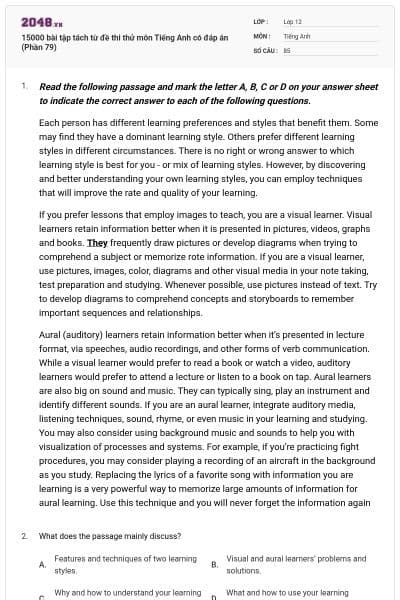
Each person has different learning preferences and styles that benefit them. Some may find they have a dominant learning style. Others prefer different learning styles in different circumstances. There is no right or wrong answer to which learning style is best for you - or mix of learning styles. However, by discovering and better understanding your own learning styles, you can employ techniques that will improve the rate and quality of your learning.
If you prefer lessons that employ images to teach, you are a visual learner. Visual learners retain information better when it is presented in pictures, videos, graphs and books. They frequently draw pictures or develop diagrams when trying to comprehend a subject or memorize rote information. If you are a visual learner, use pictures, images, color, diagrams and other visual media in your note taking, test preparation and studying. Whenever possible, use pictures instead of text. Try to develop diagrams to comprehend concepts and storyboards to remember important sequences and relationships.
Aural (auditory) learners retain information better when it’s presented in lecture format, via speeches, audio recordings, and other forms of verb communication. While a visual learner would prefer to read a book or watch a video, auditory learners would prefer to attend a lecture or listen to a book on tap. Aural learners are also big on sound and music. They can typically sing, play an instrument and identify different sounds. If you are an aural learner, integrate auditory media, listening techniques, sound, rhyme, or even music in your learning and studying. You may also consider using background music and sounds to help you with visualization of processes and systems. For example, if you’re practicing fight procedures, you may consider playing a recording of an aircraft in the background as you study. Replacing the lyrics of a favorite song with information you are learning is a very powerful way to memorize large amounts of information for aural learning. Use this technique and you will never forget the information again
What does the passage mainly discuss?
Features and techniques of two learning styles.
Visual and aural learners’ problems and solutions.
Why and how to understand your learning styles.
What and how to use your learning techniques.
Đáp án A
Đoạn văn chủ yếu bàn về?
A. Đặc điểm và kĩ thuật của 2 phong cách học tập.
B. Vấn đề và giải pháp của người học bằng thị giác và người học bằng thính giác.
C. Tại sao và làm thế nào để hiểu được phong cách học tập của bạn.
D. Những gì và làm thế nào để sử dụng tới kĩ thuật học tập của bạn.
Dạng câu hỏi tìm ý chính trong bài luôn luôn nên ưu tiên làm sau cùng sau khi đã lắm được sơ qua nội dung bài đọc.
Dễ thấy đoạn 1 là giới thiệu chủ đề, đoạn 2 bàn về phong cách học tập bằng thị giác, đoạn 3 bàn về phong cách học tập bằng thính giác => Đáp án A là hợp lí và bao quát nhất.
By discovering and better understanding your own learning styles, you can improve _______.
Your learning quality and quantity.
Your learning rate.
Your learning styles.
Your learning quality and speed.
Đáp án D
Bằng việc khám phá ra và hiểu được phong cách học tập của riêng mình, bạn có thể cải thiện được_______.
A. Khối lượng và chất lượng học tập.
B. Tốc độ học tập.
C. Phong cách học tập.
D. Chất lượng và tốc độ học tập.
Dẫn chứng ở câu cuối đoạn 1: “However, by discovering and better understanding your own learning styles, you can employ techniques that will improve the rate and quality of your learning” – (Mặc dù vậy, bằng việc khám phá và hiểu được phong cách học của riêng mình, bạn có thể vận dụng các kĩ thuật và cải thiện được tốc độ và chất lượng học tập của mình).
Chú ý: rate (n) = speed (n): tốc độ.
The word “They” in paragraph 2 refers to_______.
visual learners
pictures
videos
graphs
Đáp án A
Từ “they” ở đoạn 2 ám chỉ tới _______.
A. những người học bằng thị giác.
B. những bức tranh.
C. những băng vi-đê-ô.
D. những biểu đồ, đồ thị.
Do “they” đứng đầu làm chủ ngữ, ta đọc lên câu phía trước:
Tạm dịch: “Visual learners retain information better when it is presented in pictures, videos, graphs and books. They frequently draw pictures or develop diagrams when trying to comprehend a subject or memorize rote information” – (Những người học bằng thị giác giữ lại được thông tin tốt hơn khi nó được thể hiện dưới dạng tranh ảnh, video, biểu đồ và sách. Họ thường vẽ tranh hoặc phát triển biểu đồ khi cố gắng tiếp thu bài hoặc ghi nhớ những phần thông tin quan trọng).
=> “They” chỉ có thể là thay thế cho “visual learners”.
According to the passage, one benefit of diagrams is _______.
to understand concepts
to remember sequences.
to understand story boards.
to use pictures not texts.
Đáp án B
Theo như đoạn văn, 1 lợi ích của biểu đồ là _______.
A. hiểu được khái niệm.
B. nhớ được các chuỗi.
C. hiểu được cốt truyện.
D. sử dụng hình ảnh thay vì văn bản.
Dẫn chứng ở câu cuối đoạn 2: “Try to develop diagrams to comprehend concepts and storyboards to remember important sequencesand relationships” – (Cố gắng phát triển các biểu đồ để hiểu được những khái niệm và cốt truyện cho mục tiêu ghi nhớ các chuỗi quan trọng và những mối quan hệ).
All of the following statements are TRUE about visual learners EXCEPT _______.
They employ images to teach.
They remember graphs well.
They prefer pictures to texts.
They use story boards for relationships.
Đáp án A
Tất cả các câu sau đây đều đúng về những người học bằng thị giác, ngoại trừ:
A. Họ sử dụng hình ảnh để giảng dạy.
B. Họ nhớ được tốt các biểu đồ.
C. Họ ưu tiên tranh ảnh hơn là văn bản.
D. Họ sử dụng cốt truyện cho các mối quan hệ.
Dẫn chứng ở đoạn 2:
B- “Visual learners retain information better when it is presented in pictures, videos, graphs and books”- (Những người học bằng thị giác giữ lại được thông tin tốt hơn khi nó được thể hiện dưới dạng tranh ảnh, video, biểu đồ và sách).
C- “Whenever possible, use pictures instead of text”- (Bất cứ khi nào có thể, sử dụng biểu đồ thay vì văn bản).
D- “Try to develop diagrams to comprehend concepts and storyboards to remember important sequences and relationships” – (Cố gắng phát triển các biểu đồ để hiểu được những khái niệm và cốt truyện cho mục tiêu ghi nhớ các chuỗi quan trọng và những mối quan hệ).
Đáp án A sai bởi “If you prefer lessons that employ images to teach, you are a visual learner”- (Nếu bạn ưa thích những bài giảng có sử dụng hình ảnh để truyền đạt, bạn đích thực là người học bằng thị giác) chứ không phải “những người học bằng thị giác sử dụng hình ảnh để dạy học”.
According to the passage, the benefit of listening to music while learning and studying is that it _______.
is a hobby or an interest
attracts your attention
makes you feel relaxed
helps you visualize processes and systems
Đáp án D
Theo như đoạn văn, lợi ích của việc nghe nhạc trong khi đang học_______.
A. là 1 sở thích hoặc niềm thích thú.
B. thu hút sự chú ý.
C. làm cho thư thái.
D. giúp hình dung ra các quy trình và hệ thống.
Dẫn chứng câu 6- đoạn 3: “…or even music in your learning and studying. You may also consider using background music and sounds to help you with visualization of processes and systems” – (…hoặc thậm chí là nghe nhạc khi đang học. Bạn cũng có thể cân nhắc việc sử dụng nhạc nền và âm thanh để giúp hình dung ra các quy trình và hệ thống).
The author suggests that to remember lessons, aural learners can _______.
forget melody
learn by heart lyrics
sing along
write songs with your favorite lyrics and information you’re learning.
Đáp án D
Tác giả gợi ý rằng để nhớ được bài, những người học bằng thính giác có thể:
A. quên đi giai điệu.
B. học thuộc lòng lời nhạc.
C. hát theo.
D. viết nhạc với lời thoại ưu thích và thông tin đang được học.
Dẫn chứng câu gần cuối- đoạn 3: “Replacing the lyrics of a favorite song with information you are learning is a very powerful way to memorize large amounts of information for aural learning”- (Thay lời bài thoại của bài hát ưu thích bằng những thông tin bạn đang được học là 1 phương pháp hữu hiệu để ghi nhớ khối lượng thông tin lớn đối với việc học bằng thính giác).
It can be inferred from the passage that a person’s learning style _______.
is completely different from others’.
can never be best for them.
determines learning quality.
has its effective technique.
Đáp án D
Có thể được suy ra từ đoạn văn rằng phong cách học của 1 người ______.
A. là hoàn toàn khác với những người khác.
B. có thể không bao giờ là tốt nhất cho họ.
C. quyết định tới chất lượng học tập.
D. có những kĩ thuật hiệu quả của nó.
Dẫn chứng:
+ Kĩ thuật hiệu quả của phong cách học bằng thị giác: “…develop diagrams to comprehend concepts and storyboards to remember important sequences and relationships” – (…phát triển các biểu đồ để hiểu được những khái niệm và cốt truyện cho mục tiêu ghi nhớ các chuỗi quan trọng và những mối quan hệ)….
+ Kĩ thuật hiệu quả của phong cách học bằng thính giác: “Replacing the lyrics of a favorite song with information you are learning is a very powerful way to memorize large amounts of information for aural learning”- (Thay lời bài thoại của bài hát ưu thích bằng những thông tin bạn đang được học là 1 phương pháp hữu hiệu để ghi nhớ khối lượng thông tin lớn đối với những người học bằng thính giác)….
Read the following passage and mark the letter A, B, C or D on your answer sheet to indicate the correct answer to each of the following questions.
Ranked as the number one beverage consumed worldwide, tea takes the lead over coffee in both popularity and production with 5 million metric tons of tea produced annually. Although much of this tea is consumed in Asian, European and African countries, the United States drinks its fair share. According to estimates by the Tea Council of the United States, tea is enjoyed by no less than half of the U.S population on any given day. Black tea or green tea – iced, spiced or instant – tea drinking has spurred a billion-dollar with major tea producer in Africa and South America and throughout Asia.
Tea is made from the leaves from an evergreen plant, Camellia saneness, which grows tall and lush in tropical region. On tea plantation, the plant is kept trimmed to approximately four feet high and as new buds called flush appear; they are plucked off by hand. Even in today’s world of modern agricultural machinery, hand harvesting continues to be the preferred method. Ideally, only the top two leaves and a bud should be picked. This new growth produces the highest quality tea.
After being harvested, tea leaves are laid out on long drying racks, called withering racks, for 18 to 20 hours. During this process, the tea softens and become limp. Next, dependent on the type of tea being product, the leaves may be crushed or chopped to release flavor, and then fermented under controlled condition of heat and humidity. For green tea, the whole leaves are often steamed to retain their green color, and the fermentation process is skipped. Producing black teas requires fermentation during which the tea leaves begin darken. After fermentation, black tea is dried in vats to produce its rich brown or black color.
No one knows when or how tea became popular, but legend has it that tea as a beverage was discovered in 2737 B.C. by Emperor Shen Nung of China when leaves from camellia dropped into his drinking water as it was boiling over a fire. As the story goes, Emperor Shen Nung drank the resulting liquid and proclaimed that the drink to be most nourishing and refreshing. Though this account cannot be documented, it is thought that tea drinking probably originated in China and spread to other parts of Asia, then Europe, and ultimately to America colonies around 1650.
With about half the caffeine content of coffee, tea is often chosen by those who want to reduce, but not necessarily eliminate their caffeine intake. Some people find that tea is less acidic than coffee and therefore easier on the stomach. Others have become interested in tea drinking since the National Cancer Institute publishes its finding on the antioxidant properties of tea. But whether tea is enjoyed for it perceived health benefit, its flavor, or as a social drink, teacups continue to be filled daily with the world’ most popular beverage.
According to the passage, what is implied about tea harvesting?
It is totaling done with the assistance of modern agricultural machinery
It is longer done in China.
The method has remained nearly the same for a long time.
The method involves trimming the uppermost branches of the plant.
Đáp án C
Theo như đoạn văn, điều gì được ngụ ý về thu hoạch chè?
A. Nó được tiến hành tuyệt đối với sự trợ giúp của máy móc công nghiệp hiện đại.
B. Nó kéo dài hơn ở Trung Quốc.
C. Phương pháp được giữ nguyên gần như là giống với thời gian dài trước kia
D. Phương pháp bao gồm việc cắt tỉa các cành ngọn trên cùng của cây.
Dẫn chứng ở đoạn 2: “Even in today’s world of modern agricultural machinery, hand harvesting continues to be the preferred method” – (Ngày nay mặc dù có rất nhiều máy móc nông nghiệp hiện đại trên thế giới, nhưng việc thu hái chè bằng tay vẫn là phương pháp được ưu chuộng).
What does the word “they” in paragraph 2 refer to?
tea pickers
new buds
evergreen plants
tropical regions
Đáp án B
Từ “they” ở đoạn 2 ám chỉ tới?
A. những người hái chè.
B. những chồi non mới.
C. những cây thường xanh.
D. những vùng nhiệt đới.
Tạm dịch: “On tea plantation, the plant is kept trimmed to approximately four feet high and as new buds called flush appear; they are plucked off by hand”- (Trên những đồi chè, cây được tỉa cao khoảng 4 feet và ngay khi ngọn vừa trồi ra, chúng sẽ được hái bằng tay).
=> “they” chỉ có thể là thay thế cho “new buds”.
Which of the following is NOT true about the tea production process?
Black tea develops its dark color during fermentation and final drying.
Green tea requires a long fermentation process.
Green tea is often steamed to keep its color.
Black tea goes through two phases during production.
Đáp án B
Ý nào sau đây không đúng về quá trình sản xuất chè?
A. Chè đen lên màu tối trong suốt quá trình lên men và sấy khô cuối cùng.
B. Chè xanh đòi hỏi 1 quá trình lên men dài.
C. Chè xanh thường được hấp để giữ màu.
D. Chè đen trải qua 2 giai đoạn trong quá trình sản xuất.
Dẫn chứng câu 4- đoạn 3: “.For green tea, the whole leaves are often steamed to retain their green color, and the fermentation process is skipped”- (Đối với trà xanh, toàn bộ phần lá thường được hấp để giữ lại màu và bỏ qua quá trình lên men).
According to the passage, what is TRUE about origin of tea drinking?
It began during the Shen Nung Dynasty.
It may begin some time around 1950.
It is unknown when tea first became popular.
It was originally produced from Camilla plants in Europe.
Đáp án C
Theo như đoạn văn, điều nào sau đây là đúng về nguồn gốc của việc uống trà?
A. bắt đầu từ triều đại Shen Nung.
B. có thể bắt đầu vào khoảng thời gian quanh năm 1950.
C. không được biết tới khi trà trở nên phổ biến lần đầu tiên.
D. ban đầu được sản xuất từ cây Camilla ở Châu Âu.
Dẫn chứng ở câu đầu đoạn 4: “No one knows when or how tea became popular, but legend […]”- (Không ai biết khi nào và làm thế nào mà trà trở nên phổ biến, nhưng có 1 truyền thuyết kể lại rằng…) => Việc uống trà đã không được biết tới cho đến khi chè trở nên nổi tiếng.
Có thể nhầm sang đáp án A bởi câu chuyện về Hoàng đế Shen Nung chỉ là 1 truyền thuyết không xác thực.
The word “eliminate” in paragraph 5 could be best replaced by which of the following words?
decrease
increase
reduce
remove
Đáp án D
Câu hỏi từ vựng:
A. decrease (v): giảm.
B. increase (v): tăng.
C. reduce (v): giảm, hạ.
D. remove (v): bỏ, dời đi.
(to) eliminate: loại bỏ = D. remove (v).
According to the passage, why someone would choose to drink tea instead of coffee?
Because it’s easier to digest than coffee.
Because it has higher nutritional content than coffee.
Because it helps prevent heart attacks.
Because it has more caffeine than coffee does.
Đáp án A
Theo như đoạn văn, tại sao người ta lại chọn uống trà thay vì cà phê?
A. Vì nó dễ tiêu hóa hơn cà phê.
B. Vì nó có hàm lượng dinh dưỡng cao hơn cà phê.
C. Vì nó giúp ngăn ngừa các cơn đau tim.
D. Vì nó có nhiều caffein hơn cà phê.
Dẫn chứng ở câu 2- đoạn cuối: “Some people find that tea is less acidic than coffee and therefore easier on the stomach” – (Một vài người nhận ra rằng trà có hàm lượng a-xít thấp hơn cà phê và do đó nó dễ dàng hơn cho dạ dày).
What best describes the topic of the passage?
A. Tea consumption and production.
The two most popular types of tea.
The benefits of tea consumption worldwide.
How tea is produced and brewed.
Đáp án A
Đâu là tiêu đề phù hợp nhất cho đoạn văn?
A. Tiêu thụ và sản xuất chè.
B. 2 loại chè phổ biến nhất.
C. Những lợi ích của việc tiêu thụ chè trên toàn thế giới.
D. Cách chè được sản xuất và ủ.
Để tỉm được chủ đề phù hợp ta xem xét đến ý chính của từng đoạn:
+ Đoạn 1: Giới thiệu chủ đề
“Ranked as the number one beverage consumed worldwide, tea takes the lead over coffee in both popularity and production with 5 million metric tons of tea produced annually” – (Được xếp hạng vào loại thức uống được tiêu thụ nhiều nhất trên toàn cầu, chè dẫn đầu cà phê về cả độ nổi tiếng và sản lượng xuất ra với 5 triệu tấn được chè được sản xuất mỗi năm).
+ Đoạn 2: Thu hoạch chè.
“On tea plantation, the plant is kept trimmed to approximately four feet high and as new buds called flush appear; they are plucked off by hand. […].Ideally, only the top two leaves and a bud should be picked” – (Trên những đồi chè, cây được tỉa cao khoảng 4 feet và ngay khi ngọn vừa trồi ra, chúng sẽ được ngắt bằng tay. Lí tưởng nhất là chỉ nên ngắt thu hoạch 2 lá trên cùng với chồi).
+ Đoạn 3: Gia công chè.
“After being harvested, tea leaves are laid out on long drying racks, called withering racks, for 18 to 20 hours” – (Sau khi thu hoạch, lá chè được đặt trên những kệ sấy dài, được gọi là giá treo, trong vòng từ 18 đến 20 giờ).
“Next, dependent on the type of tea being product, the leaves may be crushed or chopped to release flavor, and then fermented under controlled condition of heat and humidity” – (Tiếp theo, phụ thuộc vào loại chè được được sản xuất, lá có thể được nghiền nhỏ hoặc xắt nhỏ để giải phóng hương vị, và sau đó cho lên men dưới điều kiện kiểm soát nhiệt và độ ẩm).
[….]
+ Đoạn 4: Nguồn gốc.
“No one knows when or how tea became popular, but legend has it that tea as a beverage was discovered in 2737 B.C. by Emperor Shen Nung of China when leaves from camellia dropped into his drinking water as it was boiling over a fire” – (Không ai biết khi nào và làm thế nào mà trà trở nên phổ biến, nhưng có 1 truyền thuyết kể lại rằng trà là 1 loại đồ uống đã được phát hiện ra từ năm 2737 trước Công nguyên bởi Hoàng đế Shen Nung của Trung Quốc, khi lá hoa Sơn Trà rơi vào nước uống của ngài khi đang sôi trên lửa).
+ Đoạn 5: Tiêu thụ chè trên thế giới.
“But whether tea is enjoyed for it perceived health benefit, its flavor, or as a social drink, teacups continue to be filled daily with the world’ most popular beverage” – (Nhưng liệu rằng chè được thưởng thức vì nó có lợi cho sức khỏe, vì hương vị hay vì nó được coi như 1 thức uống xã giao, thì những tách trà vẫn tiếp tục được làm đầy mỗi ngày với thứ đồ uống phổ biến nhất thế giới).
Read the following passage and mark the letter A, B, C or D on your answer sheet to indicate the correct answer to each of the following questions.
The economic expansion prompted by the Second World War triggered a spectacular population boom in the West. Of course, the region was no stranger to population booms. Throughout much of its history, western settlement had been characterized by spurts, rather than by a pattern of gradual and steady population growth, beginning with the gold and silver rushes of the 1850's and 1860's. The decade after the First World War - the 1920's - witnessed another major surge of people pouring into the West, particularly into urban areas. But the economic depression of the 1930's brought this expansion to a halt; some of the more sparsely settled parts of the region actually lost population as migrants sought work in more heavily industrialized areas. By 1941 when the United States entered the Second World War and began to mobilize, new job opportunities were created in the western part of the nation.
If the expansion of industries, such as shipbuilding and aircraft manufacturing, was most striking on the pacific coast, it also affected interior cities like Denver, Phoenix, and Salt Lake City. Equally dramatic were the effects of the establishment of aluminum plants in Oregon and Washington and the burgeoning steel industry in Utah and California. The flow of people into these areas provided an enormous impetus to the expansion of the service industries - banks, health care services and schools. Although strained to the limit by the influx of newcomers, western communities welcomed the vast reservoir of new job opportunities. At the same time, the unprecedented expansion of government installations in the West, such as military bases, created thousands of new civilian openings. As land had served as a magnet for western migrants in the late nineteenth century, so wartime mobilization set in motion another major expansion of population. Indeed, it could be said that the entire western United States became a giant boomtown during the Second World War. This was especially true of California. Of the more than eight million people who moved into the West in the decade after 1940, almost one-half went to the Pacific coast. In fact, between 1940 and 1950, California's population surged by more than three million people.
What is the main point of the passage?
California dominated the economic growth of the West during the Second World War.
Industrial growth during the 1940's attracted large numbers of people to the West.
The military drew people away from civilian jobs during the 1940's.
The West experienced gradual and steady economic growth from 1900 to 1940.
Đáp án B
Đâu là ý chính của đoạn văn?
A. California chi phối sự tăng trưởng của nền kinh tế Tây Mĩ trong Thế chiến thứ II.
B. Nền công nghiệp phát triển trong những năm 1940 đã thu hút được rất nhiều người tới Tây Mĩ.
C. Quân đội rút quân khỏi các công việc dân sự vào những năm 1940.
D. Tây Mĩ trải qua thời kì tăng trưởng kinh tế dần dần và ổn định từ năm 1900 đến 1940.
Giải thích: Câu chủ đề là câu đầu tiên của bài: “The economic expansion prompted by the Second World War triggered a spectacular population boom in the West” – (Nền kinh tế phát triển do sự thúc đẩy của Thế chiến thứ 2 đã gây ra sự bùng nổ dân số ngoạn mục ở bờ Tây nước Mĩ). Các ý tiếp theo đều phát triển và liên quan tới câu chủ đề.
Ngoài ra còn có một số dẫn chứng như:
+ “The flow of people into these areas provided an enormous impetus to the expansion of the service industries - banks, health care services and schools.” – (Dòng người di cư vào các khu vực này đã tạo ra một động lực to lớn cho việc mở rộng các ngành dịch vụ như: ngân hàng, chăm sóc sức khoẻ và trường học).
+ “As land had served as a magnet for western migrants in the late nineteenth century” – (Việc đất đai được cung cấp sẵn được ví như 1 thỏi nam châm thu hút người di cư tới bờ Tây vào cuối thế kỉ thứ 19).
+ “Of the more than eight million people who moved into the West in the decade after 1940, almost one-half went to the Pacific coast”– (Hơn 8 triệu người di cư tới Tây Mĩ vào thập kỉ sau 1940, gần 1 nửa trong số đó là đi tới vùng biển Thái Bình Dương).
The word "triggered" in paragraph 1 is closest in meaning to______.
was connected to
generated
interfered with
illuminated
Đáp án B
Câu hỏi từ vựng.
A. was connect to: được liên hệ với.
B. generated (v): được phát sinh ra.
C. interfered with (v): được can thiệp bởi.
D. illuminated (v): được chiếu sáng, soi rọi.
Triggered (v): được gây ra = B. generated (v): được phát sinh ra.
Why does the author mention “the gold and silver rushes of the 1850's and 1860's” in the first paragraph?
As causes of gradual population growth
As contrasts to late patterns of population
As illustrations of a market economy.
As examples of western population booms.
Đáp án D
Tại sao tác giả đề cập tới “những cơn sốt vàng và bạc vào những năm 1850 và 1860” ở đoạn 1?
A. Là nguyên nhân khiến dân số tăng dần dần.
B. Tương phản với các mô hình dân số trước kia.
C. Minh hoạ cho nền kinh tế thị trường.
D. Là ví dụ về sự bùng nổ dân số ở bờ Tây.
Tạm dịch: “Throughout much of its history, western settlement had been characterized by spurts, rather than by a pattern of gradual and steady population growth, beginning with the gold and silver rushes of the 1850's and 1860's.” – (Trong suốt chiều dài lịch sử, việc định cư ở Tây Mĩ được đặc trưng bởi tính bứt phá mạnh mẽ, chứ không phải bằng một mô hình dân số tăng dần và ổn định, bắt đầu bằng những cơn sốt vàng và bạc vào những năm 1850 và 1860).
According to the passage, the depression of the 1930's caused which of the following?
A lack of population growth in the West.
The building of new suburbs.
A creation of more job opportunities.
A growth in immigration from abroad.
Đáp án A
Theo như đoạn văn, cuộc suy thoái trong những năm 1930 gây ra cái nào dưới đây?.
A. Thiếu sự gia tăng dân số ở bờ Tây.
B. Việc xây dựng các vùng ngoại ô mới.
C. Tạo ra nhiều cơ hội việc làm.
D. Sự gia tăng số người nhập cư từ nước ngoài.
Dẫn chứng câu thứ 4- đoạn 1: “The decade after the First World War - the 1920's - witnessed another major surge of people pouring into the West, particularly into urban areas. But the economic depression of the 1930's brought this expansion to a halt” – (Thập kỉ sau Thế chiến thứ nhất –tức vào những năm 1920- chứng kiến 1 đợt tăng mạnh khác của dòng người đổ vào bờ Tây, đặc biệt là ở các khu vực thành thị. Nhưng sự suy thoái kinh tế trong những năm 1930 đã làm cho việc mở rộng này bị ngưng lại).
The word “it” in paragraph 2 refers to______.
expansion
Denver
manufacturing
the Pacific coast
Đáp án A
Từ “it” ở đoạn 2 đề cập tới ______.
A. Sự mở rộng. B. Denver. C. Sự sản xuất. D. Bờ biển Thái Bình Dương.
Thấy “it” đứng đầu câu làm chủ ngữ, ta đọc nên câu đứng trước nó.
Tạm dịch: “If the expansion of industries, such as shipbuilding and aircraft manufacturing, was most striking on the Pacific coast, it also affected interior cities like Denver, Phoenix, and Salt Lake City” – (Nếu sự mở rộng của các ngành công nghiệp như đóng tàu và sản xuất máy bay, là nổi bật nhất trên bờ biển Thái Bình Dương, thì nó đồng thời cũng ảnh hưởng đến các thành phố nội địa như Denver, Phoenix, và Salt Lake) => “it” chỉ có thể là thay thế cho “the expansion”.
The passage suggests that industrialization in the West led to all of the following EXCEPT ______.
An increase in school construction.
Improved access to doctors.
An increase in the number of banks.
A reduction in the price of land.
Đáp án D
Đoạn văn gợi ý rằng công nghiệp hóa ở Tây Mĩ dẫn tới tất cả các ý sau đây, ngoại trừ .
A. Tăng cường xây dựng các trường học.
B. Cải thiện sự tiếp cận với y tế.
C. Tăng số lượng các ngân hàng.
D. Giảm giá đất.
Các đáp án A, B, C đều được nhắc tới trong bài ở câu 3- đoạn 2: “The flow of people into these areas provided an enormous impetus to the expansion of the service industries - banks, health care services and schools.” – (Dòng người di cư vào các khu vực này đã tạo ra một động lực to lớn cho việc mở rộng các ngành dịch vụ như: ngân hàng, chăm sóc sức khoẻ và trường học).
It can be inferred from the passage that the principal cause of California’s population surge between 1940 and 1950 was ______.
the increased availability of land.
people’s desire to live in a warm, coastal climate.
the industrial mobilization necessitated by the Second World War.
overcrowding in urban areas in other regions of the United States.
Đáp án C
Cái nào có thể được suy ra từ đoạn văn là nguyên nhân chính của sự gia tăng dân số ở California từ năm 1940 đến 1950?
A. Sự gia tăng của đất đai có sẵn.
B. Con người mong muốn sống ở vùng khí hậu ấm áp, ven biển.
C. Thế chiến thứ 2 đòi hỏi sự huy động về mặt công nghiệp.
D. Sự quá tải ở các khu vực thành thị ở các bang khác trên nước Mĩ.
Dẫn chứng ở những câu cuối “…so wartime mobilization set in motion another major expansion of population. Indeed, it could be said that the entire western United States became a giant boomtown during the Second World War. This was especially true of California. Of the more than eight million people who moved into the West in the decade after 1940…” – (do đó sự huy động trong thời chiến đã tạo nên một cuộc tăng dân lớn. Thực chất có thể nói rằng toàn bộ bờ Tây nước Mĩ đã trở thành nơi bùng nổ dân số trong suốt Thế chiến thứ 2. Điều này đặc biệt đúng ở bang California, hơn 8 triệu người đã di cư tới bờ Tây trong thập kỉ sau 1940).
Read the following passage and mark the letter A, B, C, or D on your answer sheet to indicate the correct answer to each of the questions.
The Development of Refrigeration
Cold storage, or refrigeration, is keeping food at temperatures between 32 and 45 degrees F in order to delay the growth of microorganisms - bacteria, molds, and yeast - that cause food to spoil. Refrigeration produces few changes in food, so meats, fish, eggs, milk, fruits, and vegetables keep their original flavor, color, and nutrition. Before artificial refrigeration was invented, people stored perishable food with ice or snow to lengthen its storage time. Preserving food by keeping it in an ice-filled pit is a 4,000-year-old art. Cold storage areas were built in basements, cellars, or caves, lined with wood or straw, and packed with ice. The ice was transported from mountains, or harvested from local lakes or rivers, and delivered in large blocks to homes and businesses.
Artificial refrigeration is the process of removing heat from a substance, container, or enclosed area, to lower its temperature. The heat is moved from the inside of the container to the outside. A refrigerator uses the evaporation of a volatile liquid, or refrigerant, to absorb heat. In most types of refrigerators, the refrigerant is compressed, pumped through a pipe, and allowed to vaporize. As the liquid turns to vapor, it loses heat and gets colder because the molecules of vapor use energy to leave the liquid. The molecules left behind have less energy and so the liquid becomes colder. Thus, the air inside the refrigerator is chilled.
Scientists and inventors from around the world developed artificial refrigeration during the eighteenth and nineteenth centuries. William Cullen demonstrated artificial refrigeration in Scotland in 1748, when he let ethyl ether boil into a partial vacuum. In 1805, American inventor Oliver Evans designed the first refrigeration machine that used vapor instead of liquid. In 1842, physician John Gorrie used Evans's design to create an air-cooling apparatus to treat yellow-fever patients in a Florida hospital. Gorrie later left his medical practice and experimented with ice making, and in 1851 he was granted the first U.S. patent for mechanical refrigeration. In the same year, an Australian printer, James Harrison, built an ether refrigerator after noticing that when he cleaned his type with ether it became very cold as the ether evaporated. Five years later, Harrison introduced vapor-compression refrigeration to the brewing and meatpacking industries.
Brewing was the first industry in the United States to use mechanical refrigeration extensively, and in the 1870s, commercial refrigeration was primarily directed at breweries. German-born Adolphus Busch was the first to use artificial refrigeration at his brewery in St. Louis. Before refrigeration, brewers stored their beer in caves, and production was constrained by the amount of available cave space. Brewing was strictly a local business since beer was highly perishable and shipping it any distance would result in spoilage. Busch solved the storage problem with the commercial vapor- compression refrigerator. He solved the shipping problem with the newly invented refrigerated railcar, which was insulated with ice bunkers in each end. Air came in on the top, passed through the bunkers, and circulated through the car by gravity. In solving Busch's spoilage and storage problems, refrigeration also revolutionized an entire industry. By 1891, nearly every brewery was equipped with mechanical refrigerating machines.
The refrigerators of today rely on the same basic principle of cooling caused by the rapid evaporation and expansion of gases. Until 1929, refrigerators used toxic gases - ammonia, methyl chloride, and sulfur dioxide - as refrigerants. After those gases accidentally killed several people, chlorofluorocarbons (CFCs) became the standard refrigerant. However, they were found to be harmful to the earth's ozone layer, so refrigerators now use a refrigerant called HFC 134a, which is less harmful to the ozone.
What is the main reason that people developed methods of refrigeration?
They wanted to improve the flavor and nutritional value of food.
They needed to slow the natural processes that cause food to spoil.
They needed to use for the ice that formed on lakes and rivers.
They wanted to expand the production of certain industries.
Đáp án B
Lý do chính khiến con người phát triển phương pháp làm lạnh?
A. Họ muốn cải thiện hương vị và giá trị dinh dưỡng của thực phẩm.
B. Họ cần làm chậm quá trình tự nhiên làm thức ăn bị hỏng.
C. Họ cần sử dụng cho băng được hình thành trên các sông hồ.
D. Họ muốn mở rộng sản xuất một số ngành công nghiệp nhất định.
Dẫn chứng ngay câu đầu tiên: “Cold storage, or refrigeration, is keeping food at temperatures between 32 and 45 degrees F in order to delay the growth of microorganisms - bacteria, molds, and yeast - that cause food to spoil” – (Máy làm lạnh, hay còn gọi là tủ lạnh, giữ thực phẩm ở nhiệt độ từ 32 đến 45 độ F để trì hoãn sự phát triển của vi sinh vật - vi khuẩn, nấm mốc và nấm men –thứ làm cho thức ăn bị ôi thiu).
The word “perishable” in paragraph 1 is closest in meaning to ______.
capable of spoiling
uncooked
of animal origin
highly nutritious
Đáp án A
Câu hỏi từ vựng.
A. có khả năng hư hỏng.
B. không được nấu.
C. có nguồn gốc động vật.
D. có giá trị dinh dưỡng cao.
Perishable (adj): dễ bị hư = A. capable of spoiling (adj): có khả năng hư hỏng.
What can be inferred from paragraph 1 about cold storage before the invention of artificial refrigeration?
It kept food cold for only about a week.
It was dependent on a source of ice or snow.
It required a container made of mental or wood.
It was not a safe method of preserving meat.
Đáp án B
Điều gì có thể được suy ra từ đoạn 1 về kho ướp lạnh trước khi phát minh ra tủ lạnh?
A. Nó giữ lạnh thực phẩm chỉ trong khoảng một tuần.
B. Nó phụ thuộc vào nguồn băng hoặc tuyết.
C. Nó yêu cầu một thùng chứa được làm bằng kim loại hoặc gỗ.
D. Nó không phải là một phương pháp an toàn để bảo quản thịt.
Dẫn chứng 2 câu cuối –đoạn 1: “Cold storage areas were built in basements, cellars, or caves, lined with wood or straw, and packed with ice. The ice was transported from mountains, or harvested from local lakes or rivers, and delivered in large blocks to homes and businesses”- (Kho ướp lạnh được xây trong các tầng hầm, hầm rượu, hoặc trong các hang động, được lót bằng gỗ hoặc rơm và được xếp chặt với băng. Băng được vận chuyển từ trên núi, hoặc thu hoạch từ các sông hồ ở địa phương, và được phân phát thành các tảng lớn đến các hộ gia đình hoặc các doanh nghiệp).
=> Nguồn băng đá đóng vai trò rất quan trọng.
Artificial refrigeration involves all of the following processes EXCEPT______.
the pumping of water vapor through a pipe.
the rapid expansion of certain gases.
the evaporation of a volatile liquid.
the transfer of heat from one place to another.
Đáp án A
Làm lạnh nhân tạo bao gồm tất cả các quy trình sau đây, ngoại trừ______.
A. nước được bơm qua đường ống.
B. sự giãn nở nhanh chóng của một số loại khí nhất định.
C. sự bốc hơi của các chất lỏng dễ bay hơi.
D. sự truyền nhiệt từ nơi này sang nơi khác.
Dẫn chứng ở đoạn 2: “Artificial refrigeration is the process of removing heat from a substance, container, or enclosed area, to lower its temperature. The heat is moved from the inside of the container to the outside (D). A refrigerator uses the evaporation of a volatile liquid (C), or refrigerant, to absorb heat . In most types of refrigerators, the refrigerant is compressed, pumped through a pipe, and allowed to vaporize. As the liquid turns to vapor, it loses heat and gets colder because the molecules of vapor use energy to leave the liquid (B). The molecules left behind have less energy and so the liquid becomes colder. Thus, the air inside the refrigerator is chilled” – (Làm lạnh nhân tạo là quá trình loại bỏ nhiệt từ các chất, thùng chứa hoặc các khu vực xung quanh để làm giảm nhiệt độ. Nhiệt sẽ di chuyển từ bên trong các thùng chứa đi ra bên ngoài. Tủ lạnh lợi dụng sự bốc hơi của chất lỏng dễ bay hơi hoặc chất làm lạnh để hấp thụ nhiệt. Trong hầu hết các loại tủ lạnh, chất làm lạnh được nén, bơm qua đường ống, và bốc hơi. Khi chất lỏng chuyển qua thể hơi, nó sẽ mất dần nhiệt và trở nên lạnh dần do các phân tử sử dụng năng lượng để thoát lỏng. Các phân tử đó sẽ để lại phía sau ít năng lượng hơn và do đó chất lỏng sẽ trở nên lạnh dần. Như vậy, không khí trong tủ lạnh đã được làm lạnh).
Ngoài ra, ý A sai do trong đoạn trên có nhắc tới: “chất làm lạnh” được bơm qua các ống dẫn chứ không phải “nước”.
According to the passage, who was the first person to use artificial refrigeration for a practical purpose?
William Cullen
Oliver Evans
John Gorrie
Adolphus Busch
Đáp án C
Theo như đoạn văn, ai là người đầu tiên sử dụng tủ lạnh nhân tạo?
A. William Cullen
B. Oliver Evans
C. John Gorrie
D. Adolphus Busch
Dẫn chứng ở giữa đoạn 3: “William Cullen demonstrated artificial refrigeration in Scotland in 1748, when he let ethyl ether boil into a partial vacuum. In 1805, American inventor Oliver Evans designed the first refrigeration machine that used vapor instead of liquid. In 1842, physician John Gorrie used Evans's design to create an air-cooling apparatus to treat yellow-fever patients in a Florida hospital” – (William Cullen đã trình diễn màn làm lạnh nhân tạo ở Scotland vào năm 1748, khi ông dẫn khí ethyl ether sôi vào 1 bình chân không. Năm 1805, nhà phát minh người Mĩ Oliver Evans thiết kế chiếc máy làm lạnh đầu tiên sử dụng hơi thay vì chất lỏng. Vào năm 1842, bác sĩ John Gorrie đã sử dụng thiết kế của Evans để tạo ra một thiết bị làm mát không khí với mục đích điều trị cho các bệnh nhân sốt vàng da ở bệnh viện ở Florida). Và đầu đoạn 4: “and in the 1870s, commercial refrigeration was primarily directed at breweries. German-born Adolphus Busch was the first to use artificial refrigeration at his brewery in St. Louis”- (và vào những năm 1870, nền thương mại điện lạnh chủ yếu được quản lí tại các nhà máy bia. Adolphus Busch- sinh ra ở Đức, là người đầu tiên sử dụng điện lạnh nhân tạo tại nhà máy bia của mình ở St. Louis).
=> người sử dụng đầu tiên là bác sĩ John Gorrie.
The word “it” in paragraph 3 refers to______.
printer
refrigerator
type
ether
Đáp án C
Từ “nó” ở đoạn 3 ám chỉ tới ______.
A. máy in.
B. tủ lạnh.
C. kiểu, loại.
D. ê-te.
Giải thích: “it” đóng vai trò làm chủ ngữ nên ta đọc nên phía trước nó: “In the same year, an Australian printer, James Harrison, built an ether refrigerator after noticing that when he cleaned his type with ether it became very cold as the ether evaporated” – (Vào cùng năm đó, tại một nhà máy in ở Úc, James Harrison đã tạo ra 1 chiếc máy lạnh sử dụng khí ê-te sau khi ông nhận thấy rằng khi ông làm sạch loại máy lạnh này với khí ê-te, nó sẽ trở nên rất lạnh như khi có khí ê-te bay hơi).
The word “constrained” in paragraph 4 is closest in meaning to______.
restricted
spoiled
improved
alternated
Đáp án A
Câu hỏi từ vựng.
A. restricted (v): bị giới hạn, hạn chế.
B. spoiled (v): bị làm cho hư hỏng.
C. improved (v): được cải tiến.
D. alternated (v): được sắp xếp luân phiên.
Constrained (v): bị giới hạn, kìm hãm = A. restricted.
According to the passage, the first refrigerated railcar used what material as a cooling agent?
ether
ice
ammonia
CFCs
Đáp án B
Theo như đoạn văn, chiếc xe tải làm lạnh đầu tiên đã sử dụng nguyên liệu nào như 1 chất làm mát?
A. khí ê-te. B. đá lạnh. C. khí a-mô-ni. D. CFC’s
Dẫn chứng ở đoạn 4: “He solved the shipping problem with the newly invented refrigerated railcar, which was insulated with ice bunkers in each end. Air came in on the top, passed through the bunkers, and circulated through the car by gravity” - (Ông đã giải quyết vấn đề về vận chuyển bằng 1 phát minh mới - xe tải làm lạnh, được trang bị các thùng chứa đá lạnh ở mỗi đầu. Khí lạnh từ đầu xe, đi qua các thùng chứa, và lưu thông bên trong xe bằng lực hút).
Read the following passage and mark the letter A, B, C, or D on your answer sheet to indicate the correct answer to each of the questions
Today, roller skating is easy and fun. But a long time ago, it wasn't easy at all. Before 1750, the idea of skating didn't exist. That changed because of a man named Joseph Merlin. Merlin's work was making musical instruments. In his spare time he liked to play the violin. Joseph Merlin was a man of ideas and dreams. People called him a dreamer.
One day Merlin received an invitation to attend a fancy dress ball. He was very pleased and a little excited. As the day of the party came near, Merlin began to think how to make a grand entrance at the party. He had an idea. He thought he would get a lot of attention if he could skate into the room.
Merlin tried different ways to make himself roll. Finally, he decided to put two wheels under each shoe. These were the first roller skates. Merlin was very proud of his invention as he dreamed of arriving at the party on wheels while playing the violin.
On the night of the party Merlin rolled into the room playing his violin. Everyone was astonished to see him. There was just one problem. Merlin had no way to stop his roller skates. He rolled on and on. Suddenly, he ran into a huge mirror that was hanging on the wall. Down fell the mirror, breaking to pieces. Nobody forgot Merlin's grand entrance for a long time!
The passage is mainly about _______________ .
how people enjoyed themselves in the 18th century
a strange man
how roller skating began
an unusual party
Đáp án C
Đoạn văn chủ yếu bàn về ______ .
A. cách con người tận hưởng, giải trí vào thế kỉ 18.
B. người đàn ông lạ mặt.
C. cách mà môn trượt pa-tanh đã bắt đầu.
D. bữa tiệc lạ thường.
Câu mở đầu là câu chủ đề: “Today, roller skating is easy and fun. But a long time ago, it wasn't easy at all” – (Ngày nay, trượt pa-tanh rất dễ dàng và thú vị. Nhưng một thời gian dài trước kia, nó không hề dễ dàng 1 chút nào) rồi sau đó là câu chuyện ra đời của môn trượt pa-tanh.
The word "astonished" in paragraph 4 can be best replaced by________ .
tired
surprised
embarrassed
polite
Đáp án B
Câu hỏi từ vựng.
A. tired (adj): mệt mỏi.
B. surprised (adj): ngạc nhiên, kinh ngạc.
C. embarrassed (adj): ngượng ngùng, bối rối.
D. polite (adj): lịch sự.
Astonished (adj): ngạc nhiên = B. surprised.
Merlin put wheels under his shoes in order to ____________.
impress the party guests
arrive at the party sooner
show his skill in walking on wheels
test his invention
Đáp án A
Merlin đã gắn những bánh lăn vào dưới đôi giày của mình để______ .
A. gây ấn tượng với những vị khách mời.
B. tới bữa tiệc sớm hơn.
C. thể hiện kĩ năng của mình trong việc đi trên những bánh xe.
D. kiểm tra phát minh của mình.
Dẫn chứng ở đoạn 2+ đầu đoạn 3: “As the day of the party came near, Merlin began to think how to make a grand entrance at the party. He had an idea. He thought he would get a lot of attention if he could skate into the room. Merlin tried different ways to make himself roll. Finally, he decided to put two wheels under each shoe” – (Ngày diễn ra bữa tiệc đến gần, Merlin bắt đầu nghĩ làm thế nào để đi vào bữa tiệc một cách thật long trọng. Ông đã nảy ra 1 ý tưởng. Ông nghĩ rằng sẽ gây được nhiều sự chú ý nếu ông có thể trượt vào phòng. Merlin đã thử rất nhiều cách để có thể trượt. Cuối cùng, ông quyết định gắn những chiếc bánh lăn vào dưới mỗi chiếc giày của mình).
The word "ball" in paragraph 2 probably means _________.
game
party
round object
match
Đáp án B
Từ “ball” ở đoạn 2 nghĩa là
A. trò chơi
B. bữa tiệc
C. vật tròn
D. trận đấu ball (n): tiệc khiêu vũ = B. party (n): bữa tiệc.
People thought Merlin was a dreamer because he ___________.
was a gifted musician
invented the roller skates
often gave others surprises
was full of imagination
Đáp án D
Mọi người đã nghĩ Merlin là kẻ mộng mơ bởi vì ông______ .
A. là 1 nhạc sĩ thiên tài.
B. phát minh ra giày trượt.
C. thường xuyên làm mọi người ngạc nhiên.
D. giàu trí tưởng tượng.
Dẫn chứng ở 2 câu cuối đoạn 1: “Joseph Merlin was a man of ideas and dreams. People called him a dreamer” – (Joseph Merlin là con người của nhiều ý tưởng và sự mơ mộng. Mọi người đều gọi ông là kẻ mộng mơ).
What is the main point the writer is trying to make in the last paragraph?
Merlin got himself into trouble.
Merlin succeeded beyond expectation.
The roller skates needed further improvement.
The party guests took Merlin for a fool.
Đáp án B
Ý chính mà tác giả cố gắng truyền đạt ở đoạn cuối là?
A. Merlin đã gặp rắc rối.
B. Merlin đã thành công ngoài mong đợi.
C. Giày trượt cần được cải tiến hơn nữa.
D. Những vị khách đã cho rằng Merlin là kẻ ngốc.
Tạm dịch: “On the night of the party Merlin rolled into the room playing his violin. Everyone was astonished to see him. There was just one problem. Merlin had no way to stop his roller skates. He rolled on and on. Suddenly, he ran into a huge mirror that was hanging on the wall. Down fell the mirror, breaking to pieces. Nobody forgot Merlin's grand entrance for a long time” – (Vào đêm diễn ra bữa tiệc, Merlin đã trượt vào phòng trong khi đang chơi vi-ô-lông. Mọi người rất ngạc nhiên khi thấy ông. Chỉ có một vấn đề đó là Merlin không biết làm thế nào để dừng chiếc giày trượt lại. Ông cứ trượt và trượt. Đột nhiên ông đâm sầm vào chiếc gương lớn đang treo trên tường. Tấm gương rơi xuống, vỡ tan thành từng mảnh. Không ai có thể quên được cái cách long trọng mà Merlin đã đi vào bữa tiệc ngày hôm đó trong 1 thời gian dài) .
=> Merlin đã thành công ngoài mong đợi trong việc gây ấn tượng khi mọi người không thể nào quên được màn trình diễn của ông trong 1 thời gian dài.
The word "These" in paragraph 3 refers to
wheels
roller skates
different ways
shoes
Đáp án B
Từ “chúng” ở đoạn 3 ám chỉ tới
A. những bánh lăn.
B. những chiếc giày trượt.
C. những cách khác.
D. những chiếc giày.
Tạm dịch: “Finally, he decided to put two wheels under each shoe. These were the first roller skates” – (Cuối cùng, ông quyết định gắn những bánh lăn vào dưới mỗi chiếc giày. Chúng chính là những chiếc giày trượt đầu tiên).
Read the following passage and mark the letter A , B, C, or D on your answer sheet to indicate the correct answer to each of the questions
When we moved to our new house near the sea, I was eight years old. Even before that I had spent every summer messing about on boats. My dad had taught me to sail before I learnt to ride a bike so I knew how I wanted to spend my time at the new house- I was going to get my own boat and sail it everyday. The house was only a few meters from the water's edge, and in rough weather the waves would come crashing into the front garden. I used to sit with my nose pressed to the glass, fascinated by the power of the ocean. I grew up watching the skies to see if it was going to rain; would I be going sailing that afternoon or not?
Of course I sometimes wished I could live in the town like my friends. I used to get angry with my parents, who had taken early retirement because they seemed incapable of getting anywhere on time. Dad drove me the eight miles to school everyday, but I was often late because he had been walking on the cliffs earlier in the morning and had lost track of time. When I was taking my university entrance exams, I used to stay over at a friend's in town, just in case. All in all, I was lucky to grow up by the sea and I still love to sail.
At the age of eight, the writer's house was _______.
in the town
under the mountain
on boat
by the sea
Đáp án D
Khi lên 8, gia đình tác giả đã .
A. ở thành thị.
B. ở dưới núi.
C. ở trên tàu
D. ở gần biển.
Dẫn chứng ở câu đầu tiên: “When we moved to our new house near the sea, I was eight years old” – (Khi chúng tôi chuyển tới 1 căn hộ mới ở ven biển là lúc tôi lên 8 tuổi).
The word "rough"in the passage is closest in meaning to ___________.
forceful
beautiful
careful
easy
Đáp án A
Câu hỏi từ vựng.
A. forceful (adj): mạnh mẽ.
B. beautiful (adj): xinh đẹp.
C. careful (adj): cẩn trọng, chu đáo.
D. easy (adj): dễ dàng.
Rough (adj): dữ dội, mạnh mẽ, hung hãn = A. forceful.
The writer's father retired early because ___________.
he walked on the cliffs every morning.
he was unable to get anywhere on time.
he had to drive his kid to school everyday
he lost rack of time.
Đáp án B
Bố của tác giả đã nghỉ hưu sớm bởi vì .
A. ông đi bộ trên những vách đá vào mỗi sáng.
B. ông không có khả năng đi tới bất kì đâu đúng giờ.
C. ông phải lái xe đưa con cái tới trường mỗi ngày.
D. ông không nhận thức được về mặt thời gian.
Dẫn chứng ở câu 2- đoạn 2: “I used to get angry with my parents, who had taken early retirement because they seemed incapable of getting anywhere on time”- (Tôi đã từng rất giận bố mẹ, họ đã nghỉ hưu sớm bởi họ dường như không có khả năng đi tới bất kì đâu cho đúng giờ).
According to the passage, all of the following are true EXCEPT___________.
the writer didn't know how to sail.
house to school was 8 miles.
the waves came crashing into the writer's front garden in bad weather.
the write moved to a new house when he was 8.
Đáp án A
Theo như đoạn văn, tất cả những ý sau đây đều đúng ngoại trừ:
A. Tác giả không biết cách chèo thuyền.
B. Con đường từ nhà đến trường dài 8 dặm.
C. Những cơn sóng đã đánh vào khu vườn trước nhà tác giả trong thời tiết xấu.
D. Tác giả đã chuyển vào nhà mới năm lên 8.
Dẫn chứng ở đoạn 2: “My dad had taught me to sail before I learnt to ride a bike” – (Bố đã dạy tôi cách chèo thuyền trước khi tôi tập đi xe đạp).
=> A sai.
Dẫn chứng chứng minh các câu còn lại là đúng:
B. Câu 3-đoạn 2: “Dad drove me the eight miles to school everyday”- (Bố lái xe 8 dặm để đưa tôi tới trường mỗi ngày) => Con đường từ nhà đến trường dài 8 dặm.
C. Câu 4-đoạn 1: “The house was only a few meters from the water's edge, and in rough weather the waves would come crashing into the front garden” – (Ngôi nhà cách bờ biển chỉ vài mét, và trong điều kiện thời tiết xấu, sóng sẽ đánh vào khu vườn phía trước hiên nhà).
D. Câu đầu tiên: “When we moved to our new house near the sea, I was eight years old” – (Khi chúng tôi chuyển tới 1 căn hộ mới ở ven biển là lúc tôi lên 8 tuổi).
Growing up by the sea, the writer felt ___________.
excited
angry
unlucky
lucky
Đáp án D
Lớn lên gần biển, tác giả cảm thấy
A. hứng thú
B. tức giận
C. không may mắn
D. may mắn
Dẫn chứng ở câu cuối cùng: “All in all, I was lucky to grow up by the sea and I still love to sail” – (Nhìn chung lại, tôi đã rất may mắn khi được lớn lên gần biển và tôi vẫn giữ được sở thích chèo thuyền).
The writer learnt to sail ___________.
When he/ she was eight.
when his family moved to a new house
before going to school.
before learning to ride a bike
Đáp án D
Tác giả học cách chèo thuyền .
A. khi 8 tuổi.
B. khi gia đình chuyển tới căn nhà mới.
C. trước khi tới trường.
D. trước khi tập đi xe đạp.
Dẫn chứng ở đoạn 2: “My dad had taught me to sail before I learnt to ride a bike” – (Bố đã dạy tôi cách chèo thuyền trước khi tôi tập đi xe đạp).
When taking the university entrance exams, ___________.
the weather was terrible
the writer's family moved to a new house by the sea
the writer had to live in a friend's house
the writer's father drove him/ her to university.
Đáp án C
Khi thi tuyển vào Đại học,
A. thời tiết đã rất tồi tệ.
B. gia đình tác giả chuyển tới căn hộ mới gần biển.
C. tác giả sống trong căn hộ của người bạn.
D. bố tác giả đã đưa tới trường Đại học.
Dẫn chứng câu gần cuối: “When I was taking my university entrance exams, I used to stay over at a friend's in town, just in case” – (Khi đang thi tuyển vào Đại học, tôi đã sống trong căn hộ cùng gia đình 1 người bạn ở trong thị trấn).
The phrase "All in all "in the passage is closest in meaning to ___________.
In all
In the whole
On general
On the whole
Đáp án D
Cụm “all in all” trong đoạn văn gần nghĩa nhất với
A. Trong tất cả.
B. Không tồn tại “In the whole”, chỉ có “On the whole”,
C. Không tồn tại “On general”, chỉ có “In general”
D. Chung quy, Nhìn chung, Nói chung.
All in all: Nhìn chung = D. On the whole.
Read the following passage and mark the letter A, B, C or D on your answer sheet to indicate the correct answer to each of the questions.
Mr. Faugel was convinced that students’ nervousness had affected their scores; to reduce the anxiety of these students who had already been tested, he gave 22 of them a beta blocker before readministration of the test. Their scores improved significantly. The other 8 students (who did not receive the beta blockers) improved only slightly. Second-time test-takers nationwide had average improvements which were similar to those in Faugel's non-beta blocker group.
Beta blockers are prescription drugs which have been around for 25 years. These medications, which interfere with the effects of adrenalin, have been used for heart conditions and for minor stress such as stage fright. Now they are used for test anxiety. These drugs seem to help test-takers who have low scores because of test fright, but not those who do not know the material. Since there can be side effects from these beta blockers, physicians are not ready to prescribe them routinely for all test-takers.
The word “reduce” in paragraph 1 most nearly means ________.
build up
lessen
increase
maximize
Đáp án B
Từ “reduce” ở đoạn 1 gần nghĩa nhất với _______.
A. dựng nên B. làm giảm C. tăng lên D. tăng mức tối đa
(to) reduce (v): làm giảm = (to) lessen
The word “interfere” in paragraph 2 most nearly means ________.
prescribe
aid
help
hinder
Đáp án D
Từ “interfere” ở đoạn 2 gần nghĩa nhất với ________.
A. quy định, kê đơn B. trợ giúp C. giúp đỡ D. cản trở
(to) interfere (v): can thiệp, gây trở ngại = (to) hinder
Why are beta clockers not prescribed regularly?
Students are expected to do poorly.
They cause test anxiety.
The drugs are only 25 years old.
There are side effects.
Đáp án D
Tại sao thuốc chẹn beta không được kê đơn thường xuyên?
A. Học sinh được trông đợi làm bài không tốt.
B. Chúng gây nên căng thẳng thi cử.
C. Thuốc chỉ mới tồn tại được 25 năm.
D. Chúng có tác dụng phụ.
“Since there can be side effects from these beta blockers, physicians are not ready to prescribe them routinely for all test-takers.”
(Do có thể có tác dụng phụ từ thuốc chẹn beta, các bác sĩ chưa sẵn sàng kê đơn chúng rộng rãi cho tất cả thí sinh”
Như vậy, chúng không được kê đơn rộng rãi do có tác dụng phụ.
According to the passage, ____________
all people can take beta blockers.
beta blockers are widely prescribed.
beta blockers work only to improve test scores if the test-taker truly knows the material.
beta blockers work only on test anxiety.
Đáp án D
Theo như đoạn văn, ____________
A. mọi người đều có thể dùng thuốc chẹn Beta.
B. thuốc chẹn Beta được kê đơn rộng rãi.
C. thuốc chẹn Beta chỉ giúp cải thiện điểm nếu thí sinh thực sự có kiến thức.
D. thuốc chẹn Beta chỉ giúp giảm căng thẳng thi cử.
“These drugs seem to help test-takers who have low scores because of test fright, but not those who do not know the material.”
(Những thuốc này chỉ có tác dụng với những ai điểm thấp do căng thẳng mà không có tác dụng cho những ai không có kiến thức)
Từ bài đọc, ta biết thuốc này chỉ được dùng với đơn thuốc của bác sĩ mà không dùng tùy tiện, và các bác sĩ không kê đơn rộng rãi loại này do chúng có tác dụng phụ, và loại thuốc này không chỉ có tác dụng giảm căng thẳng thi cử mà còn giúp điều hòa nhịp tim, giảm áp lực nhẹ,... nên A, B, D là sai.
The expression “readministration” in this passage refers to _________.
giving the test again to both groups after beta blockers have been administered to one group.
giving the test again to people without administering beta blockers.
giving the beta blockers without retesting.
giving the test to both groups of test-takers and then giving them beta blockers.
Đáp án A
“Readministration” nói đến việc_________.
A. tổ chức tái kiểm tra cả hai nhóm sau khi thuốc chẹn Beta đã được dùng bởi một nhóm.
B. tổ chức tái kiểm tra cho những ai không dùng thuốc chẹn Beta.
C. cho dùng thuốc chẹn Beta mà không tái kiểm định.
D. tổ chức kiểm tra cho tất cả thí sinh và cho chúng dùng thuốc chẹn Beta.
“to reduce the anxiety of these students who had already been tested, he gave 22 of them a beta blocker before readministration of the test.”
(để giảm căng thẳng cho các em học sinh đã làm bài thi, ông cho 22 em trong số chúng dùng thuốc chẹn Beta trước khi tái kiểm tra.)
Như vậy, trước lúc tái kiểm tra, có một nhóm 22 em đã dùng thuốc và một nhóm 8 em còn lại không dùng.
Dễ thấy A đúng.
Tái kiểm định diễn ra, với cả 2 nhóm và sau khi chúng đã dùng thuốc nên C, B và D sai.
What possible use for beta blockers was NOT discussed in this passage?
Pain relief
Anxiety test
Heart conditions
Minor stress
Đáp án A
Tác dụng nào của thuốc chẹn Beta không được bàn đến trong bài đọc?
A. giảm đau B. giảm căng thẳng thi cử
C. điều hòa nhịp tim D. tránh những căng thẳng nhẹ
Từ bài đọc ta thấy, thuốc chẹn Beta “have been used for heart conditions and for minor stress such as stage fright. Now they are used for test anxiety.”
(được dùng để kiểm soát nhịp tim và những căng thẳng nhỏ như sợ sân khấu. Và hiện tại chúng được dùng cho căng thẳng thi cử)
Như vậy tác dụng giảm đau không được nhắc tới.
Beta blockers work on some physical and emotional symptoms because they ________.
interfere with the side effects of adrenalin
primarily change human thought processes
produce side effects worse than the symptoms
fool a person into a healthier stance
Đáp án A
Thuốc chẹn Beta có tác dụng với một vài triệu chứng về thể chất và tinh thần bởi chúng ________
A. can thiệp vào tác động của andrenalin.
B. cơ bản thay đổi quá trình suy nghĩ của con người.
C. sản sinh tác dụng phụ nguy hại hơn cả triệu chứng ban đầu.
D. đánh lừa giác quan khiến người ta cảm thấy tốt hơn.
Câu 2 đoạn 2: “These medications, which interfere with the effects of adrenalin, have been used for heart conditions and for minor stress such as stage fright.”
(Loại thuốc này, với cơ chế can thiệp vào tác động của andrenalin, được sử dụng để kiểm soát nhịp tim và những nỗi căng thẳng nhẹ như cảm giác sợ sân khấu.)
Như vậy có thể thấy, thuốc có tác dụng với triệu chứng về thể chất cũng như tâm lí là do can thiệp vào tác động của andrenalin. Các đáp án còn lại không được đề cập rõ ràng trong bài.
Faugel’s research showed that beta blockers given to his sample _______
increased scores the same as the national average.
decreased scores.
increased scores less than the national average.
increased scores much more than the national average.
Đáp án D
Nghiên cứu của Faugel cho thấy thuốc chẹn Beta được dùng trong thí nghiệm mẫu của ông ______
A. làm tăng điểm ngang mức trung bình toàn quốc.
B. làm giảm điểm.
C. làm tăng điểm ít hơn mức trung bình toàn quốc.
D. làm tăng điểm hơn mức trung bình toàn quốc.
Đoạn một có nói nhóm người dùng thuốc cải thiện điểm đáng kể, đồng thời cũng chỉ ra những người không dùng có mức cải thiện thấp, ngang với mức điểm tái kiểm tra trung bình toàn quốc. Như vậy, có thể thấy, thuốc chẹn có khả năng tăng mức điểm cao hơn nhiều so với mức trung bình toàn quốc.
Read the following passage and mark the letter A, B, C or D on your answer sheet to indicate the correct answer to each of the questions.
Today I’d like to begin a discussion on the problem of the heating up the earth. First, we’ll touch on the relationship between fluorocarbons and the ozone layer. You probably remember that the ozone layer is the protective shield around the earth. It is important to all life, because it filters out harmful ultraviolet light from the sun. Ozone itself, a form of oxygen, is regularly made by the action of the sun in the upper atmosphere. It is also regularly destroyed by natural chemical processes.
The problem now is that too much of the ozone layer is being destroyed. Scientists suspect that certain chemicals, such as fluorocarbons, are contributing to the depletion of the ozone layer. And how do we use fluorocarbons? The most common uses are in spray cans and cooling systems. The chemical pollution from these fluorocarbons can account for some of the ozone losses that have been reported. There are, however, new studies linking the sun itself to the depletion of the ozone layer. We’ll go into that new study more next time.
Who is the most likely speaker?
A mechanic
A chemist
A professor
A doctor
Đáp án C
Người diễn thuyết có thể là?
A. Một kĩ sư cơ khí B. Một nhà hoá học C. Một giáo sư D. Một bác sĩ
Bài đọc nói về vấn đề nóng lên của trái đất với nhiều thông tin được đưa ra, như vậy diễn giả là một người quan tâm và có hiểu biết về các vấn đề xã hội.
Trong số các đáp án được đưa ra, chỉ có C là phù hợp nhất.
What does the word “filters out” in paragraph 1 probably mean?
prevents
separates
keeps
stops
Đáp án A
Từ “filters out” ở đoạn 1 có nghĩa là?
A. ngăn chặn B. chia tách C. giữ D. ngừng
(to) filter out: lọc ra, loại bỏ ra ≈ (to) prevent
What is the most important purpose of the ozone layer?
Shielding the sun
Protecting the earth
Destroying chemicals
Providing fluorocarbons
Đáp án B
Vai trò quan trọng nhất của tầng ozone là?
A. Bảo vệ mặt trời. B. Bảo vệ trái đất.
C. Phá huỷ chất hoá học. D. Cung cấp floruacacbon
“the ozone layer is the protective shield around the earth.” (tầng ozone là lớp chắn bảo vệ xung quanh trái đất.)
Như vậy vai trò của nó là bảo vệ trái đất.
What does the word “depletion” in paragraph 2 probably mean?
deletion
deployment
departure
destruction
Đáp án D
Từ “depletion” ở đoạn 2 có nghĩa là?
A. sự gạch đi, xoá bỏ B. sự triển khai, dàn quân C. sự khởi hành D. sự phá hoại
Depletion (n): sự làm suy yếu, kiệt sức ≈ destruction (n): sự phá hoại
What is the ozone layer made of?
Oxygen
Shields
Ultraviolet light
Fluorocarbons
Đáp án A
Tầng ozone được tạo bởi?
A. Khí oxy B. Màng chắn C. Tia cực tím D. Floruacacbon
The speaker’s main topic is _________.
air-conditioning systems
fluorocarbons and the ozone layer
ultraviolet light
the use of spray cans
Đáp án B
Chủ đề chính của diễn giả là?
A. hệ thống điều hoà B. floruacacbon và tầng ozone
C. tia cực tím D. ứng dụng của bình phun
Câu 2 đoạn 1: “First, we’ll touch on the relationship between fluorocarbons and the ozone layer”
(Đầu tiên ta sẽ bàn đến mối tương quan giữa floruacacbon và tầng ozone)
What will the speaker probably discuss next?
The make-up of the ozone layer.
The sun as a cause of ozone layer depletion.
How to make air conditioners with fluorocarbons.
Harmful effects of ultraviolet light.
Đáp án B
Diễn giả có khả năng sẽ tiếp tục bàn về vấn đề nào?
A. Cấu tạo tầng ozone.
B. Mặt trời – tác nhân gây hao tổn tầng ozone.
C. Cách sản xuất điều hoà với floruacacbon.
D. Tác động có hại của tia cực tím.
2 câu cuối bài: “There are, however, new studies linking the sun itself to the depletion of the ozone layer. We’ll go into that new study more next time.”
(Tuy nhiên, đã có nghiên cứu liên hệ mặt trời với sự hao tổn của tầng ozone. Chúng ta sẽ đi sâu vào nghiên cứu mới này vào lần sau)
Như vậy tác giả sẽ tiếp tục bàn về mặt trời – tác nhân gây hao tổn tầng ozone.
Read the following passage and mark the letter A, B, C, or D on your answer sheet to indicate the correct answer to each of the questions.
A lot of advice is available for college leavers heading for their first job. In this article we consider the move to a second job. We are not concerned with those looking for a second temporary position while hunting for a permanent job. Nor are we concerned with those leaving an unsatisfactory job within the first few weeks. Instead, we will be dealing with those of you taking a real step on the career ladder, choosing a job to fit in with your ambitions now that you have learnt your way around, acquired some skills and have some idea of where you want to go.
What sort of job should you look for? Much depends on your long-term aim. You need to ask yourself whether you want to specialize in a particular field, work your way up to higher levels of responsibility or out of your current employment into a broader field.
Whatever you decide, you should choose your second job very carefully. You should be aiming to stay in it for two or three years. This job will be studied very carefully when you send your letter of application for your next job. It should show evidence of serious career planning. Most important, it should extend you, develop you and give you increasing responsibility. Incidentally, if you are interested in traveling, now is the time to pack up and go. You can do temporary work for a while when you return, pick up where you left off and get the second job then. Future potential employers will be relieved to see that you have got it out of your system, and are not likely to go off again.
Juliette Davidson spend her first year after leaving St. Aldate’s College working for three lawyers. It was the perfect first job in that “ OK ... they were very supportive people. I was gently introduced to the work, learnt my way around an office and improve my word processing skills. However, there was no scope for advancement. One day, I gave my notice, bought an air ticket and traveled for a year.”
Juliette now works as a Personal Assistant to Brenda Cleverdon, the Chief Executive of business in the Community. “In two and a half years I have become more able and my job has really grown”, she says. “ Right from the beginning my boss was very keen to develop me. My job title is the same as it was when I started but the duties have changed. From mainly typing and telephone work, I have progressed to doing most of the correspondence and budgets. I also have to deal with a variety of queries, coming from chairmen of large companies to people wanting to know how to start their own business. Brenda involves me in all her work but also gives me specific projects to do and events to organize.”
Who is intended to benefit from the advice given in the article?
students who have just finished their studies
people who are unhappy with their current job
those who are interested in establishing a career
people who change jobs regularly
Đáp án C
Ai sẽ nhận được lợi ích từ những lời khuyên được đưa ra trong bài viết này?
A. sinh viên vừa hoàn thành khóa học
B. những người không hài lòng với công việc hiện tại
C. những người thích tạo dựng sự nghiệp
D. những người thay đổi công việc thường xuyên.
Thông tin ở câu: “Instead, we will be dealing with those of you taking a real step on the career ladder, choosing a job to fit in with your ambitions now that you have learnt your way around, acquired some skills and have some idea of where you want to go.” (Thay vào đó, chúng ta hướng đến những người muốn tạo một bước tiến thật sự trong nấc thang sự nghiệp, chọn một ngành nghề đúng với ước muốn của bản thân khi mà bạn đã hiểu rõ chính mình, có được vài kỹ năng và biết rằng mình muốn đi đến đâu.)
According to the writer, why is the choice of your second job important?
It will affect your future job prospects.
It will last longer than your first job.
It will be difficult to change if you don’t like it.
It should give you the opportunity to study.
Đáp án A
Theo tác giả, tại sao lựa chọn công việc thứ hai rất quan trọng?
A. Nó sẽ ảnh hưởng đến triển vọng công việc tương lai.
B. Nó sẽ kéo dài hơn công việc đầu tiên.
C. Nó sẽ khó thay đổi nếu bạn không thích
D. Nó nên cho bạn cơ hội học hỏi.
Thông tin ở đoạn: “Whatever you decide, you should choose your second job very carefully. You should be aiming to stay in it for two or three years. This job will be studied very carefully when you send your letter of application for your next job. It should show evidence of serious career planning. Most important, it should extend you, develop you and give you increasing responsibility.” (Dù bạn quyết định thế nào, bạn nên chọn công việc thứ hai thật cẩn thận. Bạn nên cố gắng làm công việc đó trong hai hoặc ba năm. Công việc này sẽ được tìm hiểu kỹ lưỡng khi bạn gửi thư xin việc cho công việc tiếp theo. Nó cho bạn bằng chứng về việc lập kế hoạch nghề nghiệp nghiêm túc. Quan trọng nhất, nó nên mở rộng kiến thức của bạn, phát triển bạn và giúp bạn tăng tính trách nhiệm.)
“It” in the passage refers to _______.
first job
second job
application
career
Đáp án B
“It” trong bài đọc ám chỉ đến
A. First job: công việc đầu tiên
B. Second job: công việc thứ hai
C. Application: đơn xin việc
D. Career: sự nghiệp
Thông tin ở đoạn: “Whatever you decide, you should choose your second job very carefully. You should be aiming to stay in it for two or three years. This job will be studied very carefully when you send your letter of application for your next job. It should show evidence of serious career planning. Most important, it should extend you, develop you and give you increasing responsibility.” (Dù bạn quyết định thế nào, bạn nên chọn công việc thứ hai thật cẩn thận. Bạn nên cố gắng làm công việc đó trong hai hoặc ba năm. Công việc này sẽ được tìm hiểu kỹ lưỡng khi bạn gửi thư xin việc cho công việc tiếp theo. Nó cho bạn bằng chứng về việc lập kế hoạch nghề nghiệp nghiêm túc. Quan trọng nhất, nó mở rộng kiến thức của bạn, phát triển bạn và giúp bạn tăng tính trách nhiệm.) => Từ ý nghĩa của đoạn trên ta có thể suy ra it ở đây thay thế cho second job.
If you have a desire to travel, when does the writer suggest that you do it?
straight after you have left college
when you are unable to find a permanent job
after you have done some temporary work
between the first and second job
Đáp án D
Nếu bạn thích đi du lịch, tác giả đề nghị khi nào bạn nên làm điều đó?
A. Ngay sau khi ra trường
B. Khi bạn không thể tìm một công việc ổn định
C. Sau khi bạn đã hoàn thành một số công việc thời vụ
D. Giữa công việc thứ nhất và thứ hai
Thông tin ở câu: “Incidentally, if you are interested in traveling, now is the time to pack up and go. You can do temporary work for a while when you return, pick up where you left off and get the second job then.” (Nhân đây, nếu bạn quan tâm đến việc du lịch, bây giờ là thời gian để thu xếp hành lí và đi. Bạn có thể làm một công việc tạm thời trong một thời gian và khi bạn trở lại, tiếp tục tại điểm dừng trước đó của bạn và nhận công việc thứ hai sau đó.)
What does the phrase “you have got it out of your system” in passage mean?
You have planned your career sensibly.
You are an experienced traveler.
You have satisfied your wish to travel.
You have learned to look after yourself.
Đáp án C
Cụm từ “you have got it out of your system” có nghĩa là gì?
A. bạn đã lên kế hoạch công việc một cách hợp lý.
B. bạn là một người du khách đầy kinh nghiệm.
C. bạn hài lòng với ước mơ du lịch.
D. bạn học được cách tự chăm sóc chính bản thân mình.
(to) get something out of one’s system: Thực hiện việc bạn đã muốn làm từ lâu và không muốn trì hoãn lâu hơn nữa
Thông tin ở câu: “Future potential employers will be relieved to see that you have got it out of your system, and are not likely to go off again.” (Các nhà tuyển dụng tiềm năng sẽ yên tâm hơn khi thấy bạn không còn vương vấn về nó nữa và không muốn trì hoãn lâu hơn nữa để tiếp nhận công việc và có vẻ như sẽ không bỏ việc một lần nữa.)
How did Juliette Davidson benefit from the experience of her first job?
It was good introduction to working in an office.
She met a variety of interesting people.
It enabled her to earn enough money to travel.
She learnt how to use a word processor.
Đáp án A
Juliette Davidson đã có được lợi ích từ công việc đầu tiên như thế nào?
A. Đó là thư giới thiệu tốt cho công việc văn phòng.
B. Cô ấy đã gặp nhiều người thú vị
C. Nó giúp cô ấy kiếm đủ tiền để đi du lịch.
D. Cô ấy học cách sử dụng phần mềm xử lý văn bản.
Thông tin ở câu: I was gently introduced to the work, learnt my way around an office and improve my word processing skills. (Tôi đã chậm rãi làm quen với công việc, hiểu rõ công việc văn phòng và cải thiện được khả năng xử lí thông tin của tôi.)
In what way is Juliette’s current job better her first job?
She has a more impressive job title.
She now know how to start her own business.
She has been able to extend her skills.
She is more involve in the community.
Đáp án C
Công việc hiện tại của Juliette tốt hơn công việc đầu tiên như thế nào?
A. Cô ấy có chức danh công việc ấn tượng hơn.
B. Bây giờ cô ấy biết cách để tự bắt đầu kinh doanh.
C. Cô ấy có thể mở rộng kỹ năng.
D. Cô ấy hòa nhập với cộng đồng hơn.
Thông tin ở câu: “Right from the beginning my boss was very keen to develop me. My job title is the same as it was when I started but the duties have changed. From mainly typing and telephone work, I have progressed to doing most of the correspondence and budgets. I also have to deal with a variety of queries, coming from chairmen of large companies to people wanting to know how to start their own business. Brenda involves me in all her work but also gives me specific projects to do and events to organize.” (Ngay từ đầu ông chủ của tôi đã rất quan tâm đến việc phát triển tôi. Chức danh của tôi cũng giống như khi tôi mới bắt đầu nhưng công việc đã thay đổi. Từ chủ yếu là đánh máy và điện thoại, tôi đã tiến đến việc làm hầu hết các công việc thư tín và ngân sách. Tôi cũng phải đối phó với nhiều câu hỏi, từ chủ tịch của các công ty lớn cho đến những người muốn biết làm thế nào để bắt đầu công việc kinh doanh riêng của mình. Brenda đưa tôi vào tất cả các công việc của cô ấy nhưng cũng cho tôi những dự án cụ thể để làm và các sự kiện để tổ chức.)
Read the following passage and mark the letter A, B, C, or D on your answer sheet to indicate the correct answer to each of the questions.
It is commonly believed that school is where people go to get an education. Nevertheless, it has been said that today children interrupt their education to go to school. The difference between schooling and education implied by this remark is important.
Education is much more open-ended and all-inclusive than schooling. Education knows no limits. It can take place anywhere, whether in the shower or on the job, whether in the kitchen or on the tractor. It includes both the formal learning that takes place in school and the whole universe of informal learning. The agent (doer) of education can vary from respected grandparents to the people arguing about politics on the radio , from a child to a famous scientist. Whereas schooling has a certain predictability, education quite often produces surprises. A chance conversation with a stranger may lead a person to discover how little is known of other religions. People receive education from infancy on. Education, then, is a very broad, inclusive term; it is a lifelong process, a process that starts long before the start of school, and one that should be a necessary part of one’s entire life.
Schooling, on the other hand, is a specific, formalized process, whose general pattern varies little from one setting to the next. Throughout a country, children arrive at school at about the same time, take the assigned seats, are taught by an adult, use similar textbooks, do homework, take exams, and so on. The pieces of reality that are to be learned, whether they are the alphabet or an understanding of the workings of governments, have been limited by the subjects being taught. For example, high school students know that they are not likely to find out in their classes the truth about political problems in their society or what the newest filmmarkers are experimenting with. There are clear and undoubted conditions surrounding the formalized process of schooling.
In the passage, the expression “children interrupt their education to go to school” mostly implies that _____.
schooling prevents people discovering things
schooling takes place everywhere
all of life is an education
education is totally ruined by schooling
Đáp án C
Trong bài đọc, cụm từ “children interrupt their education to go to school” ngụ ý rằng:
A. việc đi học ngăn cản mọi người khám phá nhiều thứ
B. việc đi học diễn ra ở khắp mọi nơi
C. cả cuộc đời là một quá trình giáo dục
D. giáo dục hoàn toàn bị huỷ hoại bởi việc đi học
Thông tin ở câu: “It is commonly believed that school is where people go to get an education. Nevertheless, it has been said that today children interrupt their education to go to school.” (Người ta thường cho rằng trường học là nơi mọi người được nhận sự giáo dục. Tuy nhiên, người ta nói rằng ngày nay trẻ em làm gián đoạn việc giáo dục của họ để đi học.) => Giáo dục không chỉ diễn ra ở trường học mà nó còn là một quá trình kéo dài suốt cả cuộc đời.
What does the writer mean by saying “education quite often produces surprises”?
Educators often produce surprises.
Informal learning often brings about unexpected results.
Success of informal learning is predictable.
It’s surprising that we know little about other religions.
Đáp án B
Nhà văn có ý gì khi nói “education quite often produces surprise”?
A. Các nhà giáo dục thường tạo ra những bất ngờ.
B. Việc học ngoài nhà trường thường mang lại những kết quả bất ngờ.
C. Thành công của việc học không chính quy là có thể dự đoán được.
D. Điều đáng ngạc nhiên là chúng ta biết rất ít về các tôn giáo khác.
education quite often produces surprise: việc giáo dục thường đem lại nhiều sự bất ngờ => Education ở đây là để chỉ informal learning.
Which of the following would the writer support?
Without formal education, people won’t be able to read and write.
Going to school is only part of how people become educated.
Schooling is of no use because students do similar things every day.
Our education system needs to be changed as soon as possible.
Đáp án B
Dòng này sau đây sẽ được tác giả ủng hộ?
A. Không có nền giáo dục chính quy, mọi người sẽ không thể đọc và viết.
B. Đi học chỉ là một phần của quá trình người ta được giáo dục.
C. Việc học tập không còn hiệu quả vì học sinh làm những việc tương tự mỗi ngày.
D. Hệ thống giáo dục của chúng ta cần được thay đổi càng sớm càng tốt.
Thông tin ở đoạn: “Education knows no limits. It can take place anywhere, whether in the shower or on the job, whether in the kitchen or on the tractor. It includes both the formal learning that takes place in school and the whole universe of informal learning.” (. Giáo dục không có giới hạn. Nó có thể diễn ra ở bất cứ nơi nào, dù là trong buồng tắm hoặc ở nơi làm việc, dù là trong nhà bếp hay trên máy kéo. Nó bao gồm cả việc học chính quy diễn ra ở trường học và tất cả việc học không chính thức.) => Đi học chỉ là một phần của quá trình giáo dục.
According to the passage, the doers of education are _____.
only respected grandparents
mostly famous scientists
mainly politicians
almost all people
Đáp án D
Theo đoạn văn, những người thực hiên việc giáo dục là _____.
A. chỉ có những người cao tuổi được kính trọng
B. chủ yếu là các nhà khoa học nổi tiếng
C. chủ yếu là các chính trị gia
D. tất cả mọi người
Thông tin ở câu: “The agent (doer) of education can vary from respected grandparents to the people arguing about politics on the radio , from a child to a famous scientist.” (Tác nhân (người thực hiện) của việc giáo dục có thể là ông bà được kính trọng đến những người tranh cãi về chính trị trên đài phát thanh, từ trẻ nhỏ đến một nhà khoa học nổi tiếng.)
Which of the following is TRUE according to passage?
Education and schooling are quite different experience.
The best schools teach a variety of subjects.
Students benefit from schools, which require long hours and homework.
The more years students go to school, the better their education is.
Đáp án A
Theo đoạn văn câu nào sau đây là ĐÚNG?
A. Giáo dục và việc đi học là những trải nghiệm khác nhau.
B. Các trường tốt nhất dạy rất nhiều môn học.
C. Học sinh được hưởng lợi từ các trường học mà đòi hỏi thời gian học dài và nhiều bài tập về nhà.
D. Càng nhiều học sinh đến trường, nền giáo dục trở nên càng tốt.
Thông tin ở đâu: “The difference between schooling and education implied by this remark is important.” (Sự khác biệt giữa giáo dục và việc đi học được bào hàm trong các điểm sau có ý nghĩa quan trọng.
The word “they” in the last paragraph refers to _____.
workings of governments
newest filmmarkers
political problems
high school students
Đáp án D
Từ “they” trong đoạn cuối đề cập đến _____.
A. các hoạt động của chính phủ
B. những nhà làm phim mới nhất
C. các vấn đề chính trị
D. các học sinh trung học
Thông tin ở câu: “For example, high school students know that they are not likely to find out in their classes the truth about political problems in their society or what the newest filmmarkers are experimenting with.” (Ví dụ, học sinh trung học biết rằng chúng không thể tìm ra trong những tiết học của chúng những sự thật về các vấn đề chính trị trong xã hội của họ hoặc những gì các nhà làm phim mới nhất đang thử nghiệm.) => Từ nghĩa của câu suy ra they ở đây thay thế cho high school students.
The word “all-inclusive” in the passage mostly means _____.
including everything or everyone
going in many directions
involving many school subjects
allowing no exceptions
Đáp án A
Từ "all-inclusive" trong đoạn văn gần như có nghĩa là _____.
A. bao gồm mọi thứ hoặc mọi người
B. đi theo nhiều hướng
C. liên quan đến nhiều môn học
D. không cho phép ngoại lệ
all-inclusive (adj): bao gồm tất cả mọi thứ
This passage is mainly aimed at _____.
telling the difference between the meaning of two related words “schooling” and “education”
telling a story about execellent teachers
listing and discussing several educational problems
giving examples of different schools
Đáp án A
Từ "all-inclusive" trong đoạn văn gần như có nghĩa là _____.
A. bao gồm mọi thứ hoặc mọi người
B. đi theo nhiều hướng
C. liên quan đến nhiều môn học
D. không cho phép ngoại lệ
all-inclusive (adj): bao gồm tất cả mọi thứ
Bạn có thích hoạt động này không?