15000 bài tập tách từ đề thi thử môn Tiếng Anh có đáp án (Phần 78)
67 câu hỏi
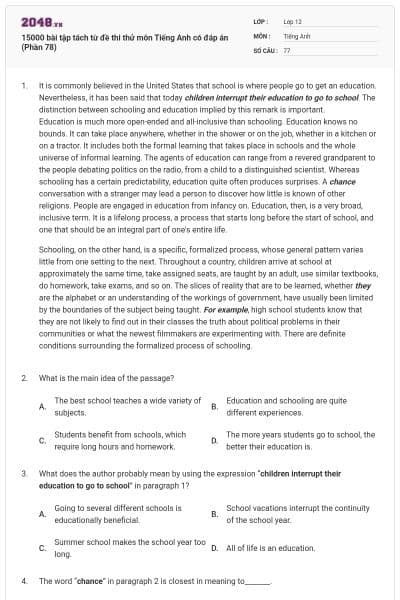
It is commonly believed in the United States that school is where people go to get an education. Nevertheless, it has been said that today children interrupt their education to go to school. The distinction between schooling and education implied by this remark is important.
Education is much more open-ended and all-inclusive than schooling. Education knows no bounds. It can take place anywhere, whether in the shower or on the job, whether in a kitchen or on a tractor. It includes both the formal learning that takes place in schools and the whole universe of informal learning. The agents of education can range from a revered grandparent to the people debating politics on the radio, from a child to a distinguished scientist. Whereas schooling has a certain predictability, education quite often produces surprises. A chance conversation with a stranger may lead a person to discover how little is known of other religions. People are engaged in education from infancy on. Education, then, is a very broad, inclusive term. It is a lifelong process, a process that starts long before the start of school, and one that should be an integral part of one's entire life.
Schooling, on the other hand, is a specific, formalized process, whose general pattern varies little from one setting to the next. Throughout a country, children arrive at school at approximately the same time, take assigned seats, are taught by an adult, use similar textbooks, do homework, take exams, and so on. The slices of reality that are to be learned, whether they are the alphabet or an understanding of the workings of government, have usually been limited by the boundaries of the subject being taught. For example, high school students know that they are not likely to find out in their classes the truth about political problems in their communities or what the newest filmmakers are experimenting with. There are definite conditions surrounding the formalized process of schooling.
What is the main idea of the passage?
The best school teaches a wide variety of subjects.
Education and schooling are quite different experiences.
Students benefit from schools, which require long hours and homework.
The more years students go to school, the better their education is.
Đáp án B
Ý chính của bài đọc là?
A. Trường học tốt nhất dạy cho học sinh đa dạng các môn học.
B. Việc học hỏi và đến trường là hai trải nghiệm khác nhau.
C. Học sinh có lợi từ việc đến trường, điều đòi hỏi nhiều giờ học và làm bài tập.
D. Học sinh đến trường càng nhiều năm, tri thức của chúng càng nhiều.
Người ta nói: “today children interrupt their education to go to school. The distinction between schooling and education implied by this remark is important.”
Từ đây có thể thấy, việc học hỏi và việc đến trường là hai trải nghiệm khác nhau.
What does the author probably mean by using the expression “children interrupt their education to go to school” in paragraph 1?
Going to several different schools is educationally beneficial.
School vacations interrupt the continuity of the school year.
Summer school makes the school year too long.
All of life is an education.
Đáp án D
Tác giả có ý gì khi nói “trẻ em tạm ngừng sự học để đến trường” trong đoạn 1?
A. Đến nhiều trường khác nhau là có lợi về mặt giáo dục.
B. Các kì nghỉ của trường học làm gián đoạn năm học.
C. Học kì hè khiến năm học kéo quá dài.
D. Sự học là chuyện cả đời.
Đọc bài, ta sẽ thấy tác giả nói đến sự học như một khái niệm toàn diện và tổng quát, nó bao gồm học hỏi về mọi thứ, tuy nhiên việc đến trường lại là để học các môn học, với tầm hiểu biết giới hạn đối với một vài phương diện.
Đồng thời, tác giả cũng nói: “It is a lifelong process, a process that starts long before the start of school, and one that should be an integral part of one's entire life.” (Nó là một quá trình kéo dài, một quá trình bắt đầu rất lâu từ trước khi ta bắt đầu đi học, và nên là một phần không thể thiếu trong cả cuộc đời mỗi người.)
Có thể thấy, nói đến việc “trẻ em tạm ngừng sự học để đến trường” là ý nói việc đến trường chỉ là một phần nhỏ, còn sự học lại là chuyện cả đời.
The word “chance” in paragraph 2 is closest in meaning to_______.
unplanned
unusual
lengthy
lively
Đáp án A
Từ “chance” trong đoạn 2 gần nghĩa nhất với _______
A. không tính trước B. không thường xuyên
C. kéo dài D. sống động
Chance (adj): tình cờ, bất ngờ = unplanned: không dự tính trước
The word “they” in paragraph 3 refers to ____________.
slices of reality
similar textbooks
boundaries
seats
Đáp án A
Từ “they” ở đoạn 3 nói đến _______
A. những lát cắt của thực tế
B. những quyển sách giáo khoa giống nhau
C. giới hạn
D. chỗ ngồi
“The slices of reality that are to be learned, whether they are the alphabet or…”
(Những lát cắt của thực tế cuộc sống mà ta được học, cho dù chúng là bảng chữ cái hay …)
Dễ thấy they là thay thế cho cụm the slices of reality.
The phrase “For example,” in paragraph 3, introduces a sentence that gives examples of _________.
similar textbooks
the results of schooling
the workings of a government
the boundaries of classroom subjects
Đáp án D
Từ “they” ở đoạn 3 nói đến _______
A. những lát cắt của thực tế
B. những quyển sách giáo khoa giống nhau
C. giới hạn
D. chỗ ngồi
“The slices of reality that are to be learned, whether they are the alphabet or…”
(Những lát cắt của thực tế cuộc sống mà ta được học, cho dù chúng là bảng chữ cái hay …)
Dễ thấy they là thay thế cho cụm the slices of reality.
The passage supports which of the following conclusions?
Without formal education, people would remain ignorant.
Education systems need to be radically reformed.
Going to school is only part of how people become educated.
Education involves many years of professional training.
Đáp án C
Bài đọc ủng hộ kết luận nào sau đây?
A. Nếu không có giáo dục chính quy, người ta sẽ mãi ngu dốt.
B. Hệ thống giáo dục cần được cải cách.
C. Đến trường chỉ là một phần trong sự học của mỗi người.
D. Sự học đòi hỏi nhiều năm đào tạo chuyên sâu.
Nói về sự học, tác giả cho rằng: “It includes both the formal learning that takes place in school and the whole universe of informal learning” (Nó bao gồm cả việc học ở trường và cả thế giới rộng lớn của việc học không theo quy củ nào)
Như vậy, đến trường chỉ là một phần trong quá trình học của con người.
The passage is organized by ___________________________.
listing and discussing several educational problems
contrasting the meanings of two related words
narrating a story about excellent teachers
giving examples of different kinds of schools
Đáp án B
Bài đọc được sắp xếp theo cách _______
A. liệt kê và bàn luận vài vấn đề giáo dục.
B. đối chiếu ý nghĩa của hai từ liên quan.
C. thuật lại một câu chuyện về những giáo viên tuyệt vời.
D. đưa ra ví dụ về các kiểu trường khác nhau.
Hai khái niệm được nhắc đến xuyên suốt bài đọc là “education” và “schooling”
Trong đó, education, sự học là một khái niệm toàn diện, bao quát và gắn với hiểu biết chung về mọi thứ. Trong khi schooling, việc đi học mang tính giới hạn, chỉ gắn với những hiểu biết nhất định và có hạn chế.
Từ đó, ta thấy bài đọc được hình thành bằng việc làm rõ sự tương phản, khác biệt giữa hai khái niệm có liên quan đến nhau.
The writer seems to agree that _________.
Schooling is more important than education
Education is not as important as schooling
Schooling is unlimited and more informal
Education is more influential than schooling
Đáp án D
Tác giả có vẻ đồng tình với ________
A. Việc đến trường quan trọng hơn sự học.
B. Sự học không quan trọng bằng việc đến trường.
C. Việc đến trường không có giới hạn và nó ít mang tính chính quy hơn.
D. Sự học có sức tác động hơn việc đến trường.
Từ nội dung bài đọc, ta biết được việc đến trường chỉ là một phần trong cả quá trình con người học hỏi, trong khi việc học lại là một phần không thể thiếu, có tác động to lớn đến cuộc sống của mỗi người. Do đó, dễ thấy sự học có sức ảnh hưởng hơn so với việc đến trường.
Read the following passage and mark the letter A, B, C or D on your answer sheet to indicate the correct answer to each of the questions.
Students working for their first degree at university are called undergraduates. Then they take their degree we say they graduate, and then they are called graduates. If they continue studying at university after they have graduated, they are called post-graduates. Full-time university students spend all their free time studying. They have no other employment. Their course usually lasts for three or four years. Medical students have to follow a course lasting for six or seven years. Then they graduate as doctors. In Britain, full-time university students have three terms of about ten weeks in each year. During these terms they go to lectures or they study by themselves. Many students become members of academic societies and sports clubs and take part in their activities. Between the university terms they have vacations (or holiday periods). Their vacations are long, but of course they can use them to study at home.
Students who continue studying at university after having graduated are called ________.
graduates
pre-graduates
undergraduates
post-graduates
Đáp án D
Sinh viên tiếp tục theo học tại đại học sau khi tốt nghiệp được gọi là ________.
A. cử nhân B. pre-graduates (từ này không có nghĩa)
C. sinh viên chưa tốt nghiệp D. nghiên cứu sinh
Câu 3: “If they continue studying at university after they have graduated, they are called post-graduates.”
The word “graduate” in line 2 is closest in meaning to __________.
finish studying
start studying
study
learn
Đáp án A
Từ “graduate” ở dòng 2 gần nghĩa nhất với _______
A. hoàn thành việc học B. bắt đầu việc học C, D. học
(to) graduate (v): tốt nghiệp ≈ hoàn thành việc học
According to the passage, the full-time university students have ________ of about 10 weeks in each year.
two terms
four terms
seven terms
three terms
Đáp án D
Theo như đoạn văn, sinh viên chính quy có _______ kéo dài khoảng 10 tuần mỗi năm.
A. 2 học kỳ B. 4 học kỳ C. 7 học kỳ D. 3 học kỳ
Ta có: “In Britain, full-time university students have three terms of about ten weeks in each year.”
The word “employment” in line 4 refers to the ________.
work
music
play
money
Đáp án A
Từ “employment” trong dòng 4 nói đến ________
A. công việc B. âm nhạc C. chơi đùa D. tiền
Employment (n) ≈ work (n): công việc, việc làm
Medical students have to follow a course lasting for _________.
four to five years
only 4 years
six or seven years
about 5 years
Đáp án C
Sinh viên Y phải theo học khoá kéo dài ________.
A. 4 đến 5 năm B. chỉ 4 năm C. 6 đến 7 năm D. khoảng 5 năm
Ta có: “Medical students have to follow a course lasting for six or seven years.”
The word “vacations” in line 9 could be best replaced by __________.
times
holidays
visits
picnics
Đáp án B
Từ “vacations” ở dòng 9 có thể được thay thế bởi _______.
A. lần B. kỳ nghỉ lễ C. chuyến thăm D. buổi dã ngoại
Vacation (n) ≈ Holiday (n): kỳ nghỉ
According to the passage, students working for their first degree at __________ are called undergraduates.
an university
laboratory
university
library
Đáp án C
Theo như đoạn văn, sinh viên học để lấy tấm bằng đầu tiên ở _______ được gị là sinh viên chưa tốt nghiệp.
A. đại học B. phòng thí nghiệm C. đại học D. thư viện
Theo ý câu đầu tiên, từ cần điền ở đây là đại học, nên loại B và D.
Đây là câu hỏi về kiến thức mạo từ a/an. Trong đó, từ university được phát âm /ˌjuː.nəˈvɝːsə.ti/, bắt đầu bằng phụ âm nên ta dùng mạo từ a.
Which of the following is NOT mentioned in the passage as full-time university students?
have other work
go to lectures
study by themselves
become members of sports clubs
Đáp án A
Điều nào sau đây không được nhắc đến khi nói về sinh viên chính quy?
A. có công việc khác bên ngoài B. đến học tại giảng đường
C. tự học D. làm thành viên câu lạc bộ thể thao
Khi nói về sinh viên chính quy tại đại học, tác giả có nhắc: “They have no other employment… they go to lectures or they study by themselves.
Many students become members of academic societies and sports clubs and take part in their activities.” (Họ không có công việc khác ở ngoài… họ đến học tại giảng đường hoặc tư học. Nhiều sinh viên trở thành thành viên các câu lạc bộ học tập hoặc thể thao và tham gia các hoạt động tại đó.)
Read the following passage and mark the letter A, B, C or D on your answer sheet to indicate the correct answer to each of the questions.
It is difficult to write rules that tell exactly when we should apologize, but it is not difficult to learn how. If we have done something to hurt someone’s feeling or if we have been impolite or rude, we should apologize. An apology indicates that we realize we have made a mistake, and we are sorry for it. It is a way of expressing our regret for something. When we apologize, we admit our wrongdoing, usually offer a reason for it, and express regret.
The simplest way to apologize is to say “I’m sorry”, but often that is not enough. Let’s take a common situation. Mario is late for class and enters the classroom, interrupting the teacher in the middle of the class. What does he do? The most polite action is usually to take a seat as quietly as possible and apologize later. But if the teacher stops and waits for him to say something, he could apologize simply “I’m sorry I’m late”, ask permission to take his seat, and sit down. Naturally, more than this, a reason for the tardiness, is needed, but this is not the time or the place for it because he has already caused one interruption and doesn’t need to make it any longer or worse than it already is.
When we apologize, ________
we express our sadness and unluckiness.
we realize our wrongdoing.
we express our happiness.
we admit our wrongdoing, offer a reason for it, and express regret.
Đáp án D
Khi xin lỗi, __________
A. ta bày tỏ nỗi buồn và sự bất hạnh.
B. ta nhận ra điều mình làm sai.
C. ta bày tỏ sự hạnh phúc.
D. ta thừa nhận việc mình làm sai, đưa ra lý do, và bày tỏ sự hối lỗi.
Câu cuối đoạn 1: “When we apologize, we admit our wrongdoing, usually offer a reason for it, and express regret.”
We should apologize _____________
when we feel tired and make mistake.
when we have been impolite, rude or done something to hurt someone’s feeling.
when we are angry with somebody about something.
when we are not happy or lose something.
Đáp án B
Ta nên xin lỗi ___________
A. khi mình thấy mệt và gây lỗi.
B. khi mình cư xử khiếm nhã, thô lỗ và làm tổn thương người khác.
C. khi mình tức giận với người khác về điều gì đó.
D. khi mình không vui hay làm mất thứ gì đó.
Câu 2 đoạn 1: “If we have done something to hurt someone’s feeling or if we have been impolite or rude, we should apologize.”
Is it difficult to learn how to apologize somebody?
Yes, it is
not difficult
No, it isn’t
No, hasn’t
Đáp án C
Học cách xin lỗi người khác có khó không?
A. Có, nó khó. B. không khó
C. Không, nó không khó D. Không, chưa từng
Câu 1 đoạn 1: “It is difficult to write rules that tell exactly when we should apologize, but it is not difficult to learn how.” (Rất khó để viết ra quy tắc quy định chính xác lúc nào nên xin lỗi, nhưng học cách xin lỗi ra sao lại không khó.)
Như vậy ta biết, câu trả lời cho câu hỏi này là không.
Vận dụng kiến thức cơ bản về cách trả lời câu hỏi Yes/No ta chọn được đáp án C.
The word “rude” in paragraph 1 could be best replaced by ________.
incorrect behavior
polite
correct behavior
good behavior
Đáp án A
Từ “rude” ở đoạn 1 có thể được thay thế bởi __________
A. cách hành xử sai lệch B. lịch sự
C. cách hành xử đúng D. cách hành xử tốt
Rude (adj): thô lỗ (đây là cách hành xử sai lệch), vậy chọn A.
What is the simplest way to apologize?
We express our regret.
We said nothing.
We say “I’m sorry”.
We admit our wrongdoing.
Đáp án C
Cách đơn giản nhất để xin lỗi là?
A. Bày tỏ sự hối lỗi. B. Không nói gì hết.
C. Nói “Tôi xin lỗi”. D. Thừa nhận điều mình sai.
Câu 1 đoạn 2: The simplest way to apologize is to say “I’m sorry”.
It is ________ to write the rules that tell exactly when we should apologize.
common
simple
easy
difficult
Đáp án D
Rất _______ để viết ra quy tắc quy định chính xác lúc nào thì nên xin lỗi.
A. bình thường B. đơn giản C. dễ dàng D. khó
Câu đầu tiên trong bài đọc: “It is difficult to write rules that tell exactly when we should apologize…”
Which of the following is NOT mentioned in the passage as the most polite action in Mario’s case?
keep quiet
apologize later
interrupt the teacher
take a seat
Đáp án C
Đâu không phải là hành động lịch sự nhất trong trường hợp của Mario như bài đọc đề cập?
A. giữ trật tự B. xin lỗi sau
C. ngắt mạch giáo viên D. ngồi vào chỗ
Trả lời cho câu hỏi “What does he do?” tác giả nói “The most polite action is usually to take a seat as quietly as possible and apologize later.”
Như vậy, giữ trật tự ngồi vào chỗ và xin lỗi sau là hành động lịch sự đơn giản nhất, còn việc ngắt mạch giáo viên là không phù hợp.
Read the following passage and mark the letter A, B, C, or D on your answer sheet to indicate the correct answer to each of the questions.
On the fourth Thursday in November, in houses around the United States, families get together for a feast, or a large meal. Almost all families eat turkey and cranberry sauce for this meal, and have pumpkin pie for dessert. This feast is part of a very special day, the holiday of Thanksgiving.
In 1620 the Pilgrims made a difficult trip across the ocean from England. They landed in what is now Massachusetts. In England the Pilgrims had not been allowed to freely practice their religion. So they went to the New World in search of religious freedom.
The Pilgrims' first winter was very hard. Almost half the group died of cold, hunger and disease. But the Indians of Massachusetts taught the Pilgrims to plant corn, to hunt and to fish. When the next fall came, the Pilgrims had plenty of food. They were thankful to God and the Indians and had a feast to give thanks. They invited the Indians to join them. This was the first Thanksgiving.
Thanksgiving became a national holiday many years later because of the effort of a woman named Sarah Hale. For forty years Sarah Hale wrote to each president and asked for a holiday of Thanksgiving. At last she was successful. In 1863 President Lincoln declared Thanksgiving a holiday.
How much is Thanksgiving today like the Pilgrims’ Thanksgiving? In many ways they are different. For example, historians think that the Pilgrims ate deer, not turkey. The idea of Thanksgiving, though, is very much the same: Thanksgiving is a day on which we celebrate and give thanks.
When did the the Pilgrims make a difficult trip to across the ocean from England?
in 1863
in 1621
in 1830
in 1620
Đáp án D
Những Người Hành hương đã thực hiện chuyến đi khó khăn vượt đại dương từ nước Anh vào khi nào?
A. năm 1863 B. năm 1621 C. năm 1830 D. năm 1620
Dẫn chứng ở câu đầu tiên – đoạn 2: “In 1620 the Pilgrims made a difficult trip across the ocean from England” – (Vào năm 1620, những Người Hành hương đã thực hiện chuyến đi khó khăn vượt đại dương từ nước Anh).
The Pilgrims immigrated to the New World because______.
They wanted to search for religious freedom.
They wanted to be taught how to plant corn.
They wanted to have more land to cultivate.
They wanted to make a difficult trip.
Đáp án A
Những Người Hành hương nhập cư vào Thế giới mới bởi vì ______.
A. Họ muốn tìm kiếm sự tự do trong tôn giáo.
B. Họ muốn được dạy cách trồng ngô.
C. Họ muốn có nhiều đất đai để canh tác.
D. Họ muốn thực hiện 1 chuyến đi khó khăn.
Dẫn chứng ở câu 2- đoạn 2: “In England the Pilgrims had not been allowed to freely practice their religion. So they went to the New World in search of religious freedom.” – (Ở Anh, những Người Hành hương không được cho phép tự do tổ chức các hoạt động tôn giáo. Cho nên họ tới Thế giới mới để tìm lại sự tự do tôn giáo).
According to the passage, today’s Thanksgiving ______.
is only celebrated in Massachusetts.
is a day on which the Pilgrims eat deer.
is different from the Pilgrims’s Thanksgiving in many ways.
is just like the Pilgrims’s Thanksgiving.
Đáp án C
Theo như đoạn văn, Lễ tạ ơn ngày nay______.
A. chỉ được tổ chức ở Massachusetts.
B. là ngày mà những Người Hành hương ăn thịt hươu.
C. khác với Lễ tạ ơn của những Người Hành hương trên nhiều phương diện.
D. giống với Lễ tạ ơn của những Người Hành hương.
Dẫn chứng ở câu đầu tiên- đoạn 4: “How much is Thanksgiving today like the Pilgrims’ Thanksgiving? In many ways they are different” – (Bao nhiêu phần của Lễ tạ ơn ngày nay giống với Lễ tạ ơn của những Người Hành hương? Trên nhiều phương diện thì chúng khác nhau).
Which of the following is NOT true about Thanksgiving?
It is celebrated on the fourth Thursday on November.
It is a day on which Americans celebrate and give thanks.
Americans usually have turkey, cranberry sauce and pumpkin pie for this occasion.
It became a national holiday thanks to President Lincoln’s 40-year efforts.
Đáp án D
Điều nào sau đây KHÔNG đúng về Lễ tạ ơn?
A. Nó được tiến hành vào thứ 5 tuần thứ 4 trong tháng 11.
B. Nó là ngày mà người Mĩ ăn mừng và thể hiện lòng cảm tạ.
C. Người Mỹ thường có gà tây, sốt cranberry và bánh bí ngô cho dịp này.
D. Nó đã trở thành kỳ nghỉ quốc lễ nhờ vào nỗ lực của Tổng thống Lincoln trong 40 năm.
Dẫn chứng ở câu đầu tiên- Đoạn 4: “Thanksgiving became a national holiday many years later because of the effort of a woman named Sarah Hale” – (Lễ tạ ơn trở thành kì nghỉ quốc lễ sau nhiều năm nỗ lực của người phụ nữ tên Sarah Hale) => D sai.
The word “they” in paragraph 3 refer to ______.
families
the Pilgrims
thanks
the Native Americans
Đáp án B
Từ “they” ở đoạn 3 ám chỉ tới ______.
A. các gia đình.
B. những Người Hành hương.
C. lời cảm ơn.
D. những người Mĩ bản địa.
Thấy “They” đứng đầu câu là chủ ngữ, ta đọc lên câu phía trước: “When the next fall came, the Pilgrims had plenty of food. They were thankful to God and the Indians and had a feast to give thanks”- (Khi mùa thu tiếp theo tới, những Người Hành hương đã có rất nhiều thức ăn. Họ biết ơn Chúa và những người da đỏ, và đã làm 1 bữa tiệc để tỏ lòng biết ơn) => “They” chỉ có thể là ám chỉ “the Pilgrims”.
Read the following passage and mark the letter A, B, C, or D on your answer sheet to indicate the correct answer to each of the questions.
As working women continue to receive better and better wages, housewives still work at home without receiving pay – checks. Should a woman who works at home, doing the housework and caring for children, be paid for her service? In a 1986 study at Cornell University, sociologists found that the value of the services of a housewife averaged $ 11,600 a year. This rate was based on a family composed of a husband, wife, and three young children. The $ 11,600 is what the husband would have to pay if he hired others to take over his wife’s household chores. The researchers concluded that it would be fair for husbands to pay wives according to federal guidelines for minimum wages.
Another plan for rewarding women who work at home has been suggested by a former Secretary of Health and Human Services. He says that full-time housewives should be allowed to pay social security taxes, with their employers contributing part of the payment. He feels that the present system is unfair. He said, “ If you stay at home and raise a family, nobody will give you credit for it.”
What is the main purpose of this passage ?
To suggest that housewives should be paid for their household chores.
To ask men to treat wives better.
To encourage women to go out to work.
To suggest that men should share the housework with their wives.
Đáp án A
Đâu là mục đính chính của đoạn văn?
A. Để đề nghị rằng các bà nội trợ nên được trả lương cho công việc nhà.
B. Để yêu cầu người đàn ông cư xử tốt với vợ hơn.
C. Để khuyến khích phụ nữ ra ngoài làm việc.
D. Để đề nghị rằng người đàn ông nên chia sẻ việc nhà với vợ.
Giải thích: Đoạn đầu ta thấy: “…housewives still work at home without receiving pay – checks. Should a woman who works at home, doing the housework and caring for children, be paid for her service…” – (các bà nội trợ vẫn tiếp tục làm việc tại nhà mà không nhận được 1 đồng lương nào. Những người phụ nữ đó nên được trả công cho những dịch vụ mà họ đã làm như làm việc nhà và chăm trẻ…) và đoạn cuối cũng đề xuất thêm “…He says that full-time housewives should be allowed to pay social security taxes, with their employers contributing part of the payment…”- (Ông nói rằng các bà nội trợ làm việc toàn thời gian nên được phép đóng thuế an sinh xã hội, cùng với chủ sử dụng lao động đóng góp vào một khoản trong đó). Chung quy lại,xuyên suốt từ đầu đến cuối bài lặp đi lặp lại ý những người phụ nữ làm việc nhà nên được trả công
A housewife’s services in a family of five people are worth______.
$ 160 a mouth on average
nearly $ 1,000 a mouth on average.
more than $ 1,000 a mouth on average.
$ 1,600 a mouth on average.
Đáp án B
Sự phục vụ của 1 người vợ nội trợ trong gia đình đáng giá ______.
A. trung bình 1 tháng 160 đô la.
B. trung bình 1 tháng gần 1.000 đô la.
C. trung bình 1 tháng hơn 1.000 đô la.
D. trung bình 1 tháng 1.600 đô la.
Dẫn chứng ở câu 3- đoạn 1: “In a 1986 study at Cornell University, sociologists found that the value of the services of a housewife averaged $ 11,600 a year.” – (Theo như nghiên cứu vào năm 1896 ở trường Đại học Cornell, các nhà xã hội học đã thấy rằng giá cả những dịch vụ mà 1 người nội trợ làm trong gia đình trung bình là 11,600 đô la 1 năm) => Trung bình gần 1000 đô la 1 tháng.
According to the researchers, husbands should ______.
pay wages to their wives for their housework.
hire others to take over their wives’ household chores.
help their wives with the housework.
care for the children.
Đáp án A
Theo các nhà nghiên cứu, những người chồng nên ______.
A. trả lương vợ theo công việc nhà.
B. thuê người khác tiếp nhận công việc nhà của vợ mình.
C. giúp vợ làm việc nhà.
D. chăm sóc con cái.
Dẫn chứng câu cuối đoạn 1: “The researchers concluded that it would be fair for husbands to pay wives according to federal guidelines for minimum wages.” – (Các nhà nghiên cứu kết luận rằng sẽ là công bằng nếu người chồng trả lương cho vợ theo chính sách liên bang về mức lương tối thiểu).
The word “employers” in the passage refers to ___________.
their sponsors
their husband
their owners
their bosses
Đáp án B
Từ “employers” ám chỉ tới ______.
A. những nhà tài trợ
B. những người chồng
C. những người chủ
D. những người sếp
Giải nghĩa: “He says that full-time housewives should be allowed to pay social security taxes, with their employers contributing part of the payment” – (Ông nói rằng các bà nội trợ làm việc toàn thời gian nên được phép đóng thuế an sinh xã hội, cùng với chủ sử dụng lao động đóng góp vào một khoản trong đó) => “Người chủ sở hữu lao động” ở đây chính là ám chỉ tới những người chồng có vợ làm nội trợ trong gia đình.
What is NOT true about the passage?
Full-time housewives are allowed to pay social security taxes.
Women who go to work get more offers than housewives
Unlike working women, housewives get no pay for housework.
Housewives’services should be rewarded.
Đáp án A
Ý nào là KHÔNG đúng theo như đoạn văn?
A. Phụ nữ làm việc toàn thời gian được phép nộp thuế an sinh xã hội.
B. Phụ nữ đi làm nhận được nhiều lời đề nghị hơn các bà nội trợ.
C. Không giống như những phụ nữ đi làm, các bà nội trợ không được trả lương cho công việc nhà.
D. Sự phục vụ của những người nội trợ nên được khen thưởng.
Giải thích: Ý A chỉ ở mức kế hoạch chứ chưa phải là thực tế của bài.
“Another plan for rewarding women who work at home has been suggested by a former Secretary of Health and Human Services. He says that full-time housewives should be allowed to pay social security taxes, with their employers contributing part of the payment” – (Một kế hoạch khen thưởng dành cho phụ nữ làm việc ở nhà đã được đề xuất bởi cựu Bộ trưởng Y tế và Dịch vụ Nhân sinh. Ông nói rằng các bà nội trợ làm việc toàn thời gian nên được phép đóng thuế an sinh xã hội, cùng với chủ sử dụng lao động đóng góp vào một khoản trong đó).
Read the following passage and mark the letter A, B, C, or D on your answer sheet to indicate the correct answer to each of the questions.
It is a characteristic of human nature that people like to get together and have fun, and people live during America's frontier days were no exception. However, because life was hard and the necessities of day-to-day living took up their time, it was common for recreation to be combined with activities necessary for survival. One example of such a form of recreation was logrolling. Many frontier areas were heavily wooded, and in order to settle an area it was necessary to move the trees. A settler could cut down the trees alone, but help was needed to move the cut trees. After a settler had cut a bunch of trees, he would then invite is neighbours over for a logrolling. A logrolling is a community event where families got together for a combination of work and fun. The women would bring food and have a much needed and infrequent opportunity to relax and chat with friends, the children would play together exuberantly, and the men would hold lively competitions that involved rolling logs from place to place as quickly as possible. This was a day of fun for everyone involved, but as its foundation was the need to clear the land.
The main idea of the passage is that in America's frontier days ________ .
people combined work with recreation
people cleared land by rolling logs
it was necessary for early settlers to clear the land
a logrolling involved the community
Đáp án A
Ý chính của đoạn văn là ở những ngày ở biên giới Hoa Kỳ ________ .
A. người ta kết hợp làm việc với giải trí
B. người ta giả phóng mặt đất bằng cách lăn những khúc gỗ
C. nó cần thiết cho người dân định cư ở đây từ sớm giải phóng mặt đất.
D. việc di chuyển gỗ cùng nhau liên quan đến cả cộng đồng
Thông tin ở câu chủ đề của đoạn văn: “It is a characteristic of human nature that people like to get together and have fun, and people live during America's frontier days were no exception. However, because life was hard and the necessities of day-to-day living took up their time, it was common for recreation to be combined with activities necessary for survival.” (Đó là một đặc điểm tự nhiên con người mà mọi người thích kết thân và vui chơi, và những người sống những ngày bên cạnh biên giới của Mỹ cũng không ngoại lệ. Tuy nhiên, vì cuộc sống thật khó khăn và những nhu cầu thiết yếu của cuộc sống hằng ngày đã chiếm hết thời gian của họ, nên họ thường kết hợp giải trí với các hoạt động cần thiết để sống còn.)
Tiếp đó tác giả lấy ví dụ về logrolling để chứng minh cho điều đó. => Ý chính của đoạn văn là đáp án A.
Dịch bài đọc
Bản chất con người là thích tụ tập và vui chơi, và những người sống trong thời kỳ biên giới của nước Mỹ cũng không ngoại lệ. Tuy nhiên, vì cuộc sống khó khăn và những nhu cầu thiết yếu của cuộc sống hàng ngày chiếm hết thời gian của họ, nên việc giải trí thường được kết hợp với các hoạt động cần thiết để sinh tồn. Một ví dụ về hình thức giải trí như vậy là đốn gỗ. Nhiều vùng biên giới có nhiều rừng rậm, và để định cư ở một khu vực, cần phải di chuyển cây. Người định cư có thể tự chặt cây, nhưng cần có người giúp đỡ để di chuyển những cây đã chặt. Sau khi người định cư chặt một loạt cây, họ sẽ mời hàng xóm đến để đốn gỗ. Đốn gỗ là một sự kiện cộng đồng, nơi các gia đình tụ họp lại để kết hợp công việc và vui chơi. Phụ nữ sẽ mang theo thức ăn và có cơ hội rất cần thiết và hiếm hoi để thư giãn và trò chuyện với bạn bè, trẻ em sẽ chơi đùa cùng nhau một cách vui vẻ, và đàn ông sẽ tổ chức các cuộc thi sôi nổi liên quan đến việc lăn gỗ từ nơi này sang nơi khác càng nhanh càng tốt. Đây là một ngày vui vẻ cho tất cả mọi người tham gia, nhưng nền tảng của nó là nhu cầu khai hoang đất đai.
The expression day-to-day could best be replaced by which of the following?
daytime
every day
day after day
today
Đáp án B
Từ day-to-day trong đoạn văn có thể thay thế bằng cụm nào dưới đây?
A. daytime (n): ban ngày
B. everyday: hàng ngày
C. day after day: ngày này qua ngày khác
D. today: ngày hôm nay
day-to-day = everyday: hàng ngày
According to the passage, what did people have to do first to settle an area?
Develop recreation ideas
Build farms
Get rid of the trees
Invite neighbors over
Đáp án C
Theo đoạn văn, người ta phải làm gì đầu tiên để định cư ở một khu vực?
A. Phát triển những ý tưởng về sự giải trí
B. Xây dựng trang trại
C. Loại bỏ cây cối
D. Mời hàng xóm ghé qua
Thông tin ở câu: “Many frontier areas were heavily wooded, and in order to settle an area it was necessary to move the trees” (Nhiều khu vực biên giới được bao phủ bởi cây, và để giải tỏa khu vực đó điều cần thiết là di chuyển những cái cây đi chỗ khác.)
According to the passage, which of the following is NOT true about a logrolling?
It involved a lot of people.
It could be enjoyable.
There could be a lot of movement.
It was rather quiet.
Đáp án D
Theo đoạn văn, điều sau đây KHÔNG đúng về việc cùng nhau di chuyển gỗ?
A. Nó liên quan đến rất nhiều người.
B. Nó có thể rất thú vị.
C. Có thể có rất nhiều sự di chuyển.
D. Nó khá là yên tĩnh
Thông tin ở câu : “The women would bring food and have a much needed and infrequent opportunity to relax and chat with friends, the children would play together exuberantly, and the men would hold lively competitions that involved rolling logs from place to place as quickly as possible.” (Phụ nữ sẽ mang thức ăn và có cơ hội cần thiết và không thường xuyên để thư giãn và trò chuyện cùng bạn bè, các em bé sẽ vui chơi cùng nhau một cách hào hứng và những người đàn ông sẽ tổ chức các cuộc thi sôi động liên quan đến việc lăn các khúc gỗ từ nơi này sang nơi khác càng nhanh càng tốt.)
Việc đốn gỗ liên quan đến ất nhiều người và rất vui vẻ. Nó cũng cần rất nhiều sự di chuyển. => Đáp án A, B, C đúng.
Nó rất sôi động => đáp án D sai.
This passage would probably be assigned reading in which of the following courses?
Forestry
Environmental Studies
Psychology
History
Đáp án D
Đoạn này có thể sẽ được chỉ định đọc trong đó các khóa học nào sau đây?
A. Lâm nghiệp
B. Nghiên cứu môi trường
C. Tâm lý học
D. Lịch sử
Đoạn văn cho người đọc thông tin về logrolling, một nét văn hóa của con người trong lịch sử. => Bài đọc này liên quan đến môn lịch sử.
Read the following passage and mark the letter A, B, C, or D on your answer sheet to indicate the correct answer to each of the questions.
People travel for a lot of reasons: Some tourists go to see battlefields or religious shrines. Others are looking for culture, or simply want to have their pictures taken in front of famous places. But most European tourists are looking for a sunny beach to lie on.
Northern Europeans are willing to pay a lot of money and put up with a lot of inconveniences for the sun because they have so little of it. Residents of cities like London, Copenhagen, and Amsterdam spend a tot of their winter in the dark because the days are so short, and much of the rest of the year in the rain. This is the reason why the Mediterranean has always attracted them. Every summer, more than 25 million people travel to Mediterranean resorts and beaches for their vacation. They all come for the same reason, sun!
The huge crowds mean lots of money for the economies of Mediterranean countries. Italy’s 30,000 hotels are booked solid every summer. And 13 million people camp out on French beaches, parks and roadsides. Spain’s long sandy coastline attracts more people than anywhere else. 37 million tourists visit yearly, or one tourist for every person living in Spain.
But there are signs that the area is getting more tourists than it can handle. The Mediterranean is already one of the most polluted seas on earth. And with increased tourism, it’s getting worse. The French can’t figure out what to do with all the garbage left by campers around St. Tropez. And in many places, swimming is dangerous because of pollution.
None of this, however, is spoiling anyone’s fun. The Mediterranean gets more popular every year with tourists. Obviously, they don’t go there for clean water and solitude. They tolerate traffic jams and seem to like crowded beaches. They don’t even mind the pollution. No matter how dirty the water is, the coastline still looks beautiful. And as long as the sun shines, it’s still better than sitting in the cold rain in Berlin, London, or Oslo.
In paragraph 2, cities like London, Copenhagen, and Amsterdam are mentioned _______.
to prove that they have got more tourism than they handle.
to tell us how wealthy their people are.
to suggest that these cities lack places of historic interest and scenic beauty.
to show that they are not good cities in terms of geography and climate.
Đáp án D
Ở đoạn 2, các thành phố như London, Copenhagen và Amsterdam được đề cập tới để _______.
A. chứng minh rằng họ có nhiều khách du lịch trên mức có thể kiểm soát.
B. nói với chúng ta rằng người dân ở đó giàu đến như thế nào.
C. gợi ý rằng những thành phố này đang thiếu những địa điểm lịch sử và các cảnh quan đẹp.
D. chỉ ra rằng đó không phải là những thành phố có vị trí địa lí và khí hậu thuận lợi.
Dịch câu: “Residents of cities like London, Copenhagen, and Amsterdam spend a tot of their winter in the dark because the days are so short, and much of the rest of the year in the rain” – (Người dân ở London, Copenhagen, và Amsterdam gần như là tận hưởng mùa đông trong tiết trời âm u bởi ban ngày rất ngắn và trời thì mưa quanh năm).
According to the passage, which of the following factors might spoil the tourists’ fun at Mediterranean resorts and beaches?
Polluted water
Traffic jams
Rainy weather
Crowded buses
Đáp án C
Theo như đoạn văn, yếu tố nào sau đây có thể làm mất hứng du khách trên các khu nghỉ mát và bãi biển ở Địa Trung Hải?
A. Ô nhiễm nước.
B. Tắc đường.
C. Mưa nhiều.
D. Xe bus đông đúc.
Dẫn chứng ở 3 câu cuối bài: “The Mediterranean gets more popular every year with tourists. Obviously, they don’t go there for clean water and solitude. They tolerate traffic jams and seem to like crowded beaches. They don’t even mind the pollution. No matter how dirty the water is, the coastline still looks beautiful. And as long as the sun shines, it’s still better than sitting in the cold rain in Berlin, London, or Oslo.” – (Biển Địa Trung Hải đang ngày càng hút khách qua mỗi năm. Rõ ràng rằng du khách tới đó không phải do nước sạch hay sự yên tĩnh. Họ chịu đựng tắc đường và trông còn có vẻ thích các bãi biển đông đúc. Họ thậm chí không bận tâm tới ô nhiễm. Dù nước có bẩn đục tới đâu thì trông các bờ biển vẫn rất tuyệt. Và miễn sao mặt trời có chiếu nắng xuống, vẫn tốt hơn là sống dưới những cơn mưa lạnh ở Berlin, London, hay Oslo”.
The writer seems to imply that Europeans travel mostly for the reason that ______.
they want to see historic remains or religious spots.
they would like to take pictures in front of famous sites.
they wish to escape from the cold, dark and rainy days back at home.
they are interested in different cultural traditions and social customs.
Đáp án C
Nhà văn ám chỉ rằng người dân Châu Âu đi du lịch chủ yếu là do:
A. Họ muốn chiêm ngưỡng những di tích lịch sử và các điểm tôn giáo.
B. Họ muốn chụp ảnh trước những địa điểm nổi tiếng.
C. Họ muốn thoát khỏi những ngày lạnh lẽo, âm u và mưa nhiều ở quê nhà.
D. Họ quan tâm và thích thú các truyền thống văn hóa và những tập quán xã hội khác nhau.
Dẫn chứng ở đầu đoạn 2: “But most European tourists are looking for a sunny beach to lie on. Northern Europeans are willing to pay a lot of money and put up with a lot of inconveniences for the sun because they have so little of it. Residents of cities like London, Copenhagen, and Amsterdam spend a lot of their winter in the dark because the days are so short, and much of the rest of the year in the rain. This is the reason why the Mediterranean has always attracted them.” – (Hầu hết du khách Châu Âu mong mỏi được nghỉ dưỡng trên những bãi biển tràn ngập ánh nắng. Những người Bắc Âu thậm chí sẵn sàng chi mạnh tay và chịu đựng được những bất tiện do ánh nắng mang lại bởi họ đang rất thiếu thứ đó. Người dân ở London, Copenhagen, và Amsterdam gần như là tận hưởng mùa đông trong tiết trời âm u bởi ban ngày rất ngắn và trời thì mưa quanh năm. Đó là lí do mà biển Địa Trung Hải rất thu hút họ).
The latter half of the last sentence in paragraph 3, “or one tourist for every person living in Spain” means _____.
every Spanish is visited by a tourist every year.
every person living in Spain has to take care of a tourist annually.
every year almost as many tourists visit Spain as there are people living in that country.
all the 37 million people living in Spain are tourists.
Đáp án C
Nửa phần sau của câu cuối đoạn 3: “mỗi du khách đều tương đương với mỗi người dân sống ở Tây Ban Nha” có nghĩa là _______.
A. Mỗi năm, người dân Tây Ban Nha lại được 1 khách du lịch tới thăm.
B. Mỗi người dân Tây Ban Nha phải chăm sóc 1 khách du lịch vào hằng năm.
C. Hằng năm, gần như số khách du lịch tới Tây Ban Nha tương đương với số dân cư sống tại đây.
D. Có tất cả 37 triệu người sống ở Tây Ban Nha là khách du lịch.
Giải nghĩa: “Spain’s long sandy coastline attracts more people than anywhere else. 37 million tourists visit yearly, or one tourist for every person living in Spain.”– (Những bờ cát dài ở Tây Ban Nha thu hút nhiều khách du lịch hơn bất cứ nơi nào khác. Có 37 triệu du khách tới thăm hằng năm, hoặc có thể nói rằng mỗi du khách đều tương đương với mỗi người dân sống ở đây). => Hằng năm Tây Ban Nha tiếp đón 37 triệu du khách, số lượng này bằng với số dân cư ở Tây Ban Nha.
The word “tolerate” in paragraph 5 is closest in meaning to ______.
reject
endure
exclude
neglect
Đáp án B
Câu hỏi từ vựng.
tolerate (v): chịu dựng, khoa dung = endure (v): cam chịu.
Các đáp án còn lại:
A. reject (v): từ chối, loại bỏ.
B. exclude (v): tống cổ, ngăn chặn, đuổi học.
D. neglect (v): sao lãng, thờ ơ.
The word “solid” in paragraph 3 means most nearly the same as ______.
having no spaces inside.
seeming to be hard to book.
having less people than normal.
being uncomfortable to live in.
Đáp án A
Từ “solid” ở đoạn 3 gần nghĩa với _______.
A. không có khoảng rỗng bên trong.
B. trông có vẻ khó để đặt chỗ.
C. có ít người hơn thông thường.
D. không thoải mái để ở.
Solid (adj): đặc = A. không có khoảng rỗng bên trong.
According to the passage, which of the following countries attracts more tourists than the others?
Greece
France
Spain
Italy
Đáp án C
Theo như đoạn văn, nước nào dưới đây thu hút nhiều khách du lịch hơn những nước còn lại?
A. Hy Lạp
B. Pháp
C. Tây Ban Nha
D. Ý
Dẫn chứng ở câu 3- đoạn 4: “Spain’s long sandy coastline attracts more people than anywhere else” – (Những bờ cát dài ở Tây Ban Nha thu hút nhiều khách du lịch hơn bất cứ nơi nào khác).
Read the following passage and mark the letter A, B, C, or D on your answer sheet to indicate the correct answer to each of the questions.
People used to know more or less how their children would live. Now things are changing so quickly that they don’t even know what their own lives will be like in a few years’ time. What follows is not science fiction. It is how experts see the future.
You are daydreaming behind the steering wheel; is it too dangerous? No! That’s no problem because you have it on automatic pilot, and with its hi-tech computers and cameras, your car “know” how to get you home safe and sound.
What is for lunch? In the old days you used to stop off to buy a hamburger or a pizza. Now you use your diagnostic machine to find out which foods your body needs. If your body needs more vegetables and less fat, your food-preparation machine makes you a salad.
After lunch, you go down the hall to your home office. Here you have everything you need to do your work. Thanks to your information screen and your latest generation computer, you needn’t go to the office any more. The information screen shows an urgentmessage from a co-worker in Brazil. You can instantly send back a reply to him and go on to deal with other matters.
What does “its” in line 5 refer to?
the future
your home
your car
the steering wheel
Đáp án C
Từ “nó” ở dòng 5 ám chỉ tới?
A. tương lai
B. ngôi nhà của bạn
C. xe của bạn
D. vô lăng
Để biết “its” ám chỉ cái gì ta đọc lại toàn bộ vế câu chứa nó: “That’s no problem because you have it on automatic pilot, and with its hi-tech computers and cameras, your car “know” how to get you home safe and sound” – “Đó không còn là vấn đề nữa bởi bạn đã có bộ điều khiển tự động, và với thiết bị máy tính và camera công nghệ cao, xe bạn sẽ biết đâu là cách để đưa bạn về nhà an toàn) => “its” chỉ có thể là ám chỉ tới “your car”
What of the following statement is true about life in the future?
People will go to work as they do today.
Hi-tech equipment will be out of the question.
It will be dangerous to drive cars because they are too fast.
People can have balanced diets for their meal.
Đáp án D
Câu nào dưới đây đúng về cuộc sống trong tương lại?
A. Con người sẽ đi làm như cách mà họ vẫn làm ngày nay.
B. Thiết bị công nghệ cao là bất khả thi.
C. Lái xe là rất nguy hiểm bởi chúng quá nhanh.
D. Con người đã có thể cân bằng chế độ dinh dưỡng trong bữa ăn của họ.
Dẫn chứng ở đoạn 2: “Now you use your diagnostic machine to find out which foods your body needs. If your body needs more vegetables and less fat, your food-preparation machine makes you a salad.” – (Bạn có thể sử dụng máy chuẩn đoán để nhận biết loại thực phẩm nào là cơ thể đang cần. Nếu cơ thể bạn đang cần nhiều rau xanh và ít chất béo, máy chuẩn bị thức ăn sẽ làm cho bạn món sa-lát). => Ý D đúng.
Which of the following is NOT true about life in the future?
Eating is a problem because food contains too much fat
There’s no need to concentrate much when driving.
Contacts between people are almost instant.
Getting information is a matter of just a few seconds.
Đáp án A
Ý nào sau đây không đúng về cuộc sống trong tương lai?
A. Ăn uống trở thành một vấn đề bởi thức ăn chứa quá nhiều chất béo.
B. Không cần phải dành nhiều sự tập trung trong lúc lái xe.
C. Liên lạc với nhau gần như là tức thời.
D. Nhận được thông tin chỉ trong vài giây.
Dẫn chứng từ câu 31 ta có thể suy ra: Trong tương lai, với sự xuất hiện của máy chuẩn đoán có thể giúp ta phát hiện loại thực phẩm mà cơ thể đang cần và máy chuẩn bị thức ăn sẽ làm ra những món có hàm lượng dinh dưỡng phù hợp với yêu cầu đó => Việc thực phẩm chứa quá nhiều chất béo sẽ không còn là vấn đề.
Ngoài ra, các ý còn lại cũng được tìm thấy trong bài:
B. Dẫn chứng ở câu cuối đoạn 1: “That’s no problem because you have it on automatic pilot, and with its hi-tech computers and cameras, your car “know” how to get you home safe and sound” – (Đó không còn là vấn đề nữa bởi bạn đã có bộ điều khiển tự động, và với thiết bị máy tính và camera công nghệ cao, xe bạn sẽ biết đâu là cách để đưa bạn về nhà an toàn).
C+D. Dẫn chứng ở đoạn cuối: “Thanks to your information screen and your latest generation computer, you needn’t go to the office any more. The information screen shows an urgent message from a co-worker in Brazil. You can instantly send back a reply to him and go on to deal with other matters.” – (Nhờ màn hình thông tin và máy tính thế hệ mới nhất , bạn không cần phải đi đến văn phòng nữa. Màn hình thông tin sẽ hiển thị tin nhắn khẩn từ một đồng nghiệp ở Brazin. Bạn ngay lập tức có thể gửi câu trả lời tới anh ta và tiếp tục giải quyết các vấn đề khác).
According to the passage, what do people use a diagnostic machine for?
To make food for them.
To find out which foods their body needs
To provide them with food.
To sell food for humans.
Đáp án B
Theo như đoạn văn, con người sử dụng máy chuẩn đoán cho mục đích gì?
A. Để tạo ra thức ăn.
B. Để tìm ra loại thực phẩm mà cơ thể cần.
C. Để cung cấp thực phẩm.
D. Để bán thực phẩm.
Dẫn chứng ở đoạn 2: “Now you use your diagnostic machine to find out which foods your body needs”- (Bạn có thể sử dụng máy chuẩn đoán để nhận biết loại thực phẩm nào là cơ thể đang cần).
Which “reply” CLOSET in meaning to?
replay
request.
answer
question
Đáp án C
Câu hỏi từ vựng.
reply (v): đáp lại, hồi âm = answer (v+n): trả lời.
Các đáp án còn lại:
A. replay (v): chơi lại (thể thao), phát lại,…
B. request (v): thỉnh cầu, yêu cầu.
D. question (n+v): hỏi, câu hỏi.
Dịch: Bạn ngay lập tức có thể hồi âm lại anh ta và tiếp tục giải quyết các vấn đề khác
The word “urgent” in the last paragraph probably means _____.
expected
pressing
unnecessary
hurry
Đáp án D
Câu hỏi từ vựng.
urgent (adj): khẩn cấp = pressing (adj): cấp bách, cấp thiết.
Các đáp án còn lại.
A. expected (Ved+adj): mong chờ, đáng mong đợi.
C. unnecessary (adj): không cần thiết.
D. hurry (adj): hối hả, gấp rút.
Dịch: Màn hình thông tin sẽ hiển thị tin nhắn khẩn từ một đồng nghiệp ở Brazin
What is the main idea of the passage?
What life is like in the future.
The role of the computer in future life.
What foods people will eat in the future.
Life in the future will be the same as life at present.
Đáp án A
Đâu là ý chính của đoạn văn?
A. Cuộc sống sẽ như thế nào trong tương lai.
B. Vai tròn của máy tính trong tương lai.
C. Loại thực phẩm nào mà con người sẽ tiêu thụ trong tương lai.
D. Cuộc sống trong tương lao sẽ giống với cuộc sống hiện tại.
Sau khi làm những câu hỏi trên có thể dễ dàng suy ra được ý chính của bài là: Cuộc sống trong tương lại. Từ đoạn đầu tiên, câu chủ đề là: “What follows is not science fiction. It is how experts see the future” – (Những điều sau đây không phải là khoa học viễn tưởng. Đó là cách mà các chuyên gia nhìn thấy tương lai). Sau đó xuyên suốt toàn bài là những ý tưởng có thể phổ biến trong cuộc sống tương lai như: xe không người lái, máy chuẩn bị thức ăn, máy tính công nghệ cao.
Read the following passage and mark the letter A, B, C, or D on your answer sheet to indicate the correct answer to each of the questions.
Herman Melville, an American author best known today for his novel Moby Dick, was actually more popular during his lifetime for some of his other works. He traveled extensively and used the knowledge gained during his travels as the basis for his early novels. In 1837, at the age of eighteen, Melville signed as a cabin boy on a merchant ship that was to sail from his Massachusetts home to Liverpool, England. His experiences on this trip served as a basis for the novel Redburn (1849). In 1841 Melville set out on a whaling ship headed for the South Seas. After jumping ship in Tahiti, he wandered around the islands of Tahiti and Moorea. This South Sea island sojourn was a backdrop to the novel Omoo (1847). After three years away from home, Melville joined up with a U.S. naval frigate that was returning to the eastern United States around Cape Horn. The novel White-Jacket (1850) describes this lengthy voyage as a navy seaman.
With the publication of these early adventure novels, Melville developed a strong and loyal following among readers eager for his tales of exotic places and situations. However, in 1851, with the publication of Moby Dick, Melville's popularity started to diminish. Moby Dick, on one level the saga of the hunt for the great white whale, was also a heavily symbolic allegory of the heroic struggle of man against the universe. The public was not ready for Melville's literary metamorphosis from romantic adventure to philosophical symbolism. It is ironic that the novel that served to diminish Melville's popularity during his lifetime is the one for which he is best known today.
The main subject of the passage is_________.
Melville’s travels
Moby Dick
Melville’s personal background
the popularity of Melville’s novels.
Đáp án D
Đối tượng chính của đoạn văn là:
A. Những chuyến du hành của Melville.
B. Moby Dick.
C. Xuất thân của Melville.
D. Sự nổi tiếng của các tác phẩm của Melville.
Dẫn chứng dựa và ý đầu tiên của bài: “Herman Melville, an American author best known today for his novel Moby Dick, was actually more popular during his lifetime for some of his other works” – (Herman Melville- nhà văn người Mĩ nổi tiếng nhất hiện nay với tiểu thuyết Moby Dick, ông càng được biết tới rộng rãi hơn qua một vài tác phẩm khác trong suốt cuộc đời của mình).
The word “basis” in paragraph 1 is closest in meaning to_________.
background
message
bottom
dissertation
Đáp án A
basic = background (n): nền tảng.
Các đáp án còn lại:
B. message: thông điệp.
C. bottom: đáy, phần dưới cùng.
D. dissertation: luận án.
Dịch: Những trải nghiệm trong chuyến đi chính là nền tảng cho sự ra đời của cuốn Redburn (1849).
According to the passage, Melville’s early novels were__________.
published while he was traveling
completely fictional
all about his work on whaling ships
based on his travel experience
Đáp án D
Theo như đoạn văn, những cuốn tiểu thuyết đầu tiên của Melville:
A. được xuất bản trong khi ông đang đi phiêu lưu.
B. hoàn toàn là hư cấu.
C. tất cả đề nói về công việc săn cá voi.
D. dựa trên những trải nghiệm của ông qua các chuyến hành trình.
Dẫn chứng ở câu thứ 2 đoạn 1: “He traveled extensively and used the knowledge gained during his travels as the basis for his early novels” – (Ông đã đi chu du nhiều nơi và sử dụng những kiến thức có được từ những cuộc hành trình để làm cơ sở cho những cuốn tiểu thuyết đầu tiên ).
The passage implies that Melville stayed in Tahiti because____________.
he had unofficially left his ship
he was on leave while his ship was in port
he had finished his term of duty
he had received permission to take a vacation in Tahiti
Đáp án A
Đoạn văn ám chỉ việc Melville ở lại Tahiti bởi vì:
A. Ông đã không chính thức rời tàu của mình.
B. Ông đã rời đi khi tàu còn đang ở cảng.
C. Ông đã hoàn thành nhiệm kì.
D. Ông đã nhận được sự chấp thuận được nghỉ dưỡng ở Tahiti.
Dẫn chứng ở câu thứ 4+5 đoạn 1: “In 1841 Melville set out on a whaling ship headed for the South Seas. After jumping ship in Tahiti, he wandered around the islands of Tahiti and Moorea” – ( Vào năm 1841, Melville bắt đầu chuyến hành trình trên 1 con tàu săn cái voi tiến về vùng biển phía Nam. Sau khi xuống tàu ở Tahiti, ông đã đi lang thang khắp các đảo ở Tahiti và Moorea ) => Ông không chính thức rời con tàu.
How did the publication of Moby Dick affect Melville’s popularity?
His popularity remained as strong as ever.
It caused his popularity to decrease.
His popularity increased immediately.
It had no effect on his popularity.
Đáp án B
Việc xuất bản Moby Dick đã ảnh hưởng đến sự nổi tiếng của Melville như thế nào?
A. Sự nổi tiếng của ông vẫn được duy trì mạnh mẽ hơn bao giờ hết.
B. Nó làm giảm sự nổi tiếng của ông.
C. Sự nổi tiếng của ông tăng lên ngay lập tức.
D. Nó không có ảnh hưởng gì tới sự nổi tiếng của ông.
Dẫn chứng ở câu thứ 2 đoạn 2: “However, in 1851, with the publication of Moby Dick, Melville's popularity started to diminish” – ( Dù vậy, vào năm 1851, cùng với sự xuất bản của Moby Dick thì danh tiếng của Melville đã bắt đầu sụt giảm).
According to the passage, Moby Dick is__________.
symbolic of humanity fighting the universe
a single-faceted work
a short story about a whale
a 47 adventure
Đáp án A
Theo như đoạn văn, Moby Dick là __________.
A. biểu tượng của nhân loại chống lại vũ trụ.
B. một tác phẩm trên 1 khía cạnh.
C. một câu chuyện ngắn về cá voi.
D. nói về 47 cuộc phiêu lưu.
Dẫn chứng ở câu thứ 3 đoạn 2: “Moby Dick, on one level the saga of the hunt for the great white whale, was also a heavily symbolic allegory of the heroic struggle of man against the universe” – ( Moby Dick- cuốn tiểu thuyến trường thiên kể về các cuộc săn cá voi trắng khổng lồ, đồng thời cũng là một câu chuyện ngụ ngôn mang tính biểu tượng về cuộc đấu tranh anh dũng của loài người chống lại vũ trụ ).
In what year did Melville’s book about his experiences as a cabin boy appear?
1849
1837
1847
1841
Đáp án A
Cuốn sách của Melville nói về trải nghiệm của ông là một cậu bé phục vụ trên tàu xuất hiện vào năm nào?
A. 1849 B. 1837 C. 1847 D. 1841
Dẫn chứng ở câu thứ 3+4 đoạn 1: “In 1837, at the age of eighteen, Melville signed as a cabin boy on a merchant ship that was to sail from his Massachusetts home to Liverpool, England. His experiences on this trip served as a basis for the novel Redburn (1849)” – (Năm 1837, khi mười tám tuổi, Melville đã đăng kí vào vị trí bồi bàn trên một con tàu thương gia đi từ nhà ông ở Massachusetts tới Liverpool, Anh Quốc. Những trải nghiệm của ông trong chuyến đi này chính là cơ sở cho cuốn tiểu thuyết Redburn (1849)
The word “metamorphosis” in paragraph 2 is closest in meaning to_________.
descent
circle
mysticism
change
Đáp án D
metamorphosis (n) sự biến đổi = change: thay đổi.
Các đáp án còn lại:
A. descent (n): dòng dõi, nguồn gốc.
B. circle (n): đường tròn, sự tuần hoàn.
C. mysticism (n): thuyết huyền bí.
Dịch: Công chúng đã không sẵn sàng cho sự thay đổi văn phong của Melville từ phiêu lưu lãng mạn đến biểu tượng triết học.
Read the following passage and mark the letter A, B, C, or D on your answer sheet to indicate the correct answer to each of the questions.
The handling and delivery of mail has always been a serious business, underpinned by the trust of the public in requiring timeliness, safety, and confidentiality. After early beginnings using horseback and stagecoach, and although cars and trucks later replaced stagecoaches and wagons, the Railway Mail Service still stands as one of America’s most resourceful and exciting postal innovations. This service began in 1832, but grew slowly until the Civil War. Then from 1862, by sorting the mail on board moving trains, the Post Office Department was able to decentralize its operations as railroads began to crisscross the nation on a regular basis, and speed up mail delivery. This service lasted until 1974. During peak decades of service, railway mail clerks handled 93% of all non-local mail and by 1905 the service had over 12,000 employees.
Railway Post Office trains used a system of mail cranes to exchange mail at stations without stopping. As a train approached the crane, a clerk prepared the catcher arm which would then snatch the incoming mailbag in the blink of an eye. The clerk then booted out the outgoing mailbag. Experienced clerks were considered the elite of the Postal Service’s employees, and spoke with pride of making the switch at night with nothing but the curves and feel of the track to warn them of an upcoming catch. They also worked under the greatest pressure and their jobs were considered to be exhausting and dangerous. In addition to regular demands of their jobs they could find themselves the victims of train wrecks and robberies.
As successful as it was, “mail-on-the-fly” still had its share of glitches. If they hoisted the train’s catcher arm too soon, they risked hitting switch targets, telegraph poles or semaphores, which would rip the catcher arm off the train. Too late, and they would miss an exchange.
Which of the following can be inferred from the first paragraph?
There was a high turnover of railway mail clerks.
The development of the mail roads during the second half of the 19th century enabled Post Office Department to focus on timeliness.
The Post Office Department was more concerned about speeding up mail delivery than the safety of its clerks.
Mail was often lost or damaged as it was exchanged on the mail crane.
Đáp án B
Ý nào sau đây có thể được suy ra từ đoạn văn thứ nhất?
A. Doanh thu lớn của các nhân viên thư tín đường sắt.
B. Sự phát triển của đường bưu điện trong nửa sau của thế kỷ 19 khiến cho Cục Bưu chính có thể tập trung vào tiến độ kịp thời.
C. Cục Bưu chính quan tâm đến chuyện đẩy nhanh việc chuyển phát thư hơn là sự an toàn của các nhân viên.
D. Thư thường bị mất hoặc bị hư vì do quá trình trao đổi ở cột báo thư.
Dẫn chứng ở câu thứ 4 đoạn 1: “Then from 1862, by sorting the mail on board moving trains, the Post Office Department was able to decentralize its operations as railroads began to crisscross the nation on a regular basis, and speed up mail delivery” – ( Sau đó từ năm 1862, bằng việc phân loại thư trên tàu đang di chuyển, Cục Bưu chính đã có thể phân nhánh quá trình hoạt động ngay khi đường xe lửa bắt đầu rẽ nhánh tới nhiều quốc gia theo thông lệ đều đặn, và làm tăng tốc độ chuyển phát thư).
The word “elite” in the second paragraph is closest in meaning to___________.
majority
superior
more capable
leader
Đáp án B
elite (adj): ưu tú = superior (adj): nổi trội, giỏi hơn.
Các đáp án còn lại:
A. majority (n): phần lớn, số đông.
C. more capable: có năng lực hơn.
D. leader (n): người chỉ huy, lãnh đạo.
Dịch: Các nhân viên giàu kinh nghiệm được xem là tầng lớp ưu tú trong Dịch vụ Bưu chính.
What does the passage mainly discuss?
How the mail cranes exchanged the mail.
Improvements in mail handling and delivery.
How Post Office Trains handled the mail without stopping.
The skills of experienced clerks.
Đáp án B
Đoạn văn chủ yếu thảo luận về?
A. Cách mà các cột báo thư trao đổi thư.
B. Cải tiến trong việc xử lý và chuyển phát thư.
C. Cách để tàu thư tín xử lý thư liên tục.
D. Kỹ năng của các nhân viên giàu kinh nghiệm.
Đối với câu hỏi này, ta sẽ xem ý chính tiêu biểu của từng đoạn:
+ Đoạn 1: “Then from 1862, by sorting the mail on board moving trains, the Post Office Department was able to decentralize its operations as railroads began to crisscross the nation on a regular basis, and speed up mail delivery” – ( Sau đó từ năm 1862, bằng việc phân loại thư trên tàu đang di chuyển, Cục Bưu chính đã có thể phân nhánh quá trình hoạt động ngay khi đường xe lửa bắt đầu rẽ nhánh tới nhiều quốc gia theo thông lệ đều đặn, và làm tăng tốc độ chuyển phát thư).=> Sự phát triển của đường xe lửa làm cho việc chuyển phát thư được diễn ra nhanh hơn.
+Đoạn 2: “Railway Post Office trains used a system of mail cranes to exchange mail at stations without stopping. As a train approached the crane, a clerk prepared the catcher arm which would then snatch the incoming mailbag in the blink of an eye. The clerk then booted out the outgoing mailbag” – ( Tàu thư tín đường sắt đã sử dụng hệ thống cột báo thư để trao đổi thư tại các trạm mà không cần dừng tàu. Khi một tàu tiến gần đến cột báo thư, một nhân viên đã đứng sẵn ở đó và chuẩn bị cánh tay để đón lấy túi thư đang tới nhanh trong nháy mắt. Và ngay sau đó, anh ta sẽ ném lại những túi thư cần chuyển phát đi).=> Việc trao đổi thư để chuyển phát được diễn ra nhanh chóng.
=> Cải tiến trong việc xử lí và chuyển phát thư.
According to the passage, the Railway Mail Service commenced in_________.
1874
1842
1832
1905
Đáp án C
Theo đoạn văn, Dịch vụ thư tín Đường sắt đã bắt đầu vào _________.
A. 1874 B. 1842 C. 1832 D. 1905
Dẫn chứng ở câu thứ 3 đoạn 1: “…, the Railway Mail Service still stands as one of America’s most resourceful and exciting postal innovations. This service began in 1832”- ( Dịch vụ thư tín đường sắt vẫn đứng vững như 1 trong những cách tân sáng tạo và gây hứng thú nhất nước Mĩ. Dịch vụ này được bắt đầu vào năm 1832).
The word “glitches” in the third paragraph can be replaced by________.
accidents
blames
advantages
problems
Đáp án D
glitches (n): sự cố, trục trặc = problems: có vấn đề.
Các đáp án còn lại:
A. accidents: tai nạn.
B. blames: sự khiển trách.
C. advantages: sự thuận lợi.
Dịch: Thành công là vậy nhưng “ thư bay” vẫn gặp phải 1 số vấn đề nhất định.
Which of the following is TRUE according to the passage?
The clerk booted out the outgoing mailbag before snatching the incoming bag.
Clerks couldn’t often see what they were doing.
The Railway Mail clerk’s job was considered elite because it was safe and exciting.
Despite their success, railway mail clerks only handled a small proportion of all non-local mail.
Đáp án C
Câu nào dưới đây là đúng theo như đoạn văn?
A. Nhân viên sẽ ném những túi thư lượt đi trước khi đón lấy những túi thư lượt tới.
B. Các nhân viên thường không thể nhìn thấy những gì họ đang làm.
C. Công việc của nhân viên ở Thư tín đường sắt được coi là ưu tú bởi nó an toàn và hồi hộp.
D. Mặc dù thành công nhưng những nhân viên thư tín đường sắt chỉ xử lý một tỷ lệ nhỏ các thư không phải ở địa phương.
Dẫn chứng ở câu thứ 4 đoạn 2: “Experienced clerks were considered the elite of the Postal Service’s employees, and spoke with pride of making the switch at night with nothing but the curves and feel of the track to warn them of an upcoming catch” – (Các nhân viên giàu kinh nghiệm được xem là tầng lớp ưu tú của Dịch vụ Bưu điện, và được nhắc tới với niềm tự hào trong việc trao đổi thư vào ban đêm không có gì ngoài những khúc quanh và cảm giác cảnh giác cao độ chờ đợi đợt bắt thư sắp tới)
Các đáp án còn lại trái ngược với những thông tin được đưa ra ở đoạn 2.
The public expects the following three services in handling and delivery of mail except___.
safety
accuracy
confidentiality
timeliness
Đáp án B
Công chúng mong đợi 3 dịch vụ xử lí và vận chuyển thư từ dưới đây ngoại trừ:
A. Tính an toàn.
B. Tính chính xác.
C. Tính bảo mật.
D. Tính đúng hạn.
Dẫn chứng ngay câu đầu tiên: “The handling and delivery of mail has always been a serious business, underpinned by the trust of the public in requiring timeliness, safety, and confidentiality” – ( Việc xử lí và chuyển phát thư luôn là một công việc đòi hỏi tính nghiêm túc, được củng cố bởi lòng tin của công chúng trên yêu cầu về tính đúng hạn, tính an toàn và tính bảo mật) => Từ đó loại ra đáp án B không được đề cập tới.
Bạn có thích hoạt động này không?