15000 bài tập tách từ đề thi thử môn Tiếng Anh có đáp án (Phần 68)
400 câu hỏi
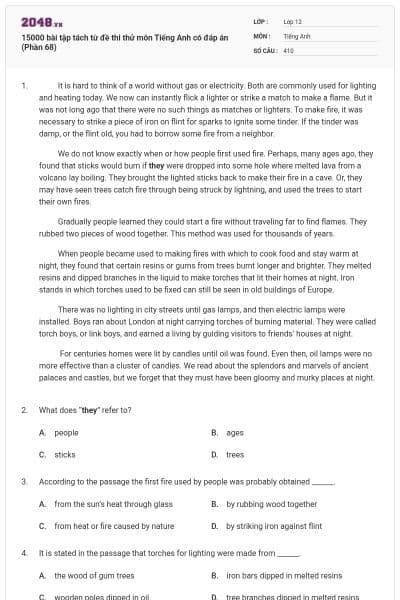
It is hard to think of a world without gas or electricity. Both are commonly used for lighting and heating today. We now can instantly flick a lighter or strike a match to make a flame. But it was not long ago that there were no such things as matches or lighters. To make fire, it was necessary to strike a piece of iron on flint for sparks to ignite some tinder. If the tinder was damp, or the flint old, you had to borrow some fire from a neighbor.
We do not know exactly when or how people first used fire. Perhaps, many ages ago, they found that sticks would burn if they were dropped into some hole where melted lava from a volcano lay boiling. They brought the lighted sticks back to make their fire in a cave. Or, they may have seen trees catch fire through being struck by lightning, and used the trees to start their own fires.
Gradually people learned they could start a fire without traveling far to find flames. They rubbed two pieces of wood together. This method was used for thousands of years.
When people became used to making fires with which to cook food and stay warm at night, they found that certain resins or gums from trees burnt longer and brighter. They melted resins and dipped branches in the liquid to make torches that lit their homes at night. Iron stands in which torches used to be fixed can still be seen in old buildings of Europe.
There was no lighting in city streets until gas lamps, and then electric lamps were installed. Boys ran about London at night carrying torches of burning material. They were called torch boys, or link boys, and earned a living by guiding visitors to friends’ houses at night.
For centuries homes were lit by candles until oil was found. Even then, oil lamps were no more effective than a cluster of candles. We read about the splendors and marvels of ancient palaces and castles, but we forget that they must have been gloomy and murky places at night.
What does “they” refer to?
people
ages
sticks
trees
Đáp án C
“they” được thay thế cho sticks trong vế trước: We do not know exactly when or how people first used fire. Perhaps, many ages ago, they found that sticks would burn
According to the passage the first fire used by people was probably obtained ______.
from the sun’s heat through glass
by rubbing wood together
from heat or fire caused by nature
by striking iron against flint
Đáp án C
Thông tin ở đoạn 2:
Perhaps, many ages ago, they found that sticks would burn if they were dropped into some hole where melted lava from a volcano lay boiling. They brought the lighted sticks back to make their fire in a cave. Or, they may have seen trees catch fire through being struck by lightning, and used the trees to start their own fires.
Con người thời xa xưa tạo ra nhiệt hoặc lửa nhờ hoàn toàn vào tự nhiên
It is stated in the passage that torches for lighting were made from ______.
the wood of gum trees
iron bars dipped in melted resins
wooden poles dipped in oil
tree branches dipped in melted resins
Đáp án D
Thông tin ở câu thứ 2 của đoạn thứ 4: They melted resins and dipped branches in the liquid to make torches that lit their homes at night. (Họ làm tan chảy nhựa và nhúng cành cây trong chất lỏng để làm ngọn đuốc thắp sáng nhà vào ban đêm.)
is mentioned in the passage that before the electric lamp was invented
oil lamps and then candles were used
candles and oil lamps appeared about the same time
candles and then oil lamps were used
people did not use any form of lighting in their houses
Đáp án C
Thông tin ở 2 câu đầu của đoạn cuối: For centuries homes were lit by candles until oil was found. Even then, oil lamps were no more effective than a cluster of candles.
TRước khi đèn điện được phát minh thì nến, sau đó là đèn dầu được sử dụng
The word “splendors” in the passage could be best replaced by which of the following?
expensive objects
places of scenic beauty
achievements
the beautiful and impressive features
Đáp án D
“splendors” = the beautiful and impressive features: vật rực rỡ, lộng lẫy
According to the passage, which of the following sentence is NOT true?
We know exactly when and how people first used fire.
Before gas lamps and electric lamps appeared, streets were lit by torches.
We can make a fire by striking a piece of iron on flint to ignite some tinder.
Matches and lighters were invented not long ago.
Đáp án A
Thông tin ở câu đầu của đoạn 2: We do not know exactly when or how people first used fire.
Chúng ta không biết rõ khi nào và bằng cách nào con người lần đầu tiên sử dụng lửa
The word “gloomy” in the passage is closest in meaning to
nearly dark
badly decorated
containing a lot of white
mysterious
Đáp án A
gloomy = nearly dark: một cách tối tăm
(ngoài ra còn có một nghĩa nữa là: u sầu, làm cho ai đó buồn sầu)
What form of street lighting was used in London when link boys used to work there?
Gas lighting
No lighting at all.
Electric lighting.
Oil lighting.
Đáp án B
Thông tin ở câu đầu đoạn 5: There was no lighting in city streets (Không có điện trên đường phố London cho đến khi có sự ra đời của gas, của đèn điện) => Link boys không sử dụng đèn mà chỉ sử dụng “torches of burning material” (đuốc từ đốt cháy các vật liệu)
One of the highest honors for formalists, writers, and musical composers is the Pulitzer Prize. First awarded in 1927, the Pulitzer Prize has been won by Ernest Hemingway, Harper Lee, John F. Kennedy, and Rodgers and Hammerstein, among others. As with many famous awards, this prize was named after its founder, Joseph Pulitzer.
Joseph Pulitzer’s story, like that of many immigrants to the United States, is one of hardship, hard work and triumph. Born in Hungary, Joseph Pulitzer moved to United States in 1864. He wanted to be a reporter, but he started his American life by fighting in the American Civil War. After the war, Pulitzer worked for the German - language newspaper, the Westliche Post. His skills as a reporter were wonderful, and he soon became a partial owner of the paper.
In 1978, Pulitzer was able to start a newspaper of his own. Right from the first edition, the newspaper took a controversial approach to new. Pulitzer wanted to appeal to the average reader, so he produced exciting stories of scandal and intrigue. Such an approach is commonplace today, but in Pulitzer’s time it was new and different. The approach led to the discovery of many instances of corruption by influential people. Pulitzer ‘paper became very famous and is still produced today.
The success of Joseph Pulitzer’s newspaper made him a very wealthy man, so he wanted to give something back to his profession. Throughout his later years, he worked to establish university programs for the teaching of journalism, and he funded numerous scholarships to assist journalism students. Finally, he wanted to leave a legacy that would encourage writers to remember the importance of quality. On his death, he gave two million dollars to Columbia University so they could award prizes to great writers.
The Pulitzer Prize recipients are a very select group. For most, winning a Pulitzer Prize is the highlight of their career. If an author, journalist, or composer you know has won a Pulitzer Prize, you can be sure they are at the top of their profession.
Why does the writer mention "John F. Kennedy" in line 3?
He was one of the inventors of the famous awards.
He was one of the winners of the Pulitzer Prize.
He was one of the people who selected the Pulitzer winners.
He was in one of the scandals reported on by Joseph Pulitzer.
Đáp án B
Tại sao tác giả đề cập đến “ John F. Kennedy” ở dòng 3?
A. Ông ấy là một trong những nhà phát minh ra giải thưởng nổi tiếng này.
B. Ông ấy là một trong những người giành giải thưởng Pulitzer.
C. Ông ấy là một trong những người được chọn chiến thắng giải Pulitzer.
D. Ông ấy liên quan đến một trong các vụ lùm xùm bị Joseph Pulitzer báo cáo lại.
Dẫn chứng: One of the highest honors for formalists, writers, and musical composers is the Pulitzer Prize. First awarded in 1927, the Pulitzer Prize has been won by Ernest Hemingway, Harper Lee, John F. Kennedy, and Rodgers and Hammerstein, among others.
According to the reading passage, why did Joseph Pulitzer invent the Pulitzer Prize?
to encourage people to remember his name and success
encourage writers to remember the importance of quality
to encourage journalism students to achieve their goals
to encourage work of the Pulitzer winners
Đáp án B
Theo bài đọc tại sao Joseph Pulitzer phát minh giải thưởng Pulitzer Prize?
A. đề khích lệ mọi người nhớ đến tên tuổi và thành công của ông.
B. để khích lệ các nhà văn nhớ về tầm quan trọng của chất lượng.
C. để khích lệ những sinh viên ngành báo chí đạt được mục tiêu của chúng.
D. để khuyến khích mọi người đề cao những tác phẩm của những tác giả giành giải Pulitzer.
Dẫn chứng:Finally, he wanted to leave a legacy that would encourage writers to remember the importance of quality. On his death, he gave two million dollars to Columbia University so they could award prizes to great writers.
Question 193. Đáp án A
The word “partial" in the passage is closest in meaning to_________.
in part only
brand new
one and only
very important
Đáp án A
Từ “ partial” trong bài đọc gần nghĩa với từ nào nhất?
A.chỉ một phần B. nhãn hiệu mới C. một và chỉ một D. rất quan trọng
Dẫn chứng:His skills as a reporter were wonderful, and he soon became a partial owner of the paper. [Những kỹ năng như là một phóng viên rất tuyệ vời và ông sớm trở thành chủ sở hữu riêng của một tờ báo]
According the passage, who receives the Pulitzer Prize?
Columbia University graduates
journalism students
noted writers and composers
most newspaper reporters
Đáp án C
Theo bài đọc ai nhận giải Pulitzer?
A. những cử nhân trường đại học Columbia
B. những sinh viên ngành báo chí
C. những nhà văn và tác giả đáng ghi nhận/ nổi bật
D. hầu hết những phóng viên báo chí.
Dẫn chứng: On his death, he gave two million dollars to Columbia University so they could award prizes to great writers.
According to the reading passage, how did Joseph Pulitzer appeal to the average reader?
He wrote about famous writers of journalism and literature
He wrote stories about the war
He produced his own newspaper
He produced exciting stories of scandal and intrigue
Đáp án D
Theo bài đọc, Joseph Pulitzer đã thu hút lượng đọc giả như thế nào?
A. Ông viết về những tác giả báo chí và văn học nổi tiếng.
B. Ông viết những câu chuyện về chiến tranh.
C. Ông tự sản xuất tờ báo của riêng mình.
D. Ông xuất bản những câu chuyện thú vị về các vụ bê bối lùm xùm và vụng trộm.
Dẫn chứng: Pulitzer wanted to appeal to the average reader, so he produced exciting stories of scandal and intrigue.
Which sentence about Joseph Pulitzer is true according to the reading passage?
He received a scholarship when he was a university student.
He was rich even when he was young
He was a reporter during the American Civil War
He immigrated to the United States from Hungary
Đáp án D
Theo bài đọc câu nào về Joseph Pulitzer là đúng?
A. Ông đã nhận học bổng khi còn là sinh viên đại học.
B. Ông trở nên giàu có thậm chí khi còn trẻ.
C. Ông là phòng viên trong cuộc nội chiến Mỹ.
D. Ông đã di cư đến Mỹ từ Hungary.
Dẫn chứng: Joseph Pulitzer’s story, like that of many immigrants to the United States, is one of hardship, hard work and triumph. Born in Hungary, Joseph Pulitzer moved to United States in 1864.
Which sentence about Joseph Pulitzer is NOT true according to the reading passage?
Joseph Pulitzer was the first writer to the win the prize in 1917.
The prize is aimed at encouraging a writer’s career.
Joseph Pulitzer left money to award to the prizewinners.
Receiving the prize is one of the highest honors for writers.
Đáp ánA
Câu nào về giải thưởng Pulitzer là không đúng?
A. Joseph Pulitzer là nhà văn đầu tiên giành giải thưởng vào năm 1917.
B. Giải thưởng nhằm mục đích ca ngợi sự nghiệp của các nhà văn.
C. Joseph Pulitzer đã để lại tiền để trao thưởng cho những người giảnh được giải thưởng.
D. Nhận được giải thường là một trong những vinh dự cao quý nhất của các nhà văn.
Dẫn chứng: One of the highest honors for formalists, writers, and musical composers is the Pulitzer Prize. First awarded in 1927, the Pulitzer Prize has been won by Ernest Hemingway, Harper Lee, John F. Kennedy, and Rodgers and Hammerstein, among others.
Clara Barton became known as “ The Angel of the Battlefield” during the American Civil War. Born in Oxford, Massachusetts in 1821, Clara Barton’s interest in helping soldiers on the battlefield began when she was told army stories from her father. Another event that influenced her decision to help soldiers was an accident her brother had. His injuries were cared for by Barton for 2 year. At the time, she was only 11 years old. Barton began teaching school at the age of 15. She taught for 18 years before she moved to Washington, D.C in 1854.
The civil war broke out 6 years later. Immediately, Barton started war service by helping the soldiers with their needs. At the battle of Bull run, Clara Barton received permission from the government to take care of the sick and hurt. Barton did this with great empathy and kindness. She acknowledged each soldier as a person . her endurance and courage on the battlefield were admired by many. When the war ended in 1865 , she used 4 years of her life to assist the government in searching for soldiers who were missing during the war.
The search for missing soldiers and years of hard work made her feeble physically. In 1869, her doctors recommended a trip to Europe for a rest. While she was on vacation , she became involved with the International Red Cross, an organization set up by the Geneva Convention in 1864. Clara Barton realized that the Red Cross would be a best help to the United States. After she returned to the United States, she worked very hard to create an American Red Cross. She talked to government leaders and let American people know about the Red Cross. In 1881, the National Society of the Red Cross was finally established with its headquarters in Washington , D.C. Clara Barton managed its activities for 23 years.
Barton never let her age stop her from helping people. At the age of 79, she helped food victims in Galveston, Texas. Barton finally resigned from the Red Cross in 1904. She was 92 years old and had truly earned her title “ The Angel of the Battle”.
According to the paragraph 1, which of the following is true of the young Barton Clara?
She helped her father when he was a soldier
She suffered from an accident when she was 11
She helped her brother who hurt in an accident
She made a decision to live with her brother for 2 years
Đáp án C
Theo đoạn văn 1, câu nào sau đây đúng về Clara Barton lúc còn trẻ
A. Cô ấy đã giúp bố khi ông là quân nhân.
B. Cô ấy đã bị tai nạn khi 11 tuổi.
C. Cô ấy đã giúp anh mình người đã bị thương trong một tai nạn.
D. Cô ấy đã quyết định sống với anh trai khoảng 2 năm.
Dẫn chứng: Another event that influenced her decision to help soldiers was an accident her brother had.
The phrase broke out in paragraph 2 is closest in meaning ti
extended
broken down
closed
began
Đáp án D
Cụm từ broke out ở đoạn 2 gần nghĩa nhất với từ nào
A. trải rộng B. hư hỏng C. đóng D. bắt đầu
Dẫn chứng:The civil war broke out 6 years later. [ Cuộc nội chiến đã bùng nổ/ bắt đầu 6 năm sau đó]
=> Broke out = began: bắt đầu
The word this in paragraph 2 refers to
recognized each soldier as a person
cooker for soldiers
took care of the sick and hurt
received permission
Đáp án C
Từ “this” ở đoạn 2 ám chỉ đến
A. Mỗi quân nhân được xem như một người
B. nấu ăn cho quân nhân
C. chăm sóc người ốm và người bị thương
D. nhận được sự cho phép
Dẫn chứng: At the battle of Bull run, Clara Barton received permission from the government to take care of the sick and hurt. Barton did this with great empathy and kindness.
The word acknowledged in paragraph 2 could best be replaced by
nursed
recognized
pleaded
believed
Đáp án B
Từ “ acknowledge” ở đoạn 2 có thể được thay thế bởi
A. săn sóc B. nhận biết C. nài nỉ D. tin tưởng
=> acknowledge = recognize: nhận biết
Dẫn chứng: She acknowledged each soldier as a person . her endurance and courage on the battlefield were admired by many.
What can be inferred about the government?
It did not always agree with Clara barton
It did not have the money to help Clara Barton
It showed Clara Barton great empathy and kindness
It had respect for Clara Barton
Đáp án D
Cái gì có thể được suy ra về chính phủ?
A. Không phải lúc nào cũng đồng ý với Clara Barton.
B. Không có tiền để giúp Clara Barton
C. Thể hiện sự thông cảm và tử tế với Clara Barton.
D. Tôn trọng Clara Barton.
Dẫn chứng: She talked to government leaders and let American people know about the Red Cross. In 1881, the National Society of the Red Cross was finally established with its headquarters in Washington , D.C. Clara Barton managed its activities for 23 years.
What does the author mention about the American Red Cross?
It was disapproved again and again by the Geneva Convention
Barton tried to have it set up in America
The American people were not interested in the Red Cross
It was first established in the Unites States
Đáp án B
Tác giả đề cập gì về Hội chữ thập đỏ Mỹ?
A. Nó không được chấp nhận bởi Hiệp định Geneva.
B. Barton đã cố gắng thành lập 1 cái như thế ở Mỹ.
C. Người Mỹ không quan tâm đến Hội chữ thập đỏ
D. Nó được thành lập lần đầu tiên ở Mỹ.
Dẫn chứng: While she was on vacation , she became involved with the International Red Cross, an organization set up by the Geneva Convention in 1864. Clara Barton realized that the Red Cross would be a best help to the United States. After she returned to the United States, she worked very hard to create an American Red Cross.
What is the main idea of the passage?
Clara Barton helped wounded soldiers and she was the founder of the Red Cross
Clara Barton was a kind and strong woman who helped people in need
Clara Barton becam a nurse during the American Civil War
Clara Barton worked for disaster victims until she was old
Đáp án B
Nội dung chính của bài đọc là gì?
A. Clara Barton đã giúp đỡ những quân nhân bị thương và cô ấy là người sang lập Hội chữ thập đỏ.
B. Clara Barton là một người phụ nữ tử tế mạnh mẽ luôn giúp đỡ mọi người khi cần.
C. Clara Barton đã trở thành một y tá trong thời nội chiến Mỹ.
D. Clara Barton đã làm việc cho những nạn nhân trong vụ thảm họa cho đến khi già.
What can be the best title of the reading passage?
The angel of the Battlefield
The American Red Cross
The American Civil War
The International Red Cross
Đáp án A
Tiêu đề hay nhất cho bài đọc là gì?
A. Thiên thần của Chiến trường B. Hội chữ thập đỏ Mỹ
C. Nội chiến Mỹ D. Hội chữ thập đỏ quốc tế
Clara Barton became known as “ The Angel of the Battlefield” during the American Civil War. Born in Oxford, Massachusetts in 1821, Clara Barton’s interest in helping soldiers on the battlefield began when she was told army stories from her father. Another event that influenced her decision to help soldiers was an accident her brother had. His injuries were cared for by Barton for 2 year. At the time, she was only 11 years old. Barton began teaching school at the age of 15. She taught for 18 years before she moved to Washington, D.C in 1854.
The civil war broke out 6 years later. Immediately, Barton started war service by helping the soldiers with their needs. At the battle of Bull run, Clara Barton received permission from the government to take care of the sick and hurt. Barton did this with great empathy and kindness. She acknowledged each soldier as a person . her endurance and courage on the battlefield were admired by many. When the war ended in 1865 , she used 4 years of her life to assist the government in searching for soldiers who were missing during the war.
The search for missing soldiers and years of hard work made her feeble physically. In 1869, her doctors recommended a trip to Europe for a rest. While she was on vacation , she became involved with the International Red Cross, an organization set up by the Geneva Convention in 1864. Clara Barton realized that the Red Cross would be a best help to the United States. After she returned to the United States, she worked very hard to create an American Red Cross. She talked to government leaders and let American people know about the Red Cross. In 1881, the National Society of the Red Cross was finally established with its headquarters in Washington , D.C. Clara Barton managed its activities for 23 years.
Barton never let her age stop her from helping people. At the age of 79, she helped food victims in Galveston, Texas. Barton finally resigned from the Red Cross in 1904. She was 92 years old and had truly earned her title “ The Angel of the Battle”.
According to the paragraph 1, which of the following is true of the young Barton Clara?
She helped her father when he was a soldier
She suffered from an accident when she was 11
She helped her brother who hurt in an accident
She made a decision to live with her brother for 2 years
Đáp án C
Theo đoạn văn 1, câu nào sau đây đúng về Clara Barton lúc còn trẻ
A. Cô ấy đã giúp bố khi ông là quân nhân.
B. Cô ấy đã bị tai nạn khi 11 tuổi.
C. Cô ấy đã giúp anh mình người đã bị thương trong một tai nạn.
D. Cô ấy đã quyết định sống với anh trai khoảng 2 năm.
Dẫn chứng: Another event that influenced her decision to help soldiers was an accident her brother had.
The phrase broke out in paragraph 2 is closest in meaning ti
extended
broken down
closed
began
Đáp án D
Cụm từ broke out ở đoạn 2 gần nghĩa nhất với từ nào
A. trải rộng B. hư hỏng C. đóng D. bắt đầu
Dẫn chứng:The civil war broke out 6 years later. [ Cuộc nội chiến đã bùng nổ/ bắt đầu 6 năm sau đó]
=> Broke out = began: bắt đầu
The word this in paragraph 2 refers to
recognized each soldier as a person
cooker for soldiers
took care of the sick and hurt
received permission
Đáp án C
Từ “this” ở đoạn 2 ám chỉ đến
A. Mỗi quân nhân được xem như một người
B. nấu ăn cho quân nhân
C. chăm sóc người ốm và người bị thương
D. nhận được sự cho phép
Dẫn chứng: At the battle of Bull run, Clara Barton received permission from the government to take care of the sick and hurt. Barton did this with great empathy and kindness.
The word acknowledged in paragraph 2 could best be replaced by
nursed
recognized
pleaded
believed
Đáp án B
Từ “ acknowledge” ở đoạn 2 có thể được thay thế bởi
A. săn sóc B. nhận biết C. nài nỉ D. tin tưởng
=> acknowledge = recognize: nhận biết
Dẫn chứng: She acknowledged each soldier as a person . her endurance and courage on the battlefield were admired by many.
What can be inferred about the government?
It did not always agree with Clara barton
It did not have the money to help Clara Barton
It showed Clara Barton great empathy and kindness
It had respect for Clara Barton
Đáp án D
Cái gì có thể được suy ra về chính phủ?
A. Không phải lúc nào cũng đồng ý với Clara Barton.
B. Không có tiền để giúp Clara Barton
C. Thể hiện sự thông cảm và tử tế với Clara Barton.
D. Tôn trọng Clara Barton.
Dẫn chứng: She talked to government leaders and let American people know about the Red Cross. In 1881, the National Society of the Red Cross was finally established with its headquarters in Washington , D.C. Clara Barton managed its activities for 23 years.
What does the author mention about the American Red Cross?
It was disapproved again and again by the Geneva Convention
Barton tried to have it set up in America
The American people were not interested in the Red Cross
It was first established in the Unites States
Đáp ánB
Tác giả đề cập gì về Hội chữ thập đỏ Mỹ?
A. Nó không được chấp nhận bởi Hiệp định Geneva.
B. Barton đã cố gắng thành lập 1 cái như thế ở Mỹ.
C. Người Mỹ không quan tâm đến Hội chữ thập đỏ
D. Nó được thành lập lần đầu tiên ở Mỹ.
Dẫn chứng: While she was on vacation , she became involved with the International Red Cross, an organization set up by the Geneva Convention in 1864. Clara Barton realized that the Red Cross would be a best help to the United States. After she returned to the United States, she worked very hard to create an American Red Cross.
What is the main idea of the passage?
Clara Barton helped wounded soldiers and she was the founder of the Red Cross
Clara Barton was a kind and strong woman who helped people in need
Clara Barton becam a nurse during the American Civil War
Clara Barton worked for disaster victims until she was old
Đáp án B
Nội dung chính của bài đọc là gì?
A. Clara Barton đã giúp đỡ những quân nhân bị thương và cô ấy là người sang lập Hội chữ thập đỏ.
B. Clara Barton là một người phụ nữ tử tế mạnh mẽ luôn giúp đỡ mọi người khi cần.
C. Clara Barton đã trở thành một y tá trong thời nội chiến Mỹ.
D. Clara Barton đã làm việc cho những nạn nhân trong vụ thảm họa cho đến khi già.
What can be the best title of the reading passage?
The angel of the Battlefield
The American Red Cross
The American Civil War
The International Red Cross
Đáp án A
Tiêu đề hay nhất cho bài đọc là gì?
A. Thiên thần của Chiến trường B. Hội chữ thập đỏ Mỹ
C. Nội chiến Mỹ D. Hội chữ thập đỏ quốc tế
The Hindu cultural celebrates marriage as a pure and pristine rite enabling two individuals start their journey of life together. It puts emphasis on the values of happiness, harmony and growth and could be traced back from the Vedic times.
Months before the wedding ceremony, an engagement is held which is called "mangni". The couple is blessed here with gifts, jewelry and clothes. Another important ritual is the "mehendi" which is a paste made from the leaves of henna plant. It is the traditional art of adorning the hands and the feet of the bride with mehendi and the name of the groom is also hidden in the design.
On the day of marriage, the couple exchanges garlands as a gesture of acceptance of one another and a pledge to respect one another as partners which is known as "jaimala". This is followed by "kanyadaan", where the father of the bride places her hand in the groom's hand requesting him to accept her as an equal partner.
Another ritual is the "havan" in which the couple invokes Agni, the god of Fire, to witness their commitment to each other. Crushed sandalwood, herbs, sugar rice and oil are offered to the ceremonial fire. The "gath bandhan" takes place where scarves of the bride and groom are tied together symbolizing their eternal bonThis signifies their pledge before God to love each other and remain loyal. The couple then takes four "mangal pheras" or walk around the ceremonial fire, representing four goals in life: "Dharma", religious and moral duties; "Artha", prosperity; "Kama" earthly pleasures; "Moksha", spiritual salvation.
The couple also takes seven steps together to begin their journey, called the "saptapardi". Then the ritual of "sindoor" takes place where the groom applies a small dot of vermilion, a red powder to the bride's forehead and welcomes her as his partner for life. This signifies the completion of the marriage. The parents of the bride and the groom then give their blessings, "ashirwad" to the newlywed couple as they touch the feet of their parents.
What might be the most suitable title for this reading passage?
The Hindu culture
The Hindu religion
The Hindu wedding
The Hindu tradition
Đáp án C
– bài viết nói về một đám cưới Hindu
What does the word magni stand for?
the wedding
the paste made from the leave of one another
the engagement
the gesture of acceptance of one another
Đáp án C
– magni: lễ đính hôn. – dòng thứ nhất đoạn thứ 2. “Months before the wedding ceremony, an engagement is held which is called "mangni".”
What do the Hindu people think about marriage?
It is entirely a spiritual traditional ritual allowing two individuals to live together.
It is a belief in the growth of a family newly formed by two individuals.
It is a wish of happiness and harmony to come to two individuals.
It is just a living-together announcement of two individuals.
Đáp án A
– dòng thứ nhất, đoạn thứ nhất. “The Hindu cultural celebrates marriage as a pure and pristine rite enabling two individuals start their journey of life together. It puts emphasis on the values of happiness, harmony and growth and could be traced back from the Vedic times.”
What can the word adorning be best replaced by?
decorating
painting
repairing
dying
Đáp án A
– adorn = decorate : trang điểm
What can the word invokes be best replaced by?
tells
says
prays
talks
Đáp án C
– invoke = pray : cầu, khấn.
Why does the couple exchange garlands?
to do a ritual
to show both their acceptance of and the swear to respect the partner.
to express their acceptance of one another and a wish of happiness.
to express their vow to respect each other for the whole life.
Đáp án B
– dòng thứ nhất, đoạn thứ ba. “On the day of marriage, the couple exchanges garlands as a gesture of acceptance of one another and a pledge to respect one another as partners which is known as "jaimala".”
When is the wedding ceremony completed?
When the parents of the bride and the groom give their blessings to the couple.
When the couple touches their parents' feet.
When the couple makes seven steps together.
When the groom applies a small dot of vermillion of the bride's forehead.
Đáp án D
– dòng thứ nhất, đoạn cuối cùng. “Then the ritual of "sindoor" takes place where the groom applies a small dot of vermilion, a red powder to the bride's forehead and welcomes her as his partner for life. This signifies the completion of the marriage.”
A Japanese construction company plans to create a huge independent city-state, akin to the legendary Atlantis, in the middle of the Pacific Ocean. The city, dubbed “Marinnation”, would have about one million inhabitants, two airports, and possibly even a space port. Marinnation, if built, would be a separate country but could serve as a home for international organisations such as the United Nations and the World Bank.
Aside from the many political and social problems that would have to be solved, the engineering task envisaged is monumental. The initial stage requires the building of a circular dam eighteen miles in diameter attached to the sea bed in a relatively shallow place in international waters. Then, several hundred powerful pumps, operating for more than a year, would suck out the sea water from within the dam. When empty and dry, the area would have a city constructed on it. The actual land would be about 300 feet below the sea level. According to designers, the hardest task from an engineering point of view would be to ensure that the dam is leak proof and earthquake proof.
If all goes well, it is hoped that Marinnation could be ready for habitation at the end of the second decade of the twenty-first century. Whether anyone would want to live in such an isolated and artificial community, however, will remain an open question until that time.
According to the text, Marrination, when built, will be a(an)__________ city.
underwater
underground
marine
legendary
Đáp án C
– underwater city : thành phố dưới đáy biển. Dòng đầu tiên, đoạn thứ nhất. “A Japanese construction company plans to create a huge independent city-state, akin to the legendary Atlantis, in the middle of the Pacific Ocean.”
The word ‘akin’ in paragraph 1 could be best replaced by __________.
likely
close
next
similar
Đáp án D
– akin = similar : gần giống.
Which of the following would NOT be a problem for the construction plan?
social
political
engineering
financial
Đáp án D
– dòng thứ nhất đoạn thứ 2. “Aside from the many political and social problems that would have to be solved, the engineering task envisaged is monumental.”
Which of the following is NOT true according to the text?
Marinnation would have about one million inhabitants.
Marinnation will be built in a deep place in the Pacific Ocean.
Marinnation will be located in the middle of the Pacific Ocean.
Marinnation could be served as home for international organisations.
Đáp án B
– dòng thứ 2, đoạn thứ 2. “The initial stage requires the building of a circular dam eighteen miles in diameter attached to the sea bed in a relatively shallow place in international waters.”
The word ‘monumental’ in Paragraph 2 means __________.
important and difficult
like a large monument
important and historic
serving as a monument
Đáp án A
– monumental : quan trọng, vĩ đại, xuất sắt, đầy thách thức.
The phrase ‘suck out’ in paragraph 2 is closest in meaning to which of the following?
draw out
dry up
take out
pull out
Đáp án A
– suck out = draw out : dẫn nước ra.
According to the text, people could come to live in the future city in the year __________.
2002
2012
2010
2020
Đáp án D
– dòng thứ nhất, đoạn thứ 3. “If all goes well, it is hoped that Marinnation could be ready for habitation at the end of the second decade of the twenty-first century.”
What does the author imply in the last sentence of the passage?
People will ask an open question about living in Marinnation.
The construction of Marinnation could never be completed in time.
People might not want to live in an isolated and artificial community.
People will ask how they can live in such an isolated and artificial city.
Đáp án C
– Tác giả đặt câu hỏi về việc liệu người ta có muốn sống trong một cộng đồng cách biệt và nhân tạo như thế không.
Algae is a primitive form of life, a single-celled or simple multiple-celled organism that is able to conduct the process of photosynthesis. It is generally found in water but can also be found elsewhere, growing on such surfaces as rocks or trees. The various types of algae are classified according to pigment.
Blue-green algae, or Cyanophyta, can grow at very high temperatures and under high-intensity light. This type of algae is the oldest form of life with photosynthetic capabilities. Fossilized remains of blue-green algae more than 3.4 billion years old have been found in parts of Africa.
Green algae, or Chlorophyta, is generally found in fresh water. It reproduces on the surfaces of enclosed bodies of water such as ponds or lakes and has the appearance of a fuzzy green coating on the surface of the water.
Brown algae, or Phaeophyta, grows in shallow, temperate water. This type of algae is the largest in size and is most recognizable as a type of seaweed. Its long stalks can be enmeshed on the ocean floor, or it can float freely on the ocean's surface.
Red algae, or Rhodophyta, is a small, delicate organism found in the deep waters of the subtropics. This type of algae has an essential role in the formation of coral reefs: it secretes lime from the seawater to foster the formation of limestone deposits.
What is the author's main purpose?
To show what color algae is
To differentiate the various classifications of algae
To describe where algae is found
To clarify the appearance of different types of algae
Đáp án B
Dụng ý chính của tác giả khi viết bài này là To differentiate the various classifications of algae (phân biệt các cách phân loại khác nhau của các loại tảo) theo màu sắc của chúng: Blue-green, green, brown, red algae
Which of the following is NOT true about algae?
All types have one cell only.
It can be found out of water.
It can use photosynthesis.
It is not a relatively new form of life.
Đáp án A
Thông tin ở câu đầu tiên của đoạn đầu tiên: Algae is a primitive form of life, a single-celled or simple multiple-celled organism (Tảo là một hình thức sinh vật sống sơ khai, là một sinh vật đơn bào hoặc đa bào đơn giản)
The word "pigment" at the end of the first paragraph means________.
size
shape
composition
color
Đáp án D
“pigment” = “color”: màu sắc
Algae remnants found in Africa are________.
still flourishing
photogenic
extremely old
red in color
Đáp án C
Thông tin ở câu cuối của đoạn 2: Fossilized remains of blue-green algae more than 3.4 billion years old have been found in parts of Africa. (Nhiều hóa thạch của loài tảo lam lục hơn 3,4 tỷ năm tuổi đã được tìm thấy trong một số khu vực của châu Phi.)
Green algae is generally found________.
on the ocean floor
on top of the water
throughout ponds and lakes
surrounding enclosed bodies of water
Đáp án B
Thông tin ở câu thứ 2 của đoạn thứ 3: It reproduces on the surfaces of enclosed bodies of water (Nó tái tạo trên bề mặt của bộ phận bao bọc nước)
Brown algae would most likely be found________.
on trees
near green algae
on rocks
in the ocean
Đáp án D
Thông tin ở câu cuối của đoạn 4: Its long stalks can be enmeshed on the ocean floor, or it can float freely on the ocean’s surface. (thân dài của nó có thể vướng vào đáy đại dương, hoặc nó có thể trôi nổi tự do trên bề mặt của đại dương.) → tảo nâu hầu như được tìm thấy ở đại dương
According to the passage, red algae is________.
sturdy
huge
fragile
found in shallow water
Đáp án C
Thông tin ở câu đầu cảu đoạn cuối: Red algae, or Rhodophyta, is a small, delicate organism (tảo đỏ là sinh vật nhỏ, mỏng manh)
It can be inferred from the passage that limestone deposits serve as the basis of________.
coral reefs
red algae
subtropical seawater
secret passages
Đáp án A
Thông tin ở câu cuối của bài: This type of algae has an essential role in the formation of coral reefs: it secretes lime from the seawater to foster the formation of limestone deposits.
Sound moves form its source to the ear by wavelike fluctuations in air pressure, something like the crests and troughs of ocean waves. Once way to keep from hearing sound is to use ear plugs. Another way is to cancel out the sound with anti-sound. Using a noisemarker controlled by a microprocessor, engineers have produced sound waves that are half a wavelength out of phase with those of the noise to be quieted-each crest is matched to a trough, and vice versa. Once the researchers have recorded the offending sound, a microprocessor calculates the amplitude and wavelength of sound that will cancel out the crests and troughs of noise. It then produces an electric current that is amplified and fed to a loudspeaker, which produces anti-sound and wipes out the noise. If the anti-sound goes out of synchronization, a microphone picks up the leftover sound and sends it back to the microprocessor, which changes the phase of the anti- sound just enough to cause complete silence.
The research team has concentrated on eliminating low-frequency noise from ship engines, which causes fatigue that can impair the efficiency and alertness of the crew, and may mask the warning sounds of alarm and fog signals.
What is the main purpose of the passage?
To discuss a physical handicap
To warn about a growing danger
To describe the structure of the ear
To report on a new invention
Đáp án D
Mục đích của bài này là To report on a new invention (Giới thiệu một phát minh mới). Phát minh đó là sử dụng bộ vi xử lý (a microprocessor) để loại bỏ các âm thanh không mong muốn
The passage compares sound to_________.
the rising and falling of water in the ocean
the crests and valleys of mountain ranges
a flag waving in the air
a machine for gauging air pressure
Đáp án A
Thông tin ở câu đầu tiên của bài đọc: Sound moves form its source to the ear by wavelike fluctuations in air pressure, something like the crests and troughs of ocean waves. (Âm thanh di chuyển hình thành nguồn gốc của nó trong tai bởi biến động trong áp suất không khí, một cái gì đó giống như các đỉnh và đáy của sóng biển.)
The passage discusses a way to deal with an offensive noise by_________.
diverting people's attention from it
masking it with a louder noise
canceling it out electronically
removing its source
Đáp án C
Thông tin ở câu thứ 2 và 3 của đoạn đầu tiên: One way to keep from hearing sound is to use ear plugs. Another way is to cancel out the sound with anti-sound. (Một cách để cách âm là sử dụng nút tai. Một cách nữa là triệt tiêu âm thanh với dụng cụ chống âm)
The microprocessor described in the passage will probably be used for_________.
composing music
repairing alarm systems
eliminating engine noises
intensifying for warning sounds
Đáp án C
Thông tin ở đoạn 1: Using a noisemarker controlled by a microprocessor, engineers have produced sound waves that are half a wavelength out of phase with those of the noise to be quieted-each crest is matched to a trough, and vice versa. Once the researchers have recorded the offending sound, a microprocessor calculates the amplitude and wavelength of sound that will cancel out the crests and troughs of noise. It then produces an electric current that is amplified and fed to a loudspeaker, which produces anti-sound and wipes out the noise.
=> microprocessor (bộ vi xử lý) được dùng để loại bỏ âm thanh
The researcher mentioned in the passage are concerned about unwanted noise because it can_________.
cause deafness
create hazardous working conditions
influence ocean waves
damage loudspeakers and sound equipment
Đáp án B
Thông tin ở câu cuối: … which causes fatigue that can impair the efficiency and alertness of the crew, and may mask the warning sounds of alarm and fog signals.
(những âm thanh không mong muốn có thể gây mệt mỏi, ảnh hưởng đến năng suất và sự tỉnh táo của phi hành đoàn, và có thể che mất âm thanh cảnh báo và tín hiệu bão => tạo ra tình trạng làm việc nguy hiểm)
According to the passage, what group of people will probably first from the use of the microprocessor?
Ship's crews
Research engineers
People with insomnia
Engine repair teams
Đáp án A
Thông tin ở đoạn cuối: The research team has concentrated on eliminating low-frequency noise from ship engines, which causes fatigue that can impair the efficiency and alertness of the crew
A paragraph following the passage would most probably discuss_________.
the nature of fog
a way to improve alarm systems
other causes of fatigue
other uses for the microprocessor
Đáp án D
Bài đọc này chủ yếu nói về công dụng loại bỏ, tách âm thanh của bộ vi xử lý (a microprocessor). Vì vậy, đoạn sau của bài đọc này có thể sẽ nói về những công dụng khác của bộ vi xử lý này
Most Americans look forward to their vacation. Most American employees receive an annual vacation with pay, and it is traditional to use this time off for travel.
Travelling within the United States is very popular because foreign travel generally takes more time and money. Every year about thirteen million people travel abroad. The most popular periods are during the summer and the two-week school break on Christmas and New Year holidays. These periods are also the most crowded and the most expensive time to travel, so people who can adjust their schedules sometimes choose to travel in the autumn.
American tourists often travel by car. Most families own a car, and those who do not have a car can rent one. Cars are usually the most economical way to travel, especially for families. It is also fairly fast and convenient. Exellent highway with motels and restaurants nearby connect the nation’s major cities. They enable tourists to travel at a speed of 55 to 66 miles an hour. Tourists that want to travel faster often fly to their destination and then rent a car when they get there.
According to the writer ________.
Americans have no vacations
Americans do not like travel.
it is impossible to have a day-off in the USA.
most Americans are fond of travelling
Đáp án D
Thông tin ở câu cuối đoạn 1: It is traditional to use this time off for travel: thường (mọi người) sẽ sử dụng thời gian này để đi du lịch = hầu hết người Mỹ thích đi du lịch
How many people travel abroad every year?
13 million people
66 million people
30 million people
55 million people
Đáp án A
Thông tin ở câu 2 đoạn 2: Every year about thirteen million people travel abroad. Mỗi năm có khoảng 13 triệu người du lịch nước ngoài
Which of the following is not mentioned in the text?
Travelling on Christmas and New Year holidays take much money.
Most American employees use their vacation to travel every year.
Most families use cars as an economical way to travel.
American people always choose to travel in autumn
Đáp án D
Thông tin ở câu cuối đoạn 2: people who can adjust their schedules sometimes choose to travel in the autumn.
Mọi người chỉ thỉnh thoảng du lịch vào mùa thu chứ không phải luôn luôn du lịch vào mùa thu
There are many people travelling ______.
in the winter
on Women’s Day
on Christmas and New Year
on Thanksgiving
Đáp án C
Thông tin ở câu thứ 3 của đoạn 2: The most popular periods are during the summer and the two-week school break on Christmas and New Year holidays.
Giai đoạn thông thường nhất là trong mùa hè hoặc kỳ nghỉ 2 tuần ở trường vào dịp Giáng sinh và Năm mới
_______ are the most popular means of transport in the USA.
Buses
Cars
Ships
Planes
Đáp án B
Thông tin ở 2 câu đầu của đoạn 3: American tourists often travel by car. Most families own a car, and those who do not have a car can rent one. Cars are usually the most economical way to travel
The word “It” in line 8 refers to ______.
destination
restaurant
vacation
car
Đáp án D
“It” ở đây được thay thế cho car ở câu trước: Cars are usually the most economical way to travel, especially for families
In the USA, __________.
the high ways are not in good condition.
tourists cannot rent a car
there are not any highways.
along the highways there are motels and restaurants available for tourists.
Đáp án D
Thông tin ở câu thứ 4 của đoạn 3: Exellent highway with motels and restaurants nearby connect the nation’s major cities.
Ở đường cao tốc thì có nhiều khách sạn và nhà hàng cho khách du lịch
For the last few years, my children have been going to a summer camp in northern Greece called Skouras Camp. They always seem to have a good time, so if you’ re wondering what to do with the kids for three weeks this summer, you could do worse than send them to this beautiful camp on the shores of the Aegean Sea. If your children, like mine, are keen on adventure, sports and good company, the Skouras Camp will keep them busy all day doing the things they most enjoy. Skouras is an international camp with children from all over the world. My children have made friends with children of their own age from Poland, China, Demark and the United States. Naturally, they get lots of opportunities to practise their English as this is the only language spoken. The camp is located in one of the most beautiful parts of Chalkidiki. It is huge (120.000 square meters) and is just a stone’s throw away from clear, blue Aegean Sea. It takes the children just five minutes to walk to the golden sandy beach on foot. The programme is packed with exciting activities such as horse riding and table tennis. Other sports in clude baseball, volleyball and athletics. The Camp ends with a sports contest in the last week which all parents are invited to attend.
All the children come to the Camp have to___________.
be only keen on adventure
be at the same age.
speak English
practise basketball.
Đáp án C
Thông tin ở câu: Naturally, they get lots of opportunities to practise their English as this is the only language spoken.
Đương nhiên, chúng có được nhiều cơ hội luyện tập tiếng Anh của mình vì đây là ngôn ngữ duy nhất được nói.
How many kinds of sports can be played in the Camp?
2
3
4
5
Đáp án D
Có 5 môn thể thao.
Thông tin ở 2 câu gần cuối: The programme is packed with exciting activities such as horse riding and table tennis. Other sports in clude baseball, volleyball and athletics.
All the statements are true except___________.
The parents can attend their children’sports contest.
The children will be busy taking part in the Camp’s programmed activities.
The camp is quite far from the Aegean Sea.
The children will take more chances of English practise.
Đáp án C
Thông tin ở những câu: The camp is located in one of the most beautiful parts of Chalkidiki. It is huge (120.000 square meters) and is just a stone’s throw away from clear, blue Aegean Sea. It takes the children just five minutes to walk to the golden sandy beach on foot.
=> Trại hè rất gần Aegean Sea
The tond of the passage could best be described as___________.
supportive
negative
disbelieving
humorous.
Đáp án A
Có thể nhận thấy giọng văn của tác giả là ủng hộ, được thể hiện qua các câu văn như:
- They always seem to have a good time, so if you’ re wondering what to do with the kids for three weeks this summer, you could do worse than send them to this beautiful camp on the shores of the Aegean Sea.
- If your children, like mine, are keen on adventure, sports and good company, the Skouras Camp will keep them busy all day doing the things they most enjoy.
- My children have made friends with children of their own age from Poland, China, Demark and the United States. Naturally, they get lots of opportunities to practise their English as this is the only language spoken.
What shoul be the best title for the passage?
Chalkidiki’s landscape – The Aegean Sea.
An international summer camp.
Children’s summer activities.
Advice on children caring in summer.
Đáp án B
Tiêu đề phù hợp nhất của bài là An international summer camp. (Một trại hè quốc tế)
Xuyên suốt bài đọc, tác giả đã giới thiệu về Skouras Camp, một trại hè quốc tế mà các con của tác giả tham gia vào mùa hè
How long does it take the children to walk to the golden sandy beach on foot?
20 minutes
an hour
5 minutes
a day
Đáp án C
Thông tin ở câu gần cuối: It takes the children just five minutes to walk to the golden sandy beach on foot.
Where is the camp located?
in Porland
in Greece
in the United States
Denmark
Đáp án B
Thông tin ở ngay câu đầu của bài đọc: For the last few years, my children have been going to a summer camp in northern Greece called Skouras Camp.
Trại hè ở phía Bắc Hy Lạp
The word contest in the last sentence could be replaced by___________.
competition
runner
competitor
athlete
Đáp án A
“contest” = “competition”: cuộc thi
It's very easy to ________ over when the snow is hard.
slide
skid
skate
slip
D
Slide (v): trượt, đi qua, lướt qua
Skid (v): chèn, trượt (bánh xe)
Skate (v): trượt băng
Slip (v): trượt, tuột, trượt chân
à dùng động từ “slip” để phù hợp với ngữ cảnh
Dịch câu: Rất dễ dàng để trượt chân khi mà tuyết cứng.
All things ________, he is the best president we are likely to get.
considered
thought
taken
added
: A
All things considered = mọi thứ đã rõ ràng, như một lẽ đương nhiên
Dịch câu: Mọi thứ đã rõ ràng, ông ấy là vị tổng thống tốt nhất mà chúng ta sẽ có.
Check the bottles carefully to make sure they have not been ________
broken into
taken out
touched up
tampered with
D
Break into: đột nhập
Take out: nhận được, xóa sạch
Touch up: tô, sửa qua
Tamper with: xáo trộn
à Chọn “tampered with” phù hợp với nghĩa của câu nhất
Dịch câu: Hãy kiểm tra những cái chai cẩn thận để đảm bảo rằng chúng không bị xáo trộn.
Do you think Ms. Brown will ________ for Parliament in the next election?
run
walk
sit
stand
Đáp án: A
Giải thích:
A. run (v): chạy, ứng cử
B. walk (v): đi bộ
C. sit (v): ngồi
D. stand (v): đứng
Đáp án A phù hợp về nghĩa.
Dịch: Bạn có nghĩ bà Brown sẽ ứng cử vào nghị viên trong cuộc bầu cử tiếp theo không?
Nearly all of the reporters ________ the press conference had questions ________
attend / asked
attended / to ask
attending / to ask
would attend / to be asked
C
Chỗ trống thứ nhất chính là dạng rút gọn của mệnh đề quan hệ bằng V-ing (hiện tại phân từ) vì mang nghĩa chủ động à chọn C
Dịch câu: Gần như tất cả các phóng viên nhà báo người mà tham dự cuộc họp báo đều có những câu hỏi để hỏi.
The general public ________ a large number of computers now, because prices are beginning to decrease.
must buy
must be buying
must have bought
must bought
C
Ta dùng cấu trúc “must have + PII” để diễn tả một suy đoán logic dựa trên những điều có thật ở quá khứ.
Dịch câu: Quần chúng nói chung chắc hẳn đã mua một số lượng lớn máy tính để bàn hiện nay, bởi vì giá đang bắt đầu giảm.
I'm worried about ________ on so much work.
she taking
she takes
her to take
her taking
D
Chỗ trống cần một danh từ, chỉ có đáp án D là danh từ
Dịch câu: Tôi lo lắng về việc đảm nhận quá nhiều việc của cô ấy.
- Hieroglyphics ________on the walls of caves provide scientists with important details on prehistoric man.
Painted
were painted
have been painted
that they painted
A
Chỗ trống là dạng rút gọn của mệnh đề quan hệ. Do mang nghĩa bị động nên ta dùng PII (quá khứ phân từ)
Dịch câu: Chữ viết tượng hình mà được vẽ trên các bức tường của những hang động cung cấp cho các nhà khoa học các chi tiết quan trọng về con người thời tiền sử.
If you ________ Peter, could you tell him to ring me up?
come into
come over
come across
come back
C
Come into: thừa kế
Come over: vượt (biển)
Come across: tình cờ gặp
Come back: trở về
à Chọn “come across” để phù hợp với ngữ cảnh
Dịch câu: Nếu bạn tình cờ gặp Peter, bạn có thể bảo anh ấy gọi cho tôi được không?
Where did you buy that ________ handbag?
funny leather purple
purple funny leather
funny purple leather
leather funny purple
C
Vị trí của các loại adj trong câu: Opinion – Size – Shape – Age – Color – Origin – Material – Purpose
Dịch câu: Bạn đã mua cái túi xách tay bằng da màu tím ngộ nghĩnh đó ở đâu vậy?
To buy this type of product, you must pay half of the money ________, and pay the rest on the day of delivery.
in advance
in cheque
in cash
in charge
A
In advance: trước
Dịch câu: Để mua loại sản phẩm này, bạn phải trả một nửa số tiền trước, và trả phần còn lại vào ngày giao hàng.
The boy was sent to the police because of several ________ that he had taken part in.
set-to
set-toes
sets-to
set-tos
D
Set-to (N số nhiều: set-tos): cuộc ẩu đả, cuộc đánh nhau
Dịch câu: Cậu bé bị đưa đến cảnh sát bởi vì nhiều cuộc ẩu đả mà cậu ta đã tham gia.
________, the results couldn’t be better.
No matter what he tried hard
No matter how hard he tried
Although very hard he tried
Despite how hard he tried
B
Cấu trúc: No matter how + adj/adv + S + V, main clause = However + adj/adv + S + V, main clause
Dịch câu: Mặc dù anh ấy đã cố gắng chăm chỉ, nhưng kết quả vẫn không thể tốt hơn.
From an early age, Wolfgang had a/an ________ for music.
interest
passion
involvement
tendency
B
Cấu trúc: to have a passion for something = say mê cái gì
Dịch: Từ lúc nhỏ tuổi, Wolfganf đã say mê âm nhạc.
Larry never spoke to anyone, and kept himself ________.
outside
withdrawn
superior
aloof
D
Cấu trúc: keep (oneself) aloof = xa cách, cách biệt, khép kín.
Dịch: Larry đã không bao giờ nói chuyện với bất kỳ ai, và khép kín bản thân.
Sarah delivered a/an ________ appeal to the court and asked for mercy.
sensational
sentimental
emotional
affectionate
C
Sensational (adj): giật gân Sentimental (adj): dễ cảm, đa cảm
Emotional (adj): cảm động, xúc động Affectionate (adj): thương yêu, yêu mến.
→ Chọn “emotional” để phù hợp với ngữ cảnh của câu
Dịch: Sarah đã đưa ra một lời thỉnh cầu đầy xúc động đến quan tòa và cầu xin sự bao dung.
No sooner had we left the house, ________ it started snowing.
and
than
when
that
B
Cấu trúc: No sooner + had + S + PII… + than + clause(QKĐ) = vừa mới…thì….
Dịch: Chúng tôi vừa mới rời khỏi nhà thì trời bắt đầu đổ tuyết
What ever Jane ________ to do, she finishes.
gets on
sees to
sets out
look for
C
Get on: lên (xe)
See to: phục vụ, lo liệu
Set out: phô trương, bắt đầu lao vào ( một việc gì với mục tiêu rõ ràng)
Look for: tìm kiếm
→ Chọn “set out” để phù hợp với nghĩa của câu
Dịch: Bất cứ thứ gì Jane bắt đầu lao vào làm, cô ấy đều hoàn thành.
Several cars, ________ owners had parked them under the trees, were damaged.
their
of which
whom
whose
D
Đại từ quan hệ “whose” được sử dụng thay thế cho dạng sở hữu của danh từ đứng trước (người hoặc vật)
→ Chọn “whose” vì sau chỗ trống là một dánh từ
Dịch: Nhiều chiếc xe hơi, mà chủ nhân của chúng đỗ chúng ở dưới những cái cây, đã bị hư hại.
I was very good ________ you to give up so much of your time.
of
for
with
to
A
Cấu trúc: It + to be + very + adj (chỉ người) + of somebody (to do something) = Ai đó thật… khi làm gì.
Dịch: Bạn thật là tốt khi bớt quá nhiều thời gian cho mìnhThe play was not ________ what we had expected.
just
absolutely
at all
very
C
Thành ngữ: not at all = không….chút nào
Dịch: vở kịch không như những gì chúng tôi đã mong chờ chút nào.
We had to get the bank loan when the money finally ________.
gave in
gave off
gave over
gave out
D
Give in: chịu thua, nộp (tài liệu) Give off: tỏa ra, phát ra
Give over: trao tay, chấm dứt Give out: hết, chấm dứt
→ Chọn “give out” để phù hợp với nghĩa của câu
Dịch: Chúng tôi đã phải vay một khoản nợ ngân hàng khi số tiền cuối cùng cũng hết.
The minister ________ to say whether all the coal mines would be closed.
refused
avoided
denied
bothered
A
Refuse + to V = từ chối làm gì Avoid + V-ing = tránh làm gì
Deny + V-ing = phủ nhận làm gì Bother + to V = phiền làm gì
→ Dùng “refused” để phù hợp ngữ cảnh
Dịch: Bộ trưởng từ chối cho ý kiến liệu tất cả các mỏ than sẽ bị đóng.
Taking an exam ________ English always makes me nervous.
on
at
in
of
C
Giới từ in dùng với ngôn ngữ: exam in English (bài kiểm tra bằng tiếng Anh).
Take exam: làm bài kiểm tra
Dịch: Làm bài kiểm tra bằng tiếng Anh luôn khiến tôi lo lắng.
Rose tried to ________ herself with everyone by paying those praises.
gratify
content
ingratiate
applaud
: C
Cấu trúc: “ingratiate oneself with sb: làm cho ai mến mình”
Dịch: Rose đã cố gắng làm hòa đồng với tất cả mọi người bằng cách cho họ những lời khen.
Since they aren’t answering their email, they ________.
must have gone
should have gone
need have gone
can have gone
A
Cấu trúc:
Must have PII: chắc hẳn là đã Should have PII: đáng lẽ ra
Need have PII: lẽ ra cần Can have PII: có thể là đã
Dịch: Vì bọn họ hiện tại không trả lời email, nên chắc chắn họ đã ra ngoài rồi.
The book would have been perfect ________ the end.
had it not been for
it hadn’t been for
it had not been for
hadn’t it been for
A
Câu điều kiện loại III đảo: S + would have PII, had + S + (not) PII
Dịch: cuốn sách này sẽ là hoàn hảo nếu như không có cái kết đó.
It is ________ of businessmen to shake hands in formal meetings.
familiar
typical
ordinary
commons
B
A typical of: tiêu biểu, đặc thù
Ordinary = common: thông thường
Familiar with: quen thuộc với
→ It is typical of businessmen to shake hands in formal meetings.
Dịch: Việc bắt tay của các doanh nhân trong các buổi họp quan trọng là rất đặc thù.
Charles was wearing _________ at the party.
a funny wide yellow silk tie.
very funny wide yellow silk tie.
a yellow silk funny tie.
a tie yellow silk funny.
A
Thứ tự tính từ trong tiếng anh: OpSACOM (opinion, size, age, color, origin, material)
Trước danh từ cần có mạo từ, trong trường hợp này là mạo từ không xác định vì cái mũ chưa bao giờ được nhắc đến. → a funny wide yellow silk tie
Dịch: Charles đang đeo 1 chiếc ca vát màu vàng lớn trông buồn cười.
I asked him ________ he understood what I was saying.
if not
if only
even if
if
D
Câu hỏi trong reported speech:
Câu hỏi bắt đầu với các trợ động từ (không có từ hỏi): S + asked (+O) + if/whether
“ Do you understand what I am saying?”
→ I asked him if he understood what I was saying.
Dịch: Tôi hỏi anh ấy liệu anh ấy có hiểu tôi đang nói gì không.
The more electricity you use, ________.
the more money you made
the more bill you are
the higher your bill is
the best money you pay
C
Cấu trúc so sánh kép:
TH1: Cùng một tính từ/ trạng từ:
- Tính từ/ trạng từ ngắn: S + V + adj/adv + er + and + adj/adv + er
- Tính từ/ trạng từ dài: S + V + more and more + adj/adv
TH2: Dạng khác: (càng…càng…) The + S + V + the + comparative + S + V (…)
Dịch: Bạn dùng càng nhiều điện, hóa đơn tiền điện của bạn càng cao.
Although he claims to have left his job voluntarily, he was actually ________ for misconduct.
dismissed
dispelled
resigned
released
A
Dismiss: sa thải Dispell: xua đuổi
Resign: từ chức Release: thả ra
Dịch: Mặc dù anh ta đã tuyên bố từ bỏ công việc của mình một cách tự nguyện, nhưng anh ta đã thực sự bị sa thải vì hành vi sai trái.
Books are no longer the only ________ of stories and information.
basis
site
source
style
C
Source of information: nguồn thông tin
Dịch: Sách không còn là nguồn truyện và thông tin duy nhất nữa.
They always kept on good ________ with their next-door neighbors for the children’s sake.
will
interpersonal
terms
link
C
Cấu trúc: to keep on good terms with somebody = có quan hệ tốt với ai
Dịch: Họ luôn luôn có quan hệ tốt với những người hàng xóm của họ vì lợi ích của bọn trẻ.
They stayed for hours, ________ my mother was very annoyed about.
that
which
this
whom
B
Ta dùng đại từ quan hệ “which” để thay thế cho cả một mệnh đề đứng trước
Dịch: Họ đã ở đây nhiều giờ đồng hồ, điều mà mẹ tôi rất bực mình.
Ellen: “________?” – Tom: “He’s tall and thin with blue eyes.”
What does John look like
Who does John look like
How is John doing
What does John like
A
Câu trả lời là miêu tả một người → Câu hỏi phải hỏi về ai đó trông như thế nào → dùng câu hỏi “What does John look like?”
Dịch: Elen: “Trông John như thế nào vậy?” – Tom: “Anh ấy cao và mảnh cùng với đôi mắt màu xanh nước biển.”
Offices, too, will go ________ with the result that paper will almost completely disappear.
well
wrong
electrified
electronic
D
Go electronic = điện tử hóa
Dịch: các văn phòng, cũng vậy, sẽ trở nên tự động hóa với kết quả là các loại giấy sẽ hầu như biến mất hoàn toàn.
In future, cars will still be ________ us, but, instead of petrol, they will run ________ anything from electricity to methane gas.
for/ on
with/ by
for/ by
with/ on
D
Chỗ trống thứ nhất ta cần dùng giới từ “with” mang nghĩa là “với”.
Cụm từ to run on = chạy bằng
Dịch: Trong tương lai, xe hơi vẫn còn với chúng ta, nhưng, thay vì dùng xăng dầu, chúng sẽ chạy bằng bất cứ thứ gì từ điện cho đến khí mê-tan.
I wonder if you could ________ me a small favour, Tom?
bring
make
give
do
D
Cụm từ: do somebody a favour = giúp đỡ ai
Dịch: Tôi băn khoăn liệu bạn có thể giúp đỡ tôi một chút được không, Tom?
Can you take of the shop while Mr. Bontall is away?
management
running
charge
operation
C
Cụm từ: take charge of something = chịu trách nhiệm trông nom cái gì
Dịch: Bạn có thể trông nom cửa hàng trong khi ông Bontall đi vắng không?
They shifted economic priority from heavy industry to three major economic programmes, ________, production of food, production of consumer goods and production of exports.
as a result
namely
especially
accordingly
B
- as a result: vì vậy - namely (adv): là, ấy là
- especially (adv): đặc biệt - accordingly (adv): do đó, vì vậy
Đề bài đang kể tên các ngành kinh tế, vì vậy chọn “namely” để phù hợp với nghĩa và ngữ pháp
Dịch: Họ đã chuyển sự ưu tiên về kinh tế từ ngành công nghiệp nặng sang 3 chương trình kinh tế chính, ấy là, sản xuất thực phẩm, sản xuất đồ tiêu dùng và sản xuất hàng xuất khẩu.
There is a very clear relationship ________ education and academic success.
between
for
in
on
A
Cấu trúc: between …and… = giữa…. và….
Dịch: Có một mối quan hệ rõ ràng giữa giáo dục và thành công về mặt lý thuyết.
Being well-dress and punctual can help you create a good on your interviewer.
effectiveness
pressure
employment
impression
D
Cấu trúc: To create (make) an impression on somebody = gây ấn tượng với ai
Dịch: Việc ăn mặc lịch sự và đến đúng giờ có thể giúp bạn gây ấn tượng tốt cho người phỏng vấn bạn.
Any child has the right to an education ________ of sex, creed, race or nationality.
despite
regardless
because
providing
B
Regardless of = bất chấp, bất kể
Dịch: Bất kì đứa trẻ nào đều có quyền học tập giáo dục bất kể giới tính, tín ngưỡng, chủng tộc và quốc tịch.
_________ her tears, she waved goodbye to her family from the station platform.
Filling out
Bringing in
Turning over
Fighting back
D
- fill out = điền vào/ làm căng ra - bring in = đưa vào (thói quen)
- turn over = lật/ giao chuyển - fight back = phản công, cầm lại (nước mắt)
Dựa vào ngữ cảnh của đề bài, ta chọn “Fighting back”
Dịch: cầm lại nước mắt, cô ấy vẫy tay tạm biệt gia đình của cô ấy từ sân ga.
It is essential that Alice ________ Tom of the meeting tomorrow.
will remind
must remind
reminds
remind
D
Cấu trúc của đề bài bàng thái cách: It is essential/important/necessary/… that + S + (should) + V(inf)
Dịch: Nó cần thiết rằng Alice nhắc nhở Tom về cuộc họp ngày mai.
If only we ________ more time, we could have seen more of the country.
had
have had
had had
would have had
C
Cấu trúc Đề bài mong ước ở quá khứ với “if only”: If only + S + had + PII,… = Giá mà…
Dịch: Giá mà chúng tôi có nhiều thời gian hơn, chúng tôi đã có thể thăm quan được đất nước nhiều hơn.
He always did well at school ________ having his early education disrupted by illness.
in spite of
on account of
even though
in addition to
A
- in spite of + N/V-ing,… = although + SVO,… = even though + SVO,… = mặc dù…, nhưng…
- on account of = vì
- in addition to = thêm vào
Vì hai vế của đề bài có nghĩa tương phản → dùng “in spite of” để phù hợp ngữ pháp và nghĩa
Dịch: Anh ấy luôn luôn học tập tốt ở trường mặc dù sự giáo dục của anh ấy bị gián đoạn bởi bệnh tật.
Developments in micro technology-computers and telecommunication are bound to have a huge influence on various ________ of our lives.
numbers
aspects
angles
results
B
- number (n): số lượng - aspect (n): khía cạnh, mặt
- angle (n): góc, quan điểm - result (n): kết quả
→ Aspect of life = các khía cạnh của cuộc sống → chọn B để phù hợp nghĩa
Dịch: Sự phát triển trong các máy tính công nghệ siêu nhỏ và viễn thông có xu hướng gây ảnh hưởng lớn đến nhiều khía cạnh của cuộc sống.
Please ________ and see us some time. You’re always welcome.
come to
come around
come about
come away
B
come to: đến come around: ghé qua
come about = happen: xảy ra come away: đi, rời khỏi
Dựa vào ngữ nghĩa chọn “come around”
Dịch: Hãy ghé qua đây và thăm chúng tôi một lúc nào đó. Bạn luôn được chào đón.
The judge ________ the murderer to a lifetime imprisonment.
accused
convicted
sentenced
prosecuted
C
Cấu trúc: sentence sb to imprisonment: bỏ tù ai.
Dịch: Thẩm phán phán kẻ giết người ở tù chung thân.
Only in the Civil War ________ killed or wounded.
soldiers in America were
so many American soldiers were
many in America were
were so many American soldiers
D
Đây là cấu trúc đảo ngữ nên “were” được đảo lên trước.
Dịch: Chỉ trong Nội chiến mới có nhiều lính Mỹ bị thiệt mạng và bị thương.
I have to assure myself that I ________ the best possible decision.
have leapt
have done
have made
have reached
C
Cấu trúc: make a decision: đưa ra quyết định
Dịch: Tôi phải đảm bảo với mình rằng tôi vừa đưa ra quyết định đúng đắn nhất có thể.
If it ________ their encouragement, he could have given it up.
had been for
hadn’t been for
wouldn’t have been for
hadn’t been
B
Cấu trúc câu điều kiện loại 3: If it hadn’t been for … : Nếu không phải tại …
Dịch: Nếu không phải do đính ước của họ, anh ta có thể đã từ bỏ nó rồi.
It’s surprising that ex-smokers are less ________ smokers than non-smokers.
tolerant of
tolerable to
intolerant
tolerance towards
A
Cấu trúc: be tolerant of sth: chịu đựng được cái gì
Dịch: Đáng ngạc nhiên là những người từng hút thuốc lại chịu đựng những người hút thuốc kém hơn những người không hút thuốc.
The criminal was sentenced to death because of ________ of his crime.
the severity
the complexity
a punishment
the importance
A
the severity: mức độ nghiêm trọng the complexity: độ phức tạp
a punishment: một hình phạt the importance: độ quan trọng
Dịch: Tên tội phạm bị kết án tử hình vì độ nghiêm trọng của tội anh ta.
Tony often watches TV after his parents ________ to bed.
have gone
go
had gone
went
Câu chỉ thói quen ở hiện tại: chia hiện tại đơn
Dịch: Tony thường xem TV sau khi bố mẹ anh ta đi ngủ.
My brother has no ________ in football.
interestingly
interested
interest
interesting
C
have no interest in something: không hứng thú với việc gì
Dịch: Anh trai tôi không hứng thú đến bóng đá.
My father has to work ________ a night shift once a week.
at
in
on
under
Đáp án: C
Giải thích:
Kiến thức: Giới từ
work on a night shift: làm ca đêm
Dịch: Bố tôi phải làm ca đêm một lần mỗi tuần.
We expected him at eight but he finally ________ at midnight.
came off
turned out
came to
turned up
D
Turn up: xuất hiện Turn out: trở nên
Come to: đến đâu Come off: rời ra
Dịch: Chúng tôi mong anh ấy lúc 8h nhưng cuối cùng anh ấy xuất hiện lúc nửa đêm.
The computer’s memory is the place where information ________ and calculations are done.
keep
is kept
kept
are kept
B
Information là danh từ không đếm được chỉ vật nên phải dùng động từ số ít và ở dạng bị động.
Dịch: Bộ nhớ máy tính là chỗ các thông tin được lưu trữ và các phép tính được thực hiện.
Mary. ________ mother is a doctor, intends to choose medical career.
that
whose
whom
who
B
Đại từ quan hệ whose để chỉ sự sở hữu
Dịch: Mary, mẹ của cô ấy là bác sỹ, cái người mà có ý định chọn học nghề y.
________ classical dance for five years, Akiko finally felt ready ________ in public.
Studying / to be performed
To study / performed
Being studied / having performed
Having studied / to perform
D
Cấu trúc rút gọn chủ ngữ ở mệnh đề có dạng chủ động having + pp
Dịch: Sau khi tham dự lớp học nhảy cổ điển 5 năm, Akiko cuối cùng thấy sẵn sàng cho việc biểu diễn trước đám đông.
Last year Matt earned ________ his brother, who had a better position.
twice more than
twice as many as
twice as more as
twice as much as
D
Cấu trúc so sánh gấp bội / gấp bao nhiêu lần: số lần + as + much / many + as
Trong câu này ta dùng much vì tiền là không đếm được
Dịch: Năm ngoái Matt đã kiếm tiền nhiều gấp 2 lần so với anh trai tôi, người mà có vị trí công việc tốt hơn.
Internet ________ has helped bloggers share their experiences and opinions ________ easily and quickly.
connector
connecting
connectivity
connection
D
Internet connection: sự kết nối internet
Dịch: Sự kết nối internet đã giúp các blogger (người dùng blog) chia sẻ các kinh nghiệm và ý tưởng của họ một cách dễ dàng và nhanh chóng.
It is raining hard. We had better ________ at home tonight.
to stay
to be staying
staying
stay
D
had better + V (động từ nguyên thể không có to)
Dịch: Trời mưa nặng hạt quá, chúng mình nên ở nhà tối nay.
My mother advised me ________ an apple every day to stay healthy.
eat
ate
to eat
eating
C
advise someone to do something: khuyên ai làm gì
Dịch: Mẹ tôi khuyên tôi nên ăn một quả táo mỗi ngày để có sức khỏe dồi dào.
Not only ________ to determine the depth of the ocean floor, but it is also used to locate oil.
to use seismology
is seismology used
seismology is used
using seismology
B
Khi xuất hiện “ Not only” ở đầu câu thì ngay sau đó ta phải sử dụng dạng đảo ngữ.
Dịch: Địa chấn học không chỉ được sử dụng để xác định độ sâu của tầng đại dương, mà còn được sử dụng để xác định vị trí dầu.
________ most student in the class, Terry never does homework before going to school.
Unlike
Like
Similiar
Different
A
- unlike (adj): không giống - like (adj): giống
- similar to (adj): giống - diferent from (adj): khác
Các đáp án C, D loại vì thiếu giới từ đi kèm. Dựa vào nghĩa của câu ta chọn “unlike”.
Dịch: Không giống phần lớn học sinh ở trong lớp này, Terry không bao giờ làm bài tập trước khi đến trường.
Having been found guilty of theft, ________ to find work in his chosen field as an accountant.
was difficult for David
David found is difficult
found David difficult
it was found by David difficult
B
Mệnh đề trước ta dùng dạng rút gọn bằng V-ing và chủ ngữ được rút gọn ở đây là David.
=> Mệnh đề sau bắt buộc chủ ngữ chính là David.
Notes: Chúng ta chỉ có thể rút gọn mệnh đề trước của câu bằng dạng V-ing khi chủ ngữ của cả hai mệnh đề trong câu cùng là một chủ thể.
Dịch: Bị phán xét có tội ăn trộm, David cảm thấy rất khó để có thể để tìm một công việc trong lĩnh vực anh ấy lựa chọn để trở thành một kế toán.
That can’t be a true story. He ________ it up.
can have made
must have made
would have made
should have made
B
Ta dùng “must have + PII” để nói lên những suy đoán một cách chắc chắn của người nói dựa trên những sự việc có thật trong quá khứ
Dịch: Đó không thể là câu chuyện thật được. Chắc chắn anh ta đã dựng lên nó.
In his official visit to Vietnam a few months ago, President Obama had the opportunity to try Bun Cha, a traditional ________ hailing from Hanoi.
meal
cuisine
dish
course
C
- meal (n): bữa ăn - cuisine (n): cách nấu
- dish (n): món ăn - course (n): món ăn ( đưa lần lượt)
Dựa vào ngữ nghĩa của câu, ta chọn “dish”
Dịch: Trong chuyến thăm chính thức đến Việt Nam một vài tháng trước, Tổng thống Obama đã có cơ hội thử Bún Chả, một món ăn truyền thống bắt nguồn từ Hà Nội.
Nowadays, women have gained significant legal ________.
wrongs
works
responsibilities
rights
D
- wrong (n): điều sai trái - work (n): công việc
- responsibility (n): trách nhiệm - right (n): quyền
In my family, both my parents ________ to give us a nice house and a happy home.
deal with
get out
shake hands
join hands
D
- deal with: giải quyết - get out: đi ra
- shake hands: bắt tay - join hands: chung tay, chung sức
Dựa vào ngữ cảnh, ta chọn “join hands” để hòa hợp nghĩa
Dịch: Trong gia đình tôi, cả bố và mẹ chung sức để cho chúng tôi một ngôi nhà đẹp và một gia đình hạnh phúc.
Hurry up! They’ve only got ________ seats left.
a lot of
a little
a few
plenty of.
C
- a lot of + N(số nhiều /Nkhông đếm đươc) = nhiều
- plenty of + N(không đếm được) = nhiều
- a little + N(không đếm được) = ít
- a few + N(số nhiều) = ít
Dựa vào nghĩa và cách dùng của các từ, ta chọn “a few”
Dịch: Nhanh lên! Họ chỉ còn một vài cái ghế còn trống thôi
I ________ an old friend of mine in the street this morning. We haven’t seen each other for ages.
ran into
ran out
came over
came round
A
- run into: tình cờ gặp, chạm mặt - run out: hết
- come over: xâm chiếm, ghé qua - come round: tỉnh lại
Dựa vào nghĩa, ta chọn “ran into”
Dịch: Tôi đã chạm mặt một người bạn cũ của tôi trên phố sáng nay. Chúng tôi đã không gặp nhau nhiều năm rồi.
There are about 50 ________ for each vacancy.
competitors
attendants
applicants
interviewers
C
- competition (n): cuộc thi
- attendant (n): người phục vụ, người theo hầu
- applicant (n): người xin việc
- interviewer (n): người phỏng vấn
Dựa vào ngữ nghĩa của câu, ta chọn “applicants”
Dịch: Có hơn 50 người xin việc cho mỗi chỗ trống.
I am always under ________, and it is affecting my health.
work
pressure
study
relax
B
To be under pressure: bị áp lực
Dịch: Tôi luôn luôn bị áp lực, và nó đang ảnh hưởng đến sức khỏe của tôi.
Hurry up, or they ________ serving meals by the time we get to the restaurant.
stopped
will have stopped
are stopping
would stop
B
Diễn tả một hành động sự việc sẽ kết thúc trước một thời điểm hoặc một hành động khác trong tương lai, ta dùng thì tương lai hoàn thành.
Dịch: Nhanh lên, hoặc là họ sẽ ngừng phục vụ những bữa ăn vào lúc chúng ta đến nhà hàng.
Whenever I feel embarrassed, I always go red as a ________.
rose
lipstick
raspberry
beetroot
D
Thành ngữ: red as a beetroot: đỏ như gấc
Dịch: Bất cứ khi nào tôi cảm thấy xấu hổ, thì người tôi luôn luôn đỏ như gấc.
The new director of the company seems to be an intelligent and ________ man.
well-educated
well-educate
well-educational
well-education
: A
Ta thành lập tính từ bằng cách sử dụng trạng từ đứng trước PII và có dấu gạch ngang ở giữa.
Dịch: Người giám đốc mới của công ty có vẻ là một người thông minh và được giáo dục tốt.
Nowadays children prefer history ________ in more practical ways.
be taught
teach
to be taught
to be teaching
C
Cấu trúc bị động với “prefer”: S + prefer(thì) + O + to be + PII
Dịch: Ngày nay bọn trẻ thích môn lịch sử được dạy theo những cách thực tế hơn.
They have a mere_______________ of Vietnamese.
smattering
konwledge
acquaintance
command
A
have a smattering of something: có hiểu biết một chút về
Dịch: Họ chỉ biết một chút tiếng Việt
Don’t_________a word of this to anyone else, it’s my top secret.
breathe
speak
pass
mutter
A
say/breathe a word: nói với ai điều gì đó
Dịch: Đừng nói với bất cứ ai điều này, nó là bí mật lớn của tôi
The gold bronze medalist was later____________for running outside his lane.
banned
disqualified
disallowed
outlawed
B
- banned: bị cấm - disqualified: bị loại
- bisallowed: không được phép - outlawed: ngoài vòng pháp luật
Dịch: Vận động viên huy chương đồng sau đó đã bị loại vì chạy ngoài đường chạy của anh ấy.
It’s tiny table lamp, so it doesn’t_____________off much light.
cast
give
shed
spend
B
Give of: phát ra
Dịch: Nó là một cái đèn bàn nhỏ, nên nó không phát ra nhiều ánh sáng
The smokes were so thick that I was___________for breath.
suffocation
inhaling
gasging
wheezing
Đáp án: C
Giải thích:
Kiến thức: Từ vựng
suffocate (v): chết vì ngạt thở, không thể thở được
inhale (v): hít vào (chỉ hành động hít thở thông thường)
gasp (v): thở hổn hển, cố gắng hít thở trong tình trạng khó khăn
wheeze (v): thở khò khè
Dựa vào nghĩa câu, chọn C. (vì phía sau có “for breath”, có nghĩa là anh ấy vẫn đang cố gắng hít thở, nên không chọn A)
Dịch: Khói dày đặc đến nỗi tôi phải thở hổn hển.
Jim_____________hope of any reconciliation.
departed
left
ceased
abandoned
D
abandon hope: từ bỏ hy vọng
Dịch: Jim từ bỏ mọi hy vọng có sự hài giải.
The hurricane causing flooding and landslides in Hanoi prompted the government to ____________ hundreds from coastal towns.
evacuate
demolish
contribute
evaporate
A
- evacuate (v): sơ tán - demolist (v): tàn phá
- contribute (v): đóng góp - evaporate (v): bốc hơi
Dịch: Cơn bão gây lũ và lở đất ở Hà Nội khiến chính quyền quyết định sơ tán hàng trăm người khỏi những thị trấn gần bờ biển.
She dropped it down the stairs? She is fortunate it is still in one__________!
full
piece
totally
part
B
in one piece: nguyên vẹn, lành lặn
Dịch: Cô ấy làm rơi nó xuống cầu thang à? Cô ấy thật may là nó vẫn còn nguyên vẹn đấy.
Tim is conducting a wide________of serveys throughout schools in Hanoi.
pool
range
selection
set
B
A wide range of something: một loạt các…
Dịch: Tim đang thực hiện một loạt các khảo sát trên khắp các trường ở Hà Nội.
Hey, will you stop_______in and let me finish my sentence!
butting
moving
forcing
plugging
A
butt in: xen vào, can thiệp vào
Dịch: Này, cậu đừng có xen vào và để tớ nói nốt câu được không__________with her boyfriend yesterday, she doesn’t want to answer his message.
Having quarreled
Because having quarreled
Because of she quarreled
Had quarreled
Đáp án: A
Giải thích:
Loại đáp án C vì because of + cụm danh từ/V-ing
Dùng phân từ hoàn thành (having + VpII) để nối hai mệnh đề cùng chủ ngữ là Mary, dạng chủ động. Mệnh đề có phân từ hoàn thành ở đây cung cấp thông tin về nguyên nhân và thời gian cho mệnh đề sau.
Everyone in both cars___________injured in the accident last night,_______?
were/weren’t they
was/ weren’t they
was/wasn’t he
were/were they
B
Chỗ trống đầu tiên chia “was” do chủ từ là “every body”.
Chỗ trống sau, ta hiểu câu nói tới nhiều người, nên chọn “weren’t they”.
Dịch: Mọi người ở cả 2 xe đều bị thương trong vụ tai nạn đêm qua, có phải không?
Tim__________in trouble with the police department now if he had listened to me in the first place.
isn’t
won’t be
wouldn’t be
wouldn’t have been
C
Câu điều kiện loại mix: If SVO (QKHT), S would (not) + V
Dịch: Tim giờ sẽ không gặp vấn đề gì với cảnh sát nếu ngay từ đầu anh ta đã nghe lời tôi.
Ros_____________the flowers. If she had, they wouldn’t have died.
may not have watered
shouldn’t have watered
can’t have watered
might not have watered
D
Dự đoán cái gì đó trong quá khứ: might + have + p2
Dịch: Ros có lẽ đã không tưới hoa. Nếu cô ấy đã làm vậy, chúng sẽ không đã chết.
The woman____________down completely on hearing of her husband’s death.
broke
demolished
turned
went
A
Break down (v): suy sụp
Dịch: Cô gái suy sụp hoàn toàn khi nghe tin về cái chết của người chồng.
The father_________her little daughter. She gives her whatever she wants.
spoils
harms
ruins
damages
A
- spoil (v): làm hư, chiều hư - harm (v): gây hại, làm hại
- ruin (v): làm hỏng, hủy hoại - damage (v): gây thiệt hại, làm hư hại
Dịch: Người bố làm hư đứa con nhỏ của mình. Ông ấy cho cô bé mọi thứ nó muốn.
Rapidly, the world is going to__________ natural resources.
run into
run out of
keep up with
come up
B
Dịch: Nhanh thôi, thế giới sẽ cạn kiệt các nguồn tài nguyên tự nhiên.
Is this the address____________you want the parcel sent?
that
where
to which
which
Đáp án: C
Giải thích:
Từ which dùng trong mệnh đề xác định để chỉ vật, thay thế cho danh từ the address (địa chỉ) và là tân ngữ cho mệnh đề phụ. Đồng thời ta có cấu trúc send to somewhere (gửi đi đâu) nên phương án C phù hợp nhất.
Dịch: Đây có phải là địa chỉ bạn muốn gửi bưu kiện không?
_____________, he couldn’t finish that test in 30 minutes.
As the boy was intelligent
Intelligent as the boy was
As intelligent the boy was
Intelligent as was the boy
B
Đảo ngữ để thể hiện ý tương phản với mệnh đề sau.
Dịch: Dù cậu ta thông minh, cậu ta đã không thể hoàn thành bài kiểm tra đó trong 30 phút.
Several picture sent from outer space are currently on___________in the public library.
duty
interchange
display
account
C
be on display: được trưng bày
Dịch: Rất nhiều bức ảnh được gửi về từ vũ trụ hiện được trưng bày ở thư viện công.
___________, Jim was an accomplished author while still a child.
Whatever it seems remarkable how
No matter how does it seemremarkable
No matter how it seems remarkable
No matter how remarkable it seems
D
A. Sai ở “Whatever”
B. Sai vì đảo động từ “seems” lên trước chủ từ “it”
C. Không hợp nghĩa
D. Đúng cấu trúc: No matter how/ However + adj + SVO
Dịch: Dù điều đó có vẻ xuất chúng/ khó tin, (nhưng) Jim đã là một nhà văn có thành tựu khi vẫn còn là một đứa trẻ.
You may borrow as many books as you like, provided you show them to ________ is at the checking desk.
whoever
whom
who
that
A
Whoever mang nghĩa là bất cứ ai và có thể đóng chức năng là chủ ngữ.
Dịch: Bạn có thể mượn bao nhiêu cuốn sách tùy ý muốn, với điều kiện là bạn cho bất kỳ ai ở bàn kiểm duyệt thấy.
Take the number 9 bus and get_______________at OX Road.
down
up
off
in
C
get off (v): xuống xe
Dịch: Hãy bắt xe buýt số 9 và xuống ở đường OX.
A trust worker was discovered to have ________ confidential information to a rival corporation.
stolen
spread
rumored
leaked
D
Steal (v): trộm cắp
Spread (v): lan tràn
Rumor (v): đồn đại
Leak (v): tiết lộ; rò rỉ
Dịch: Một nhân viên đáng tin cậy bị phát hiện là đã tiết lộ các thông tin tuyệt mật cho một công ty đối thủ.
Poor supervision brought the firm to ________ of collapse.
the edge
the foot
the ring
the brink
D
To the brink of: tới bờ vực của (nghĩa bóng)
Dịch: Sự quản lý yếu kém đã đưa công ty tới bờ vực của sự sụp đổ.
It never ________ his mind that his badly behaved manner would be discovered.
crossed
came
spunk
passed
A
Cross one’s mind (v): bất chợt nghĩ, có ý nghĩ rằng
Dịch: Chưa bao giờ anh ta có ý nghĩ rằng hành vi tồi tệ của anh ta sẽ bị phát hiện.
The clinicians are examining the dog ________ the child for rabies, which is a hazardous illness ________ immediate treatment.
biting/ required
bitten/ required
bitten/ requiring
biting/ requiring
D
Dạng rút gọn (nghĩa chủ động) của các mệnh đề quan hệ:
The dog biting the child = the dog that/which bit the child
A dangerous disease requiring immediate treatment = a dangerous disease that/which requires immediate treatment
Do you have any objections ________ this new plan?
at
with
to
for
C
Objection to sth/V-ing: sự phản đối điều gì
Dịch: Bạn có bất kỳ sự phản đối nào về dự án mới này không?
Despite a lot of difficulties, the Star City Project will go ________.
backward
forward
advance
ahead
D
Go ahead (v): tiến hành
Dịch: Mặc dù có nhiều khó khắn, dự án Star City vẫn được tiến hành.
Gale-force winds caused destruction ________ the buildings ________ the seashore.
to/ along
of/ in
for/ by
with/ on
A
Dịch: Các cơn gió cực mạnh đã gây thiệt hại tới các tòa nhà dọc theo bờ biển.
The reason why this game fascinates so many children is that ________ other video games, this one is far more exciting.
comparing to
in compared with
on comparison to
in comparison with
D
In comparison with: so sánh với
Dịch: Lý do vì sao trò chơi này thu hút nhiều người trẻ như vậy là vì khi so sánh với các trò chơi điện tử khác, trò này thú vị hơn nhiều.
________ have made communication faster and easier through the use of email and the Internet is widely recognized.
It is that computers
That computers
Computers that
That it’s computers
B
Phân tích câu:
S: That computers have made communication faster and easier through the use of email and the Internet (Mệnh đề danh ngữ làm chủ từ)
V: is widely recognized
Phân tích mệnh đề danh ngữ:
S: computers
V: have made communication faster and easier through the use of email and the Internet
Dịch: Việc máy tính đã làm cho giao tiếp nhanh hơn và dễ dàng hơn qua việc sử dụng thư điện tử và mạng Internet được công nhận rộng rãi.
A quick look would indicate that in Australia the number of computers, at 10 million, is ________ the number for TV.
almost as big as
almost many as
. almost the same as
almost much as
A
Dịch: Nhìn sơ qua cũng có thể thấy được rằng ở Úc, số lượng máy tính ở mức 10 triệu, lớn gần bằng số lượng TV.
Jim paid $40 for his meal, ________ he had thought it would cost.
not much as
not so much as
less as
not so many as
B
Not so much/ many as something: không nhiều như
Giá tiền là không đếm được → dùng not so much as
Dịch: Jim trả $40 cho bữa ăn, không nhiều như anh ấy tưởng________ over long distance is a fact.
That electricity transmitting
That electricity can be transmitted
That electricity
That can be transmitted
B
Cụm “_____ over long distances” là chủ ngữ của câu
Cần điền chỗ trống có dạng “That SVO” (That electricity can be transmitted) là mệnh đề danh ngữ để làm chủ ngữ.
The discovery was a huge ________ for experts.
breakthrough
breakdown
break-in
breakout
A
Breakthrough (n): sự đột phá, bước đột phá
Breakdown (n): sự hỏng hóc, sự không thành
Break-in (n): sự đột nhập, vụ đột nhập
Breakout (n): sự vượt ngục
Dịch: Khám phá đó là một bước đột phá lớn của các chuyên gia.
Jim ________ knowledge from many of his real life experiences in his work.
approved
accomplished
appreciated
applied
D
Approve (v): xác nhận, phê duyệt
Accomplish (v): đạt thành tựu
Appreciate (v): cảm kích, đánh giá cao
Apply (v): ứng dụng, áp dụng, nộp đơn
Cấu trúc: apply sth to sth: ứng dụng/ áp dụng thứ gì vào việc gì
Dịch: Jim ứng dụng hiểu biết từ rất nhiều trải nghiệm sống của ảnh ấy vào công việc.
________, sheep were then used for wool.
Having first domesticated for milk production
Having been first domesticated for milk production
Because they had been first domesticated for milk production
Although they had first domesticated for milk production
B
Domesticate (v): thuần hóa
Chủ ngữ là “sheep” → “domesticate” cần chia dạng bị động → loại A, D.
C sai ở “Because” (không hợp lý về ngữ nghĩa câu Chọn B)
Dịch: Đã được thuần hóa đầu tiên để sản xuất sữa, cừu sau đó được dùng để làm len.
Rose is very skinny, ________ her young brother, who is quite heavy.
unlike
dissimilar to
dislike
unlikely
A
Unlike (prep): không giống, khác với
Dissimilar from: khác với (B sai giới từ)
Dislike (v): không thích
Unlikely (adj): khó có thể xảy ra
Dịch: Rose rất gầy, khác với em cô ấy, người mà khá nặng cân.
Flooding in May is an unusual ________ in this area.
occurrence
occur
occurring
occurred
A
Occurrence (n): sự việc, biến cố
Occur (v): xảy ra, diễn ra
Dịch: Ngập lụt vào tháng Năm là một biến cố bất thường ở khu vực này.
It is factual that _________ form of energy.
electricity being the most useful
electricity is the most useful
the most useful in electricity
electricity the most useful
B
“______ form of energy” là một mệnh đề SVO hoàn chỉnh
Loại C, D vì không có động từ; loại A vì “being” không phải là dạng chia thời thì.
Dịch: Sự thật là điện năng là dạng năng lượng có ích nhất.
You have a good feeling about yourself and ________ when you volunteer.
the others
other
the other
others
D
Đối tượng “những người khác” được nhắc tới lần đầu, chưa xác định nên không dùng “the”; số nhiều → thêm “s” → chon “others”.
Dịch: Bạn có cảm xúc tích cực về bản thân bạn và những người khác khi bạn đi tình nguyện.
Prices of modern apartments ________ form a few thousand to millions of dollars
change
vary
differ
fluctuate
B
Change (v): thay đổi
Vary (v): thay đổi, khác nhau, dao động
Differ (v): khác nhau
Fluctuate (v): biến động (lên xuống/ tăng giảm)
Cấu trúc: vary from… to…: thay đổi/ biến động từ (mức)… tới (mức)…
Dịch: Giá các căn hộ cao cấp biến động từ mức vài nghìn tới mức hàng triệu đô-la.
By the end of this year I ________ for this firm for a years.
have been working
will work
will have been working
will be working
C
“By the end of this year” → Chia thì tương lai hoàn thành (việc sẽ hoàn tất tính tới một thời điểm ở tương lai).
→ Chon C (TL hoàn thành tiếp diễn – dùng để nhấn mạnh tính liên tục của hành động).
Dịch: Tính tới cuối năm nay, tôi sẽ đã đang làm việc cho công ty này được 1 năm.
The old man explained to us ________ get to the supermarket.
how
how could
how we could
how could we
C
Dịch: Người đàn ông giải thích cho chúng tôi CÁCH (MÀ) CHÚNG TÔI CÓ THỂ đi tới siêu thị.
Không chọn D vì đây là câu tường thuật, KHÔNG đảo “could” lên trước chủ ngữ.
Is this the school ________ you want the kid to be sent?
that
where
to which
which
: C
Dịch: Đây có phải là trường MÀ bạn muốn gửi con đến không?
In fact the criminals____________ into because the front door was wide open and so they just walked in.
needn’t have broken
didn’t need break
didn’t need to break
needn’t to have broken
: C
A. không cần phải đã đột nhập ( không cần, nhưng đã làm)
C. đã không cần phải đột nhập ( không cần, và đã không làm)
Đáp án B, và D. sai cấu trúc.
Dịch: Trên thực tế, những tên tội phạm đã không cần phải đột nhập vào tòa nhà vì cửa chính đã rộng mở, và vậy nên họ cứ thế bước vào.
The city libraries present a gloomy picure of the_______________ who used to flock the libraries every evening.
gradual reduction of readers
gradual readers reduction
gradual readers of reduction
reduction gradual readers
A
Dịch: Các thư viện thành phố trưng bày một bức hình ảm đạm về “ sự suy giảm dần của những người đọc” – những ngưòi mà đã từng uà vào thư viện mỗi tối.
I have looked through the report, but I must admit, only_______________.
superficially
thoroughly
carefully
seriously
A
- superficially (adv): một cách hời hợt/ qua loa; nông cạn
- thoroughly ( adv): một cách kỹ lưỡng, sâu sắc
- carefully ( adv): một các cẩn thận
- seriously ( adv): một cách nghiêm túc/ nghiêm trọng
Dịch: Tôi đã xem xét báo cáo, nhưng tôi phải thừa nhận là ( tôi chỉ xem ) một cách qua loa.
– “ Who wrote this poem?” – “ It’s said ________________ written by one of the Bronte sisters.”
to be
to have been
to being
to having been
B
Hành động write (v) diễn ra trước thời điểm người nói nói ( It’s said) à Chia dạng to have + Pll
Dịch:
- Ai đã viết bài thơ này?
- Nghe nói là nó đã được viết bởi một trong những người chị em gái nhà Bronte.
After Jill had realized that the new computer was not what she really wanted, she _______ it for an other one.
dropped
traded
turned down
bought
B
- drop (v): làm rơi; bỏ dở
- trade (v): mua bán, trao đôỉ
- turn down (v): từ chối; vặn nhỏ ( tiếng )
- buy (v): mua
Dịch: Sau khi Jill nhận ra chiếc máy tính không phải như cô ấy muốn, cố ấy đã đôỉ nó lấy một chiếc khác.
The new campus parking rule______________ many sudents.
affects
effect
has an influence
effective
A
- affect (v): ảnh hưởng, tác động
- effect (v): sự ảnh hưởng, sự tác động
- have (an) influence on sb/sth: có ảnh hưởng, tác động tới ai/ cái gì
- effective ( adj): có hiệu lực
Cần điền V vào chỗ trống. Loại đáp án C, vì thiếu giới từ ON.
Dịch: Luật gửi xe mới ở khu kí túc làm ảnh hưởng tới rất nhiều sinh viên.
Human carelessness has been _____________ damaging marine life.
accused of
prevented
said to
warned against
: A
- accuse of sth/V-ing: buộc tội về điều gì
- prevent sb/sth from..: ngăn cản/ bảo vệ ai/ cái gì khỏi..
-be said to V: được nói là làm gì ( dạng bị động)
- be warned not to V: được cảnh báo là không làm gì
Dịch: Sự bất cẩn của con người đã bị buộc tội phá họai môi trường biển.
Anne was not_______________to think that the test was too difficult.
who
the one who
the only one
among the people
C
Dịch: Anna không phải là “ người duy nhất mà” nghĩ rằng bài kiểm tra đã quá khó.
The teacher always__________ that the students make an outline before writing the complete essay.
reports
tells
C. says
recommends
D
Dịch: Giáo viên luôn khuyên rằng học sinh ( nên) làm dàn ý trước khi viết bài luận hoàn chỉnh.
Only if you do what you tell others________________ as they are told.
will they do
they will do
they won’t do
won’t they
A
Chỉ khi bạn làm những gì bạn nói người khác, “ thì họ mới làm” như ( những gì) họ được báo.
Sử dụng dạng đảo ngữ “ will they do”, vì đầu câu có “ Only if”.
He had changed so much since the last time we met that I_______________ him.
could recognize
could hardly recognize
wouldn’t have recognized
D. don’t recognize
B
Anh ấy đã thay đổi rất nhiều từ lần cuối chúng tôi gặp nhau tới nỗi tôi đã gàn như không thể nhận ra anh ấy
. _________ of transportation has given someone the idea for a new type of toy.
Mostly forms.
Most every form
Almost forms
Almost every form
D
A. sai vì mostly (adv) không thể bổ nghĩa cho form (n)
B. sai vì most không thể đi cùng every
C. sai vì ở dạng số nhiều, trong khi động từ của câu “ has given” chia dạng số ít.
Dịch: Hầu hết mọi dạng phương tiện vận chuyển đã cho ai đó ý tưởng về một lọai đồ chơi mới.
Helen is ___________ seafood, so she never tries thesse delicious dishes.
allergic to
tired of
keen on
preferable to
A
- be allergic to sth/ V-ing: bị dị ứng thứ gì
- be tired of sth/ V-ing: mệt mỏi vì điều gì
- be keen on sth/V-ing: yêu thích điều gì
- be preferable to sth/V-ing: thích/ thích hợp hơn điều gì
Dịch: Helen bị dị ứng với đồ biển, nên cô ấy không bao giờ thử những món ăn ngon tuyệt này.
. __________ one day by a passing car, the dog never walked proper again.
Having injured
Injuring
Injured
To be injured
C
Dịch: Đã có lần bị thương bởi một chiếc ô tô đi ngang qua, con chó không bao giờ đi lại bình thường được nưã.
PII đứng đầu câu để thể hiện nghĩa bị động.
A, B sai vì nghĩa chủ động.
_________ you to be offered that job, would you have to move to another city?
Should
Were
Had
Provided that
B
Câu điều kiện loại 2, dạng đảo ngữ. Cấu trúc:
Were S + to V, S would V.
à Câu hỏi: Were S + to V, would S V?
Dịch: Nếu bạn được đề nghị công việc đó, bạn có phải chuyển tới một thành phố khác không?
If too many species_________ out, it will upset the ecosystem.
disappear
die
go
extinct
Đáp án: B
Giải thích:
A. disappear (v): biến mất
B. die out (v): tuyệt chủng
C. go out (v): đi ra ngoài
D. extinct (adj): tuyệt chủng
Vị trí cần điền là một động từ, dựa vào từ “out” phía sau, chọn B.
Dịch: Nếu quá nhiều loài sinh vật tuyệt chủng, điều đó sẽ làm mất cân bằng hệ sinh thái.
They would ____________ go by air than travel by train.
always
always
prefer
rather
D
Would rather do sth than do sth: muốn làm gì hơn làm gì
Dịch: Họ muốn đi bằng đường hàng không hơn là đi bằng tàu hỏa.
Don’t worry. He’ll do the job as__________as possible.
economizing
economic
economic
economically
D
- economize (v): tiết kiệm; tiêu ít
- economic (adv): thuộc về kinh tế
- uneconomically ( adv): không có tính kinh tế, không tiết kiệm; tốn kém
- economically (adv): một cách kinh tế, tiết kiệm; ít tốn kém
Cần điền adv để bổ nghĩa cho do (v).
Dịch: Dừng lo. Anh ấy sẽ làm việc đó một cách kinh tế nhất có thể.
_________ entering the hall, he found everyone waitiong for him.
With
On
At
During
Đáp án: B
Giải thích:
Kiến thức: Giới từ + V-ing
Cấu trúc "On + V-ing" diễn tả một hành động xảy ra ngay sau một hành động khác, có nghĩa là "Ngay khi...".
Chọn B.
Dịch: Ngay khi bước vào hội trường, anh ấy thấy mọi người đang đợi mình.
The old lady ________ somebody in the factory had stolen her golden necklet, but although the police searched everyone in the factory, it wasn’t found.
impose
forced
claimed
warned
C
- impose (v): đánh thuế - force (v): bắt buộc
- claim (v): khẳng định, tuyên bố; yêu cầu - warn (v): cảnh báo, cảnh cáo
Dịch: Người đàn bà lớn tuổi khẳng định ai đó trong công ty đã trộm vòng cổ bằng vàng của bà ta, nhưng dù cảnh sát đã lục soát tất cả mọi người trong công ty, nó đã không được tìm thấy
As Tim was ________ of the modification in the schedule, he arrived an hour late for the meeting.
unaware
unconscious
unable
unreasonable
A
- unaware (adj): không biết - unconscious (adj): bất tỉnh, vô thức
- unable (adj): không thể - unreasonable (adj): vô lý
Dịch: Vì Tim không biết có sự thay đổi trong lịch trình, anh ấy đã đến cuộc họp muộn một tiếng.
The best invention ________ this year was given to Tim.
Reward
Brand
Factor
Award
D
- reward (n): phần thưởng - brand (n): nhãn hiệu
- factor (n): yếu tố - award (n): giải thưởng
Dịch: Giải thưởng cho phát minh tốt nhất năm nay thuộc về Tim.
On my Mum’s birthday, the ________ family gathers for lunch, usually at my mother's house.
mere
entire
total
complete
B.
- mere (adj): chỉ - entire (adj): toàn thể, toàn bộ
- total (adj): tổng số - complete (adj): hoàn thiện, hoàn thành
Dịch: Vào ngày sinh nhật của mẹ tôi, toàn thể gia đình tôi ăn trưa cùng nhau, thường là ở nhà mẹ tôi.
When the first Vietnamese restaurants opened in Italy, it was very difficult to get fresh _______ of Vietnamese vegetables.
Contribution
materials
supplies
ingredients
C
- provision (n): sự tiếp tế, sự cung cấp - material (n): vật liệu
- supply (n): nguồn cung - ingredient (n): nguyên liệu
Dịch: Khi nhà hàng Việt Nam đầu tiên ở Ý được mở ra, đã rất khó để kiếm được nguồn cung cấp các loại rau tươi Việt Nam.
Tim finds mending old clothes incredibly _______, that's why he always asks his mother to do it for him.
hilarious
tedious
funny
recreational
B
- hilarious (adj): nực cười - tedious (adj): nhàm chán, buồn tẻ
- funny (adj): buồn cười - recreational (adj): có tính giải trí
Dịch: Tim thấy việc vá quần áo cũ là vô cùng nhàm chán, đó là lý do tại sao anh ấy luôn nhờ mẹ anh ấy làm hộ.
Rose solved her financial problem quite _______ as she happened to mention it to a friend of hers who had had the same problem and told her what to do.
occasionally
Carefully
accidentally
attentively
C
- occasionally (adv): thỉnh thoảng
- carefully (adv): một cách vụng về
- accidentally (adv): một cách ngẫu nhiên/ tình cờ
- attentively (adv): một cách chăm chú
Dịch: Rose giải quyết vấn đề về tài chính của cô ấy một cách khá tình cờ, khi mà cô ấy nhắc tới nó với một người bạn mà đã từng có vấn đề tương tự và đã nói cho cô ấy biết cần làm gì.
Lary is probably the best known and most successful Italia _______ in painting.
pioneer
navigator
employer
volunteer
A.
- pioneer (n): nhà tiên phong - navigator (n): hoa tiêu
- employer (n): nhà tuyển dụng - volunteer (n): tình nguyện viên
Dịch: Lary có lẽ là nhà tiên phong nổi tiếng và thành công nhất của Ý về ngành hội họa.
My father often _______ our mistakes, whereas my teacher is very strict and disciplines us for even the slightest one.
passes
abandon
escapes
overlooks
D
- pass (v): chuyền; vượt qua, thông qua - abandon (v): thờ ơ, bỏ mặc
- escape (v): né tránh - overlook (v): bỏ lỡ, bỏ qua
Dịch: Bố tôi thường bỏ qua cho những lỗi lầm của chúng tôi, trong khi thầy tôi thì rất nghiêm khắc và phạt chúng tôi thậm chí vì cái lỗi nhỏ nhất.
When Tim worked at the factory, he found it hard to _______ out orders from his boss, but he soon got used to it.
call
carry
miss
take
B
- call (v): gọi (điện thoại) - carry out (v): tiến hành
- miss (v): bỏ lỡ; nhớ - take out (v): loại bỏ; vứt
Dịch: Khi Tim mới gia nhập cơ quan, anh ấy thấy rất khó để tiến hành các mệnh lệnh từ cấp trên, nhưng tôi nhanh chóng làm quen với điều đó.
After a year without any rain, the nation was facing one of the worst _______ in the last 60 years.
draughts
floods
eruptions
droughts
D
- draught (n): bản nháp, dự thảo - flood (n): lũ lụt
- eruption (n): sự phun trào (núi lửa) - drought (n): hạn hán
Dịch: Sau một năm không có chút mưa nào, đất nước đã phải đối mặt với một trong những trận hạn hán tồi tệ nhất trong vòng 60 năm qua
What I like about this company is that there is _______ parking space right outside it.
plenty
ample
expanded
big
B
- plenty (adv): nhiều
- ample (adj): nhiều, dư thừa; phong phú, dồi dào
- expand (v): mở rộng
- big (adj): lớn
Dịch: Điều tôi thích ở công ty này là có nhiều chỗ đỗ xe ở ngay bên ngoài.
In an ________ to diffuse the tension, I suggest that we go to see a movie.
attempt
improvement
determination
capability
A
in an attempt to + V: trong một nỗ lực làm gì
Dịch: Để giảm bớt sự căng thẳng, tôi đề nghị chúng ta hãy đi xem phim.
One man ________ outside his own nation is tipped to become the new President.
little knowing
to know little
little known
to be little known
D
Mệnh đề quan hệ dạng giản lược, đối với bị động thì giữ lại động từ ở dạng phân từ 2
Dịch: Một người đàn ông chẳng mấy ai biết ngoài đất nước của anh ấy đã dự đoán là sẽ trở thành tổng thống mới.
We are surprised to hear that Rose and Jack have ________. They seemed very happy together when I saw them last in Hanoi.
ended up
been separating
split up
finished up
C
split up: chấm dứt mối quan hệ end up: kết luận, kết thúc
separate: tách rời, riêng rẽ finish up: hoàn thành
Dịch: Chúng tôi ngạc nhiên khi nghe rằng Rose và Jack đã cắt đứt mối quan hệ, Họ dường như rất hạnh phúc bên nhau khi tôi thấy họ ở Hanoi.
The serious issue ________ question made everyone in the meeting overstressed.
from
at
on
in
D
in question: đang được thảo luận
Dịch: vấn đề nghiêm trọng đang được thảo luận làm tất cả mọi người trong cuộc họp căng thẳng quá mức.
We really respect our teacher ________ her good teaching method.
by
about
with
for
: D
to respect sb for sth: tôn trọng ai vì điều gì
Dịch: Chúng tôi thật sự tôn trọng giáo viên vì phương pháp giảng dạy tốt của cô.
It's too loud here. I would really like to go somewhere ________ so that we can talk.
the quietest
quieter
more quieter
quite
B
Cấu trúc so sánh hơn short adj+er chính là quieter
Dịch: Chỗ này quá ồn ào. Tôi thật sự muốn chúng ta đến nơi nào đó yên tĩnh hơn để có thể nói chuyện.
The profit has now ________ towards the point where it nearly doubled.
arrived
approached
advanced
reached
C
advance to/towards sth: đạt đến mức độ nào, giai đoạn nào = reach/approach sth
Dịch: lợi nhuận đã đạt đến độ gần gấp đôi.
No matter how angry my mother was, she would never ________ to violence.
utilize
resolve
resort
resource
C
resort TO sth: sử dụng đến cái gì (tiêu cực)
utilize sth: sử dụng sth
resolve ON sth/V-ing: kiên quyết làm gì
have a recourse TO sb/sth: nhờ cậy ai, cái gì
Dịch: Dù giận dữ đến đâu, mẹ tôi cũng không bao giờ sử dụng bạo lực.
Whenever the boss does something, he should ________ for the sake of the company.
go down well with
turn over a new leaf
weigh up the pros and cons
get through
Đáp án: C
Giải thích:
Kiến thức: Cụm động từ, Thành ngữ
A. go down well with: được đón nhận, được ưa chuộng bởi ai đó
B. turn over a new leaf: thay đổi hành vi, sống tốt hơn
C. weigh up the pros and cons: cân nhắc mặt lợi và mặt hại
D. get through: vượt qua, hoàn thành
Dựa vào nghĩa, chọn C.
Dịch: Bất cứ khi nào ông chủ làm điều gì đó, ông ấy nên cân nhắc mặt lợi và hại vì lợi ích của công ty.
________ Rose likes to do something that she has never done before.
Very so often
Every so often
Very often so
Every often so
B
every so often: thỉnh thoảng
Dịch: Thỉnh thoảng Rose thích làm việc gì đó mà cô ấy chưa bao giờ từng làm.
Hey, have you watched the extensive ________ of sporting events on Star Channel this afternoon?
broadcast
network
coverage
vision
C
coverage: việc đưa tin
coverage of sporting events: sự kiện thể thao
Dịch: Này, cậu đã xem 1 lượng lớn các chương trình sự kiện thể thao trên kênh Star chiều nay chưa?
Some researches believe that the________family is rapidly becoming common in recent years.
basic
closed
immediate
nuclear
D
Cụm từ “nuclear family”: gia đình là hạt nhân (Gia đình hiểu theo nghĩa thuần tuý là chỉ có cha mẹ và các con, gia đình hạt nhân)
basic (adj): cơ bản
closed (adj): gần gũi
immediate (adj): ngay lập tức
Dịch: Nhiều nhà nghiên cứu tin rằng “gia đình hạt nhân rất phổ biến ngày nay”.
Many people who attended Mr Jack’s performance________him for many years.
didn’t see
wouldn’t see
haven’t seen
hadn’t seen
D
Đây là cấu trúc về thời quá khứ hoàn thành (dâu hiệu : “for many years”/attended) nên đáp án là “hadn’t seen”.
Dịch: Rất nhiều người dự buổi biểu diễn của ông Jack đã không gặp ông ấy nhiều năm rồi.
________Jack got top grades at Vaucluse Hight School, he never went to university.
nevertheless
despite
although
meanwhile
C
Although: mặc dù (liên từ nối 2 mệnh đề)
despite + ving/n: mặc dù
nevertheless = however: tuy nhiên
meanwhile: trong khi đó (thường được dùng làm trạng từ, như “meanwhile…” trong khi đó, cùng lúc đó…)
Dịch: Mặc dù anh ấy đạt điểm rất cao ở trường phổ thông Vaucluse, anh ấy chưa bao giờ vào đại học.
The clinician asked Mr.Jack to keep________fried food for great amount of fat.
off
at
back
up
A
keep off sth: tránh xa, kiêng, nhịn cái gì đó/điều gì đó
keep at: kiên trì
keep back: cầm lại, giữ lại
keep up: duy trì, giữ vững
Dịch: Bác sĩ luôn nhắc ông Jack không ăn đồ rán vì hàm lượng chất béo cao.
Rose is an expert________Music.
at
with
in
of
C
Expert in a subject: Giỏi về một môn học nào đó.
Dịch: Rose là chuyên gia về Âm nhạc.
“These beers are________!” whispered the grinning tenant to his customers on Sunday morning.
on the shelf
on the house
on the rocks
on the carpet
B
to be on the house: miễn phí
Dịch: “Những đồ uống này là miễn phí!” Người chủ nhà vừa cười vừa nói với các khách hàng vào sang Giáng sinh.
Jack was looked________by others because he is so poor.
out for
up to
down on
into
C
look down on/upon: coi thường
look up to: ngưỡng mộ, kính trọng
look out for: để ý, đợi chờ
look into: điều tra, nghiên cứu
Dịch: Jack bị mọi người coi thường vì nghèo.
The manager is determined to________bribery.
put the stop to
put stop to
put stops to
put a stop to
D
(to) put s stop to sth: dừng lại việc gì, đặt dấu chấm hết cho cái gì
Cả 3 đáp án còn lại đều không đúng cấu trúc.
Dịch: Người quản lý quyết tâm chặn đứng nạn hối lộ.
If Jack were here, he would accompany you on the keyboard.
Supposing he were here
Because he were here
Were he here
Both A and C
D
Cấu trúc: If + clause = supposing (that) + clause = Providing (that) + clause = Were + S + Vp2 (đảo ngữ điều kiện loại 2) = …
Dịch: Nếu Jack ở đây, anh ấy sẽ đệm đàn cho bạn.
As soon as Mary________the zoo, it started to rain.
had been leaving
had left
left
was leaving
C
Liên từ: “as soon as” để diễn tả một hành động mà đã được thực hiện ngay tức thì sau hành động khác trong quá khứ.
Dịch: Ngay sau khi Mary rời khỏi sở thú, trời bắt đầu mưa.
His financial problems________from the difficulties he encountered in the recession.
stem
flourish
root
sprout
A
Cấu trúc: (to) stem from sth= derive from sth: xuất phát từ, nảy sinh từ, bắt nguồn từ
Flourish (v): hưng thịnh, phát đạt
Root (n): gốc, rễ cây
Sprout (v): mọc lên, nhú lên, nảy mầm…
Dịch: Những vấn đề về tài chính của anh ấy xuất phát từ khó khan anh gặp phải trong giai đoạn khủng hoảng.
Rose is said________her memory.
to have been lost
to be lost
to lose
to have lost
D
Cấu trúc bị động đặc biệt: (be) said to V (2 mệnh đề cùng thời)/ to have P2 (2 mệnh đề lệch thời gian nhau).
Dịch: Rose được cho là đã mất trí nhớ.
Rose is always trying ________ him.
to avoid to see
avoiding seeing
to avoid seeing
avoiding to see
C
try to V: cố gắng làm gì, try V-ing: thử làm gì
avoid V-ing: né tránh làm gì
Dịch: Rose luôn có gắng né tránh gặp mặt anh ý.
Mr. Jack ________ for this company from 1980 to 1990.
had worked
has worked
had been working
worked
D
Thời điểm xác định trong QK (1980 – 1990), hành động này đã kết thúc hoàn toàn → chia QK đơn
Dịch: Ông Jack đã làm việc cho công ty từ năm 1980 tới năm 1990.
Would you please ________ him speak about the new plan?
let
allow
ask
tell
D
Thời điểm xác định trong QK (1980 – 1990), hành động này đã kết thúc hoàn toàn → chia QK đơn
Dịch: Ông Jack đã làm việc cho công ty từ năm 1980 tới năm 1990.
Although he is unfriendly, I can’t help ________ him.
like
liked
to like
liking
D
can’t help V-ing: không thể ngưng làm gì
Dịch: Dù anh ấy không thân thiện tôi vẫn không thể ngừng thích anh ấy.
Although Rose looked the same after all those months, he noticed ________ changes which made her look even more beautiful than he remembered.
fair
sensitive
subtle
joint
C
fair (adj): công bằng, tốt đẹp
sensitive (adj): nhạy cảm
subtle (adj): tế nhị
joint (adj): chung
Dịch: Dù Rose trông khá giống hồi xưa (dù) sau nhiều tháng, anh ấy đã chú ý thấy những thay đổi tế nhị mà khiến cô ấy trông thậm chí còn xinh đẹp hơn lúc anh nhớ được.
After a long time bargaining with the merchant, Jack bought the raincoat for ________ of the original price.
fraction
piece
part
spot
A
Cụm từ: a fraction of the original price = (giá bằng) một phần nhỏ của giá gốc
Dịch: Sau nhiều giờ mặc cả với người bán, Jack đã mua chiếc áo mới với giá bằng một phần nhỏ của giá gốc.
The football match tomorrow evening will be broadcast ________ on TV and radio.
simultaneously
communally
uniformly
jointly
A
simultaneously (adv): đồng thời, cùng lúc
communally (adv): của chung, công cộng
uniformly (adv): thống nhất, dồng bộ
jointly (adv): cùng chung; có tính hợp tác, liên đới
Dịch: Trận bóng đá tối mai sẽ được phát trực tiếp trên TV và đài phát thanh.
Please fill in your healthy history, including your ________ diseases as well as any previous ones you mighr have had.
private
daily
constant
current
D
private (adj): riêng tư daily (adj): hằng ngày
constant (adj): không đổi, cố định current (adj): hiện tại, hiện giờ
Dịch: hãy điền (vào đơn) lịch sử sức khỏe của bạn, bao gồm cả bệnh viện hiện thời của bạn cũng như bất kỳ bệnh nào trước đó mà bạn từng có.
Most cinemas in the city ________ Concession at special rates for both old people and students.
issue
transmit
project
A
issue (v): phát hành, ấn hành transmit (v): truyền tải, chuyển giao print (v): in, in ấn
project (v): dự trù
Dịch: Hầu hết các rạp chiếu phim trong thành phố ấn hành vé giảm giá ở mức giá đặc biệt dành choc ả người già và sinh viên.
My mother often ________ our mistakes, whereas my father is very strict and punishes us for even the slightest one.
passes
neglects
avoids
overlooks
D
pass (v): chuyền, vượt qua, đỗ
neglect (v): thờ ơ, bỏ mặc
avoid (v): né tránh
overlook (v): cho qua bỏ qua
Dịch: Mẹ tôi thường cho qua những lỗi lầm của chúng tôi, trong khi cha tôi rất nghiêm khắc và phạt chúng tối vì những lỗi dù là nhỏ nhất.
________ the lesson well, Adrian couldn’t answer the teacher’s question.
Didn’t prepare
Having prepared
Preparing not
Not preparing
D
“… the lesson well” rút gọn chủ ngữ, prepare (v) mang nghĩa chủ động → Cần chia dạng V-ing hoặc Having PII → Loại đáp án A
Loại C vì sai trật tự.
Xét nghĩa B và D → chọn D
Dịch KHÔNG chuẩn bị bài tốt, Adrian đã không thể trả lời câu hỏi của giáo viên.
She hates those who are not ________ for appointment. She doesn’t want to wait.
punctually
punctual
punctuality
punctuate
B
punctually (adv): đúng giờ, không chậm trễ
punctual (adj): đúng giờ, không chậm trễ
punctuality (n): sự đúng giờ, sụ đúng hẹn
punctuate (v): chấm câu
Cần điền adj đi sau “are not”, bổ nghĩa cho đối tượng “those who” (những người mà)
Dịch: Cô ấy ghết những người mà không đúng giờ cho cuộc hẹn. Cô ấy không muốn phải chờ đợi.
As the child ________, Jack decided to go out silently.
sleeps
has slept
sleep
was sleeping
D
Dựa vào mệnh đề sau → câu ở thì QK đơn → chỉ đáp án D đúng.
Dịch: Vì đứa trẻ đang ngủ nên Jack quyết định đi ra ngoài, một cách nhẹ nhàng.
I’m scared ________ snakes, they terrify me.
in
to
of
for
C
Be scared of sth: sợ cái gì
Dịch: Tôi sợ rắn, chúng làm tôi kinh hãi
We’ve already bought the house but won’t ________ it until May, when the present occupants have moved out.
take possession of
catch sight of
keep tract of
gain recognition of
A
Take possession of sth: chiếm hữu cái gì
Catch sight of sth: nhìn thấy, bắt gặp cái gì
Keep track of sth: theo dõi
Gain recognition of sth: được công nhận về cái gì
Dịch: Chúng tôi đã mua ngôi nhà đó nhưng sẽ không chiếm hữu nó cho đến tháng 5, khi người ở hiện tại đã chuyển đi.
Whenever he had an important decision to make, he ________ a cigar to calm his nerves.
would light
would be lighting
would have lit
had lit
A
Nói đến một thói quen trong QK → dùng “would + V”
Dịch: Bất cứ khi nào anh ấy đưa ra quyết định quan trọng, anh ấy đều châm một điếu xì gà để tỉnh táo.
You can stay here until your visa runs ________.
up
out
off
away
B
Run out: hết (thời hạn)
Dịch: Bạn có thể ở lại đây cho đến khi visa của bạn hết hạn.
Is he looking for anything in ________?
special
detail
peculiar
particular
D
In particular: đặc biệt
Dịch: Anh ấy đang tìm kiếm thứ gì đặc biệt à?
________ more about her, you would never ask her to marry you.
If you know
If you did know
If you knew
If did you know
C
Dựa vào mệnh đề sau → câu ĐK loại II
Dịch: Nếu bạn biết nhiều hơn về cô ấy, bạn sẽ không bao giờ hỏi cưới cô ấy cả.
I got everyone in the company ________ my boss’s birthday card before I sent it to her.
sign
to sign
signing
signed
B
Get sb to V: nhờ, bảo ai làm gì
Dịch: Tôi bảo mọi người trong công ty ký tên vào thiệp mừng sinh nhật của sếp trước khi tôi gửi nó cho cô ấy.
A number of deaths in the last 3 months ________ caused by car accidents.
were
have been
have
are
B
A number of + N + V (chia ở dạng số nhiều)
The number of + N + V (chia ở dạng số ít)
Có trạng từ “in the last 3 months” → dùng thì HTHT
Dịch: Nhiều người bị chết trong 3 tháng qua được gây ra bởi tai nạn xe hơi.
Rose shouted as if she ________ a ghost.
has seen
had seen
would see
see
B
Diễn tả sự việc không có thật ở QK với “as if” → dùng thì QKHT
Dịch: Rose hét lên như thể cô ấy vừa nhìn thấy ma vậy.
Be sure not to rely too ________ on your mother tongue when you are learning a foreign language.
abundantly
severely
numerously
heavily
D
Abundantly (adv): Phong phú
Severely (adv): Nghiêm trọng
Numerously (adv): nhiều
Heavily (adv): Nặng nề
Dịch: Đừng nên dựa vào tiếng mẹ đẻ nhiều quá khi học một ngoại ngữHe never lets anything ________ him and his weekend fishing trip.
come among
come between
come up
come on
B
Come between: gây sự tranh chấp, mâu thuẫn/ can thiệp vào
Come up: xảy ra
Come on: nhanh lên
Dịch: Anh ấy không bao giờ để bất cứ điều gì can thiệp vào giữa anh ấy và chuyến đi câu cá cuối tuần.
It is important that he ________ a gallon of water with him if he wants to hike to the bottom of the Grand Canyon.
taking
takes
took
take
D
Thể giả định: It’s important/ necessary/ essential… that + S +V(nguyên thể)
Dịch: Điều quan trọng là anh ta phải mang theo một ga-lông nước nếu anh ta muốn đi xuống đáy của hẻm núi Grand Canyon.
The Lake District, _______ was made a national park in 1951, attracts a large number of tourists every year.
that
where
what
which
D
Thay thế cho N chỉ vật làm chủ ngữ → dùng “which”
Dịch: Lake District, được lập thành một vườn quốc gia vào năm 1951, thu hút một số lượng lớn khách du lịch mỗi năm.
The _______ north we go, the less likely we are to meet high temperatures.
far
further
farther
farthest
C
Dạng so sánh kép → loại A, D
Farther: dùng với một đặc tính tự nhiên, dùng để miêu tả cự ly địa lý (có thể quan sát, cảm nhận và tự đánh giá)
Further: dùng với nghĩa trừu tượng, dùng để chỉ mức độ hoặc không gian, thời gian,…
Dịch: Chúng ta càng đi xa hơn về phía Nam, chúng ta càng ít có khả năng gặp phải nhiệt độ cao.
_______ the weather forecast, it will rain heavily later this morning.
On account of
According to
Due to
Because of
B
On account of: trong trường hợp
According to sth: theo như cái gì
Due to + N: bởi vì (thường dùng với nghĩa tiêu cực)
Because of + N: bởi vì
Dịch: Theo như dự báo thời tiết, trời sẽ mưa lớn sau sáng nay.
I _______ the bell three times when he answered the door.
had rung
rang
would ring
was ringing
A
Diễn tả hành động xảy ra trước một hành động khác trong quá khứ → dùng thì QKHT
Dịch: Tôi đã nhấn chuông 3 lần khi anh ấy ra mở cửa.
The ______ vegetation in the jungle made it difficult to spot snakes and lizards.
heavy
elaborate
thick
lush
C
Heavy (adj): nặng
Elaborate (adj): kỹ lưỡng
Thick (adj): dày, rậm rạp
Lush (adj): tươi tốt
Dịch: Thảm thực vật rậm rạp trong rừng làm cho khó phát hiện được những con rắn và những con thằn lằn.
“Do you like the weather here?” - “I wish it _______.”
doesn’t rain
didn’t rain
won’t rain
hadn’t rained
B
Diễn tả mong muốn không đúng ở HT với “wish” → dùng thì QKĐ (“tobe” chia là “were” với mọi chủ ngữ)
Dịch: “Bạn có thích thời tiết ở đây không?” – “Tôi ước gì trời không mưa.”
She should have been here but she’s _______ flu.
gone thought with
come in for
gone down with
come against
Đáp án: C
Giải thích:
A. go through sth: kiếm tra kĩ; trải qua việc gì đó.
Ex:
She went through the company’s account, looking for evidence of fraud: Cô ta kiểm tra kỹ tài khoản của công ty, tìm kiếm chứng cứ lừa đảo.
She’s been going through a bad patch recently: Cô ta vừa trải qua một vận đen lớn gần đây.
B. come in for with sth: chịu đựng cái gì.
Ex:
The publishing house has come in for a lot of criticism due to its new book: Nhà xuất bản đã hứng chịu rất nhiều chỉ trích vì cuốn sách mới của mình.
C. go down with sth: become sick/ ill (tiếng Anh-Anh)
Ex:
Your daughter has gone down with smallpox: Con gái của tôi đã mắc phải bệnh đậu mùa.
D. come up against sth (v): giải quyết, vượt qua khó khăn.
Ex:
We may find we come up against quite a lot of opposition from local people: Chúng tôi có thể thấy rằng chúng tôi phải đối mặt với khả nhiều sự phản đối từ người dân địa phương.
Đáp án chính xác là C. gone down with.
Dịch: Cô ấy đáng lẽ đã ở đây nhưng cô ấy lại bị cúm gà.
No sooner _______ my car than the alarm went off.
the thief had touched
had the thief touched
touched the thief
the thief touched
B
Cấu trúc: No sooner + had + S + PII … than + S + V (past) …: vừa mới… thì…
Dịch: Tên trộm vừa mới chạm vào chiếc xe thì chuông cảnh báo reo lên.
The doctor told him to keep _______ sweets and chocolate to lose weight.
off
up
at
back
A
Keep off: tránh xa
Keep up: giữ gìn
Keep at: kiên trì (làm việc)
Dịch: Bác sĩ bảo anh ấy tránh xa đồ ngọt và sô-cô-la để giảm cân.
You _______ that book last year - it only came out two weeks ago.
can’t have read
mustn’t have read
shouldn’t have red
needn’t have read
A
Diễn tả dự đoán về một hành động, sự việc không thể xảy ra trong quá khứ → dùng “can’t have + PII”
Dịch: Bạn không thể nào đọc cuốn sách đó năm ngoái được – nó mới chỉ xuất bản 2 tuần trước thôi.
Are you having a _______ exam before you sit the actual exam in July?
fake
false
mock
counterfeit
C
Mock test/ exam: kỳ thi thử
Fake (n): vật làm giả, đồ giả mạo
False (adj): sai, nhầm/ không thật, giả
Counterfeit (adj): giả, giả mạo (counterfeit money: tiền giả)
Dịch: Bạn sẽ có một kỳ thi thử trước khi bạn thi kỳ thi chính thức vào tháng Bảy đúng không?
There should be an international law against _______.
reforestation
forestry
deforestation
afforestation
C
Reforestation (n): tái trồng rừng
Forestry (n): lâm nghiệp
Deforestation (n): nạn phá rừng
Afforestation (n): rừng
Dịch: Nên có một bộ luật quốc tế chống nạn phá rừng.
Without the accident on the way this morning, Rose _______ late for class.
would be
would have been
hadn’t been
wouldn’t have been
D
Diễn tả điều kiện không có thật ở QK, dùng câu điều kiện loại III
Dựa vào ngữ nghĩa à chọn D
Dịch: Nếu không bị tai nạn trên đường sáng nay, Rose đã không bị muộn học.
It is important that every passenger o board _______ before the flight.
be checked
is checked
must be checked
were checked
: A
Cấu trúc: It is + important/ imperative/ essential … + S + V (nguyên thể) … (thể giả định cách)
Dịch: Điều rất quan trọng là mỗi khách hàng khi lên trên máy bay phải được kiểm tra trước chuyến bay.
Rose is visiting Vietnam tomorrow on her first business trip and she is very excited _______ it.
at
beside
about
with
C
To be excited about something: hào hứng về cái gì
Dịch: Rose sẽ đi đến Việt Nam ngày mai trong chuyến đi công tác đầu tiên của cô ấy và cô ấy rất hào hứng về nó.
Before cooking, Rose should buy all the necessary _______.
factors
ingredients
substances
elements
B
Factor (n): nguyên tố Ingredient (n): thành phần (để nấu ăn)
Substance (n): vật chất Element (n): thành phần, nguyên tố
Dịch: Trước khi nấu ăn, Rose nên mua tất cả những thành phần cân thiết.
Not only _______, it also performs an crucial function in the reproduction of the plant.
the flower looks lovely
the flower is looking lovely
does the flower look lovely
the lovely flower
C
“Not only” được đảo lên đầu câu theo sau lạ dạng đảo ngữ à để nhấn mạnh
Dịch: Hoa không chỉ trông đẹp, nó còn thực hiện một chức năng quan trọng trong quá trình sinh sản của cây.
The _______ reason why she cannot love him is because he constantly treats her badly
big
great
main
large
C
Big (adj): to, lớn Great (adj): to, lớn/ tuyệt
Main (adj): chính Large (adj): rộng
à The main reason why: lý do chính tại sao …
Dịch: Lý do chính tại sao cô ấy không yêu nổi anh ý vì anh ý liên tục đối xử tệ với cô ấy.
While Jack was looking through his old albums the other day, he _______ this photograph of his parents’ wedding.
took after
made up
turned down
came across
D
Take after (vp): giống
Make up (vp): chiếm/ dựng lên/ trang điểm
Turn down (vp): từ chối
Come across (vp): tình cờ gặp
Dịch: Trong khi Jack đang nhìn lướt qua cuốn album ảnh cũ vào một ngày nọ, anh ấy tình cờ gặp tấm ảnh cưới này của bố mẹ anh ấy.
My family gave me a surprising party, _______ was so kind of them.
which
this
that
what
A
Thay thế cho cả một mệnh đề, ta dùng đại từ quan hệ “which”
Dịch: gia đình tôi đã cho tôi một bữa tiệc bất ngờ, họ thật tốt.
In general, the South of Vietnam is as _______ as the North.
flat
less flat
flatter
the flattest
A
Cấu trúc so sánh ngang bằng: as + adj + as
Dịch: Thông thường, miền Nam Việt Nam bằng phẳng như miền Bắc.
The person that you saw last night _______ have been Jack because he was here with me all that time.
shan’t
can’t
wouldn’t
oughtn’t.
B
Diễn tả dự đoán không thể xảy ra trong QK à dùng “can’t have + Pll”
Dịch: Người bạn nhìn thấy đêm qua không thể nào là Jack, bởi vì anh ấy đã ở đây với tôi trong suốt thời gian đó
No one will fly off the _______ for no reason.
rooftop
handles
needles
pate
B
Fly off the handles (idiom): tức giận, nổi giận
Dịch: Không ai nổi giận mà không có lý do cả.
Carbon dioxide _______ as one of the main contributors to the greenhouse effect.
had identified
has been identified
has identified
had been identified
Đáp án: B
Giải thích:
Câu không có trạng từ chỉ thời gian rõ ràng → dựa thêm vào ngữ nghĩa, chia ở thì HTHT → loại A, D
Dựa vào ngữ nghĩa → câu mang nghĩa bị động → chọn B
Dịch: Carbon dioxide được xác định là một trong những nguyên nhân chính gây nên hiệu ứng nhà kính.
Water volume in rivers in central Vietnam will decline by 30 to 50 percent, potentially leading to a _______ between April and June.
scarcity
scarce
scarify
scarcely
A
Sau mạo từ “a” cần dùng một danh từ → chọn A
Dịch: Khối lượng nước ở các sông ở miền Trung Việt Nam sẽ giảm từ 30 đến 50 phần trăm, có khả năng dẫn đến một tình trạng khan hiếm giữa tháng Tư và tháng Sáu.
The number of working women _______ from 49% in 1980 to nearly 65% in China today.
is increasing
has increased
have increased
has been increased
B
Diễn tả hành động sự việc bắt đầu từ quá khứ, kéo dài đến hiện tại và có thể tiếp tục ở tương lai, dùng thì HTHT
Chủ ngữ là “the number of” → động từ chia như ngôi thứ ba số ít → chọn B
Dịch: Số lượng phụ nữ làm việc tăng từ 49% năm 1980 lên gần 65% ở Trung Quốc ngày nay.
The new manager _______ very strict rules as soon as he had taken over the position.
settled down
put down
laid down
wrote down
C
Settle down: định cư
Put down: để xuống
Lay down: đặt xuống/ chỉ định
Write down: ghi chép
Dịch: Người quản lý mới đã chỉ thị những quy tắc rất nghiêm ngặt ngay sau khi ông ấy tiếp quản vị trí này.
Learners of English as a foreign language often fail to_______ between unfamiliar sounds in that language.
distinguish
differ
separate
solve
A
Distinguish (v): phân biệt
Differ (v): khác
Separate (v): chia tách
Solve (v): giải quyết
Dựa vào ngữ nghĩa, chọn A
Dịch: Những người học tiếng Anh như một ngôn ngữ nước ngoài thường không phân biệt được âm thanh lạ trong ngôn ngữ này.
“_______ you treat him, he’ll help you. He’s so tolerant.”
Even though
No matter how
As if
In addition to
B
Even though: mặc dù
No matter how: dù thế nào
As if: như thể, như là
In addition to: thêm vào
Dựa vào ngữ nghĩa, chọn B
Dịch: “Dù bạn đối xử với anh ấy như thế nào, anh ấy vẫn sẽ giúp đỡ bạn. Anh ấy quá khoan dung.”
William is an authority _______ medieval tapestries.
on
with
about
in
A
To be an authority on sth: là một chuyên gia về lĩnh vực gì
Dịch: William là một chuyên gia về thảm trang trí thời trung cổ.
You _____ have cooked so many dishes. There are only three of us for lunch.”
couldn’t
wouldn’t
needn’t
oughtn’t
C
Diễn tả điều gì không cần thiết phải làm trong quá khứ (nhưng đã làm) → dùng cấu trúc “needn’t have + PII”
Dịch: “Bạn đáng ra không cần nấu quá nhiều món ăn. Chỉ có ba người chúng ta ăn trưa thôi mà.”
Everyone here has been to London, _______?
haven’t they
hasn’t he
hasn’t they
has he
A
Câu trước ở thể khẳng định và chủ ngữ là “everybody” → câu hỏi đuôi là “haven’t they”
Dịch: Mọi người ở đây đều đã đến London rồi đúng không?
Books and magazines _______ around made his room very untidy
that lie
laying
which lied
lying
Đáp án: D
Giải thích:
Rút gọn mệnh đề quan hệ ở dạng chủ động: bỏ đại từ quan hệ, bỏ “tobe” nếu có và chuyển động từ trong mệnh đề quan hệ về dạng V-ing.
Câu đầy đủ: Books and magazines which are lying around made his room very untidy.
Tránh nhầm lẫn với từ “lay” (đặt, để). Ở đây ta dùng “lie” (nằm, rải rác).
Dịch: Những quyển sách và tạp chí nằm xung quanh khiến căn phòng của cậu ta rất bừa bộn.
He decided to make a claim _______ damages to his car.
for
in
about
on
C
Make a claim about: đưa ra yêu cầu bồi thường về việc gì
Dịch: Anh ấy quyết định đưa ra yêu cầu đòi bồi thường về những thiệt hại đến xe của anh ấy.
Jane really loves the _______ jewelry box that her parents gave her as a birthday present.
nice brown wooden
brown wooden nice
nice wooden brown
wooden brown nice
Thứ tự các tính từ trong một câu: Opinion – Size – Age – Shape – Color – Origin – Material – Purpose → chọn A
Dịch: Jane thực sự thích hộp trang sức bằng gỗ màu nâu đẹp đẽ mà bố mẹ cô ấy đã tặng cô ấy như là một món quà sinh nhật.
The opposition will be elected into government at the next election, without a _______ of a doubt.
shade
shadow
benefit
hue
B
Without a shadow of debt: không chút mảy may nghi ngờ
Dịch: Phe đối lập sẽ được bầu vào chính phủ vào cuộc bầu cử tới, không chút mảy may nghi ngờ nào nữa.
Aerodynamics is the study of the forces ________ on an object as it moves through the atmosphere.
acting
act
are acting
acted
A
Mệnh đề quan hệ rút gọn, sử dụng V-ing để rút gọn cho mệnh đề mang nghĩa chủ động Acting ~ that/which act
Dịch: Khí động học là sự nghiên cứu của các lực lượngtác động lên một vật khi nó di chuyển qua bầu khí quyển.
I’m sure Mary will have no ________ the driving test.
difficulties of passing
difficulty passing
difficulties to pass
difficulty to pass
B
Have (no) difficulty (in) doing something: (không) gặp khó khăn trong việc gì
Dịch: Tôi chắc là Mary sẽ không gặp khó khăn gì để đỗ kì thi lái xe.
We’d better insure the jewelry ________ robbery.
in case of
but for
as a result of
in addition to
A
In case of + N: phòng khi, trong trường hợp
But for + N: ngoại trừ, nếu không có
As a result of: kết quảlà
in addition to + N: thêm vào
Dịch: Chúng ta nên dự phòng đồ trang sức quí trong trường hợp bị trộm
The Z-War ________ in 1979.
brought about
turned up
broke out
took out
C
Bring about: đem lại kếtquả
Turn up: xuất hiện
Break out: khởi phát bất thình lình, bùng nổ
Take out: lấy đi
Dịch: Chiến tranh Zbùng nổ năm 1979.
He’d rather ________ a hot beverage during a meal.
me not to have
me did not have
I did not have
I do not have.
C
S1 + would rather + S2 + V(past) : S1 muốn S2 làm gi
Dịch: Anh ấy muốn tôi uống đồ uống nóng trong suốt bữa ăn
At first it was all silence. Then ________ that Iwas familiar with.
came a voice
a voice came
a voice is coming
a voice comes
A
Dạng đảo ngữ đặc biệt: V + S (động từ được chia theo S)
Dịch: Đầu tiên là sự im lặng. Rồi một giọng nói mà tôi quen biết vang lên.
The man ________ car is brown is my boyfriend.
which
whose
whom
who
B
Sau chỗ trống là một danh từ ® dùng đại từ quan hệ “whose” để thay thế cho dạng sở hữucách.
Dịch: Người đàn ông có xe màu nâu là bạn trai của tôi.
Hurry up. Rose! They’ve only got ________ tickets left.
a lot of
a little
a few
plenty of
C
“Tickets” là danh từ đếm được số nhiều ® loại B, D Dựa vào nghĩa của câu ®chọn “a few”
Dịch: Nhanh lên nào Rose! Họ chỉ còn vài chiếc thuyền trống thôi.
Being well-dress and punctual can help you make a good ________ on your audience.
effectiveness
pressure
employment
impression
D
Make/ create an impression on somebody: gây ấn tượng choai
Dịch: Ăn mặc gọn gàng và đúng giờ có thể giúp bạntạo ấn tượng tốt cho khán giả của bạn.
The program “Rush Hours” is a project that uses short films to teach lessons in
traffic safety and ________.
protecting
protector
protective
protection
D
Protecting (V-ing): bảo vệ Protector (n): người bảo vệ
Protective (adj): bảo vệ Protection (n): sự bảo vệ
Từ nối “and” nối 2 từ có cùng từ loại® chỗ trống cần một danh từ Dựa vào ngữ nghĩa chọn “protection”.
Dịch: Chương trình “giờ cao điểm” là một dự án mà sử dụng những đoạn phim ngắn để truyền dạy những bài học về an toàn và bảo vệ giao thông.
Her manager fired her, ________ made her so upset.
that
this
what
which
D
Dùng đại từ quan hệ “which” để thay thế cho cả một mệnh đề đứng trước dấu phẩy
Dịch: Ông chủ đã xa thải cô ấy, điều này làm cô ấy tức giận.
One thing seems rather certain. The battle ________ in a proper way.
hasn’t run
wasn’t run
hadn’t run
wouldn’t run
B
Chủ ngữ “the advertising campaign” là danh từ chỉ vật, và dựa vào nghĩa của câu ®dùng dạng bị động
Dịch: Một thứ có vẻ khá chắc chắn. Chiến dịch quảng cảo đã không được điều hành một cách đúng đắn.
A motorbike helmet ________ protection for a driver’s head from accident and other hazards.
to provide
provides
providing
that provides
B
Chủ ngữ của câu là “A climbing helmet” và vế còn lại “protection for… other hazards” đóng vai trò làm tân ngữ
Vậy câu thiếu động từ chính à chỗ trống cần một động từ chia ở ngôi số ít
Dịch: Một cái mũ bảo hiểm xe máy cung cấp sự bảo vệ cho phần đầu của người lái khỏi những tai nạn và những sự nguy hiểm khác.
________ a stream on land, an underground current does not flow in a straight line.
Alike
Likewise
Like
Likely
C
Alike (adj): giống, tương tự
Likewise (adv): cũng giống như vậy
Like (adj): giống như
Likely (adv): có thể, chắc
Dịch: Giống như một con suối trên bề mặt đất, một dòng chảy của các dòng nước ngầm không chảy theo một đường thẳng.
Would it be possible to make an early ________ to have my car serviced tomorrow?
appoint
appointing
appointed
appointment
D
Chỗ trống cần một danh từ vì sau một tính từ à chọn “appointment”
Dịch: Liệu có thể đặt một cuộc họp sớm để xe hơi của tôi được sửa chữa vào ngày mai không?
Power tools require careful handling ________ injuries.
by avoiding
they avoid
to avoid
that avoid
: C
To + V: để làm gì (chỉ mục đích của hành động)
Dịch: Những thiết bị năng lượng yêu cầu kỹ năng sử dụng khéo léo để tránh bị thương.
Green fountain is the most famous but ________ the most powerful geyser in National Park.
none of
no
nothing
not
D
Vì phía trước dùng động từ “to be” nên ta phải dùng “not”
Dịch: Green là mạch nước phun nổi tiếng nhưng không phải là mạch nước phun mạnh nhất trong Công viên quốc gia
Your grandmother is completely deaf. You’ll have to ________ allowance for her.
bring
take
make
find
C
Make allowance for sb: chiếu cố, thương hại ai
Dịch: Bà hoàn toàn bị điếc. Bạn sẽ phải chiếu cố cho cô ấy.
________ that Rose was able to retire at the age of 40.
So successful her business was
So successful was her business
Her business was successful
So was her successful business
B
Cấu trúc đảo ngữ: So + adj + be + S + that ~ S + be + adj + that: quá đến nỗi mà
Dịch: Công việc kinh doanh của Rose quá thành công đến nỗi mà cô ấy đã có thể nghỉ hưu ở độ tuổi 40.
Jack refuses to even listen to anyone else’s advice. He is very ________.
open-minded
kind-hearted
narrow-minded
absent-minded
C
Open-mind (adj): rộng rãi, sẵn sàng tiếp thu cái mới
Kind-hearted (adj): có lòng tốt
Narrow-minded (adj): hẹp hòi, nhỏ nhen, nông cạn
Absent-minded (adj): đãng trí
Dựa vào nghĩa, chọn C
Dịch: Jack từ chối lắng nghe bất kỳ lời khuyên của ai. Hắn ta rất nông cạn.
________ it with my own eyes, I would never have believed it.
Had I not seen
Unless I hah not seen
If I had seen
Provided I had seen
Đáp án: A
Giải thích:
Kiến thức: Câu điều kiện loại 3
Xét các đáp án:
A. Đảo ngữ với câu điều kiện loại 3
Had + S + (not) + VpII = If + S + had (not) VpII
Đúng nghĩa và cấu trúc
B. If + S + had not VpII = Unless + S + VpII
Thừa phủ định “not” vì “unless” đã mang nghĩa phủ định rồi
C. Đúng cấu trúc câu điều kiện loại 3 nhưng không phù hợp về nghĩa
D. Đúng cấu trúc câu điều kiện loại 3 nhưng không phù hợp về nghĩa
Dịch: Nếu không tận mắt chứng kiến, tôi sẽ không bao giờ tin được.
Rose ________ on our conservation to tell us that Jack had just been injured.
cut in
faced up
broke up
got ahead
A
Cut in: xen vào, chen vào
Dịch: Rebecca đã xem ngang vào cuộc trò chuyện của chúng tôi để nói cho chúng tôi biết rằng Jack vừa mới bị thương.
Rose has never had the slightest disagreement ________him________anything.
with/about
with/in
on/about
on/at
A
Have disagreement with sb about sth: không đồng ý với ai về điều gì
Dịch: Rose chưa bao giwof có sự bất đồng nhỏ nào với anh ấy về bất cứ điều gì.
Please look through our advertisement brochure________ your pleasure.
on
in
for
at
D
At someone;s pleasure: tùy ý muốn của ai
Dịch: Hãy xem qua tờ quảng cáo này của chúng tôi tùy theo ý của bạn
A recent survey has shown that supporters of equal partnership in marriage are in the _______.
crowd
particular
obligation
majority
Đáp án D
Crowd (n): đám đông
Particular (n): chi tiết
Obligation (n): sự bắt buộc
Majority (n): đa số, phần lớn
Dịch: Một cuộc khảo sát gần đây chỉ ra rằng những người ủng hộ mối quan hệ bình đẳng trong hôn nhân là chiếm đa số.
John asked me _______ in English.
what that word means
what did this word mean
what does this word mean
what that word meant
Đáp án D
Khi chuyển từ câu trực tiếp sang gián tiếp với từ đề hỏi, ta lùi một thì của động từ và không đảo trợ động từ lên trước chủ ngữ
Dịch: John hỏi tôi từ đó nghĩa là gì trong tiếng Anh.
“I have gone to the doctor's to have a check up.” – “You _______.You just had your check-up last week!”
didn't need to go
needn’t have gone
needn’t go
don’t need to go
Đáp án B
Diễn tả hành động không cần thiết phải làm trong quá khứ (nhưng đã làm) → dùng cấu trúc “needn’t have + PII”
Dịch: “Tôi vừa mới đu đến gặp bác sĩ để kiểm tra.” – “Lẽ ra bạn không cần phải đi. Bạn đã kiểm tra chỉ vừa mới tuần trước thôi mà!”
Body language is a potent form of _______ communication.
verbal
oral
non-verbal
tongue
Đáp án C
Non-verbal communication: giao tiếp phi ngôn ngữ
Dịch: Ngôn ngữ cơ thể là một dạng giao tiếp phi ngôn ngữ có hiệu quả.
_______ we work with her, we get confused because of her fast speaking pace.
So that
Although
Whenever
Lest
Đáp án C
So that + SVO: để… (chỉ mục đích của hành động)
Although + SVO…, SVO…: mặc dù… nhưng…
Whenever: bất cứ khi nào
Lest: để… khỏi…
Dựa vào ngữ nghĩa, chọn “Whenever”
Dịch: Bất cứ khi nào chúng tôi làm việc với cô ấy, chúng tôi đều bị bối rối bởi tốc độ nói nhanh của cô ấy.
_______ umbrella should not be used during _______ thunderstorm.
A/ a
The/a
An/a
No article/ a
Đáp án C
Hai danh từ “umbrella” và “thunderstorm” đều được nhắc đến lần đầu và không được xác định → dùng mạo từ không xác định
“Umbrella” bắt đầu bằng một nguyên âm nên dùng mạo từ “an”
Dịch: Một chiếc ô không nên được sử dụng trong suốt một trận mưa bão có sấm chớp.
Many people are trying their best to study and work in the hope that they will _______ fame and fortune in the near future.
lose
achieve
collect
remove
Đáp án B
Lose (v): thua, mất
Achieve (v): đạt được
Collect (v): thu gom
Remove (v): loại bỏ
Dựa vào ngữ nghĩa → chọn “achieve”
Dịch: Nhiều người đang cố gắng hết sức để học và làm việc với hy vọng rằng họ sẽ đạt được danh tiếng và sự giàu có trong tương lai tới.
John proposed _______ Mary on a fine day at the crowded beach in their hometown.
that they married
getting married
to have married
to marry
Đáp án D
Propose + to V: đề xuất làm gì/ cầu (hôn)
Dịch: John cầu hôn Mary vào một ngày đẹp trời tại một bãi biển đông người ở quê nhà của họ.
The students in class were made _______ very hard.
learning
learn
to learn
having learnt
Đáp án C
To be made + to V: bị bắt làm gì
Dịch: Học sinh trong lớp bị bắt phải học tập rất chăm chỉ.
I don’t think T-shirts and jeans will ever go ____ of style among young people.
away
out
off
down
Đáp án B
Go out of fashion/ style: lỗi mốt
Dịch: Tôi không nghĩa là áo phông và quần jean sẽ bị lỗi mốt trong giới trẻ.
Her mother’s dream _______ a family doctor will be fulfilled in six years.
by
with
of
at
Đáp án C
Dream of + N/ V-ing: mơ ước điều gì
Dịch: Mơ ước trở thành một bác sĩ gia đình của mẹ cô ấy sẽ được thực hiện trong 6 năm tới.
They _______ their service up to now.
didn’t do
haven’t done
don’t do
aren’t doing
Đáp án B
Trạng từ “up to now” là dấu hiệu của thì HTHT → chọn B
Dịch: Họ vẫn chưa hoàn thành dịch vụ của mình cho đến tận bây giờ.
____________ I like to do something completely spontaneous.
Very so often
Every so often
Very often so
Every often so
B
Ta có: every so often = now and then = once in a while = sometimes; thỉnh thoảng, đôi khi.
Dịch: Đôi khi tôi muốn làm một cái gì đó một cách hoàn toàn tự phát.
Taxis don’t follow any schedule; the come and go_______________.
chronological
punctually
in sequence
at random
D
At random: ngẫu nhiên
Chronologically: theo thời gian
Punctually: đúng giờ
In sequence: theo thứ tự
Dịch: Taxi không đến theo bất cứ một lịch trình nào, chúng đến và đi một cách ngẫu nhiên.
The preparations __________ by the time the visitors__________.
have finished/ arrived
havebeen finished/ arrived
had been finished/ arrived
had finished/ arrived
: C
Cấu trúc: By the time + QKĐ.QKHT
Hành động xảy ra trước dùng quá khứ hoàn thành câu bị động, hành động xảy ra sau dùng quá khứ đơn.
Dịch: Việc chuẩn bị phải được hoàn thành trước khi khách mời đến.
The effect of the painkiller is____________ and Rose begins to feel the soreness again.
turing out
doing without
fading away
wearing off
Đáp án: D
Giải thích:
Kiến thức: Cụm động từ
A. turning out: trở nên
B. doing without: bỏ qua
C. fading away: giải tán
D. wearing off: mất dần, dần hết tác dụng
Dựa vào nghĩa, chọn D.
Dịch: Hiệu quả của thuốc giảm đau đang mất dần và tôi bắt đầu cảm thấy cơn đau trở lại.
_________ parents of Jack claimed that he was at___________ home at the time of _________ robbery.
Ø/Ø/the
The/Ø/the
The/the/the
Ø/Ø/a
B
Câu đầu ta thấy có “of” và danh từ đã xác định nên phải có mạo từ “ the”, chỗ trống số 2 at home là 1 cụm, không có mạo từ ở giữa, chỗ trống thứ 3 đã xác định nên có “ the”.
Dịch: Bố mẹ của Jack cho là anh ấy đã ở nhà trong thời gian vụ trộm diễn ra
When you use Internet, you have so much information at your________.
hands
fingures
fingertips
thumbs
C
At one’s fingertips: sẵn có, dễ tiếp cận nhất là nói về thông tin
Dịch: Khi bạn sử dụng Internet, bạn sẽ có rất nhiều thông tin có sẵn.
Jack: “Which is more important? Luck or effort?”
Rose: “ Luck is_____________ effort.”
on the same importance
as the same importance as
the same importance as
of the same importance as
D
Be importan = be of the importance: quan trọng
Dịch: Jack: “Điều gì quan trọng hơn? May mắn hay nỗ lực?”
Rose: “ May mắn là quan trọng như nỗ lực”
Jack would have studied medicine if he_________ to a medical school.
was admitted
has been admitted
had admitte
would be able to enter
B
Câu điều kiện loại 3: If S + had Ved, S + would/ could have Ved
Dịch: Jack sẽ học ngành dược nếu anh ấy được nhận vào trường y.
Mệnh đề if mang nghĩa bị động nên phải dùng “ had been Ved”
It never________ my head that such a terrible thing would happen.
struck
dawned
occurred
entered
D
Viết “ Tôi không bao giờ nghĩ rằng…” trong Tiếng Anh”
+ I never thought that
+ I didn’t suppose/ guess that
+ It never crossed my mind that
+ It never entered my head that
Dịch: Tôi không bao giờ nghĩ rằng điều tồi tệ như vậy sẽ xảy ra.
Rose and I ___________ reserved the rooms in the same hotel. She really surprised to see me there.
coincidentally
practically
intentionally
deliberately
A
Coincidental (adj) ngẫu nhiên >< intentional = deliberate (adj) cố ý
Dịch: Rose và tôi ngẫu nhiên đặt phòng trong cùng 1 khách sạn. Cô ấy thực sự rất ngạc nhiên khi thấy tôi ở đó.
__________ appear, they are really much larger than the Earth
Small as the stars
The stars as small
As the small stars
Despite of the small stars
A
Cấu trúc: Adj + as/ though + S + be/ Verb, clause
Dịch: Dù những ngôi sao xuất hiện rất nhỏ bé, chúng thực sự lớn hơn rất nhiều so với trái đất.
It’s a good idea to see your doctor regularly for___________.
a revision
a check - up
an investigation
a control
B
A check – up: kiểm tra sức khỏe
An investigation: cuộc điều tra nghiên cứu
Dịch: Đó là ý kiến hay khi đến gặp bác sĩ của bạn thường xuyên để có 1 cuộc kiểm tra sức khỏe.
Mark the letter A, B, C, D on your answer sheet to indicate the correct answer to each of the following question.
I _______ there once a long time ago and ________ back since.
have gone/was
go/am not
was going/had not been
went/have not been
Đáp án D
Vế đầu ta xác định thì quá khứ đơn nhờ từ ago, vế sau ta xác định thì hiện tại hoàn thành nhờ từ since.
Dịch nghĩa: Tôi từng tới đó cách đây khá lâu và đó giờ vẫn chưa quay lại.
The students ________ by Mrs. Monty. However, this week they ________ by Mr. Tanzer.
have usually been taught / have been teaching
usually teach / are teaching
were usually teaching / are teaching
are usually taught / are being taught
Đáp án D
Vế trước là sự thật hiển nhiên, điều diễn ra thông thường nên dùng hiện tại đơn.
Vế sau là sự việc đang diễn ra trong thời điểm cụ thể là trong tuần này, và không theo như thường lệ nên ta dùng thì hiện tại tiếp diễn.
Dịch nghĩa: Học sinh thường thì được dạy bởi cô Monty. Nhưng tuần này, chúng đang được thầy Tanzer dạy.
Can you tell me who is responsible ________ checking passports?
at
for
about
to
Đáp án B
Câu hỏi giới từ
(to) be responsible for: có trách nhiệm với việc gì
Dịch nghĩa: Anh có thể chỉ tôi người chịu trách nhiệm kiểm tra hộ chiếu được không?
It was ________ of you to leave the medicine where the children could get it.
caring
care
careless
careful
Đáp án C
(to) be careless (adj): bất cẩn
Các đáp án còn lại:
A. chu đáo, quan tâm B. quan tâmD. cẩn thận
Dịch nghĩa: Bạn thật bất cẩn khi để thuốc trong tầm với của bọn trẻ.
Most children would prefer _______ with their parents and siblings.
play
played
playing
to play
Đáp án D
Would prefer + to-V: thích làm gì
Dịch nghĩa: Hầu hết bọn trẻ thích chơi với bố mẹ và anh chị em của chúng.
I will return Bob’s pen to him the next time I ______ him.
see
have seen
will see
will have seen
Đáp án A
Ở đây cụm the next time mang nghĩa tương đương when. Để nói về một thời điểm trong tương lai, ta dùng When + S + V, trong đó verb được chia theo thì hiện tại.
Dịch nghĩa: Tôi sẽ trả bút cho Bob vào lần gặp tới.
Many young people have objected to _________ marriage, which is decided by the parents of the bride and groom.
shared
agreed
sacrificed
contractual
Đáp án D
Contractual marriage (n): hôn ước (thường là cha mẹ đặt đâu con ngồi đấy)
Dịch nghĩa: Nhiều người trẻ phản đối việc kết hôn theo hôn ước, kiểu hôn nhân được ước định bởi cha mẹ của cô dâu và chú rể.
We needed some snow; so we _______ our minds to go abroad.
set in
made up
turned out
brought into
Đáp án B
(to) make up one’s mind: quyết định
Các đáp án còn lại:
A. (to) set in: bắt đầu
C (to) turn out: hoá ra, thành ra
D. (to) bring into: đưa vào, đề cập đến
Dịch nghĩa: Chúng tôi muốn thấy tuyết rơi, nên đã quyết tâm ra nước ngoài.
If you heat water to 100˚C, it _______.
boil
boils
will boils
shall boil
Đáp án B
Đây là điều kiện loại 0, chỉ sự thật tổng quan, mang tính khoa học.
Cấu trúc: If + S1 + V(s/es), S2 + V(s/es)
Nước sôi ở 100˚C là sự thật hiển nhiên, nên ta dùng thì hiện tại đơn.
Dịch nghĩa: Nếu bạn đun nước tới 100˚C, nó sôi.
Had they learnt English well, they _______ the scholarship to learn in England.
got
would get
would have got
will get
Đáp án C
Đảo ngữ câu điều kiện loại 3.
Cấu trúc: Had + S + Vpp, S + would/could + have + Vpp
Dịch nghĩa: Nếu học Tiếng Anh tốt, họ đã có thể giành học bổng sang Anh du học.
Ba said that he _______ early the next day.
will set off
set off
had set off
would set off
Đáp án D
Trong câu tường thuật, will -> would
Câu gốc có thể là: “I will set off early tomorrow”, Ba said.
Và ta viết lại thành: Ba said that he would set off early the next day.
Dịch nghĩa: Ba nói cậu ấy sẽ khởi hành sớm vào hôm sau
This is Henry, _________ works for your father.
who
A&D are correct
whom
that
Đáp án A
Who – đại từ quan hệ thay thế cho danh từ chỉ người, làm chủ ngữ trong câu Whom – đại từ quan hệ thay thế cho danh từ chỉ người, làm tân ngữ trong câu
That – đạ từ quan hệ thay thế cho danh từ chỉ người, vật, không dùng trong MĐQH không xác định
Đây là MĐQH không xác định, và đối tượng được thay thế làm chủ ngữ trong câu, nên ta dùng who.
Dịch nghĩa: Đây là Henry, nhân viên của bố cậu.
Children in England don’t have to pay tuition fee when they go to ______ school
state
private
independent
public
Đáp án A
Giải nghĩa: state school: trường công, trường quốc lập.
Các đáp án còn lại:
B. private (adj): riêng tư.
C. independent (adj): độc lập (independent shool: trường tư, trường tự chủ tài chính).
D. public (n+adj): công cộng (public school: trường dân lập).
Dịch: Trẻ em ở Anh không cần phải trả học phí khi tới học tai các trường công lập.
Waving, nodding, pointing and hand raising are considered ______ forms of communication.
affective
unusual
verbal
non-verbal
Đáp án D
Câu hỏi từ vựng.
A. affective (adj): dễ xúc động.
B. unusual (adj): bất thường.
C. verbal (adj): bằng lời nói, có lời.
D. non-verbal (adj): không lời.
Dịch: Lắc đầu, gật đầu, chỉ tay và vẫy tay được cho là hình thức giao tiếp không lời.
Traditionally in Vietnam, the wedding ceremony starts in front of the ______.
house
guests
altar
church
Đáp án C
Câu hỏi từ vựng.
A. house (n): ngôi nhà.
B. guests (n): các khách mời.
C. altar (n): bàn thờ.
D. church (n): nhà thờ.
Dịch: Theo truyền thống Việt Nam, lễ cưới được bắt đầu ngay trước bàn thờ tổ tiên
If I had ______ her address now, I would send her an invitation to my birthday party next week.
had found
found
would find
find
Đáp án B
Cấu trúc câu điều kiện loại 2: If S V-ed, S would V.
Diễn tả điều kiện không có thật ở hiện tại.
Dịch: Nếu tôi biết được địa chỉ của cô ấy, tôi sẽ mời cô ấy tới dự bữa tiệc sinh nhật của mình vào tuần sau.
I’m trying to win a place at university, so I am ______ a lot of study pressure.
for
at
under
in
Đáp án C
Tobe under study pressure: dưới áp lực học tập.
Dịch: Tôi đang cố gắng để vào được đại học, do đó tôi đang chịu rất nhiều áp lực học tập.
As I am the oldest child, I have to ______ my three little mischievous brothers.
take off
look for
look after
take after
Đáp án C
Câu hỏi từ vựng.
A. take off: cất cánh (máy bay).
B. look for: tìm kiếm.
C. look after: trông nom, chăm sóc.
D. take after: giống nhau.
Dịch: Vì là đứa lớn nhất nên tôi phải trông nom đứa em 3 tuổi hay nghịch ngợm.
According on Tuoitre Online, more than 100 people ______ when Typhoon Damrey struck Vietnam last November.
had been killed
were killed
killed
must kill
Đáp án B
Dấu hiệu “last November” (tháng 11 năm ngoái) => Thì Qúa khứ đơn.
Dịch: Theo như báo Tuổi Trẻ đưa tin, đã có hơn 100 người bị thiệt mạng khi cơn bão Damrey đổ bộ vào Việt Nam vào tháng 11 năm ngoái.
My classmate was really happy when she received the letter of ______ from Ho Chi Minh city University of Education.
application
refusal
acceptance
entrance
Đáp án C
Giải nghĩa: letter of acceptance: Thư chấp nhận.
Các đáp án còn lại:
A. application (n): đơn xin việc, sự ứng dụng.
B. refusal (n): sự từ chối.
D. entrance (n): sự kết nạp, lối vào.
Dịch: Bạn tôi đã rất vui mừng khi nhận được thư chấp nhận từ trường Đại học Sư phạm Hồ Chí Minh.
You should make a(n) ______ to answer the questions the interviewer asks.
effort
impression
enthusiasm
confidence
Đáp án A
Câu hỏi từ vựng.
A. effort (n): cố gắng, nỗ lực.
B. impression (n): ấn tương.
C. enthusiasm (n): lòng nhiệt thành.
D. confidence (n): sự tự tin.
(to) make an effort: cố gắng, nỗ lực.
Dịch: Bạn nên cố gắng trả lời những câu hỏi mà nhà phỏng vấn đưa ra.
In England, an academic year is divided ______ three terms. Spring term, Summer term and Autumn term.
into
with
from
to
Đáp án A
(to) devide into: chia ra thành.
Dịch: Ở Anh, 1 năm học được chia ra thành 3 học kì: kì học mùa xuân, kì học mùa hè và kì học mùa thu.
According to a recent survey, most young people think that they are concerned with ______ attractiveness when choosing a husband or wife.
emotionless
physical
romantic
physics
Đáp án B
Cụm danh từ: physical attractiveness: sự thu hút về mặt ngoại hình.
Các đáp án còn lại:
A. emotionless (adj): không cảm xúc.
C. romantic (adj): lãng mạn.
D. physics (n): môn vật lý.
Dịch: Theo 1 cuộc khảo sát gần đây, hần hết người trẻ nghĩ rằng họ quan tâm tới ngoại hình khi lựa chọn bạn đời.
Children in Vietnam and England have to take the ______ at the end of their secondary education.
semester
state school
GCSE examination
education system
Đáp án C
Câu hỏi từ vựng.
A. semester (n): học kì.
B. state school: trường công lập.
C. GCSE examination: kì thi GCSE.
D. education system: hệ thống giáo dục.
Dịch: Trẻ em ở Việt Nam và Anh phải tham gia kì thi GCSE vào cuối năm cấp 2.
In my family, my mother ______ running the household .
is willing to
joins hands with
comes up
takes the responsibility for
Đáp án D
takes the responsibility for: chịu trách nhiệm, đảm nhận.
Các đáp án còn lại:
A. sẵn lòng.
B. giúp đỡ, tham gia vào.
C. xuất hiện.
Dịch: Trong gia đình , mẹ tôi là người đảm nhận các công việc nhà.
She asked me ______my holidays the previous year.
where I had spent
where I spend
where did I spend
where I spent
Đáp án A
Chủ điểm ngữ pháp liên quan tới Câu gián tiếp.
S1 asked sbd + where S2 + V-lùi thì.
Ở đây có “previous year”- năm ngoái, nên cần lùi về thì Qúa khứ hoàn thành (had PII).
Dịch: Cô ấy hỏi tôi rằng tôi đã dành kì nghỉ năm ngoái ở đâu.
He was the only ______ that was offered the job.
applying
application
apply
applicant
Đáp án D
Câu hỏi từ vựng.
Ở vị trí này ta cần 1 danh từ chỉ người.
A. applying (V-ing): ứng tuyển.
B. application (n): đơn xin việc.
C. apply (v): ứng tuyển.
D. applicant (n): ứng cử viên.
Dịch: Anh ấy là ứng cử viên duy nhất được nhận công việc này.
Last month. Mr. Donald Trump, ______ is the president of the US, visited Vietnam and had a wonderful time in this country.
that
who
whose
which
Đáp án B
Chủ điểm ngữ pháp liên quan tới Mệnh đề quan hệ.
A. that- Đại từ quan hệ (ĐTQH) thay thế cho danh từ chỉ người, vật hoặc cả cụm chỉ người và vật, đóng vai trò là chủ ngữ hoặc tân ngữ. “That” chỉ được dùng trong Mệnh đề quan hệ xác định và không bao giờ đứng sau dấu phẩy. Buộc phải dùng “That” trong trường hợp có bổ nghĩa chỉ sự so sánh nhất và tính tuyệt đối như The biggest…/The only/The last/The first, the second../etc.
B. who- ĐTQH thay thế cho danh từ chỉ người, đóng vai trò làm chủ ngữ.
C. whose- ĐTQH chỉ sự sở hữu, whose + N.
D. which- ĐTQH thay thế cho danh từ chỉ vật, đóng chức năng làm chủ ngữ hoặc tân ngữ. Khi “which” đứng sau dấu phẩy trong Mệnh đề quan hệ xác định thì nó thay thế cho cả mệnh đề đứng trước dấu phẩy.
Dịch: Tháng trước, ngài Donald Trump – vị tổng thống đương nhiệm của nước Mĩ đã đến thăm Việt Nam và có được khoảng thời gian tuyệt vời ở đất nước này.
My mother allowed me to go out with my friends after I ______ my housework.
had finished
have finish
would finish
finish
Đáp án A
Hành động xảy ra trước Qúa khứ chia thì Qúa khứ hoàn thành (had PII).
Dịch: Mẹ cho phép tôi ra ngoài với bạn sau khi tôi đã hoàn thành xong bài tập về nhà.
_________ in Shanghai than any other city in China.
More people live
More people living
It has more people
More living people
Đáp án A
Để câu có đủ chủ ngữ và vị ngữ, ta chỉ có thể chọn đáp án A hoặc C. Nhưng đáp án C. Nó có nhiều người hơn. không hợp với nghĩa của câu.
Dịch nghĩa: Nhiều người sống ở Thượng Hải hơn bất kỳ thành phố nào khác ở Trung Quốc.
I can’t find my umbrella. I _________ it in the restaurant last night.
must have left
had left
left
might left
Đáp án A
must have + V(P.P): chắc hẳn là đã => Chỉ sự suy đoán logic dựa trên những hiện tượng có thật ở quá khứ.
Dịch nghĩa: Tôi không thể tìm thấy chiếc ô của tôi. Tôi đã để nó trong nhà hàng vào đêm qua.
I wish everything _________ so expensive.
wouldn’t be
would be
won’t be
could be
Đáp án A
Câu điều ước về một điều trong tương lai S + wish + S + would/could + V(inf) + O.
Đáp ấn C sai về cấu trúc.
Đáp án B và D không hợp nghĩa.
Dịch nghĩa: Tôi ước mọi thứ sẽ không quá đắt.
The injured man couldn’t walk and had to _________ .
be carried
carry
being carry
be carrying
Đáp án A
Cấu trúc bị động với have to: S + have to + V(P.P)
Dịch nghĩa: Người bị thương không thể đi bộ và phải được khiêng đi.
Bạn có thích hoạt động này không?