15000 bài tập tách từ đề thi thử môn Tiếng Anh có đáp án (Phần 63)
69 câu hỏi
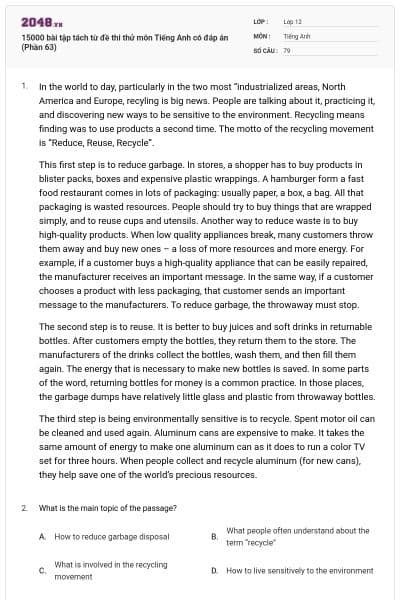
In the world to day, particularly in the two most “industrialized areas, North America and Europe, recyling is big news. People are talking about it, practicing it, and discovering new ways to be sensitive to the environment. Recycling means finding was to use products a second time. The motto of the recycling movement is “Reduce, Reuse, Recycle”.
This first step is to reduce garbage. In stores, a shopper has to buy products in blister packs, boxes and expensive plastic wrappings. A hamburger form a fast food restaurant comes in lots of packaging: usually paper, a box, a bag. All that packaging is wasted resources. People should try to buy things that are wrapped simply, and to reuse cups and utensils. Another way to reduce waste is to buy high-quality products. When low quality appliances break, many customers throw them away and buy new ones – a loss of more resources and more energy. For example, if a customer buys a high-quality appliance that can be easily repaired, the manufacturer receives an important message. In the same way, if a customer chooses a product with less packaging, that customer sends an important message to the manufacturers. To reduce garbage, the throwaway must stop.
The second step is to reuse. It is better to buy juices and soft drinks in returnable bottles. After customers empty the bottles, they return them to the store. The manufacturers of the drinks collect the bottles, wash them, and then fill them again. The energy that is necessary to make new bottles is saved. In some parts of the word, returning bottles for money is a common practice. In those places, the garbage dumps have relatively little glass and plastic from throwaway bottles.
The third step is being environmentally sensitive is to recycle. Spent motor oil can be cleaned and used again. Aluminum cans are expensive to make. It takes the same amount of energy to make one aluminum can as it does to run a color TV set for three hours. When people collect and recycle aluminum (for new cans), they help save one of the world’s precious resources.
What is the main topic of the passage?
How to reduce garbage disposal
What people often understand about the term “recycle”
What is involved in the recycling movement
How to live sensitively to the environment
Đáp án C
Trong bài tác giả kể ra 3 bước (The first step, The second step, The third step) của “the recycling movement” (phong trào tái chế)
People can do the following to reduce waste EXCEPT:
buy high-quality product
buy simply-wrapped things
reuse cups
buy fewer hamburgers
Đáp án D
Trong đoạn 2 tất cả đều được nhắc đến trừ đáp án D: “People should try to buy things that are wrapped simply, and to reuse cups and utensils. Another way to reduce waste is to buy high-quality products.”
Dịch: Mọi người nên cố gắng mua đồ được gói đơn giản, và tái sử dụng cốc và thìa dĩa. Một cách khác để giảm rác thải là mua các sản phẩm có chất lượng cao
Why is it a waste when customers buy low-quality products?
Because people will soon throw them away.
Because they have to be repaired many times.
Because customers change their ideas all the time.
Because they produce less energy.
Đáp án A
Trong đoạn 2: “When low quality appliances break, many customers throw them away and buy new ones – a loss of more resources and more energy.”
Dịch: Khi các thiết bị kém chất lượng bị hỏng, nhiều khách hàng vứt chúng đi và mua cái mới – môt sự tốn kém nhiều tài nguyên và nhiều năng lượng hơn.
What best describes the process of reuse?
The bottles are collected, washes, returned and filled again.
The bottles are filled again after being returned, collected and washed.
The bottles are washed, returned filled again and collected.
The bottles are collected, returned filled again and washed.
Đáp án B
Trong đoạn 3: “After customers empty the bottles, they return them to the store. The manufactures ò drinks collect the bottles, wash them and then fill them again.”
Dịch: Sau khi khách hàng sử dụng xong chai, họ trả chúng về cửa hàng. Các nhà sản xuất của các loại nước thu thập chai, rửa sạch chúng, và sau đó lại làm đầy chúng.
Vậy đáp án B là chính xác: “The bottles are filled again after being returned, collected and washed.
What are the two things mentioned as example of recycling?
Aluminum cans and plastic wrapping.
Hamburger wrappings and spent motor oil.
Aluminum cans and spent motor oil.
TV sets and aluminum cans.
Đáp án C
Trong đoạn 4: “Spent motor oil can be cleaned and used again… When people collected and recyle aluminum (for new cans)…”
Dịch: Dầu máy đã qua sử dụng có thể được làm sạch và sử dụng lại… Khi mọi người thu thập và tái chế nhôm (cho các lon mới)
Telecommuting is some form of computer communication between employees’homes and offices. For employees whose job involve sitting at a terminal or word processor entering data or typing reports, the location of the computer is of no consequence. If the machine can communicate over telephone lines, when the work is completed, employees can dial the office computer and transmit the material to theiremployer. A recent survey in USA Today estimates that there are approximately 8,7 million telecommuters. But although the numbers are rising annually, the trend does not appear to be as significant as predicted when Business Week published “ The Portable Executive” as its cover story a few years ago. Why hasn’t telecommuting become more popular?
Clearly, change simply takes time. But in addition, there has been active resistance on the part of many managers. These executives claim that supervising the telecommuters in a large work force scattered across the country would be too difficult, or, at least, systems for managing them are not yet developed, thereby complicating the manager’s responsibilities.
It is also true that employees who are given the option of telecommuting are reluctant to accept the opportunity. Most people feel that they need regular interaction with a group, and many are concerned that they will not have the same consideration for advancement if they are not more visible in the office setting. Some people feel that even when a space in their homes is set aside as a work area, they never really get away from the office.
With which of the following topics is the passage primarly concerned?
The advantages of telecommuting.
A definition of telecommuting.
An overview of telecommuting.
The failure of telecommuting.
C
Văn bản chủ yếu đề cập tới chủ đề nào trong các chủ đề sau?
à C. An ovẻview of telecommuting. ( Tổng quan về ( hình thức ) liên lạc từ xa)
The phrase “ of no consequence” means___________.
of no use
of no good
unimportant
irrelevant
C
Cụm từ: of no consequence = unimportant: không quan trọng
The author mentions all of the following as concerns of telecommuting, EXCEPT_______.
the opportunities for advancement.
the different system of supervision.
the lack of interaction with a group.
The work place is in the home
B
Tác giả đề cập tới cá ý sau về liên lạc từ xa, NGOẠI TRỪ ______
B. the different system of supervision. ( hệ thống giám sát khác)
A. ( các cơ hội thăng tiến) xuất hiện ở “... and many are concerned that they will not have the same consideration for advancement if they are not visible in the office setting.”
(... và nhiều người lo ngại rằng họ sẽ không được xem xét thăng tiến nếu họ không thường xuyên có mặt ở văn phòng.)
C. ( sự thiếu hụt tương tạc với nhóm) xuất hiện ở : Most people feel that they need regular interacion with a group...”
( Đa số mọi người cảm thấy họ cần có sự tương tác thường xuyên với nhóm...)
D. ( nơi làm việc là ở nhà) xuất hiện ở “ Some people feel that even when a space in their homes is set aside as a work area, they never really get away from the office.”
( Một số người cảm thấy rằng , thậm chí khi một khoảng không gian ở nhà họ được dành riêng ra thành một khu vực làm việc, họ vẫn không bao giờ thực sự rời khỏi văn phòng.)
The reason why telecommuting has not become popular is that the employees _______.
need regular interaction with their families.
are worried aboout the promotion if they are not seen at the office.
feel that a work area in their home is away from the office.
are ignorant of telecommuting.
B
Lý do mà liên lạc từ xa chưa trở nên phổ biến là vì các nhân viên ___________
A. cần có tương tác thường xuyên với gia đình
B. lo lắng về việc thăng chức nếu họ không có mặt ở văn phòng.
C. cảm thấy rằng một khu vực làm việc ở n hà là xa rời khỏi văn phòng.
D. còn thiếu hiểu biết về liên lạc từ xa.
When Busines Week published “ The Portable Executive”, it implied that_________.
systems for managing telecommuters were not effective.
there was resistance on the part of many managers about telecommuting.
the trend for telecommuting was optimistic.
most telecommuters were satisfied with their work.
C
Khi tuần báo Business xuất bản bài viết “ The Portable Executive”, có hàm ý rằng _____
A. các hệ thống quản lý liên lạc từ xa chưa có hiệu quả
B. có sự khiên cưỡng ở nhiều người quản lý đối với ( việc sử dụng) liên lạc từ xa.
C. xu hướng liên lạc từ xa có triển vọng / rất lạc quan.
D. đa số những người liên lạc từ xa hài lòng về công việc của họ.
Trong bài có:”... the trend does not appear to be as significant as predicted when Business Week published “ The Portable Executive” as its cover story a few years ago."
(... xu hướng không có vẻ đáng kể/ lớn như dự đoán của tuần báo Business khi họ xuất bản bài viết “ The Portable Executive” làm câu chuyện trên bìa vài năm trước.)
In addition to providing energy, fats have several other functions in the body. The fat soluble vitamins, A, D, E, and K, are dissolved in fats, as their name implies. Good sources of these vitamins have high oil or fat content, and the vitamins are stored in the body’s fatty tissues. In the diet, fats cause food to remain longer in the stomach, this increasing the feeling of fullness for some time after a meal is eaten. Fats add variety, taste and texture to foods, which accounts for the popularity of fried foods. Fatty deposits in the body have an insulating and protective value. The curves of the human female body are due mostly to strategically located fat deposits.
Whether a certain amount of fat in the diet is essential to human health is not definitely known. When rats are fed a fat-free diet, their growth eventually ceases, their skin becomes inflamed and scaly, and their reproductive systems are damaged. Two fatty acids, linoleic and acids, prevent these abnormalities and hence are called essential fatty acids. They also are required by a number of other animals but their roles in human beings are debatable. Most nutritionists consider linoleic fatty acid an essential nutrient for humans.
This passage probably appeared in which of the following?
A diet book
A book on basic nutrition
A cookbook
A popular women’s magazine
B
Đề: Bài luận này có thể xuất hiện trên…
A. sách về ăn kiêng
B. sách về dinh dưỡng cơ bản
C. sách dạy nấu ăn
D. một tạp chí phụ nữ nổi tiếng
Cả bài nói về các chất dinh dưỡng nên đáp án B là đáp án chính xác nhất
The phrase “stored in” in lines 3 is closest in meaning to ________.
manufactured in
attached to
measured by
accumulated
D
Đề: Cụm từ “stored in” (chứa đựng/dự trữ trong) ở dòng 3 sát nghĩa nhất với…
A. sản xuất ở B. gắn/đính kèm với
C. đo lường bởi D. tích trữ, tích luỹ
The author states that fats serve all of the following body functions EXCEPT to ________.
promote a feeling of fullness
insulate and protect the body
provide energy
control weight gain
D
Đề: Tác giả chỉ ra rằng, các chất béo phụ vụ các chức năng cơ thể sau đây, NGOẠI TRỪ…
A. tạo cảm giác no
B. bao bọc và bảo vệ cơ thể
C. cung cấp năng lượng
D. điều khiển/kiểm soát sự tăng cân
Các thông tin A, B, C đều có trong bài vậy đáp án D là đáp án chính xác
According to the author of the passage, which of the following is true for rats when they are fed a fat free diet?
They stop growing
They have more babies
They lose body hair
They require less care
A
Đề: Theo tác giả bài luận, ý nào sau đây đúng với chuột khi chúng được cho ăn chế độ không chất béo?
A. Chúng ngừng lớn lên B. Chúng sinh đẻ nhiều hơn
C. Chúng bị rụng lông D. Chúng đòi hỏi ít sự chăm sóc hơn
Câu 2 đoạn 2: “When rats are fed a fat-free diet, their growth eventually ceases, their skin becomes inflamed and scaly, and their reproductive systems are damaged.”
Dịch: Khi chuột được cho ăn chế độ không chất béo, sự tăng trưởng của chúng ngừng lại, da của chúng bị viêm và có vảy, và hệ sinh sản của chúng bị hư hại.
Linoleic fatty acid is mentioned in the passage as ________.
an essential nutrient for humans
more useful than acid
prevent weight gain in rats
a nutrient found in most foods
A
Đề: Axit béo linoleic được đề cập trong đoạn văn như là…
A. một chất dinh dưỡng thiết yếu với con người
B. hữu ích hơn axit arachidonic
C. có thể phòng chống tăng cân ở chuột
D. một chất dinh dưỡng có thể được tìm thấy ở đa số các loại thực phẩm
Câu 3 đoạn 2: “Two fatty acids, linoleic and arachidonic acids, prevent these abnormalities and hence are called essential fatty acids.”
Dịch: 2 axit béo, axit linoleic và arachidonic, phòng chống các biến dị đó và vì vậy mà (chúng) được gọi là các axit béo thiết yếu.
The phrase “these abnormalities” in line 11 refers to ________.
a condition caused by fried foods
strategically located fat deposits
curves on the human female body
cessation of growth, bad skin, and damaged reproductive systems
D
Đề: Cụm từ “these abnormalities” ở dòng 11 nói tới…
A. một điều kiện tạo ra bởi thức ăn chiên rán
B. các vùng chất béo có vị trí chiến lược
C. các đường con trên cơ thể nữ giới
D. sự ngừng lại trong tăng trưởng, da dẻ xấu, và hệ sinh sản bị hư hại
Dựa vào câu trước đó: “When rats are fed a fat-free diet, their growth eventually ceases, their skin becomes inflamed and scaly, and their reproductive systems are damaged.” Ta thấy có nhắc đến sự ngừng lại trong tăng trưởng, da dẻ xấu, và hệ sinh sản bị hư hại nên đáp án D là đáp án chính xác.
That humans should all have some fat in our diets is, according to the author
a commonly held view
not yet a proven fact
only true for women
proven to be true by experiments on rats
B
Đề: Việc mọi người nên có chất béo trong chế độ ăn uống là, theo như tác giả,…
A. một quan điểm thường thắy
B. một việc chưa được chứng minh
C. chỉ đúng đối với nữ giới
D. đã được chứng minh là đúng bởi các thí nghiệm trên chuột
An air pollutant is defined as a compound added directly or indirectly by humans to the atmosphere in such quantities as to affect humans, animals, vegetation, or materials adversely. Air pollution requires a very flexible definition that permits continuous change. When the first air pollution laws were established in England in the fourteenth century, air pollutants were limited to compounds that could be seen or smelled - a far cry from the extensive list of harmful substances known today. As technology has developed and knowledge of the health aspects of various chemicals has increased, the list of air pollutants has lengthened. In the future, even water vapor might be considered an air pollutant under certain conditions.
Many of the more important air pollutants, such as sulfur oxides, carbon monoxide, and nitrogen oxides, are found in nature. As the Earth developed, the concentration of these pollutants was altered by various chemical reactions; they became components in biogeochemical cycles. These serve as an air purification scheme by allowing the compounds to move from the air to the water or soil. On a global basis, nature's output of these compounds dwarfs that resulting from human activities.
However, human production usually occurs in a localized area, such as a city. In such a region, human output may be dominant and may temporarily overload the natural purification scheme of the cycles. The result is an increased concentration of noxious chemicals in the air. The concentrations at which the adverse effects appear will be greater than the concentrations that the pollutants would have in the absence of human activities. The actual concentration need not be large for a substance to be a pollutant; in fact, the numerical value tells us little until we know how much of an increase this represents over the concentration that would occur naturally in the area. For example, sulfur dioxide has detectable health effects at 0.08 parts per million (ppm), which is about 400 times its natural level. Carbon monoxide, however, has a natural level of 0.1 ppm and is not usually a pollutant until its level reaches about 15 ppm.
What does the passage mainly discuss?
The economic impact of air pollution.
What constitutes an air pollutant.
How much harm air pollutants can cause.
The effects of compounds added to the atmosphere.
: B
Đề: Bài luận bàn luận chủ yếu về vấn đề gì?
A. Tác động về kinh tế của ô nhiễm không khí.
B. Điều gì cấu thành/tạo nên ô nhiễm không khí.
C. Ô nhiễm không khí có thể gây hại nhiều tới mức nào.
D. Tác động của các hợp chất được đưa vào bầu không khí/khí quyển.
Dựa vào câu mở bài: “An air pollutant is defined as a compound added directly or indirectly by humans to the atmosphere in such quantities as to affect humans, animals, vegetation, or materials adversely.”
Dịch: Một chất gây ô nhiễm không khí được định nghĩa là một hợp chất được đưa vào bầu không khí/khí quyển một cách trực tiếp hoặc gián tiếp bởi con người ở một mức độ mà ảnh hưởng xấu tới con người, động thực vật hoặc các vật chất.
(Sau đó toàn bài đi sâu phân tích các chất gây ô nhiễm và cách chúng tạo nên ô nhiễm không khí.)
It can be inferred from the first paragraph that ________.
water vapor is an air pollutant in localized areas
most air pollutants today can be seen or smelled
the definition of air pollution will continue to change
a substance becomes an air pollutant only in cities
C
Đề: Có thể được suy luận ra từ đoạn văn đầu tiên rằng…
A. hơi nước là một chất gây ô nhiễm không khí ở các khu dân cư
B. hầu hết các chất gây ô nhiễm không khí ngày nay có thể được nhìn thấy hoặc ngửi thấy
C. định nghĩa về ô nhiễm không khí sẽ tiếp tục thay đổi
Dựa vào câu 2: “Air pollution requires a very flexible definition that permits continuous change.”
Dịch: Sự ô nhiễm không khí đòi hỏi một sự định nghĩa linh hoạt mà cho phép có sự thay đổi không ngừng/liên tục.
For which of the following reasons can natural pollutants play an important role in controlling air pollution?
They function as part of a purification process.
They occur in greater quantities than other pollutants.
They are less harmful to living beings than other pollutants.
They have existed since the Earth developed.
A
Đề: Vì lý do nào sau đây mà các chất gây ô nhiễm tự nhiên đóng vai trò quan trọng trong việc kiểm soát sự ô nhiễm không khí?
A. Chúng hoạt động với chức năng là một phần của quá trình thanh lọc.
B. Chúng xuất hiện với số lượng lớn hơn nhiều so với các chất gây ô nhiễm khác.
C. Chúng ít có hại tới các sinh vật sống hơn so với các chất gây ô nhiễm khác.
D. Chúng đã luôn tồn tại từ khi trái đất hình thành.
Đoạn 2: “Many of the more important air pollutants, such as… are found in nature. As the Earth developed, the concentration of these pollutants was altered by various chemical reactions; they became components in biogeochemical cycles. These serve as an air purification scheme…”
Dịch: Nhiều chất gây ô nhiễm không khí quan trọng/nghiêm trọng hơn, như… được tìm thấy trong tự nhiên. Khi trái đất hình thành/phát triển, chúng trở thành các thành phần trong các chu kỳ sinh hoá. Chúng có tác dụng như là một cách thanh lọc không khí…
According to the passage, human-generated air pollution in localized regions ________.
can be dwarfed by nature's output of pollutants
can overwhelm the natural system that removes pollutants
will damage areas outside of the localized regions
will react harmfully with natural pollutants
B
Đề: Theo bài luận, ô nhiễm không khí gây ra bởi con người ở các khu vực tập trung dân cư…
A. có thể được lấn át bởi các chất gây ô nhiễm sinh ra từ tự nhiên.
B. có thể áp đảo hệ thống tự nhiên mà (hệ thống đó) loại bỏ các chất gây ô nhiễm.
C. sẽ gây thiệt hại tới các khu vực ngoài các vùng tập trung dân cư.
D. sẽ phản ứng một cách có hại với các chất gây ô nhiễm tự nhiên.
Đầu đoạn 3: “In such a region, human output may be dominant and may temporarily overload the natural purification scheme of the cycles.”
Dịch: Ở những vùng như vậy, khí thải do con người có thể chi phối và có thể tạm thời gây quá tải lên sự thanh lọc tự nhiên của các chu kỳ.
The word “localized” in the third paragraph is closest in meaning to ________.
specified
circled
surrounded
encircled
A
Đề: Từ “localized” (tập trung dân cư; nội địa hoá; giới hạn khu vực) ở đoạn 3 sát nghĩa nhất với…
A. specified (P2): xác định B. circled (P2): được xoay vòng
C. surrounded (P2): được bao quanh D. encircled (P2): bị bao vây
According to the passage, the numerical value of the concentration level of a
substance is only useful if ________.
the other substances in the area are known
it is in a localized area
the natural level is also known
it can be calculated quickly
C
Đề: Theo như văn bản, giá trị số của nồng độ của một chất chỉ hữu ích nếu…
A. các chất khác trong khu vực đã được biết
B. nó ở trong một khu xác định
C. mức độ/nồng độ tự nhiên cũng đã được biết
D. nó có thể được tính toán nhanh chóng
Giữa đoạn 3: “… in fact, the numerical value tells us little until we know how much of an increase this represents over the concentration that would occur naturally in the area.”
Dịch: … trên thực tế, giá trị số không cho ta biết nhiều, cho tới khi ta biết được nó đại diện cho sự tăng lên nhiều như thế nào trong nồng độ mà sẽ xuất hiện tự nhiên ở khu vực đó.
Which of the following is best supported by the passage?
To effectively control pollution, local government should regularly review their air pollution laws.
One of the most important steps in preserving natural lands is to better enforce air pollution laws.
Scientists should be consulted in order to establish uniform limits for all air pollutants
Human activities have been effective in reducing air pollution.
D
Đề: Ý nào sau đây được bổ trợ tốt nhất bởi bài luận?
A. Để kiểm soát ô nhiễm một cách hiệu quả, chính phủ địa phương cần thường xuyên xem xét lại các luật về ô nhiễm môi trường của họ.
B. Một trong các bước quan trọng nhất trong việc bảo tồn đất đai tự nhiên là thi hành tốt hơn các luật về ô nhiễm môi trường.
C. Các nhà khoa học nên được hỏi ý kiến để thiết lập những giới hạn đồng bộ cho mọi chất gây ô nhiễm không khí.
D. Các hoạt động của con người đã và đang có hiệu quả trong việc giảm thiểu ô nhiễm không khí.
The history of clinic nutrition, or the study of the relationship between health and how the body takes in and utilizers food substances, can be divided into four distinct eras: the first began in the nineteenth century and extended into the early twentieth century when it was recognized for the first time that food contained constituents that were essential agents. Near the end of this era, research studies demonstrated that rapid weight loss was associated with nitrogen imbalance and could only be rectified by providing adequate protein associate with certain foods.
The second era was initiated in the early decades of the twentieth century and might be called "the vitamin period". Vitamins came to be recognized in foods, en deficiency syndromes were described. As vitamins became recognized as essential food constituents necessary for health, it became tempting to suggest that every disease and condition for which there had been no previous effective treatment might be responsive to vitamin therapy. At the point in time, medical schools started to become more interested in having their curricula integrate nutritional therapies in medicine. Reckless claims were made for effects of vitamins that went far beyond what could actually be achieved from the use of them.
In the third era of nutritional history in the early 1950's to mid-1960's, vitamin therapy began to fall into disrepute. Concomitant with this, nutrition education in medical schools also became less popular. It was just a decade before this that many drug companies had found their vitamins sales skyrocketing and were quick to supply practicing physicians with generous samples of vitamins and literature extolling the virtue of supplementation for a variety health-related conditions. Expectations as to the success of vitamins in disease control were exaggerated. As is known in retrospect, vitamin and mineral therapies are much less effective when applied to health-crisis conditions that when applied to long-term problems of nutrition that lead chronic health problem.
What does the passage mainly discuss?
The effects of vitamins in the human body.
The history f food preferences from the 19th century to the present.
The stages of development of clinical nutrition as a field of study.
Nutritional practices of the 19th century.
Đáp án C
Đoạn 1 có đề cập "The history of clinical nutrition… can be divided into four distinct eras", và tiếp sau đó, tác giả trình bày về 3 thời kỳ (eras) đầu tiên.
Dịch: Lịch sử về các chất dinh dưỡng, hay sự nghiên cứu về mối quan hệ giữa sức khỏe và làm thế nào cơ thể có thể hấp thụ và sử dụng các chất trong thức ăn, có thể được chia làm 4 giai đoạn…"
It can be inferred from the passages that which of the following discoveries was made during the first era in the history of nutrition?
Protein was recognized as an essential component of diet.
Vitamins were synthesized from foods.
Effective technique of weight loss were determined.
Certain food were found to be harmful to good health.
Đáp án A
"Near the end of this era…associated with certain food"
Dịch: Gần cuối của giai đoạn này, các nghiên cứu chứng minh rằng sự giảm cân nhanh chóng có liên quan đến sự thiếu cân bằng nitrogen và có thể điều chỉnh bằng việc cung cấp protein có trong thức ăn hằng ngày.
The word "tempting" is closest meaning to ________.
necessary
attractive
realistic
correct
Đáp án B
tempting (adj) = attractive (adj): hấp dẫn, thu hút.
The word "reckless" can be best replaced by ________.
recorded
irresponsible
informative
urgent
Đáp án B
reckless (adj) = irresponsible (adj): thiếu thận trọng, liều lĩnh.
The word "them" refers to ________.
therapies
claims
effects
vitamins
Đáp án D
"Reckless claims were made for effects of vitamins that went far beyond what could actually be achieved from the use of them."
Dịch: Những tuyên bố thiếu thận trọng về hiệu quả của vitamin đã đi khá xa so với những cái có thể đạt được từ việc sử dụng chúng.
Why did vitamins therapy begin losing favour in the 1950's?
The public lost interest in vitamins.
Medical schools stopped teaching nutritional concepts
Nutritional research was of poor quality.
Claims for the effectiveness of vitamin therapy were seen to be exaggerated.
Đáp án D
"Expectations as to the success of vitamins in disease control… that lead to chronic health problems"
Dịch: Những sự mong đợi thành công về việc vitamin có thể kiểm soát bệnh tật đã đi quá đà. Như đã biết trong quá khứ, liệu pháp trị bệnh bằng vitamin và chất khoáng thì ít có hiệu quả hơn khi áp dụng với tình trạng khủng hoảng sức khỏe so với khi áp dụng cho vấn đề về dinh dưỡng lâu dài mà điều này dẫn đến các vấn đề sức khỏe kinh niên.
The word "skyrocketing" is closest meaning to ________.
internationally popular
acceptable
increasing rapidly
surprising
Đáp án C
skyrocket = increase rapidly: tăng vọt
Plants and animals will find it difficult to escape from or adjust to the effect of global warming. Scientists have already observed shifts in the lifecycles of many plants and animals, such as flowers blooming earlier and birds hatching earlier in the spring. Many species have begun shifting where they live or their annual migration patterns due to warmer temperatures.
With further warming, animals will tend to migrate toward the poles and up mountainsides toward higher elevations. Plants will also attempt to shift their rangers, seeking new areas as old habitats grow too warm. In many places, however, human development will prevent these shifts. Species that find cities of farmland blocking their way north or south may become extinct. Species living in unique ecosystems, such as those found in polar and mountaintop regions, are especially at risk because migration to new habitats is not possible. For instance, polar bears and marine mammals in the Arctic are already threatened by dwindling sea ice but have nowhere father to go.
Projecting species extinction due to global warming is extremely difficult. Some scientists have estimated that 20 to 50 percent of species could be committed to extinction with 2 to 3 Celsius degrees of further warming. The rate of warming, not just the magnitude, is extremely important for plants and animals. Some species and even entire ecosystems, such as certain types of forest, many not be able to adjust quickly enough and may disappear.
Ocean ecosystems, especially fragile ones like coral reefs, will also be affected by global warming. Warmer ocean temperatures can cause coral to "bleach", a state which if prolonged will lead to the death of the coral. Scientists estimate that even 1 Celsius degree of additional warming could lead to widespread bleaching and death of coral reefs around the world. Also, increasing carbon dioxide in the atmosphere enters the ocean and increases the acidity of ocean waters. This acidification further stresses ocean ecosystems.
Scientists have observed that warmer temperatures in the spring cause flower to ________.
die instantly
bloom earlier
become lighter
lose colour
Đáp án B
"Plants and animals will find it difficult…many plants and animals, such as flowers blooming earlier and birds hatching earlier in the spring."
Dịch: Động thực vật sẽ cảm thấy khó khăn trong việc thoát khỏi hay thích ứng với sự ảnh hưởng của biến đổi khí hậu. Cách nhà khoa học đã quan sát sự thay đổi về vòng đời của một số loại động thực vật, chẳng hạn như việc hoa nở sớm và chim ấp sớm vào mùa xuân.
According to paragraph 2, when their habitats grow warmer, animals tend to move ________.
south - eastwards and down mountainsides toward lower elevations.
north - westward and up mountainsides toward higher elevations.
toward the North Pole and down mountainsides toward lower elevations.
toward the poles and up mountainsides toward higher elevations.
Đáp án D
"With further warming, animals will tend to migrate toward the poles and up mountainsides toward higher elevations."
Dịch: Với việc ngày càng ấm dần lên, động vật sẽ có khuynh hướng di cư về các cực và từ các vùng núi về các vùng có độ cao hơn."
The pronoun "those" in paragraph 2 refers to ________.
species
ecosystems
habitats
areas
Đáp án A
"Species living in unique…to new habitats is not possible."
Dịch: Những loại động vật sống trong các hệ sinh thái đặc biệt, chẳng hạn như các loài được phát hiện ở các cực và vùng núi, thì đặc biệt rủi ro cao bởi vì sự di cư đến một môi trường sống mới là điều không thể.
The phrase "dwindling sea ice" in paragraph 2 refers to ________.
the frozen water in the Arctic
the violent Arctic Ocean
the melting ice in the Arctic
the cold ice in the Arctic
Đáp án C
"For example, polar bears and marine mammals in the Arctic are already threatened by dwindling sea ice but…"
Dịch: Lấy ví dụ như, gấu bắ cực và động vật biển có vú ở Đại Tây Dương thì hoàn toàn bị đe dọa bởi sự tan băng…"
It is mentioned in the passage that if the global temperature rose by 2 or 3 Celsius degrees, ________.
half of the earth's surface would be flooded
the sea level would rise by 2o centimetres
water supply would decrease by 50 percent
20 to 50 percent of species could become extinct
Đáp án D
"Some scientist have estimated that 20 to 50 percent of species could be committed to extinction with 2 to 3 Celsius degrees of further warming."
Dịch: Một vài nhà khoa học đã dự đoán rằng từ 20 đến 50 phần trăm loài có thể bị đẩy đến sự tuyệt chủng với sự nóng lên từ 2 đến 3 độ C.
According to the passage, if some species are not able to adjust quickly to warmer temperatures, ________.
they may be endangered
they can begin to develop
they will certainly need water
they move to tropical forests
Đáp án A
"Some species and even entire ecosystem, such as certain types of forest, many not be able to adjust quickly enough and may disappear."
Dịch: Một vài loài và thậm chí toàn bộ hệ sinh thái, chẳng hạn như các loại đặc trưng ở rừng, nhiều loài sẽ không có khả năng thích ứng đủ nhanh và có thể biến mất.
The word "fragile" in paragraph 4 most probably means ________.
very large
easily damaged
rather strong
pretty hard
Đáp án B
fragile: easily broken or damaged à fragile = easily broken: mỏng manh, dễ vỡ
The bleaching of coral reefs as mentioned in paragraph 4 indicates ________.
the water absorption of coral reefs
the quick growth of marine mammals
the blooming phase of sea weeds
the slow death of coral reefs
Đáp án D
"Warmer ocean temperatures can cause coral to "bleach", a state which if prolonged will lead to the death of the coral."
Dịch: Nhiệt độ đại dương nóng lên có thể làm cho san hô bị tẩy trắng, một tình trạng mà nếu bị kéo dài sẽ dẫn tới cái chết của san hô.
Under the Medicare insurance policy, people approaching 65 may enroll during the seven-month period that includes three months before the sixty-fifth birthday, the month in which the birthday falls, and three months after the birthday. However, if they wish the insurance coverage to begin when they reach 65, they must enroll three months before their birthday. People who do not enroll within their first enrollment period may enroll later, during the first three months of each year. Those people, however, must pay 10% additional for each twelve-month period that elapsed since they first could have enrolled. The monthly premium is deducted from social security payment, railroad retirement or civil service retirement benefits.
The author’s purpose is to________.
describe the benefits of Medicare.
stimulate enrollment in Medicare.
advertise Medicare.
tell people when they may enroll in Medicare.
Đáp án D
Đề: Mục đích của tác già là:
A. Miêu tả những lợi ích của Medicare
B. Khuyến khích mọi người tham gia Medicare
C. Quảng cáo Medicare
D. Nói cho mọi người biết khi nào thì họ có thể tham gia vào Medicare
People would pay 10% more for their insurance if they________.
were under 65
enrolled after their sixty-fifth birthday.
applied seven months before their sixty-fifth birthday.
enrolled in a private plan.
Đáp án B
Đề: Mọi người sẽ trả hơn 10% tiền bảo hiểm của họ nếu:
A. Dưới 65 tuổi
B. Đăng ký sau sinh nhật lần thứ 65
C. Đăng ký 7 tháng trước khi đến sinh nhật lần thứ 65
D. Tham gia 1 dự án tư nhân
Ta tìm thông tin ở dòng: “Those people, however, must pay 10% additional for each twelve – month period that elapsed since they first could have enrolled”
(Những người này, tuy nhiên, phải trả 10% phí cộng them cho mỗi giai đoạn 12 tháng trôi qua kể từ khi họ lần đầu tiên đăng ký.)
To start coverage by Medicare on their sixty-fifth birthday, people must apply________.
seven months before their birthday.
four months before their birthday.
three months before their birthday.
the month in which their birthday occurs.
Đáp án C
Đề: Để bắt đầu một gói bảo hiểm Medicare vào sinh nhật lần thứ 65, mọi người phải đăng ký:
A. 7 tháng trước sinh nhật của họ
B. 4 tháng trước sinh nhật của họ
C. 3 tháng trước sinh nhật của họ
D. Trong tháng mà sinh nhật của họ diễn ra
To word “deducted” in the passage can be replaced by________.
taken away
protected
subtracted
escaped
Đáp án C
Từ “deducted” (khấu trừ) trong đoạn trên có thể thay thế bằng từ nào dưới đây:
A. Mang đi, đem đi
B. Được bảo vệ
C. Được trừ đi
D. Trốn thoát, tẩu thoát
To word “elapsed” in the passage most closely means________.
passed
finished
ended
expired
Đáp án A
Từ “elapsed” (trôi qua – thời gian) trong đoạn trên sát nghĩa nhất với từ nào:
A. Trôi qua
B. Kết thúc
C. Chấm dứt
D. Hết hạn
The period after the sixty-fifth birthday during which people may apply for Medicare is________.
a quarter of a year
seven months
one month
January 1 to March 31 yearly.
Đáp án D
Đề: Khoảng thời gian sau sinh nhật lần thứ 65 khi mà mọi người có thể tham gia Medicare là:
A. 3 tháng (1/4 năm) B. 7 tháng
C. 1 tháng D. Từ ngày 01/01 đến 31/03 hằng năm
Medicare subscriber’s premiums________.
are due the first of every month
are taken out of their salaries
are subtracted from their pension
come from the government.
Đáp án C
Đề: Phí bảo hiểm của những người đăng ký Medicare:
A. Hạn nộp là ngày đầu tiên của mỗi tháng
B. Được lấy ra từ lương của họ
C. Được trích ra từ lương hưu của họ
D. Được đến từ chính phủ
May 7, 1840 was the birthday of one of the most famous Russian composers of the nineteenth century Peter Illich Tchaikovsky. The son of a mining inspector, Tchaikovsky studied music as a child and later studied composition at the St.Pertersburg Conservatory. His greatest period of productivity occurred between 1876 and 1890, during which time he enjoyed the patronage of Madame von Meck, a woman he never met, who gave him a living stipend of about $1,000.00 a year. Madame von Meck later terminated her friendship with Tchaikovsky, as well as his living allowance, when she, herself, was facing financial difficulties. It was during the time of Madame von Meck’s patronage, however, that Tchaikovsky created the music for which he is most famous, including the music for the ballets of Swan Lake and The Sleeping Beauty.
Tchaikovsky’s music, well known for its rich melodic and sometimes melancholy passages, was one of the first that brought serious dramatic music to dance. Before this, little attention had been given to the music behind the dance. Tchaikovsky died on November 6,1893, ostensibly of cholera, though there are now some scholars who argue that he committed suicide.
With what topic is the passage primary concerned?
the life and music of Tchaikovsky
development of Tchaikovsky’s music for ballets
Tchaikovsky’s relationship with Madame Von Meck
the cause of Tchaikovsky’s death
Đáp án A
Đề: Topic nào dưới đây được đề cập đến đầu tiên trong bài:
A. Cuộc đời và sự nghiệp âm nhạc của Tchaikovsky
B. Sự phát triển của âm nhạc Tchaikovsky dành cho ba lê
C. Mối quan hệ giữa Tchaikovsky và Madame Von Meck
D. Nguyên nhân dẫn đến cái chết của Tchaikovsky.Which of the following is closest in meaning to the word “productivity”?
fertility
affinity
creativity
maturity
Đáp án C
Đề: Từ nào trong những từ dưới đây sát nghĩa nhất với “productivity” (sự sáng tạo, năng suất):
A. Sự phì nhiêu, màu mỡ
B. Sự giống nhau, sự thu hút
C. Sự sáng tạo
D. Sự trưởng thành
The phrase “enjoyed the patronage of” probably means________?
liked the company of
was mentally attached to
solicited the advice of
was financially dependent upon
Đáp án D
Đề: Cụm từ “enjoyed the patronage of” (được hưởng sự bảo trợ của) có nghĩa là:
A. Thích công ty này của
B. Được đi kèm về mặt tinh thần
C. Khẩn khoản xin lời khuyên của
D. Bị phụ thuộc tài chính của
Which of the following could best replace the word “terminated”?
discontinued
resolved
exploited
hated
Đáp án A
Đề: Từ nào dưới đây có thể thay thế được từ “terminated” (chấm dứt):
A. Chấm dứt
B. Giải quyết
C. Khai thác, lợi dụng
D. Gét
According to the passage, all of the following describe Madame von Meck EXCEPT________.
She had economic troubles.
She was generous.
She enjoyed Tchaikovsky’s music.
She was never introduced to Tchaikovsky.
Đáp án C
Đề: Dựa vào đoạn văn trên, tất cả những điều dưới đây đều miêu tả Madame von Meck ngoại trừ:
A. ba ta có vấn đề về tài chính
B. Bà ta rất rộng lượng
C. Bà ấy thích âm nhạc của Tchaikovsky
D. Bà ấy chưa bao giờ được giới thiệu tới Tchaikovsky
According to the passage, for what is Tchaikovsky’s music most well known?
Its repetitive and monotonous tones.
The ballet-like quality of the music.
Its lively, capricious melodies.
The richness and melodic drama of the music.
Đáp án D
Đề: Dựa vào đoạn trên, âm nhạc của Tchaikovsky nổi tiếng nhất về cái gì:
A. Những tone lặp lại và đều đều
B. Chất lượng âm nhạc của những vở bale
C. Sự bảo trợ của bà Madame von Meck
D. Sự phong phú và du dương trong âm nhạc
According to the passage, “Swan Lake” and “The Sleeping Beauty” are________
dance
songs
operas
plays
Đáp án D
Đề: Dựa vào đoạn trên, “Swan Lake” và “The Sleeping Beauty” là:
A. Những bài nhảy B. Những bài hát
C. Những bài opera D. Những vở nhạc kịch
Which of the following is NOT mentioned in the passage?
Tchaikovsky’s influence on ballet music
Tchaikovsky’s unhappiness leading to suicide
the patronage of Madame von Meck
Tchaikovsky’s productivity in composing
Đáp án B
Đề: Những điều nào dưới đây không được đề cập trong bài:
A. Ảnh hưởng của Tchaikovsky đến âm nhạc bale
B. Sự buồn bực của Tchaikovsky dẫn đến cái chết
C. Sự bảo trợ của bà Madame von Meck
D. Sự sang tạo, năng suất của Tchaikovsky trong việc soạn nhạc
Carbohydrates, which are sugars, are an essential part of a healthy diet. They provide the main source of energy for the body, and they also function to flavor and sweeten foods. Carbohydrates range from simple sugars like glucose to complex sugars such as amylose ans amylopectin. Nutritionists estimate that carbohydrates should make up about one-fourth to one-fifth of a person’s diet. This translates to about 75-100 grams of carbohydrates per day.
A diet that is deficient in carbohydrates can have an adverse effect on a person’s health. When the body lacks a sufficient amount of carbohydrates, it must then use its protein supplies for energy, a process called gluconeogenesis. This, however, results in a lack of necessary protein, and further health difficulties may occur. A lack of carbohydrates can also lead to ketosis, a build-up of ketones in the body that causes fatigue, lethargy, and bad breath.
What is the main idea of this passage?
Carbohydrates are needed for good health
Carbohydrates prevent a build-up of proteins.
Cacbohydrates can lead to ketosis.
Carbohydrates are an expendable part of a good diet.
A
Đề: Ý chính của bài đọc là gì?
A. Carbohydrates cần thiết để có sức khỏe tốt.
B. Carbohydrates ngăn ngừa sự tích tụ các protein.
C. Carbohydrates có thể dẫn tới/ tạo nên hội chứng ketosis
D. Carbohydrates là một phần có thể bỏ đi của một chế độ ăn uống tốt.
Dòng đầu tiên: ” Carbohydrates, which are sugars, are an essential part of a healthy diet.”
(Carbohydrates, các chất đường, là một phần thiết yếu của một chế độ ăn uống lành mạnh.)
According to the passage, what do most nutritionists suggest?
Sufficient carbohydrates will prevent gluconeogenesis.
Carbohydrates are simple sugars called glucose.
Carbohydrates should make up about a quarter of a person’s daily diet.
Carbohydrates should be eaten in very small quantities.
C
Đề: Theo bài đọc, đa số các nhà dinh dưỡng học khuyên điều gì?
A. Carbohydrates đầy đủ sẽ phòng gữa qua trình gluconeogenesis.
B. Carbohydrates là các đường đơn có tên glucose.
C. Carbohydrates nên chiếm 1/4 chế độ ăn uống hằng ngày của mỗi người.
D. Carbohydrates nên được ăn ở một lượng rất nhỏ.
Dựa vào cuối đoạn 1: ”Nutritionists estimte that carbohydrates should make up about one-fourth to one-fifth of a person’s diet.”
(Các nhà dinh dưỡng học ước tính rằng cacbohydrates nên chiêm từ 1/4 đến 1/5 chế độ ăn uống hằng ngày của mỗi người.)
Which of the following do carbohydrates NOT do?
prevent ketosis
cause gluconeogenesis
provide energy for the body
flavor and sweeten food
B
Đề: Carbohydrates KHÔNG làm được điều nào sau đây?
A. phòng ngừa hội chứng ketosis
B. gây nên quá trình gluconeogenesis
C. cung cấp năng lượng cho cơ thể
D. tạo hương bị và làm ngọt thực phẩm
Dựa vào đầu đoạn 2:”When the body lacks a suffcient amount carbohydrates if must then use its protein supplies for energy, a process called gluconeogenesis.”
(Khi cơ thể không có đủ lượng cacbohydrates, nó phải dùng nguồn cung protein làm năng lượng, quá trình này gọi là gluconeogenesis.)
Which of the following words could best replace”deficient” as used in line 6?
outstanding
abundant
insufficient
unequal
C
Đề: Từ nào sau đây thay thế tốt nhất từ “deficient” ở dòng 7?
outstanding (adj): vượt trội, xuất sắc
abundant (adj): nhiều, dồi dào
insufficient (adj): không đủ = deficient (adj): thiếu
unequal (adj): không bằng nhau, bất bình đẳng
What does the word “this” refer to in line 8?
using protein supplies for energy
converting carbohydrates to energy
having a deficiency in carbohydrates
having an insufficient amount of protein
A
Từ “this” ở dòng 8 nói về?
A. sủ dụng các nguồn cung protein làm năng lượng
B. chuyển đổi carbohydrates thành năng lượng
C. có sự thiếu hụt carbohydrates
D. có sự thiếu hụt protein
Dòng trước: “…, it must then use its protein supplies for energy, a procees called gluconeogenesis,…”
According to the passage, which of the following does NOT describe carbohydrates?
a protein supply
a necessily
a range of sugars
an energy source
A
Đề: Theo bài đọc, điều nào sau đây KHÔNG mô tả carbohydrates?
A. là một nguồn cung protein
.B. là một sự cần thiết
(Carbohydrates, which are sugars, are an essential part of a healthy diet.)
C. các loại đường
(Cacbohydrates range from simple sugars like glucose to complex sugar …)
D. một nguồn năng lượng
(They provide the main source of energy for the body…)
Which of the following best describes the organization of this passage?
Cause and result
Comparison and contrast
Speccific to general
Definition and example
D
Đề: Ý nào sau đây mô tả đúng nhất cấu trúc của bài đọc?
A. Nguyên nhất và kết quả
B. So sánh và tương phản
C. Từ cụ thể tới khái quát
D. Khái niệm/ Định nghĩa và ví dụ
Cả bài đọc ta thấy tác giả định nghĩa “carbohydrates” ở đoạn 1, “diet” ở đoạn 2 và các ví dụ minh hoa.
Until recently, most American entrepreneurs were men. Discrimination against women in business, the demands of caring for families, and lack of business training had kept the number of women entrepreneurs small. Now, however, businesses owned by women account for more than $40 billion in annual revenues, and this figure is likely to continue rising throughout the 1990s. as Carolyn Doppe;t Gray, an offical of the Small Business Administration, has noted, “The 1970s was the decade of women entering management, and the 1980s turned out to be the decade pf the women entrepreneur”. What are some of the factors behind this trend? For one thing, as more women earn advanced degrees in business and enter the corporate world, they are finding obstacles. Women are still excuded from most executive suites. Charlotte Taylor, a management consultant, had noted, “In the 1970s, women believed if they got an MBA anf worked hard, they could become chairman of the board. Now they’ve found out that isn’t going to happen, so they go out on their own.”
In the past, most women entrepreneurs worked in “women’s” fields: cosmetics and clothing, for example. But this is changing. Consider ASK Computer Systems, a $22-milliona-year computar software business. It was founded in 1973 by Sandra Kurtzig, who was then a housewife with degrees in math and engineering. When Kurtzig founded the business, her first product was software that let weekly newspapers keep tabs on their newspaper carrier sand her office was a bedroom at home, with a shoebox under the bed to hold the company’s cash. After she succeeded with the newspaper software system, she hired several bright computer-science graduates to develop additional programs. When these were marketed and sold, ASK began to grow. It niw has 200 employees, and Sandra Kurtzig owns $66.9 million of stock.
Of course, many women who start their own businesses fail, just as men often do. They still face hurdles in the business world, especially problems in raising money; the banking and finance world is still dominated by men, and old attitudes die hard. Most businesses owned by women are still quite small. But the situations is changing; there are likely to be many more Sandra Kurtzigs in the years ahead.
What is the main idea of this passage?
Women today are better educated than is the past, marking them more attractive to the business world.
The computer is especially lucrative for women today.
Women are better at small business of their own.
Women today are opening more business of their own.
: D
Đề: Ý chính của bài đọc là gì?
A. Phụ nữ ngày nay được giáo dục tốt hơn trước đây, khiên họ trở nên thu hút hơn đối với giới kinh doanh.
B. Máy tính đặc biệt hữu ích cho phụ nữ ngày nay.
C. Phụ nữ giỏi kinh doanh nhỏ hơn là đàn ông.
D. Phụ nữ ngày nay đang tự kinh doanh/tự mở doanh nghiệp nhiều hơn.
Dựa vào câu 3: “Now, however, businesses owned by women account for more than $40 billion in annual revenues, and this figure is likely to continue rising throughout the 1990s.”
(Tuy nhiên, ngày nay, các doanh nghiệp được sở hữu bởi phụ nữ chiếm hơn 40 tỷ đô-la trong doanh thu hằng năm, và con số này nhiều khả năng sẽ tiếp tục tăng xuyên suốt thập niên 90.)
All of the following were mentioned in the passage as detriments to women in the business world EXCEPT________
Women were required to stay at home with their families.
Women lacked ability to work in business.
Women faced discrimination in business.
Women were not trained in business.
B
Đề: Những ý sau được nhắc tới là tổn hại của phụ nữa trong giới kinh doanh, NGOẠI TRỪ…
A. Phụ nữ được yêu cầu ở nhà với gia đinh, (thông tin được tìm thấy trong câu:”…the demands of caring for families”)
B. Phụ nữ thiếu khả năng hoạt động kinh doanh.
Phụ nữ gặp phải sự phân biệt đối xử trong kinh doanh. (Thông tin được tìm thấy trong câu:”…women believed if they got an MBA and worked hard, they could become chairman of the board. Now they’ve found out that isn’t going to happen, so they go out on their own”.)
C. Phụ nữ không được đào tạo trong kinh doanh. (Thông tin được tìm thấy trong câu:”…and lack of business training had kept the number of women entrepreneurs small”)
in line 12, “that” refers to________.
woman becoming the chairmen of the board
women working hard
women achieving advanced degrees
women believing that business is a place for them
A
Đề: Ở dòng 12, “that” nói về…
A. việc phụ nữa trở thành chủ tịch hội đồng
B. việc phụ nữ làm việc chăm chỉ
C. Việc phụ nữ đạt được bằng cấp/chứng chỉ cao
D. việc phụ nữ tin rằng kinh doanh cũng dành cho họ
Câu trước “that”: “In the 1970s, women believed if they got an MBA and worked hard, they could become chairman of the board.”
(Ở thập niên 70, phụ nữ từng tin rằng nếu họ có được bằng MBA và làm việc chăm chỉ, họ có thể trở thành chủ tịch hội đồng.)
According to the passage, Charlotte Taylor believes that women in 1970s________.
were unrealistic about their opportunities in business management.
were still more interested in education than business opportunities.
had fewer obstacles in business than they do today.
were inable to work hard enough to success in business.
A
Đề: Theo bài đọc, Charlotte Taylor tin rằng phụ nữ ở thập niên 70…
A. đã không thực tế về những cơ hội của họ trong quản lý doanh nghiệp
B. vẫn quan tâm tới giao dục hơn là các cơ hội kinh doanh
C. đã có ít trở ngại trong kinh doanh hơn so với ngày nay
D. đã không thể làm việc đủ chăm chỉ để thành công trong kinh doanh
Dựa vào câu “Charlotte Taylor, a management consultant, had noted, “In the 1970s, women believed if they got an MBA and worked hard, they could become chairman of the board. Now they’ve found out that isn’t going to happen…”
Dịch: Charlotte Taylor, cố vấn quản lý, đã ghi nhận rằng, “Ở thập niên 70, phụ nữ từng tin rằng nếu họ có được bằng MBA và làm việc chăm chỉ, họ có thể trở thành chủ tịch hội đồng. Tuy nhiên, bây giờ họ đã thấy điều đó sẽ không diễn ra…”
The expression “keep tabs on” in line 17 is closest meaning to________.
recognize the appearance of
keep records of
provide transportation for
pay the salaries of
B
Đề: Cụm “keep tabs on” ở dòng 17 sát nghĩa nhất với…
A. nhận ra diện mạo của
B. lưu lại
C. cung cấp phương tiện giao thông cho
D. trả lương
Cụm động từ keep tab on có nghĩa là ghi nhớ, lưu trữ
The word “hurdles” in line 23 can be best replaced by________.
fences
obstacles
question
small group
B
Đề: Từ “hurdles” ở dòng 23 có thể được thay thế tốt nhất bởi…
fence (n): hàng rào
obstacle (n) vật cản; trở ngại = hurdles (n): rào cản; trở ngại
question (n): câu hỏi
small groups: các nhóm nhỏ
It can be inferred from the passage that the author believes that business operated by women are small because________.
women prefer a small intimate setting.
women can’t deal with money.
women are not able to borrow money easily.
many women fail at large businesses.
C
Đề: Có thể suy ra từ bài đọc rằng, tác giả tin rằng kinh doanh được điều hành bởi phụ nữ thì nhỏ lẻ vì
A. phụ nữ thích bối cảnh làm việc nhỏ, thân mật
B. phụ nữ không thể xoay xở tiền bạc
C. phụ nữ không thể vay tiền một cách dễ dàng
D. nhiều người phụ nữ thất bại trong kinh doanh lớn.
Câu gần cuối bài: “They still face hurdles in the business world, especially problems in raising money…”
(Họ vẫn đối mặt với nhiều trở ngại trong giới kinh doanh, đặc biệt là các vấn đề về gây quỹ …)
The author’s attitude about the future of women in business is________.
skeptical
optimistic
frustrated
negative
B
Đề: Thái độ của người viết về tương lai của người phụ nữ trong kinh doanh là
A. hoài nghi
B. lạc quan
C. bực bội; nản chí
D. tiêu cực
Câu cuối bài: “But the situations is changing; there are likely to be many more Sandra Kurtzigs in the years ahead.”
(Nhưng tình thế đang thay đổi; có khả năng sẽ có nhiều Sandra Kurtzig (xuất hiện) trong những năm tới.)
Bạn có thích hoạt động này không?