15000 bài tập tách từ đề thi thử môn Tiếng Anh có đáp án (Phần 46)
63 câu hỏi
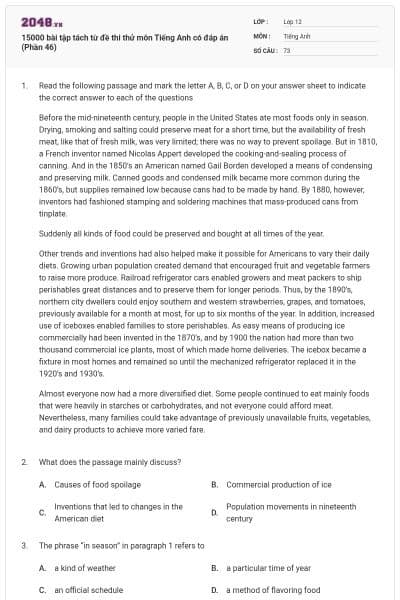
Read the following passage and mark the letter A, B, C, or D on your answer sheet to indicate the correct answer to each of the questions
Before the mid-nineteenth century, people in the United States ate most foods only in season. Drying, smoking and salting could preserve meat for a short time, but the availability of fresh meat, like that of fresh milk, was very limited; there was no way to prevent spoilage. But in 1810, a French inventor named Nicolas Appert developed the cooking-and-sealing process of canning. And in the 1850’s an American named Gail Borden developed a means of condensing and preserving milk. Canned goods and condensed milk became more common during the 1860’s, but supplies remained low because cans had to be made by hand. By 1880, however, inventors had fashioned stamping and soldering machines that mass-produced cans from tinplate.
Suddenly all kinds of food could be preserved and bought at all times of the year.
Other trends and inventions had also helped make it possible for Americans to vary their daily diets. Growing urban population created demand that encouraged fruit and vegetable farmers to raise more produce. Railroad refrigerator cars enabled growers and meat packers to ship perishables great distances and to preserve them for longer periods. Thus, by the 1890’s, northern city dwellers could enjoy southern and western strawberries, grapes, and tomatoes, previously available for a month at most, for up to six months of the year. In addition, increased use of iceboxes enabled families to store perishables. As easy means of producing ice commercially had been invented in the 1870’s, and by 1900 the nation had more than two thousand commercial ice plants, most of which made home deliveries. The icebox became a fixture in most homes and remained so until the mechanized refrigerator replaced it in the 1920’s and 1930’s.
Almost everyone now had a more diversified diet. Some people continued to eat mainly foods that were heavily in starches or carbohydrates, and not everyone could afford meat. Nevertheless, many families could take advantage of previously unavailable fruits, vegetables, and dairy products to achieve more varied fare.
What does the passage mainly discuss?
Causes of food spoilage
Commercial production of ice
Inventions that led to changes in the American diet
Population movements in nineteenth century
Đáp án C
Kiến thức: Đọc hiểu
Giải thích:
Đoạn văn chủ yếu thảo luận gì?
A. Nguyên nhân gây hư hỏng thực phẩm
B. Sản xuất băng thương mại
C. Các phát minh dẫn đến những thay đổi trong chế độ ăn uống của người Mỹ
D. Phong trào dân số thế kỷ XIX
Ý xuyên suốt của bài là các phát minh khiến cho chế độ ăn của người Mỹ thay đổi ( từ theo mùa thành có đồ ăn phong phú đủ loại quanh năm)
The phrase “in season” in paragraph 1 refers to
a kind of weather
a particular time of year
an official schedule
a method of flavoring food
Đáp án B
Kiến thức: Đọc hiểu
Giải thích:
Cụm từ "in season" trong đoạn 1 đề cập đến
A. một loại thời tiết
B. một khoảng thời gian cụ thể trong năm
C. một lịch trình chính thức
D. một phương pháp tạo hương vị thực phẩm
"in season": theo mùa, một khoảng thời gian cụ thể trong năm
The word “prevent” in paragraph 1 is closest in meaning to
estimate
avoid
correct
confine
Đáp án B
Kiến thức: Đọc hiểu
Giải thích:
Từ "prevent" trong đoạn 1 gần nhất có nghĩa là
A. ước tính B. tránh C. đúng D. giới hạn
"prevent" = avoid: tránh, ngăn ngừa
but the availability of fresh meat, like that of fresh milk, was very limited; there was no way to prevent spoilage.
nhưng sự sẵn có của thịt tươi, giống như sữa tươi, rất hạn chế; không có cách nào để ngăn ngừa sự hư hỏng.
During the 1860’s, canned food products were
unavailable in rural areas
shipped in refrigerator cans
available in limited quantities
a staple part of the American diet
Đáp án C
Kiến thức: Đọc hiểu
Giải thích:
Trong những năm 1860, các sản phẩm thực phẩm đóng hộp
A. không có ở các vùng nông thôn
B. vận chuyển trong hộp lạnh
C. có sẵn với số lượng hạn chế
D. một phần chủ yếu của chế độ ăn kiêng Mỹ
Thông tin: Canned goods and condensed milk became more common during the 1860’s, but supplies remained low because cans had to be made by hand.
It can be inferred that railroad refrigerator cars came into use
before 1860
before 1890
after 1900
after 1920
Đáp án B
Kiến thức: Đọc hiểu
Giải thích:
Có thể suy ra rằng xe lửa đông lạnh đã được sử dụng
A. trước năm 1860 B. trước năm 1890
C. sau năm 1900 D. sau năm 1920
Thông tin: Railroad refrigerator cars enabled growers and meat packers to ship perishables great distances and to preserve them for longer periods. Thus, by the 1890’s, northern city dwellers could enjoy southern and western strawberries, grapes, and tomatoes, previously available for a month at most, for up to six months of the year.
The word “them” in paragraph 2 refers to
refrigerator cars
perishables
growers
distances
Đáp án B
Kiến thức: Đọc hiểu
Giải thích:
Từ "them" trong đoạn 2 đề cập đến
A. xe đông lạnh B. đồ dễ hư hỏng C. người trồng D. khoảng cách
"them" đề cập đến perishables: Railroad refrigerator cars enabled growers and meat packers to ship perishables great distances and to preserve them for longer periods.
Xe lửa đông lạnh cho phép người trồng và người đóng gói thịt vận chuyển đồ dễ hỏng ở những khoảng cách lớn dễ dàng và bảo quản chúng lâu hơn.
The author implies that in the 1920’s and 1930’s home deliveries of ice
decreased in number
were on an irregular schedule
increased in cost
occurred only in the summ
Đáp án A
Kiến thức: Đọc hiểu
Giải thích:
Tác giả ngụ ý rằng trong những đợt giao hàng băng đá tại nhà năm 1920 và năm 1930
A. giảm về số lượng B. có một lịch trình thường xuyên
C. tăng chi phí D. chỉ xảy ra vào mùa hè
Thông tin: The icebox became a fixture in most homes and remained so until the mechanized refrigerator replaced it in the 1920’s and 1930’s.
Dịch bài đọc số 56:
Trước giữa thế kỷ XIX, người dân Hoa Kỳ chỉ ăn hầu hết thực phẩm theo mùa. Việc sấy, hun khói và ướp muối có thể bảo quản thịt trong một thời gian ngắn, nhưng sự sẵn có của thịt tươi, giống như sữa tươi, rất hạn chế; không có cách nào để ngăn ngừa sự hư hỏng. Nhưng năm 1810, một nhà phát minh Pháp tên là Nicolas Appert đã phát triển quá trình nấu và đóng kín của đồ hộp. Và trong những năm 1850 một người Mỹ tên là Gail Borden đã phát triển một phương pháp ngưng tụ và bảo quản sữa. Hàng đóng hộp và sữa đặc đã trở nên phổ biến hơn trong những năm 1860, nhưng nguồn cung cấp vẫn còn thấp vì phải đóng hộp bằng tay. Tuy nhiên, đến năm 1880, các nhà phát minh đã chế tạo máy dập và hàn để sản xuất lon từ thiếc. Đột nhiên tất cả các loại thực phẩm có thể được bảo quản và mua vào mọi lúc trong năm.
Các xu hướng và phát minh khác cũng đã giúp làm cho người Mỹ có thể thay đổi chế độ ăn uống hàng ngày của họ. Dân số đô thị đang phát triển đã tạo ra nhu cầu khuyến khích nông dân trồng rau quả tăng sản lượng. Xe lửa đông lạnh cho phép người trồng và người đóng gói thịt vận chuyển đồ dễ hỏng ở những khoảng cách lớn dễ dàng và bảo quản chúng lâu hơn. Do đó, vào những năm 1890, những người ở thành phố phía Bắc có thể thưởng thức trái dâu tây, nho và cà chua ở miền Nam và miền tây, trước đây có sẵn trong một tháng, tối đa sáu tháng trong năm. Thêm vào đó, việc gia tăng sử dụng các hộp nước đá cho phép các gia đình có thể cất giữ những thứ dễ hư hỏng. Như một cách dễ dàng để sản xuất băng đá thương mại đã được phát minh vào những năm 1870, và đến năm 1900, cả nước đã có hơn 2.000 nhà máy đá thương mại, hầu hết đều được cung cấp tại nhà. Hộp nước đá đã trở thành một vật cố định trong hầu hết các ngôi nhà và vẫn được giữ cho đến khi tủ lạnh cơ giới thay thế nó trong những năm 1920 và 1930.
Hầu như mọi người bây giờ đều có chế độ ăn uống đa dạng hơn. Một số người tiếp tục ăn phần lớn là thực phẩm có nhiều tinh bột hoặc carbohydrate, và không phải ai cũng có thể mua được thịt. Tuy nhiên, nhiều gia đình có thể tận dụng các trái cây, rau cải, và các sản phẩm từ sữa không sẵn có trước đây để có được thức ăn đa dạng hơn.
Read the following passage and mark the letter A, B, C, or D on your answer sheet to indicate the correct word(s) to each of the questions
Last year, there were millions of international tourist arrivals across the globe. Whether they were students on their (376)______ years looking for overseas adventure, stressed-out workers hoping to get away for a weekend, or retirees (377)______ to relax in an exotic location- clearly none of them thought they could find the same experience at home. The question is whether foreign travel brings more advantages or disadvantages.
An obvious positive point is that going abroad sometimes helps people to expand their knowledge of the world. If they are (378)_____ - minded, they can learn about new cultures and hopefully gain a more accurate understanding about their way of life. In addition, there is the economic benefit of tourism to countries which have few other resources. It can provide an income to many people within the industry.
Having said that, some people simply go to a foreign resort (379)______ by high walls and therefore learn little about their holiday (380)______. Another issue is that hordes of tourists often spoil the “unspoilt” places they visit. The most recent example of this is Antarctica, where last year cruise ships took thousands of visitors to view the disappearing icebergs and wildlife. Vegetation, nesting penguins and resting walrus are vulnerable
when humans intrude.
space
break
pause
gap
Đáp án D
Kiến thức: Từ vựng, đọc hiểu
Giải thích:
gap years: năm nghỉ ngơi giữa những năm học
Các từ còn lại: space: không gian; break: phá vỡ; pause: ngừng lại
wish
wished
wishing
to wish
Đáp án C
Kiến thức: Hiện tại phân từ, đọc hiểu
Giải thích:
Hiện tại phân từ (V-ing) dùng để tạo mệnh đề quan hệ rút gọn với câu chủ động. Trong câu này, “wishing” được hiểu là “who wish”
open
narrow
absent
single
Đáp án A
Kiến thức: Từ vựng, đọc hiểu
Giải thích:
open-minded: phóng khoáng; không thành kiến
narrow-minded: [có đầu óc] hẹp hòi
absent-minded: đãng trí
single-minded: chuyên chú vào một mục đích duy nhất
covered
surrounded
sheltered
stopped
Đáp án B
Kiến thức: Từ vựng, đọc hiểu
Giải thích:
cover: bao phủ surround: bao quanh, xung quanh
shelter: che; trú ẩn stop: dừng lại
direction
destination
departure
situation
Đáp án B
Kiến thức: Từ vựng, đọc hiểu
Giải thích:
direction: phương hướng destination: điểm đến
departure : khởi hành situation: tình huống, vị trí
Dịch bài đọc số 57:
Năm ngoái, đã có hàng triệu khách du lịch quốc tế trên toàn cầu. Dù họ là sinh viên trong những năm nghỉ ngơi tìm kiếm những cuộc phiêu lưu ở nước ngoài, hay những người làm việc căng thẳng mong muốn đi xa vào một ngày cuối tuần, hoặc những người về hưu muốn thư giãn ở một nơi kỳ lạ - rõ ràng không ai nghĩ rằng họ có thể tìm thấy một trải nghiệm giống như vậy ở nhà. Câu hỏi đặt ra là liệu du lịch nước ngoài mang lại thuận lợi hay bất lợi nhiều hơn.
Một điểm tích cực rõ ràng là đi ra nước ngoài đôi khi giúp mọi người mở rộng kiến thức của họ về thế giới. Nếu họ cởi mở, họ có thể tìm hiểu về nền văn hoá mới và có được một sự hiểu biết chính xác hơn về cách sống của họ. Thêm vào đó, lợi ích kinh tế của du lịch đối với các nước không có nhiều nguồn lực khác. Nó có thể mang lại thu nhập cho nhiều người trong ngành.
Có người nói rằng, một số người chỉ đơn giản đi đến một khu nghỉ mát ở nước ngoài được bao quanh bởi những bức tường cao và do đó học hỏi ít nhiều về điểm đến của kỳ nghỉ. Một vấn đề nữa là khách du lịch thường làm hư hỏng những nơi "không hư hỏng" mà họ đến thăm. Ví dụ gần đây nhất của điều này là Nam Cực, nơi những chiếc tàu du lịch năm ngoái đã đưa hàng ngàn du khách đến xem những tảng băng trôi và động vật hoang dã đang dần biến mất. Thực vật, chim cánh cụt và chim ưng dễ bị tổn thương khi con người không mời mà đến.
Read the following pasage and mark the letter A, B, C or D on your answer sheet to indicate the correct answer to each of the questions
Any list of the greatest thinkers in history contains the name of the brilliant physicist Albert Einstein. His theories of relativity led to entirely new ways of thinking about time, space, matter, energy, and gravity. Einstein's work led to such scientific advances as the control of atomic energy, even television as a practical application of Einstein's work.
In 1902 Einstein became an examiner in the Swiss patent office at Bern. In 1905, at age 26, he published the first of five major research papers. The first one provided a theory explaining Brownian movement, the zig-zag motion of microscopic particles in suspension. The second paper laid the foundation for the photon, or quantum, theory of light. In it he proposed that light is composed of separate packets of energy, called quanta or photons, that have some of the properties of particles and some of the properties of waves. A third paper contained the "special theory of relativity" which showed that time and motion are relative to the observer, if the speed of light is constant and the natural laws are the same everywhere in the universe. The fourth paper was a mathematical addition to the special theory of relativity. Here Einstein presented his famous formula, E = m(cc), known as the energy mass equivalence. In 1916, Einstein published his general theory of relativity. In it he proposed that gravity is not a force, but a curve in the space-time continuum, created by the presence of mass.
Einstein spoke out frequently against nationalism, the exalting of one nation above all others. He opposed war and violence and supported Zionism, the movement to establish a Jewish homeland in Palestine. When the Nazis came to power in 1933, they denounced his ideas. He then moved to the United States. In 1939 Einstein learned that two German chemists had split the uranium atom. Einstein wrote to President Franklind. Roosevelt warning him that this scientific knowledge could lead to Germany developing an atomic bomb. He suggested the United States begin its own atomic bomb research.
According to the passage l, Einstein's primary work was in the area of
chemistry
biology
physics
math
Đáp án C
Kiến thức: Đọc hiểu
Giải thích:
Theo đoạn 1, công trình nghiên cứu chính của Einstein là trong lĩnh vực
A. hóa học B. sinh học C. vật lý D. toán học
Thông tin: Any list of the greatest thinkers in history contains the name of the brilliant physicist Albert Einstein. (Bất kỳ danh sách những nhà tư tưởng vĩ đại nhất nào trong lịch sử đều có tên của nhà vật lý học xuất sắc Albert Einstein.)Which of the following inventions is mentioned in the passage as a practical application of Einstein's discoveries?
Radio
Television
Automobiles
Computer
Đáp án B
Kiến thức: Đọc hiểu
Giải thích:
Những phát minh nào sau đây được đề cập trong đoạn văn như là một ứng dụng thực tế của khám phá của Einstein?
A. Radio B. Ti vi C. Ô tô D. Máy tính
Thông tin: Einstein's work led to such scientific advances as the control of atomic energy, even television as a practical application of Einstein's work. (Công trình nghiên cứu của Einstein đã dẫn tới những tiến bộ khoa học như việc kiểm soát năng lượng nguyên tử, thậm chí cả ti vi như một ứng dụng thực tiễn của công trình nghiên cứu của Einstein.)
According to the passage, Einstein supported all of the following except
nationalism
the establishment of a Jewish homeland in Palestine
atomic bomb research in the United States.
the defeat of the Nazis.
Đáp án A
Kiến thức: Đọc hiểu
Giải thích:
Theo đoạn văn, Einstein ủng hộ/hỗ trợ tất cả những điều sau đây ngoại trừ
A. chủ nghĩa dân tộc
B. thành lập một quê hương Do Thái ở Palestine
C. nghiên cứu bom nguyên tử tại Hoa Kỳ.
D. sự thất bại của phát xít Đức.
Thông tin: Einstein spoke out frequently against nationalism, the exalting of one nation above all others. (Einstein thường xuyên nói chuyện chống lại chủ nghĩa dân tộc, sự nổi lên của một quốc gia trên tất cả các nước khác.)
According to the passage in which country did Einstein live in 1930s?
Switzerland
the United States
Germany
Israel
Đáp án B
Kiến thức: Đọc hiểu
Giải thích:
Theo đoạn văn Einstein sống ở đâu vào năm 1930?
A. Thụy Sĩ B. Hoa Kỳ C. Đức D. Israel
Thông tin: When the Nazis came to power in 1933, they denounced his ideas. He then moved to the United States. (Khi phát xít Đức lên nắm quyền vào năm 1933, họ lên án những ý tưởng của ông. Sau đó ông chuyển đến Hoa Kỳ.)
The word “exalting” in the passage is closest in meaning to
criticism
elimination
support
elevation
Đáp án D
Kiến thức: Đọc hiểu
Giải thích:
Từ “exalting” trong đoạn văn gần nhất có nghĩa là
A. chỉ trích B. loại bỏ C. hỗ trợ D. sự nâng lên, sự đưa lên
“exalting” = elevation
Einstein spoke out frequently against nationalism, the exalting of one nation above all others. (Einstein thường xuyên nói chuyện chống lại chủ nghĩa dân tộc, sự nổi lên của một quốc gia trên tất cả các nước khác.)
It is clear from the tone of the passage that the author feels
Einstein's work in physics was somewhat tarnished by his conservative political views.
Einstein's work in physics, though theoretically impressive, led to few practical applications.
Albert Einstein was one of the most brilliant thinkers in history.
Einstein's theories have been consistently proven incorrect.
Đáp án C
Kiến thức: Đọc hiểu
Giải thích:
Rõ ràng từ giọng điệu của đoạn văn tác giả cảm thấy
A. Nghiên cứu của Einstein về vật lý đã bị lu mờ bởi quan điểm chính trị bảo thủ của ông.
B. Nghiên cứu của Einstein về vật lý, mặc dù ấn tượng về mặt lý thuyết, dẫn đến một số ứng dụng thực tiễn.
C. Albert Einstein là một trong những nhà tư tưởng xuất sắc nhất trong lịch sử.
D. Các lý thuyết của Einstein đã được chứng minh là không chính xác.
Thông tin: Any list of the greatest thinkers in history contains the name of the brilliant physicist Albert Einstein. His theories of relativity led to entirely new ways of thinking about time, space, matter, energy, and gravity. (Bất kỳ danh sách những nhà tư tưởng vĩ đại nhất nào trong lịch sử đều có tên của nhà vật lý học xuất sắc Albert Einstein. Lý thuyết tương đối của ông đã dẫn đến những cách suy nghĩ hoàn toàn mới về thời gian, không gian, vật chất, năng lượng và trọng lực.)
According to Einstein, light is composed of separate packets of energy called
electrons
photoelectrons
gamma rays
quanta
Đáp án D
Kiến thức: Đọc hiểu
Giải thích:
Theo Einstein, ánh sáng bao gồm các gói năng lượng riêng gọi là
A. electron B. photoelectrons (quang điện)
C. tia gamma D. quanta (lượng tử)
Thông tin: In it he proposed that light is composed of separate packets of energy, called quanta or photons, that have some of the properties of particles and some of the properties of waves. (Trong đó, ông đề xuất rằng ánh sáng bao gồm các gói năng lượng riêng biệt, gọi là quanta hoặc photon, có một số tính chất của các hạt và một số đặc tính của sóng.)
Dịch bài đọc số 58:
Bất kỳ danh sách những nhà tư tưởng vĩ đại nhất nào trong lịch sử đều có tên của nhà vật lý học xuất sắc Albert Einstein. Lý thuyết tương đối của ông đã dẫn đến những cách suy nghĩ hoàn toàn mới về thời gian, không gian, vật chất, năng lượng và trọng lực. Công trình nghiên cứu của Einstein đã dẫn tới những tiến bộ khoa học như việc kiểm soát năng lượng nguyên tử, thậm chí cả ti vi như một ứng dụng thực tiễn của công trình nghiên cứu của Einstein.
Năm 1902 Einstein trở thành giám khảo tại văn phòng bằng sáng chế của Thụy Sĩ tại Bern. Năm 1905, ở tuổi 26, ông đã xuất bản bài đầu tiên trong năm bài báo nghiên cứu chính. Bài đầu tiên cung cấp một lý thuyết giải thích phong trào Browni, chuyển động zig-zag của các hạt cực nhỏ trong hệ thống treo. Bài báo thứ hai đặt nền móng cho photon, hoặc lượng tử, lý thuyết về ánh sáng. Trong đó, ông đề xuất rằng ánh sáng bao gồm các gói năng lượng riêng biệt, gọi là quanta hoặc photon, có một số tính chất của các hạt và một số đặc tính của sóng.
Bài báo thứ ba chứa "lý thuyết tương đối đặc biệt" cho thấy thời gian và chuyển động tương đối so với người quan sát, nếu tốc độ ánh sáng không đổi và luật tự nhiên ở mọi nơi trong vũ trụ đều giống nhau. Bài báo thứ tư là một bổ sung toán học cho lý thuyết tương đối đặc biệt. Ở đây, Einstein trình bày công thức nổi tiếng của ông, E = m(cc), được gọi là sự tương đương khối lượng-năng lượng. Năm 1916, Einstein công bố thuyết tương đối tổng quát của ông. Trong đó ông đề xuất rằng lực hấp dẫn không phải là lực, nhưng là một đường cong trong không gian-thời gian liên tục, được tạo ra bởi sự hiện diện của khối lượng.
Einstein thường xuyên nói chuyện chống lại chủ nghĩa dân tộc, sự nổi lên của một quốc gia trên tất cả các nước khác. Ông đã phản đối chiến tranh và bạo lực và ủng hộ chủ nghĩa Zion, phong trào thiết lập một quê hương Do Thái ở Palestine. Khi phát xít Đức lên nắm quyền vào năm 1933, họ lên án những ý tưởng của ông. Sau đó ông chuyển đến Hoa Kỳ. Năm 1939 Einstein đã biết được rằng hai nhà hóa học người Đức đã phân chia nguyên tử urani. Einstein đã viết cho Tổng thống Franklin D. Roosevelt cảnh báo ông rằng kiến thức khoa học này có thể dẫn đến việc Đức phát triển một quả bom nguyên tử. Ông đề nghị Hoa Kỳ bắt đầu nghiên cứu bom nguyên tử của họ.
Read the following passage and mark the letter A, B,C or D on your answer sheet to indicate the correct word or phrase that best first each of the numbered blanks
Humans are destroying the earth’s tropical rain forests. About 80,000 square kilometers are being destroyed every year. About a quarter of the (388)_____ comes from people cutting trees for fuel. Another quarter is to make grassland for their cattle. The (389)______ trees are cut down to sell the wood to start farms.
The population in cities all over the world is growing, and more and more wood is needed to build huge new buildings. For example, 5,000 trees from Sarawak rain forest in Malaysia were used to build just one tall building. (390)_______ people continue cutting down that many trees in Sarawak rain forest, all the trees could be gone in eight years.
The world needs more food, and it (391)______ like a good idea to clear the rain forests and use the land for agriculture. Many people think that the land under these huge, thick forests must be in rich nutrients, but it isn't. This is another surprising thing about rain forests. Most of the land in tropical rain forest is very (392)________.
destruction
destroying
destroy
destructive
Đáp án A
Kiến thức: Từ loại, đọc hiểu
Giải thích:
destruction (n): sự phá hoại, sự phá huỷ destroying (hiện tại phân từ): phá hoại, phá huỷ
destroy (v): phá hoại, phá huỷ destructive (a): tính phá hủy, tàn phá
Vị trí này ta cần một danh từ, vì phía trước có mạo từ “the”
The (389)______ trees are cut down to sell the wood to start farms.
staying
remaining
standing
dwelling
Đáp án B
Kiến thức: Từ vựng, đọc hiểu
Giải thích:
stay (v): ở lại remain (v): còn lại
stand (v): đứng dwell (v): ở, ngụ ở
390)_______ people continue cutting down that many trees in Sarawak rain forest, all the trees could be gone in eight years.
Unless
If
While
Although
Đáp án B
Kiến thức: Liên từ, đọc hiểu
Giải thích:
Unless: trừ khi = If not If: nếu
While: trong khi Although + mệnh đề: mặc dù, dù cho
seems
looks
tastes
sounds
Đáp án A
Kiến thức: Từ vựng, đọc hiểu
Giải thích:
seem (v): dường như, có vẻ look (v): nhìn, trông; look like: trông giống như
taste (v): nếm sound (v): nghe như, nghe có vẻ như
short
poor
unfortunate
ill
Đáp án B
Kiến thức: Từ vựng, đọc hiểu
Giải thích:
short (a): ngắn, thiếu poor (a): nghèo, kém
unfortunate (a): bất hạnh; không may ill (a): ốm, tồi, xấu
Dịch bài đọc số 59:
Con người đang phá hủy rừng mưa nhiệt đới của trái đất. Khoảng 80.000 km vuông đang bị phá hủy hàng năm. Khoảng một phần tư sự tàn phá là do con người chặt cây để lấy nhiên liệu. Một phần tư nữa là do để tạo đồng cỏ cho gia súc của họ. Các cây còn lại bị chặt hạ để bán gỗ xây dựng trang trại.
Dân số ở các thành phố trên toàn thế giới đang tăng lên, và ngày càng có nhiều gỗ cần để xây dựng các tòa nhà mới. Ví dụ, 5.000 cây từ rừng nhiệt đới Sarawak ở Malaysia đã được sử dụng để xây dựng một tòa nhà mới. Nếu con người tiếp tục chặt phá nhiều cây trong rừng nhiệt đới Sarawak, tất cả cây có thể sẽ biến mất trong tám năm.
Thế giới cần thêm lương thực, và có vẻ như là một ý tưởng hay khi xóa bỏ rừng mưa và sử dụng đất cho nông nghiệp. Nhiều người nghĩ rằng đất dưới những khu rừng khổng lồ, dày này phải có chất dinh dưỡng phong phú, nhưng không phải vậy. Đây là một điều đáng ngạc nhiên khác về rừng mưa. Phần lớn đất trong rừng nhiệt đới rất nghèo nàn.
Read the following pasage and mark the letter A, B, C or D on your answer sheet to indicate the correct answer to each of the questions
Garbage cans are not magical portals. Trash does not disappear when you toss it in a can. Yet, the average American throws away an estimated 1,600 pounds of waste each year. If there are no magic garbage fairies, where does all that trash go? There are four methods to managing waste: recycling, landfilling, composting, and incinerating. Each method has its strengths and weaknesses. Let's take a quick look at each.
Recycling is the process of turning waste into new materials. For example, used paper can be turned into paperboard, which can be used to make book covers. Recycling can reduce pollution, save materials, and lower energy use. Yet, some argue that recycling wastes energy. They believe that collecting, processing, and converting waste uses more energy than it saves. Still, most people agree that recycling is better for the planet
than landfilling.
Landfilling is the oldest method of managing waste. In its simplest form, landfilling is when people bury garbage in a hole. Over time the practice of landfilling has advanced. Garbage is compacted before it is thrown into the hole. In this way more garbage can fit in each landfill. Large liners are placed in the bottom of landfills so that toxic garbage juice doesn't get into the ground water. Sadly, these liners don't always work. Landfills may pollute the local water supply. Not to mention that all of that garbage stinks. Nobody wants to live next to a landfill. This makes it hard to find new locations for landfills.
Compositing is when people pile up organic matter, such as food waste, and allow it to decompose. The product of this decomposition is compost. Compost can be added to the soil to make the soil richer and better for growing crops. While composting is easy to do onsite somewhere, like home or school, it's hard to do after the garbage gets all mixed up. This is because plastic and other inorganic materials must be removed from the compost pile or they will pollute the soil. There's a lot of plastic in garbage, which makes it hard to compost on a large scale.
One thing that is easier to do is burning garbage. There are two main ways to incinerate waste. The first is to create or harvest a fuel from the waste, such as methane gas, and burn the fuel. The second is to burn the waste directly. The heat from the incineration process can boil water, which can power steam generators. Unfortunately, burning garbage pollutes the air. Also, some critics worry that incinerators destroy valuable resources that could be recycled.
Usually, the community in which you live manages waste. Once you put your garbage in that can, what happens to it is beyond your control. But you can make choices while it is still in your possession. You can choose to recycle, you can choose to compost, or you can choose to let someone else deal with it. The choice is yours.
Which of the following serves as the best title for this passage?
The Magic of Recycling: Bringing Back What Was Once Lost
Recycling, Landfilling or Composing: Which is Best for You?
Do Your Part How to Save the Earth by Recycling and Composting.
Methods of Waste Management: Advantages and Disadvantages
Đáp án D
Kiến thức: Đọc hiểu
Giải thích:
Câu nào sau đây là tiêu đề tốt nhất cho đoạn văn này?
A. Sự kỳ diệu của tái chế: Đem lại những gì đã từng bị mất
B. Tái chế, chôn lấp hay ủ phân: cái nào tốt nhất cho bạn?
C. Làm những gì bạn có thể: Làm thế nào để cứu trái đất bằng cách tái chế và ủ phân.
D. Các phương pháp quản lý chất thải: Những ưu và nhược điểm
Thông tin: There are four methods to managing waste: recycling, landfilling, composting, and incinerating. Each method has its strengths and weaknesses. Let's take a quick look at each. (Có bốn phương pháp để quản lý chất thải: tái chế, chôn lấp, ủ và đốt. Mỗi phương pháp đều có điểm mạnh và điểm yếu. Chúng ta hãy cùng xem xét từng cái.)
According to the passage all of the following are mentioned as an issue with landfilling EXCEPT that
landfills are smelly
landfills may pollute the water supply
it is difficult to find locations for landfills
usable materials are wasted in landfills
Đáp án D
Kiến thức: Đọc hiểu
Giải thích:
Theo đoạn văn, tất cả những điều dưới đây được đề cập đến như là một vấn đề với bãi chôn lấp TRỪ
A. bãi chôn lấp có mùi
B. bãi chôn lấp có thể làm ô nhiễm nguồn cung cấp nước
C. khó tìm được vị trí bãi chôn lấp
D. vật liệu có thể sử dụng được bị lãng phí trong các bãi chôn lấp
Thông tin:
- Not to mention that all of that garbage stinks. Nobody wants to live next to a landfill.
- Landfills may pollute the local water supply.
- This makes it hard to find new locations for landfills.
Chỉ có đáp án D không được nhắc đến
Which of the following best explains why composting is not feasible on a large scale?
People wouldn't want to touch all of that gross rotting food.
Plastic would get into the compost and turn it into a pollutant.
It would smell too bad in densely populated cities.
It would attract rodents that would spread disease.
Đáp án A
Kiến thức: Đọc hiểu
Giải thích:
Từ "stinks" ở đoạn 3 nghĩa là gì?
A. mùi khó chịu B. có vẻ bẩn C. trông hấp dẫn D. cảm thấy mềm
"stinks" = smells unpleasant
Not to mention that all of that garbage stinks. Nobody wants to live next to a landfill.
(Chưa kể đến tất cả rác đó bốc mùi hôi thối. Không ai muốn sống bên cạnh bãi rác.)
According to the passage which of the following best defines “incineration”?
buying waste materials in a large hole
allowing waste products to decompose and become fertilizer
turning waste materials into products like book covers
burning waste materials and harvesting the energy
Đáp án B
Kiến thức: Đọc hiểu
Giải thích:
Câu nào giải thích đúng nhất tại sao việc ủ phân là không khả thi trên quy mô lớn?
A. Người ta không muốn chạm vào tất cả những thức ăn thừa ghê bẩn.
B. Chất dẻo sẽ rơi vào đống ủ phân và biến nó thành chất gây ô nhiễm.
C. Nó có thể bốc mùi quá nặng ở các thành phố đông dân.
D. Nó sẽ thu hút các loài gặm nhấm lây lan bệnh.
Thông tin: This is because plastic and other inorganic materials must be removed from the compost pile or they will pollute the soil. There's a lot of plastic in garbage, which makes it hard to compost on a large scale. (Điều này là do các chất dẻo và các chất vô cơ khác phải được loại bỏ khỏi đống ủ hoặc chúng sẽ làm ô nhiễm đất. Có rất nhiều chất dẻo trong rác thải, làm cho khó ủ phân ở quy mô lớn.)
The word “it” in the last paragraph refers to
community
garbage
waste
possession
Đáp án D
Kiến thức: Đọc hiểu
Giải thích:
Theo đoạn văn câu nào sau đây định nghĩa đúng nhất từ "incineration"?
A. mua vật liệu phế thải trong một hố lớn
B. cho phép các chất thải phân hủy và trở thành phân bón
C. biến vật liệu phế thải thành các sản phẩm như bìa sách
D. đốt vật liệu phế thải và thu năng lượng
Thông tin: The second is to burn the waste directly. The heat from the incineration process can boil water, which can power steam generators. (Thứ hai là đốt cháy trực tiếp chất thải. Nhiệt từ quá trình đốt có thể đun sôi nước, có thể cấp điện máy phát điện hơi nước.)
According to the passage how many main ways to incinerate waste?
one
three
two
four
Đáp án B
Kiến thức: Đọc hiểu
Giải thích:
Từ "it" ở đoạn cuối đề cập đến
A. cộng đồng B. rác thải C. chất thải D. sở hữu
Từ “it” đề cập đến “garbage”: Usually, the community in which you live manages waste. Once you put your garbage in that can, what happens to it is beyond your control. (Thông thường, cộng đồng mà bạn sống quản lý chất thải. Một khi bạn bỏ rác vào thùng rác, điều gì sẽ xảy ra với nó nằm ngoài tầm kiểm soát của bạn.)
Which conclusion could be drawn from the passage?
Recycling is without a doubt the best way to handle waste.
Each method of waste management has its drawbacks.
Incineration is the best way to process waste.
All large cities should create massive compost piles.
Đáp án C
Kiến thức: Đọc hiểu
Giải thích:
Theo đoạn văn có bao nhiêu cách chính để đốt chất thải?
A. một B. ba C. hai D. bốn
Thông tin: One thing that is easier to do is burning garbage. There are two main ways to incinerate waste. (Một điều dễ làm hơn chính là đốt. Có hai cách chính để đốt các chất thải.)
Read the following passage and mark the letter A, B, C, or D on your answer sheet to indicate the correct answer to each of the questions
Since water is the basis of life, composing the greater part of the tissues of all living things, the crucial problem of desert animals is to survive in a world where sources of flowing water are rare. And since man’s inexorable necessity is to absorb large quantities of water at frequent intervals, he can scarcely comprehend that many creatures of the desert pass their entire lives without a single drop.
Uncompromising as it is, the desert has not eliminated life but only those forms unable to withstand its desiccating effects. No moist- skinned, water-loving animals can exist there. Few large animals are found. The giants of the North American desert are the deer, the coyote, and the bobcat. Since desert country is open, it holds more swift-footed running and leaping creatures than the tangled forest. Its population is largely
nocturnal, silent, filled with reticence, and ruled by stealth. Yet they are not emaciated.
Having adapted to their austere environment, they are as healthy as animals anywhere else in the word. The secret of their adjustment lies in the combination of behavior and physiology. None could survive if, like mad dogs and Englishmen, they went out in the midday sun; many would die in a matter of minutes. So most of them pass the burning hours asleep in cool, humid burrows underneath the ground, emerging to hunt only by night. The surface of the sun-baked desert averages around 150 degrees, but 18 inches down the temperature is only 60 degrees.
The author mentions all the following as examples of the behavior of desert animals EXCEPT
they are watchful and quiet
they sleep during the day
they dig home underground
they are noisy and aggressive
Đáp án B
Kiến thức: Đọc hiểu
Giải thích:
Kết luận nào có thể được rút ra từ đoạn văn?
A. Tái chế không nghi ngờ gì là cách tốt nhất để xử lý chất thải.
B. Mỗi phương pháp quản lý chất thải đều có những hạn chế.
C. Đốt là cách tốt nhất để xử lý chất thải.
D. Tất cả các thành phố lớn nên tạo ra các đống ủ phân lớn.
Thông tin: There are four methods to managing waste: recycling, landfilling, composting, and incinerating. Each method has its strengths and weaknesses. (Có bốn phương pháp để quản lý chất thải: tái chế, chôn lấp, ủ và đốt. Mỗi phương pháp đều có điểm mạnh và điểm yếu)
Dịch bài đọc số 60:
Thùng rác không phải là những chiếc cổng huyền diệu. Rác không biến mất khi bạn ném nó vào một chiếc thùng rác. Tuy nhiên, một người Mỹ trung bình ném ra khoảng 1.600 cân phế thải mỗi năm. Nếu không có thùng rác, tất cả số rác đó đi đâu? Có bốn phương pháp để quản lý chất thải: tái chế, chôn lấp, ủ và đốt. Mỗi phương pháp đều có điểm mạnh và điểm yếu. Chúng ta hãy cùng xem xét từng cái.
Tái chế là quá trình biến chất thải thành vật liệu mới. Ví dụ, giấy đã qua sử dụng có thể được biến thành bìa giấy, có thể được sử dụng để làm bìa sách. Tái chế có thể làm giảm ô nhiễm, tiết kiệm vật liệu và giảm sử dụng năng lượng. Tuy nhiên, một số người cho rằng tái chế lãng phí năng lượng. Họ tin rằng việc thu gom, xử lý và chuyển đổi chất thải sẽ sử dụng nhiều năng lượng hơn mức tiết kiệm. Tuy nhiên hầu hết mọi người đồng ý rằng tái chế tốt hơn cho hành tinh so với việc chôn lấp.
Chôn lấp là phương pháp lâu đời nhất để quản lý chất thải. Trong hình thức đơn giản nhất, chôn lấp rác là khi người ta chôn rác trong một hố. Theo thời gian việc thực hiện của chôn lấp đã có tiến bộ. Rác được kết chặt lại trước khi nó được ném vào hố. Theo cách này nhiều rác có thể vừa khít trong mỗi bãi chôn lấp. Các lớp lót lớn được đặt dưới đáy bãi chôn lấp để nước thải độc hại không ngấm vào lòng đất. Đáng buồn thay, những lớp lót này không phải lúc nào cũng hiệu quả. Các bãi chôn lấp có thể làm ô nhiễm nguồn nước địa phương. Chưa kể
đến tất cả rác đó bốc mùi hôi thối. Không ai muốn sống bên cạnh bãi rác. Điều này làm cho khó tìm được vị trí mới cho bãi chôn lấp.
Ủ là khi người ta đổ chất hữu cơ, như chất thải thực phẩm, và để nó phân hủy. Sản phẩm của phân hủy này là phân. Phân có thể được thêm vào trong đất để làm cho đất màu mỡ hơn và tốt hơn cho cây trồng. Trong khi ủ phân rất dễ dàng ở một nơi nào đó, như ở nhà hoặc ở trường, thật khó để làm sau khi rác thải được trộn lẫn. Điều này là do các chất dẻo và các chất vô cơ khác phải được loại bỏ khỏi đống ủ hoặc chúng sẽ làm ô nhiễm đất. Có rất nhiều chất dẻo trong rác thải, làm cho khó ủ phân ở quy mô lớn.
Một điều dễ làm hơn chính là đốt. Có hai cách chính để đốt các chất thải. Đầu tiên là tạo ra hoặc thu hoạch một nhiên liệu từ chất thải, như khí mê-tan, và đốt nhiên liệu. Thứ hai là đốt cháy trực tiếp chất thải. Nhiệt từ quá trình đốt có thể đun sôi nước, có thể cấp điện máy phát điện hơi nước. Thật không may, đốt rác thải gây ô nhiễm không khí. Ngoài ra, một số nhà phê bình lo ngại lò đốt sẽ tiêu hủy các nguồn tài nguyên quý giá có thể được tái chế.
Thông thường, cộng đồng mà bạn sống quản lý chất thải. Một khi bạn bỏ rác vào thùng rác, điều gì sẽ xảy ra với nó nằm ngoài tầm kiểm soát của bạn. Nhưng bạn có thể lựa chọn trong khi nó vẫn còn thuộc sở hữu của bạn. Bạn có thể chọn để tái chế, bạn có thể chọn để ủ phân, hoặc bạn có thể chọn để cho người khác xử lý nó. Sự lựa chọn là của bạn.
We can infer from the passage that
healthy animals live longer lives
living things adjust to their environment
desert life is colorful and diverse
water is the basis of desert life
Đáp án D
Kiến thức: Đọc hiểu
Giải thích:
Tác giả đề cập đến tất cả những điều sau đây như là những ví dụ về hành vi của động vật sa mạc trừ
A. chúng thận trọng và yên tĩnh B. chúng ngủ vào ban ngày
C. chúng đào nhà dưới lòng đất D. chúng ồn và hiếu chiến
Thông tin:
- Its population is largely nocturnal, silent, filled with reticence, and ruled by stealth.
- So most of them pass the burning hours asleep in cool, humid burrows underneath the ground
Chỉ có đáp án D không chính xác
According to the passage, creatures in the desert
are smaller and fleeter than forest animals
are more active during the day than those in the tangled forest
live in an accommodating environment
are not as healthy as those anywhere else in the world
Đáp án B
Kiến thức: Đọc hiểu
Giải thích:
Chúng ta có thể suy luận từ đoạn văn rằng
A. động vật khỏe mạnh sống lâu hơn
B. sinh vật sống thích nghi với môi trường xung quanh
C. cuộc sống sa mạc đầy màu sắc và đa dạng
D. nước là nền tảng của cuộc sống sa mạc
Thông tin: Having adapted to their austere environment, they are as healthy as animals anywhere else in the word. The secret of their adjustment lies in the combination of behavior and physiology.
The phrase “those forms” in the passage refers to all of the following EXCEPT
moist-skinned animals
many large animals
water-loving animals
the coyote and the bobcat
Đáp án A
Kiến thức: Đọc hiểu
Giải thích:
Theo đoạn văn, những sinh vật ở sa mạc
A. nhỏ hơn và nhanh hơn so với động vật rừng
B. hoạt động mạnh hơn trong ngày so với những sinh vật trong rừng rậm
C. sinh sống trong một môi trường dễ thích nghi
D. không khoẻ như những sinh vật ở nơi khác trên thế giới
Thông tin:
- Few large animals are found.
- Since desert country is open, it holds more swift-footed running and leaping creatures than the tangled forest.
The word “them” means
animals
minutes
people
water
Đáp án A
Kiến thức: Đọc hiểu
Giải thích:
Cụm từ "những thể sống" trong đoạn văn đề cập đến tất cả những loài sau đây trừ
A. động vật da ẩm B. nhiều động vật lớn
C. động vật yêu nước D. chó sói đồng cỏ và linh miêu
Thông tin: No moist- skinned, water-loving animals can exist there. Few large animals are found. The giants of the North American desert are the deer, the coyote, and the bobcat.
The word “emaciated” in the passage mostly means
wild
unmanageable
cunning
unhealthy
Đáp án A
Kiến thức: Đọc hiểu
Giải thích:
Từ "them" có nghĩa là
A. động vật B. phút C. con người D. nước
Từ “them” chỉ các loài động vật sống ở sa mạc
Man can hardly understand why many animals live their whole life in the desert, as
water is an essential part of his existence
very few large animals are found in the desert
sources of flowing water are rare in a desert
water composes the greater part of the tissues of living things
Đáp án D
Kiến thức: Đọc hiểu
Giải thích:
Từ "emaciate" trong đoạn văn chủ yếu có nghĩa là
A. hoang dại B. không thể quản lý C. khéo léo D. không khoẻ mạnh
"emaciate": gầy, không khoẻ mạnh
Its population is largely nocturnal, silent, filled with reticence, and ruled by stealth. Yet they are not emaciated.
Dân số sống về đêm, im lặng, tràn ngập sự trầm lặng, và cai trị bằng sự im ắng. Tuy nhiên, chúng không gầy yếu.
The title for this passage could be
“Man’s Life in a Desert Environment”
“Desert Plants”
“Animal Life in a Desert Environment”
“Life Underground”
Đáp án A
Kiến thức: Đọc hiểu
Giải thích:
Con người khó có thể hiểu tại sao nhiều loài động vật sống cả đời trong sa mạc, vì
A. nước là một phần thiết yếu của sự tồn tại của nó
B. rất ít loài động vật lớn được tìm thấy trong sa mạc
C. các nguồn nước chảy rất hiếm ở sa mạc
D. nước tạo nên phần lớn các mô của sinh vật
Thông tin: Since water is the basis of life […]And since man’s inexorable necessity is to absorb large quantities of water at frequent intervals, he can scarcely comprehend that many creatures of the desert pass their entire lives without a single drop.
Read the following passage and mark the letter A, B, C, or D on your answer sheet to indicate the correct word or phrase that best fits each of the numbered blanks from 409 to 413.
TATTOOING: AN ANCIENT TRADITION
Tattooing is an old art. In ancient Greece, people who had tattoos were regarded as members of the upper classes. On the other hand, tattooing was (409) __________ in Europe by the early Christians, who thought that it was a sinful thing to do. It was not until the late 18th century, when Captain Cook saw South Sea Islander decorating their bodies with tattoos that attitudes began to change. Sailors came back from these islands with
pictures of Christ on their backs and from then on, tattooing (410)__________ in popularity. A survey by the French army in 1881 showed that among the 387 men (411) __________there were 1,333 designs.
Nowadays, not everybody finds tattoos acceptable. Some people thing that getting one is silly because tattoos are more or less permanent. There is also some (412) __________ about catching a blood disease from unsterilized needles. Even for those who do want a tattoo, the process of getting one is not painless, but the final result, in their eyes, is (413) __________ the pain.
exported
finished
banned
blamed
Đáp án C
Kiến thức: Đọc hiểu
Giải thích:
Tiêu đề cho đoạn này có thể là
A. "Cuộc sống của con người trong môi trường sa mạc"
B. “Thực vật ở sa mạc”
C. "Cuộc sống của động vật trong môi trường sa mạc"
D. "Cuộc sống dưới lòng đất"
Dịch bài đọc số 61:
Nước là khởi nguồn của sự sống, nó cấu tạo nên phần lớn các tế bào của sinh vật, vấn đề quan trọng của các sinh vật ở sa mạc là tồn tại trong môi trường khan hiếm nước. Và bởi vì nhu cầu cấp thiết và không thay đổi của con người là hấp thụ lượng lớn nước trong những khoảng thời gian thường xuyên, họ hiếm khi hiểu được rằng có rất nhiều sinh vật ở sa mạc không mất giọt nước nào trong suốt quá trình sống.
Một điều chắc chắn là sa mạc không diệt đi sự sống mà chỉ những thể sống không thể chịu được ảnh hưởng của sự khô hạn. Không có bộ da ẩm, động vật ưa nước có thể sống ở đây. Chỉ có thể thấy vài động vật to lớn: sa mạc Bắc Mĩ có hươu, chó sói đồng cỏ và linh miêu. Vì sa mạc là lãnh địa rộng lớn, nhiều loài thú chân nhanh, chạy nhảy nhiều tồn tại đông hơn so với các loài ở rừng rậm. Dân số sống về đêm, im lặng, tràn ngập sự trầm lặng, và cai trị bằng sự im ắng. Tuy nhiên, chúng không gầy yếu.
Đã thích nghi với môi trường khắc nghiệt, chúng khỏe mạnh giống như động vật ở bất cứ nơi nào khác trên thế giới. Bí mật của sự điều chỉnh của chúng nằm ở sự kết hợp của hành vi và sinh lý học. Không ai có thể sống sót nếu, giống như những con chó điên và những người Anh, chúng đi ra ngoài vào buổi giữa trưa; nhiều trong số chúng sẽ chết chỉ trong vài phút. Vì vậy, hầu hết chúng vượt qua những giờ nóng thiêu cháy trong những hang ổ mát mẻ, ẩm ướt bên dưới mặt đất, chỉ săn vào ban đêm. Bề mặt của sa mạc bị nắng hun đốt trung bình khoảng
150 độ, nhưng 18 inch ở phía dưới nhiệt độ chỉ là 60 độ.
Sailors came back from these islands with
pictures of Christ on their backs and from then on, tattooing (410)__________ in popularity.gained
won
earned
made
Đáp án C
Kiến thức: Từ vựng, đọc hiểu
Giải thích:
export (v): xuất khẩu finish (v): kết thúc
ban (v): cấm blame (v): đổ lỗi
A survey by the French army in 1881 showed that among the 387 men (411) __________there were 1,333 designs.
inquired
questioned
spoken
demanded
Đáp án B
Kiến thức: Từ vựng, đọc hiểu
Giải thích:
inquire (v): thăm dò, dò hỏi question (v): hỏi, thẩm vấn
speak (v): nói demand (v): đòi, yêu cầu
Ở đây ta dùng dạng phân từ II: questioned – hình thức rút gọn mệnh đề quan hệ bị động – nghĩa là “được hỏi”
trouble
danger
concern
threat
Đáp án C
Kiến thức: Từ vựng, đọc hiểu
Giải thích:
trouble (n): điều phiền toái, rắc rối danger (n): sự nguy hiểm
concern (n): sự lo lắng threat (n): sự đe doạ
Ta có cụm “concern about sth”: sự lo lắng, mối e ngại về vấn đề gì
Even for those who do want a tattoo, the process of getting one is not painless, but the final result, in their eyes, is (413) __________ the pain.
worth
owed
due
deserved
Đáp án A
Kiến thức: Từ vựng, đọc hiểu
Giải thích:
worth (a): đáng giá owe: nợ, có được
due: thích hợp, thích đáng deserved: đáng, xứng đáng
Ta có cụm “worth something”: đáng giá, xứng đáng với cái gì
Dịch bài đọc số 62:
Xăm là một nghệ thuật cổ xưa. Ở Hy Lạp cổ đại, những người có hình xăm được coi là thành viên của tầng lớp trên. Mặt khác, hình xăm bị cấm ở Châu Âu bởi các Kitô, người nghĩ rằng đó là một việc làm tội lỗi. Mãi cho đến cuối thế kỷ 18, khi thuyền trưởng Cook nhìn thấy người đảo Nam Hải trang trí cơ thể của họ bằng hình xăm, thái độ bắt đầu thay đổi. Những thủy thủ trở lại từ những hòn đảo này với hình ảnh của Chúa Kitô trên lưng của họ và từ đó về sau, hình xăm đã trở nên phổ biến. Cuộc điều tra của quân đội Pháp năm 1881 cho thấy trong 387 người được hỏi có 1.333 mẫu thiết kế.
Ngày nay, không phải ai cũng có thể chấp nhận hình xăm. Một số người nghĩ xăm một cái trên người là điều ngớ ngẩn vì những hình xăm ít nhiều là vĩnh viễn. Cũng có một số mối quan tâm về việc mắc một bệnh về máu từ kim tiêm không được tiệt trùng. Ngay cả đối với những người muốn có một hình xăm, quá trình xăm không phải không đau, nhưng kết quả cuối cùng, trong mắt họ, là đáng để chịu đau.
Read the following passage and mark the letter A, B, C, or D on your answer sheet to indicate the correct answer to each of the questions
Learning means acquiring knowledge or developing the ability to perform new behaviors. It is common to think of learning as something that takes place in school, but much of human learning occurs outside the classroom, and people continue to learn throughout their lives.
Even before they enter school, young children learn to walk, to talk, and to use their hands to manipulate toys, food, and other objects. They use all of their senses to learn about the sights, sounds, tastes, and smells in their environments. They learn how to interact with their parents, siblings, friends, and other people important to their world. When they enter school, children learn basic academic subjects such as reading, writing, and mathematics. They also continue to learn a great deal outside the classroom. They learn which behaviors are likely to be rewarded and which are likely to be punished. They learn social skills for interacting with other children. After they finish school, people must learn to adapt to the many major changes that affect their lives, such as getting married, raising children, and finding and keeping a job.
Because learning continues throughout our lives and affects almost everything we do, the study of learning is important in many different fields. Teachers need to understand the best ways to educate children. Psychologists, social workers, criminologists, and other human-service workers need to understand how certain experiences change people’s behaviors. Employers, politicians, and advertisers make use of the principles of learning to influence the behavior of workers, voters, and consumers.
Learning is closely related to memory, which is the storage of information in the brain. Psychologists who study memory are interested in how the brain stores knowledge, where this storage takes place, and how the brain later retrieves knowledge when we need it. In contrast, psychologists who study learning are more interested in behavior and how behavior changes as a result of a person’s experiences.
There are many forms of learning, ranging from simple to complex. Simple forms of learning involve a single stimulus. A stimulus is anything perceptible to the senses, such as a sight, sound, smell, touch, or taste. In a form of learning known as classical conditioning, people learn to associate two stimuli that occur in sequence, such as lightning followed by thunder. In operant conditioning, people learn by forming an association between a behavior and its consequences (reward or punishment). People and animals can also learn by observation - that is, by watching others perform behaviors. More complex forms of learning include learning languages, concepts, and motor skills.
(Extracted from Microsoft® Student 2009 – DVD Version)
Getting married, raising children, and finding and keeping a job are mentioned in paragraph 2 as examples of ______.
the situations in which people cannot teach themselves
the ways people’s lives are influenced by education
the changes to which people have to orient themselves
the areas of learning which affect people’s lives
Đáp án C
Kiến thức: Đọc hiểu
Giải thích:
Kết hôn, nuôi dạy con, tìm và giữ việc làm được đề cập đến trong đoạn 2 như là ví dụ của ______.
A. những tình huống trong đó con người không thể tự dạy mình
B. cách sống của con người bị ảnh hưởng bởi giáo dục
C. những thay đổi mà con người phải tự định hướng
D. các lĩnh vực học tập ảnh hưởng đến cuộc sống của con người
Thông tin: After they finish school, people must learn to adapt to the many major changes that affect their lives, such as getting married, raising children, and finding and keeping a job.
According to the passage, which of the following is learning in broad view comprised of?
Acquisition of social and behavioural skills
Knowledge acquisition outside the classroom
Acquisition of academic knowledge
Knowledge acquisition and ability development
Đáp án D
Kiến thức: Đọc hiểu
Giải thích:
Theo đoạn văn, học trong khái niệm bao quát bao gồm?
A. Tiếp thu các kỹ năng xã hội và hành vi B. Kiến thức thu được bên ngoài lớp học
C. Tiếp thu kiến thức lý thuyết D. Phát triển kiến thức và phát triển khả năng
Thông tin: Learning means acquiring knowledge or developing the ability to perform new behaviors.
According to the passage, what are children NOT usually taught outside the classroom?
literacy and calculation
right from wrong
life skills
interpersonal communication
Đáp án A
Kiến thức: Đọc hiểu
Giải thích:
Theo đoạn văn, trẻ em thường không được giảng dạy gì ở ngoài lớp học?
A. biết chữ và tính toán B. từ đúng đến sai
C. kỹ năng sống D. giao tiếp giữa các cá nhân
Thông tin: When they enter school, children learn basic academic subjects such as reading, writing, and mathematics.
The passage mainly discusses ______.
practical examples of learning inside the classroom
simple forms of learning
application of learning principles to formal education
general principles of learning
Đáp án D
Kiến thức: Đọc hiểu
Giải thích:
Đoạn văn chủ yếu thảo luận ______.
A. các ví dụ thực tế của việc học bên trong lớp học
B. các hình thức học đơn giản
C. áp dụng nguyên tắc học tập vào giáo dục chính quy
D. các nguyên tắc chung về học tập
It can be inferred from the passage that social workers, employers, and politicians concern themselves with the study of learning because they need to ______.
make the objects of their interest more aware of the importance of learning
understand how a stimulus relates to the senses of the objects of their interest
thoroughly understand the behaviours of the objects of their interest
change the behaviours of the objects of their interest towards learning
Đáp án C
Kiến thức: Đọc hiểu
Giải thích:
Có thể suy luận từ đoạn văn rằng các nhân viên xã hội, nhà tuyển dụng, và các chính trị gia quan tâm đến việc nghiên cứu về học tập vì họ cần ______.
A. làm cho các đối tượng quan tâm nhiều hơn về tầm quan trọng của việc học
B. hiểu cách thức một kích thích liên quan đến các giác quan của các đối tượng quan tâm của họ
C. hiểu sâu sắc các hành vi của các đối tượng mà họ quan tâm
D. thay đổi hành vi của các đối tượng mà họ quan tâm đối với việc học
Thông tin: Psychologists, social workers, criminologists, and other human-service workers need to understand how certain experiences change people’s behaviors.
According to the passage, the study of learning is important in many fields due to ______.
the need for certain experiences in various areas
the exploration of the best teaching methods
the influence of various behaviours in the learning process
the great influence of the on-going learning process
Đáp án D
Kiến thức: Đọc hiểu
Giải thích:
Theo đoạn văn, nghiên cứu về học tập là rất quan trọng trong nhiều lĩnh vực do ______.
A. nhu cầu về những kinh nghiệm nhất định trong các lĩnh vực khác nhau
B. thăm dò các phương pháp giảng dạy tốt nhất
C. ảnh hưởng của các hành vi khác nhau trong quá trình học tập
D. ảnh hưởng lớn của quá trình học liên tục
Thông tin: Because learning continues throughout our lives and affects almost everything we do, the study of learning is important in many different fields.
The word “retrieves” in paragraph 4 is closest in meaning to _______.
recovers
creates
generates
gains
Đáp án A
Kiến thức: Đọc hiểu
Giải thích:
Từ "retrieves" ở đoạn 4 gần nhất có nghĩa là _______.
A. phục hồi B. tạo ra C. sinh ra D. tăng
"retrieve" = recover: lấy lại, phục hồi
Dịch bài đọc số 63:
Học tập có nghĩa là thu thập kiến thức hoặc phát triển khả năng thực hiện hành vi mới. Thường nghĩ đến việc học như là một điều xảy ra ở trường học, nhưng phần lớn sự học hỏi của con người xảy ra bên ngoài lớp học, và mọi người tiếp tục học hỏi suốt cuộc đời của họ.
Ngay cả trước khi đi học, trẻ nhỏ học đi bộ, nói chuyện, và sử dụng bàn tay để thao tác đồ chơi, thức ăn và các đồ vật khác. Chúng sử dụng tất cả các giác quan để tìm hiểu về thị giác, thính giác, vị giác, và khứu giác trong môi trường của chúng. Chúng học cách giao tiếp với cha mẹ, anh chị em, bạn bè, và những người khác quan trọng với thế giới của chúng. Khi đi học, trẻ học các môn học cơ bản như đọc, viết và toán học. Chúng cũng tiếp tục học hỏi rất nhiều ở ngoài lớp học. Chúng học những hành vi nào có thể sẽ được thưởng và có thể sẽ bị trừng phạt. Chúng học các kỹ năng xã hội để giao tiếp với những đứa trẻ khác. Sau khi học xong, phải học cách thích ứng với những thay đổi lớn ảnh hưởng đến cuộc sống của họ, như kết hôn, nuôi dạy trẻ, tìm kiếm và giữ việc làm.
Bởi vì việc học tiếp tục trong suốt cuộc đời của chúng ta và ảnh hưởng đến hầu hết mọi thứ chúng ta làm, nghiên cứu về học tập là rất quan trọng trong nhiều lĩnh vực khác nhau. Giáo viên cần phải hiểu cách tốt nhất để giáo dục trẻ em. Các nhà tâm lý học, nhân viên xã hội, các nhà tội phạm học và các nhân viên dịch vụ nhân sự khác cần phải hiểu những trải nghiệm nào làm thay đổi hành vi của con người. Nhà tuyển dụng, chính trị gia và nhà quảng cáo sử dụng các nguyên tắc học tập để ảnh hưởng đến hành vi của người lao động, cử tri và người tiêu dùng.
Học tập có quan hệ mật thiết với trí nhớ, đó là việc lưu giữ thông tin trong não. Các nhà tâm lý học nghiên cứu bộ nhớ quan tâm đến cách bộ não lưu giữ kiến thức, nơi lưu giữ này diễn ra, và làm thế nào bộ não sau đó lấy lại kiến thức khi chúng ta cần nó. Ngược lại, các nhà tâm lý học nghiên cứu việc học tập quan tâm đến hành vi và hành vi thay đổi như là kết quả của kinh nghiệm của một người.
Có nhiều hình thức học tập, từ đơn giản đến phức tạp. Các hình thức học đơn giản liên quan đến một tác nhân kích thích. Một tác nhân kích thích là bất cứ điều gì cảm nhận được với các giác quan, chẳng hạn như thị giác, thính giác, khứu giác, xúc giác, hay vị giác. Trong một hình thức học được gọi là điều kiện cổ điển, người ta học cách liên kết hai kích thích xảy ra theo trình tự, như sét đánh theo sau sấm sét. Trong điều kiện hoạt động, con người học bằng cách tạo ra mối liên hệ giữa hành vi và hậu quả (phần thưởng hay hình phạt). Con người và động vật cũng có thể học bằng cách quan sát - nghĩa là, khi xem những người khác thực hiện hành vi. Các hình thức học tập phức tạp hơn bao gồm học ngôn ngữ, khái niệm, và kỹ năng vận động.
Read the following passage and mark the letter A, B, C, or D on your answer sheet to indicate the correct answer to each of the questions from 421 to 427.
Duncan Phyfe made some of the most beautiful furniture found in America. His family name was originally Fife, and he was born in Scotland in 1768. In 1784, the Fife family immigrated to Albany, New York where Duncan’s father opened a cabinetmaking shop. Duncan followed his father’s footsteps and was apprenticed to a cabinetmaker. After completing his training, Duncan moved to New York City.
Duncan Fife was first mentioned in the 1792 NYC Directory as a furniture “joiner” in business at 2 Broad Street. Two years later, he moved, expanded his business, and changed his name to Phyfe. He was a quiet-living, God-fearing young man who felt his new name would probably appeal to potential customers who were definitely anti-British in this post-Revolutionary War period.
Duncan Phyfe’s name distinguished him from his contemporaries. Although the new spelling helped him better compete with French emigrant craftsmen, his new name had more to do with hanging it on a sign over his door stoop.
The artisans and merchants who came to America discovered a unique kind of freedom. They were no longer restricted by class and guild traditions of Europe. For the first time in history, a man learned that by working hard, he could build his business based on his own name and reputation and quality of work.
Phyfe’s workshop apparently took off immediately. At the peak of his success, Phyfe employed 100 craftsmen. Some economic historians point to Phyfe as having employed division of labor and an assembly line. What his workshop produced shows Phyfe’s absolute dedication to quality in workmanship. Each piece of furniture was made of the best available materials. He was reported to have paid $1,000 for a single Santo Domingo mahogany log.
Phyfe did not create new designs. Rather, he borrowed from a broad range of the period’s classical styles, Empire, Sheraton, Regency, and French Classical among them. Nevertheless, Phyfe’s high quality craftsmanship established him as America’s patriotic interpreter of European design in the late eighteenth and early nineteenth centuries.
Although the number of pieces produced by Duncan Phyfe’s workshop is enormous, comparatively few marked or labeled pieces have been found extant. In antiques shops and auctions, collectors have paid $11,000 for a card table, $24,200 for a tea table, and $93,500 for a sewing table.
What is the main idea of the passage?
The business of cabinetmaking.
The significance of Duncan Phyfe’s name.
Duncan Phyfe’s life and career.
Duncan Phyfe’s cabinetmaking designs.
Đáp án C
Kiến thức: Đọc hiểu
Giải thích:
Ý tưởng chính của đoạn văn là gì?
A. Kinh doanh đồ nội thất. B. Ý nghĩa của tên Duncan Phyfe.
C. Cuộc sống và sự nghiệp của Duncan Phyfe. D. Thiết kế nội thất của Duncan Phyfe.
According to the passage, which of the following does the author imply?
Duncan Fife and his father had the same first name.
Duncan Fife worked for his father in Scotland
Duncan Fife and his father were in the same business.
Duncan Phyfe made over 100 different kinds of tables.
Đáp án C
Kiến thức: Đọc hiểu
Giải thích:
Theo đoạn văn, tác giả gợi ý điều nào sau đây?
A. Duncan Fife và cha của ông có cùng tên.
B. Duncan Fife làm việc cho cha ông ở Scotland.
C. Duncan Fife và cha của ông có cùng kinh doanh.
D. Duncan Phyfe đã làm trên 100 loại bảng khác nhau.
Thông tin: In 1784, the Fife family immigrated to Albany, New York where Duncan’s father opened a cabinetmaking shop. Duncan followed his father’s footsteps and was apprenticed to a cabinetmaker.
Which choice does the word “it” in paragraph 3 refer to?
His spelling
His chair
His French
His name
Đáp án D
Kiến thức: Đọc hiểu
Giải thích:
Từ "nó" trong đoạn 3 đề cập đến?
A. lối viết tên của ông B. ghế của ông
C. tiếng Pháp của ông D. tên của ông
“it” đề cập đến tên của ông trong vế trước: Although the new spelling helped him better compete with French emigrant craftsmen, his new name had more to do with hanging it on a sign over his door stoop.
Which choice is closest in meaning to the word “guild” in paragraph 4?
Verdict of a jury
Organization of craftsmen
Political party of emigrants
Immigrants’ club
Đáp án B
Kiến thức: Đọc hiểu
Giải thích:
Lựa chọn nào có ý nghĩa gần nhất với từ "guild" trong đoạn 4?
A. Bản án của bồi thẩm đoàn
B. Tổ chức thợ thủ công
C. Đảng chính trị của người nhập cư
D. Câu lạc bộ người nhập cư
“guild”: phường hội, là một tổ chức của các thợ thủ công
In his business, Duncan Phyfe used all of the following EXCEPT________.
division of labor
an assembly line
continental designs
the least expensive materials
Đáp án D
Kiến thức: Đọc hiểu
Giải thích:
Trong kinh doanh, Duncan Phyfe đã sử dụng tất cả TRỪ
A. phân công lao động B. một dây chuyền lắp ráp
C. thiết kế lục địa D. các vật liệu ít đắt tiền nhất
Thông tin:
- Some economic historians point to Phyfe as having employed division of labor and an assembly line.
- Rather, he borrowed from a broad range of the period’s classical styles, Empire, Sheraton, Regency, and French Classical among them.
- Each piece of furniture was made of the best available materials. He was reported to have paid $1,000 for a single Santo Domingo mahogany log.
Như vậy đáp án D là không chính xác
Based on the information in the passage, what can be inferred about Duncan Phyfe’s death?
He died in the eighteenth century.
He died in Albany.
He died in the nineteenth century.
He died in Scotland.
Đáp án C
Kiến thức: Đọc hiểu
Giải thích:
Dựa vào thông tin trong đoạn văn, có thể suy ra được gì về cái chết của Duncan Phyfe?
A. Ông qua đời vào thế kỷ XVIII. B. Ông qua đời tại Albany.
C. Ông qua đời vào thế kỷ XIX. D. Ông qua đời tại Scotland.
Thông tin: Phyfe’s high quality craftsmanship established him as America’s patriotic interpreter of European design in the late eighteenth and early nineteenth centuries.
The author implies that________.
furniture from Duncan Phyfe’s workshop no longer exists.
furniture from Duncan Phyfe’s workshop costs a lot of money today.
furniture from Duncan Phyfe’s workshop was ignored by New Yorkers.
furniture from Duncan Phyfe’s workshop was made by his father.
Đáp án B
Kiến thức: Đọc hiểu
Giải thích:
Tác giả ám chỉ rằng ________
A. đồ nội thất từ xưởng của Duncan Phyfe không còn tồn tại.
B. đồ nội thất từ xưởng của Duncan Phyfe tốn rất nhiều tiền ngày nay.
C. đồ nội thất từ xưởng của Duncan Phyfe bị người New York phớt lờ.
D. đồ nội thất từ xưởng của Duncan Phyfe được thực hiện bởi cha ông.
Thông tin: In antiques shops and auctions, collectors have paid $11,000 for a card table, $24,200 for a tea table, and $93,500 for a sewing table.
Dịch bài đọc số 64:
Duncan Phyfe đã tạo ra một số đồ nội thất đẹp nhất ở Mỹ. Họ của ông vốn là Fife, và ông sinh ra ở Scotland vào năm 1768. Năm 1784, gia đình Fife di cư đến Albany, New York, nơi cha của Duncan mở một cửa hiệu làm đồ nội thất. Duncan theo bước chân của cha mình và đã học nghề làm đồ nội thất. Sau khi hoàn thành khóa học, Duncan đã chuyển đến New York.
Duncan Fife lần đầu tiên được đề cập đến trong cuốn NYC Directory năm 1792 với tư cách là một "thợ lắp" nội thất làm việc tại số 2 Broad Street. Hai năm sau, ông chuyển đi, mở rộng kinh doanh, đổi tên thành Phyfe. Ông là một thanh niên tĩnh lặng, theo đạo giáo, cảm thấy tên mới của mình có lẽ sẽ thu hút những khách hàng tiềm năng, những người chắc chắn chống lại Anh trong giai đoạn hậu Chiến tranh Cách mạng.
Tên của Duncan Phyfe đã phân biệt ông với những người cùng thời. Mặc dù lối viết tên mới đã giúp ông cạnh tranh tốt hơn với các thợ thủ công người Pháp, tên mới của ông có liên quan đến việc phải treo nó trên một cái dấu trên cánh cửa.
Các nghệ nhân và các thương gia đến Mỹ đã khám phá ra một loại tự do độc nhất. Họ không còn bị hạn chế bởi các truyền thống của các tầng lớp và phường hội của Châu Âu. Lần đầu tiên trong lịch sử, một người đã học được rằng bằng cách làm việc chăm chỉ, anh ta có thể xây dựng kinh doanh dựa trên tên tuổi, danh tiếng và chất lượng công việc.
Xưởng của Phyfe dường như nổi tiếng ngay lập tức. Vào thời đỉnh cao thành công của mình, Phyfe đã thuê 100 thợ thủ công. Một số nhà sử học về kinh tế đã chỉ ra rằng Phyfe đã sử dụng phân công lao động và dây chuyền lắp ráp. Những gì xưởng của ông sản xuất cho thấy sự cống hiến tuyệt đối của Phyfe đến chất lượng trong tay nghề. Mỗi đồ nội thất được làm bằng các vật liệu sẵn có tốt nhất. Ông đã cho là đã phải trả 1.000 đô la cho một khúc gỗ gụ mộc mạc Santo Domingo.
Phyfe không tạo ra kiểu dáng mới. Thay vào đó, ông vay mượn từ một loạt các phong cách cổ điển của thời kỳ, Empire, Sheraton, Regency, và cổ điển Pháp trong số đó. Tuy nhiên, thủ công chất lượng cao của Phyfe đã giúp ông trở thành người phiên dịch yêu nước của Mỹ về thiết kế châu Âu vào cuối thế kỷ mười tám và đầu thế kỷ XIX.
Mặc dù số lượng các tác phẩm do xưởng của Duncan Phyfe sản xuất rất lớn, nhưng có ít dấu hiệu hoặc nhãn mác đã được tìm thấy còn tồn tại. Trong các cửa hàng bán đồ cổ và đấu giá, người thu mua đã trả 11.000 đô la cho một cái bàn chải len, 24.200 đô la cho một chiếc bàn trà, và 93.500 đô la cho một chiếc bàn may.
Read the following passage and mark the letter A, B, C or D on your answer sheet to indicate the correct word or phrase that best fits each of the numbered blanks from 428 to 432.
A rainbow is an optical display of color that usually appears in the sky when a beam of sunlight refracts through millions of raindrops. Each (428)________ color from the spectrum is then sent to your eyes. For this to happen, the angle between the ray of light, the raindrop and the human eye must be between 40 and 42 degrees.
After studying rainbows in (429)________, Sir Isaac Newton was able to explain how they are formed. However, he was color blind, so he had to rely on the eyes of his assistant, who could easily (430)________all the seven colors: red, orange, yellow, green, blue, indigo and violet. His assistant could also clearly tell the difference between indigo and violet.
There are two types of rainbows. Primary rainbows are the most common and have the most distinctive colors, with red appearing on the outside of the arc and violet on the inside. Secondary rainbows are unusual because the light is reflected twice within the raindrop before it (431)________ a rainbow, so the colors are in reverse order and not as bright as primary rainbows.
There is a popular myth that if you reach the end of a rainbow, you will find a pot of gold waiting for you. In fact, it is impossible to do this, because a rainbow has no end - as you go towards the point where the rainbow seems to touch the ground, it moves away from you as quickly as you (432)________.
single
divided
detached
separate
Đáp án D
Kiến thức: Từ vựng, đọc hiểu
Giải thích:
single (a): đơn, chỉ một
divided (a): phân chia, số bị chia
detached (a): đứng tách riêng ra (ngôi nhà…)
separate (a): tách rời, riêng; khác biệt
depth
width
breadth
length
Đáp án A
Kiến thức: Từ vựng, đọc hiểu
Giải thích:
depth (n): chiều sâu, độ sâu width (n): bề rộng, chiều rộng
breadth (n): bề ngang, bề rộng length (n): chiều dài, bề dài
realize
discover
understand
recognize
Đáp án D
Kiến thức: Từ vựng, đọc hiểu
Giải thích:
realize (v): nhận thức rõ, thấy rõ discover (v): phát hiện, tìm ra
understand (v): hiểu recognize (v): nhận ra, thừa nhận, công nhận
Secondary rainbows are unusual because the light is reflected twice within the raindrop before it (431)________ a rainbow, so the colors are in reverse order and not as bright as primary rainbows.
forms
grows
develops
shapes
Đáp án A
Kiến thức: Từ vựng, đọc hiểu
Giải thích:
form (v): hình thành, tạo thành grow (v): lớn lên, phát triển
develop (v): phát triển shape (n): hình dáng
In fact, it is impossible to do this, because a rainbow has no end - as you go towards the point where the rainbow seems to touch the ground, it moves away from you as quickly as you (432)________.
progress
arrive
get
approach
Đáp án D
Kiến thức: Từ vựng, đọc hiểu
Giải thích:
progress (v): tiến tới, tiến hành (công việc) arrive (v): đến
get (v): có được, lấy được approach (v): tiếp cận, đến gần
Dịch bài đọc số 65:
Cầu vồng là một hiển thị quang học về màu sắc thường xuất hiện trên bầu trời khi một chùm ánh sáng mặt trời lọt qua hàng triệu giọt mưa. Mỗi màu riêng biệt từ quang phổ sẽ được gửi đến mắt bạn. Để điều này xảy ra, góc giữa tia sáng, giọt mưa và mắt người phải nằm trong khoảng từ 40 đến 42 độ.
Sau khi nghiên cứu sâu về cầu vồng, Sir Isaac Newton đã có thể giải thích cách chúng được hình thành. Tuy nhiên, ông bị mù màu vì vậy ông phải dựa vào mắt trợ lý của mình, người có thể dễ dàng nhận ra tất cả bảy màu: đỏ, cam, vàng, xanh, xanh, chàm và tím. Trợ lý của ông cũng có thể nói rõ sự khác biệt giữa chàm và tím.
Có hai loại cầu vồng. Cầu vồng chính là phổ biến nhất và có màu sắc đặc biệt nhất, với màu đỏ xuất hiện ở bên ngoài và màu tím bên trong. Cầu vồng thứ bất thường bởi vì ánh sáng được phản xạ hai lần trong giọt mưa trước khi nó tạo thành một cầu vồng, vì vậy màu sắc theo thứ tự ngược lại và không sáng như cầu vồng chính.
Có một huyền thoại phổ biến rằng nếu bạn đến cuối một cầu vồng, bạn sẽ tìm thấy một nồi chứa vàng đang chờ bạn. Trên thực tế, không thể làm điều này, bởi vì một cầu vồng không có kết thúc - khi bạn đi đến chỗ mà cầu vồng dường như chạm đất, nó sẽ di chuyển ra xa nhanh như bạn đến gần.
Bạn có thích hoạt động này không?