15000 bài tập tách từ đề thi thử môn Tiếng Anh có đáp án (Phần 41)
68 câu hỏi
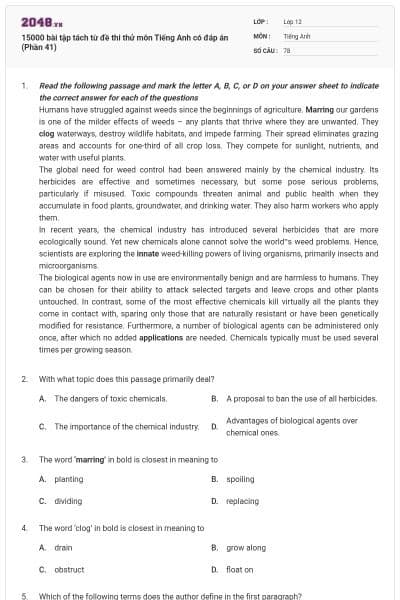
Read the following passage and mark the letter A, B, C, or D on your answer sheet to indicate the correct answer for each of the questions
Humans have struggled against weeds since the beginnings of agriculture. Marring our gardens is one of the milder effects of weeds – any plants that thrive where they are unwanted. They clog waterways, destroy wildlife habitats, and impede farming. Their spread eliminates grazing areas and accounts for one-third of all crop loss. They compete for sunlight, nutrients, and water with useful plants.
The global need for weed control had been answered mainly by the chemical industry. Its herbicides are effective and sometimes necessary, but some pose serious problems, particularly if misused. Toxic compounds threaten animal and public health when they accumulate in food plants, groundwater, and drinking water. They also harm workers who apply them.
In recent years, the chemical industry has introduced several herbicides that are more ecologically sound. Yet new chemicals alone cannot solve the world‟s weed problems. Hence, scientists are exploring the innate weed-killing powers of living organisms, primarily insects and microorganisms.
The biological agents now in use are environmentally benign and are harmless to humans. They can be chosen for their ability to attack selected targets and leave crops and other plants untouched. In contrast, some of the most effective chemicals kill virtually all the plants they come in contact with, sparing only those that are naturally resistant or have been genetically modified for resistance. Furthermore, a number of biological agents can be administered only once, after which no added applications are needed. Chemicals typically must be used several times per growing season.
With what topic does this passage primarily deal?
The dangers of toxic chemicals.
A proposal to ban the use of all herbicides.
The importance of the chemical industry.
Advantages of biological agents over chemical ones.
D
Chủ đề nào đoạn văn này chủ yếu giải quyết?
A. Sự nguy hiểm của hóa chất độc hại.
B. Đề xuất cấm sử dụng tất cả các chất diệt cỏ.
C. Tầm quan trọng của ngành công nghiệp hoá chất.
D. Ưu điểm của tác nhân sinh học hơn những hóa chất.
=> đáp án D
The word ‘marring’ in bold is closest in meaning to
planting
spoiling
dividing
replacing
B
Từ ‘marring’ in đậm gần nghĩa nhất với
A. trồng B. làm hỏng C. phân chia D. thay thế
=> đáp án B
The word ‘clog’ in bold is closest in meaning to
drain
grow along
obstruct
float on
C
Từ ‘clog’ in đậm gần nghĩa nhất với
A. cống B. phát triển dọc theo C. cản trở D. nổi trên
=> đáp án C
‘clog’ = obstruct: cản trở, làm tắc nghẽn
Which of the following terms does the author define in the first paragraph?
grazing area
weeds
nutrients
wildlife habitats
B
Thuật ngữ nào sau đây được định nghĩa trong đoạn đầu tiên?
A. khu chăn thả B. cỏ dại
C. chất dinh dưỡng D. môi trường sống động vật hoang dã
=> đáp án B
Thông tin: weeds – any plants that thrive where they are unwanted. (cỏ dại - bất kỳ loài cây nào phát triển nơi chúng không cần thiết.)
Which of the following statements about the use of chemical agents as herbicides would the author most likely agree?
It has become more dangerous recently.
It is occasionally required.
It is safe but inefficient.
It should be increased.
B
Câu nào trong những câu sau đây về việc sử dụng các tác nhân hóa học như chất diệt cỏ tác giả có thể đồng ý?
A. Gần đây đã trở nên nguy hiểm hơn.
B. Nó thỉnh thoảng cần thiết.
C. Nó an toàn nhưng không hiệu quả.
D. Nó nên được tăng lên.
=> đáp án B
Thông tin: The global need for weed control had been answered mainly by the chemical industry. Its herbicides are effective and sometimes necessary (Nhu cầu kiểm soát cỏ dại toàn cầu đã được hồi đáp chủ yếu bởi ngành công nghiệp hoá chất. Thuốc diệt cỏ có hiệu quả và đôi khi cần thiết)
The word ‘innate’ in bold is closest in meaning to
effective
natural
active
organic
B
Từ ‘innate’ in đậm gần nghĩa nhất với
A. hiệu quả B. tự nhiên C. năng động D. hữu cơ
=> đáp án B
‘innate’ = natural: tự nhiên, bẩm sinh
The word ‘applications’ in bold could best be replaced by which of the following?
treatments
requests
special purposes
qualifications
A
Từ ‘applications’ in đậm có thể được thay thế bằng từ nào sau đây?
A. phương pháp điều trị B. yêu cầu
C. mục đích đặc biệt D. trình độ
=> đáp án A
Which of the following best describes the organization of the passage?
Two possible causes of a phenomenon are compared.
A problem is described and possible solutions are discussed.
A general idea is introduced and several specific examples are given.
A recommendation is analysed and rejected
C
Câu nào sau đây mô tả đúng nhất việc tổ chức đoạn văn?
A. Hai nguyên nhân có thể xảy ra của một hiện tượng được so sánh.
B. Một vấn đề được mô tả và các giải pháp có thể năng được thảo luận.
C. Một ý tưởng chung được giới thiệu và một số ví dụ cụ thể được đưa ra.
D. Một khuyến nghị được phân tích và bác bỏ.
=> đáp án C
Dịch bài đọc số 6
Con người đã chống cỏ dại từ khi bắt đầu nông nghiệp. Làm hỏng vườn của chúng ta là một trong những ảnh hưởng nhẹ nhàng của cỏ dại - bất kỳ loài cây nào phát triển nơi chúng không cần thiết. Chúng làm tắc nghẽn đường dẫn nước, phá huỷ môi trường sống của động vật hoang dã và cản trở việc nuôi trồng. Sự lây lan của chúng sẽ xoá bỏ các khu vực chăn thả và chiếm một phần ba lượng mất mùa. Chúng cạnh tranh ánh sáng mặt trời, chất dinh dưỡng, và nước với cây trồng hữu ích.
Nhu cầu kiểm soát cỏ dại toàn cầu đã được hồi đáp chủ yếu bởi ngành công nghiệp hoá chất. Thuốc diệt cỏ có hiệu quả và đôi khi cần thiết, nhưng một số lại gây ra những vấn đề nghiêm trọng, đặc biệt nếu lạm dụng. Các hợp chất độc hại đe doạ động vật và sức khoẻ cộng đồng khi chúng tích tụ trong thực phẩm, nước ngầm và nước uống. Chúng cũng làm hại người sử dụng chúng.
Trong những năm gần đây, ngành công nghiệp hóa chất đã đưa ra một số chất diệt cỏ có vẻ sinh thái hơn. Tuy nhiên, các hóa chất mới không thể giải quyết được vấn đề cỏ dại trên thế giới. Do đó, các nhà khoa học đang khám phá năng lực diệt cỏ bẩm sinh của sinh vật sống, chủ yếu là côn trùng và vi sinh vật.
Các tác nhân sinh học hiện nay đang sử dụng rất thân thiện với môi trường và không gây hại cho con người. Chúng có thể được lựa chọn bởi khả năng tấn công các mục tiêu đã chọn của chúng và cây mùa vụ và các cây trồng khác không bị ảnh hưởng. Ngược lại, một số hóa chất có hiệu quả nhất giết chết hầu như tất cả các cây mà chúng tiếp xúc, chỉ còn lại những cây có khả năng đề kháng tự nhiên hoặc đã được biến đổi gen để đề kháng. Hơn nữa, một số tác nhân sinh học có thể được sử dụng một lần, sau đó không cần thiết điều trị nào nữa. Hóa chất thường phải được sử dụng nhiều lần trong mỗi mùa vụ.
Read the following passage and mark the letter A, B, C, or D on your answer sheet to indicate the correct word or phrase for each of the blanks from 41 to 45
About 50 or so kinds modern plastic are made from oil, gas, or coal-non-renewable natural resources. We (41)___ well over three million tons of the stuff in Japan each year and, sooner or later, most of it is thrown away. A high proportion of our animal consumption is in the (42)____ of packaging and this constitutes about seven percent by weight, of our domestic(43) ____ . Almost all of it can be recycled, but very little of it is, though the plastic recycling industry is growing fast. The plastics themselves are extremely energy - rich – they have a higher calorific(44) ____ than coal and one methodn of “recovery” strongly (45)____ by plastic manufacturers if the conversion of waste plastic into a fuel.
consign
import
consume
remove
B
Kiến thức: Từ vựng, đọc hiểu
Giải thích:
consign (v): chuyển giao
import (v): nhập khẩu
consume (v): tiêu tốn
remove (v): chuyển đổi, di dời
We (15)____ well over three million tones of the stuff in Japan each year and, sooner or later, most of it is
thrown away.
Tạm dịch: Ở Nhật Bản, chúng ta nhập khẩu cũng hơn ba triệu tấn vật liệu mỗi năm, và sớm hay muộn, hầu hết chúng sẽ bị ném đi.
Đáp án: B
form
way
type
kind
A
Kiến thức: Từ vựng, đọc hiểu
Giải thích:
form (n): dạng
way (n): cách
type (n): loại
kind (n): loại
A high proportion of our animal consumption is in the (16)_____of packaging, and this constitutes about seven percent by weight of our domestic(17)____ .
Tạm dịch: Một tỷ lệ cao được tiêu thụ là ở dạng bao bì, và điều này tạo nên khoảng bảy phần trăm theo trọng lượng rác thải sinh hoạt. Hầu như tất cả chúng đều có thể được tái chế, nhưng rất ít được tái chế mặc dù ngành công nghiệp tái chế nhựa phát triển nhanh.
Đáp án: A
goods
refuse
rubble
requirements
B
Kiến thức: Từ vựng, đọc hiểu
Giải thích:
goods (n): hàng hóa
refuse (n): chất thải
rubble (n): dây điện
requirement (n): nhu cầu
A high proportion of our animal consumption is in the (16)_____of packaging, and this constitutes about seven per cent by weight of our domestic(17)____ .
Tạm dịch: Một tỷ lệ cao được tiêu thụ là ở dạng bao bì, và điều này tạo nên khoảng bảy phần trăm theo trọng lượng rác thải sinh hoạt. Hầu như tất cả chúng đều có thể được tái chế, nhưng rất ít được tái chế mặc dù ngành công nghiệp tái chế nhựa phát triển nhanh.
Đáp án: B
effect
degree
value
demand
C
Kiến thức: Từ vựng, đọc hiểu
Giải thích:
effect (n): ảnh hưởng
degree (n): bằng cấp
value (n): giá trị
demand (n): nhu cầu
The plastics themselves are extremely energy-rich – they have a higher calorific (18)_____ than coal and one method of 'recovery' strongly (19)____ by the plastic manufacturers is the conversion of waste plastic into a fuel.
Tạm dịch: Bản thân nhựa là nguồn năng lượng cực kì phong phú- chúng có giá trị năng lượng cao hơn cả than
và một phương pháp 'khôi phục' rất được ưa thích bởi các nhà sản xuất nhựa là biến đổi chất thải nhựa thành nhiên liệu
Đáp án: C
and one methodn of “recovery” strongly (45)____ by plastic manufacturers if the conversion of waste plastic into a fuel.
argued
presented
desired
favored
D
Kiến thức: Từ vựng, đọc hiểu
Giải thích:
argued (quá khứ phân từ): tranh cãi
presented (quá khứ phân từ): thể hiện
desired (quá khứ phân từ): ham muốn
favored (quá khứ phân từ): thích thú
The plastics themselves are extremely energy-rich – they have a higher calorific (18)_____ than coal and one method of 'recovery' strongly (19)____ by the plastic manufacturers is the conversion of waste plastic into a fuel.
Tạm dịch: Bản thân nhựa là nguồn năng lượng cực kì phong phú- chúng có giá trị năng lượng cao hơn cả than và một phương pháp 'khôi phục' rất được ưa thích bởi các nhà sản xuất nhựa là biến đổi chất thải nhựa thành nhiên liệu
Đáp án: D
Dịch bài đọc số 7
Khoảng 50 hoặc nhiều hơn các loại nhựa hiện đại được làm từ dầu, khí đốt hoặc than-tài nguyên không thể tái tạo. Ở Nhật Bản, chúng ta nhập khẩu cũng hơn ba triệu tấn vật liệu mỗi năm, và sớm hay muộn, hầu hết chúng sẽ bị ném đi. Một tỷ lệ cao được tiêu thụ là ở dạng bao bì, và điều này tạo nên khoảng bảy phần trăm theo trọng lượng rác thải sinh hoạt. Hầu như tất cả chúng đều có thể được tái chế, nhưng rất ít được tái chế mặc dù ngành công nghiệp tái chế nhựa phát triển nhanh.
Bản thân nhựa là nguồn năng lượng cực kì phong phú- chúng có giá trị năng lượng cao hơn cả than và một phương pháp 'khôi phục' rất được ưa thích bởi các nhà sản xuất nhựa là biến đổi chất thải nhựa thành nhiên liệu.
Read the following passage and mark the letter A, B, C or D on your answer sheet to indicate the correct answer to each of the questions from 46 to 51.
FIRST TIME IN THE AIR
When John Mills was going to fly in an aeroplane for the first time, he was frightened. He did not like the idea of being thousands of feet up in the air. “ I also didn't like the fact that I wouldn't be in control,” says John.
“I'm a terrible passenger in the car. When somebody else is driving, I tell them what to so. It drives everybody crazy.”
However John couldn't avoid flying any longer. It was the only way he could visit his grandchildren in Canada.
“I had made up my mind that I was going to do it, I couldn't let my son, his wife and their three children travel all the way here to visit me. It would be so expensive for them and I know Tom's business isn't doing so well at the moment – it would also be tiring for the children – it's a nine-hour flight!” he says.
To get ready for the flight John did lots of reading about aeroplanes. When he booked his seat, he was told that he would be flying on a Boeing 747, which is better known as a jumbo jet. “I needed to know as much as possible before getting in that plane. I suppose it was a way of making myself feel better. The Boeing 747 is the largest passenger aircraft in the world at the moment. The first one flew on February 9th 1969 in the USA. It can carry up to 524 passengers and 3.400 pieces of luggage. The fuel for aeroplanes is kept in the wings and the 747 is wings are so big that they can carry enough fuel for an average car to be able to travel 16,000 kilometres a year for 70 years. Isn't that unbelievable? Even though I had discovered all this very interesting information about the jumbo, when I saw it for the first time, just before I was going to travel to Canada, I still couldn't believe that something so enormous was going to get up in the air and fly. I was even more impressed when I saw how big it was inside with hundreds of people!”
The biggest surprise of all for John was the flight itself. “The take-off itself was much smoother than I expected although I was still quite scared until we were in the air. In the end, I managed to relax, enjoy the food and watch one of the movies and the view from the window was spectacular. I even managed to sleep for a while! Of course,” continues John, “the best reward of all was when I arrived in Canada and saw my son and his family, particularly my beautiful grandchildren. Suddenly, I felt so silly about all the years when I couldn't even think of getting on a plane. I had let my fear of living stop me from seeing the people I love most in the world. I can visit my son and family as often as I like now!”
Why did John Mills fly in an aeroplane?
He wanted to go on holiday
He wanted to try it.
He wanted to see his family
He had to travel on business.
C
Kiến thức: Đọc hiểu
Giải thích:
Tại sao ông John Mills đi máy bay?
A. Ông ấy muốn đi nghỉ. B. Ông ấy muốn thử.
C. Ông ấy muốn thăm gia đình. D. Ông ấy phải đi công tác.
Dẫn chứng: It was the only way he could visit his grandchildren in Canada. “I had made up my mind that I was going to do it, I couldn't let my son, his wife and their three children travel all the way here to visit me. It would be so expensive for them and I know Tom's business isn't doing so well at the moment – it would also be tiring for the children – it's a nine-hour flight!” he says.
Đáp án: C
Why did John read about aeroplane?
He wanted to know how they work.
It was his hobby.
It made him feel safer.
He had found a book on them.
A
Kiến thức: Đọc hiểu
Giải thích:
Tại sao ông John đọc về máy bay ?
A. Ông muốn biết nó hoặt động như nào? B. Sở thích của ông.
C. Để đảm bảo an toàn cho ông. D. Ông ấy tìm được 1 quyển sách về máy bay.
Dẫn chứng: To get ready for the flight John did lots of reading about aeroplanes. When he booked his seat, he was told that he would be flying on a Boeing 747, which is better known as a jumbo jet. “I needed to know as much as possible before getting in that plane.
Đáp án: A
What happened when he saw the jumbo jet for the first time?
He felt much safer.
He liked the shape of it.
He couldn‟t believe how big it was.
He thought the wings were very small.
C
Kiến thức: Đọc hiểu
Giải thích:
Điều gì đã diễn ra khi ông ấy nhìn thấy chiếc máy bay phản lực lần đầu tiên?
A. Ông ấy cảm thấy an toàn hơn. B. Ông ấy thích hình dáng của nó.
C. Ông ngạc nhiên về độ lớn của nó. D. Ông ấy nghĩ cánh của nó rất nhỏ.
Dẫn chứng: Even though I had discovered all this very interesting information about the jumbo, when I saw it for the first time, just before I was going to travel to Canada, I still couldn't believe that something so enormous was going to get up in the air and fly. I was even more impressed when I saw how big it was inside with hundreds of people!”
Đáp án: C
How did John feel when the aeroplane was taking off?
excited
happy
sad
frightened
D
Kiến thức: Đọc hiểu
Giải thích:
Ông John cảm thấy thế nào khi máy bay cất cánh?
A. thú vị B. vui C. buồn D. sợ hãi
Dẫn chứng: “The take-off itself was much smoother than I expected although I was still quite scared until we were in the air.
Đáp án: D
What surprised John most about the flight?
that he liked the food.
that he was able to sleep
that there was a movie being shown
that the view was good
B
Kiến thức: Đọc hiểu
Giải thích:
Điều gì khiến ông John ngạc nhiên nhất về chuyến bay?
A. Ông ấy thích đồ ăn. B. Ông ấy có thể ngủ.
C. Có chiếu phim. D. Cảnh rất đẹp.
Dẫn chứng: In the end, I managed to relax, enjoy the food and watch one of the movies and the view from the window was spectacular. I even managed to sleep for a while! Of course,”
Đáp án: B
How did John feel about his fears in the end?
He thought he had wasted time being afraid.
He realized it was okay to be afraid.
He hoped his grandchildren weren‟t afraid of flying.
He realized that being afraid kept him safe.
A
Kiến thức: Đọc hiểu
Giải thích:
Cuối cùng thì ông John cảm thấy thế nào về nhưng nỗi sợ?
A. Ông nghĩ mình đã phí thời gian để sợ hãi
B. Ông nhận ra khá ổn khi sợ hãi
C. Ông hi vọng cháu mình sẽ không sợ bay
D. Ông nhận ra việc sợ hãi giúp ông được an toàn.
Dẫn chứng: Suddenly, I felt so silly about all the years when I couldn't even think of getting on a plane. I had let my fear of living stop me from seeing the people I love most in the world. I can visit my son and family as often as I like now!”
Đáp án: A
Dịch bài đọc số 8
Khi John Mills bay lần đầu tiên trên máy bay, ông đã rất sợ hãi. Ông không thích cảm giác cách xa mặt đất cả ngàn feet trong không trung. "Tôi cũng không thích thực tế là tôi không kiểm soát được", John nói."Tôi là một hành khách khủng khiếp trong ô tô. Khi người khác lái xe, tôi sẽ nói với họ phải lái thế nào. Điều này khiến họ phát điên lên."
Tuy nhiên, John không thể trốn tránh việc ba mãi nữa. Đó là cách duy nhất ông có thể ghé thăm các cháu của mình tại Canada. "Tôi đã quyết định sẽ thực hiện điều này, tôi không thể để con trai tôi, vợ và ba đứa cháu bay cả chuyến đường dài để tới thăm tôi được. Sẽ rất tốn kém và tôi biết việc kinh doanh của Tom lúc này không tốt – bọn trẻ cũng sẽ thấy mệt nữa – chuyến bay dài 9 tiếng! "ông nói.
Để sẵn sàng John đọc rất nhiều về máy bay. Khi ông đặt vé, ông nói rằng ông sẽ bay trên một chiếc Boeing 747, tốt hơn thì được gọi là một máy bay phản lực lớn, "Tôi cần phải biết càng nhiều càng tốt trước khi đặt vé bay chiếc máy bay đó. Tôi cho rằng đó là một cách để làm cho bản thân mình cảm thấy tốt hơn. Boeing 747 là máy bay chở khách lớn nhất thế giới ở thời điểm này. Chiếc đầu tiên bay vào ngày 9 tháng 2 năm 1969 tại Hoa Kỳ. Nó có thể chở hành khách 524 và 3.400 hành lý. Nhiên liệu cho máy bay được giữ ở cánh và đôi cánh của chiếc 747 lớn đến mức có thể mang đủ nhiên liệu cho một chiếc xe trung bình để có thể đi du lịch 16.000 kilômét một năm trong vòng 70 năm. Không thể tin được đúng không? Mặc dù tôi đã phát hiện ra tất cả các thông tin này rất thú vị về chiếc máy bay, khi tôi thấy nó lần đầu tiên, ngay trước khi tôi đến Canada, tôi vẫn không thể tin rằng có thứ lại lớn như vậy được đưa lên không trung và bay. Tôi đã thậm chí còn ấn tượng hơn nhiều khi thấy nó có thể chứa hàng trăm người! " Bất ngờ lớn nhất của John là chính chuyến."Nó cất cánh mượt hơn tôi nghĩ
nhiều, mặc dù tôi vẫn còn khá sợ hãi cho đến khi chúng tôi lên không trung. Cuối cùng, tôi vẫn thư giãn, thưởng thức các món ăn, xem một trong những bộ phim và ngắm cảnh. Tôi thậm chí còn có thể ngủ được 1 lát!” John tiếp tục “ phần thưởng lớn nhất là khi tôi đến Canada và thấy con trai cùng gia đình, đặc biệt là đứa cháu xinh đẹp của mình. Đột nhiên, tôi cảm thấy rất ngớ ngẩn về tất cả những năm tháng khi tôi thậm chí không dám nghĩ về việc bước lên máy bay. Nỗi sợ hãi đã ngăn tôi được gặp những người tôi yêu thương nhất trên thế giới.
Bây giờ tôi có thể ghé thăm con trai và gia đình của tôi thường xuyên !"
Read the following passage and mark the letter A, B, C or D on your answer sheet to indicate the correct answer to each of the questions from 52 to 34.
Although noise, commonly defined as unwanted sound, is a widely recognized form of pollution, it is very difficult to measure because the discomfort experienced by different individuals is highly subjective and, therefore, variable. Exposure to lower levels of noise may be slightly irritating, whereas exposure to higher levels may actually cause hearing loss. Particularly in congested urban areas, the noise produced as a by-product of our advancing technology causes physical and psychological harm, and detracts from the quality of life for those who are exposed to it.
Unlike the eyes, which can be covered by the eyelids against strong light, the ear has no lid, and is, therefore, always open and vulnerable; noise penetrates without protection.
Noise causes effects that the hearer cannot control and to which the body never becomes accustomed. Loud noises instinctively signal danger to any organism with a hearing mechanism, including human beings. In response, heartbeat and respiration accelerate, blood vessels constrict, the skin pales, and muscles tense. In fact, there is a general increase in functioning brought about by the flow of adrenaline released in response to fear, and some of these responses persist even longer than the noise, occasionally as long as thirty minutes after the sound has ceased.
Because noise is unavoidable in a complex, industrial society, we are constantly responding in the same way that we would respond to danger. Recently, researchers have concluded that noise and our response may be much more than an annoyance. It may be a serious threat to physical and psychological health and well-being, causing damage not only to the ear and brain but also to the heart and stomach. We have long known that hearing loss is America's number one nonfatal health problem, but now we are learning that some of us with heart disease and ulcers may be victims of noise as well. Fetuses exposed to noise tend to be overactive, they cry easily, and they are more sensitive to gastrointestinal problems after birth. In addition, the psychic effect of noise is very important. Nervousness, irritability, tension, and anxiety increase affecting the quality of rest during sleep, and the efficiency of activities during waking hours, as well as the way that we interact with each other
Which of the following is the author‟s main point?
Hearing loss is America's number one nonfatal health problem.
Loud noises signal danger.
Noise may pose a serious threat to our physical and psychological health.
The ear is not like the eye.
C
Kiến thức: Đọc hiểu
Giải thích:
Câu nào sau đây là ý chính tác giải muốn gửi gắm?
A. Mất thính giác là vấn đề sức khỏe nhỏ ở Mỹ.
B. Tiếng ồn lớn báo hiệu sự nguy hiểm.
C. Tiếng ồn có thể gây ra một mối đe dọa nghiêm trọng đối với sức khoẻ thể chất và tâm lý của chúng ta.
D. Tai không giống như mắt.
Đáp án: C
According to the passage, what is noise?
A byproduct of technology.
Physical and psychological harm
Congestion..
Unwanted sound.
D
Kiến thức: Đọc hiểu
Giải thích:
Theo như đoạn văn, tiếng ồn là gì?
A. Sản phẩm phụ của công nghệ B. Tác hại tâm lý và thể chất.
C. Sự đông đúc D. Âm thanh không mong muốn
Dẫn chứng: Although noise, commonly defined as unwanted sound, is a widely recognized form of pollution.
Đáp án: D
Why is noise difficult to measure?
All people do not respond to it in the same way
It causes hearing loss.
It is unwanted.
People become accustomed to it.
A.
Kiến thức: Đọc hiểu
Giải thích:
Tại sao âm thanh khó đo lường ?
A. Mọi người phản ứng với nó theo các cách khác nhau. B. Nó gây ra bệnh mất thính giác.
C. Nó không được mong muốn. D. Mọi người đã quen với nó.
Dẫn chứng: it is very difficult to measure because the discomfort experienced by different individuals is highly subjective and, therefore, variable.
Đáp án: A
The word congested in paragraph 1 could best be replaced by ___.
hazardous
crowded
polluted
rushed
B
Kiến thức: Từ vựng
Giải thích:
Từ “congested” ở đoạn 1 gần nghĩa với?
A. khó khăn B. đông đúc C. ô nhiễm D. vội vàng.
congested = crowded (a): đông đúc
Đáp án: B
The word it in the first paragraph refers to ___
the quality of life
advancing technology
the noise
physical and psychological harm
C
Kiến thức: Từ vựng, đọc hiểu
Giải thích:
Từ “ it” ở đoạn 1 chỉ____?
A. chất lượng cuộc sống B. công nghệ tiên tiến
C. âm thanh D. tác hại tâm lý và thể chất.
Dẫn chứng: Particularly in congested urban areas, the noise produced as a by-product of our advancing technology causes physical and psychological harm, and detracts from the quality of life for those who are exposed to it.
Đáp án: C
According to the passage, people respond to loud noises in the same way that they respond to ___.
annoyance
danger
damage
disease
B
Kiến thức: Đọc hiểu
Giải thích:
Theo đoạn văn, con người phản ứng với tiếng ồn lớn giống phản ứng với ______
A. sự khó chịu B. nguy hiểm C. tổn thất D. căn bệnh
Dẫn chứng: Because noise is unavoidable in a complex, industrial society, we are constantly responding in the same way that we would respond to danger.
Đáp án: B
Look at the verb accelerate in paragraph 3. Which of the following is the closest in meaning to _____.
decrease
alter
increase
release
D.
Kiến thức: Từ vựng, đọc hiểu
Giải thích:
Từ “ accelerate” ở đoạn 3 gần nghĩa với?
A. sự kết thúc B. mọc, nhô lên C. chỗ sưng lên D. tăng
Đáp án: D
The phrase as well in paragraph 4 is closest in meaning to ___.
after all
instead
also
regardless
C.
Kiến thức: Từ vựng, đọc hiểu
Giải thích:
Từ “as well as” ở đoạn 4 gần nghĩa với?
A. sau tất cả B. thay vì C. cũng, và D. bất chấp
as well as = also = and
Đáp án: C
It can be inferred from the passage that the eye ___.
responds to fear
enjoys greater protection than the ear
increases functions
is damaged by noise
B.
Kiến thức: Đọc hiểu
Giải thích:
Có thể suy ra từ đoạn văn rằng mắt thì ___
A. phản ứng với nỗi sợ B. bảo vệ tốt hơn tai
C. tăng chức năng D. bị tổn thương do tiếng ồn
Dẫn chứng: Unlike the eyes, which can be covered by the eyelids against strong light, the ear has no lid, and is, therefore, always open and vulnerable; noise penetrates without protection.
Dịch bài đọc số 9
Mặc dù tiếng ồn, thường được định nghĩa là âm thanh không mong muốn, là một hình thức ô nhiễm được thừa nhận rộng rãi, nhưng lại rất khó đo lường bởi vì sự khó chịu của các cá nhân khác nhau là rất chủ quan và do đó có sự biến đổi. Tiếp xúc với mức độ ồn thấp có thể gây khó chịu một chút, trong khi tiếp xúc mức cao hơn có thể gây ra tình trạng nghe kém. Đặc biệt ở các khu đô thị đông đúc, tiếng ồn phát sinh như là sản phẩm phụ của công nghệ tiên tiến gây ra những tổn hại về thể chất và tâm lý, và làm giảm chất lượng cuộc sống của những người tiếp xúc với nó.
Không giống như mắt, có thể được phủ bởi mí mắt chống lại ánh sáng mạnh, tai không có nắp, và do đó, luôn luôn mở và dễ bị tổn thương; tiếng ồn xâm nhập mà không có sự bảo vệ. Tiếng ồn gây ra hiệu ứng mà người nghe không thể kiểm soát được và cơ thể không bao giờ trở nên quen với
việc đó. Những âm thanh ồn ào theo bản năng báo hiệu sự nguy hiểm cho bất cứ cơ thể nào bằng cơ chế lắng nghe, bao gồm cả con người. Đáp lại thì nhịp tim và hô hấp sẽ tăng lên, các mạch máu co lại, da nhợt nhạt và cơ căng lên. Trên thực tế, có sự gia tăng chung về chức năng do luồng adrenalin phát hành để đáp ứng lại sự sợ hãi, và một số phản ứng vẫn tồn tại lâu hơn tiếng ồn, đôi khi là ba mươi phút sau khi âm thanh dừng lại. Bởi vì tiếng ồn là không thể tránh khỏi trong một xã hội công nghiệp phức tạp, chúng ta liên tục đáp trả theo cách mà chúng ta sẽ đối phó với nguy hiểm. Gần đây, các nhà nghiên cứu đã kết luận rằng tiếng ồn và phản ứng của chúng ta có thể là nhiều hơn đơn thuần là sự khó chịu. Nó có thể là một mối đe dọa nghiêm trọng đối với sức khỏe thể chất và tâm lý và phúc lợi, gây thiệt hại không chỉ đến tai và não mà còn cho tim và dạ dày. Từ lâu chúng ta biết rằng mất thính giác là vấn đề sức khoẻ số một của Hoa Kỳ, nhưng bây giờ chúng ta đang học rằng một số trong chúng ta có bệnh tim và loét cũng có thể là nạn nhân của tiếng ồn. Các bào thai tiếp xúc với tiếng ồn thường có phản ứng quá mức, chúng dễ khóc và nhạy cảm hơn với các vấn đề về đường tiêu hóa sau khi sinh. Ngoài ra, hiệu ứng tâm linh của tiếng ồn là rất quan trọng. Lo lắng, đau khổ, căng thẳng, và lo âu tăng ảnh hưởng đến chất lượng của phần còn lại trong khi ngủ, và hiệu quả của các hoạt động trong thời gian thức, cũng như cách mà chúng ta tương tác với nhau.
Read the following passage and mark the letter A, B, C or D on your answer sheet to indicate the correct word or phrase that best fits each of the numbered blanks from 61 to 28.
EXAMS OR CONTINUOUS ASSESSMENT?
How do you feel when you (61) ______an exam? Do you always succeed in getting all your ideas down on paper, or do you sometimes feel that you’re (62) ______a mess of it? Apart from those lucky few who sail through exams, most secondary school (63) ______find them very stressful. Many teachers are aware of the problems their students face and use a different method for measuring their progress: continuous assessment. With continuous assessment, students are given various (64) ______to do through the year. All their marks are added together to produce a total mark at the end of the year. Students have to take more responsibility for their education because they can’t rely on doing well on just one day. Also, they have more time to (65) ______ over their work, meaning that they are able to do their best.
sit
write
make
give
Đáp án A
(to) sit an exam = (to) take an exam: thi, kiểm tra.
Dịch: Bạn cảm thấy như thế nào khi làm bài kiểm tra.
doing
making
having
taking
Đáp án B
(to) make a mess: làm rối tung.
Dịch: hoặc đôi khi bạn cảm thấy mình như đang làm rối tung mọi thứ lên.
colleagues
classmates
perfects
students
Đáp án D
A. colleagues (n): đồng nghiệp.
B. classmates (n): bạn cùng lớp
C. perfects (n): người hoàn hảo.
D. students (n): học sinh, sinh viên.
Dịch: phần lớn các học sinh trung học đều cảm thấy việc kiểm tra rất nặng nề.
tasks
efforts
achievements
results
Đáp án A
(to) do tasks: làm nhiệm vụ.
Ngoài đáp án A, các đáp án còn lại không đi với động từ “do”.
B. efforts (n): cố gắng, nỗ lực.
C. achievements (n): thành tựu.
D. results (n): kết quả.
Dịch: Với hình thức đánh giá liên tục này, học sinh sẽ được giao cho những nhiệm vụ để làm trong suốt năm học.
Also, they have more time to (65) ______ over their work, meaning that they are able to do their best.
consider
imagine
think
examine
Đáp án C
(to) think over = consider carefully: căn nhắc cẩn thận.
Các đáp án còn lại:
A. consider (v): cân nhắc.
B. imagine (v): tưởng tượng.
D. examine (v): kiểm tra, khảo sát.
Dịch: Ngoài ra, họ còn có nhiều thời gian hơn để cân nhắc kĩ về việc làm của mình.
Read the following passage and mark the letter A, B, C or D on your answer sheet to indicate the correct answer to each of the questions from 66 to 72.
Because writing has become so important in our culture, we sometimes think of it as more real than speech. A little thought, however, will show why speech is primary and writing secondary to language. Human beings have been writing (as far as we can tell from surviving evidence) for at least 5000 years; but they have been talking for much longer, doubtless ever since there have been human beings.
When writing did develop, it was derived from and represented speech, although imperfectly. Even today there are spoken languages that have no written form. Furthermore, we all learn to talk well before we learn to write; any human child who is not severely handicapped physically or mentally will learn to talk: a normal human being cannot be prevented from doing so. On the other hand, it takes a special effort to learn to write. In the past many intelligent and useful members of society did not acquire the skill, and even today many who speak languages with writing systems never learn to read or write, while some who learn the rudiments of those skills do so only imperfectly.
To affirm the primacy of speech over writing is not, however, to disparage the latter. One advantage writing has over speech is that it is more permanent and makes possible the records that any civilization must have. Thus, if speaking makes us human, writing makes us civilized.
We sometimes think of writing as more real than speech because______.
it has become very important in our culture.
human beings have been writing for at least 5000 years.
writing is secondary to language.
people have been writing since there have been human beings.
Đáp án A
Đôi khi chúng ta nghĩ chữ viết chân thực hơn lời nói là bởi vì ______.
A. nó đã trở nên rất quan trọng trong nền văn hóa của chúng ta.
B. con người đã viết ít nhất 5000 năm.
C. chữ viết là yếu tố thứ 2 đối với ngôn ngữ.
D. người ta đã viết kể từ khi có loài người.
Dẫn chứng là câu đầu tiên: “Because writing has become so important in our culture, we sometimes think of it as more real than speech” – (Bởi vì chữ viết đã trở nên rất quan trọng trong nền văn hóa của chúng ta, nên đôi khi chúng ta nghĩ nó chân thực hơn là lời nói).
The author of the passage argues that______.
all languages should have a written form.
writing has become too important in today’s society.
everyone who learns to speak must learn to write.
speech is more basic to language than writing.
Đáp án D
Tác giả của bài văn tranh luận rằng _____.
A. Tất cả các ngôn ngữ nên được để dưới dạng chữ viết.
B. Chữ viết đã trở nên rất quan trọng trong xã hội ngày nay.
C. Bất kể ai học nói phải cần học viết.
D. Lời nói là cơ bản đối với ngôn ngữ hơn là chữ viết.
Dẫn chứng ở câu thứ 2- đoạn 1: “A little thought, however, will show why speech is primary and writing secondary to language”- (Nghĩ một chút, tuy nhiên, sẽ sáng tỏ ra rằng tại sao tiếng nói đóng vai trò cốt yếu và chữ viết là thứ yếu đối với ngôn ngữ).
Normal human beings______.
learn to talk after learning to write.
learn to write before learning to talk.
learn to write and to talk at the same time.
learn to talk before learning to write.
Đáp án D
Người bình thường ______.
A. học nói sau khi học viết.
B. học viết trước khi học nói.
C. học nói và học viết đồng thời với nhau.
D. học nói trước khi học viết.
Dẫn chứng ở câu thứ 2- đoạn 2: “Furthermore, we all learn to talk well before we learn to write” – (Hơn nữa, chúng ta đều học nói trước khi học viết).
In order to show that learning to write requires effort, the author gives the example of ______.
severely handicapped children.
people who learn the rudiments of speech.
intelligent people who couldn’t write.
people who speak many languages.
Đáp án C
Để chỉ ra rằng việc học viết cần những nỗ lực, tác giả đưa ra ví dụ về______.
A. những đứa trẻ tàn tật nặng.
B. những người học nói sơ đẳng.
C. những người thông minh nhưng không biết viết.
D. những người nói nhiều thứ tiếng.
Dẫn chứng ở câu cuối- đoạn 2: “On the other hand, it takes a special effort to learn to write. In the past many intelligent and useful members of society did not acquire the skill, and even today many who speak languages with writing systems never learn to read or write, while some who learn the rudiments of those skills do so only imperfectly”- (Mặt khác, phải mất một nỗ lực đặc biệt để học cách viết. Trong quá khứ, có nhiều người thông minh và có ích cho xã hội đã không có được kĩ năng này, và thậm chí ngày nay có nhiều người sử dụng ngôn ngữ với hệ thống chữ viết nhưng không bao giờ học đọc hoặc học viết, trong khi một vài người học kiến thức cơ sở của kĩ năng này lại làm được, chỉ là không hoàn hảo cho lắm).
According to the author, one mark of any civilized society is that it______.
keeps written records.
affirms the primacy of speech over writing.
teaches its children to speak perfectly.
affirms the primacy of writing over speech.
Đáp án A
Theo như nhà văn, 1 dấu hiệu của bất kì xã hội văn minh nào đó là nó ______.
A. giữ lại những ghi chép bằng chữ viết.
B. khẳng định tầm quan trọng của lời nói thông qua chữ viết.
C. dạy con cái mình nó chuyện một cách hoàn hảo.
D. khẳng định tầm quan trọng của chữ viết thông qua lời nói.
Dẫn chứng ở 2 câu cuối cùng: “One advantage writing has over speech is that it is more permanent and makes possible the records that any civilization must have. Thus, if speaking makes us human, writing makes us civilized”- (Một ưu thế của chữ viết vượt trội hơn lời nói đó là nó vĩnh cửu và làm cho có khả thi đối với những ghi chép mà bất kì nền văn minh nào cũng cần phải có. Do đó, nếu nói tiếng nói làm cho chúng ta thành người, thì chính chữ viết khiến cho chúng ta văn minh, tiến bộ).
The word “advantage” in the last paragraph most closely means______.
skill
rudiments
domination
benefit
Đáp án D
Câu hỏi từ vựng:
A. skill (n): kĩ năng.
B. rudiments (n): nguyên lí sơ đẳng, kiến thức cơ sở.
C. domination (n): sự thống trị.
D. benefit (n): lợi ích.
Advantage (n): lợi thế, thuận lợi = D. benefit (n): lợi ích.
Which of the following is NOT true?
It is easy to acquire the writing skill.
Writing has become so important in our culture.
Writing represents speech, but not perfectly.
Speech is essential but writing has important benefits.
Đáp án A
Câu nào sau đây KHÔNG ĐÚNG?
A. Rất dễ dàng để có được kỹ năng viết.
B. Chữ viết đã trở nên rất quan trọng trong văn hoá của chúng ta.
C. Chữ viết là đại diện cho lời nói, nhưng không hoàn toàn.
D. Lời nói là cần thiết nhưng chữ viết lại có những lợi ích quan trọng.
Mâu thuẫn với câu 34 nên ta có thể chọn ngay được đáp án C.
Dẫn chứng ở đoạn 2: “Furthermore, we all learn to talk well before we learn to write; any human child who is not severely handicapped physically or mentally will learn to talk: a normal human being cannot be prevented from doing so. On the other hand, it takes a special effort to learn to write” – (Hơn nữa, tất cả chúng ta đều học nói cho tốt trước khi học viết; kể cả bất kì đứa trẻ nào có những thương tật về mặt thể chất hay tinh thần sẽ đều học nói trước và 1 người bình thường không thể bị ngăn cản khỏi việc học nói. Nhưng mặt khác, phải tốn 1 nỗ lực đặc biệt cho việc học viết).
Read the following passage and mark the letter A, B, C or D on your answer sheet to indicate the correct answer to each of the questions from 73 to 80
If parents bring up a child with the sole aim of turning the child into a genius, they will cause a disaster. According to several leading educational psychologists, this is one of the biggest mistakes which ambitious parents make. Generally, the child will be only too aware of what his parents expect, and will fail. Unrealistic parental expectations can cause great damage to children
However, if parents are not too unrealistic about what they expect their children to do, but are ambitious in a sensible way, the child may succeed in doing very well – especially if the parents are very supportive of their child.
Michael Collins is very lucky. He is crazy about music, and his parents help him a lot by taking him to concerts and arranging private piano and violin lessons for him. They even drive him 50 kilometers twice a week for violin lessons. Michael’s mother knows very little about music, but his father plays the trumpet in a large orchestra. However, he never makes Michael enter music competitions if he is unwilling.
Winston Smith, Michael’s friend, however, is not so lucky. Both his parents are successful musicians, and they set too high a standard for Winston. They want their son to be as successful as they are and so they enter him for every piano competition held. They are very unhappy when he does not win. Winston is always afraid that he will disappoint his parents and now he always seems quiet and unhappy.
One of the serious mistakes parents can make is to______.
push their child into trying too much.
help their child to become a genius.
make their child become a musician.
neglect their child’s education.
Đáp án A
Một trong những sai lầm nghiêm trọng mà các bậc phụ huynh có thể mắc phải đó là ______.
A. đẩy con cái vào việc cố gắng quá sức.
B. giúp con trở thành một thiên tài.
C. làm cho con trở thành một nhạc sĩ.
D. thời ơ việc học hành của con.
Dẫn chứng ở 2 câu đầu tiên: “If parents bring up a child with the sole aim of turning the child into a genius, they will cause a disaster. According to several leading educational psychologists, this is one of the biggest mistakes which ambitious parents make”- (Nếu cha mẹ nuôi nấng con cái chỉ với một mục đích duy nhất là biến con mình trở thành thiên tài, thì họ sẽ gây ra 1 thảm họa khôn lường. Theo như 1 vài nhà tâm lí giáo dục, đó là 1 trong những sai lầm lớn nhất mà các bậc phụ huynh hay tham vọng thường mắc phải).
=> Việc nuôi con chỉ với mục đích biến chúng trở thành 1 thiên tài nghĩa là đang đẩy chúng vào việc cố gắng quá sức mình, chứ không phải là giúp đỡ chúng trở thành thiên tài.
Who have criticized the methods of some ambitious parents?
Successful musicians.
Unrealistic parents.
Their children.
Educational psychologists.
Đáp án D
Ai đã chỉ trích về phương pháp dạy con của một số bậc cha mẹ tham vọng?
A. Những nhạc sĩ thành công.
B. Những bậc cha mẹ không thực tế.
C. Con cái của họ.
D. Các nhà tâm lí giáo dục.
Dẫn chứng ở 2 câu đầu tiên: “If parents bring up a child with the sole aim of turning the child into a genius, they will cause a disaster. According to several leading educational psychologists, this is one of the biggest mistakes which ambitious parents make”- (Nếu cha mẹ nuôi nấng con cái chỉ với một mục đích duy nhất là biến con mình trở thành thiên tài, thì họ sẽ gây ra 1 thảm họa khôn lường. Theo như 1 vài nhà tâm lí giáo dục, đó là 1 trong những sai lầm lớn nhất mà các bậc phụ huynh hay tham vọng thường mắc phải).
Michael Collins is fortunate in that______.
his father is a musician.
his parents are quite rich.
his parents help him in a sensible way.
his mother knows little about music.
Đáp án C
Michael Collins may mắn trong việc ______.
A. cha anh là 1 nhạc sĩ.
B. bố mẹ anh rất giàu có.
C. được bố mẹ giúp đỡ 1 cách tài tình, hợp lí.
D. mẹ anh không biết gì về âm nhạc.
Dẫn chứng ở 2 câu đầu đoạn 3: “Michael Collins is very lucky. He is crazy about music, and his parents help him a lot by taking him to concerts and arranging private piano and violin lessons for him” – (Michael Collins rất may mắn. Anh đam mê âm nhạc và được bố mẹ giúp đỡ rất nhiều bằng việc đưa tới các buổi hòa nhạc và sắp xếp cho những buổi học piano và violin).
The phrase "crazy about" in in the paragraph 3 mostly means______.
surprised at
extremely interested in
completely unaware of
confused about
Đáp án B
Câu hỏi từ vựng.
A. surprised at: ngạc nhiên về.
B. extremely interested in: cực kì thích thú về.
C. completely unaware of: hoàn toàn không biết về.
D. confused about: bối rối, lúng túng về.
Tobe crazy about sbd/smt: say mê, điên đảo về ai/cái gì = B. tobe extremely interested in smt: cực kì thích thú về ai/cái gì.
Winston’s parents push their son so much and he______.
has won a lot of piano competitions.
cannot learn much music from them.
has become a good musician.
is afraid to disappoint them.
Đáp án D
Cha mẹ của Winson thúc ép con mình quá nhiều và anh ấy ______.
A. đã chiến thắng nhiều cuộc thi piano.
B. không thể học được nhiều về âm nhạc từ họ.
C. trở thành 1 nhạc sĩ tài giỏi.
D. sợ sẽ làm họ thất vọng.
Dẫn chứng ở câu cuối cùng: “Winston is always afraid that he will disappoint his parents and now he always seems quiet and unhappy”- (Winston luôn luôn lo lắng rằng anh sẽ làm bố mẹ mình thất vọng và hiện giờ anh ấy luôn luôn trông rất trầm lặng và không mấy cảm thấy hạnh phúc).
The word "They" in the paragraph 3 refers to______.
Michael’s parents
violin lessons
parents in general
concerts
Đáp án A
Từ “They” ở đoạn 3 ám chỉ tới______.
A. cha mẹ của Michael.
B. những bài học violon.
C. những bậc phụ huynh nói chung.
D. những buổi hòa nhạc.
Tạm dịch: “Michael Collins is very lucky. He is crazy about music, and his parents help him a lot by taking him to concerts and arranging private piano and violin lessons for him. They even drive him 50 kilometers twice a week for violin lessons”- (Michael Collins rất may mắn. Anh đam mê âm nhạc và được bố mẹ giúp đỡ rất nhiều bằng việc đưa tới các buổi hòa nhạc và sắp xếp cho những buổi học piano và violin. Họ thậm chí còn lái xe 50 km 2 lần mỗi tuần để đưa anh tới các buổi học violin).
=> “They” chỉ có thể là chỉ “Michael’s parents”.
All of the following people are musical EXCEPT______.
Winston’s father
Winston’s mother
Michael’s father
Michael’s mother
Đáp án D
Tất cả những người sau đây đều là nhạc sĩ NGOẠI TRỪ______.
A. bố của Winston.
B. mẹ của Winston.
C. bố của Michael.
D. mẹ của Michael.
Dẫn chứng ở đoạn 3: “Michael’s mother knows very little about music, but his father plays the trumpet in a large orchestra” – (Mẹ của Michael không biết gì về âm nhạc, nhưng bố anh là người chơi trumpet trong một dàn nhạc lớn).
The two examples given in the passage illustrate the principle that______.
successful parents always have intelligent children.
successful parents often have unsuccessful children.
parents should let the child develop in the way he wants.
parents should spend more money on the child’s education.
Đáp án C
2 ví dụ được đưa ra trong đoạn văn minh họa cho nguyên tắc______.
A. những bậc phụ huynh thành đạt luôn luôn có những đứa con thông minh.
B. những bậc phụ huynh thành đạt thường có những đứa con bất tài.
C. bố mẹ nên để con cái phát triển theo hướng mà chúng muốn.
D. bố mẹ nên chi nhiều tiền hơn vào việc giáo dục của con cái.
Giải thích: Ví dụ thứ nhất về Michael Collins, anh luôn luôn được bố mẹ ủng hộ và tận tình giúp đỡ cho niềm đam mê của mình, đó là một niềm may mắn lớn; và ví dụ thứ 2 về Winston Smith – bạn của Michael, bố mẹ anh luôn đặt kì vọng vọng lớn vào con trai và họ sẽ không vui nếu như con mình không chiến thắng. Do đó Winston sống rất lặng lẽ và không mấy cảm thấy hạnh phúc.
Read the following passage and mark the letter A, B, C, or D on your answer sheet to
indicate the correct word or phrases that best fits each of the numbered blanks.
I had never been to Denmark before, so when I set out to catch the ferry in early May, I little suspected that by the end of the trip I'd have made such lasting friendships. Esjberg is a (81) ________ port for a cyclist's arrival, where tourist information can be obtained and money changed. A cycle track leads (82) ________ town and down to Ribe, where I spent my first night. The only appointment I had to keep was a meeting with a friend who was flying out in June. I wanted to use my time well, so I had planned a route which would include several small islands and various parts of the countryside.
In my (83) ________, a person travelling alone sometimes meets with unexpected hospitality, and this trip was no (84) ________. On only my second day, I got into conversation with a cheerful man who turned out to be the local baker. He insisted that I should join his family for lunch, and, while we were eating, he contacted his daughter inOdense. Within minutes, he had (85) ________ for me to visit her and her family. Then I was sent on my way with a fresh loaf of bread to keep me going and the feeling that this would turn out to be a wonderful holiday.
capable
ready
favorable
convenient
Đáp án D
Câu hỏi từ vựng.
A. capable (adj): có khả năng
B. ready (adj): sắn sàng
C. favorable (adj): thuận lợi
D. convenient (adj): tiện lợi, thuận tiện
Dịch nghĩa: Esbjerg là một cảng thuận tiện cho người đi xe đạp, nơi có thể thu thập được thông tin du lịch và đổi được tiền.
in to
up ward
out of
upon
Đáp án C
Câu hỏi giới từ.
(to) lead out of town: dẫn ra ngoài thị trấn
Các đáp án còn lại:
A. in to: vào
B. up ward: lên cao
D. upon: trên
Dịch nghĩa: Một đường đi xe đạp dẫn ra khỏi thị trấn và xuống đến Ribe, nơi tôi đã trải qua đêm đầu tiên.
information
experience
knowledge
observation
Đáp án A
In one’s experience: theo kinh nghiệm của ai đó
Dịch nghĩa: Theo kinh nghiệm của tôi, một người đi du lịch một mình đôi khi gặp được sự hiếu khách bất ngờ...
exception
difference
change
contract
Đáp án A
Câu hỏi từ vựng.
A. exception (n) : ngoại lệ
B. difference (n): điểm khác nhau
C. change (n): sự thay đổi
D. contract (n): hợp đồng
Dịch nghĩa: Theo kinh nghiệm của tôi, một người đi du lịch một mình đôi khi gặp được sự hiếu khách bất ngờ và chuyến đi này cũng không ngoại lệ.
fixed
ordered
settled
arranged
Đáp án D
Câu hỏi từ vựng.
A. (to) fix : sửa chữa
B. (to) order: đặt hàng
C. (to) settle: ổn định
D. (to) arrange: sắp xếp
Dịch nghĩa: Trong vài phút, ông đã sắp xếp cho tôi thăm cô và gia đình của cô.
Read the following passage and mark the letter A, B, C, or D on your answer sheet to
indicate the correct answer to each of the questions.
Telecommuting is some form of computer communication between employees’ homes and offices. For employees whose job involve sitting at a terminal or word processor entering data or typing reports, the location of the computer is of no consequence. If the machine can communicate over telephone lines, when the work is completed, employees can dial the office computer and transmit the material to their employers. A recent survey in USA Today estimates that there are approximately 8,7 million telecommuters. But although the numbers are rising annually, the trend does not appear to be as significant as predicted when Business Week published “The Portable Executive” as its cover story a few years ago. Why hasn’t telecommuting become more popular?
Clearly, change simply takes time. But in addition, there has been active resistance on the part of many managers. These executives claim that supervising the telecommuters in a large work force scattered across the country would be too difficult, or, at least, systems for managing them are not yet developed, thereby complicating the manager’s responsibilities.
It is also true that employees who are given the option of telecommuting are reluctant to accept the opportunity. Most people feel that they need regular interaction with a group, and many are concerned that they will not have the same consideration for advancement if they are not more visible in the office setting. Some people feel that even when a space in their homes is set aside as a work area, they never really get away from the office.
With which of the following topics is the passage primarily concerned?
An overview of telecommuting
The failure of telecommuting
The advantages of telecommuting
A definition of telecommuting
Đáp án A
Đoạn văn chủ yếu quan tâm đến chủ đề nào sau đây?
A. Tổng quan về làm việc từ xa
B. Sự thất bại của làm việc từ xa
C. Những ưu điểm của làm việc từ xa
D. Một định nghĩa về làm việc từ xa
Đoạn văn nêu lên định nghĩa về làm việc từ xa, thuận lợi, bất lợi của làm việc từ xa => Chủ đề của đoạn văn là Tổng quan về làm việc từ xa.
How many Americans are involved in telecommuting?
More than predicted in Business Week
More than 8 million
Fewer than last year
Fewer than estimated in USA Today
Đáp án B
Có bao nhiêu người Mỹ tham gia vào việc làm việc từ xa?
A. Nhiều hơn dự đoán trong Business Week
B. Hơn 8 triệu
C. Ít hơn năm ngoái
D. Ít hơn ước tính trong USA Today
Thông tin ở câu: “A recent survey in USA Today estimates that there are approximately 8,7 million telecommuters.” (Một cuộc khảo sát gần đây ở USA Today ước tính có khoảng 8,7 triệu người làm việc từ xa.)
The phrase “of no consequence” means ________.
of no use
irrelevant
of no good
unimportant
Đáp án D
Cụm “of no consequence” có nghĩa là ________.
A. of no use: không có ích
B. irrelevan (adj): không thích hợp
C. of no good: xấu xa
D. unimportant (adj): không quan trọng
of no consequence : không quan trọng = unimportant
The author mentions all of the following as concerns of telecommuting EXCEPT ________.
the opportunities for advancement
the different system of supervision
the lack of interaction with a group
the work place is in the home
Đáp án B
Tác giả đề cập đến tất cả những điều sau đây như là mối quan tâm của việc làm việc từ xa ngoại trừ ________.
A. những cơ hội để thăng chức
B. hệ thống giám sát khác nhau
C. sự thiếu tương tác với một nhóm
D. nơi làm việc là ở nhà
Thông tin ở đoạn : “Most people feel that they need regular interaction with a group...” (Hầu hết mọi người cảm thấy rằng họ cần sự tương tác thường xuyên với một nhóm...) => Đáp án C. sự thiếu tương tác với một nhóm được nhắc đến.
“...many are concerned that they will not have the same consideration for advancement if they are not more visible in the office setting.” (...nhiều người lo ngại rằng họ sẽ không có sự cân nhắc tương tự cho việc thăng chức nếu họ không xuất hiện nhiều hơn trong bối cảnh văn phòng.) => Đáp án A. những cơ hội để thăng chức được nhắc đến “Some people feel that even when a space in their homes is set aside as a work area, they never really get away from the office.” (Một số người cảm thấy rằng ngay cả khi một không gian trong nhà của họ được dành riêng như là một khu vực làm việc, họ vẫn không bao giờ thực sự rời khỏi văn phòng.) => Đáp án D. nơi làm việc là ở nhà được nhắc đến. => Chỉ có đáp án B không được nhắc đến như một mối quan tâm của làm việc từ xa.
The word “them” in the second paragraph refers to ________.
telecommuters
systems
executives
responsibilities
Đáp án A
Từ “them” trong đoạn 2 đề cập đến ________.
A. telecommuters: những người làm việc từ xa
B. systems: những hệ thống
C. executives: những giám đốc điều hành
D. responsibilities: những trách nhiệm
Thông tin ở câu: “These executives claim that supervising the telecommuters in a large work force scattered across the country would be too difficult, or, at least, systems for managing them are not yet developed, thereby complicating the manager’s responsibilities.” (Các giám đốc điều hành cho rằng giám sát những người làm việc từ xa trong một lực lượng lao động lớn rải rác khắp đất nước sẽ là quá khó khăn, hoặc, ít nhất, các hệ thống để quản lý họ chưa được phát triển, do đó khiến trách nhiệm của người quản lý trở nên phức tạp.) => Từ nghĩa của câu suy ra them ở đây thay thế cho danh từ chỉ người telecommuters đã được nhắc đến ở trước.
The reason why telecommuting has not become popular is that the employees ________.
need regular interaction with their families.
are worried about the promotion if they are not seen at the office.
feel that a work area in their home is away from the office.
are ignorant of telecommuting.
Đáp án B
Lý do mà liên lạc từ xa chưa trở nên phổ biến là vì các nhân viên ________.
A. cần có tương tác thường xuyên với gia đình.
B. lo lắng về việc thăng chức nếu họ không có mặt ở văn phòng.
C. cảm thấy rằng một khu vực làm việc ở nhà là xa rời khỏi văn phòng.
D. còn thiếu hiểu biết về liên lạc từ xa.
Thông tin ở câu: “...many are concerned that they will not have the same consideration for advancement if they are not more visible in the office setting.” (...nhiều người lo ngại rằng họ sẽ không có sự cân nhắc tương tự cho việc thăngThe word “reluctant” in line 13 can best be replaced by ________.
opposite
willing
hesitant
typical
Đáp án C
Từ “reluctant” ở dòng 13 có thể thay thế hợp lí nhất bởi từ ________.
A. opposite (adj) : ngược nhau
B. willing (adj): sẵn lòng
C. hesitant (adj): do dự
D. typical (adj): bình thường
reluctant (adj): lưỡng lự ≈ hesitant (adj): do dự
Read the following passage and mark the letter A, B, C, or D on your answer sheet to indicate the correct answer to each of the questions.
In my experience, freshmen today are different from those I knew when I started as a counselor and professor 25 years ago. College has always been demanding both academically and socially. But students now are less mature and often not ready for the responsibility of being in college.
It is really too easy to point the finger at parents who protect their children from life’s obstacle. Parents, who handle every difficulty and every other responsibility for their children writing admission essays to picking college courses, certainly may contribute to their children’s lack of coping strategies. But we can look even more broadly to the social trends of today.
How many people do you know who are on medication to prevent anxiety or depression? The number of students who arrive at college already medicated for unwanted emotions has increased dramatically in the past 10 years. We, as a society, don’t want to “feel” anything unpleasant and we certainly don’t want our children to “suffer”.
The resulting problem is that by not experiencing negative emotions, one does not learn the necessary skills to tolerate and negotiate adversity. As a psychologist, I am well aware of the fact that some individuals suffer from depression and anxiety and can benefit from treatment, but I question the growing number of medicated adolescents today.
Our world is more stressful in general because of the current economic and political realities, but I don’t believe that the college experience itself is more intense today than that of the past 10 years. What I do think is that many students are often not prepared to be young “adults” with all the responsibilities of life.
What does this mean for college faculty and staff? We are required to assist in the basic parenting of these students – the student who complains that the professor didn’t remind her of the due date for an assignment that was clearly listed on the syllabus and the student who cheats on an assignment in spite of careful instructions about plagiarism.
As college professors, we have to explain what it means to be an independent college student before we can even begin to teach. As parents and teachers we should expect young people to meet challenges. To encourage them in this direction, we have to step back and let them fail and pick themselves up and move forward. This approach needs to begin at an early age so that college can actually be a passage to independent adulthood.
According to the writer, students today are different from those she knew in that they are ____________.
too ready for college
not as mature
not so academic
responsible for their work
Đáp án B
Theo nhà văn, sinh viên ngày nay khác với những người mà cô đã từng biết theo cách mà chúng ____________.
A. quá sẵn sàng cho đại học
B. không chín chắn
C. không quá có học thức
D. chịu trách nhiệm cho việc làm của chúng
Thông tin ở câu: "But students now are less mature and often not ready for the responsibility of being in college." (Nhưng bây giờ sinh viên ít chín chắn hơn và thường không sẵn sàng để có trách nhiệm cho việc học đại học.)
The word “handle” in parapgraph 2 mostly means ____________.
deal with
gain benefits from
lend a hand to
point at
Đáp án A
Từ “handle” trong đoạn 2 gần nghĩa nhất với ____________.
A. (to) deal with: giải quyết
B. (to) gain benefits from: hưởng lợi từ
C. (to) lend a hand to: nhờ vả
D. (to) point at: chỉ vào
(to) handle: xử lí ≈ (to) deal with
According to the writer, students’ difficulties to cope with college life are partly due to ____________.
the absence of parents’ protection
the lack of parental support
the over-parenting from parents
the lack of financial support
Đáp án C
Theo như tác giả thì sinh viên gặp phải khó khăn trong việc giải quyết các vấn đề ở môi trường đại học phần lớn là do________
A. việc thiếu vắng sự bảo vệ từ cha mẹ
B. việc không được hỗ trợ từ cha mẹ
C. việc chăm sóc con cái quá kỹ lưỡng từ cha mẹ
D. việc không được hỗ trợ tài chính từ cha mẹ
Thông tin ở câu: “It is really too easy to point the finger at parents who protect their children from life’s obstacle. Parents, who handle every difficulty and every other responsibility for their children writing admission essays to picking college courses, certainly may contribute to their children’s lack of coping strategies.” (Quá dễ để chỉ trích các bậc cha mẹ, những người bao bọc con mình khỏi tất cả trở ngại của cuộc sống. Các bậc cha mẹ, những người xử lý mọi khó khăn và mọi trách nhiệm khác cho con của họ từ viết bài tiểu luận để nộp đến chọn các khóa học đại học, chắc chắn có thể đã góp phần làm cho trẻ thiếu các chiến lược đối phó với khó khăn.)
The phrase “on medication” in paragraph 3 is similar in meaning to ________.
studying medicine at college
doing medical research
receiving medical treatment
suffering anxiety from depression
Đáp án C
Cụm “on medication” ở đoạn 3 đồng nghĩa với ___________.
A. việc học y khoa ở trường đại học
B. tiến hành nghiên cứu y khoa
C. việc điều trị y khoa
D. việc trải qua chứng trầm cảm hoặc lo lắng
Which of the following is NOT TRUE according to the passage?
College faculty and staff are required to help in the parenting of problematic students.
The college experience itself is more intense today than that of the past 10 years.
Our world is more stressful because of the current economic and political situation.
Our society certainly doesn’t want our children to experience unpleasant things.
Đáp án B
Dựa theo đoạn văn thì phát biểu nào sao đây là không đúng?
A. Đội ngũ nhân viên và giảng viên ở trường đại học được yêu cầu hỗ trợ, chăm sóc như cha mẹ đối với những sinh viên cá biệt.
B. Việc học đại học ngày nay thì căng thẳng, áp lực hơn 10 năm về trước.
C. Thế giới của chúng ta ngày càng căng thẳng hơn vì tình hình chính trị và kinh tế hiện tại.
D. Xã hội của chúng ta không muốn để những đứa trẻ phải trải nghiệm nhiều khó khăn, thử thách.
Thông tin ở câu: “...but I don’t believe that the college experience itself is more intense today than that of the past 10 years.” (... nhưng tôi không tin rằng ngày nay trải nghiệm ở trường đại học căng thẳng hơn 10 năm trước.) => Đáp án B sai.
Students who are not well – prepared to be young “adults” with all the responsibilities of life will need ______.
to be assigned more housework from adults
to be given more social responsibilities
to be encouraged to meet challenges
daily coaching from their teachers
Đáp án C
Những sinh viên không được chuẩn bị đầy đủ để trưởng thành với việc đảm đương những trách nhiệm trong cuộc sống sẽ cần ___________.
A. được giao nhiều công việc nhà hơn
B. được giao nhiều công việc xã hội hơn
C. được khuyến khích đối mặt với các thử thách
D. sự hướng dẫn hằng ngày từ giáo viên
Thông tin ở câu: “As parents and teachers we should expect young people to meet challenges.” (Là cha mẹ và giáo viên, chúng ta nên mong đợi những người trẻ tuổi gặp phải những thách thức.)
According to the writer, failure in life and less support from parents will ______.
help students to learn to stand on their own feet
allow students to learn the first lesson in their lives
defeat students from the very beginning
discourage students and let them down forever
Đáp án A
Theo như tác giả, thất bại trong cuộc sống và việc hạn chế sự hỗ trợ từ cha mẹ sẽ _______.
A. giúp sinh viên học cách tự đứng trên đôi chân của mình
B. cho phép sinh viên học bài học đường đời đầu tiên
C. đánh bại sinh viên ngay từ giai đoạn đầu tiên
D. làm cho sinh viên nản chí mãi mãi
Thông tin ở câu: “This approach needs to begin at an early age so that college can actually be a passage to independent adulthood.” (Cách tiếp cận này cần phải bắt đầu từ khi còn rất nhỏ để môi trường đại học có thể thực sự là một sự chuyển tiếp sang tuổi trưởng thành độc lập.)
What is probably the writer’s attitude in the passage?
Praising
Indifferent
Humorous
Critial
Đáp án D
Thái độ của tác giả trong bài viết này như thế nào?
A. Khen ngợi, tán dương
B. Trung lập
C. Hài hước
D. Chỉ trích
Trong bài viết này, tác giả chỉ trích các bậc cha mẹ quá bảo bọc con mình, khiến chúng thiếu tinh thần độc lập và không thể tự giải quyết được những trở ngại trong cuộc sống.
Bạn có thích hoạt động này không?