15000 bài tập tách từ đề thi thử môn Tiếng Anh có đáp án (Phần 17)
75 câu hỏi
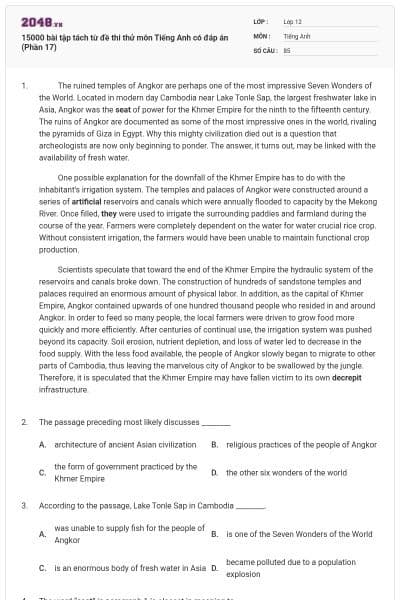
The ruined temples of Angkor are perhaps one of the most impressive Seven Wonders of the World. Located in modern day Cambodia near Lake Tonle Sap, the largest freshwater lake in Asia, Angkor was the seat of power for the Khmer Empire for the ninth to the fifteenth century. The ruins of Angkor are documented as some of the most impressive ones in the world, rivaling the pyramids of Giza in Egypt. Why this mighty civilization died out is a question that archeologists are now only beginning to ponder. The answer, it turns out, may be linked with the availability of fresh water.
One possible explanation for the downfall of the Khmer Empire has to do with the inhabitant’s irrigation system. The temples and palaces of Angkor were constructed around a series of artificial reservoirs and canals which were annually flooded to capacity by the Mekong River. Once filled, they were used to irrigate the surrounding paddies and farmland during the course of the year. Farmers were completely dependent on the water for water crucial rice crop. Without consistent irrigation, the farmers would have been unable to maintain functional crop production.
Scientists speculate that toward the end of the Khmer Empire the hydraulic system of the reservoirs and canals broke down. The construction of hundreds of sandstone temples and palaces required an enormous amount of physical labor. In addition, as the capital of Khmer Empire, Angkor contained upwards of one hundred thousand people who resided in and around Angkor. In order to feed so many people, the local farmers were driven to grow food more quickly and more efficiently. After centuries of continual use, the irrigation system was pushed beyond its capacity. Soil erosion, nutrient depletion, and loss of water led to decrease in the food supply. With the less food available, the people of Angkor slowly began to migrate to other parts of Cambodia, thus leaving the marvelous city of Angkor to be swallowed by the jungle. Therefore, it is speculated that the Khmer Empire may have fallen victim to its own decrepit infrastructure.
The passage preceding most likely discusses ________
architecture of ancient Asian civilization
religious practices of the people of Angkor
the form of government practiced by the Khmer Empire
the other six wonders of the world
D
Bài đọc phía trước có thể thảo luận về.............
A. kiến trúc của nền văn minh cổ đại châu Á.
B. những phong tục tôn giáo của người Ăngkor
C. việc hình thành chính phủ được thực hiện bởi triều đại Khơ-me.
D. 6 kỳ quan khác của thế giới.
Dẫn chứng: The ruined temples of Angkor are perhaps one of the most impressive Seven Wonders of the World.
=>Chọn D
According to the passage, Lake Tonle Sap in Cambodia ________.
was unable to supply fish for the people of Angkor
is one of the Seven Wonders of the World
is an enormous body of fresh water in Asia
became polluted due to a population explosion
C
Theo bài đọc, hồ Tôn Lê Sáp ở Cam-pu-chia......................
A. Không thể cung ứng cá cho người Angkor
B. Là một trong 7 kỳ quan thế giới
C. Là một phần lớn của nước sạch ở châu Á.
D. Trở nên ô nhiễm do bùng nổ dân số.
Dẫn chứng: Located in modern day Cambodia near Lake Tonle Sap, the largest freshwater lake in Asia, Angkor was the seat of power for the Khmer Empire for the ninth to the fifteenth century.
=>Chọn C
The word “seat” in paragraph 1 is closest in meaning to ________.
battle
summit
location
chief
C
Từ “seat” ở đoạn văn 1 gần nghĩa nhất với...................
Battle: trận chiến
Summit: đỉnh núi
Location: vị trí địa lý
Chief: chính/ chủ yếu
Dẫn chứng: Located in modern day Cambodia near Lake Tonle Sap, the largest freshwater lake in Asia, Angkor was the seat of power for the Khmer Empire for the ninth to the fifteenth century. [ Được đặt ở thời Cam-pu-chia hiện đại gần hồ Tôn Lê Sáp, vùng nướ sạch lớn nhất châu Á, Angkor là vị trí sức mạnh của triều đại Khơ-me khoảng thế kỷ 9 đến 15.]
=>Chọn C
The hydraulic system of reservoirs ________.
supplied irrigation from the Indian Ocean
helped transport the sandstone for constructing temples
were destroyed by nearby warrior’s tribes
became non–functional due to overuse
D
Hệ thống thủy lực của các bể chứa............
A. cung cấp cho việc tưới tiêu từ Ấn Độ Dương.
B. đã giúp vận chuyển những tảng đá cát để xây dựng đền.
C. bị phá hủy bởi các bộ tộc của quân nhân gần đó.
D. trở nên vô dụng do sử dụng quá mức.
Dẫn chứng: After centuries of continual use, the irrigation system was pushed beyond its capacity.
=>Chọn D
The word “artificial” in paragraph 2 is closest in meaning to ________.
man–made
numerous
natural
insincere
A
Từ “artificial” để đoạn văn 2 gần nghĩa nhất với..............
Man-made: nhân tạo
Numerous: nhiều
Natural: tự nhiên/ thuộc về thiên nhiên
Insincere: không chân thành
=>artificial = man-made: nhân tạo
=>Chọn A
The word “they” in paragraph 2 refers to ____
reservoirs and canals
temples and palaces
rice paddles
farmland
A
Từ “they” ở đoạn 2 ám chỉ đến.............
A. những bể chứa nước và kênh đào
B. những ngôi đền và dinh thự
C. những cánh đồng
D. nông trại
Dẫn chứng: The temples and palaces of Angkor were constructed around a series of artificial reservoirs and canals which were annually flooded to capacity by the Mekong River. Once filled, they were used to irrigate the surrounding paddies and farmland during the course of the year.
=>Chọn A
All of the following are mentioned as events that can affect food supply EXCEPT ________.
reduction of nutrients
contamination of soil
loss of water supply
erosion of soil
B
Tất cả những ý sau được đề cập như những sự kiện có thể ảnh hưởng đến lương thực ngoại trừ...........
A. cắt giảm chất dinh dưỡng
B. sự ô nhiễm đất
C. mất nguồn cung cấp nước
D. sự xói mòn đất
Dẫn chứng: Soil erosion, nutrient depletion, and loss of water led to decrease in the food supply.
=>Chọn B
The quest for sustainable sources of energy study the energy has led humans to study the energy potential of the sun and the wind, as well as the immense power created by dammed rivers. The oceans, too, represent an impressive source of potential energy. For example, it has been estimated that the oceans could provide nearly 3,000 times the energy generated by hydroelectric dams such as the Hoover Dam. Yet, this source remains quite difficult to exploit.
But this challenge has not prevented scientists from trying. Within the last few decades, several technologies that can transform the ocean’s immense forces into usable electricity have been invented and introduced. Some focus on capturing the power of the changing tides, while others rely on thermal energy created by oceans in certain tropical regions. However, the most common and easiest-to-develop technologies are those designed to harness the power inherent in the ocean’s waves.
There are several methods by which ocean-wave energy can be collected. All of them work because the movement of the water that the waves induce creates storable energy by directly or indirectly driving a power generator. In one such technology, the changing water levels in the ocean that are produced by waves lift a long floating tube comprised of many sections connected by hinges. As the sections move up and down with the water, they pump a special fluid through the tube that can be used to drive a generator. Another technique works on a similar principle, only the floating object rocks back and forth with the motion of the water instead of up and down. A third method of collecting wave energy relies on the rising water from the waves to compress air in a partially submerged chamber. As the waves rush into the chamber, they push the air out through a narrow tunnel. Located inside this tunnel is a turbine connected to a power generator. The movement of the air turns the turbine, which feeds energy into the generator.
The drawback to each of these concepts is that the they make it necessary to have many pieces of machinery linked together. This presents a problem because the larger the device, the more vulnerable it is to damage from hazardous ocean environments, and the more likely it is to interfere with otherwise unspoiled coastal scenery. Also, these methods demand the construction of site-specific machines that take into consideration average local wave heights and sea conditions. Such a requirement can be quite cost-prohibitive, because engineers must create unique power generation mechanism for each site. In other words, the ability to get power from waves differ from region to region.
Japan, Norway, and the UK have attempted to generate energy by capturing the power of ocean waves. In northern Scotland, the first power plan to use wave power, OSPREY ( Ocean Swell Powered Renewable Energy ), began operating in 1995. It followed the principle of the third method described above : waves entering a partially submerged chamber pushed air into turbines to generate electricity. The electricity was then transmitted to power collectors in the shore via underwater cables. Unfortunately, the OSPREY plant was destroyed in a large storm, highlighting an unavoidable difficulty associated with this kind of power generation.
The potential benefits of wave-based energy are hard to ignore. Once the proper machinery is produced and installed, the energy is free. Maintenance cost are small, and the equipment does not pose any threats of environmental pollution. And best of all, the amounts of energy produced are enormous.
However, these theoretical advantages have yet to be fully realized. In many cases, a lack of government funding has inhibited the technologies from advancing. For example, despite the relative abundance of proposed wave-power devices, many have not been adequately tested, and most have been evaluated only in artificial pools where they are not subjected to the harsh marine conditions that exist in actual oceans. Protecting the equipment from the sea’s destructive forces, as well as the fundamental task of determining feasible locations for collecting energy source are substantial and will require more time to overcome.
The phrase this source in the passage refers to
sun
wind
dammed rivers
oceans
D
Cụm từ “ this source” trong bài đọc ám chỉ đến.........................
Sun: mặt trời
Wind: gió
Rivers: sông
Oceans: đại dương
Dẫn chứng: The oceans, too, represent an impressive source of potential energy. For example, it has been estimated that the oceans could provide nearly 3,000 times the energy generated by hydroelectric dams such as the Hoover Dam. Yet, this source remains quite difficult to exploit.
=>Chọn D
The word exploit in the passage is closest meaning to
utilize
declare
contain
determine
A
Từ “ exploit” trong bài đọc gần nghĩa nhất với........................
Utilize: sử dụng
Declare: tuyên bố
Contain: chứa
Determine: xác nhận
=>exploit [ khai thác] = Utilize
=>Chọn A
Why does the author mention the Hoover Dam in paragraph one ?
To give a current example of ocean–based energy technology
To explain that dams are effective producers of sustainable energy
To draw a comparison between two sources of renewable energy
To show that alternative energy sources have not been successful
C
Tại sao tác giả đề cập đến Đập nước Hoover ở đoạn 1?
A. Để đưa ra ví dụ gần đây về công nghệ năng lượng dựa trên đại dương.
B. Để giải thích rằng những đập nước là nguồn sản xuất năng năng lượng bền bỉ và hiệu quả.
C. Để phác họa sự so sánh giữa hai nguồn năng lượng có thể tái tạo.
D. Đề cho thấy rằng những nguồn năng lượng thay thế không thành công.
Dẫn chứng: For example, it has been estimated that the oceans could provide nearly 3,000 times the energy generated by hydroelectric dams such as the Hoover Dam.
=>Chọn C
According to paragraph 3, which of the following is true about wave–power technologies?
Many of them use submerged objects to obtain the waves’ energy
Compressed air must be present for them to work properly
They undertake three steps in order to collect wave power
They rely on the water’s motion to create electricity
D
Theo đoạn 3, câu nào sau đây đúng về công nghệ năng lượng sóng?
A. Nhiều trong số chúng dùng vật thể ngập nước để lấy được năng lượng sóng.
B. Không khí bị nén phải tồn tại cho chúng hoạt động hiệu quả.
C. Chúng thực hiện 3 bước để thu thập năng lượng sóng.
D. Chúng dựa vào sự chuyển động của nước để tạo ra điện.
Dẫn chứng: All of them work because the movement of the water that the waves induce creates storable energy by directly or indirectly driving a power generator.
=>Chọn D
According to paragraph 5, what part did the cables play in OSPREY’s design?
They attached the partially submerged chamber to the sea floor
They generated the electricity which was then collected in turbines.
They conducted the electricity from the generator to the shore.
They provided stability during powerful ocean storms.
C
Theo đoạn 5, những dây cáp đóng vai trò là bộ phận nào trong thiết kế của OSPREY’s?
A. Chúng đính kèm với buồng chìm một phần với đáy đại dương.
B. Chúng phát ra điện cái mà được thu thập lại trong tua bin.
C. Chúng dẫn điện từ máy phát điện đến bờ biển.
D. Chúng cung cấp sự ổn định trong suốt những cơn bão đại dương lớn.
Dẫn chứng: The electricity was then transmitted to power collectors in the shore via underwater cables.
=>Chọn C
The word inhibited in the passage is closest in meaning to
delivered
prevented
protected
approved
B
Từ “ inhibited” trong bài đọc gần nghĩa nhất với
Inhibite: cản trở
Deliver: chuyển giao [ hàng hóa]
Prevent: ngăn chặn
Protect: bảo vệ
Approve: đồng ý
=>inhibite = prevent
=>Chọn B
What can be inferred from paragraph 7 about governments?
They do not believe wave–energy devices can withstand ocean forces.
Their interests often conflict with those of the energy industries.
They demand much scientific research before they provide funding.
Their support is often essential to the success of new endeavors.
D
Có thể suy ra gì từ đoạn 7 về chính phủ?
A. Họ không tin những thiết bị năng lượng sóng có thể chịu được sức mạnh của đại dương.
B. Sự quan tâm của họ thường mâu thuẫn với sự quan tâm của các ngành công nghiệp năng lượng.
C. Họ yêu cầu nhiều nghiên cứu khoa học trước khi cung cấp nguồn vốn.
D. Sự ủng hộ của họ thưởng rất quan trọng đối với sự thành công của những nỗ lực mới.
Dẫn chứng: In many cases, a lack of government funding has inhibited the technologies from advancing.
=>Chọn D
All of these are problems associated with the collection of wave energy EXCEPT ?
the difficulty of finding feasible locations
the destructive power of the ocean
the size of the equipment involved
the constant changing of the tides
D
Tất cả những vấn đề sau đây liên quan đến việc thu gom năng lượng sóng ngoại trừ?
A. Sự khó khăn của việc tìm ra vị trí khả thi.
B. Năng lượng hủy diệt của đại dương
C. Kích thước của thiết bị có liên quan
D. sự thay đổi liên tục của thủy triều
Dẫn chứng: Protecting the equipment from the sea’s destructive forces, as well as the fundamental task of determining feasible locations for collecting energy source are substantial and will require more time to overcome.[ câu A+ B]
This presents a problem because the larger the device, the more vulnerable it is to damage from hazardous ocean environments, and the more likely it is to interfere with otherwise unspoiled coastal scenery.[ câu C]
=>Chọn D
Telecommuting-substituting the computer for the trip to the job-has been hailed as a solution to all kinds of problems related to office work. For workers, it promises freedom from the office, less time wasted in traffic, and help with child-care conflicts. For management, telecommuting helps keep high performers on board, minimizes tardiness and absenteeism by eliminating commutes, allows periods of solitude for high-concentration tasks, and provides scheduling flexibility. In some areas, such as Southern California and Seattle, Washington, local governments are encouraging companies to start telecommuting programs in order to reduce rush-hour congestion and improve air quality, but these benefits do not come easily. Making a telecommuting program work requires careful planning and an understanding of the differences between telecommuting realities and popular images.
Many workers are seduced by rosy illusions of life as a telecommuter. A computer programmer from New York City moves to the tranquil Adirondack Mountains and stays in contact with her office via computer. A manager comes into his Office three days a week and works at home the other two. An accountant stays home to care for child; she hooks up her telephone modem connections and does office work between calls to the doctor.
These are powerful images, but they are a limited reflection of reality. Telecommuting workers soon learn that it is almost impossible to concentrate on work and care for a young child at the same time. Before a certain age, young children cannot recognize, much less respect, the necessary boundaries between work and family. Additional child support is necessary if the parent is to get any work done.
Management, too, must separate the myth from the reality. Although the media has paid a great deal of attention to telecommuting, in most cases it is the employee’s situation, not the availability of technology, that precipitates a telecommuting arrangement.
That is partly why, despite the widespread press coverage, the number of companies with work-at-home programs or policy guidelines remains small.
What is the main subject of the passage?
Business management policies
Commuting to work
Extending the workplace by means of telecommutingk
Telecommuting for child-care purposes
C
Chủ đề chính của bài đọc là gì?
A. Các chính sách quản trị kinh doanh.
B. Đi đi về về làm việc
C. Mở rộng nơi làm việc bằng các phương tiện viễn thông.
D. Viễn thông dành cho các mục đích chăm sóc trẻ em.
=>Chọn C
According to the passage, what is the most important tool for a telecommuter to work at home?
telephone
a camera
a smart phone
a computer
D
Theo bài đọc, cái gì là công cụ quan trọng nhất cho một người làm việc ở nhà thông qua thiết bị viễn thông?
A. điện thoại
B. camera giám sát
C. điện thoại thông minh
D. máy tính
Dẫn chứng: Telecommuting-substituting the computer for the trip to the job-has been hailed as a solution to all kinds of problems related to office work.
=>Chọn D
The word “hailed” in the first paragraph is closest in meaning to
welcomed
communicated
considered
arranged
A
Từ “ hailed” ở đoạn 1 gần nghĩa nhất với....
Welcomed: chào đón
Communicated: giao tiếp
Considerated: cân nhắc, xem xét
Arranged: sắp xếp
Telecommuting-substituting the computer for the trip to the job-has been hailed as a solution to all kinds of problems related to office work.
[ Làm việc ở nhà thông qua các thiết bị viễn thông với máy tính thay thế cho việc đi lại đến nơi làm việc, đã được đón nhận như là một giải pháp đối với tất cả các loại vấn đề liên quan đến làm việc trong văn phòng.]
=>hailed = welcomed
=>Chọn A
Which of the following is NOT mentioned as a problem for office employees?
Being restricted to the office
Incurring expenses for lunches and clothing
Taking care of sick children
Driving in heavy traffic
B
Câu nào sau đây không được đề cập như vấn đề của các nhân viên văn phòng?
A. Bị giới hạn trong văn phòng.
B. Gánh chịu chi phí cho bữa ăn trưa và ăn mặc.
C. Chăm sóc trẻ ốm.
D. Lái xe lúc giao thông ùn tắc.
Dẫn chứng: local governments are encouraging companies to start telecommuting programs in order to reduce rush-hour congestion => loại D
An accountant stays home to care for child; she hooks up her telephone modem connections and does office work between calls to the doctor. => loại C
=>Chọn B
Which of the following is NOT mentioned as a problem for employers that is potentially solved by telecommuting?
Employees’ lateness for work
Employees’ absence from work
Employees’ need for time to work intensively alone
Employees’ conflicts with second jobs
D
Câu nào sau đây không được đề cập như là một vấn đề của nhân viên cái mà có thể được giải quyết bằng cách làm việc ở nhà thông qua các thiết bị viễn thông?
A. Trễ giờ làm của nhân viên
B. Nghỉ làm / vắng mặt/ nghỉ phép
C. Cần thời gian để làm việc chuyên sâu 1 mình
D. Mâu thuẫn của nhân viên với công việc thứ hai.
Dẫn chứng: telecommuting helps keep high performers on board, minimizes tardiness and absenteeism by eliminating commutes, allows periods of solitude for high-concentration tasks, and provides scheduling flexibility.
=>Chọn D
Which of the following does the author mention as a possible disadvantage of telecommuting?
Small children cannot understand the boundaries of work and play.
Computer technology is not advanced enough to accommodate the needs of every situation.
Electrical malfunctions can destroy a project.
The worker often does not have all the needed resources at home.
A
Câu nào sau đây tác giả đề cập như là 1 bất lợi của làm việc tại nhà thồn qua viễn thông?
A. Trẻ nhỏ không hiểu ranh giới giữa chơi và làm việc.
B. Công nghệ máy tính không được cải tiến để đáp ứng nhu cầu cho mọi tình huống.
C. Những trục trặc về điện tử có thể làm hỏng 1 dự án.
D. Công nhân thường không có tất cả những nguồn cần thiết khi ở nhà.
Dẫn chứng: Before a certain age, young children cannot recognize, much less respect, the necessary boundaries between work and family.
=>Chọn A
Which of the following is an example of telecommuting as described in the passage?
A scientist in a laboratory developing plans for a space station
A technical writer sending via computer documents created at home
A computer technician repairing an office computer network
A teacher directing computer-assisted learning in a private school.
B
Câu nào sau đây là ví dụ của làm việc tịa nhà thông qua máy tính được miêu tả trong bài đọc?
A. Một nhà khoa học làm việc trong phòng thí nghiệm phát triển các kế hoạch cho trạm không gian.
B. Một người viết sách về kỹ thuật gửi những tài liệu thông qua máy tính ở nhà.
C. Một thợ sửa chữa máy tính sửa một mạng lưới máy tính văn phòng.
D. Một giáo viên hướng dẫn cách học với sự hỗ trợ của máy tính ở một trường tư.
=>Chọn B
Millions of people tune into the weather forecast each evening on televisions. Most of them imagine that the presenter does little more than arrive at the studio a few minutes before the broadcast, read the weather, and then go home.
In fact, this imagine is far from the truth. The two-minute bulletin which we all rely on when we need to know tomorrow’s weather is the result of a hard day’s work by the presenter, who is actually a highly-qualified meteorologist.
Every morning after arriving at the TV studios, the first task of the days is to collect the latest data from the national Meteorological Office. This office provides up-to-the-minute information about weather conditions throughout the day, both in Britain and around the world. The information is very detailed and includes predictions, satellite and radar pictures, as well as more technical data. After gathering all the relevant material from this office, the forecaster has to translate the scientific terminology and maps into images and word which viewers can easily understand.
The final broadcast is then carefully planned. It is prepared in the same way as other programmes. The presenter decides what to say and in what order to say it. Next, a “story board” is drawn up which lay out the script word for word. What make a weather forecast more complicated than other programmes are the maps and electronic images which are required. The computer has to be programmed so that the pictures appear in the correct order during the bulletin.
The time allocated for each broadcast can also alter. This is because the weather report is screened after the news, which can vary in length. The weather forecaster doesn’t always know how much time is available, which means that he/ she has to be thoroughly prepared so that the material can be adapted to the time available.
Another related complication is that the weather forecast has to be a live broadcast; it cannot be pre- recorded. Live shows are very nerve- racking for the presenter because almost anything can go wrong. Perhaps the most worrying aspect for every weather forecaster is getting the following day’s predictions wrong. Unfortunately for them this is not an unusual occurrence; the weather is not always possible to predict accurately.
The weather is a national obsession in Britain, Perhaps because it is so changeable. It’s the national talking point, and most people watch at least one daily bulletin. It can be mortifying for a weather man or woman who has predicted rain for the morning to wake up to brilliant sunshine. These days, a weather forecaster’s job is even more complicated because they are replied upon to predict other environmental conditions. For example, in the summer the weather forecast has to include the pollen count for hay fever sufferers. Some also include reports on ultraviolet radiation intensity to help people avoid sunburn.
The job of the weather forecaster is certainly far more complicated than just pointing at a map and describing weather conditions. It’s a job for professionals who can cope with stressful and demanding conditions.
What perception do most people have a weather forecasters?
They have many qualifications.
They do a hard day’s work at the studio.
They always tell the truth.
They work very short hours.
D
Nhận thức của hầu hết mọi người về một phát thanh viên dự báo thời tiết là gì?
A. Họ có nhiều bằng cấp khác nhau.
B. họ làm việc vất vả cả ngày ở phòng quay.
C. Họ luôn nói sự thật.
D. Họ làm việc rất ít giờ.
Dẫn chứng: Most of them imagine that the presenter does little more than arrive at the studio a few minutes before the broadcast, read the weather, and then go home.
=>Chọn D
Meteorologists get their forecasting information from
The TV studio
The country’ s main weather centre
Satellite and radar information
Their office
B
Các nhà thiên văn học nhận được thông tin dự báo từ...
A. Phòng quay đài truyền hình
B. Trung tâm dự báo khí tượng trung ương
C. vệ tinh và rada thông tin
D. văn phòng của họ
Dẫn chứng: Every morning after arriving at the TV studios, the first task of the days is to collect the latest data from the national Meteorological Office.
=>Chọn B
The phrase up- to- the- minute in paragraph 3 is closest in meaning to
Very brief
Very short
( the) most recent
Fashionable
C
Cụm từ “up- to – the – minute” ở đoạn 3 gần nghĩa nhất với...
A. rất ngắn gọn/ cô động
B. rất ngắn
C. gần đây nhất/ mới nhất
D. hợp xu hướng thời trang
=>up- to – the – minute = the most recent
=>Chọn C
So that the visual are sequenced correctly
So that the script is visible to the presenter
Because the script has to be written on a story board
Because electric maps are used
A
Máy tính phải được lập trình cẩn thận ...
A. để mà thiết bị trực quan được vận hành đúng
B. để mà đoạn trích dẫn có thể dễ nhìn thấy với người thuyết trình
C. bởi vì đoạn trích phải được viết trên bảng tin.
D. bởi vì bản đồ điện tử được sử dụng.
Dẫn chứng: The computer has to be programmed so that the pictures appear in the correct order during the bulletin.
=>Chọn A
Weather forecasters have to know the material well because
The length of the report may have to change
The forecast may be incorporated into the news broadcast
The content of the report may have to change
The broadcast is pre-recorded
A
Các phát thanh viên dự báo thời tiết phải biết về tài liệu rất rõ bởi vì...
A. Độ dài của bài viết có thể thay đổi.
B. Bài dự báo có thể được kết hợp thành 1 tin tức dự báo.
C. nội dung của bài viết có thể phải thay đổi.
D. bài dự báo được ghi âm lại.
Dẫn chứng: The time allocated for each broadcast can also alter.
=>Chọn A
What does this in paragraph 6 refer to?
The weather forecaster’s worry
Reading the weather ‘live’
Giving a forecast that doesn’t come true
An accurate prediction
C
Từ “this” trong đoạn 6 ám chỉ đến cái gì?
A. Nỗi lo lắng của phát thanh viên dự báo thời tiết.
B. Việc đọc bản tin trực tiếp
C. Việc đưa ra bài dự báo không đúng
D. Sự tiên đoán chính xác.
Perhaps the most worrying aspect for every weather forecaster is getting the following day‟s predictions wrong. Unfortunately for them this is not an unusual occurrence; the weather is not always possible to predict accurately.
=>Chọn C
The word mortifying in the last paragraph is closest in meaning to
embarrassing
enjoyable
deceitful
frightening
A
Từ “ mortifying” ở đoạn cuối gần nghĩa nhất với...
Mortifying (adj): lúng túng
embarrassing : lúng túng
enjoyable: được yêu thích
deceitful: giả dối
frightening: đáng sợ
=>Mortifying = embarrassing
=>Chọn A
Nowadays, weather forecasters have to
A. do experiments to determine the pollen count.
B. simply point at maps and describe weather conditions.
C. cope with professionals.
D. be able to cope under pressure.
do experiments to determine the pollen count.
simply point at maps and describe weather conditions.
cope with professionals.
be able to cope under pressure.
D
Ngày nay các phát thanh viên dự báo thời tiết phải....
A. tiến hành thí nghiệm để xác định lượng phấn hoa
B. đơn giản chỉ vào bản đồ và mô tả điều kiện thời tiết
C. làm việc với các chuyên gia
D. có khả năng chịu được áp lực
Dẫn chứng: It‟s a job for professionals who can cope with stressful and demanding conditions.
=>Chọn D
Since the world became industrialized, the number of animal species that have either become extinct or near extinction has increased. Bengal tigers, for instance, which once roamed the jungles in vast numbers, now number only about 2,300. By the year 2025, it is estimated that they will become extinct.
What is alarming about the case of the Bengal tiger is that this extinction will have been caused almost entirely by poachers who, according to some sources, are not always interested in material gain but in personal gratification. This is an example of the callousness that is contributing to the problem of extinction. Animals such as the Bengal tiger, as well as other endangered species, are valuable parts of the world/s ecosystem. International laws protecting animals must be enacted to ensure their survival-and the survival of our planet.
Countries around the world have begun to deal with the problem in various ways. Some countries, in an effort to circumvent the problem, have allocated large amounts of land to animal reserves. They then charge admission prices to help defray the costs of maintaining the parks, and they often must also depend on world organizations for support. This money enables them to invest in equipment and patrols o protect the animals. Another response to the increase in animal extinction is an international boycott of products made from endangered species. This has had some effect, but by itself will not prevent animals from being hunted and killed.
What is the main topic of the passage?
The Bengal tiger
International boycotts.
Endangered species
Problems with industrialization
. C
Chủ đề chính của bài đọc là gì?
A. Cọp/ Hổ Bengal
B. Cuộc tẩy chay toàn cầu
C. những loại động vật bị đe dọa
D. những vấn đề với nền công nghiệp hóa
=>Chọn C
Dịch bài đọc
Kể từ khi thế giới trở nên công nghiệp hóa, số lượng các loài động vật đã tuyệt chủng hoặc gần tuyệt chủng đã tăng lên. Ví dụ, hổ Bengal, loài từng lang thang trong rừng rậm với số lượng lớn, giờ chỉ còn khoảng 2.300 con. Người ta ước tính rằng đến năm 2025, chúng sẽ tuyệt chủng.
Điều đáng báo động về trường hợp của hổ Bengal là sự tuyệt chủng này hầu như hoàn toàn do những kẻ săn trộm gây ra, theo một số nguồn tin, chúng không phải lúc nào cũng quan tâm đến lợi ích vật chất mà chỉ quan tâm đến sự thỏa mãn cá nhân. Đây là một ví dụ về sự vô cảm đang góp phần gây ra vấn đề tuyệt chủng. Các loài động vật như hổ Bengal, cũng như các loài có nguy cơ tuyệt chủng khác, là những bộ phận có giá trị của hệ sinh thái thế giới/sống động vật. Luật quốc tế bảo vệ động vật phải được ban hành để đảm bảo sự sống còn của chúng và sự sống còn của hành tinh chúng ta.
Các quốc gia trên khắp thế giới đã bắt đầu giải quyết vấn đề theo nhiều cách khác nhau. Một số quốc gia, trong nỗ lực giải quyết vấn đề, đã phân bổ một lượng lớn đất cho các khu bảo tồn động vật. Sau đó, họ tính giá vé vào cửa để giúp trang trải chi phí duy trì công viên và họ thường phải phụ thuộc vào các tổ chức thế giới để được hỗ trợ. Số tiền này cho phép họ đầu tư vào thiết bị và tuần tra để bảo vệ động vật. Một phản ứng khác đối với sự gia tăng tuyệt chủng của động vật là tẩy chay quốc tế các sản phẩm làm từ các loài có nguy cơ tuyệt chủng. Điều này đã có một số tác động, nhưng bản thân nó sẽ không ngăn chặn được việc động vật bị săn bắt và giết hại.
Which of the following could best replace the word 'case' as used in paragraph 2?
Act
Situation
Contrast
Trade
B
Từ nào sau đây thay thế tốt nhất cho từ “case” được sử dụng ở đoạn 2.
Act: phản ứng
Situation: tình huống
Contrast: sự tương phản
Trade: thương mại
What is alarming about the case of the Bengal tiger is
[ Cái đang gây báo động về trường hợp của loài hổ Belgan là...]
=>case = situation
=>Chọn B
The word 'poachers' as used in paragraph 2 could be best replaced by which of the following?
Illegal hunters
Enterprising researchers
Concerned scientists
Trained hunters
A
Từ “ poachers” được sử dụng ở đoạn 2 có thể được thay thế tốt nhất bởi từ nào sau đây?
A. thợ săn trái phép
B. các nhà nghiên cứu kinh doanh
C. các nhà khoa học quan tâm về vấn đề này
D. những thợ săn được đào tạo
poacher: thợ săn trái phép
=>poachers = Illegal hunters
=>Chọn A
What does the word 'this' in paragraph 2 refer to in the passage?
Bengal tigers
Interest in material gain
Killing animals for personal satisfaction.
The decrease in the Bengal tiger population
C
Từ “this” ở đoạn 2 ám chỉ đến cái gì trong bài đọc?
A. những con hổ Bengal
B. sự quan tâm đến việc lấy được nguyên liệu
C. việc giết những con vật vì thú vui cá nhân.
D. sự giảm về số lượng hổ Bengal
What is alarming about the case of the Bengal tiger is that this extinction will have been caused almost entirely by poachers who, according to some sources, are not always interested in material gain but in personal gratification. This is an example of the callousness that is contributing to the problem of extinction.
[Điều gây ra cảnh báo về trường hợp của loài hổ Bengal là sự tuyệt chủng này sẽ bị gây ra gần như hoàn toàn bởi bọn thợ săn bất hợp pháp, người mà theo như một số nguồn, không phải lúc nào cũng quan tâm đến việc lấy được vật liệu mà chỉ vì thú vui cá nhân. Đây là một ví dụ của sự chết dần chết mòn cái mà góp phần vào vấn đề tuyệt chủng.]
=>Chọn C
Which of the following could best replace the word ‘allocated’ in paragraph 3?
Set aside
Combined
Organized
Taken off
A
Từ nào sau đây có thể thay thế từ “ allocate” ở đoạn 3 tốt nhất?
Set aside: để phần/ để dành/ dành phần
Combined: kết hợp
Organized: tổ chức
Taken off: cởi [ quần áo, trang phục], cất cánh [ máy bay]
Some countries, in an effort to circumvent the problem, have allocated large amounts of land to animal reserves.
[ Một số nước, đang nỗ lực tìm cách giải quyết vấn đề này, đã phân bổ vùng đất rộng lớn cho các khu bảo tồn động vật.]
=>Chọn A
What does the term 'international boycott' in paragraph 3 refer to?
Buying and selling of animal products overseas.
A refusal to buy animal products worldwide
A global increase in animal survival.
Defraying the cost of maintaining national parks.
B
Thuật ngữ “ tẩy chay toàn cầu” ở đoạn 3 ám chỉ đến cái gì?
A. Việc mua bán những sản phẩm làm từ động vật ra nước ngoài.
B. Việc từ chối mua các sản phẩm làm từ động vật trên toàn cầu.
C. Việc tăng sự sống sót của động vật trên toàn cầu.
D. Việc chi trả chi phí cho việc bảo trì các công việc quốc gia.
Another response to the increase in animal extinction is an international boycott of products made from endangered species.
[ Một phản hồi khác về sự tăng tình trạng tuyệt chủng của động vật là cuộc tẩy chay toàn cầu những sản phẩm được làm từ các loài động vật đang bị đe dọa.]
=>Chọn B
Which of the folỉowing best describes the author's attitude?
Forgiving
Concerned
Vindictive
Surprised
B
Ý nào miêu tả đúng nhất thái độ của tác giả?
Forgiving: tha thứ
Concerned: quan tâm
Vindictive: thù hằn
Surprised: ngạc nhiên
=>Chọn B
Though Edmund Halley was most famous because of his achievements as an astronomer, he was a scientist of diverse interests and great skill. In addition to studying the skies, Halley was also deeply interested exploring the unknown depths of the oceans. One of his lesser-known accomplishments that was quite remarkable was his design for a diving bell that facilitated exploration of the watery depths.
The diving bell that Halley designed had a major advantage over the diving bells that were in use prior to his. Earlier diving bells could only make use of the air contained within the bell itself, so divers had to surface when the air inside the bell ran low. Halley's bell was an improvement in that its design allowed for an additional supply of fresh air that enabled a crew of divers to remain underwater for several hours.
The diving contraption that Halley designed was in the shape of a bell that measured three feet across the top and five feet across the bottom and could hold several divers comfortably; it was open at the bottom so that divers could swim in and out at will. The bell was built of wood, which was first heavily tarred to make it water repellent and was then covered with a half-ton sheet of lead to make the bell heavy enough to sink in water. The bell shape held air inside for the divers to breathe as the bell sank to the bottom.
The air inside the bell was not the only source of air for the divers to breathe, and it was this improvement that made Halley's bell superior to its predecessors. In addition to the air already in the bell, air was also supplied to the divers from a lead barrel that was lowered to the ocean floor close to the bell itself. Air flowed through a leather pipe from the lead barrel on the ocean floor to the bell. The diver could breath the air from a position inside the bell, or he could move around outside the bell wearing a diving suit that consisted of a lead bell-shaped helmet with a glass viewing window and a leather body suit, with a leather pipe carrying fresh air from the diving bell to the helmet.
The subject of the preceding passage was most likely Halley's
childhood
work as an astronomer
many different interests
invention of the diving bell
B
Chủ đề của bài đọc trước đó có thể là
A. thời thơ ấu của Halley
B. công việc như một nhà thiên văn học của Halley
C. nhiều sở thích khác nhau của Halley
D. sự phát minh chuông lặn
Dẫn chứng: Though Edmund Halley was most famous because of his achievements as an astronomer, he was a scientist of diverse interests and great skill.
=>Chọn B
Dịch bài đọc
Mặc dù Edmund Halley nổi tiếng nhất vì những thành tựu của ông với tư cách là một nhà thiên văn học, ông là một nhà khoa học có nhiều sở thích và kỹ năng tuyệt vời. Ngoài việc nghiên cứu bầu trời, Halley còn rất thích khám phá những độ sâu chưa được biết đến của đại dương. Một trong những thành tựu ít được biết đến của ông nhưng khá đáng chú ý là thiết kế chuông lặn giúp khám phá độ sâu của nước.
Chuông lặn mà Halley thiết kế có một ưu điểm lớn so với các chuông lặn được sử dụng trước đó. Các chuông lặn trước đó chỉ có thể sử dụng không khí chứa trong chính chuông, vì vậy thợ lặn phải nổi lên mặt nước khi không khí bên trong chuông cạn. Chuông của Halley là một cải tiến ở chỗ thiết kế của nó cho phép cung cấp thêm không khí trong lành giúp một đội thợ lặn có thể ở dưới nước trong nhiều giờ.
Thiết bị lặn mà Halley thiết kế có hình dạng một chiếc chuông có kích thước ba feet ngang trên cùng và năm feet ngang dưới cùng và có thể chứa nhiều thợ lặn một cách thoải mái; nó được mở ở phía dưới để thợ lặn có thể bơi vào và ra tùy ý. Chuông được làm bằng gỗ, đầu tiên được phủ một lớp hắc ín dày để chống thấm nước và sau đó được phủ một tấm chì nặng nửa tấn để làm cho chuông đủ nặng để chìm trong nước. Hình dạng của chuông giữ không khí bên trong để thợ lặn thở khi chuông chìm xuống đáy.
Không khí bên trong chuông không phải là nguồn không khí duy nhất để thợ lặn thở, và chính sự cải tiến này đã khiến chuông Halley vượt trội hơn so với những người tiền nhiệm của nó. Ngoài không khí đã có trong chuông, không khí còn được cung cấp cho thợ lặn từ một thùng chì được hạ xuống đáy đại dương gần với chính chiếc chuông. Không khí chảy qua một ống da từ thùng chì trên đáy đại dương đến chuông. Thợ lặn có thể hít thở không khí từ một vị trí bên trong chuông hoặc anh ta có thể di chuyển bên ngoài chuông khi mặc bộ đồ lặn bao gồm mũ bảo hiểm hình chuông bằng chì có cửa sổ quan sát bằng kính và bộ đồ liền thân bằng da, với một ống da dẫn không khí trong lành từ chuông lặn đến mũ bảo hiểm.
Which of the following best expresses the subject of this passage?
Halley's work as an astronomer
Haley's many different interests
Halley's invention of a contraption for diving
Halley's experiences as a diver
C
Câu nào sau đây thể hiện đúng nhất chủ đề của bài đọc?
A. Công việc của Halley như là một nhà thiên văn học.
B. Nhiều sở thích khác nhau của Hally
C. Phát minh thiết bị lặn kỳ lạ
D. Kinh nghiệm của Halley như là 1 thợ lặn
Dẫn chứng: One of his lesser-known accomplishments that was quite remarkable was his design for a diving bell that facilitated exploration of the watery depths.
=>Chọn C
Halley's bell was better than its predecessors because it
was bigger
provided more air
weighed less
could rise more quickly
B
Quả chuông của Halley tốt hơn so với những cái chuông trước đó bởi vì nó
A. To hơn
B. Cung cấp nhiều không khí hơn
C. Trọng lượng nhẹ hơn
D. Có thể nâng lên nhanh chóng
Dẫn chứng: Halley's bell was an improvement in that its design allowed for an additional supply of fresh air that enabled a crew of divers to remain underwater for several hours.
=>Chọn B
The expression ran low in paragraph 2 is closest in meaning to
moved slowly
had been replenished
sank to the bottom
was almost exhausted
D
Cụm từ “ran low” ở đoạn 2 gần nghĩa nhất với
A. Di chuyển chậm chạp
B. Đã được làm đầy lại
C. Chìm đến đáy
D. Gần như cạn kiệt
....divers had to surface when the air inside the bell ran low. [ Thợ lặn phải trở lại mặt nước khin không khí bên trong sắp cạn kiệt.]
=>Chọn D
How long could divers stay underwater in Halley's bell?
Just a few seconds
Only a few minutes
For hours at a time
For days on end
C
Những thợ lặn có thể ở dưới nước bao lâu trong cái chuông của Halley?
A. một vài giây
B. một vài phút
C. khoảng vài giờ một lần
D. khoảng vài ngày
Dẫn chứng: Halley's bell was an improvement in that its design allowed for an additional supply of fresh air that enabled a crew of divers to remain underwater for several hours.
=>Chọn C
It is NOT stated in the passage that Halley's bell
was wider at the bottom than at the top
was made of tarred wood
was completely enclosed
could hold more than one diver
C
Câu nào không được trình bày trong bài đọc về quả chuông của Halley?
A. lớn hơn ở đáy so với ở đỉnh
B. được làm từ gỗ có quét dầu hắc
C. hoàn toàn khép kín
D. có thể chứa nhiều hơn 1 thợ lặn
Dẫn chứng: The diving contraption that Halley designed was in the shape of a bell that measured three feet across the top and five feet across the bottom and could hold several divers comfortably; it was open at the bottom so that divers could swim in and out at will. The bell was built of wood, which was first heavily tarred to make it water repellent and was then covered with a half-ton sheet of lead to make the bell heavy enough to sink in water.
=>Chọn C
The word its in paragraph 4 refers to
improvement
Halley's bell
source of air
a lead barrel
B
Từ “its” ở đoạn 4 ám chỉ đến
A. sự cải thiện
B. chuông của Halley
C. nguồn không khí
D. thùng dẫn
The air inside the bell was not the only source of air for the divers to breathe, and it was this improvement that made Halley's bell superior to its predecessors.
[ Không khí bên trong không phải là nguồn không khí duy nhất cho các thợ lặn để thở mà nó là sự cải thiện đã làm quả chuông của Halley vượt trội hơn so với những cái trước của nó.]
=>Chọn B
This passage would most likely be assigned reading in a course on
astronomy
recreation
oceanography
physiology
C
Bài đọc này sẽ gần như được nằm trong bài đọc về
A. thiên văn học
B. sự giải trí
C. hải dương học
D. sinh lý học
=>Chọn C
Every year about two million people visit Mount Rushmore, were the faces of four U.S presidents were carved in granite by sculptor Gutzon Borglum and his son, the late Lincoln Borglum. The creation of the Mount Rushmore monument Line took 14 years – from 1927 to 1941 – and nearly a million dollars. There were times when money was difficult to come by and many people were jobless. To move more than 400,000 tons of rock, Borglum hired laid-off workers from the closed-down mines in the Black Hills area. He taught these men to dynamite, drill, carve, and finish the granite as they were hanging in midair in his specially devised chairs, which had many safety features. Borglum was proud of the fact that no workers were killed or severely injured during the years of blasting and carving.
During the carving, many changes in original design had to be made to keep the carved heads free of large fissures that were uncovered. However, not all the cracks could be avoided, so Borglum concocted a mixture of granite dust, white lead, and linseed oil to fill them.
Every winter, water from melting snows gets into the fissures and expands as it freezes, making the fissures bigger. Consequently, every autumn maintenance work is done to refill the cracks. The repairers swing out in space over a 500-foot drop and fix the monument with the same mixture that Borglum used to preserve this national monument for future generations.
This passage is mainly about _________
the visitors to the Mount Rushmore monument
the faces at the Mount Rushmore monument
the sculptor of the Mount Rushmore monument
the creation of the Mount Rushmore monument
D
Bài đọc này chủ yếu nói về..........
A. những du khách đến công trình núi Rushmore.
B. những khuôn mặt ở công trình núi Rushmore.
C. nhà điêu khắc công trình núi Rushmore.
D. sự sáng tạo của công trình núi Rushmore.
=>Chọn D
According to the passage, Borglum’s son _________
is dead
was a president
did maintenance work
spent a million dollars
A
Theo bài đọc, con trai của Borglium ......................
A. đã qua đời
B. đã từng là tổng thống
C. đã làm công việc bảo trì
D. đã tiêu một triệu đô la
Dẫn chứng: P1 [ Every year about two million people visit Mount Rushmore, were the faces of four U.S presidents were carved in granite by sculptor Gulzon Borglum and his son, the late Lincoln Borglum.]
=>Chọn A
The word ‘which’ is paragraph 1 refers to ________
granite
these man
chairs
features
C
Từ “which” ở đoạn 1 ám chỉ đến........................
Granite: đá granit
These man: những con người này
Chairs: những cái ghế
Features: đặc điểm
Dẫn chứng: P1 [ He taught these men to dynamite, drill, carve, and finish the granite as they were hanging in midair in his specially devised chairs, which had many safety features.]
=>Chọn C
The men who Borglum hired were _________
trained sculptors
laid-off stone masons
Black Hills volunteers
unemployed miners
D
Những người đàn ông mà Borglum đã tuyển dụng thì.............
A. là những thợ điêu khắc đã qua đào tạo
B. là những thợ điêu khắc đá đã bị sa thải
C. những tình nguyện viên ở Black Hill
D. những thợ mỏ thất nghiệp
Dẫn chứng: Borglum đã tuyển dụng những công nhân bị sa thải từ các mỏ đã đóng cửa ở khu vực đồi Black Hills.
=> Chọn D
It can be inferred from the passage that ________
the heads are not as originally planned
the workers made mistakes when blasting
the cracks caused serious injuries
the designs had large fissures in them
A
Có thể suy ra từ bài đọc rằng...................
A. những cái đầu không theo dự định ban đầu
B. những công nhân đã mắc sai lầm khi phá đá
C. những vết nứt đã gây ra tổn thương nghiêm trọng
D. những thiết kế có những vết nứt lớn bên trong chúng
Dẫn chứng: During the carving, many changes in original design had to be made to keep the carved heads free of large fissures that were uncovered.
=> Chọn A
Borglum’s mixture for filling cracks was _________
very expensive
bought at the Black Hills mines
invented
uncovered during carving
C
Hỗn hợp của Borglum để che lấp những vết nứt thì...............
A. rất tốn kém
B. được mua ở những mỏ Black Hills
C. được phát minh
D. không thể phục hồi trong quá trình chạm khắc
Dẫn chứng: However, not all the cracks could be avoided, so Borglum concocted a mixture of granite dust, white lead, and linseed oil to fill them.
=> Chọn C
Today, Mount Rushmore needs to be _________
protected from air pollution
polished for tourists
restored during the winter
repaired periodically
D
Ngày nay, núi Rushmore cần được...............
A. bảo vệ khỏi ô nhiễm không khí
B. đánh bóng cho các du khách
C. lưu trữ suốt mùa đông
D. được sửa chữa định kỳ
Dẫn chứng: every autumn maintanance work is done to refill the racks.
=> Chọn D
In the late 1960’s, many people in North America turned their attention to environmental problems and new steel-and-glass skyscrapers were widely criticized. Ecologists pointed out that a cluster of tall buildings in a city often overburdens public transportation and parking lot capacities.
Skyscrapers are also lavish consumers, and waster, of electric power. In one recent year, the addition of 17 million square feet of skyscraper office space in New York City raised the peak daily demand for electricity by 120,-000 kilowatts-enough to supply the entire city of Albany, New York, for a day.
Glass-walled skyscrapers can be especially wasteful. The heat loss (or gain) through a wall of half-inch plate glass is more than ten times that through a typical masonry wall filled with insulation board. To lessen the strain on heating and air-conditioning equipment, builders of skyscrapers have begun to use double glazed panels of glass, and reflective glasses coated with silver or gold mirror films that reduce glare as well as heat gain. However, mirror-walled skyscrapers raise the temperature of the surrounding air and affect neighboring buildings.
Skyscrapers put a severe strain on a city’s sanitation facilities, too. If fully occupied, the two World Trade Center towers in New York City would alone generate 2.25 million gallons of raw sewage each year-as much as a city the size of Stamford, Connecticut, which has a population of more than 109,000.
Skyscrapers also interfere with television reception, block bird flyways, and obstruct air traffic. In Boston, in the late 1960’s some people even feared that shadows from skyscrapers would kill the grass on Boston Common.
Still, people continue to build skyscrapers for all the reasons that they have always built them – personal ambition, civic pride, and the desire of owners to have the largest possible amount of rentable space.
The main purpose of the passage is to _________
compare skyscrapers with other modern structures.
describe skyscrapers and their effects on the environment.
advocate the use of masonry in the construction of skyscrapers.
illustrate some architectural designs of skyscrapers.
B
Mục đích chính của bài đọc là để..................
A. so sánh những tòa nhà chọc trời với những công trình kiến trúc hiện đại khác.
B. Miêu tả những tòa nhà chọc trời và ảnh hưởng của nó đến môi trường
C. biện hộ cho việc sử dụng nề trong việc xây dựng những tòa nhà chọc trời.
D. minh họa một số thiết kế kiến trúc của những tòa nhà chọc trời.
=>Chọn B
According to the passage, the attitude of many people in North America towards skyscrapers could be best described as _______
unemotional
skeptical
critical
bitter
C
Theo bài đọc, thái độ của nhiều người ở Bắc Mỹ đối với những tòa nhà chọc trời có thể được mô tả tốt nhất như là
Unemotional: không cô xúc
Skeptical: hoài nghi
Critical: phên bình, nhận xét
Bitter: cay đắng
Dẫn chứng: In the late 1960’s, many people in North America turned their attention to environmental problems and new steel – and – glass skycrapers were widely criticized.
=>Chọn C
The word “overburden” in paragraph 1 is closest in meaning to_________
overwhelm
overload
overachieve
overcome
B
Từ “overburden” ở đoạn 1 gần nghĩa nhất với.................
Overwhelm: áp đảo
Overload: quá tải
Overachieve: làm tốt hơn mong đợi
Overcome: vượt qua
Ecologists pointed out that a cluster of tall buildings in a city often overburdens public transportation and parking lot capacities.
=>overburden = overload
=>Chọn B
According to the passage, what is one disadvantage of skyscrapers that have mirrored walls?
The exterior surrounding air is heated.
The windows must be cleaned daily.
Construction time is increased.
Extra air-conditioning equipment is needed.
A
Theo bài đọc, một trong những bất lợi của những tòa nhà chọc trời với những bức tường bằng kính?
A. Không khí bao quanh bên ngoài nóng bức.
B. Cửa sổ phải được làm sạch hằng ngày.
C. Thời gian xây dựng tăng lên.
D. Những thiết bị điều hòa không khí rất cần thiết.
Dẫn chứng: mirror – walled skyscapers raise the temperature of the surrounding air and affect neighboring buildings.
=>Chọn A
According to the passage, in the late 1960’s some residents of Boston were concerned with which aspect of skyscrapers?
The noise from their construction
The removal of trees from building sites
The harmful effects on the city’s grass
The high cost of rentable office space
C
Theo bài đọc, cuối những năm 1960 một số dân cư ở Boston quan tâm đến khía cạnh nào của những tòa nhà chọc trời?
A. tiếng ồn từ việc xây dựng
B. việc di dời cây ra khỏi địa điểm xây tòa nhà.
C. những ảnh hưởng tiêu cực lên cỏ ở thành phố
D. chi phí cao đối với những tòa nhà văn phòng cho thuê.
Dẫn chứng: In Boston, in the late 1960’s some people even feared that shadows from skycrapers would kill the grass on Boston Common.
=> Chọn C
The author raises issues that would most concern which of the following groups?
Electricians
Environmentalists
Aviators
Teachers
B
Tác giả đã nêu lên vấn đề cái mà sẽ liên quan nhất đến những nhóm nào sau đây?
Electricians: thợ điện
Environmentalists: nhà môi trường học
Aviators: phi công
Teachers: giáo viên
=>Chọn B
In which paragraph does the author compare the energy consumption of skyscrapers with that of a city?
paragraph 2
paragraph 3
paragraph 4
paragraph 5
A
ở đoạn văn nào tác giả so sánh sự tiêu thụ năng lượng của những tòa nhà chọc trời với sự tiêu thụ năng lượng của một thành phố.
A. đoạn 2
B. đoạn 3
C. đoạn 4
D. đoạn 5
Dẫn chứng: P2 [ In one recent year, the addition of 17 million square feet of skyscaper office in New York City raised the peak daily demand for electricity by 120,000 kilowatts – eough to supply the entire city of Albany, New York, for a day.
=>Chọn A
According to the passage, all of the following are mentioned as reasons for building skyscrapers EXCEPT
people’s strong desire to build high.
people’s pride for their towns or cities
the greed of the owners to have more place for lease
the need to accommodate more people.
D
Theo bài đọc, tất cả những ý sau được đề cập là lý do của việc xây dựng những tòa nhà chọc trời NGOẠI TRỪ
A. khát vọng mãnh liệt xây những tòa nhà cao tầng của con người.
B. niềm tự hào của mọi người về thị trấn và thành phố của họ.
C. sự tham lam của những chủ sở hữu có nhiều chỗ cho thuê hơn
D. nhu cầu tạo chỗ cư trú cho nhiều người hơn
Dẫn chứng: P6 [ Still, people continue to build skycrapers for all the reasons that they have always built them – personal ambition, civic pride, and the desire of owners to have the largest possible amount of rentable space.
=> Chọn D
Edward Patrick Francis “Eddie” Eagan (April 26, 1897-June 14, 1967), was an amateur boxing star of the early 1920s. He was born into a poor family in Denver, Colorado. His father died in a railroad accident when Eagan was only a year old. He and his four brothers were raised by his mother, who earned a small income from teaching foreign languages.
Inspired by Frank Merriwell, the hero of a series of popular novels for boys, Eagan pursued an education for himself as well as an interest in boxing. He attended the University of Denver for a year before serving in the U.S. Army as an artillery lieutenant during World War I. After the war, he entered Yale University and, while studying there, won the U.S. national amateur heavyweight boxing title. He graduated from Yale in 1921, attended Harvard Law School, and received a Rhodes scholarship to the University of Oxford where he received his Master’s Degree in 1928.
While studying at Oxford, Eagan became the first American to win the British amateur boxing championship. Eagan won his first Olympic gold medal as a light heavyweight boxer at the 1920 Olympic Games in Antwerp, Belgium. Eagan also fought at the 1924 Olympics in Paris as a heavyweight but failed to get a medal. Though he had taken up the sport just three weeks before the competition, he managed to win a second gold medal as a member of the four-man bobsled team at the 1932 Olympics in Lake Placid, New York. Thus he became the only athlete to win gold medals at both the Summer and Winter Olympics.
Eagan was a member of the first group of athletes inducted into the U.S. Olympic Hall of Fame in 1983. Eagan became a respected attorney, serving as an assistant district attorney for southern New York and as chairman of the New York State Athletic Commission (1945-51). He married soap heiress. Margaret Colgate and attained the rank of lieutenant colonel during World War II. He died at the age of 70, in Rye, New York.
What is the main idea of the passage?
Eagan’s life shows how a wealthy student can achieve as much as a poor one.
Eagan’s life shows that military experience makes athletes great.
Eagan’s life shows that a man can be an athlete and a well-educated person.
Eagan’s life shows how easy it is to win two gold medals in different Olympic sports.
C
Nội dung chính của bài đọc là gì?
A. Cuộc sống của Eagan cho thấy một học sinh giàu có có thể đạt được thành tích như một học sinh nghèo.
B. Cuộc sống của Eagan cho thấy rằng kinh nghiệm trong quân đội làm cho vận động viên tuyệt vời hơn.
C. Cuộc sống của Eagan cho thấy một người đàn ông có thể là một vần động viên và một người học giỏi.
D. Cuộc sống của Eagan cho thấy dễ dàng như thế nào để giành được huy chương vàng ở các sự kiện thể thao Thế vận hội Châu Á khác nhau.
=> Chọn C
Dịch bài đọc
Edward Patrick Francis “Eddie” Eagan (26 tháng 4 năm 1897-14 tháng 6 năm 1967), là một ngôi sao quyền anh nghiệp dư vào đầu những năm 1920. Ông sinh ra trong một gia đình nghèo ở Denver, Colorado. Cha ông qua đời trong một vụ tai nạn đường sắt khi Eagan mới chỉ một tuổi. Ông và bốn anh em được mẹ nuôi dưỡng, người kiếm được một khoản thu nhập nhỏ từ việc dạy ngoại ngữ.
Lấy cảm hứng từ Frank Merriwell, anh hùng của một loạt tiểu thuyết nổi tiếng dành cho trẻ em trai, Eagan theo đuổi con đường học vấn cũng như sở thích về quyền anh. Ông theo học tại Đại học Denver trong một năm trước khi phục vụ trong Quân đội Hoa Kỳ với tư cách là trung úy pháo binh trong Thế chiến thứ nhất. Sau chiến tranh, ông vào Đại học Yale và trong thời gian học tại đó, ông đã giành được danh hiệu quyền anh hạng nặng nghiệp dư quốc gia Hoa Kỳ. Ông tốt nghiệp Đại học Yale năm 1921, theo học Trường Luật Harvard và nhận được học bổng Rhodes tại Đại học Oxford, nơi ông nhận bằng Thạc sĩ năm 1928.
Trong thời gian học tại Oxford, Eagan đã trở thành người Mỹ đầu tiên giành chức vô địch quyền anh nghiệp dư của Anh. Eagan đã giành huy chương vàng Olympic đầu tiên của mình với tư cách là một võ sĩ quyền anh hạng dưới nặng tại Thế vận hội Olympic 1920 ở Antwerp, Bỉ. Eagan cũng đã chiến đấu tại Thế vận hội Olympic 1924 ở Paris với tư cách là một võ sĩ hạng nặng nhưng không giành được huy chương. Mặc dù ông đã bắt đầu chơi môn thể thao này chỉ ba tuần trước cuộc thi, ông đã giành được huy chương vàng thứ hai với tư cách là thành viên của đội xe trượt tuyết bốn người tại Thế vận hội Olympic 1932 ở Lake Placid, New York. Do đó, ông đã trở thành vận động viên duy nhất giành huy chương vàng tại cả Thế vận hội Mùa hè và Mùa đông.
Eagan là thành viên của nhóm vận động viên đầu tiên được ghi danh vào Đại sảnh Danh vọng Olympic Hoa Kỳ năm 1983. Eagan trở thành một luật sư được kính trọng, làm trợ lý luật sư quận cho miền Nam New York và là chủ tịch Ủy ban Thể thao Tiểu bang New York (1945-51). Ông kết hôn với người thừa kế xà phòng Margaret Colgate và đạt cấp bậc trung tá trong Thế chiến II. Ông qua đời ở tuổi 70, tại Rye, New York.
According to the passage, how did Eagan’s mother earn a living?
Renting rooms to immigrants
Teaching foreign languages
Doing laundry and cleaning
Writing fiction for women’s magazines
B
Theo bài đọc, mẹ của Eagan kiếm sống bằng cách nào?
A. cho những người nhập cư thuê phòng
B. dạy ngoại ngữ
C. giặt ủi và dọn dẹp
D. viết truyện giả tưởng cho các tạp chí phụ nữ.
Dẫn chứng: He and his four brothers were raised by his mother, who earned a small income from teaching foreign languages.
=> Chọn B
According to the passage, who was Frank Merriwell?
A teacher at Yale
A fictional character
A student at Oxford
A bobsledder at the Olympics
B
Theo bài đọc, Frank Merriwell là ai?
A. một giáo viên ở Yale
B. một nhân vật giả tưởng
C. một sinh viên tại Oxford
D. một người lái xe trượt tuyết ở Thế vận hội
Dẫn chứng: Inspired by Frank Merriwell, the hero of a series of popular novels for boys
=> Chọn B
The word “artillery” in paragraph 2 is closest in meaning to
large weapons such as cannons
small weapons such as pistols
shoulder weapons such as rifles
tension weapons such as crossbows
A
Từ “ artillery” [ súng đại bác] gần nghĩa nhất với
A. vũ khí lớn như súng thần công
B. vũ khí nhỏ như súng lục [ súng ngắn]
C. vũ khi vác trên vai như súng trường
D. vũ khi kéo căng dây như nỏ
Dẫn chứng: Army as an artillery lieutenant during World War I.
=> Chọn A
According to the passage, Eagan won all of the following EXCEPT
Light heavyweight boxing, Olympic gold medal
U.S. national amateur heavyweight boxing title.
British amateur boxing championship
Heavyweight boxing, Olympic gold medal
D
Theo bài đọc, Eagan đã chiến thắng tất cả những giải này NGOẠI TRỪ
A. huy chương vàng Olympic quyền Anh hạng nhẹ
B. danh hiệu quyền Anh hạng nặng nghiệp dư quốc gia Mỹ
C. danh hiệu vô địch quyên Anh nghiệp dư Anh
D. huy chương vàng Olympic quyền Anh hạng nặng
Dẫn chứng: Eagan also fought at the 1924 Olympics in Paris as a heavyweight but failed to get a medal.
=> Chọn D
According to the passage, where were the 1920 Olympic Games held?
In Antwerp, Belgium
In Paris, France
In London, England
In Lake Placid, New York
A
Theo bài đọc, Thế vận hội Olympic 1920 được tổ chức ở đâu?
A. Antwerp, Bỉ
B. Paris, Pháp
C. Luân Đôn , Anh
D. hồ Placid, New York
Dẫn chứng: Eagan won his first Olympic gold medal as a light heavyweight boxer at the 1920 Olympic Games in Antwerp, Belgium.
=> Chọn A
According to the passage, what special honor did Eagan receive in 1983?
He was inducted into U.S. Olympic Hall of Fame.
He was promoted to lieutenant colonel in the U.S. Army.
He received a gold medal in four-man bobsledding
He was appointed assistant district attorney for Southern New York.
A
Theo bài đọc, niềm vinh dự đặc biệt gì mà Eagan đã nhận được vào năm 1983?
A. Ông ấy đã được giới thiệu vào Hội trường danh dự của Olympic Mỹ
B. Ông ấy được đề cử làm trung tá trong quân đội Mỹ
C. Ông ấy đã nhận huy chương vàng trong cuộc thi kéo xe tuyết 4 người
D. Ông ấy được chỉ định là trợ lý luật sư của quận cho phía nam New York.
Dẫn chứng: Eagan was a member of the first group of athletes inducted into the U.S. Olympic Hall of Fame in 1983.
=> Chọn A
What makes it rain? Rain falls from clouds for the same reason anything falls to Earth. The Earth’s gravity pulls it. But every cloud is made of water droplets or ice crystals. Why doesn’t rain or snow fall constantly from all clouds? The droplets or ice crystals in clouds are exceedingly small. The effect of gravity on them is minute. Air currents move and lift droplets so that the net downward displacement is zero, even though the droplets are in constant motion.
Droplets and ice crystals behave somewhat like dust in the air made visible in a shaft of sunlight. To the casual observer, dust seems to act in a totally random fashion moving about chaotically without fixed direction. But in fact dust particles are much larger than water droplets and they finally fall. The cloud droplet of average size is only 1/2500 inch in diameter. It is so small that it would take sixteen hours to fall half a mile in perfectly still air, and it does not fall out of moving air at all. Only when the droplet grows to a diameter of 1/125 inch or larger can it fall from the cloud. The average raindrop contains a million times as much water as a tiny cloud droplet. The growth of a cloud droplet to a size large enough to fall out is the cause of rain and other forms of precipitation. This important growth process is called “coalescence”.
What is the main topic of the passage?
The mechanics of rain.
The climate of North America.
How gravity affects agriculture.
Types of clouds.
A
Chủ đề chính của bài đọc là gì?
A. cơ chế tạo ra mưa
B. khí hậu của Bắc Mỹ
C. trọng lực ảnh hưởng như thế nào đến nông nghiệp
D. các loại mây
Dẫn chứng: What makes it rain?
=> Chọn A
Which of the following best replaces the word “minute” in paragraph 1?
second
tiny
slow
predictable
B
Từ nào thay thế tốt nhất cho từ “ minute” ở đoạn 1?
Second: giây
Tiny: nhỏ bé
Slow: chậm
Predictable: có thể đoán trước được
The droplets or ice crystals in clouds are exceedingly small. The effect of gravity on them is minute.
[ Các giọt nhỏ hoặc các tinh thể băng cực kỳ nhỏ. Ảnh hưởng của trọng lực lên chúng rất nhỏ.]
=> minute = tiny
=> Chọn B
What does “in constant motion” in paragraph 1 mean?
moving all the time
always having feeling
never changing
falling down easily
A
“ Sự chuyển động liên tục” ở đoạn 1 nghĩa là gì?
A. Luôn luôn di chuyển
B. Luôn có cảm xúc
C. Không bao giờ thay đổi
D. Rơi xuống một cách dễ dàng
Air currents move and lift droplets so that the net downward displacement is zero, even though the droplets are in constant motion.
=> in constant motion = moving all the time
=> Chọn A
Why don’t all ice crystals in clouds immediately fall to the Earth?
They are balanced by the pressure of rain droplets.
The effect of gravity at high altitude is random.
They are kept aloft by air currents.
The heat from the Sun’s rays melts them.
C
Tại sao tinh thể băng trong những đám mây không rơi xuống Trái Đất ngay lập tức?
A. Chúng được cân bằng bởi áp lực của những hạt mưa.
B. Ảnh hưởng của trọng lực ở độ cao so với mặt nước biển ngẫu nhiên.
C. Chúng bị giữ trong không trung bởi các luồng không khí.
D. Nhiệt từ các tia nắng mặt trời làm chúng tan chảy.
Dẫn chứng: Air currents move and lift droplets so that the net downward displacement is zero
=> Chọn C
What are water droplets?
They are ice crystals.
They are small drops of dew.
They are watery fruits.
They are animals living on ice.
A
Những giọt nước là gì?
A. Chúng là những tinh thể băng.
B. Chúng là những giọt sương nhỏ.
C. Chúng là trái cây mọng nước.
D. Chúng là động vật sống trên băng.
Dẫn chứng: But every cloud is made of water droplets or ice crystals.
=> Chọn A
What can be inferred about drops of water larger than 1/125 inch in diameter?
They never occur.
They are not affected by the force of gravity.
In still air they would fall to the ground.
In moving air they fall at a speed of thirty-two miles per hour.
C
Có thể suy ra điều gì từ những giọt nước có đường kín lớn hơn 1/125 inch?
A. Chúng không bao giờ xảy ra.
B. Chúng không bị ảnh hưởng bởi trọng lực.
C. Trong không khí tĩnh chúng sẽ rơi xuống mặt đất.
D. Khi di chuyển trong không khí chúng rơi với tốc độ 32 dặm/ giờ.
Dẫn chứng: Only when the droplet grows to a diameter of 1/125 inch or larger can it fall from the cloud.
=> Chọn C
What is the diameter of the average cloud droplet?
1/16 inch
1/125 inch
1/2500 inch
one millionth of an inch
C
Đường kính trung bình của hạt mây là?
A. 1/16 inch
B. 1/125 inch
C. 1/2500 inch
D. 1/ 1 triệu inch
Dẫn chứng: The cloud droplet of average size is only 1/2500 inch in diameter.
=> Chọn C
What is an example of precipitation?
rain
lightening
wind
thunder
A
Cái nào là ví dụ của sự kết tủa?
Rain: mưa
Lightening: sét
Wind: gió
Thunder: sấm sét
Dẫn chứng: The growth of a cloud droplet to a size large enough to fall out is the cause of rain and other forms of precipitation.
=> Chọn A
Bạn có thích hoạt động này không?