150 câu trắc nghiệm Tìm lỗi sai nâng cao (P7)
20 câu hỏi
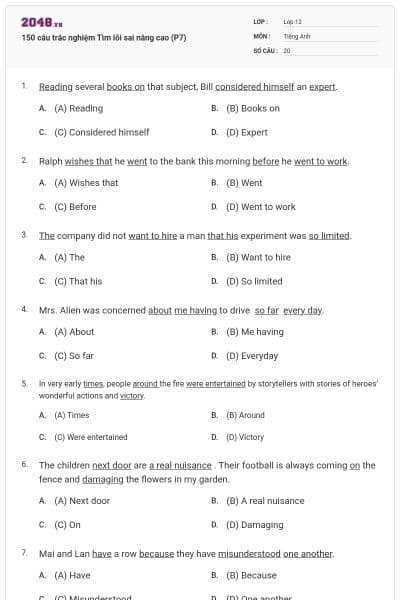
Reading several books on that subject, Bill considered himself an expert.
(A) Reading
(B) Books on
(C) Considered himself
(D) Expert
Đáp án A => having read
Ta thấy động từ vế sau ở thời quá khứ “Bill tự coi mình là một chuyên gia”, nên việc đọc sách đã xảy ra trước đó, cần chia ở dạng having PII để diễn tả sự lệch thời
Ralph wishes that he went to the bank this morning before he went to work.
(A) Wishes that
(B) Went
(C) Before
(D) Went to work
Đáp án B => had been
cấu trúc câu ước quá khứ với wish: S wish(es) + (that) + S + V(qkht)
The company did not want to hire a man that his experiment was so limited.
(A) The
(B) Want to hire
(C) That his
(D) So limited
Đáp án C => whose
mệnh đề quan hệ sở hữu whose. Ta không dùng that hay which + tính từ sở hữu trước danh từ mà phải dùng whose
Mrs. Alien was concerned about me having to drive so far every day.
(A) About
(B) Me having
(C) So far
(D) Everyday
Đáp án B => my having
Ving được hiểu là một danh động từ, mà trước danh động từ ta cần dùng tính từ sở hữu.
In very early times, people around the fire were entertained by storytellers with stories of heroes’ wonderful actions and victory.
(A) Times
(B) Around
(C) Were entertained
(D) Victory
Đáp án: D
Giải thích:
danh từ "actions" ở dạng số nhiều, nhưng "victory" lại ở dạng số ít, làm cho cấu trúc trở nên không cân đối.
Sửa: victory → victories
Dịch: Vào thời kỳ rất sớm, những người xung quanh đống lửa được giải trí bởi những người kể chuyện với những câu chuyện về những hành động tuyệt vời và những chiến thắng của các anh hùng.
The children next door are a real nuisance . Their football is always coming on the fence and damaging the flowers in my garden.
(A) Next door
(B) A real nuisance
(C) On
(D) Damaging
Đáp án C => over
on nghĩa là “ở trên”, là giới từ chỉ vị trí tĩnh, không đi với come. Ở đây quả bóng bay qua hàng rào, nên giới từ over là phù hợp.
Mai and Lan have a row because they have misunderstood one another.
(A) Have
(B) Because
(C) Misunderstood
(D) One another
Đáp án D => each other
each other: lẫn nhau (trong số 2 người/ vật)
One another: lẫn nhau (trong số nhiều người)

Học thông minh hơn mỗi ngày
Xem toàn bộ 20 câu hỏi và nhiều hơn nữa với tài khoản miễn phí
The workers are building a new bridge which is 150 meters in high.
(A) Building
(B) A new bridge
(C) Which
(D) High
Đáp án D => height
sau giới từ là danh từ
cách nói chiều cao: S + be + chiều cao + high/ in height
When you are writing or speaking English it is important to use language that includes both men and women equally the same.
(A) Are
(B) To use
(C) Both
(D) Equally the same
Đáp án D => equally
Vì equally và the same có cùng trường nghĩa (equally: một cách công bằng, ngang hàng – the same: giống nhau), nên ta không sử dụng cả 2 từ trong cùng một câu.
The Oxford English Dictionary is well known for including many different meanings of words and to give real examples.
(A) Well known
(B) Many
(C) Meaning of words
(D) To give
Đáp án D => giving
Cấu trúc song song, hai động từ “including” và “giving” cùng đi sau giới từ “for” nên to give phải được chuyển về dạng Ving
A novel is a story long enough to fill a complete book, in that the characters and events are usually imaginary.
(A) Is
(B) Long enough
(C) In that
(D) Imaginary
Đáp án C => in which
Trong mệnh đề quan hệ, giới từ không đi với that
The student must have her assessment form fill in by the examiner during the oral exam.
(A) The student
(B) Fill in
(C) The
(D) Oral exam
Đáp án B => filled in
cấu trúc bị động đặc biệt sb have st done: để cho cái gì được làm gì
When precipitation occurs, some of it evaporates, some runs off the surface it strikes, and some sinking into the ground.
(A) When
(B) It
(C) Runs off
(D) Sinking
Đáp án D => sinks
Cấu trúc song song, 2 vế trước động từ đều chia ở dạng thức thời hiện tại đơn nên sinking phải được chuyển thành sinks
Of all the art-related reference and research library in North America, that of the Metropolitan Museum of Art in New York City is among the largest and most complete.
(A) Of all
(B) Reference and research
(C) Library
(D) That of
Đáp án C => libraries
Cấu trúc sau “of all” là danh từ số nhiều, nghĩa: trong số tất cả
A warning printed on a makeshift lifebuoy says: “This is not a life-saving device. Children should be accompany by their parents.”
(A) Printed
(B) Makeshift lifebuoy
(C) Device
(D) Accompany
Đáp án D => accompanied
Cấu trúc câu bị động Be + PII + be sb/st
I like the fresh air and green trees of the village which I spent my vacation last year.
(A) I like
(B) Which
(C) Spent
(D) Last
Đáp án B => where/ in which
Mệnh đề quan hệ chỉ nơi chốn. Ta thấy which thường thay cho danh từ chỉ vật làm chủ ngữ hoặc tân ngữ trong câu, ở đây vế sau đã đầy đủ chủ-vị nên ta cần một trạng ngữ.
Some people often say that using cars is not as convenient than using motorbikes.
(A) Some
(B) Say
(C) Than
(D) Is
Đáp án C => as
cấu trúc so sánh bằng: Be as adj as N
It was not until the end of prehistoric times that the first wheeled vehicles appearing.
(A) It was
(B) Prehistoric
(C) wheeled vehicles
(D) Appearing
Đáp án D => appeared
Cấu trúc it + be + not until + thời gian + that + mệnh đề: không...cho đến tận khi...
In the early 1900's, Pennsylvania's industries grew rapidly, a growth sometimes accompanied by disputes labor.
(A)The early 1900’s
(B) Industries
(C) Accompanied by
(D) Labor
Đáp án C => was accompanied by
Đây là câu bị động thời quá khứ đơn, cấu trúc S + be(was/were) PII + by sb/st
Looking from afar, the village resembles a small green spot dotted with tiny fireballs.
(A) Looking
(B) The village
(C) Dotted
(D) Fireballs
Đáp án A => looked
Cụm hiện tại phân từ thuộc về chủ ngữ “the village”, ngôi làng được nhìn thấy chứ không thể tự nhìn, nên câu cần phân từ bị động
Bạn có thích hoạt động này không?
Ý kiến của bạn sẽ giúp chúng tôi đề xuất nội dung phù hợp hơn.
Gợi ý cho bạn
![[Năm 2022] Đề thi thử môn Vật lí THPT Quốc gia có lời giải - Đề số 21](/_next/image?url=https%3A%2F%2Fvideo.vietjack.com%2Fupload%2Fimages%2Fvj-image%2Fimage-3izficdefgfoel0s9j8s-1786772791.jpg&w=3840&q=75)
![[Năm 2022] Đề thi thử môn Vật lí THPT Quốc gia có lời giải - Đề số 20](/_next/image?url=https%3A%2F%2Fvideo.vietjack.com%2Fupload%2Fimages%2Fvj-image%2Fimage-emy0gtcksawvorajezvv-1786772460.jpg&w=3840&q=75)
Tài liệu phổ biến Lớp 12
Tài liệu phổ biến Tiếng Anh