1400 câu trắc nghiệm Đọc hiểu Tiếng Anh có đáp án - Phần 28
29 câu hỏi
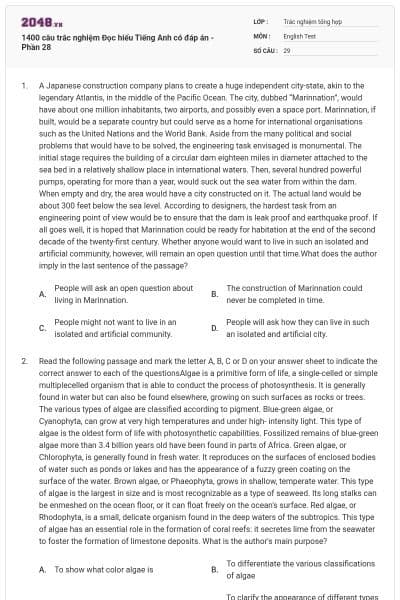
A Japanese construction company plans to create a huge independent city-state, akin to the legendary Atlantis, in the middle of the Pacific Ocean. The city, dubbed “Marinnation”, would have about one million inhabitants, two airports, and possibly even a space port. Marinnation, if built, would be a separate country but could serve as a home for international organisations such as the United Nations and the World Bank. Aside from the many political and social problems that would have to be solved, the engineering task envisaged is monumental. The initial stage requires the building of a circular dam eighteen miles in diameter attached to the sea bed in a relatively shallow place in international waters. Then, several hundred powerful pumps, operating for more than a year, would suck out the sea water from within the dam. When empty and dry, the area would have a city constructed on it. The actual land would be about 300 feet below the sea level. According to designers, the hardest task from an engineering point of view would be to ensure that the dam is leak proof and earthquake proof. If all goes well, it is hoped that Marinnation could be ready for habitation at the end of the second decade of the twenty-first century. Whether anyone would want to live in such an isolated and artificial community, however, will remain an open question until that time.What does the author imply in the last sentence of the passage?
People will ask an open question about living in Marinnation.
The construction of Marinnation could never be completed in time.
People might not want to live in an isolated and artificial community.
People will ask how they can live in such an isolated and artificial city.
Đáp án C
Tác giả đặt câu hỏi về việc liệu người ta có muốn sống trong một cộng đồng cách biệt và nhân tạo như thế không.
Read the following passage and mark the letter A, B, C or D on your answer sheet to indicate the correct answer to each of the questionsAlgae is a primitive form of life, a single-celled or simple multiplecelled organism that is able to conduct the process of photosynthesis. It is generally found in water but can also be found elsewhere, growing on such surfaces as rocks or trees. The various types of algae are classified according to pigment. Blue-green algae, or Cyanophyta, can grow at very high temperatures and under high- intensity light. This type of algae is the oldest form of life with photosynthetic capabilities. Fossilized remains of blue-green algae more than 3.4 billion years old have been found in parts of Africa. Green algae, or Chlorophyta, is generally found in fresh water. It reproduces on the surfaces of enclosed bodies of water such as ponds or lakes and has the appearance of a fuzzy green coating on the surface of the water. Brown algae, or Phaeophyta, grows in shallow, temperate water. This type of algae is the largest in size and is most recognizable as a type of seaweed. Its long stalks can be enmeshed on the ocean floor, or it can float freely on the ocean's surface. Red algae, or Rhodophyta, is a small, delicate organism found in the deep waters of the subtropics. This type of algae has an essential role in the formation of coral reefs: it secretes lime from the seawater to foster the formation of limestone deposits. What is the author's main purpose?
To show what color algae is
To differentiate the various classifications of algae
To describe where algae is found
To clarify the appearance of different types of algae
Đáp án B
Dụng ý chính của tác giả khi viết bài này là To differentiate the various classifications of algae (phân biệt các cách phân loại khác nhau của các loại tảo) theo màu sắc của chúng: Blue-green, green, brown, red algae
Which of the following is NOT true about algae?
All types have one cell only.
It can be found out of water.
It can use photosynthesis.
It is not a relatively new form of life.
Đáp án A
Thông tin ở câu đầu tiên của đoạn đầu tiên: Algae is a primitive form of life, a single-celled or simple multiple-celled organism (Tảo là một hình thức sinh vật sống sơ khai, là một sinh vật đơn bào hoặc đa bào đơn giản)
The word "pigment" at the end of the first paragraph means ...........
size
shape
composition
color
Đáp án D
“pigment” = “color”: màu sắc
Algae remnants found in Africa are ..............
still flourishing
photogenic
extremely old
red in color
Đáp án C
Thông tin ở câu cuối của đoạn 2: Fossilized remains of blue-green algae more than 3.4 billion years old have been found in parts of Africa. (Nhiều hóa thạch của loài tảo lam lục hơn 3,4 tỷ năm tuổi đã được tìm thấy trong một số khu vực của châu Phi.)
Green algae is generally found .............
on the ocean floor
on top of the water
throughout ponds and lakes
surrounding enclosed bodies of water
Đáp án B
Thông tin ở câu thứ 2 của đoạn thứ 3: It reproduces on the surfaces of enclosed bodies of water (Nó tái tạo trên bề mặt của bộ phận bao bọc nước)
Brown algae would most likely be found ...........
on trees
near green algae
on rocks
in the ocean
Đáp án D
Thông tin ở câu cuối của đoạn 4: Its long stalks can be enmeshed on the ocean floor, or it can float freely on the ocean’s surface. (thân dài của nó có thể vướng vào đáy đại dương, hoặc nó có thể trôi nổi tự do trên bề mặt của đại dương.) → tảo nâu hầu như được tìm thấy ở đại dương
According to the passage, red algae is ..............
sturdy
huge
fragile
found in shallow water
Đáp án C
Thông tin ở câu đầu cảu đoạn cuối: Red algae, or Rhodophyta, is a small, delicate organism (tảo đỏ là sinh vật nhỏ, mỏng manh)
It can be inferred from the passage that limestone deposits serve as the basis of .................
coral reefs
red algae
subtropical seawater
secret passages
Đáp án A
Thông tin ở câu cuối của bài: This type of algae has an essential role in the formation of coral reefs: it secretes lime from the seawater to foster the formation of limestone deposits.
Read the following passage and mark the letter A, B, C or D on your answer sheet to indicate the correct answer to each of the questionsThe Hindu culture celebrates marriage as a pure and pristine rite enabling two individuals start their journey of life together. It puts emphasis on the values of happiness, harmony and growth and could be traced back from the Vedic times. Months before the wedding ceremony, an engagement is held which is called “magni”. The couple is blessed here with gifts, jewelry and clothes. Another important ritual is the “mehendi” which is a paste made from the leaves of henna plant. It is the traditional art of adorning the hands and the feet of the bride with mehendi and the name of the groom is also hidden in the design. On the day of marriage, the couple exchanges garlands as a gesture of acceptance of one another and a pledge to respect one another as partners which is known as «jaimala». This is followed by «jaimala», where the father of the bride places her hand in the groom’s hand requesting him to accept her as an equal partner. Another ritual is the «havan» in which the couple invokes Agni, the god of Fire, to witness their commitment to each other. Crushed sandalwood, herbs, sugar rice and oil are offered to the ceremonial fire. The “gath bandhan” takes place where scarves of the bride and groom are tied together symbolizing their eternal bond. This signifies their pledge before God to love each other and remain loyal. The couple then takes four “mangal pheras” or walk around the ceremonial fire, representing four goals in life: “Dharma”, religious and moral duties; “Artha”, prosperity; “Kama” earthly pleasures; “Moksha”, spiritual salvation. The couple also takes seven steps together to begin their journey, called the “saptapardi”. Then the ritual of “sindoor” takes place where the groom applies a small dot of vermilion, a red powder to the bride’s forehead and welcomes her as his partner for life. This signifies the completion of the marriage. The parents of the bride and the groom then give their blessings, “ashirwad” to the newly wed couple as they touch the feet of their parents. What might be the most suitable title for this reading passage?
The Hindu culture
The Hindu religion
The Hindu wedding
The Hindu tradition
Đáp án C
Tiêu đề thích hợp cho bài đọc này là gì?
A. Văn hóa Hindu
B. Tôn giáo Hindu
C. Đám cưới Hindu
D. Truyền thống Hindu
Đọc từ đấu bài đến cuối, chúng ta thấy rằng bài đọc này nói về phong tục đám cưới Hindu (marriage, couple, engagement, bride, groom, etc.)
What does the word “magni” stand for?
the wedding
the paste made from the leave of one another
the engagement
the gesture of acceptance oi one another
Đáp án C
Dẫn chứng ở dòng đầu tiên trong đoạn thứ 2: “Months before the wedding ceremony, an engagement is held which is called “magni”. (Những tháng trước lễ cưới, một lễ đính hôn được tổ chức, cái mà được gọi là “magni”Từ “magni” ở đây là “engagement”.
What do the Hindu people think about marriage?
It is entirely a spiritual traditional ritual allowing two individuals to live together
It is a belief in the growth of a family newly formed by two individuals
It is a wish of happiness and harmony to come to two individuals
It is just a living-together announcement of two individuals
Đáp án A
Dẫn chứng ở những dòng đầu tiên trong đoạn 1: “The Hindu cultural cclehrules marriage as a pure and pristine rite enabling two individuals start their journey of life together. It puts emphasis on the values of happiness, harmony and growth and could be traced back from the Vedic times.”
What can the word adorning be best replaced by?
decorating
painting
repairing
dying
Đáp án A
Adorn /ə'dɔ:n/ - decorate (v): trang điểm E.g: the house is being adorned with
flowers.
Paint (v); sơn, vẽ
Repair tv): sửa
Dye tv): nhuộm
“It is the traditional art of adorning the hands and the feet of the bride with mehendi” (Đó là nghệ thuật truyền thống trang điểm mehendi trên tay và chân của cô dâu)
What can the word invokes be best replaced by?
tells
says
prays
talks
Đáp án C
Invoke /in'vəuk/ ~ Pray: khấn, cầu nguyện
Tell (v): bảo, kể
Say (v): nói
Talk (v): nói, nói chuyện
“Another ritual is the “havan” in which the couple invokes Agni, the god of Fire, to witness their commitment to each other” (Một nghi lễ khác là “havan”, nghi lễ mà cặp đôi khấn vái thần Agni, thần lửa, để làm chứng cho sự cam kết của họ với nhau.)
Why does the couple exchange garlands?
to do a ritual
to show both their acceptance of and the swear to respect the partner
to express their acceptance of one another and a wish of happiness
to express their vow to respect each other for the whole life
Đáp án B
Dẫn chứng ở dòng đầu tiên trong đoạn 3: “On the day of marriage, the couple exchanges garlands as ạ gesture of acceptance of one another and a pledge to respect one another as partners which is known as “jaimala”.
When is the wedding ceremony completed?
When the parents ot the bride and the groom give their blessings to the couple
When the couple touches their parents’ feet
When the couple makes seven steps together
When the groom applies a small dot of vermillion of the brides forehead
Đáp án D
Dẫn chứng trong đoạn cuối: “Then the ritual of “sindoor” takes place where the groom applies a small dot ot vermilion, a red powder to the brides forehead and welcomes her as his partner for life. This signifies the completion of the marriage.”
What does “they” refer to?
people
ages
sticks
trees
Đáp án C
Dẫn chứng trong bài đọc: “ We do not know exactly when or how people first used fire. Perhaps, many ages ago, they found that sticks would burn if they were dropped into some hole ...” (Chúng ta không biết chính xác lúc nào hay bằng cách nào mà con người sử dụng lửa. Có lẽ, cách đây rất lâu, họ phát hiện ra que củi sẽ cháy nếu chúng rơi vào hố mà...)
Vậy: they = sticks
According to the passage the first fire used by people was probably obtained ..........
from the suns heat through glass
by rubbing wood together
from heat or fire caused by nature
by striking iron against flint
Đáp án C Dẫn chứng trong đoạn 2:
“Perhaps, many ages ago, they found that sticks would burn if they were dropped into some hole where melted lava from a volcano lay boiling. They brought the lighted sticks back to make their fire in a cave. Or, they may have seen trees catch fire through being struck by lightning, and used the trees to start their own fires.”
Điều này có nghĩa là từ thời xưa con người tạo ra lửa nhờ vào tự nhiên.
It is stated in the passage that torches for lighting were made from ................
the wood of gum trees
iron bars dipped in melted resins
wooden poles dipped in oil
tree branches dipped in melted resins
Đáp án D
Dẫn chứng ở đoạn 4: “When people became used to making fires with which to cook food and stay warm at night, they found that certain resins or gums from trees burnt longer and brighter. They melted resins and dipped branches in the liquid to make torches that lit their homes at night.” (Khi con người đã quen với việc tạo ra lửa để nấu ăn và sưởi ấm vào ban đêm thì họ phát hiện ra nhựa cây đốt cháy được lâu hơn và sáng hơn, Họ làm tan chảy nhựa cây và nhúng cành cây trong chất lỏng để làm ngọn đuốc thắp sáng nhà vào ban đêm)
It is mentioned in the passage that before the electric lamp was invented, ...........
oil lamps and then candles were used
candles and oil lamps appeared about the same time
candles and then oil lamps were used
people did not use any form of lighting in their houses
Đáp án C
Dẫn chứng ở đoạn cuối: “For centuries homes were lit by candles until oil was found. Even then, oil lamps were no more effective than a cluster of candles.”
The word “splendors” in the passage could be best replaced by which of the following?
expensive object
places of scenic beauty
achievements
the beautiful and impressive features
Đáp án D
“We read about the splendors and marvels of ancient palaces and castles, but we forget that they must have been gloomy and murky places at night.”
(Chúng ta biết được về những vật lộng lẫy của cung điện và lâu đài, nhưng quên rằng đó chắc hẳn là những nơi tối tăm và ảm đạm vào ban đêm.)
Phía sau từ “but” có những từ như “gloomy, murky” (tối tăm, ảm đảm) nên phía trước phải có nghĩa trái ngược.
Vậy: splendors = the beautiful and impressive features: vật rực rỡ, lộng lẫy
According to the passage, which of the following sentence is NOT true?
We know exactly when and how people first used fire
Before gas lamps and electric lamps appeared, streets were lit by torches
We can make a fire by striking a piece of iron on flint to ignite some tinder
Matches and lighters were invented not long ago
Đáp án A
B. đúng theo Dẫn chứng trong bài dọc: “There was no lighting in city streets until gas lamps, and then electric lamps were installed. Boys ran about London at night carrying torches of burning material.”
C. đúng theo Dẫn chứng trong bà đọc: “To make fire, it was necessary to strike a piece of iron on flint for sparks to ignite some tinder”
D. đúng theo Dẫn chứng trong bài đọc: “But it was not long ago that there were no such things as matches or lighters”
A. không đúng theo Dẫn chứng trong bài đọc: “We do not know exactly when or how people first used fire.
The word “gloomy” in the passage is closest in meaning to .............
nearly dark
badly decorated
containing a lot of white
mysterious
Đáp án AThông tin trong bài đọc: “We read about the splendors and marvels of ancient
palaces and castles, but we forget that they must have been gloomy and murky places at night.” (Chúng ta biết được về những vật lộng lẫy của cung
điện và lâu đài, nhưng quên rằng đó chắc hẳn là những nơi tối tăm và ảm đạm vào ban đêm.)
Vậy gloomy” ~ nearly dark
What form of street lighting was used in London when link boys used to work there?
Gas lighting
No lighting at all
Electric lighting
Oil lighting
Đáp án B
Dẫn chứng trong bài đọc: “There was no lighting in city streets until gas lamps, and then electric lamps were installed. Boys ran about London at night carrying torches of burning material.” (Không có điện trên đường phố cho đến khi có sự ra đời của đèn gas, đèn điện. Các cậu bé chạy khắp thành phố Luân Đôn vào ban đêm mang theo những bó đuốc từ việc đốt cháy các vật liệu)
Read the following passage and mark the letter A, B, C or D on your answer sheet to indicate the correct answer to each of the questionsThe rules of etiquette in American restaurants depend upon a number of factors the physical location of the restaurant, e.g., rural or urban; the type of restaurant, e.g., informal or formal; and certain standards that are more universal. In other words, some standards of etiquette vary significantly while other standards apply almost anywhere. Learning the proper etiquette in a particular type of restaurant in a particular area may sometimes require instruction, but more commonly it simply requires sensitivity and experience. For example, while it is acceptable to read a magazine in a coffee shop, it is inappropriate to do the same in a more luxurious setting. And, if you are eating in a very rustic setting, it may be fine to tuck your napkin into your shirt, but if you are in a sophisticated urban restaurant this behavior would demonstrate a lack of manners. It is safe to say, however, that in virtually every restaurant it is unacceptable to indiscriminately throw your food on the floor. The conclusion we can most likely draw from the above is that while the types and locations of restaurants determine etiquette appropriate to them, some rules apply to all restaurants. What topic is this passage primarily concerned?
Instruction in proper etiquette
Rules of etiquette
Variable and universal standards of etiquette
The importance of good manners
Đáp án C
Dẫn chứng trong bài đọc: The rules of etiquette in American restaurants depend upon a number of factors the physical location of the restaurant, e.g., rural or urban; the type of restaurant, e.g., informal or formal; and certain standards that are more universal.
According to the passage, which of the following is a universal rule of etiquette?
reading a magazine at a coffee shop
not throwing food on the floor
eating in rustic settings
Đáp án B
Dẫn chứng trong bài đọc: “It is safe to say, however, that in virtually every restaurant it is unacceptable to indiscriminately throw your food on the floor” => quy tắc chung ở hầu hết các nhà hàng là không được vứt thức ăn lên sàn nhà.
What does the word “it” refer to?
learning the proper etiquette
clear instruction
knowing the type of restaurant
sensitivity
Đáp án A
Dẫn chứng trong bài đọc: “Learning the proper etiquette in a particular type of restaurant in a particular area may sometimes require instruction, but more commonly it simply requires sensitivity and experience” =>Học phép xã giao thích hợp.
Which of the following words is most similar to the meaning of “rustic”?
urban
unsophisticated
agricultural
ancient
Đáp án B
Rustic ~ Unsophisticated (adj); đơn giản, không phức tạp, mộc mạc
Urban (adj): (thuộc) thành phố, thành thị
Agricultural (adj): (thuộc) nông nghiệp
Ancient (adj): cổ xưa
“And, if you are eating in a very rustic setting, it may be fine to tuck your napkin into your shirt but if you are in a sophisticated urban restaurant this behavior would demonstrate a lack of manners.” (Và nếu bạn đang ăn ở một nơi đơn giản mộc mạc thì việc bỏ khăn ăn vào áo có thể chấp nhận được, nhưng nếu bạn đang ở một nhà hàng thành thị phức tạp thì hành vi này sẽ thể hiện bạn không biết cách ứng xử)
Nhận xét: Ở phía sau có liên từ “but” nên ý cùa 2 câu này trái ngược nhau; mà phía sau có từ “sophisticated” thì phía trước từ “rustic” sẽ có nghĩa trái ngược với nó
Which of the following is closest in meaning to the word “tuck”?
set
put
fold
hold
Đáp án B
Tuck /tʌk/ ~ Put: đặt, để, bỏ
“And, if you are eating in a very rustic setting, it may be fine to tuck your napkin into your shirt” (Và nếu bạn đang ăn ỏ một nơi đơn giản mộc mạc thì việc bỏ khăn ăn vào áo có thể chấp nhận được.