Trắc nghiệm tổng hợp Tiếng anh có đáp án 2023 ( Phần 65)
117 câu hỏi
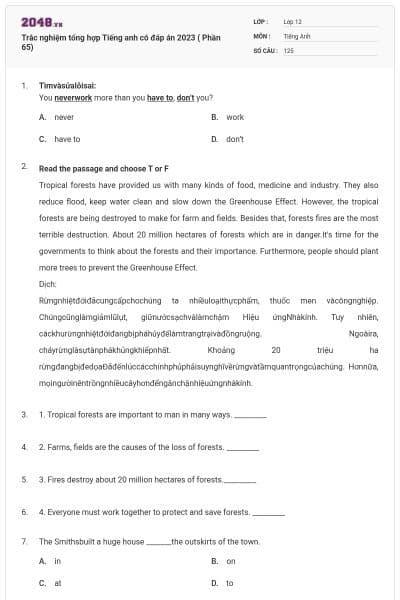
Tìmvàsửalỗisai:
You neverwork more than you have to, don’t you?
never
work
have to
don’t
Đápán: D
Giảithích:
- Đối với câu hỏi đuôi, khi mệnh đề chính khẳng định thì phần đuôi phủ định và ngược lại. Tuy nhiên nếu mệnh đề chính chứa các từ mang tính phủ định như “rarely, seldom, never, hardly,...” thì mệnh đề chính được coi là phủ định => phần đuôi khẳng định
- Cấu trúc phần đuôi: trợ động từ (not) + S
- Mệnhđềchínhchứatừphủđịnh “never” => phầnđuôiphải ở dạngkhẳngđịnh => sửa “don’t” thành “do”
Dịch: Bạnkhông bao giờlàmviệcnhiềuhơnmứccầnthiết, phảikhông?
Read the passage and choose T or F
Tropical forests have provided us with many kinds of food, medicine and industry. They also reduce flood, keep water clean and slow down the Greenhouse Effect. However, the tropical forests are being destroyed to make for farm and fields. Besides that, forests fires are the most terrible destruction. About 20 million hectares of forests which are in danger.It's time for the governments to think about the forests and their importance. Furthermore, people should plant more trees to prevent the Greenhouse Effect.
Dịch:
Rừngnhiệtđớiđãcungcấpchochúng ta nhiềuloạithựcphẩm, thuốc men vàcôngnghiệp. Chúngcũnglàmgiảmlũlụt, giữnướcsạchvàlàmchậm Hiệu ứngNhàkính. Tuy nhiên, cáckhurừngnhiệtđớiđangbịpháhủyđểlàmtrangtrạivàđồngruộng. Ngoàira, cháyrừnglàsựtànphákhủngkhiếpnhất. Khoảng 20 triệu ha rừngđangbịđedọaĐãđếnlúccácchínhphủphảisuynghĩvềrừngvàtầmquantrọngcủachúng. Hơnnữa, mọingườinêntrồngnhiềucâyhơnđểngănchặnhiệuứngnhàkính.
4. Everyone must work together to protect and save forests. _________
The Smithsbuilt a huge house _______the outskirts of the town.
in
on
at
to
Đápán: B
Giảithích: on the outskirts: vùngngoại ô
Dịch: Gia đình Smith đãxâymộtngôinhàkhổnglồ ở ngoại ô thịtrấn.
My boyfriend is very short-tempered.
=> My boyfriend loses _________________.
Đápán: My boyfriend loses his temper very easily.
Giảithích: lose one’s temper = short-tempered: mấtbìnhtĩnh
Dịch: Bạntraitôirấtdễmấtbìnhtĩnh.
ìmvàsửalỗisai:
A lot of cultural and artist activities are held in DalatFlower Festival.
cultural
artist
held
Festival
Đápán: B
Giảithích: trướcdanhtừ “activities” cần 1 tínhtừbổnghĩa => sửa “artist” thành “’artistic”
Dịch: Rấtnhiềuhoạtđộngvănhóa, nghệthuậtđượctổchứctại Festival Hoa ĐàLạt.
Ann had a lot of trouble because she lost her passport last week.
If Ann had lost her passport last week, she would have had a lot of trouble.
If Ann didn't lose her passport last week, she wouldn’t have a lot of trouble.
If Ann hadn’t lost her passport last week, she wouldn’t have had a lot of trouble.
If Ann lost her passport last week, she would have a lot of trouble.
Đápán: C
Giảithích: Câuđiềukiệnloại 3: If + S + had (not) + Vp2, S + would/could (not) + have + Vp2: đượcsửdụngkhingườinóitưởngtượngkếtquảcủamộttìnhhuốngkhôngcóthậttrongquákhứ
Dịch: Nếu Ann khôngbịmấthộchiếuvàotuầntrướcthìcôấyđãkhônggặpnhiềurắcrối.
“Are there some oranges in the fridge?” She asked her mom
=> She asked her mom ___________________________________.
Đápán: She asked her mom if there were some oranges in the fridge.
Giảithích:
-Câu gián tiếp dạng yes/no question: S + asked(+O)/ wondered + if/whether + S + V(lùi thì)
+ Câutrựctiếphiệntạiđơn -> câugiántiếpquákhứđơn
Dịch: Côhỏimẹtrongtủlạnhcó cam không.
Ba asked Tam “How often do you wash your clothes?”
=> Ba asked Tam ___________________________________.
Đápán:
Giảithích: Ba asked Tam how often she washed her clothes.
- CấutrúccâugiántiếpdạngcâuhỏiWh-question:
S + asked(+O)/wanted to know/wondered + Wh-words + S + V(lùithì)
- Câutrựctiếp ở hiệntạiđơn -> câugiántiếpquákhứđơn
Dịch: Ba hỏi Tâm côcóthườngxuyêngiặtquầnáokhông.
_________Celia was driving to the airport, she realised that she had left her passport at home.
Before
As
During
After
Đápán: B
Giảithích:
A. Trướckhi
B. Khi
C. Trong suốtkhoảngthờigian
D. Saukhi
Dịch: Khi Celia đangláixeđếnsân bay, cônhậnrarằngmìnhđãđểquênhộchiếu ở nhà.
Tìm từ có trọng âm khác với những từ còn lại
crocodile
corridor
enormous
northerly
Đápán: C
Giảithích: Đápán C trọngâmrơivàoâmtiếtthứ 2, cácđápáncònlạitrọngâmrơivàoâmtiếtthứ 1
Dịch:
A.cásấu
B. hành lang
C. to lớn
D. hướngbắc
Đápán: Darkness
Giảithích: Chỗtrốngcần 1 danhtừđếmđượcsốíthoặcdanhtừkhôngđếmđượclàmchủngữvìđộngtừ “covers” được chia ở sốít => Darkness: bóngtối
Dịch: Bóngtối bao trùmbầutrờivào ban đêm.
Do you want to get up by yourself, or would you like me wakeup you?
Do you want
get up
would you like
wake
Đápán: D
Giảithích:
- Cấutrúc: Would you like + to + V-inf?:đượcdùngkhingườinóimuốnđưaralờimờihoặcđềnghị ai làmviệcgìđó
=> sửa “wake” thành “to wake”
Dịch: Bạnmuốntựmìnhđứngdậy hay muốntôiđánhthứcbạn?
Read the passage and choose the best answer.
Father's Day was created to complement Mother’s Day. Like Mother's Day (1) ______ honors mothers and motherhood, Father's Day celebrates fatherhood and paternal bonds; it highlights the (2) ______ of fathers in society. Many countries celebrate it on the third Sunday of June, but it is also celebrated widely on other days. Historically, Sonora Smart Dodd was the woman behind the celebration of male parenting. Her father, the Civil War veteran William Jackson Smart, was a single parent who (3) ______ his six children there. After hearing a sermon about Jarvis' Mother's Day in 1909, she told her pastor that fathers should have a similar holiday honoring them. Although she initially suggested June 5, her father's birthday, the pastors did not have enough time to prepare their sermons, and the celebration was deferred to the third Sunday of June. The first celebration was in Spokane, Washington at the YMCA (Young Men's Christian Association) on June 19,1910. Since then it has become a traditional day (4) ______ year.
In recognition of what fathers do for their families, on this day people may have a party celebrating male parenting or simply make a phone call or send a greeting card.(5) ______, schools help children prepare handmade gifts for their fathers many days before the celebration.
Dịch:
Ngàycủa Cha đượctạorađểbổ sung choNgàycủaMẹ. GiốngnhưNgàycủaMẹtônvinhtìnhmẹvàtìnhmẫutử, Ngàycủa Cha tônvinhtìnhphụtửvàtình cha con; nónêubậtảnhhưởngcủanhữngngười cha trongxãhội. NhiềuquốcgiakỷniệmngàynàyvàoChủnhậtthứbacủathángSáu, nhưngnócũngđượctổchứcrộngrãivàonhữngngàykhác. Trong lịchsử, Sonora Smart Dodd làngườiphụnữđứngsauviệctônvinhviệcnuôidạy con cáicủanamgiới. Cha củacô, cựuchiếnbinhNộichiến William Jackson Smart, làmộtôngbốbàmẹđơnthânđãnuôisáuđứa con củamình ở đó. Sau khinghebàigiảngvềNgàycủaMẹcủa Jarvis vàonăm 1909, cônói
which
when
who
where
conquest
result
influence
consequence
2.
A. conquest (n): sựchinhphục
B. result (n): kếtquả
C. influence (n): sựảnhhưởng
D. consequence (n): hậuquả
=> Dựatheonghĩacủacâuchọnđápán C
raised
realized
took
made
3.
A. raised (v): nuôidạy
B. realized (v): nhậnra
C. took (v): thựchiện
D. made (v): làm
=> Dựatheonghĩacủacâuchọnđápán A
another
other
any
every
Besides
In contrast
However
Then
A. Besides: Ngoàira
B. In contrast: Ngượclại
C. However: Tuy nhiên
D. Then: Sau đó
=> Dựatheonghĩacủacâuchọnđápán A
He's still ________dependent on his parents; he regularly receives money to live from them.
finance
financial
financially
financier
Đápán: C
Giảithích: trướctínhtừcần 1 độngtừbổnghĩa => chọn “financially”: tàichính
Dịch: Anh ấyvẫnphụthuộctàichínhvào cha mẹmình; anh ta thườngxuyênnhậntiềnđểsốngtừhọ.
Viếtlạicâusửdụngđạitừquanhệ:
Her book was published last year. It became a best seller.
=> ________________________________________________.
Đápán: Her book which became a best seller was published last year.
Giảithích: Đạitừquanhệ “which” thaythếchodanhtừchỉvật “Her book”’ trướcnó
Dịch: Quyểnsáchbánchạycủacôấyđượcxuấtbảntừnămngoái.
Here’s the house where I lived as a child. (in)
=> ____________________________________.
Đápán: Here’s the house in which I lived as a child.
Giảithích: where = in which: đượcdùngđểthaythếchodanhtừchỉnơichốn “the house” trướcnó
Dịch: Đâylàngôinhànơitôiđãsốngkhicònnhỏ.
His brother told him “You can use my computer today.”
=> _______________________________________________.
Đápán: His brother told him that he could use his computer that day.
Giảithích:
-Câugiántiếpdạngcâukể: S + told + O + (that) + S + V(lùithì)
+Lùithì: can -> could
+Đổingôi: you -> he
+Đổitínhtừsởhữu: my -> his
+ Trạngtừ: today -> that day
Dịch: Anh traianhấynóivớianhấyrằnganhấycóthểsửdụngmáytínhvàongàyhômđó.
His teachers don't like him.His friends also don't like him. (Neither)
=> _________________________________________________.
Đápán: Neither his teacher nor his friends like him.
Giảithích: Cấutrúc “Neither … nor”: Neither + N1 + nor + N2 + V(chia theo N2)
Dịch:Cảgiáoviênlẫnbạnbèđềukhôngthíchanhấy.
“How much does this dress cost?” Lan asked Lien.
=> __________________________________________.
Đápán: Lan asked Lien how much that dress cost.
Giảithích:
- CấutrúccâugiántiếpdạngcâuhỏiWh-question:
S + asked(+O)/wanted to know/wondered + Wh-words + S + V(lùithì)
- Câutrựctiếp ở hiệntạiđơn -> câugiántiếpquákhứđơn
Dịch: Lan hỏi Liên chiếcváyđógiá bao nhiêu.
Tìmvàsửalỗisai:
“I am not going to tolerate this anymore”, said Sarah.
=> Sarah said she was not going to tolerate this anymore.
said
was
going
this
Đápán: D
Giảithích: Khi chuyển sang câutrựctiếpphảiđổiđạitừchỉđịnh “this”=> sửa “this” thành “that”
Dịch: Sarah chobiếtcôsẽkhôngchịuđựngđượcđiềunàynữa.
ìmvàsửalỗisai:
I'musuallyright about the weather, amn't I?
usually
right
the
amn’t
Đápán: D
Giảithích:
- Đối với câu hỏi đuôi, khi mệnh đề chính khẳng định thì phần đuôi phủ định và ngược lại. Tuy nhiên nếu mệnh đề chính chứa các từ mang tính phủ định như “rarely, seldom, never, hardly,...” thì mệnh đề chính được coi là phủ định => phần đuôi khẳng định
- Cấu trúc phần đuôi: trợ động từ (not) + S
- “I am” ghichuyển sang câuhỏiđuôisẽlà “aren’t I” => sửa “amn’t” thành “aren’t I”
Dịch: Tôithườngđúngvềthờitiếtphảikhông?
I can make myself __________pretty well in English.
understand
to understand
understanding
understood
Đápán: A
Giảithích: make + sb/sth + V-inf: khiếnhoặcbắtbuộc ai đó/điềugìđólàmcáigì
Dịch: Tôicóthểlàmchomìnhhiểukhátốtbằngtiếng Anh.
“I'm sorry I broke the glass” Peter said to Jane.
=> Peter apologized _________________________.
Đápán: Peter apologized to Jane for breaking the glass.
Giảithích: apologize to sb for Ving: xinlỗi ai vìđiềugì
Dịch: Peter xinlỗi Jane vìđãlàmvỡkính.
I'mvery sad that Iwasn't accepted in that group.
=> I'mvery sad not ____________________________.
Đápán: I'mvery sad not to be accepted in that group.
Giảithích:
-S + tobe + adj + (not) + to V-inf: ai đónhưthếnàovìlàm/khônglàmgì
- Ở câugốc, độngtừđang ở dạngbịđộng => chuyểnthành “not to be Vp2”
Dịch: Tôirấtbuồnkhikhôngđượcnhậnvàonhómđó.
I’ve made an appointment at the dentist’s. I ________ her on Tuesday.
see
saw
will see
have seen
Đápán: C
Giảithích: Thìtươnglaiđơn: S + will + V-inf: dùngđểdiễntảmộtquyếtđịnhngaytạithờiđiểmnói
Dịch: Tôiđãđặtlịchhẹn ở nhasĩ. Tôisẽgặpcôấyvàothứ Ba.
It is believed in Brazil that placing a small cup or dish of salt in the corner of your housewill ________you good luck.
take
carry
bring
result
Đápán: C
Giảithích: bring good luck: manglại may mắn
Dịch: Người Brazil tin rằngviệcđặtmộtcốchoặcđĩamuốinhỏ ở gócnhàsẽmanglại may mắnchobạn.
Tìmvàsửalỗisai:
It was an extremelyfrightened experience in my life.
It was
extremely
frightened
in
Đápán: C
Giảithích:
- Khi môtảđặcđiểm, tínhchấtcủangười -> adj-ed
- Khi môtảđặcđiểm, tínhchấtcủasựvật -> adj-ing
- Trong câunàyđangnóiđến “kinhnghiệm” chỉsựvật -> tínhtừphải ở dạng adj-ing => sửa “frightened” thành “frightening”
Dịch: Đólàmộttrảinghiệmcựckỳđángsợtrongcuộcđờitôi.
“Keep away from this area.”The security guardsaid
=> The security guard told __________________________.
Đápán: The security guard toldusto keep away from that area.
Giảithích:
-told sb to V-inf: bảo ai làmgì
- Khi sang câugiántiếpchuyển “this” thành “that”
Dịch: Nhânviênbảovệbảochúngtôitránh xa khuvựcđó.
Keith certainly can't be held responsible for the accident.
=> In no way ______________________________________.
Đápán: In no way can Keith be held responsible for the accident.
Giảithích:
Cấutrúcđảongữvớicụmtừphủđịnh “In no way”: In no way + trợđộngtừ + S + V: khôngcòncáchnào
Dịch: Keith khôngthểnàochịutráchnhiệmvềvụ tai nạnđược.
Nam: “I’m afraid I failed my driving test.” - Chris:“______________”
I’m sorry. I’m late.
Never mind. Better luck next time!
Oh dear. I don’t think I can.
Oh, I think you shouldn’t.
Đápán: B
Giảithích:
A. Tôixinlỗi. Tôitrễ.
B. Đừngbậntâm. Chúc may mắnlầnsau!
C. Ôi chao. Tôikhôngnghĩrằngtôicóthể.
D. Ồ, tôinghĩbạnkhôngnên.
Dịch: Nam:“Tôi e rằngtôiđãtrượtbàikiểmtraláixe.” - Chris:“Đừngbậntâm. Chúc may mắnlầnsau!”
Read the passage and choose the best answer.
Mars has captured the imaginations of people since ancient times. People have long wondered if the planet is home to alien life. Over the years, a number of theories concerning this matter have arisen.
In the nineteenth century, there were finally telescopes made that could closely examine at the surface of the Red Planet. While looking at Mars, an Italian astronomer saw many straight channels on its surface. These were most likely caused by the action of either the wind or water in the distant past. When he published his observations, he used the Italian wordcanali, which means "channels". However, English-speaking astronomers interpreted the word as "canals" and assumed that he was referring to something akin tomanmade canals on Earth.
An American astronomer. Percival Lowell, believed that these "canals" had been built by a race of intelligent beings that had lived - and might still be living - on Mars. The result of that highly publicized claim was that a great number of myths about Mars suddenly arose. For instance, H. G. Wells wrote The War of the Worlds, a book about a Martian invasion of Earth, in 1898. Over the next few decades, Mars and Martians featured in countless science fiction stories, movies, and TV shows.
Years later, in the 1960s and 1970s, the United States sent several satellites to investigate Mars more closely. The satellites found no canals. but one picture suddenly ignited a great deal of interest in Mars. In 1976, Viking 1 took a snapshot of the Martian surface. In the picture was what appeared to be an enormous human face. It was so large that it measured more than three kilometers long. This convinced people that there was - or had been - intelligent life on Mars.
In 2001. however, the mystery of the Martian face was solved by Mars Global Surveyor. The pictures that it transmitted proved that the face was just a mesa, a type of geological formation. As for the "eyes, nose, and mouth" of the face, they were merely shadows. Despite this proof, many people are still convinced that signs of life could be found on Mars someday.
Dịch:
Sao Hỏađãchiếmđượctrítưởngtượngcủa con ngườitừthờicổđại. Mọingườitừlâuđãtựhỏiliệuhànhtinhnàycóphảilànơisinhsốngcủasựsốngngoàihànhtinh hay không. Trong nhữngnăm qua, mộtsốlýthuyếtliênquanđếnvấnđềnàyđãxuấthiện.
Vàothếkỷ 19, cuốicùngđãcónhữngchiếckínhthiênvăncóthểquansátkỹcàngbềmặtHànhtinhĐỏ. Khi quansátsaoHỏa, mộtnhàthiênvănhọcngười Ý đãnhìnthấynhiềukênhthẳngtrênbềmặtcủanó. Nhữngđiềunày
What is the best title for the passage?
The Martian face and other mysteries
What are Martians thought to look like?
Martian Civilization: What happened to it?
Mars and the belief that life exists on it
1.Cảbàivănđềunóiđếncácsựkiệnxảyraxoayquanhsaohỏa
A. KhuônmặtsaoHỏavànhữngbíẩnkhác
B. NgườisaoHỏađượccholàtrôngnhưthếnào?
C. NềnvănminhsaoHỏa: Điềugìđãxảyravớinó?
D. Sao Hỏavàniềm tin rằngcósựsốngtồntạitrênđó
=> chọnđápán C
Which of the following can be inferred from the passage about Mars?
It is farther from the sun than Earth
One of its nicknames is the Red Planet
Humans hope to visit it someday
It almost surely had life on it at some point
In line 9, the phrase “akinto” is closest in meaning to
useful to
resembling
imitated by
precisely like
akin to sth: giốngvậtgìđó
A. useful to: hữudụng
B. resembling: giốngvới
C. imitated by: bắtchướcbởi
D. precisely like: chínhxácnhưthế
=> akin to = resembling
Chọn B
The author uses “The war of the Worlds” as example of
evidence supporting the possibility of life on Mars
a work inspired by thoughts of Mars
a story based on Percival Lowell's work
a bestselling novel and movie
What does the author point out by writing that a picture ignited a great deal of interest in Mars in line 18?
Schools focused on educating students on Mars
More pictures of Mars became available
People wanted more satellites to be sent to Mars
Many people began to think about Mars
Read the passage and choose the best answer.
Modern life is impossible without travelling. The fastest way of travelling is by air. With a modern airliner you can travel in one day to places which it took a month or more to get to a hundred years ago.
Travelling by train is slower than by air, but it has its advantages. You can see the country you are travelling through. Modern trains have comfortable seats and dining cars. They make even the longest journey enjoyable.
Some people prefer to travel by sea when it is possible. There are large liners and river boats. You can visit many other countries and different places. Travelling by sea is a very pleasant way to spend a holiday.
Many people like to travel by car. You can make your own timetable. You can travel three or four hundred miles or only fifty or one hundred miles a day, just as you like. You can stop wherever you wish - where there is something interesting to see, at a good restaurant where you can enjoy a good meal, or at a hotel to spend the night. That is why travelling by car is popular for pleasure trips, while people usually take a train or a plane when they are travelling on business.
Dịch:
Cuộcsốnghiệnđạilàkhôngthểthiếuđi du lịch. Cách di chuyểnnhanhnhấtlàbằngđườnghàngkhông. Vớimộtchiếcmáy bay hiệnđại, bạncóthểđi du lịchtrongmộtngàytớinhữngnơimàcáchđâyhàngtrămnămphảimấtmộtthánghoặchơnmớiđếnđược.
Di chuyểnbằngtàuhỏachậmhơnbằngđườnghàngkhôngnhưngnócónhữngưuđiểm. Bạncóthểnhìnthấyđấtnướcbạnđangđi qua. Các đoàntàuhiệnđạicóchỗngồithoảimáivà toa ănuống. Họlàmchocuộchànhtrìnhdàinhấttrởnênthúvị.
Mộtsốngườithíchđi du lịch
From the passage we know the fastest way of travelling is ______.
by car
by train
by air
by sea
If we travel by car, we can ___________.
make the longest journey enjoyable
make our own timetable
travel to a very far place in several minutes
travel only fifty or one hundred miles a day
The underlined word "They" in the passage refers to _______.
modern trains in the country
the travelers on the modern trains
the slower ways of travelling
comfortable seats and dining cars
When people travel on business, they usually take ________.
a train or a plane
a boat or a train
a plane or a car
a car or a boat
How many ways of travelling are mentioned in the passage?
three
four
five
six
5. Dẫnchứng:
- “The fastest way of travelling is by air.”;
- “Travelling by train is slower than by air, but it has its advantages.”;
- “Some people prefer to travel by sea when it is possible.”;
- “Many people like to travel by car.”
Chọn B
People think that an apple a day is good for you.
=> An apple a day _____________________________.
Đápán: An apple a day is thought to be good for you.
Giảithích:
-Cấutrúccâubịđộngkhôngngôi:
+ Câuchủđộng: People + say/expect/think + that + S + V
=> Câubịđộng: S + be + said/expected/thought + to V-inf/ have Vp2
+ Nếu 2 vếtrướcvàsau that cùngthì -> sửdụng to Vinf
+ Nếu 2 vếtrướcvàsau that khácthì -> sửdụng have Vp2
Dịch: Mộtquảtáomỗingàyđượccholàtốtchobạn.
Tìm từ có phần gạch chân phát âm khác với những từ còn lại.
religious
highlight
firework
lively
Đápán: A
Giảithích: Đápán A phátâmlà /ɪ/, cácđápáncònlạiphátâmlà /aɪ/
Dịch:
A. tôngiáo
B. nổibật
C. pháohoa
D. sốngđộng
She asked John how he liked her new dress.
=> How __________________________________.
Đápán: "How do you like my new dress?" She asked John.
Giảithích:
- Cấutrúcchuyểncâugiántiếpsang câutrựctiếpdạngcâuhỏiWh-question:
Wh-words + trợđộngtừ + S + V-inf?
- Khi chuyển sang câugiántiếpphảilùi 1 thì:
+ Câugiántiếpquákhứđơn -> Câutrựctiếp ở hiệntạiđơn
Dịch: "Bạnthấychiếcváymớicủatôithếnào?" Côhỏi John.
She said “He doesn't buy this book.”
=> She said _________________________.
Đápán: She said that he didn't buy that book.
Giảithích:
-Câugiántiếpdạngcâukể: S + said + (that) + S + V(lùithì)
+Lùithì: hiệntạiđơn-> quákhứđơn
+ Đạitừchỉđịnh: this -> that
Dịch: Côấynóirằnganhấykhôngmuacuốnsáchđó.
Someone had started a fire in the forest. Tom admitted that he had done it.
=> Tom admitted __________________________________.
Đápán: Tom admitted having started a fire in the forest.
Giảithích: admit + Ving: thừanhậnlàmgì
Dịch: Tom thừanhậnđãgâyramộtvụcháyrừng.
That dancing club _______north of the city.
lays
lies
locates
lain
Đápán: B
Giảithích: lie – lay – lain = locate in/at: nằm
Dịch: Câulạcbộnhảynằm ở phíabắccủathànhphố.
Tìmvàsửalỗisai:
He never needsbereminded about assignments and other schoolwork.
needs
be
reminded
other
Đápán: B
Giảithích:
- Câubịđộngvới “need”:
+ Khi “need” đóngvaitròlàđộngtừkhuyếtthiếu: need + be + Vp2
+ Khi “need” đóngvaitròlàđộngtừthường: need + to + be + Vp2
-Trong câunày “need” đóngvaitròlàđộngtừthườngvìđứngsautrạngtừchỉtầnsuất => sửa “be” thành “to be”
Dịch: Anh ấykhông bao giờcầnđượcnhắcnhởvềbàitậpvàcácbàitậpkhác ở trường.
Đápán: actors
Giảithích: sau “the” cần 1 danhtừsốnhiềuvìđộngtừ “perform” theosaunó chia ở sốnhiều => actors: cácdiễnviên
Dịch: Câuchuyệnphimkhôngthúvịlắmnhưngcácdiễnviêndiễnxuấtrấttốt.
Tìmvàsửalỗisai:
They announced that he had meta number ofkey figures yesterday.
that
has met
key
yesterday
Đápán: D
Giảithích: Khi chuyểntừcâutrựctiếp sang câugiántiếpphảiđổitrạngtừ “yesterday” thành “the day before” => sửa “yesterday” thành “the day before”
Dịch: Họthôngbáorằngngàyhômtrướcanhđãgặpmộtsốnhânvậtchủchốt.
They said,“We're going to the drugstore.”
=> ____________________________________.
Đápán: They said that they were going to the drugstore.
Giảithích:
-Câugiántiếpdạngcâukể: S + said + (that) + S + V(lùithì)
+Lùithì: hiệntạitiếpdiễn-> quákhứtiếpdiễn
+ Đổiđạitừ: we => they
Dịch: Họnóirằnghọđangđiđếnhiệuthuốc.
Đápán: hasn’t it
Giảithích:
- Đối với câu hỏi đuôi, khi mệnh đề chính khẳng định thì phần đuôi phủ định và ngược lại. Tuy nhiên nếu mệnh đề chính chứa các từ mang tính phủ định như “rarely, seldom, never, hardly,...” thì mệnh đề chính được coi là phủ định => phần đuôi khẳng định
- Cấu trúc phần đuôi: trợ động từ (not) + S
Dịch: Thiên Tân, thànhphốsinhthái ở Trung Quốc, đãtậptrungvàoviệcđảmbảotấtcảcáccôngtrìnhcủanóđủđiềukiệnlàcôngtrìnhxanh, phảikhông?
“What would you do if you saw a snake?” Nam asked Nga.
=> _____________________________________.
Đápán: Nam asked Nga what she would do if she saw a snake.
Giảithích:
- CấutrúccâugiántiếpdạngcâuhỏiWh-question:
S + asked(+O)/wanted to know/wondered + Wh-words + S + V
-Đốivớicâuđiềukiệnloại 2 và 3, khichuyển sang câugiántiếpkhônglùithì
Dịch: Nam hỏi Nga côấysẽlàmgìnếunhìnthấymột con rắn.
Whatever happened, I didn't wantto lose friendship of Vera.
happened
didn'twant
to lose
of
Đápán: D
Giảithích: friendship with sb: tìnhbạnvới ai => sửa “of” thành “with”
Dịch: Dùcóchuyệngìxảyra, tôicũngkhôngmuốnđánhmấttìnhbạnvới Vera.
Viếtlạithành 1 câuvới “when”
I(leave) _______ the house this morning. The sun (shine) ________.
Đápán: When I left the house this morning, the sun was shining.
Giảithích:
-Cấutrúckếthợpgiữaquákhứđơnvàquákhứtiếpdiễn:
When S1 + Vqk + O, S2 + was/were + Ving: diễntảmộthànhđộngđangdiễnratrongquákhứvàbịmộthànhđộngkhác xen vào
+ Hành động đang xảy ra chia quá khứ tiếp diễn
+ Hành động xen vào chia quá khứ đơn
Dịch: Sáng nay khitôirờikhỏinhà, mặttrờiđangchiếusáng.
Tìmvàsửalỗisai:
Wheredid you wentlast Sunday?
Where
did
went
last
Đápán: C
Giảithích: CấutrúccâuhỏiWh-question: Wh-words + trợđộngtừ + S + V-inf?
=> sửa “went” thành “go”
Dịch: Chủnhậttuầntrướcbạnđãđiđâu?
Tìmvàsửalỗisai:
While I amlistening to music, I heard the doorbell.
While
am
listening to
heard
Đápán: B
Giảithích:
-Cấutrúckếthợpgiữaquákhứđơnvàquákhứtiếpdiễnvới “while”:
While + S1 + was/were + Ving+ O, S2 +Vqk + O: diễntảmộthànhđộngđangdiễnratrongquákhứvàbịmộthànhđộngkhác xen vào
+ Hành động đang xảy ra chia quá khứ tiếp diễn
+ Hành động xen vào chia quá khứ đơn
=> sửa “am” thành “was”
Dịch: Khi tôiđangnghenhạcthìtôinghethấycótiếngchuôngcửa.
Researchers are developing low-cost devices. These devices can detectwaterpollutants in rivers and lakes.
Researchers are developing low-cost devices that can detect water pollutants in rivers and lakes.
Researchers are developing low-cost devices to detect water pollutants in rivers and lakes.
Researchers are developing low-cost devices so that they can detect water pollutants in rivers and lakes.
Researchers are developing low-cost devices who can detect water pollutants in rivers and lakes.
Đápán: A
Giảithích:
-Đạitừquanhệ “that” thaythếchodanhtừchỉvật “devices” trướcnó
- Đápán B, C sainghĩa
- Đápán D sửdụngđạitừquanhệ “who” sai do “who” thaythếchodanhtừchỉngười
Dịch: Các nhànghiêncứuđangpháttriểncácthiếtbịgiárẻcóthểpháthiệncácchấtgây ô nhiễmnước ở sônghồ.
Tìm từ có phần gạch chân phát âm khác với những từ còn lại
repeats
classmates
amuses
attacks
Đápán: C
Giảithích: Đápán C phátâmlà /iz/, cácđápáncònlạiphátâmlà /s/
Dịch:
A. lặplại
B. bạncùnglớp
C. thíchthú
D. tấncông
By the ages of 25,he ________two famous novels.
wrote
writes
has written
had written
Đápán: D
Giảithích: By + mốcthờigian => dấuhiệucủathìquákhứhoànthành
Dịch: Ở tuổi 25, ôngđãviếtđượchaicuốntiểuthuyếtnổitiếng.
Tìm từ có trọng âm khác với những từ còn lại
heritage
handicraft
tablecloth
attraction
Đápán: D
Giảithích: Đápán D trọngâmrơivàoâmtiếtthứ 2, cácđápáncònlạitrongâmrơivàoâmtiếtthứ 1
Dịch:
A. di sản
B. thủcôngmỹnghệ
C. khăntrảibàn
D. sứchấpdẫn
Tìmvàsửalỗisai:
He got up early and have breakfast with his family yesterday morning.
got up
have
with
yesterday morning
Đápán: B
Giảithích: trongcâucó “yesterday morning” làdấuhiệucủathìquákhứđơn => sửa “have” thành “had”
Dịch: Sáng hôm qua anhấyđãdậysớmvàănsángcùnggiađình.
Đápán: will look
Giảithích: Thìtươnglaiđơn: S + will + V-inf: dùngđểdiễntảmộtdựđoánkhôngcócăncứ
Dịch: Tôichắcchắnrằngnămtớithànhphốnàysẽđẹphơnnhiều.
If the homework is difficult, I will ask you for help.
=> Unless _______________________________________.
Đápán: Unless the homework is easy, I will ask you for help.
Giảithích:
- Unless = If not
-Cấutrúc “unless” trongcâuđiềukiệnloại 1: Unless + S + V(s/es), S + will/can/shall + (not) + V-inf: diễntảgiảthiếtcóthật ở hiệntại, cóthểxảyra ở hiệntạihoặctươnglai
Dịch: Trừkhibàitậpvềnhàdễdàng, nếukhôngthìtôisẽnhờbạngiúpđỡ.
Nam has a broken leg _________ he fell over while he was playing basketball.
although
because
because of
despite
Đápán: B
Giảithích:
-Because + S + V = Because of + N/Ving: bởivì
- Although + S + V = In spite of/ Despite + N/Ving: mặcdù
Dịch:Nam bịgãychânvìbịngãkhiđangchơibóngrổ.
Passengers wishing to get up can do so after the seat belt light has gone off.
=> Passengers _________________________________________________. (who)
Đápán: Passengerswho wish to get up can do so after the seat belt light has gone off.
Giảithích:
-Đạitừquanhệ “who” thaythếchodanhtừchỉngười “Passengers” trướcnó
- Do độngtừtrongcâurútgọn ở dạng Ving => mệnhđề ở câugốc ở dạngchủđộng => độngtừ “wish” chia ở thìhiệntạiđơndạngchủđộngsốnhiều do danhtừ “Passengers” sốnhiều
Dịch: Hànhkháchmuốnđứngdậycóthểthựchiệnviệcnàysaukhiđènthắtdây an toàntắt.
Tìmvàsửalỗisai:
Peter turn on theTV, but there was nothinginteresting.
turn
the
nothing
interesting
Đápán: A
Giảithích: trongcâucó “there was” làdấuhiệucủathìquákhứđơn => sửa “turn” thành “turned”
Dịch: Peter bật TV lênnhưngchẳngcógìthúvịcả.
Phong said “I need to learn more vocabulary.”
=> Phong said (that) _________________________.
Đápán: Phong said he needed to learn more vocabulary.
Giảithích:
-Câugiántiếpdạngcâukể: S + said + (that) + S + V(lùithì)
+Lùithì: hiệntạiđơn-> quákhứđơn
+ Đổiđạitừ: I => he
Dịch: Phong nóirằnganhấycầnhọcthêmtừvựng.
Chọnđápánđúng:
She said she was seeing her brother the following day/ the previous day.
Đápán: the following day
Giảithích:
- Khi chuyểntừcâutrựctiếp sang câugiántiếpphảilùi 1 thì => khicâugiántiếp ở thìquákhứtiếpdiễnthìcâutrựctiếpphải ở thìhiệntạitiếpdiễn
- “the following day” trongcâugiántiếp => “tomorrow” trongcâutrựctiếp
- “the previous day” trongcâugiántiếp => “yesterday” trongcâutrựctiếp
- Do câutrựctiếpđang ở thìhiệntạitiếpdiễn => khôngthểsửdụng “yesterday” vì “yesterday” (hôm qua) dùng ở thìquákhứđơn
=> chọn “the following day”
Dịch: Côấynóirằngcôấysẽgặpanhtraimìnhvàongàymai.
The children can read English, __________?
can’tthey
can they
they can
they can’t
Đápán: A
Giảithích:
- Đối với câu hỏi đuôi, khi mệnh đề chính khẳng định thì phần đuôi phủ định và ngược lại. Tuy nhiên nếu mệnh đề chính chứa các từ mang tính phủ định như “rarely, seldom, never, hardly,...” thì mệnh đề chính được coi là phủ định => phần đuôi khẳng định
- Cấu trúc phần đuôi: trợ động từ (not) + S
Dịch: Bọntrẻcóthểđọcđượctiếng Anh phảikhông?
Without conservation, human beings ________ survive for a long time.
will
won’t
would
wouldn’t
Đápán: D
Giảithích: Cấutrúc “Without” trongcâuđiềukiệnloại 2: Without + N/Ving, S + would/could (not) + V-inf: dùngđểnóivềmộtđiềukiệnvàmộtkếtquảgiảđịnh, khôngcóthực ở hiệntại
Dịch: Nếukhôngcósựbảotồn, con ngườisẽkhôngthểtồntạiđượclâu.
You watched the match on TV last night, didn't you?
Was the match on TV last night exciting?
Did you watch the match on TV last night?
Who watched the match on TV last night with you?
Do you want to watch the match on TV again?
Đápán: B
Giảithích: Bạnđãxemtrậnđấutrên TV tối qua phảikhông?
A. Trậnđấutrên TV tối qua cóthúvịkhông? => sainghĩa
B. Bạncóxemtrậnđấutrên TV tối qua không? => đúngnghĩa
C. Ai đãxemtrậnđấutrên TV tối qua vớibạn? => sainghĩa
D. Bạncómuốnxemlạitrậnđấutrên TV không? = > sainghĩa
=> chọnđápán B
Dịch: Bạncóxemtrậnđấutrên TV tối qua không?
Families camped out in a citypark after their homes_________ by the earthquake.
have heavily damaged
had damaged heavily
were heavily damaged
are damaged heavily
Đápán: C
Giảithích: Câubịđộngthìquákhứđơn: S + was/were + Vp2
Dịch: Các giađìnhđãcắmtrạitrongcôngviênthànhphốsaukhinhàcủahọbịhưhạinặngnề do trậnđộngđất.
They never came to class late, and ___________.
neither did I
so did I
I did either
neither I did
Đápán: A
Giảithích:
-S + trợđộngtừ/tobe/modal verbs + not + either = Neither + trợđộngtừ/tobe/modal verbs + S: dùngđểnóivề "cũng" nhưngdạngphủđịnh
- Mệnhđềchính ở dạngphủđịnhvìcó “never” => chọnđápán A
Dịch: Họkhông bao giờđếnlớpmuộnvàtôicũngvậy.
Read the passage and choose the best answer.
Alexander graham was born(1) _____ March 3, 1847 in Edinburgh, Scotland. As a boy, alexander become interested in sounds and speech. In 1879, the bells decided(2) _______to America. They lived in Boston, where alexander taught in a school for the deaf. There he began experimenting with a machine which send the human voice from one place to another? He began to work on a new (3) _______for years, Bell and his assistant, Thomas Watson, worked day and night.(4) ________ rented rooms in a boarding house. Bell was on one floor, and Watson was on another. They tried to send (5) _______through a wire. Finally, on upstairs, ran into Bell’s room and should: “I heard you!”
in
on
from
at
go
went
to go
going
invention
inventor
inventive
invent
(4) ________ rented rooms in a boarding house. Bell was on one floor, and Watson was on another.
he
we
it
they
speaking
letters
speech
telegram
A. lờinói
B. chữcái
C. lờinói
D. điệntín
Chọn B
By the end of this week, my father will have bought a new vacuum cleaner as a gift for my mother.
=> By the end of this week, a new vacuum cleaner_____________________________.
Đápán: By the end of this week, a new vacuum cleanerwill have been boughtas a gift for my mother by my father.
Giảithích: Câubịđộngthìtươnglaihoànthành: S + will + have + been + Vp2 + (by O)
Dịch: Đếncuốituầnnày, bốtôisẽmuamộtchiếcmáyhútbụimớiđểlàmquàchomẹtôi.
I’ve looked _______some new words in the dictionary.
at
for
up
on
Đápán: C
Giảithích:
A. look at: nhìnvào
B. look for: tìmkiếm
C. look up: tracứu, tìmkiếmthôngtin
D. look on: xemcáigìnhưmộttộiácmàkhônggiúpđỡ
Dịch: Tôiđãtracứumộtsốtừmớitrongtừđiển.
The environment is polluted. Birds leave their habitats and plant die.(make)
=> ________________________________________________________.
Đápán: The polluted environment makes birds leave their habitats and plants die.
Giảithích: make + sb/sth + V-inf: khiến ai/cáigìlàmgì
Dịch:Môitrường ô nhiễmkhiếnchimrờibỏnơisống, câycốichết.
The tsunami happened. Many people in this area became homeless. (made)
=> _________________________________________________________.
Đápán: The tsunami made many people in this area become homeless.
Giảithích: make + sb/sth + V-inf: khiến ai/cáigìlàmgì
Dịch: Trậnsóngthầnkhiếnnhiềungườidânkhuvựcnàytrởthànhvôgiacư.
There was a loud noise next to my door last night, so I couldn’t sleep.
=> Because ___________________________________________________.
Đápán: Because there was a loud noise next to my door last night, I couldn't sleep.
Giảithích:
-Because + S + V: bởivì
- So + S + V: vìvậy
Dịch: Vìđêm qua cótiếngđộnglớncạnhcửanêntôikhôngthểngủđược.
“Would you like to go to the movies with us tonight?” They said to me.
=> They invited ______________________________________________.
Đápán: They invited me to go to the movies with them that night.
Giảithích:
- invite sb to V-inf: mời ai làmgì
- Khi chuyển sang câugiántiếpphảiđổitrạngtừ: tonight -> that night
Dịch: Họmờitôiđixemphimcùnghọtốihômđó.
Both men and women now have ________ chances for recreation.
equal
equally
equality
equalise
Đápán: A
Giảithích: trướcdanhtừcần 1 tínhtừ => equal: côngbằng
Dịch: Hiện nay cảnamvànữđềucócơhộigiảitrínhưnhau.
Đápán: The entrance of the zoo is at the bus stop.
Giảithích: at + địađiểm: ở đâuđó
Dịch: Lốivàovườnthúnằm ở bếnxebuýt.
Read the passage and answer the below questions.
Hurricanes, cyclones, and typhoons are all the same weather phenomenon;we just use different names for these storms in different places. In the Atlantic and Northeast Pacific, the term "hurricane" is used. The same hype of disturbance in the Northwest Pacific is called a "typhoon" and "cyclones" occur in the South Pacificand Indian Ocean. The ingredients for these storms include a preexisting weather disturbance, warm tropical oceans, moisture, and relatively light winds. If the rightconditions persist long enough, they can combine to produce the violent winds,incredible waves, torrential rains, and floods we associate with this phenomenon. In the Atlantic, hurricane season officially runs June 1 to November 30. However, while97 percent of tropical activity occurs during this time period, there is nothing magical in these dates, and hurricanes have occurred outside of these six months.
Dịch:
Bão, lốcxoáyvàbãocuồngphongđềulànhữnghiệntượngthờitiếtgiốngnhau; chúngtôichỉsửdụngnhữngcáitênkhácnhauchonhữngcơnbão ở nhữngnơikhácnhau. Ở Đại Tây Dương và Đông Bắc Thái Bình Dương, thuậtngữ "bão" đượcsửdụng. Sựxáotrộncườngđiệutươngtự ở Tây Bắc Thái Bình Dương đượcgọilà "bão" và "lốcxoáy" xảyra ở Nam Thái Bình Dương vàẤnĐộ Dương. Các thànhphầntạonênnhữngcơnbãonày bao gồmsựxáotrộnthờitiếttừtrước, đạidươngnhiệtđớiấmáp, độẩmvàgiótươngđốinhẹ. Nếucácđiềukiệnthíchhợptồntạiđủlâu, chúngcóthểkếthợpđểtạoranhữngcơngiódữdội, nhữngđợtsóngkhủngkhiếp, mưaxốixảvàlũlụtmàchúng ta liêntưởngđếnhiệntượngnày. Ở Đại Tây Dương, mùabãochínhthứcdiễnratừngày 1 tháng 6 đếnngày 30 tháng 11. Tuy nhiên, trongkhi 97% hoạtđộngnhiệtđớidiễnratrongkhoảngthờigiannày, khôngcógìkỳdiệuvàonhữngngàynàyvàcáccơnbãođãxảyrangoàisáuthángnày.
ìmvàsửalỗisai:
I look forward to have the resolution to the problem I have mentioned.
look forward
have
to
have mentioned
Đápán: B
Giảithích: look forward to Ving: mongchờđiềugì => sửa “have” thành “having”
Dịch: Tôimongchờcógiảiphápchovấnđềtôiđãđềcập.
If you work for this company, you have to travel a lot.
=> Working for this company involves ___________________.
Đápán: Working for this company involves a lot of travel.
Giảithích: involve sth: liênquanđếncáigì
Dịch: Làmviệcchocông ty nàyđòihỏiphảiđilạirấtnhiều.
They found no improvement after the tenth day of treatment.
=> No improvement ______________________________________.
Đápán: No improvement was found after the tenth day of treatment.
Giảithích: Câubịđộngthìquákhứđơn: S + was/were + Vp2 + (by O)
Dịch: Khôngcósựcảithiệnnàođượctìmthấysaungàyđiềutrịthứmười.
She hasn't even spoken. You are interrupting her. (before)
=> __________________________________________.
Đápán: She won't speak before you stop interrupting her.
Giảithích: Cấutrúc “Before” ở tươnglai: Thìtươnglaiđơn + before + Thìhiệntạiđơn: dùngđểdiễntảvềmộthànhđộng/sựkiệnsẽxảyratrướcmộthànhđộng/sựkiệnnàođó
Dịch: Côấysẽkhôngnóitrướckhibạnngừngngắtlờicôấy.
Since peter changed his hairstyle, he ______ the centre of attention.
was
will be
had been
has been
Đápán: D
Giảithích: Khi “since” nóivềmộtsựviệcxảyratrongquákhứ, chúng ta sửdụngthìquákhứđơntheosau “since” vàthìhiệntạihoànthành ở mệnhđềchính:
S + have/has + Vp2 + since + S + Vqk
Dịch: Kểtừkhi Peter thayđổikiểutóc, anhấyđãtrởthànhtrungtâmcủasựchú ý.
The old man is a good doctor. He lives near my house.
=> The old man ____________________________________.
Đápán: The old man who lives near my house is a good doctor.
Giảithích: Đạitừquanhệ “who” thaythếchodanhtừchỉngưởi “The old man” trướcnó
Dịch: Ônglãosốnggầnnhàtôilàmộtbácsĩgiỏi.
There’s room for one more piece of __________.
bag
suitcase
luggage
Đápán: C
Giảithích: piece of luggage: kiệnhànhlí
Dịch: Cóchỗchothêmmộtkiệnhànhlý.
Đápán: additional
Giảithích: trướcdanhtừcần 1 tínhtừbổnghĩa => additional: bổ sung
Dịch: Cuốnsổtaynàycungcấpchochúng ta thêmthông tin vềcácnước ASEAN.
Read the passage and choose the best answer.
As most potential ecotourist sites are inhabited by ethnic minorities, the principle of “encouraging community participation in ecotourism activities” should both create income and help maintain cultural identity. These communities have a deep understanding of traditional festivals, cultivation and land use customs, traditional lifestyle and handicrafts, and historical places. A trip to the limestone mountain of Cao Bang - Bac Kan, for example, is valuable not only for the Ba Be Lake, but for the opportunity to learn about cultivation customs, dying practices using endemic plants to produce brocading, and traditional handmade boats of precious timber collected in the forest.
Because ecotourism is important for environmental education, maintenance of indigenous culture, and local economic development, both investment and government encouragement are required.
One research shows that 90 percent of ecotourist guides lack environmental knowledge about the flora, fauna, and natural resources in the area, and 88 percent would benefit from ecotourism guidebooks written especially for them. An illustration of wasted potential caused by this lack of training is Ha Long Bay, a world heritage site with immense environmental value - coral reefs, limestone mountains, thousands of flora and fauna species of high biodiversity, and rich cultural identity. But tourists in Ha Long Bay are presently visiting only the Bay and some caves, not accessing environmental information or local cultural activities. In general, the full potential of ecotourism has not yet been reached.
International visitors to Viet Nam often like to visit ethnic minority villages to observe the culture, meet local people, and participate in traditional activities. The ethnic minorities who live in or near nature reserves maintaindistinctive lifestyles, cultural identities, and traditional customs. These features are part of the real value of ecotourism. However, local people are not much involved in ecotourism.
In additional, local people still live in poverty, their life closely associates with natural resources. The economic benefits of ecotourism need to be shared with them, but this will not happen without community participation.
Dịch:
Do hầuhếtcácđịađiểm du lịchsinhtháitiềmnăngđềulànơisinhsốngcủangườidântộcthiểusốnênnguyêntắc “khuyếnkhíchcộngđồngthamgiavàocáchoạtđộng du lịchsinhthái” vừatạothunhậpvừagiúpduytrìbảnsắcvănhóa. Nhữngcộngđồngnàycóhiểubiếtsâusắcvềcáclễhộitruyềnthống, phongtụccanhtácvàsửdụngđấtđai, lốisốngvànghềthủcôngtruyềnthống, cácđịađiểmlịchsử. Chẳnghạn, mộtchuyếnđiđếnvùngnúiđávôi Cao Bằng - Bắc Kạnkhôngchỉcógiátrịđốivới
The word “distinctive” in paragraph 4 is closest in meaning to ____.
close to nature
easily understood
clearly different from others
staying the same for a long time
distinctive: khácbiệt
A. close to nature: gầngũivớithiênnhiên
B. easily understood: dễhiểu
C. clearly different from others:rõràngkhácbiệtvớinhữngngườikhác
D. staying the same for a long time: giữnguyêntrongmộtthờigiandài
=> distinctive = clearly different from others
Chọn C
In order to develop ecotourism, local communities should ____.
change their distinctive lifestyles
share the economic benefits of ecotourism
depend on natural resources
take part in all aspects of ecotourism
An ecotour to the region of ethnic minorities is very valuable because tourists ____.
can understand the aspects of cultures and traditions
can make a trip to the limestone mountain of Cao Bang - Bac Kan
can learn dying practices using endemic plants to produce brocading
can make traditional boats of precious timber collected in the forest
Ecotourism can bring all the following benefits EXCEPT ____.
establishing more national parks and nature reserves
introducing cultures of ethnic minorities to foreign tourists
maintaining cultural identity
providing opportunities to learn about traditional customs
Tourist guides who lack environmental knowledge can't ____.
get ecotourism guidebooks written especially for them
make ethnic minorities have a deep understanding of their traditional festivals
make tourists access all environmental information or local cultural activities
take tourists to Ha Long Bay, a world heritage site with immense environmental value
Read the passage and choose the best answer.
In an effort to fight pollution and help the environment, the Marina Hills Ecology Club offers free trees to institutions willing to plant them on their grounds. Among those that took advantage of the offer was Marina Hills High School. After consulting with his teachers on where to plant the trees, Principal Max Webb contacted the Ecology Club.But when the seedlings arrived, Webb had an idea. Instead of planting the young trees in front of the school, he thought it would be better to put them behind the school, where the sun gets very hot in the afternoon.“It gets so hot inside the building that the students start to sweat during their afternoon classes,” said Webb. “Now the shade from our trees will bring them some relief.”
“There was no argument from the teachers,” he added. “When I proposed the idea, everyone said, ‘Now why didn’t I think of that!’”.Therelief won’t come until the trees grow taller, but the school will not have to wait long because it requested two species of trees that grow quickly. “Time is key, and we wanted our trees to get big fast,” said Webb. “We were given a wide choice, from shrubs to fruit trees. We requested eucalyptus and willow trees.”Webb said he is also looking forward to finally seeing some wildlife in the school yard at Marina Hills High School. “If all you have is a grass lawn with no trees, you can’t expect the local birds to come and visit,” said Webb. “They have no place to make their nests. Now that will change, and we’ll be able to see birds from our classroom windows.”
Dịch:
Trong nỗlựcchống ô nhiễmvàbảovệmôitrường, Câulạcbộ Sinh thái Marina Hills tặngcâymiễnphíchocáctổchứcsẵnsàngtrồngcâytrênkhuônviêncủahọ. Trong sốnhữngtrườngđãtậndụngđượclờiđềnghịnàycótrườngtrunghọc Marina Hills. Sau khithamkhảo ý kiếncácgiáoviênvềnơitrồngcây, Hiệu trưởng Max Webb đãliênhệvớiCâulạcbộ Sinh thái. Nhưngkhicâygiốngđến, Webb nảyramột ý tưởng. Thay vìtrồngcây non trướccổngtrường, anhnghĩnênđặtchúng ở phíasautrường, nơibuổichiềunắngrấtgắt. Webb chobiết: “Bêntrongtòanhànóngđếnmứchọcsinhbắtđầuđổmồhôitronggiờhọcbuổichiều. “Bâygiờbóngmáttừcâycốicủa
What would be the most appropriate headline for this article?
Local school gets greener
Student wins science award
Principal discovers new tree
Teacher leads ecological club
What problem does Principal Webb talk about?
Pollution in the city
Classrooms that are too hot
Tall trees that block the view
Wild animals that destroy trees
What did the Ecology Club do for Marina Hills High School?
It helped design the school yard.
It put flowers in the classrooms.
It sold seeds to the school.
It provided free trees.
What decision was changed?
Which trees should be dug up
When the old trees should be cut down
Where the new trees should be planted
Which type of tree should be chosen
What can be inferred from the article about eucalyptus and willow trees?
They grow quickly.
They become extremely tall.
They are less expensive than fruit trees.
They do not grow flowers in the springtime.
Bạn có thích hoạt động này không?