Trắc nghiệm Tiếng Anh 12 Global Success Unit 8 Reading (có đáp án)
20 câu hỏi
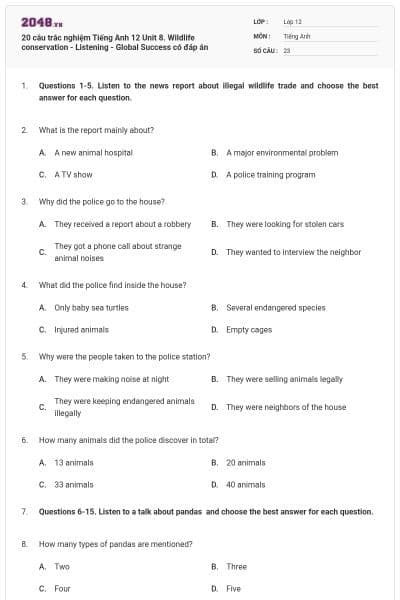
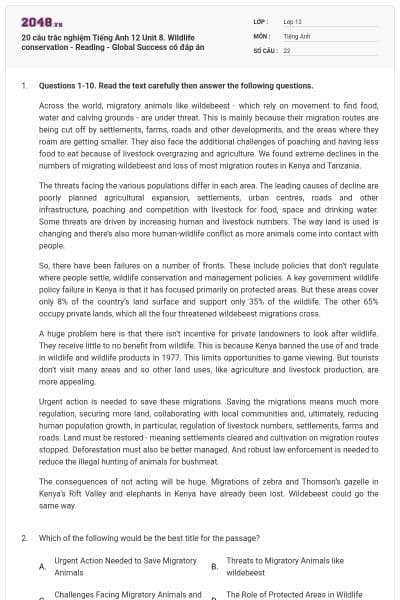
Questions 1-10. Read the text carefully then answer the following questions.
Across the world, migratory animals like wildebeest - which rely on movement to find food, water and calving grounds - are under threat. This is mainly because their migration routes are being cut off by settlements, farms, roads and other developments, and the areas where they roam are getting smaller. They also face the additional challenges of poaching and having less food to eat because of livestock overgrazing and agriculture. We found extreme declines in the numbers of migrating wildebeest and loss of most migration routes in Kenya and Tanzania.
The threats facing the various populations differ in each area. The leading causes of decline are poorly planned agricultural expansion, settlements, urban centres, roads and other infrastructure, poaching and competition with livestock for food, space and drinking water. Some threats are driven by increasing human and livestock numbers. The way land is used is changing and there’s also more human-wildlife conflict as more animals come into contact with people.
So, there have been failures on a number of fronts. These include policies that don’t regulate where people settle, wildlife conservation and management policies. A key government wildlife policy failure in Kenya is that it has focused primarily on protected areas. But these areas cover only 8% of the country’s land surface and support only 35% of the wildlife. The other 65% occupy private lands, which all the four threatened wildebeest migrations cross.
A huge problem here is that there isn’t incentive for private landowners to look after wildlife. They receive little to no benefit from wildlife. This is because Kenya banned the use of and trade in wildlife and wildlife products in 1977. This limits opportunities to game viewing. But tourists don’t visit many areas and so other land uses, like agriculture and livestock production, are more appealing.
Urgent action is needed to save these migrations. Saving the migrations means much more regulation, securing more land, collaborating with local communities and, ultimately, reducing human population growth, in particular, regulation of livestock numbers, settlements, farms and roads. Land must be restored - meaning settlements cleared and cultivation on migration routes stopped. Deforestation must also be better managed. And robust law enforcement is needed to reduce the illegal hunting of animals for bushmeat.
The consequences of not acting will be huge. Migrations of zebra and Thomson’s gazelle in Kenya’s Rift Valley and elephants in Kenya have already been lost. Wildebeest could go the same way.
Which of the following would be the best title for the passage?
Urgent Action Needed to Save Migratory Animals
Threats to Migratory Animals like wildebeest
Challenges Facing Migratory Animals and Solutions
The Role of Protected Areas in Wildlife Preservation
Đáp án đúng: C
Giải thích: Bài đọc nêu rõ cả nguyên nhân – thách thức – và giải pháp cho động vật di cư, không chỉ riêng “threats”.
The word “they” in paragraph 1 refers to _______.
calving grounds
migratory animals
migration routes
areas
Đáp án đúng: B
Giải thích:
Dựa vào câu: They also face the additional challenges of poaching and having less food to eat because of livestock overgrazing and agriculture.
According to paragraph 3, what percentage of Kenya’s wildlife is supported by protected areas?
8%
35%
65%
92%
Đáp án đúng: B
Giải thích:
Dựa vào câu: These areas cover only 8% of the country’s land surface and support only 35% of the wildlife. (Những khu vực này chỉ chiếm 8% diện tích đất liền của đất nước và chỉ là nơi sinh sống của 35% động vật hoang dã.)
What is NOT a threat for migratory animals like wildebeest?
illegal hunting
loss of migration routes
climate change
competition with other animals
Đáp án đúng: C
Giải thích: Bài đọc không đề cập đến climate change (biến đổi khí hậu) mà tập trung vào săn trộm, mất nơi di cư, chăn nuôi và nông nghiệp.
What is NOT a threat for migratory animals like wildebeest?
The word “regulate” in paragraph 3 is closest in meaning to _______.
reattach
impose
conserve
manage
Đáp án đúng: D
Giải thích: “regulate” có nghĩa gần nhất là “manage” – quản lý.
Which of the following is stated in paragraph 4?
Private landowners have no motivation to care for wildlife.
Kenya prohibited illegal wildlife trade and wildlife products in 1987.
The ban on wildlife use and trade has led to increased opportunities for game viewing.
Tourists visit areas in Kenya for wildlife viewing rather than for other land uses.
Đáp án đúng: A
Giải thích:
Dựa vào câu: A huge problem here is that there isn’t incentive for private landowners to look after wildlife. (Một vấn đề lớn ở đây là không có động lực để các chủ đất tư nhân chăm sóc động vật hoang dã.)
The word “enforcement” in paragraph 5 is closest in meaning to _______.
conservation
criteria
implementation
disregard
Đáp án đúng: C
Giải thích: “enforcement” có nghĩa gần nhất là “implementation” – sự thi hành.
What is one of the urgent actions needed to save migratory animal migrations?
increasing human population growth
diminishing regulation of livestock numbers
cooperating with local communities
encouraging more agricultural expansion
Đáp án đúng: C
Giải thích:
Dựa vào câu: Saving the migrations means much more regulation, securing more land, collaborating with local communities and, ultimately, reducing human population growth, in particular, regulation of livestock numbers, settlements, farms and roads. (Việc bảo vệ các cuộc di cư có nghĩa là phải có nhiều quy định hơn, đảm bảo nhiều đất hơn, hợp tác với cộng đồng địa phương và cuối cùng là giảm tốc độ tăng trưởng dân số, đặc biệt là quy định về số lượng vật nuôi, khu định cư, trang trại và đường sá.)
Which of the following can be inferred from the passage?
If deforestation is better managed, the illegal hunting of animals will be reduced.
Infrastructure developments have contributed to the decline of migratory animals.
Wildebeest could face the same threats as zebras and elephants even when urgent action is taken.
Migratory animals tend to prefer human-developed areas for their migration.
Đáp án đúng: B
Giải thích:
Dựa vào câu: This is mainly because their migration routes are being cut off by settlements, farms, roads and other developments, and the areas where they roam are getting smaller. (Nguyên nhân chủ yếu là do các tuyến đường di cư của chúng bị cắt đứt bởi các khu định cư, trang trại, đường sá và các hoạt động phát triển khác, và các khu vực chúng di chuyển đang ngày càng thu hẹp lại.)
Which of the following is NOT true about wildlife conservation in Kenya according to the passage?
Kenya’s wildlife policy has primarily focused on protecting private lands.
Increasing conflict between humans and wildlife threatens migratory animals.
The challenges facing migratory animals are not the same among different areas.
Wildlife conservation policies in Kenya are inefficient due to lack of regulation.
Đáp án đúng: A
Giải thích:
Dựa vào câu: A key government wildlife policy failure in Kenya is that it has focused primarily on protected areas … (Một thất bại quan trọng trong chính sách bảo vệ động vật hoang dã của chính phủ Kenya là họ chủ yếu tập trung vào các khu vực được bảo vệ)
Dịch bài đọc:
Trên khắp thế giới, các loài động vật di cư như linh dương đầu bò - vốn dựa vào sự di chuyển để tìm kiếm thức ăn, nước uống và nơi sinh sản - đang bị đe dọa. Nguyên nhân chủ yếu là do các tuyến đường di cư của chúng bị cắt đứt bởi các khu định cư, trang trại, đường sá và các hoạt động phát triển khác, và diện tích sinh sống của chúng đang ngày càng thu hẹp. Chúng cũng phải đối mặt với những thách thức bổ sung từ nạn săn trộm và tình trạng khan hiếm thức ăn do chăn thả gia súc quá mức và nông nghiệp. Chúng tôi nhận thấy số lượng linh dương đầu bò di cư giảm mạnh và hầu hết các tuyến đường di cư ở Kenya và Tanzania đều bị mất.
Mối đe dọa mà các quần thể khác nhau phải đối mặt ở mỗi khu vực là khác nhau. Nguyên nhân hàng đầu gây ra sự suy giảm là do việc mở rộng nông nghiệp, các khu định cư, trung tâm đô thị, đường sá và các cơ sở hạ tầng khác được quy hoạch kém, nạn săn trộm và cạnh tranh với gia súc về thức ăn, không gian và nước uống. Một số mối đe dọa bắt nguồn từ sự gia tăng số lượng người và gia súc. Cách thức sử dụng đất đang thay đổi và cũng có nhiều xung đột giữa người và động vật hoang dã hơn khi ngày càng nhiều động vật tiếp xúc với con người.
Vì vậy, đã có những thất bại trên một số mặt trận. Những thất bại này bao gồm các chính sách không quy định nơi định cư của con người, các chính sách bảo tồn và quản lý động vật hoang dã. Một thất bại quan trọng trong chính sách bảo tồn động vật hoang dã của chính phủ Kenya là việc tập trung chủ yếu vào các khu bảo tồn. Tuy nhiên, những khu vực này chỉ chiếm 8% diện tích đất của đất nước và chỉ là nơi sinh sống của 35% động vật hoang dã. 65% còn lại nằm trên đất tư nhân, nơi cả bốn tuyến di cư của linh dương đầu bò đang bị đe dọa đều đi qua.
Một vấn đề lớn ở đây là các chủ đất tư nhân không có động lực để chăm sóc động vật hoang dã. Họ nhận được rất ít hoặc không được hưởng lợi từ động vật hoang dã. Điều này là do Kenya đã cấm sử dụng và buôn bán động vật hoang dã và các sản phẩm từ động vật hoang dã vào năm 1977. Điều này hạn chế cơ hội ngắm thú săn. Tuy nhiên, khách du lịch không đến thăm nhiều khu vực, vì vậy các mục đích sử dụng đất khác, như nông nghiệp và chăn nuôi, lại hấp dẫn hơn.
Cần có hành động khẩn cấp để cứu những cuộc di cư này. Việc cứu những cuộc di cư đồng nghĩa với việc tăng cường quản lý, đảm bảo đất đai, hợp tác với cộng đồng địa phương và cuối cùng là giảm tốc độ tăng trưởng dân số, đặc biệt là quản lý số lượng gia súc, khu định cư, trang trại và đường sá. Đất đai phải được phục hồi - nghĩa là phải dọn sạch các khu định cư và chấm dứt canh tác trên các tuyến đường di cư. Nạn phá rừng cũng phải được quản lý tốt hơn. Và cần có sự thực thi pháp luật mạnh mẽ để giảm thiểu nạn săn bắt động vật hoang dã trái phép để lấy thịt.
Hậu quả của việc không hành động sẽ rất lớn. Các cuộc di cư của ngựa vằn và linh dương Thomson ở Thung lũng Rift của Kenya và voi ở Kenya đã bị tuyệt chủng. Linh dương đầu bò cũng có thể đi theo con đường tương tự.
Questions 11-20. Read the text carefully then answer the following questions.
Wildlife crimes - like rhino poaching or overfishing-were once considered a “green” matter. But this has changed. Such crimes have moved higher up on global security and policy agendas. This is partly linked to concerns about the extinction of species and the demise of ecosystems. It’s also been caused by the involvement of organised criminal networks in illegal wildlife supply chains.
Rhino poaching has particularly attracted public attention. A lot of protective and controlling national and international measures aimed at preventing the consumer markets and criminal networks that allow the trade to flourish have failed. The problem is that such approaches almost deal with wildlife crime’s signs rather than its root causes: a conflict over access to land, resources and benefits.
The reality is that wildlife conservation continues to benefit economic and political elites. Local communities remain mostly excluded from real benefits, and conservation often comes at a huge cost to them. They lose their land, access to natural resources and cultural sites. They have limited agency and ownership of areas and management. Often the only benefits for communities from wildlife and conservation come from the poaching profits.
Instead of recognising local people as important change agents in wildlife conservation, conservationists are calling for more boots on the ground, helicopter gunships and new technologies. Money is spent on security officials and private investigators. Expensive technologies are brought in to deter poachers.
Some scholars have started to look at the root causes of environmental and wildlife crimes by considering broader economic, political and systemic factors. Their assessment is that community empowerment is key. This will not only address basic inequality and poverty, but can reduce wildlife crime and other types of crime. This is borne out by Namibia’s experiences: there, former poachers have become wildlife guardians. Local communities may become protectors of wildlife and conservation areas if they were granted agency, ownership and benefits.
Although not perfect, the example of communal conservation areas in Namibia provides fascinating insights into the process of encouraging communities. One thing is clear: we need to create happy sustainable communities that benefit from and live in harmony with ecosystems.
Which of the following can be the best title for the passage?
The Reasons for Wildlife Crimes
The Effective Measures in Preventing Wildlife Crimes
Wildlife Conservation Efforts
The Key Role of Communities in Wildlife Conservation
Đáp án đúng: D
Giải thích: Bài đọc nhấn mạnh vai trò của cộng đồng địa phương trong việc giảm tội phạm về động vật hoang dã và bảo tồn thiên nhiên.
The word “demise” in paragraph 1 is closest in meaning to ________.
decline
evolution
conservation
displacement
Đáp án đúng: A
Giải thích: demise = “sự suy tàn, sụp đổ” → gần nghĩa nhất với “decline”.
The word “they” in paragraph 3 refers to ________.
economic and political elites
real benefits
local communities
cultural sites
Đáp án đúng: C
Giải thích:
Dựa vào câu: They lose their land, access to natural resources and cultural sites. They have limited agency and ownership of areas and management. (Họ mất đất đai, mất quyền tiếp cận tài nguyên thiên nhiên và di tích văn hóa. Họ bị hạn chế quyền tự quyết và quyền sở hữu các khu vực cũng như quyền quản lý.)
What is the main criticism of current approaches to wildlife conservation?
They focus too much on community empowerment.
They fail to tackle the root causes of wildlife crimes.
They prioritise profits over wildlife conservation.
They involve too many protective and regulatory measures.
Đáp án đúng: B
Giải thích:
Dựa vào câu: Such approaches almost deal with wildlife crime’s signs rather than its root causes. (Những cách tiếp cận như vậy hầu như chỉ giải quyết các dấu hiệu của tội phạm động vật hoang dã thay vì nguyên nhân gốc rễ của nó.)
The word “deter” in paragraph 4 is closest in meaning to ________.
release
stimulate
prevent
arrest
Đáp án đúng: C
Giải thích: Deter = ngăn chặn, cản trở → đồng nghĩa với prevent.
Which statement is NOT true according to the passage?
Wildlife crimes with criminal networks contribute to the disappearance of species.
Wildlife crimes are now a less significant concern on global security and policy agendas than before.
Conservation often puts a financial burden on local communities.
Community empowerment can tackle basic inequality and reduce wildlife crime.
Đáp án đúng: B
Giải thích:
Dựa vào câu: Such crimes have moved higher up on global security and policy agendas. (Những tội ác như vậy đã được đưa lên vị trí cao hơn trong chương trình nghị sự về chính sách và an ninh toàn cầu.)
Which of the following can be inferred from the passage?
If local communities were granted ownership and benefits, they would not conserve wildlife.
Conflict over access to benefits is the main factor discouraging local communities from conserving wildlife.
Conservationists are unaware of the crucial role of local people in wildlife conservation.
Communal conservancies in Namibia managed to involve communities in wildlife conservation.
Đáp án đúng: D
Giải thích:
Dựa vào câu: The example of communal conservation areas in Namibia provides fascinating insights into encouraging communities. (Ví dụ về các khu bảo tồn cộng đồng ở Namibia cung cấp những hiểu biết sâu sắc hấp dẫn về việc khuyến khích cộng đồng.)
According to the passage, what is one of the main consequences local communities face because of conservation efforts?
They gain control over wildlife resources.
They lose access to their traditional lands and natural resources.
They are provided with modern technologies and benefits.
They receive financial support from conservation organisations.
Đáp án đúng: B
Giải thích:
Dựa vào câu: They lose their land, access to natural resources and cultural sites. (Họ mất đất đai, mất quyền tiếp cận tài nguyên thiên nhiên và di tích văn hóa.)
What has been the major focus of recent conservation strategies, according to the passage?
Supporting private landowners financially
Investing in security measures and technologies
Educating communities about wildlife protection
Promoting equal ownership among local people
Đáp án đúng: B
Giải thích:
Dựa vào câu: Money is spent on security officials and private investigators. Expensive technologies are brought in to deter poachers. (Tiền được chi cho các nhân viên an ninh và thám tử tư. Công nghệ đắt tiền được đưa vào để ngăn chặn những kẻ săn trộm.)
What does the passage suggest about former poachers in Namibia?
They continue to hunt wildlife for profit.
They have moved to other countries.
They have become protectors of wildlife.
They are excluded from conservation projects.
Đáp án đúng: C
Giải thích:
Dựa vào câu: In Namibia’s experiences, former poachers have become wildlife guardians. (Theo kinh nghiệm của Namibia, những kẻ săn trộm trước đây đã trở thành người bảo vệ động vật hoang dã.)
Dịch bài đọc:
Tội phạm động vật hoang dã - như săn trộm tê giác hay đánh bắt quá mức - từng được coi là vấn đề "xanh". Nhưng quan điểm này đã thay đổi. Những tội ác như vậy đã được đưa lên vị trí cao hơn trong chương trình nghị sự về an ninh và chính sách toàn cầu. Điều này một phần liên quan đến những lo ngại về sự tuyệt chủng của các loài và sự suy tàn của các hệ sinh thái. Nó cũng là do sự tham gia của các mạng lưới tội phạm có tổ chức vào chuỗi cung ứng động vật hoang dã bất hợp pháp.
Nạn săn trộm tê giác đặc biệt thu hút sự chú ý của công chúng. Nhiều biện pháp bảo vệ và kiểm soát ở cấp quốc gia và quốc tế nhằm ngăn chặn thị trường tiêu thụ và các mạng lưới tội phạm tạo điều kiện cho hoạt động buôn bán này phát triển đã thất bại. Vấn đề là những cách tiếp cận như vậy hầu như chỉ giải quyết các dấu hiệu của tội phạm động vật hoang dã thay vì nguyên nhân gốc rễ của nó: xung đột về quyền tiếp cận đất đai, tài nguyên và lợi ích.
Thực tế là việc bảo tồn động vật hoang dã tiếp tục mang lại lợi ích cho giới tinh hoa kinh tế và chính trị. Các cộng đồng địa phương phần lớn vẫn bị loại trừ khỏi những lợi ích thực sự, và việc bảo tồn thường phải trả giá rất đắt. Họ mất đất đai, quyền tiếp cận tài nguyên thiên nhiên và các di tích văn hóa. Họ có quyền tự quyết và quyền sở hữu các khu vực cũng như quyền quản lý hạn chế. Thông thường, lợi ích duy nhất mà cộng đồng nhận được từ động vật hoang dã và công tác bảo tồn đến từ lợi nhuận từ việc săn trộm.
Thay vì công nhận người dân địa phương là những tác nhân thay đổi quan trọng trong công tác bảo tồn động vật hoang dã, các nhà bảo tồn đang kêu gọi tăng cường lực lượng thực địa, trực thăng vũ trang và công nghệ mới. Tiền bạc được chi cho các quan chức an ninh và điều tra viên tư nhân. Công nghệ đắt tiền được đưa vào để ngăn chặn những kẻ săn trộm.
Một số học giả đã bắt đầu xem xét nguyên nhân gốc rễ của tội phạm môi trường và động vật hoang dã bằng cách xem xét các yếu tố kinh tế, chính trị và hệ thống rộng hơn. Đánh giá của họ cho rằng trao quyền cho cộng đồng là chìa khóa. Điều này không chỉ giải quyết bất bình đẳng cơ bản và nghèo đói mà còn có thể giảm tội phạm động vật hoang dã và các loại tội phạm khác. Điều này được chứng minh bằng kinh nghiệm của Namibia: ở đó, những kẻ săn trộm trước đây đã trở thành người bảo vệ động vật hoang dã. Cộng đồng địa phương có thể trở thành người bảo vệ động vật hoang dã và các khu bảo tồn nếu họ được trao quyền tự chủ, quyền sở hữu và lợi ích.
Mặc dù chưa hoàn hảo, ví dụ về các khu bảo tồn cộng đồng ở Namibia cung cấp những hiểu biết thú vị về quá trình khuyến khích cộng đồng. Một điều rõ ràng là: chúng ta cần tạo ra những cộng đồng bền vững, hạnh phúc, được hưởng lợi từ và sống hòa hợp với hệ sinh thái.