Trắc nghiệm Tiếng Anh 12 Global Success Unit 10 Reading (có đáp án)
20 câu hỏi
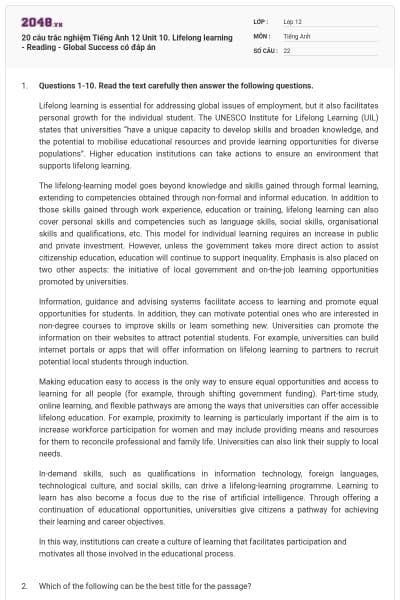
Questions 1-10. Read the text carefully then answer the following questions.
Lifelong learning is essential for addressing global issues of employment, but it also facilitates personal growth for the individual student. The UNESCO Institute for Lifelong Learning (UIL) states that universities “have a unique capacity to develop skills and broaden knowledge, and the potential to mobilise educational resources and provide learning opportunities for diverse populations”. Higher education institutions can take actions to ensure an environment that supports lifelong learning.
The lifelong-learning model goes beyond knowledge and skills gained through formal learning, extending to competencies obtained through non-formal and informal education. In addition to those skills gained through work experience, education or training, lifelong learning can also cover personal skills and competencies such as language skills, social skills, organisational skills and qualifications, etc. This model for individual learning requires an increase in public and private investment. However, unless the government takes more direct action to assist citizenship education, education will continue to support inequality. Emphasis is also placed on two other aspects: the initiative of local government and on-the-job learning opportunities promoted by universities.
Information, guidance and advising systems facilitate access to learning and promote equal opportunities for students. In addition, they can motivate potential ones who are interested in non-degree courses to improve skills or learn something new. Universities can promote the information on their websites to attract potential students. For example, universities can build internet portals or apps that will offer information on lifelong learning to partners to recruit potential local students through induction.
Making education easy to access is the only way to ensure equal opportunities and access to learning for all people (for example, through shifting government funding). Part-time study, online learning, and flexible pathways are among the ways that universities can offer accessible lifelong education. For example, proximity to learning is particularly important if the aim is to increase workforce participation for women and may include providing means and resources for them to reconcile professional and family life. Universities can also link their supply to local needs.
In-demand skills, such as qualifications in information technology, foreign languages, technological culture, and social skills, can drive a lifelong-learning programme. Learning to learn has also become a focus due to the rise of artificial intelligence. Through offering a continuation of educational opportunities, universities give citizens a pathway for achieving their learning and career objectives.
In this way, institutions can create a culture of learning that facilitates participation and motivates all those involved in the educational process.Which of the following can be the best title for the passage?
The Role of Universities in Fostering Lifelong Learning
Modern Educational Technology and Its Impact
Technology and Education: The Future of Learning
The Importance of Government Funding in Higher Education
Đáp án đúng: A
Giải thích: Đoạn văn nhấn mạnh vai trò của universities trong việc tạo môi trường và cơ hội học tập suốt đời, nên A là tiêu đề phù hợp nhất.
What is NOT mentioned as a merit of lifelong learning in paragraph 1?
It resolves global problems related to employment.
It promotes the individual student’s personal development.
It enables universities to generalise educational resources.
It offers learning opportunities for a variety of populations.
Đáp án đúng: C
Giải thích:
Dựa vào câu: The UNESCO Institute for Lifelong Learning (UIL) states that universities “have a unique capacity to develop skills and broaden knowledge, and the potential to mobilise educational resources and provide learning opportunities for diverse populations”. (Viện Học tập suốt đời UNESCO (UIL) tuyên bố rằng các trường đại học “có năng lực độc đáo trong việc phát triển kỹ năng và mở rộng kiến thức, cũng như tiềm năng huy động nguồn lực giáo dục và cung cấp cơ hội học tập cho nhiều nhóm dân số khác nhau”.)
Which of the following is stated in paragraph 2?
Lifelong learning includes personal skills such as competencies and social skills.
An increase in public and private investment is essential for the lifelong-learning model.
Government action to assist citizenship education will support inequality in education.
Emphasis is focused on on-the-job learning opportunities offered by local government.
Đáp án đúng: A
Giải thích:
Dựa vào câu: In addition to those skills gained through work experience, education or training, lifelong learning can also cover personal skills and competencies such as language skills, social skills, organisational skills and qualifications, etc. (Ngoài những kỹ năng có được thông qua kinh nghiệm làm việc, giáo dục hoặc đào tạo, học tập suốt đời cũng có thể bao gồm các kỹ năng và năng lực cá nhân như kỹ năng ngôn ngữ, kỹ năng xã hội, kỹ năng tổ chức và trình độ, v.v.)
The word “ones” in paragraph 3 refers to __________.
systems
universities
opportunities
students
Đáp án đúng: D
Giải thích: Cụm “potential ones who are interested in non-degree courses” = những người (học viên tiềm năng) quan tâm đến các khóa học không cấp bằng → ones = students.
The word “induction” in paragraph 3 is closest in meaning to __________.
motivation
institution
introduction
deduction
Đáp án đúng: C
Giải thích: “induction” trong ngữ cảnh “induction programmes” = buổi giới thiệu, định hướng cho người mới
What role do information, guidance, and advising systems play in education?
They focus on both degree and non-degree courses.
They attract and recruit potential local students.
They facilitate access to equitable learning opportunities.
They restrict access to Internet portals or apps.
Đáp án đúng: C
Giải thích:
Dựa vào câu: Information, guidance and advising systems facilitate access to learning and promote equal opportunities for students. (Hệ thống thông tin, hướng dẫn và tư vấn tạo điều kiện thuận lợi cho việc tiếp cận học tập và thúc đẩy cơ hội bình đẳng cho sinh viên.)
The word “reconcile” in paragraph 4 is closest in meaning to __________.
adapt
balance
pursue
imbalance
Đáp án đúng: B
Giải thích: “reconcile professional and family life” = cân bằng giữa công việc và gia đình → balance.
How can universities ensure equal opportunities and access to learning for all people?
by increasing government funding for higher education
by excluding certain populations from educational opportunities
by making lifelong education easily accessible
by focusing on social needs to offer suitable supply
Đáp án đúng: C
Giải thích:
Dựa vào câu: Making education easy to access is the only way to ensure equal opportunities and access to learning for all people (for example, through shifting government funding). (Việc tạo điều kiện tiếp cận giáo dục dễ dàng là cách duy nhất để đảm bảo cơ hội bình đẳng và khả năng tiếp cận học tập cho tất cả mọi người (ví dụ, thông qua việc chuyển đổi nguồn tài trợ của chính phủ).)
Which of the following can be inferred from the passage?
Higher education institutions play a crucial role in creating an environment for both formal and non-formal learning.
Emphasis on the initiative of local universities can address inequality in education.
Offering lifelong learning, universities pave the way for citizens to gain learning and career objectives.
Lifelong learning prioritises formal education over non-formal and informal education.
Đáp án đúng: C
Giải thích:
Dựa vào câu: Universities give citizens a pathway for achieving their learning and career objectives. (Các trường đại học cung cấp cho công dân con đường để đạt được mục tiêu học tập và nghề nghiệp của họ.)
Which of the following is NOT true according to the passage?
Competencies can be obtained through both education and work experience.
Universities provide easy access to lifelong education through part-time study and online learning.
Proximity to learning can facilitate participation for the female workforce.
The development of artificial intelligence makes learning to learn unappreciated.
Đáp án đúng: D
Giải thích:
Dựa vào câu: Learning to learn has also become a focus due to the rise of artificial intelligence. (Học cách học cũng đã trở thành trọng tâm do sự phát triển của trí tuệ nhân tạo.)
Dịch bài đọc:
Học tập suốt đời là điều cần thiết để giải quyết các vấn đề việc làm toàn cầu, đồng thời cũng tạo điều kiện cho sự phát triển cá nhân của mỗi sinh viên. Viện Học tập Suốt đời (UIL) của UNESCO tuyên bố rằng các trường đại học “có năng lực độc đáo trong việc phát triển kỹ năng và mở rộng kiến thức, cũng như tiềm năng huy động các nguồn lực giáo dục và cung cấp cơ hội học tập cho nhiều nhóm dân số khác nhau”. Các cơ sở giáo dục đại học có thể hành động để đảm bảo một môi trường hỗ trợ học tập suốt đời.
Mô hình học tập suốt đời không chỉ giới hạn ở kiến thức và kỹ năng đạt được thông qua học tập chính quy, mà còn mở rộng sang các năng lực đạt được thông qua giáo dục phi chính quy và không chính quy. Bên cạnh những kỹ năng đạt được thông qua kinh nghiệm làm việc, giáo dục hoặc đào tạo, học tập suốt đời còn có thể bao gồm các kỹ năng và năng lực cá nhân như kỹ năng ngôn ngữ, kỹ năng xã hội, kỹ năng tổ chức và trình độ chuyên môn, v.v. Mô hình học tập cá nhân này đòi hỏi sự gia tăng đầu tư từ khu vực công và tư nhân. Tuy nhiên, nếu chính phủ không hành động trực tiếp hơn để hỗ trợ giáo dục công dân, giáo dục sẽ tiếp tục tạo ra bất bình đẳng. Hai khía cạnh khác cũng được nhấn mạnh: sáng kiến của chính quyền địa phương và các cơ hội học tập tại nơi làm việc do các trường đại học thúc đẩy.
Hệ thống thông tin, hướng dẫn và tư vấn tạo điều kiện thuận lợi cho việc tiếp cận học tập và thúc đẩy cơ hội bình đẳng cho sinh viên. Ngoài ra, họ có thể khuyến khích những người quan tâm đến các khóa học không cấp bằng nâng cao kỹ năng hoặc học hỏi điều gì đó mới mẻ. Các trường đại học có thể quảng bá thông tin trên trang web của mình để thu hút sinh viên tiềm năng. Ví dụ, các trường đại học có thể xây dựng các cổng thông tin hoặc ứng dụng internet cung cấp thông tin về học tập suốt đời cho các đối tác để tuyển dụng sinh viên địa phương tiềm năng thông qua chương trình giới thiệu.
Việc tạo điều kiện tiếp cận giáo dục dễ dàng là cách duy nhất để đảm bảo cơ hội bình đẳng và khả năng tiếp cận học tập cho tất cả mọi người (ví dụ, thông qua việc chuyển đổi ngân sách của chính phủ). Học bán thời gian, học trực tuyến và các lộ trình học tập linh hoạt là một trong những cách mà các trường đại học có thể cung cấp giáo dục suốt đời dễ tiếp cận. Ví dụ, việc gần gũi với việc học tập đặc biệt quan trọng nếu mục tiêu là tăng cường sự tham gia của phụ nữ vào lực lượng lao động và có thể bao gồm việc cung cấp các phương tiện và nguồn lực để họ cân bằng giữa cuộc sống nghề nghiệp và gia đình. Các trường đại học cũng có thể liên kết nguồn cung của mình với nhu cầu địa phương.
Các kỹ năng đang có nhu cầu cao, chẳng hạn như bằng cấp về công nghệ thông tin, ngoại ngữ, văn hóa công nghệ và kỹ năng xã hội, có thể thúc đẩy một chương trình học tập suốt đời. Học để học cũng đã trở thành trọng tâm do sự phát triển của trí tuệ nhân tạo. Thông qua việc cung cấp các cơ hội giáo dục liên tục, các trường đại học tạo cho công dân một con đường để đạt được mục tiêu học tập và nghề nghiệp của họ.
Theo cách này, các tổ chức có thể tạo ra một nền văn hóa học tập thúc đẩy sự tham gia và động viên tất cả những người tham gia vào quá trình giáo dục.
Questions 11-20. Read the text then decide whether each statement is True or False.
Lifelong learning is an essential part of personal and professional development. It is a continuous process that helps individuals stay relevant in their fields, keep up with changes in trends and adapt to unclearness.
Curiosity is the spark that ignites the fire of learning. It is the desire to explore, question and discover new knowledge and experiences, which is required for lifelong learning. Albert Einstein is often credited with saying, “I have no special talents. I am only passionately curious.”
Curiosity is the fuel that makes individuals seek out new information, skills and perspectives.
Curious people listen and approach interactions with the hope of learning something valuable. When someone is sincerely interested in something, they tend to listen more closely - determined to uncover the facts, seek out answers and pile up deep knowledge along the way.
With more information and details at their disposal, they tend to be more motivated, more focused and, ultimately, more productive. Research also shows “curiosity to be associated with higher levels of positive emotions, lower levels of anxiety, and more satisfaction with life.” However, curiosity is only the driving force for the journey of lifelong learning.
Lifelong learning only focuses on professional development.
True
False
Đáp án đúng: B
Giải thích:
Dựa vào câu: Lifelong learning is an essential part of personal and professional development. (Học tập suốt đời là một phần thiết yếu của sự phát triển cá nhân và nghề nghiệp.)
Lifelong learning helps individuals stay updated with new trends.
True
False
Đáp án đúng: A
Giải thích:
Dựa vào câu: It is a continuous process that helps individuals stay relevant in their fields, keep up with changes in trends and adapt to unclearness. (Đây là một quá trình liên tục giúp cá nhân luôn cập nhật trong lĩnh vực của mình, theo kịp những thay đổi về xu hướng và thích nghi với sự không rõ ràng.)
Curiosity plays no role in lifelong learning.
True
False
Đáp án đúng: B
Giải thích:
Dựa vào câu: Curiosity is the spark that ignites the fire of learning. (Sự tò mò là tia lửa thắp sáng ngọn lửa học tập.)
Albert Einstein believed curiosity was more important than having special talents.
True
False
Đáp án đúng: A
Giải thích:
Dựa vào câu: Albert Einstein is often credited with saying, “I have no special talents. I am only passionately curious.” (Albert Einstein thường được cho là đã nói rằng: "Tôi không có tài năng đặc biệt nào cả. Tôi chỉ tò mò một cách say mê mà thôi.")
Curiosity leads people to gather deep knowledge by seeking answers and facts.
True
False
Đáp án đúng: A
Giải thích:
Dựa vào câu: They tend to listen more closely - determined to uncover the facts, seek out answers and pile up deep knowledge. (Họ có xu hướng lắng nghe kỹ hơn - quyết tâm khám phá sự thật, tìm kiếm câu trả lời và tích lũy kiến thức sâu rộng.)
Having curiosity can make individuals more productive.
True
False
Đáp án đúng: A
Giải thích:
Dựa vào câu: With more information and details at their disposal, they tend to be more motivated, more focused and, ultimately, more productive. (Với nhiều thông tin và chi tiết hơn, họ có xu hướng có động lực hơn, tập trung hơn và cuối cùng là làm việc hiệu quả hơn.)
Research shows curiosity is linked to higher anxiety levels.
True
False
Đáp án đúng: B
Giải thích:
Dựa vào câu: Research also shows “curiosity to be associated with higher levels of positive emotions, lower levels of anxiety, and more satisfaction with life.” (Nghiên cứu cũng chỉ ra rằng “sự tò mò có liên quan đến mức độ cảm xúc tích cực cao hơn, mức độ lo lắng thấp hơn và sự hài lòng với cuộc sống cao hơn”.)
Curiosity is described as the final goal of lifelong learning.
True
False
Đáp án đúng: B
Giải thích:
Dựa vào câu: Curiosity is only the driving force for the journey of lifelong learning. (Sự tò mò chỉ là động lực cho hành trình học tập suốt đời.)
The passage implies that being curious can make learning more enjoyable and meaningful.
True
False
Đáp án đúng: A
Giải thích:
Dựa vào câu: Thông qua sự tò mò, người học sẽ khám phá và tìm ra những kiến thức và trải nghiệm mới, khiến việc học trở nên hấp dẫn hơn.
Dịch bài đọc:
Học tập suốt đời là một phần thiết yếu của sự phát triển cá nhân và nghề nghiệp. Đây là một quá trình liên tục giúp mỗi cá nhân luôn phù hợp với lĩnh vực của mình, bắt kịp những thay đổi trong xu hướng và thích nghi với sự mơ hồ.
Sự tò mò là tia lửa thắp sáng ngọn lửa học tập. Đó là mong muốn khám phá, đặt câu hỏi và tìm hiểu kiến thức và trải nghiệm mới, điều cần thiết cho việc học tập suốt đời. Albert Einstein thường được cho là đã nói: "Tôi không có tài năng đặc biệt nào. Tôi chỉ tò mò một cách say mê."
Sự tò mò là động lực thúc đẩy mỗi cá nhân tìm kiếm thông tin, kỹ năng và quan điểm mới.
Những người tò mò lắng nghe và tiếp cận các tương tác với hy vọng học được điều gì đó có giá trị. Khi ai đó thực sự quan tâm đến điều gì đó, họ có xu hướng lắng nghe kỹ hơn - quyết tâm khám phá sự thật, tìm kiếm câu trả lời và tích lũy kiến thức sâu sắc trong suốt quá trình.
Với nhiều thông tin và chi tiết hơn trong tay, họ có xu hướng có động lực hơn, tập trung hơn và cuối cùng là năng suất hơn. Nghiên cứu cũng cho thấy "sự tò mò gắn liền với mức độ cảm xúc tích cực cao hơn, mức độ lo lắng thấp hơn và sự hài lòng hơn với cuộc sống." Tuy nhiên, sự tò mò chỉ là động lực cho hành trình học tập suốt đời.
Curious people tend to ignore what others say in conversations.
True
False
Đáp án đúng: B
Giải thích:
Dựa vào câu: Curious people listen and approach interactions with the hope of learning something valuable. (Những người tò mò sẽ lắng nghe và tiếp cận các cuộc tương tác với hy vọng học được điều gì đó có giá trị.)