Trắc nghiệm Tiếng Anh 12 Global Success Unit 1 Writing (có đáp án)
20 câu hỏi
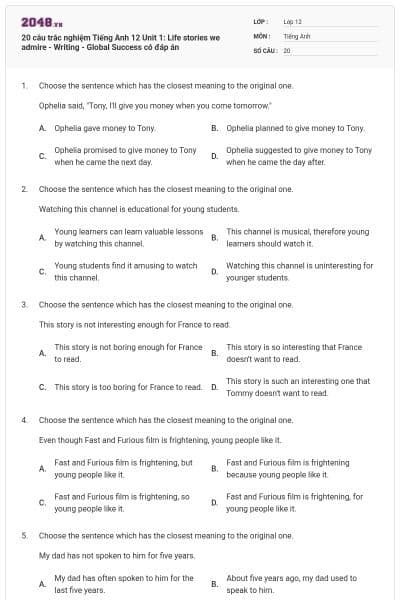
Ophelia gave money to Tony.
Ophelia planned to give money to Tony.
Ophelia promised to give money to Tony when he came the next day.
Ophelia suggested to give money to Tony when he came the day after.
Đáp án đúng: C
Giải thích: Câu tường thuật gián tiếp
“I'll give you money when you come tomorrow” → she promised to …. (hứa sẽ làm gì.)
Dịch nghĩa: Ophelia hứa sẽ đưa tiền cho Tony khi anh đến vào ngày hôm sau.
Young learners can learn valuable lessons by watching this channel.
This channel is musical, therefore young learners should watch it.
Young students find it amusing to watch this channel.
Watching this channel is uninteresting for younger students.
Đáp án đúng: A
Giải thích: educational = giúp học sinh học hỏi, thu được kiến thức/giá trị.
Dịch nghĩa: Học sinh có thể học những bài học bổ ích bằng cách xem kênh này.
This story is not boring enough for France to read.
This story is so interesting that France doesn't want to read.
This story is too boring for France to read.
This story is such an interesting one that Tommy doesn't want to read.
Đáp án đúng: C
Giải thích: not interesting enough (không đủ thú vị) ≈ too boring (quá nhàm).
Dịch nghĩa: Câu chuyện này quá nhàm chán để France đọc.
Fast and Furious film is frightening, but young people like it.
Fast and Furious film is frightening because young people like it.
Fast and Furious film is frightening, so young people like it.
Fast and Furious film is frightening, for young people like it.
Đáp án đúng: A
Giải thích: Câu gốc diễn đạt sự tương phản (Even though…). Đáp án A dùng but để thể hiện mối quan hệ trái ngược.
Dịch nghĩa: Bộ phim Fast and Furious đáng sợ, nhưng giới trẻ vẫn thích.
My dad has often spoken to him for the last five years.
About five years ago, my dad used to speak to him.
The last time my dad spoke to him was five years ago.
My dad spoke to him five years ago and will never speak to him again.
Đáp án đúng: C
Giải thích: Cấu trúc: has not + V3 for … years = lần cuối cùng làm việc đó là … năm trước.
Dịch nghĩa: Lần cuối bố tôi nói chuyện với ông ấy là 5 năm trước.
Lot of this kind of cuisine used to be consumed by her.
She's accustomed to consuming this type of cuisine.
She has never eaten this kind of cuisine before.
She's had this kind of cuisine numerous times in the past.
Đáp án đúng: C
Giải thích: Cấu trúc: has never had … before = chưa từng … trước đây.
Dịch nghĩa: Cô ấy chưa bao giờ ăn loại đồ ăn này trước đây.
I'm glad you lent me the novel last week because it seems curious.
It wasn't the fascinating book you gave me last week.
I'm finding it too curious to read the novel you lent me last week.
I'm really interested in the novel you lent me last week.
Đáp án đúng: D
Giải thích: attracts my curiosity greatly = khiến tôi rất hứng thú.
Dịch nghĩa: Tôi thực sự quan tâm/thích thú với cuốn tiểu thuyết mà bạn cho tôi mượn tuần trước.
Housewives will never stop perform household chores.
Housewives are required to devote an increasing amount of time to cleaning.
Housewives have never spent more time cleaning the house than they do right now.
Housewives no longer have to devote a lot of time to housekeeping.
Đáp án đúng: D
Giải thích: don’t have to = không cần phải, no longer have to = không còn cần phải.
Dịch nghĩa: Nội trợ không còn phải dành nhiều thời gian cho việc nhà nữa.
Lisa is the only student in our class who speaks Chinese better than me.
Among the Chinese speakers in our class, Lisa is the worst.
Lisa is just as proficient in Chinese as everyone else in our class.
Lisa is the student in our class who speaks Chinese the best.
Đáp án đúng: D
Giải thích: Lisa speaks … more fluently than everyone else = Lisa nói tiếng Trung giỏi nhất lớp.
Dịch nghĩa: Lisa là học sinh trong lớp nói tiếng Trung tốt nhất.

Học thông minh hơn mỗi ngày
Xem toàn bộ 20 câu hỏi và nhiều hơn nữa với tài khoản miễn phí
Every day, this room needs to be cleaned.
Every day, this room ought being cleaned.
This area needs to be cleaned every day.
Every day, this room need to be cleaned.
Đáp án đúng: A
Giải thích: should clean every day = cần được dọn dẹp mỗi ngày → needs to be cleaned every day (bị động).
Dịch nghĩa: Mỗi ngày, căn phòng này cần được dọn dẹp.
Careful environmental planning protects the world we live in.
Planning the environment carefully, we can protect the world in which we live.
Protecting the world we live in, we plan the environment carefully.
We can protect the world we live in only with careful environmental planning.
Đáp án đúng: D
Giải thích: Câu đảo ngữ: Only with … can we …
Dịch nghĩa: Chúng ta chỉ có thể bảo vệ thế giới mình đang sống nhờ việc lập kế hoạch môi trường cẩn thận.
Taking regular exercises is better than sitting in front of the television all day.
Sitting in front of the television all day helps you take regular exercises.
Sitting in front of the television all day and taking exercises are advisable.
Don't take regular exercises, just sit in front of the television all day.
Đáp án đúng: A
Giải thích: “Instead of” = tốt hơn là … so với …
Dịch nghĩa: Tập thể dục thường xuyên thì tốt hơn là ngồi cả ngày trước TV.
Why haven't they have been informed about the new development?
Shouldn't they have been consulted before the scheme was changed?
Don't they think they should be informed about the changes in the plan?
We'd better ask them to change the plan, hadn't we?
Đáp án đúng: C
Giải thích: Câu hỏi gợi ý: Wouldn’t it be better to … ?
Dịch nghĩa: Chẳng phải họ nên được thông báo về những thay đổi trong kế hoạch sao?
You can ignore all his talk of being ill; he's actually perfectly healthy.
Try to avoid the subject of his health as I am tired of hearing all about his complaints.
Don't listen to him talking about his health; it's his favorite subject.
If you let him, he would talk only about his ill-health though actually he is quite healthy.
Đáp án đúng: A
Giải thích: Câu gốc: “Đừng để ý đến việc anh ta than phiền về sức khỏe, anh ta không có bệnh gì cả.”
→ A diễn đạt chính xác: Có thể bỏ qua lời than bệnh, thực tế anh ta hoàn toàn khỏe mạnh.
Dịch nghĩa: Bạn có thể bỏ qua tất cả lời anh ta nói về bệnh tật; thực ra anh ta hoàn toàn khỏe mạnh.
The match will never always be with the people that watched it.
People observing the match will never always remember that.
Everyone who watched the match won't soon forget it.
All of the people at the show will never forget it.
Đáp án đúng: C
Giải thích: Thay “people” và “they” của 2 câu gốc thành “everyone” (mọi người)
Dịch nghĩa: Tất cả những ai đã xem trận đấu sẽ không sớm quên được nó.
The novel was interesting so I stayed up all night reading it.
I would stay up all night reading a novel, unless it was really interesting.
I remained up all night reading the novel, even if it was interesting.
I stayed up all night reading the story because it wasn't so fascinating.
Đáp án đúng: A
Giải thích: Nguyên nhân – kết quả: dùng “so” (vì thế, nên).
Dịch nghĩa: Cuốn tiểu thuyết rất hay nên tôi đã thức suốt đêm để đọc nó.
Everyone left the room so he sang badly.
He sang very badly so everyone left the room.
He sang badly as a result of everyone leaving the room.
He sang so badly but everyone left the room.
Đáp án đúng: B
Giải thích: Nguyên nhân – kết quả: dùng “so” (vì thế, nên).
Dịch nghĩa: Anh ta hát quá dở nên mọi người rời khỏi phòng.
No matter how hard Rockie worked yesterday, he completed the project on time.
Rockie worked very hard yesterday in order to complete the project on time.
Rockie worked very hard yesterday although he wanted to complete the project on time.
However hard Rockie worked yesterday, he completed the project on time.
Đáp án đúng: B
Giải thích: Hai câu gốc có quan hệ mục đích → dùng “in order to” (để mà).
Dịch nghĩa: Rockie đã làm việc rất chăm chỉ hôm qua để hoàn thành dự án đúng hạn.
My sister can't pass the examination but she is very hard-working.
Despite working really hard, my sister is unable to pass the exam.
My sister can't pass the examination despite she is very hard-working.
My sister can't pass the examination despite a fact that she isn't very hard-working.
Đáp án đúng: B
Giải thích: Quan hệ nhượng bộ (chăm chỉ nhưng vẫn không qua được kỳ thi) → Despite + N
Dịch nghĩa: Mặc dù làm việc rất chăm chỉ, chị gái tôi vẫn không thể vượt qua kỳ thi.
When everyone left the room, Eliza sang poorly.
Despite Eliza's terrible singing, everyone fled the room.
Eliza sang poorly because everyone had left the room.
Everyone left the room because of Eliza's awful singing.
Đáp án đúng: D
Giải thích: Quan hệ nguyên nhân - kết quả: because of + N (bởi vì điều gì)
Dịch nghĩa: Mọi người rời khỏi phòng vì Eliza hát quá tệ.
Bạn có thích hoạt động này không?
Hãy lưu hoặc chia sẻ nội dung này đến mọi người.
Gợi ý cho bạn

Ý tưởng của bạn, bài học của bạn
Tự thiết kế đề thi, bài giảng hoặc flashcard theo cách riêng.